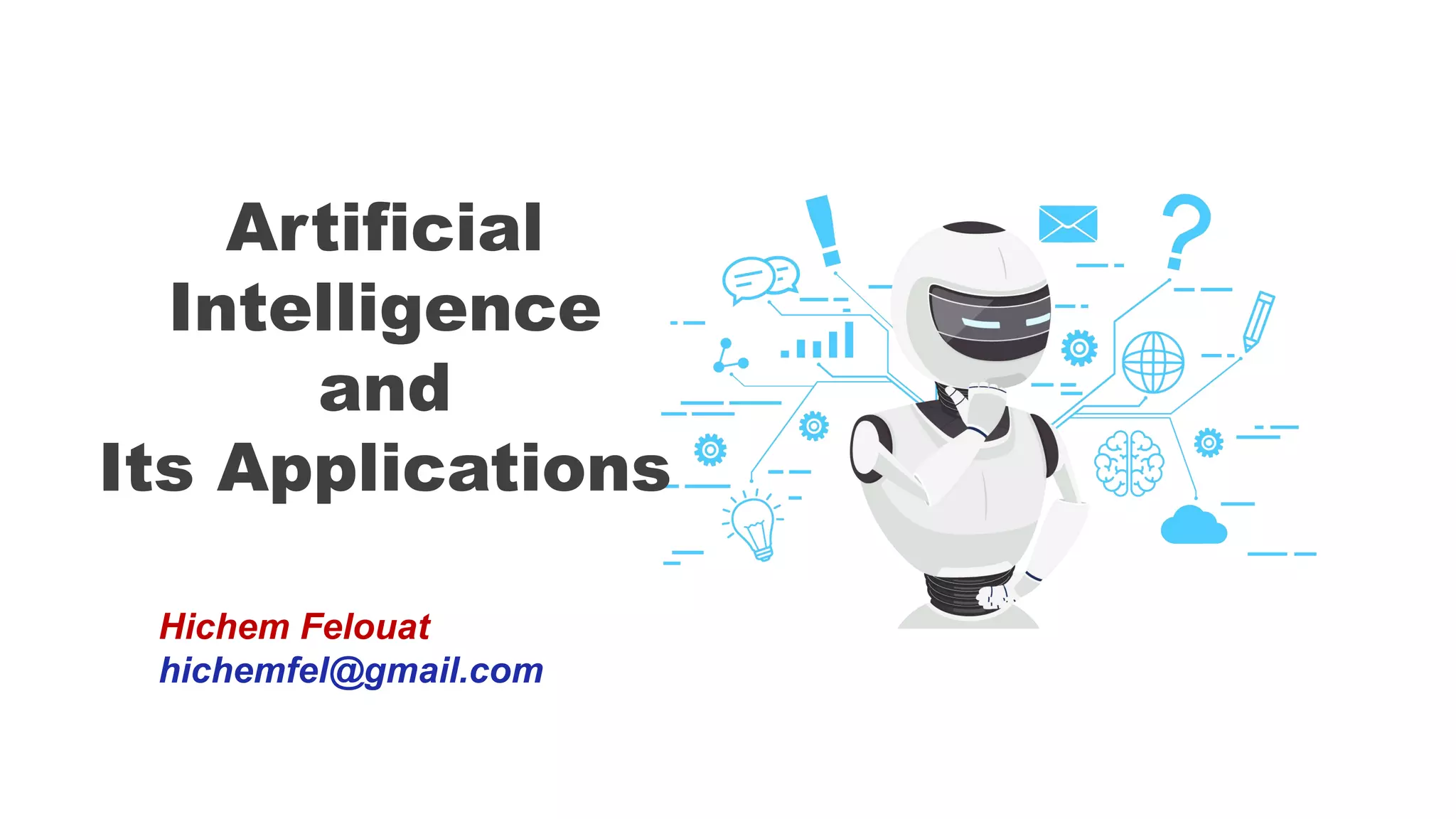
Artificial
Intelligence
and
Its Applications
Hichem Felouat
hichemfel@gmail.com
Hichem Felouat - hichemfel@gmail.com 2
What is Artificial Intelligence?
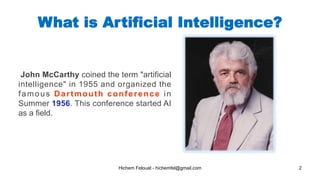
John McCarthy coined the term "artificial
intelligence" in 1955 and organized the
famous Dartmouth conference in
Summer 1956. This conference started AI
as a field.
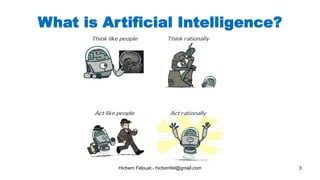
What is Artificial Intelligence?
3Hichem Felouat - hichemfel@gmail.com
4Hichem Felouat - hichemfel@gmail.com
What is Artificial Intelligence?
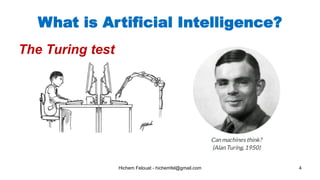
The Turing test
Hichem Felouat - hichemfel@gmail.com 5
What is Artificial Intelligence?
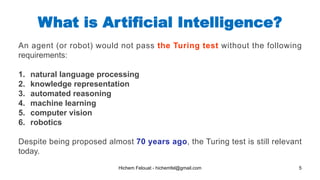
An agent (or robot) would not pass the Turing test without the following
requirements:
1. natural language processing
2. knowledge representation
3. automated reasoning
4. machine learning
5. computer vision
6. robotics
Despite being proposed almost 70 years ago, the Turing test is still relevant
today.
Hichem Felouat - hichemfel@gmail.com 6
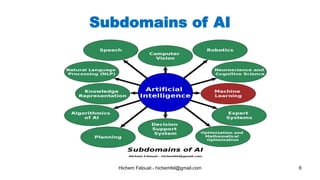
Subdomains of AI
Hichem Felouat - hichemfel@gmail.com 7
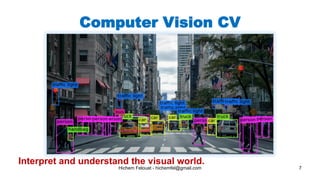
Computer Vision CV
Interpret and understand the visual world.
Hichem Felouat - hichemfel@gmail.com 8
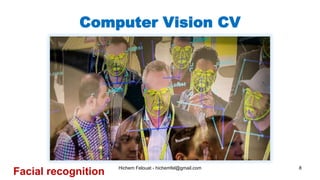
Computer Vision CV
Facial recognition
Hichem Felouat - hichemfel@gmail.com 9
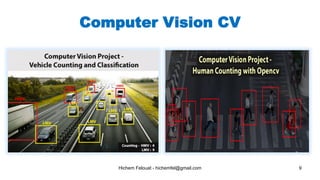
Computer Vision CV
Hichem Felouat - hichemfel@gmail.com 10
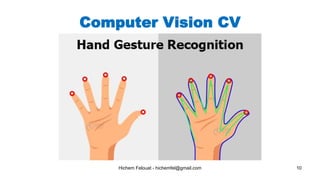
Computer Vision CV
Hichem Felouat - hichemfel@gmail.com 11
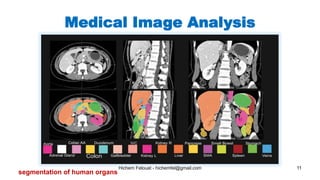
Medical Image Analysis
segmentation of human organs
Hichem Felouat - hichemfel@gmail.com 12
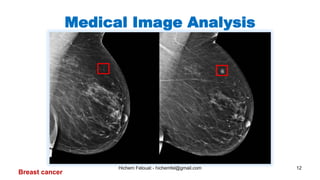
Medical Image Analysis
Breast cancer
Hichem Felouat - hichemfel@gmail.com 13
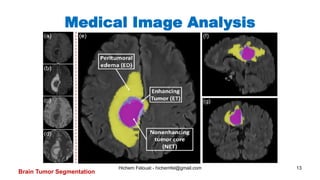
Brain Tumor Segmentation
Medical Image Analysis
Hichem Felouat - hichemfel@gmail.com 14
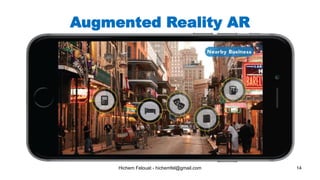
Augmented Reality AR
Hichem Felouat - hichemfel@gmail.com 15
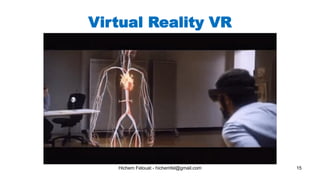
Virtual Reality VR
Hichem Felouat - hichemfel@gmail.com 16
Machine Learning and Deep Learning
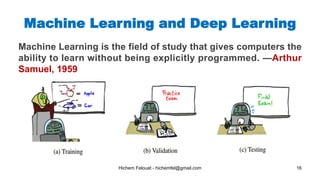
Machine Learning is the field of study that gives computers the
ability to learn without being explicitly programmed. —Arthur
Samuel, 1959
Hichem Felouat - hichemfel@gmail.com 17
Machine Learning and Deep Learning
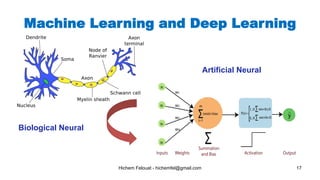
Biological Neural
Artificial Neural
Hichem Felouat - hichemfel@gmail.com 18
Machine Learning and Deep Learning
Hichem Felouat - hichemfel@gmail.com 19
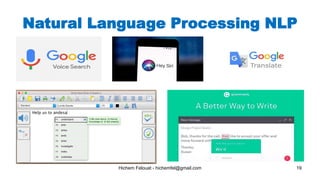
Natural Language Processing NLP
Hichem Felouat - hichemfel@gmail.com 20
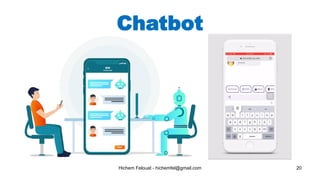
Chatbot
Hichem Felouat - hichemfel@gmail.com 21
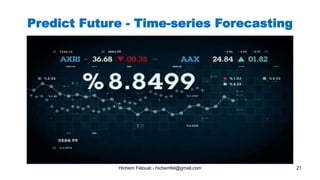
Predict Future - Time-series Forecasting
Hichem Felouat - hichemfel@gmail.com 22
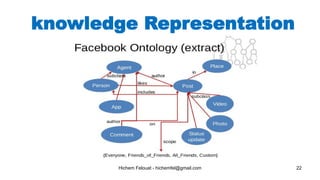
knowledge Representation
Hichem Felouat - hichemfel@gmail.com 23
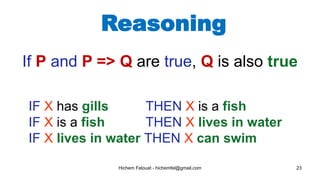
Reasoning
If P and P => Q are true, Q is also true
IF X has gills THEN X is a fish
IF X is a fish THEN X lives in water
IF X lives in water THEN X can swim
Hichem Felouat - hichemfel@gmail.com 24
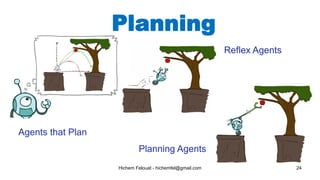
Planning
Agents that Plan
Reflex Agents
Planning Agents
Hichem Felouat - hichemfel@gmail.com 25
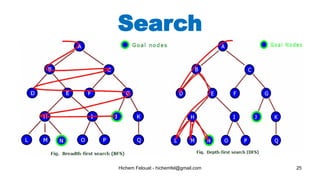
Search
Hichem Felouat - hichemfel@gmail.com 26
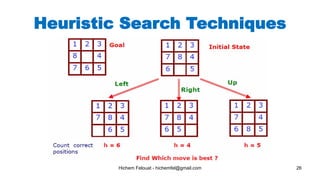
Heuristic Search Techniques
Hichem Felouat - hichemfel@gmail.com 27
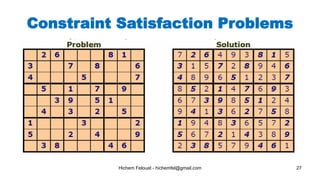
Constraint Satisfaction Problems
Hichem Felouat - hichemfel@gmail.com 28
Step 1: Create a variable set.
Step 2: Create a domain set.
Step 3: Create a constraint set with variables and domains
(if possible) after considering the constraints.
Step 4: Find an optimal solution.
Constraint Satisfaction Problems
Hichem Felouat - hichemfel@gmail.com 29
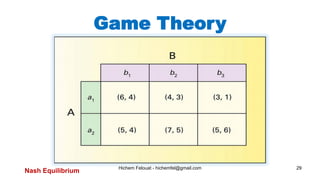
Game Theory
Nash Equilibrium
Hichem Felouat - hichemfel@gmail.com 30
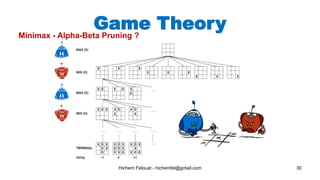
Game TheoryMinimax - Alpha-Beta Pruning ?
Hichem Felouat - hichemfel@gmail.com 31
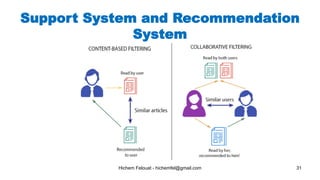
Support System and Recommendation
System
Hichem Felouat - hichemfel@gmail.com 32
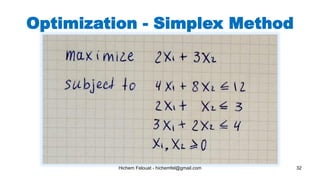
Optimization - Simplex Method
Hichem Felouat - hichemfel@gmail.com 33
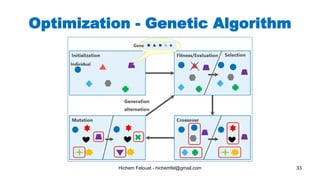
Optimization - Genetic Algorithm
Hichem Felouat - hichemfel@gmail.com 34
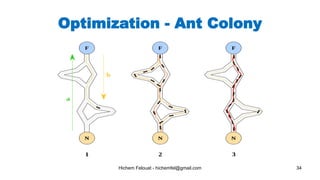
Optimization - Ant Colony
Hichem Felouat - hichemfel@gmail.com 35
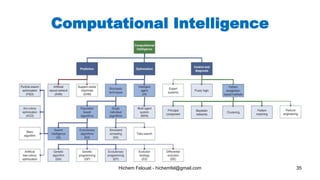
Computational Intelligence
Hichem Felouat - hichemfel@gmail.com 36
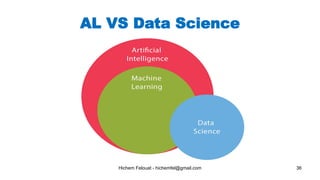
AL VS Data Science
Hichem Felouat - hichemfel@gmail.com 37
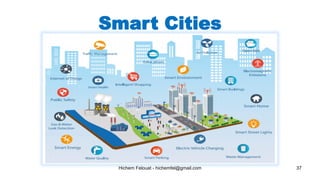
Smart Cities
Hichem Felouat - hichemfel@gmail.com 38
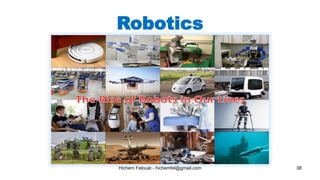
Robotics
Hichem Felouat - hichemfel@gmail.com 39
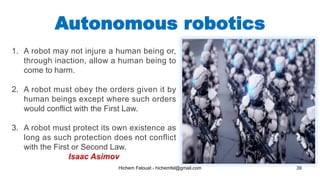
Autonomous robotics
1. A robot may not injure a human being or,
through inaction, allow a human being to
come to harm.
2. A robot must obey the orders given it by
human beings except where such orders
would conflict with the First Law.
3. A robot must protect its own existence as
long as such protection does not conflict
with the First or Second Law.
Isaac Asimov
Hichem Felouat - hichemfel@gmail.com 40
Thank you for your
attention

Artificial Intelligence and its Applications

  • 1.
  • 2.
    Hichem Felouat -hichemfel@gmail.com 2 What is Artificial Intelligence? John McCarthy coined the term "artificial intelligence" in 1955 and organized the famous Dartmouth conference in Summer 1956. This conference started AI as a field.
  • 3.
    What is ArtificialIntelligence? 3Hichem Felouat - hichemfel@gmail.com
  • 4.
    4Hichem Felouat -hichemfel@gmail.com What is Artificial Intelligence? The Turing test
  • 5.
    Hichem Felouat -hichemfel@gmail.com 5 What is Artificial Intelligence? An agent (or robot) would not pass the Turing test without the following requirements: 1. natural language processing 2. knowledge representation 3. automated reasoning 4. machine learning 5. computer vision 6. robotics Despite being proposed almost 70 years ago, the Turing test is still relevant today.
  • 6.
    Hichem Felouat -hichemfel@gmail.com 6 Subdomains of AI
  • 7.
    Hichem Felouat -hichemfel@gmail.com 7 Computer Vision CV Interpret and understand the visual world.
  • 8.
    Hichem Felouat -hichemfel@gmail.com 8 Computer Vision CV Facial recognition
  • 9.
    Hichem Felouat -hichemfel@gmail.com 9 Computer Vision CV
  • 10.
    Hichem Felouat -hichemfel@gmail.com 10 Computer Vision CV
  • 11.
    Hichem Felouat -hichemfel@gmail.com 11 Medical Image Analysis segmentation of human organs
  • 12.
    Hichem Felouat -hichemfel@gmail.com 12 Medical Image Analysis Breast cancer
  • 13.
    Hichem Felouat -hichemfel@gmail.com 13 Brain Tumor Segmentation Medical Image Analysis
  • 14.
    Hichem Felouat -hichemfel@gmail.com 14 Augmented Reality AR
  • 15.
    Hichem Felouat -hichemfel@gmail.com 15 Virtual Reality VR
  • 16.
    Hichem Felouat -hichemfel@gmail.com 16 Machine Learning and Deep Learning Machine Learning is the field of study that gives computers the ability to learn without being explicitly programmed. —Arthur Samuel, 1959
  • 17.
    Hichem Felouat -hichemfel@gmail.com 17 Machine Learning and Deep Learning Biological Neural Artificial Neural
  • 18.
    Hichem Felouat -hichemfel@gmail.com 18 Machine Learning and Deep Learning
  • 19.
    Hichem Felouat -hichemfel@gmail.com 19 Natural Language Processing NLP
  • 20.
    Hichem Felouat -hichemfel@gmail.com 20 Chatbot
  • 21.
    Hichem Felouat -hichemfel@gmail.com 21 Predict Future - Time-series Forecasting
  • 22.
    Hichem Felouat -hichemfel@gmail.com 22 knowledge Representation
  • 23.
    Hichem Felouat -hichemfel@gmail.com 23 Reasoning If P and P => Q are true, Q is also true IF X has gills THEN X is a fish IF X is a fish THEN X lives in water IF X lives in water THEN X can swim
  • 24.
    Hichem Felouat -hichemfel@gmail.com 24 Planning Agents that Plan Reflex Agents Planning Agents
  • 25.
    Hichem Felouat -hichemfel@gmail.com 25 Search
  • 26.
    Hichem Felouat -hichemfel@gmail.com 26 Heuristic Search Techniques
  • 27.
    Hichem Felouat -hichemfel@gmail.com 27 Constraint Satisfaction Problems
  • 28.
    Hichem Felouat -hichemfel@gmail.com 28 Step 1: Create a variable set. Step 2: Create a domain set. Step 3: Create a constraint set with variables and domains (if possible) after considering the constraints. Step 4: Find an optimal solution. Constraint Satisfaction Problems
  • 29.
    Hichem Felouat -hichemfel@gmail.com 29 Game Theory Nash Equilibrium
  • 30.
    Hichem Felouat -hichemfel@gmail.com 30 Game TheoryMinimax - Alpha-Beta Pruning ?
  • 31.
    Hichem Felouat -hichemfel@gmail.com 31 Support System and Recommendation System
  • 32.
    Hichem Felouat -hichemfel@gmail.com 32 Optimization - Simplex Method
  • 33.
    Hichem Felouat -hichemfel@gmail.com 33 Optimization - Genetic Algorithm
  • 34.
    Hichem Felouat -hichemfel@gmail.com 34 Optimization - Ant Colony
  • 35.
    Hichem Felouat -hichemfel@gmail.com 35 Computational Intelligence
  • 36.
    Hichem Felouat -hichemfel@gmail.com 36 AL VS Data Science
  • 37.
    Hichem Felouat -hichemfel@gmail.com 37 Smart Cities
  • 38.
    Hichem Felouat -hichemfel@gmail.com 38 Robotics
  • 39.
    Hichem Felouat -hichemfel@gmail.com 39 Autonomous robotics 1. A robot may not injure a human being or, through inaction, allow a human being to come to harm. 2. A robot must obey the orders given it by human beings except where such orders would conflict with the First Law. 3. A robot must protect its own existence as long as such protection does not conflict with the First or Second Law. Isaac Asimov
  • 40.
    Hichem Felouat -hichemfel@gmail.com 40 Thank you for your attention