ADVANCED ANALYTICS
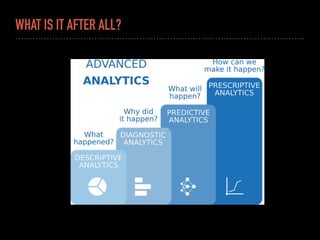
WHAT IS IT AFTER ALL?
CURRENT SCENARIO
➤ Data is driving new business models
➤ serious investment on data from tech giants
➤ Data will become important part of competitive
differentiation
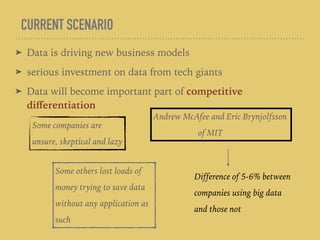
Difference of 5-6% between
companies using big data
and those not
Andrew McAfee and Eric Brynjolfsson
of MIT
Some companies are
unsure, skeptical and lazy
Some others lost loads of
money trying to save data
without any application as
such
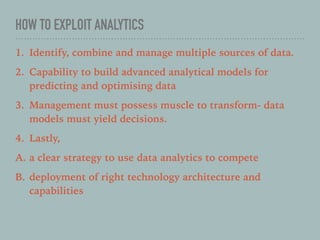
HOW TO EXPLOIT ANALYTICS
1. Identify, combine and manage multiple sources of data.
2. Capability to build advanced analytical models for
predicting and optimising data
3. Management must possess muscle to transform- data
models must yield decisions.
4. Lastly,
A. a clear strategy to use data analytics to compete
B. deployment of right technology architecture and
capabilities
ALSO….!
➤ Desired impact must drive integrated approach to:
1. data sourcing
2. data building
3. organisational transformation
➤ Sufficient time and energy must be invested
➤ Align managers for support of mission
CHOOSING THE RIGHT DATA
➤ Volume of information growing rapidly
➤ More powerful, less costly softwares - high accessibility
➤ Bigger and better data - granular, panoramic views
➤ Source and process data creatively
➤ More comprehensive look of information required
➤ One question to ask:
What would we do if we have all the decision we needed?
GET NECESSARY IT SUPPORT
➤ Legacy IT structures may hinder new types of data
sourcing
➤ Most of them were built to deliver flow in batches and
hence cant give data continuously
➤ Prioritise short term requirements
➤ Identify data —> clean up operation —>merge
overlapping data —> work around missing information
➤ Scaling computer power to meet demands cost-
effectively
BUILD MODELS TO PREDICT AND OPTIMISE BUSINESS
➤ Most effective approach does not start with data
➤ It starts with identifying the problem
➤ Simple data mining - inconsistent results - dozens of tests - 0
benefit
➤ Hypothesis led modelling leads to faster outcomes.
➤ All data models have inherent risk.
➤ Simple question to ask :
Whats the least complex model which will improve performance?
TRANSFORM COMPANIES CAPABILITIES
➤ Generally, people at top decision making positions:
Don’t believe in the model
Don’t know how it works
➤ Mismatch between existing culture and emerging tactics.
➤ Tools seem to be designed for experts rather than for people
on front line.
➤ Using big data needs thoughtful organisational change
and 3 areas of action can get us there
WAY FORWARD
➤ Conversations between model designers and managers
➤ Pricing analytics and resulting scenario tools need to
complement existing processes.
➤ Transparent methods for daily usage.
➤ separate statistics experts, technology experts from decision
taking managers.
➤ Simple tools to deliver complex analytical solutions.
MANAGERIAL RELEVANCE
➤ Upgrade analytical skills and literacy.
➤ Analytics central to solving problems and identifying
opportunities.
➤ Field and forum approach - learn by doing
➤ multi-faceted approach including training, incentives, role
modelling.
➤ promotion analytics
➤ targeted efforts yielding constant opportunities
CREDITS
➤ Google images
➤ wikipedia
➤ Making advanced analytics work by Dominic Barton and
D.Court
➤Thank you

Advanced analytics

  • 1.
  • 2.
    WHAT IS ITAFTER ALL?
  • 3.
    CURRENT SCENARIO ➤ Datais driving new business models ➤ serious investment on data from tech giants ➤ Data will become important part of competitive differentiation Difference of 5-6% between companies using big data and those not Andrew McAfee and Eric Brynjolfsson of MIT Some companies are unsure, skeptical and lazy Some others lost loads of money trying to save data without any application as such
  • 4.
    HOW TO EXPLOITANALYTICS 1. Identify, combine and manage multiple sources of data. 2. Capability to build advanced analytical models for predicting and optimising data 3. Management must possess muscle to transform- data models must yield decisions. 4. Lastly, A. a clear strategy to use data analytics to compete B. deployment of right technology architecture and capabilities
  • 5.
    ALSO….! ➤ Desired impactmust drive integrated approach to: 1. data sourcing 2. data building 3. organisational transformation ➤ Sufficient time and energy must be invested ➤ Align managers for support of mission
  • 6.
    CHOOSING THE RIGHTDATA ➤ Volume of information growing rapidly ➤ More powerful, less costly softwares - high accessibility ➤ Bigger and better data - granular, panoramic views ➤ Source and process data creatively ➤ More comprehensive look of information required ➤ One question to ask: What would we do if we have all the decision we needed?
  • 7.
    GET NECESSARY ITSUPPORT ➤ Legacy IT structures may hinder new types of data sourcing ➤ Most of them were built to deliver flow in batches and hence cant give data continuously ➤ Prioritise short term requirements ➤ Identify data —> clean up operation —>merge overlapping data —> work around missing information ➤ Scaling computer power to meet demands cost- effectively
  • 8.
    BUILD MODELS TOPREDICT AND OPTIMISE BUSINESS ➤ Most effective approach does not start with data ➤ It starts with identifying the problem ➤ Simple data mining - inconsistent results - dozens of tests - 0 benefit ➤ Hypothesis led modelling leads to faster outcomes. ➤ All data models have inherent risk. ➤ Simple question to ask : Whats the least complex model which will improve performance?
  • 9.
    TRANSFORM COMPANIES CAPABILITIES ➤Generally, people at top decision making positions: Don’t believe in the model Don’t know how it works ➤ Mismatch between existing culture and emerging tactics. ➤ Tools seem to be designed for experts rather than for people on front line. ➤ Using big data needs thoughtful organisational change and 3 areas of action can get us there
  • 10.
    WAY FORWARD ➤ Conversationsbetween model designers and managers ➤ Pricing analytics and resulting scenario tools need to complement existing processes. ➤ Transparent methods for daily usage. ➤ separate statistics experts, technology experts from decision taking managers. ➤ Simple tools to deliver complex analytical solutions.
  • 11.
    MANAGERIAL RELEVANCE ➤ Upgradeanalytical skills and literacy. ➤ Analytics central to solving problems and identifying opportunities. ➤ Field and forum approach - learn by doing ➤ multi-faceted approach including training, incentives, role modelling. ➤ promotion analytics ➤ targeted efforts yielding constant opportunities
  • 12.
    CREDITS ➤ Google images ➤wikipedia ➤ Making advanced analytics work by Dominic Barton and D.Court ➤Thank you