5 Essential Practices of the
Data Driven Organization
Andrew Edwards
Essential behaviors for both
content and technology
teams focused on digital ROI.
Debunking terminology
Common roadblocks and how
to overcome them using
expertise and technology.
Insights into multi-channel
and “Convergence Analytics”
Overview: We Will Cover . . .
Analytics Today: a Tough Fight
• Few organizations can manage effectively
• Lack of overall standards and benchmarks
• Quantity of data is ahead of data analysis
• Terminology getting in the way
• Frequent uncertainty that data is accurate
• Flawed data collection
• Explosion of mobile and how to measure?
• Difficult to keep tools/tagging/expertise
current
• Difficulty in driving accountability to
content teams
• Where are the experts?
Multi-Channel Adds to Complexity
• Now we can measure. . .
• Desktop
• Mobile
• Tablet
• Smartphone
• Ios
• Android
• Other (?)
• CRM
• “Big Data”
• . . .and many other channels
• Convergence Analytics is here—but who’s doing it right?
Muted Impact of Analytics
• Analytics often isolated from decision-makers
• Reports go to report recipients—but what do they do with the
data?
• Analysts generate insights
• . . .but executives may or may not be interested
• Tendency to focus on global trending data
• rather than engagement and conversion metrics
• Internal political impact of success/failure of content (as measured)
• Can we drive responsibility to content creators?
• Multi-channel requirements adds to confusion
• Buzzword terminology clouds the picture
The Terminology Challenge
• Buzzwords favored by vendors and consultants—but why?
• As a class, they are relatively imprecise and less important than
many would like you to think.
• Real Time:
• No agreement on what this is
• Really means “right time”
Big Data:
• Lots of data of course
• Do you even have any??
• Predictive:
• Really means “data modeling”
• And “forecasting” – except where it’s automated
The Data Driven Organization
<link rel='stylesheet' id='hubspot-css'
href='http://www.technologyleaders.com/wp-
content/plugins/hubspot/css/hubspot.css?ver=3.3.2'
type='text/css' media='all' />
<link rel='stylesheet' id='page-list-style-css'
href='http://www.technologyleaders.com/wp-
content/plugins/sitemap/css/page-list.css?ver=3.7'
type='text/css' media='all' />
<script type='text/javascript'
src='http://www.technologyleaders.com/wp-
includes/js/jquery/jquery.js?ver=1.7.1'></script>
<script type='text/javascript'
src='http://maps.google.com/maps/api/js?sensor=false&#038;
ver=3.3.2'></script>
<link rel="EditURI" type="application/rsd+xml" title="RSD"
href="http://www.technologyleaders.com/xmlrpc.php?rsd" />
<link rel="wlwmanifest" type="application/wlwmanifest+xml"
href="http://www.technologyleaders.com/wp-
includes/wlwmanifest.xml" />
Standardization,
Governance,
Accuracy
and a
Repeatable Process.
The Data-Driven Organization is:
• Organized around the intelligence gained from the data it
collects about its customer interactions.
• Good about managing expectations
• Willing to admit its requirements are not unique
• Ready to standardize its measurements across digital
properties (Governance)
• Ready to get expertise as needed
• Open-minded about tools and technologies
• Eager to improve based on findings
• Multi-channel aware
Five Essential Practices (1)
• The Data Driven Organization
defines what it wants to measure
• (knows its KPIs for different channels)
Five Essential Practices (2)
• The Data Driven Organization
deploys analytics tools expertly
and consistently across all
markets
• (enforces governance and
standardization)
• masters data collection
Five Essential Practices (3)
• The Data Driven Organization
analyzes results and makes
recommendations
• (crosses the divide from observation
into action)
Five Essential Practices (4)
• The Data Driven Organization
creates changes based on data
• (drives responsibility down to
content owners)
Five Essential Practices (5)
• The Data Driven Organization
measures again. . .and again (to
see what worked)
• Recognizes that success means
continual testing and optimization
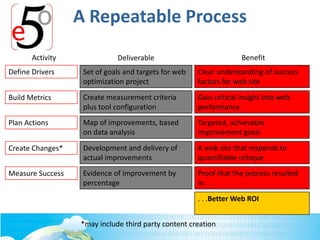
A Repeatable Process
• eBusiness 5 Step Optimization
• The method by which the Data Driven
Organization can get organized
A Repeatable Process
• e5o provides a framework for total web and digital
ROI. Properly deployed, it is a complete, repeatable
feedback loop targeted at success. It involves
business, technical, analysis and creative
components that form the basis for a data-driven
marketing organization
A Repeatable Process
Define Drivers Set of goals and targets for web
optimization project
Clear understanding of success
factors for web site
Activity Deliverable Benefit
Build Metrics Create measurement criteria
plus tool configuration
Gain critical insight into web
performance
Plan Actions Map of improvements, based
on data analysis
Targeted, achievable
improvement goals
Create Changes* Development and delivery of
actual improvements
A web site that responds to
quantifiable critique
Measure Success Evidence of improvement by
percentage
Proof that the process resulted
in. . .
. . .Better Web ROI
*may include third party content creation
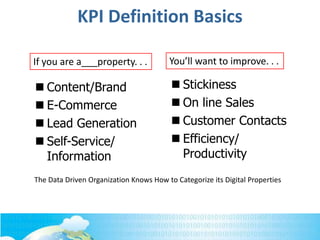
KPI Definition Basics
You’ll want to improve. . .
 Stickiness
 On line Sales
 Customer Contacts
 Efficiency/
Productivity
 Content/Brand
 E-Commerce
 Lead Generation
 Self-Service/
Information
If you are a___property. . .
The Data Driven Organization Knows How to Categorize its Digital Properties
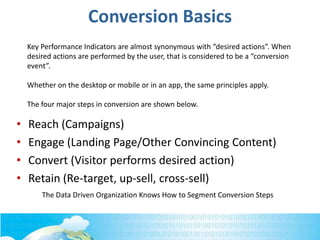
Conversion Basics
• Reach (Campaigns)
• Engage (Landing Page/Other Convincing Content)
• Convert (Visitor performs desired action)
• Retain (Re-target, up-sell, cross-sell)
Key Performance Indicators are almost synonymous with “desired actions”. When
desired actions are performed by the user, that is considered to be a “conversion
event”.
Whether on the desktop or mobile or in an app, the same principles apply.
The four major steps in conversion are shown below.
The Data Driven Organization Knows How to Segment Conversion Steps
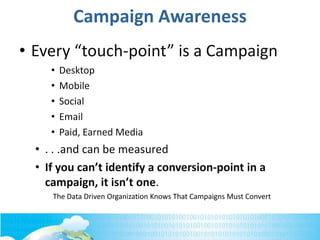
Campaign Awareness
• Every “touch-point” is a Campaign
• Desktop
• Mobile
• Social
• Email
• Paid, Earned Media
• . . .and can be measured
• If you can’t identify a conversion-point in a
campaign, it isn’t one.
The Data Driven Organization Knows That Campaigns Must Convert
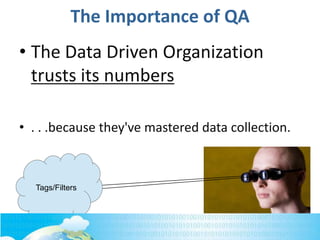
The Importance of QA
• The Data Driven Organization
trusts its numbers
• . . .because they've mastered data collection.
Tags/Filters
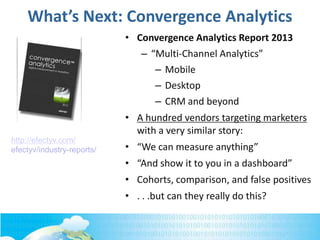
What’s Next: Convergence Analytics
• Convergence Analytics Report 2013
– “Multi-Channel Analytics”
– Mobile
– Desktop
– CRM and beyond
• A hundred vendors targeting marketers
with a very similar story:
• “We can measure anything”
• “And show it to you in a dashboard”
• Cohorts, comparison, and false positives
• . . .but can they really do this?
http://efectyv.com/
efectyv/industry-reports/
Convergence Analytics: How it works
• Convergence Analytics Application Operations
• “Multi-Channel plus Visualization”
–Data extraction
–Data preparation
–Data load
–Data presentation
• From numerous data sources
The Goal of Convergence Analytics
• A single view of marketing touchpoints
• Focused on understanding true ROI
• But. . .
• Can any one tool promise and deliver?
• Or are we still in need of vertical
solutions?
Look in the Mirror
• Do you recognize your
organization?
• Can you:
• Define your conversions
• Measure accurately
• Change
content/architecture based
on metrics
• Are you ready for multi-
channel?
Data Driven
What Success Looks Like
• Data Driven Organizations will thrive in a
digitized marketplace because they know that:
• “Creativity without Conversion
equals Zero” *
*Rand Schulman
Thank You
• Andrew Edwards
• Managing Partner, Efectyv Digital
• aedwards@efectyv.com
• @andrewVedwards

5 Essential Practices of the Data Driven Organization

  • 1.
    5 Essential Practicesof the Data Driven Organization Andrew Edwards
  • 2.
    Essential behaviors forboth content and technology teams focused on digital ROI. Debunking terminology Common roadblocks and how to overcome them using expertise and technology. Insights into multi-channel and “Convergence Analytics” Overview: We Will Cover . . .
  • 3.
    Analytics Today: aTough Fight • Few organizations can manage effectively • Lack of overall standards and benchmarks • Quantity of data is ahead of data analysis • Terminology getting in the way • Frequent uncertainty that data is accurate • Flawed data collection • Explosion of mobile and how to measure? • Difficult to keep tools/tagging/expertise current • Difficulty in driving accountability to content teams • Where are the experts?
  • 4.
    Multi-Channel Adds toComplexity • Now we can measure. . . • Desktop • Mobile • Tablet • Smartphone • Ios • Android • Other (?) • CRM • “Big Data” • . . .and many other channels • Convergence Analytics is here—but who’s doing it right?
  • 5.
    Muted Impact ofAnalytics • Analytics often isolated from decision-makers • Reports go to report recipients—but what do they do with the data? • Analysts generate insights • . . .but executives may or may not be interested • Tendency to focus on global trending data • rather than engagement and conversion metrics • Internal political impact of success/failure of content (as measured) • Can we drive responsibility to content creators? • Multi-channel requirements adds to confusion • Buzzword terminology clouds the picture
  • 6.
    The Terminology Challenge •Buzzwords favored by vendors and consultants—but why? • As a class, they are relatively imprecise and less important than many would like you to think. • Real Time: • No agreement on what this is • Really means “right time” Big Data: • Lots of data of course • Do you even have any?? • Predictive: • Really means “data modeling” • And “forecasting” – except where it’s automated
  • 7.
    The Data DrivenOrganization <link rel='stylesheet' id='hubspot-css' href='http://www.technologyleaders.com/wp- content/plugins/hubspot/css/hubspot.css?ver=3.3.2' type='text/css' media='all' /> <link rel='stylesheet' id='page-list-style-css' href='http://www.technologyleaders.com/wp- content/plugins/sitemap/css/page-list.css?ver=3.7' type='text/css' media='all' /> <script type='text/javascript' src='http://www.technologyleaders.com/wp- includes/js/jquery/jquery.js?ver=1.7.1'></script> <script type='text/javascript' src='http://maps.google.com/maps/api/js?sensor=false&#038; ver=3.3.2'></script> <link rel="EditURI" type="application/rsd+xml" title="RSD" href="http://www.technologyleaders.com/xmlrpc.php?rsd" /> <link rel="wlwmanifest" type="application/wlwmanifest+xml" href="http://www.technologyleaders.com/wp- includes/wlwmanifest.xml" /> Standardization, Governance, Accuracy and a Repeatable Process.
  • 8.
    The Data-Driven Organizationis: • Organized around the intelligence gained from the data it collects about its customer interactions. • Good about managing expectations • Willing to admit its requirements are not unique • Ready to standardize its measurements across digital properties (Governance) • Ready to get expertise as needed • Open-minded about tools and technologies • Eager to improve based on findings • Multi-channel aware
  • 9.
    Five Essential Practices(1) • The Data Driven Organization defines what it wants to measure • (knows its KPIs for different channels)
  • 10.
    Five Essential Practices(2) • The Data Driven Organization deploys analytics tools expertly and consistently across all markets • (enforces governance and standardization) • masters data collection
  • 11.
    Five Essential Practices(3) • The Data Driven Organization analyzes results and makes recommendations • (crosses the divide from observation into action)
  • 12.
    Five Essential Practices(4) • The Data Driven Organization creates changes based on data • (drives responsibility down to content owners)
  • 13.
    Five Essential Practices(5) • The Data Driven Organization measures again. . .and again (to see what worked) • Recognizes that success means continual testing and optimization
  • 14.
    A Repeatable Process •eBusiness 5 Step Optimization • The method by which the Data Driven Organization can get organized
  • 15.
    A Repeatable Process •e5o provides a framework for total web and digital ROI. Properly deployed, it is a complete, repeatable feedback loop targeted at success. It involves business, technical, analysis and creative components that form the basis for a data-driven marketing organization
  • 16.
    A Repeatable Process DefineDrivers Set of goals and targets for web optimization project Clear understanding of success factors for web site Activity Deliverable Benefit Build Metrics Create measurement criteria plus tool configuration Gain critical insight into web performance Plan Actions Map of improvements, based on data analysis Targeted, achievable improvement goals Create Changes* Development and delivery of actual improvements A web site that responds to quantifiable critique Measure Success Evidence of improvement by percentage Proof that the process resulted in. . . . . .Better Web ROI *may include third party content creation
  • 17.
    KPI Definition Basics You’llwant to improve. . .  Stickiness  On line Sales  Customer Contacts  Efficiency/ Productivity  Content/Brand  E-Commerce  Lead Generation  Self-Service/ Information If you are a___property. . . The Data Driven Organization Knows How to Categorize its Digital Properties
  • 18.
    Conversion Basics • Reach(Campaigns) • Engage (Landing Page/Other Convincing Content) • Convert (Visitor performs desired action) • Retain (Re-target, up-sell, cross-sell) Key Performance Indicators are almost synonymous with “desired actions”. When desired actions are performed by the user, that is considered to be a “conversion event”. Whether on the desktop or mobile or in an app, the same principles apply. The four major steps in conversion are shown below. The Data Driven Organization Knows How to Segment Conversion Steps
  • 19.
    Campaign Awareness • Every“touch-point” is a Campaign • Desktop • Mobile • Social • Email • Paid, Earned Media • . . .and can be measured • If you can’t identify a conversion-point in a campaign, it isn’t one. The Data Driven Organization Knows That Campaigns Must Convert
  • 20.
    The Importance ofQA • The Data Driven Organization trusts its numbers • . . .because they've mastered data collection. Tags/Filters
  • 21.
    What’s Next: ConvergenceAnalytics • Convergence Analytics Report 2013 – “Multi-Channel Analytics” – Mobile – Desktop – CRM and beyond • A hundred vendors targeting marketers with a very similar story: • “We can measure anything” • “And show it to you in a dashboard” • Cohorts, comparison, and false positives • . . .but can they really do this? http://efectyv.com/ efectyv/industry-reports/
  • 22.
    Convergence Analytics: Howit works • Convergence Analytics Application Operations • “Multi-Channel plus Visualization” –Data extraction –Data preparation –Data load –Data presentation • From numerous data sources
  • 23.
    The Goal ofConvergence Analytics • A single view of marketing touchpoints • Focused on understanding true ROI • But. . . • Can any one tool promise and deliver? • Or are we still in need of vertical solutions?
  • 24.
    Look in theMirror • Do you recognize your organization? • Can you: • Define your conversions • Measure accurately • Change content/architecture based on metrics • Are you ready for multi- channel? Data Driven
  • 25.
    What Success LooksLike • Data Driven Organizations will thrive in a digitized marketplace because they know that: • “Creativity without Conversion equals Zero” * *Rand Schulman
  • 26.
    Thank You • AndrewEdwards • Managing Partner, Efectyv Digital • aedwards@efectyv.com • @andrewVedwards