StudyMafia.Org
Submitted To: Submitted By:
Studymafia.org Studymafia.org
Art Integrated
Learning(AIL)
Table Contents
• Definition
• Introduction
• Objectives of AIL
• Strategies of AIL
• Principles of AIL
• Conclusion
2
Definition
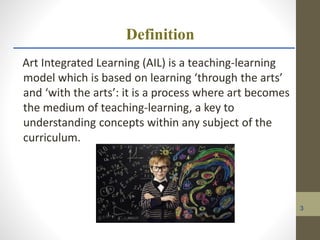
Art Integrated Learning (AIL) is a teaching-learning
model which is based on learning ‘through the arts’
and ‘with the arts’: it is a process where art becomes
the medium of teaching-learning, a key to
understanding concepts within any subject of the
curriculum.
3
Introduction
• Learners explore creatively while building
connections between different concepts through
various art forms.
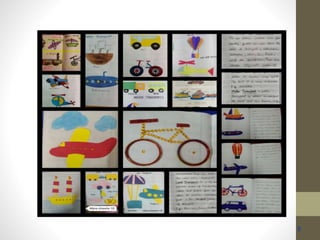
• Art experiences, both in visual (drawing and
painting, clay modelling, pottery, paper crafts,
mask and puppet making, heritage crafts etc.) and
performing arts (music, dance, theatre, puppetry
etc.) lead to a better understanding and
construction of knowledge about different
concepts. 4
5
Objectives of AIL
• Make learning joyful and engaging
• Encourage children to be aware of their
environment through keen observation and
unhindered exploration
• Promote sensitivity towards their environment
• Allow free emotional expression,
communication and creative involvement
• Facilitate children to express freely and
spontaneously
●●●
6
Objectives of AIL
• Experience joy and eagerness to learn
• Learn to live in an inclusive environment
• Discover concepts of Mathematics and Science
in the world around them
• Be aware of interdisciplinary connections
• Enhance observation, curiosity, exploration
and creative and free expression
●●●
7
Objectives of AIL
• Explore and understand body movement and
coordination
• Develop expressive communication and
critical thinking skills
• Foster an inquisitive attitude towards learning
and knowledge
• Understand and regulate their emotions
• Create awareness of rich heritage and cultural
diversity
8
Strategies of AIL
1. Capacity Building
Introducing art as a resource will require re-
orienting the school system in the use of it as
pedagogical tool. All stakeholders of school
education, including the school management
need to be oriented to understand the
importance and the relevance of this
pedagogy.
●●●
9
Strategies of AIL
2. Planning of Activities
Once the teacher begins to utilise AIL
methodology, she would need to work on the
dynamics of planning. AIL would require
linking art experience to the subject matter
seamlessly and to identify methods and
techniques to engage children in group
activities.
●●●
10
Strategies of AIL
3. Planning of time
Time management at every stage is an
important aspect of teachers’ professional
competence and productivity. Teachers can
sometimes find it challenging to take out time
for organizing art experiences, due to paucity
of time. This can compromise the creation of a
joyful and experiential learning environment.
●●●
11
Strategies of AIL
4. Resource Planning
Proper planning of resources adds a novelty to
the art integrated experience. Regular research
and extensive groundwork by the teacher
helps them to create a rich repository of
resources which include regional/local
resources.
12
Principles of AIL
Perception
Perception requires the individual to be a
careful observer and an active listener, taking
in the subtleties of their surroundings, be it in
the classroom or out in nature.
●●●
13
Principles of AIL
Practice
One does not become a star overnight. In
order to be successful at any endeavor in life,
you must practice. Practice helps us to hone
our skills, become more proficient, more
adept, and better prepared
●●●
14
Principles of AIL
Perseverance
Perseverance is good old fashion stick-to-it-
ness. That means not giving up when things
get difficult or push you beyond your comfort
zone. Trust me in that most artists and creative
individuals make many mistakes along the way
before producing something of true beauty
and innovation.
●●●
15
Principles of AIL
Patience
Patience and perseverance go hand in hand.
Sometimes we feel as though we just have
nothing to say so therefore we have no reason
to create. When you are stuck in a creative
slump the best advice is just to have patience
with yourself.
●●●
16
Principles of AIL
Passion
In the end it all boils down to this, passion. In
whatever you choose to do in life, however
your creative spirit manifests, do it from a
place of passion. Be excited about your work.
17
Conclusion
 Assessment through art integrated learning
helps the facilitator to move away from the
traditional paper-pencil or oral and recall
method towards a continuous and
comprehensive assessment method which can
help assess both the learning of the subject as
well as the socio-emotional development of
the student.
19
References
• Google.com
• Wikipedia.org
• Studymafia.org
• Slidespanda.com
Thanks
To
StudyMafia.org

Art intigrated learning power point presentation

  • 1.
    StudyMafia.Org Submitted To: SubmittedBy: Studymafia.org Studymafia.org Art Integrated Learning(AIL)
  • 2.
    Table Contents • Definition •Introduction • Objectives of AIL • Strategies of AIL • Principles of AIL • Conclusion 2
  • 3.
    Definition Art Integrated Learning(AIL) is a teaching-learning model which is based on learning ‘through the arts’ and ‘with the arts’: it is a process where art becomes the medium of teaching-learning, a key to understanding concepts within any subject of the curriculum. 3
  • 4.
    Introduction • Learners explorecreatively while building connections between different concepts through various art forms. • Art experiences, both in visual (drawing and painting, clay modelling, pottery, paper crafts, mask and puppet making, heritage crafts etc.) and performing arts (music, dance, theatre, puppetry etc.) lead to a better understanding and construction of knowledge about different concepts. 4
  • 5.
  • 6.
    Objectives of AIL •Make learning joyful and engaging • Encourage children to be aware of their environment through keen observation and unhindered exploration • Promote sensitivity towards their environment • Allow free emotional expression, communication and creative involvement • Facilitate children to express freely and spontaneously ●●● 6
  • 7.
    Objectives of AIL •Experience joy and eagerness to learn • Learn to live in an inclusive environment • Discover concepts of Mathematics and Science in the world around them • Be aware of interdisciplinary connections • Enhance observation, curiosity, exploration and creative and free expression ●●● 7
  • 8.
    Objectives of AIL •Explore and understand body movement and coordination • Develop expressive communication and critical thinking skills • Foster an inquisitive attitude towards learning and knowledge • Understand and regulate their emotions • Create awareness of rich heritage and cultural diversity 8
  • 9.
    Strategies of AIL 1.Capacity Building Introducing art as a resource will require re- orienting the school system in the use of it as pedagogical tool. All stakeholders of school education, including the school management need to be oriented to understand the importance and the relevance of this pedagogy. ●●● 9
  • 10.
    Strategies of AIL 2.Planning of Activities Once the teacher begins to utilise AIL methodology, she would need to work on the dynamics of planning. AIL would require linking art experience to the subject matter seamlessly and to identify methods and techniques to engage children in group activities. ●●● 10
  • 11.
    Strategies of AIL 3.Planning of time Time management at every stage is an important aspect of teachers’ professional competence and productivity. Teachers can sometimes find it challenging to take out time for organizing art experiences, due to paucity of time. This can compromise the creation of a joyful and experiential learning environment. ●●● 11
  • 12.
    Strategies of AIL 4.Resource Planning Proper planning of resources adds a novelty to the art integrated experience. Regular research and extensive groundwork by the teacher helps them to create a rich repository of resources which include regional/local resources. 12
  • 13.
    Principles of AIL Perception Perceptionrequires the individual to be a careful observer and an active listener, taking in the subtleties of their surroundings, be it in the classroom or out in nature. ●●● 13
  • 14.
    Principles of AIL Practice Onedoes not become a star overnight. In order to be successful at any endeavor in life, you must practice. Practice helps us to hone our skills, become more proficient, more adept, and better prepared ●●● 14
  • 15.
    Principles of AIL Perseverance Perseveranceis good old fashion stick-to-it- ness. That means not giving up when things get difficult or push you beyond your comfort zone. Trust me in that most artists and creative individuals make many mistakes along the way before producing something of true beauty and innovation. ●●● 15
  • 16.
    Principles of AIL Patience Patienceand perseverance go hand in hand. Sometimes we feel as though we just have nothing to say so therefore we have no reason to create. When you are stuck in a creative slump the best advice is just to have patience with yourself. ●●● 16
  • 17.
    Principles of AIL Passion Inthe end it all boils down to this, passion. In whatever you choose to do in life, however your creative spirit manifests, do it from a place of passion. Be excited about your work. 17
  • 19.
    Conclusion  Assessment throughart integrated learning helps the facilitator to move away from the traditional paper-pencil or oral and recall method towards a continuous and comprehensive assessment method which can help assess both the learning of the subject as well as the socio-emotional development of the student. 19
  • 20.
    References • Google.com • Wikipedia.org •Studymafia.org • Slidespanda.com
  • 21.