My Coral Reef Fish Research Information


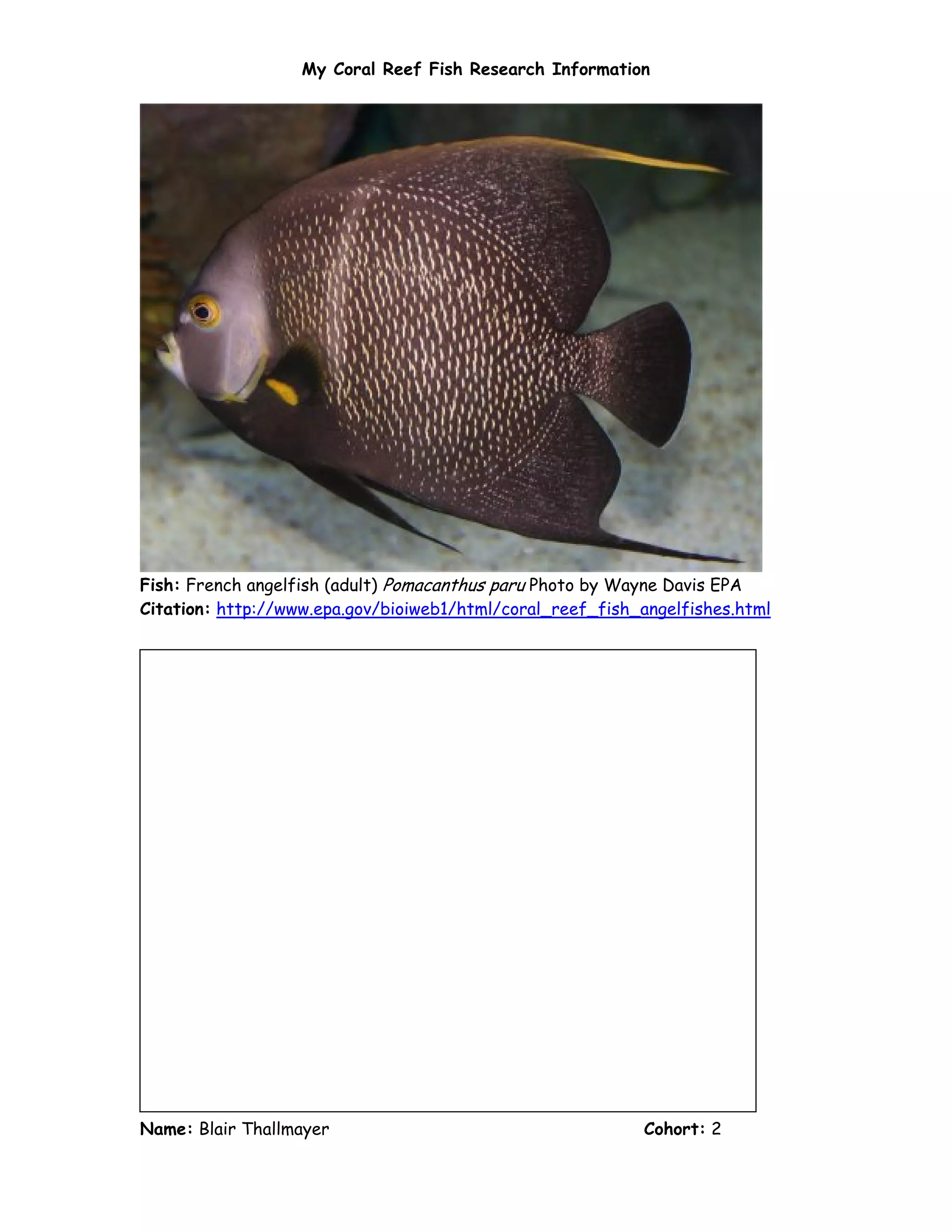
Fish: French angelfish (adult) Pomacanthus paru Photo by Wayne Davis EPA
Citation: http://www.epa.gov/bioiweb1/html/coral_reef_fish_angelfishes.html


Name: Blair Thallmayer                                     Cohort: 2
1.  Common name: French angelfish,
2.  Scientific name of fish: Pomacanthus paru
3.  Size (Length): 41.1 cm
4.  Size (Width):
5.  Basic shape of fish (Rough sketch, then describe):
6.  Basic shape of caudal (tail) fine (rough sketch, then describe)
7.  Basic shape of dorsal fin (Rough sketch, then describe):
8.  Description of skin, scales: Black, the scales of the body, except those at
    front from nape to abdomen, rimmed with golden yellow; a broad orange-
    yellow bar at pectoral base; dorsal filament yellow; chin whitish; outer part
    of iris yellow; eye narrowly rimmed below with blue.
9. Description of coloration: Coloration
    The scales on the body are black and rimmed with a bright golden yellow.
    There is a broad orange-yellow bar at the base of the pectoral fins and a
    yellow filament in the dorsal. The chin appears whitish. Eyes are narrowly
    edged in blue with a yellow outer portion of the iris. All fins are black.
    Juveniles differ greatly from the adult coloration. The juveniles are
    distinguished from the adults with a dark brown to black body with three
    thick vertical yellow bands that continue onto the fins. As the juvenile
    matures, the scales resemble those of the adult - black with yellow edges -
    throughout the body except those near the front of the fish which remain
    black. It also loses the vertical yellow bands except for the yellow-orange
    bar at the outer base of the pectoral fin. The dorsal filament turns yellow.
10. Describe how your fish moves: can swim backwards They can be aggressive
    with others and will quickly become the dominant fish in the tank. often in
    pairs; unafraid; often clean parasites from larger fish
11. What does your fish eat? sponges, algae, bryozoans, zoantharians,
    gorgonians and tunicates.
    What eats your fish? Large fishes are potential predators of the French
    angelfish.
12.         Citations:
Pomacanthus paru, French Angelfish - MarineBio.org. Retrieved Tuesday,
October 2, 2007, from http://marinebio.org/species.asp?id=81.
http://www.flmnh.ufl.edu/fish/Gallery/Descript/FrenchAngelfish/FrenchAngelf
ish.html
Blair Thallmayer                       Art Exploration 2                November 6, 2007


      Math has been referred to as the language of nature. We measure, collect, watch

for patterns, and observe. If the patterns change, we know that nature is trying to tell

us something. It can be a good message or not so good message that maybe we can fix.

The key to the message reading is to keep good records and data so that when a new

message appears, we will notice it.

      Students could use math connections to create their coral reef fish for the

classroom. Each student could use math skills such as patterns, counting skills,

measurement, geometry and algebra to determine different areas of creating their fish.

A student could use a graph to organize and measure the number of scales that need to

be drawn onto their fish. Measurement could be used to measure the width, length, area,

etc of the fish. Measurement could also be used to measure the distance between the

different parts of the fish, and to measure the amount of space that is the same one

both sides. Counting skills could be used to count the number of parts the fish has, such

as two eyes, one dorsal fin, one bottom fin, one back fin, one mouth, etc.

      Math could also be used as the visual art piece. When mixing paints, the student

needs to know how much drops of each color they are mixing with another to get the

same color more than one. Example: I needed a tannish-honey tone. I would mix one drop

of brown with, 6 drops of white. This is also thought of as science concept because it is

mixing to substances together to create another.

      Math is a subject that could be used in any other curriculum area. It is important

for students to understand that Math is not only used in the classroom, but it important

to become good at math to daily life. Example would be completing this fish project by

the due date. Time & dates are another form of math.
Art Exploration 2
Art Exploration 2

Art Exploration 2

  • 1.
    My Coral ReefFish Research Information Fish: French angelfish (adult) Pomacanthus paru Photo by Wayne Davis EPA Citation: http://www.epa.gov/bioiweb1/html/coral_reef_fish_angelfishes.html Name: Blair Thallmayer Cohort: 2
  • 2.
    1. Commonname: French angelfish, 2. Scientific name of fish: Pomacanthus paru 3. Size (Length): 41.1 cm 4. Size (Width): 5. Basic shape of fish (Rough sketch, then describe): 6. Basic shape of caudal (tail) fine (rough sketch, then describe) 7. Basic shape of dorsal fin (Rough sketch, then describe): 8. Description of skin, scales: Black, the scales of the body, except those at front from nape to abdomen, rimmed with golden yellow; a broad orange- yellow bar at pectoral base; dorsal filament yellow; chin whitish; outer part of iris yellow; eye narrowly rimmed below with blue. 9. Description of coloration: Coloration The scales on the body are black and rimmed with a bright golden yellow. There is a broad orange-yellow bar at the base of the pectoral fins and a yellow filament in the dorsal. The chin appears whitish. Eyes are narrowly edged in blue with a yellow outer portion of the iris. All fins are black. Juveniles differ greatly from the adult coloration. The juveniles are distinguished from the adults with a dark brown to black body with three thick vertical yellow bands that continue onto the fins. As the juvenile matures, the scales resemble those of the adult - black with yellow edges - throughout the body except those near the front of the fish which remain black. It also loses the vertical yellow bands except for the yellow-orange bar at the outer base of the pectoral fin. The dorsal filament turns yellow. 10. Describe how your fish moves: can swim backwards They can be aggressive with others and will quickly become the dominant fish in the tank. often in pairs; unafraid; often clean parasites from larger fish 11. What does your fish eat? sponges, algae, bryozoans, zoantharians, gorgonians and tunicates. What eats your fish? Large fishes are potential predators of the French angelfish. 12. Citations: Pomacanthus paru, French Angelfish - MarineBio.org. Retrieved Tuesday, October 2, 2007, from http://marinebio.org/species.asp?id=81. http://www.flmnh.ufl.edu/fish/Gallery/Descript/FrenchAngelfish/FrenchAngelf ish.html
  • 3.
    Blair Thallmayer Art Exploration 2 November 6, 2007     Math has been referred to as the language of nature. We measure, collect, watch for patterns, and observe. If the patterns change, we know that nature is trying to tell us something. It can be a good message or not so good message that maybe we can fix. The key to the message reading is to keep good records and data so that when a new message appears, we will notice it. Students could use math connections to create their coral reef fish for the classroom. Each student could use math skills such as patterns, counting skills, measurement, geometry and algebra to determine different areas of creating their fish. A student could use a graph to organize and measure the number of scales that need to be drawn onto their fish. Measurement could be used to measure the width, length, area, etc of the fish. Measurement could also be used to measure the distance between the different parts of the fish, and to measure the amount of space that is the same one both sides. Counting skills could be used to count the number of parts the fish has, such as two eyes, one dorsal fin, one bottom fin, one back fin, one mouth, etc. Math could also be used as the visual art piece. When mixing paints, the student needs to know how much drops of each color they are mixing with another to get the same color more than one. Example: I needed a tannish-honey tone. I would mix one drop of brown with, 6 drops of white. This is also thought of as science concept because it is mixing to substances together to create another. Math is a subject that could be used in any other curriculum area. It is important for students to understand that Math is not only used in the classroom, but it important to become good at math to daily life. Example would be completing this fish project by the due date. Time & dates are another form of math.