Data Structure and Algorithm
CS-102/CS2005
1
Classification
• Data Structure
– Linear
– Non-Linear
A data structure is said to be linear if every
element in the data structure has a unique
successor and a unique predecessor other
than the first and last element. The first
element has no predecessor and the last
element has no successor.
2
Representation in Memory
• Two basic representation in memory
– Have a linear relationship between the
elements represented by means of
sequential memory locations [ Arrays]
– Have the linear relationship between the
elements represented by means of pointer
or links [ Linked List]
3
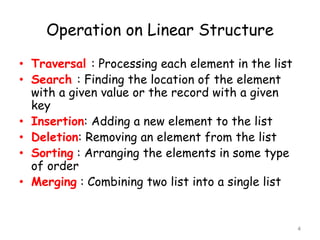
Operation on Linear Structure
• Traversal : Processing each element in the list
• Search : Finding the location of the element
with a given value or the record with a given
key
• Insertion: Adding a new element to the list
• Deletion: Removing an element from the list
• Sorting : Arranging the elements in some type
of order
• Merging : Combining two list into a single list
4
Array
5
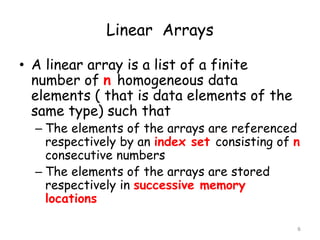
Linear Arrays
• A linear array is a list of a finite
number of n homogeneous data
elements ( that is data elements of the
same type) such that
– The elements of the arrays are referenced
respectively by an index set consisting of n
consecutive numbers
– The elements of the arrays are stored
respectively in successive memory
locations
6
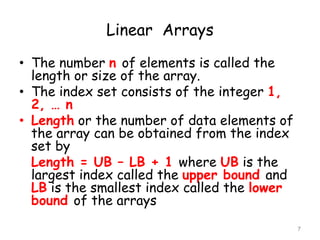
Linear Arrays
• The number n of elements is called the
length or size of the array.
• The index set consists of the integer 1,
2, … n
• Length or the number of data elements of
the array can be obtained from the index
set by
Length = UB – LB + 1 where UB is the
largest index called the upper bound and
LB is the smallest index called the lower
bound of the arrays
7
Linear Arrays
• Element of an array A may be denoted
by
– Subscript notation A1, A2, , …. , An
– Parenthesis notation A(1), A(2), …. , A(n)
– Bracket notation A[1], A[2], ….. , A[n]
• The number K in A[K] is called subscript
or an index and A[K] is called a
subscripted variable
8
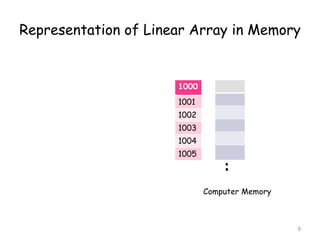
Representation of Linear Array in Memory
9
1000
1001
1002
1003
1004
1005
Computer Memory
:
Representation of Linear Array in Memory
• Let LA be a linear array in the memory of
the computer
• LOC(LA[K]) = address of the element
LA[K] of the array LA
• The element of LA are stored in the
successive memory cells
• Computer does not need to keep track of
the address of every element of LA, but
need to track only the address of the first
element of the array denoted by Base(LA)
called the base address of LA
10
Representation of Linear Array in Memory
• LOC(LA[K]) = Base(LA) + w(K – LB)
where w is the number of words per
memory cell of the array LA [w is the
size of the data type]
11
Example 1
12
200
201
202
203
204
205
206
207
LA[0]
LA[2]
LA[3]
LA[4]
LA[5]
LA[6]
LA[7]
LA[1]
Find the address for LA[6]
Each element of the array
occupy 1 byte
LOC(LA[K]) = Base(LA) + w(K – lower bound)
LOC(LA[6]) = 200 + 1(6 – 0) = 206
:
Example 2
13
200
201
202
203
204
205
206
207
LA[0]
LA[1]
LA[2]
LA[3]
Find the address for LA[15]
Each element of the array
occupy 2 bytes
LOC(LA[K]) = Base(LA) + w(K – lower bound)
LOC(LA[15]) = 200 + 2(15 – 0) = 230
:
Representation of Linear Array in Memory
• Given any value of K, time to calculate
LOC(LA[K]) is same
• Given any subscript K one can access and
locate the content of LA[K] without
scanning any other element of LA
• A collection A of data element is said to be
indexed if any element of A called Ak can
be located and processed in time that is
independent of K
14
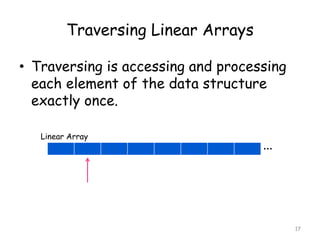
Traversing Linear Arrays
• Traversing is accessing and processing
each element of the data structure
exactly once.
15
•••
Linear Array
Traversing Linear Arrays
• Traversing is accessing and processing
each element of the data structure
exactly once.
16
•••
Linear Array
Traversing Linear Arrays
• Traversing is accessing and processing
each element of the data structure
exactly once.
17
•••
Linear Array
Traversing Linear Arrays
• Traversing is accessing and processing
each element of the data structure
exactly once.
18
•••
Linear Array
Traversing Linear Arrays
• Traversing is accessing and processing
each element of the data structure
exactly once.
19
•••
Linear Array
Traversing Linear Arrays
• Traversing is accessing and processing
each element of the data structure
exactly once.
20
•••
Linear Array
1. Repeat for K = LB to UB for( i=0;i<size;i++)
Apply PROCESS to LA[K] printf(“%d”,LA[i]);
[End of Loop]
2. Exit
Inserting and Deleting
• Insertion: Adding an element
– Beginning
– Middle
– End
• Deletion: Removing an element
– Beginning
– Middle
– End
21
Insertion
1 Brown
2 Davis
3 Johnson
4 Smith
5 Wagner
6
7
8
22
1 Brown
2 Davis
3 Johnson
4 Smith
5 Wagner
6 Ford
7
8
Insert Ford at the End of Array
Insertion
1 Brown
2 Davis
3 Johnson
4 Smith
5 Wagner
6
7
8
23
1 Brown
2 Davis
3 Johnson
4 Smith
5
6 Wagner
7
8
Insert Ford as the 3rd Element of Array
1 Brown
2 Davis
3 Johnson
4
5 Smith
6 Wagner
7
8
1 Brown
2 Davis
3
4 Johnson
5 Smith
6 Wagner
7
8
Ford
Insertion is not Possible without loss
of data if the array is FULL
Insertion Algorithm
• INSERT (LA, N , K , ITEM) [LA is a
linear array with N elements and K is a positive
integers such that K ≤ N. This algorithm inserts an
element ITEM into the Kth position in LA ]
1. [Initialize Counter] Set J := N
2. Repeat Steps 3 and 4 while J ≥ K
3. [Move the Jth element downward ] Set LA[J + 1]
:= LA[J]
4. [Decrease Counter] Set J := J -1
5 [Insert Element] Set LA[K] := ITEM
6. [Reset N] Set N := N +1;
7. Exit
24
Deletion
1 Brown
2 Davis
3 Ford
4 Johnson
5 Smith
6 Taylor
7 Wagner
8
25
1 Brown
2 Davis
3 Ford
4 Johnson
5 Smith
6 Taylor
7
8
Deletion of Wagner at the End of Array
Deletion
1 Brown
2 Davis
3 Ford
4 Johnson
5 Smith
6 Taylor
7 Wagner
8
26
1 Brown
2
3 Ford
4 Johnson
5 Smith
6 Taylor
7 Wagner
8
Deletion of Davis from the Array
1 Brown
2 Ford
3
4 Johnson
5 Smith
6 Taylor
7 Wagner
8
1 Brown
2 Ford
3 Johnson
4
5 Smith
6 Taylor
7 Wagner
8
Deletion
1 Brown
2 Ford
3 Johnson
4 Smith
5 Taylor
6 Wagner
7
8
27
No data item can be deleted from an empty
array
Deletion Algorithm
• DELETE (LA, N , K , ITEM) [LA is a
linear array with N elements and K is a positive
integers such that K ≤ N. This algorithm deletes Kth
element from LA ]
1. Set ITEM := LA[K]
2. Repeat for J = K+1 to N:
[Move the Jth element upward] Set LA[J-1] :=
LA[J]
3. [Reset the number N of elements] Set N := N - 1;
4. Exit
28
Multidimensional Array
• One-Dimensional Array
• Two-Dimensional Array
• Three-Dimensional Array
29
Two-Dimensional Array
• A Two-Dimensional m x n array A is a
collection of m . n data elements such
that each element is specified by a pair
of integers (such as J, K) called
subscripts with property that
1 ≤ J ≤ m and 1 ≤ K ≤ n
The element of A with first subscript J
and second subscript K will be denoted
by AJ,K or A[J][K]
30
2D Arrays
The elements of a 2-dimensional array a
is shown as below
a[0][0] a[0][1] a[0][2] a[0][3]
a[1][0] a[1][1] a[1][2] a[1][3]
a[2][0] a[2][1] a[2][2] a[2][3]
Rows Of A 2D Array
a[0][0] a[0][1] a[0][2] a[0][3] row 0
a[1][0] a[1][1] a[1][2] a[1][3] row 1
a[2][0] a[2][1] a[2][2] a[2][3] row 2
Columns Of A 2D Array
a[0][0] a[0][1] a[0][2] a[0][3]
a[1][0] a[1][1] a[1][2] a[1][3]
a[2][0] a[2][1] a[2][2] a[2][3]
column 0 column 1 column 2 column 3
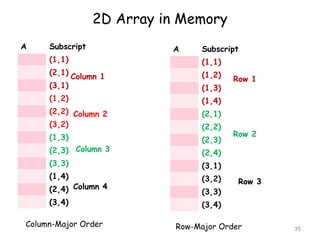
2D Array
• Let A be a two-dimensional array m x n
• The array A will be represented in the
memory by a block of m x n sequential
memory location
• Programming language will store array A
either
– Column by Column (Called Column-Major
Order) Ex: Fortran, MATLAB
– Row by Row (Called Row-Major Order) Ex: C,
C++ , Java
34
2D Array in Memory
A Subscript
(1,1)
(2,1)
(3,1)
(1,2)
(2,2)
(3,2)
(1,3)
(2,3)
(3,3)
(1,4)
(2,4)
(3,4)
35
Column 1
Column 2
Column 3
Column 4
A Subscript
(1,1)
(1,2)
(1,3)
(1,4)
(2,1)
(2,2)
(2,3)
(2,4)
(3,1)
(3,2)
(3,3)
(3,4)
Row 1
Row 3
Row 2
Column-Major Order Row-Major Order
2D Array
• LOC(LA[K]) = Base(LA) + w(K -1)
• LOC(A[J,K]) of A[J,K]
Column-Major Order
LOC(A[J,K]) = Base(A) + w[(J-LB) + m(K-LB)]
Row-Major Order
LOC(A[J,K]) = Base(A) + w[n(J-LB) + (K-LB) ]
36
2D Array (Row Major)
A[J][K]
37
A5x6
Jth
Row
Kth
Column
LOC(A[J,K]) = Base(A) + w[n(J-LB) + (K-LB)]
2D Array (Column Major)
A[J][K]
38
A5x6
Jth
Row
Kth
Column
LOC(A[J,K]) = Base(A) + w[(J-LB) + m(K-LB)]
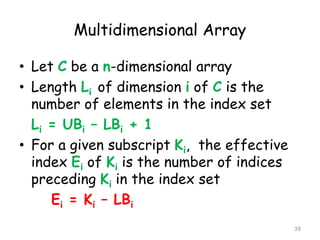
Multidimensional Array
• Let C be a n-dimensional array
• Length Li of dimension i of C is the
number of elements in the index set
Li = UBi – LBi + 1
• For a given subscript Ki, the effective
index Ei of Ki is the number of indices
preceding Ki in the index set
Ei = Ki – LBi
39
Multidimensional Array
• Address LOC(C[K1,K2, …., Kn]) of an
arbitrary element of C can be obtained as
Column-Major Order
Base( C) + w[((( … (ENLN-1 + EN-1)LN-2)
+ ….. +E3)L2+E2)L1+E1]
Row-Major Order
Base( C) + w[(… ((E1L2 + E2)L3 + E3)L4
+ ….. +EN-1)LN +EN]
40
Example
• MAZE(2:8, -4:1, 6:10)
• Calculate the address of MAZE[5,-1,8]
• Given: Base(MAZE) = 200, w = 4, MAZE
is stored in Row-Major order
• L1 = 8-2+1 = 7, L2 = 6, L3 = 5
• E1 = 5 -2 = 3, E2 = 3, E3 = 2
41
Example Contd ..
• Base( C) + w[(… ((E1L2 + E2)L3 + E3)L4 +
….. +EN-1)LN +EN]
• E1L2 = 3 . 6 = 18
• E1L2 + E2 = 18 + 3 = 21
• (E1L2 + E2)L3 = 21 . 5 = 105
• (E1L2+E2)L3 + E3 = 105 + 2 = 107
• MAZE[5,-1,8] = 200 + 4(107) = 200 +
428 = 628
42
Pointer, Pointer Array
• Let DATA be any array
• A variable P is called a pointer if P points
to an element in DATA i.e if P contains
the address of an element in DATA.
e.g. int *p=&DATA[1];
• An array PTR is called a pointer array if
each element of PTR is a pointer
• int *PTR[5];
ptr[1] =&DATA[1];
ptr[2] =&DATA[2];
43

Arrays

  • 1.
    Data Structure andAlgorithm CS-102/CS2005 1
  • 2.
    Classification • Data Structure –Linear – Non-Linear A data structure is said to be linear if every element in the data structure has a unique successor and a unique predecessor other than the first and last element. The first element has no predecessor and the last element has no successor. 2
  • 3.
    Representation in Memory •Two basic representation in memory – Have a linear relationship between the elements represented by means of sequential memory locations [ Arrays] – Have the linear relationship between the elements represented by means of pointer or links [ Linked List] 3
  • 4.
    Operation on LinearStructure • Traversal : Processing each element in the list • Search : Finding the location of the element with a given value or the record with a given key • Insertion: Adding a new element to the list • Deletion: Removing an element from the list • Sorting : Arranging the elements in some type of order • Merging : Combining two list into a single list 4
  • 5.
  • 6.
    Linear Arrays • Alinear array is a list of a finite number of n homogeneous data elements ( that is data elements of the same type) such that – The elements of the arrays are referenced respectively by an index set consisting of n consecutive numbers – The elements of the arrays are stored respectively in successive memory locations 6
  • 7.
    Linear Arrays • Thenumber n of elements is called the length or size of the array. • The index set consists of the integer 1, 2, … n • Length or the number of data elements of the array can be obtained from the index set by Length = UB – LB + 1 where UB is the largest index called the upper bound and LB is the smallest index called the lower bound of the arrays 7
  • 8.
    Linear Arrays • Elementof an array A may be denoted by – Subscript notation A1, A2, , …. , An – Parenthesis notation A(1), A(2), …. , A(n) – Bracket notation A[1], A[2], ….. , A[n] • The number K in A[K] is called subscript or an index and A[K] is called a subscripted variable 8
  • 9.
    Representation of LinearArray in Memory 9 1000 1001 1002 1003 1004 1005 Computer Memory :
  • 10.
    Representation of LinearArray in Memory • Let LA be a linear array in the memory of the computer • LOC(LA[K]) = address of the element LA[K] of the array LA • The element of LA are stored in the successive memory cells • Computer does not need to keep track of the address of every element of LA, but need to track only the address of the first element of the array denoted by Base(LA) called the base address of LA 10
  • 11.
    Representation of LinearArray in Memory • LOC(LA[K]) = Base(LA) + w(K – LB) where w is the number of words per memory cell of the array LA [w is the size of the data type] 11
  • 12.
    Example 1 12 200 201 202 203 204 205 206 207 LA[0] LA[2] LA[3] LA[4] LA[5] LA[6] LA[7] LA[1] Find theaddress for LA[6] Each element of the array occupy 1 byte LOC(LA[K]) = Base(LA) + w(K – lower bound) LOC(LA[6]) = 200 + 1(6 – 0) = 206 :
  • 13.
    Example 2 13 200 201 202 203 204 205 206 207 LA[0] LA[1] LA[2] LA[3] Find theaddress for LA[15] Each element of the array occupy 2 bytes LOC(LA[K]) = Base(LA) + w(K – lower bound) LOC(LA[15]) = 200 + 2(15 – 0) = 230 :
  • 14.
    Representation of LinearArray in Memory • Given any value of K, time to calculate LOC(LA[K]) is same • Given any subscript K one can access and locate the content of LA[K] without scanning any other element of LA • A collection A of data element is said to be indexed if any element of A called Ak can be located and processed in time that is independent of K 14
  • 15.
    Traversing Linear Arrays •Traversing is accessing and processing each element of the data structure exactly once. 15 ••• Linear Array
  • 16.
    Traversing Linear Arrays •Traversing is accessing and processing each element of the data structure exactly once. 16 ••• Linear Array
  • 17.
    Traversing Linear Arrays •Traversing is accessing and processing each element of the data structure exactly once. 17 ••• Linear Array
  • 18.
    Traversing Linear Arrays •Traversing is accessing and processing each element of the data structure exactly once. 18 ••• Linear Array
  • 19.
    Traversing Linear Arrays •Traversing is accessing and processing each element of the data structure exactly once. 19 ••• Linear Array
  • 20.
    Traversing Linear Arrays •Traversing is accessing and processing each element of the data structure exactly once. 20 ••• Linear Array 1. Repeat for K = LB to UB for( i=0;i<size;i++) Apply PROCESS to LA[K] printf(“%d”,LA[i]); [End of Loop] 2. Exit
  • 21.
    Inserting and Deleting •Insertion: Adding an element – Beginning – Middle – End • Deletion: Removing an element – Beginning – Middle – End 21
  • 22.
    Insertion 1 Brown 2 Davis 3Johnson 4 Smith 5 Wagner 6 7 8 22 1 Brown 2 Davis 3 Johnson 4 Smith 5 Wagner 6 Ford 7 8 Insert Ford at the End of Array
  • 23.
    Insertion 1 Brown 2 Davis 3Johnson 4 Smith 5 Wagner 6 7 8 23 1 Brown 2 Davis 3 Johnson 4 Smith 5 6 Wagner 7 8 Insert Ford as the 3rd Element of Array 1 Brown 2 Davis 3 Johnson 4 5 Smith 6 Wagner 7 8 1 Brown 2 Davis 3 4 Johnson 5 Smith 6 Wagner 7 8 Ford Insertion is not Possible without loss of data if the array is FULL
  • 24.
    Insertion Algorithm • INSERT(LA, N , K , ITEM) [LA is a linear array with N elements and K is a positive integers such that K ≤ N. This algorithm inserts an element ITEM into the Kth position in LA ] 1. [Initialize Counter] Set J := N 2. Repeat Steps 3 and 4 while J ≥ K 3. [Move the Jth element downward ] Set LA[J + 1] := LA[J] 4. [Decrease Counter] Set J := J -1 5 [Insert Element] Set LA[K] := ITEM 6. [Reset N] Set N := N +1; 7. Exit 24
  • 25.
    Deletion 1 Brown 2 Davis 3Ford 4 Johnson 5 Smith 6 Taylor 7 Wagner 8 25 1 Brown 2 Davis 3 Ford 4 Johnson 5 Smith 6 Taylor 7 8 Deletion of Wagner at the End of Array
  • 26.
    Deletion 1 Brown 2 Davis 3Ford 4 Johnson 5 Smith 6 Taylor 7 Wagner 8 26 1 Brown 2 3 Ford 4 Johnson 5 Smith 6 Taylor 7 Wagner 8 Deletion of Davis from the Array 1 Brown 2 Ford 3 4 Johnson 5 Smith 6 Taylor 7 Wagner 8 1 Brown 2 Ford 3 Johnson 4 5 Smith 6 Taylor 7 Wagner 8
  • 27.
    Deletion 1 Brown 2 Ford 3Johnson 4 Smith 5 Taylor 6 Wagner 7 8 27 No data item can be deleted from an empty array
  • 28.
    Deletion Algorithm • DELETE(LA, N , K , ITEM) [LA is a linear array with N elements and K is a positive integers such that K ≤ N. This algorithm deletes Kth element from LA ] 1. Set ITEM := LA[K] 2. Repeat for J = K+1 to N: [Move the Jth element upward] Set LA[J-1] := LA[J] 3. [Reset the number N of elements] Set N := N - 1; 4. Exit 28
  • 29.
    Multidimensional Array • One-DimensionalArray • Two-Dimensional Array • Three-Dimensional Array 29
  • 30.
    Two-Dimensional Array • ATwo-Dimensional m x n array A is a collection of m . n data elements such that each element is specified by a pair of integers (such as J, K) called subscripts with property that 1 ≤ J ≤ m and 1 ≤ K ≤ n The element of A with first subscript J and second subscript K will be denoted by AJ,K or A[J][K] 30
  • 31.
    2D Arrays The elementsof a 2-dimensional array a is shown as below a[0][0] a[0][1] a[0][2] a[0][3] a[1][0] a[1][1] a[1][2] a[1][3] a[2][0] a[2][1] a[2][2] a[2][3]
  • 32.
    Rows Of A2D Array a[0][0] a[0][1] a[0][2] a[0][3] row 0 a[1][0] a[1][1] a[1][2] a[1][3] row 1 a[2][0] a[2][1] a[2][2] a[2][3] row 2
  • 33.
    Columns Of A2D Array a[0][0] a[0][1] a[0][2] a[0][3] a[1][0] a[1][1] a[1][2] a[1][3] a[2][0] a[2][1] a[2][2] a[2][3] column 0 column 1 column 2 column 3
  • 34.
    2D Array • LetA be a two-dimensional array m x n • The array A will be represented in the memory by a block of m x n sequential memory location • Programming language will store array A either – Column by Column (Called Column-Major Order) Ex: Fortran, MATLAB – Row by Row (Called Row-Major Order) Ex: C, C++ , Java 34
  • 35.
    2D Array inMemory A Subscript (1,1) (2,1) (3,1) (1,2) (2,2) (3,2) (1,3) (2,3) (3,3) (1,4) (2,4) (3,4) 35 Column 1 Column 2 Column 3 Column 4 A Subscript (1,1) (1,2) (1,3) (1,4) (2,1) (2,2) (2,3) (2,4) (3,1) (3,2) (3,3) (3,4) Row 1 Row 3 Row 2 Column-Major Order Row-Major Order
  • 36.
    2D Array • LOC(LA[K])= Base(LA) + w(K -1) • LOC(A[J,K]) of A[J,K] Column-Major Order LOC(A[J,K]) = Base(A) + w[(J-LB) + m(K-LB)] Row-Major Order LOC(A[J,K]) = Base(A) + w[n(J-LB) + (K-LB) ] 36
  • 37.
    2D Array (RowMajor) A[J][K] 37 A5x6 Jth Row Kth Column LOC(A[J,K]) = Base(A) + w[n(J-LB) + (K-LB)]
  • 38.
    2D Array (ColumnMajor) A[J][K] 38 A5x6 Jth Row Kth Column LOC(A[J,K]) = Base(A) + w[(J-LB) + m(K-LB)]
  • 39.
    Multidimensional Array • LetC be a n-dimensional array • Length Li of dimension i of C is the number of elements in the index set Li = UBi – LBi + 1 • For a given subscript Ki, the effective index Ei of Ki is the number of indices preceding Ki in the index set Ei = Ki – LBi 39
  • 40.
    Multidimensional Array • AddressLOC(C[K1,K2, …., Kn]) of an arbitrary element of C can be obtained as Column-Major Order Base( C) + w[((( … (ENLN-1 + EN-1)LN-2) + ….. +E3)L2+E2)L1+E1] Row-Major Order Base( C) + w[(… ((E1L2 + E2)L3 + E3)L4 + ….. +EN-1)LN +EN] 40
  • 41.
    Example • MAZE(2:8, -4:1,6:10) • Calculate the address of MAZE[5,-1,8] • Given: Base(MAZE) = 200, w = 4, MAZE is stored in Row-Major order • L1 = 8-2+1 = 7, L2 = 6, L3 = 5 • E1 = 5 -2 = 3, E2 = 3, E3 = 2 41
  • 42.
    Example Contd .. •Base( C) + w[(… ((E1L2 + E2)L3 + E3)L4 + ….. +EN-1)LN +EN] • E1L2 = 3 . 6 = 18 • E1L2 + E2 = 18 + 3 = 21 • (E1L2 + E2)L3 = 21 . 5 = 105 • (E1L2+E2)L3 + E3 = 105 + 2 = 107 • MAZE[5,-1,8] = 200 + 4(107) = 200 + 428 = 628 42
  • 43.
    Pointer, Pointer Array •Let DATA be any array • A variable P is called a pointer if P points to an element in DATA i.e if P contains the address of an element in DATA. e.g. int *p=&DATA[1]; • An array PTR is called a pointer array if each element of PTR is a pointer • int *PTR[5]; ptr[1] =&DATA[1]; ptr[2] =&DATA[2]; 43