1
Proceedings of the 23rd National Heat and Mass Transfer Conference and
1st International ISHMT-ASTFE Heat and Mass Transfer Conference
IHMTC2015
17-20 December, 2015, Thiruvananthapuram, India
Paper No. 988
TWO-DIMENSIONAL NUMERICAL INVESTIGATION OF TWO-PHASE FLOW JET
PUMP WITH SWIRLING PRIMARY JET
Arpita Srivastava
Department of Mechanical Engineering
Indian Institute of Technology Madras
Chennai-600036, India
Email: arpita.sri.lko@gmail.com
Shaligram Tiwari
Department of Mechanical Engineering
Indian Institute of Technology Madras
Chennai-600036, India
Email: shaligt@iitm.ac.in
Mani Annamalai
Department of Mechanical Engineering
Indian Institute of Technology
Madras, India
Email: mania@iitm.ac.in
ABSTRACT
Many studies have been proposed on jet pump
advertising its various benefits and freedom from
complexity of moving parts. Aim of the present study is to
carry out two-dimensional numerical investigations of two
phase flow jet pumps with and without swirling jet,
studying its various performance characteristics under
optimized conditions of the parameters such as upstream
and downstream pressures, primary jet mass flow rate,
entrained secondary stream mass flow rate, geometry of
the ejector, efficiency, etc. The present study helps in
predicting the near to actual flow behavior at the exit of
nozzle with respect to different nozzle profiles as swirling
primary jet is introduced. For carrying out the same, an
optimized turbulent model is selected employing
axisymmetric swirling flow. The dependence of pump
efficiency on positioning of the nozzle with respect to the
mixing chamber has been investigated. At first, validation
of the numerical computations have been carried out with
the existing literature. Two phase pump incorporates
water as the high velocity primary jet and air as entrained
fluid. Nozzle profiles selected are circular, elliptical and
conical having different area ratios. The mean diameter of
nozzle is varied from 4 mm to 10mm. The present studies
helps in predicting the more suitable geometry to get better
efficiency if swirling jet are used instead of axial jet.
Keywords: Jet pump, axisymmetric, swirling jet
.
NOMENCLATURE
Do Nozzle diameter
Dsec Suction chamber diameter
Dmt Mixing tube diameter
Dp Inlet diameter of supply tube
Lmt Length of the mixing tube
S Distance between nozzle and mixing tube
Ld Length of the diffuser
Dd Diameter of the diffuser at outlet
 Diffuser semi cone angle
Eficiency of pump
F Flow ratio
H Head ratio
Qp Primary fluid mass flow rate
Qs Secondary fluid mass flow rate
PD Downstream pressure
PS Secondary pressure
PU Upstream pressure
gk Generation of turbulence kinetic energy due to
the mean velocity gradients
gb Generation of turbulence kinetic energy due to
buoyancy
2
yp Contribution of the fluctuating dilatation in
compressible turbulence to the overall dissipation
rate
μt0 Turbulent viscosity calculated without the swirl
modification
Ω Swirl number
αs Swirl constant value which can be selected on the
basis of swirl intensity ranging from moderate to
high value
INTRODUCTION
A high-pressure fluid (motive fluid) with very low
velocity at the primary inlet is accelerated to high velocity
jet through a converging nozzle for the liquid jet pump. A
wide range of investigations are carried out globally to
develop energy efficient desalination techniques that
induce negligible environmental pollution. Vacuum inside
the desalination system was to be achieved using the
designed two phase jet pump .Since the two-phase jet
pump is the heart of the system, the present numerical
approach helps to analyse and optimize the jet pump with
the effect of swirl in primary stream inside nozzle and how
it affects the downstream flow. Many authors have
conducted the studies on various evolutionary designs of
ejectors several years ago. The application of the liquid jet
gas pump for air and vapour removal from steam
condensers and pump casings was reported in various
German and Russian papers, beginning with Hoefer [1].
Several investigators later proposed various enhancement
in existing ejectors for getting better performance. Design
analysis of pumps that uses liquids of low viscosity have
been studied by Gosline and O’Brien [2]. Their studies
promote self entrainment of viscous fluids and two
component entrainment when the two fluids are liquids of
different densities.
Many researchers extended the work of these
pioneers contributing their own suggestions and also
carried out valuable experiments to determine the
conditions at which improvements can be achieved.
Martinelli [3] et al. reported that increase in secondary air
can be achieved by increasing pressure of fluid at primary
side. Muller [4] whereas performed studies in existing
designs and concluded that performance can be enhanced
by 37% which was reportedly the maximum efficiency. He
concluded that when the setback distance i.e, the distance
between nozzle exit and mixing chamber entry length is
equal to driving nozzle diameter and also the least angle of
the diffuser will help in enhancing efficiency of jet pump.
Pfliedderer [5] proposed that the pressure ratio
and air flow rate are independent of each other. Stepanoff
analyzed various jet pumps models and proposed a jet
centrifugal pump system. There were studies on ejectors
with multi hole nozzle . Gopichand [6] confirmed that
single nozzle is better than multiple nozzle. Experimental
investigation on various ejector geometries is carried out
by Havelka et al. [7] carried out experimental studies with
various designs of ejctorsat different operating conditions.
There were already various suggestions available in nozzle
profiles and one of those studies confirmed that elliptical
nozzle can be proved to be better by Gutmark and
Grinstein [8] for better mixing of two streams and fanning.
Similar studies were done by Sudevan [9] employing a
multi hole nozzle to optimize mixing tube length as it has
also played a major role in ejector performance. Later,
Vishnu [10] did studies on elliptical nozzle along with
conical and circular to compare the performance in his
work experimentally. The geometrical design is inspired
from his work Vishnu experiment. It was concluded that
area ratio has major role to play in ejector efficiency than
any other parameter. Reddy and Kar [11] studied the effect
of flow ratio and concluded that if it is equal to unity then
maximum efficiency of system can be achieved. Lesser
area ratio ejectors were also studied by Sangar [12] with
primary fluid as water. Winoto et al. [13] performed one
dimensional theoretical study on water- air ejector system.
Also to support his studies, he carried out experimental
work on water jet pump. And concluded that a nozzle with
non circular cross section has an impact on nozzle
performance and sharp edges may lower overall efficiency
of jet pump. Narabayashi et al. [14] did experiments as
well as and performed computational fluid dynamics
(CFD) analysis of flow in single and multi-hole nozzle jet
pumps and reported that single hole nozzle works
efficiently for zero set back distance . Also they tried a
different mixing tube with a tapered shape rather than a
traditional straight for enhancing efficiency. According to
their experimental results, five hole nozzle gives performs
ill as compared to single nozzle as in between the nozzle
finger there is more resistance developed. Gresho [15]
numerically optimized mixing throat length for area ratio
of 0.6 by three-dimensional (3-D) using re-normalization
group k-ɛ1 turbulent model. In present time, investigators
and research are attracted towards the swirl activity in
nozzle such studies were carried out by Guillaume and
Judge [16] through their experiments. They reported that at
moderate swirl, the jet pump has shown 4.5% increment in
entrained secondary fluid which leads to 5% increase in
overall efficiency when compared to the same pump
without swirl . Samad et al. [17] and shows that swirl
promotes jet breakup resulting in higher suction rates. He
incorporates swirler of various angle in his experiments.
Although various combination of design prove that
incorporating swirl into a jet pump may increase
performance, Zhou et al. [18], showed numerically that
swirl can be detrimental to pump performance.
Specifically, they used commercial CFD software
FLUENT to model the effect of swirling the primary jet in
a study designed to evaluate the effectiveness of a jet pump
on reducing the infrared signature of the exhaust of a gas
turbine. They found numerically that pump performance
decreased as the swirl angle was increased.
3
CFD ANALYSIS OF EJECTOR
The efficiency of the pump can be calculated by using the
flow ratio and head ratio as
(1)
(2)
FIGURE 1. REPRESENTATIONAL VIEW OF
EJECTOR OF JET PUMP
The traditional view of ejector is shown in Figure 1.
Further in current study the profile of nozzle will be
changed to visualise change in flow pattern. The
dimensions of ejector used are shown in Table 1 [10].
In the present study, the CFD software ANSYS Fluent
14.0 has been employed to analyze a two-phase ejector of
jet pump which is supposed to be part of an experimental
set up. It is designed to entrain air from a pressure vessel to
create vaccum. Considering the situation to be an
incompressible, steady flow, the axisymmetric pressure-
based solver has been used. The governing equations for
mass and momentum conservation are given in tensor
notation as
(3)
(4)
TABLE 1. DESIGN PARAMETERS OF NOZZLE
Notation Conical
(mm)
Elliptical
(mm)
Circular
(mm)
Do 4,6,8 4,6,8 4,6,8
Dp 21,21,25 21,21,25 21,21,25
Dmt 10 10 10
Dsec 21 21 21
Lmt 265 265 265
S 20 20 20
Ld 135 135 135
Dd 21 21 21
 2°30’ 2°30’ 2°30’
The pressure drop that takes place at various pipe
connections has been neglected. The solver is appropriate
for both lower as well as higher values of Reynolds
number and is applicable for simulating the two-phase flow
of air-water mixture. Pressure velocity coupling offers to
solve the problem in either segregated manner or coupled
manner. The SIMPLE algorithm is followed which solves
equations of velocity and pressure to enforce mass
conservation and to obtain the pressure field. Also, this
solver takes lesser computational time and memory. Spatial
Discretization scheme contains settings that control the
spatial discretization of the convection terms in the
solution equations and here for calculating gradients Least
Squares Cell-Based is used. Standard scheme is taken for
pressure, power law scheme for momentum, swirl velocity,
kinetic energy and turbulent dissipation rate and first order
upwind for volume fraction. The standard interpolation
schemes for calculating cell-face pressures takes lesser
time as compared to power law method. For bubble flow
there are Mixture model and Eulerian model can be used to
solve multiphase flow. Mixture model is based on pressure
solver. The differences in between both is that the mixture
model can be a substitute for the full Eulerian multiphase
model in some cases. A full multiphase model is not as
feasible as mixture model. The under relaxation factor for
pressure and momentum quatities are kept as 0.3 and for
the turbulent quantities 0.6. The solutions were assumed to
have converged for the residual level of 10-4
for continuity,
x-velocity, and y velocity and 10-6
for k -epsilon. For
selecting the turbulent model, one can think of standard k-ε
model which is considered as the simplest “complete
model” of turbulence. It is a model based on model
transport equations for the turbulence kinetic energy (k)
and its dissipation rate (ε), that means, it includes two extra
transport equations to represent the turbulent properties of
the flow. Renormalization-Group (RNG) model is
improved from the standard k-ε model by using a rigorous
statistical technique. It is similar to the standard k-ε model,
but can be proved more beneficial as compared to standard
or realizable k-ε model.
1. It includes extra term in governing equation that
provides better accuracy for rapidly strained flows.
2. The effect of swirl in the form of swirl factor is included
which can be activated for swirl dominated flow condition,
and hence improves the accuracy for swirling and rotating
flows. For strongly swirling flows, however, a higher value
of swirl factor can be used which is st as 0.07 for moderate
swirl by default in the software.
Transport Equations for the RNG k- ε Model
–
(5)
4
(6)
(7)
3. An analytical formula for turbulent Prandtl numbers is
provided for solving the heat transfer problem
of turbulent boundary layer flows
4. An analytically derived differential formula for
effective viscosity is included to capture low Reynolds
flow behaviours.
These features produce more reliability and
accuracy in the model than the standard k-ε model.
However, these additional features are not required in this
study. The RNG k-ε model needs 10 to 15% more CPU
time and memory requirement than the standard k-ε model.
RESULTS AND DISCUSSION
Swirl in the upstream of the nozzle is induced by
giving velocity components in axial and tangential
direction. Radial component is assumed to be weak enough
to contribute to swirl hence it is completely neglected. The
swirl intensity can be measured in terms of swirl number.
The swirl number is defined as the radius-weighted ratio of
axial flux of angular momentum to the axial flux of axial
momentum.
(8)
Inlet tangential flow is the measure of swirl intensity in the
flow field.
Qt = Qt / (Qt+ Qa) (9)
Hence for zero tangential component there will be no swirl.
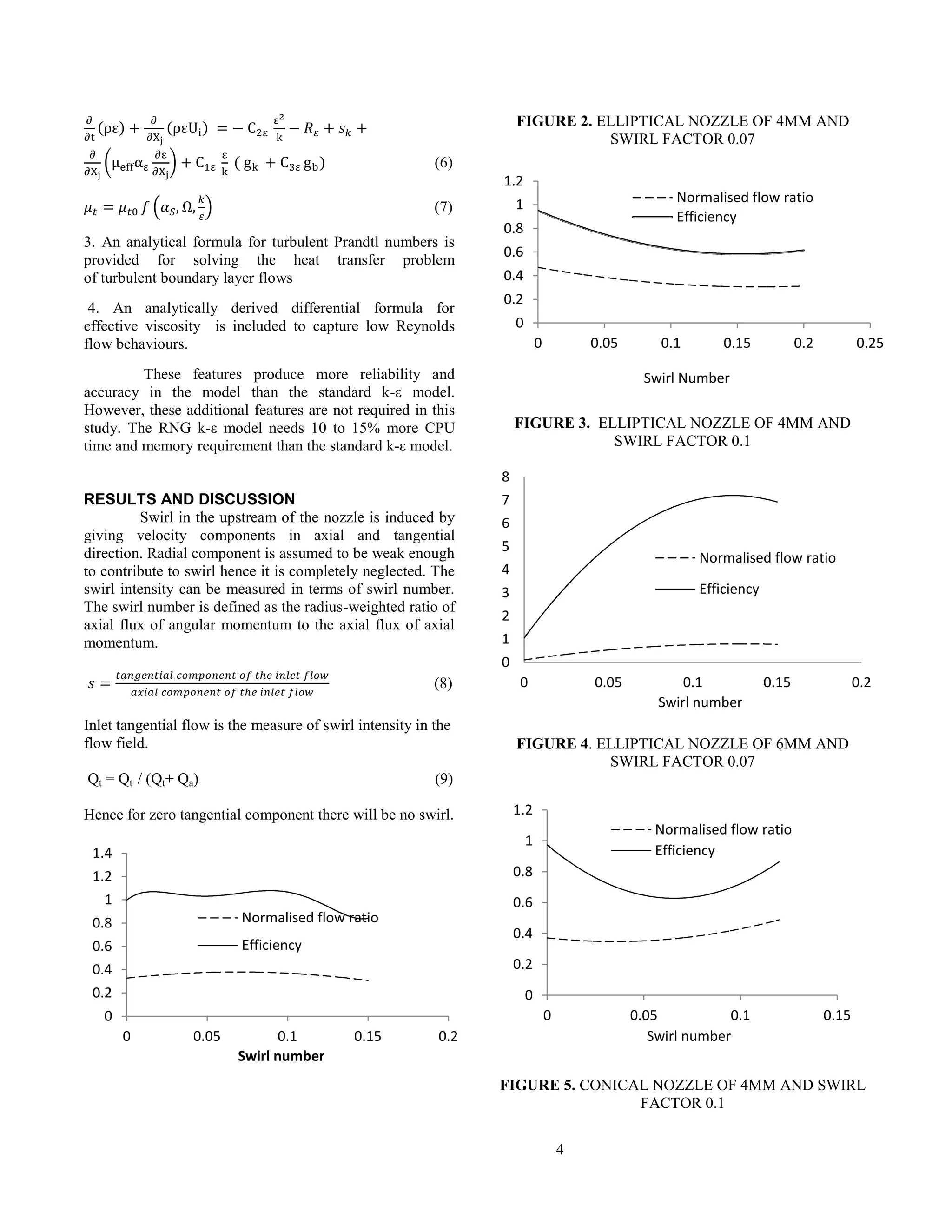
FIGURE 2. ELLIPTICAL NOZZLE OF 4MM AND
SWIRL FACTOR 0.07
FIGURE 3. ELLIPTICAL NOZZLE OF 4MM AND
SWIRL FACTOR 0.1
FIGURE 4. ELLIPTICAL NOZZLE OF 6MM AND
SWIRL FACTOR 0.07
FIGURE 5. CONICAL NOZZLE OF 4MM AND SWIRL
FACTOR 0.1
0
0.2
0.4
0.6
0.8
1
1.2
1.4
0 0.05 0.1 0.15 0.2
Swirl number
Normalised flow ratio
Efficiency
0
0.2
0.4
0.6
0.8
1
1.2
0 0.05 0.1 0.15 0.2 0.25
Swirl Number
Normalised flow ratio
Efficiency
0
1
2
3
4
5
6
7
8
0 0.05 0.1 0.15 0.2
Swirl number
Normalised flow ratio
Efficiency
0
0.2
0.4
0.6
0.8
1
1.2
0 0.05 0.1 0.15
Swirl number
Normalised flow ratio
Efficiency
5
FIGURE 6. CONICAL NOZZLE OF 4MM AND USING
REALIZABLE
K-Ɛ MODEL
The concept of normalized–flow ratio K was given by
Guillaume and Judge [16]. It compares the performance of
jet pump with and without inclusion of swirl and hence is
one of the performance parameter for determining pump
efficiency.
 
 
without swirl
with swirl
/
/
S P
S P
Q Q
K
Q Q
 (10)
Since QP is same for both cases, hence
, with swirl
, without swirl
S
S
Q
K
Q
 (11)
Figure 2 shows the variation of efficiency and normalized
flow ratio with respect to swirl number in elliptical profiled
nozzle. Initially, the secondary flow decreases but on
giving 9% of axial flow as the inlet tangential flow it
reaches it maximum and further start decreasing. As shown
in Figure 3, on increasing the swirl factor, for the same
cases, from default 0.07 value to 0.1, the secondary
entrainment as well as efficiency of jet pump decreases.
Similar trends were observed in other nozzles also.
Performance curves obtained on employing different
model can be seen in Figure 5 and Figure 6 for conical
nozzle of 4mm throat diameter. An increase in swirl
number can cause a increase in entrainment but further
increase in swirl will cause a depreciation too. This can be
observed from Table 2 where on increasing the tangential
component of flow there is increase in secondary flow but
as swirl intensity is raised by giving swirl factor as 0.1 is
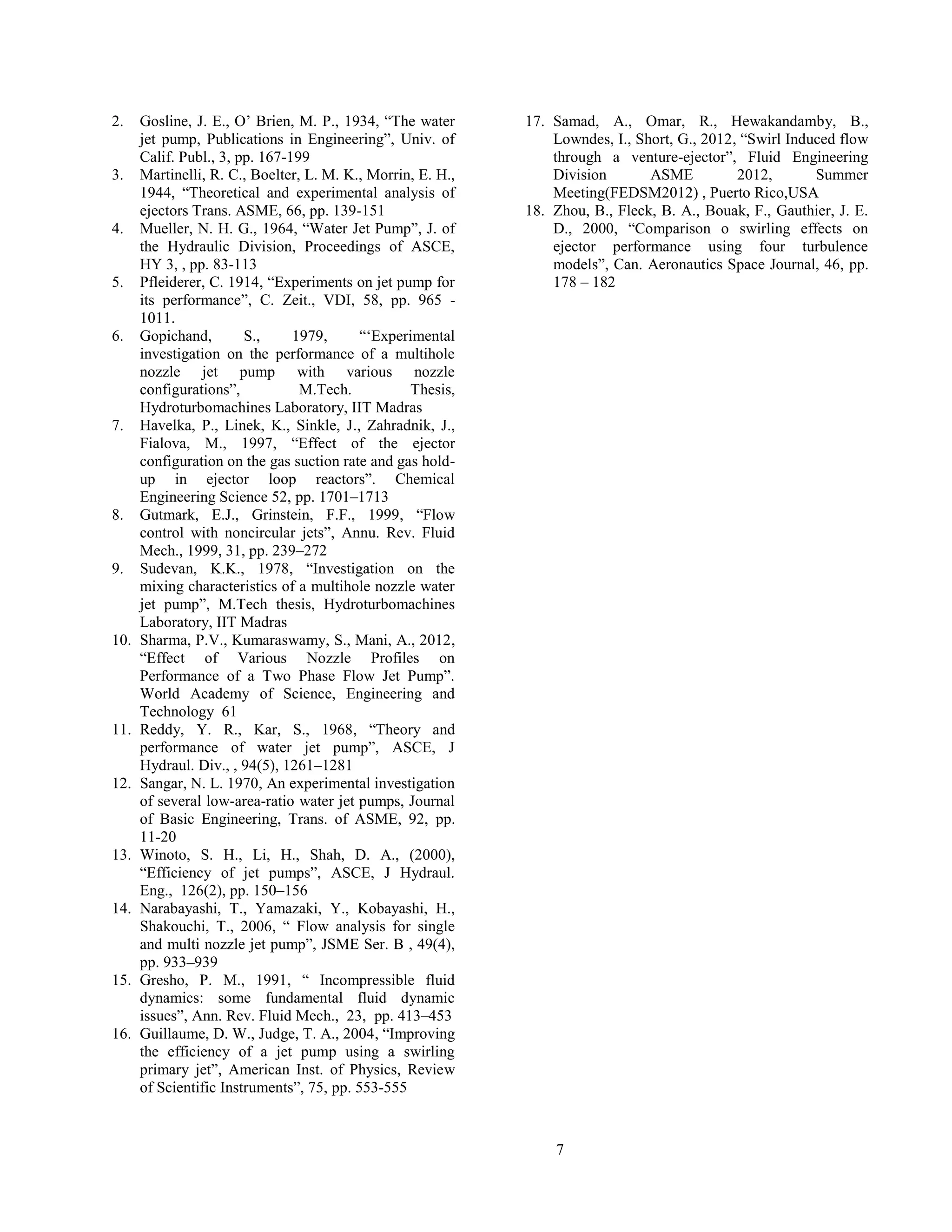
went down. Figure 9 shows a comparative view of flow
pattern on increasing the swirl number. On giving swirl
number upto 0.25 to 0.3 there is an increase in entrainment
and then decreases further causing reverse flow in the
secondary. On observing the Figure 6 similar trend is
observed. For swirl number 0.12 it attains maximum and a
maximum entrainment is thus reported. The vortices
developed enhances the secondary flow and enable better
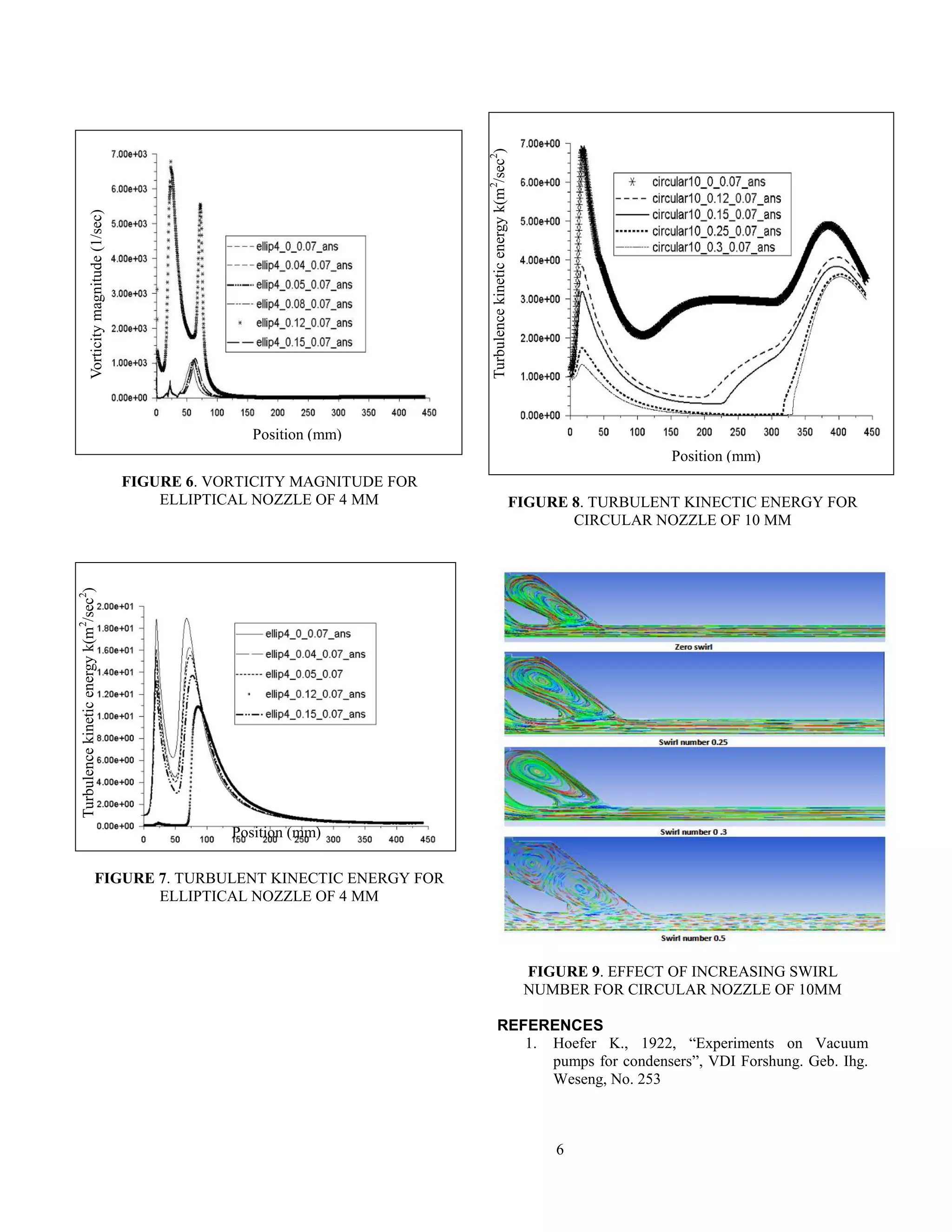
mixing of fluids. However, turbulent kinetic energy
however decreases on attaining higher swirl number as
shown in Figure 7-8 . A decreasing turbulent intensity does
signifies that the flow becomes less turbulent. It can be
predicted that the velocity fluctuations divided by the
mean velocity decreases. If both values increases, but the
mean velocity increases even more, than the intensity
decreases. Reynolds number is a ratio representing the
relative importance of inertial forces to viscous forces in
the flow. Further wall effects can be studied to get more
realistic view of the flow. This preliminary experiment
shows that the efficiency of a jet pump can be significantly
improved by simply replacing the jet nozzle that has a
round cross section with a jet nozzle that has an elliptical
cross section.
CONCLUSION
It was found that elliptical nozzle with 4mm diameter gives
better efficiency as compared to other nozzle for the same
inlet flow condition. The formation of vortices and their
interaction with walls also plays an important role in
determining entrainment as it influence the mixing of two
phase fluids at downstream. Upon giving 10% to 12% of
axial flow as a tangential flow at the inlet there is a
increase in entrainment by 4 to 7 %. Further based on the
swirl numbers leading to better efficiency swirler can be
designed to validate the results.
FIGURE 5. VELOCITY PROFILE FOR ELLIPTICAL
NOZZLE OF 4 MM
0
0.2
0.4
0.6
0.8
1
1.2
1.4
1.6
1.8
0 0.02 0.04 0.06 0.08 0.1 0.12
Swirl number
Efficiency
----- Normalised flow ratio
Position (mm)
VelocityMagnitude(m/sec)
6
FIGURE 6. VORTICITY MAGNITUDE FOR
ELLIPTICAL NOZZLE OF 4 MM
FIGURE 7. TURBULENT KINECTIC ENERGY FOR
ELLIPTICAL NOZZLE OF 4 MM
FIGURE 8. TURBULENT KINECTIC ENERGY FOR
CIRCULAR NOZZLE OF 10 MM
FIGURE 9. EFFECT OF INCREASING SWIRL
NUMBER FOR CIRCULAR NOZZLE OF 10MM
REFERENCES
1. Hoefer K., 1922, “Experiments on Vacuum
pumps for condensers”, VDI Forshung. Geb. Ihg.
Weseng, No. 253
Vorticitymagnitude(1/sec)
Position (mm)
Turbulencekineticenergyk(m2
/sec2
)
Position (mm)
Position (mm)
Turbulencekineticenergyk(m2
/sec2
)
7
2. Gosline, J. E., O’ Brien, M. P., 1934, “The water
jet pump, Publications in Engineering”, Univ. of
Calif. Publ., 3, pp. 167-199
3. Martinelli, R. C., Boelter, L. M. K., Morrin, E. H.,
1944, “Theoretical and experimental analysis of
ejectors Trans. ASME, 66, pp. 139-151
4. Mueller, N. H. G., 1964, “Water Jet Pump”, J. of
the Hydraulic Division, Proceedings of ASCE,
HY 3, , pp. 83-113
5. Pfleiderer, C. 1914, “Experiments on jet pump for
its performance”, C. Zeit., VDI, 58, pp. 965 -
1011.
6. Gopichand, S., 1979, “‘Experimental
investigation on the performance of a multihole
nozzle jet pump with various nozzle
configurations”, M.Tech. Thesis,
Hydroturbomachines Laboratory, IIT Madras
7. Havelka, P., Linek, K., Sinkle, J., Zahradnik, J.,
Fialova, M., 1997, “Effect of the ejector
configuration on the gas suction rate and gas hold-
up in ejector loop reactors”. Chemical
Engineering Science 52, pp. 1701–1713
8. Gutmark, E.J., Grinstein, F.F., 1999, “Flow
control with noncircular jets”, Annu. Rev. Fluid
Mech., 1999, 31, pp. 239–272
9. Sudevan, K.K., 1978, “Investigation on the
mixing characteristics of a multihole nozzle water
jet pump”, M.Tech thesis, Hydroturbomachines
Laboratory, IIT Madras
10. Sharma, P.V., Kumaraswamy, S., Mani, A., 2012,
“Effect of Various Nozzle Profiles on
Performance of a Two Phase Flow Jet Pump”.
World Academy of Science, Engineering and
Technology 61
11. Reddy, Y. R., Kar, S., 1968, “Theory and
performance of water jet pump”, ASCE, J
Hydraul. Div., , 94(5), 1261–1281
12. Sangar, N. L. 1970, An experimental investigation
of several low-area-ratio water jet pumps, Journal
of Basic Engineering, Trans. of ASME, 92, pp.
11-20
13. Winoto, S. H., Li, H., Shah, D. A., (2000),
“Efficiency of jet pumps”, ASCE, J Hydraul.
Eng., 126(2), pp. 150–156
14. Narabayashi, T., Yamazaki, Y., Kobayashi, H.,
Shakouchi, T., 2006, “ Flow analysis for single
and multi nozzle jet pump”, JSME Ser. B , 49(4),
pp. 933–939
15. Gresho, P. M., 1991, “ Incompressible fluid
dynamics: some fundamental fluid dynamic
issues”, Ann. Rev. Fluid Mech., 23, pp. 413–453
16. Guillaume, D. W., Judge, T. A., 2004, “Improving
the efficiency of a jet pump using a swirling
primary jet”, American Inst. of Physics, Review
of Scientific Instruments”, 75, pp. 553-555
17. Samad, A., Omar, R., Hewakandamby, B.,
Lowndes, I., Short, G., 2012, “Swirl Induced flow
through a venture-ejector”, Fluid Engineering
Division ASME 2012, Summer
Meeting(FEDSM2012) , Puerto Rico,USA
18. Zhou, B., Fleck, B. A., Bouak, F., Gauthier, J. E.
D., 2000, “Comparison o swirling effects on
ejector performance using four turbulence
models”, Can. Aeronautics Space Journal, 46, pp.
178 – 182

Arpita_ISHMT2015

  • 1.
    1 Proceedings of the23rd National Heat and Mass Transfer Conference and 1st International ISHMT-ASTFE Heat and Mass Transfer Conference IHMTC2015 17-20 December, 2015, Thiruvananthapuram, India Paper No. 988 TWO-DIMENSIONAL NUMERICAL INVESTIGATION OF TWO-PHASE FLOW JET PUMP WITH SWIRLING PRIMARY JET Arpita Srivastava Department of Mechanical Engineering Indian Institute of Technology Madras Chennai-600036, India Email: arpita.sri.lko@gmail.com Shaligram Tiwari Department of Mechanical Engineering Indian Institute of Technology Madras Chennai-600036, India Email: shaligt@iitm.ac.in Mani Annamalai Department of Mechanical Engineering Indian Institute of Technology Madras, India Email: mania@iitm.ac.in ABSTRACT Many studies have been proposed on jet pump advertising its various benefits and freedom from complexity of moving parts. Aim of the present study is to carry out two-dimensional numerical investigations of two phase flow jet pumps with and without swirling jet, studying its various performance characteristics under optimized conditions of the parameters such as upstream and downstream pressures, primary jet mass flow rate, entrained secondary stream mass flow rate, geometry of the ejector, efficiency, etc. The present study helps in predicting the near to actual flow behavior at the exit of nozzle with respect to different nozzle profiles as swirling primary jet is introduced. For carrying out the same, an optimized turbulent model is selected employing axisymmetric swirling flow. The dependence of pump efficiency on positioning of the nozzle with respect to the mixing chamber has been investigated. At first, validation of the numerical computations have been carried out with the existing literature. Two phase pump incorporates water as the high velocity primary jet and air as entrained fluid. Nozzle profiles selected are circular, elliptical and conical having different area ratios. The mean diameter of nozzle is varied from 4 mm to 10mm. The present studies helps in predicting the more suitable geometry to get better efficiency if swirling jet are used instead of axial jet. Keywords: Jet pump, axisymmetric, swirling jet . NOMENCLATURE Do Nozzle diameter Dsec Suction chamber diameter Dmt Mixing tube diameter Dp Inlet diameter of supply tube Lmt Length of the mixing tube S Distance between nozzle and mixing tube Ld Length of the diffuser Dd Diameter of the diffuser at outlet  Diffuser semi cone angle Eficiency of pump F Flow ratio H Head ratio Qp Primary fluid mass flow rate Qs Secondary fluid mass flow rate PD Downstream pressure PS Secondary pressure PU Upstream pressure gk Generation of turbulence kinetic energy due to the mean velocity gradients gb Generation of turbulence kinetic energy due to buoyancy
  • 2.
    2 yp Contribution ofthe fluctuating dilatation in compressible turbulence to the overall dissipation rate μt0 Turbulent viscosity calculated without the swirl modification Ω Swirl number αs Swirl constant value which can be selected on the basis of swirl intensity ranging from moderate to high value INTRODUCTION A high-pressure fluid (motive fluid) with very low velocity at the primary inlet is accelerated to high velocity jet through a converging nozzle for the liquid jet pump. A wide range of investigations are carried out globally to develop energy efficient desalination techniques that induce negligible environmental pollution. Vacuum inside the desalination system was to be achieved using the designed two phase jet pump .Since the two-phase jet pump is the heart of the system, the present numerical approach helps to analyse and optimize the jet pump with the effect of swirl in primary stream inside nozzle and how it affects the downstream flow. Many authors have conducted the studies on various evolutionary designs of ejectors several years ago. The application of the liquid jet gas pump for air and vapour removal from steam condensers and pump casings was reported in various German and Russian papers, beginning with Hoefer [1]. Several investigators later proposed various enhancement in existing ejectors for getting better performance. Design analysis of pumps that uses liquids of low viscosity have been studied by Gosline and O’Brien [2]. Their studies promote self entrainment of viscous fluids and two component entrainment when the two fluids are liquids of different densities. Many researchers extended the work of these pioneers contributing their own suggestions and also carried out valuable experiments to determine the conditions at which improvements can be achieved. Martinelli [3] et al. reported that increase in secondary air can be achieved by increasing pressure of fluid at primary side. Muller [4] whereas performed studies in existing designs and concluded that performance can be enhanced by 37% which was reportedly the maximum efficiency. He concluded that when the setback distance i.e, the distance between nozzle exit and mixing chamber entry length is equal to driving nozzle diameter and also the least angle of the diffuser will help in enhancing efficiency of jet pump. Pfliedderer [5] proposed that the pressure ratio and air flow rate are independent of each other. Stepanoff analyzed various jet pumps models and proposed a jet centrifugal pump system. There were studies on ejectors with multi hole nozzle . Gopichand [6] confirmed that single nozzle is better than multiple nozzle. Experimental investigation on various ejector geometries is carried out by Havelka et al. [7] carried out experimental studies with various designs of ejctorsat different operating conditions. There were already various suggestions available in nozzle profiles and one of those studies confirmed that elliptical nozzle can be proved to be better by Gutmark and Grinstein [8] for better mixing of two streams and fanning. Similar studies were done by Sudevan [9] employing a multi hole nozzle to optimize mixing tube length as it has also played a major role in ejector performance. Later, Vishnu [10] did studies on elliptical nozzle along with conical and circular to compare the performance in his work experimentally. The geometrical design is inspired from his work Vishnu experiment. It was concluded that area ratio has major role to play in ejector efficiency than any other parameter. Reddy and Kar [11] studied the effect of flow ratio and concluded that if it is equal to unity then maximum efficiency of system can be achieved. Lesser area ratio ejectors were also studied by Sangar [12] with primary fluid as water. Winoto et al. [13] performed one dimensional theoretical study on water- air ejector system. Also to support his studies, he carried out experimental work on water jet pump. And concluded that a nozzle with non circular cross section has an impact on nozzle performance and sharp edges may lower overall efficiency of jet pump. Narabayashi et al. [14] did experiments as well as and performed computational fluid dynamics (CFD) analysis of flow in single and multi-hole nozzle jet pumps and reported that single hole nozzle works efficiently for zero set back distance . Also they tried a different mixing tube with a tapered shape rather than a traditional straight for enhancing efficiency. According to their experimental results, five hole nozzle gives performs ill as compared to single nozzle as in between the nozzle finger there is more resistance developed. Gresho [15] numerically optimized mixing throat length for area ratio of 0.6 by three-dimensional (3-D) using re-normalization group k-ɛ1 turbulent model. In present time, investigators and research are attracted towards the swirl activity in nozzle such studies were carried out by Guillaume and Judge [16] through their experiments. They reported that at moderate swirl, the jet pump has shown 4.5% increment in entrained secondary fluid which leads to 5% increase in overall efficiency when compared to the same pump without swirl . Samad et al. [17] and shows that swirl promotes jet breakup resulting in higher suction rates. He incorporates swirler of various angle in his experiments. Although various combination of design prove that incorporating swirl into a jet pump may increase performance, Zhou et al. [18], showed numerically that swirl can be detrimental to pump performance. Specifically, they used commercial CFD software FLUENT to model the effect of swirling the primary jet in a study designed to evaluate the effectiveness of a jet pump on reducing the infrared signature of the exhaust of a gas turbine. They found numerically that pump performance decreased as the swirl angle was increased.
  • 3.
    3 CFD ANALYSIS OFEJECTOR The efficiency of the pump can be calculated by using the flow ratio and head ratio as (1) (2) FIGURE 1. REPRESENTATIONAL VIEW OF EJECTOR OF JET PUMP The traditional view of ejector is shown in Figure 1. Further in current study the profile of nozzle will be changed to visualise change in flow pattern. The dimensions of ejector used are shown in Table 1 [10]. In the present study, the CFD software ANSYS Fluent 14.0 has been employed to analyze a two-phase ejector of jet pump which is supposed to be part of an experimental set up. It is designed to entrain air from a pressure vessel to create vaccum. Considering the situation to be an incompressible, steady flow, the axisymmetric pressure- based solver has been used. The governing equations for mass and momentum conservation are given in tensor notation as (3) (4) TABLE 1. DESIGN PARAMETERS OF NOZZLE Notation Conical (mm) Elliptical (mm) Circular (mm) Do 4,6,8 4,6,8 4,6,8 Dp 21,21,25 21,21,25 21,21,25 Dmt 10 10 10 Dsec 21 21 21 Lmt 265 265 265 S 20 20 20 Ld 135 135 135 Dd 21 21 21  2°30’ 2°30’ 2°30’ The pressure drop that takes place at various pipe connections has been neglected. The solver is appropriate for both lower as well as higher values of Reynolds number and is applicable for simulating the two-phase flow of air-water mixture. Pressure velocity coupling offers to solve the problem in either segregated manner or coupled manner. The SIMPLE algorithm is followed which solves equations of velocity and pressure to enforce mass conservation and to obtain the pressure field. Also, this solver takes lesser computational time and memory. Spatial Discretization scheme contains settings that control the spatial discretization of the convection terms in the solution equations and here for calculating gradients Least Squares Cell-Based is used. Standard scheme is taken for pressure, power law scheme for momentum, swirl velocity, kinetic energy and turbulent dissipation rate and first order upwind for volume fraction. The standard interpolation schemes for calculating cell-face pressures takes lesser time as compared to power law method. For bubble flow there are Mixture model and Eulerian model can be used to solve multiphase flow. Mixture model is based on pressure solver. The differences in between both is that the mixture model can be a substitute for the full Eulerian multiphase model in some cases. A full multiphase model is not as feasible as mixture model. The under relaxation factor for pressure and momentum quatities are kept as 0.3 and for the turbulent quantities 0.6. The solutions were assumed to have converged for the residual level of 10-4 for continuity, x-velocity, and y velocity and 10-6 for k -epsilon. For selecting the turbulent model, one can think of standard k-ε model which is considered as the simplest “complete model” of turbulence. It is a model based on model transport equations for the turbulence kinetic energy (k) and its dissipation rate (ε), that means, it includes two extra transport equations to represent the turbulent properties of the flow. Renormalization-Group (RNG) model is improved from the standard k-ε model by using a rigorous statistical technique. It is similar to the standard k-ε model, but can be proved more beneficial as compared to standard or realizable k-ε model. 1. It includes extra term in governing equation that provides better accuracy for rapidly strained flows. 2. The effect of swirl in the form of swirl factor is included which can be activated for swirl dominated flow condition, and hence improves the accuracy for swirling and rotating flows. For strongly swirling flows, however, a higher value of swirl factor can be used which is st as 0.07 for moderate swirl by default in the software. Transport Equations for the RNG k- ε Model – (5)
  • 4.
    4 (6) (7) 3. An analyticalformula for turbulent Prandtl numbers is provided for solving the heat transfer problem of turbulent boundary layer flows 4. An analytically derived differential formula for effective viscosity is included to capture low Reynolds flow behaviours. These features produce more reliability and accuracy in the model than the standard k-ε model. However, these additional features are not required in this study. The RNG k-ε model needs 10 to 15% more CPU time and memory requirement than the standard k-ε model. RESULTS AND DISCUSSION Swirl in the upstream of the nozzle is induced by giving velocity components in axial and tangential direction. Radial component is assumed to be weak enough to contribute to swirl hence it is completely neglected. The swirl intensity can be measured in terms of swirl number. The swirl number is defined as the radius-weighted ratio of axial flux of angular momentum to the axial flux of axial momentum. (8) Inlet tangential flow is the measure of swirl intensity in the flow field. Qt = Qt / (Qt+ Qa) (9) Hence for zero tangential component there will be no swirl. FIGURE 2. ELLIPTICAL NOZZLE OF 4MM AND SWIRL FACTOR 0.07 FIGURE 3. ELLIPTICAL NOZZLE OF 4MM AND SWIRL FACTOR 0.1 FIGURE 4. ELLIPTICAL NOZZLE OF 6MM AND SWIRL FACTOR 0.07 FIGURE 5. CONICAL NOZZLE OF 4MM AND SWIRL FACTOR 0.1 0 0.2 0.4 0.6 0.8 1 1.2 1.4 0 0.05 0.1 0.15 0.2 Swirl number Normalised flow ratio Efficiency 0 0.2 0.4 0.6 0.8 1 1.2 0 0.05 0.1 0.15 0.2 0.25 Swirl Number Normalised flow ratio Efficiency 0 1 2 3 4 5 6 7 8 0 0.05 0.1 0.15 0.2 Swirl number Normalised flow ratio Efficiency 0 0.2 0.4 0.6 0.8 1 1.2 0 0.05 0.1 0.15 Swirl number Normalised flow ratio Efficiency
  • 5.
    5 FIGURE 6. CONICALNOZZLE OF 4MM AND USING REALIZABLE K-Ɛ MODEL The concept of normalized–flow ratio K was given by Guillaume and Judge [16]. It compares the performance of jet pump with and without inclusion of swirl and hence is one of the performance parameter for determining pump efficiency.     without swirl with swirl / / S P S P Q Q K Q Q  (10) Since QP is same for both cases, hence , with swirl , without swirl S S Q K Q  (11) Figure 2 shows the variation of efficiency and normalized flow ratio with respect to swirl number in elliptical profiled nozzle. Initially, the secondary flow decreases but on giving 9% of axial flow as the inlet tangential flow it reaches it maximum and further start decreasing. As shown in Figure 3, on increasing the swirl factor, for the same cases, from default 0.07 value to 0.1, the secondary entrainment as well as efficiency of jet pump decreases. Similar trends were observed in other nozzles also. Performance curves obtained on employing different model can be seen in Figure 5 and Figure 6 for conical nozzle of 4mm throat diameter. An increase in swirl number can cause a increase in entrainment but further increase in swirl will cause a depreciation too. This can be observed from Table 2 where on increasing the tangential component of flow there is increase in secondary flow but as swirl intensity is raised by giving swirl factor as 0.1 is went down. Figure 9 shows a comparative view of flow pattern on increasing the swirl number. On giving swirl number upto 0.25 to 0.3 there is an increase in entrainment and then decreases further causing reverse flow in the secondary. On observing the Figure 6 similar trend is observed. For swirl number 0.12 it attains maximum and a maximum entrainment is thus reported. The vortices developed enhances the secondary flow and enable better mixing of fluids. However, turbulent kinetic energy however decreases on attaining higher swirl number as shown in Figure 7-8 . A decreasing turbulent intensity does signifies that the flow becomes less turbulent. It can be predicted that the velocity fluctuations divided by the mean velocity decreases. If both values increases, but the mean velocity increases even more, than the intensity decreases. Reynolds number is a ratio representing the relative importance of inertial forces to viscous forces in the flow. Further wall effects can be studied to get more realistic view of the flow. This preliminary experiment shows that the efficiency of a jet pump can be significantly improved by simply replacing the jet nozzle that has a round cross section with a jet nozzle that has an elliptical cross section. CONCLUSION It was found that elliptical nozzle with 4mm diameter gives better efficiency as compared to other nozzle for the same inlet flow condition. The formation of vortices and their interaction with walls also plays an important role in determining entrainment as it influence the mixing of two phase fluids at downstream. Upon giving 10% to 12% of axial flow as a tangential flow at the inlet there is a increase in entrainment by 4 to 7 %. Further based on the swirl numbers leading to better efficiency swirler can be designed to validate the results. FIGURE 5. VELOCITY PROFILE FOR ELLIPTICAL NOZZLE OF 4 MM 0 0.2 0.4 0.6 0.8 1 1.2 1.4 1.6 1.8 0 0.02 0.04 0.06 0.08 0.1 0.12 Swirl number Efficiency ----- Normalised flow ratio Position (mm) VelocityMagnitude(m/sec)
  • 6.
    6 FIGURE 6. VORTICITYMAGNITUDE FOR ELLIPTICAL NOZZLE OF 4 MM FIGURE 7. TURBULENT KINECTIC ENERGY FOR ELLIPTICAL NOZZLE OF 4 MM FIGURE 8. TURBULENT KINECTIC ENERGY FOR CIRCULAR NOZZLE OF 10 MM FIGURE 9. EFFECT OF INCREASING SWIRL NUMBER FOR CIRCULAR NOZZLE OF 10MM REFERENCES 1. Hoefer K., 1922, “Experiments on Vacuum pumps for condensers”, VDI Forshung. Geb. Ihg. Weseng, No. 253 Vorticitymagnitude(1/sec) Position (mm) Turbulencekineticenergyk(m2 /sec2 ) Position (mm) Position (mm) Turbulencekineticenergyk(m2 /sec2 )
  • 7.
    7 2. Gosline, J.E., O’ Brien, M. P., 1934, “The water jet pump, Publications in Engineering”, Univ. of Calif. Publ., 3, pp. 167-199 3. Martinelli, R. C., Boelter, L. M. K., Morrin, E. H., 1944, “Theoretical and experimental analysis of ejectors Trans. ASME, 66, pp. 139-151 4. Mueller, N. H. G., 1964, “Water Jet Pump”, J. of the Hydraulic Division, Proceedings of ASCE, HY 3, , pp. 83-113 5. Pfleiderer, C. 1914, “Experiments on jet pump for its performance”, C. Zeit., VDI, 58, pp. 965 - 1011. 6. Gopichand, S., 1979, “‘Experimental investigation on the performance of a multihole nozzle jet pump with various nozzle configurations”, M.Tech. Thesis, Hydroturbomachines Laboratory, IIT Madras 7. Havelka, P., Linek, K., Sinkle, J., Zahradnik, J., Fialova, M., 1997, “Effect of the ejector configuration on the gas suction rate and gas hold- up in ejector loop reactors”. Chemical Engineering Science 52, pp. 1701–1713 8. Gutmark, E.J., Grinstein, F.F., 1999, “Flow control with noncircular jets”, Annu. Rev. Fluid Mech., 1999, 31, pp. 239–272 9. Sudevan, K.K., 1978, “Investigation on the mixing characteristics of a multihole nozzle water jet pump”, M.Tech thesis, Hydroturbomachines Laboratory, IIT Madras 10. Sharma, P.V., Kumaraswamy, S., Mani, A., 2012, “Effect of Various Nozzle Profiles on Performance of a Two Phase Flow Jet Pump”. World Academy of Science, Engineering and Technology 61 11. Reddy, Y. R., Kar, S., 1968, “Theory and performance of water jet pump”, ASCE, J Hydraul. Div., , 94(5), 1261–1281 12. Sangar, N. L. 1970, An experimental investigation of several low-area-ratio water jet pumps, Journal of Basic Engineering, Trans. of ASME, 92, pp. 11-20 13. Winoto, S. H., Li, H., Shah, D. A., (2000), “Efficiency of jet pumps”, ASCE, J Hydraul. Eng., 126(2), pp. 150–156 14. Narabayashi, T., Yamazaki, Y., Kobayashi, H., Shakouchi, T., 2006, “ Flow analysis for single and multi nozzle jet pump”, JSME Ser. B , 49(4), pp. 933–939 15. Gresho, P. M., 1991, “ Incompressible fluid dynamics: some fundamental fluid dynamic issues”, Ann. Rev. Fluid Mech., 23, pp. 413–453 16. Guillaume, D. W., Judge, T. A., 2004, “Improving the efficiency of a jet pump using a swirling primary jet”, American Inst. of Physics, Review of Scientific Instruments”, 75, pp. 553-555 17. Samad, A., Omar, R., Hewakandamby, B., Lowndes, I., Short, G., 2012, “Swirl Induced flow through a venture-ejector”, Fluid Engineering Division ASME 2012, Summer Meeting(FEDSM2012) , Puerto Rico,USA 18. Zhou, B., Fleck, B. A., Bouak, F., Gauthier, J. E. D., 2000, “Comparison o swirling effects on ejector performance using four turbulence models”, Can. Aeronautics Space Journal, 46, pp. 178 – 182