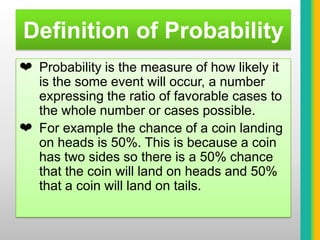
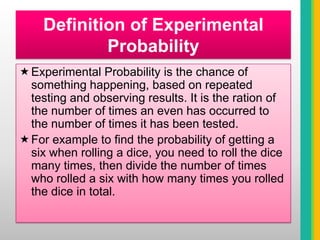
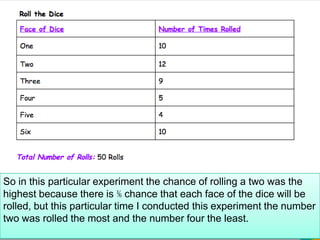
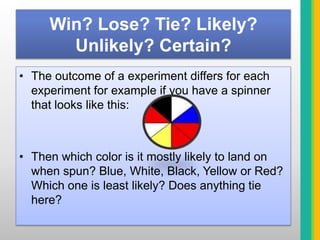
Probability is used to determine the likelihood of events occurring and is calculated by dividing the number of favorable outcomes by the total possible outcomes. It is used in many fields like math, statistics, finance, gambling, and science to analyze experiments and predict outcomes. Experimental probability is determined by repeating tests and observing results to calculate the ratio of times an event occurs to the total number of times tested. Probability helps understand whether outcomes are certain, likely, unlikely, or a tie in experiments with multiple potential results.