Supplier Performance
                                                                 Management, Part II


How are you managing suppliers today?
The forces of globalization are fundamentally changing the way that companies operate and compete, offering both
business opportunities and challenges. The quest for lower-cost sources of supply and the promise of new markets are
driving organizations of all sizes—from large, Fortune 50 enterprises to small Midwest manufacturers—to venture into
the global economy. At the same time, increased competition from emerging markets, a sagging U.S. dollar and
tightening supply markets are quickly erasing the lines between local and global supply chains.
Even as companies seek to sell, compete and secure supply in far-reaching corners of the world, they also must contend
with challenges inherent to the global supply chain. Longer lead times mean that supply chain executives are
recalculating the balancing point between “too Lean” and “too much inventory.” Supply uncertainty is forcing a greater
emphasis on supply chain risk management as a discipline. And the need to negotiate and govern business contracts
across multiple jurisdictions is adding new complexity to the supply management process and prompting procurement
executives to reexamine the skills necessary for managing a global supply base.


In the last issue of Supplier Performance Management, Part I, we outlined the need to view your supplier management
as a program not just a scorecard. By developing a performance management process, you continually drive, measure
and improve your supplier performance.
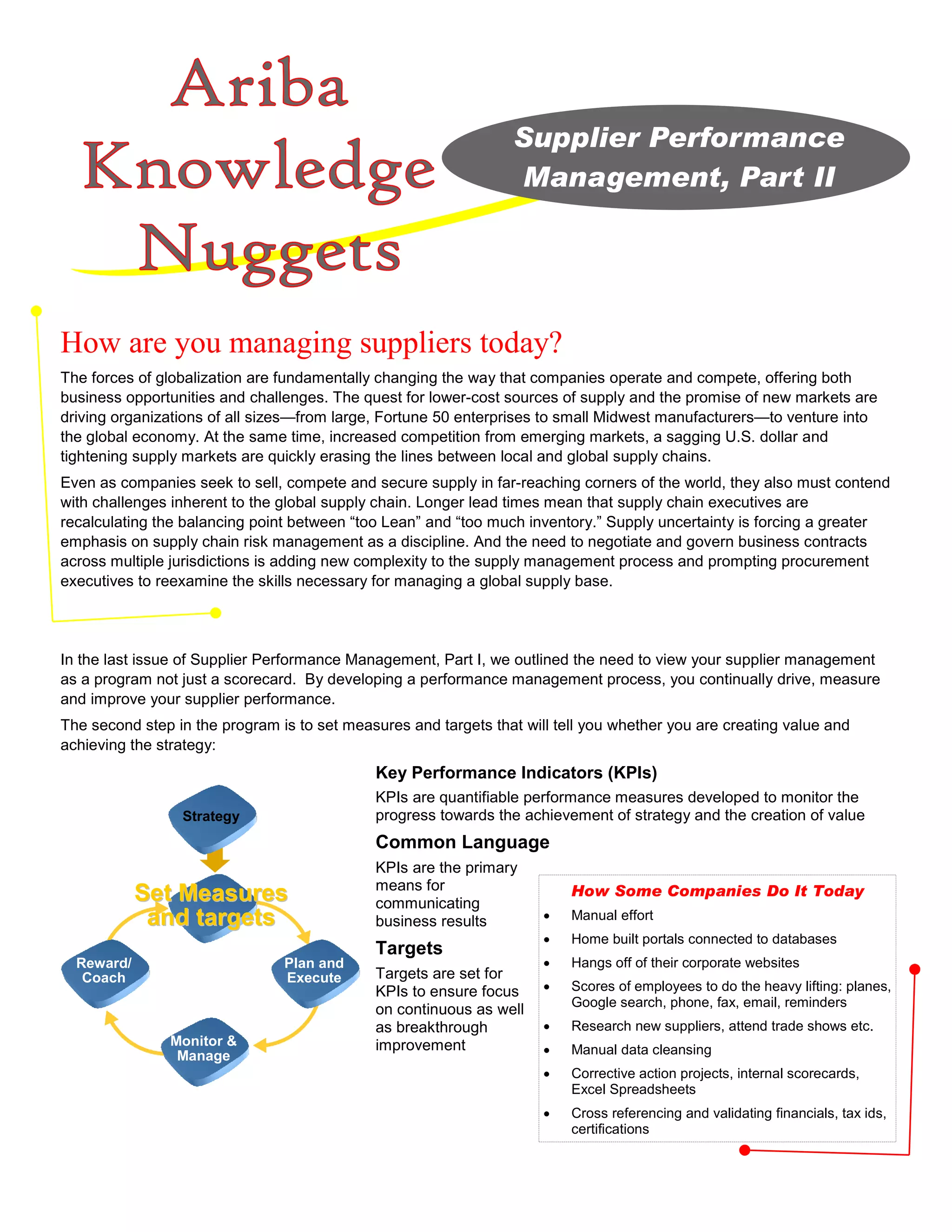
The second step in the program is to set measures and targets that will tell you whether you are creating value and
achieving the strategy:
                                             Key Performance Indicators (KPIs)
                                             KPIs are quantifiable performance measures developed to monitor the
                 Strategy                    progress towards the achievement of strategy and the creation of value
                                             Common Language
                                             KPIs are the primary
                                             means for
            Set Measures                     communicating
                                                                          How Some Companies Do It Today
             and targets                     business results         •   Manual effort
                                                                      •   Home built portals connected to databases
                                             Targets
  Reward/                       Plan and                              •   Hangs off of their corporate websites
   Coach                        Execute      Targets are set for
                                             KPIs to ensure focus     •   Scores of employees to do the heavy lifting: planes,
                                                                          Google search, phone, fax, email, reminders
                                             on continuous as well
                                             as breakthrough          •   Research new suppliers, attend trade shows etc.
               Monitor &                     improvement
                Manage                                                •   Manual data cleansing
                                                                      •   Corrective action projects, internal scorecards,
                                                                          Excel Spreadsheets
                                                                      •   Cross referencing and validating financials, tax ids,
                                                                          certifications
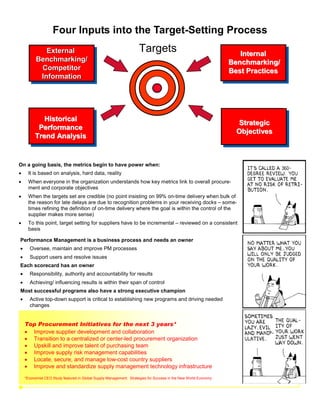
Four Inputs into the Target-Setting Process
             External
              External
                                                                    Targets                                         Internal
          Benchmarking/
          Benchmarking/                                                                                          Benchmarking/
           Competitor
            Competitor                                                                                           Best Practices
           Information
            Information


            Historical
                                                                                                                   Strategic
          Performance
                                                                                                                   Objectives
         Trend Analysis


On a going basis, the metrics begin to have power when:
•     It is based on analysis, hard data, reality
•     When everyone in the organization understands how key metrics link to overall procure-
      ment and corporate objectives
•     When the targets set are credible (no point insisting on 99% on-time delivery when bulk of
      the reason for late delays are due to recognition problems in your receiving docks – some-
      times refining the definition of on-time delivery where the goal is within the control of the
      supplier makes more sense)
•     To this point, target setting for suppliers have to be incremental – reviewed on a consistent
      basis

Performance Management is a business process and needs an owner
•     Oversee, maintain and improve PM processes
•     Support users and resolve issues
Each scorecard has an owner
•     Responsibility, authority and accountability for results
•     Achieving/ influencing results is within their span of control
Most successful programs also have a strong executive champion
•     Active top-down support is critical to establishing new programs and driving needed
      changes


    Top Procurement Initiatives for the next 3 years*
    • Improve supplier development and collaboration
    • Transition to a centralized or center-led procurement organization
    • Upskill and improve talent of purchasing team
    • Improve supply risk management capabilities
    • Locate, secure, and manage low-cost country suppliers
    • Improve and standardize supply management technology infrastructure
    *Economist CEO Study featured in Global Supply Management: Strategies for Success in the New World Economy
The third step in the program is to develop performance plans that will enable the
organization to reach the KPI targets:
Performance Plans
•       Plans established specifically to dictate how quickly KPI targets are achieved. These plans can drive the budgeting
        process
Prioritization of Resources
•       Performance plans help prioritize existing and future initiatives such as implementation of technology, optimization
        of resources, and alignment of business processes


The fourth step in the program is to continuously monitor and evaluate performance
results:
Performance Monitoring and Evaluation
•       The consistent and continuous reporting and feedback of performance results against targets. This monitors the
        effectiveness of performance plans and the ultimate creation of value
Management Discipline
•       Performance Monitoring and Evaluation institutionalizes the performance management program as the primary
        means of dialogue for discussing business results -the common language - and creates management focus on
        important strategic and operational issues


The fifth step in the program is to encourage the desired behavior to achieve performance
results:
Reward and Coach
•       Behavior that is aligned with the achievement of performance targets is rewarded. Actions that are not aligned with
        the optimization of performance results are realigned
Responsibility and Accountability
•       The Reward and Coach process is one of the key enablers that drive responsibility and accountability in the
        organization -thus promoting a performance-centered culture


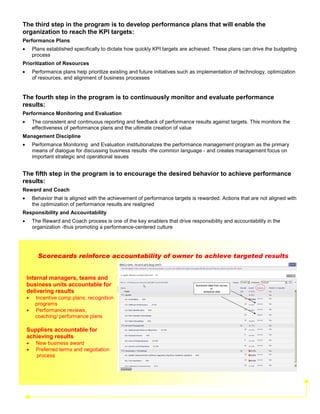
          Scorecards reinforce accountability of owner to achieve targeted results


    Internal managers, teams and
    business units accountable for                                              Scorecard data from survey
                                                                                            or
    delivering results                                                                analytical data

    •    Incentive comp plans, recognition
         programs
    •    Performance reviews,
         coaching/ performance plans

    Suppliers accountable for
    achieving results
    •    New business award
    •    Preferred terms and negotiation
         process

Ariba Knowledge Nuggets: Supplier Performance Management Part 2

  • 1.
    Supplier Performance Management, Part II How are you managing suppliers today? The forces of globalization are fundamentally changing the way that companies operate and compete, offering both business opportunities and challenges. The quest for lower-cost sources of supply and the promise of new markets are driving organizations of all sizes—from large, Fortune 50 enterprises to small Midwest manufacturers—to venture into the global economy. At the same time, increased competition from emerging markets, a sagging U.S. dollar and tightening supply markets are quickly erasing the lines between local and global supply chains. Even as companies seek to sell, compete and secure supply in far-reaching corners of the world, they also must contend with challenges inherent to the global supply chain. Longer lead times mean that supply chain executives are recalculating the balancing point between “too Lean” and “too much inventory.” Supply uncertainty is forcing a greater emphasis on supply chain risk management as a discipline. And the need to negotiate and govern business contracts across multiple jurisdictions is adding new complexity to the supply management process and prompting procurement executives to reexamine the skills necessary for managing a global supply base. In the last issue of Supplier Performance Management, Part I, we outlined the need to view your supplier management as a program not just a scorecard. By developing a performance management process, you continually drive, measure and improve your supplier performance. The second step in the program is to set measures and targets that will tell you whether you are creating value and achieving the strategy: Key Performance Indicators (KPIs) KPIs are quantifiable performance measures developed to monitor the Strategy progress towards the achievement of strategy and the creation of value Common Language KPIs are the primary means for Set Measures communicating How Some Companies Do It Today and targets business results • Manual effort • Home built portals connected to databases Targets Reward/ Plan and • Hangs off of their corporate websites Coach Execute Targets are set for KPIs to ensure focus • Scores of employees to do the heavy lifting: planes, Google search, phone, fax, email, reminders on continuous as well as breakthrough • Research new suppliers, attend trade shows etc. Monitor & improvement Manage • Manual data cleansing • Corrective action projects, internal scorecards, Excel Spreadsheets • Cross referencing and validating financials, tax ids, certifications
  • 2.
    Four Inputs intothe Target-Setting Process External External Targets Internal Benchmarking/ Benchmarking/ Benchmarking/ Competitor Competitor Best Practices Information Information Historical Strategic Performance Objectives Trend Analysis On a going basis, the metrics begin to have power when: • It is based on analysis, hard data, reality • When everyone in the organization understands how key metrics link to overall procure- ment and corporate objectives • When the targets set are credible (no point insisting on 99% on-time delivery when bulk of the reason for late delays are due to recognition problems in your receiving docks – some- times refining the definition of on-time delivery where the goal is within the control of the supplier makes more sense) • To this point, target setting for suppliers have to be incremental – reviewed on a consistent basis Performance Management is a business process and needs an owner • Oversee, maintain and improve PM processes • Support users and resolve issues Each scorecard has an owner • Responsibility, authority and accountability for results • Achieving/ influencing results is within their span of control Most successful programs also have a strong executive champion • Active top-down support is critical to establishing new programs and driving needed changes Top Procurement Initiatives for the next 3 years* • Improve supplier development and collaboration • Transition to a centralized or center-led procurement organization • Upskill and improve talent of purchasing team • Improve supply risk management capabilities • Locate, secure, and manage low-cost country suppliers • Improve and standardize supply management technology infrastructure *Economist CEO Study featured in Global Supply Management: Strategies for Success in the New World Economy
  • 3.
    The third stepin the program is to develop performance plans that will enable the organization to reach the KPI targets: Performance Plans • Plans established specifically to dictate how quickly KPI targets are achieved. These plans can drive the budgeting process Prioritization of Resources • Performance plans help prioritize existing and future initiatives such as implementation of technology, optimization of resources, and alignment of business processes The fourth step in the program is to continuously monitor and evaluate performance results: Performance Monitoring and Evaluation • The consistent and continuous reporting and feedback of performance results against targets. This monitors the effectiveness of performance plans and the ultimate creation of value Management Discipline • Performance Monitoring and Evaluation institutionalizes the performance management program as the primary means of dialogue for discussing business results -the common language - and creates management focus on important strategic and operational issues The fifth step in the program is to encourage the desired behavior to achieve performance results: Reward and Coach • Behavior that is aligned with the achievement of performance targets is rewarded. Actions that are not aligned with the optimization of performance results are realigned Responsibility and Accountability • The Reward and Coach process is one of the key enablers that drive responsibility and accountability in the organization -thus promoting a performance-centered culture Scorecards reinforce accountability of owner to achieve targeted results Internal managers, teams and business units accountable for Scorecard data from survey or delivering results analytical data • Incentive comp plans, recognition programs • Performance reviews, coaching/ performance plans Suppliers accountable for achieving results • New business award • Preferred terms and negotiation process