Argumentative
Essay
Prepared by: Erika Poloan
Objectives
At the end of the lesson the students are
expected to:
A. Identifies the structure of a good
argumentative essay;
B. Compose an argumentative essay
C. Explain the importance of writing an
argumentative essay
Argumentative Essay
An argumentative essay is a
type of essay that presents
arguments about both sides of an
issue.
4
An argumentative essay takes
a strong stance on any given
issue. In addition to the writer's
thoughts and feelings, it makes a
solid case using facts and
evidence to back up its
arguments.
Structure of a Good Argumentative Essay
1. Introductory paragraph - The first paragraph of the
essay must outline the topic, give background information
of the argument, outline the evidence, and state the
thesis.
2. Thesis statement - This is part of your first paragraph. It
is concise, one-sentence summary of your main point and
claim.
6
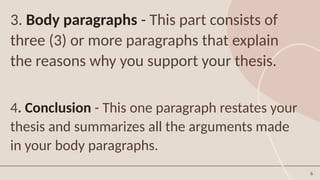
3. Body paragraphs - This part consists of
three (3) or more paragraphs that explain
the reasons why you support your thesis.
4. Conclusion - This one paragraph restates your
thesis and summarizes all the arguments made
in your body paragraphs.
presentation title 7
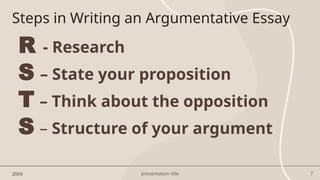
Steps in Writing an Argumentative Essay
20XX
R - Research
S – State your proposition
T – Think about the opposition
S – Structure of your argument
8
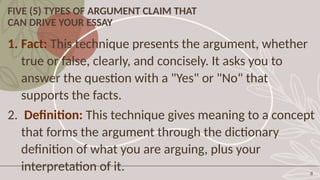
FIVE (5) TYPES OF ARGUMENT CLAIM THAT
CAN DRIVE YOUR ESSAY
1. Fact: This technique presents the argument, whether
true or false, clearly, and concisely. It asks you to
answer the question with a "Yes" or "No" that
supports the facts.
2. Definition: This technique gives meaning to a concept
that forms the argument through the dictionary
definition of what you are arguing, plus your
interpretation of it.
9
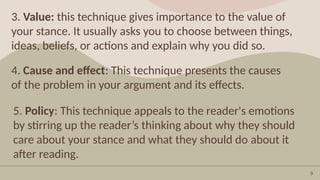
3. Value: this technique gives importance to the value of
your stance. It usually asks you to choose between things,
ideas, beliefs, or actions and explain why you did so.
4. Cause and effect: This technique presents the causes
of the problem in your argument and its effects.
5. Policy: This technique appeals to the reader's emotions
by stirring up the reader’s thinking about why they should
care about your stance and what they should do about it
after reading.
Any of the above argument claims can be presented in
three (3) ways, namely:
1. Classical- This is also called Aristotelian. This is
the most popular strategy for making an argument
because it is the simplest line of thinking.
2. Rogerian- This is also called the "common
ground" argument. The writer acknowledges the
opposing side of the argument with the
assumption you and the readers share common
ideas, beliefs, and arguments.
11
3. Toulmin- Present your claim,
present grounds to back up that
claim, and justify that the grounds
are linked to the claim.
The key to a good
argumentative essay is
knowing how to structure
your point of view correctly.
13
ACTIVITY
Group 1: Does homework help kids learn?
Group 2: Should kids get paid for getting
good grades?
Directions: Compose an argumentative essay using this information I provided for you,
and identify its part.
14
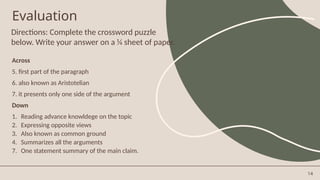
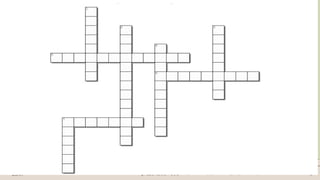
Directions: Complete the crossword puzzle
below. Write your answer on a ¼ sheet of paper.
Evaluation
Across
5. first part of the paragraph
6. also known as Aristotelian
7. it presents only one side of the argument
Down
1. Reading advance knowldege on the topic
2. Expressing opposite views
3. Also known as common ground
4. Summarizes all the arguments
7. One statement summary of the main claim.
presentation title 15
20XX
Click icon to add picture
presentation title 16
From the given topics and arguments, choose one topic, and write an
argumentative essay
about it. Please be guided with the following criteria in writing your
essay.
(Content 20 points, Organization 15 points, Mechanics 15 points)
Topics Arguments
1.Cancel culture
What is your stand about cancel culture?
2. Rise of Digital Entertainment platforms
Are the Filipinos ready to shift from "free to air" to "digital media?
3. Gas Lighting
Are victims always wrong?
20XX
ASSIGNMENT
Thank you
Prepared By:
Poloan, Erika S.

Argumentative Essay ppt grade 10 en.pptx

  • 1.
  • 2.
    Objectives At the endof the lesson the students are expected to: A. Identifies the structure of a good argumentative essay; B. Compose an argumentative essay C. Explain the importance of writing an argumentative essay
  • 3.
    Argumentative Essay An argumentativeessay is a type of essay that presents arguments about both sides of an issue.
  • 4.
    4 An argumentative essaytakes a strong stance on any given issue. In addition to the writer's thoughts and feelings, it makes a solid case using facts and evidence to back up its arguments.
  • 5.
    Structure of aGood Argumentative Essay 1. Introductory paragraph - The first paragraph of the essay must outline the topic, give background information of the argument, outline the evidence, and state the thesis. 2. Thesis statement - This is part of your first paragraph. It is concise, one-sentence summary of your main point and claim.
  • 6.
    6 3. Body paragraphs- This part consists of three (3) or more paragraphs that explain the reasons why you support your thesis. 4. Conclusion - This one paragraph restates your thesis and summarizes all the arguments made in your body paragraphs.
  • 7.
    presentation title 7 Stepsin Writing an Argumentative Essay 20XX R - Research S – State your proposition T – Think about the opposition S – Structure of your argument
  • 8.
    8 FIVE (5) TYPESOF ARGUMENT CLAIM THAT CAN DRIVE YOUR ESSAY 1. Fact: This technique presents the argument, whether true or false, clearly, and concisely. It asks you to answer the question with a "Yes" or "No" that supports the facts. 2. Definition: This technique gives meaning to a concept that forms the argument through the dictionary definition of what you are arguing, plus your interpretation of it.
  • 9.
    9 3. Value: thistechnique gives importance to the value of your stance. It usually asks you to choose between things, ideas, beliefs, or actions and explain why you did so. 4. Cause and effect: This technique presents the causes of the problem in your argument and its effects. 5. Policy: This technique appeals to the reader's emotions by stirring up the reader’s thinking about why they should care about your stance and what they should do about it after reading.
  • 10.
    Any of theabove argument claims can be presented in three (3) ways, namely: 1. Classical- This is also called Aristotelian. This is the most popular strategy for making an argument because it is the simplest line of thinking. 2. Rogerian- This is also called the "common ground" argument. The writer acknowledges the opposing side of the argument with the assumption you and the readers share common ideas, beliefs, and arguments.
  • 11.
    11 3. Toulmin- Presentyour claim, present grounds to back up that claim, and justify that the grounds are linked to the claim.
  • 12.
    The key toa good argumentative essay is knowing how to structure your point of view correctly.
  • 13.
    13 ACTIVITY Group 1: Doeshomework help kids learn? Group 2: Should kids get paid for getting good grades? Directions: Compose an argumentative essay using this information I provided for you, and identify its part.
  • 14.
    14 Directions: Complete thecrossword puzzle below. Write your answer on a ¼ sheet of paper. Evaluation Across 5. first part of the paragraph 6. also known as Aristotelian 7. it presents only one side of the argument Down 1. Reading advance knowldege on the topic 2. Expressing opposite views 3. Also known as common ground 4. Summarizes all the arguments 7. One statement summary of the main claim.
  • 15.
  • 16.
    presentation title 16 Fromthe given topics and arguments, choose one topic, and write an argumentative essay about it. Please be guided with the following criteria in writing your essay. (Content 20 points, Organization 15 points, Mechanics 15 points) Topics Arguments 1.Cancel culture What is your stand about cancel culture? 2. Rise of Digital Entertainment platforms Are the Filipinos ready to shift from "free to air" to "digital media? 3. Gas Lighting Are victims always wrong? 20XX ASSIGNMENT
  • 17.