1
Arduino Tutorial #3
- Measuring the light -
Dong Ho Son
POSTECH
Pohang, Korea
donghoson@postech.ac.kr
2
Measuring the light - Overview
 Sensor: Analog  Digital
• Analog : continuous
• Digital : discrete
 Photoresistor (or Light-Dependent Resistor, LDR)
• A light-controlled variable resistor
• The resistance increases/decreases according to the brightness
 Let’s configure the circuit
• The brightness of the LED is changed according to the brightness of the
environment
• If dark, the LED also would be dark
• If bright, the LED also would be bright
source: wikimedia.org
3
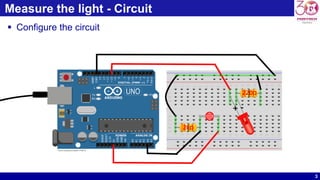
Measure the light - Circuit
 Configure the circuit
+-
2kΩ
220Ω
Source: pixabay.com/photo-2168193
4
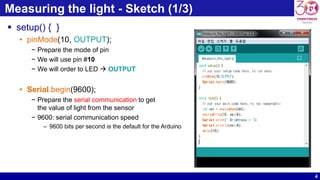
Measuring the light - Sketch (1/3)
 setup() { }
• pinMode(10, OUTPUT);
− Prepare the mode of pin
− We will use pin #10
− We will order to LED  OUTPUT
• Serial.begin(9600);
− Prepare the serial communication to get
the value of light from the sensor
− 9600: serial communication speed
– 9600 bits per second is the default for the Arduino
5
Measuring the light - Sketch (2/3)
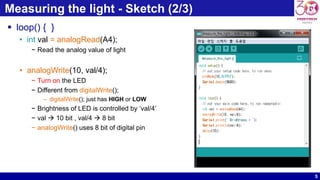
 loop() { }
• int val = analogRead(A4);
− Read the analog value of light
• analogWrite(10, val/4);
− Turn on the LED
− Different from digitalWrite();
– digitalWrite(); just has HIGH or LOW
− Brightness of LED is controlled by ‘val/4’
− val  10 bit , val/4  8 bit
− analogWrite() uses 8 bit of digital pin
6
Measuring the light - Sketch (3/3)
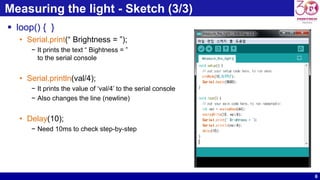
 loop() { }
• Serial.print(“ Brightness = ”);
− It prints the text “ Bightness = ”
to the serial console
• Serial.println(val/4);
− It prints the value of ‘val/4’ to the serial console
− Also changes the line (newline)
• Delay(10);
− Need 10ms to check step-by-step
7
Measuring the light - Result
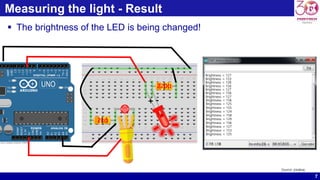
 The brightness of the LED is being changed!
+-
Brightness = 127
Brightness = 153
Brightness = 128
Brightness = 156
Brightness = 127
Brightness = 156
Brightness = 127
Brightness = 156
Brightness = 125
Brightness = 155
Brightness = 124
Brightness = 158
Brightness = 129
Brightness = 156
Brightness = 127
Brightness = 153
Brightness = 125
Source: pixabay
2kΩ
220Ω
Source: pixabay.com/photo-2168193

Arduino tutorial #3

  • 1.
    1 Arduino Tutorial #3 -Measuring the light - Dong Ho Son POSTECH Pohang, Korea donghoson@postech.ac.kr
  • 2.
    2 Measuring the light- Overview  Sensor: Analog  Digital • Analog : continuous • Digital : discrete  Photoresistor (or Light-Dependent Resistor, LDR) • A light-controlled variable resistor • The resistance increases/decreases according to the brightness  Let’s configure the circuit • The brightness of the LED is changed according to the brightness of the environment • If dark, the LED also would be dark • If bright, the LED also would be bright source: wikimedia.org
  • 3.
    3 Measure the light- Circuit  Configure the circuit +- 2kΩ 220Ω Source: pixabay.com/photo-2168193
  • 4.
    4 Measuring the light- Sketch (1/3)  setup() { } • pinMode(10, OUTPUT); − Prepare the mode of pin − We will use pin #10 − We will order to LED  OUTPUT • Serial.begin(9600); − Prepare the serial communication to get the value of light from the sensor − 9600: serial communication speed – 9600 bits per second is the default for the Arduino
  • 5.
    5 Measuring the light- Sketch (2/3)  loop() { } • int val = analogRead(A4); − Read the analog value of light • analogWrite(10, val/4); − Turn on the LED − Different from digitalWrite(); – digitalWrite(); just has HIGH or LOW − Brightness of LED is controlled by ‘val/4’ − val  10 bit , val/4  8 bit − analogWrite() uses 8 bit of digital pin
  • 6.
    6 Measuring the light- Sketch (3/3)  loop() { } • Serial.print(“ Brightness = ”); − It prints the text “ Bightness = ” to the serial console • Serial.println(val/4); − It prints the value of ‘val/4’ to the serial console − Also changes the line (newline) • Delay(10); − Need 10ms to check step-by-step
  • 7.
    7 Measuring the light- Result  The brightness of the LED is being changed! +- Brightness = 127 Brightness = 153 Brightness = 128 Brightness = 156 Brightness = 127 Brightness = 156 Brightness = 127 Brightness = 156 Brightness = 125 Brightness = 155 Brightness = 124 Brightness = 158 Brightness = 129 Brightness = 156 Brightness = 127 Brightness = 153 Brightness = 125 Source: pixabay 2kΩ 220Ω Source: pixabay.com/photo-2168193