Art in the 3 rd  Dimension:  Architecture Reading: Artforms , 189-205 Terms/Concepts: function, form, structure, compression, stretching, bending, post and beam, arch, keystone, arcade, vault, barrel vault, groin vault, dome, squinch, pendentive, buttress, pier buttress, flying buttress, coffer.
Key Issue for Every Building 1. Function: how the building is used. 2. Form: how the building looks. 3. Structure: how the building stands up.
Architecture: Art and Science “ As an  art , architecture both  creates interior spaces  and wraps them in an  expressive shape .” “ As a  science , architecture is a physical problem: How does a structure  hold up its own weight  and loads placed on it” --Patrick Frank,  Artforms , 189.
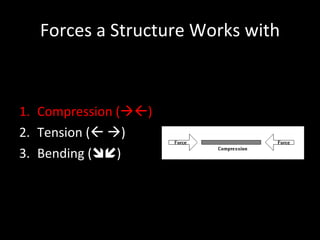
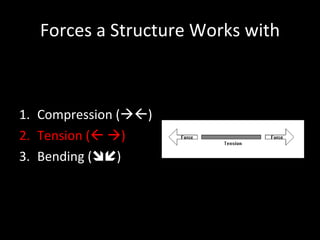
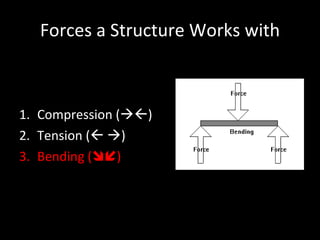
Forces a Structure Works with Compression (  ) Tension (     ) Bending (  )
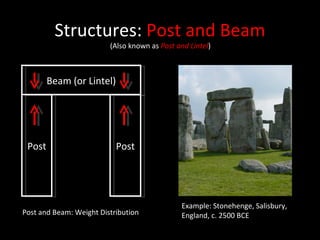
Structures:  Post and Beam (Also known as  Post and Lintel ) Example: Stonehenge, Salisbury, England, c. 2500 BCE Post and Beam: Weight Distribution Beam (or Lintel) Post Post
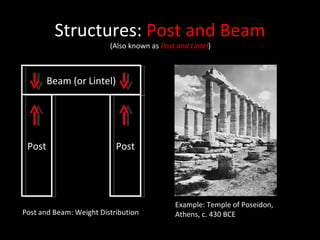
Structures:  Post and Beam (Also known as  Post and Lintel ) Example: Temple of Poseidon, Athens, c. 430 BCE  Post and Beam: Weight Distribution Beam (or Lintel) Post Post
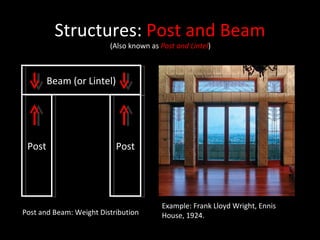
Structures:  Post and Beam (Also known as  Post and Lintel ) Example: Frank Lloyd Wright, Ennis House, 1924.  Post and Beam: Weight Distribution Beam (or Lintel) Post Post
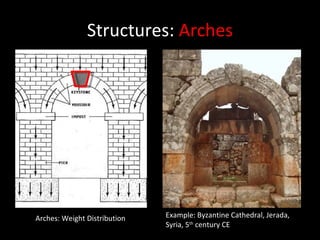
Structures:  Arches Arches: Weight Distribution Example: Byzantine Cathedral, Jerada, Syria, 5 th  century CE
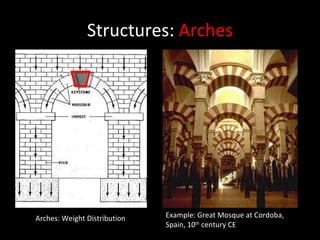
Structures:  Arches Arches: Weight Distribution Example: Great Mosque at Cordoba, Spain, 10 th  century CE
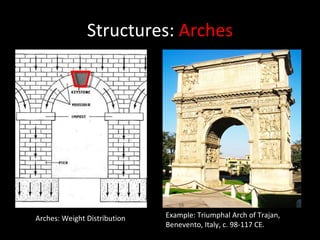
Structures:  Arches Arches: Weight Distribution Example: Triumphal Arch of Trajan, Benevento, Italy, c. 98-117 CE.
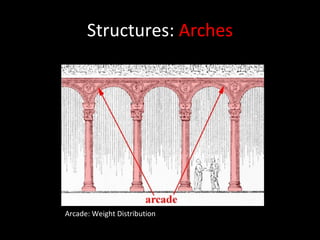
Structures:  Arches Arcade: Weight Distribution
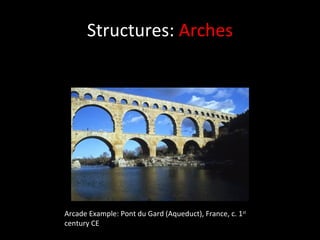
Structures:  Arches Arcade Example: Pont du Gard (Aqueduct), France, c. 1 st  century CE
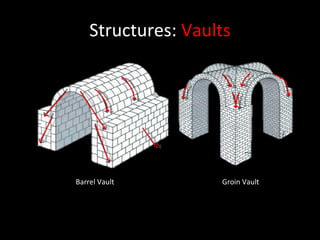
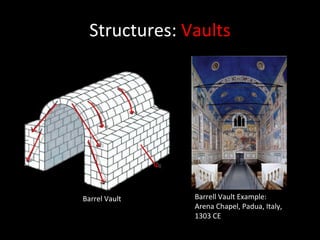
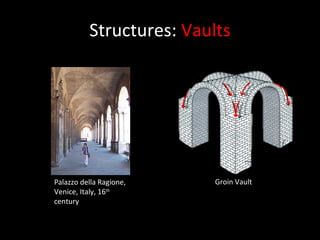
Structures:  Vaults Barrel Vault Groin Vault
Structures:  Vaults Barrel Vault Barrell Vault Example: Arena Chapel, Padua, Italy, 1303 CE
Structures:  Vaults Groin Vault Palazzo della Ragione, Venice, Italy, 16 th  century
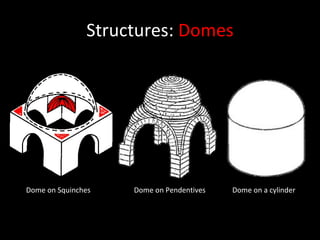
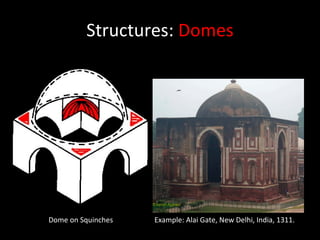
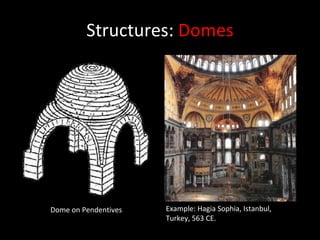
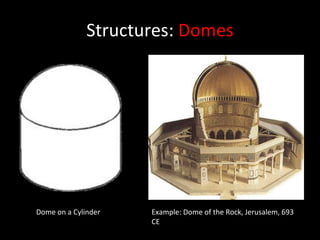
Structures:  Domes Dome on Squinches Dome on Pendentives Dome on a cylinder
Structures:  Domes Dome on Squinches Example: Alai Gate, New Delhi, India, 1311.
Structures:  Domes Dome on Pendentives Example: Hagia Sophia, Istanbul, Turkey, 563 CE.
Structures:  Domes Dome on a Cylinder Example: Dome of the Rock, Jerusalem, 693 CE
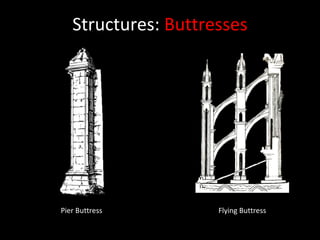
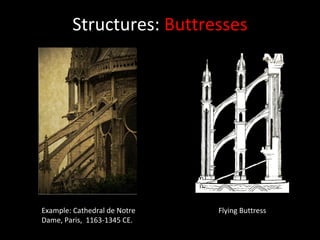
Structures:  Buttresses Pier Buttress Flying Buttress
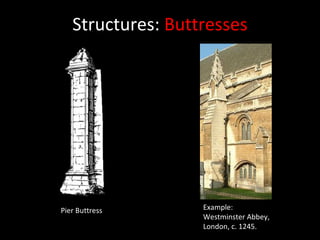
Structures:  Buttresses Pier Buttress Example: Westminster Abbey, London, c. 1245.
Structures:  Buttresses Flying Buttress Example: Cathedral de Notre Dame, Paris,  1163-1345 CE.
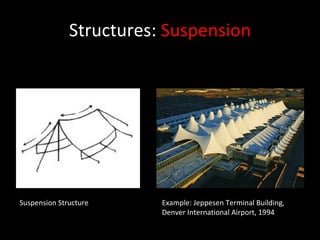
Structures:  Suspension Suspension Structure Example: Jeppesen Terminal Building, Denver International Airport, 1994
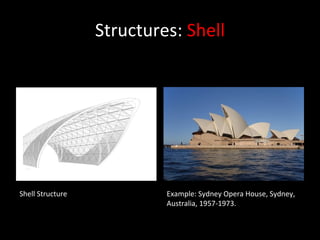
Structures:  Shell Shell Structure Example: Sydney Opera House, Sydney, Australia, 1957-1973.
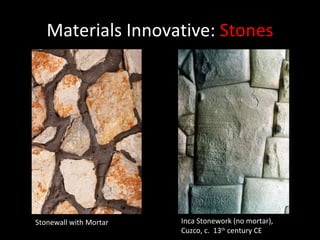
Materials Innovative:  Stones Inca Stonework (no mortar), Cuzco, c.  13 th  century CE Stonewall with Mortar
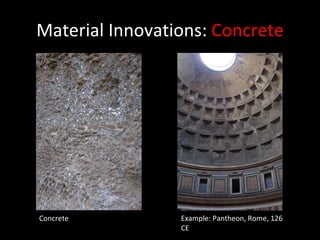
Material Innovations:  Concrete Concrete Example: Pantheon, Rome, 126 CE
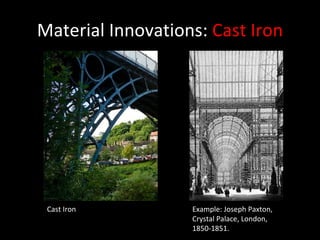
Material Innovations:  Cast Iron Cast Iron Example: Joseph Paxton, Crystal Palace, London, 1850-1851.
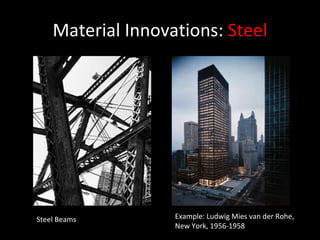
Material Innovations:  Steel Steel Beams Example: Ludwig Mies van der Rohe,  New York, 1956-1958
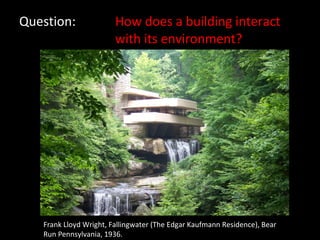
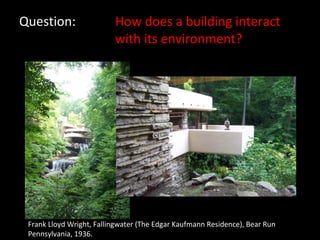
Question: How does a building interact  with its environment? Frank Lloyd Wright, Fallingwater (The Edgar Kaufmann Residence), Bear Run Pennsylvania, 1936.
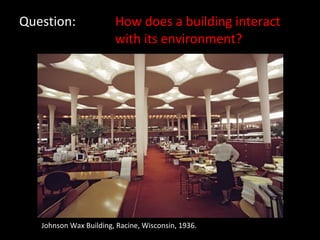
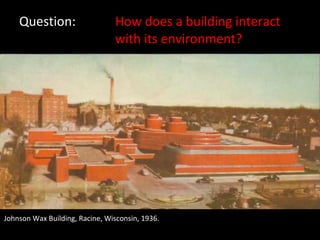
Question: How does a building interact  with its environment? Johnson Wax Building, Racine, Wisconsin, 1936.
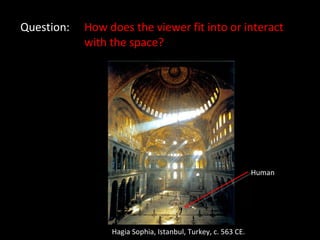
Question: How does the viewer fit into or interact  with the space? Hagia Sophia, Istanbul, Turkey, c. 563 CE. Human
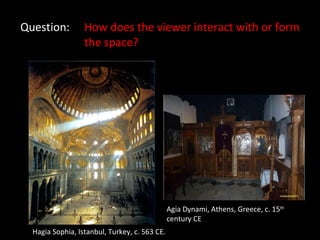
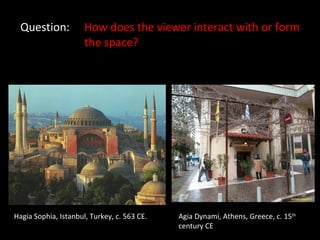
Question: How does the viewer interact with or form  the space? Hagia Sophia, Istanbul, Turkey, c. 563 CE. Agia Dynami, Athens, Greece, c. 15 th  century CE
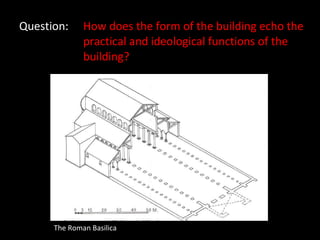
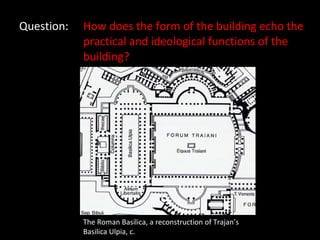
Question: How does the form of the building echo the  practical and ideological functions of the  building? The Roman Basilica
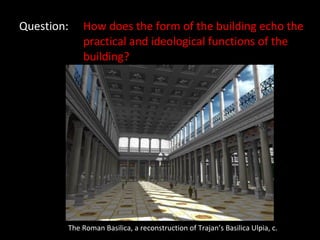
Question: How does the form of the building echo the  practical and ideological functions of the  building? The Roman Basilica, a reconstruction of Trajan’s Basilica Ulpia, c.
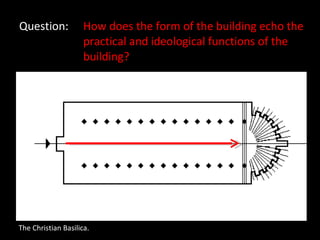
Question: How does the form of the building echo the  practical and ideological functions of the  building? The Christian Basilica.
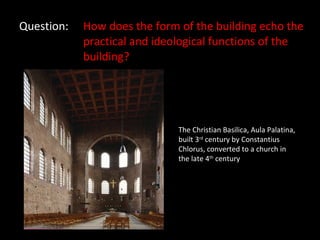
Question: How does the form of the building echo the  practical and ideological functions of the  building? The Christian Basilica, Aula Palatina, built 3 rd  century by Constantius Chlorus, converted to a church in the late 4 th  century
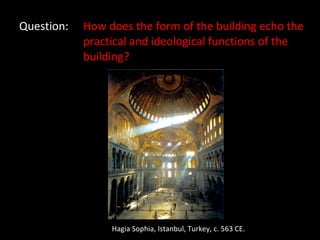
Question: How does the form of the building echo the  practical and ideological functions of the  building? Hagia Sophia, Istanbul, Turkey, c. 563 CE.
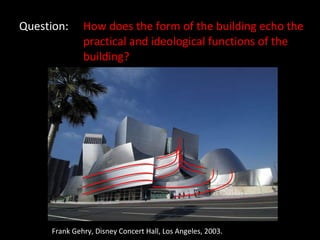
Question: How does the form of the building echo the  practical and ideological functions of the  building? Frank Gehry, Disney Concert Hall, Los Angeles, 2003.
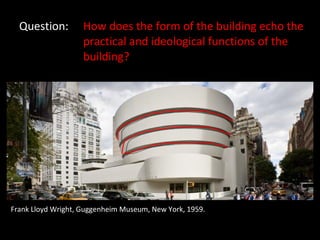
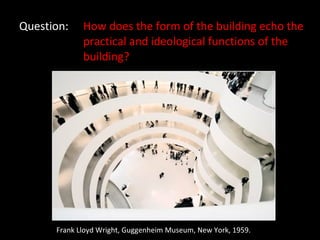
Question: How does the form of the building echo the  practical and ideological functions of the  building? Frank Lloyd Wright, Guggenheim Museum, New York, 1959.

Architecture upload

  • 1.
    Art in the3 rd Dimension: Architecture Reading: Artforms , 189-205 Terms/Concepts: function, form, structure, compression, stretching, bending, post and beam, arch, keystone, arcade, vault, barrel vault, groin vault, dome, squinch, pendentive, buttress, pier buttress, flying buttress, coffer.
  • 2.
    Key Issue forEvery Building 1. Function: how the building is used. 2. Form: how the building looks. 3. Structure: how the building stands up.
  • 3.
    Key Issue forEvery Building 1. Function: how the building is used. 2. Form: how the building looks. 3. Structure: how the building stands up.
  • 4.
    Architecture: Art andScience “ As an art , architecture both creates interior spaces and wraps them in an expressive shape .” “ As a science , architecture is a physical problem: How does a structure hold up its own weight and loads placed on it” --Patrick Frank, Artforms , 189.
  • 5.
    Forces a StructureWorks with Compression (  ) Tension (   ) Bending (  )
  • 6.
    Forces a StructureWorks with Compression (  ) Tension (   ) Bending (  )
  • 7.
    Forces a StructureWorks with Compression (  ) Tension (   ) Bending (  )
  • 8.
    Structures: Postand Beam (Also known as Post and Lintel ) Example: Stonehenge, Salisbury, England, c. 2500 BCE Post and Beam: Weight Distribution Beam (or Lintel) Post Post
  • 9.
    Structures: Postand Beam (Also known as Post and Lintel ) Example: Temple of Poseidon, Athens, c. 430 BCE Post and Beam: Weight Distribution Beam (or Lintel) Post Post
  • 10.
    Structures: Postand Beam (Also known as Post and Lintel ) Example: Frank Lloyd Wright, Ennis House, 1924. Post and Beam: Weight Distribution Beam (or Lintel) Post Post
  • 11.
    Structures: ArchesArches: Weight Distribution Example: Byzantine Cathedral, Jerada, Syria, 5 th century CE
  • 12.
    Structures: ArchesArches: Weight Distribution Example: Great Mosque at Cordoba, Spain, 10 th century CE
  • 13.
    Structures: ArchesArches: Weight Distribution Example: Triumphal Arch of Trajan, Benevento, Italy, c. 98-117 CE.
  • 14.
    Structures: ArchesArcade: Weight Distribution
  • 15.
    Structures: ArchesArcade Example: Pont du Gard (Aqueduct), France, c. 1 st century CE
  • 16.
    Structures: VaultsBarrel Vault Groin Vault
  • 17.
    Structures: VaultsBarrel Vault Barrell Vault Example: Arena Chapel, Padua, Italy, 1303 CE
  • 18.
    Structures: VaultsGroin Vault Palazzo della Ragione, Venice, Italy, 16 th century
  • 19.
    Structures: DomesDome on Squinches Dome on Pendentives Dome on a cylinder
  • 20.
    Structures: DomesDome on Squinches Example: Alai Gate, New Delhi, India, 1311.
  • 21.
    Structures: DomesDome on Pendentives Example: Hagia Sophia, Istanbul, Turkey, 563 CE.
  • 22.
    Structures: DomesDome on a Cylinder Example: Dome of the Rock, Jerusalem, 693 CE
  • 23.
    Structures: ButtressesPier Buttress Flying Buttress
  • 24.
    Structures: ButtressesPier Buttress Example: Westminster Abbey, London, c. 1245.
  • 25.
    Structures: ButtressesFlying Buttress Example: Cathedral de Notre Dame, Paris, 1163-1345 CE.
  • 26.
    Structures: SuspensionSuspension Structure Example: Jeppesen Terminal Building, Denver International Airport, 1994
  • 27.
    Structures: ShellShell Structure Example: Sydney Opera House, Sydney, Australia, 1957-1973.
  • 28.
    Materials Innovative: Stones Inca Stonework (no mortar), Cuzco, c. 13 th century CE Stonewall with Mortar
  • 29.
    Material Innovations: Concrete Concrete Example: Pantheon, Rome, 126 CE
  • 30.
    Material Innovations: Cast Iron Cast Iron Example: Joseph Paxton, Crystal Palace, London, 1850-1851.
  • 31.
    Material Innovations: Steel Steel Beams Example: Ludwig Mies van der Rohe, New York, 1956-1958
  • 32.
    Question: How doesa building interact with its environment? Frank Lloyd Wright, Fallingwater (The Edgar Kaufmann Residence), Bear Run Pennsylvania, 1936.
  • 33.
    Question: How doesa building interact with its environment? Frank Lloyd Wright, Fallingwater (The Edgar Kaufmann Residence), Bear Run Pennsylvania, 1936.
  • 34.
    Question: How doesa building interact with its environment? Johnson Wax Building, Racine, Wisconsin, 1936.
  • 35.
    Question: How doesa building interact with its environment? Johnson Wax Building, Racine, Wisconsin, 1936.
  • 36.
    Question: How doesthe viewer fit into or interact with the space? Hagia Sophia, Istanbul, Turkey, c. 563 CE. Human
  • 37.
    Question: How doesthe viewer interact with or form the space? Hagia Sophia, Istanbul, Turkey, c. 563 CE. Agia Dynami, Athens, Greece, c. 15 th century CE
  • 38.
    Question: How doesthe viewer interact with or form the space? Hagia Sophia, Istanbul, Turkey, c. 563 CE. Agia Dynami, Athens, Greece, c. 15 th century CE
  • 39.
    Question: How doesthe form of the building echo the practical and ideological functions of the building? The Roman Basilica
  • 40.
    Question: How doesthe form of the building echo the practical and ideological functions of the building? The Roman Basilica, a reconstruction of Trajan’s Basilica Ulpia, c.
  • 41.
    Question: How doesthe form of the building echo the practical and ideological functions of the building? The Roman Basilica, a reconstruction of Trajan’s Basilica Ulpia, c.
  • 42.
    Question: How doesthe form of the building echo the practical and ideological functions of the building? The Christian Basilica.
  • 43.
    Question: How doesthe form of the building echo the practical and ideological functions of the building? The Christian Basilica, Aula Palatina, built 3 rd century by Constantius Chlorus, converted to a church in the late 4 th century
  • 44.
    Question: How doesthe form of the building echo the practical and ideological functions of the building? Hagia Sophia, Istanbul, Turkey, c. 563 CE.
  • 45.
    Question: How doesthe form of the building echo the practical and ideological functions of the building? Frank Gehry, Disney Concert Hall, Los Angeles, 2003.
  • 46.
    Question: How doesthe form of the building echo the practical and ideological functions of the building? Frank Lloyd Wright, Guggenheim Museum, New York, 1959.
  • 47.
    Question: How doesthe form of the building echo the practical and ideological functions of the building? Frank Lloyd Wright, Guggenheim Museum, New York, 1959.

Editor's Notes

  • #12 A masonry arch 1. Keystone 2. Voussoir 3. Extrados 4. Impost 5. Intrados 6. Rise 7. Clear span 8. Abutment
  • #13 A masonry arch 1. Keystone 2. Voussoir 3. Extrados 4. Impost 5. Intrados 6. Rise 7. Clear span 8. Abutment
  • #14 A masonry arch 1. Keystone 2. Voussoir 3. Extrados 4. Impost 5. Intrados 6. Rise 7. Clear span 8. Abutment
  • #15 A masonry arch 1. Keystone 2. Voussoir 3. Extrados 4. Impost 5. Intrados 6. Rise 7. Clear span 8. Abutment
  • #16 A masonry arch 1. Keystone 2. Voussoir 3. Extrados 4. Impost 5. Intrados 6. Rise 7. Clear span 8. Abutment
  • #30 The first form of concrete. Devised by the Romans over two thousand years ago some of their concrete structures and buildings are still standing so it is also the longest lasting form of concrete.