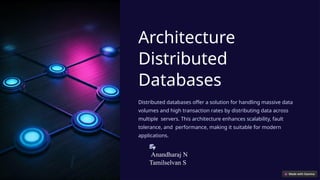
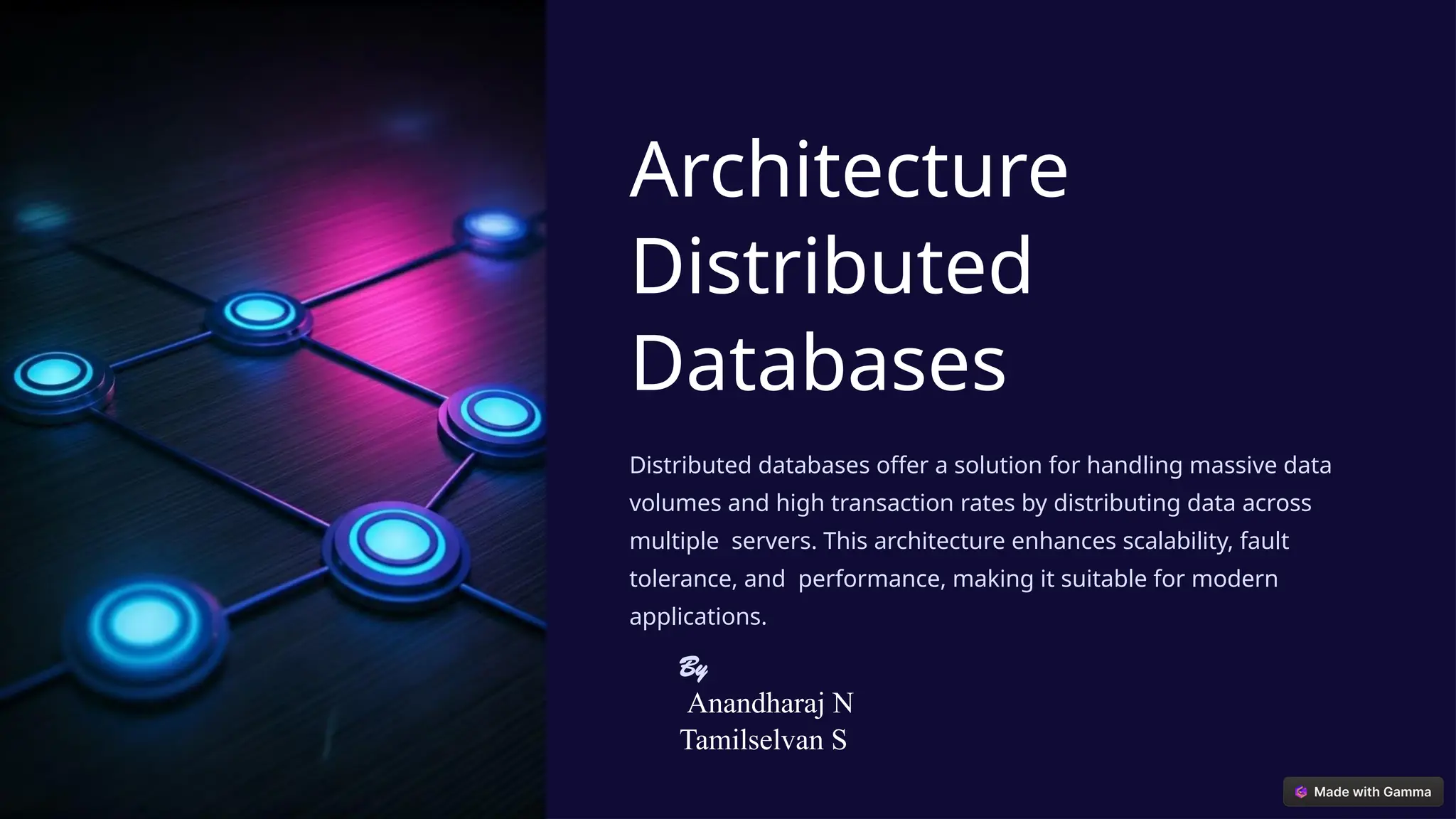
Architecture
Distributed
Databases
Distributed databases offer a solution for handling massive data
volumes and high transaction rates by distributing data across
multiple servers. This architecture enhances scalability, fault
tolerance, and performance, making it suitable for modern
applications.
By
Anandharaj N
Tamilselvan S
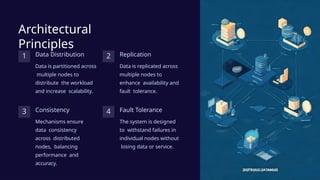
Architectural
Principles
1 Data Distribution
Data is partitioned across
multiple nodes to
distribute the workload
and increase scalability.
2 Replication
Data is replicated across
multiple nodes to
enhance availability and
fault tolerance.
3 Consistency
Mechanisms ensure
data consistency
across distributed
nodes, balancing
performance and
accuracy.
4 Fault Tolerance
The system is designed
to withstand failures in
individual nodes without
losing data or service.
Data Partitioning and Replication
Strategies
Partitioning
Techniques
Hash partitioning distributes
data based on a hash function,
ensuring even distribution.
Range partitioning divides data
based on a range of values,
facilitating efficient queries
within a range.
Replication
Techniques
Master-slave replication designates
a primary node for updates and
secondary nodes for read
operations.
Multi-master replication
allows updates on multiple
nodes, enhancing
performance and
availability.
Consideration
s
Partitioning and replication
strategies need to be carefully
chosen based on application
requirements, data characteristics,
and performance goals.
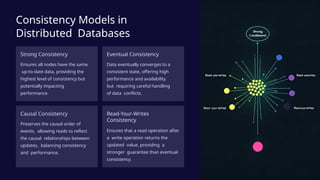
Consistency Models in
Distributed Databases
Strong Consistency
Ensures all nodes have the same
up-to-date data, providing the
highest level of consistency but
potentially impacting
performance.
Eventual Consistency
Data eventually converges to a
consistent state, offering high
performance and availability
but requiring careful handling
of data conflicts.
Causal Consistency
Preserves the causal order of
events, allowing reads to reflect
the causal relationships between
updates, balancing consistency
and performance.
Read-Your-Writes
Consistency
Ensures that a read operation after
a write operation returns the
updated value, providing a
stronger guarantee than eventual
consistency.
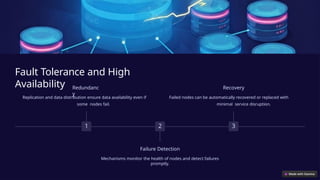
Fault Tolerance and High
Availability
1
Redundanc
y
Replication and data distribution ensure data availability even if
some nodes fail.
2
Failure Detection
Mechanisms monitor the health of nodes and detect failures
promptly.
3
Recovery
Failed nodes can be automatically recovered or replaced with
minimal service disruption.
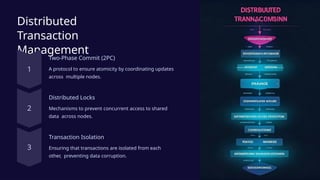
Distributed
Transaction
Management
Two-Phase Commit (2PC)
A protocol to ensure atomicity by coordinating updates
across multiple nodes.
Distributed Locks
Mechanisms to prevent concurrent access to shared
data across nodes.
Transaction Isolation
Ensuring that transactions are isolated from each
other, preventing data corruption.
Distributed Query Processing and
Optimization
Data
Locality
Routing queries to nodes containing the relevant
data.
Query
Fragmentation
Breaking down a complex query into smaller
subqueries that can be processed independently.
Parallel
Execution
Executing subqueries in parallel across multiple
nodes to speed up query processing.
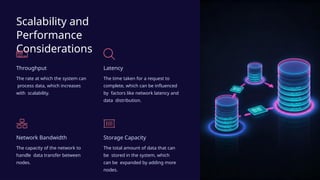
Scalability and
Performance
Considerations
Throughput
The rate at which the system can
process data, which increases
with scalability.
Latency
The time taken for a request to
complete, which can be influenced
by factors like network latency and
data distribution.
Network Bandwidth
The capacity of the network to
handle data transfer between
nodes.
Storage Capacity
The total amount of data that can
be stored in the system, which
can be expanded by adding more
nodes.
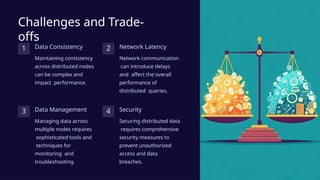
Challenges and Trade-
offs
1 Data Consistency
Maintaining consistency
across distributed nodes
can be complex and
impact performance.
2 Network Latency
Network communication
can introduce delays
and affect the overall
performance of
distributed queries.
3 Data Management
Managing data across
multiple nodes requires
sophisticated tools and
techniques for
monitoring and
troubleshooting.
4 Security
Securing distributed data
requires comprehensive
security measures to
prevent unauthorized
access and data
breaches.
Emerging Trends and
Future Directions
1 Cloud-Native Databases
Leveraging cloud
infrastructure for scalability,
flexibility, and cost
optimization.
2 Edge Computing
Processing data closer to
its source to reduce
latency and improve real-
time responsiveness.
3 Serverless Architecture
Offloading database
management tasks to
cloud providers,
simplifying development
and operations.
4 Blockchain Integration
Utilizing blockchain
technology for secure and
transparent data storage
and transaction
management.

Architecture Distributed Database Management System

  • 1.
    Architecture Distributed Databases Distributed databases offera solution for handling massive data volumes and high transaction rates by distributing data across multiple servers. This architecture enhances scalability, fault tolerance, and performance, making it suitable for modern applications. By Anandharaj N Tamilselvan S
  • 2.
    Architectural Principles 1 Data Distribution Datais partitioned across multiple nodes to distribute the workload and increase scalability. 2 Replication Data is replicated across multiple nodes to enhance availability and fault tolerance. 3 Consistency Mechanisms ensure data consistency across distributed nodes, balancing performance and accuracy. 4 Fault Tolerance The system is designed to withstand failures in individual nodes without losing data or service.
  • 3.
    Data Partitioning andReplication Strategies Partitioning Techniques Hash partitioning distributes data based on a hash function, ensuring even distribution. Range partitioning divides data based on a range of values, facilitating efficient queries within a range. Replication Techniques Master-slave replication designates a primary node for updates and secondary nodes for read operations. Multi-master replication allows updates on multiple nodes, enhancing performance and availability. Consideration s Partitioning and replication strategies need to be carefully chosen based on application requirements, data characteristics, and performance goals.
  • 4.
    Consistency Models in DistributedDatabases Strong Consistency Ensures all nodes have the same up-to-date data, providing the highest level of consistency but potentially impacting performance. Eventual Consistency Data eventually converges to a consistent state, offering high performance and availability but requiring careful handling of data conflicts. Causal Consistency Preserves the causal order of events, allowing reads to reflect the causal relationships between updates, balancing consistency and performance. Read-Your-Writes Consistency Ensures that a read operation after a write operation returns the updated value, providing a stronger guarantee than eventual consistency.
  • 5.
    Fault Tolerance andHigh Availability 1 Redundanc y Replication and data distribution ensure data availability even if some nodes fail. 2 Failure Detection Mechanisms monitor the health of nodes and detect failures promptly. 3 Recovery Failed nodes can be automatically recovered or replaced with minimal service disruption.
  • 6.
    Distributed Transaction Management Two-Phase Commit (2PC) Aprotocol to ensure atomicity by coordinating updates across multiple nodes. Distributed Locks Mechanisms to prevent concurrent access to shared data across nodes. Transaction Isolation Ensuring that transactions are isolated from each other, preventing data corruption.
  • 7.
    Distributed Query Processingand Optimization Data Locality Routing queries to nodes containing the relevant data. Query Fragmentation Breaking down a complex query into smaller subqueries that can be processed independently. Parallel Execution Executing subqueries in parallel across multiple nodes to speed up query processing.
  • 8.
    Scalability and Performance Considerations Throughput The rateat which the system can process data, which increases with scalability. Latency The time taken for a request to complete, which can be influenced by factors like network latency and data distribution. Network Bandwidth The capacity of the network to handle data transfer between nodes. Storage Capacity The total amount of data that can be stored in the system, which can be expanded by adding more nodes.
  • 9.
    Challenges and Trade- offs 1Data Consistency Maintaining consistency across distributed nodes can be complex and impact performance. 2 Network Latency Network communication can introduce delays and affect the overall performance of distributed queries. 3 Data Management Managing data across multiple nodes requires sophisticated tools and techniques for monitoring and troubleshooting. 4 Security Securing distributed data requires comprehensive security measures to prevent unauthorized access and data breaches.
  • 10.
    Emerging Trends and FutureDirections 1 Cloud-Native Databases Leveraging cloud infrastructure for scalability, flexibility, and cost optimization. 2 Edge Computing Processing data closer to its source to reduce latency and improve real- time responsiveness. 3 Serverless Architecture Offloading database management tasks to cloud providers, simplifying development and operations. 4 Blockchain Integration Utilizing blockchain technology for secure and transparent data storage and transaction management.