Big Data Management
and NoSQL Databases
Lecture 4. Basic Principles
Doc. RNDr. Irena Holubova, Ph.D.
holubova@ksi.mff.cuni.cz
http://www.ksi.mff.cuni.cz/~holubova/NDBI040/
NDBI040
NoSQL Overview
 Main objective: implement distributed state
 Different objects stored on different servers
 Same object replicated on different servers
 Main idea: give up some of the ACID
 To improve performance
 Simple interface:
 Write (=Put): needs to write all replicas
 Read (=Get): may get only one
 Strong consistency → eventual consistency
Basic Principles
 Scalability
How to handle growing amounts of data
without losing performance
 CAP theorem
 Distribution models
Sharding, replication, consistency, …
How to handle data in a distributed manner
Scalability
Vertical Scaling (scaling up)
 Traditional choice has been in favour of strong
consistency
 System architects have in the past gone in favour of scaling up
(vertical scaling)
 Involves larger and more powerful machines
 Works in many cases but…
 Vendor lock-in
 Not everyone makes large and powerful machines
 Who do, often use proprietary formats
 Makes a customer dependent on a vendor for products and
services
 Unable to use another vendor
Scalability
Vertical Scaling (scaling up)
 Higher costs
 Powerful machines usually cost a lot more than commodity
hardware
 Data growth perimeter
 Powerful and large machines work well until the data grows to fill
it
 Even the largest of machines has a limit
 Proactive provisioning
 Applications have no idea of the final large scale when they start
out
 Scaling vertically = you need to budget for large scale upfront
Scalability
Horizontal Scaling (scaling out)
 Systems are distributed across multiple machines or
nodes (horizontal scaling)
 Commodity machines, cost effective
 Often surpasses scalability of vertical approach
 Fallacies of distributed computing:
 The network is reliable
 Latency is zero
 Bandwidth is infinite
 The network is secure
 Topology does not change
 There is one administrator
 Transport cost is zero
 The network is homogeneous
https://blogs.oracle.com/jag/resource/Fallacies.html
CAP Theorem
Consistency
 After an update, all readers in a distributed system see
the same data
 All nodes are supposed to contain the same data at all
times
 Example:
 A single database instance is always consistent
 If multiple instances exist, all writes must be duplicated before
write operation is completed
CAP Theorem
Availability
 All requests (reads, writes) are always answered,
regardless crashes
 Example:
 A single instance has an availability of 100% or 0%
 Two servers may be available 100%, 50%, or 0%
Partition Tolerance
 System continues to operate, even if two sets of servers
get isolated
 Example:
 Failed connection will not cause troubles if the system is tolerant
CAP Theorem
ACID vs. BASE
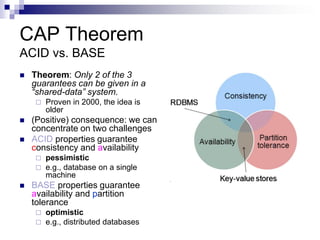
 Theorem: Only 2 of the 3
guarantees can be given in a
“shared-data” system.
 Proven in 2000, the idea is
older
 (Positive) consequence: we can
concentrate on two challenges
 ACID properties guarantee
consistency and availability
 pessimistic
 e.g., database on a single
machine
 BASE properties guarantee
availability and partition
tolerance
 optimistic
 e.g., distributed databases
CAP Theorem
Criticism
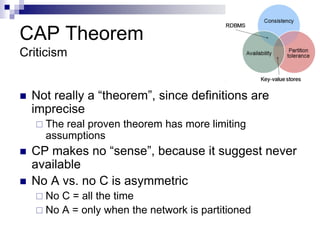
 Not really a “theorem”, since definitions are
imprecise
 The real proven theorem has more limiting
assumptions
 CP makes no “sense”, because it suggest never
available
 No A vs. no C is asymmetric
 No C = all the time
 No A = only when the network is partitioned
CAP Theorem
Consistency
 A single-server system is a CA system
 Clusters have to be tolerant of network partitions
 CAP theorem: you can only get two out of three
 Reality: you can trade off a little Consistency to get
some Availability
 It is not a binary decision
BASE
 In contrast to ACID
 Leads to levels of scalability that cannot be obtained with ACID
 At the cost of (strong) consistency
Basically Available
 The system works basically all the time
 Partial failures can occur, but without total system failure
Soft State
 The system is in flux and non-deterministic
 Changes occur all the time
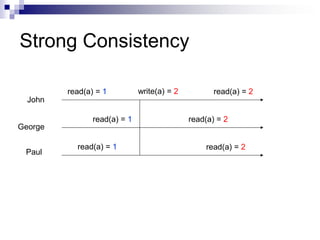
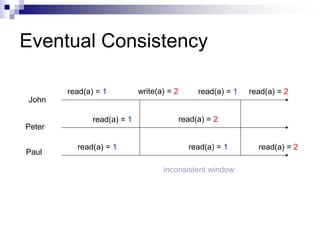
Eventual Consistency
 The system will be in some consistent state
 At some time in future
Strong Consistency
John
George
Paul
read(a) = 1
read(a) = 1
read(a) = 1
write(a) = 2 read(a) = 2
read(a) = 2
read(a) = 2
Eventual Consistency
John
Peter
Paul
read(a) = 1
read(a) = 1
read(a) = 1
write(a) = 2 read(a) = 1
read(a) = 1
read(a) = 2
inconsistent window
read(a) = 2
read(a) = 2
Distribution Models
 Scaling out = running the database on a cluster
of servers
 Two orthogonal techniques to data distribution:
 Replication – takes the same data and copies it over
multiple nodes
 Master-slave or peer-to-peer
 Sharding – puts different data on different nodes
 We can use either or combine them
Distribution Models
Single Server
 No distribution at all
 Run the database on a single machine
 It can make sense to use NoSQL with a single-
server distribution model
 Graph databases
 The graph is “almost” complete → it is difficult to distribute it
Distribution Models
Sharding
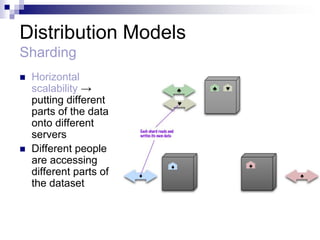
 Horizontal
scalability →
putting different
parts of the data
onto different
servers
 Different people
are accessing
different parts of
the dataset
Distribution Models
Sharding
 The ideal case is rare
 To get close to it we have to ensure that data that is
accessed together is clumped together
 How to arrange the nodes:
a. One user mostly gets data from a single server
b. Based on a physical location
c. Distributed across the nodes with equal amounts of the load
 Many NoSQL databases offer auto-sharding
 A node failure makes shard’s data unavailable
 Sharding is often combined with replication
Distribution Models
Master-slave Replication
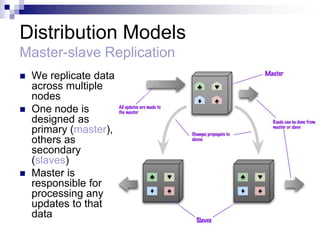
 We replicate data
across multiple
nodes
 One node is
designed as
primary (master),
others as
secondary
(slaves)
 Master is
responsible for
processing any
updates to that
data
Distribution Models
Master-slave Replication
 For scaling a read-intensive dataset
 More read requests → more slave nodes
 The master fails → the slaves can still handle read
requests
 A slave can be appointed a new master quickly (it is a
replica)
 Limited by the ability of the master to process
updates
 Masters are appointed manually or automatically
 User-defined vs. cluster-elected
Distribution Models
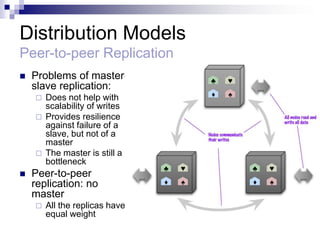
Peer-to-peer Replication
 Problems of master-
slave replication:
 Does not help with
scalability of writes
 Provides resilience
against failure of a
slave, but not of a
master
 The master is still a
bottleneck
 Peer-to-peer
replication: no
master
 All the replicas have
equal weight
Distribution Models
Peer-to-peer Replication
 Problem: consistency
 We can write at two different places: a write-write
conflict
 Solutions:
 Whenever we write data, the replicas coordinate to
ensure we avoid a conflict
 At the cost of network traffic
 But we do not need all the replicas to agree on the
write, just a majority
Distribution Models
Combining Sharding and Replication
 Master-slave replication and sharding:
 We have multiple masters, but each data item only
has a single master
 A node can be a master for some data and a slave for
others
 Peer-to-peer replication and sharding:
 A common strategy for column-family databases
 A good starting point for peer-to-peer replication is to
have a replication factor of 3, so each shard is
present on three nodes
Consistency
Write (update) Consistency
 Problem: two users want to update the same
record (write-write conflict)
 Issue: lost update
 Pessimistic (preventing conflicts from occurring)
vs. optimistic solutions (lets conflicts occur, but
detects them and takes actions to sort them out)
 Write locks, conditional update, save both updates
and record that they are in conflict, …
Consistency
Read Consistency
 Problem: one user reads, other writes (read-write
conflict)
 Issue: inconsistent read
 Relational databases support the notion of transactions
 NoSQL databases support atomic updates within a
single aggregate
 But not all data can be put in the same aggregate
 Update that affects multiple aggregates leaves open a
time when clients could perform an inconsistent read
 Inconsistency window
 Another issue: replication consistency
 A special type of inconsistency in case of replication
 Ensuring that the same data item has the same value when read
from different replicas
Consistency
Quorums
 How many nodes need to be involved to get strong
consistency?
 Write quorum: W > N/2
 N = the number of nodes involved in replication (replication
factor)
 W = the number of nodes participating in the write
 The number of nodes confirming successful write
 “If you have conflicting writes, only one can get a majority.”
 How many nodes you need to contact to be sure you
have the most up-to-date change?
 Read quorum: R + W > N
 R = the number of nodes we need to contact for a read
 „Concurrent read and write cannot happen.“
References
 http://nosql-database.org/
 Pramod J. Sadalage – Martin Fowler: NoSQL Distilled:
A Brief Guide to the Emerging World of Polyglot
Persistence
 Eric Redmond – Jim R. Wilson: Seven Databases in
Seven Weeks: A Guide to Modern Databases and the
NoSQL Movement
 Sherif Sakr – Eric Pardede: Graph Data Management:
Techniques and Applications
 Shashank Tiwari: Professional NoSQL

Lecture-04-Principles of data management.pdf

  • 1.
    Big Data Management andNoSQL Databases Lecture 4. Basic Principles Doc. RNDr. Irena Holubova, Ph.D. holubova@ksi.mff.cuni.cz http://www.ksi.mff.cuni.cz/~holubova/NDBI040/ NDBI040
  • 2.
    NoSQL Overview  Mainobjective: implement distributed state  Different objects stored on different servers  Same object replicated on different servers  Main idea: give up some of the ACID  To improve performance  Simple interface:  Write (=Put): needs to write all replicas  Read (=Get): may get only one  Strong consistency → eventual consistency
  • 3.
    Basic Principles  Scalability Howto handle growing amounts of data without losing performance  CAP theorem  Distribution models Sharding, replication, consistency, … How to handle data in a distributed manner
  • 4.
    Scalability Vertical Scaling (scalingup)  Traditional choice has been in favour of strong consistency  System architects have in the past gone in favour of scaling up (vertical scaling)  Involves larger and more powerful machines  Works in many cases but…  Vendor lock-in  Not everyone makes large and powerful machines  Who do, often use proprietary formats  Makes a customer dependent on a vendor for products and services  Unable to use another vendor
  • 5.
    Scalability Vertical Scaling (scalingup)  Higher costs  Powerful machines usually cost a lot more than commodity hardware  Data growth perimeter  Powerful and large machines work well until the data grows to fill it  Even the largest of machines has a limit  Proactive provisioning  Applications have no idea of the final large scale when they start out  Scaling vertically = you need to budget for large scale upfront
  • 6.
    Scalability Horizontal Scaling (scalingout)  Systems are distributed across multiple machines or nodes (horizontal scaling)  Commodity machines, cost effective  Often surpasses scalability of vertical approach  Fallacies of distributed computing:  The network is reliable  Latency is zero  Bandwidth is infinite  The network is secure  Topology does not change  There is one administrator  Transport cost is zero  The network is homogeneous https://blogs.oracle.com/jag/resource/Fallacies.html
  • 7.
    CAP Theorem Consistency  Afteran update, all readers in a distributed system see the same data  All nodes are supposed to contain the same data at all times  Example:  A single database instance is always consistent  If multiple instances exist, all writes must be duplicated before write operation is completed
  • 8.
    CAP Theorem Availability  Allrequests (reads, writes) are always answered, regardless crashes  Example:  A single instance has an availability of 100% or 0%  Two servers may be available 100%, 50%, or 0% Partition Tolerance  System continues to operate, even if two sets of servers get isolated  Example:  Failed connection will not cause troubles if the system is tolerant
  • 9.
    CAP Theorem ACID vs.BASE  Theorem: Only 2 of the 3 guarantees can be given in a “shared-data” system.  Proven in 2000, the idea is older  (Positive) consequence: we can concentrate on two challenges  ACID properties guarantee consistency and availability  pessimistic  e.g., database on a single machine  BASE properties guarantee availability and partition tolerance  optimistic  e.g., distributed databases
  • 10.
    CAP Theorem Criticism  Notreally a “theorem”, since definitions are imprecise  The real proven theorem has more limiting assumptions  CP makes no “sense”, because it suggest never available  No A vs. no C is asymmetric  No C = all the time  No A = only when the network is partitioned
  • 11.
    CAP Theorem Consistency  Asingle-server system is a CA system  Clusters have to be tolerant of network partitions  CAP theorem: you can only get two out of three  Reality: you can trade off a little Consistency to get some Availability  It is not a binary decision
  • 12.
    BASE  In contrastto ACID  Leads to levels of scalability that cannot be obtained with ACID  At the cost of (strong) consistency Basically Available  The system works basically all the time  Partial failures can occur, but without total system failure Soft State  The system is in flux and non-deterministic  Changes occur all the time Eventual Consistency  The system will be in some consistent state  At some time in future
  • 13.
    Strong Consistency John George Paul read(a) =1 read(a) = 1 read(a) = 1 write(a) = 2 read(a) = 2 read(a) = 2 read(a) = 2
  • 14.
    Eventual Consistency John Peter Paul read(a) =1 read(a) = 1 read(a) = 1 write(a) = 2 read(a) = 1 read(a) = 1 read(a) = 2 inconsistent window read(a) = 2 read(a) = 2
  • 15.
    Distribution Models  Scalingout = running the database on a cluster of servers  Two orthogonal techniques to data distribution:  Replication – takes the same data and copies it over multiple nodes  Master-slave or peer-to-peer  Sharding – puts different data on different nodes  We can use either or combine them
  • 16.
    Distribution Models Single Server No distribution at all  Run the database on a single machine  It can make sense to use NoSQL with a single- server distribution model  Graph databases  The graph is “almost” complete → it is difficult to distribute it
  • 17.
    Distribution Models Sharding  Horizontal scalability→ putting different parts of the data onto different servers  Different people are accessing different parts of the dataset
  • 18.
    Distribution Models Sharding  Theideal case is rare  To get close to it we have to ensure that data that is accessed together is clumped together  How to arrange the nodes: a. One user mostly gets data from a single server b. Based on a physical location c. Distributed across the nodes with equal amounts of the load  Many NoSQL databases offer auto-sharding  A node failure makes shard’s data unavailable  Sharding is often combined with replication
  • 19.
    Distribution Models Master-slave Replication We replicate data across multiple nodes  One node is designed as primary (master), others as secondary (slaves)  Master is responsible for processing any updates to that data
  • 20.
    Distribution Models Master-slave Replication For scaling a read-intensive dataset  More read requests → more slave nodes  The master fails → the slaves can still handle read requests  A slave can be appointed a new master quickly (it is a replica)  Limited by the ability of the master to process updates  Masters are appointed manually or automatically  User-defined vs. cluster-elected
  • 21.
    Distribution Models Peer-to-peer Replication Problems of master- slave replication:  Does not help with scalability of writes  Provides resilience against failure of a slave, but not of a master  The master is still a bottleneck  Peer-to-peer replication: no master  All the replicas have equal weight
  • 22.
    Distribution Models Peer-to-peer Replication Problem: consistency  We can write at two different places: a write-write conflict  Solutions:  Whenever we write data, the replicas coordinate to ensure we avoid a conflict  At the cost of network traffic  But we do not need all the replicas to agree on the write, just a majority
  • 23.
    Distribution Models Combining Shardingand Replication  Master-slave replication and sharding:  We have multiple masters, but each data item only has a single master  A node can be a master for some data and a slave for others  Peer-to-peer replication and sharding:  A common strategy for column-family databases  A good starting point for peer-to-peer replication is to have a replication factor of 3, so each shard is present on three nodes
  • 24.
    Consistency Write (update) Consistency Problem: two users want to update the same record (write-write conflict)  Issue: lost update  Pessimistic (preventing conflicts from occurring) vs. optimistic solutions (lets conflicts occur, but detects them and takes actions to sort them out)  Write locks, conditional update, save both updates and record that they are in conflict, …
  • 25.
    Consistency Read Consistency  Problem:one user reads, other writes (read-write conflict)  Issue: inconsistent read  Relational databases support the notion of transactions  NoSQL databases support atomic updates within a single aggregate  But not all data can be put in the same aggregate  Update that affects multiple aggregates leaves open a time when clients could perform an inconsistent read  Inconsistency window  Another issue: replication consistency  A special type of inconsistency in case of replication  Ensuring that the same data item has the same value when read from different replicas
  • 26.
    Consistency Quorums  How manynodes need to be involved to get strong consistency?  Write quorum: W > N/2  N = the number of nodes involved in replication (replication factor)  W = the number of nodes participating in the write  The number of nodes confirming successful write  “If you have conflicting writes, only one can get a majority.”  How many nodes you need to contact to be sure you have the most up-to-date change?  Read quorum: R + W > N  R = the number of nodes we need to contact for a read  „Concurrent read and write cannot happen.“
  • 27.
    References  http://nosql-database.org/  PramodJ. Sadalage – Martin Fowler: NoSQL Distilled: A Brief Guide to the Emerging World of Polyglot Persistence  Eric Redmond – Jim R. Wilson: Seven Databases in Seven Weeks: A Guide to Modern Databases and the NoSQL Movement  Sherif Sakr – Eric Pardede: Graph Data Management: Techniques and Applications  Shashank Tiwari: Professional NoSQL