CONFIDENTIAL | © 2017 TM Forum | Page 1
Architectural Best Practice
(Extract of Slides)
Brian Levy
Strategic Advisor
CONFIDENTIAL | © 2017 TM Forum | Page 2
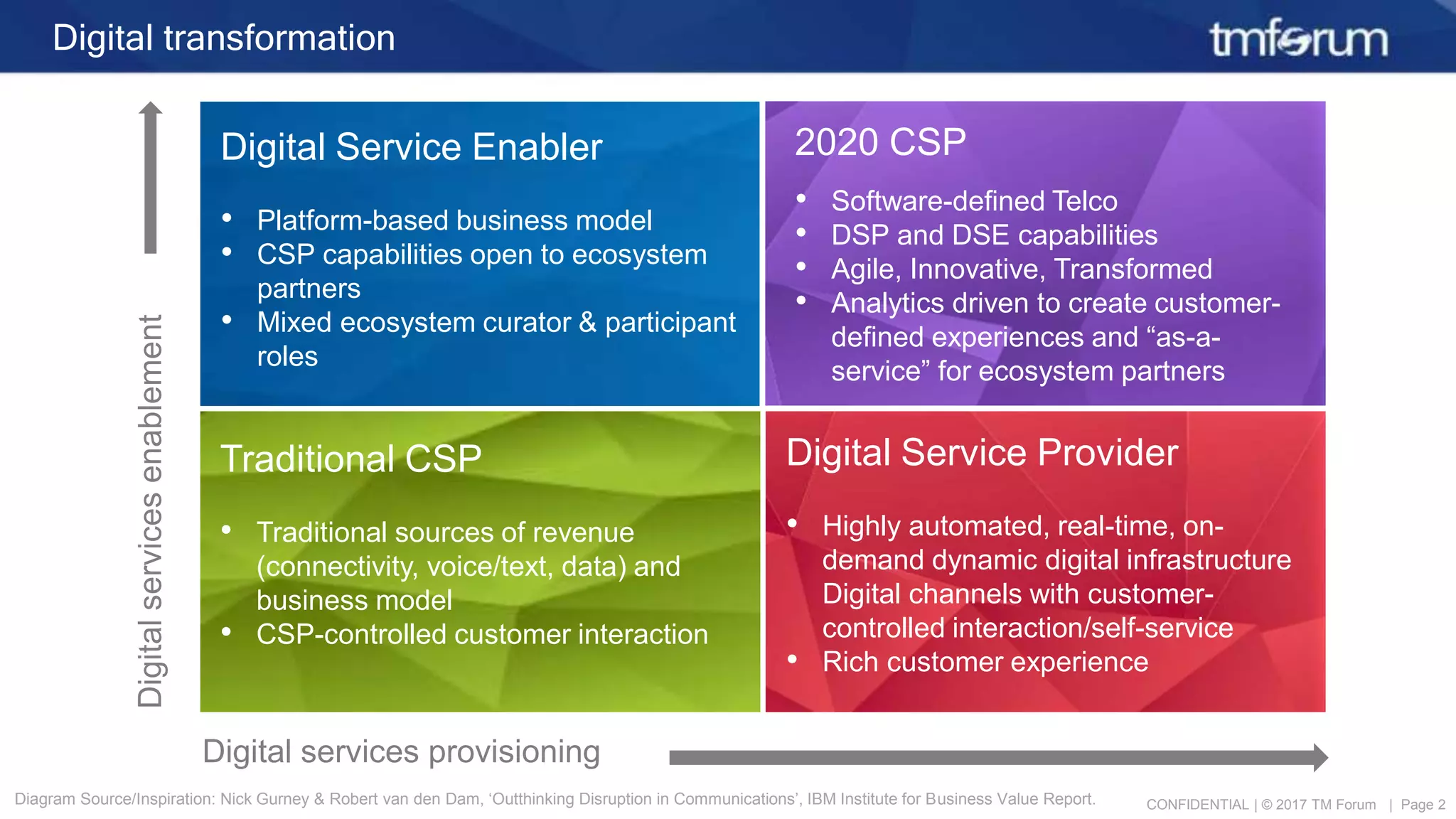
Digital transformation
Diagram Source/Inspiration: Nick Gurney & Robert van den Dam, ‘Outthinking Disruption in Communications’, IBM Institute for Business Value Report.
Digital Service Enabler
• Platform-based business model
• CSP capabilities open to ecosystem
partners
• Mixed ecosystem curator & participant
roles
2020 CSP
• Software-defined Telco
• DSP and DSE capabilities
• Agile, Innovative, Transformed
• Analytics driven to create customer-
defined experiences and “as-a-
service” for ecosystem partners
Traditional CSP
• Traditional sources of revenue
(connectivity, voice/text, data) and
business model
• CSP-controlled customer interaction
Digital Service Provider
• Highly automated, real-time, on-
demand dynamic digital infrastructure
Digital channels with customer-
controlled interaction/self-service
• Rich customer experience
Digital services provisioning
Digitalservicesenablement
CONFIDENTIAL | © 2017 TM Forum | Page 3
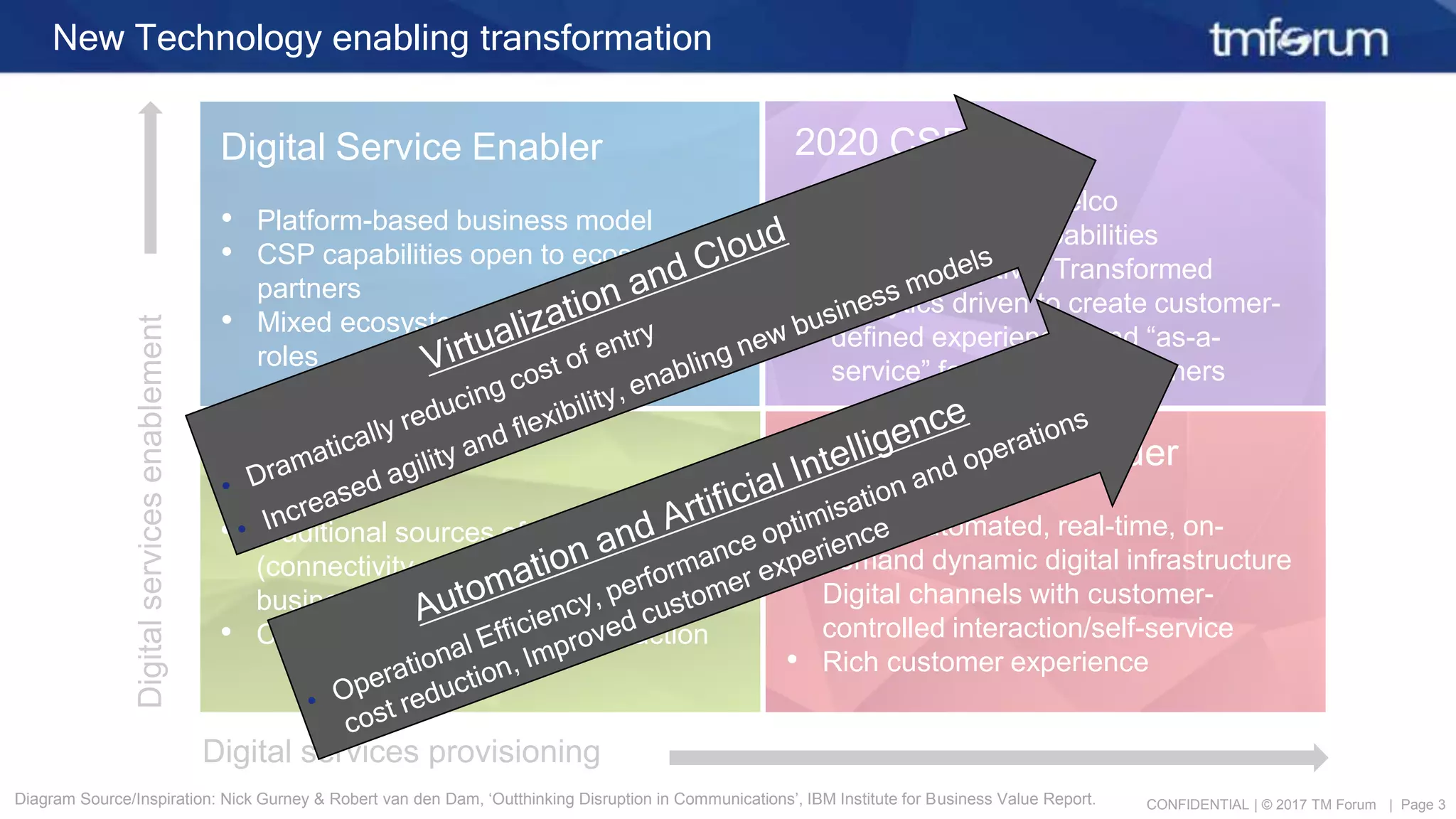
New Technology enabling transformation
Diagram Source/Inspiration: Nick Gurney & Robert van den Dam, ‘Outthinking Disruption in Communications’, IBM Institute for Business Value Report.
Digital Service Enabler
• Platform-based business model
• CSP capabilities open to ecosystem
partners
• Mixed ecosystem curator & participant
roles
2020 CSP
• Software-defined Telco
• DSP and DSE capabilities
• Agile, Innovative, Transformed
• Analytics driven to create customer-
defined experiences and “as-a-
service” for ecosystem partners
Traditional CSP
• Traditional sources of revenue
(connectivity, voice/text, data) and
business model
• CSP-controlled customer interaction
Digital Service Provider
• Highly automated, real-time, on-
demand dynamic digital infrastructure
Digital channels with customer-
controlled interaction/self-service
• Rich customer experience
Digital services provisioning
Digitalservicesenablement
CONFIDENTIAL | © 2017 TM Forum | Page 4
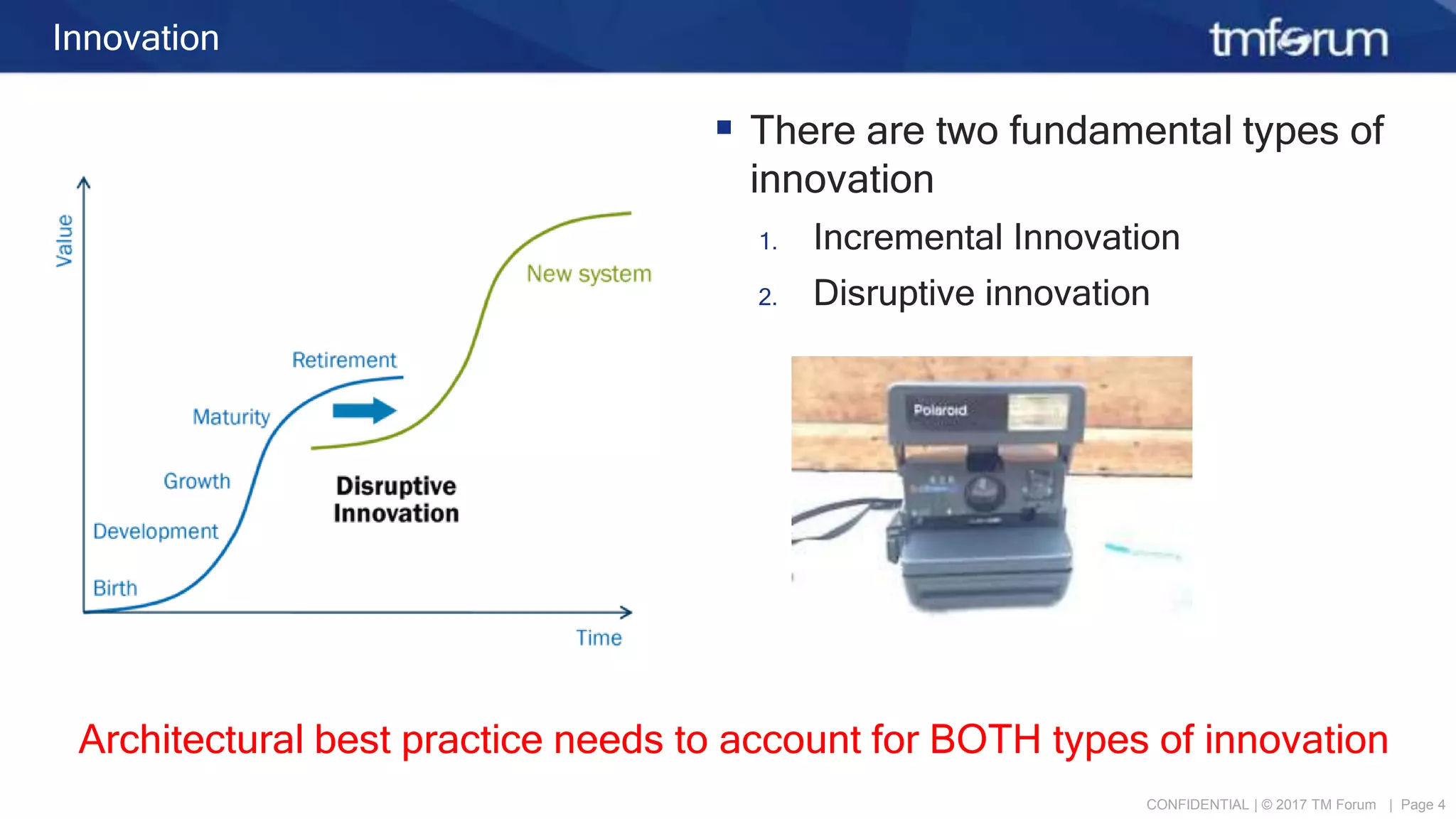
Innovation
 There are two fundamental types of
innovation
1. Incremental Innovation
2. Disruptive innovation
Architectural best practice needs to account for BOTH types of innovation
CONFIDENTIAL | © 2017 TM Forum | Page 5
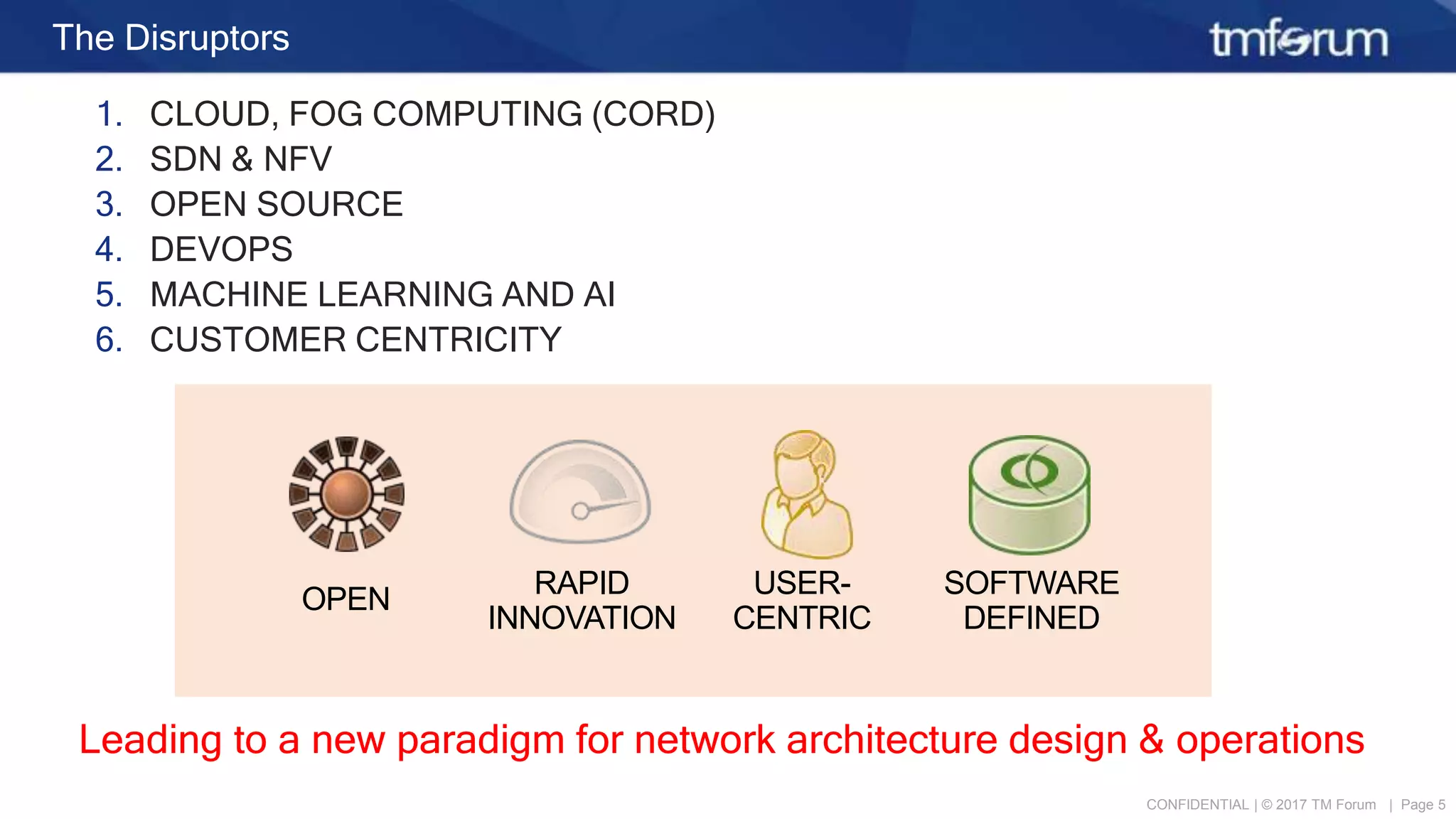
The Disruptors
1. CLOUD, FOG COMPUTING (CORD)
2. SDN & NFV
3. OPEN SOURCE
4. DEVOPS
5. MACHINE LEARNING AND AI
6. CUSTOMER CENTRICITY
Leading to a new paradigm for network architecture design & operations
RAPID
INNOVATION
USER-
CENTRIC
SOFTWARE
DEFINED
OPEN
CONFIDENTIAL | © 2017 TM Forum | Page 6
And new ways to build it
Open Source – Harnessing the power of a global community
DevOps – Bringing together deployment and operations teams
in continuous innovation
But buyer beware – OPEN SOURCE does not just mean just putting the software up on GITHUB
And DEVOPS and AGILE methodologies are not appropriate for everything
CONFIDENTIAL | © 2017 TM Forum | Page 7
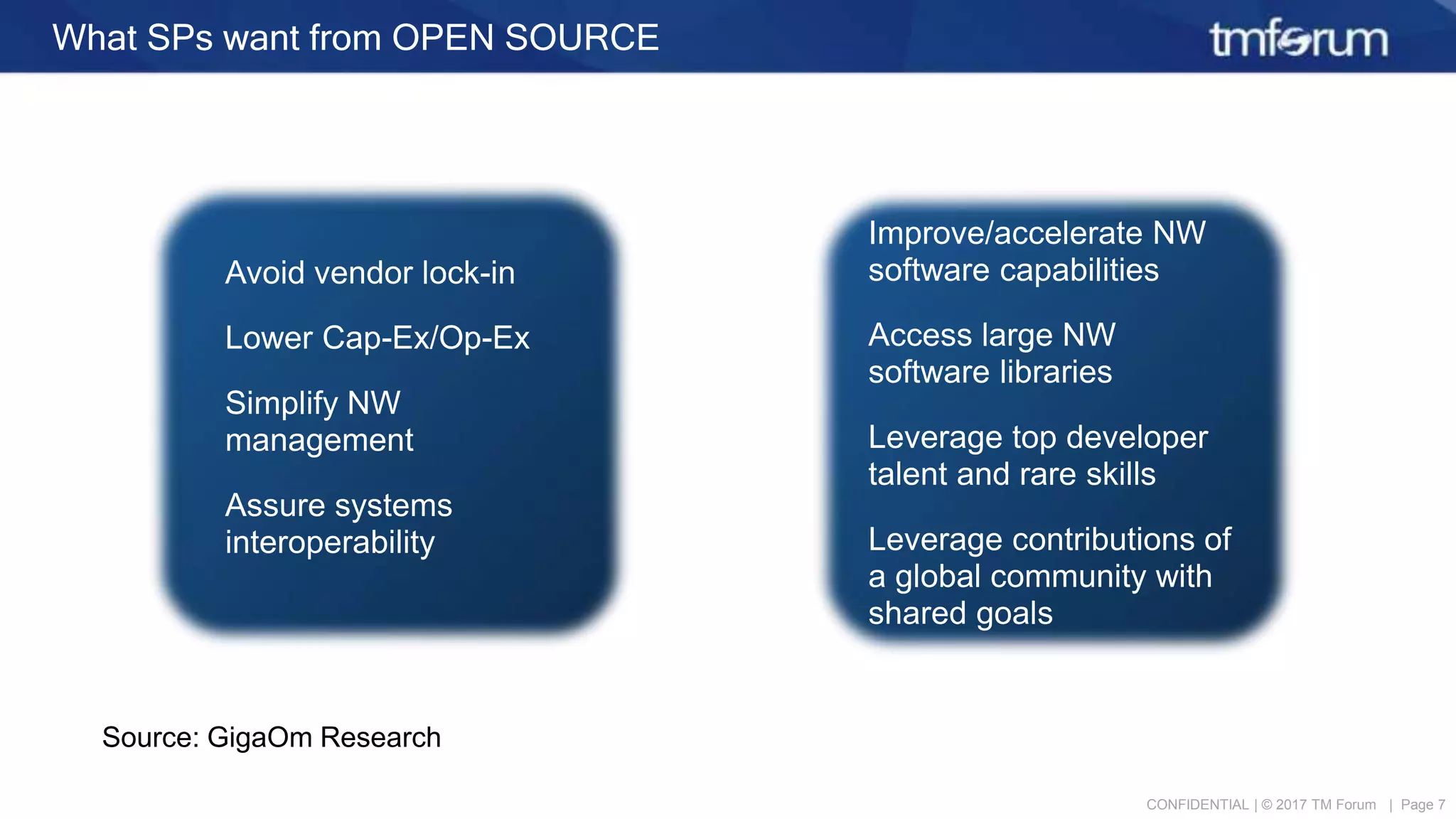
What SPs want from OPEN SOURCE
Improve/accelerate NW
software capabilities
Access large NW
software libraries
Leverage top developer
talent and rare skills
Leverage contributions of
a global community with
shared goals
Avoid vendor lock-in
Lower Cap-Ex/Op-Ex
Simplify NW
management
Assure systems
interoperability
Source: GigaOm Research
CONFIDENTIAL | © 2017 TM Forum | Page 8
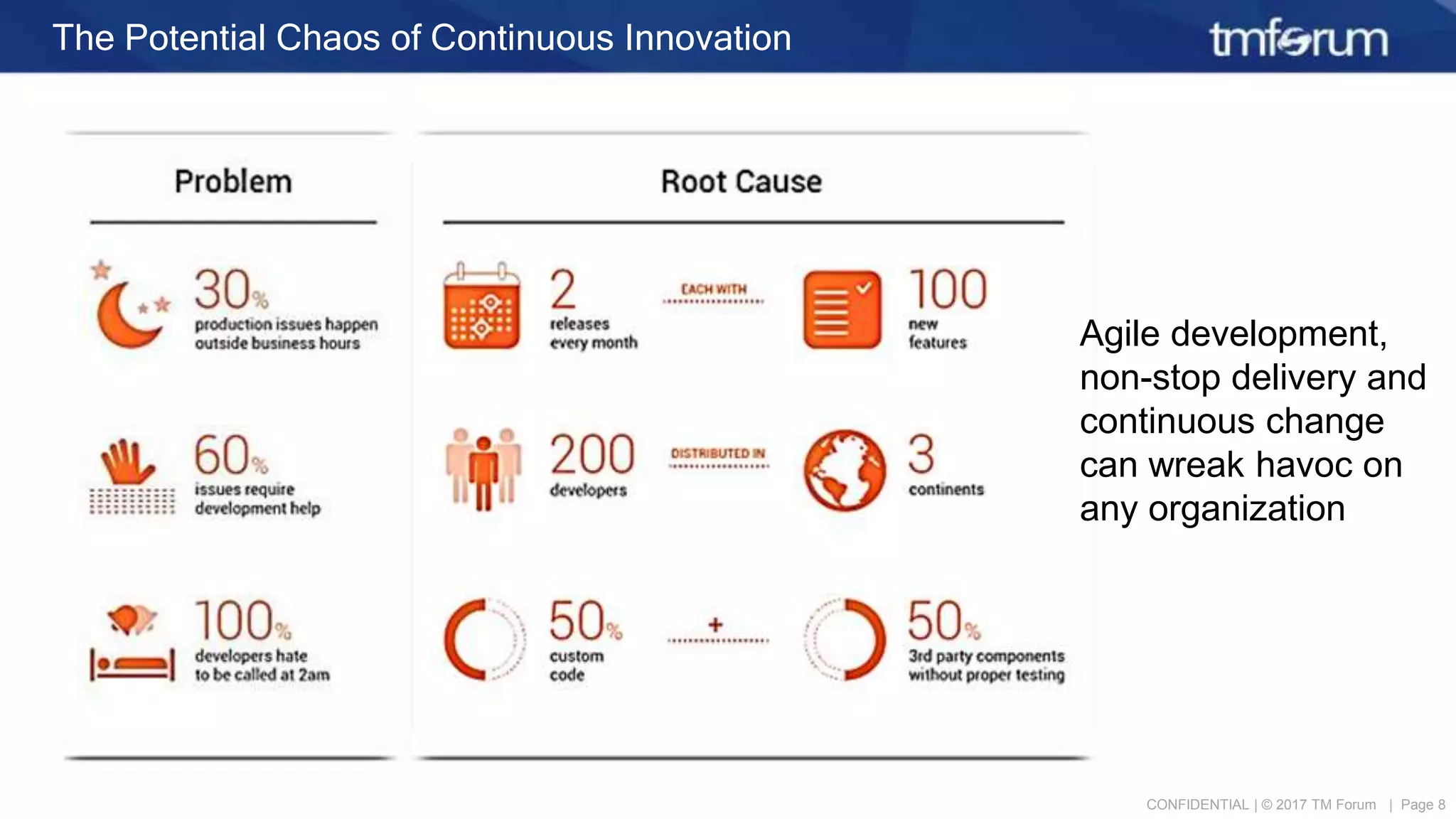
The Potential Chaos of Continuous Innovation
Agile development,
non-stop delivery and
continuous change
can wreak havoc on
any organization
CONFIDENTIAL | © 2017 TM Forum | Page 9
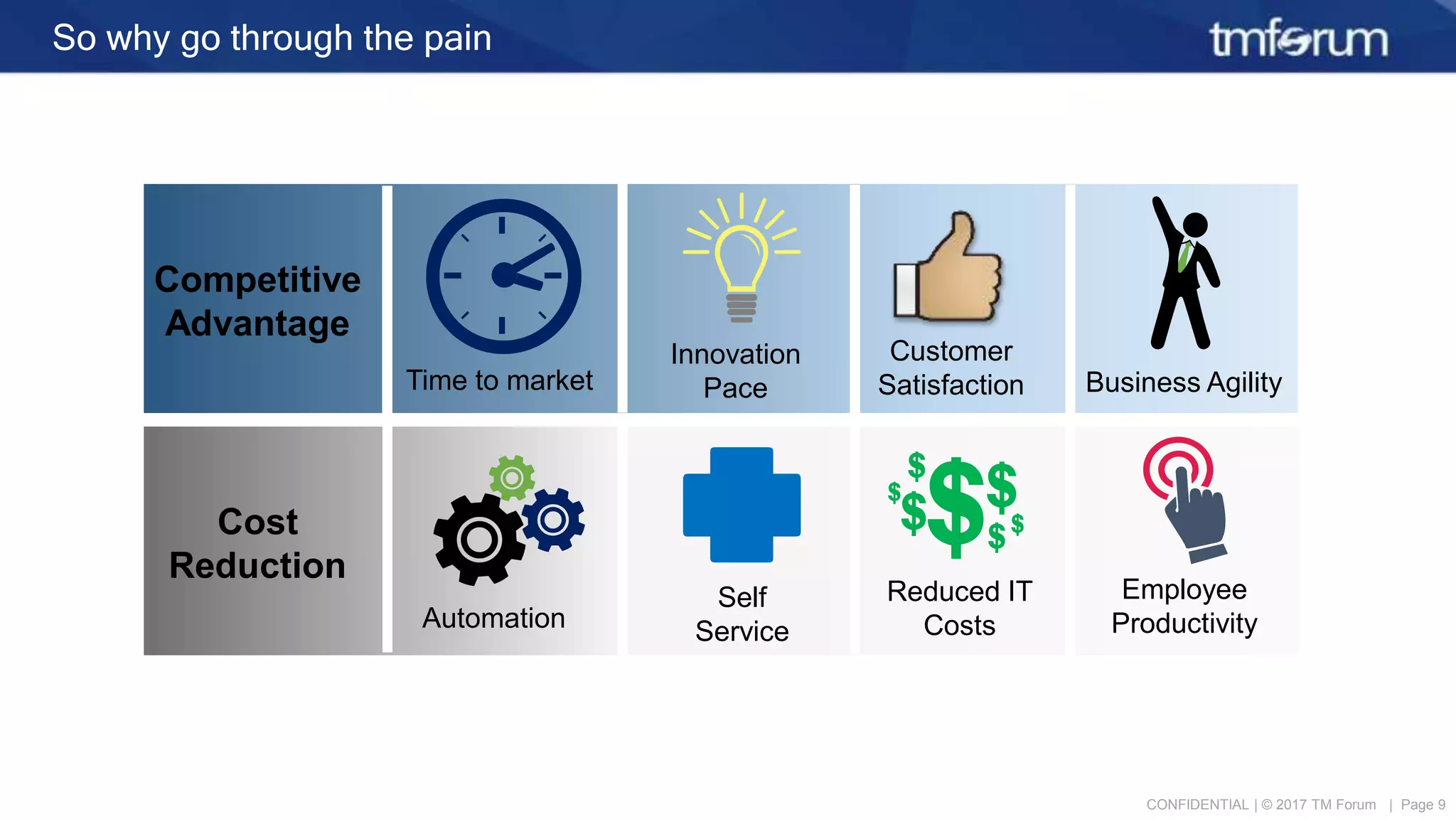
So why go through the pain
Time to market Business Agility
Customer
Satisfaction
Competitive
Advantage
Innovation
Pace
Automation
Employee
Productivity
Reduced IT
Costs
Cost
Reduction
Self
Service
CONFIDENTIAL | © 2017 TM Forum | Page 10
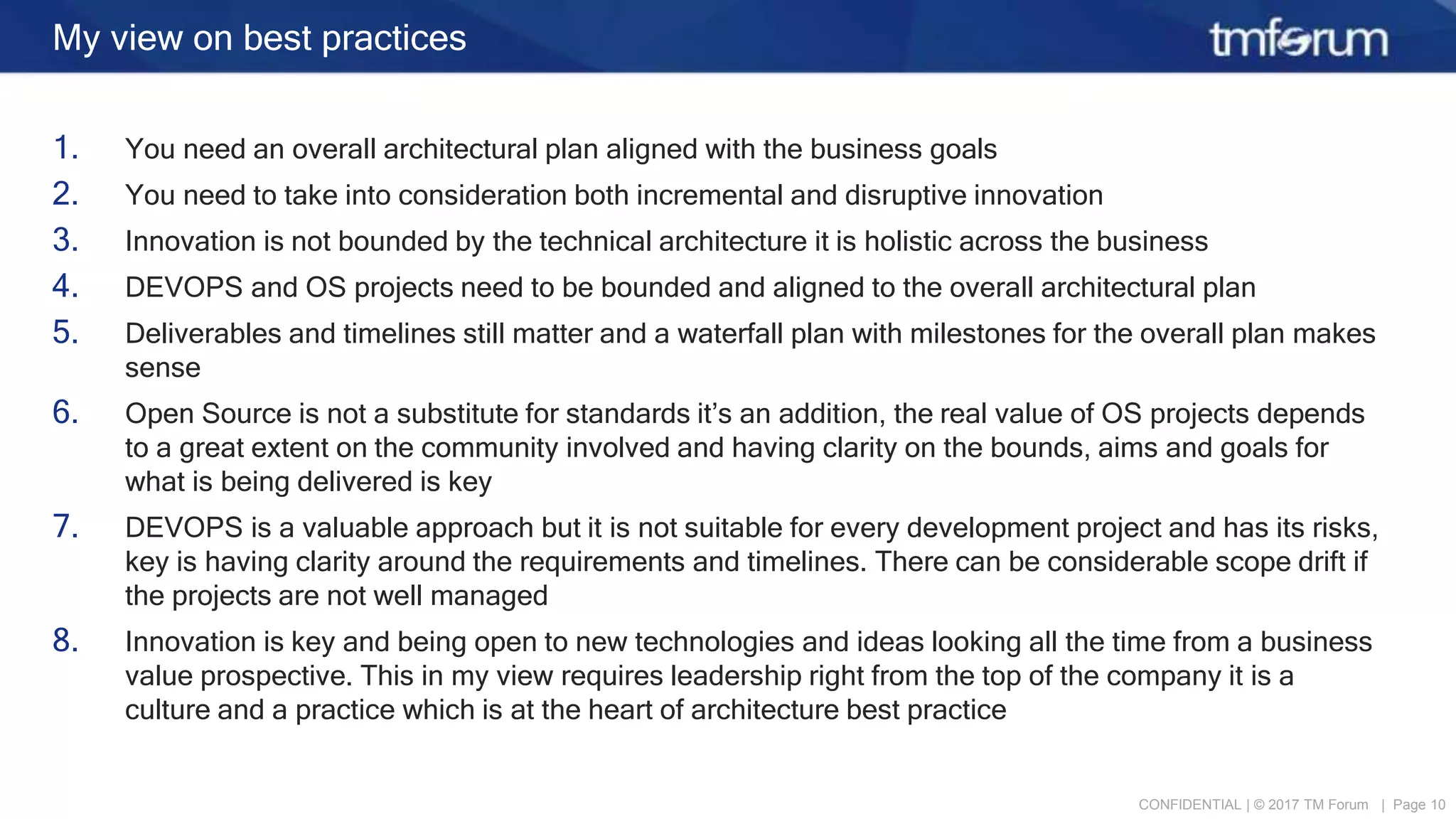
My view on best practices
1. You need an overall architectural plan aligned with the business goals
2. You need to take into consideration both incremental and disruptive innovation
3. Innovation is not bounded by the technical architecture it is holistic across the business
4. DEVOPS and OS projects need to be bounded and aligned to the overall architectural plan
5. Deliverables and timelines still matter and a waterfall plan with milestones for the overall plan makes
sense
6. Open Source is not a substitute for standards it’s an addition, the real value of OS projects depends
to a great extent on the community involved and having clarity on the bounds, aims and goals for
what is being delivered is key
7. DEVOPS is a valuable approach but it is not suitable for every development project and has its risks,
key is having clarity around the requirements and timelines. There can be considerable scope drift if
the projects are not well managed
8. Innovation is key and being open to new technologies and ideas looking all the time from a business
value prospective. This in my view requires leadership right from the top of the company it is a
culture and a practice which is at the heart of architecture best practice
CONFIDENTIAL | © 2017 TM Forum | Page 11
Thank You
Brian Levy

Architectural best practice (extract) tmf

  • 1.
    CONFIDENTIAL | ©2017 TM Forum | Page 1 Architectural Best Practice (Extract of Slides) Brian Levy Strategic Advisor
  • 2.
    CONFIDENTIAL | ©2017 TM Forum | Page 2 Digital transformation Diagram Source/Inspiration: Nick Gurney & Robert van den Dam, ‘Outthinking Disruption in Communications’, IBM Institute for Business Value Report. Digital Service Enabler • Platform-based business model • CSP capabilities open to ecosystem partners • Mixed ecosystem curator & participant roles 2020 CSP • Software-defined Telco • DSP and DSE capabilities • Agile, Innovative, Transformed • Analytics driven to create customer- defined experiences and “as-a- service” for ecosystem partners Traditional CSP • Traditional sources of revenue (connectivity, voice/text, data) and business model • CSP-controlled customer interaction Digital Service Provider • Highly automated, real-time, on- demand dynamic digital infrastructure Digital channels with customer- controlled interaction/self-service • Rich customer experience Digital services provisioning Digitalservicesenablement
  • 3.
    CONFIDENTIAL | ©2017 TM Forum | Page 3 New Technology enabling transformation Diagram Source/Inspiration: Nick Gurney & Robert van den Dam, ‘Outthinking Disruption in Communications’, IBM Institute for Business Value Report. Digital Service Enabler • Platform-based business model • CSP capabilities open to ecosystem partners • Mixed ecosystem curator & participant roles 2020 CSP • Software-defined Telco • DSP and DSE capabilities • Agile, Innovative, Transformed • Analytics driven to create customer- defined experiences and “as-a- service” for ecosystem partners Traditional CSP • Traditional sources of revenue (connectivity, voice/text, data) and business model • CSP-controlled customer interaction Digital Service Provider • Highly automated, real-time, on- demand dynamic digital infrastructure Digital channels with customer- controlled interaction/self-service • Rich customer experience Digital services provisioning Digitalservicesenablement
  • 4.
    CONFIDENTIAL | ©2017 TM Forum | Page 4 Innovation  There are two fundamental types of innovation 1. Incremental Innovation 2. Disruptive innovation Architectural best practice needs to account for BOTH types of innovation
  • 5.
    CONFIDENTIAL | ©2017 TM Forum | Page 5 The Disruptors 1. CLOUD, FOG COMPUTING (CORD) 2. SDN & NFV 3. OPEN SOURCE 4. DEVOPS 5. MACHINE LEARNING AND AI 6. CUSTOMER CENTRICITY Leading to a new paradigm for network architecture design & operations RAPID INNOVATION USER- CENTRIC SOFTWARE DEFINED OPEN
  • 6.
    CONFIDENTIAL | ©2017 TM Forum | Page 6 And new ways to build it Open Source – Harnessing the power of a global community DevOps – Bringing together deployment and operations teams in continuous innovation But buyer beware – OPEN SOURCE does not just mean just putting the software up on GITHUB And DEVOPS and AGILE methodologies are not appropriate for everything
  • 7.
    CONFIDENTIAL | ©2017 TM Forum | Page 7 What SPs want from OPEN SOURCE Improve/accelerate NW software capabilities Access large NW software libraries Leverage top developer talent and rare skills Leverage contributions of a global community with shared goals Avoid vendor lock-in Lower Cap-Ex/Op-Ex Simplify NW management Assure systems interoperability Source: GigaOm Research
  • 8.
    CONFIDENTIAL | ©2017 TM Forum | Page 8 The Potential Chaos of Continuous Innovation Agile development, non-stop delivery and continuous change can wreak havoc on any organization
  • 9.
    CONFIDENTIAL | ©2017 TM Forum | Page 9 So why go through the pain Time to market Business Agility Customer Satisfaction Competitive Advantage Innovation Pace Automation Employee Productivity Reduced IT Costs Cost Reduction Self Service
  • 10.
    CONFIDENTIAL | ©2017 TM Forum | Page 10 My view on best practices 1. You need an overall architectural plan aligned with the business goals 2. You need to take into consideration both incremental and disruptive innovation 3. Innovation is not bounded by the technical architecture it is holistic across the business 4. DEVOPS and OS projects need to be bounded and aligned to the overall architectural plan 5. Deliverables and timelines still matter and a waterfall plan with milestones for the overall plan makes sense 6. Open Source is not a substitute for standards it’s an addition, the real value of OS projects depends to a great extent on the community involved and having clarity on the bounds, aims and goals for what is being delivered is key 7. DEVOPS is a valuable approach but it is not suitable for every development project and has its risks, key is having clarity around the requirements and timelines. There can be considerable scope drift if the projects are not well managed 8. Innovation is key and being open to new technologies and ideas looking all the time from a business value prospective. This in my view requires leadership right from the top of the company it is a culture and a practice which is at the heart of architecture best practice
  • 11.
    CONFIDENTIAL | ©2017 TM Forum | Page 11 Thank You Brian Levy