

Product Labelling
This product is suitable for investors who are seeking*:
 Income and capital appreciation
 Dynamic Asset allocation between equity related Instruments
and fixed income instruments so as to provide with long term
capital appreciation.
*Investors should consult their financial advisers if in doubt about whether the product is suitable for them.
Index
• The Asset Allocation Puzzle
• Need for Asset Allocation
• Why have a Dynamic Asset Allocation Strategy?
• SBI Dynamic Asset Allocation Fund
• Key Features
• Why Invest?
• Investment Team
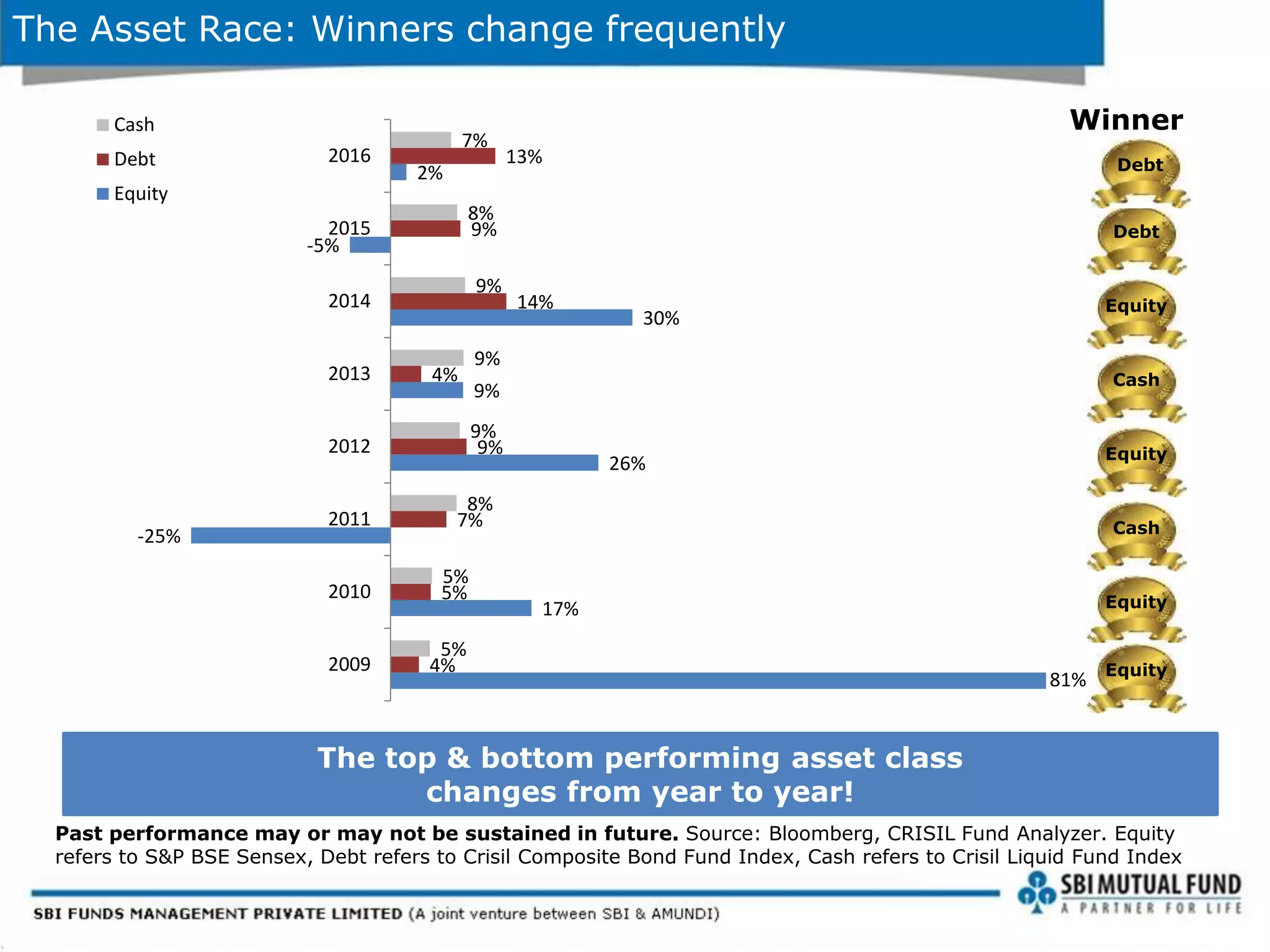
The Asset Allocation Puzzle
81%
17%
-25%
26%
9%
30%
-5%
2%
4%
5%
7%
9%
4%
14%
9%
13%
5%
5%
8%
9%
9%
9%
8%
7%
2009
2010
2011
2012
2013
2014
2015
2016
Cash
Debt
Equity
The Asset Race: Winners change frequently
Past performance may or may not be sustained in future. Source: Bloomberg, CRISIL Fund Analyzer. Equity
refers to S&P BSE Sensex, Debt refers to Crisil Composite Bond Fund Index, Cash refers to Crisil Liquid Fund Index
The top & bottom performing asset class
changes from year to year!
Debt
Equity
Cash
Equity
Cash
Equity
Equity
Winner
Debt
The Asset Allocation Puzzle!
What do I do?
Need for Asset Allocation
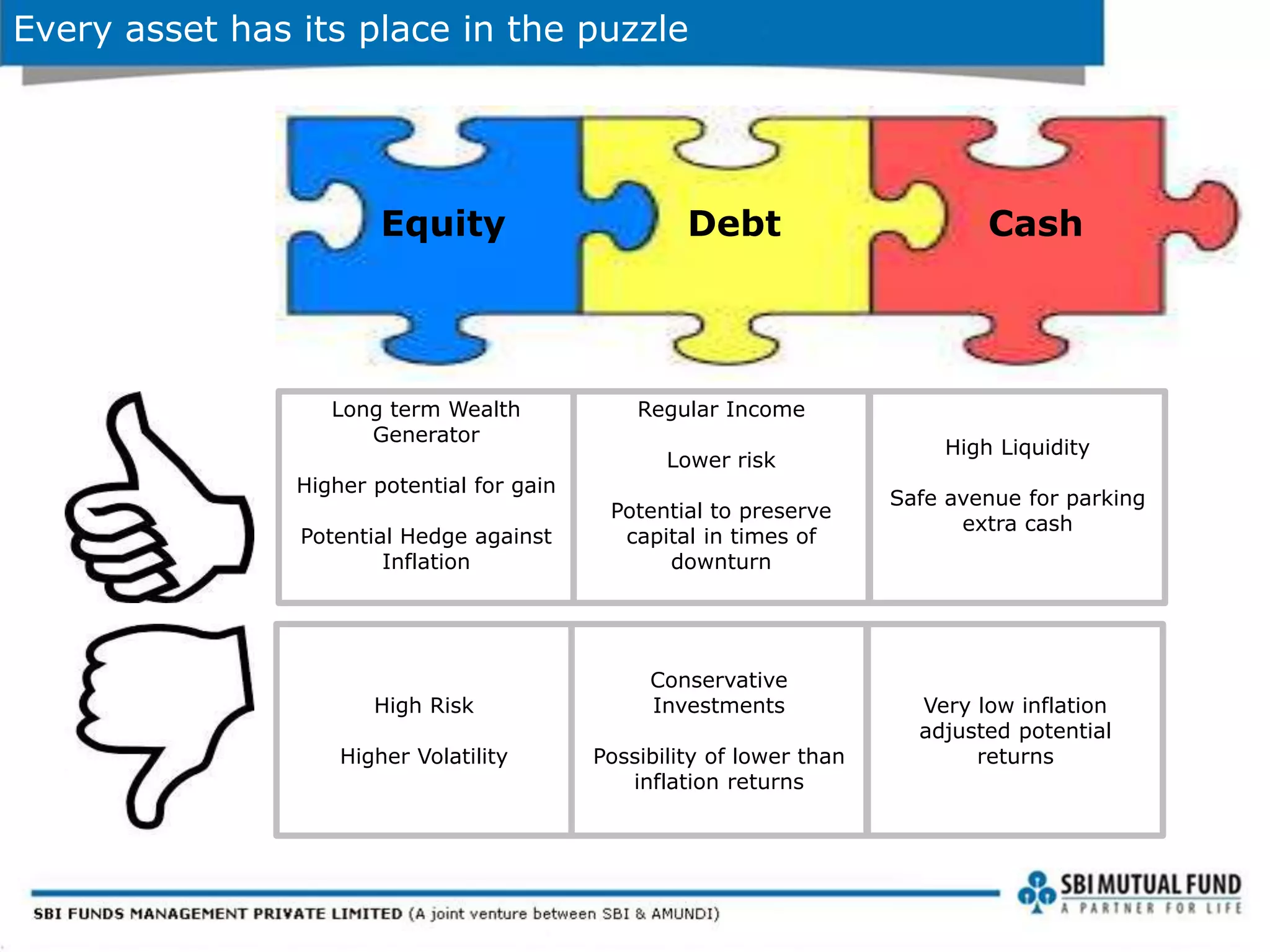
Every asset has its place in the puzzle
Equity Debt Cash
Long term Wealth
Generator
Higher potential for gain
Potential Hedge against
Inflation
Regular Income
Lower risk
Potential to preserve
capital in times of
downturn
High Liquidity
Safe avenue for parking
extra cash
High Risk
Higher Volatility
Conservative
Investments
Possibility of lower than
inflation returns
Very low inflation
adjusted potential
returns
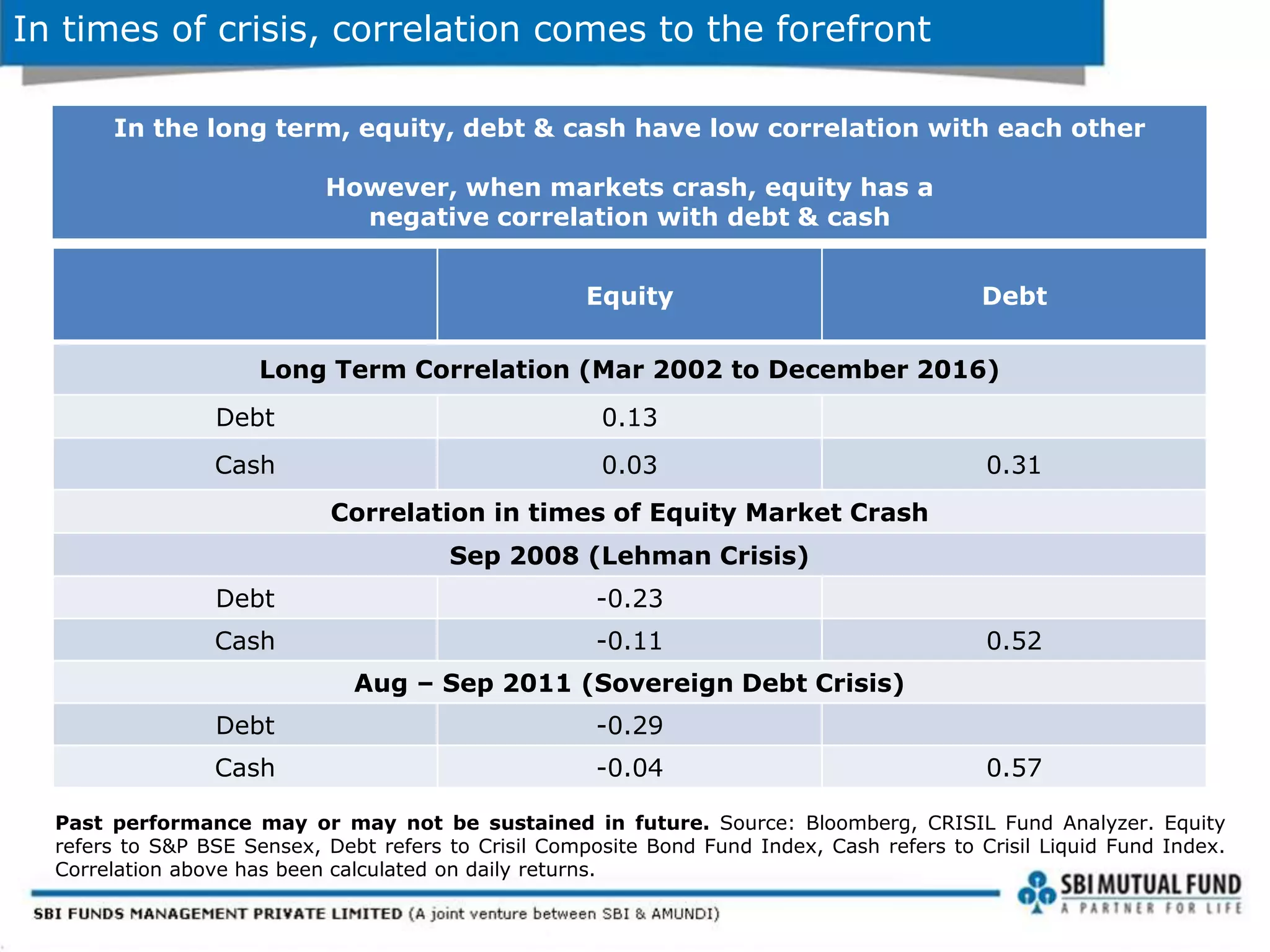
In times of crisis, correlation comes to the forefront
Past performance may or may not be sustained in future. Source: Bloomberg, CRISIL Fund Analyzer. Equity
refers to S&P BSE Sensex, Debt refers to Crisil Composite Bond Fund Index, Cash refers to Crisil Liquid Fund Index.
Correlation above has been calculated on daily returns.
Equity Debt
Long Term Correlation (Mar 2002 to December 2016)
Debt 0.13
Cash 0.03 0.31
Correlation in times of Equity Market Crash
Sep 2008 (Lehman Crisis)
Debt -0.23
Cash -0.11 0.52
Aug – Sep 2011 (Sovereign Debt Crisis)
Debt -0.29
Cash -0.04 0.57
In the long term, equity, debt & cash have low correlation with each other
However, when markets crash, equity has a
negative correlation with debt & cash
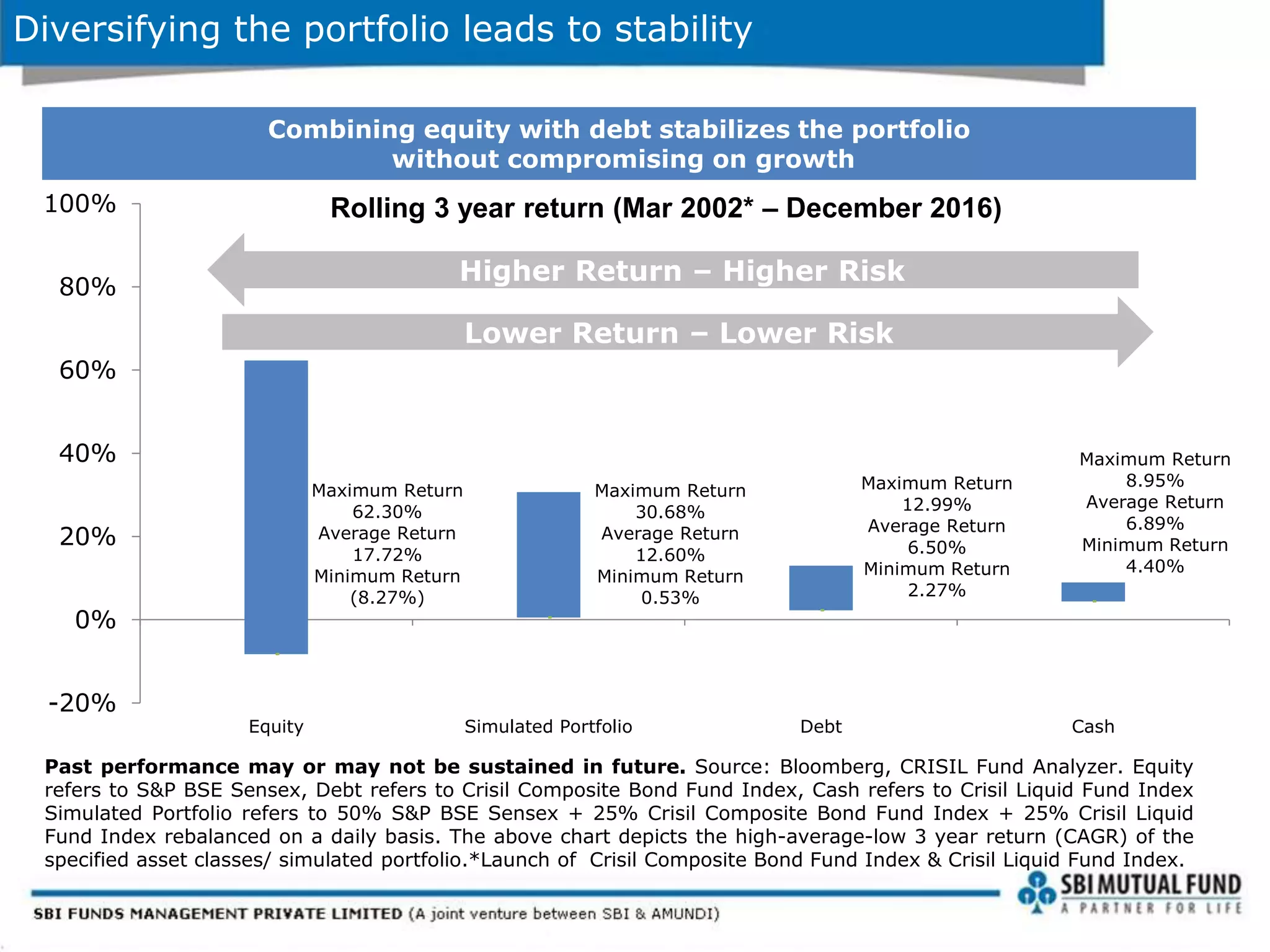
Maximum Return
62.30%
Average Return
17.72%
Minimum Return
(8.27%)
Maximum Return
30.68%
Average Return
12.60%
Minimum Return
0.53%
Maximum Return
12.99%
Average Return
6.50%
Minimum Return
2.27%
Maximum Return
8.95%
Average Return
6.89%
Minimum Return
4.40%
-20%
0%
20%
40%
60%
80%
100%
Equity Simulated Portfolio Debt Cash
Diversifying the portfolio leads to stability
Past performance may or may not be sustained in future. Source: Bloomberg, CRISIL Fund Analyzer. Equity
refers to S&P BSE Sensex, Debt refers to Crisil Composite Bond Fund Index, Cash refers to Crisil Liquid Fund Index
Simulated Portfolio refers to 50% S&P BSE Sensex + 25% Crisil Composite Bond Fund Index + 25% Crisil Liquid
Fund Index rebalanced on a daily basis. The above chart depicts the high-average-low 3 year return (CAGR) of the
specified asset classes/ simulated portfolio.*Launch of Crisil Composite Bond Fund Index & Crisil Liquid Fund Index.
Combining equity with debt stabilizes the portfolio
without compromising on growth
Higher Return – Higher Risk
Lower Return – Lower Risk
Rolling 3 year return (Mar 2002* – December 2016)
Simulated
Portfolio
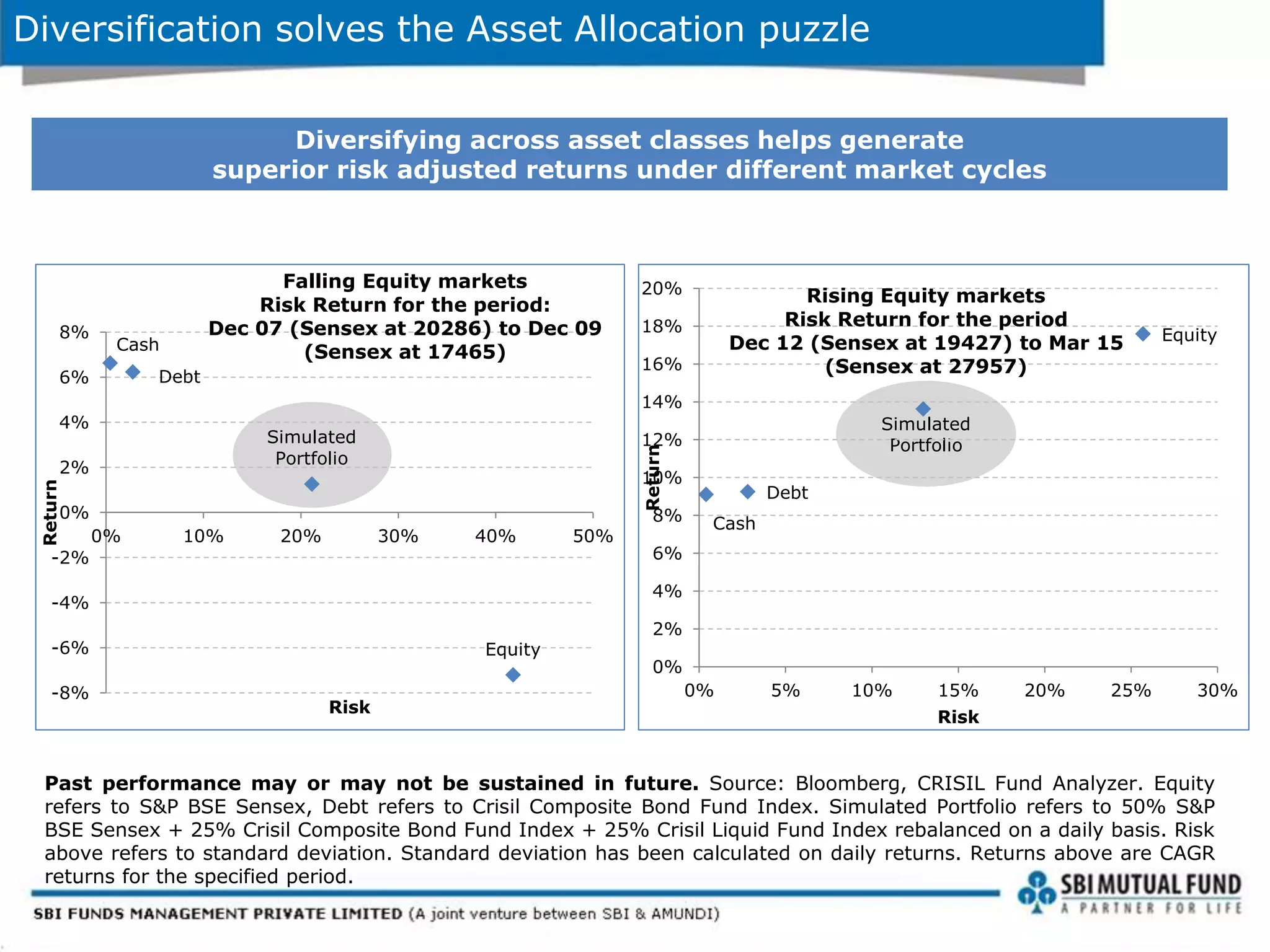
Diversification solves the Asset Allocation puzzle
Past performance may or may not be sustained in future. Source: Bloomberg, CRISIL Fund Analyzer. Equity
refers to S&P BSE Sensex, Debt refers to Crisil Composite Bond Fund Index. Simulated Portfolio refers to 50% S&P
BSE Sensex + 25% Crisil Composite Bond Fund Index + 25% Crisil Liquid Fund Index rebalanced on a daily basis. Risk
above refers to standard deviation. Standard deviation has been calculated on daily returns. Returns above are CAGR
returns for the specified period.
Diversifying across asset classes helps generate
superior risk adjusted returns under different market cycles
Equity
Simulated
Portfolio
Debt
Cash
-8%
-6%
-4%
-2%
0%
2%
4%
6%
8%
0% 10% 20% 30% 40% 50%
Return
Risk
Falling Equity markets
Risk Return for the period:
Dec 07 (Sensex at 20286) to Dec 09
(Sensex at 17465)
Equity
Debt
Cash
0%
2%
4%
6%
8%
10%
12%
14%
16%
18%
20%
0% 5% 10% 15% 20% 25% 30%
Return
Risk
Rising Equity markets
Risk Return for the period
Dec 12 (Sensex at 19427) to Mar 15
(Sensex at 27957)
Why have a Dynamic Asset
Allocation Strategy?
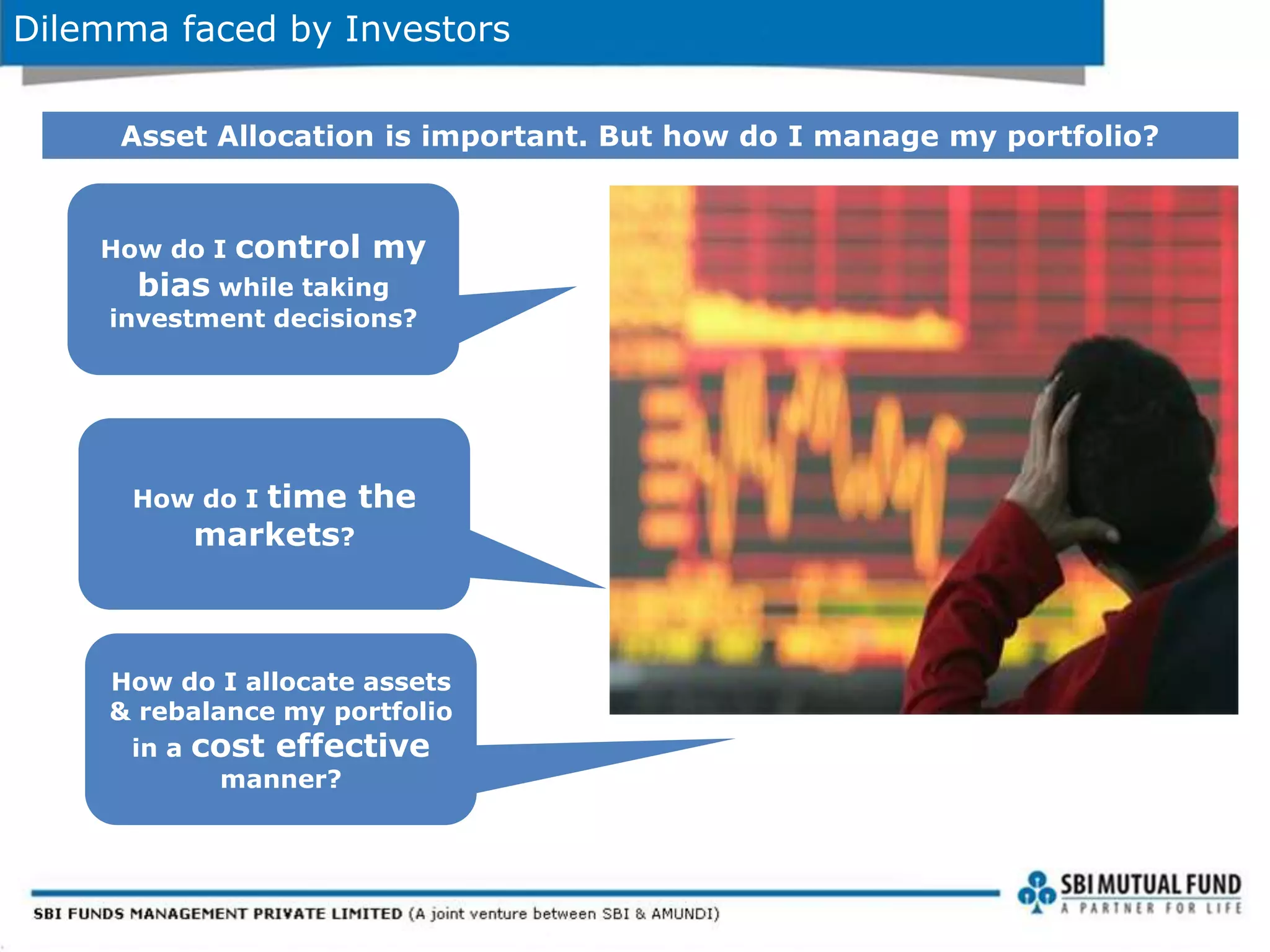
Dilemma faced by Investors
How do I control my
bias while taking
investment decisions?
How do I time the
markets?
How do I allocate assets
& rebalance my portfolio
in a cost effective
manner?
Asset Allocation is important. But how do I manage my portfolio?
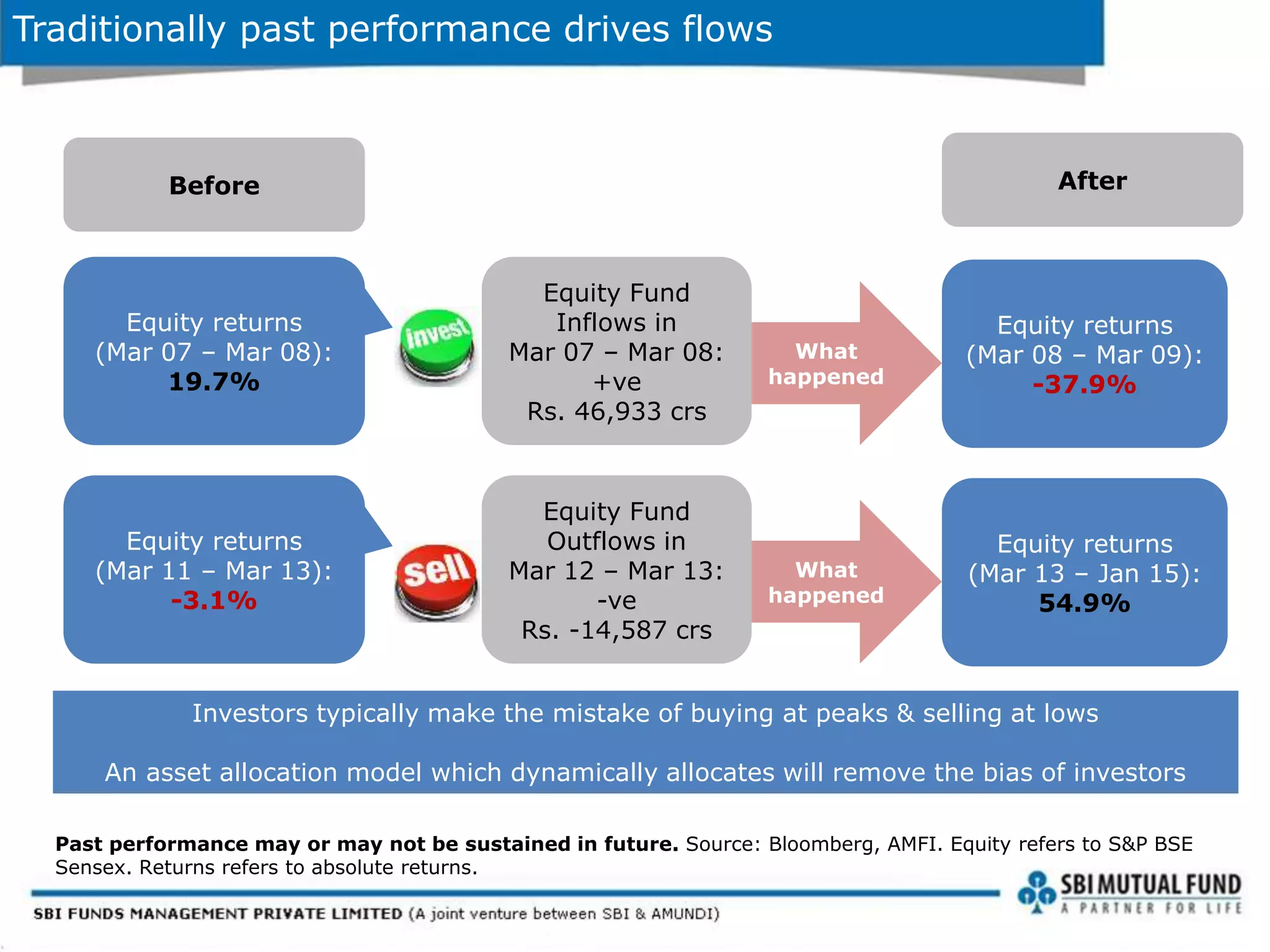
Traditionally past performance drives flows
Past performance may or may not be sustained in future. Source: Bloomberg, AMFI. Equity refers to S&P BSE
Sensex. Returns refers to absolute returns.
Investors typically make the mistake of buying at peaks & selling at lows
An asset allocation model which dynamically allocates will remove the bias of investors
Equity returns
(Mar 07 – Mar 08):
19.7%
Equity Fund
Inflows in
Mar 07 – Mar 08:
+ve
Rs. 46,933 crs
Equity returns
(Mar 08 – Mar 09):
-37.9%
What
happened
Equity returns
(Mar 11 – Mar 13):
-3.1%
Equity Fund
Outflows in
Mar 12 – Mar 13:
-ve
Rs. -14,587 crs
Equity returns
(Mar 13 – Jan 15):
54.9%
What
happened
AfterBefore
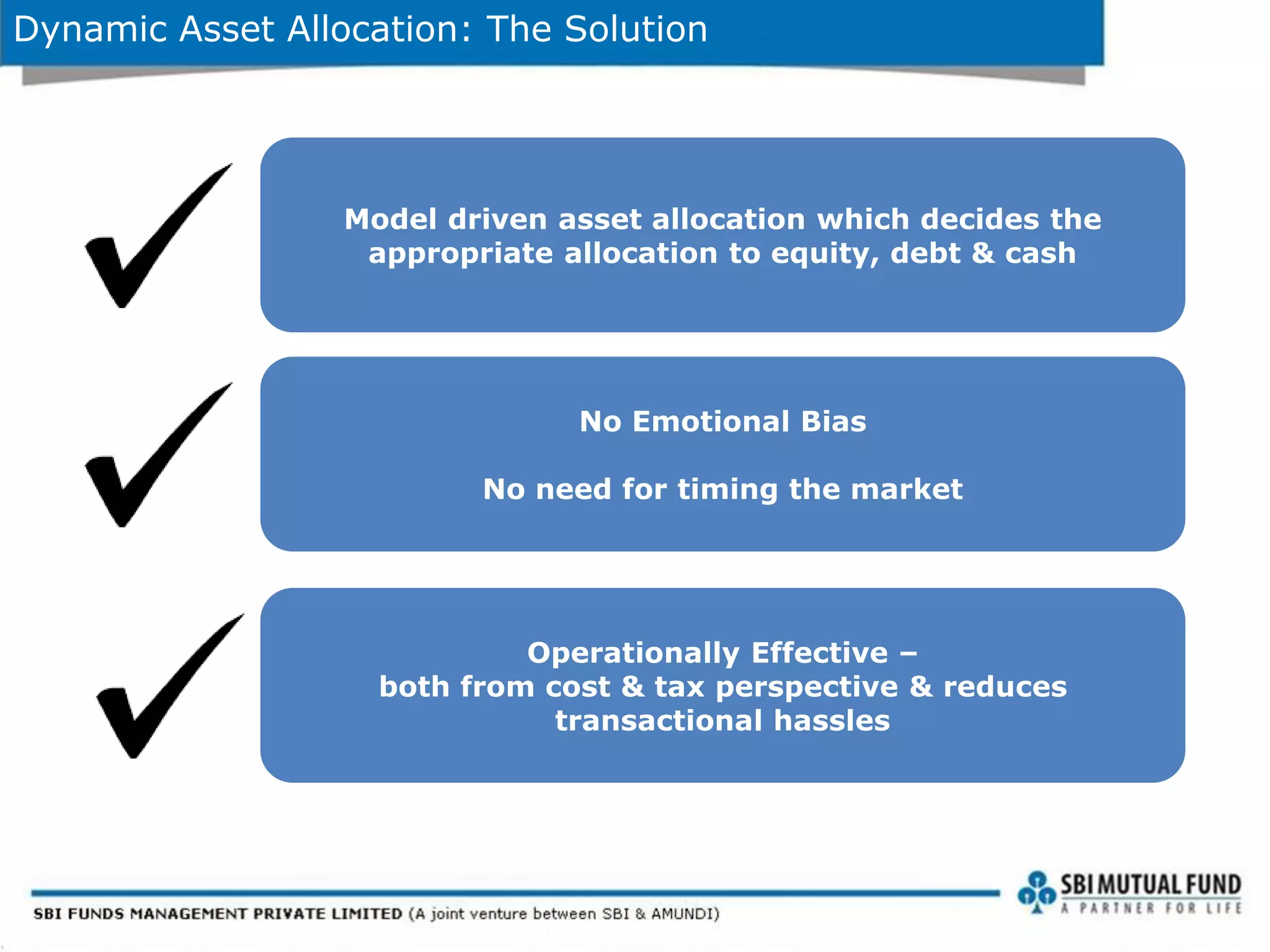
Dynamic Asset Allocation: The Solution
Model driven asset allocation which decides the
appropriate allocation to equity, debt & cash
No Emotional Bias
No need for timing the market
Operationally Effective –
both from cost & tax perspective & reduces
transactional hassles
SBI Dynamic Asset Allocation Fund
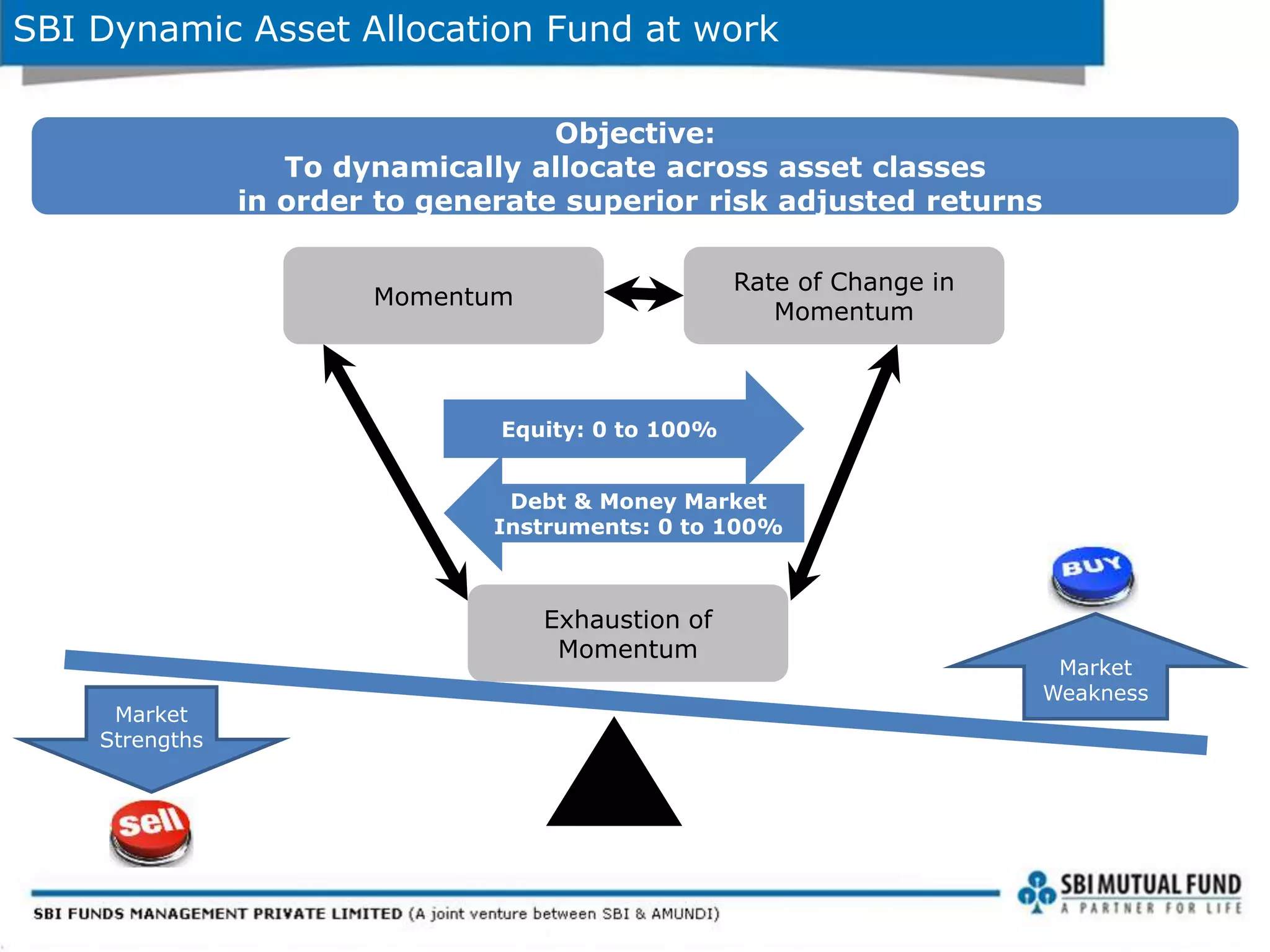
SBI Dynamic Asset Allocation Fund at work
Equity: 0 to 100%
Debt & Money Market
Instruments: 0 to 100%
Momentum
Exhaustion of
Momentum
Rate of Change in
Momentum
Market
Weakness
Market
Strengths
Objective:
To dynamically allocate across asset classes
in order to generate superior risk adjusted returns
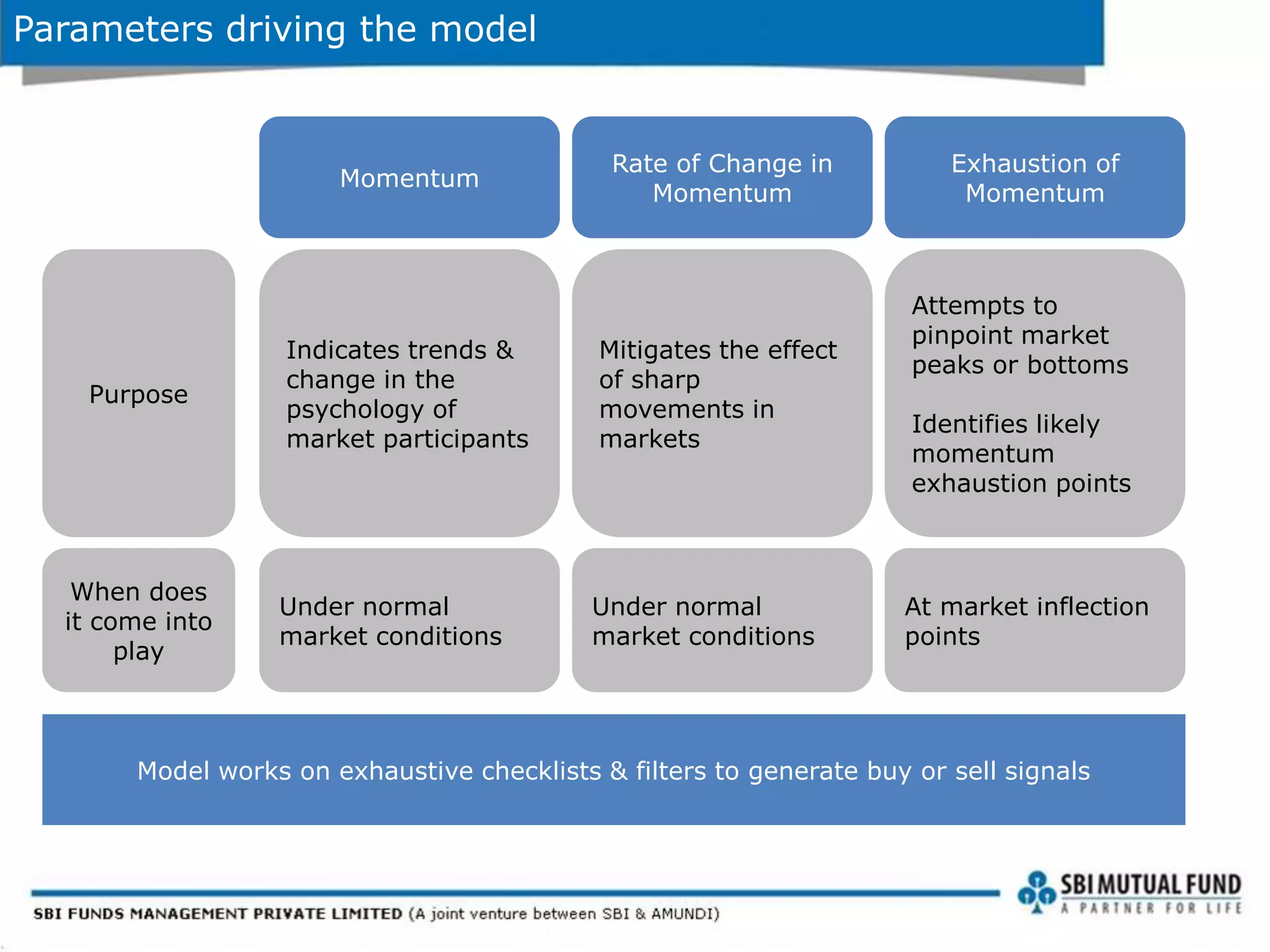
Parameters driving the model
Momentum
Rate of Change in
Momentum
Exhaustion of
Momentum
Indicates trends &
change in the
psychology of
market participants
Mitigates the effect
of sharp
movements in
markets
Attempts to
pinpoint market
peaks or bottoms
Identifies likely
momentum
exhaustion points
Purpose
Under normal
market conditions
Under normal
market conditions
At market inflection
points
When does
it come into
play
Model works on exhaustive checklists & filters to generate buy or sell signals
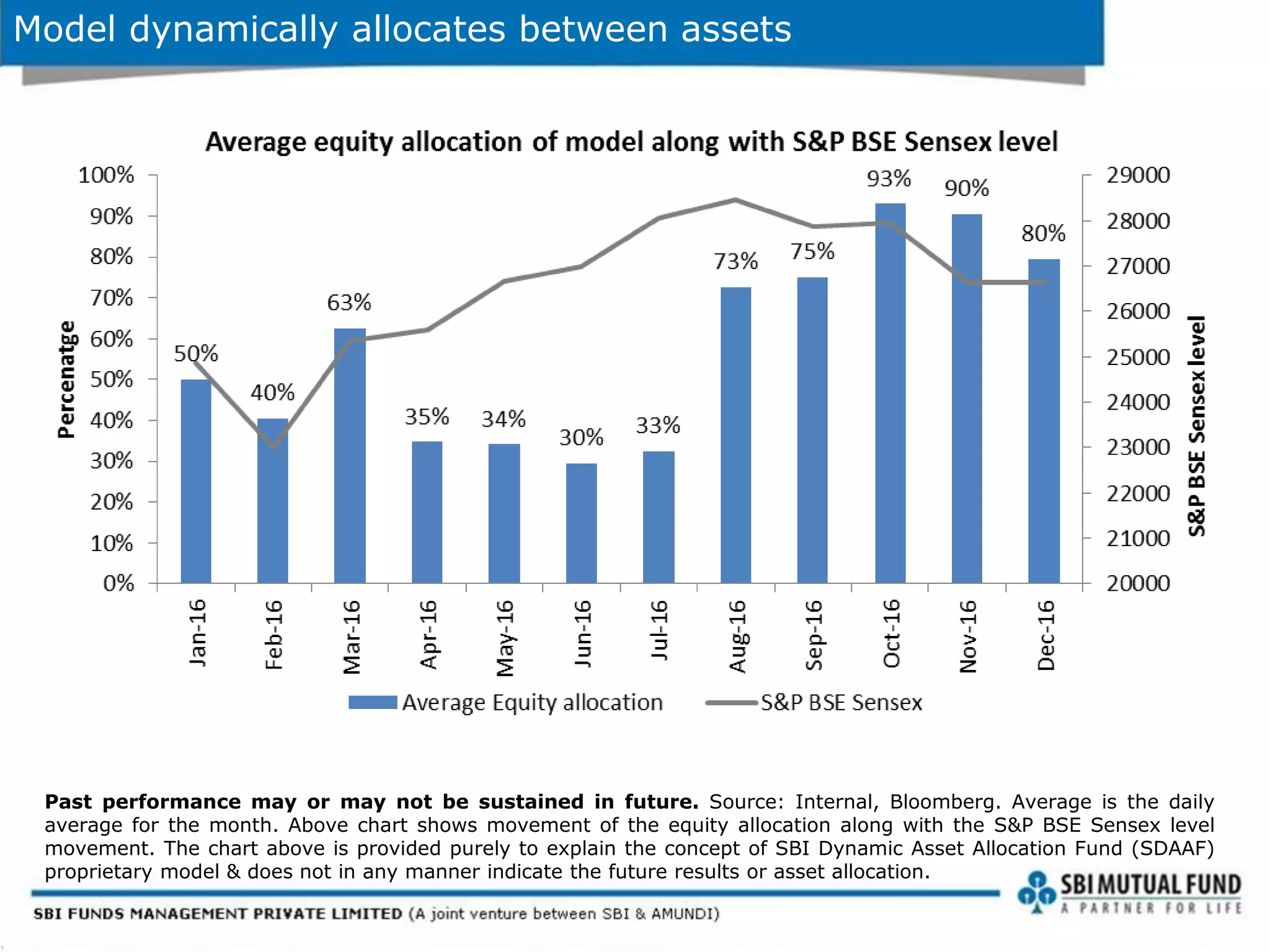
Model dynamically allocates between assets
Past performance may or may not be sustained in future. Source: Internal, Bloomberg. Average is the daily
average for the month. Above chart shows movement of the equity allocation along with the S&P BSE Sensex level
movement. The chart above is provided purely to explain the concept of SBI Dynamic Asset Allocation Fund (SDAAF)
proprietary model & does not in any manner indicate the future results or asset allocation.
Model dynamically allocates between assets
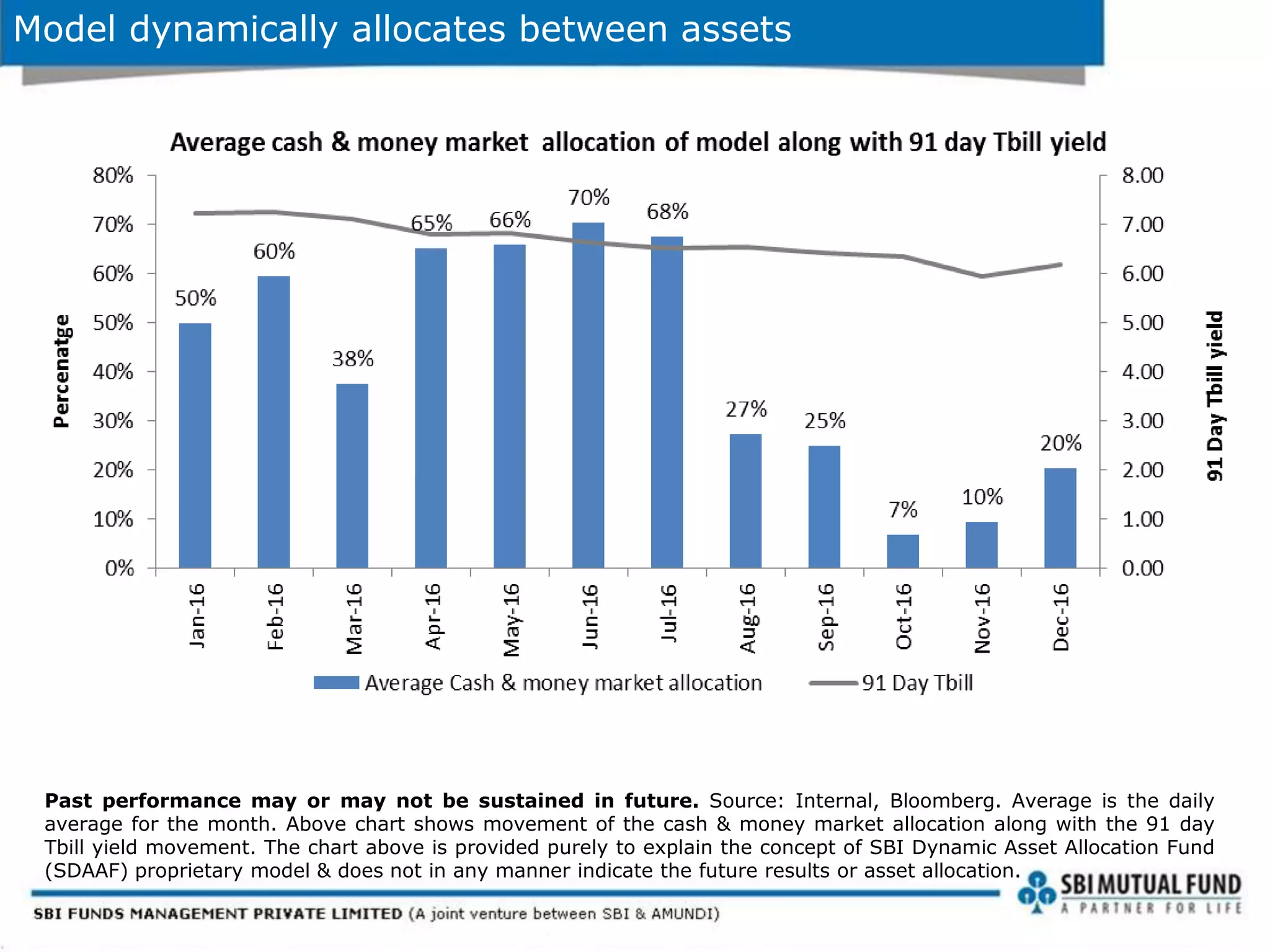
Past performance may or may not be sustained in future. Source: Internal, Bloomberg. Average is the daily
average for the month. Above chart shows movement of the cash & money market allocation along with the 91 day
Tbill yield movement. The chart above is provided purely to explain the concept of SBI Dynamic Asset Allocation Fund
(SDAAF) proprietary model & does not in any manner indicate the future results or asset allocation.
Model dynamically allocates between assets
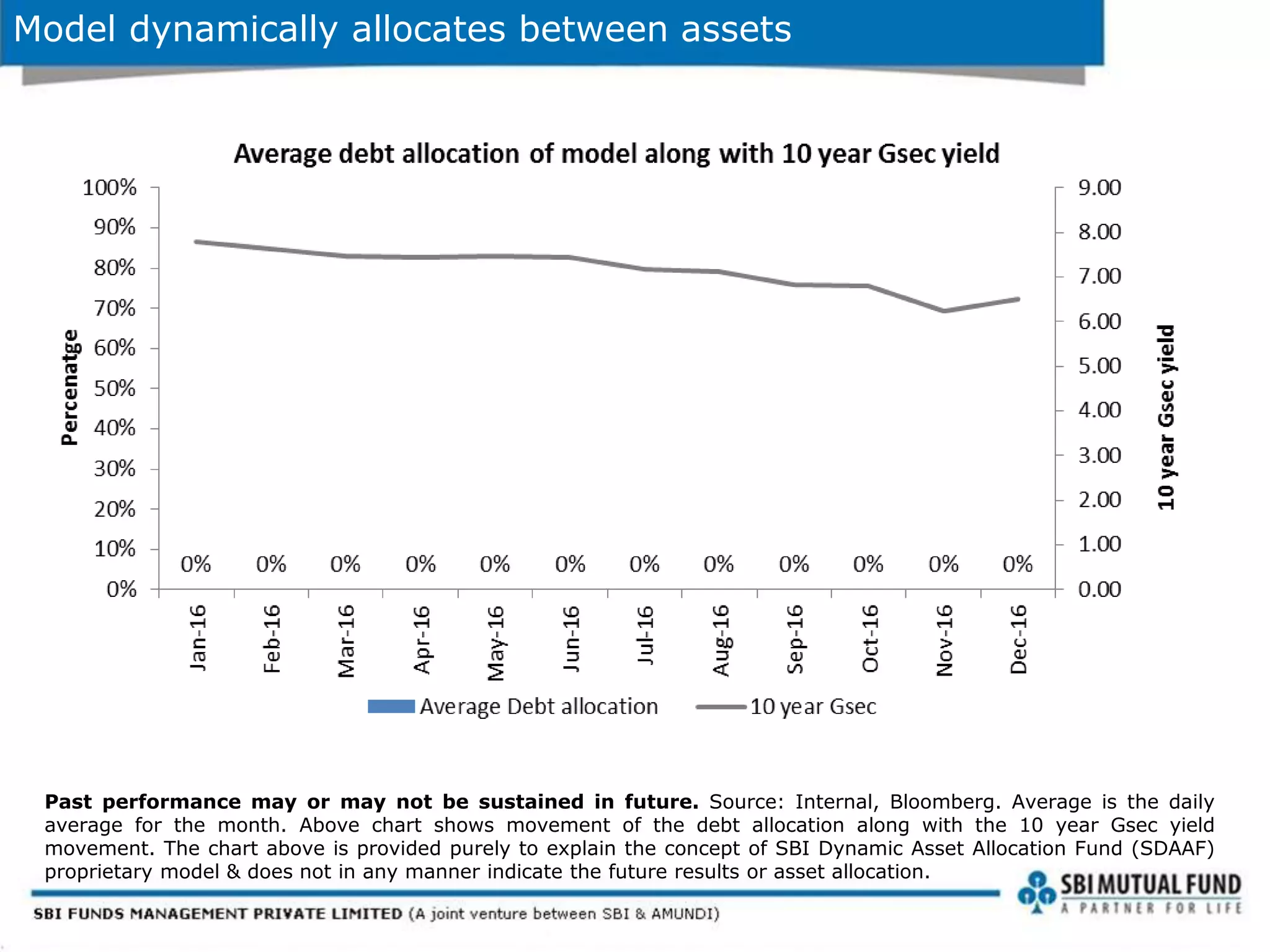
Past performance may or may not be sustained in future. Source: Internal, Bloomberg. Average is the daily
average for the month. Above chart shows movement of the debt allocation along with the 10 year Gsec yield
movement. The chart above is provided purely to explain the concept of SBI Dynamic Asset Allocation Fund (SDAAF)
proprietary model & does not in any manner indicate the future results or asset allocation.
Performance
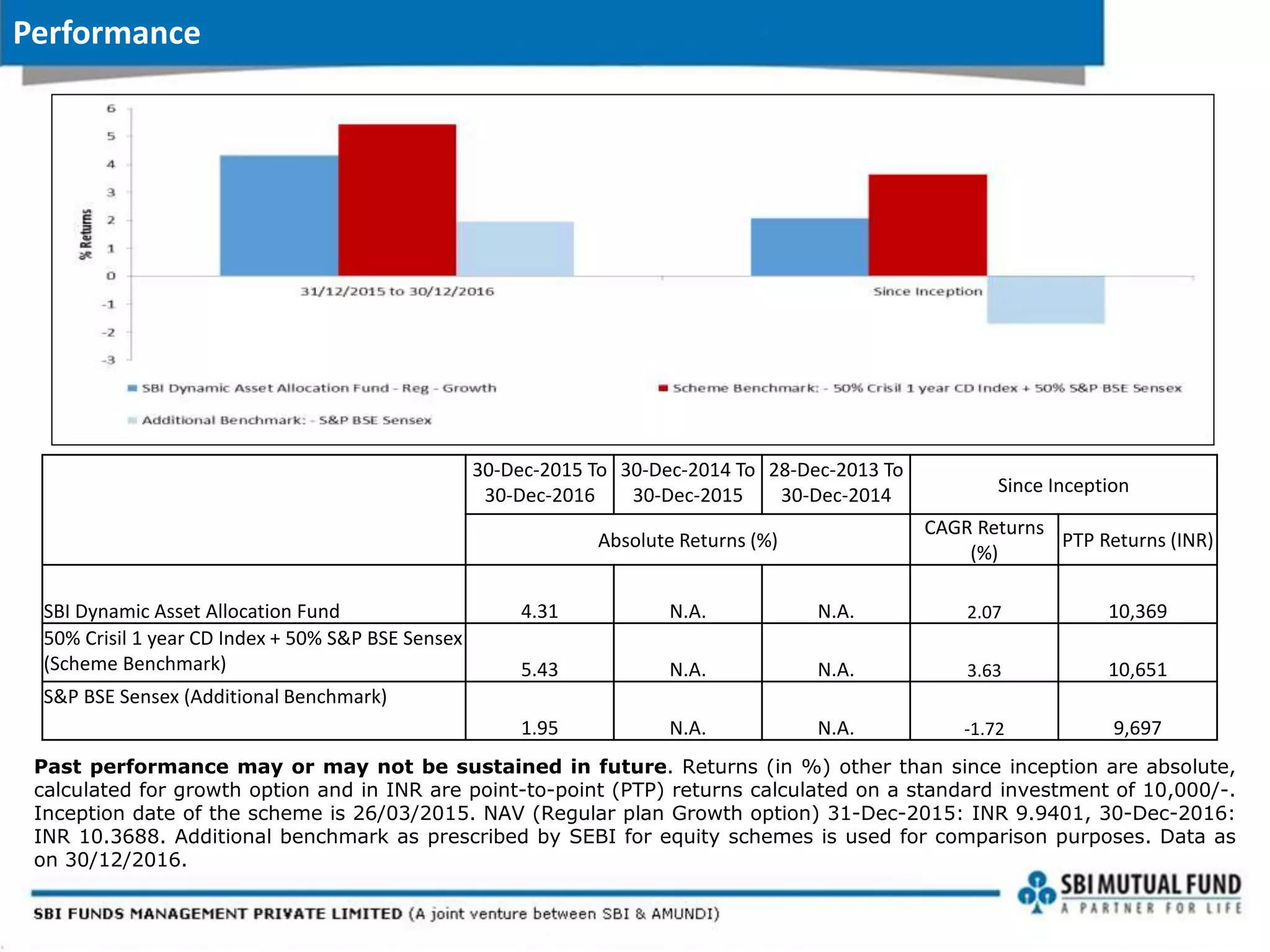
Past performance may or may not be sustained in future. Returns (in %) other than since inception are absolute,
calculated for growth option and in INR are point-to-point (PTP) returns calculated on a standard investment of 10,000/-.
Inception date of the scheme is 26/03/2015. NAV (Regular plan Growth option) 31-Dec-2015: INR 9.9401, 30-Dec-2016:
INR 10.3688. Additional benchmark as prescribed by SEBI for equity schemes is used for comparison purposes. Data as
on 30/12/2016.
30-Dec-2015 To
30-Dec-2016
30-Dec-2014 To
30-Dec-2015
28-Dec-2013 To
30-Dec-2014 Since Inception
Absolute Returns (%)
CAGR Returns
(%)
PTP Returns (INR)
SBI Dynamic Asset Allocation Fund 4.31 N.A. N.A. 2.07 10,369
50% Crisil 1 year CD Index + 50% S&P BSE Sensex
(Scheme Benchmark) 5.43 N.A. N.A. 3.63 10,651
S&P BSE Sensex (Additional Benchmark)
1.95 N.A. N.A. -1.72 9,697
Fund Philosophy & Asset Allocation
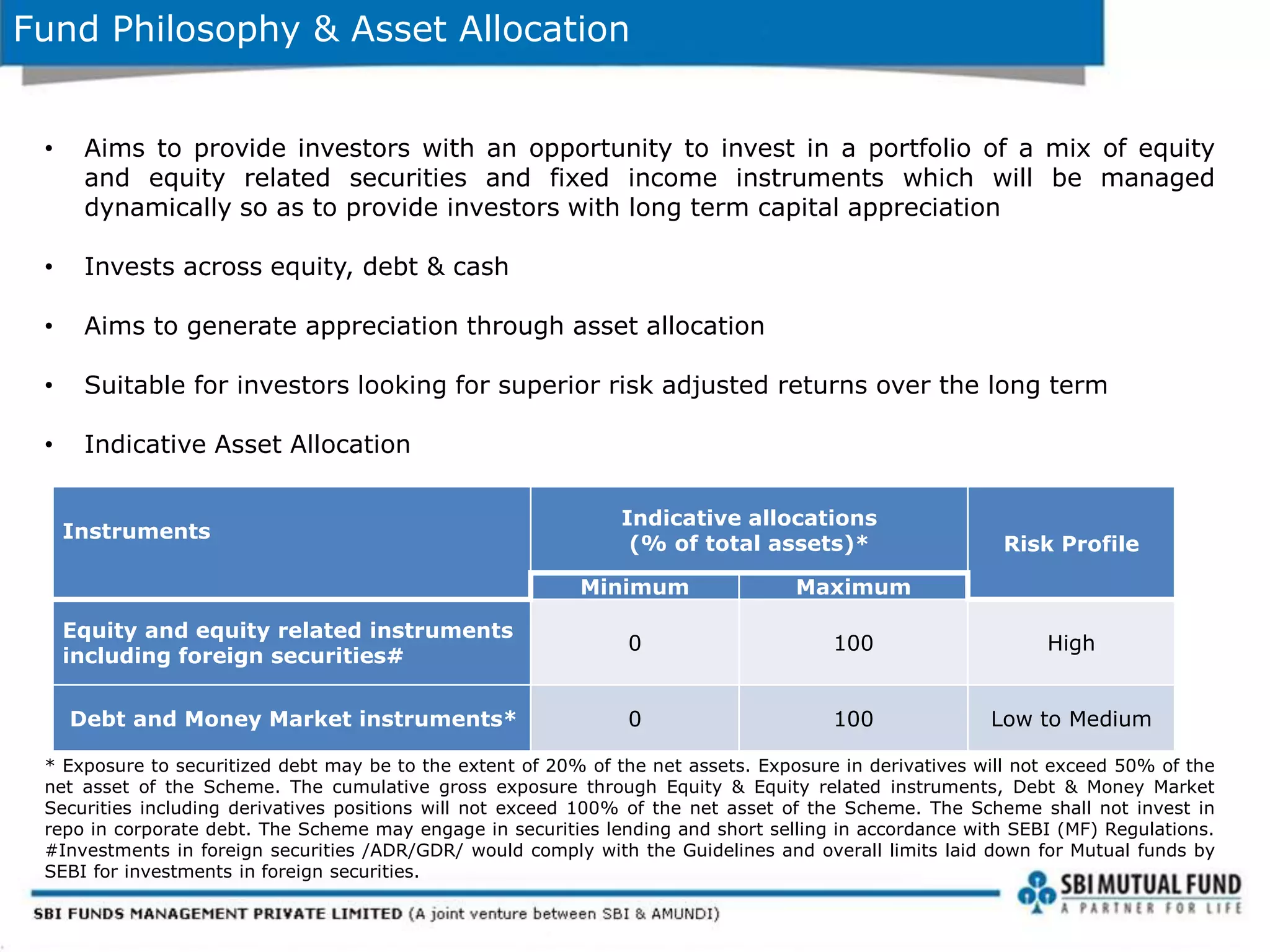
• Aims to provide investors with an opportunity to invest in a portfolio of a mix of equity
and equity related securities and fixed income instruments which will be managed
dynamically so as to provide investors with long term capital appreciation
• Invests across equity, debt & cash
• Aims to generate appreciation through asset allocation
• Suitable for investors looking for superior risk adjusted returns over the long term
• Indicative Asset Allocation
* Exposure to securitized debt may be to the extent of 20% of the net assets. Exposure in derivatives will not exceed 50% of the
net asset of the Scheme. The cumulative gross exposure through Equity & Equity related instruments, Debt & Money Market
Securities including derivatives positions will not exceed 100% of the net asset of the Scheme. The Scheme shall not invest in
repo in corporate debt. The Scheme may engage in securities lending and short selling in accordance with SEBI (MF) Regulations.
#Investments in foreign securities /ADR/GDR/ would comply with the Guidelines and overall limits laid down for Mutual funds by
SEBI for investments in foreign securities.
Instruments
Indicative allocations
(% of total assets)* Risk Profile
Minimum Maximum
Equity and equity related instruments
including foreign securities#
0 100 High
Debt and Money Market instruments* 0 100 Low to Medium
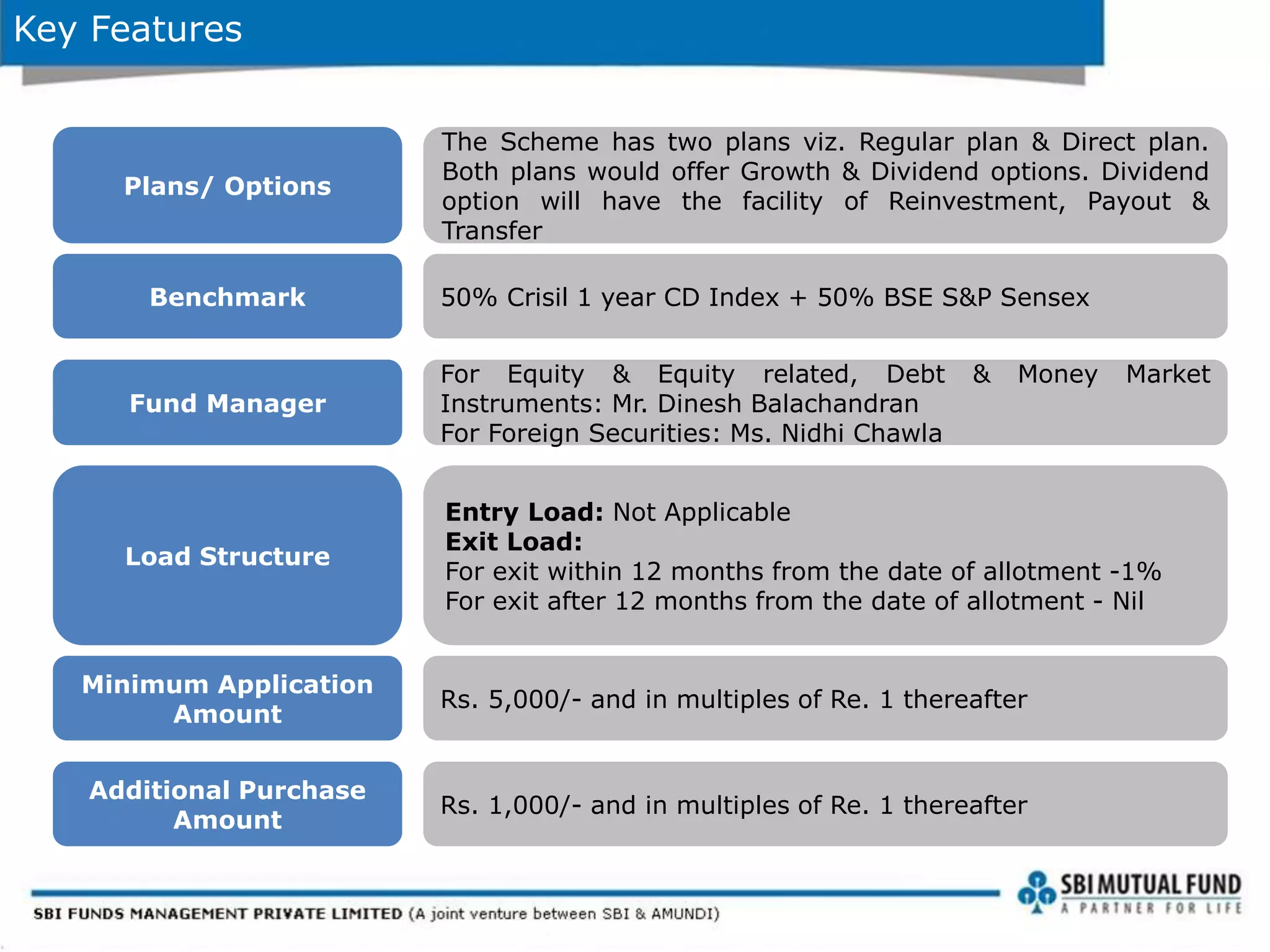
Key Features
Plans/ Options
The Scheme has two plans viz. Regular plan & Direct plan.
Both plans would offer Growth & Dividend options. Dividend
option will have the facility of Reinvestment, Payout &
Transfer
Benchmark 50% Crisil 1 year CD Index + 50% BSE S&P Sensex
Fund Manager
For Equity & Equity related, Debt & Money Market
Instruments: Mr. Dinesh Balachandran
For Foreign Securities: Ms. Nidhi Chawla
Load Structure
Entry Load: Not Applicable
Exit Load:
For exit within 12 months from the date of allotment -1%
For exit after 12 months from the date of allotment - Nil
Minimum Application
Amount
Rs. 5,000/- and in multiples of Re. 1 thereafter
Additional Purchase
Amount
Rs. 1,000/- and in multiples of Re. 1 thereafter
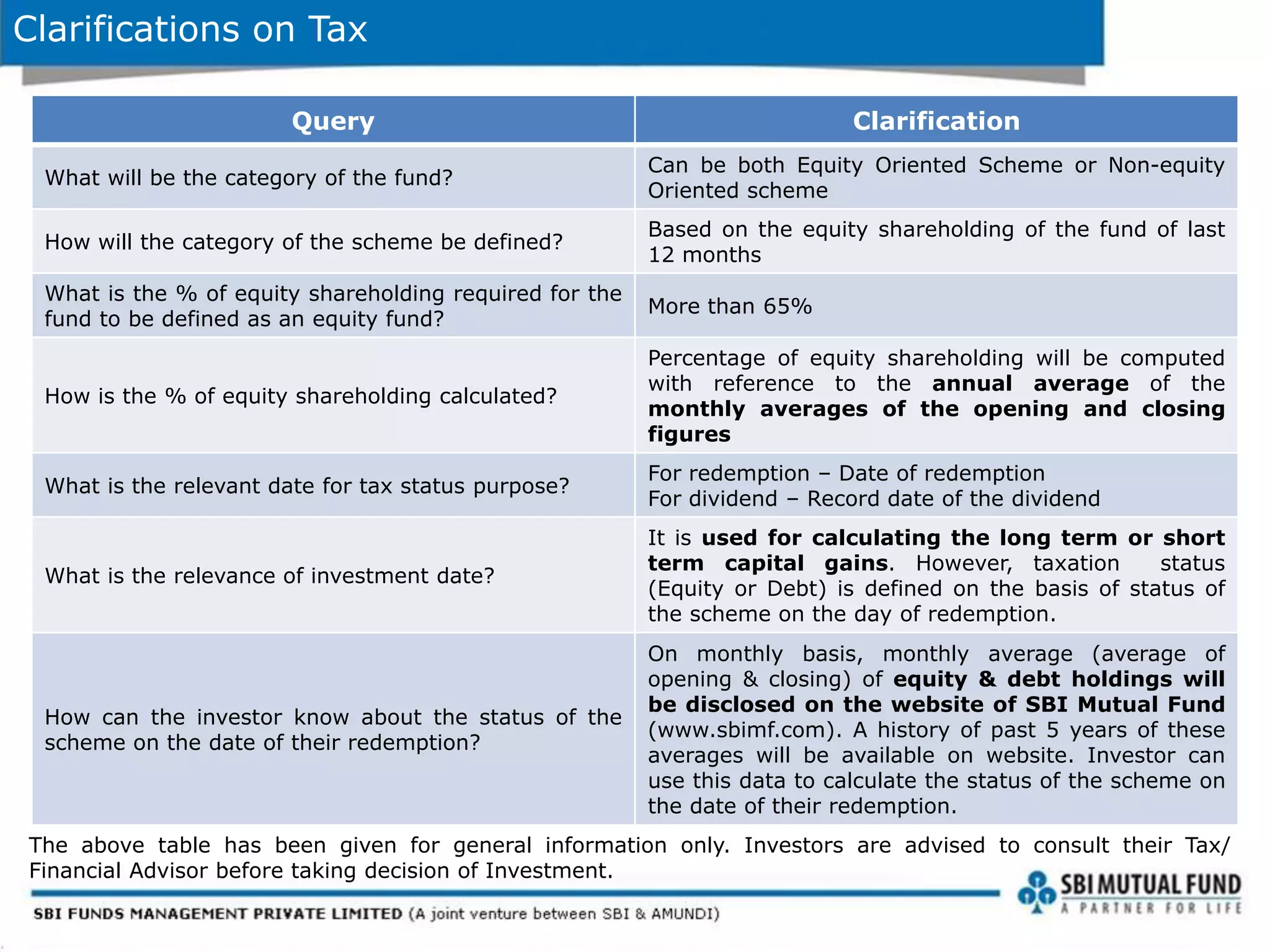
Clarifications on Tax
Query Clarification
What will be the category of the fund?
Can be both Equity Oriented Scheme or Non-equity
Oriented scheme
How will the category of the scheme be defined?
Based on the equity shareholding of the fund of last
12 months
What is the % of equity shareholding required for the
fund to be defined as an equity fund?
More than 65%
How is the % of equity shareholding calculated?
Percentage of equity shareholding will be computed
with reference to the annual average of the
monthly averages of the opening and closing
figures
What is the relevant date for tax status purpose?
For redemption – Date of redemption
For dividend – Record date of the dividend
What is the relevance of investment date?
It is used for calculating the long term or short
term capital gains. However, taxation status
(Equity or Debt) is defined on the basis of status of
the scheme on the day of redemption.
How can the investor know about the status of the
scheme on the date of their redemption?
On monthly basis, monthly average (average of
opening & closing) of equity & debt holdings will
be disclosed on the website of SBI Mutual Fund
(www.sbimf.com). A history of past 5 years of these
averages will be available on website. Investor can
use this data to calculate the status of the scheme on
the date of their redemption.
The above table has been given for general information only. Investors are advised to consult their Tax/
Financial Advisor before taking decision of Investment.
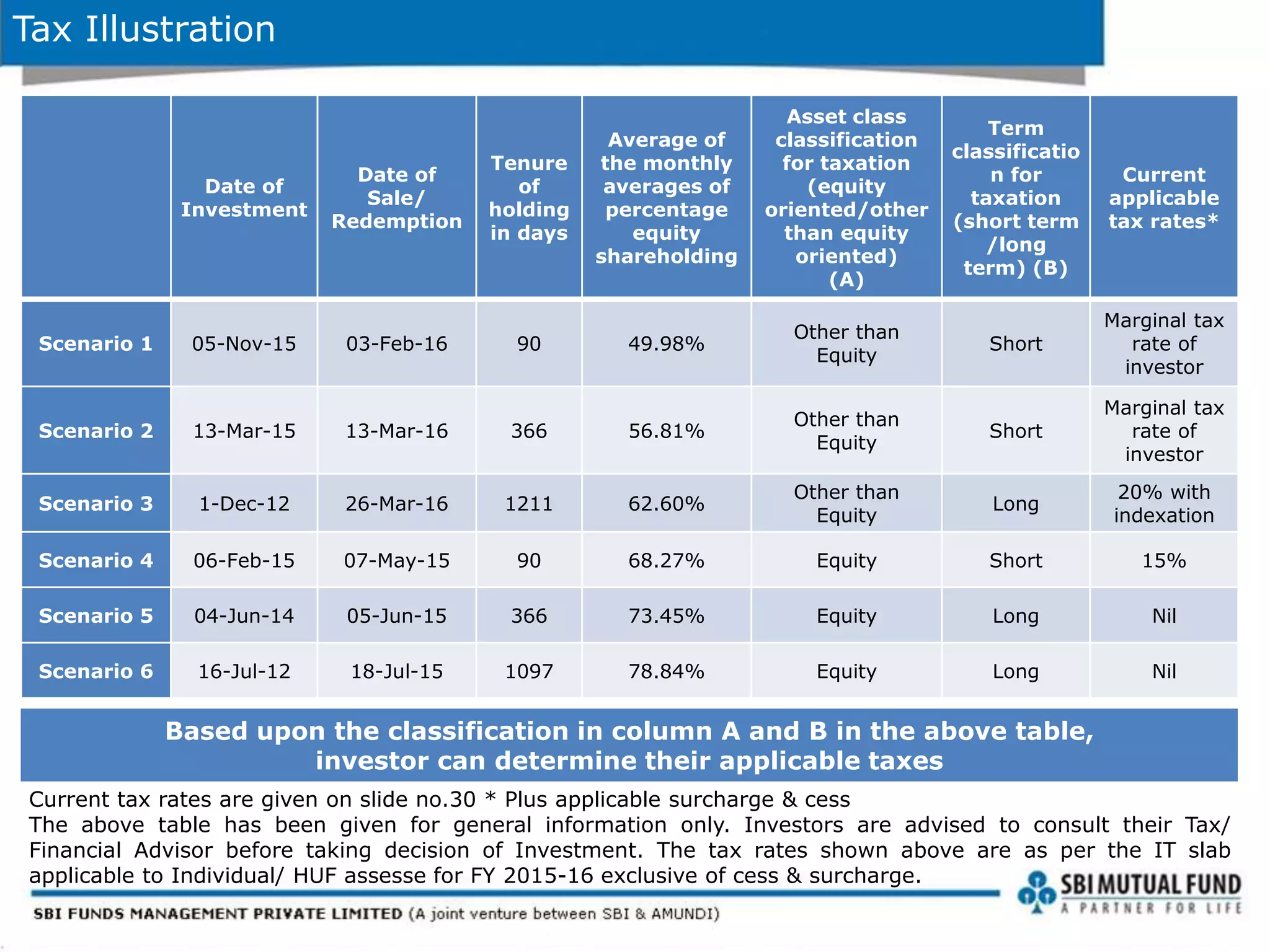
Tax Illustration
Date of
Investment
Date of
Sale/
Redemption
Tenure
of
holding
in days
Average of
the monthly
averages of
percentage
equity
shareholding
Asset class
classification
for taxation
(equity
oriented/other
than equity
oriented)
(A)
Term
classificatio
n for
taxation
(short term
/long
term) (B)
Current
applicable
tax rates*
Scenario 1 05-Nov-15 03-Feb-16 90 49.98%
Other than
Equity
Short
Marginal tax
rate of
investor
Scenario 2 13-Mar-15 13-Mar-16 366 56.81%
Other than
Equity
Short
Marginal tax
rate of
investor
Scenario 3 1-Dec-12 26-Mar-16 1211 62.60%
Other than
Equity
Long
20% with
indexation
Scenario 4 06-Feb-15 07-May-15 90 68.27% Equity Short 15%
Scenario 5 04-Jun-14 05-Jun-15 366 73.45% Equity Long Nil
Scenario 6 16-Jul-12 18-Jul-15 1097 78.84% Equity Long Nil
Current tax rates are given on slide no.30 * Plus applicable surcharge & cess
The above table has been given for general information only. Investors are advised to consult their Tax/
Financial Advisor before taking decision of Investment. The tax rates shown above are as per the IT slab
applicable to Individual/ HUF assesse for FY 2015-16 exclusive of cess & surcharge.
Based upon the classification in column A and B in the above table,
investor can determine their applicable taxes
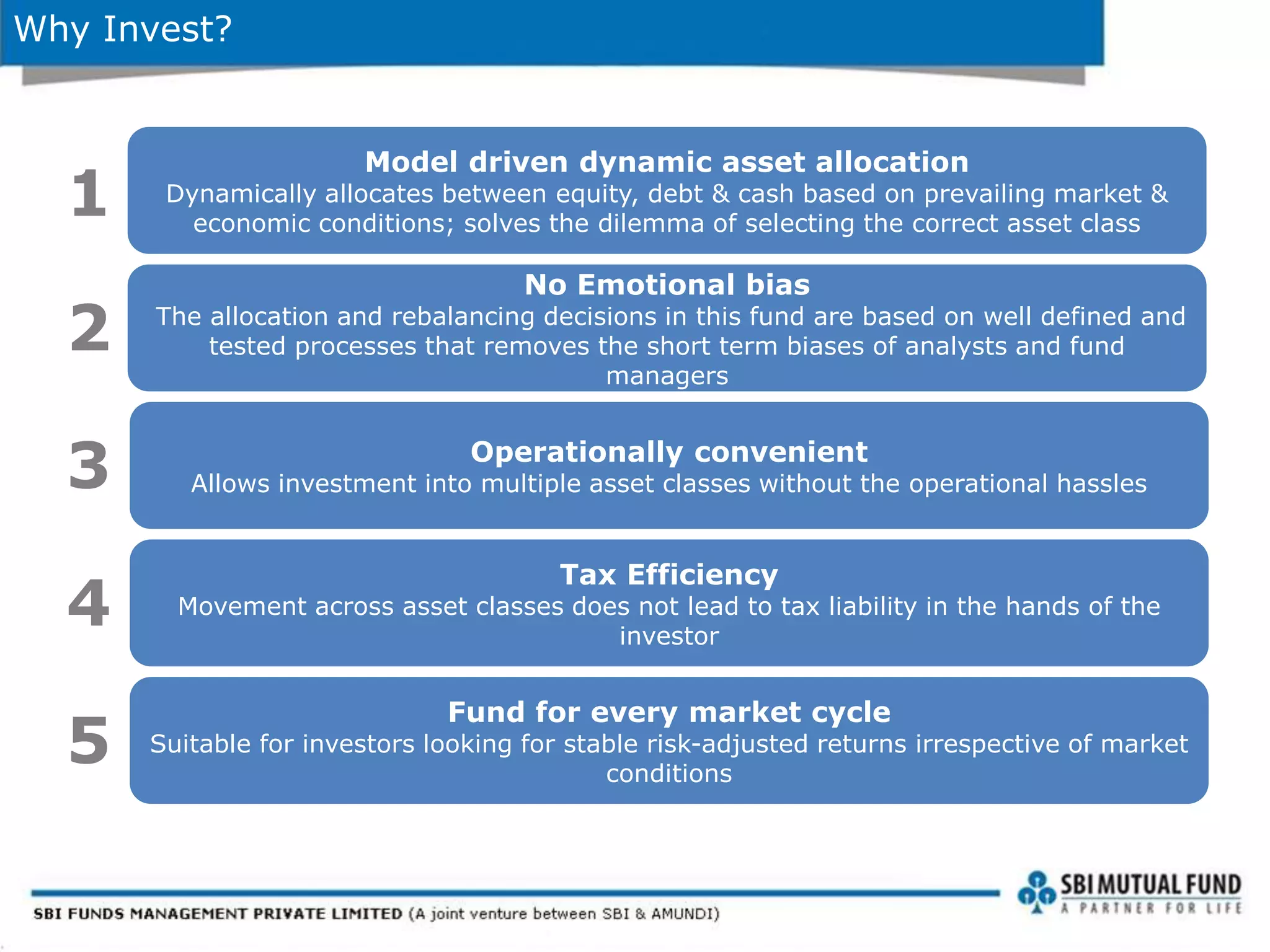
Why Invest?
Model driven dynamic asset allocation
Dynamically allocates between equity, debt & cash based on prevailing market &
economic conditions; solves the dilemma of selecting the correct asset class
No Emotional bias
The allocation and rebalancing decisions in this fund are based on well defined and
tested processes that removes the short term biases of analysts and fund
managers
1
2
Operationally convenient
Allows investment into multiple asset classes without the operational hassles3
Tax Efficiency
Movement across asset classes does not lead to tax liability in the hands of the
investor
4
Fund for every market cycle
Suitable for investors looking for stable risk-adjusted returns irrespective of market
conditions
5
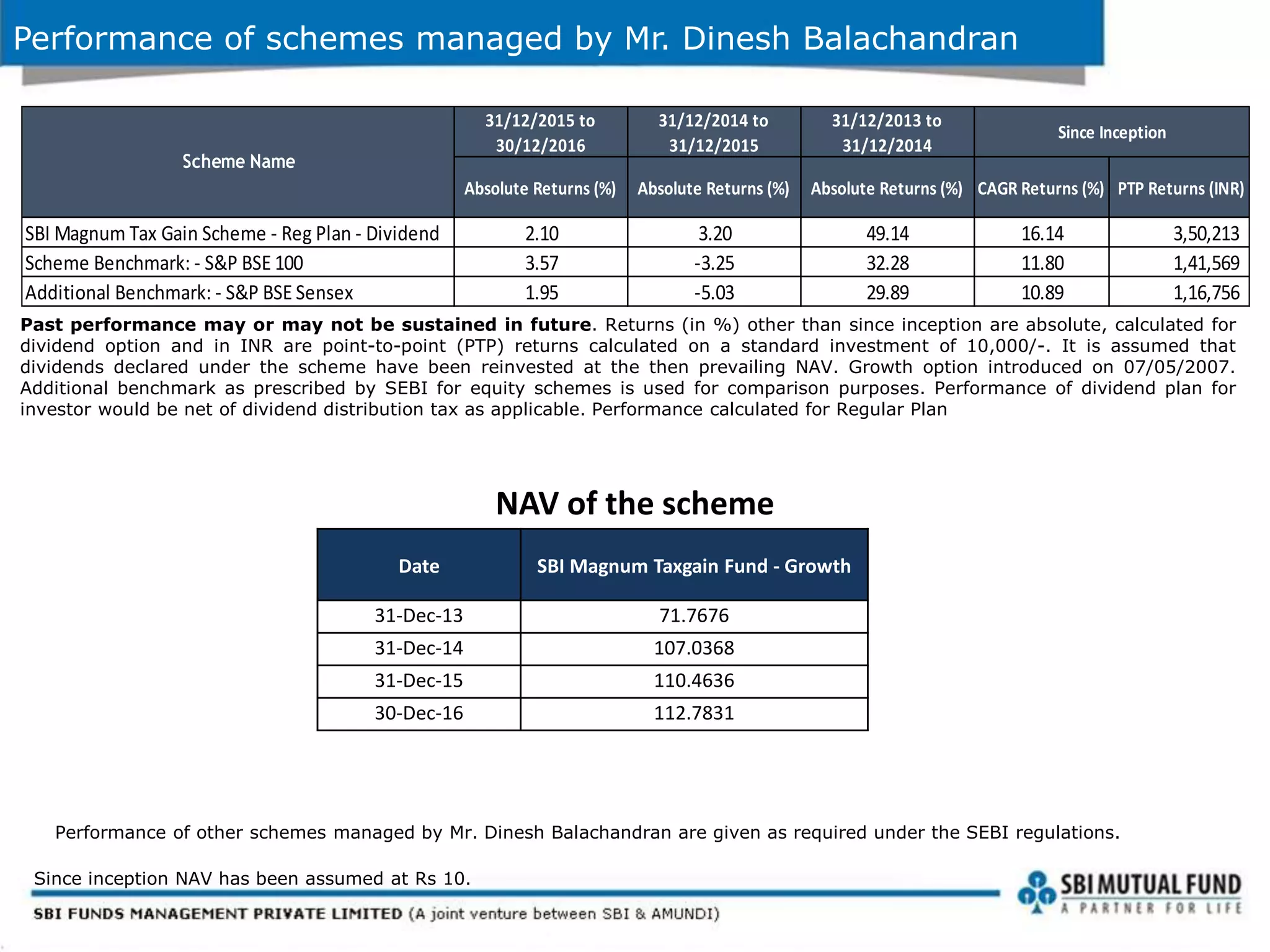
Performance of schemes managed by Mr. Dinesh Balachandran
Since inception NAV has been assumed at Rs 10.
NAV of the scheme
Performance of other schemes managed by Mr. Dinesh Balachandran are given as required under the SEBI regulations.
Past performance may or may not be sustained in future. Returns (in %) other than since inception are absolute, calculated for
dividend option and in INR are point-to-point (PTP) returns calculated on a standard investment of 10,000/-. It is assumed that
dividends declared under the scheme have been reinvested at the then prevailing NAV. Growth option introduced on 07/05/2007.
Additional benchmark as prescribed by SEBI for equity schemes is used for comparison purposes. Performance of dividend plan for
investor would be net of dividend distribution tax as applicable. Performance calculated for Regular Plan
Date SBI Magnum Taxgain Fund - Growth
31-Dec-13 71.7676
31-Dec-14 107.0368
31-Dec-15 110.4636
30-Dec-16 112.7831
31/12/2015 to
30/12/2016
31/12/2014 to
31/12/2015
31/12/2013 to
31/12/2014
Absolute Returns (%) Absolute Returns (%) Absolute Returns (%) CAGR Returns (%) PTP Returns (INR)
SBI Magnum Tax Gain Scheme - Reg Plan - Dividend 2.10 3.20 49.14 16.14 3,50,213
Scheme Benchmark: - S&P BSE 100 3.57 -3.25 32.28 11.80 1,41,569
Additional Benchmark: - S&P BSE Sensex 1.95 -5.03 29.89 10.89 1,16,756
Since Inception
Scheme Name
28
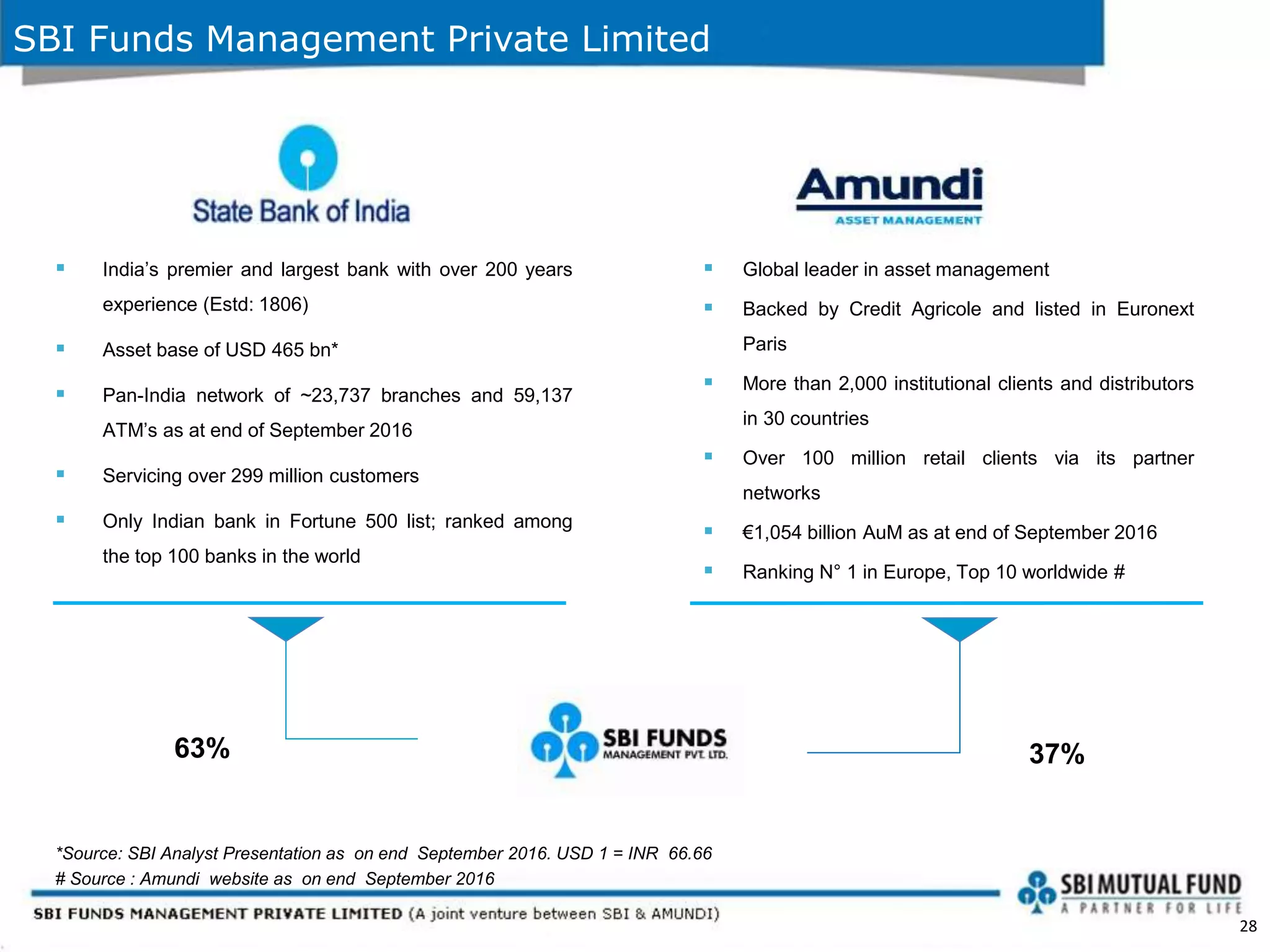
SBI Funds Management Private Limited
*Source: SBI Analyst Presentation as on end September 2016. USD 1 = INR 66.66
# Source : Amundi website as on end September 2016
63% 37%
 India’s premier and largest bank with over 200 years
experience (Estd: 1806)
 Asset base of USD 465 bn*
 Pan-India network of ~23,737 branches and 59,137
ATM’s as at end of September 2016
 Servicing over 299 million customers
 Only Indian bank in Fortune 500 list; ranked among
the top 100 banks in the world
 Global leader in asset management
 Backed by Credit Agricole and listed in Euronext
Paris
 More than 2,000 institutional clients and distributors
in 30 countries
 Over 100 million retail clients via its partner
networks
 €1,054 billion AuM as at end of September 2016
 Ranking N° 1 in Europe, Top 10 worldwide #
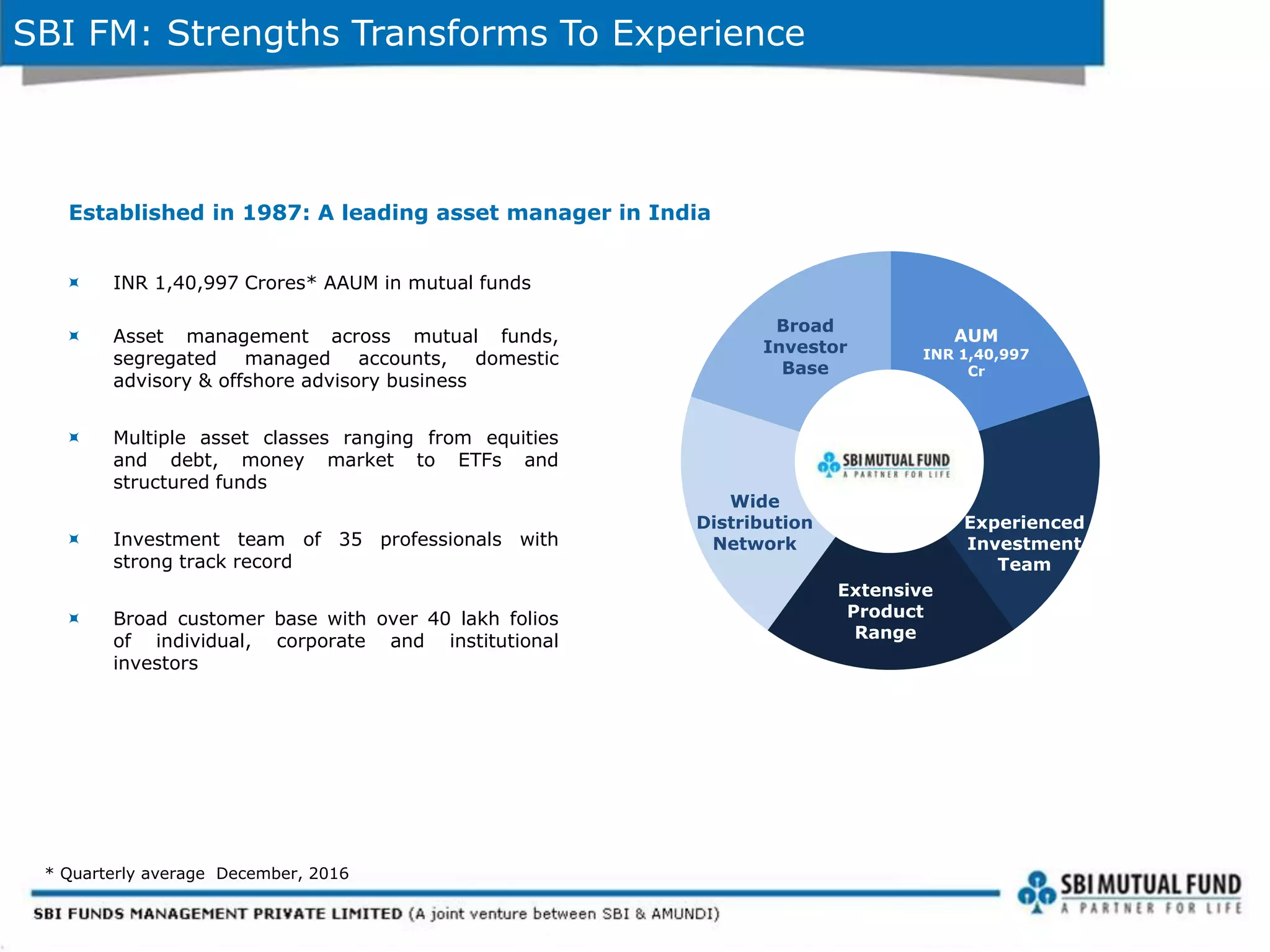
SBI FM: Strengths Transforms To Experience
Established in 1987: A leading asset manager in India
Broad
Investor
Base
AUM
INR 1,40,997
Cr
Wide
Distribution
Network
Experienced
Investment
Team
Extensive
Product
Range
 INR 1,40,997 Crores* AAUM in mutual funds
 Asset management across mutual funds,
segregated managed accounts, domestic
advisory & offshore advisory business
 Multiple asset classes ranging from equities
and debt, money market to ETFs and
structured funds
 Investment team of 35 professionals with
strong track record
 Broad customer base with over 40 lakh folios
of individual, corporate and institutional
investors
* Quarterly average December, 2016
Annexure
Investment Team
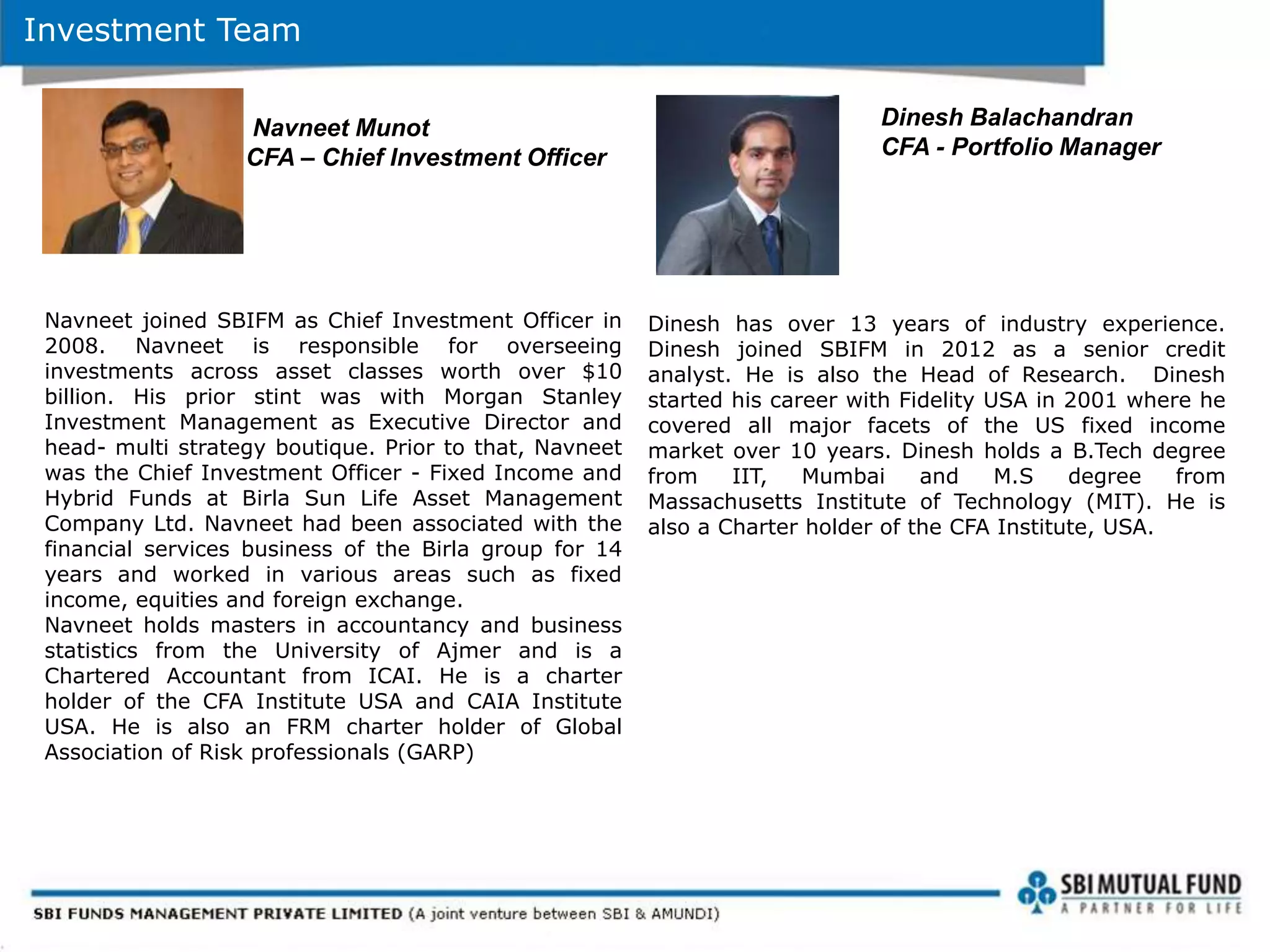
Navneet joined SBIFM as Chief Investment Officer in
2008. Navneet is responsible for overseeing
investments across asset classes worth over $10
billion. His prior stint was with Morgan Stanley
Investment Management as Executive Director and
head- multi strategy boutique. Prior to that, Navneet
was the Chief Investment Officer - Fixed Income and
Hybrid Funds at Birla Sun Life Asset Management
Company Ltd. Navneet had been associated with the
financial services business of the Birla group for 14
years and worked in various areas such as fixed
income, equities and foreign exchange.
Navneet holds masters in accountancy and business
statistics from the University of Ajmer and is a
Chartered Accountant from ICAI. He is a charter
holder of the CFA Institute USA and CAIA Institute
USA. He is also an FRM charter holder of Global
Association of Risk professionals (GARP)
Navneet Munot
CFA – Chief Investment Officer
Dinesh has over 13 years of industry experience.
Dinesh joined SBIFM in 2012 as a senior credit
analyst. He is also the Head of Research. Dinesh
started his career with Fidelity USA in 2001 where he
covered all major facets of the US fixed income
market over 10 years. Dinesh holds a B.Tech degree
from IIT, Mumbai and M.S degree from
Massachusetts Institute of Technology (MIT). He is
also a Charter holder of the CFA Institute, USA.
Dinesh Balachandran
CFA - Portfolio Manager
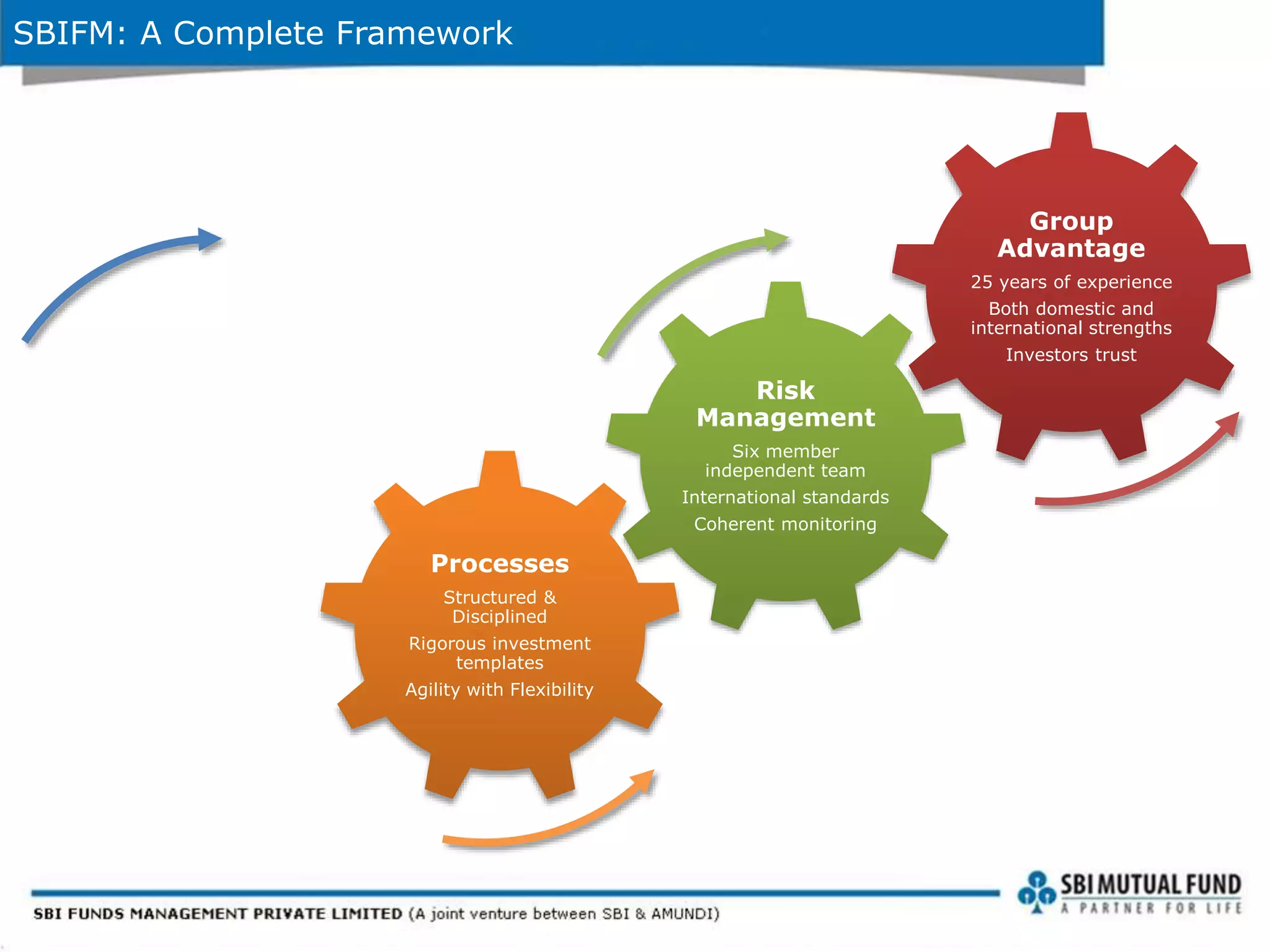
SBIFM: A Complete Framework
Processes
Structured &
Disciplined
Rigorous investment
templates
Agility with Flexibility
Risk
Management
Six member
independent team
International standards
Coherent monitoring
Group
Advantage
25 years of experience
Both domestic and
international strengths
Investors trust
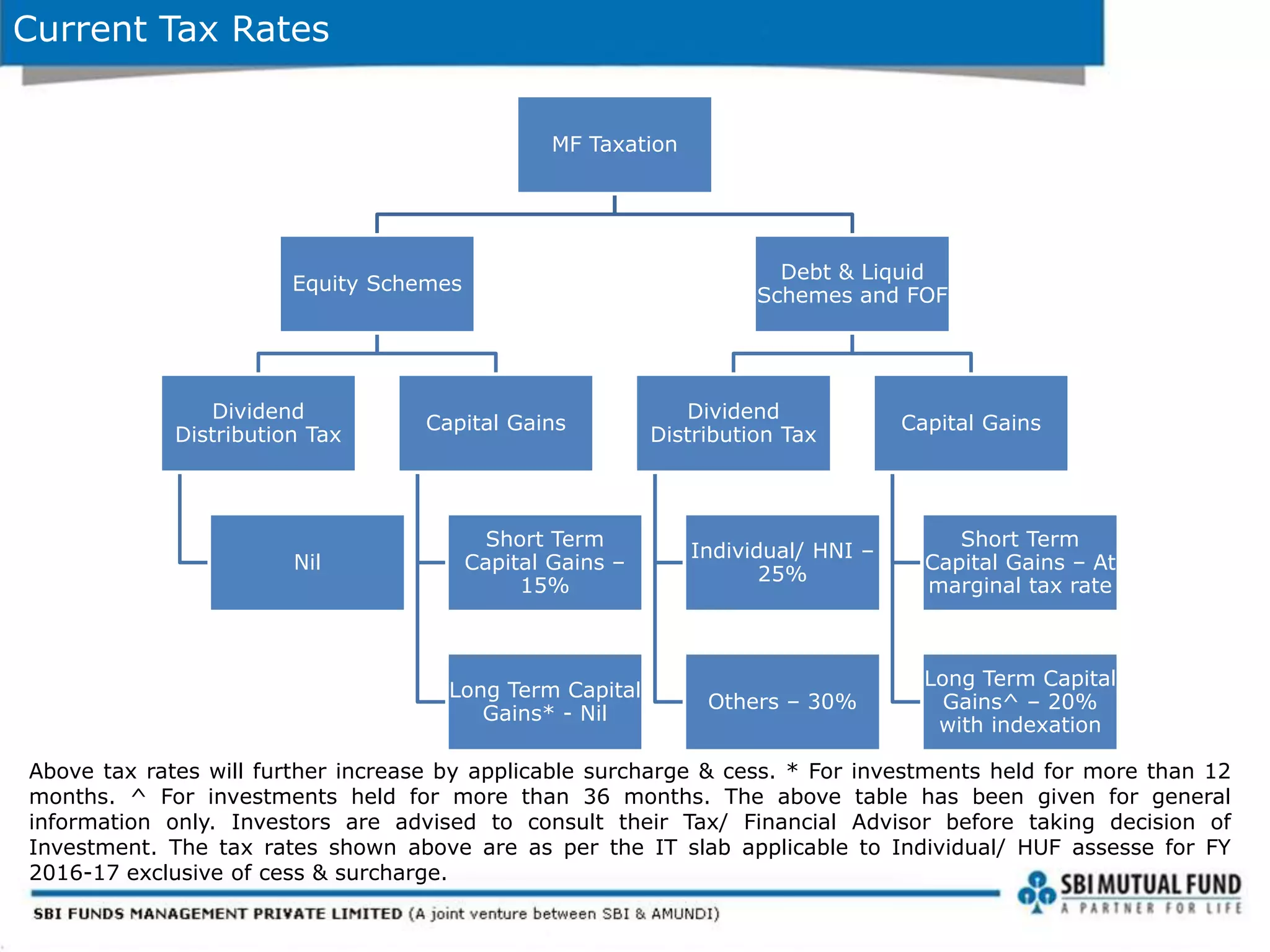
Current Tax Rates
Above tax rates will further increase by applicable surcharge & cess. * For investments held for more than 12
months. ^ For investments held for more than 36 months. The above table has been given for general
information only. Investors are advised to consult their Tax/ Financial Advisor before taking decision of
Investment. The tax rates shown above are as per the IT slab applicable to Individual/ HUF assesse for FY
2016-17 exclusive of cess & surcharge.
MF Taxation
Equity Schemes
Dividend
Distribution Tax
Nil
Capital Gains
Short Term
Capital Gains –
15%
Long Term Capital
Gains* - Nil
Debt & Liquid
Schemes and FOF
Dividend
Distribution Tax
Individual/ HNI –
25%
Others – 30%
Capital Gains
Short Term
Capital Gains – At
marginal tax rate
Long Term Capital
Gains^ – 20%
with indexation
Disclaimer
Mutual Fund investments are subject to market risks, read all scheme related documents carefully.
This presentation is for information purposes only and is not an offer to sell or a solicitation to buy any mutual fund
units/securities. The views expressed herein are based on the basis of internal data, publicly available information &
other sources believed to be reliable. Any calculations made are approximations meant as guidelines only, which need to
be confirmed before relying on them. These views alone are not sufficient and should not be used for the development
or implementation of an investment strategy. It should not be construed as investment advice to any party. All opinions
and estimates included here constitute our view as of this date and are subject to change without notice. Neither SBI
Funds Management Private Limited, SBI Mutual Fund nor any person connected with it, accepts any liability arising from
the use of this information. The recipient of this material should rely on their investigations and take their own
professional advice

SBI Dynamic Asset Allocation Fund: An Open-ended Dynamic Asset Allocation Scheme - Dec 16

  • 1.
    Product Labelling This productis suitable for investors who are seeking*:  Income and capital appreciation  Dynamic Asset allocation between equity related Instruments and fixed income instruments so as to provide with long term capital appreciation. *Investors should consult their financial advisers if in doubt about whether the product is suitable for them.
  • 2.
    Index • The AssetAllocation Puzzle • Need for Asset Allocation • Why have a Dynamic Asset Allocation Strategy? • SBI Dynamic Asset Allocation Fund • Key Features • Why Invest? • Investment Team
  • 3.
  • 4.
    81% 17% -25% 26% 9% 30% -5% 2% 4% 5% 7% 9% 4% 14% 9% 13% 5% 5% 8% 9% 9% 9% 8% 7% 2009 2010 2011 2012 2013 2014 2015 2016 Cash Debt Equity The Asset Race:Winners change frequently Past performance may or may not be sustained in future. Source: Bloomberg, CRISIL Fund Analyzer. Equity refers to S&P BSE Sensex, Debt refers to Crisil Composite Bond Fund Index, Cash refers to Crisil Liquid Fund Index The top & bottom performing asset class changes from year to year! Debt Equity Cash Equity Cash Equity Equity Winner Debt
  • 5.
    The Asset AllocationPuzzle! What do I do?
  • 6.
    Need for AssetAllocation
  • 7.
    Every asset hasits place in the puzzle Equity Debt Cash Long term Wealth Generator Higher potential for gain Potential Hedge against Inflation Regular Income Lower risk Potential to preserve capital in times of downturn High Liquidity Safe avenue for parking extra cash High Risk Higher Volatility Conservative Investments Possibility of lower than inflation returns Very low inflation adjusted potential returns
  • 8.
    In times ofcrisis, correlation comes to the forefront Past performance may or may not be sustained in future. Source: Bloomberg, CRISIL Fund Analyzer. Equity refers to S&P BSE Sensex, Debt refers to Crisil Composite Bond Fund Index, Cash refers to Crisil Liquid Fund Index. Correlation above has been calculated on daily returns. Equity Debt Long Term Correlation (Mar 2002 to December 2016) Debt 0.13 Cash 0.03 0.31 Correlation in times of Equity Market Crash Sep 2008 (Lehman Crisis) Debt -0.23 Cash -0.11 0.52 Aug – Sep 2011 (Sovereign Debt Crisis) Debt -0.29 Cash -0.04 0.57 In the long term, equity, debt & cash have low correlation with each other However, when markets crash, equity has a negative correlation with debt & cash
  • 9.
    Maximum Return 62.30% Average Return 17.72% MinimumReturn (8.27%) Maximum Return 30.68% Average Return 12.60% Minimum Return 0.53% Maximum Return 12.99% Average Return 6.50% Minimum Return 2.27% Maximum Return 8.95% Average Return 6.89% Minimum Return 4.40% -20% 0% 20% 40% 60% 80% 100% Equity Simulated Portfolio Debt Cash Diversifying the portfolio leads to stability Past performance may or may not be sustained in future. Source: Bloomberg, CRISIL Fund Analyzer. Equity refers to S&P BSE Sensex, Debt refers to Crisil Composite Bond Fund Index, Cash refers to Crisil Liquid Fund Index Simulated Portfolio refers to 50% S&P BSE Sensex + 25% Crisil Composite Bond Fund Index + 25% Crisil Liquid Fund Index rebalanced on a daily basis. The above chart depicts the high-average-low 3 year return (CAGR) of the specified asset classes/ simulated portfolio.*Launch of Crisil Composite Bond Fund Index & Crisil Liquid Fund Index. Combining equity with debt stabilizes the portfolio without compromising on growth Higher Return – Higher Risk Lower Return – Lower Risk Rolling 3 year return (Mar 2002* – December 2016)
  • 10.
    Simulated Portfolio Diversification solves theAsset Allocation puzzle Past performance may or may not be sustained in future. Source: Bloomberg, CRISIL Fund Analyzer. Equity refers to S&P BSE Sensex, Debt refers to Crisil Composite Bond Fund Index. Simulated Portfolio refers to 50% S&P BSE Sensex + 25% Crisil Composite Bond Fund Index + 25% Crisil Liquid Fund Index rebalanced on a daily basis. Risk above refers to standard deviation. Standard deviation has been calculated on daily returns. Returns above are CAGR returns for the specified period. Diversifying across asset classes helps generate superior risk adjusted returns under different market cycles Equity Simulated Portfolio Debt Cash -8% -6% -4% -2% 0% 2% 4% 6% 8% 0% 10% 20% 30% 40% 50% Return Risk Falling Equity markets Risk Return for the period: Dec 07 (Sensex at 20286) to Dec 09 (Sensex at 17465) Equity Debt Cash 0% 2% 4% 6% 8% 10% 12% 14% 16% 18% 20% 0% 5% 10% 15% 20% 25% 30% Return Risk Rising Equity markets Risk Return for the period Dec 12 (Sensex at 19427) to Mar 15 (Sensex at 27957)
  • 11.
    Why have aDynamic Asset Allocation Strategy?
  • 12.
    Dilemma faced byInvestors How do I control my bias while taking investment decisions? How do I time the markets? How do I allocate assets & rebalance my portfolio in a cost effective manner? Asset Allocation is important. But how do I manage my portfolio?
  • 13.
    Traditionally past performancedrives flows Past performance may or may not be sustained in future. Source: Bloomberg, AMFI. Equity refers to S&P BSE Sensex. Returns refers to absolute returns. Investors typically make the mistake of buying at peaks & selling at lows An asset allocation model which dynamically allocates will remove the bias of investors Equity returns (Mar 07 – Mar 08): 19.7% Equity Fund Inflows in Mar 07 – Mar 08: +ve Rs. 46,933 crs Equity returns (Mar 08 – Mar 09): -37.9% What happened Equity returns (Mar 11 – Mar 13): -3.1% Equity Fund Outflows in Mar 12 – Mar 13: -ve Rs. -14,587 crs Equity returns (Mar 13 – Jan 15): 54.9% What happened AfterBefore
  • 14.
    Dynamic Asset Allocation:The Solution Model driven asset allocation which decides the appropriate allocation to equity, debt & cash No Emotional Bias No need for timing the market Operationally Effective – both from cost & tax perspective & reduces transactional hassles
  • 15.
    SBI Dynamic AssetAllocation Fund
  • 16.
    SBI Dynamic AssetAllocation Fund at work Equity: 0 to 100% Debt & Money Market Instruments: 0 to 100% Momentum Exhaustion of Momentum Rate of Change in Momentum Market Weakness Market Strengths Objective: To dynamically allocate across asset classes in order to generate superior risk adjusted returns
  • 17.
    Parameters driving themodel Momentum Rate of Change in Momentum Exhaustion of Momentum Indicates trends & change in the psychology of market participants Mitigates the effect of sharp movements in markets Attempts to pinpoint market peaks or bottoms Identifies likely momentum exhaustion points Purpose Under normal market conditions Under normal market conditions At market inflection points When does it come into play Model works on exhaustive checklists & filters to generate buy or sell signals
  • 18.
    Model dynamically allocatesbetween assets Past performance may or may not be sustained in future. Source: Internal, Bloomberg. Average is the daily average for the month. Above chart shows movement of the equity allocation along with the S&P BSE Sensex level movement. The chart above is provided purely to explain the concept of SBI Dynamic Asset Allocation Fund (SDAAF) proprietary model & does not in any manner indicate the future results or asset allocation.
  • 19.
    Model dynamically allocatesbetween assets Past performance may or may not be sustained in future. Source: Internal, Bloomberg. Average is the daily average for the month. Above chart shows movement of the cash & money market allocation along with the 91 day Tbill yield movement. The chart above is provided purely to explain the concept of SBI Dynamic Asset Allocation Fund (SDAAF) proprietary model & does not in any manner indicate the future results or asset allocation.
  • 20.
    Model dynamically allocatesbetween assets Past performance may or may not be sustained in future. Source: Internal, Bloomberg. Average is the daily average for the month. Above chart shows movement of the debt allocation along with the 10 year Gsec yield movement. The chart above is provided purely to explain the concept of SBI Dynamic Asset Allocation Fund (SDAAF) proprietary model & does not in any manner indicate the future results or asset allocation.
  • 21.
    Performance Past performance mayor may not be sustained in future. Returns (in %) other than since inception are absolute, calculated for growth option and in INR are point-to-point (PTP) returns calculated on a standard investment of 10,000/-. Inception date of the scheme is 26/03/2015. NAV (Regular plan Growth option) 31-Dec-2015: INR 9.9401, 30-Dec-2016: INR 10.3688. Additional benchmark as prescribed by SEBI for equity schemes is used for comparison purposes. Data as on 30/12/2016. 30-Dec-2015 To 30-Dec-2016 30-Dec-2014 To 30-Dec-2015 28-Dec-2013 To 30-Dec-2014 Since Inception Absolute Returns (%) CAGR Returns (%) PTP Returns (INR) SBI Dynamic Asset Allocation Fund 4.31 N.A. N.A. 2.07 10,369 50% Crisil 1 year CD Index + 50% S&P BSE Sensex (Scheme Benchmark) 5.43 N.A. N.A. 3.63 10,651 S&P BSE Sensex (Additional Benchmark) 1.95 N.A. N.A. -1.72 9,697
  • 22.
    Fund Philosophy &Asset Allocation • Aims to provide investors with an opportunity to invest in a portfolio of a mix of equity and equity related securities and fixed income instruments which will be managed dynamically so as to provide investors with long term capital appreciation • Invests across equity, debt & cash • Aims to generate appreciation through asset allocation • Suitable for investors looking for superior risk adjusted returns over the long term • Indicative Asset Allocation * Exposure to securitized debt may be to the extent of 20% of the net assets. Exposure in derivatives will not exceed 50% of the net asset of the Scheme. The cumulative gross exposure through Equity & Equity related instruments, Debt & Money Market Securities including derivatives positions will not exceed 100% of the net asset of the Scheme. The Scheme shall not invest in repo in corporate debt. The Scheme may engage in securities lending and short selling in accordance with SEBI (MF) Regulations. #Investments in foreign securities /ADR/GDR/ would comply with the Guidelines and overall limits laid down for Mutual funds by SEBI for investments in foreign securities. Instruments Indicative allocations (% of total assets)* Risk Profile Minimum Maximum Equity and equity related instruments including foreign securities# 0 100 High Debt and Money Market instruments* 0 100 Low to Medium
  • 23.
    Key Features Plans/ Options TheScheme has two plans viz. Regular plan & Direct plan. Both plans would offer Growth & Dividend options. Dividend option will have the facility of Reinvestment, Payout & Transfer Benchmark 50% Crisil 1 year CD Index + 50% BSE S&P Sensex Fund Manager For Equity & Equity related, Debt & Money Market Instruments: Mr. Dinesh Balachandran For Foreign Securities: Ms. Nidhi Chawla Load Structure Entry Load: Not Applicable Exit Load: For exit within 12 months from the date of allotment -1% For exit after 12 months from the date of allotment - Nil Minimum Application Amount Rs. 5,000/- and in multiples of Re. 1 thereafter Additional Purchase Amount Rs. 1,000/- and in multiples of Re. 1 thereafter
  • 24.
    Clarifications on Tax QueryClarification What will be the category of the fund? Can be both Equity Oriented Scheme or Non-equity Oriented scheme How will the category of the scheme be defined? Based on the equity shareholding of the fund of last 12 months What is the % of equity shareholding required for the fund to be defined as an equity fund? More than 65% How is the % of equity shareholding calculated? Percentage of equity shareholding will be computed with reference to the annual average of the monthly averages of the opening and closing figures What is the relevant date for tax status purpose? For redemption – Date of redemption For dividend – Record date of the dividend What is the relevance of investment date? It is used for calculating the long term or short term capital gains. However, taxation status (Equity or Debt) is defined on the basis of status of the scheme on the day of redemption. How can the investor know about the status of the scheme on the date of their redemption? On monthly basis, monthly average (average of opening & closing) of equity & debt holdings will be disclosed on the website of SBI Mutual Fund (www.sbimf.com). A history of past 5 years of these averages will be available on website. Investor can use this data to calculate the status of the scheme on the date of their redemption. The above table has been given for general information only. Investors are advised to consult their Tax/ Financial Advisor before taking decision of Investment.
  • 25.
    Tax Illustration Date of Investment Dateof Sale/ Redemption Tenure of holding in days Average of the monthly averages of percentage equity shareholding Asset class classification for taxation (equity oriented/other than equity oriented) (A) Term classificatio n for taxation (short term /long term) (B) Current applicable tax rates* Scenario 1 05-Nov-15 03-Feb-16 90 49.98% Other than Equity Short Marginal tax rate of investor Scenario 2 13-Mar-15 13-Mar-16 366 56.81% Other than Equity Short Marginal tax rate of investor Scenario 3 1-Dec-12 26-Mar-16 1211 62.60% Other than Equity Long 20% with indexation Scenario 4 06-Feb-15 07-May-15 90 68.27% Equity Short 15% Scenario 5 04-Jun-14 05-Jun-15 366 73.45% Equity Long Nil Scenario 6 16-Jul-12 18-Jul-15 1097 78.84% Equity Long Nil Current tax rates are given on slide no.30 * Plus applicable surcharge & cess The above table has been given for general information only. Investors are advised to consult their Tax/ Financial Advisor before taking decision of Investment. The tax rates shown above are as per the IT slab applicable to Individual/ HUF assesse for FY 2015-16 exclusive of cess & surcharge. Based upon the classification in column A and B in the above table, investor can determine their applicable taxes
  • 26.
    Why Invest? Model drivendynamic asset allocation Dynamically allocates between equity, debt & cash based on prevailing market & economic conditions; solves the dilemma of selecting the correct asset class No Emotional bias The allocation and rebalancing decisions in this fund are based on well defined and tested processes that removes the short term biases of analysts and fund managers 1 2 Operationally convenient Allows investment into multiple asset classes without the operational hassles3 Tax Efficiency Movement across asset classes does not lead to tax liability in the hands of the investor 4 Fund for every market cycle Suitable for investors looking for stable risk-adjusted returns irrespective of market conditions 5
  • 27.
    Performance of schemesmanaged by Mr. Dinesh Balachandran Since inception NAV has been assumed at Rs 10. NAV of the scheme Performance of other schemes managed by Mr. Dinesh Balachandran are given as required under the SEBI regulations. Past performance may or may not be sustained in future. Returns (in %) other than since inception are absolute, calculated for dividend option and in INR are point-to-point (PTP) returns calculated on a standard investment of 10,000/-. It is assumed that dividends declared under the scheme have been reinvested at the then prevailing NAV. Growth option introduced on 07/05/2007. Additional benchmark as prescribed by SEBI for equity schemes is used for comparison purposes. Performance of dividend plan for investor would be net of dividend distribution tax as applicable. Performance calculated for Regular Plan Date SBI Magnum Taxgain Fund - Growth 31-Dec-13 71.7676 31-Dec-14 107.0368 31-Dec-15 110.4636 30-Dec-16 112.7831 31/12/2015 to 30/12/2016 31/12/2014 to 31/12/2015 31/12/2013 to 31/12/2014 Absolute Returns (%) Absolute Returns (%) Absolute Returns (%) CAGR Returns (%) PTP Returns (INR) SBI Magnum Tax Gain Scheme - Reg Plan - Dividend 2.10 3.20 49.14 16.14 3,50,213 Scheme Benchmark: - S&P BSE 100 3.57 -3.25 32.28 11.80 1,41,569 Additional Benchmark: - S&P BSE Sensex 1.95 -5.03 29.89 10.89 1,16,756 Since Inception Scheme Name
  • 28.
    28 SBI Funds ManagementPrivate Limited *Source: SBI Analyst Presentation as on end September 2016. USD 1 = INR 66.66 # Source : Amundi website as on end September 2016 63% 37%  India’s premier and largest bank with over 200 years experience (Estd: 1806)  Asset base of USD 465 bn*  Pan-India network of ~23,737 branches and 59,137 ATM’s as at end of September 2016  Servicing over 299 million customers  Only Indian bank in Fortune 500 list; ranked among the top 100 banks in the world  Global leader in asset management  Backed by Credit Agricole and listed in Euronext Paris  More than 2,000 institutional clients and distributors in 30 countries  Over 100 million retail clients via its partner networks  €1,054 billion AuM as at end of September 2016  Ranking N° 1 in Europe, Top 10 worldwide #
  • 29.
    SBI FM: StrengthsTransforms To Experience Established in 1987: A leading asset manager in India Broad Investor Base AUM INR 1,40,997 Cr Wide Distribution Network Experienced Investment Team Extensive Product Range  INR 1,40,997 Crores* AAUM in mutual funds  Asset management across mutual funds, segregated managed accounts, domestic advisory & offshore advisory business  Multiple asset classes ranging from equities and debt, money market to ETFs and structured funds  Investment team of 35 professionals with strong track record  Broad customer base with over 40 lakh folios of individual, corporate and institutional investors * Quarterly average December, 2016
  • 30.
  • 31.
    Investment Team Navneet joinedSBIFM as Chief Investment Officer in 2008. Navneet is responsible for overseeing investments across asset classes worth over $10 billion. His prior stint was with Morgan Stanley Investment Management as Executive Director and head- multi strategy boutique. Prior to that, Navneet was the Chief Investment Officer - Fixed Income and Hybrid Funds at Birla Sun Life Asset Management Company Ltd. Navneet had been associated with the financial services business of the Birla group for 14 years and worked in various areas such as fixed income, equities and foreign exchange. Navneet holds masters in accountancy and business statistics from the University of Ajmer and is a Chartered Accountant from ICAI. He is a charter holder of the CFA Institute USA and CAIA Institute USA. He is also an FRM charter holder of Global Association of Risk professionals (GARP) Navneet Munot CFA – Chief Investment Officer Dinesh has over 13 years of industry experience. Dinesh joined SBIFM in 2012 as a senior credit analyst. He is also the Head of Research. Dinesh started his career with Fidelity USA in 2001 where he covered all major facets of the US fixed income market over 10 years. Dinesh holds a B.Tech degree from IIT, Mumbai and M.S degree from Massachusetts Institute of Technology (MIT). He is also a Charter holder of the CFA Institute, USA. Dinesh Balachandran CFA - Portfolio Manager
  • 32.
    SBIFM: A CompleteFramework Processes Structured & Disciplined Rigorous investment templates Agility with Flexibility Risk Management Six member independent team International standards Coherent monitoring Group Advantage 25 years of experience Both domestic and international strengths Investors trust
  • 33.
    Current Tax Rates Abovetax rates will further increase by applicable surcharge & cess. * For investments held for more than 12 months. ^ For investments held for more than 36 months. The above table has been given for general information only. Investors are advised to consult their Tax/ Financial Advisor before taking decision of Investment. The tax rates shown above are as per the IT slab applicable to Individual/ HUF assesse for FY 2016-17 exclusive of cess & surcharge. MF Taxation Equity Schemes Dividend Distribution Tax Nil Capital Gains Short Term Capital Gains – 15% Long Term Capital Gains* - Nil Debt & Liquid Schemes and FOF Dividend Distribution Tax Individual/ HNI – 25% Others – 30% Capital Gains Short Term Capital Gains – At marginal tax rate Long Term Capital Gains^ – 20% with indexation
  • 34.
    Disclaimer Mutual Fund investmentsare subject to market risks, read all scheme related documents carefully. This presentation is for information purposes only and is not an offer to sell or a solicitation to buy any mutual fund units/securities. The views expressed herein are based on the basis of internal data, publicly available information & other sources believed to be reliable. Any calculations made are approximations meant as guidelines only, which need to be confirmed before relying on them. These views alone are not sufficient and should not be used for the development or implementation of an investment strategy. It should not be construed as investment advice to any party. All opinions and estimates included here constitute our view as of this date and are subject to change without notice. Neither SBI Funds Management Private Limited, SBI Mutual Fund nor any person connected with it, accepts any liability arising from the use of this information. The recipient of this material should rely on their investigations and take their own professional advice