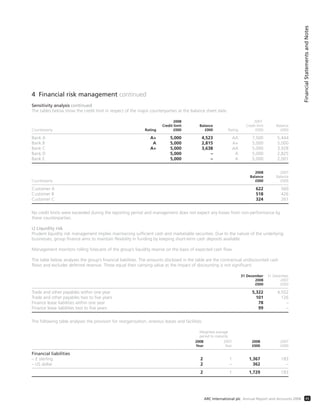
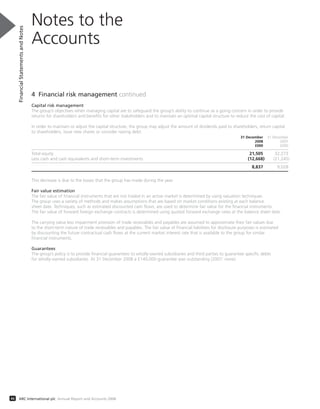
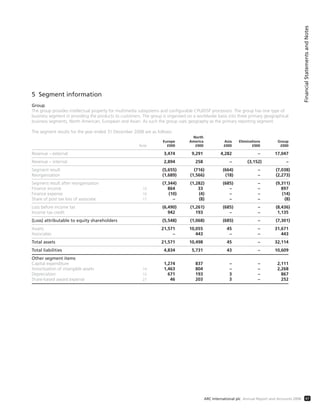
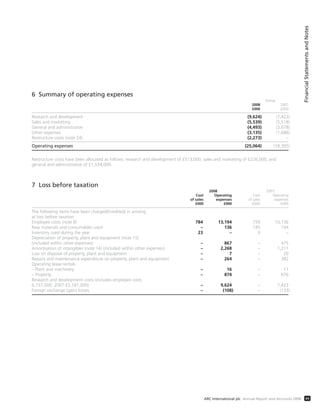
ANNUAL REPORT AND ACCOUNTS 2008
Enabling the Multimedia Revolution
Improving the Multimedia Experience
Consumers around the globe are using a growing number
of electronic products to capture, share, and play high-quality
multimedia content. Improving the multimedia experience –
regardless of the electronic device – presents a significant
market opportunity and is a key part of ARC’s strategy.
ARC Who We Are
Overview
01ARC International plc Annual Report and Accounts 2008
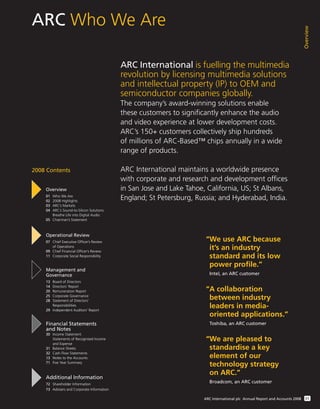
ARC International is fuelling the multimedia
revolution by licensing multimedia solutions
and intellectual property (IP) to OEM and
semiconductor companies globally.
The company’s award-winning solutions enable
these customers to significantly enhance the audio
and video experience at lower development costs.
ARC’s 150+ customers collectively ship hundreds
of millions of ARC-Based™ chips annually in a wide
range of products.
ARC International maintains a worldwide presence
with corporate and research and development offices
in San Jose and Lake Tahoe, California, US; St Albans,
England; St Petersburg, Russia; and Hyderabad, India.
Overview
01 Who We Are
02 2008 Highlights
03 ARC’s Markets
04 ARC’s Sound-to-Silicon Solutions
Breathe Life into Digital Audio
05 Chairman’s Statement
Operational Review
07 Chief Executive Officer’s Review
of Operations
09 Chief Financial Officer’s Review
11 Corporate Social Responsibility
Management and
Governance
13 Board of Directors
14 Directors’ Report
20 Remuneration Report
25 Corporate Governance
28 Statement of Directors’
Responsibilities
29 Independent Auditors’ Report
Financial Statements
and Notes
30 Income Statement
Statements of Recognised Income
and Expense
31 Balance Sheets
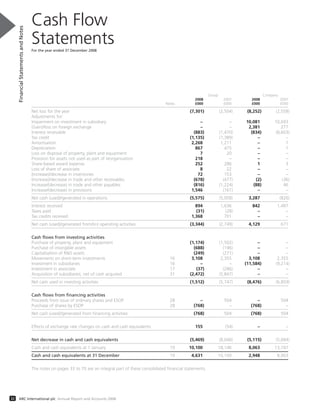
32 Cash Flow Statements
33 Notes to the Accounts
71 Five Year Summary
Additional Information
72 Shareholder Information
73 Advisers and Corporate Information
2008 Contents
“We use ARC because
it’s an industry
standard and its low
power profile.”
Intel, an ARC customer
“A collaboration
between industry
leaders in media-
oriented applications.”
Toshiba, an ARC customer
“We are pleased to
standardise a key
element of our
technology strategy
on ARC.”
Broadcom, an ARC customer
Royalty revenue US$000*
08
07
06
05
04
14,334
9,726
6,288
3,913
5,408
2008 HighlightsOverview
02 ARC International plc Annual Report and Accounts 2008
Strategic direction is strengthened
Acquisitions strengthened product offerings
New “Sound-to-Silicon” solutions were introduced
Entered new market segments
New wins with OEM and chip customers
Strengthened management team
Restructuring
Generates annual cost savings in excess of 25%
Significantly lowers ARC’s cost base while
maintaining development programmes
Enhances ability to deploy multimedia solutions
Revenue by year US$000*
31,188
28,930
24,754
19,007
22,265
08
07
06
05
04
* based on an average exchange rate for the respective year 1 Includes short-term investments
Revenues and royalties increased
Total revenue up 18% at £17.0 million
Royalty revenue up 61% at £7.9 million
Licensing revenue flat at £7.3 million
Net loss increased to £7.3 million
Cash balance1
at £12.7 million
Royalties drove revenue growth
Increase in post-2003 contracts contributing
royalty revenues
Recognised new higher value royalties from
OEM customers
Increase in ARC-Based™ shipments
Operational Financial
Total bookings US$000*
08
07
06
05
04
29,291
37,256
30,531
22,003
22,0580.0
Growth of ARC’s worldwide customer base
08
07
06
05
04
152
144
137
112
96
ARC’s Markets
Overview
03ARC International plc Annual Report and Accounts 2008
ARC’s technology is driving an increasing number of high growth markets
relating to how multimedia content is captured, shared, and played. Whether
it’s audio or video players, digital or mobile TVs, media-enabled cell phones,
portable storage cards, or PCs and laptops, ARC-Based™ electronic devices are
helping consumers around the world experience high-quality multimedia content.
PCs and laptops
Media enabled
cell phones
Digital TVs
Flash devices Portable media players
Set-top boxes
ARC is focusing on increasing licensing and royalty revenues from OEM and
chip companies in regions driving the design and development of consumer
electronics devices.
North America
represented
55%
of revenue
Europe
represented
20%
of revenue
Asia
represented
25%
of revenue
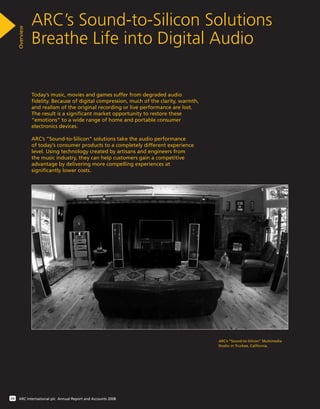
Today’s music, movies and games suffer from degraded audio
fidelity. Because of digital compression, much of the clarity, warmth,
and realism of the original recording or live performance are lost.
The result is a significant market opportunity to restore these
“emotions” to a wide range of home and portable consumer
electronics devices.
ARC’s “Sound-to-Silicon” solutions take the audio performance
of today’s consumer products to a completely different experience
level. Using technology created by artisans and engineers from
the music industry, they can help customers gain a competitive
advantage by delivering more compelling experiences at
significantly lower costs.
ARC’s Sound-to-Silicon Solutions
Breathe Life into Digital Audio
Overview
04 ARC International plc Annual Report and Accounts 2008
ARC’s “Sound-to-Silicon” Multimedia
Studio in Truckee, California.
Chairman’s
Statement
Overview
05ARC International plc Annual Report and Accounts 2008
In 2008 ARC traded against the backdrop of an increasingly challenging
economic environment that worsened in the second half of the year.
Despite this ARC was able to grow top line revenues driven by higher value
royalty payments from new customers. Going forward into 2009, we remain
cautious as visibility is limited and uncertainty in the semiconductor industry
with lengthening sales cycles may affect the timing of new licence revenues
and royalty volumes.
However, a rapid transition to profitability and positive cash flow continues to be our
overriding goal, and in response to the challenging semiconductor market and global
economic conditions we have taken swift and decisive action to further enhance our
ability to achieve this goal within planned timescales. To accelerate growth in our
revenues and customer base, we have strengthened our product portfolio through
the acquisition of Sonic Focus, transformed our ability to deploy integrated multimedia
solutions, broadened our target market to include the higher royalty OEM and
consumer electronics sectors, strengthened our worldwide sales and marketing
organisations and made significant new appointments to the senior management
team. In addition, the company-wide restructuring announced in September 2008
has been substantially completed, and already is delivering improved operational
efficiencies, a rationalised and streamlined management structure and product
portfolio, and a significantly lower cost base. We will continue to assess industry
conditions throughout 2009 to ensure that the company’s cost structure is aligned
with revenue opportunities.
Over the medium to long term we expect consumer demand for devices delivering
increasingly higher quality multimedia content to continue to grow, driving OEM and
semiconductor companies to create innovative next-generation products with better
performance and lower development costs. Feedback from ARC’s worldwide customers
and partners underpins our confidence that our integrated solutions and more efficient
organisation can continue to provide compelling value. We remain confident in our
strategy and our ability to execute.
Richard Barfield
Chairman
ARC International plc
11 March 2009
“A rapid transition to profitability
and positive cash flow continues
to be our overriding goal.”
“To accelerate growth in our
revenues and customer base,
we have strengthened our
product portfolio of multimedia
solutions, broadened our target
market to include more lucrative
consumer electronics sectors,
and strengthened our worldwide
organisation.”
“Going forward into 2009
we will continue to assess
industry conditions to ensure
that ARC is best positioned
to take advantage of revenue
opportunities in the consumer
electronics industry.”
OperationalReview
06 ARC International plc Annual Report and Accounts 2008
High Quality Audio Experience
ARC’s solutions create a home entertainment centre listening experience on
PCs and laptops.
A leading consumer electronics company was able to achieve real competitive
differentiation for their device by providing a high-quality audio experience.
The ARC customer also was able to reduce the number of speakers and eliminate
costly audio components thus saving millions of dollars in development costs.
Chief Executive Officer’s
Review of Operations
OperationalReview
07ARC International plc Annual Report and Accounts 2008
ARC’s strategy is to monetise the increasing trend of consumers to capture,
share, and play high-quality multimedia content on a variety of electronics
devices. By developing and delivering integrated “Sound-to-Silicon” solutions
to OEM and semiconductor companies globally, ARC is helping these customers
create new types of devices at lower development costs that deliver a better
experience to consumers.
In 2008 ARC grew revenues and strengthened its competitive position in an increasingly
challenging economic environment. The acquisition of Sonic Focus, a leading provider
of audio enrichment technology, was completed in February and brings to ARC a
complementary class of customers and markets. This is helping stimulate new revenue
opportunities in an uncertain economic climate from new companies as well as ARC’s
historical base of more than 150 customers worldwide.
Today ARC’s Sound-to-Silicon solutions are receiving strong interest from OEM and
semiconductor companies. An industry first, they offer a complete solution for a
number of high growth consumer electronics markets:
• ARC® Portable Media Device Solution
Implemented on a portable media device, the ARC PMD Solution enables consumers
to enjoy music, movies, and games anywhere and anytime with a home entertainment
centre listening experience and extended playback time.
• ARC® Digital TV and Home Theater Solution
The ARC Digital TV and Home Theater Solution creates a compelling home
entertainment centre listening experience that provides for the ear what high-
definition video provides for the eye. The ARC solution eliminates costly
components, such as centre channel speakers and woofers. It also enables ARC
customers to create a single device that addresses numerous market opportunities,
such as set-top boxes, digital TVs, and home theaters.
• ARC® PC and Laptop Solution
The ARC Personal Computer and Laptop Audio Solution provides a home
entertainment centre listening experience using existing speakers or headphones.
The solution refines the sound so it resembles the original studio performance.
To ensure ARC is best positioned to deliver on its strategy in the current economic
uncertainty, management undertook a strategic review of the business. The result
was a company-wide restructuring that lowered ARC’s cost base and brought visible
improvements to ARC’s planning and execution by creating:
• A new integrated worldwide sales team and field organisation to accelerate
engagements with OEM and semiconductor customers globally.
“Audio on the HP
TouchSmart PC is
simply amazing.”
HP, an ARC customer
“Sound for an ultra
thin notebook that’s
astounding.”
Lenovo, an ARC customer
ARC’s “Sound-to-
Silicon” Multimedia
Studio in San Jose,
California.
Chief Executive Officer’s
Review of Operations
OperationalReview
08 ARC International plc Annual Report and Accounts 2008
• An enhanced global product development organisation to ensure ARC’s integrated
solutions meet the needs of customers creating products for high-volume
multimedia markets.
• A worldwide marketing team under new leadership with in-depth experience and
understanding of the consumer electronics industry and OEM customers. These skills
will assist ARC to continue its focus on delivering integrated multimedia solutions.
The industry adoption of ARC’s products continued throughout 2008. OEM and
semiconductor companies worldwide announced they have taken licenses for,
or are shipping products containing, an ARC solution. They included:
• PC and Laptop applications
• Hewlett Packard – introduced its new TouchSmart PC computer, which has
been heralded as “redefining personal computing” and includes ARC’s Sonic
Focus technology.
• Lenovo – launched the x300 laptop computer running the Microsoft Vista
operating system with ARC’s Sonic Focus technology.
• N-Trig – has signed a multi-year license agreement for ARC’s processor products
for use in N-trig’s DuoSense™ technology for PCs.
• Digital televisions
• A leading mobile digital TV company signed a multi-use agreement for ARC
solutions to provide high-quality digital TV reception in nearly every global
geographic region.
• Abilis announced it has standardised its mobile DTV product development
on ARC technology.
• Fujitsu extended its long-term relationship with ARC and took a new license
for use in its next-generation HDTV products.
• ViXS has taken a license for ARC’s multimedia solutions for use in its XCode™
chipset family, which enables the processing of multiple HD video streams.
• Other electronic market applications
• A leading flash company took an ARC license for flash applications because
of ARC’s recognised leadership in the industry.
• A top ten Taiwan chip company is incorporating ARC’s low power solution into
cellular design that is targeting the worldwide handset market.
• A leading smart card provider signed a new license enabling the existing ARC
customer to create new ARC-Based™ solutions for high volume smartcard-
related devices.
• Toshiba extended its collaboration with ARC by taking a new license for
development of leading-edge processor technology.
For the year, these developments helped ARC grow the top line despite a deteriorating
industry climate. ARC enters 2009 with a strengthened product portfolio and Sound-to-
Silicon solutions that are helping drive new revenue opportunities and deliver higher value
royalties. The restructuring plan has lowered ARC’s cost base and strengthened the
management team. For the year, management remains cautious as visibility is limited
due to the ongoing economic uncertainty. However, we have confidence in ARC’s
strategy, strengthening position in the industry, and attractiveness of our solutions that
help customers increase competitiveness in the growing consumer electronics market.
Carl Schlachte
President and Chief Executive Officer
11 March 2009
“ARC’s technology has
played a significant
role in the success
of our product.”
SanDisk, an ARC customer
“ARC’s technology
enhances our
competitive
differentiation.”
Infineon, an ARC customer
Chief Financial
Officer’s Review
OperationalReview
09ARC International plc Annual Report and Accounts 2008
Strong revenue growth in 1H was offset by deteriorating confidence of certain
customers in 2H. Net loss was greater than planned due to the acquisition of and
incremental costs from Sonic Focus, the restructuring charges, and the delayed
revenue from two licensing contracts. Without these incremental expenses and
charges, operating costs were in line with management’s plan for 2008.
Revenue
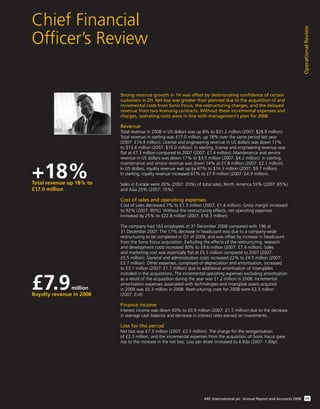
Total revenue in 2008 in US dollars was up 8% to $31.2 million (2007: $28.9 million).
Total revenue in sterling was £17.0 million, up 18% over the same period last year
(2007: £14.4 million). License and engineering revenue in US dollars was down 11%
to $13.4 million (2007: $15.0 million). In sterling, license and engineering revenue was
flat at £7.3 million compared to 2007 (2007: £7.4 million). Maintenance and service
revenue in US dollars was down 17% to $3.5 million (2007: $4.2 million). In sterling,
maintenance and service revenue was down 14% at £1.8 million (2007: £2.1 million).
In US dollars, royalty revenue was up by 47% to $14.3 million (2007: $9.7 million).
In sterling, royalty revenue increased 61% to £7.9 million (2007: £4.9 million).
Sales in Europe were 20% (2007: 20%) of total sales, North America 55% (2007: 65%)
and Asia 25% (2007: 15%).
Cost of sales and operating expenses
Cost of sales decreased 7% to £1.3 million (2007: £1.4 million). Gross margin increased
to 92% (2007: 90%). Without the restructuring effects, net operating expenses
increased by 25% to £22.8 million (2007: £18.3 million).
The company had 163 employees at 31 December 2008 compared with 196 at
31 December 2007. The 17% decrease in headcount was due to a company-wide
restructuring to be completed in Q1 of 2009, and was offset by increase in headcount
from the Sonic Focus acquisition. Excluding the effects of the restructuring, research
and development costs increased 30% to £9.6 million (2007: £7.4 million). Sales
and marketing cost was essentially flat at £5.5 million compared to 2007 (2007:
£5.5 million). General and administration costs increased 22% to £4.5 million (2007:
£3.7 million). Other expenses, comprised of depreciation and amortisation, increased
to £3.1 million (2007: £1.7 million) due to additional amortisation of intangibles
included in the acquisitions. The incremental operating expenses excluding amortisation
as a result of the acquisition during the year was £1.2 million in 2008. Incremental
amortisation expenses associated with technologies and intangible assets acquired
in 2008 was £0.3 million in 2008. Restructuring costs for 2008 were £2.3 million
(2007: £nil).
Finance income
Interest income was down 40% to £0.9 million (2007: £1.5 million) due to the decrease
in average cash balance and decrease in interest rates earned on investments.
Loss for the period
Net loss was £7.3 million (2007: £2.5 million). The charge for the reorganisation
of £2.3 million, and the incremental expenses from the acquisition of Sonic Focus gave
rise to the increase in the net loss. Loss per share increased to 4.93p (2007: 1.69p).
+18%Total revenue up 18% to
£17.0 million
£7.9million
Royalty revenue in 2008
Chief Financial
Officer’s Review
OperationalReview
10 ARC International plc Annual Report and Accounts 2008
Cash flow and balance sheet
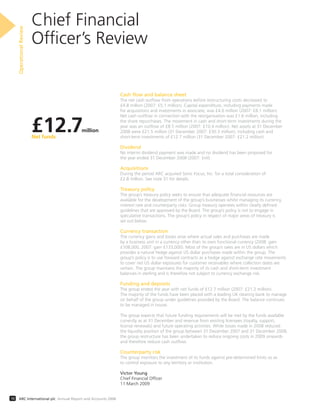
The net cash outflow from operations before restructuring costs decreased to
£4.8 million (2007: £5.1 million). Capital expenditure, including payments made
for acquisitions and investments in associate, was £4.6 million (2007: £8.1 million).
Net cash outflow in connection with the reorganisation was £1.6 million, including
the share repurchases. The movement in cash and short-term investments during the
year was an outflow of £8.5 million (2007: £10.4 million). Net assets at 31 December
2008 were £21.5 million (31 December 2007: £30.3 million), including cash and
short-term investments of £12.7 million (31 December 2007: £21.2 million).
Dividend
No interim dividend payment was made and no dividend has been proposed for
the year ended 31 December 2008 (2007: £nil).
Acquisitions
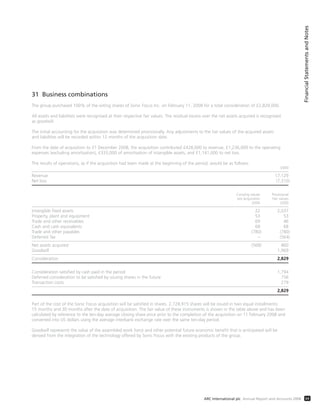
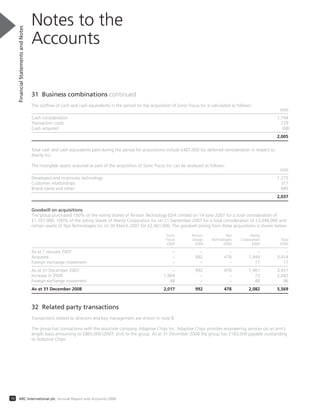
During the period ARC acquired Sonic Focus, Inc. for a total consideration of
£2.8 million. See note 31 for details.
Treasury policy
The group’s treasury policy seeks to ensure that adequate financial resources are
available for the development of the group’s businesses whilst managing its currency,
interest rate and counterparty risks. Group treasury operates within clearly defined
guidelines that are approved by the Board. The group’s policy is not to engage in
speculative transactions. The group’s policy in respect of major areas of treasury is
set out below.
Currency transaction
The currency gains and losses arise where actual sales and purchases are made
by a business unit in a currency other than its own functional currency (2008: gain
£108,000, 2007: gain £133,000). Most of the group’s sales are in US dollars which
provides a natural hedge against US dollar purchases made within the group. The
group’s policy is to use forward contracts as a hedge against exchange rate movements
to cover net US dollar exposures for customer receivables where collection dates are
certain. The group maintains the majority of its cash and short-term investment
balances in sterling and is therefore not subject to currency exchange risk.
Funding and deposits
The group ended the year with net funds of £12.7 million (2007: £21.2 million).
The majority of the funds have been placed with a leading UK clearing bank to manage
on behalf of the group under guidelines provided by the Board. The balance continues
to be managed in house.
The group expects that future funding requirements will be met by the funds available
currently as at 31 December and revenue from existing licensees (royalty, support,
license renewals) and future operating activities. While losses made in 2008 reduced
the liquidity position of the group between 31 December 2007 and 31 December 2008,
the group restructure has been undertaken to reduce ongoing costs in 2009 onwards
and therefore reduce cash outflow.
Counterparty risk
The group monitors the investment of its funds against pre-determined limits so as
to control exposure to any territory or institution.
Victor Young
Chief Financial Officer
11 March 2009
£12.7million
Net funds
Corporate Social
Responsibility
OperationalReview
11ARC International plc Annual Report and Accounts 2008
In addition to the needs of the group’s shareholders, the
group recognises the interests of employees, customers,
suppliers and the local communities and environments
in which we operate. The Board accepts that it must be
mindful of the needs of all of its stakeholders and seeks
to enhance all relationships with the differing groups
concerned. The following policies reflect the Board’s
commitment to corporate social responsibility (“CSR”).
Employee relations policy
The group values its employees and believes they are one
of its best assets. Policies and practices are in place to attract,
motivate, retain and develop the group’s employees. As an
intellectual property (IP) development group with over 70%
of the employees working within research and development,
continual professional development and training is paramount.
In order to retain and integrate the new employees from the
recent acquisitions the group has reviewed the working practices
and culture within the group. This has enabled the new
employees to understand the group’s operations and move
smoothly into its processes.
During 2008 the group undertook a restructure programme
that reduced the number of employees. The restructure and
subsequent employee reductions were handled in accordance
with local customs and laws. As part of the process the group
undertook to assist those employees leaving the group through
programmes of outplacement assistance, as well as liaising with
recruitment companies or other local companies. The group has
also undertaken a programme of measures to ensure that those
employees remaining are fully engaged with the group and the
strategic objectives for the future.
The group seeks to benchmark the salary and total remuneration
of the employees to the industry best practice. To that end
the group partakes in various salary surveys to enable the
management to understand the remuneration currently on offer
within the group’s operational sectors. Employees are given the
opportunity, where legally possible, to share in the rewards of its
future success through the group’s operation of a share option
scheme. Other benefits such as pension contributions to either
state sponsored or defined contribution schemes and health
insurance programmes are available to employees.
The group communicates regularly with the employees through
the use of regular “all employee” meetings and conference
calls chaired by the Chief Executive Officer (CEO). These cover
a wide range of topics that allow each employee easy access
to the senior management to ask questions and quiz them on
recent activities and/or general strategy. These meetings are
supplemented by site level meetings where information is spread
across departments and managers can receive feedback on any
topic or development. The CEO has also implemented an e-mail
update system and web-blog of recent activities. This has proved
popular in spreading news quickly throughout the group.
The group has a policy of helping employees achieve an
appropriate work/life balance. This is accomplished through the
use of policies on maternity and paternity leave, flexible working
arrangements and part time working where appropriate. The
group believes that recent improvements in technology within
the workplace should be implemented to assist employees.
The group has policies that cover grievances and disciplinary
procedures as well as recruitment processes.
The annual appraisal system has been reviewed during the
year to ensure that it is meeting the needs of both the group
and the employee. This review has reinforced the recognition
that development of employees will lead to better designs and
products from the group. The group will continue to invest in
appraisals, training and development to assist employees in their
skills development, both professional and personal. The group
likes to promote from within so all vacancies are advertised
internally, and the group operates a system for employees
to refer people for advertised positions.
Environmental policy
The Board acknowledges that the group has a role to play
in environmental issues. The group does not perform any
manufacturing activities and therefore has negligible impact
on the environment. The group operates from offices with the
main activity being the development of hardware and software
designs by employees working on computers, which does not
involve the use of hazardous substances or waste. The group
policy is to endeavour to minimise the impact of its activities on
the environment and to comply with all relevant environmental
laws and regulations. The group has a policy of recycling
as much as possible, ranging from paper waste to printer
cartridges, reducing energy usage through the use of efficient
lighting products and computer equipment and reducing travel
wherever possible. Under the Waste Electrical and Electronic
Equipment (WEEE) directive the group has a responsibility
to dispose of its computer equipment safely and responsibly.
The group operates with several partners to ensure that all old
computer equipment is recycled or disposed of in a safe manner.
Community
The group aims to work appropriately with the local community
in which it operates. The group encourages its employees to
take part in charitable activities and offers support whenever
possible. The group has also worked with various educational
establishments to provide training and work experience to
young people. This involvement has ranged from one-week
work experience projects to summer internships with the
group. The group has an ongoing relationship with the
University of Edinburgh, whereby the group provides research
projects to the students and the University provides research
services to the group.
ManagementandGovernance
12 ARC International plc Annual Report and Accounts 2008
Extended Playback Time
Portable media players containing ARC’s solutions can deliver a natural and
realistic experience with extended playback time.
ARC’s multimedia products provide an integrated solution to manufacturers
and chip makers, cutting overall development costs and extending battery life.
Consumers benefit by having a device that adds clarity to the audio spectrum
with a rich surround sound and reduced listener fatigue.
Board of
Directors
ManagementandGovernance
13ARC International plc Annual Report and Accounts 2008
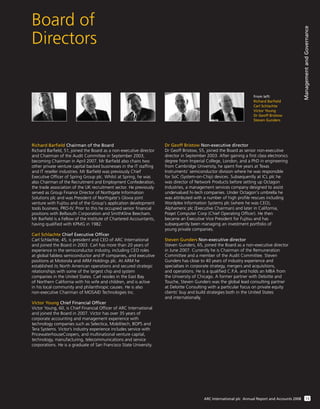
From left:
Richard Barfield
Carl Schlachte
Victor Young
Dr Geoff Bristow
Steven Gunders
Richard Barfield Chairman of the Board
Richard Barfield, 51, joined the Board as a non-executive director
and Chairman of the Audit Committee in September 2003,
becoming Chairman in April 2007. Mr Barfield also chairs two
other private venture capital backed businesses in the IT staffing
and IT reseller industries. Mr Barfield was previously Chief
Executive Officer of Spring Group plc. Whilst at Spring, he was
also Chairman of the Recruitment and Employment Confederation,
the trade association of the UK recruitment sector. He previously
served as Group Finance Director of Northgate Information
Solutions plc and was President of Northgate's Glovia joint
venture with Fujitsu and of the Group's application development
tools business, PRO-IV. Prior to this he occupied senior financial
positions with Bellsouth Corporation and SmithKline Beecham.
Mr Barfield is a Fellow of the Institute of Chartered Accountants,
having qualified with KPMG in 1982.
Carl Schlachte Chief Executive Officer
Carl Schlachte, 45, is president and CEO of ARC International
and joined the Board in 2003. Carl has more than 20 years of
experience in the semiconductor industry, including CEO roles
at global fabless semiconductor and IP companies, and executive
positions at Motorola and ARM Holdings plc. At ARM he
established its North American operations and secured strategic
relationships with some of the largest chip and system
companies in the United States. Carl resides in the East Bay
of Northern California with his wife and children, and is active
in his local community and philanthropic causes. He is also
non-executive Chairman of MOSAID Technologies Inc.
Victor Young Chief Financial Officer
Victor Young, 60, is Chief Financial Officer of ARC International
and joined the Board in 2007. Victor has over 35 years of
corporate accounting and management experience with
technology companies such as Selectica, Mobilitech, BOPS and
Tera Systems. Victor’s industry experience includes service with
PricewaterhouseCoopers, and multinational venture capital,
technology, manufacturing, telecommunications and service
corporations. He is a graduate of San Francisco State University.
Dr Geoff Bristow Non-executive director
Dr Geoff Bristow, 55, joined the Board as senior non-executive
director in September 2003. After gaining a first class electronics
degree from Imperial College, London, and a PhD in engineering
from Cambridge University, he spent five years at Texas
Instruments’ semiconductor division where he was responsible
for SoC (System-on-Chip) devices. Subsequently at ICL plc he
was director of Network Products before setting up Octagon
Industries, a management services company designed to assist
undervalued hi-tech companies. Under Octagon's umbrella he
was attributed with a number of high profile rescues including
Wordplex Information Systems plc (where he was CEO),
Alphameric plc (Executive Chairman) and later in California,
Poqet Computer Corp (Chief Operating Officer). He then
became an Executive Vice President for Fujitsu and has
subsequently been managing an investment portfolio of
young private companies.
Steven Gunders Non-executive director
Steven Gunders, 65, joined the Board as a non-executive director
in June 2007. Currently he is Chairman of the Remuneration
Committee and a member of the Audit Committee. Steven
Gunders has close to 40 years of industry experience and
specialises in corporate strategy, mergers and acquisitions,
and operations. He is a qualified C.P.A. and holds an MBA from
the University of Chicago. A former partner with Deloitte and
Touche, Steven Gunders was the global lead consulting partner
at Deloitte Consulting with a particular focus on private equity
clients’ buy and build strategies both in the United States
and internationally.
Directors’
Report
ManagementandGovernance
14 ARC International plc Annual Report and Accounts 2008
The directors present their report and the audited financial
statements for the year ended 31 December 2008.
Business review and principal activities
The Group licenses award-winning consumer electronics intellectual
property (IP) in the form of vertically integrated solutions,
multimedia subsystems, configurable processors, and related
technologies to semiconductor and OEM companies worldwide.
The company is a public limited company quoted on the
London Stock Exchange, registered in England and Wales
and is domiciled in the UK. The address of the registered
office is Verulam Point, Station Way, St Albans, Hertfordshire.
The company’s registered number is 3592130.
The group has principal operating activities in the UK, US,
Russia and in India through the associate Adaptive Chips, Inc,.
The addresses of the principal offices are set out on the back
cover. A list of subsidiaries is given in note 16 to the accounts
on page 58, and the group also operates representative offices
in Taiwan, Japan, Germany and the Netherlands.
A review of the operations and future developments is included
in the Chairman’s statement, Chief Executive’s review of
operations and Chief Financial Officer’s review on pages 5 to
10 and have been incorporated by reference. The group position
at the year end includes a net funds position (including cash
and cash equivalents and short-term investments) of
£12.7 million (2007: £21.2 million) and a net asset position
of £21.5 million (2007: net assets £30.3 million).
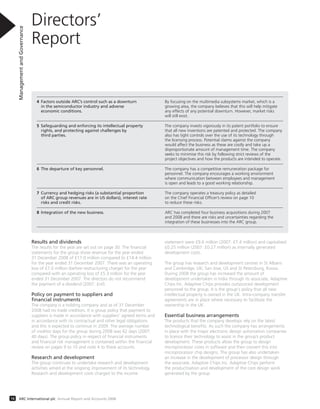
The key performance indicators used by the directors and management are summarised below:
Description Metrics Performance Comment
Revenue Revenue for the company Total revenue up 18% from 2007. With all sales made in US dollars the overall
is made up of licencing increase was 8%. Royalties continued to
and engineering revenue, Royalties up 61% from 2007. increase as unit shipments increased.
maintenance revenue and During 2008 customers shipped increasing
royalties on units sold. units of new higher royalty bearing products.
Royalty revenues may fluctuate due to seasonal
fluctuations in volume shipments by licencees,
economic conditions in end markets, end of
life cycles or unforeseen delays in reporting
royalties by licencees.
Revenue per Monitoring revenue per £88,000 compared to During the year ARC has made one
average headcount headcount allows the £91,000 in 2007. acquisition but this headcount increase
directors to measure the has been offset by the restructuring that
efficiency of the group. the group undertook in September. The year
end headcount was 163 which will be carried
through to 2009. Therefore, the revenue per
average headcount should improve.
LBITDA The monitoring of the £3.9 million* versus LBITDA has increased by 5% over 2007,
loss before interest, £3.7 million in 2007. partially due to the delayed revenue from
tax, depreciation and two licencing contracts in 2008.
amortisation allows the
directors to understand
the operating results
of the group. *Before restructuring costs.
New licences New licences signed will 27 new licences versus The group has been focusing on increasing
during year drive future royalties. 34 in 2007. the average deal revenue. Renewing
contracts for new products with existing
customers confirms the customer valuation
of the group’s products.
Net funds used The group is loss making, £8.6 million versus The group used £2.5 million cash for the
so it monitors the cash £10.4 million in 2007. acquisition during the year. Cash outflow
used to ensure that the from operations increased to £5.6 million
cash is put to best use from £5.1 million in 2007, due to changes
for the group. including, year end working capital
movements, one-off restructuring costs and
absorbing the acquisitions during the year.
ManagementandGovernance
15ARC International plc Annual Report and Accounts 2008
The directors consider that licencing growth drives an IP
licencing business model. Therefore, revenue-based metrics
such as growth rates, revenue per head and new customers and
licence agreements are key to company growth. The directors
also consider that the move to profitability is important. This is
measured by review of LBITDA and net funds used.
Principal business risks and uncertainties
The Board has a process for identifying and managing business
risks and reviews the major operational risks and uncertainties
for the ARC business at each Board meeting.
This Annual Report contains certain forward-looking statements
that are ARC’s expectations and beliefs about our future
business. These statements are made by the directors in good
faith, based on information available to them at the time of
the approval of the report. Undue reliance should not be placed
on such statements, which are based on ARC’s current plans,
estimates, projections and assumptions. By their nature,
forward-looking statements involve known and unknown risk
and uncertainty because they relate to events and depend on
circumstances which may occur in the future and which in some
cases are beyond ARC’s control. Actual results may differ from
those expressed in such statements, depending on a variety of
factors. These factors include, but are not limited to: consumer
and market acceptance of the company’s products and the
products that use the company’s products; decreases in the
demand for the company’s products; excess inventory levels at
the company’s customers; decline in average selling prices of the
company’s products; cancellation of existing orders or the failure
to secure new orders; the company’s failure to introduce new
products and to implement new technologies on a timely basis;
the company’s failure to anticipate changing customer product
requirements; the company’s failure to deliver products to its
customers on a timely basis; the timing of significant orders;
increased expenses associated with new product introductions;
the commencement of, or developments with respect to, any
future litigation; the cyclicality of the semiconductor industry;
and overall economic conditions.
Trends and factors likely to affect future development,
performance and position of the groups business
The major risks and uncertainties and how the Board tries
to mitigate them are:
1 Its ability to produce new products that satisfy The company undertakes extensive market analysis and has
the target markets. a close working relationship with potential customers, with
a view to identifying the correct product for the target market.
The design cycle for the company’s products can take 12 to
18 months to reach acceptance by its customer base. This long
lead time can lead to difficulties with the timing and scheduling
of product design as well as the potential to miss a market
opportunity for the products developed. Therefore, throughout
the research and development cycle the company operates a tight
project management schedule to ensure that products are on
time and within specification. Product reviews are undertaken
regularly to ensure that those being developed are in line with
market expectations.
2 The company operates an intellectual property (“IP”) The use of the IP business model by companies has increased
business model that relies on licencing IP to customers over the last years. Customers have seen the benefits of licencing
for integration into their own products. industry standard IP and adding to this to make their own
products different than competitors. However, customers could
revert to using “in-house” development teams and cease licencing
in product. The Company undertakes development work to ensure
that its products are ahead of the customers needs and available
when they need them. The company has the advantage in that
it licences to more than one supplier, its development costs should
be recouped over more than one customer, therefore having a
price advantage over in-house development teams.
3 Competitive pressures; ARC’s competitors include Through the use of market analysis the company has focused
major corporations that have a larger base of software on multimedia subsystems, which is a growing market.
support for their product range and much larger The company endeavours to produce products that are compatible
installed customer base. with industry standards and other major players so as to appeal
to the widest customer base.
Directors’
Report
ManagementandGovernance
16 ARC International plc Annual Report and Accounts 2008
Results and dividends
The results for the year are set out on page 30. The financial
statements for the group show revenue for the year ended
31 December 2008 of £17.0 million compared to £14.4 million
for the year ended 31 December 2007. There was an operating
loss of £7.0 million (before restructuring charge) for the year
compared with an operating loss of £5.3 million for the year
ended 31 December 2007. The directors do not recommend
the payment of a dividend (2007: £nil).
Policy on payment to suppliers and
financial instruments
The company is a holding company and as of 31 December
2008 had no trade creditors. It is group policy that payment to
suppliers is made in accordance with suppliers’ agreed terms and
in accordance with its contractual and other legal obligations
and this is expected to continue in 2009. The average number
of creditor days for the group during 2008 was 62 days (2007:
40 days). The group policy in respect of financial instruments
and financial risk management is contained within the financial
review on pages 9 to 10 and note 4 to these accounts.
Research and development
The group continues to undertake research and development
activities aimed at the ongoing improvement of its technology.
Research and development costs charged to the income
statement were £9.6 million (2007: £7.4 million) and capitalised
£0.25 million (2007: £0.27 million) as internally generated
development costs.
The group has research and development centres in St Albans
and Cambridge, UK; San Jose, US and St Petersburg, Russia.
During 2008 the group has increased the amount of
development undertaken in India through its associate, Adaptive
Chips Inc. Adaptive Chips provides outsourced development
personnel to the group. It is the group‘s policy that all new
intellectual property is owned in the UK. Intra-company transfer
agreements are in place where necessary to facilitate the
ownership in the UK.
Essential business arrangements
The products that the company develops rely on the latest
technological benefits. As such the company has arrangements
in place with the major electronic design automation companies
to licence their technology to assist in the group’s product
development. These products allow the group to design
microprocessor cores in software and then convert this into
microprocessor chip designs. The group has also undertaken
an increase in the development of processor design through
the associate, Adaptive Chips Inc. Adaptive Chips perform
the productisation and development of the core design work
generated by the group.
4 Factors outside ARC’s control such as a downturn By focusing on the multimedia subsystems market, which is a
in the semiconductor industry and adverse growing area, the company believes that this will help mitigate
economic conditions. any effects of any potential downturn. However, market risks
will still exist.
5 Safeguarding and enforcing its intellectual property The company invests vigorously in its patent portfolio to ensure
rights, and protecting against challenges by that all new inventions are patented and protected. The company
third parties. also has tight controls over the use of its technology through
the licensing process. Potential claims against the company
would affect the business as these are costly and take up a
disproportionate amount of management time. The company
seeks to minimise this risk by following strict reviews of the
project objectives and how the products are intended to operate.
6 The departure of key personnel. The company has a competitive remuneration package for
personnel. The company encourages a working environment
where communication between employees and management
is open and leads to a good working relationship.
7 Currency and hedging risks (a substantial proportion The company operates a treasury policy as detailed
of ARC group revenues are in US dollars), interest rate on the Chief Financial Officer’s review on page 10
risks and credit risks. to reduce these risks.
8 Integration of the new business. ARC has completed four business acquisitions during 2007
and 2008 and there are risks and uncertainties regarding the
integration of these businesses into the ARC group.
ManagementandGovernance
17ARC International plc Annual Report and Accounts 2008
As of the date of this report there have been no other changes
to the above interests of the directors in the ordinary shares of
the company.
The company operates a process of orderly rotation of the
directors for re-election to the Board. Richard Barfield offers
himself for re-election at the AGM. Richard Barfield is the
Chairman of the Board and has been with the company since
September 2003. Richard has 25 years of corporate accounting
and management experience. Richard Barfield has a services
agreement with no notice period specified. Geoffrey Bristow also
offers himself for re-election at the AGM. Geoffrey Bristow is the
Senior Non-Executive Director on the Board and has also been
with the company since September 2003. Geoffrey has 25 years
of electronic engineering and management experience and
specialises in working with technology companies. Geoffrey
Bristow has a services agreement with no notice period specified.
The company maintains a directors’ and officers’ insurance policy
for the benefit of all directors and management of the group.
Corporate governance
The Board’s report on corporate governance is set out on
pages 25 to 27.
Donations
During 2008 the group made £nil of charitable donations
(2007: $200). No political contributions were made during
the year (2007: £nil).
Substantial shareholdings
At 20 February 2009 the company had been notified of the
following interests of over 3% in the issued ordinary share
capital of the company:
Number of % of
ordinary shares capital
Gartmore Investment Limited 26,902,498 17.62
Axa Investment Managers 10,660,665 6.98
GAM Fund Management 10,527,812 6.89
Legal & General 9,659,001 6.32
Aviva 8,853,682 5.80
UBS Investment Bank 7,856,963 5.15
River and Mercantile
Asset Management LLP 7,758,378 5.08
Employee Benefit Trust 7,641,799 5.00
Additional information for shareholders
Following the implementation of the EU Takeover Directive
into UK law, the following description provides the required
information for shareholders where not already provided
elsewhere in this report.
Information on the group’s employees
The group operates over three continents in 11 countries,
and as such is very aware of the local environments in which
its employees operate. The group is aware of the diverse local
customs and takes these into account when dealing with its
employees. Even with the diverse geographical locations the
group minimises its environmental impact through using new
methods of communications rather than flights to meetings.
The product ranges that the group develops are to allow
the end consumer products to be more power efficient
and therefore more environmentally friendly also.
The group’s headcount has reduced from 196 in December 1997
to 163 in December 2008. The average number of employees
during 2008 was 193 (2007: 158) with 70% (2007: 72%)
working in research and development. During 2008 the group
undertook a restructuring programme that reduced the number
of employees. Overall the group still has 72% of employees
working in research and development but concentrated on new
product research and initiatives, with development undertaken
by the associate in India. The group recognises that the employees
play an important part in the future success of the company, and
seek to recruit and retain those people who possess the requisite
skills and knowledge as well as the personal commitment to
respond to the challenges of working within a fast changing
technology group. As part of the restructure, the group has
refocused its employee skill base on multimedia based product
offerings. The collaboration of the engineers within the group
and those of the associate in India, should allow the group to
leverage the talented employee workforce and produce new
products in a cost effective and efficient manner.
The restructure and subsequent employee reductions were
handled in accordance with local customs and laws. As part
of the process the group undertook to assist those employees
leaving the group through programmes of outplacement
assistance, as well as liaising with recruitment companies
or other local companies. The group has also undertaken
a programme of measures to ensure that those employees
remaining are fully engaged with the group and the strategic
objectives for the future.
Directors and their interests
The directors in service at the end of the year, and their interests
(which are all beneficial) in the ordinary share capital of the
company, are shown below and details of options held are given
in the remuneration report on pages 23 and 24.
Offered for Shares Shares
Date of re-election at 31 December 31 December
appointment next AGM 2008 2007
R Barfield 03.09.03 Yes 10,000 –
G Bristow 03.09.03 Yes – –
S Gunders 21.06.07 10,000 –
C Schlachte 20.02.04 752,364 681,364
V Young 13.02.07 – –
Share capital
As at 28 February 2009, 152,703,048 (28 February 2008:
152,703,048) ordinary shares of 0.1p each were in issue and
listed on the London Stock Exchange. All issued shares
are fully paid up and do not carry any special rights or
additional obligations.
At the AGM on 22 April 2008 (the “2008 AGM”), the
shareholders authorised the company to make market purchases of
up to 5% of the ordinary shares capital and the maximum price
which could be paid was an amount equal to 105% of the average
of the middle market quotation for the five business days
preceding the day of purchase. As at 11 March 2009, no purchases
have been made and the company has an unexpired authority to
repurchase shares up to a maximum of 7,544,698 ordinary shares.
At the 2008 AGM, the shareholders authorised the directors
to allot shares up to an aggregate nominal value of £50,901.
Since the 2008 AGM no shares have been allotted.
The company is not aware of any agreements between
shareholders that may result in the restriction on the transfer
of the company’s shares or of the voting rights attaching
to the company’s shares.
Rights and obligations attaching to shares
Voting
In a general meeting of the company, subject to the provisions
of the Articles and to any special rights or restrictions as to
voting attached to any class of shares in the company (of which
there are none):
on a show of hands, every member present in person shall
have one vote; and
on a poll, every member who is present in person or
by proxy shall have one vote for every share of which
he or she is the holder.
No member shall be entitled to vote at any general meeting or
class meeting in respect of any shares held by him or her if any
call or other sum then payable by him or her in respect of that
share remains unpaid. Currently, all issued shares are fully paid.
No member who is in default of a s.212 notice to provide
information about his holding in shares of the company shall
be entitled to receive notice of or attend or vote at a general
meeting of the company in respect of the shares in which he
is in default.
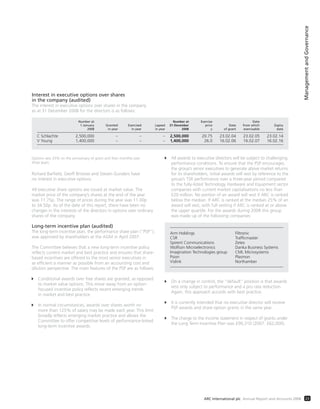
Deadlines for voting rights
For the purposes of determining which persons are entitled to
attend or vote at a meeting and how many votes such person
may cast, the company may specify in the notice of the meeting
a time, not more than 48 hours before the time fixed for the
meeting, by which a person must be entered on the register
in order to have the right to attend or vote at the meeting.
Directors’
Report
ManagementandGovernance
18 ARC International plc Annual Report and Accounts 2008
Dividends and distributions
Subject to the provisions of the Companies Act 1985 and the
Companies Act 2006 (the “Companies Acts”), the company
may, by ordinary resolution, declare a dividend to be paid
to the members, but no dividend shall exceed the amount
recommended by the Board.
The Board may pay interim dividends, and also any fixed rate
dividend, whenever the financial position of the company,
in the opinion of the Board, justifies its payment. All dividends
shall be apportioned and paid pro rata according to the amounts
paid up on the shares during any portion or portions of the
period in respect of which the dividend is paid.
Liquidation
Under the current articles, if the company is in liquidation, the
liquidator may, with the authority of an extraordinary resolution
of the company and any other authority required by the Statutes
(as defined in the articles):
divide among the members in specie the whole or any part
of the assets of the company; or
vest the whole or any part of the assets in trustees upon
such trusts for the benefit of members as the liquidator,
with the like authority, shall think fit.
Transfer of shares
Subject to the articles, any member may transfer all or any of
his or her certificated shares by an instrument of transfer in any
usual form or in any other form which the Board may approve.
The Board may, in its absolute discretion and without giving
any reason, decline to register any instrument of transfer of
a certificated share which is not a fully paid share or on which
the company has a lien. The Board may also decline to register
a transfer of a certificated share unless the instrument of
transfer is:
i) left at the transfer office for registration; and
ii) accompanied by the certificate for the shares to be
transferred and such other evidence (if any) as the Board
may reasonably require to prove the title of the intending
transferor or his or her right to transfer the shares.
The Board may permit any class of shares in the company
to be held in uncertificated form and, subject to the current
articles, title to uncertificated shares to be transferred by
means of a relevant system.
The Board may refuse to register the transfer of shares in favour
of more than four persons jointly.
Amendment of the company’s articles of association
Any amendments to the company’s articles of association may
be made in accordance with the provisions of the Companies
Act 1985 by way of special resolution.
Appointment and replacement of directors
Directors shall be no less than three and no more than
15 in number.
ManagementandGovernance
19ARC International plc Annual Report and Accounts 2008
Directors may be appointed by the company by ordinary
resolution or by the Board. A director appointed by the Board
holds office only until the next following Annual General
Meeting and is then eligible for election by the shareholders.
The Board may from time to time appoint one or more directors
to hold employment or executive office for such period
(subject to the Companies Acts) and on such terms as they may
determine and may revoke or terminate any such appointment.
At every Annual General Meeting of the company, any director
in office who:
a) has been appointed by the Board since the previous Annual
General Meeting; or
b) was elected or last re-elected at or before the Annual General
Meeting held in the third calendar year before shall retire
from office by rotation. A retiring director shall be eligible
for re-election.
The Company may remove a director from office by passing
an ordinary resolution of which special notice has been given.
The Board may remove a director from office if they make a
request in writing signed by at least three quarters of the other
members of the Board.
The office of director will also be vacated if:
i) he or she resigns;
ii) he or she is or may be suffering from a mental disorder;
iii) he or she is absent without permission of the Board from
meetings of the Board for six consecutive months and the
Board resolves that his or her office is vacated;
iv) he or she becomes bankrupt or compounds with his or
her creditors generally;
v) he or she is prohibited by law from being a director; or
vi) he or she is removed from office pursuant to the articles.
Powers of the directors
The business of the company will be managed by the Board
who may exercise all the powers of the company, subject to
the provisions of the company’s memorandum of association,
the articles, the Companies Acts and any ordinary resolution of
the company. The directors may exercise all the powers of the
company to borrow money but shall not at any time without
the prior sanction of an ordinary resolution of the company
exceed a sum equal to £20 million.
Shares held in the Employee Benefit Trust
The trustee of the ARC International plc Employee Benefit Trust
(“EBT”) hold 7,641,799 ordinary shares in ARC International plc.
If any offer is made to shareholders to acquire their shares the
trustee will not be obliged to accept or reject the offer in respect
of any shares which are at that time subject to subsisting awards,
but will have regard to the interests of the award holders and will
have power to consult them to obtain their views on the offer.
Subject to the above the trustee may take the action with respect
to the offer it thinks fair.
Change to the articles during 2008
At the AGM in 2008 the shareholders approved a change to the
articles, as a result of new provisions under the Company’s Act
2006, to allow the directors to authorise conflicts and potential
conflicts of interest in a similar way to the current law. No conflicts
have had to be approved in the period.
Change of control
There are no agreements between any group company and any
of its employees or any director of the company which provide
for compensation to be paid to the employee or director for
termination of employment or for loss of office as a consequence
of a takeover of the company. Details of significant agreements
to which group companies are a party containing provisions
which would be triggered as a consequence of a takeover
of the company, and details of the effect of such provisions,
are set out below.
Significant agreements – change of control
The group has significant agreements that contain termination
and other rights for our counterparties upon a change of control
of the company. The group is party to licensing agreements with
major Electronic Design Automation software vendors, that
specify that in the event of a change of control of the company,
the company must obtain their written consent for the licences to
be assigned. This is a standard contract term in software licences.
The group operates a Performance Share Plan, detailed in
the remuneration report on page 23. On a change in control,
the “default” position is that awards vest only subject to
performance and a pro rata reduction.
Annual General Meeting
The Annual General Meeting (AGM) will be held at 9.30am
on 22 April 2009 at Verulam Point, Station Way, St Albans,
Herts AL1 5HE.
Auditors
Each of the directors as of the date of this report confirms
the following:
As far as the director is aware, there is no relevant audit
information of which the company’s auditors are
unaware; and
He has taken all the steps he ought to have taken as
a director in order to make himself aware of any audit
information and to establish that the company’s auditors
are aware of that information.
During the year PricewaterhouseCoopers LLP resigned as
auditors and KPMG Audit Plc was appointed. KPMG Audit Plc,
have indicated their willingness to continue in office, and a
resolution concerning their reappointment will be proposed
at the AGM.
By order of the Board
Charles Rendell
Joint Company Secretary
11 March 2009
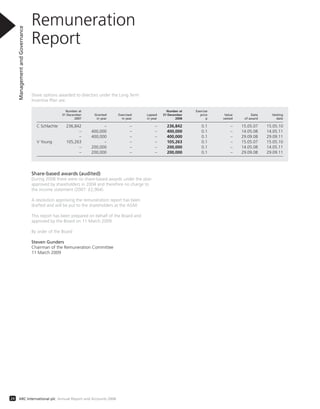
The emoluments of directors and their interests in executive
options over shares in the company and share-based awards
are the only auditable elements of the remuneration report.
Remuneration Committee
The members of the Remuneration Committee during the
year were:
Steven Gunders (Chairman)
Richard Barfield
Geoff Bristow (Chairman until 22 April 2008)
All the members of the Committee are non-executive directors
and considered to be independent.
The principal function of the Remuneration Committee is to
determine the remuneration packages of all executive directors
and for monitoring the remuneration of senior management.
This includes base salaries, pension contributions, bonus
payments, share-based incentives and service contracts.
The Remuneration Committee prepares the Board’s Annual
Report to shareholders on the group’s policy on remuneration
of the executive directors and the directors’ remuneration report.
The terms of reference are available on the group’s website:
www.arc.com/upload/company/remuneration_committee_terms
_of_reference_2008.pdf.
Advice provided to the Remuneration Committee
During the year, the following were appointed by the
Committee to provide advice that materially assisted
the Committee:
New Bridge Street Consultants
Charles Rendell (Joint Company Secretary)
Thomas Huppuch (Joint Company Secretary)
Sandy O’Gorman (Vice President Human Resources)
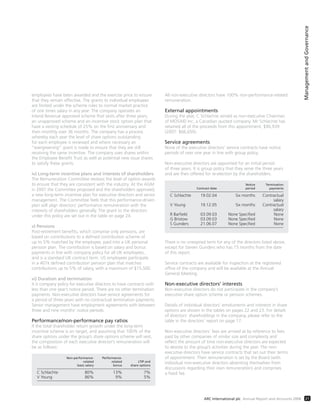
New Bridge Street Consultants were appointed by the
Committee (and provide no other services to the company)
in respect of share-based incentive plans, to ensure that any
new plans fulfil the Committee’s long-term incentive criteria.
Remuneration policy
In determining the company’s policy on remuneration, the
Remuneration Committee has regard to the following objectives:
i) Remuneration packages offered are designed to be
competitive, being comparable with packages available
within other groups operating in similar markets (i.e.
internationally) and on a similar scale, including competitors.
Remuneration
Report
ManagementandGovernance
20 ARC International plc Annual Report and Accounts 2008
ii) Remuneration packages are set so as to attract, retain and
motivate executives of the highest calibre, and at the same
time optimise the interests of shareholders. The Committee
takes into account that the company is striving towards
profitability when reviewing the compensation that is
awarded to directors and senior management.
iii) Consideration of environmental, social and governance
issues. The board reviews the environmental impact of the
company as a whole, together with the social impact and the
governance issues. Currently there are no plans to incorporate
these into the bonus plans or the variable elements to the
remuneration packages. The Board will review this if the
position or operations of the group change.
The policy is designed to provide a mix of performance and
non-performance remuneration so as to align their objectives
to those of the shareholders. The remuneration mix for 2008
has changed with an increased emphasis on the performance
related pay. The percentage available by way of variable
measurable bonus has increased to reward increased performance.
The policy on executive director and senior management
remuneration and appointments is set out below.
There have been no changes to policy, other than an increased
emphasis on variable performance related pay, from the preceding
year and no departures from this policy in the current year. The current
policy is expected to continue through the current financial year.
Elements of the policy
i) Basic salary
In assessing the level of basic salary, the Remuneration Committee
takes account of the pay practices of other companies, the
responsibilities of each director and senior manager, and pay
awards elsewhere in the group. Salaries are reviewed annually
by the Remuneration Committee.
ii) Bonus payments
Bonus payments are paid to executive directors, of up to
75% (2007: 50%) of base salary, and the senior management,
of up to 55% (2007: 25%) of base salary, based on objectives,
including revenue, operating profit and cash flow targets, set
for each individual. The Chief Executive Officer received a bonus
for 2008 of $61,384 or 15.3% of base salary (2007: $29,000).
The bonus payment was for the first half performance.
iii) Share options
Share option grants are a significant element of company
performance-related remuneration. Share options are awarded
on the commencement of employment and are granted by the
Remuneration Committee at the next available meeting.
Employees of the company participates in the executive share
option programme, where appropriate, and the Board considers
this to be a significant employee motivator. The Committee
reviews the number of share options that directors and
ManagementandGovernance
21ARC International plc Annual Report and Accounts 2008
employees have been awarded and the exercise price to ensure
that they remain effective. The grants to individual employees
are limited under the scheme rules to normal market practice
of one times salary in any year. The company operates an
Inland Revenue approved scheme that vests after three years,
an unapproved scheme and an incentive stock option plan that
have a vesting schedule of 25% on the first anniversary and
then monthly over 36 months. The company has a process
whereby each year the level of share options outstanding
for each employee is reviewed and where necessary an
“evergreening” grant is made to ensure that they are still
receiving the same incentive. The company uses shares within
the Employee Benefit Trust as well as potential new issue shares
to satisfy these grants.
iv) Long-term incentive plans and interests of shareholders
The Remuneration Committee reviews the level of option awards
to ensure that they are consistent with the industry. At the AGM
in 2007 the Committee proposed and the shareholders approved,
a new long-term incentive plan for executive directors and senior
management. The Committee feels that this performance-driven
plan will align directors’ performance remuneration with the
interests of shareholders generally. The grant to the directors
under this policy are set out in the table on page 24.
v) Pensions
Post-retirement benefits, which comprise only pensions, are
based on contributions to a defined contribution scheme of
up to 5% matched by the employee, paid into a UK personal
pension plan. The contribution is based on salary and bonus
payments in line with company policy for all UK employees,
and is a standard UK contract term. US employees participate
in a 401k defined contribution pension plan that matches
contributions up to 5% of salary, with a maximum of $15,500.
vi) Duration and termination
It is company policy for executive directors to have contracts with
less than one year’s notice period. There are no other termination
payments. Non-executive directors have service agreements for
a period of three years with no contractual termination payments.
Senior management have employment agreements with between
three and nine months’ notice periods.
Performance/non-performance pay ratios
If the total shareholder return growth under the long-term
incentive scheme is on target, and assuming that 100% of the
share options under the group’s share options scheme will vest,
the composition of each executive director’s remuneration will
be as follows:
Non-performance- Performance-
related related LTIP and
basic salary bonus share options
C Schlachte 80% 13% 7%
V Young 86% 9% 5%
All non-executive directors have 100% non-performance-related
remuneration.
External appointments
During the year, C Schlachte served as non-executive Chairman
of MOSAID Inc, a Canadian quoted company. Mr Schlachte has
retained all of the proceeds from this appointment, $90,939
(2007: $66,650).
Service agreements
None of the executive directors’ service contracts have notice
periods of over one year in line with group policy.
Non-executive directors are appointed for an initial period
of three years. It is group policy that they serve the three years
and are then offered for re-election by the shareholders.
Notice Termination
Contract date period payments
C Schlachte 19.02.04 Six months Contractual
salary
V Young 19.12.05 Six months Contractual
salary
R Barfield 03.09.03 None Specified None
G Bristow 03.09.03 None Specified None
S Gunders 21.06.07 None Specified None
There is no unexpired term for any of the directors listed above,
except for Steven Gunders who has 15 months from the date
of this report.
Service contracts are available for inspection at the registered
office of the company and will be available at the Annual
General Meeting.
Non-executive directors’ interests
Non-executive directors do not participate in the company’s
executive share option scheme or pension schemes.
Details of individual directors’ emoluments and interests in share
options are shown in the tables on pages 22 and 23. For details
of directors’ shareholdings in the company, please refer to the
table in the directors’ report on page 17.
Non-executive directors’ fees are arrived at by reference to fees
paid by other companies of similar size and complexity and
reflect the amount of time non-executive directors are expected
to devote to the group’s activities during the year. The non-
executive directors have service contracts that set out their terms
of appointment. Their remuneration is set by the Board (with
individual non-executive directors absenting themselves from
discussions regarding their own remuneration) and comprises
a fixed fee.
Remuneration
Report
ManagementandGovernance
22 ARC International plc Annual Report and Accounts 2008
2005 2006 2007 20082004
ARC International total return FTSE all share technology hardware and equipment total return
Rebased total return index
Source: Thomson Datastream, monthly average
0
5
10
15
20
25
30
Emoluments of directors (audited)
The emoluments of the directors of the company were as follows:
Salary Total Pension Total Pension
and fees Bonus Benefits2
2008 2008 2007 2007
Executive directors
C Schlachte1 4
265,039 42,398 11,396 318,833 7,942 173,598 7,072
V Young1 4
(appointed 13 February 2007) 188,203 19,432 20,548 228,183 – 151,713 –
Non-executive directors
R Barfield 80,000 – – 80,000 – 86,875 –
G Bristow3
60,000 – – 60,000 – 61,622 –
S Gunders (appointed 21 June 2007) 30,000 – – 30,000 – 15,807 –
P van Cuylenburg4
(resigned 3 April 2007) – – – – – 55,673 –
Total 623,242 61,830 31,944 717,016 7,942 545,288 7,072
The emoluments shown above are for the period when each
individual was a director of the company. Details of dates are
contained in the directors’ report. No directors waived their
rights to emoluments.
1 Payments for 2008 made in US dollars converted at year-end rate of $1.4479 (2007: $1.9973).
2 Benefits include provision of health benefits.
3 The figure for Geoff Bristow includes £25,833 for time spent on strategic projects over and above time as a director
which was paid to Decision Curve Limited, a company controlled by Geoff Bristow (2007: £36,623).
4 Includes amounts paid by ARC International I.P. Inc.
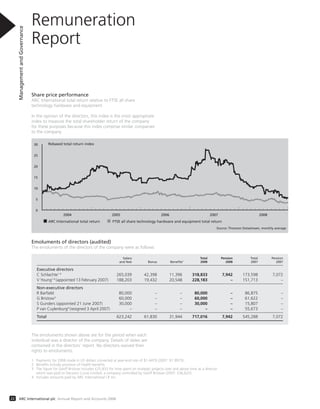
Share price performance
ARC International total return relative to FTSE all share
technology hardware and equipment.
In the opinion of the directors, this index is the most appropriate
index to measure the total shareholder return of the company
for these purposes because this index comprise similar companies
to the company.
ManagementandGovernance
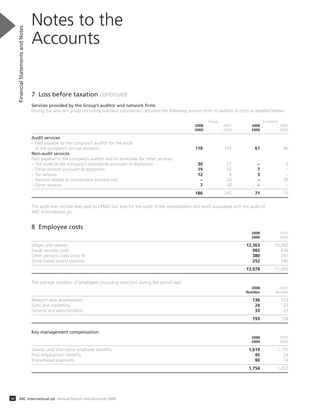
23ARC International plc Annual Report and Accounts 2008
Options vest 25% on the anniversary of grant and then monthly over
three years.
Richard Barfield, Geoff Bristow and Steven Gunders have
no interest in executive options.
All executive share options are issued at market value. The
market price of the company’s shares at the end of the year
was 11.75p. The range of prices during the year was 11.00p
to 34.50p. As of the date of this report, there have been no
changes in the interests of the directors in options over ordinary
shares of the company.
Long-term incentive plan (audited)
The long-term incentive plan, the performance share plan (“PSP”),
was approved by shareholders at the AGM in April 2007.
The Committee believes that a new long-term incentive policy
reflects current market and best practice and ensures that share-
based incentives are offered to the most senior executives in
as efficient a manner as possible from an accounting cost and
dilution perspective. The main features of the PSP are as follows:
Conditional awards over free shares are granted, as opposed
to market value options. This move away from an option-
focused incentive policy reflects recent emerging trends
in market and best practice.
In normal circumstances, awards over shares worth no
more than 125% of salary may be made each year. This limit
broadly reflects emerging market practice and allows the
Committee to offer competitive levels of performance-linked
long-term incentive awards.
All awards to executive directors will be subject to challenging
performance conditions. To ensure that the PSP encourages
the group’s senior executives to generate above market returns
for its shareholders, initial awards will vest by reference to the
group’s TSR performance over a three-year period compared
to the fully-listed Technology Hardware and Equipment sector
companies with current market capitalisations no less than
£20 million. No portion of an award will vest if ARC is ranked
below the median. If ARC is ranked at the median 25% of an
award will vest, with full vesting if ARC is ranked at or above
the upper quartile. For the awards during 2008 this group
was made up of the following companies:
Arm Holdings Filtronic
CSR Trafficmaster
Spirent Communications Zetex
Wolfson Microelectronics Danka Business Systems
Imagination Technologies group CML Microsystems
Psion Plasmon
Vislink Northamber
On a change in control, the “default” position is that awards
vest only subject to performance and a pro rata reduction.
Again, this approach accords with best practice.
It is currently intended that no executive director will receive
PSP awards and share option grants in the same year.
The charge to the income statement in respect of grants under
the Long Term Incentive Plan was £90,310 (2007: £62,000).
Interest in executive options over shares
in the company (audited)
The interest in executive options over shares in the company
as at 31 December 2008 for the directors is as follows:
Number at Number at Exercise Date
1 January Granted Exercised Lapsed 31 December price Date from which Expiry
2008 in year in year in year 2008 p of grant exercisable date
C Schlachte 2,500,000 – – – 2,500,000 20.75 23.02.04 23.02.05 23.02.14
V Young 1,400,000 – – – 1,400,000 26.0 16.02.06 16.02.07 16.02.16
Remuneration
Report
ManagementandGovernance
24 ARC International plc Annual Report and Accounts 2008
Share-based awards (audited)
During 2008 there were no share-based awards under the plan
approved by shareholders in 2004 and therefore no charge to
the income statement (2007: £2,964).
A resolution approving the remuneration report has been
drafted and will be put to the shareholders at the AGM.
This report has been prepared on behalf of the Board and
approved by the Board on 11 March 2009.
By order of the Board
Steven Gunders
Chairman of the Remuneration Committee
11 March 2009
Share options awarded to directors under the Long Term
Incentive Plan are:
Number at Number at Exercise
31 December Granted Exercised Lapsed 31 December price Value Date Vesting
2007 in year in year in year 2008 p vested of award date
C Schlachte 236,842 – – – 236,842 0.1 – 15.05.07 15.05.10
– 400,000 – – 400,000 0.1 – 14.05.08 14.05.11
– 400,000 – – 400,000 0.1 – 29.09.08 29.09.11
V Young 105,263 – – – 105,263 0.1 – 15.05.07 15.05.10
– 200,000 – – 200,000 0.1 – 14.05.08 14.05.11
– 200,000 – – 200,000 0.1 – 29.09.08 29.09.11
Corporate
Governance
ManagementandGovernance
25ARC International plc Annual Report and Accounts 2008
The directors subscribe to the principles of good governance
and the code of best practice on corporate governance.
The company has embedded the principles into the processes
used by the directors and the establishment of the various
committees of the directors.
The company is in compliance with the provisions set out
in Section 1 of the 2006 Combined Code on corporate
governance issued by the Financial Reporting Council, except
that the Chairman of the company is also Chairman of the
Audit Committee.
The directors supervise the management of the business and the
affairs of the company and see their prime responsibility as being
to determine the broad strategy of the company. The directors
have embedded the principles of good corporate governance
and the process by which risks are identified and controlled and
effective accountability assured.
with information in a form and of a quality appropriate to
enable it to discharge its duties.
In addition to the Board meeting as a whole during the year,
the non-executive directors meet without the executive directors
being present.
All the directors have access to the advice and services of the
joint company secretaries and the provision of independent
professional advice at the company’s expense. The company
maintained directors’ and officers’ liability insurance throughout
the year.
Performance evaluation
The non-executive directors met during the year to appraise
the former Chairman’s performance and also take into account
the executive directors’ view. The whole Board performs an
evaluation of its performance by a process of self-assessment
questionnaires. This process is an external system for evaluations
designed by Evalu8 Software. The Board performed an evaluation
of the Board as a whole and the committees for 2008. Therefore
the company considers that it was in compliance with principle
A.6, in that a rigorous and formal process for evaluating the
Board and committees was in place.
Board committees
The Board has delegated responsibility in a number of areas
to three sub committees with clearly defined terms of reference.
The Terms of Reference for the Remuneration, Audit and
Nomination Committees are available on the company’s website,
www.arc.com/company/directors.html.
Directors
Chairman Richard Barfield
Senior non-executive director Geoff Bristow
Non-executive director Steven Gunders
Executive director –
Chief Executive Officer Carl Schlachte
Executive director –
Chief Financial Officer Victor Young
The Board considers Richard Barfield, Geoff Bristow and Steven
Gunders to be independent.
Richard Barfield is Chairman of the Board and Audit Committee.
The roles of the Chairman and Chief Executive Officer are
separated, with a clear division of responsibilities between them.
The Chairman of the company is responsible for running the
Board, and the Chief Executive is responsible for running the
company’s business. Each director is provided with sufficient
information for him to discharge his duties and responsibilities
as a director including training and access to independent
professional advice. The Articles of Association require each
director to submit himself for re-election at least every three years.
Operation of the Board
The Board meets on a regular basis throughout the year.
The Board has reserved certain items for its review and approval,
including the annual and interim results; annual business plan;
significant capital expenditure which is not included in the
current business plan and is not in the ordinary course of
business of the company; and senior management appointments.
Other matters are delegated to Board committees including
those detailed below. The Board is supplied, in a timely manner,
Audit Committee
Committee Chairman Richard Barfield
Committee member Steven Gunders
The Board has established an Audit Committee comprising
two non-executive directors. The directors are responsible for
ensuring that a sound system of internal control to safeguard
shareholders’ investments and the group’s assets is being
maintained. The Committee assists with this process. The
Committee meets at least twice a year and reviews the annual
and half-yearly financial statements and the other documents to
be sent to shareholders before they are submitted to the Board.
The Committee also meets with the auditors without the
presence of executive management. The Committee considers
the appointment of auditors, receives a report from them at
each meeting where financial statements are reviewed and
ensures that appropriate relationships are maintained with
the auditors (in respect of audit and non-audit fees). As part
of ensuring that the appropriate relationship is maintained,
the Committee recommends that different firms are invited
Corporate
Governance
ManagementandGovernance
26 ARC International plc Annual Report and Accounts 2008
to tender for non-audit work. The Audit Committee reviews
non-audit services undertaken by the auditors to ensure that
auditor objectivity and independence are safeguarded. However,
the group moved its UK taxation services to KPMG as it believed
that they would be able to provide an efficient and cost effective
service. The group continues to use independent companies for
taxation services outside of the UK.
* Attended Audit and Remuneration Committee meetings by invitation.
( ) Those eligible to attend.
Operational management
The executive directors are supported by a team of senior
managers who are responsible for assisting in the development
and achievement of the group’s corporate strategy. The senior
management includes the Chief Technology Officer – who assists
in the development of the product line.
Internal controls
The directors have overall responsibility for establishing financial
reporting procedures to provide them with a reasonable basis
to make proper judgements as to the financial position and
prospects of the group, and have responsibility for establishing
the group’s system of internal control and for monitoring its
effectiveness. Internal control systems are designed to meet the
particular needs of the group and the risks to which it is exposed
and include financial, operational and compliance controls and
risk management.
The internal controls have been in place for the year under
review and up to the date of the approval of the accounts and
are periodically reviewed by the Board and Audit Committee.
During 2007 the Board put in place a process whereby the risks
facing the company were reviewed at each Board meeting and
this continued in 2008. This ensures that the review remains
up to date and accords with the guidance in the Turnbull report.
The Board conducts an annual assessment of the internal controls.
Although no system of internal control can provide absolute
assurance that physical and financial assets are safeguarded,
the system of control is designed in such a way that transactions
are authorised and properly recorded and material errors and
irregularities are either prevented or detected with the minimum
of delay.
The Board has considered the need for an internal audit function
and, given the scale and nature of the group’s operations,
has concluded that one is not required at the present time.
Remuneration Committee
Committee Chairman Steven Gunders
Committee member Richard Barfield
Committee member Geoff Bristow (until April 2008)
The Board has established a Remuneration Committee
comprising two non-executive directors. The role of the
Committee is to set the company’s policy on the remuneration
of the executive directors and senior management and to
determine their specific remuneration packages, including
bonus and share option arrangements. The report on directors’
remuneration is set out on pages 20 to 24. The whole Board
decides upon the remuneration of the non-executive directors,
although no director is involved in deciding his own remuneration.
Nomination Committee
Committee Chairman Richard Barfield
Committee member Geoff Bristow
The Nomination Committee is responsible for reviewing
the Board structure, size and composition and to make
recommendations to the Board with regard to any adjustments
that are deemed necessary; to be responsible for identifying
and nominating candidates for the approval of the Board; to fill
Board vacancies as and when they arise as well as put in place
plans for succession, in particular, of the Chairman and Chief
Executive Officer; and to make recommendations to the Board
for the continuation (or not) in the service of an executive
director as an executive or non-executive director.
It is noted that the Board met as follows:
Remuneration Audit Nomination
Board Committee Committee Committee
In person 5 1 2 –
By teleconference 3 11 2 –
In committee 1 – – –
And the directors’ attendance at Board and Committee
Meetings was:
Remuneration Audit Nomination
Board Committee Committee Committee
R Barfield 9 (9) 12 (12) 4 (4) –
C Schlachte* 9 (9) 2 – 1 –
V Young* 9 (9) 1 – 3 –
G Bristow 8 (8) 5 (5) – –
S Gunders 8 (8) 12 (12) 4 (4) –
ManagementandGovernance
27ARC International plc Annual Report and Accounts 2008
Financial reporting and monitoring of operations
A detailed annual plan is collated from submissions by each
functional department. The plan is reviewed by executive
directors and approved by the Board. The annual plan is used
to monitor and control actual performance. The process of
maintaining a sound system of internal control includes the
use of financial reports both for weekly information and on a
monthly basis. The group has a weekly management meeting
that discusses sales and software development schedules.
Each site and function manager must prepare a weekly report
of activities for discussion. This is then followed by a monthly
report of results, where these are compared with the annual
plan and forecasted results. Monthly meetings discuss results
and a report is prepared and sent to the Board for review.
The Board meets each quarter to discuss the results and review
the future plans.
Treasury operations
The group’s treasury function operates within clearly defined risk
management guidelines monitored by the Board. Its policies and
procedures are designed to set guidelines for the management
of interest rates on cash deposits and the exposure to foreign
exchange movements. All these policies and positions are
regularly monitored and conservatively managed. It is a group
policy not to undertake any speculative transactions which
create additional exposures over and above those arising from
normal trading activity, and to manage the counterparty risk
to protect the capital of the group.
Whistleblowing policy
In 2004 the Board established a “whistleblowing” hotline
operated by a third party. Employees are encouraged to use
this to report possible improprieties directly to the Board through
this anonymous process. The Chairman of the Audit Committee
is the nominated director to receive these calls and follow up
with appropriate action. To date, however, there has been
nothing reported.
Annual Report
In submitting this Annual Report and the financial statements
to the shareholders, the Board has sought to ensure that a
balanced and understandable assessment of the group’s position
and prospects has been presented to the shareholders.
Auditor independence
The company operates a policy that non-audit work is only
undertaken by the external auditors when they are most suited
to undertake it. The company had appointed an independent
firm to advise on taxation matters in general and especially for
specific projects such as UK Research and Development tax
credits, however a review of taxation advisers in the UK was
undertaken and KPMG were appointed as taxation advisers
in the UK. When KPMG were appointed auditors it was felt
that it was still appropriate to keep KPMG as taxation advisers.
The company has also undertaken royalty audits of its licensees
and has used the previous auditors, PricewaterhouseCoopers,
as well as a smaller more specialised audit firm. The amount
paid to the external auditors during the year for audit and other
services are set out in note 7 on page 50. The Board considers
that the auditor independence is not compromised.
Relations with shareholders
In addition to ensuring that sufficient information is
disseminated in order to maintain an orderly market in the
shares of the company, the company maintains a regular
dialogue with major institutional shareholders. The company
reports its financial results on a half-yearly basis to its shareholders.
The management presents to shareholders and the analyst
community and receives feedback from the company’s financial
PR advisers and brokers who obtain feedback after the investor
and analyst meetings.
The company operates an investor relations section on the
company website. This is updated regularly with information
including the results of the AGM voting, any financial press
releases and the ability to register to receive all press releases
the company makes.
The company prides itself on the comprehensive business
information that is provided not only on itself but its products
and partners. The Chief Executive Officer and the Chief Financial
Officer have met with shareholders, obtaining their views and
reporting to the whole Board. The senior non-executive director
and Chairman of the Board have had extensive correspondence
with shareholders during the year.
The AGM of shareholders will be held on 22 April 2009.
The company sees this as an opportunity to communicate with
all shareholders, including private investors in the company.
The AGM will be held at the company’s offices at St Albans
which will enable not only employee shareholders to easily
partake in the meeting but investors to meet with local
management. The Chairmen of the Audit and Remuneration
Committees will be in attendance to respond to any queries,
and it is expected that all directors will attend the AGM.
Going concern
On the basis of current financial projections and facilities
available, the directors have a reasonable expectation that the
group and the company has adequate resources to continue in
operational existence for the foreseeable future and, accordingly,
consider that it is appropriate to adopt the going concern basis
in preparing the financial statements.
By order of the Board
Charles Rendell
Joint Company Secretary
11 March 2009
Statement of Directors’
ResponsibilitiesIn respect of the Annual Report, the directors’ remuneration report and the financial statements
ManagementandGovernance
28 ARC International plc Annual Report and Accounts 2008
The directors are responsible for preparing the Annual Report,
the directors’ remuneration report and the group and parent
company financial statements in accordance with applicable
law and regulations.
Company law requires the directors to prepare the group and
parent company financial statements for each financial year.
Under that law the directors are required to prepare the group
financial statements in accordance with International Financial
Reporting Standards (IFRSs) as adopted by the European Union
and have elected to prepare the parent company financial
statements on the same basis. The financial statements are
required by law to give a true and fair view of the state of affairs
of the company and the group and of the profit or loss of the
group for that period.
In preparing those financial statements, the directors are
required to:
select suitable accounting policies and then apply
them consistently;
make judgements and estimates that are reasonable
and prudent;
state that the financial statements comply with IFRSs
as adopted by the European Union; and
prepare the financial statements on the going concern
basis, unless it is inappropriate to presume that the group
and parent company will continue in business.
The directors confirm that they have complied with the above
requirements in preparing the financial statements.
The directors are responsible for keeping proper accounting
records that disclose with reasonable accuracy at any time the
financial position of the company and the group and enable
them to ensure that the financial statements and the directors’
remuneration report comply with the Companies Act 1985.
They are also responsible for safeguarding the assets of the
company and the group and hence for taking reasonable
steps for the prevention and detection of fraud and
other irregularities.
The directors are responsible for the maintenance and integrity
of the company’s website and legislation in the United Kingdom
governing the preparation and dissemination of financial
statements may differ from legislation in other jurisdictions.
We confirm that to the best of our knowledge:
the financial statements, prepared in accordance with the
accounting standards referred to above, give a true and fair
view of the assets, liabilities, financial position and profit
and loss of the Company and the undertakings included
in the consolidation taken as a whole; and
the director’s report included a fair review of the development
and performance of the Company and the undertakings
included in the consolidation taken as a whole, together
with a description of the principal risks and uncertainties
that they face.
By order of the Board
Charles Rendell
Joint Company Secretary
11 March 2009
Independent
Auditors’ ReportTo the members of ARC International plc
ManagementandGovernance
29ARC International plc Annual Report and Accounts 2008
We have audited the group and parent company financial
statements (the ’’financial statements’’) of ARC International plc
for the year ended 31 December 2008 which comprise the group
income statement, the group and parent company balance
sheets, the group and parent company cash flow statements,
the group and parent company statements of recognised income
and expense and the related notes. These financial statements
have been prepared under the accounting policies set out therein.
We have also audited the information in the directors’ remuneration
report that is described as having been audited.
This report is made solely to the company’s members, as a body,
in accordance with section 235 of the Companies Act 1985. Our
audit work has been undertaken so that we might state to the
company’s members those matters we are required to state to
them in an auditor’s report and for no other purpose. To the
fullest extent permitted by law, we do not accept or assume
responsibility to anyone other than the company and the
company’s members as a body, for our audit work, for this
report, or for the opinions we have formed.
Respective responsibilities of directors and auditors
The directors’ responsibilities for preparing the Annual Report,
the directors’ remuneration report and the financial statements
in accordance with applicable law and International Financial
Reporting Standards (IFRSs) as adopted by the European Union are
set out in the statement of directors’ responsibilities on page 28.
Our responsibility is to audit the financial statements and the
part of the directors’ remuneration report to be audited in
accordance with relevant legal and regulatory requirements
and International Standards on Auditing (UK and Ireland).
We report to you our opinion as to whether the financial
statements give a true and fair view and whether the financial
statements and the part of the directors’ remuneration report
to be audited have been properly prepared in accordance with
the Companies Act 1985 and, as regards the group financial
statements, Article 4 of the IAS Regulation. We also report
to you whether in our opinion the information given in the
directors’ report is consistent with the financial statements.
In addition we report to you if, in our opinion, the company has
not kept proper accounting records, if we have not received all
the information and explanations we require for our audit, or if
information specified by law regarding directors’ remuneration
and other transactions is not disclosed.
We review whether the corporate governance statement reflects
the company’s compliance with the nine provisions of the 2006
Combined Code specified for our review by the Listing Rules
of the Financial Services Authority, and we report if it does not.
We are not required to consider whether the Board’s statements
on internal control cover all risks and controls, or form an
opinion on the effectiveness of the group’s corporate
governance procedures or its risk and control procedures.
We read other information contained in the Annual Report
and consider whether it is consistent with the audited financial
statements. We consider the implications for our report if
we become aware of any apparent misstatements or material
inconsistencies with the financial statements. Our responsibilities
do not extend to any other information.
Basis of audit opinion
We conducted our audit in accordance with International
Standards on Auditing (UK and Ireland) issued by the Auditing
Practices Board. An audit includes examination, on a test basis,
of evidence relevant to the amounts and disclosures in the
financial statements and the part of the directors’ remuneration
report to be audited. It also includes an assessment of the
significant estimates and judgements made by the directors in
the preparation of the financial statements, and of whether the
accounting policies are appropriate to the group’s and company’s
circumstances, consistently applied and adequately disclosed.
We planned and performed our audit so as to obtain all the
information and explanations which we considered necessary
in order to provide us with sufficient evidence to give reasonable
assurance that the financial statements and the part of the
directors’ remuneration report to be audited are free from
material misstatement, whether caused by fraud or other
irregularity or error. In forming our opinion we also evaluated
the overall adequacy of the presentation of information in the
financial statements and the part of the directors’ remuneration
report to be audited.
Opinion
In our opinion:
the group financial statements give a true and fair view,
in accordance with IFRSs as adopted by the EU, of the state
of the group’s affairs as at 31 December 2008 and of its loss
for the year then ended;
the parent company financial statements give a true and
fair view, in accordance with IFRSs as adopted by the EU as
applied in accordance with the provisions of the Companies
Act 1985, of the state of the parent company’s affairs as
at 31 December 2008;
the financial statements and the part of the directors’
remuneration report to be audited have been properly
prepared in accordance with the Companies Act 1985 and,
as regards the group financial statements, Article 4 of the
IAS Regulation; and
the information given in the directors’ report is consistent
with the financial statements.
KPMG Audit Plc
Chartered Accountants and Registered Auditor, St Albans
11 March 2009
2008 Group
Before 2008 2008
restructure restructure Total 2007
Notes £000 £000 £000 £000
Continuing operations
Revenue 5 17,047 – 17,047 14,401
Cost of sales (1,294) – (1,294) (1,437)
Gross profit 15,753 – 15,753 12,964
Operating expenses 6, 24 (22,791) (2,273) (25,064) (18,305)
Operating loss (7,038) (2,273) (9,311) (5,341)
Finance income 10 897 – 897 1,470
Finance expense 10 (14) – (14) –
Share of post-tax loss of associate 17 (8) – (8) (22)
Loss before income tax (6,163) (2,273) (8,436) (3,893)
Income tax credit 11 1,135 – 1,135 1,389
Loss for the year attributable to equity shareholders 28 (5,028) (2,273) (7,301) (2,504)
Weighted average number of shares 13 147,965,359 148,031,270
Basic and diluted loss per share – pence 13 (4.93) (1.69)
All activities relate to continuing operations.
The notes on pages 33 to 70 are an integral part of these consolidated financial statements.
Statements of Recognised
Income and ExpenseFor the year ended 31 December 2008
Group Company
2008 2007 2008 2007
Notes £000 £000 £000 £000
Loss for the year 28 (7,301) (2,504) (8,252) (2,558)
Currency translation differences 28 (951) (54) – –
Total recognised expense for the year (8,252) (2,558) (8,252) (2,558)
Income
StatementFor the year ended 31 December 2008
FinancialStatementsandNotes
30 ARC International plc Annual Report and Accounts 2008
Group Company
2008 2007 2008 2007
Notes £000 £000 £000 £000
Assets
Non-current assets
Intangible assets 14 11,600 7,506 – –
Property, plant and equipment 15 1,970 1,537 – –
Investment in associate 17 443 414 – –
Investment in subsidiaries 16 – – 10,462 11,093
Trade and other receivables 21 442 417 – –
14,455 9,874 10,462 11,093
Current assets
Inventories 20 – 72 – –
Trade and other receivables 21 4,060 4,241 191 193
Current corporation tax receivable 931 1,368 – –
Short-term investments 16 8,037 11,145 8,037 11,145
Cash and cash equivalents 19 4,631 10,100 2,948 8,063
17,659 26,926 11,176 19,401
Total assets 32,114 36,800 21,638 30,494
Liabilities
Current liabilities
Loans and borrowings 22 78 – – –
Trade and other payables 23 7,529 5,729 133 221
Provisions for other liabilities and charges 24 871 163 – –
8,478 5,892 133 221
Net current assets 9,181 21,034 11,043 19,180
Non-current liabilities
Loans and borrowings 22 99 – – –
Trade and other payables 23 101 126 – –
Deferred income tax liabilities 25 1,073 489 – –
Provisions for other liabilities and charges 24 858 20 – –
2,131 635 – –
Net assets 21,505 30,273 21,505 30,273
Shareholders’ equity
Ordinary shares 26 153 153 153 153
Share premium 28 3,683 3,683 3,683 3,683
Other reserves 28 61,289 61,037 60,825 60,573
Cumulative translation adjustment 28 (1,462) (511) – –
Retained earnings 28 (42,158) (34,089) (43,156) (34,136)
Total shareholders’ equity 21,505 30,273 21,505 30,273
The notes on pages 33 to 70 are an integral part of these consolidated financial statements.
The financial statements on pages 30 to 70 were approved by the Board of Directors on 11 March 2009 and were signed on its behalf by:
By order of the Board
Carl Schlachte
Chief Executive Officer
11 March 2009
Balance
SheetsAs at 31 December 2008
FinancialStatementsandNotes
31ARC International plc Annual Report and Accounts 2008
Group Company
2008 2007 2008 2007
Notes £000 £000 £000 £000
Net loss for the year (7,301) (2,504) (8,252) (2,558)
Adjustments for:
Impairment on investment in subsidiary – – 10,081 10,043
(Gain)/loss on foreign exchange – – 2,381 277
Interest receivable (883) (1,470) (834) (8,603)
Tax credit (1,135) (1,389) – –
Amortisation 2,268 1,211 – 1
Depreciation 867 475 – 1
Loss on disposal of property, plant and equipment 7 20 – –
Provision for assets not used as part of reorganisation 218 – – –
Share-based award expense 252 286 1 3
Loss of share of associate 8 22 – –
(Increase)/decrease in inventories 72 153 – –
(Increase)/decrease in trade and other receivables (678) (477) (2) (36)
Increase/(decrease) in trade and other payables (816) (1,224) (88) 46
Increase/(decrease) in provisions 1,546 (161) – –
Net cash (used)/generated in operations (5,575) (5,058) 3,287 (826)
Interest received 894 1,636 842 1,497
Taxes paid (31) (28) – –
Tax credits received 1,368 701 – –
Net cash (used)/generated from/(in) operating activities (3,344) (2,749) 4,129 671
Cash flows from investing activities
Purchase of property, plant and equipment (1,174) (1,502) – –
Purchase of intangible assets (688) (196) – –
Capitalisation of R&D assets (249) (271) – –
Movements on short-term investments 16 3,108 2,355 3,108 2,355
Investment in subsidiaries 16 – – (11,584) (9,214)
Investment in associate 17 (37) (286) – –
Acquisition of subsidiaries, net of cash acquired 31 (2,472) (5,847) – –
Net cash used in investing activities (1,512) (5,747) (8,476) (6,859)
Cash flows from financing activities
Proceeds from issue of ordinary shares and ESOP 28 – 504 – 504
Purchase of shares by ESOP 28 (768) – (768) –
Net cash (used)/generated from financing activities (768) 504 (768) 504
Effects of exchange rate changes on cash and cash equivalents 155 (54) – –
Net decrease in cash and cash equivalents (5,469) (8,046) (5,115) (5,684)
Cash and cash equivalents at 1 January 19 10,100 18,146 8,063 13,747
Cash and cash equivalents at 31 December 19 4,631 10,100 2,948 8,063
The notes on pages 33 to 70 are an integral part of these consolidated financial statements.
Cash Flow
StatementsFor the year ended 31 December 2008
FinancialStatementsandNotes
32 ARC International plc Annual Report and Accounts 2008
1 Reporting entity
ARC International plc (the “company”) is a company domiciled in England and Wales. The address of the Company is Verulam Point,
Station Way, St Albans, Hertfordshire, AL1 5HE. These consolidated financial statements of the Company as at and for the year ended
31 December 2008 comprise the Company and its subsidiaries (together referred to as the “group” and individually as “group entities”)
and the group’s interest in associates. The group is primarily involved in the development and licensing of semiconductor intellectual
property for the design of microprocessor cores and multimedia subsystems.
2 Basis of preparation
These consolidated financial statements were authorised for issue by the Board of directors on 11 March 2009. They are subject to
approval by the shareholders at the Annual General Meeting.
a) Basis of preparation
These consolidated financial statements have been prepared in accordance with EU-endorsed International Financial Reporting
Standards (IFRS), IFRIC interpretations and the Companies Act, 1985 applicable to companies reporting under IFRS. The consolidated
financial statements have been prepared under the historical cost convention, except for the following:
derivative financial instruments are measured at fair value.
financial instruments at fair value through the profit and loss are measured at fair value.
Methods used to measure fair values are discussed further in note 4.
b) Functional and presentation currency
These consolidated financial statements are presented in sterling, which is the company’s functional and presentation currency,
and rounded to the nearest £1,000.
c) Use of estimates and judgements
The preparation of financial statements in conformity with IFRS requires the use of certain critical accounting estimates. It also requires
management to exercise its judgement in the process of applying the group’s accounting policies. Although these estimates are based
on management’s best knowledge of the amount, event or actions, actual results ultimately may differ from those estimates.
Estimates and underlying assumptions are continually evaluated and are based on historical experience and other factors, including
expectations of future events that are believed to be reasonable under the circumstances. Revisions to accounting estimates are
recognised in the period in which the estimates are revised and in any future period affected.
The group makes estimates and assumptions concerning the future. The resulting accounting estimates will, by definition, seldom
equal the related actual results. The estimates and assumptions that have a significant risk of causing a material adjustment to the
carrying amounts of assets and liabilities within the next financial year are discussed below.
i) Revenue recognition The group frequently enters into contracts with multiple element arrangements. The calculation of fair values
attributable to the separable elements requires the group to estimate the fair value of the various elements, such as post-contract
maintenance and support.
ii) Estimated impairment of goodwill The group tests annually whether goodwill has suffered any impairment, in accordance
with the accounting policy stated in (g) below. The recoverable amounts of the cash-generating unit has been determined based
on value-in-use calculations. These calculations require the use of estimates (note 14).
iii) Provisions The group makes provisions as noted in (m) below, and uses assumptions and judgements based on prior experience
and other market conditions.
Notes to the
Accounts
FinancialStatementsandNotes
33ARC International plc Annual Report and Accounts 2008
2 Basis of preparation continued
iv) Income taxes The group is subject to income taxes in numerous jurisdictions. Significant judgement is required in determining the
worldwide provision for income tax. There are many transactions and calculations for which the ultimate tax determination is uncertain
during the ordinary course of business.
v) Business combination The group has made an acquisition in the year and the pre-acquisition carry amounts were determined
based on applicable IFRS immediately before the acquisition. The values, liabilities and contingent liabilities recognised on acquisition
are their estimated fair values.
vi) Share-based payment expense The calculation of the share-based payment expense is subject to assumptions and judgement
involved in the valuation models and expected dividend and lapse rates.
3 Accounting policies
The principal accounting policies adopted in the preparation of the consolidated financial statements are set out below. These policies
have been consistently applied to both years presented, unless otherwise stated.
a) Basis of consolidation
The financial statements comprise consolidated accounts for the company and all of its subsidiaries. The accounts of all subsidiaries
are prepared annually to 31 December. Subsidiaries are all entities over which the group has the power to govern the financial and
operating policies generally accompanying a shareholding of more than one half of the voting rights. The existence and effect of
potential voting rights that are currently exercisable or convertible are considered when assessing whether the group controls another
entity. Subsidiaries are fully consolidated from the date on which control is transferred to the group. They are de-consolidated from
the date that control ceases.
The purchase method of accounting is used to account for the acquisition of subsidiaries by the group. The cost of an acquisition is
measured as the fair value of the assets given, equity instruments issued and liabilities incurred or assumed at the date of exchange,
plus costs directly attributable to the acquisition. Identifiable assets acquired and liabilities and contingent liabilities assumed in a
business combination are measured initially at their fair value at the acquisition date, irrespective of the extent of any minority interest.
The excess of the cost of acquisition over the fair value of the group’s share of the identifiable net assets acquired is recorded as
goodwill. If the cost of acquisition is less than the fair value of the net assets of the subsidiary acquired, the difference is recognised
directly in the income statement.
Inter-company transactions, balances and unrealised gains on transactions between group companies are eliminated. Unrealised losses
are also eliminated but considered an impairment indicator of the asset transferred. Accounting policies of subsidiaries have been
changed where necessary to ensure consistency with the policies adopted by the group.
Associates are all entities over which the group has significant influence but not control, generally accompanying a shareholding of
between 20% and 50% of the voting rights. Investments in associates are accounted for using the equity method of accounting and
are initially recognised at cost. The group’s investment in associates includes goodwill identified on acquisition, net of any accumulated
impairment loss (note (j)).
The group’s share of its associates’ post-acquisition profits or losses is recognised in the income statement, and its share of post-
acquisition movements in reserves is recognised in reserves. The cumulative post-acquisition movements are adjusted against the
carrying amount of the investment. When the group’s share of losses in an associate equals or exceeds its interest in the associate,
including any other unsecured receivables, the group does not recognise further losses, unless it has incurred obligations or made
payments on behalf of the associate.
Unrealised gains on transactions between the group and its associates are eliminated to the extent of the group’s interest in the
associates. Unrealised losses are also eliminated unless the transaction provides evidence of an impairment of the asset transferred.
Accounting policies of associates have been changed where necessary to ensure consistency with the policies adopted by the group.
Notes to the
Accounts
FinancialStatementsandNotes
34 ARC International plc Annual Report and Accounts 2008
3 Accounting policies continued
b) Revenue recognition
Revenue represents amounts receivable for the sale of licences, royalties arising from the sale of licensees’ ARC-based products,
revenue from support, maintenance and training, net of trade discounts.
Licence fees are recognised upon delivery to the customer, provided that persuasive evidence of an arrangement exists, fees are fixed
and determinable and collectibility is reasonably assured. The group does not offer a right of return. Where there are extended
payment terms, or management has doubt as to the recoverability of the licence fees, income is deferred until payment becomes
due and recoverable.
The group’s transactions frequently include the sale of software and services under multiple element arrangements. The group uses the
residual method for revenue recognition for multiple element arrangements. In accordance with this method, the total contract value
is attributed first to any undelivered elements, based on their fair values, equal to the fee charged when such services are sold separately.
The remainder of the contract value is then attributed to the products, resulting in any discounts inherent in the total contract value
to be allocated to the products.
Where contracts contain an agreement to provide post-contract maintenance, the attributable income is recognised on a straight-line
basis over the period for which the maintenance has been agreed, or in the case of support sold by reference to time, as that support
is used.
Where contracts contain an agreement to provide custom engineering services, these are accounted for on a percentage of completion
basis (based on actual costs incurred and forecast costs to completion).
The excess of amounts invoiced for licence fees and maintenance and support and the amount recognised as revenue is recorded
as deferred revenue within liabilities.
Royalty income is recognised by the group when the amounts are reported to the group and collection is probable.
Interest income is recognised on a time-proportion basis using the effective interest method. When a receivable is impaired, the group
reduces the carrying amount to its recoverable amount, being the estimated future cash flow discounted at the original effective
interest rate of the instrument, and continues unwinding the discount as interest income. Interest income on impaired loans is
recognised using the original effective interest rate.
Dividend income is recognised when the right to receive payment is established.
c) Foreign currency translation
1) Functional and presentation currency Items included in the financial statements of each of the group’s entities are measured
using the currency of the primary economic environment in which the entity operates (the “functional currency”). The consolidated
financial statements are presented in sterling, which is the company’s functional and presentational currency, and rounded to the
nearest £1,000.
2) Transactions and balances Foreign currency transactions are translated into the functional currency using the exchange rates
prevailing at the dates of the transactions. Foreign exchange gains and losses resulting from the settlement of such transactions and
from the translation at year-end exchange rates of monetary assets and liabilities denominated in foreign currencies are recognised
in the income statement.
3) Group companies The results and financial position of all group entities (none of which has the currency of a hyper-inflationary
economy) that have a functional currency different from the presentation currency are translated into the presentation currency
as follows:
i) Assets and liabilities for each balance sheet presented are translated at the closing rate at the date of that balance sheet;
ii) Income and expenses for each income statement are translated at average exchange rates; and
iii) All resulting exchange differences are recognised as a separate component of equity (cumulative translation adjustment).
FinancialStatementsandNotes
35ARC International plc Annual Report and Accounts 2008
3 Accounting policies continued
c) Foreign currency translation continued
Exchange differences arising from the translation of the net investment in foreign entities, and of borrowings and other currency
instruments designated as hedges of such investments, are taken to shareholders’ equity on consolidation. When a foreign operation
is sold, such exchange differences are recognised in the income statement as part of the gain or loss on sale.
Foreign exchange gains or losses arising from a monetary item receivable from or payable to a foreign operation, the settlement of
which is neither planned nor likely in the foreseeable future, are considered to form part of a net investment in a foreign operation
and are recognised directly in equity.
Goodwill and fair value adjustments arising on the acquisition of a foreign entity are treated as assets and liabilities of the foreign
entity and translated at the closing rate.
d) Segmental reporting
The group provides intellectual property for multimedia subsystems and configurable CPU/DSP processors. The group has one type of
business segment in providing the products to customers. The group is organised on a worldwide basis into three primary geographical
business segments, North American, European and Asian. As such the group uses geography as the primary reporting segment.
Intersegment revenue is based on intercompany agreements to reflect arm’s length pricing. The assets are recorded by location and
there is a cost allocation between segments based on intercompany agreements for group overheads.
e) Financial assets
The group classifies its financial assets in the following categories: at fair value through profit or loss, loans and receivables, and
available for sale. The classification depends on the purpose for which the financial assets were acquired. Management determines
the classification of its financial assets at initial recognition.
1) Financial assets at fair value through profit and loss Financial assets at fair value through profit or loss are financial assets held
for trading. A financial asset is classified in this category if acquired principally for the purpose of selling in the short term. Derivatives
are also categorised as held for trading unless they are designated as hedges. Assets in this category are classified as current assets.
2) Loans and receivables Loans and receivables are non-derivative financial assets with fixed or determinable payments that are
not quoted in an active market. They are included in current assets, except for maturities greater than 12 months after the balance
sheet date. These are classified as non-current assets. The group’s loans and receivables comprise “trade and other receivables”
and cash and cash equivalents in the balance sheets.
3) Available-for-sale financial assets Available-for-sale financial assets are non-derivatives that are either designated in this category
or not classified in any of the other categories. They are included in non-current assets unless management intends to dispose of the
investment within 12 months of the balance sheet date.
Regular purchases and sales of financial assets are recognised on the trade date – the date on which the group commits to purchase
or sell the asset. Investments are initially recognised at fair value plus transaction costs for all financial assets not carried at fair value
through profit or loss. Financial assets carried at fair value through profit or loss are initially recognised at fair value and transaction
costs are expensed in the income statement. Financial assets are derecognised when the rights to receive cash flows from the
investments have expired or have been transferred and the group has transferred substantially all risks and rewards of ownership.
Available-for-sale financial assets and financial assets at fair value though profit or loss are subsequently carried at fair value.
Loans and receivables are carried at amortised cost using the effective interest method.
Gains or losses arising from changes in the fair value of the “financial assets at fair value through profit or loss” category are presented
in the income statement within “other (losses)/gains – net” in the period in which they arise. Dividend income from financial assets
at fair value through profit or loss is recognised in the income statement as part of the other income when the group’s right to receive
payments is established.
Changes in the fair value of monetary securities denominated in a foreign currency and classified as available for sale are analysed
between translation differences resulting from changes in amortised cost of the security and other changed in the carrying amount
of security. The translation differences on monetary securities are recognised in profit or loss, while translation differences on
non-monetary securities are recognised in equity. Changes in the fair value of monetary and non-monetary securities classified
as available for sale are recognised in equity.
Notes to the
Accounts
FinancialStatementsandNotes
36 ARC International plc Annual Report and Accounts 2008
3 Accounting policies continued
e) Financial assets continued
When securities classified as available for sale are sold or impaired, the accumulated fair value adjustments recognised in equity are
included in the income statement as “gains and losses from investment securities”.
Interest on available-for-sale securities calculated using the effective interest method is recognised in the income statement as part
of the other income. Dividends on available-for-sale equity instruments are recognised in the income statement as part of other
income when the group’s right to receive payments is established.
The group assesses at each balance sheet date whether there is objective evidence that a financial asset or a group of financial assets
is impaired. In the case of equity securities classified as available for sale, a significant or prolonged decline in the fair value of the
security below its cost is considered as an indicator that the securities are impaired. If such evidence exists for available-for-sale
financial assets, the cumulative loss – measured as the difference between the acquisition cost and the current fair value, less any
impairment loss on that financial asset previously recognised in profit or loss – is removed from equity and recognised in the income
statement. Impairment losses recognised in the income statement on equity instruments are not reversed through the income
statement. Trade receivables are tested for impairment and a provision is established when there is objective evidence that the group
will not be able to collect all amounts due according to the original terms of the receivables.
f) Property, plant and equipment
Items of property, plant and equipment are measured at cost less accumulated depreciation. Cost is the initial purchase price plus
any costs associated with bringing the asset to the current location and condition. The cost of self constructed assets includes the cost
of materials and any other costs directly attributable to bringing the asset to a working condition for their intended use. Purchased
software that is integral to the functionality of the related equipment is capitalised as part of the equipment. Computer software
that is not integral to the operation of the computer hardware is classified as an intangible asset. Depreciation is provided at rates
calculated to write off the cost less estimated residual value of each asset over its expected useful economic life, as follows:
Leasehold improvements – over the period of the lease on a straight-line basis
Computer hardware and integral software – three years on a straight-line basis
Fixtures, fittings and equipment – five to seven years on a straight-line basis
An asset’s carrying amount is written down immediately to its recoverable amount if the asset’s carrying amount is greater than its
estimated recoverable amount. An annual review of the useful economic life and residual values is performed.
g) Intangible assets
Intangible assets arise from internally generated assets and other acquired intangible assets. Assets are stated at cost less accumulated
amortisation.
1) Goodwill Goodwill represents the excess of the cost of an acquisition over the fair value of the group’s share of the net identifiable
assets of the acquired subsidiary/associate at the date of acquisition. Goodwill on acquisitions of subsidiaries is included in “intangible
assets”. Goodwill on acquisition of associates is included in “investment in associates” and is tested for impairment as part of the overall
balance. Separately recognised goodwill is tested annually for impairment and carried at cost less accumulated impairment losses.
Impairment losses on goodwill are not reversed. Gains and losses on the disposal of an entity include the carrying amount of goodwill
relating to the entity sold.
Goodwill is allocated to cash-generating units for the purpose of impairment testing. The allocation is made to those cash-generating
units or groups of cash-generating units that are expected to benefit from the business combination in which the goodwill arose.
The company has one cash-generating unit.
2) Research and development Research expenditure is recognised as an expense as incurred. Costs incurred on development projects
(relating to the design and testing of new products) are recognised as intangible assets when it is probable that the project will be a
success, considering its commercial and technological feasibility, and costs can be measured reliably. Other development expenditures
are recognised as an expense as incurred. Development costs previously recognised as an expense are not recognised as an asset in
a subsequent period.
Capitalised development expenditure is measured at cost less accumulated amortisation and accumulated impairment losses.
FinancialStatementsandNotes
37ARC International plc Annual Report and Accounts 2008
3 Accounting policies continued
g) Intangible assets continued
3) Amortisation Amortisation is provided to write off the cost of the asset over its useful economic life on a straight-line basis as follows:
Internally generated development costs – useful life of asset, three to six years
Externally purchased development costs – useful life of asset, three to six years
Computer software and licences – over three years
Website domain name – over three years
Customer relationships – over three to seven years
Trade name – up to six years
Customer backlog – over 21 months
Provision is made against the carrying value of assets where impairment in value is deemed to have occurred.
h) Leases
Assets acquired under leases are reviewed to see if they are finance leases or operating leases, based on the following criteria:
If the leases transfer ownership of the asset at the end of the lease. If it has a bargain purchase option.
If the lease term is for the major part of the economic life of the asset.
If the present value of the lease obligations amounts to at least substantially all of the fair value of the asset.
If the leased assets are specialised for the lessee only.
Leases are classified as a finance lease if the majority of the risks and rewards of ownership are transferred to the company.
Assets obtained under hire purchase contracts and finance leases are capitalised as tangible assets and depreciated over the shorter
of the lease term and their useful lives. Obligations under such agreements are included in current/non-current liabilities net of the
finance charge allocated to future periods. The finance element of the rental payment is charged to the profit and loss account so
as to produce a constant periodic rate of charge on the net obligation outstanding in each period.
Rents payable under operating leases are charged against income on a straight-line basis over the lease term, except for non-operational
property where full provision is made for future rental costs, less any rental income. Any rent-free incentive is amortised over the length
of the lease.
i) Inventories
Inventories are valued at the lower of purchase cost, using the FIFO method, and estimated net realisable value. Purchase cost is
defined as the initial cost to purchase the goods. Net realisable value, including a review of obsolete, slow moving and defective
inventory, is based on the sales value of the inventory less any costs associated with selling the product.
j) Impairment
1) Financial assets
A financial asset is assessed at each reporting date to determine whether there is any objective evidence that it is impaired. A financial
asset is considered to be impaired if objective evidence indicates that one or more events have had a negative effect on the estimated
future cash flows of that asset.
An impairment loss in respect of a financial asset measured at amortised cost is calculated as the difference between its carrying
amount, and the present value of the estimated future cash flows discounted at the original effective interest rate. An impairment
loss in respect of an available-for-sale financial asset is calculated by reference to its fair value.
Individually significant financial assets are tested for impairment on an individual basis. The remaining financial assets are assessed
collectively in groups that share similar credit risk characteristics.
All impairment losses are recognised in profit or loss
An impairment loss is reversed if the reversal can be related objectively to an event occurring after the impairment loss was recognised.
For financial assets measured at amortised cost and available-for-sale financial assets that are debt securities, the reversal is recognised
in profit or loss. For available-for-sale financial assets that are equity securities, the reversal is recognised directly in equity.
Notes to the
Accounts
FinancialStatementsandNotes
38 ARC International plc Annual Report and Accounts 2008
3 Accounting policies continued
j) Impairment continued
2) Non-financial assets
Assets that have an indefinite useful life, for example goodwill, are not subject to amortisation and are tested annually for impairment.
Assets that are subject to amortisation are reviewed for impairment whenever events or changes in circumstances indicate that the
carrying amount may not be recoverable.
An impairment loss is recognised for the amount by which the asset’s carrying amount exceeds its recoverable amount. The
recoverable amount is the higher of an asset’s fair value less costs to sell and value in use. For the purposes of assessing impairment,
assets are grouped at the lowest levels for which there are separately identifiable cash flows (cash-generating units). Non-financial
assets other than goodwill that suffered an impairment are reviewed for possible reversal of the impairment at each reporting date.
k) Employee benefit costs
Contributions payable to personal defined contribution pension schemes are charged against profits during the period in which the
related services were performed.
l) Share-based payment
The group regularly enters into equity-settled share-based payment transactions with employees.
The fair value of the employee services received in exchange for the grant of the options or shares is recognised as an expense over the
relevant vesting period. The total amount to be expensed rateably over the vesting period is determined by reference to fair value of
the options or shares determined at the grant date, excluding the impact of any non-market vesting conditions (for example, revenue
targets). Non-market vesting conditions are included in assumptions about the number of options that are expected to become
exercisable or the number of shares that the employee will ultimately receive. This estimate is revised at each balance sheet date and
the difference is charged or credited to the income statement, with a corresponding adjustment to equity. The proceeds received on
exercise of the options net of any directly attributable transaction costs are credited to equity.
The proceeds received net of any directly attributed transaction costs are credited to share capital (nominal value) and share premium
when the options are exercised.
The grant by the company of options over its equity instruments to the employees of subsidiary undertakings in the group is treated
as a capital contribution. The fair value of employee services received, measured by reference to the grant date fair value, is recognised
over the investing period as an increase to investment in subsidiary undertakings, with corresponding credit to equity.
The company seeks to minimise the charge for employer’s National Insurance contributions by recovering employers’ National Insurance
contributions from employees as a condition of grant on new share options.
m) Provisions
Provisions for liabilities are made on the basis that the business has a constructive or legal obligation due to a past event. Provision
is made for non-operational property where full provision is made for future rental costs, less any rental income. Before a provision
is established, the group recognises any impairment on the assets associated with that contract. Provision is also made for any
dilapidations that might be necessary on the vacation of any leased property. Such dilapidations are based on the directors’ best
estimate of the future costs involved. Provision for restructuring is made where a decision to restructure has been made at and raised
a valid expectation in those affected or before the balance sheet date and can be quantified.
Provisions are determined by discounting the expected future cash flows at a pre-tax rate that reflects current market assessments
of the time value of money and the risks specific to the liability.
n) Finance income and expenses
Finance income comprises interest income on funds invested, dividend income and changes in the fair value of financial assets at fair
value through profit or loss. Interest income is recognised as it accrues in profit or loss, using the effective interest method. Dividend
income is recognised in profit or loss on the date that the group’s right to receive payment is established, which in the case of quoted
securities is the ex-dividend date.
FinancialStatementsandNotes
39ARC International plc Annual Report and Accounts 2008
3 Accounting policies continued
n) Finance income and expenses continued
Finance expenses comprise interest expense on borrowings and unwinding of the discount on provisions. All borrowing costs are
recognised in profit or loss using the effective interest method.
Foreign currency gains and losses are reported on a net basis.
o) Taxation including deferred taxation
The charge for current tax is based on the results for the year as adjusted for items which are non-assessable or disallowed. It is
calculated using taxation rates that have been enacted or subsequently enacted by the balance sheet date. Research and development
tax credits are accounted for in the period received or management believe there is certainty of the credit being received. Deferred
income tax is determined using tax rates (and laws) that have been enacted or substantially enacted by the balance sheet date and are
expected to apply when the related deferred income tax asset is realised or the deferred income tax liability is settled. Deferred income
tax assets are recognised to the extent that it is probable that future taxable profit will be available against which the temporary
differences can be utilised.
Deferred income tax is provided in full, using the liability method, on temporary differences arising between the tax bases of assets
and liabilities and their carrying amounts in the consolidated financial statements.
Deferred income tax is provided on temporary differences arising on investments in subsidiaries, except where the timing of the
reversal of the temporary difference is controlled by the group and it is probable that the temporary difference will not reverse
in the foreseeable future.
p) Discontinued operations
The group accounts for discontinued operations separately to continuing operations on the face of the profit and loss account.
All revenues and costs incurred by the discontinuing operations to the date of disposal are accounted for separately. Any revisions
to estimates or resolution of uncertainties that arise in the following period are also shown as discontinuing activities.
q) Earnings per share
The group presents basic and diluted earnings per share (EPS) data for its ordinary shares. Basic EPS is calculated by dividing the profit
or loss attributable to ordinary shareholders of the company by the weighted average number of ordinary shares outstanding during
the period, excluding those held in the Employee Benefit Trust. Diluted EPS is determined by adjusting the profit or loss attributable
to ordinary shareholders and the weighted average number of ordinary shares outstanding for the effects of all dilutive potential
ordinary shares, which comprise share options granted to employees and shares to be issued as consideration for the acquisitions.
r) Investments
The parent company’s investment in subsidiary undertakings is shown at cost less provision for any impairment in value.
s) Cash and cash equivalents
Cash is defined as cash on hand, in transit where confirmation of despatch is received and on demand deposits. Cash equivalents are
short-term, highly liquid investments with original maturities of three months or less. Deposits with maturities of over three months
are classified as short-term investments.
t) Trade receivables
Trade receivables are recognised initially at fair value and subsequently measured at amortised cost using the effective interest method,
less provision for impairment. A provision for impairment of trade receivables is established when there is objective evidence that the
group will not be able to collect all amounts due according to the original terms of the receivables. The amount of the provision is
the difference between the asset’s carrying amount and the present value of estimated future cash flows, discounted at the original
effective interest rate. The carrying amount of the asset is reduced through the use of an allowance account, and the amount of the
loss is recognised in the income statement within “sales and marketing” costs. When a trade receivable is uncollectible, it is written
off against the allowance account for trade receivables. Subsequent recoveries of amounts previously written off are credited against
“sales and marketing” costs in the income statement.
Notes to the
Accounts
FinancialStatementsandNotes
40 ARC International plc Annual Report and Accounts 2008
3 Accounting policies continued
u) Trade payables
Trade payables are recognised initially at fair value and subsequently measured at amortised cost using the effective interest method.
v) Employee Share Option Trusts
The group’s ESOP trust is a separately administered trust which is funded by a loan from the company. The assets of the trust comprise
shares in the company. These shares, held through the ESOP trust, are valued at the initial purchase cost, and deducted in arriving
at shareholders’ funds. Where such shares are subsequently used to satisfy the exercise of share options, any consideration received
(net of transaction costs) is included in equity attributable to the company’s equity holders.
w) Capitalisation of borrowing costs and interest
The group does not capitalise interest or other finance costs.
x) Share capital and share premium
The company has ordinary shares with a nominal value of 0.1p. Ordinary shares are classified as equity. Incremental costs directly
attributable to the issue of ordinary shares and share options are recognised as a deduction from equity, net of any tax effects.
Any amount received for an ordinary share in excess of the nominal value is credited to the share premium account. Interim dividends
are accounted for within the period when they are paid, and final dividends when approved by shareholders.
y) Dividend distribution
Dividend distribution to the company’s shareholders is recognised as a liability in the group’s financial statements in the period in which
the dividends are approved by the company’s shareholders.
z) New standards and interpretations not yet adopted
A number of new standards, amendments to standards and interpretations are not yet effective for the year ended 31 December
2008, and have not been applied in preparing these consolidated financial statements:
– IFRS 8 Operating Segments introduces the “management approach” to segment reporting. IFRS 8, which becomes mandatory for
the group’s 2009 consolidated financial statements, will require a change in the presentation and disclosure of segment information
based on the internal reports regularly reviewed by the group’s Chief Operating Decision Maker in order to assess each segment’s
performance and to allocate resources to them. Currently the group presents segment information in respect of its geographical
segments (see note 5). Under the management approach, the group will continue to present segment information in respect of
geographical segments.
– Revised IAS 23 Borrowing Costs removes the option to expense borrowing costs and requires that an entity capitalise
borrowing costs directly attributable to the acquisition, construction or production of a qualifying asset as part of the cost of that
asset. The revised IAS 23 will become mandatory for the group’s 2009 consolidated financial statements and will constitute a change
in accounting policy for the group. In accordance with the transitional provisions, the group will apply the revised IAS 23 to qualifying
assets for which capitalisation of borrowing costs commences on or after the effective date. Therefore there will be no impact on prior
periods in the group’s 2009 consolidated financial statements.
– IFRIC 13 Customer Loyalty Programmes addresses the accounting by entities that operate, or otherwise participate in, customer
loyalty programmes under which the customer can redeem credits for awards such as free or discounted goods or services. IFRIC 13,
which becomes mandatory for the group’s 2009 consolidated financial statements, is not expected to have any impact on the
consolidated financial statements.
– Revised IAS 1 Presentation of Financial Statements (2007) introduces the term total comprehensive income, which represents
changes in equity during a period other than those changes resulting from transactions with owners in their capacity as owners.
Total comprehensive income may be presented in either a single statement of comprehensive income (effectively combining both the
income statement and all non-owner changes in equity in a single statement), or in an income statement and a separate statement
of comprehensive income. Revised IAS 1, which becomes mandatory for the group’s 2009 consolidated financial statements,
is expected to have a significant impact on the presentation of the consolidated financial statements. The group plans to provide
total comprehensive income in a single statement of comprehensive income for its 2009 consolidated financial statements.
FinancialStatementsandNotes
41ARC International plc Annual Report and Accounts 2008
3 Accounting policies continued
z) New standards and interpretations not yet adopted continued
– Amendments to IAS 32 Financial Instruments: Presentation and IAS 1 Presentation of Financial Statements – Puttable
Financial Instruments and Obligations Arising on Liquidation requires puttable instruments, and instruments that impose on
the entity an obligation to deliver to another party a pro rata share of the net assets of the entity only on liquidation, to be classified
as equity if certain conditions are met. The amendments, which become mandatory for the group’s 2009 consolidated financial
statements, with retrospective application required, are not expected to have any impact on the consolidated financial statements.
– Revised IFRS 3 Business Combinations (2008) incorporates the following changes that are likely to be relevant to the
group’s operations:
– The definition of a business has been broadened, which is likely to result in more acquisitions being treated as
business combinations.
– Contingent consideration will be measured at fair value, with subsequent changes therein recognised in profit or loss.
– Transaction costs, other than share and debt issue costs, will be expensed as incurred.
– Any pre-existing interest in the acquiree will be measured at fair value with the gain or loss recognised in profit or loss.
– Any non-controlling (minority) interest will be measured at either fair value, or at its proportionate interest in the identifiable
assets and liabilities of the acquiree, on a transaction-by-transaction basis.
Revised IFRS 3, which becomes mandatory for the group’s 2010 consolidated financial statements, will be applied prospectively
and therefore there will be no impact on prior periods in the group’s 2010 consolidated financial statements (not yet endorsed
for use in the EU).
– Amended IAS 27 Consolidated and Separate Financial Statements (2008) requires accounting for changes in ownership
interests by the group in a subsidiary, while maintaining control, to be recognised as an equity transaction. When the group loses
control of a subsidiary, any interest retained in the former subsidiary will be measured at fair value with the gain or loss recognised
in profit or loss. The amendments to IAS 27, which become mandatory for the group’s 2010 consolidated financial statements,
are not expected to have a significant impact on the consolidated financial statements (not yet endorsed for use in the EU).
– Amendment to IFRS 2 Share-based Payment – Vesting Conditions and Cancellations clarifies the definition of vesting
conditions, introduces the concept of non-vesting conditions, requires non-vesting conditions to be reflected in grant-date fair
value and provides the accounting treatment for non-vesting conditions and cancellations. The amendments to IFRS 2 will become
mandatory for the group’s 2009 consolidated financial statements, with retrospective application. The group has not yet determined
the potential effect of the amendment.
Notes to the
Accounts
FinancialStatementsandNotes
42 ARC International plc Annual Report and Accounts 2008
4 Financial risk management
Financial risk factors
The group’s activities expose it to a variety of financial risks: market risk (including currency risk, fair value interest rate risk, cash flow
interest rate risk and price risk), credit risk and liquidity risk. The group’s overall risk management programme focuses on the unpredictability
of technology markets and seeks to minimise potential adverse effects on the group’s financial performance.
Financial risk management is carried out by the group finance department under policies approved by the Board of directors.
The Board provides written principles for overall risk management, as well as written policies covering specific areas, such as
foreign exchange risk, interest rate risk, credit risk, use of derivative financial instruments and non-derivative financial instruments,
and investment of excess liquidity.
a) Market risk
i) Foreign exchange risk The group operates internationally and is exposed to foreign exchange risk arising from various currency
exposures, primarily with respect to the US dollar. Foreign exchange risk arises from future commercial transactions, recognised assets
and liabilities and net investments in foreign operations. Management has set up a policy to require group companies to manage their
foreign exchange risk against their functional currency.
Group finance reviews the group exposure on a regular basis. To manage their foreign exchange risk arising from commercial
transactions and recognised assets and liabilities, entities in the group may use forward contracts when collection and transaction
dates are certain. Foreign exchange risk arises when future commercial transactions or recognised assets or liabilities are denominated
in a currency that is not the entity’s functional currency.
The following table sets out the net foreign currency monetary assets/(liabilities) of the group (including short-term trade debtors
and creditors).
2008 2007
£000 £000
US dollars 681 2,636
Other (160) (49)
Net foreign currency monetary assets 521 2,587
Sensitivity analysis
A 10% strengthening of the pound against the US dollar with all other variables held constant, equity and post-tax loss for the year
would have increased (decreased) by:
2008 2007
£000 £000
Profit or loss 458 552
Equity (542) (511)
ii) Price risk The group is not exposed to equity securities price risk. The group is not exposed to commodity price risk.
iii) Cash flow and fair value interest rate risk As the group has no significant interest-bearing borrowings, the group’s income
and operating cash flows are substantially independent of changes in market interest rates. The group’s interest rate risk arises from
short-term investments and cash deposits. Cash deposits expose the group to cash flow interest rate risk. Group policy is to maintain
the cash deposits on maturity periods of less than 12 months and to use cash deposits and certificates of deposits (CD). During 2008
and 2007, the group’s cash deposits at variable rate were denominated in UK pounds.
FinancialStatementsandNotes
43ARC International plc Annual Report and Accounts 2008
4 Financial risk management continued
Sensitivity analysis continued
The interest rate profile of the group’s financial assets as at 31 December is summarised in the table below (excluding short-term trade
debtors and creditors):
2008 2007
£000 £000
Financial assets
Cash at bank and on hand
– £ sterling 2,991 8,077
– US dollar 1,487 1,941
– other 153 82
– variable rate 4,631 10,100
Investments (term deposits)
– £ sterling 8,037 11,145
– fixed rate 8,037 11,145
12,668 21,245
The group analyses its interest rate exposure by varying the length of the deposits within the 12-month period.
Fixed rate cash and short-term deposits in all currencies are for a period ranging from overnight to one year for interest rates between
2.25% and 6.38% (2007: 3.814% and 5.17%). The book value of the financial instruments does not differ materially from the fair
value. As at 31 December 2008 the group has no unrecognised losses in respect of financial instruments used as hedges (2007: £nil).
At 31 December 2008, if interest rates on UK pound-denominated cash deposits had been ten basis points higher/lower with all other
variables held constant, post-tax loss for the year would have been £4,000 (2007: £10,000) lower/greater, mainly as a result of
higher/lower interest income.
b) Credit risk
Credit risk is managed on a group basis. Credit risk arises from cash and cash equivalents, derivative financial instruments and
deposits with banks and financial institutions, as well as credit exposures to customers, including outstanding receivables and
committed transactions.
The carrying amount of financial assets represents the maximum credit exposure. The maximum exposure to credit risk at the reporting
date was:
31 December 31 December
2008 2007
£000 £000
Short-term investments 8,037 11,145
Trade and other receivables 4,060 4,241
Cash and cash equivalents 4,631 10,100
For banks and financial institutions, only independently rated parties with a minimum rating of “A” are accepted. For customers,
if there is no independent rating, the finance department assesses the credit quality of the customer, taking into account their financial
position, past experience and other factors. Individual risk limits are set based on internal or external ratings. Management monitors
the utilisation of credit limits regularly.
Notes to the
Accounts
FinancialStatementsandNotes
44 ARC International plc Annual Report and Accounts 2008
4 Financial risk management continued
Sensitivity analysis continued
The tables below show the credit limit in respect of the major counterparties at the balance sheet date.
2008 2007
Credit limit Balance Credit limit Balance
Counterparty Rating £000 £000 Rating £000 £000
Bank A A+ 5,000 4,523 AA 7,500 5,444
Bank B A 5,000 2,815 A+ 5,000 5,000
Bank C A+ 5,000 3,638 AA 5,000 3,928
Bank D 5,000 – A 5,000 2,825
Bank E 5,000 – A 5,000 2,001
2008 2007
Balance Balance
Counterparty £000 £000
Customer A 622 560
Customer B 518 426
Customer C 324 261
No credit limits were exceeded during the reporting period and management does not expect any losses from non-performance by
these counterparties.
c) Liquidity risk
Prudent liquidity risk management implies maintaining sufficient cash and marketable securities. Due to the nature of the underlying
businesses, group finance aims to maintain flexibility in funding by keeping short-term cash deposits available.
Management monitors rolling forecasts of the group’s liquidity reserve on the basis of expected cash flow.
The table below analyses the group’s financial liabilities. The amounts disclosed in the table are the contractual undiscounted cash
flows and excludes deferred revenue. These equal their carrying value as the impact of discounting is not significant.
31 December 31 December
2008 2007
£000 £000
Trade and other payables within one year 5,322 4,502
Trade and other payables two to five years 101 126
Finance lease liabilities within one year 78 –
Finance lease liabilities two to five years 99 –
The following table analyses the provision for reorganisation, onerous leases and facilities:
Weighted average
period to maturity
2008 2007 2008 2007
Year Year £000 £000
Financial liabilities
– £ sterling 2 1 1,367 183
– US dollar 2 – 362 –
2 1 1,729 183
FinancialStatementsandNotes
45ARC International plc Annual Report and Accounts 2008
4 Financial risk management continued
Capital risk management
The group’s objectives when managing capital are to safeguard the group’s ability to continue as a going concern in order to provide
returns for shareholders and benefits for other stakeholders and to maintain an optimal capital structure to reduce the cost of capital.
In order to maintain or adjust the capital structure, the group may adjust the amount of dividends paid to shareholders, return capital
to shareholders, issue new shares or consider raising debt.
31 December 31 December
2008 2007
£000 £000
Total equity 21,505 32,273
Less cash and cash equivalents and short-term investments (12,668) (21,245)
8,837 9,028
This decrease is due to the losses that the group has made during the year.
Fair value estimation
The fair value of financial instruments that are not traded in an active market is determined by using valuation techniques.
The group uses a variety of methods and makes assumptions that are based on market conditions existing at each balance
sheet date. Techniques, such as estimated discounted cash flows, are used to determine fair value for the financial instruments.
The fair value of forward foreign exchange contracts is determined using quoted forward exchange rates at the balance sheet date.
The carrying value less impairment provision of trade receivables and payables are assumed to approximate their fair values due
to the short-term nature of trade receivables and payables. The fair value of financial liabilities for disclosure purposes is estimated
by discounting the future contractual cash flows at the current market interest rate that is available to the group for similar
financial instruments.
Guarantees
The group’s policy is to provide financial guarantees to wholly-owned subsidiaries and third parties to guarantee specific debts
for wholly-owned subsidiaries. At 31 December 2008 a £140,000 guarantee was outstanding (2007: none).
Notes to the
Accounts
FinancialStatementsandNotes
46 ARC International plc Annual Report and Accounts 2008
5 Segment information
Group
The group provides intellectual property for multimedia subsystems and configurable CPU/DSP processors. The group has one type of
business segment in providing the products to customers. The group is organised on a worldwide basis into three primary geographical
business segments, North American, European and Asian. As such the group uses geography as the primary reporting segment.
The segment results for the year ended 31 December 2008 are as follows:
North
Europe America Asia Eliminations Group
Note £000 £000 £000 £000 £000
Revenue – external 3,474 9,291 4,282 – 17,047
Revenue – internal 2,894 258 – (3,152) –
Segment result (5,655) (716) (664) – (7,038)
Reorganisation (1,689) (1,566) (18) – (2,273)
Segment result after reorganisation (7,344) (1,282) (685) – (9,311)
Finance income 10 864 33 – – 897
Finance expense 10 (10) (4) – – (14)
Share of post tax loss of associate 17 – (8) – – (8)
Loss before income tax (6,490) (1,261) (685) – (8,436)
Income tax credit 942 193 – – 1,135
(Loss) attributable to equity shareholders (5,548) (1,068) (685) – (7,301)
Assets 21,571 10,055 45 – 31,671
Associates – 443 – – 443
Total assets 21,571 10,498 45 – 32,114
Total liabilities 4,834 5,731 43 – 10,609
Other segment items
Capital expenditure 1,274 837 – – 2,111
Amortisation of intangible assets 14 1,463 804 – – 2,268
Depreciation 15 671 193 3 – 867
Share-based award expense 27 46 203 3 – 252
FinancialStatementsandNotes
47ARC International plc Annual Report and Accounts 2008
5 Segment information continued
The segment results for the year ended 31 December 2007 are as follows:
Europe North America Asia Eliminations Group
Notes £000 £000 £000 £000 £000
Revenue – external 2,897 9,353 2,151 14,401
Revenue – internal 3,044 193 – (3,237) –
Segment result (1,585) (3,066) (690) (5,341)
Finance income 10 1,410 60 – 1,470
Share of post tax loss of associate 17 – (22) – (22)
Loss before income tax (175) (3,028) (690) (3,893)
Income tax credit 1,369 20 – 1,389
Profit/(loss) attributable to equity shareholders 1,194 (3,008) (690) (2,504)
Assets 29,263 7,083 40 36,386
Associates – 414 – 414
Total assets 29,263 7,497 40 36,800
Total liabilities (3,154) (3,360) (13) 6,527
Other segment items
Capital expenditure 1,677 283 9 1,969
Amortisation of intangible assets 14 1,023 188 – 1,211
Depreciation 15 357 116 2 475
Share-based award expense 27 80 199 7 286
The group only has a single business segment, and therefore, it does not have a secondary reporting format.
The group’s revenue has been analysed below:
Group
2008 2007
Analysis of revenue by category: £000 £000
Licence and engineering revenue 7,317 7,428
Maintenance and service revenue 1,829 2,121
Royalties 7,901 4,852
17,047 14,401
Notes to the
Accounts
FinancialStatementsandNotes
48 ARC International plc Annual Report and Accounts 2008
6 Summary of operating expenses
Group
2008 2007
£000 £000
Research and development (9,624) (7,423)
Sales and marketing (5,539) (5,518)
General and administrative (4,493) (3,678)
Other expenses (3,135) (1,686)
Restructure costs (note 24) (2,273) –
Operating expenses (25,064) (18,305)
Restructure costs have been allocated as follows: research and development of £513,000, sales and marketing of £226,000, and
general and administrative of £1,534,000.
7 Loss before taxation
2008 2007
Cost Operating Cost Operating
of sales expenses of sales expenses
£000 £000 £000 £000
The following items have been charged/(credited) in arriving
at loss before taxation:
Employee costs (note 8) 784 13,194 759 10,736
Raw materials and consumables used – 136 145 194
Inventory used during the year 23 – 9 –
Depreciation of property, plant and equipment (note 15)
(included within other expenses) – 867 – 475
Amortisation of intangibles (note 14) (included within other expenses) – 2,268 – 1,211
Loss on disposal of property, plant and equipment – 7 – 20
Repairs and maintenance expenditure on property, plant and equipment – 264 – 382
Operating lease rentals
– Plant and machinery – 16 – 11
– Property – 874 – 676
Research and development costs (includes employee costs
6,737,000: 2007 £5,181,000) – 9,624 – 7,423
Foreign exchange (gain) losses – (108) – (133)
FinancialStatementsandNotes
49ARC International plc Annual Report and Accounts 2008
7 Loss before taxation continued
Services provided by the Group’s auditor and network firms
During the year the group (including overseas subsidiaries) obtained the following services from its auditor at costs as detailed below:
Group Company
2008 2007 2008 2007
£000 £000 £000 £000
Audit services
– Fees payable to the company’s auditor for the audit
of the company’s annual accounts 118 103 61 46
Non-audit services
Fees payable to the company’s auditor and its associates for other services:
– The audit of the company’s subsidiaries pursuant to legislation 30 21 – 9
– Other services pursuant to legislation 19 35 7 –
– Tax services 12 8 3 –
– Services related to transactions entered into – 20 – 20
– Other services 7 58 – –
186 245 71 75
The audit fees include fees paid to KPMG San Jose for the audit of the consolidation and work associated with the audit of
ARC International plc.
8 Employee costs
2008 2007
£000 £000
Wages and salaries 12,363 10,082
Social security costs 983 836
Other pension costs (note 9) 380 291
Share-based award expense 252 286
13,978 11,495
The average numbers of employees (including directors) during the period was:
2008 2007
Number Number
Research and development 136 113
Sales and marketing 24 23
General and administration 33 22
193 158
Key management compensation
2008 2007
£000 £000
Salaries and short-term employee benefits 1,619 1,155
Post-employment benefits 45 28
Share-based payments 90 74
1,754 1,257
Notes to the
Accounts
FinancialStatementsandNotes
50 ARC International plc Annual Report and Accounts 2008
8 Employee costs continued
Key management comprise executive and non-executive directors and certain managers. Executive directors and managers participate
in the group share option schemes and the performance share plan. Non-executive directors do not. Post-employment benefits are
solely contributions to defined contribution pension schemes.
Aggregate directors’ emoluments (see also page 22)
2008 2007
£000 £000
Aggregate emoluments 717 545
Aggregate gains made on the exercise of share option and share-based awards – 286
Company contributions to money purchase pension schemes 8 7
725 838
The key management figures given above include directors. The company has no employees (2007: nil). The aggregate directors’
emoluments for 2007 include those of Victor Young since his appointment as a director on 13 February 2007.
9 Pension costs
The group pays into defined contribution schemes for certain directors and employees.
The total pension costs for the periods were:
Group
2008 2007
£000 £000
Pension costs 380 291
Accruals include £32,000 relating to pension costs (2007: £29,000).
10 Finance income and expense
Group
2008 2007
£000 £000
Bank interest receivable 897 1,440
Other interest receivable – 30
Finance income 897 1,470
Bank interest payable – –
Other interest payable 14 –
Finance expense 14 –
Net finance income recognised in the income statement 883 1,470
FinancialStatementsandNotes
51ARC International plc Annual Report and Accounts 2008
11 Taxation
2008 2007
£000 £000
UK
– adjustment in respect of prior periods (research and development credit) (931) (1,673)
Foreign tax
– on profits for the year 35 14
– irrecoverable withholding tax 17 –
Release of deferred tax liability on acquisitions (256) (35)
(1,135) (1,389)
The research and development credit of £931,000 in 2008 includes the claims for 2007, (2007: £1,368,000 included the credit for
2005 and 2006). These claims are included within amounts receivable when there is certainty around recoverability and as they were
outstanding at 31 December 2008 (2007: £1,368,000).
Factors affecting the tax charge for the year
The current tax assessed for the period is lower than the standard rate of corporation tax in the UK (28.5%).
2008 2007
£000 £000
Loss on ordinary activities before tax (8,436) (3,893)
Loss on ordinary activities multiplied by the standard rate of
corporation tax in the UK of 28.5% (2007: 30%) (2,404) (1,168)
Expenses not deductible for tax purposes 184 433
Deferred tax assets not recognised 1,965 714
Variations arising from overseas tax rates not equal to UK rate 51 –
Other (including research and development credit) (931) (1,368)
Current tax credit for the year (1,135) (1,389)
12 Loss attributable to members of the parent company
2008 2007
£000 £000
Loss in the accounts of the parent company (8,252) (2,558)
As permitted under Section 230 of the Companies Act 1985, the company has elected not to present the parent company
income statement.
Notes to the
Accounts
FinancialStatementsandNotes
52 ARC International plc Annual Report and Accounts 2008
13 Loss per ordinary share
Basic loss per share is calculated by dividing the loss attributable to ordinary shareholders by the weighted average number of ordinary
shares in issue during the year, excluding those held in the Employee Benefit Trust.
For diluted loss per share, the weighted average number of shares in issue is adjusted to assume conversion of all dilutive potential
ordinary shares. Diluted loss per share and the basic loss per share are the same for the years ended 31 December 2008 and
31 December 2007 as in these loss-making periods the effect of potential dilutive ordinary shares would be anti-dilutive.
Loss per share
2008 2007
Basic Basic
weighted weighted
average average
number Loss number Loss
Loss of shares per share Loss of shares per share
£000 Number p £000 Number p
Loss per share (7,301) 147,965,359 (4.93) (2,504) 148,031,270 (1.69)
The company has issued 14,868,616 options over ordinary 0.1p shares, and 2,728,915 ordinary 0.1p shares for the acquisition of
Sonic Focus that could potentially dilute basic earnings per share in the future, but were not included in the calculation of diluted
earnings per share because they are antidilutive for the periods presented.
2008 2007
Number Number
Issued ordinary shares at 1 January 152,703,048 150,857,089
Effect of own shares held in Employee Benefit Trust (4,737,689) (4,073,207)
Effect of share options exercised – 1,247,388
Weighted average number of ordinary shares at 31 December 147,965,359 148,031,270
FinancialStatementsandNotes
53ARC International plc Annual Report and Accounts 2008
14 Intangible assets
Developed and Brand Intangible
Computer in process Customer name and assets
Goodwill software technology relationships other Total
Group £000 £000 £000 £000 £000 £000
Cost
At 1 January 2007 13,580 6,046 668 – 78 20,372
Additions – 644 271 – – 915
Acquisitions 3,414 – 2,963 404 150 6,931
Exchange difference 17 – (12) – – 5
At 31 December 2007 17,011 6,690 3,890 404 228 28,223
Additions – 2,036 249 – – 2,285
Acquisitions (note 31) 2,042 7 1,275 317 445 4,086
Exchange difference 96 – (6) – – 90
At 31 December 2008 19,149 8,733 5,408 721 673 34,684
Amortisation and impairment losses
At 1 January 2007 (13,580) (5,322) (550) – (77) (19,529)
Charge for the year – (610) (508) (76) (17) (1,211)
Exchange difference – 19 4 – – 23
At 31 December 2007 (13,580) (5,913) (1,054) (76) (94) (20,717)
Charge for the year – (855) (1,127) (184) (102) (2,268)
Exchange difference – (8) (90) (4) – (99)
At 31 December 2008 (13,580) (6,776) (2,271) (261) (196) (23,084)
Net book value
At 1 January 2007 – 724 118 – 1 843
At 31 December 2007 3,431 777 2,836 328 134 7,506
At 31 December 2008 5,569 1,957 3,137 460 477 11,600
Capitalised R&D, which is part of “developed and in process technology”, is the only internally-generated intangible asset, and represents
staff costs incurred on the specific products that meet the criteria detailed in note 3 (g).
Key method of estimating the fair value of intangible assets
The key method of estimating the fair value of the intangible assets is the income approach. The income approach values an asset
based on the earnings capacity of the asset. This approach values an asset based on the future cash flows that could potentially be
generated by the asset over its estimated remaining life. The future cash flows are discounted to their present value utilising a discount
rate which would provide sufficient return to a potential investor to estimate the value of the subject asset. The present value of the
cash flows over the life of the asset is summed to equal the estimated value of the asset. The income approach was used to value all
of the identified intangible assets.
The discount rate applied to the above cash flows for each of the intangible assets are given in the following table:
Sonic Teja Tenison Alarity
Focus Technologies Automation Corporation
% % % %
Developed core technology 18 26 26 20
In process technology 22 – 30 –
Customer relationships 20 28 28 20
Brand name 20 28 – 20
Notes to the
Accounts
FinancialStatementsandNotes
54 ARC International plc Annual Report and Accounts 2008
14 Intangible assets continued
Review of the carrying value of goodwill
Management consider the group to have only one cash generating unit (“CGU”). The recoverable amount of the goodwill is
determined based on a value-in-use calculation. This calculation uses a pre-tax cashflow projection based on financial forecasts
approved by management over a five-year period. Cash flows beyond the five-year period are calculated in perpetuity. Key assumptions
used are:
Revenue growth rate 20% per annum for five years
Operating expenses growth rate 13.5% per annum for five years
Pre-tax discount rate 25%
Perpetual growth rate 2% per annum
Management determined these growth rates based on past performance and expectations of future market growth.
Sensitivity analysis on the carrying value of goodwill
If the estimated growth rate applied to the revenue forecasts had been 7% lower than management estimates, i.e. 13% and
not 20%, the group would have recognised a £535,000 impairment charge.
If the estimated operating expenses growth rate applied to the forecast had been 8% higher than management estimates,
i.e. 21.5% and not 13.5%, the group would have recognised a £325,000 impairment charge.
Domain Computer
name software Total
Company £000 £000 £000
Cost
At 1 January 2007 and 31 December 2007 78 9 87
At 1 January 2008 and 31 December 2008 78 9 87
Amortisation
At 1 January 2007 (77) (9) (86)
Charge for the year (1) – (1)
At 31 December 2007 (77) – (87)
Charge for the year – – (1)
At 31 December 2008 (78) (9) (87)
Net book value
At 1 January 2007 1 – 1
At 31 December 2007 – – 1
At 1 January 2008 – – –
At 31 December 2008 – – –
FinancialStatementsandNotes
55ARC International plc Annual Report and Accounts 2008
15 Property, plant and equipment
Leasehold Fixtures, fitting Computer
improvement and equipment hardware Total
Group £000 £000 £000 £000
At 1 January 2007 81 471 2,030 2,582
Acquisitions 8 21 90 119
Additions 570 5 927 1,502
Disposal (44) (160) (194) (398)
Exchange difference – 38 – 38
At 31 December 2007 615 375 2,853 3,843
Acquisitions 9 18 56 83
Additions 72 43 1,059 1,174
Disposal – – (158) (158)
Disposal from reorganisation (295) – – (295)
Exchange difference (9) (19) 320 292
At 31 December 2008 392 417 4,130 4,939
Depreciation
At 1 January 2007 (31) (458) (1,669) (2,158)
Charge for the year (88) (26) (361) (475)
Disposal 27 159 192 378
Exchange difference (4) (2) (45) (51)
At 31 December 2007 (96) (327) (1,883) (2,306)
Charge for the year (149) (26) (692) (867)
Disposal – – 165 165
Disposal from reorganisation 74 – – 74
Exchange difference 13 (2) (46) (35)
At 31 December 2008 (158) (355) (2,456) (2,969)
Net book value
At 1 January 2007 50 13 361 424
At 31 December 2007 519 48 970 1,537
At 31 December 2008 234 62 1,674 1,970
The group leases some computer equipment under finance leases. At 31 December 2008 the net carrying amount of leased
equipment was £172,900 (2007: none). Deprecition charge during the year for equipment under finance lease was £65,000 (2007: nil).
Notes to the
Accounts
FinancialStatementsandNotes
56 ARC International plc Annual Report and Accounts 2008
15 Property, plant and equipment continued
During the year the group carried out a restructure which resulted in the identification of excess office space at the St Albans
and San Jose locations. As part of the review any leasehold improvements associated with that office space has been reviewed for
impairment provision. The company’s intention is to sub-let any excess space, however, given the current economic environment
management has decided that these assets should be impaired to a coverable amount of £nil. As such an impairment charge of
£146,930 has been taken in the provision set up during the year ended 31 December 2008 (2007: nil).
Fixtures, fitting Computer
and equipment hardware Total
Company £000 £000 £000
Cost
At 1 January 2007 and 31 December 2007 2 11 13
At 1 January 2008 and 31 December 2008 2 11 13
Depreciation
At 1 January 2007 (2) (10) (12)
Charge for the year – (1) (1)
At 31 December 2007 (2) (11) (13)
At 31 December 2008 (2) (11) (13)
Net book value
At 1 January 2007 – 1 1
At 31 December 2007 and 31 December 2008 – – –
FinancialStatementsandNotes
57ARC International plc Annual Report and Accounts 2008
16 Investments
Non-current assets
Group Company
2008 2007 2008 2007
£000 £000 £000 £000
Shares in Group undertakings
At 1 January – – 11,093 4,660
Additions in year – – 9,450 16,476
Impairment – – (10,081) (10,043)
At 31 December – – 10,462 11,093
The book value of investments in subsidiaries includes long-term funding balances treated as equity, which have subsequently been
adjusted to reflect the recoverable amount. All subsidiaries have been included in the consolidation.
Company fixed asset investments includes the following investments in subsidiary undertakings:
Nature of business % holding Country of incorporation
Direct holding
ARC International Overseas Holdings Limited Holding company 100 United Kingdom
ARC International (UK) Limited Trading 100 United Kingdom
Indirect holding
ARC International US Holdings, Inc. Holding company 100 United States
ARC International Nova Scotia Holdings Limited Holding company 100 Canada
ARC International Nova Scotia Limited Holding company 100 Canada
ARC International Software Stacks, Inc. Trading 100 Canada
ARC International I.P., Inc. Trading 100 United States
ARC International Intellectual Property, Inc. Trading 100 United States
ARC International Nashua, Inc. Trading 100 United States
ARC International Korea Limited Trading 100 Korea
ARC International Cambridge Limited (formerly Tenison Technology Limited) Trading 100 United Kingdom
Tenison Design Automation Inc. Trading 100 United States
Alarity Corporation Inc. Trading 100 United States
Alarity SPb Ltd. Trading 100 Russia
ARC International Israel Limited Trading 100 Israel
Sonic Focus Inc. Trading 100 United States
ARC Cores Limited Dormant 100 United Kingdom
On 14 December 2007 ARC International France SARL was dissolved. On 11 February 2008, the Company purchased Sonic Focus Inc.
Current assets
Group Company
2008 2007 2008 2007
£000 £000 £000 £000
Short-term investments
At 1 January 11,145 13,500 11,145 13,500
Net movement in investments (3,108) (2,355) (3,108) (2,355)
At 31 December 8,037 11,145 8,037 11,145
Short-term investments, which comprise fixed term money market deposits with the banks, have interest rates of 2.25% to 6.38%
(2007: 3.814% to 5.17%) and have an average maturity of 80 days (2007: 46 days).
Notes to the
Accounts
FinancialStatementsandNotes
58 ARC International plc Annual Report and Accounts 2008
17 Investment in associate
Group Company
2008 2007 2008 2007
£000 £000 £000 £000
1 January 414 – – –
Investment in associate 37 436 – –
Share of (loss) (8) (22) – –
31 December 443 414 – –
As at 31 December 2008, the group has made a cash investment of £472,000 in Adaptive Chips, Inc (2007:£286,000). The group has
no further equity commitments in the foreseeable future (2007:£150,000).
The results of Adaptive Chips, and its aggregated assets and liabilities are:
2007 Country of Assets Liabilities Revenues Loss Interest
Name incorporation £000 £000 £000 £000 %
Adaptive Chips Inc. United States 147 10 – 114 19.9
2008 Country of Assets Liabilities Revenues Loss Interest
Name incorporation £000 £000 £000 £000 %
Adaptive Chips Inc. United States 604 227 674 40 19.9
Adaptive Chips, Inc. is a privately owned company based in San Jose with principal activities in India, that was established in 2007.
The business objective of Adaptive Chips is to provide custom engineering services to the semiconductor industry. During 2007
and 2008 Adaptive Chips’ sole customer has been the group. As part of the group restructure the group has increased its financial
relationship with Adaptive Chips and as at the 31 December 2008 has 50 engineers working on ARC-based projects.
The group considers that the investment in Adaptive Chips be accounted for as an associate because the group has board representation
which gives significant influence beyond the 19.9% shareholding.
18 Financial instruments by category
The accounting policies for financial instruments have been applied to the line items below:
Group Company
Loans and Loans and Loans and Loans and
receivables receivables receivables receivables
2008 2007 2008 2007
£000 £000 £000 £000
Assets as per balance sheet
Trade and other receivables 4,132 4,010 132 –
Short-term investments 8,037 11,145 8,037 11,145
Cash and cash equivalents 4,639 10,100 2,948 8,063
16,808 25,255 11,117 19,208
All trade and other payables are held at amortised cost.
FinancialStatementsandNotes
59ARC International plc Annual Report and Accounts 2008
19 Cash and cash equivalents
Group Company
2008 2007 2008 2007
£000 £000 £000 £000
Cash at bank and in hand 1,693 2,046 10 9
Short-term bank deposits 2,938 8,054 2,938 8,054
4,631 10,100 2,948 8,063
The effective interest rate on short-term deposits was 6.28% (2006: 5.15%) and these deposits have an average maturity of five days
(2006: six days).
20 Inventories
Group Company
2008 2007 2008 2007
£000 £000 £000 £000
Work in progress – 22 – –
Finished goods – 50 – –
– 72 – –
The cost of inventories recognised as an expense and included in cost of sales amounted to £23,000 (2007: £9,000).
Computer hardware with a value of £49,000 (2007:£122,000) was capitalised during the year.
21 Trade and other receivables
Group Company
2008 2007 2008 2007
Non-current assets £000 £000 £000 £000
Other receivables 442 417 – –
Group Company
2008 2007 2008 2007
Current assets £000 £000 £000 £000
Trade receivables 3,253 3,246 – –
Less provision for impairment of receivables (137) (55) – –
Trade receivables – net 3,116 3,191 – –
Other receivables 437 347 132 –
Prepayments and accrued income 507 703 59 193
4,060 4,241 191 193
Notes to the
Accounts
FinancialStatementsandNotes
60 ARC International plc Annual Report and Accounts 2008
21 Trade and other receivables continued
Movements in the group provision for impairment of trade receivables are as follows:
2008 2007
£000 £000
At 1 January 55 113
Provision for receivables impairment 82 44
Receivables written-off during the year as uncollectible – (102)
At 31 December 137 55
All non-current receivables are due within five years from the balance sheet date. The carrying amounts of trade and other receivables
approximates their fair value.
As of 31 December 2008, trade receivables can be analysed as follows:
Group
2008 2007
£000 £000
Current 2,946 2,696
Past due but not impaired 170 495
Individually impaired amounts 137 55
3,253 3,246
Based on historic default rates, the group believes that no impairment allowance is necessary in respect of trade receivables not
past due; 83% of the balance relates to customers that have a good payment record with the group.
22 Loans and borrowings
Group Company
2008 2007 2008 2007
Non-current liabilities £000 £000 £000 £000
Finance lease liabilities 99 – – –
Group Company
2008 2007 2008 2007
Current liabilities £000 £000 £000 £000
Finance lease liabilities 78 – – –
Finance lease liabilities are payable as follows:
2008 2007
Future Present value Future Present value
minimum of minimum minimum of minimum
lease payment Interest lease payments lease payment Interest lease payments
Expiry date £000 £000 £000 £000 £000 £000
Not later than one year – – – – – –
Later than one year but not more than five 190 13 177 – – –
Over five years – – – – – –
190 13 177 – – –
FinancialStatementsandNotes
61ARC International plc Annual Report and Accounts 2008
23 Trade and other payables
Group Company
2008 2007 2008 2007
Non-current liabilities £000 £000 £000 £000
Accruals 101 126 – –
Group Company
2008 2007 2008 2007
Current liabilities £000 £000 £000 £000
Trade payables 768 743 – –
Other taxes and social security costs 292 339 – –
Accruals 4,262 3,420 133 221
Other creditors 756 – – –
Deferred revenue 1,451 1,227 – –
7,529 5,729 133 221
The carrying amount of trade and other payables approximates their fair value.
Other creditors of £756,000 represents the value of shares to be issued as consideration arising from the acquisition of Sonic Focus Inc.
as described in note 31.
24 Provision for other liabilities and charges
Office
Onerous restoration Total
Restructure leases costs provision
Group £000 £000 £000 £000
At 1 January 2008 – – 183 183
Provisions made in the year 1,131 1,142 60 2,333
Utilised (790) – (12) (802)
Foreign exchange 15 – – 15
At 31 December 2008 356 1,142 231 1,729
Non-current – 778 80 858
Current 356 364 151 871
Restructure
In September 2008 the group committed to a plan of restructuring of the group’s organisation. Following the announcement of the
plan the group recognised a provision of £2,273,000 for expected restructuring costs, including onerous leases, contract termination
costs, consulting fees and employee termination benefits. Estimated costs were based on the terms of the relevant contracts.
£790,000 was charged against the provision in 2008. The restructuring is expected to be completed in early 2009.
Onerous leases
As part of the restructuring above the group had non-cancellable leases for office space which the group had ceased to use.
The lease on the office space in San Jose expires in 2011 and the lease on the office space in St Albans expires in 2012. The obligation
for the discounted future payments (at a risk free rate of 4.5%), net of expected rental income, has been provided for. In both cases
the company is seeking to sublet the space, but due to recent economic conditions, the expected rental income is nil.
Office restoration costs
The group has entered into property leases whereby the company is responsible for the restoration of the office space back to the
condition in which it was let. The company vacated a property in Elstree UK in July 2007, and had made a provision for these restoration
costs. There is currently uncertainty as to the timing and amount of the restoration payments. The company has established a provision
to cover the restoration costs for the office space in St Albans UK and provides a set amount each year so that at the end of the lease
the provision will cover the expected restoration costs.
Notes to the
Accounts
FinancialStatementsandNotes
62 ARC International plc Annual Report and Accounts 2008
25 Deferred tax
Group Company
2008 2007 2008 2007
Unrecognised deferred tax asset £000 £000 £000 £000
Fixed assets timing differences 1,569 2,236 2 2
Tax loss carry forwards 22,717 17,548 – –
Other timing differences 565 340 – –
Assets 24,851 20,124 2 2
Intangible
assets
Recognised deferred tax liabilities £000
As at 1 January 2007 –
Arising on acquisition 524
Credited to the income statement (35)
As at 31 December 2007 489
Arising on acquisition 564
Credited to the income statement (256)
Foreign exchange 276
As at 31 December 2008 1,073
Deferred tax liability is disclosed in:
Non current liabilities 1,073
Deferred tax liability arises on the recognition of intangible assets at acquisition and is released through the income statement as the
amortisation of the intangible assets is recognised.
The directors do not consider it appropriate to recognise a deferred tax asset at the balance sheet date due to uncertainty as to the
specific timing of suitable taxable profits against which the asset would crystallise. The losses set out above represent those reported
to the relevant taxation authorities in the countries within which the group operates. As these losses become available to offset against
future taxable profits, there remains a risk that they may be disallowable upon review and challenged by the relevant taxation authority.
Where the losses expire for tax purposes, they expire as follows:
2008 2007
Year £000 £000
2021 16,129 9,233
2022 10,094 7,317
2023 10,962 7,932
2025 630 1,127
2026 147 91
2028 3,234 –
Total 41,196 25,700
Total of losses that do not expire 37,237 38,864
FinancialStatementsandNotes
63ARC International plc Annual Report and Accounts 2008
26 Called-up share capital
2008 2007
Group and company £000 £000
Authorised
500,000,000 ordinary shares, nominal value 0.1p 500 500
2008 2007
Shares £000 Shares £000
Allotted, called-up and fully paid
At 1 January 152,703,048 153 150,857,089 151
Allotted under share option schemes – – 1,845,959 2
At 31 December 152,703,048 153 152,703,048 153
The company has issued the following to employees under the share option scheme:
2008 2007
Number of shares – 1,845,959
Nominal value – £1,846
Consideration received – £429,330
Potential issue of ordinary shares
The company has issued options to subscribe for shares in the company at prices ranging from 0.1p to 190p under the share option
schemes and performance share plan (LTIP). All share options are granted at the market value on date of grant (except the the LTIP,
as noted in the remuneration report).
The number of shares subject to options, the periods in which they were granted and the periods in which they may be exercised
are given below:
Weighted Weighted
average average
exercise price 2008 exercise price 2007
Year of grant p Exercise period Numbers Year of grant p Exercise period Numbers
1999 23.22 2000-2009 3,413,332 1999 23.22 2000-2009 3,413,332
2000 67.54 2001-2010 356,946 2000 75.09 2001-2010 440,536
2001 53.00 2002-2011 312,700 2001 52.54 2002-2011 392,700
2002 30.66 2003-2012 2,049,800 2002 30.05 2003-2012 2,604,800
2003 23.33 2004-2013 120,000 2003 23.34 2004-2013 158,000
2004 21.79 2005-2014 3,185,308 2004 22.48 2005-2014 3,803,162
2005 41.97 2006-2015 964,507 2005 41.32 2006-2015 1,732,016
2006 26.17 2007-2016 2,166,000 2006 26.20 2007-2016 2,602,000
2007 39.10 2008-2017 2,085,605 2007 38.21 2008-2017 2,748,078
2008 15.90 2009-2018 4,218,500
18,872,698 17,894,624
In addition shares will be issued to statisfy part of the consideration on the acquisition of Sonic Focus Inc (see note 31).
Notes to the
Accounts
FinancialStatementsandNotes
64 ARC International plc Annual Report and Accounts 2008
27 Share-based payments
The company operates a share option programme for all permanent employees of the group. The company has the following plans:
Executive Share Option Plans (ESOPs) Long Term Incentive Plan (LTIP)
Inland Revenue Approved Executive Share Option Scheme (approved) Performance Share Plan
Unapproved Executive Share Option Scheme (unapproved)
Incentive Stock Option sub plan (ISO)
Other option plans
Sharesave scheme
Share incentive plan (formerly All Employee Share Ownership Plan)
Non-Employee Stock Option plan
There have been no grants in 2008 (2007: nil) under the “other option plans”. Details of the Performance Share Plan are contained in
the Remuneration Committee Report on page 23. There were two grants during the year and the details are shown in the table below.
Options are granted under the ESOPs with a fixed exercise price equal to the market price of the shares under option at the date
of grant. The contractual life is ten years. The company makes an initial grant to employees when they first join the company and
operates an “evergreening” process where employees’ options are reviewed each year to ensure that they are at the appropriate level
for their position and experience. The grants are usually within one times salary. Options become exercisable after three years for the
approved scheme and 25% after the first year and then monthly over the next 36 months for the unapproved and ISO. Exercise of
an option is subject to continued employment. Options were valued using the Black-Scholes option-pricing model. The fair value per
option granted and the assumptions used in the calculation are as follows:
Grant date 25/2/08 25/2/08 31/3/08 31/3/08 14/5/08 14/5/08 14/5/08 11/8/08 11/8/08 29/9/08 29/9/08 29/9/08 08/12/08 08/12/08
Share price at grant 27.25p 27.25p 22.5p 22.5p 23.5p 23.5p 23.5p 18p 18p 19.5p 19.5p 19.5p 12.75p 12.75p
Exercise price 27.25p 27.25p 22.5p 22.5p 23.5p 0.1p 23.5p 18p 18p 19.5p 0.1p 19.5p 12.75p 12.75p
number of employees 16 7 1 1 1 3 1 3 1 17 2 7 2 2
Share under option 907,743 198,091 15,000 9,000 72,341 700,000 127,659 30,000 21,000 1,471,154 600,000 394,846 100,000 70,000
Vesting period (years) 1-4 3 1-4 3 1-4 3 3 1-4 3 1-4 3 3 1-4 3
Expected volatility 27% 27% 27% 27% 27% 27% 27% 28% 28% 29% 29% 29% 34% 34%
Option life (years) 10 10 10 10 10 10 10 10 10 10 10 10 10 10
Expected life (years) 3-6 5 3-6 5 3-6 3 5 3-6 5 3-6 3 5 3-6 5
Risk free rate 4.24%- 4.41% 3.81%- 4.41% 4.58%- 4.61% 4.61% 5.25%- 5.31% 5.11%- 5.14% 5.14% 2.67%- 3.23%
4.49% 4.05% 4.65% 5.43% 5.25% 3.41%
Expected dividends 0 0 0 0 0 0 0 0 0 0 0 0 0 0
Expected lapse rate 11 20 11 0 0 0 20 11 0 0 0 0 0 0
Fair value of option 6.51p- 8.85p 5.24p- 7.08p 5.66p- 23.5p 7.66p 4.75p- 6.35p 5.20p- 19.5p 6.96p 3.33p- 4.48p
9.88p 7.92p 8.55p 7.04p 7.70p 4.98p
Grant date 16/2/07 16/2/07 3/4/07 3/4/07 15/5/07 3/8/07 3/8/07 7/9/07 27/9/07 27/9/07
Share price at grant 46.75p 46.75p 46p 46p 57.50p 47.5p 47.5p 44.75p 48.25p 48.25p
Exercise price 46.75p 46.75p 46p 46p 0.1p 47.5p 47.5p 44.75p 48.25p 48.25p
Number of employees 5 6 22 1 3 14 14 1 4 1
Share under option 88,000 67,000 1,090,000 7,500 506,578 423,500 247,000 10,000 310,000 28,500
Vesting period (years) 1-4 3 1-4 3 3 1-4 3 1-4 1-4 3
Expected volatility 26% 26% 25% 25% 25% 26% 26% 26% 26% 26%
Option life (years) 10 10 10 10 10 10 10 10 10 10
Expected life (years) 3-6 5 3-6 5 5 3-6 5 3-6 3-6 5
Risk-free rate 4.96%- 5.03% 5.13%- 5.18% 5.18% 5.30%- 5.35% 5.68%- 5.53%- 5.56%
5.16% 5.31% 5.47% 5.9% 5.64%
Expected dividends 0 0 0 0 0 0 0 0 0 0
Expected lapse rate 11% 20% 6% 0% 0% 11% 20% 0% 0% 0%
Fair value of option 11.35p- 11.16p- 11.76p- 11.37p- 12.20p- 16.56p
17.01p 15.33 16.79p 15.10p 57.50p 17.70p 15.93p 17.12p 18.43p
FinancialStatementsandNotes
65ARC International plc Annual Report and Accounts 2008
27 Share-based payments continued
The expected volatility is based on the historical volatility over the previous four years (2007: three years) before the grant concerned.
The expected life is the expected average period to exercise. The risk-free rate of return is the yield on zero-coupon UK government
bonds of a term consistent with the assumed option life.
2008 2007
Weighted Weighted
average average
exercise exercise
price price
Number pence Number pence
Options outstanding at 1 January 17,894,624 30.47 18,305,226 28.27
Options granted in the year 4,716,834 15.90 2,778,078 38.30
Options exercised in the year – – (2,116,359) 23.83
Options expired in the year (2,186,268) 35.42 (28,999) 35.85
Options forfeited in the year (1,552,492) 30.07 (1,043,322) 25.43
Options outstanding at 31 December 18,872,698 26.53 17,894,624 30.47
Exercisable at 31 December 11,723,210 29.04 12,122,136 28.63
2008 2007
Weighted Weighted
average Weighted average Weighted
Range of exercise prices exercise price Number of average remaining life exercise price Number of average remaining life
pence pence shares Expected Contractual pence shares Expected Contractual
0.10-20.00 11.70 5,144,105 3.22 6.73 11.28 2,051,578 1.88 3.15
20.01-30.00 24.37 7,846,608 1.80 5.76 24.55 8,479,462 2.51 6.30
30.01-40.00 32.79 2,762,832 1.73 2.03 33.02 3,062,332 2.74 3.44
40.01-60.00 45.92 2,930,207 2.66 7.15 45.71 4,038,716 3.56 8.09
60.01-190.00 103.18 188,946 1.67 1.67 107.20 262,536 2.61 2.61
18,872,698 2.31 5.65 17,894,624 2.72 5.80
There were no share option exercises in the year, the weighted average share price during the year for options exercised during 2007
was 44.56p.
The total charge for the year relating to employee share-based payments was £252,040 (2006: £286,438), all of which related to
equity-settled share-based payment transactions.
Notes to the
Accounts
FinancialStatementsandNotes
66 ARC International plc Annual Report and Accounts 2008
28 Movement in shareholders’ equity
Cumulative
Share Share Other translation Retained
capital premium reserves adjustment earnings Total
Group £000 £000 £000 £000 £000 £000
At 1 January 2007 151 3,256 60,751 (457) (31,660) 32,041
Shares issued 2 427 – – – 429
Change in value of ESOP reserve – – – – 75 75
Share-based award reserve – – 286 – – 286
Exchange gain/(loss) – – – (54) – (54)
(Loss) for the year – – – – (2,504) (2,504)
At 31 December 2007 153 3,683 61,037 (511) (34,089) 30,273
Shares issued – – – – – –
Change in value of ESOP reserve – – – – (768) (768)
Share-based award reserve – – 252 – – 252
Exchange gain/(loss) – – – (951) – (951)
(Loss) for the year – – – – (7,301) (7,301)
At 31 December 2008 153 3,683 61,289 (1,462) (42,158) 21,505
Company
At 1 January 2007 151 3,256 60,287 – (31,653) 32,041
Shares issued 2 427 – – – 429
Change in value of ESOP reserve – – – – 75 75
Share-based award reserve – – 286 – – 286
(Loss) for the year – – – – (2,558) (2,558)
At 31 December 2007 153 3,683 60,573 – (34,136) 30,273
Shares issued – – – – – –
Change in value of ESOP reserve – – – – (768) (768)
Share-based award reserve – – 252 – – 252
(Loss) for the year – – – – (8,252) (8,252)
At 31 December 2008 153 3,683 60,825 – (43,156) 21,505
Other reserves comprise:
Group Company
2008 2007 2008 2007
£000 £000 £000 £000
Cancellation of share premium in 2003 arising from the capital
reduction set out in the court order approved on 2 April 2003
– Distributable reserve 25,171 25,171 25,171 25,171
– Non-distributable reserve 33,900 33,900 33,900 33,900
Fair value of options issued as consideration for the acquisition
of ARC International Nashua, Inc (formerly VAutomation Inc): 42 42 42 42
Share-based awards reserve 1,907 1,655 1,443 1,191
Merger reserve 107 107 107 107
Capital redemption reserve 162 162 162 162
61,289 60,751 60,825 60,573
FinancialStatementsandNotes
67ARC International plc Annual Report and Accounts 2008
29 Commitments
At the year end, the group had total commitments under non-cancellable operating leases as follows:
2008 2007
Land and Land and
buildings Other buildings Other
Expiry date £000 £000 £000 £000
Not later than one year 981 16 690 11
Later than one year but not more than five 2,030 – 2,165 –
Over five years 960 – 1,281 –
3,971 16 4,136 11
The group leases a number of office properties under operating leases. The lease typically runs for a period of ten years, sometimes
with a break clause after five years. Some leases have rent reviews after five years and some have automatic review amounts built into
the lease payment profile.
The group currently has vacant office space available to sublet but, as of the balance sheet date, the group has not entered into any
sublease arrangements.
The company had no financial commitments (2007: £nil). The group and the company have £nil and £nil capital commitments
respectively at the year end (2007: £200,000 and £nil respectively). The parent company acts as guarantor to the capital commitments
of the group as at 31 December 2007.
30 Contingent liabilities
In 2008 two licencees independently contacted ARC to request assistance in responding to their customers who were contacted by
patent holders. The company has requested additional information and expressed a willingness to assist the licencees in responding
to these enquiries.
The directors are of the opinion and have been so advised that the risk to the company in relation to these matters is remote and
no provision has been made in the accounts.
Notes to the
Accounts
FinancialStatementsandNotes
68 ARC International plc Annual Report and Accounts 2008
31 Business combinations
The group purchased 100% of the voting shares of Sonic Focus Inc. on February 11, 2008 for a total consideration of £2,829,000.
All assets and liabilities were recognised at their respective fair values. The residual excess over the net assets acquired is recognised
as goodwill.
The initial accounting for the acquisition was determined provisionally. Any adjustments to the fair values of the acquired assets
and liabilities will be recorded within 12 months of the acquisition date.
From the date of acquisition to 31 December 2008, the acquisition contributed £428,000 to revenue, £1,236,000 to the operating
expenses (excluding amortisation), £333,000 of amortisation of intangible assets, and £1,141,000 to net loss.
The results of operations, as if the acquisition had been made at the beginning of the period, would be as follows:
£000
Revenue 17,129
Net loss (7,310)
Carrying values Provisional
pre acquisition Fair values
£000 £000
Intangible fixed assets 22 2,037
Property, plant and equipment 53 53
Trade and other receivables 69 46
Cash and cash equivalents 68 68
Trade and other payables (780) (780)
Deferred Tax – (564)
Net assets acquired (568) 860
Goodwill 1,969
Consideration 2,829
Consideration satisfied by cash paid in the period 1,794
Deferred consideration to be satisfied by issuing shares in the future 756
Transaction costs 279
2,829
Part of the cost of the Sonic Focus acquisition will be satisfied in shares. 2,728,915 shares will be issued in two equal installments:
15 months and 30 months after the date of acquisition. The fair value of these instruments is shown in the table above and has been
calculated by reference to the ten-day average closing share price prior to the completion of the acquisition on 11 February 2008 and
converted into US dollars using the average interbank exchange rate over the same ten-day period.
Goodwill represents the value of the assembled work force and other potential future economic benefit that is anticipated will be
derived from the integration of the technology offered by Sonic Focus with the existing products of the group.
FinancialStatementsandNotes
69ARC International plc Annual Report and Accounts 2008
70 ARC International plc Annual Report and Accounts 2008
31 Business combinations continued
The outflow of cash and cash equivalents in the period on the acquisition of Sonic Focus Inc is calculated as follows:
£000
Cash consideration 1,794
Transaction costs 279
Cash acquired (68)
2,005
Total cash and cash equivalents paid during the period for acquisitions include £467,000 for deferred consideration in respect to
Alarity Inc.
The intangible assets acquired as part of the acquisition of Sonic Focus Inc can be analysed as follows:
£000
Developed and in-process technology 1,275
Customer relationships 317
Brand name and other 445
2,037
Goodwill on acquisitions
The group purchased 100% of the voting shares of Tenison Technology EDA Limited on 14 June 2007 for a total consideration of
£1,107,000, 100% of the voting shares of Alarity Corporation Inc on 21 September 2007 for a total consideration of £3,048,000 and
certain assets of Teja Technologies Inc on 30 March 2007 for £2,461,000. The goodwill arising from these acquisitions is shown below:
Sonic Tenison Teja Alarity
Focus Design Technologies Corporation Total
£000 £000 £000 £000 £000
As at 1 January 2007 – – – – –
Acquired – 992 478 1,944 3,414
Foreign exchange movement – – – 17 17
As at 31 December 2007 – 992 478 1,961 3,431
Increase in 2008 1,969 – – 73 2,042
Foreign exchange movement 48 – – 48 96
As at 31 December 2008 2,017 992 478 2,082 5,569
32 Related party transactions
Transactions related to directors and key management are shown in note 8.
The group has transactions with the associate company, Adaptive Chips Inc. Adaptive Chips provides engineering services on an arm’s
length basis amounting to £865,000 (2007: £nil) to the group. As at 31 December 2008 the group has £183,000 payable outstanding
to Adaptive Chips.
Notes to the
Accounts
FinancialStatementsandNotes
71ARC International plc Annual Report and Accounts 2008
Year ended Year ended Year ended Year ended Year ended
31 December* 31 December* 31 December* 31 December* 31 December
2008 2007 2006 2005 2004
£000 £000 £000 £000 £000
Revenue 17,047 14,401 13,411 10,494 12,162
Cost of sales (1,294) (1,437) (1,591) (1,638) (1,661)
Gross profit 15,753 12,964 11,820 8,856 10,501
Operating expenses (25,064) (18,305) (16,045) (15,804) (20,394)
Operating loss (9,311) (5,341) (4,225) (6,948) (9,893)
Exceptional gain on business disposal – – – – 2,578
Finance income 897 1,470 1,509 1,530 1,443
Finance expenses (14) – – – –
Share of loss of associate (8) (22) – – –
Loss before income tax (8,436) (3,893) (2,716) (5,418) (5,872)
Tax credit 1,135 1,389 1,583 1,077 790
Loss for the year attributable to equity shareholders (7,301) (2,504) (1,133) (4,341) (5,082)
Basic and diluted loss per share (p) (4.93) (1.69) (0.78) (3.05) (3.67)
* under IFRS
Five Year
Summary
Financial calendar
Annual General Meeting 22 April 2009
Announcement of results for the six months to 30 June August 2009
Analysis of ordinary shareholders as of 31 December 2008
Shareholding
analysis
Number Holders Holding
Description of holders % Holding %
Private shareholders 1,206 79.66 5,009,736 3.28
Nominee companies 267 17.64 144,873,135 94.87
Limited companies 23 1.52 793,480 0.52
Bank and bank nominees 9 0.59 1,522,038 0.99
Other 9 0.59 504,654 0.33
Total 1,514 152,703,048
Range of holdings
Shareholding
analysis
Number Holders Holding
Range (up to) of holders % Holding %
100 58 3.83 4,099 0.01
200 106 7.00 17,133 0.01
500 279 18.43 99,528 0.07
1,000 266 17.57 231,123 0.15
2,000 234 15.46 377,345 0.25
5,000 250 16.51 794,316 0.52
10,000 91 6.01 699,040 0.46
50,000 135 8.92 3,379,058 2.21
100,000 31 2.05 2,129,835 1.39
500,000 28 1.85 5,972,310 3.91
1,000,000 8 0.53 5,990,710 3.92
5,000,000 17 1.12 44,702,201 29.27
10,000,000 9 0.59 65,413,050 42.84
50,000,000 2 0.13 22,893,300 14.99
Total 1,514 152,703,048
72 ARC International plc Annual Report and Accounts 2008
Shareholder
Information
AdditionalInformation
Joint company secretaries
Tom Huppuch, Charles Rendell
Registered office
Verulam Point
Station Way
St Albans
Hertfordshire AL1 5HE
The company is a public limited company, plc,
Registered in England and Wales No. 3592130.
The company is listed on the main market of
the London Stock Exchange.
www.ARC.com
Registrar
Capita Registrars
The Registry, Beckenham Road
Beckenham, Kent BR3 4TU
Tel +44 (0)20 8639 2000
Fax +44 (0)20 8658 3430
Shareholders should contact the Registrar
in connection with changes of name and
address, lost share certificates and the
transfer of shares.
Principal bankers
Lloyds TSB Bank plc
25 Gresham Street
London EC2V 7HN
Royal Bank of Scotland plc
135 Bishopsgate
London EC2M 3UR
Brokers
Jefferies
Vintners Place
68 Upper Thames Street
London EC4V 3BJ
Legal adviser
Macfarlanes
10 Norwich Street
London EC4A 1BD
Registered auditors
KPMG Audit Plc
31 Fishpool Street
St Albans
Herts AL3 4RF
Designed and produced by 85FOUR. Printed in England by Cousin ISO 14001 environmentally accredited printers.
This report is printed on Megamatt paper, which is produced from pulp which is 50% chlorine free and 50% recycled fibre,
from a sustainable and renewable forest source, and is therefore an ecologically sound use of raw and recycled resources.
About ARC International plc
ARC International is a world-leading provider of consumer IP to OEM and semiconductor companies globally. ARC’s award-
winning, vertically integrated audio and video solutions enable high quality multimedia content to be captured, shared, and
played on a wide range of electronics devices. ARC’s 150+ customers collectively ship hundreds of millions of ARC-Based™ chips
annually in products such as PCs and laptops, digital and mobile TVs, portable media players, flash storage, digital cameras,
network appliances, and medical and government systems.
ARC International maintains a worldwide presence with corporate and research and development offices in San Jose and
Lake Tahoe, California, St. Albans, England, St. Petersburg, Russia, and Hyderabad, India. For more information visit
www.ARC.com. ARC International is listed on the London Stock Exchange as ARC International plc (LSE: ARK).
ARC, ARC-Based and Sonic Focus are trademarks or registered trademarks of ARC International with the US Patent and Trademark Office and other international
trademark organisations. All other brands or product names contained herein are the property of their respective owners. This press release may contain certain
“forward-looking statements” that involve risks and uncertainties, including the development, implementation, and release of features described herein. These
are at the sole discretion of ARC International. Licences from third parties for certain software and essential patents may be required depending on licensees’
use/implementation. For other factors that could cause actual results to differ, visit the company’s website as well as the listing particulars filed with the United
Kingdom Listing Authority and the Registrar of Companies in England and Wales.
Advisers and
Corporate
Information
AdditionalInformation
73ARC International plc Annual Report and Accounts 2008
Europe
ARC International (UK) Limited
Verulam Point, Station Way
St Albans, Hertfordshire AL1 5HE
United Kingdom
Tel +44 (0) 1727 891 400
Fax +44 (0) 1727 891 401
North America
ARC International I.P., Inc
3590 N. First Street, Suite 200
San Jose CA 95134
USA
Tel +1 408 437 3400
Fax +1 408 437 3401
ARCINTERNATIONALPLCANNUALREPORTANDACCOUNTS2008
www.arc.com

ARC 2008 Annual Report

  • 1.
    ANNUAL REPORT ANDACCOUNTS 2008 Enabling the Multimedia Revolution
  • 2.
    Improving the MultimediaExperience Consumers around the globe are using a growing number of electronic products to capture, share, and play high-quality multimedia content. Improving the multimedia experience – regardless of the electronic device – presents a significant market opportunity and is a key part of ARC’s strategy.
  • 3.
    ARC Who WeAre Overview 01ARC International plc Annual Report and Accounts 2008 ARC International is fuelling the multimedia revolution by licensing multimedia solutions and intellectual property (IP) to OEM and semiconductor companies globally. The company’s award-winning solutions enable these customers to significantly enhance the audio and video experience at lower development costs. ARC’s 150+ customers collectively ship hundreds of millions of ARC-Based™ chips annually in a wide range of products. ARC International maintains a worldwide presence with corporate and research and development offices in San Jose and Lake Tahoe, California, US; St Albans, England; St Petersburg, Russia; and Hyderabad, India. Overview 01 Who We Are 02 2008 Highlights 03 ARC’s Markets 04 ARC’s Sound-to-Silicon Solutions Breathe Life into Digital Audio 05 Chairman’s Statement Operational Review 07 Chief Executive Officer’s Review of Operations 09 Chief Financial Officer’s Review 11 Corporate Social Responsibility Management and Governance 13 Board of Directors 14 Directors’ Report 20 Remuneration Report 25 Corporate Governance 28 Statement of Directors’ Responsibilities 29 Independent Auditors’ Report Financial Statements and Notes 30 Income Statement Statements of Recognised Income and Expense 31 Balance Sheets 32 Cash Flow Statements 33 Notes to the Accounts 71 Five Year Summary Additional Information 72 Shareholder Information 73 Advisers and Corporate Information 2008 Contents “We use ARC because it’s an industry standard and its low power profile.” Intel, an ARC customer “A collaboration between industry leaders in media- oriented applications.” Toshiba, an ARC customer “We are pleased to standardise a key element of our technology strategy on ARC.” Broadcom, an ARC customer
  • 4.
    Royalty revenue US$000* 08 07 06 05 04 14,334 9,726 6,288 3,913 5,408 2008HighlightsOverview 02 ARC International plc Annual Report and Accounts 2008 Strategic direction is strengthened Acquisitions strengthened product offerings New “Sound-to-Silicon” solutions were introduced Entered new market segments New wins with OEM and chip customers Strengthened management team Restructuring Generates annual cost savings in excess of 25% Significantly lowers ARC’s cost base while maintaining development programmes Enhances ability to deploy multimedia solutions Revenue by year US$000* 31,188 28,930 24,754 19,007 22,265 08 07 06 05 04 * based on an average exchange rate for the respective year 1 Includes short-term investments Revenues and royalties increased Total revenue up 18% at £17.0 million Royalty revenue up 61% at £7.9 million Licensing revenue flat at £7.3 million Net loss increased to £7.3 million Cash balance1 at £12.7 million Royalties drove revenue growth Increase in post-2003 contracts contributing royalty revenues Recognised new higher value royalties from OEM customers Increase in ARC-Based™ shipments Operational Financial Total bookings US$000* 08 07 06 05 04 29,291 37,256 30,531 22,003 22,0580.0 Growth of ARC’s worldwide customer base 08 07 06 05 04 152 144 137 112 96
  • 5.
    ARC’s Markets Overview 03ARC Internationalplc Annual Report and Accounts 2008 ARC’s technology is driving an increasing number of high growth markets relating to how multimedia content is captured, shared, and played. Whether it’s audio or video players, digital or mobile TVs, media-enabled cell phones, portable storage cards, or PCs and laptops, ARC-Based™ electronic devices are helping consumers around the world experience high-quality multimedia content. PCs and laptops Media enabled cell phones Digital TVs Flash devices Portable media players Set-top boxes ARC is focusing on increasing licensing and royalty revenues from OEM and chip companies in regions driving the design and development of consumer electronics devices. North America represented 55% of revenue Europe represented 20% of revenue Asia represented 25% of revenue
  • 6.
    Today’s music, moviesand games suffer from degraded audio fidelity. Because of digital compression, much of the clarity, warmth, and realism of the original recording or live performance are lost. The result is a significant market opportunity to restore these “emotions” to a wide range of home and portable consumer electronics devices. ARC’s “Sound-to-Silicon” solutions take the audio performance of today’s consumer products to a completely different experience level. Using technology created by artisans and engineers from the music industry, they can help customers gain a competitive advantage by delivering more compelling experiences at significantly lower costs. ARC’s Sound-to-Silicon Solutions Breathe Life into Digital Audio Overview 04 ARC International plc Annual Report and Accounts 2008 ARC’s “Sound-to-Silicon” Multimedia Studio in Truckee, California.
  • 7.
    Chairman’s Statement Overview 05ARC International plcAnnual Report and Accounts 2008 In 2008 ARC traded against the backdrop of an increasingly challenging economic environment that worsened in the second half of the year. Despite this ARC was able to grow top line revenues driven by higher value royalty payments from new customers. Going forward into 2009, we remain cautious as visibility is limited and uncertainty in the semiconductor industry with lengthening sales cycles may affect the timing of new licence revenues and royalty volumes. However, a rapid transition to profitability and positive cash flow continues to be our overriding goal, and in response to the challenging semiconductor market and global economic conditions we have taken swift and decisive action to further enhance our ability to achieve this goal within planned timescales. To accelerate growth in our revenues and customer base, we have strengthened our product portfolio through the acquisition of Sonic Focus, transformed our ability to deploy integrated multimedia solutions, broadened our target market to include the higher royalty OEM and consumer electronics sectors, strengthened our worldwide sales and marketing organisations and made significant new appointments to the senior management team. In addition, the company-wide restructuring announced in September 2008 has been substantially completed, and already is delivering improved operational efficiencies, a rationalised and streamlined management structure and product portfolio, and a significantly lower cost base. We will continue to assess industry conditions throughout 2009 to ensure that the company’s cost structure is aligned with revenue opportunities. Over the medium to long term we expect consumer demand for devices delivering increasingly higher quality multimedia content to continue to grow, driving OEM and semiconductor companies to create innovative next-generation products with better performance and lower development costs. Feedback from ARC’s worldwide customers and partners underpins our confidence that our integrated solutions and more efficient organisation can continue to provide compelling value. We remain confident in our strategy and our ability to execute. Richard Barfield Chairman ARC International plc 11 March 2009 “A rapid transition to profitability and positive cash flow continues to be our overriding goal.” “To accelerate growth in our revenues and customer base, we have strengthened our product portfolio of multimedia solutions, broadened our target market to include more lucrative consumer electronics sectors, and strengthened our worldwide organisation.” “Going forward into 2009 we will continue to assess industry conditions to ensure that ARC is best positioned to take advantage of revenue opportunities in the consumer electronics industry.”
  • 8.
    OperationalReview 06 ARC Internationalplc Annual Report and Accounts 2008 High Quality Audio Experience ARC’s solutions create a home entertainment centre listening experience on PCs and laptops. A leading consumer electronics company was able to achieve real competitive differentiation for their device by providing a high-quality audio experience. The ARC customer also was able to reduce the number of speakers and eliminate costly audio components thus saving millions of dollars in development costs.
  • 9.
    Chief Executive Officer’s Reviewof Operations OperationalReview 07ARC International plc Annual Report and Accounts 2008 ARC’s strategy is to monetise the increasing trend of consumers to capture, share, and play high-quality multimedia content on a variety of electronics devices. By developing and delivering integrated “Sound-to-Silicon” solutions to OEM and semiconductor companies globally, ARC is helping these customers create new types of devices at lower development costs that deliver a better experience to consumers. In 2008 ARC grew revenues and strengthened its competitive position in an increasingly challenging economic environment. The acquisition of Sonic Focus, a leading provider of audio enrichment technology, was completed in February and brings to ARC a complementary class of customers and markets. This is helping stimulate new revenue opportunities in an uncertain economic climate from new companies as well as ARC’s historical base of more than 150 customers worldwide. Today ARC’s Sound-to-Silicon solutions are receiving strong interest from OEM and semiconductor companies. An industry first, they offer a complete solution for a number of high growth consumer electronics markets: • ARC® Portable Media Device Solution Implemented on a portable media device, the ARC PMD Solution enables consumers to enjoy music, movies, and games anywhere and anytime with a home entertainment centre listening experience and extended playback time. • ARC® Digital TV and Home Theater Solution The ARC Digital TV and Home Theater Solution creates a compelling home entertainment centre listening experience that provides for the ear what high- definition video provides for the eye. The ARC solution eliminates costly components, such as centre channel speakers and woofers. It also enables ARC customers to create a single device that addresses numerous market opportunities, such as set-top boxes, digital TVs, and home theaters. • ARC® PC and Laptop Solution The ARC Personal Computer and Laptop Audio Solution provides a home entertainment centre listening experience using existing speakers or headphones. The solution refines the sound so it resembles the original studio performance. To ensure ARC is best positioned to deliver on its strategy in the current economic uncertainty, management undertook a strategic review of the business. The result was a company-wide restructuring that lowered ARC’s cost base and brought visible improvements to ARC’s planning and execution by creating: • A new integrated worldwide sales team and field organisation to accelerate engagements with OEM and semiconductor customers globally. “Audio on the HP TouchSmart PC is simply amazing.” HP, an ARC customer “Sound for an ultra thin notebook that’s astounding.” Lenovo, an ARC customer ARC’s “Sound-to- Silicon” Multimedia Studio in San Jose, California.
  • 10.
    Chief Executive Officer’s Reviewof Operations OperationalReview 08 ARC International plc Annual Report and Accounts 2008 • An enhanced global product development organisation to ensure ARC’s integrated solutions meet the needs of customers creating products for high-volume multimedia markets. • A worldwide marketing team under new leadership with in-depth experience and understanding of the consumer electronics industry and OEM customers. These skills will assist ARC to continue its focus on delivering integrated multimedia solutions. The industry adoption of ARC’s products continued throughout 2008. OEM and semiconductor companies worldwide announced they have taken licenses for, or are shipping products containing, an ARC solution. They included: • PC and Laptop applications • Hewlett Packard – introduced its new TouchSmart PC computer, which has been heralded as “redefining personal computing” and includes ARC’s Sonic Focus technology. • Lenovo – launched the x300 laptop computer running the Microsoft Vista operating system with ARC’s Sonic Focus technology. • N-Trig – has signed a multi-year license agreement for ARC’s processor products for use in N-trig’s DuoSense™ technology for PCs. • Digital televisions • A leading mobile digital TV company signed a multi-use agreement for ARC solutions to provide high-quality digital TV reception in nearly every global geographic region. • Abilis announced it has standardised its mobile DTV product development on ARC technology. • Fujitsu extended its long-term relationship with ARC and took a new license for use in its next-generation HDTV products. • ViXS has taken a license for ARC’s multimedia solutions for use in its XCode™ chipset family, which enables the processing of multiple HD video streams. • Other electronic market applications • A leading flash company took an ARC license for flash applications because of ARC’s recognised leadership in the industry. • A top ten Taiwan chip company is incorporating ARC’s low power solution into cellular design that is targeting the worldwide handset market. • A leading smart card provider signed a new license enabling the existing ARC customer to create new ARC-Based™ solutions for high volume smartcard- related devices. • Toshiba extended its collaboration with ARC by taking a new license for development of leading-edge processor technology. For the year, these developments helped ARC grow the top line despite a deteriorating industry climate. ARC enters 2009 with a strengthened product portfolio and Sound-to- Silicon solutions that are helping drive new revenue opportunities and deliver higher value royalties. The restructuring plan has lowered ARC’s cost base and strengthened the management team. For the year, management remains cautious as visibility is limited due to the ongoing economic uncertainty. However, we have confidence in ARC’s strategy, strengthening position in the industry, and attractiveness of our solutions that help customers increase competitiveness in the growing consumer electronics market. Carl Schlachte President and Chief Executive Officer 11 March 2009 “ARC’s technology has played a significant role in the success of our product.” SanDisk, an ARC customer “ARC’s technology enhances our competitive differentiation.” Infineon, an ARC customer
  • 11.
    Chief Financial Officer’s Review OperationalReview 09ARCInternational plc Annual Report and Accounts 2008 Strong revenue growth in 1H was offset by deteriorating confidence of certain customers in 2H. Net loss was greater than planned due to the acquisition of and incremental costs from Sonic Focus, the restructuring charges, and the delayed revenue from two licensing contracts. Without these incremental expenses and charges, operating costs were in line with management’s plan for 2008. Revenue Total revenue in 2008 in US dollars was up 8% to $31.2 million (2007: $28.9 million). Total revenue in sterling was £17.0 million, up 18% over the same period last year (2007: £14.4 million). License and engineering revenue in US dollars was down 11% to $13.4 million (2007: $15.0 million). In sterling, license and engineering revenue was flat at £7.3 million compared to 2007 (2007: £7.4 million). Maintenance and service revenue in US dollars was down 17% to $3.5 million (2007: $4.2 million). In sterling, maintenance and service revenue was down 14% at £1.8 million (2007: £2.1 million). In US dollars, royalty revenue was up by 47% to $14.3 million (2007: $9.7 million). In sterling, royalty revenue increased 61% to £7.9 million (2007: £4.9 million). Sales in Europe were 20% (2007: 20%) of total sales, North America 55% (2007: 65%) and Asia 25% (2007: 15%). Cost of sales and operating expenses Cost of sales decreased 7% to £1.3 million (2007: £1.4 million). Gross margin increased to 92% (2007: 90%). Without the restructuring effects, net operating expenses increased by 25% to £22.8 million (2007: £18.3 million). The company had 163 employees at 31 December 2008 compared with 196 at 31 December 2007. The 17% decrease in headcount was due to a company-wide restructuring to be completed in Q1 of 2009, and was offset by increase in headcount from the Sonic Focus acquisition. Excluding the effects of the restructuring, research and development costs increased 30% to £9.6 million (2007: £7.4 million). Sales and marketing cost was essentially flat at £5.5 million compared to 2007 (2007: £5.5 million). General and administration costs increased 22% to £4.5 million (2007: £3.7 million). Other expenses, comprised of depreciation and amortisation, increased to £3.1 million (2007: £1.7 million) due to additional amortisation of intangibles included in the acquisitions. The incremental operating expenses excluding amortisation as a result of the acquisition during the year was £1.2 million in 2008. Incremental amortisation expenses associated with technologies and intangible assets acquired in 2008 was £0.3 million in 2008. Restructuring costs for 2008 were £2.3 million (2007: £nil). Finance income Interest income was down 40% to £0.9 million (2007: £1.5 million) due to the decrease in average cash balance and decrease in interest rates earned on investments. Loss for the period Net loss was £7.3 million (2007: £2.5 million). The charge for the reorganisation of £2.3 million, and the incremental expenses from the acquisition of Sonic Focus gave rise to the increase in the net loss. Loss per share increased to 4.93p (2007: 1.69p). +18%Total revenue up 18% to £17.0 million £7.9million Royalty revenue in 2008
  • 12.
    Chief Financial Officer’s Review OperationalReview 10ARC International plc Annual Report and Accounts 2008 Cash flow and balance sheet The net cash outflow from operations before restructuring costs decreased to £4.8 million (2007: £5.1 million). Capital expenditure, including payments made for acquisitions and investments in associate, was £4.6 million (2007: £8.1 million). Net cash outflow in connection with the reorganisation was £1.6 million, including the share repurchases. The movement in cash and short-term investments during the year was an outflow of £8.5 million (2007: £10.4 million). Net assets at 31 December 2008 were £21.5 million (31 December 2007: £30.3 million), including cash and short-term investments of £12.7 million (31 December 2007: £21.2 million). Dividend No interim dividend payment was made and no dividend has been proposed for the year ended 31 December 2008 (2007: £nil). Acquisitions During the period ARC acquired Sonic Focus, Inc. for a total consideration of £2.8 million. See note 31 for details. Treasury policy The group’s treasury policy seeks to ensure that adequate financial resources are available for the development of the group’s businesses whilst managing its currency, interest rate and counterparty risks. Group treasury operates within clearly defined guidelines that are approved by the Board. The group’s policy is not to engage in speculative transactions. The group’s policy in respect of major areas of treasury is set out below. Currency transaction The currency gains and losses arise where actual sales and purchases are made by a business unit in a currency other than its own functional currency (2008: gain £108,000, 2007: gain £133,000). Most of the group’s sales are in US dollars which provides a natural hedge against US dollar purchases made within the group. The group’s policy is to use forward contracts as a hedge against exchange rate movements to cover net US dollar exposures for customer receivables where collection dates are certain. The group maintains the majority of its cash and short-term investment balances in sterling and is therefore not subject to currency exchange risk. Funding and deposits The group ended the year with net funds of £12.7 million (2007: £21.2 million). The majority of the funds have been placed with a leading UK clearing bank to manage on behalf of the group under guidelines provided by the Board. The balance continues to be managed in house. The group expects that future funding requirements will be met by the funds available currently as at 31 December and revenue from existing licensees (royalty, support, license renewals) and future operating activities. While losses made in 2008 reduced the liquidity position of the group between 31 December 2007 and 31 December 2008, the group restructure has been undertaken to reduce ongoing costs in 2009 onwards and therefore reduce cash outflow. Counterparty risk The group monitors the investment of its funds against pre-determined limits so as to control exposure to any territory or institution. Victor Young Chief Financial Officer 11 March 2009 £12.7million Net funds
  • 13.
    Corporate Social Responsibility OperationalReview 11ARC Internationalplc Annual Report and Accounts 2008 In addition to the needs of the group’s shareholders, the group recognises the interests of employees, customers, suppliers and the local communities and environments in which we operate. The Board accepts that it must be mindful of the needs of all of its stakeholders and seeks to enhance all relationships with the differing groups concerned. The following policies reflect the Board’s commitment to corporate social responsibility (“CSR”). Employee relations policy The group values its employees and believes they are one of its best assets. Policies and practices are in place to attract, motivate, retain and develop the group’s employees. As an intellectual property (IP) development group with over 70% of the employees working within research and development, continual professional development and training is paramount. In order to retain and integrate the new employees from the recent acquisitions the group has reviewed the working practices and culture within the group. This has enabled the new employees to understand the group’s operations and move smoothly into its processes. During 2008 the group undertook a restructure programme that reduced the number of employees. The restructure and subsequent employee reductions were handled in accordance with local customs and laws. As part of the process the group undertook to assist those employees leaving the group through programmes of outplacement assistance, as well as liaising with recruitment companies or other local companies. The group has also undertaken a programme of measures to ensure that those employees remaining are fully engaged with the group and the strategic objectives for the future. The group seeks to benchmark the salary and total remuneration of the employees to the industry best practice. To that end the group partakes in various salary surveys to enable the management to understand the remuneration currently on offer within the group’s operational sectors. Employees are given the opportunity, where legally possible, to share in the rewards of its future success through the group’s operation of a share option scheme. Other benefits such as pension contributions to either state sponsored or defined contribution schemes and health insurance programmes are available to employees. The group communicates regularly with the employees through the use of regular “all employee” meetings and conference calls chaired by the Chief Executive Officer (CEO). These cover a wide range of topics that allow each employee easy access to the senior management to ask questions and quiz them on recent activities and/or general strategy. These meetings are supplemented by site level meetings where information is spread across departments and managers can receive feedback on any topic or development. The CEO has also implemented an e-mail update system and web-blog of recent activities. This has proved popular in spreading news quickly throughout the group. The group has a policy of helping employees achieve an appropriate work/life balance. This is accomplished through the use of policies on maternity and paternity leave, flexible working arrangements and part time working where appropriate. The group believes that recent improvements in technology within the workplace should be implemented to assist employees. The group has policies that cover grievances and disciplinary procedures as well as recruitment processes. The annual appraisal system has been reviewed during the year to ensure that it is meeting the needs of both the group and the employee. This review has reinforced the recognition that development of employees will lead to better designs and products from the group. The group will continue to invest in appraisals, training and development to assist employees in their skills development, both professional and personal. The group likes to promote from within so all vacancies are advertised internally, and the group operates a system for employees to refer people for advertised positions. Environmental policy The Board acknowledges that the group has a role to play in environmental issues. The group does not perform any manufacturing activities and therefore has negligible impact on the environment. The group operates from offices with the main activity being the development of hardware and software designs by employees working on computers, which does not involve the use of hazardous substances or waste. The group policy is to endeavour to minimise the impact of its activities on the environment and to comply with all relevant environmental laws and regulations. The group has a policy of recycling as much as possible, ranging from paper waste to printer cartridges, reducing energy usage through the use of efficient lighting products and computer equipment and reducing travel wherever possible. Under the Waste Electrical and Electronic Equipment (WEEE) directive the group has a responsibility to dispose of its computer equipment safely and responsibly. The group operates with several partners to ensure that all old computer equipment is recycled or disposed of in a safe manner. Community The group aims to work appropriately with the local community in which it operates. The group encourages its employees to take part in charitable activities and offers support whenever possible. The group has also worked with various educational establishments to provide training and work experience to young people. This involvement has ranged from one-week work experience projects to summer internships with the group. The group has an ongoing relationship with the University of Edinburgh, whereby the group provides research projects to the students and the University provides research services to the group.
  • 14.
    ManagementandGovernance 12 ARC Internationalplc Annual Report and Accounts 2008 Extended Playback Time Portable media players containing ARC’s solutions can deliver a natural and realistic experience with extended playback time. ARC’s multimedia products provide an integrated solution to manufacturers and chip makers, cutting overall development costs and extending battery life. Consumers benefit by having a device that adds clarity to the audio spectrum with a rich surround sound and reduced listener fatigue.
  • 15.
    Board of Directors ManagementandGovernance 13ARC Internationalplc Annual Report and Accounts 2008 From left: Richard Barfield Carl Schlachte Victor Young Dr Geoff Bristow Steven Gunders Richard Barfield Chairman of the Board Richard Barfield, 51, joined the Board as a non-executive director and Chairman of the Audit Committee in September 2003, becoming Chairman in April 2007. Mr Barfield also chairs two other private venture capital backed businesses in the IT staffing and IT reseller industries. Mr Barfield was previously Chief Executive Officer of Spring Group plc. Whilst at Spring, he was also Chairman of the Recruitment and Employment Confederation, the trade association of the UK recruitment sector. He previously served as Group Finance Director of Northgate Information Solutions plc and was President of Northgate's Glovia joint venture with Fujitsu and of the Group's application development tools business, PRO-IV. Prior to this he occupied senior financial positions with Bellsouth Corporation and SmithKline Beecham. Mr Barfield is a Fellow of the Institute of Chartered Accountants, having qualified with KPMG in 1982. Carl Schlachte Chief Executive Officer Carl Schlachte, 45, is president and CEO of ARC International and joined the Board in 2003. Carl has more than 20 years of experience in the semiconductor industry, including CEO roles at global fabless semiconductor and IP companies, and executive positions at Motorola and ARM Holdings plc. At ARM he established its North American operations and secured strategic relationships with some of the largest chip and system companies in the United States. Carl resides in the East Bay of Northern California with his wife and children, and is active in his local community and philanthropic causes. He is also non-executive Chairman of MOSAID Technologies Inc. Victor Young Chief Financial Officer Victor Young, 60, is Chief Financial Officer of ARC International and joined the Board in 2007. Victor has over 35 years of corporate accounting and management experience with technology companies such as Selectica, Mobilitech, BOPS and Tera Systems. Victor’s industry experience includes service with PricewaterhouseCoopers, and multinational venture capital, technology, manufacturing, telecommunications and service corporations. He is a graduate of San Francisco State University. Dr Geoff Bristow Non-executive director Dr Geoff Bristow, 55, joined the Board as senior non-executive director in September 2003. After gaining a first class electronics degree from Imperial College, London, and a PhD in engineering from Cambridge University, he spent five years at Texas Instruments’ semiconductor division where he was responsible for SoC (System-on-Chip) devices. Subsequently at ICL plc he was director of Network Products before setting up Octagon Industries, a management services company designed to assist undervalued hi-tech companies. Under Octagon's umbrella he was attributed with a number of high profile rescues including Wordplex Information Systems plc (where he was CEO), Alphameric plc (Executive Chairman) and later in California, Poqet Computer Corp (Chief Operating Officer). He then became an Executive Vice President for Fujitsu and has subsequently been managing an investment portfolio of young private companies. Steven Gunders Non-executive director Steven Gunders, 65, joined the Board as a non-executive director in June 2007. Currently he is Chairman of the Remuneration Committee and a member of the Audit Committee. Steven Gunders has close to 40 years of industry experience and specialises in corporate strategy, mergers and acquisitions, and operations. He is a qualified C.P.A. and holds an MBA from the University of Chicago. A former partner with Deloitte and Touche, Steven Gunders was the global lead consulting partner at Deloitte Consulting with a particular focus on private equity clients’ buy and build strategies both in the United States and internationally.
  • 16.
    Directors’ Report ManagementandGovernance 14 ARC Internationalplc Annual Report and Accounts 2008 The directors present their report and the audited financial statements for the year ended 31 December 2008. Business review and principal activities The Group licenses award-winning consumer electronics intellectual property (IP) in the form of vertically integrated solutions, multimedia subsystems, configurable processors, and related technologies to semiconductor and OEM companies worldwide. The company is a public limited company quoted on the London Stock Exchange, registered in England and Wales and is domiciled in the UK. The address of the registered office is Verulam Point, Station Way, St Albans, Hertfordshire. The company’s registered number is 3592130. The group has principal operating activities in the UK, US, Russia and in India through the associate Adaptive Chips, Inc,. The addresses of the principal offices are set out on the back cover. A list of subsidiaries is given in note 16 to the accounts on page 58, and the group also operates representative offices in Taiwan, Japan, Germany and the Netherlands. A review of the operations and future developments is included in the Chairman’s statement, Chief Executive’s review of operations and Chief Financial Officer’s review on pages 5 to 10 and have been incorporated by reference. The group position at the year end includes a net funds position (including cash and cash equivalents and short-term investments) of £12.7 million (2007: £21.2 million) and a net asset position of £21.5 million (2007: net assets £30.3 million). The key performance indicators used by the directors and management are summarised below: Description Metrics Performance Comment Revenue Revenue for the company Total revenue up 18% from 2007. With all sales made in US dollars the overall is made up of licencing increase was 8%. Royalties continued to and engineering revenue, Royalties up 61% from 2007. increase as unit shipments increased. maintenance revenue and During 2008 customers shipped increasing royalties on units sold. units of new higher royalty bearing products. Royalty revenues may fluctuate due to seasonal fluctuations in volume shipments by licencees, economic conditions in end markets, end of life cycles or unforeseen delays in reporting royalties by licencees. Revenue per Monitoring revenue per £88,000 compared to During the year ARC has made one average headcount headcount allows the £91,000 in 2007. acquisition but this headcount increase directors to measure the has been offset by the restructuring that efficiency of the group. the group undertook in September. The year end headcount was 163 which will be carried through to 2009. Therefore, the revenue per average headcount should improve. LBITDA The monitoring of the £3.9 million* versus LBITDA has increased by 5% over 2007, loss before interest, £3.7 million in 2007. partially due to the delayed revenue from tax, depreciation and two licencing contracts in 2008. amortisation allows the directors to understand the operating results of the group. *Before restructuring costs. New licences New licences signed will 27 new licences versus The group has been focusing on increasing during year drive future royalties. 34 in 2007. the average deal revenue. Renewing contracts for new products with existing customers confirms the customer valuation of the group’s products. Net funds used The group is loss making, £8.6 million versus The group used £2.5 million cash for the so it monitors the cash £10.4 million in 2007. acquisition during the year. Cash outflow used to ensure that the from operations increased to £5.6 million cash is put to best use from £5.1 million in 2007, due to changes for the group. including, year end working capital movements, one-off restructuring costs and absorbing the acquisitions during the year.
  • 17.
    ManagementandGovernance 15ARC International plcAnnual Report and Accounts 2008 The directors consider that licencing growth drives an IP licencing business model. Therefore, revenue-based metrics such as growth rates, revenue per head and new customers and licence agreements are key to company growth. The directors also consider that the move to profitability is important. This is measured by review of LBITDA and net funds used. Principal business risks and uncertainties The Board has a process for identifying and managing business risks and reviews the major operational risks and uncertainties for the ARC business at each Board meeting. This Annual Report contains certain forward-looking statements that are ARC’s expectations and beliefs about our future business. These statements are made by the directors in good faith, based on information available to them at the time of the approval of the report. Undue reliance should not be placed on such statements, which are based on ARC’s current plans, estimates, projections and assumptions. By their nature, forward-looking statements involve known and unknown risk and uncertainty because they relate to events and depend on circumstances which may occur in the future and which in some cases are beyond ARC’s control. Actual results may differ from those expressed in such statements, depending on a variety of factors. These factors include, but are not limited to: consumer and market acceptance of the company’s products and the products that use the company’s products; decreases in the demand for the company’s products; excess inventory levels at the company’s customers; decline in average selling prices of the company’s products; cancellation of existing orders or the failure to secure new orders; the company’s failure to introduce new products and to implement new technologies on a timely basis; the company’s failure to anticipate changing customer product requirements; the company’s failure to deliver products to its customers on a timely basis; the timing of significant orders; increased expenses associated with new product introductions; the commencement of, or developments with respect to, any future litigation; the cyclicality of the semiconductor industry; and overall economic conditions. Trends and factors likely to affect future development, performance and position of the groups business The major risks and uncertainties and how the Board tries to mitigate them are: 1 Its ability to produce new products that satisfy The company undertakes extensive market analysis and has the target markets. a close working relationship with potential customers, with a view to identifying the correct product for the target market. The design cycle for the company’s products can take 12 to 18 months to reach acceptance by its customer base. This long lead time can lead to difficulties with the timing and scheduling of product design as well as the potential to miss a market opportunity for the products developed. Therefore, throughout the research and development cycle the company operates a tight project management schedule to ensure that products are on time and within specification. Product reviews are undertaken regularly to ensure that those being developed are in line with market expectations. 2 The company operates an intellectual property (“IP”) The use of the IP business model by companies has increased business model that relies on licencing IP to customers over the last years. Customers have seen the benefits of licencing for integration into their own products. industry standard IP and adding to this to make their own products different than competitors. However, customers could revert to using “in-house” development teams and cease licencing in product. The Company undertakes development work to ensure that its products are ahead of the customers needs and available when they need them. The company has the advantage in that it licences to more than one supplier, its development costs should be recouped over more than one customer, therefore having a price advantage over in-house development teams. 3 Competitive pressures; ARC’s competitors include Through the use of market analysis the company has focused major corporations that have a larger base of software on multimedia subsystems, which is a growing market. support for their product range and much larger The company endeavours to produce products that are compatible installed customer base. with industry standards and other major players so as to appeal to the widest customer base.
  • 18.
    Directors’ Report ManagementandGovernance 16 ARC Internationalplc Annual Report and Accounts 2008 Results and dividends The results for the year are set out on page 30. The financial statements for the group show revenue for the year ended 31 December 2008 of £17.0 million compared to £14.4 million for the year ended 31 December 2007. There was an operating loss of £7.0 million (before restructuring charge) for the year compared with an operating loss of £5.3 million for the year ended 31 December 2007. The directors do not recommend the payment of a dividend (2007: £nil). Policy on payment to suppliers and financial instruments The company is a holding company and as of 31 December 2008 had no trade creditors. It is group policy that payment to suppliers is made in accordance with suppliers’ agreed terms and in accordance with its contractual and other legal obligations and this is expected to continue in 2009. The average number of creditor days for the group during 2008 was 62 days (2007: 40 days). The group policy in respect of financial instruments and financial risk management is contained within the financial review on pages 9 to 10 and note 4 to these accounts. Research and development The group continues to undertake research and development activities aimed at the ongoing improvement of its technology. Research and development costs charged to the income statement were £9.6 million (2007: £7.4 million) and capitalised £0.25 million (2007: £0.27 million) as internally generated development costs. The group has research and development centres in St Albans and Cambridge, UK; San Jose, US and St Petersburg, Russia. During 2008 the group has increased the amount of development undertaken in India through its associate, Adaptive Chips Inc. Adaptive Chips provides outsourced development personnel to the group. It is the group‘s policy that all new intellectual property is owned in the UK. Intra-company transfer agreements are in place where necessary to facilitate the ownership in the UK. Essential business arrangements The products that the company develops rely on the latest technological benefits. As such the company has arrangements in place with the major electronic design automation companies to licence their technology to assist in the group’s product development. These products allow the group to design microprocessor cores in software and then convert this into microprocessor chip designs. The group has also undertaken an increase in the development of processor design through the associate, Adaptive Chips Inc. Adaptive Chips perform the productisation and development of the core design work generated by the group. 4 Factors outside ARC’s control such as a downturn By focusing on the multimedia subsystems market, which is a in the semiconductor industry and adverse growing area, the company believes that this will help mitigate economic conditions. any effects of any potential downturn. However, market risks will still exist. 5 Safeguarding and enforcing its intellectual property The company invests vigorously in its patent portfolio to ensure rights, and protecting against challenges by that all new inventions are patented and protected. The company third parties. also has tight controls over the use of its technology through the licensing process. Potential claims against the company would affect the business as these are costly and take up a disproportionate amount of management time. The company seeks to minimise this risk by following strict reviews of the project objectives and how the products are intended to operate. 6 The departure of key personnel. The company has a competitive remuneration package for personnel. The company encourages a working environment where communication between employees and management is open and leads to a good working relationship. 7 Currency and hedging risks (a substantial proportion The company operates a treasury policy as detailed of ARC group revenues are in US dollars), interest rate on the Chief Financial Officer’s review on page 10 risks and credit risks. to reduce these risks. 8 Integration of the new business. ARC has completed four business acquisitions during 2007 and 2008 and there are risks and uncertainties regarding the integration of these businesses into the ARC group.
  • 19.
    ManagementandGovernance 17ARC International plcAnnual Report and Accounts 2008 As of the date of this report there have been no other changes to the above interests of the directors in the ordinary shares of the company. The company operates a process of orderly rotation of the directors for re-election to the Board. Richard Barfield offers himself for re-election at the AGM. Richard Barfield is the Chairman of the Board and has been with the company since September 2003. Richard has 25 years of corporate accounting and management experience. Richard Barfield has a services agreement with no notice period specified. Geoffrey Bristow also offers himself for re-election at the AGM. Geoffrey Bristow is the Senior Non-Executive Director on the Board and has also been with the company since September 2003. Geoffrey has 25 years of electronic engineering and management experience and specialises in working with technology companies. Geoffrey Bristow has a services agreement with no notice period specified. The company maintains a directors’ and officers’ insurance policy for the benefit of all directors and management of the group. Corporate governance The Board’s report on corporate governance is set out on pages 25 to 27. Donations During 2008 the group made £nil of charitable donations (2007: $200). No political contributions were made during the year (2007: £nil). Substantial shareholdings At 20 February 2009 the company had been notified of the following interests of over 3% in the issued ordinary share capital of the company: Number of % of ordinary shares capital Gartmore Investment Limited 26,902,498 17.62 Axa Investment Managers 10,660,665 6.98 GAM Fund Management 10,527,812 6.89 Legal & General 9,659,001 6.32 Aviva 8,853,682 5.80 UBS Investment Bank 7,856,963 5.15 River and Mercantile Asset Management LLP 7,758,378 5.08 Employee Benefit Trust 7,641,799 5.00 Additional information for shareholders Following the implementation of the EU Takeover Directive into UK law, the following description provides the required information for shareholders where not already provided elsewhere in this report. Information on the group’s employees The group operates over three continents in 11 countries, and as such is very aware of the local environments in which its employees operate. The group is aware of the diverse local customs and takes these into account when dealing with its employees. Even with the diverse geographical locations the group minimises its environmental impact through using new methods of communications rather than flights to meetings. The product ranges that the group develops are to allow the end consumer products to be more power efficient and therefore more environmentally friendly also. The group’s headcount has reduced from 196 in December 1997 to 163 in December 2008. The average number of employees during 2008 was 193 (2007: 158) with 70% (2007: 72%) working in research and development. During 2008 the group undertook a restructuring programme that reduced the number of employees. Overall the group still has 72% of employees working in research and development but concentrated on new product research and initiatives, with development undertaken by the associate in India. The group recognises that the employees play an important part in the future success of the company, and seek to recruit and retain those people who possess the requisite skills and knowledge as well as the personal commitment to respond to the challenges of working within a fast changing technology group. As part of the restructure, the group has refocused its employee skill base on multimedia based product offerings. The collaboration of the engineers within the group and those of the associate in India, should allow the group to leverage the talented employee workforce and produce new products in a cost effective and efficient manner. The restructure and subsequent employee reductions were handled in accordance with local customs and laws. As part of the process the group undertook to assist those employees leaving the group through programmes of outplacement assistance, as well as liaising with recruitment companies or other local companies. The group has also undertaken a programme of measures to ensure that those employees remaining are fully engaged with the group and the strategic objectives for the future. Directors and their interests The directors in service at the end of the year, and their interests (which are all beneficial) in the ordinary share capital of the company, are shown below and details of options held are given in the remuneration report on pages 23 and 24. Offered for Shares Shares Date of re-election at 31 December 31 December appointment next AGM 2008 2007 R Barfield 03.09.03 Yes 10,000 – G Bristow 03.09.03 Yes – – S Gunders 21.06.07 10,000 – C Schlachte 20.02.04 752,364 681,364 V Young 13.02.07 – –
  • 20.
    Share capital As at28 February 2009, 152,703,048 (28 February 2008: 152,703,048) ordinary shares of 0.1p each were in issue and listed on the London Stock Exchange. All issued shares are fully paid up and do not carry any special rights or additional obligations. At the AGM on 22 April 2008 (the “2008 AGM”), the shareholders authorised the company to make market purchases of up to 5% of the ordinary shares capital and the maximum price which could be paid was an amount equal to 105% of the average of the middle market quotation for the five business days preceding the day of purchase. As at 11 March 2009, no purchases have been made and the company has an unexpired authority to repurchase shares up to a maximum of 7,544,698 ordinary shares. At the 2008 AGM, the shareholders authorised the directors to allot shares up to an aggregate nominal value of £50,901. Since the 2008 AGM no shares have been allotted. The company is not aware of any agreements between shareholders that may result in the restriction on the transfer of the company’s shares or of the voting rights attaching to the company’s shares. Rights and obligations attaching to shares Voting In a general meeting of the company, subject to the provisions of the Articles and to any special rights or restrictions as to voting attached to any class of shares in the company (of which there are none): on a show of hands, every member present in person shall have one vote; and on a poll, every member who is present in person or by proxy shall have one vote for every share of which he or she is the holder. No member shall be entitled to vote at any general meeting or class meeting in respect of any shares held by him or her if any call or other sum then payable by him or her in respect of that share remains unpaid. Currently, all issued shares are fully paid. No member who is in default of a s.212 notice to provide information about his holding in shares of the company shall be entitled to receive notice of or attend or vote at a general meeting of the company in respect of the shares in which he is in default. Deadlines for voting rights For the purposes of determining which persons are entitled to attend or vote at a meeting and how many votes such person may cast, the company may specify in the notice of the meeting a time, not more than 48 hours before the time fixed for the meeting, by which a person must be entered on the register in order to have the right to attend or vote at the meeting. Directors’ Report ManagementandGovernance 18 ARC International plc Annual Report and Accounts 2008 Dividends and distributions Subject to the provisions of the Companies Act 1985 and the Companies Act 2006 (the “Companies Acts”), the company may, by ordinary resolution, declare a dividend to be paid to the members, but no dividend shall exceed the amount recommended by the Board. The Board may pay interim dividends, and also any fixed rate dividend, whenever the financial position of the company, in the opinion of the Board, justifies its payment. All dividends shall be apportioned and paid pro rata according to the amounts paid up on the shares during any portion or portions of the period in respect of which the dividend is paid. Liquidation Under the current articles, if the company is in liquidation, the liquidator may, with the authority of an extraordinary resolution of the company and any other authority required by the Statutes (as defined in the articles): divide among the members in specie the whole or any part of the assets of the company; or vest the whole or any part of the assets in trustees upon such trusts for the benefit of members as the liquidator, with the like authority, shall think fit. Transfer of shares Subject to the articles, any member may transfer all or any of his or her certificated shares by an instrument of transfer in any usual form or in any other form which the Board may approve. The Board may, in its absolute discretion and without giving any reason, decline to register any instrument of transfer of a certificated share which is not a fully paid share or on which the company has a lien. The Board may also decline to register a transfer of a certificated share unless the instrument of transfer is: i) left at the transfer office for registration; and ii) accompanied by the certificate for the shares to be transferred and such other evidence (if any) as the Board may reasonably require to prove the title of the intending transferor or his or her right to transfer the shares. The Board may permit any class of shares in the company to be held in uncertificated form and, subject to the current articles, title to uncertificated shares to be transferred by means of a relevant system. The Board may refuse to register the transfer of shares in favour of more than four persons jointly. Amendment of the company’s articles of association Any amendments to the company’s articles of association may be made in accordance with the provisions of the Companies Act 1985 by way of special resolution. Appointment and replacement of directors Directors shall be no less than three and no more than 15 in number.
  • 21.
    ManagementandGovernance 19ARC International plcAnnual Report and Accounts 2008 Directors may be appointed by the company by ordinary resolution or by the Board. A director appointed by the Board holds office only until the next following Annual General Meeting and is then eligible for election by the shareholders. The Board may from time to time appoint one or more directors to hold employment or executive office for such period (subject to the Companies Acts) and on such terms as they may determine and may revoke or terminate any such appointment. At every Annual General Meeting of the company, any director in office who: a) has been appointed by the Board since the previous Annual General Meeting; or b) was elected or last re-elected at or before the Annual General Meeting held in the third calendar year before shall retire from office by rotation. A retiring director shall be eligible for re-election. The Company may remove a director from office by passing an ordinary resolution of which special notice has been given. The Board may remove a director from office if they make a request in writing signed by at least three quarters of the other members of the Board. The office of director will also be vacated if: i) he or she resigns; ii) he or she is or may be suffering from a mental disorder; iii) he or she is absent without permission of the Board from meetings of the Board for six consecutive months and the Board resolves that his or her office is vacated; iv) he or she becomes bankrupt or compounds with his or her creditors generally; v) he or she is prohibited by law from being a director; or vi) he or she is removed from office pursuant to the articles. Powers of the directors The business of the company will be managed by the Board who may exercise all the powers of the company, subject to the provisions of the company’s memorandum of association, the articles, the Companies Acts and any ordinary resolution of the company. The directors may exercise all the powers of the company to borrow money but shall not at any time without the prior sanction of an ordinary resolution of the company exceed a sum equal to £20 million. Shares held in the Employee Benefit Trust The trustee of the ARC International plc Employee Benefit Trust (“EBT”) hold 7,641,799 ordinary shares in ARC International plc. If any offer is made to shareholders to acquire their shares the trustee will not be obliged to accept or reject the offer in respect of any shares which are at that time subject to subsisting awards, but will have regard to the interests of the award holders and will have power to consult them to obtain their views on the offer. Subject to the above the trustee may take the action with respect to the offer it thinks fair. Change to the articles during 2008 At the AGM in 2008 the shareholders approved a change to the articles, as a result of new provisions under the Company’s Act 2006, to allow the directors to authorise conflicts and potential conflicts of interest in a similar way to the current law. No conflicts have had to be approved in the period. Change of control There are no agreements between any group company and any of its employees or any director of the company which provide for compensation to be paid to the employee or director for termination of employment or for loss of office as a consequence of a takeover of the company. Details of significant agreements to which group companies are a party containing provisions which would be triggered as a consequence of a takeover of the company, and details of the effect of such provisions, are set out below. Significant agreements – change of control The group has significant agreements that contain termination and other rights for our counterparties upon a change of control of the company. The group is party to licensing agreements with major Electronic Design Automation software vendors, that specify that in the event of a change of control of the company, the company must obtain their written consent for the licences to be assigned. This is a standard contract term in software licences. The group operates a Performance Share Plan, detailed in the remuneration report on page 23. On a change in control, the “default” position is that awards vest only subject to performance and a pro rata reduction. Annual General Meeting The Annual General Meeting (AGM) will be held at 9.30am on 22 April 2009 at Verulam Point, Station Way, St Albans, Herts AL1 5HE. Auditors Each of the directors as of the date of this report confirms the following: As far as the director is aware, there is no relevant audit information of which the company’s auditors are unaware; and He has taken all the steps he ought to have taken as a director in order to make himself aware of any audit information and to establish that the company’s auditors are aware of that information. During the year PricewaterhouseCoopers LLP resigned as auditors and KPMG Audit Plc was appointed. KPMG Audit Plc, have indicated their willingness to continue in office, and a resolution concerning their reappointment will be proposed at the AGM. By order of the Board Charles Rendell Joint Company Secretary 11 March 2009
  • 22.
    The emoluments ofdirectors and their interests in executive options over shares in the company and share-based awards are the only auditable elements of the remuneration report. Remuneration Committee The members of the Remuneration Committee during the year were: Steven Gunders (Chairman) Richard Barfield Geoff Bristow (Chairman until 22 April 2008) All the members of the Committee are non-executive directors and considered to be independent. The principal function of the Remuneration Committee is to determine the remuneration packages of all executive directors and for monitoring the remuneration of senior management. This includes base salaries, pension contributions, bonus payments, share-based incentives and service contracts. The Remuneration Committee prepares the Board’s Annual Report to shareholders on the group’s policy on remuneration of the executive directors and the directors’ remuneration report. The terms of reference are available on the group’s website: www.arc.com/upload/company/remuneration_committee_terms _of_reference_2008.pdf. Advice provided to the Remuneration Committee During the year, the following were appointed by the Committee to provide advice that materially assisted the Committee: New Bridge Street Consultants Charles Rendell (Joint Company Secretary) Thomas Huppuch (Joint Company Secretary) Sandy O’Gorman (Vice President Human Resources) New Bridge Street Consultants were appointed by the Committee (and provide no other services to the company) in respect of share-based incentive plans, to ensure that any new plans fulfil the Committee’s long-term incentive criteria. Remuneration policy In determining the company’s policy on remuneration, the Remuneration Committee has regard to the following objectives: i) Remuneration packages offered are designed to be competitive, being comparable with packages available within other groups operating in similar markets (i.e. internationally) and on a similar scale, including competitors. Remuneration Report ManagementandGovernance 20 ARC International plc Annual Report and Accounts 2008 ii) Remuneration packages are set so as to attract, retain and motivate executives of the highest calibre, and at the same time optimise the interests of shareholders. The Committee takes into account that the company is striving towards profitability when reviewing the compensation that is awarded to directors and senior management. iii) Consideration of environmental, social and governance issues. The board reviews the environmental impact of the company as a whole, together with the social impact and the governance issues. Currently there are no plans to incorporate these into the bonus plans or the variable elements to the remuneration packages. The Board will review this if the position or operations of the group change. The policy is designed to provide a mix of performance and non-performance remuneration so as to align their objectives to those of the shareholders. The remuneration mix for 2008 has changed with an increased emphasis on the performance related pay. The percentage available by way of variable measurable bonus has increased to reward increased performance. The policy on executive director and senior management remuneration and appointments is set out below. There have been no changes to policy, other than an increased emphasis on variable performance related pay, from the preceding year and no departures from this policy in the current year. The current policy is expected to continue through the current financial year. Elements of the policy i) Basic salary In assessing the level of basic salary, the Remuneration Committee takes account of the pay practices of other companies, the responsibilities of each director and senior manager, and pay awards elsewhere in the group. Salaries are reviewed annually by the Remuneration Committee. ii) Bonus payments Bonus payments are paid to executive directors, of up to 75% (2007: 50%) of base salary, and the senior management, of up to 55% (2007: 25%) of base salary, based on objectives, including revenue, operating profit and cash flow targets, set for each individual. The Chief Executive Officer received a bonus for 2008 of $61,384 or 15.3% of base salary (2007: $29,000). The bonus payment was for the first half performance. iii) Share options Share option grants are a significant element of company performance-related remuneration. Share options are awarded on the commencement of employment and are granted by the Remuneration Committee at the next available meeting. Employees of the company participates in the executive share option programme, where appropriate, and the Board considers this to be a significant employee motivator. The Committee reviews the number of share options that directors and
  • 23.
    ManagementandGovernance 21ARC International plcAnnual Report and Accounts 2008 employees have been awarded and the exercise price to ensure that they remain effective. The grants to individual employees are limited under the scheme rules to normal market practice of one times salary in any year. The company operates an Inland Revenue approved scheme that vests after three years, an unapproved scheme and an incentive stock option plan that have a vesting schedule of 25% on the first anniversary and then monthly over 36 months. The company has a process whereby each year the level of share options outstanding for each employee is reviewed and where necessary an “evergreening” grant is made to ensure that they are still receiving the same incentive. The company uses shares within the Employee Benefit Trust as well as potential new issue shares to satisfy these grants. iv) Long-term incentive plans and interests of shareholders The Remuneration Committee reviews the level of option awards to ensure that they are consistent with the industry. At the AGM in 2007 the Committee proposed and the shareholders approved, a new long-term incentive plan for executive directors and senior management. The Committee feels that this performance-driven plan will align directors’ performance remuneration with the interests of shareholders generally. The grant to the directors under this policy are set out in the table on page 24. v) Pensions Post-retirement benefits, which comprise only pensions, are based on contributions to a defined contribution scheme of up to 5% matched by the employee, paid into a UK personal pension plan. The contribution is based on salary and bonus payments in line with company policy for all UK employees, and is a standard UK contract term. US employees participate in a 401k defined contribution pension plan that matches contributions up to 5% of salary, with a maximum of $15,500. vi) Duration and termination It is company policy for executive directors to have contracts with less than one year’s notice period. There are no other termination payments. Non-executive directors have service agreements for a period of three years with no contractual termination payments. Senior management have employment agreements with between three and nine months’ notice periods. Performance/non-performance pay ratios If the total shareholder return growth under the long-term incentive scheme is on target, and assuming that 100% of the share options under the group’s share options scheme will vest, the composition of each executive director’s remuneration will be as follows: Non-performance- Performance- related related LTIP and basic salary bonus share options C Schlachte 80% 13% 7% V Young 86% 9% 5% All non-executive directors have 100% non-performance-related remuneration. External appointments During the year, C Schlachte served as non-executive Chairman of MOSAID Inc, a Canadian quoted company. Mr Schlachte has retained all of the proceeds from this appointment, $90,939 (2007: $66,650). Service agreements None of the executive directors’ service contracts have notice periods of over one year in line with group policy. Non-executive directors are appointed for an initial period of three years. It is group policy that they serve the three years and are then offered for re-election by the shareholders. Notice Termination Contract date period payments C Schlachte 19.02.04 Six months Contractual salary V Young 19.12.05 Six months Contractual salary R Barfield 03.09.03 None Specified None G Bristow 03.09.03 None Specified None S Gunders 21.06.07 None Specified None There is no unexpired term for any of the directors listed above, except for Steven Gunders who has 15 months from the date of this report. Service contracts are available for inspection at the registered office of the company and will be available at the Annual General Meeting. Non-executive directors’ interests Non-executive directors do not participate in the company’s executive share option scheme or pension schemes. Details of individual directors’ emoluments and interests in share options are shown in the tables on pages 22 and 23. For details of directors’ shareholdings in the company, please refer to the table in the directors’ report on page 17. Non-executive directors’ fees are arrived at by reference to fees paid by other companies of similar size and complexity and reflect the amount of time non-executive directors are expected to devote to the group’s activities during the year. The non- executive directors have service contracts that set out their terms of appointment. Their remuneration is set by the Board (with individual non-executive directors absenting themselves from discussions regarding their own remuneration) and comprises a fixed fee.
  • 24.
    Remuneration Report ManagementandGovernance 22 ARC Internationalplc Annual Report and Accounts 2008 2005 2006 2007 20082004 ARC International total return FTSE all share technology hardware and equipment total return Rebased total return index Source: Thomson Datastream, monthly average 0 5 10 15 20 25 30 Emoluments of directors (audited) The emoluments of the directors of the company were as follows: Salary Total Pension Total Pension and fees Bonus Benefits2 2008 2008 2007 2007 Executive directors C Schlachte1 4 265,039 42,398 11,396 318,833 7,942 173,598 7,072 V Young1 4 (appointed 13 February 2007) 188,203 19,432 20,548 228,183 – 151,713 – Non-executive directors R Barfield 80,000 – – 80,000 – 86,875 – G Bristow3 60,000 – – 60,000 – 61,622 – S Gunders (appointed 21 June 2007) 30,000 – – 30,000 – 15,807 – P van Cuylenburg4 (resigned 3 April 2007) – – – – – 55,673 – Total 623,242 61,830 31,944 717,016 7,942 545,288 7,072 The emoluments shown above are for the period when each individual was a director of the company. Details of dates are contained in the directors’ report. No directors waived their rights to emoluments. 1 Payments for 2008 made in US dollars converted at year-end rate of $1.4479 (2007: $1.9973). 2 Benefits include provision of health benefits. 3 The figure for Geoff Bristow includes £25,833 for time spent on strategic projects over and above time as a director which was paid to Decision Curve Limited, a company controlled by Geoff Bristow (2007: £36,623). 4 Includes amounts paid by ARC International I.P. Inc. Share price performance ARC International total return relative to FTSE all share technology hardware and equipment. In the opinion of the directors, this index is the most appropriate index to measure the total shareholder return of the company for these purposes because this index comprise similar companies to the company.
  • 25.
    ManagementandGovernance 23ARC International plcAnnual Report and Accounts 2008 Options vest 25% on the anniversary of grant and then monthly over three years. Richard Barfield, Geoff Bristow and Steven Gunders have no interest in executive options. All executive share options are issued at market value. The market price of the company’s shares at the end of the year was 11.75p. The range of prices during the year was 11.00p to 34.50p. As of the date of this report, there have been no changes in the interests of the directors in options over ordinary shares of the company. Long-term incentive plan (audited) The long-term incentive plan, the performance share plan (“PSP”), was approved by shareholders at the AGM in April 2007. The Committee believes that a new long-term incentive policy reflects current market and best practice and ensures that share- based incentives are offered to the most senior executives in as efficient a manner as possible from an accounting cost and dilution perspective. The main features of the PSP are as follows: Conditional awards over free shares are granted, as opposed to market value options. This move away from an option- focused incentive policy reflects recent emerging trends in market and best practice. In normal circumstances, awards over shares worth no more than 125% of salary may be made each year. This limit broadly reflects emerging market practice and allows the Committee to offer competitive levels of performance-linked long-term incentive awards. All awards to executive directors will be subject to challenging performance conditions. To ensure that the PSP encourages the group’s senior executives to generate above market returns for its shareholders, initial awards will vest by reference to the group’s TSR performance over a three-year period compared to the fully-listed Technology Hardware and Equipment sector companies with current market capitalisations no less than £20 million. No portion of an award will vest if ARC is ranked below the median. If ARC is ranked at the median 25% of an award will vest, with full vesting if ARC is ranked at or above the upper quartile. For the awards during 2008 this group was made up of the following companies: Arm Holdings Filtronic CSR Trafficmaster Spirent Communications Zetex Wolfson Microelectronics Danka Business Systems Imagination Technologies group CML Microsystems Psion Plasmon Vislink Northamber On a change in control, the “default” position is that awards vest only subject to performance and a pro rata reduction. Again, this approach accords with best practice. It is currently intended that no executive director will receive PSP awards and share option grants in the same year. The charge to the income statement in respect of grants under the Long Term Incentive Plan was £90,310 (2007: £62,000). Interest in executive options over shares in the company (audited) The interest in executive options over shares in the company as at 31 December 2008 for the directors is as follows: Number at Number at Exercise Date 1 January Granted Exercised Lapsed 31 December price Date from which Expiry 2008 in year in year in year 2008 p of grant exercisable date C Schlachte 2,500,000 – – – 2,500,000 20.75 23.02.04 23.02.05 23.02.14 V Young 1,400,000 – – – 1,400,000 26.0 16.02.06 16.02.07 16.02.16
  • 26.
    Remuneration Report ManagementandGovernance 24 ARC Internationalplc Annual Report and Accounts 2008 Share-based awards (audited) During 2008 there were no share-based awards under the plan approved by shareholders in 2004 and therefore no charge to the income statement (2007: £2,964). A resolution approving the remuneration report has been drafted and will be put to the shareholders at the AGM. This report has been prepared on behalf of the Board and approved by the Board on 11 March 2009. By order of the Board Steven Gunders Chairman of the Remuneration Committee 11 March 2009 Share options awarded to directors under the Long Term Incentive Plan are: Number at Number at Exercise 31 December Granted Exercised Lapsed 31 December price Value Date Vesting 2007 in year in year in year 2008 p vested of award date C Schlachte 236,842 – – – 236,842 0.1 – 15.05.07 15.05.10 – 400,000 – – 400,000 0.1 – 14.05.08 14.05.11 – 400,000 – – 400,000 0.1 – 29.09.08 29.09.11 V Young 105,263 – – – 105,263 0.1 – 15.05.07 15.05.10 – 200,000 – – 200,000 0.1 – 14.05.08 14.05.11 – 200,000 – – 200,000 0.1 – 29.09.08 29.09.11
  • 27.
    Corporate Governance ManagementandGovernance 25ARC International plcAnnual Report and Accounts 2008 The directors subscribe to the principles of good governance and the code of best practice on corporate governance. The company has embedded the principles into the processes used by the directors and the establishment of the various committees of the directors. The company is in compliance with the provisions set out in Section 1 of the 2006 Combined Code on corporate governance issued by the Financial Reporting Council, except that the Chairman of the company is also Chairman of the Audit Committee. The directors supervise the management of the business and the affairs of the company and see their prime responsibility as being to determine the broad strategy of the company. The directors have embedded the principles of good corporate governance and the process by which risks are identified and controlled and effective accountability assured. with information in a form and of a quality appropriate to enable it to discharge its duties. In addition to the Board meeting as a whole during the year, the non-executive directors meet without the executive directors being present. All the directors have access to the advice and services of the joint company secretaries and the provision of independent professional advice at the company’s expense. The company maintained directors’ and officers’ liability insurance throughout the year. Performance evaluation The non-executive directors met during the year to appraise the former Chairman’s performance and also take into account the executive directors’ view. The whole Board performs an evaluation of its performance by a process of self-assessment questionnaires. This process is an external system for evaluations designed by Evalu8 Software. The Board performed an evaluation of the Board as a whole and the committees for 2008. Therefore the company considers that it was in compliance with principle A.6, in that a rigorous and formal process for evaluating the Board and committees was in place. Board committees The Board has delegated responsibility in a number of areas to three sub committees with clearly defined terms of reference. The Terms of Reference for the Remuneration, Audit and Nomination Committees are available on the company’s website, www.arc.com/company/directors.html. Directors Chairman Richard Barfield Senior non-executive director Geoff Bristow Non-executive director Steven Gunders Executive director – Chief Executive Officer Carl Schlachte Executive director – Chief Financial Officer Victor Young The Board considers Richard Barfield, Geoff Bristow and Steven Gunders to be independent. Richard Barfield is Chairman of the Board and Audit Committee. The roles of the Chairman and Chief Executive Officer are separated, with a clear division of responsibilities between them. The Chairman of the company is responsible for running the Board, and the Chief Executive is responsible for running the company’s business. Each director is provided with sufficient information for him to discharge his duties and responsibilities as a director including training and access to independent professional advice. The Articles of Association require each director to submit himself for re-election at least every three years. Operation of the Board The Board meets on a regular basis throughout the year. The Board has reserved certain items for its review and approval, including the annual and interim results; annual business plan; significant capital expenditure which is not included in the current business plan and is not in the ordinary course of business of the company; and senior management appointments. Other matters are delegated to Board committees including those detailed below. The Board is supplied, in a timely manner, Audit Committee Committee Chairman Richard Barfield Committee member Steven Gunders The Board has established an Audit Committee comprising two non-executive directors. The directors are responsible for ensuring that a sound system of internal control to safeguard shareholders’ investments and the group’s assets is being maintained. The Committee assists with this process. The Committee meets at least twice a year and reviews the annual and half-yearly financial statements and the other documents to be sent to shareholders before they are submitted to the Board. The Committee also meets with the auditors without the presence of executive management. The Committee considers the appointment of auditors, receives a report from them at each meeting where financial statements are reviewed and ensures that appropriate relationships are maintained with the auditors (in respect of audit and non-audit fees). As part of ensuring that the appropriate relationship is maintained, the Committee recommends that different firms are invited
  • 28.
    Corporate Governance ManagementandGovernance 26 ARC Internationalplc Annual Report and Accounts 2008 to tender for non-audit work. The Audit Committee reviews non-audit services undertaken by the auditors to ensure that auditor objectivity and independence are safeguarded. However, the group moved its UK taxation services to KPMG as it believed that they would be able to provide an efficient and cost effective service. The group continues to use independent companies for taxation services outside of the UK. * Attended Audit and Remuneration Committee meetings by invitation. ( ) Those eligible to attend. Operational management The executive directors are supported by a team of senior managers who are responsible for assisting in the development and achievement of the group’s corporate strategy. The senior management includes the Chief Technology Officer – who assists in the development of the product line. Internal controls The directors have overall responsibility for establishing financial reporting procedures to provide them with a reasonable basis to make proper judgements as to the financial position and prospects of the group, and have responsibility for establishing the group’s system of internal control and for monitoring its effectiveness. Internal control systems are designed to meet the particular needs of the group and the risks to which it is exposed and include financial, operational and compliance controls and risk management. The internal controls have been in place for the year under review and up to the date of the approval of the accounts and are periodically reviewed by the Board and Audit Committee. During 2007 the Board put in place a process whereby the risks facing the company were reviewed at each Board meeting and this continued in 2008. This ensures that the review remains up to date and accords with the guidance in the Turnbull report. The Board conducts an annual assessment of the internal controls. Although no system of internal control can provide absolute assurance that physical and financial assets are safeguarded, the system of control is designed in such a way that transactions are authorised and properly recorded and material errors and irregularities are either prevented or detected with the minimum of delay. The Board has considered the need for an internal audit function and, given the scale and nature of the group’s operations, has concluded that one is not required at the present time. Remuneration Committee Committee Chairman Steven Gunders Committee member Richard Barfield Committee member Geoff Bristow (until April 2008) The Board has established a Remuneration Committee comprising two non-executive directors. The role of the Committee is to set the company’s policy on the remuneration of the executive directors and senior management and to determine their specific remuneration packages, including bonus and share option arrangements. The report on directors’ remuneration is set out on pages 20 to 24. The whole Board decides upon the remuneration of the non-executive directors, although no director is involved in deciding his own remuneration. Nomination Committee Committee Chairman Richard Barfield Committee member Geoff Bristow The Nomination Committee is responsible for reviewing the Board structure, size and composition and to make recommendations to the Board with regard to any adjustments that are deemed necessary; to be responsible for identifying and nominating candidates for the approval of the Board; to fill Board vacancies as and when they arise as well as put in place plans for succession, in particular, of the Chairman and Chief Executive Officer; and to make recommendations to the Board for the continuation (or not) in the service of an executive director as an executive or non-executive director. It is noted that the Board met as follows: Remuneration Audit Nomination Board Committee Committee Committee In person 5 1 2 – By teleconference 3 11 2 – In committee 1 – – – And the directors’ attendance at Board and Committee Meetings was: Remuneration Audit Nomination Board Committee Committee Committee R Barfield 9 (9) 12 (12) 4 (4) – C Schlachte* 9 (9) 2 – 1 – V Young* 9 (9) 1 – 3 – G Bristow 8 (8) 5 (5) – – S Gunders 8 (8) 12 (12) 4 (4) –
  • 29.
    ManagementandGovernance 27ARC International plcAnnual Report and Accounts 2008 Financial reporting and monitoring of operations A detailed annual plan is collated from submissions by each functional department. The plan is reviewed by executive directors and approved by the Board. The annual plan is used to monitor and control actual performance. The process of maintaining a sound system of internal control includes the use of financial reports both for weekly information and on a monthly basis. The group has a weekly management meeting that discusses sales and software development schedules. Each site and function manager must prepare a weekly report of activities for discussion. This is then followed by a monthly report of results, where these are compared with the annual plan and forecasted results. Monthly meetings discuss results and a report is prepared and sent to the Board for review. The Board meets each quarter to discuss the results and review the future plans. Treasury operations The group’s treasury function operates within clearly defined risk management guidelines monitored by the Board. Its policies and procedures are designed to set guidelines for the management of interest rates on cash deposits and the exposure to foreign exchange movements. All these policies and positions are regularly monitored and conservatively managed. It is a group policy not to undertake any speculative transactions which create additional exposures over and above those arising from normal trading activity, and to manage the counterparty risk to protect the capital of the group. Whistleblowing policy In 2004 the Board established a “whistleblowing” hotline operated by a third party. Employees are encouraged to use this to report possible improprieties directly to the Board through this anonymous process. The Chairman of the Audit Committee is the nominated director to receive these calls and follow up with appropriate action. To date, however, there has been nothing reported. Annual Report In submitting this Annual Report and the financial statements to the shareholders, the Board has sought to ensure that a balanced and understandable assessment of the group’s position and prospects has been presented to the shareholders. Auditor independence The company operates a policy that non-audit work is only undertaken by the external auditors when they are most suited to undertake it. The company had appointed an independent firm to advise on taxation matters in general and especially for specific projects such as UK Research and Development tax credits, however a review of taxation advisers in the UK was undertaken and KPMG were appointed as taxation advisers in the UK. When KPMG were appointed auditors it was felt that it was still appropriate to keep KPMG as taxation advisers. The company has also undertaken royalty audits of its licensees and has used the previous auditors, PricewaterhouseCoopers, as well as a smaller more specialised audit firm. The amount paid to the external auditors during the year for audit and other services are set out in note 7 on page 50. The Board considers that the auditor independence is not compromised. Relations with shareholders In addition to ensuring that sufficient information is disseminated in order to maintain an orderly market in the shares of the company, the company maintains a regular dialogue with major institutional shareholders. The company reports its financial results on a half-yearly basis to its shareholders. The management presents to shareholders and the analyst community and receives feedback from the company’s financial PR advisers and brokers who obtain feedback after the investor and analyst meetings. The company operates an investor relations section on the company website. This is updated regularly with information including the results of the AGM voting, any financial press releases and the ability to register to receive all press releases the company makes. The company prides itself on the comprehensive business information that is provided not only on itself but its products and partners. The Chief Executive Officer and the Chief Financial Officer have met with shareholders, obtaining their views and reporting to the whole Board. The senior non-executive director and Chairman of the Board have had extensive correspondence with shareholders during the year. The AGM of shareholders will be held on 22 April 2009. The company sees this as an opportunity to communicate with all shareholders, including private investors in the company. The AGM will be held at the company’s offices at St Albans which will enable not only employee shareholders to easily partake in the meeting but investors to meet with local management. The Chairmen of the Audit and Remuneration Committees will be in attendance to respond to any queries, and it is expected that all directors will attend the AGM. Going concern On the basis of current financial projections and facilities available, the directors have a reasonable expectation that the group and the company has adequate resources to continue in operational existence for the foreseeable future and, accordingly, consider that it is appropriate to adopt the going concern basis in preparing the financial statements. By order of the Board Charles Rendell Joint Company Secretary 11 March 2009
  • 30.
    Statement of Directors’ ResponsibilitiesInrespect of the Annual Report, the directors’ remuneration report and the financial statements ManagementandGovernance 28 ARC International plc Annual Report and Accounts 2008 The directors are responsible for preparing the Annual Report, the directors’ remuneration report and the group and parent company financial statements in accordance with applicable law and regulations. Company law requires the directors to prepare the group and parent company financial statements for each financial year. Under that law the directors are required to prepare the group financial statements in accordance with International Financial Reporting Standards (IFRSs) as adopted by the European Union and have elected to prepare the parent company financial statements on the same basis. The financial statements are required by law to give a true and fair view of the state of affairs of the company and the group and of the profit or loss of the group for that period. In preparing those financial statements, the directors are required to: select suitable accounting policies and then apply them consistently; make judgements and estimates that are reasonable and prudent; state that the financial statements comply with IFRSs as adopted by the European Union; and prepare the financial statements on the going concern basis, unless it is inappropriate to presume that the group and parent company will continue in business. The directors confirm that they have complied with the above requirements in preparing the financial statements. The directors are responsible for keeping proper accounting records that disclose with reasonable accuracy at any time the financial position of the company and the group and enable them to ensure that the financial statements and the directors’ remuneration report comply with the Companies Act 1985. They are also responsible for safeguarding the assets of the company and the group and hence for taking reasonable steps for the prevention and detection of fraud and other irregularities. The directors are responsible for the maintenance and integrity of the company’s website and legislation in the United Kingdom governing the preparation and dissemination of financial statements may differ from legislation in other jurisdictions. We confirm that to the best of our knowledge: the financial statements, prepared in accordance with the accounting standards referred to above, give a true and fair view of the assets, liabilities, financial position and profit and loss of the Company and the undertakings included in the consolidation taken as a whole; and the director’s report included a fair review of the development and performance of the Company and the undertakings included in the consolidation taken as a whole, together with a description of the principal risks and uncertainties that they face. By order of the Board Charles Rendell Joint Company Secretary 11 March 2009
  • 31.
    Independent Auditors’ ReportTo themembers of ARC International plc ManagementandGovernance 29ARC International plc Annual Report and Accounts 2008 We have audited the group and parent company financial statements (the ’’financial statements’’) of ARC International plc for the year ended 31 December 2008 which comprise the group income statement, the group and parent company balance sheets, the group and parent company cash flow statements, the group and parent company statements of recognised income and expense and the related notes. These financial statements have been prepared under the accounting policies set out therein. We have also audited the information in the directors’ remuneration report that is described as having been audited. This report is made solely to the company’s members, as a body, in accordance with section 235 of the Companies Act 1985. Our audit work has been undertaken so that we might state to the company’s members those matters we are required to state to them in an auditor’s report and for no other purpose. To the fullest extent permitted by law, we do not accept or assume responsibility to anyone other than the company and the company’s members as a body, for our audit work, for this report, or for the opinions we have formed. Respective responsibilities of directors and auditors The directors’ responsibilities for preparing the Annual Report, the directors’ remuneration report and the financial statements in accordance with applicable law and International Financial Reporting Standards (IFRSs) as adopted by the European Union are set out in the statement of directors’ responsibilities on page 28. Our responsibility is to audit the financial statements and the part of the directors’ remuneration report to be audited in accordance with relevant legal and regulatory requirements and International Standards on Auditing (UK and Ireland). We report to you our opinion as to whether the financial statements give a true and fair view and whether the financial statements and the part of the directors’ remuneration report to be audited have been properly prepared in accordance with the Companies Act 1985 and, as regards the group financial statements, Article 4 of the IAS Regulation. We also report to you whether in our opinion the information given in the directors’ report is consistent with the financial statements. In addition we report to you if, in our opinion, the company has not kept proper accounting records, if we have not received all the information and explanations we require for our audit, or if information specified by law regarding directors’ remuneration and other transactions is not disclosed. We review whether the corporate governance statement reflects the company’s compliance with the nine provisions of the 2006 Combined Code specified for our review by the Listing Rules of the Financial Services Authority, and we report if it does not. We are not required to consider whether the Board’s statements on internal control cover all risks and controls, or form an opinion on the effectiveness of the group’s corporate governance procedures or its risk and control procedures. We read other information contained in the Annual Report and consider whether it is consistent with the audited financial statements. We consider the implications for our report if we become aware of any apparent misstatements or material inconsistencies with the financial statements. Our responsibilities do not extend to any other information. Basis of audit opinion We conducted our audit in accordance with International Standards on Auditing (UK and Ireland) issued by the Auditing Practices Board. An audit includes examination, on a test basis, of evidence relevant to the amounts and disclosures in the financial statements and the part of the directors’ remuneration report to be audited. It also includes an assessment of the significant estimates and judgements made by the directors in the preparation of the financial statements, and of whether the accounting policies are appropriate to the group’s and company’s circumstances, consistently applied and adequately disclosed. We planned and performed our audit so as to obtain all the information and explanations which we considered necessary in order to provide us with sufficient evidence to give reasonable assurance that the financial statements and the part of the directors’ remuneration report to be audited are free from material misstatement, whether caused by fraud or other irregularity or error. In forming our opinion we also evaluated the overall adequacy of the presentation of information in the financial statements and the part of the directors’ remuneration report to be audited. Opinion In our opinion: the group financial statements give a true and fair view, in accordance with IFRSs as adopted by the EU, of the state of the group’s affairs as at 31 December 2008 and of its loss for the year then ended; the parent company financial statements give a true and fair view, in accordance with IFRSs as adopted by the EU as applied in accordance with the provisions of the Companies Act 1985, of the state of the parent company’s affairs as at 31 December 2008; the financial statements and the part of the directors’ remuneration report to be audited have been properly prepared in accordance with the Companies Act 1985 and, as regards the group financial statements, Article 4 of the IAS Regulation; and the information given in the directors’ report is consistent with the financial statements. KPMG Audit Plc Chartered Accountants and Registered Auditor, St Albans 11 March 2009
  • 32.
    2008 Group Before 20082008 restructure restructure Total 2007 Notes £000 £000 £000 £000 Continuing operations Revenue 5 17,047 – 17,047 14,401 Cost of sales (1,294) – (1,294) (1,437) Gross profit 15,753 – 15,753 12,964 Operating expenses 6, 24 (22,791) (2,273) (25,064) (18,305) Operating loss (7,038) (2,273) (9,311) (5,341) Finance income 10 897 – 897 1,470 Finance expense 10 (14) – (14) – Share of post-tax loss of associate 17 (8) – (8) (22) Loss before income tax (6,163) (2,273) (8,436) (3,893) Income tax credit 11 1,135 – 1,135 1,389 Loss for the year attributable to equity shareholders 28 (5,028) (2,273) (7,301) (2,504) Weighted average number of shares 13 147,965,359 148,031,270 Basic and diluted loss per share – pence 13 (4.93) (1.69) All activities relate to continuing operations. The notes on pages 33 to 70 are an integral part of these consolidated financial statements. Statements of Recognised Income and ExpenseFor the year ended 31 December 2008 Group Company 2008 2007 2008 2007 Notes £000 £000 £000 £000 Loss for the year 28 (7,301) (2,504) (8,252) (2,558) Currency translation differences 28 (951) (54) – – Total recognised expense for the year (8,252) (2,558) (8,252) (2,558) Income StatementFor the year ended 31 December 2008 FinancialStatementsandNotes 30 ARC International plc Annual Report and Accounts 2008
  • 33.
    Group Company 2008 20072008 2007 Notes £000 £000 £000 £000 Assets Non-current assets Intangible assets 14 11,600 7,506 – – Property, plant and equipment 15 1,970 1,537 – – Investment in associate 17 443 414 – – Investment in subsidiaries 16 – – 10,462 11,093 Trade and other receivables 21 442 417 – – 14,455 9,874 10,462 11,093 Current assets Inventories 20 – 72 – – Trade and other receivables 21 4,060 4,241 191 193 Current corporation tax receivable 931 1,368 – – Short-term investments 16 8,037 11,145 8,037 11,145 Cash and cash equivalents 19 4,631 10,100 2,948 8,063 17,659 26,926 11,176 19,401 Total assets 32,114 36,800 21,638 30,494 Liabilities Current liabilities Loans and borrowings 22 78 – – – Trade and other payables 23 7,529 5,729 133 221 Provisions for other liabilities and charges 24 871 163 – – 8,478 5,892 133 221 Net current assets 9,181 21,034 11,043 19,180 Non-current liabilities Loans and borrowings 22 99 – – – Trade and other payables 23 101 126 – – Deferred income tax liabilities 25 1,073 489 – – Provisions for other liabilities and charges 24 858 20 – – 2,131 635 – – Net assets 21,505 30,273 21,505 30,273 Shareholders’ equity Ordinary shares 26 153 153 153 153 Share premium 28 3,683 3,683 3,683 3,683 Other reserves 28 61,289 61,037 60,825 60,573 Cumulative translation adjustment 28 (1,462) (511) – – Retained earnings 28 (42,158) (34,089) (43,156) (34,136) Total shareholders’ equity 21,505 30,273 21,505 30,273 The notes on pages 33 to 70 are an integral part of these consolidated financial statements. The financial statements on pages 30 to 70 were approved by the Board of Directors on 11 March 2009 and were signed on its behalf by: By order of the Board Carl Schlachte Chief Executive Officer 11 March 2009 Balance SheetsAs at 31 December 2008 FinancialStatementsandNotes 31ARC International plc Annual Report and Accounts 2008
  • 34.
    Group Company 2008 20072008 2007 Notes £000 £000 £000 £000 Net loss for the year (7,301) (2,504) (8,252) (2,558) Adjustments for: Impairment on investment in subsidiary – – 10,081 10,043 (Gain)/loss on foreign exchange – – 2,381 277 Interest receivable (883) (1,470) (834) (8,603) Tax credit (1,135) (1,389) – – Amortisation 2,268 1,211 – 1 Depreciation 867 475 – 1 Loss on disposal of property, plant and equipment 7 20 – – Provision for assets not used as part of reorganisation 218 – – – Share-based award expense 252 286 1 3 Loss of share of associate 8 22 – – (Increase)/decrease in inventories 72 153 – – (Increase)/decrease in trade and other receivables (678) (477) (2) (36) Increase/(decrease) in trade and other payables (816) (1,224) (88) 46 Increase/(decrease) in provisions 1,546 (161) – – Net cash (used)/generated in operations (5,575) (5,058) 3,287 (826) Interest received 894 1,636 842 1,497 Taxes paid (31) (28) – – Tax credits received 1,368 701 – – Net cash (used)/generated from/(in) operating activities (3,344) (2,749) 4,129 671 Cash flows from investing activities Purchase of property, plant and equipment (1,174) (1,502) – – Purchase of intangible assets (688) (196) – – Capitalisation of R&D assets (249) (271) – – Movements on short-term investments 16 3,108 2,355 3,108 2,355 Investment in subsidiaries 16 – – (11,584) (9,214) Investment in associate 17 (37) (286) – – Acquisition of subsidiaries, net of cash acquired 31 (2,472) (5,847) – – Net cash used in investing activities (1,512) (5,747) (8,476) (6,859) Cash flows from financing activities Proceeds from issue of ordinary shares and ESOP 28 – 504 – 504 Purchase of shares by ESOP 28 (768) – (768) – Net cash (used)/generated from financing activities (768) 504 (768) 504 Effects of exchange rate changes on cash and cash equivalents 155 (54) – – Net decrease in cash and cash equivalents (5,469) (8,046) (5,115) (5,684) Cash and cash equivalents at 1 January 19 10,100 18,146 8,063 13,747 Cash and cash equivalents at 31 December 19 4,631 10,100 2,948 8,063 The notes on pages 33 to 70 are an integral part of these consolidated financial statements. Cash Flow StatementsFor the year ended 31 December 2008 FinancialStatementsandNotes 32 ARC International plc Annual Report and Accounts 2008
  • 35.
    1 Reporting entity ARCInternational plc (the “company”) is a company domiciled in England and Wales. The address of the Company is Verulam Point, Station Way, St Albans, Hertfordshire, AL1 5HE. These consolidated financial statements of the Company as at and for the year ended 31 December 2008 comprise the Company and its subsidiaries (together referred to as the “group” and individually as “group entities”) and the group’s interest in associates. The group is primarily involved in the development and licensing of semiconductor intellectual property for the design of microprocessor cores and multimedia subsystems. 2 Basis of preparation These consolidated financial statements were authorised for issue by the Board of directors on 11 March 2009. They are subject to approval by the shareholders at the Annual General Meeting. a) Basis of preparation These consolidated financial statements have been prepared in accordance with EU-endorsed International Financial Reporting Standards (IFRS), IFRIC interpretations and the Companies Act, 1985 applicable to companies reporting under IFRS. The consolidated financial statements have been prepared under the historical cost convention, except for the following: derivative financial instruments are measured at fair value. financial instruments at fair value through the profit and loss are measured at fair value. Methods used to measure fair values are discussed further in note 4. b) Functional and presentation currency These consolidated financial statements are presented in sterling, which is the company’s functional and presentation currency, and rounded to the nearest £1,000. c) Use of estimates and judgements The preparation of financial statements in conformity with IFRS requires the use of certain critical accounting estimates. It also requires management to exercise its judgement in the process of applying the group’s accounting policies. Although these estimates are based on management’s best knowledge of the amount, event or actions, actual results ultimately may differ from those estimates. Estimates and underlying assumptions are continually evaluated and are based on historical experience and other factors, including expectations of future events that are believed to be reasonable under the circumstances. Revisions to accounting estimates are recognised in the period in which the estimates are revised and in any future period affected. The group makes estimates and assumptions concerning the future. The resulting accounting estimates will, by definition, seldom equal the related actual results. The estimates and assumptions that have a significant risk of causing a material adjustment to the carrying amounts of assets and liabilities within the next financial year are discussed below. i) Revenue recognition The group frequently enters into contracts with multiple element arrangements. The calculation of fair values attributable to the separable elements requires the group to estimate the fair value of the various elements, such as post-contract maintenance and support. ii) Estimated impairment of goodwill The group tests annually whether goodwill has suffered any impairment, in accordance with the accounting policy stated in (g) below. The recoverable amounts of the cash-generating unit has been determined based on value-in-use calculations. These calculations require the use of estimates (note 14). iii) Provisions The group makes provisions as noted in (m) below, and uses assumptions and judgements based on prior experience and other market conditions. Notes to the Accounts FinancialStatementsandNotes 33ARC International plc Annual Report and Accounts 2008
  • 36.
    2 Basis ofpreparation continued iv) Income taxes The group is subject to income taxes in numerous jurisdictions. Significant judgement is required in determining the worldwide provision for income tax. There are many transactions and calculations for which the ultimate tax determination is uncertain during the ordinary course of business. v) Business combination The group has made an acquisition in the year and the pre-acquisition carry amounts were determined based on applicable IFRS immediately before the acquisition. The values, liabilities and contingent liabilities recognised on acquisition are their estimated fair values. vi) Share-based payment expense The calculation of the share-based payment expense is subject to assumptions and judgement involved in the valuation models and expected dividend and lapse rates. 3 Accounting policies The principal accounting policies adopted in the preparation of the consolidated financial statements are set out below. These policies have been consistently applied to both years presented, unless otherwise stated. a) Basis of consolidation The financial statements comprise consolidated accounts for the company and all of its subsidiaries. The accounts of all subsidiaries are prepared annually to 31 December. Subsidiaries are all entities over which the group has the power to govern the financial and operating policies generally accompanying a shareholding of more than one half of the voting rights. The existence and effect of potential voting rights that are currently exercisable or convertible are considered when assessing whether the group controls another entity. Subsidiaries are fully consolidated from the date on which control is transferred to the group. They are de-consolidated from the date that control ceases. The purchase method of accounting is used to account for the acquisition of subsidiaries by the group. The cost of an acquisition is measured as the fair value of the assets given, equity instruments issued and liabilities incurred or assumed at the date of exchange, plus costs directly attributable to the acquisition. Identifiable assets acquired and liabilities and contingent liabilities assumed in a business combination are measured initially at their fair value at the acquisition date, irrespective of the extent of any minority interest. The excess of the cost of acquisition over the fair value of the group’s share of the identifiable net assets acquired is recorded as goodwill. If the cost of acquisition is less than the fair value of the net assets of the subsidiary acquired, the difference is recognised directly in the income statement. Inter-company transactions, balances and unrealised gains on transactions between group companies are eliminated. Unrealised losses are also eliminated but considered an impairment indicator of the asset transferred. Accounting policies of subsidiaries have been changed where necessary to ensure consistency with the policies adopted by the group. Associates are all entities over which the group has significant influence but not control, generally accompanying a shareholding of between 20% and 50% of the voting rights. Investments in associates are accounted for using the equity method of accounting and are initially recognised at cost. The group’s investment in associates includes goodwill identified on acquisition, net of any accumulated impairment loss (note (j)). The group’s share of its associates’ post-acquisition profits or losses is recognised in the income statement, and its share of post- acquisition movements in reserves is recognised in reserves. The cumulative post-acquisition movements are adjusted against the carrying amount of the investment. When the group’s share of losses in an associate equals or exceeds its interest in the associate, including any other unsecured receivables, the group does not recognise further losses, unless it has incurred obligations or made payments on behalf of the associate. Unrealised gains on transactions between the group and its associates are eliminated to the extent of the group’s interest in the associates. Unrealised losses are also eliminated unless the transaction provides evidence of an impairment of the asset transferred. Accounting policies of associates have been changed where necessary to ensure consistency with the policies adopted by the group. Notes to the Accounts FinancialStatementsandNotes 34 ARC International plc Annual Report and Accounts 2008
  • 37.
    3 Accounting policiescontinued b) Revenue recognition Revenue represents amounts receivable for the sale of licences, royalties arising from the sale of licensees’ ARC-based products, revenue from support, maintenance and training, net of trade discounts. Licence fees are recognised upon delivery to the customer, provided that persuasive evidence of an arrangement exists, fees are fixed and determinable and collectibility is reasonably assured. The group does not offer a right of return. Where there are extended payment terms, or management has doubt as to the recoverability of the licence fees, income is deferred until payment becomes due and recoverable. The group’s transactions frequently include the sale of software and services under multiple element arrangements. The group uses the residual method for revenue recognition for multiple element arrangements. In accordance with this method, the total contract value is attributed first to any undelivered elements, based on their fair values, equal to the fee charged when such services are sold separately. The remainder of the contract value is then attributed to the products, resulting in any discounts inherent in the total contract value to be allocated to the products. Where contracts contain an agreement to provide post-contract maintenance, the attributable income is recognised on a straight-line basis over the period for which the maintenance has been agreed, or in the case of support sold by reference to time, as that support is used. Where contracts contain an agreement to provide custom engineering services, these are accounted for on a percentage of completion basis (based on actual costs incurred and forecast costs to completion). The excess of amounts invoiced for licence fees and maintenance and support and the amount recognised as revenue is recorded as deferred revenue within liabilities. Royalty income is recognised by the group when the amounts are reported to the group and collection is probable. Interest income is recognised on a time-proportion basis using the effective interest method. When a receivable is impaired, the group reduces the carrying amount to its recoverable amount, being the estimated future cash flow discounted at the original effective interest rate of the instrument, and continues unwinding the discount as interest income. Interest income on impaired loans is recognised using the original effective interest rate. Dividend income is recognised when the right to receive payment is established. c) Foreign currency translation 1) Functional and presentation currency Items included in the financial statements of each of the group’s entities are measured using the currency of the primary economic environment in which the entity operates (the “functional currency”). The consolidated financial statements are presented in sterling, which is the company’s functional and presentational currency, and rounded to the nearest £1,000. 2) Transactions and balances Foreign currency transactions are translated into the functional currency using the exchange rates prevailing at the dates of the transactions. Foreign exchange gains and losses resulting from the settlement of such transactions and from the translation at year-end exchange rates of monetary assets and liabilities denominated in foreign currencies are recognised in the income statement. 3) Group companies The results and financial position of all group entities (none of which has the currency of a hyper-inflationary economy) that have a functional currency different from the presentation currency are translated into the presentation currency as follows: i) Assets and liabilities for each balance sheet presented are translated at the closing rate at the date of that balance sheet; ii) Income and expenses for each income statement are translated at average exchange rates; and iii) All resulting exchange differences are recognised as a separate component of equity (cumulative translation adjustment). FinancialStatementsandNotes 35ARC International plc Annual Report and Accounts 2008
  • 38.
    3 Accounting policiescontinued c) Foreign currency translation continued Exchange differences arising from the translation of the net investment in foreign entities, and of borrowings and other currency instruments designated as hedges of such investments, are taken to shareholders’ equity on consolidation. When a foreign operation is sold, such exchange differences are recognised in the income statement as part of the gain or loss on sale. Foreign exchange gains or losses arising from a monetary item receivable from or payable to a foreign operation, the settlement of which is neither planned nor likely in the foreseeable future, are considered to form part of a net investment in a foreign operation and are recognised directly in equity. Goodwill and fair value adjustments arising on the acquisition of a foreign entity are treated as assets and liabilities of the foreign entity and translated at the closing rate. d) Segmental reporting The group provides intellectual property for multimedia subsystems and configurable CPU/DSP processors. The group has one type of business segment in providing the products to customers. The group is organised on a worldwide basis into three primary geographical business segments, North American, European and Asian. As such the group uses geography as the primary reporting segment. Intersegment revenue is based on intercompany agreements to reflect arm’s length pricing. The assets are recorded by location and there is a cost allocation between segments based on intercompany agreements for group overheads. e) Financial assets The group classifies its financial assets in the following categories: at fair value through profit or loss, loans and receivables, and available for sale. The classification depends on the purpose for which the financial assets were acquired. Management determines the classification of its financial assets at initial recognition. 1) Financial assets at fair value through profit and loss Financial assets at fair value through profit or loss are financial assets held for trading. A financial asset is classified in this category if acquired principally for the purpose of selling in the short term. Derivatives are also categorised as held for trading unless they are designated as hedges. Assets in this category are classified as current assets. 2) Loans and receivables Loans and receivables are non-derivative financial assets with fixed or determinable payments that are not quoted in an active market. They are included in current assets, except for maturities greater than 12 months after the balance sheet date. These are classified as non-current assets. The group’s loans and receivables comprise “trade and other receivables” and cash and cash equivalents in the balance sheets. 3) Available-for-sale financial assets Available-for-sale financial assets are non-derivatives that are either designated in this category or not classified in any of the other categories. They are included in non-current assets unless management intends to dispose of the investment within 12 months of the balance sheet date. Regular purchases and sales of financial assets are recognised on the trade date – the date on which the group commits to purchase or sell the asset. Investments are initially recognised at fair value plus transaction costs for all financial assets not carried at fair value through profit or loss. Financial assets carried at fair value through profit or loss are initially recognised at fair value and transaction costs are expensed in the income statement. Financial assets are derecognised when the rights to receive cash flows from the investments have expired or have been transferred and the group has transferred substantially all risks and rewards of ownership. Available-for-sale financial assets and financial assets at fair value though profit or loss are subsequently carried at fair value. Loans and receivables are carried at amortised cost using the effective interest method. Gains or losses arising from changes in the fair value of the “financial assets at fair value through profit or loss” category are presented in the income statement within “other (losses)/gains – net” in the period in which they arise. Dividend income from financial assets at fair value through profit or loss is recognised in the income statement as part of the other income when the group’s right to receive payments is established. Changes in the fair value of monetary securities denominated in a foreign currency and classified as available for sale are analysed between translation differences resulting from changes in amortised cost of the security and other changed in the carrying amount of security. The translation differences on monetary securities are recognised in profit or loss, while translation differences on non-monetary securities are recognised in equity. Changes in the fair value of monetary and non-monetary securities classified as available for sale are recognised in equity. Notes to the Accounts FinancialStatementsandNotes 36 ARC International plc Annual Report and Accounts 2008
  • 39.
    3 Accounting policiescontinued e) Financial assets continued When securities classified as available for sale are sold or impaired, the accumulated fair value adjustments recognised in equity are included in the income statement as “gains and losses from investment securities”. Interest on available-for-sale securities calculated using the effective interest method is recognised in the income statement as part of the other income. Dividends on available-for-sale equity instruments are recognised in the income statement as part of other income when the group’s right to receive payments is established. The group assesses at each balance sheet date whether there is objective evidence that a financial asset or a group of financial assets is impaired. In the case of equity securities classified as available for sale, a significant or prolonged decline in the fair value of the security below its cost is considered as an indicator that the securities are impaired. If such evidence exists for available-for-sale financial assets, the cumulative loss – measured as the difference between the acquisition cost and the current fair value, less any impairment loss on that financial asset previously recognised in profit or loss – is removed from equity and recognised in the income statement. Impairment losses recognised in the income statement on equity instruments are not reversed through the income statement. Trade receivables are tested for impairment and a provision is established when there is objective evidence that the group will not be able to collect all amounts due according to the original terms of the receivables. f) Property, plant and equipment Items of property, plant and equipment are measured at cost less accumulated depreciation. Cost is the initial purchase price plus any costs associated with bringing the asset to the current location and condition. The cost of self constructed assets includes the cost of materials and any other costs directly attributable to bringing the asset to a working condition for their intended use. Purchased software that is integral to the functionality of the related equipment is capitalised as part of the equipment. Computer software that is not integral to the operation of the computer hardware is classified as an intangible asset. Depreciation is provided at rates calculated to write off the cost less estimated residual value of each asset over its expected useful economic life, as follows: Leasehold improvements – over the period of the lease on a straight-line basis Computer hardware and integral software – three years on a straight-line basis Fixtures, fittings and equipment – five to seven years on a straight-line basis An asset’s carrying amount is written down immediately to its recoverable amount if the asset’s carrying amount is greater than its estimated recoverable amount. An annual review of the useful economic life and residual values is performed. g) Intangible assets Intangible assets arise from internally generated assets and other acquired intangible assets. Assets are stated at cost less accumulated amortisation. 1) Goodwill Goodwill represents the excess of the cost of an acquisition over the fair value of the group’s share of the net identifiable assets of the acquired subsidiary/associate at the date of acquisition. Goodwill on acquisitions of subsidiaries is included in “intangible assets”. Goodwill on acquisition of associates is included in “investment in associates” and is tested for impairment as part of the overall balance. Separately recognised goodwill is tested annually for impairment and carried at cost less accumulated impairment losses. Impairment losses on goodwill are not reversed. Gains and losses on the disposal of an entity include the carrying amount of goodwill relating to the entity sold. Goodwill is allocated to cash-generating units for the purpose of impairment testing. The allocation is made to those cash-generating units or groups of cash-generating units that are expected to benefit from the business combination in which the goodwill arose. The company has one cash-generating unit. 2) Research and development Research expenditure is recognised as an expense as incurred. Costs incurred on development projects (relating to the design and testing of new products) are recognised as intangible assets when it is probable that the project will be a success, considering its commercial and technological feasibility, and costs can be measured reliably. Other development expenditures are recognised as an expense as incurred. Development costs previously recognised as an expense are not recognised as an asset in a subsequent period. Capitalised development expenditure is measured at cost less accumulated amortisation and accumulated impairment losses. FinancialStatementsandNotes 37ARC International plc Annual Report and Accounts 2008
  • 40.
    3 Accounting policiescontinued g) Intangible assets continued 3) Amortisation Amortisation is provided to write off the cost of the asset over its useful economic life on a straight-line basis as follows: Internally generated development costs – useful life of asset, three to six years Externally purchased development costs – useful life of asset, three to six years Computer software and licences – over three years Website domain name – over three years Customer relationships – over three to seven years Trade name – up to six years Customer backlog – over 21 months Provision is made against the carrying value of assets where impairment in value is deemed to have occurred. h) Leases Assets acquired under leases are reviewed to see if they are finance leases or operating leases, based on the following criteria: If the leases transfer ownership of the asset at the end of the lease. If it has a bargain purchase option. If the lease term is for the major part of the economic life of the asset. If the present value of the lease obligations amounts to at least substantially all of the fair value of the asset. If the leased assets are specialised for the lessee only. Leases are classified as a finance lease if the majority of the risks and rewards of ownership are transferred to the company. Assets obtained under hire purchase contracts and finance leases are capitalised as tangible assets and depreciated over the shorter of the lease term and their useful lives. Obligations under such agreements are included in current/non-current liabilities net of the finance charge allocated to future periods. The finance element of the rental payment is charged to the profit and loss account so as to produce a constant periodic rate of charge on the net obligation outstanding in each period. Rents payable under operating leases are charged against income on a straight-line basis over the lease term, except for non-operational property where full provision is made for future rental costs, less any rental income. Any rent-free incentive is amortised over the length of the lease. i) Inventories Inventories are valued at the lower of purchase cost, using the FIFO method, and estimated net realisable value. Purchase cost is defined as the initial cost to purchase the goods. Net realisable value, including a review of obsolete, slow moving and defective inventory, is based on the sales value of the inventory less any costs associated with selling the product. j) Impairment 1) Financial assets A financial asset is assessed at each reporting date to determine whether there is any objective evidence that it is impaired. A financial asset is considered to be impaired if objective evidence indicates that one or more events have had a negative effect on the estimated future cash flows of that asset. An impairment loss in respect of a financial asset measured at amortised cost is calculated as the difference between its carrying amount, and the present value of the estimated future cash flows discounted at the original effective interest rate. An impairment loss in respect of an available-for-sale financial asset is calculated by reference to its fair value. Individually significant financial assets are tested for impairment on an individual basis. The remaining financial assets are assessed collectively in groups that share similar credit risk characteristics. All impairment losses are recognised in profit or loss An impairment loss is reversed if the reversal can be related objectively to an event occurring after the impairment loss was recognised. For financial assets measured at amortised cost and available-for-sale financial assets that are debt securities, the reversal is recognised in profit or loss. For available-for-sale financial assets that are equity securities, the reversal is recognised directly in equity. Notes to the Accounts FinancialStatementsandNotes 38 ARC International plc Annual Report and Accounts 2008
  • 41.
    3 Accounting policiescontinued j) Impairment continued 2) Non-financial assets Assets that have an indefinite useful life, for example goodwill, are not subject to amortisation and are tested annually for impairment. Assets that are subject to amortisation are reviewed for impairment whenever events or changes in circumstances indicate that the carrying amount may not be recoverable. An impairment loss is recognised for the amount by which the asset’s carrying amount exceeds its recoverable amount. The recoverable amount is the higher of an asset’s fair value less costs to sell and value in use. For the purposes of assessing impairment, assets are grouped at the lowest levels for which there are separately identifiable cash flows (cash-generating units). Non-financial assets other than goodwill that suffered an impairment are reviewed for possible reversal of the impairment at each reporting date. k) Employee benefit costs Contributions payable to personal defined contribution pension schemes are charged against profits during the period in which the related services were performed. l) Share-based payment The group regularly enters into equity-settled share-based payment transactions with employees. The fair value of the employee services received in exchange for the grant of the options or shares is recognised as an expense over the relevant vesting period. The total amount to be expensed rateably over the vesting period is determined by reference to fair value of the options or shares determined at the grant date, excluding the impact of any non-market vesting conditions (for example, revenue targets). Non-market vesting conditions are included in assumptions about the number of options that are expected to become exercisable or the number of shares that the employee will ultimately receive. This estimate is revised at each balance sheet date and the difference is charged or credited to the income statement, with a corresponding adjustment to equity. The proceeds received on exercise of the options net of any directly attributable transaction costs are credited to equity. The proceeds received net of any directly attributed transaction costs are credited to share capital (nominal value) and share premium when the options are exercised. The grant by the company of options over its equity instruments to the employees of subsidiary undertakings in the group is treated as a capital contribution. The fair value of employee services received, measured by reference to the grant date fair value, is recognised over the investing period as an increase to investment in subsidiary undertakings, with corresponding credit to equity. The company seeks to minimise the charge for employer’s National Insurance contributions by recovering employers’ National Insurance contributions from employees as a condition of grant on new share options. m) Provisions Provisions for liabilities are made on the basis that the business has a constructive or legal obligation due to a past event. Provision is made for non-operational property where full provision is made for future rental costs, less any rental income. Before a provision is established, the group recognises any impairment on the assets associated with that contract. Provision is also made for any dilapidations that might be necessary on the vacation of any leased property. Such dilapidations are based on the directors’ best estimate of the future costs involved. Provision for restructuring is made where a decision to restructure has been made at and raised a valid expectation in those affected or before the balance sheet date and can be quantified. Provisions are determined by discounting the expected future cash flows at a pre-tax rate that reflects current market assessments of the time value of money and the risks specific to the liability. n) Finance income and expenses Finance income comprises interest income on funds invested, dividend income and changes in the fair value of financial assets at fair value through profit or loss. Interest income is recognised as it accrues in profit or loss, using the effective interest method. Dividend income is recognised in profit or loss on the date that the group’s right to receive payment is established, which in the case of quoted securities is the ex-dividend date. FinancialStatementsandNotes 39ARC International plc Annual Report and Accounts 2008
  • 42.
    3 Accounting policiescontinued n) Finance income and expenses continued Finance expenses comprise interest expense on borrowings and unwinding of the discount on provisions. All borrowing costs are recognised in profit or loss using the effective interest method. Foreign currency gains and losses are reported on a net basis. o) Taxation including deferred taxation The charge for current tax is based on the results for the year as adjusted for items which are non-assessable or disallowed. It is calculated using taxation rates that have been enacted or subsequently enacted by the balance sheet date. Research and development tax credits are accounted for in the period received or management believe there is certainty of the credit being received. Deferred income tax is determined using tax rates (and laws) that have been enacted or substantially enacted by the balance sheet date and are expected to apply when the related deferred income tax asset is realised or the deferred income tax liability is settled. Deferred income tax assets are recognised to the extent that it is probable that future taxable profit will be available against which the temporary differences can be utilised. Deferred income tax is provided in full, using the liability method, on temporary differences arising between the tax bases of assets and liabilities and their carrying amounts in the consolidated financial statements. Deferred income tax is provided on temporary differences arising on investments in subsidiaries, except where the timing of the reversal of the temporary difference is controlled by the group and it is probable that the temporary difference will not reverse in the foreseeable future. p) Discontinued operations The group accounts for discontinued operations separately to continuing operations on the face of the profit and loss account. All revenues and costs incurred by the discontinuing operations to the date of disposal are accounted for separately. Any revisions to estimates or resolution of uncertainties that arise in the following period are also shown as discontinuing activities. q) Earnings per share The group presents basic and diluted earnings per share (EPS) data for its ordinary shares. Basic EPS is calculated by dividing the profit or loss attributable to ordinary shareholders of the company by the weighted average number of ordinary shares outstanding during the period, excluding those held in the Employee Benefit Trust. Diluted EPS is determined by adjusting the profit or loss attributable to ordinary shareholders and the weighted average number of ordinary shares outstanding for the effects of all dilutive potential ordinary shares, which comprise share options granted to employees and shares to be issued as consideration for the acquisitions. r) Investments The parent company’s investment in subsidiary undertakings is shown at cost less provision for any impairment in value. s) Cash and cash equivalents Cash is defined as cash on hand, in transit where confirmation of despatch is received and on demand deposits. Cash equivalents are short-term, highly liquid investments with original maturities of three months or less. Deposits with maturities of over three months are classified as short-term investments. t) Trade receivables Trade receivables are recognised initially at fair value and subsequently measured at amortised cost using the effective interest method, less provision for impairment. A provision for impairment of trade receivables is established when there is objective evidence that the group will not be able to collect all amounts due according to the original terms of the receivables. The amount of the provision is the difference between the asset’s carrying amount and the present value of estimated future cash flows, discounted at the original effective interest rate. The carrying amount of the asset is reduced through the use of an allowance account, and the amount of the loss is recognised in the income statement within “sales and marketing” costs. When a trade receivable is uncollectible, it is written off against the allowance account for trade receivables. Subsequent recoveries of amounts previously written off are credited against “sales and marketing” costs in the income statement. Notes to the Accounts FinancialStatementsandNotes 40 ARC International plc Annual Report and Accounts 2008
  • 43.
    3 Accounting policiescontinued u) Trade payables Trade payables are recognised initially at fair value and subsequently measured at amortised cost using the effective interest method. v) Employee Share Option Trusts The group’s ESOP trust is a separately administered trust which is funded by a loan from the company. The assets of the trust comprise shares in the company. These shares, held through the ESOP trust, are valued at the initial purchase cost, and deducted in arriving at shareholders’ funds. Where such shares are subsequently used to satisfy the exercise of share options, any consideration received (net of transaction costs) is included in equity attributable to the company’s equity holders. w) Capitalisation of borrowing costs and interest The group does not capitalise interest or other finance costs. x) Share capital and share premium The company has ordinary shares with a nominal value of 0.1p. Ordinary shares are classified as equity. Incremental costs directly attributable to the issue of ordinary shares and share options are recognised as a deduction from equity, net of any tax effects. Any amount received for an ordinary share in excess of the nominal value is credited to the share premium account. Interim dividends are accounted for within the period when they are paid, and final dividends when approved by shareholders. y) Dividend distribution Dividend distribution to the company’s shareholders is recognised as a liability in the group’s financial statements in the period in which the dividends are approved by the company’s shareholders. z) New standards and interpretations not yet adopted A number of new standards, amendments to standards and interpretations are not yet effective for the year ended 31 December 2008, and have not been applied in preparing these consolidated financial statements: – IFRS 8 Operating Segments introduces the “management approach” to segment reporting. IFRS 8, which becomes mandatory for the group’s 2009 consolidated financial statements, will require a change in the presentation and disclosure of segment information based on the internal reports regularly reviewed by the group’s Chief Operating Decision Maker in order to assess each segment’s performance and to allocate resources to them. Currently the group presents segment information in respect of its geographical segments (see note 5). Under the management approach, the group will continue to present segment information in respect of geographical segments. – Revised IAS 23 Borrowing Costs removes the option to expense borrowing costs and requires that an entity capitalise borrowing costs directly attributable to the acquisition, construction or production of a qualifying asset as part of the cost of that asset. The revised IAS 23 will become mandatory for the group’s 2009 consolidated financial statements and will constitute a change in accounting policy for the group. In accordance with the transitional provisions, the group will apply the revised IAS 23 to qualifying assets for which capitalisation of borrowing costs commences on or after the effective date. Therefore there will be no impact on prior periods in the group’s 2009 consolidated financial statements. – IFRIC 13 Customer Loyalty Programmes addresses the accounting by entities that operate, or otherwise participate in, customer loyalty programmes under which the customer can redeem credits for awards such as free or discounted goods or services. IFRIC 13, which becomes mandatory for the group’s 2009 consolidated financial statements, is not expected to have any impact on the consolidated financial statements. – Revised IAS 1 Presentation of Financial Statements (2007) introduces the term total comprehensive income, which represents changes in equity during a period other than those changes resulting from transactions with owners in their capacity as owners. Total comprehensive income may be presented in either a single statement of comprehensive income (effectively combining both the income statement and all non-owner changes in equity in a single statement), or in an income statement and a separate statement of comprehensive income. Revised IAS 1, which becomes mandatory for the group’s 2009 consolidated financial statements, is expected to have a significant impact on the presentation of the consolidated financial statements. The group plans to provide total comprehensive income in a single statement of comprehensive income for its 2009 consolidated financial statements. FinancialStatementsandNotes 41ARC International plc Annual Report and Accounts 2008
  • 44.
    3 Accounting policiescontinued z) New standards and interpretations not yet adopted continued – Amendments to IAS 32 Financial Instruments: Presentation and IAS 1 Presentation of Financial Statements – Puttable Financial Instruments and Obligations Arising on Liquidation requires puttable instruments, and instruments that impose on the entity an obligation to deliver to another party a pro rata share of the net assets of the entity only on liquidation, to be classified as equity if certain conditions are met. The amendments, which become mandatory for the group’s 2009 consolidated financial statements, with retrospective application required, are not expected to have any impact on the consolidated financial statements. – Revised IFRS 3 Business Combinations (2008) incorporates the following changes that are likely to be relevant to the group’s operations: – The definition of a business has been broadened, which is likely to result in more acquisitions being treated as business combinations. – Contingent consideration will be measured at fair value, with subsequent changes therein recognised in profit or loss. – Transaction costs, other than share and debt issue costs, will be expensed as incurred. – Any pre-existing interest in the acquiree will be measured at fair value with the gain or loss recognised in profit or loss. – Any non-controlling (minority) interest will be measured at either fair value, or at its proportionate interest in the identifiable assets and liabilities of the acquiree, on a transaction-by-transaction basis. Revised IFRS 3, which becomes mandatory for the group’s 2010 consolidated financial statements, will be applied prospectively and therefore there will be no impact on prior periods in the group’s 2010 consolidated financial statements (not yet endorsed for use in the EU). – Amended IAS 27 Consolidated and Separate Financial Statements (2008) requires accounting for changes in ownership interests by the group in a subsidiary, while maintaining control, to be recognised as an equity transaction. When the group loses control of a subsidiary, any interest retained in the former subsidiary will be measured at fair value with the gain or loss recognised in profit or loss. The amendments to IAS 27, which become mandatory for the group’s 2010 consolidated financial statements, are not expected to have a significant impact on the consolidated financial statements (not yet endorsed for use in the EU). – Amendment to IFRS 2 Share-based Payment – Vesting Conditions and Cancellations clarifies the definition of vesting conditions, introduces the concept of non-vesting conditions, requires non-vesting conditions to be reflected in grant-date fair value and provides the accounting treatment for non-vesting conditions and cancellations. The amendments to IFRS 2 will become mandatory for the group’s 2009 consolidated financial statements, with retrospective application. The group has not yet determined the potential effect of the amendment. Notes to the Accounts FinancialStatementsandNotes 42 ARC International plc Annual Report and Accounts 2008
  • 45.
    4 Financial riskmanagement Financial risk factors The group’s activities expose it to a variety of financial risks: market risk (including currency risk, fair value interest rate risk, cash flow interest rate risk and price risk), credit risk and liquidity risk. The group’s overall risk management programme focuses on the unpredictability of technology markets and seeks to minimise potential adverse effects on the group’s financial performance. Financial risk management is carried out by the group finance department under policies approved by the Board of directors. The Board provides written principles for overall risk management, as well as written policies covering specific areas, such as foreign exchange risk, interest rate risk, credit risk, use of derivative financial instruments and non-derivative financial instruments, and investment of excess liquidity. a) Market risk i) Foreign exchange risk The group operates internationally and is exposed to foreign exchange risk arising from various currency exposures, primarily with respect to the US dollar. Foreign exchange risk arises from future commercial transactions, recognised assets and liabilities and net investments in foreign operations. Management has set up a policy to require group companies to manage their foreign exchange risk against their functional currency. Group finance reviews the group exposure on a regular basis. To manage their foreign exchange risk arising from commercial transactions and recognised assets and liabilities, entities in the group may use forward contracts when collection and transaction dates are certain. Foreign exchange risk arises when future commercial transactions or recognised assets or liabilities are denominated in a currency that is not the entity’s functional currency. The following table sets out the net foreign currency monetary assets/(liabilities) of the group (including short-term trade debtors and creditors). 2008 2007 £000 £000 US dollars 681 2,636 Other (160) (49) Net foreign currency monetary assets 521 2,587 Sensitivity analysis A 10% strengthening of the pound against the US dollar with all other variables held constant, equity and post-tax loss for the year would have increased (decreased) by: 2008 2007 £000 £000 Profit or loss 458 552 Equity (542) (511) ii) Price risk The group is not exposed to equity securities price risk. The group is not exposed to commodity price risk. iii) Cash flow and fair value interest rate risk As the group has no significant interest-bearing borrowings, the group’s income and operating cash flows are substantially independent of changes in market interest rates. The group’s interest rate risk arises from short-term investments and cash deposits. Cash deposits expose the group to cash flow interest rate risk. Group policy is to maintain the cash deposits on maturity periods of less than 12 months and to use cash deposits and certificates of deposits (CD). During 2008 and 2007, the group’s cash deposits at variable rate were denominated in UK pounds. FinancialStatementsandNotes 43ARC International plc Annual Report and Accounts 2008
  • 46.
    4 Financial riskmanagement continued Sensitivity analysis continued The interest rate profile of the group’s financial assets as at 31 December is summarised in the table below (excluding short-term trade debtors and creditors): 2008 2007 £000 £000 Financial assets Cash at bank and on hand – £ sterling 2,991 8,077 – US dollar 1,487 1,941 – other 153 82 – variable rate 4,631 10,100 Investments (term deposits) – £ sterling 8,037 11,145 – fixed rate 8,037 11,145 12,668 21,245 The group analyses its interest rate exposure by varying the length of the deposits within the 12-month period. Fixed rate cash and short-term deposits in all currencies are for a period ranging from overnight to one year for interest rates between 2.25% and 6.38% (2007: 3.814% and 5.17%). The book value of the financial instruments does not differ materially from the fair value. As at 31 December 2008 the group has no unrecognised losses in respect of financial instruments used as hedges (2007: £nil). At 31 December 2008, if interest rates on UK pound-denominated cash deposits had been ten basis points higher/lower with all other variables held constant, post-tax loss for the year would have been £4,000 (2007: £10,000) lower/greater, mainly as a result of higher/lower interest income. b) Credit risk Credit risk is managed on a group basis. Credit risk arises from cash and cash equivalents, derivative financial instruments and deposits with banks and financial institutions, as well as credit exposures to customers, including outstanding receivables and committed transactions. The carrying amount of financial assets represents the maximum credit exposure. The maximum exposure to credit risk at the reporting date was: 31 December 31 December 2008 2007 £000 £000 Short-term investments 8,037 11,145 Trade and other receivables 4,060 4,241 Cash and cash equivalents 4,631 10,100 For banks and financial institutions, only independently rated parties with a minimum rating of “A” are accepted. For customers, if there is no independent rating, the finance department assesses the credit quality of the customer, taking into account their financial position, past experience and other factors. Individual risk limits are set based on internal or external ratings. Management monitors the utilisation of credit limits regularly. Notes to the Accounts FinancialStatementsandNotes 44 ARC International plc Annual Report and Accounts 2008
  • 47.
    4 Financial riskmanagement continued Sensitivity analysis continued The tables below show the credit limit in respect of the major counterparties at the balance sheet date. 2008 2007 Credit limit Balance Credit limit Balance Counterparty Rating £000 £000 Rating £000 £000 Bank A A+ 5,000 4,523 AA 7,500 5,444 Bank B A 5,000 2,815 A+ 5,000 5,000 Bank C A+ 5,000 3,638 AA 5,000 3,928 Bank D 5,000 – A 5,000 2,825 Bank E 5,000 – A 5,000 2,001 2008 2007 Balance Balance Counterparty £000 £000 Customer A 622 560 Customer B 518 426 Customer C 324 261 No credit limits were exceeded during the reporting period and management does not expect any losses from non-performance by these counterparties. c) Liquidity risk Prudent liquidity risk management implies maintaining sufficient cash and marketable securities. Due to the nature of the underlying businesses, group finance aims to maintain flexibility in funding by keeping short-term cash deposits available. Management monitors rolling forecasts of the group’s liquidity reserve on the basis of expected cash flow. The table below analyses the group’s financial liabilities. The amounts disclosed in the table are the contractual undiscounted cash flows and excludes deferred revenue. These equal their carrying value as the impact of discounting is not significant. 31 December 31 December 2008 2007 £000 £000 Trade and other payables within one year 5,322 4,502 Trade and other payables two to five years 101 126 Finance lease liabilities within one year 78 – Finance lease liabilities two to five years 99 – The following table analyses the provision for reorganisation, onerous leases and facilities: Weighted average period to maturity 2008 2007 2008 2007 Year Year £000 £000 Financial liabilities – £ sterling 2 1 1,367 183 – US dollar 2 – 362 – 2 1 1,729 183 FinancialStatementsandNotes 45ARC International plc Annual Report and Accounts 2008
  • 48.
    4 Financial riskmanagement continued Capital risk management The group’s objectives when managing capital are to safeguard the group’s ability to continue as a going concern in order to provide returns for shareholders and benefits for other stakeholders and to maintain an optimal capital structure to reduce the cost of capital. In order to maintain or adjust the capital structure, the group may adjust the amount of dividends paid to shareholders, return capital to shareholders, issue new shares or consider raising debt. 31 December 31 December 2008 2007 £000 £000 Total equity 21,505 32,273 Less cash and cash equivalents and short-term investments (12,668) (21,245) 8,837 9,028 This decrease is due to the losses that the group has made during the year. Fair value estimation The fair value of financial instruments that are not traded in an active market is determined by using valuation techniques. The group uses a variety of methods and makes assumptions that are based on market conditions existing at each balance sheet date. Techniques, such as estimated discounted cash flows, are used to determine fair value for the financial instruments. The fair value of forward foreign exchange contracts is determined using quoted forward exchange rates at the balance sheet date. The carrying value less impairment provision of trade receivables and payables are assumed to approximate their fair values due to the short-term nature of trade receivables and payables. The fair value of financial liabilities for disclosure purposes is estimated by discounting the future contractual cash flows at the current market interest rate that is available to the group for similar financial instruments. Guarantees The group’s policy is to provide financial guarantees to wholly-owned subsidiaries and third parties to guarantee specific debts for wholly-owned subsidiaries. At 31 December 2008 a £140,000 guarantee was outstanding (2007: none). Notes to the Accounts FinancialStatementsandNotes 46 ARC International plc Annual Report and Accounts 2008
  • 49.
    5 Segment information Group Thegroup provides intellectual property for multimedia subsystems and configurable CPU/DSP processors. The group has one type of business segment in providing the products to customers. The group is organised on a worldwide basis into three primary geographical business segments, North American, European and Asian. As such the group uses geography as the primary reporting segment. The segment results for the year ended 31 December 2008 are as follows: North Europe America Asia Eliminations Group Note £000 £000 £000 £000 £000 Revenue – external 3,474 9,291 4,282 – 17,047 Revenue – internal 2,894 258 – (3,152) – Segment result (5,655) (716) (664) – (7,038) Reorganisation (1,689) (1,566) (18) – (2,273) Segment result after reorganisation (7,344) (1,282) (685) – (9,311) Finance income 10 864 33 – – 897 Finance expense 10 (10) (4) – – (14) Share of post tax loss of associate 17 – (8) – – (8) Loss before income tax (6,490) (1,261) (685) – (8,436) Income tax credit 942 193 – – 1,135 (Loss) attributable to equity shareholders (5,548) (1,068) (685) – (7,301) Assets 21,571 10,055 45 – 31,671 Associates – 443 – – 443 Total assets 21,571 10,498 45 – 32,114 Total liabilities 4,834 5,731 43 – 10,609 Other segment items Capital expenditure 1,274 837 – – 2,111 Amortisation of intangible assets 14 1,463 804 – – 2,268 Depreciation 15 671 193 3 – 867 Share-based award expense 27 46 203 3 – 252 FinancialStatementsandNotes 47ARC International plc Annual Report and Accounts 2008
  • 50.
    5 Segment informationcontinued The segment results for the year ended 31 December 2007 are as follows: Europe North America Asia Eliminations Group Notes £000 £000 £000 £000 £000 Revenue – external 2,897 9,353 2,151 14,401 Revenue – internal 3,044 193 – (3,237) – Segment result (1,585) (3,066) (690) (5,341) Finance income 10 1,410 60 – 1,470 Share of post tax loss of associate 17 – (22) – (22) Loss before income tax (175) (3,028) (690) (3,893) Income tax credit 1,369 20 – 1,389 Profit/(loss) attributable to equity shareholders 1,194 (3,008) (690) (2,504) Assets 29,263 7,083 40 36,386 Associates – 414 – 414 Total assets 29,263 7,497 40 36,800 Total liabilities (3,154) (3,360) (13) 6,527 Other segment items Capital expenditure 1,677 283 9 1,969 Amortisation of intangible assets 14 1,023 188 – 1,211 Depreciation 15 357 116 2 475 Share-based award expense 27 80 199 7 286 The group only has a single business segment, and therefore, it does not have a secondary reporting format. The group’s revenue has been analysed below: Group 2008 2007 Analysis of revenue by category: £000 £000 Licence and engineering revenue 7,317 7,428 Maintenance and service revenue 1,829 2,121 Royalties 7,901 4,852 17,047 14,401 Notes to the Accounts FinancialStatementsandNotes 48 ARC International plc Annual Report and Accounts 2008
  • 51.
    6 Summary ofoperating expenses Group 2008 2007 £000 £000 Research and development (9,624) (7,423) Sales and marketing (5,539) (5,518) General and administrative (4,493) (3,678) Other expenses (3,135) (1,686) Restructure costs (note 24) (2,273) – Operating expenses (25,064) (18,305) Restructure costs have been allocated as follows: research and development of £513,000, sales and marketing of £226,000, and general and administrative of £1,534,000. 7 Loss before taxation 2008 2007 Cost Operating Cost Operating of sales expenses of sales expenses £000 £000 £000 £000 The following items have been charged/(credited) in arriving at loss before taxation: Employee costs (note 8) 784 13,194 759 10,736 Raw materials and consumables used – 136 145 194 Inventory used during the year 23 – 9 – Depreciation of property, plant and equipment (note 15) (included within other expenses) – 867 – 475 Amortisation of intangibles (note 14) (included within other expenses) – 2,268 – 1,211 Loss on disposal of property, plant and equipment – 7 – 20 Repairs and maintenance expenditure on property, plant and equipment – 264 – 382 Operating lease rentals – Plant and machinery – 16 – 11 – Property – 874 – 676 Research and development costs (includes employee costs 6,737,000: 2007 £5,181,000) – 9,624 – 7,423 Foreign exchange (gain) losses – (108) – (133) FinancialStatementsandNotes 49ARC International plc Annual Report and Accounts 2008
  • 52.
    7 Loss beforetaxation continued Services provided by the Group’s auditor and network firms During the year the group (including overseas subsidiaries) obtained the following services from its auditor at costs as detailed below: Group Company 2008 2007 2008 2007 £000 £000 £000 £000 Audit services – Fees payable to the company’s auditor for the audit of the company’s annual accounts 118 103 61 46 Non-audit services Fees payable to the company’s auditor and its associates for other services: – The audit of the company’s subsidiaries pursuant to legislation 30 21 – 9 – Other services pursuant to legislation 19 35 7 – – Tax services 12 8 3 – – Services related to transactions entered into – 20 – 20 – Other services 7 58 – – 186 245 71 75 The audit fees include fees paid to KPMG San Jose for the audit of the consolidation and work associated with the audit of ARC International plc. 8 Employee costs 2008 2007 £000 £000 Wages and salaries 12,363 10,082 Social security costs 983 836 Other pension costs (note 9) 380 291 Share-based award expense 252 286 13,978 11,495 The average numbers of employees (including directors) during the period was: 2008 2007 Number Number Research and development 136 113 Sales and marketing 24 23 General and administration 33 22 193 158 Key management compensation 2008 2007 £000 £000 Salaries and short-term employee benefits 1,619 1,155 Post-employment benefits 45 28 Share-based payments 90 74 1,754 1,257 Notes to the Accounts FinancialStatementsandNotes 50 ARC International plc Annual Report and Accounts 2008
  • 53.
    8 Employee costscontinued Key management comprise executive and non-executive directors and certain managers. Executive directors and managers participate in the group share option schemes and the performance share plan. Non-executive directors do not. Post-employment benefits are solely contributions to defined contribution pension schemes. Aggregate directors’ emoluments (see also page 22) 2008 2007 £000 £000 Aggregate emoluments 717 545 Aggregate gains made on the exercise of share option and share-based awards – 286 Company contributions to money purchase pension schemes 8 7 725 838 The key management figures given above include directors. The company has no employees (2007: nil). The aggregate directors’ emoluments for 2007 include those of Victor Young since his appointment as a director on 13 February 2007. 9 Pension costs The group pays into defined contribution schemes for certain directors and employees. The total pension costs for the periods were: Group 2008 2007 £000 £000 Pension costs 380 291 Accruals include £32,000 relating to pension costs (2007: £29,000). 10 Finance income and expense Group 2008 2007 £000 £000 Bank interest receivable 897 1,440 Other interest receivable – 30 Finance income 897 1,470 Bank interest payable – – Other interest payable 14 – Finance expense 14 – Net finance income recognised in the income statement 883 1,470 FinancialStatementsandNotes 51ARC International plc Annual Report and Accounts 2008
  • 54.
    11 Taxation 2008 2007 £000£000 UK – adjustment in respect of prior periods (research and development credit) (931) (1,673) Foreign tax – on profits for the year 35 14 – irrecoverable withholding tax 17 – Release of deferred tax liability on acquisitions (256) (35) (1,135) (1,389) The research and development credit of £931,000 in 2008 includes the claims for 2007, (2007: £1,368,000 included the credit for 2005 and 2006). These claims are included within amounts receivable when there is certainty around recoverability and as they were outstanding at 31 December 2008 (2007: £1,368,000). Factors affecting the tax charge for the year The current tax assessed for the period is lower than the standard rate of corporation tax in the UK (28.5%). 2008 2007 £000 £000 Loss on ordinary activities before tax (8,436) (3,893) Loss on ordinary activities multiplied by the standard rate of corporation tax in the UK of 28.5% (2007: 30%) (2,404) (1,168) Expenses not deductible for tax purposes 184 433 Deferred tax assets not recognised 1,965 714 Variations arising from overseas tax rates not equal to UK rate 51 – Other (including research and development credit) (931) (1,368) Current tax credit for the year (1,135) (1,389) 12 Loss attributable to members of the parent company 2008 2007 £000 £000 Loss in the accounts of the parent company (8,252) (2,558) As permitted under Section 230 of the Companies Act 1985, the company has elected not to present the parent company income statement. Notes to the Accounts FinancialStatementsandNotes 52 ARC International plc Annual Report and Accounts 2008
  • 55.
    13 Loss perordinary share Basic loss per share is calculated by dividing the loss attributable to ordinary shareholders by the weighted average number of ordinary shares in issue during the year, excluding those held in the Employee Benefit Trust. For diluted loss per share, the weighted average number of shares in issue is adjusted to assume conversion of all dilutive potential ordinary shares. Diluted loss per share and the basic loss per share are the same for the years ended 31 December 2008 and 31 December 2007 as in these loss-making periods the effect of potential dilutive ordinary shares would be anti-dilutive. Loss per share 2008 2007 Basic Basic weighted weighted average average number Loss number Loss Loss of shares per share Loss of shares per share £000 Number p £000 Number p Loss per share (7,301) 147,965,359 (4.93) (2,504) 148,031,270 (1.69) The company has issued 14,868,616 options over ordinary 0.1p shares, and 2,728,915 ordinary 0.1p shares for the acquisition of Sonic Focus that could potentially dilute basic earnings per share in the future, but were not included in the calculation of diluted earnings per share because they are antidilutive for the periods presented. 2008 2007 Number Number Issued ordinary shares at 1 January 152,703,048 150,857,089 Effect of own shares held in Employee Benefit Trust (4,737,689) (4,073,207) Effect of share options exercised – 1,247,388 Weighted average number of ordinary shares at 31 December 147,965,359 148,031,270 FinancialStatementsandNotes 53ARC International plc Annual Report and Accounts 2008
  • 56.
    14 Intangible assets Developedand Brand Intangible Computer in process Customer name and assets Goodwill software technology relationships other Total Group £000 £000 £000 £000 £000 £000 Cost At 1 January 2007 13,580 6,046 668 – 78 20,372 Additions – 644 271 – – 915 Acquisitions 3,414 – 2,963 404 150 6,931 Exchange difference 17 – (12) – – 5 At 31 December 2007 17,011 6,690 3,890 404 228 28,223 Additions – 2,036 249 – – 2,285 Acquisitions (note 31) 2,042 7 1,275 317 445 4,086 Exchange difference 96 – (6) – – 90 At 31 December 2008 19,149 8,733 5,408 721 673 34,684 Amortisation and impairment losses At 1 January 2007 (13,580) (5,322) (550) – (77) (19,529) Charge for the year – (610) (508) (76) (17) (1,211) Exchange difference – 19 4 – – 23 At 31 December 2007 (13,580) (5,913) (1,054) (76) (94) (20,717) Charge for the year – (855) (1,127) (184) (102) (2,268) Exchange difference – (8) (90) (4) – (99) At 31 December 2008 (13,580) (6,776) (2,271) (261) (196) (23,084) Net book value At 1 January 2007 – 724 118 – 1 843 At 31 December 2007 3,431 777 2,836 328 134 7,506 At 31 December 2008 5,569 1,957 3,137 460 477 11,600 Capitalised R&D, which is part of “developed and in process technology”, is the only internally-generated intangible asset, and represents staff costs incurred on the specific products that meet the criteria detailed in note 3 (g). Key method of estimating the fair value of intangible assets The key method of estimating the fair value of the intangible assets is the income approach. The income approach values an asset based on the earnings capacity of the asset. This approach values an asset based on the future cash flows that could potentially be generated by the asset over its estimated remaining life. The future cash flows are discounted to their present value utilising a discount rate which would provide sufficient return to a potential investor to estimate the value of the subject asset. The present value of the cash flows over the life of the asset is summed to equal the estimated value of the asset. The income approach was used to value all of the identified intangible assets. The discount rate applied to the above cash flows for each of the intangible assets are given in the following table: Sonic Teja Tenison Alarity Focus Technologies Automation Corporation % % % % Developed core technology 18 26 26 20 In process technology 22 – 30 – Customer relationships 20 28 28 20 Brand name 20 28 – 20 Notes to the Accounts FinancialStatementsandNotes 54 ARC International plc Annual Report and Accounts 2008
  • 57.
    14 Intangible assetscontinued Review of the carrying value of goodwill Management consider the group to have only one cash generating unit (“CGU”). The recoverable amount of the goodwill is determined based on a value-in-use calculation. This calculation uses a pre-tax cashflow projection based on financial forecasts approved by management over a five-year period. Cash flows beyond the five-year period are calculated in perpetuity. Key assumptions used are: Revenue growth rate 20% per annum for five years Operating expenses growth rate 13.5% per annum for five years Pre-tax discount rate 25% Perpetual growth rate 2% per annum Management determined these growth rates based on past performance and expectations of future market growth. Sensitivity analysis on the carrying value of goodwill If the estimated growth rate applied to the revenue forecasts had been 7% lower than management estimates, i.e. 13% and not 20%, the group would have recognised a £535,000 impairment charge. If the estimated operating expenses growth rate applied to the forecast had been 8% higher than management estimates, i.e. 21.5% and not 13.5%, the group would have recognised a £325,000 impairment charge. Domain Computer name software Total Company £000 £000 £000 Cost At 1 January 2007 and 31 December 2007 78 9 87 At 1 January 2008 and 31 December 2008 78 9 87 Amortisation At 1 January 2007 (77) (9) (86) Charge for the year (1) – (1) At 31 December 2007 (77) – (87) Charge for the year – – (1) At 31 December 2008 (78) (9) (87) Net book value At 1 January 2007 1 – 1 At 31 December 2007 – – 1 At 1 January 2008 – – – At 31 December 2008 – – – FinancialStatementsandNotes 55ARC International plc Annual Report and Accounts 2008
  • 58.
    15 Property, plantand equipment Leasehold Fixtures, fitting Computer improvement and equipment hardware Total Group £000 £000 £000 £000 At 1 January 2007 81 471 2,030 2,582 Acquisitions 8 21 90 119 Additions 570 5 927 1,502 Disposal (44) (160) (194) (398) Exchange difference – 38 – 38 At 31 December 2007 615 375 2,853 3,843 Acquisitions 9 18 56 83 Additions 72 43 1,059 1,174 Disposal – – (158) (158) Disposal from reorganisation (295) – – (295) Exchange difference (9) (19) 320 292 At 31 December 2008 392 417 4,130 4,939 Depreciation At 1 January 2007 (31) (458) (1,669) (2,158) Charge for the year (88) (26) (361) (475) Disposal 27 159 192 378 Exchange difference (4) (2) (45) (51) At 31 December 2007 (96) (327) (1,883) (2,306) Charge for the year (149) (26) (692) (867) Disposal – – 165 165 Disposal from reorganisation 74 – – 74 Exchange difference 13 (2) (46) (35) At 31 December 2008 (158) (355) (2,456) (2,969) Net book value At 1 January 2007 50 13 361 424 At 31 December 2007 519 48 970 1,537 At 31 December 2008 234 62 1,674 1,970 The group leases some computer equipment under finance leases. At 31 December 2008 the net carrying amount of leased equipment was £172,900 (2007: none). Deprecition charge during the year for equipment under finance lease was £65,000 (2007: nil). Notes to the Accounts FinancialStatementsandNotes 56 ARC International plc Annual Report and Accounts 2008
  • 59.
    15 Property, plantand equipment continued During the year the group carried out a restructure which resulted in the identification of excess office space at the St Albans and San Jose locations. As part of the review any leasehold improvements associated with that office space has been reviewed for impairment provision. The company’s intention is to sub-let any excess space, however, given the current economic environment management has decided that these assets should be impaired to a coverable amount of £nil. As such an impairment charge of £146,930 has been taken in the provision set up during the year ended 31 December 2008 (2007: nil). Fixtures, fitting Computer and equipment hardware Total Company £000 £000 £000 Cost At 1 January 2007 and 31 December 2007 2 11 13 At 1 January 2008 and 31 December 2008 2 11 13 Depreciation At 1 January 2007 (2) (10) (12) Charge for the year – (1) (1) At 31 December 2007 (2) (11) (13) At 31 December 2008 (2) (11) (13) Net book value At 1 January 2007 – 1 1 At 31 December 2007 and 31 December 2008 – – – FinancialStatementsandNotes 57ARC International plc Annual Report and Accounts 2008
  • 60.
    16 Investments Non-current assets GroupCompany 2008 2007 2008 2007 £000 £000 £000 £000 Shares in Group undertakings At 1 January – – 11,093 4,660 Additions in year – – 9,450 16,476 Impairment – – (10,081) (10,043) At 31 December – – 10,462 11,093 The book value of investments in subsidiaries includes long-term funding balances treated as equity, which have subsequently been adjusted to reflect the recoverable amount. All subsidiaries have been included in the consolidation. Company fixed asset investments includes the following investments in subsidiary undertakings: Nature of business % holding Country of incorporation Direct holding ARC International Overseas Holdings Limited Holding company 100 United Kingdom ARC International (UK) Limited Trading 100 United Kingdom Indirect holding ARC International US Holdings, Inc. Holding company 100 United States ARC International Nova Scotia Holdings Limited Holding company 100 Canada ARC International Nova Scotia Limited Holding company 100 Canada ARC International Software Stacks, Inc. Trading 100 Canada ARC International I.P., Inc. Trading 100 United States ARC International Intellectual Property, Inc. Trading 100 United States ARC International Nashua, Inc. Trading 100 United States ARC International Korea Limited Trading 100 Korea ARC International Cambridge Limited (formerly Tenison Technology Limited) Trading 100 United Kingdom Tenison Design Automation Inc. Trading 100 United States Alarity Corporation Inc. Trading 100 United States Alarity SPb Ltd. Trading 100 Russia ARC International Israel Limited Trading 100 Israel Sonic Focus Inc. Trading 100 United States ARC Cores Limited Dormant 100 United Kingdom On 14 December 2007 ARC International France SARL was dissolved. On 11 February 2008, the Company purchased Sonic Focus Inc. Current assets Group Company 2008 2007 2008 2007 £000 £000 £000 £000 Short-term investments At 1 January 11,145 13,500 11,145 13,500 Net movement in investments (3,108) (2,355) (3,108) (2,355) At 31 December 8,037 11,145 8,037 11,145 Short-term investments, which comprise fixed term money market deposits with the banks, have interest rates of 2.25% to 6.38% (2007: 3.814% to 5.17%) and have an average maturity of 80 days (2007: 46 days). Notes to the Accounts FinancialStatementsandNotes 58 ARC International plc Annual Report and Accounts 2008
  • 61.
    17 Investment inassociate Group Company 2008 2007 2008 2007 £000 £000 £000 £000 1 January 414 – – – Investment in associate 37 436 – – Share of (loss) (8) (22) – – 31 December 443 414 – – As at 31 December 2008, the group has made a cash investment of £472,000 in Adaptive Chips, Inc (2007:£286,000). The group has no further equity commitments in the foreseeable future (2007:£150,000). The results of Adaptive Chips, and its aggregated assets and liabilities are: 2007 Country of Assets Liabilities Revenues Loss Interest Name incorporation £000 £000 £000 £000 % Adaptive Chips Inc. United States 147 10 – 114 19.9 2008 Country of Assets Liabilities Revenues Loss Interest Name incorporation £000 £000 £000 £000 % Adaptive Chips Inc. United States 604 227 674 40 19.9 Adaptive Chips, Inc. is a privately owned company based in San Jose with principal activities in India, that was established in 2007. The business objective of Adaptive Chips is to provide custom engineering services to the semiconductor industry. During 2007 and 2008 Adaptive Chips’ sole customer has been the group. As part of the group restructure the group has increased its financial relationship with Adaptive Chips and as at the 31 December 2008 has 50 engineers working on ARC-based projects. The group considers that the investment in Adaptive Chips be accounted for as an associate because the group has board representation which gives significant influence beyond the 19.9% shareholding. 18 Financial instruments by category The accounting policies for financial instruments have been applied to the line items below: Group Company Loans and Loans and Loans and Loans and receivables receivables receivables receivables 2008 2007 2008 2007 £000 £000 £000 £000 Assets as per balance sheet Trade and other receivables 4,132 4,010 132 – Short-term investments 8,037 11,145 8,037 11,145 Cash and cash equivalents 4,639 10,100 2,948 8,063 16,808 25,255 11,117 19,208 All trade and other payables are held at amortised cost. FinancialStatementsandNotes 59ARC International plc Annual Report and Accounts 2008
  • 62.
    19 Cash andcash equivalents Group Company 2008 2007 2008 2007 £000 £000 £000 £000 Cash at bank and in hand 1,693 2,046 10 9 Short-term bank deposits 2,938 8,054 2,938 8,054 4,631 10,100 2,948 8,063 The effective interest rate on short-term deposits was 6.28% (2006: 5.15%) and these deposits have an average maturity of five days (2006: six days). 20 Inventories Group Company 2008 2007 2008 2007 £000 £000 £000 £000 Work in progress – 22 – – Finished goods – 50 – – – 72 – – The cost of inventories recognised as an expense and included in cost of sales amounted to £23,000 (2007: £9,000). Computer hardware with a value of £49,000 (2007:£122,000) was capitalised during the year. 21 Trade and other receivables Group Company 2008 2007 2008 2007 Non-current assets £000 £000 £000 £000 Other receivables 442 417 – – Group Company 2008 2007 2008 2007 Current assets £000 £000 £000 £000 Trade receivables 3,253 3,246 – – Less provision for impairment of receivables (137) (55) – – Trade receivables – net 3,116 3,191 – – Other receivables 437 347 132 – Prepayments and accrued income 507 703 59 193 4,060 4,241 191 193 Notes to the Accounts FinancialStatementsandNotes 60 ARC International plc Annual Report and Accounts 2008
  • 63.
    21 Trade andother receivables continued Movements in the group provision for impairment of trade receivables are as follows: 2008 2007 £000 £000 At 1 January 55 113 Provision for receivables impairment 82 44 Receivables written-off during the year as uncollectible – (102) At 31 December 137 55 All non-current receivables are due within five years from the balance sheet date. The carrying amounts of trade and other receivables approximates their fair value. As of 31 December 2008, trade receivables can be analysed as follows: Group 2008 2007 £000 £000 Current 2,946 2,696 Past due but not impaired 170 495 Individually impaired amounts 137 55 3,253 3,246 Based on historic default rates, the group believes that no impairment allowance is necessary in respect of trade receivables not past due; 83% of the balance relates to customers that have a good payment record with the group. 22 Loans and borrowings Group Company 2008 2007 2008 2007 Non-current liabilities £000 £000 £000 £000 Finance lease liabilities 99 – – – Group Company 2008 2007 2008 2007 Current liabilities £000 £000 £000 £000 Finance lease liabilities 78 – – – Finance lease liabilities are payable as follows: 2008 2007 Future Present value Future Present value minimum of minimum minimum of minimum lease payment Interest lease payments lease payment Interest lease payments Expiry date £000 £000 £000 £000 £000 £000 Not later than one year – – – – – – Later than one year but not more than five 190 13 177 – – – Over five years – – – – – – 190 13 177 – – – FinancialStatementsandNotes 61ARC International plc Annual Report and Accounts 2008
  • 64.
    23 Trade andother payables Group Company 2008 2007 2008 2007 Non-current liabilities £000 £000 £000 £000 Accruals 101 126 – – Group Company 2008 2007 2008 2007 Current liabilities £000 £000 £000 £000 Trade payables 768 743 – – Other taxes and social security costs 292 339 – – Accruals 4,262 3,420 133 221 Other creditors 756 – – – Deferred revenue 1,451 1,227 – – 7,529 5,729 133 221 The carrying amount of trade and other payables approximates their fair value. Other creditors of £756,000 represents the value of shares to be issued as consideration arising from the acquisition of Sonic Focus Inc. as described in note 31. 24 Provision for other liabilities and charges Office Onerous restoration Total Restructure leases costs provision Group £000 £000 £000 £000 At 1 January 2008 – – 183 183 Provisions made in the year 1,131 1,142 60 2,333 Utilised (790) – (12) (802) Foreign exchange 15 – – 15 At 31 December 2008 356 1,142 231 1,729 Non-current – 778 80 858 Current 356 364 151 871 Restructure In September 2008 the group committed to a plan of restructuring of the group’s organisation. Following the announcement of the plan the group recognised a provision of £2,273,000 for expected restructuring costs, including onerous leases, contract termination costs, consulting fees and employee termination benefits. Estimated costs were based on the terms of the relevant contracts. £790,000 was charged against the provision in 2008. The restructuring is expected to be completed in early 2009. Onerous leases As part of the restructuring above the group had non-cancellable leases for office space which the group had ceased to use. The lease on the office space in San Jose expires in 2011 and the lease on the office space in St Albans expires in 2012. The obligation for the discounted future payments (at a risk free rate of 4.5%), net of expected rental income, has been provided for. In both cases the company is seeking to sublet the space, but due to recent economic conditions, the expected rental income is nil. Office restoration costs The group has entered into property leases whereby the company is responsible for the restoration of the office space back to the condition in which it was let. The company vacated a property in Elstree UK in July 2007, and had made a provision for these restoration costs. There is currently uncertainty as to the timing and amount of the restoration payments. The company has established a provision to cover the restoration costs for the office space in St Albans UK and provides a set amount each year so that at the end of the lease the provision will cover the expected restoration costs. Notes to the Accounts FinancialStatementsandNotes 62 ARC International plc Annual Report and Accounts 2008
  • 65.
    25 Deferred tax GroupCompany 2008 2007 2008 2007 Unrecognised deferred tax asset £000 £000 £000 £000 Fixed assets timing differences 1,569 2,236 2 2 Tax loss carry forwards 22,717 17,548 – – Other timing differences 565 340 – – Assets 24,851 20,124 2 2 Intangible assets Recognised deferred tax liabilities £000 As at 1 January 2007 – Arising on acquisition 524 Credited to the income statement (35) As at 31 December 2007 489 Arising on acquisition 564 Credited to the income statement (256) Foreign exchange 276 As at 31 December 2008 1,073 Deferred tax liability is disclosed in: Non current liabilities 1,073 Deferred tax liability arises on the recognition of intangible assets at acquisition and is released through the income statement as the amortisation of the intangible assets is recognised. The directors do not consider it appropriate to recognise a deferred tax asset at the balance sheet date due to uncertainty as to the specific timing of suitable taxable profits against which the asset would crystallise. The losses set out above represent those reported to the relevant taxation authorities in the countries within which the group operates. As these losses become available to offset against future taxable profits, there remains a risk that they may be disallowable upon review and challenged by the relevant taxation authority. Where the losses expire for tax purposes, they expire as follows: 2008 2007 Year £000 £000 2021 16,129 9,233 2022 10,094 7,317 2023 10,962 7,932 2025 630 1,127 2026 147 91 2028 3,234 – Total 41,196 25,700 Total of losses that do not expire 37,237 38,864 FinancialStatementsandNotes 63ARC International plc Annual Report and Accounts 2008
  • 66.
    26 Called-up sharecapital 2008 2007 Group and company £000 £000 Authorised 500,000,000 ordinary shares, nominal value 0.1p 500 500 2008 2007 Shares £000 Shares £000 Allotted, called-up and fully paid At 1 January 152,703,048 153 150,857,089 151 Allotted under share option schemes – – 1,845,959 2 At 31 December 152,703,048 153 152,703,048 153 The company has issued the following to employees under the share option scheme: 2008 2007 Number of shares – 1,845,959 Nominal value – £1,846 Consideration received – £429,330 Potential issue of ordinary shares The company has issued options to subscribe for shares in the company at prices ranging from 0.1p to 190p under the share option schemes and performance share plan (LTIP). All share options are granted at the market value on date of grant (except the the LTIP, as noted in the remuneration report). The number of shares subject to options, the periods in which they were granted and the periods in which they may be exercised are given below: Weighted Weighted average average exercise price 2008 exercise price 2007 Year of grant p Exercise period Numbers Year of grant p Exercise period Numbers 1999 23.22 2000-2009 3,413,332 1999 23.22 2000-2009 3,413,332 2000 67.54 2001-2010 356,946 2000 75.09 2001-2010 440,536 2001 53.00 2002-2011 312,700 2001 52.54 2002-2011 392,700 2002 30.66 2003-2012 2,049,800 2002 30.05 2003-2012 2,604,800 2003 23.33 2004-2013 120,000 2003 23.34 2004-2013 158,000 2004 21.79 2005-2014 3,185,308 2004 22.48 2005-2014 3,803,162 2005 41.97 2006-2015 964,507 2005 41.32 2006-2015 1,732,016 2006 26.17 2007-2016 2,166,000 2006 26.20 2007-2016 2,602,000 2007 39.10 2008-2017 2,085,605 2007 38.21 2008-2017 2,748,078 2008 15.90 2009-2018 4,218,500 18,872,698 17,894,624 In addition shares will be issued to statisfy part of the consideration on the acquisition of Sonic Focus Inc (see note 31). Notes to the Accounts FinancialStatementsandNotes 64 ARC International plc Annual Report and Accounts 2008
  • 67.
    27 Share-based payments Thecompany operates a share option programme for all permanent employees of the group. The company has the following plans: Executive Share Option Plans (ESOPs) Long Term Incentive Plan (LTIP) Inland Revenue Approved Executive Share Option Scheme (approved) Performance Share Plan Unapproved Executive Share Option Scheme (unapproved) Incentive Stock Option sub plan (ISO) Other option plans Sharesave scheme Share incentive plan (formerly All Employee Share Ownership Plan) Non-Employee Stock Option plan There have been no grants in 2008 (2007: nil) under the “other option plans”. Details of the Performance Share Plan are contained in the Remuneration Committee Report on page 23. There were two grants during the year and the details are shown in the table below. Options are granted under the ESOPs with a fixed exercise price equal to the market price of the shares under option at the date of grant. The contractual life is ten years. The company makes an initial grant to employees when they first join the company and operates an “evergreening” process where employees’ options are reviewed each year to ensure that they are at the appropriate level for their position and experience. The grants are usually within one times salary. Options become exercisable after three years for the approved scheme and 25% after the first year and then monthly over the next 36 months for the unapproved and ISO. Exercise of an option is subject to continued employment. Options were valued using the Black-Scholes option-pricing model. The fair value per option granted and the assumptions used in the calculation are as follows: Grant date 25/2/08 25/2/08 31/3/08 31/3/08 14/5/08 14/5/08 14/5/08 11/8/08 11/8/08 29/9/08 29/9/08 29/9/08 08/12/08 08/12/08 Share price at grant 27.25p 27.25p 22.5p 22.5p 23.5p 23.5p 23.5p 18p 18p 19.5p 19.5p 19.5p 12.75p 12.75p Exercise price 27.25p 27.25p 22.5p 22.5p 23.5p 0.1p 23.5p 18p 18p 19.5p 0.1p 19.5p 12.75p 12.75p number of employees 16 7 1 1 1 3 1 3 1 17 2 7 2 2 Share under option 907,743 198,091 15,000 9,000 72,341 700,000 127,659 30,000 21,000 1,471,154 600,000 394,846 100,000 70,000 Vesting period (years) 1-4 3 1-4 3 1-4 3 3 1-4 3 1-4 3 3 1-4 3 Expected volatility 27% 27% 27% 27% 27% 27% 27% 28% 28% 29% 29% 29% 34% 34% Option life (years) 10 10 10 10 10 10 10 10 10 10 10 10 10 10 Expected life (years) 3-6 5 3-6 5 3-6 3 5 3-6 5 3-6 3 5 3-6 5 Risk free rate 4.24%- 4.41% 3.81%- 4.41% 4.58%- 4.61% 4.61% 5.25%- 5.31% 5.11%- 5.14% 5.14% 2.67%- 3.23% 4.49% 4.05% 4.65% 5.43% 5.25% 3.41% Expected dividends 0 0 0 0 0 0 0 0 0 0 0 0 0 0 Expected lapse rate 11 20 11 0 0 0 20 11 0 0 0 0 0 0 Fair value of option 6.51p- 8.85p 5.24p- 7.08p 5.66p- 23.5p 7.66p 4.75p- 6.35p 5.20p- 19.5p 6.96p 3.33p- 4.48p 9.88p 7.92p 8.55p 7.04p 7.70p 4.98p Grant date 16/2/07 16/2/07 3/4/07 3/4/07 15/5/07 3/8/07 3/8/07 7/9/07 27/9/07 27/9/07 Share price at grant 46.75p 46.75p 46p 46p 57.50p 47.5p 47.5p 44.75p 48.25p 48.25p Exercise price 46.75p 46.75p 46p 46p 0.1p 47.5p 47.5p 44.75p 48.25p 48.25p Number of employees 5 6 22 1 3 14 14 1 4 1 Share under option 88,000 67,000 1,090,000 7,500 506,578 423,500 247,000 10,000 310,000 28,500 Vesting period (years) 1-4 3 1-4 3 3 1-4 3 1-4 1-4 3 Expected volatility 26% 26% 25% 25% 25% 26% 26% 26% 26% 26% Option life (years) 10 10 10 10 10 10 10 10 10 10 Expected life (years) 3-6 5 3-6 5 5 3-6 5 3-6 3-6 5 Risk-free rate 4.96%- 5.03% 5.13%- 5.18% 5.18% 5.30%- 5.35% 5.68%- 5.53%- 5.56% 5.16% 5.31% 5.47% 5.9% 5.64% Expected dividends 0 0 0 0 0 0 0 0 0 0 Expected lapse rate 11% 20% 6% 0% 0% 11% 20% 0% 0% 0% Fair value of option 11.35p- 11.16p- 11.76p- 11.37p- 12.20p- 16.56p 17.01p 15.33 16.79p 15.10p 57.50p 17.70p 15.93p 17.12p 18.43p FinancialStatementsandNotes 65ARC International plc Annual Report and Accounts 2008
  • 68.
    27 Share-based paymentscontinued The expected volatility is based on the historical volatility over the previous four years (2007: three years) before the grant concerned. The expected life is the expected average period to exercise. The risk-free rate of return is the yield on zero-coupon UK government bonds of a term consistent with the assumed option life. 2008 2007 Weighted Weighted average average exercise exercise price price Number pence Number pence Options outstanding at 1 January 17,894,624 30.47 18,305,226 28.27 Options granted in the year 4,716,834 15.90 2,778,078 38.30 Options exercised in the year – – (2,116,359) 23.83 Options expired in the year (2,186,268) 35.42 (28,999) 35.85 Options forfeited in the year (1,552,492) 30.07 (1,043,322) 25.43 Options outstanding at 31 December 18,872,698 26.53 17,894,624 30.47 Exercisable at 31 December 11,723,210 29.04 12,122,136 28.63 2008 2007 Weighted Weighted average Weighted average Weighted Range of exercise prices exercise price Number of average remaining life exercise price Number of average remaining life pence pence shares Expected Contractual pence shares Expected Contractual 0.10-20.00 11.70 5,144,105 3.22 6.73 11.28 2,051,578 1.88 3.15 20.01-30.00 24.37 7,846,608 1.80 5.76 24.55 8,479,462 2.51 6.30 30.01-40.00 32.79 2,762,832 1.73 2.03 33.02 3,062,332 2.74 3.44 40.01-60.00 45.92 2,930,207 2.66 7.15 45.71 4,038,716 3.56 8.09 60.01-190.00 103.18 188,946 1.67 1.67 107.20 262,536 2.61 2.61 18,872,698 2.31 5.65 17,894,624 2.72 5.80 There were no share option exercises in the year, the weighted average share price during the year for options exercised during 2007 was 44.56p. The total charge for the year relating to employee share-based payments was £252,040 (2006: £286,438), all of which related to equity-settled share-based payment transactions. Notes to the Accounts FinancialStatementsandNotes 66 ARC International plc Annual Report and Accounts 2008
  • 69.
    28 Movement inshareholders’ equity Cumulative Share Share Other translation Retained capital premium reserves adjustment earnings Total Group £000 £000 £000 £000 £000 £000 At 1 January 2007 151 3,256 60,751 (457) (31,660) 32,041 Shares issued 2 427 – – – 429 Change in value of ESOP reserve – – – – 75 75 Share-based award reserve – – 286 – – 286 Exchange gain/(loss) – – – (54) – (54) (Loss) for the year – – – – (2,504) (2,504) At 31 December 2007 153 3,683 61,037 (511) (34,089) 30,273 Shares issued – – – – – – Change in value of ESOP reserve – – – – (768) (768) Share-based award reserve – – 252 – – 252 Exchange gain/(loss) – – – (951) – (951) (Loss) for the year – – – – (7,301) (7,301) At 31 December 2008 153 3,683 61,289 (1,462) (42,158) 21,505 Company At 1 January 2007 151 3,256 60,287 – (31,653) 32,041 Shares issued 2 427 – – – 429 Change in value of ESOP reserve – – – – 75 75 Share-based award reserve – – 286 – – 286 (Loss) for the year – – – – (2,558) (2,558) At 31 December 2007 153 3,683 60,573 – (34,136) 30,273 Shares issued – – – – – – Change in value of ESOP reserve – – – – (768) (768) Share-based award reserve – – 252 – – 252 (Loss) for the year – – – – (8,252) (8,252) At 31 December 2008 153 3,683 60,825 – (43,156) 21,505 Other reserves comprise: Group Company 2008 2007 2008 2007 £000 £000 £000 £000 Cancellation of share premium in 2003 arising from the capital reduction set out in the court order approved on 2 April 2003 – Distributable reserve 25,171 25,171 25,171 25,171 – Non-distributable reserve 33,900 33,900 33,900 33,900 Fair value of options issued as consideration for the acquisition of ARC International Nashua, Inc (formerly VAutomation Inc): 42 42 42 42 Share-based awards reserve 1,907 1,655 1,443 1,191 Merger reserve 107 107 107 107 Capital redemption reserve 162 162 162 162 61,289 60,751 60,825 60,573 FinancialStatementsandNotes 67ARC International plc Annual Report and Accounts 2008
  • 70.
    29 Commitments At theyear end, the group had total commitments under non-cancellable operating leases as follows: 2008 2007 Land and Land and buildings Other buildings Other Expiry date £000 £000 £000 £000 Not later than one year 981 16 690 11 Later than one year but not more than five 2,030 – 2,165 – Over five years 960 – 1,281 – 3,971 16 4,136 11 The group leases a number of office properties under operating leases. The lease typically runs for a period of ten years, sometimes with a break clause after five years. Some leases have rent reviews after five years and some have automatic review amounts built into the lease payment profile. The group currently has vacant office space available to sublet but, as of the balance sheet date, the group has not entered into any sublease arrangements. The company had no financial commitments (2007: £nil). The group and the company have £nil and £nil capital commitments respectively at the year end (2007: £200,000 and £nil respectively). The parent company acts as guarantor to the capital commitments of the group as at 31 December 2007. 30 Contingent liabilities In 2008 two licencees independently contacted ARC to request assistance in responding to their customers who were contacted by patent holders. The company has requested additional information and expressed a willingness to assist the licencees in responding to these enquiries. The directors are of the opinion and have been so advised that the risk to the company in relation to these matters is remote and no provision has been made in the accounts. Notes to the Accounts FinancialStatementsandNotes 68 ARC International plc Annual Report and Accounts 2008
  • 71.
    31 Business combinations Thegroup purchased 100% of the voting shares of Sonic Focus Inc. on February 11, 2008 for a total consideration of £2,829,000. All assets and liabilities were recognised at their respective fair values. The residual excess over the net assets acquired is recognised as goodwill. The initial accounting for the acquisition was determined provisionally. Any adjustments to the fair values of the acquired assets and liabilities will be recorded within 12 months of the acquisition date. From the date of acquisition to 31 December 2008, the acquisition contributed £428,000 to revenue, £1,236,000 to the operating expenses (excluding amortisation), £333,000 of amortisation of intangible assets, and £1,141,000 to net loss. The results of operations, as if the acquisition had been made at the beginning of the period, would be as follows: £000 Revenue 17,129 Net loss (7,310) Carrying values Provisional pre acquisition Fair values £000 £000 Intangible fixed assets 22 2,037 Property, plant and equipment 53 53 Trade and other receivables 69 46 Cash and cash equivalents 68 68 Trade and other payables (780) (780) Deferred Tax – (564) Net assets acquired (568) 860 Goodwill 1,969 Consideration 2,829 Consideration satisfied by cash paid in the period 1,794 Deferred consideration to be satisfied by issuing shares in the future 756 Transaction costs 279 2,829 Part of the cost of the Sonic Focus acquisition will be satisfied in shares. 2,728,915 shares will be issued in two equal installments: 15 months and 30 months after the date of acquisition. The fair value of these instruments is shown in the table above and has been calculated by reference to the ten-day average closing share price prior to the completion of the acquisition on 11 February 2008 and converted into US dollars using the average interbank exchange rate over the same ten-day period. Goodwill represents the value of the assembled work force and other potential future economic benefit that is anticipated will be derived from the integration of the technology offered by Sonic Focus with the existing products of the group. FinancialStatementsandNotes 69ARC International plc Annual Report and Accounts 2008
  • 72.
    70 ARC Internationalplc Annual Report and Accounts 2008 31 Business combinations continued The outflow of cash and cash equivalents in the period on the acquisition of Sonic Focus Inc is calculated as follows: £000 Cash consideration 1,794 Transaction costs 279 Cash acquired (68) 2,005 Total cash and cash equivalents paid during the period for acquisitions include £467,000 for deferred consideration in respect to Alarity Inc. The intangible assets acquired as part of the acquisition of Sonic Focus Inc can be analysed as follows: £000 Developed and in-process technology 1,275 Customer relationships 317 Brand name and other 445 2,037 Goodwill on acquisitions The group purchased 100% of the voting shares of Tenison Technology EDA Limited on 14 June 2007 for a total consideration of £1,107,000, 100% of the voting shares of Alarity Corporation Inc on 21 September 2007 for a total consideration of £3,048,000 and certain assets of Teja Technologies Inc on 30 March 2007 for £2,461,000. The goodwill arising from these acquisitions is shown below: Sonic Tenison Teja Alarity Focus Design Technologies Corporation Total £000 £000 £000 £000 £000 As at 1 January 2007 – – – – – Acquired – 992 478 1,944 3,414 Foreign exchange movement – – – 17 17 As at 31 December 2007 – 992 478 1,961 3,431 Increase in 2008 1,969 – – 73 2,042 Foreign exchange movement 48 – – 48 96 As at 31 December 2008 2,017 992 478 2,082 5,569 32 Related party transactions Transactions related to directors and key management are shown in note 8. The group has transactions with the associate company, Adaptive Chips Inc. Adaptive Chips provides engineering services on an arm’s length basis amounting to £865,000 (2007: £nil) to the group. As at 31 December 2008 the group has £183,000 payable outstanding to Adaptive Chips. Notes to the Accounts FinancialStatementsandNotes
  • 73.
    FinancialStatementsandNotes 71ARC International plcAnnual Report and Accounts 2008 Year ended Year ended Year ended Year ended Year ended 31 December* 31 December* 31 December* 31 December* 31 December 2008 2007 2006 2005 2004 £000 £000 £000 £000 £000 Revenue 17,047 14,401 13,411 10,494 12,162 Cost of sales (1,294) (1,437) (1,591) (1,638) (1,661) Gross profit 15,753 12,964 11,820 8,856 10,501 Operating expenses (25,064) (18,305) (16,045) (15,804) (20,394) Operating loss (9,311) (5,341) (4,225) (6,948) (9,893) Exceptional gain on business disposal – – – – 2,578 Finance income 897 1,470 1,509 1,530 1,443 Finance expenses (14) – – – – Share of loss of associate (8) (22) – – – Loss before income tax (8,436) (3,893) (2,716) (5,418) (5,872) Tax credit 1,135 1,389 1,583 1,077 790 Loss for the year attributable to equity shareholders (7,301) (2,504) (1,133) (4,341) (5,082) Basic and diluted loss per share (p) (4.93) (1.69) (0.78) (3.05) (3.67) * under IFRS Five Year Summary
  • 74.
    Financial calendar Annual GeneralMeeting 22 April 2009 Announcement of results for the six months to 30 June August 2009 Analysis of ordinary shareholders as of 31 December 2008 Shareholding analysis Number Holders Holding Description of holders % Holding % Private shareholders 1,206 79.66 5,009,736 3.28 Nominee companies 267 17.64 144,873,135 94.87 Limited companies 23 1.52 793,480 0.52 Bank and bank nominees 9 0.59 1,522,038 0.99 Other 9 0.59 504,654 0.33 Total 1,514 152,703,048 Range of holdings Shareholding analysis Number Holders Holding Range (up to) of holders % Holding % 100 58 3.83 4,099 0.01 200 106 7.00 17,133 0.01 500 279 18.43 99,528 0.07 1,000 266 17.57 231,123 0.15 2,000 234 15.46 377,345 0.25 5,000 250 16.51 794,316 0.52 10,000 91 6.01 699,040 0.46 50,000 135 8.92 3,379,058 2.21 100,000 31 2.05 2,129,835 1.39 500,000 28 1.85 5,972,310 3.91 1,000,000 8 0.53 5,990,710 3.92 5,000,000 17 1.12 44,702,201 29.27 10,000,000 9 0.59 65,413,050 42.84 50,000,000 2 0.13 22,893,300 14.99 Total 1,514 152,703,048 72 ARC International plc Annual Report and Accounts 2008 Shareholder Information AdditionalInformation
  • 75.
    Joint company secretaries TomHuppuch, Charles Rendell Registered office Verulam Point Station Way St Albans Hertfordshire AL1 5HE The company is a public limited company, plc, Registered in England and Wales No. 3592130. The company is listed on the main market of the London Stock Exchange. www.ARC.com Registrar Capita Registrars The Registry, Beckenham Road Beckenham, Kent BR3 4TU Tel +44 (0)20 8639 2000 Fax +44 (0)20 8658 3430 Shareholders should contact the Registrar in connection with changes of name and address, lost share certificates and the transfer of shares. Principal bankers Lloyds TSB Bank plc 25 Gresham Street London EC2V 7HN Royal Bank of Scotland plc 135 Bishopsgate London EC2M 3UR Brokers Jefferies Vintners Place 68 Upper Thames Street London EC4V 3BJ Legal adviser Macfarlanes 10 Norwich Street London EC4A 1BD Registered auditors KPMG Audit Plc 31 Fishpool Street St Albans Herts AL3 4RF Designed and produced by 85FOUR. Printed in England by Cousin ISO 14001 environmentally accredited printers. This report is printed on Megamatt paper, which is produced from pulp which is 50% chlorine free and 50% recycled fibre, from a sustainable and renewable forest source, and is therefore an ecologically sound use of raw and recycled resources. About ARC International plc ARC International is a world-leading provider of consumer IP to OEM and semiconductor companies globally. ARC’s award- winning, vertically integrated audio and video solutions enable high quality multimedia content to be captured, shared, and played on a wide range of electronics devices. ARC’s 150+ customers collectively ship hundreds of millions of ARC-Based™ chips annually in products such as PCs and laptops, digital and mobile TVs, portable media players, flash storage, digital cameras, network appliances, and medical and government systems. ARC International maintains a worldwide presence with corporate and research and development offices in San Jose and Lake Tahoe, California, St. Albans, England, St. Petersburg, Russia, and Hyderabad, India. For more information visit www.ARC.com. ARC International is listed on the London Stock Exchange as ARC International plc (LSE: ARK). ARC, ARC-Based and Sonic Focus are trademarks or registered trademarks of ARC International with the US Patent and Trademark Office and other international trademark organisations. All other brands or product names contained herein are the property of their respective owners. This press release may contain certain “forward-looking statements” that involve risks and uncertainties, including the development, implementation, and release of features described herein. These are at the sole discretion of ARC International. Licences from third parties for certain software and essential patents may be required depending on licensees’ use/implementation. For other factors that could cause actual results to differ, visit the company’s website as well as the listing particulars filed with the United Kingdom Listing Authority and the Registrar of Companies in England and Wales. Advisers and Corporate Information AdditionalInformation 73ARC International plc Annual Report and Accounts 2008
  • 76.
    Europe ARC International (UK)Limited Verulam Point, Station Way St Albans, Hertfordshire AL1 5HE United Kingdom Tel +44 (0) 1727 891 400 Fax +44 (0) 1727 891 401 North America ARC International I.P., Inc 3590 N. First Street, Suite 200 San Jose CA 95134 USA Tel +1 408 437 3400 Fax +1 408 437 3401 ARCINTERNATIONALPLCANNUALREPORTANDACCOUNTS2008 www.arc.com