THE ARBITRATION AND
CONCILIATION ACT, 1996
&
Environment Protection Act
By : Tejpal Sheth

1
Objectives of Amendment
Minimise the supervisory role of the Courts
Arbitral Tribunal to give reasons for Award
Permit Arb. Tribunal to use Mediation,
Conciliation, other procedures
Arbitral Award enforced as if it were a decree
of the court
Conciliation proceedings --same status and
effect as an Arbitral Award
Foreign Awards

2
Benefits for the Parties
Choose the arbitrator(s);
Choose the issues to be arbitrated;
Choose the place of arbitration;
Choose the substantive law that will control the
merits of the dispute;
Choose the procedural rules;
Choose the schedule;
Choose exhibits, witnesses and other evidence to be
adduced including arranging for tests and site visits;
Choose the form of relief to be awarded;
Choose the form of the award; and
Agree to facilitate enforcement of the award.
3
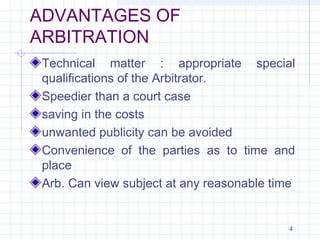
ADVANTAGES OF
ARBITRATION
Technical matter : appropriate special
qualifications of the Arbitrator.
Speedier than a court case
saving in the costs
unwanted publicity can be avoided
Convenience of the parties as to time and
place
Arb. Can view subject at any reasonable time

4
Conduct of arbitrations by
permanent institutions
the International Chamber of Commerce's International Court of
Arbitration,
World Intellectual Property Organization (WIPO) Arbitration
Center,
American Arbitration Association (AAA),
China International Economic and Trade Arbitration
Commission,
Indian Council for Arbitration, or the
International Center for Settlement of Investment Disputes
(ICSD),
International Chamber of Commerce (“ICC”), located in Paris.
The American Arbitration Association (“AAA”)
London Court of International Arbitration
Arbitration Institute of the Stockholm Chamber of Commerce;
5
TERMS OF AN
ARBITRATION AGREEMENT
Insert lawful terms as parties wish
terms must be stated with certainty
powers of Arbitrator to be clearly stated
questions to be determined by Arb .
Any matters for exclusion of reference
Any technical or legal bar to the parties
should be inserted
Composition of Arbitral Tribunal

6
Disputes inappropriate for resolution by
arbitration
Matrimonial matters, like divorce or restitution of conjugal
rights;
matters relating to guardianship of a minor or other person
under disability;
testamentary matters, for example, questions about the
validity of a will;
insolvency matters, such as adjudication of a person as an
insolvent;
criminal proceedings;
questions relating to charities or charitable trusts;
matters falling within the purview of the Monopolies and
Restrictive Trade Practices Act; dissolution or winding up of a
company.
matters involving morality, status and public policy cannot be
referred to arbitration.
7
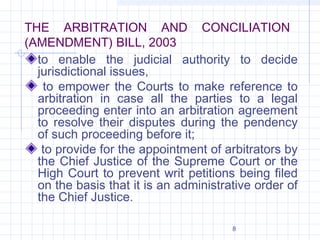
THE ARBITRATION AND CONCILIATION
(AMENDMENT) BILL, 2003
to enable the judicial authority to decide
jurisdictional issues,
to empower the Courts to make reference to
arbitration in case all the parties to a legal
proceeding enter into an arbitration agreement
to resolve their disputes during the pendency
of such proceeding before it;
to provide for the appointment of arbitrators by
the Chief Justice of the Supreme Court or the
High Court to prevent writ petitions being filed
on the basis that it is an administrative order of
the Chief Justice.
8
THE ARBITRATION AND CONCILIATION
(AMENDMENT) BILL, 2003-2
where the place of arbitration under Part I of is
in India, between Indian parties or an
international arbitration Indian law will apply.
completion of arbitrations within one year; at the
end of one year the Court will fix up a time
schedule for completion of the proceedings until
the award is passed.
empower the arbitral tribunal to pass
peremptory orders for implementation of
interlocutory orders and in case they are not
implemented, to enable the Court to order costs
or pass other orders in default.
9
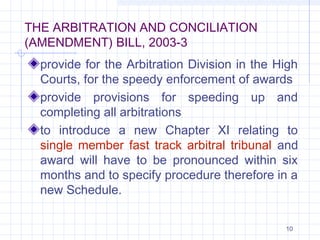
THE ARBITRATION AND CONCILIATION
(AMENDMENT) BILL, 2003-3
provide for the Arbitration Division in the High
Courts, for the speedy enforcement of awards
provide provisions for speeding up and
completing all arbitrations
to introduce a new Chapter XI relating to
single member fast track arbitral tribunal and
award will have to be pronounced within six
months and to specify procedure therefore in a
new Schedule.
10
Appointment of an Arbitrator
person of any nationality
parties to agree on a procedure for appointment
of Arb.
Failing agreement as in above -- the two Arb
shall appoint a third Arb who shall act as the
presiding Arb---Umpire.
30 days
failing which CJ or any person or institution
designated by him
Procedure by Arbitrator
Delivery of points of claim and
defence--similar to pleadings
particulars of claim and counterclaim
discovery and inspection of documents
inspection of property and things by (1)
arbitrator (2) parties
fixing the time and place of hearing
12
Procedure
Claimant (or advocate) opens his case ---also
defence to counterclaim
Claimant calls and examines his witness-who may be cross -examined by the
respondent
Claimant may re-examine him
Respondent opens his case
Respondent calls and examines his witnessmay be cross examined by the claimant
13
When court can set aside
arbitration award
1.incapacity of the parties.
2.not valid under law.
3.no proper notice.
4. beyond the scope of the matter
decided to be referred to Arb.
5. Composition of the Arb. Tribunal
defective.
14
Content of Arb. Award

shall be made in writing
signed by the Arb. Tribunal
shall state the reasons
state date and place
signed copy delivered to each party
payment of money: include in the sum for which
award is made
provision of 18% interest from the date of award to
the date of payment unless the award otherwise
directs.
Award does not transfer a property : parties are
directed to execute conveyance or other wise make
a transfer of the property in dispute
15
Environmental control
legislation
United nation environmental Programee
(UNIP)
Ministry of environment & forests
http://envfor.nic.in
Water pollution Act
Air Pollution Act
Environment (Protection) Act
16
Environmental control
legislation
Factories Act


Emission of air pollutants, improper handling
of hazardous wastes

Motor vehicles Act


Excessive emission of stock/Noise beyond
limit

Indian Port Act


Throwing rubbish in water

IPC


Public nuisance, mischief etc.

Indian Fisheries Act


Putting noxious material in water

17
Responsibilities of persons
under the Environment Act
Not to exceed standards of pollution


Industry or operation shall not discharge or
emit any pollution in excess of limit

Safeguards
substances


in

handling

hazardous

As per prescribed procedure &
safeguards of Central Government

follow

Furnishing information of accident




Person in charge must take immediate action
to mitigate and inform the authorities.
Expenses can be recovered from person
18
Environmental clearance
Government has identified 29 highly polluting industries
Environment impact assessment of development projects
compulsory
Various areas declared as green belt or no industry zone.
Public hearing made mandatory for projects which requires
central government clearance




Application made to State pollution board
Summary of project will be available for public inspection
Clearance granted will be valid for 5 yrs.

Green, orange & Red industries




Green means non-polluting industries
Orange means – industry permitted with pollution control measure
Red means – industry not permitted. They have to be closed or
shifted.

19

Bus law arbitration

  • 1.
    THE ARBITRATION AND CONCILIATIONACT, 1996 & Environment Protection Act By : Tejpal Sheth 1
  • 2.
    Objectives of Amendment Minimisethe supervisory role of the Courts Arbitral Tribunal to give reasons for Award Permit Arb. Tribunal to use Mediation, Conciliation, other procedures Arbitral Award enforced as if it were a decree of the court Conciliation proceedings --same status and effect as an Arbitral Award Foreign Awards 2
  • 3.
    Benefits for theParties Choose the arbitrator(s); Choose the issues to be arbitrated; Choose the place of arbitration; Choose the substantive law that will control the merits of the dispute; Choose the procedural rules; Choose the schedule; Choose exhibits, witnesses and other evidence to be adduced including arranging for tests and site visits; Choose the form of relief to be awarded; Choose the form of the award; and Agree to facilitate enforcement of the award. 3
  • 4.
    ADVANTAGES OF ARBITRATION Technical matter: appropriate special qualifications of the Arbitrator. Speedier than a court case saving in the costs unwanted publicity can be avoided Convenience of the parties as to time and place Arb. Can view subject at any reasonable time 4
  • 5.
    Conduct of arbitrationsby permanent institutions the International Chamber of Commerce's International Court of Arbitration, World Intellectual Property Organization (WIPO) Arbitration Center, American Arbitration Association (AAA), China International Economic and Trade Arbitration Commission, Indian Council for Arbitration, or the International Center for Settlement of Investment Disputes (ICSD), International Chamber of Commerce (“ICC”), located in Paris. The American Arbitration Association (“AAA”) London Court of International Arbitration Arbitration Institute of the Stockholm Chamber of Commerce; 5
  • 6.
    TERMS OF AN ARBITRATIONAGREEMENT Insert lawful terms as parties wish terms must be stated with certainty powers of Arbitrator to be clearly stated questions to be determined by Arb . Any matters for exclusion of reference Any technical or legal bar to the parties should be inserted Composition of Arbitral Tribunal 6
  • 7.
    Disputes inappropriate forresolution by arbitration Matrimonial matters, like divorce or restitution of conjugal rights; matters relating to guardianship of a minor or other person under disability; testamentary matters, for example, questions about the validity of a will; insolvency matters, such as adjudication of a person as an insolvent; criminal proceedings; questions relating to charities or charitable trusts; matters falling within the purview of the Monopolies and Restrictive Trade Practices Act; dissolution or winding up of a company. matters involving morality, status and public policy cannot be referred to arbitration. 7
  • 8.
    THE ARBITRATION ANDCONCILIATION (AMENDMENT) BILL, 2003 to enable the judicial authority to decide jurisdictional issues, to empower the Courts to make reference to arbitration in case all the parties to a legal proceeding enter into an arbitration agreement to resolve their disputes during the pendency of such proceeding before it; to provide for the appointment of arbitrators by the Chief Justice of the Supreme Court or the High Court to prevent writ petitions being filed on the basis that it is an administrative order of the Chief Justice. 8
  • 9.
    THE ARBITRATION ANDCONCILIATION (AMENDMENT) BILL, 2003-2 where the place of arbitration under Part I of is in India, between Indian parties or an international arbitration Indian law will apply. completion of arbitrations within one year; at the end of one year the Court will fix up a time schedule for completion of the proceedings until the award is passed. empower the arbitral tribunal to pass peremptory orders for implementation of interlocutory orders and in case they are not implemented, to enable the Court to order costs or pass other orders in default. 9
  • 10.
    THE ARBITRATION ANDCONCILIATION (AMENDMENT) BILL, 2003-3 provide for the Arbitration Division in the High Courts, for the speedy enforcement of awards provide provisions for speeding up and completing all arbitrations to introduce a new Chapter XI relating to single member fast track arbitral tribunal and award will have to be pronounced within six months and to specify procedure therefore in a new Schedule. 10
  • 11.
    Appointment of anArbitrator person of any nationality parties to agree on a procedure for appointment of Arb. Failing agreement as in above -- the two Arb shall appoint a third Arb who shall act as the presiding Arb---Umpire. 30 days failing which CJ or any person or institution designated by him
  • 12.
    Procedure by Arbitrator Deliveryof points of claim and defence--similar to pleadings particulars of claim and counterclaim discovery and inspection of documents inspection of property and things by (1) arbitrator (2) parties fixing the time and place of hearing 12
  • 13.
    Procedure Claimant (or advocate)opens his case ---also defence to counterclaim Claimant calls and examines his witness-who may be cross -examined by the respondent Claimant may re-examine him Respondent opens his case Respondent calls and examines his witnessmay be cross examined by the claimant 13
  • 14.
    When court canset aside arbitration award 1.incapacity of the parties. 2.not valid under law. 3.no proper notice. 4. beyond the scope of the matter decided to be referred to Arb. 5. Composition of the Arb. Tribunal defective. 14
  • 15.
    Content of Arb.Award shall be made in writing signed by the Arb. Tribunal shall state the reasons state date and place signed copy delivered to each party payment of money: include in the sum for which award is made provision of 18% interest from the date of award to the date of payment unless the award otherwise directs. Award does not transfer a property : parties are directed to execute conveyance or other wise make a transfer of the property in dispute 15
  • 16.
    Environmental control legislation United nationenvironmental Programee (UNIP) Ministry of environment & forests http://envfor.nic.in Water pollution Act Air Pollution Act Environment (Protection) Act 16
  • 17.
    Environmental control legislation Factories Act  Emissionof air pollutants, improper handling of hazardous wastes Motor vehicles Act  Excessive emission of stock/Noise beyond limit Indian Port Act  Throwing rubbish in water IPC  Public nuisance, mischief etc. Indian Fisheries Act  Putting noxious material in water 17
  • 18.
    Responsibilities of persons underthe Environment Act Not to exceed standards of pollution  Industry or operation shall not discharge or emit any pollution in excess of limit Safeguards substances  in handling hazardous As per prescribed procedure & safeguards of Central Government follow Furnishing information of accident   Person in charge must take immediate action to mitigate and inform the authorities. Expenses can be recovered from person 18
  • 19.
    Environmental clearance Government hasidentified 29 highly polluting industries Environment impact assessment of development projects compulsory Various areas declared as green belt or no industry zone. Public hearing made mandatory for projects which requires central government clearance    Application made to State pollution board Summary of project will be available for public inspection Clearance granted will be valid for 5 yrs. Green, orange & Red industries    Green means non-polluting industries Orange means – industry permitted with pollution control measure Red means – industry not permitted. They have to be closed or shifted. 19