Arbitration Procedure
THE INTERNATIONAL CENTER FOR THE RESOLUTION OF
INVESTMENT DISPUTES AND THE WORLD INTELLECTUAL
PROPERTY ORGANIZATION
Solving
Problems
Peacefully
People,
Governments,
Companies
The International Center for the Settlement
of Investment Disputes (ICSID)
 The ICSID was created in 1965 at a conference held in Washington, D. C.
Sponsored by the World Bank
 The World Bank drafted the ICISD Convention to calm fears of both
individuals and companies that investments in developing countries would
be expropriated
 The Convention was designed to provide a reliable mechanism for
impartially resolving disputes between an investor and the country of
investment
THE ICSID ORGANIZATION
 Administrative Council – made up of representatives of the states
parties to the Washington Convention; chaired by the President of
the World Bank; adopts the organization’s rules regarding
arbitration and conciliation; chooses the Panel of Arbitrators and
the Panel of Conciliators the Panel of Conciliators
 Secretariat – made up of a secretary-general (elected by the
Council for a six-year term)
 Administrative Staff– act as the organization’s registrar.
ICSID RULES
 The Administrative Council has enacted rules that regulate how
conciliations and arbitrations are begun (these are called Institutional
Rules)as well as rules for conducting conciliations (Conciliation Rules) as
well as arbitral hearings (Arbitration Rules)
 Litigants (i.e., the investor or private party and the host state or state party)
may agree to the rules of law governing a particular arbitration.
 If the litigants cannot agree, then both international law and the state
parties law (including the state parties rules for deciding conflicts about
the applicable ability of particular laws) are to apply.
The Most
Important Rule
Third party states, including
the state of the investor
involved in the dispute, are
not allowed to intervene
Constituting an ICSID Arbitration Tribunal
 First– the state in which the investment is being made (the host
state) and the state of which the investor is a national (the home
state) must both be parties to the Washington Convention
 Second– the investor and the host state must both consent to ICSID
jurisdiction
 Neither of these steps can be waived– the consent to jurisdiction
must be in writing
 The ICSID arbitration agreement should be included in every
contractual arrangement between the investor and the home state
What is Considered an Investment?
 The ICSID Convention – Article 25 does not define
“investment” – it merely says “jurisdiction of the Centre
shall extend to any legal dispute arising directly out of
an investment.”
 The drafters of the ICSID convention could not agree on
a definition of this term so they left it out.
 Most commentators have said that the drafters meant
for the term to be given broad scope.
UNILATERAL WITHDRAWAL
 Article 25 of the ICSID Convention colds that if proper consent has been
given to establish an ICSID tribunal, then the tribunal can be set up even
when the host state or the investor refuses to participate
 Once consent has been given it cannot be unilaterally withdrawn –
according to Article72, a state party cannot withdraw by filing a later
reservation to the Convention or even by denouncing the Convention
 Generally, a reservation to the convention will apply only to agreements
made after the reservation was filed with the ICSID
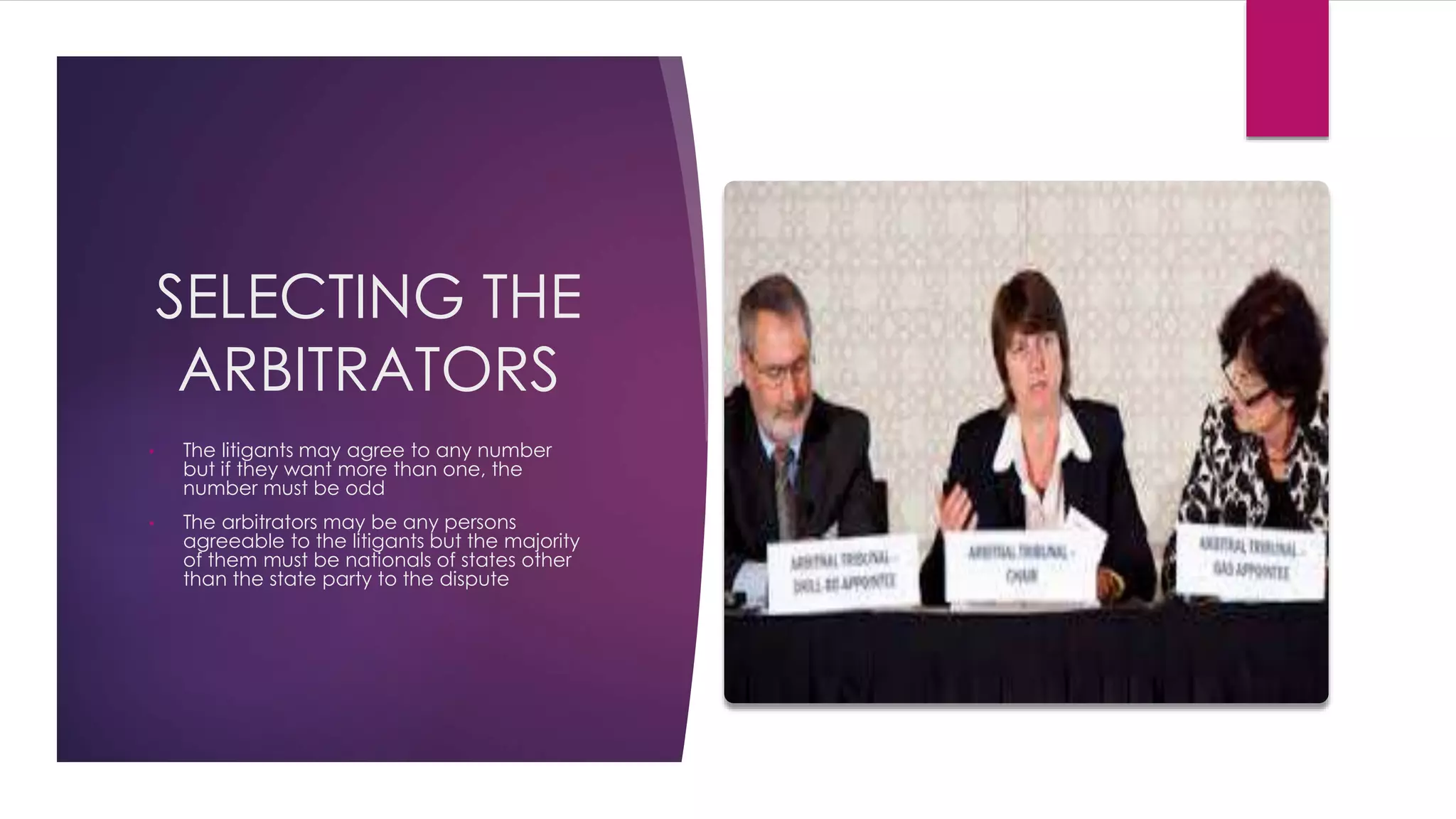
SELECTING THE
ARBITRATORS
• The litigants may agree to any number
but if they want more than one, the
number must be odd
• The arbitrators may be any persons
agreeable to the litigants but the majority
of them must be nationals of states other
than the state party to the dispute
Arbitration Location
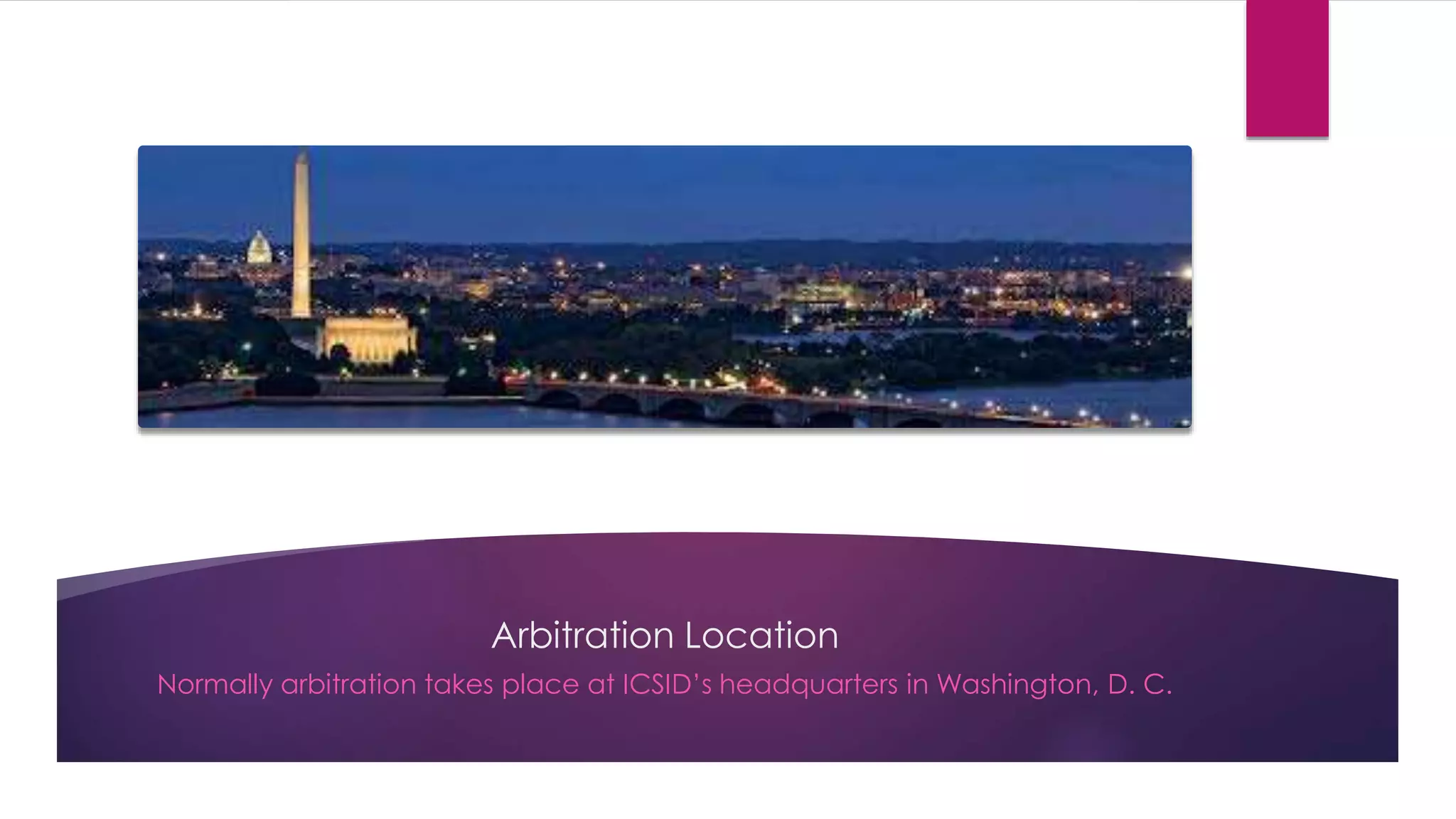
Normally arbitration takes place at ICSID’s headquarters in Washington, D. C.
By Agreement the
Litigants Can Elect to
Have the Arbitration
Elsewhere
This can be at any institution with which
the ICSID has Made Arrangements –
Permanent Court of Arbitration at the
Hague, Regional Office of the Asian-
African Consultive Committee and several
others
EXLCUSIVE REMEDY
 Giving consent to ICSID arbitration is deemed to
exclude all other remedies
 The case cannot be tried in a municipal or other
international tribunal
 The investor cannot turn to the home state for
diplomatic protection
 Any dispute about the power of an ICSID tribunal to
hear the matter is for the tribunal itself to decide
For a Tribunal to have Personal Jurisdiction
 The parties appearing before it must be a state party and a national of another
contracting State
 A state party includes the state itself, its agencies, and its subdivisions (subdivisions
include the states or provinces of a federal state, semi-autonomous dependencies,
and municipalities) the state party and either the agency or subdivision must have
consented to ICSID jurisdiction
 National of another state can be either a natural or a juridical person – a natural
person is a human being who has the nationality of a home state (the home state
must be a contracting party to the convention and not itself a party to the dispute;
the natural person must have a home state nationality at two critical times: (1) on
the date the parties consented to arbitration and (2) on the date that a request for
the arbitration is registered with the ICSID
JURIDICAL PERSON
 Juridical person is a legal entity, other than a natural person, that
has sufficient existence in the eyes of the law to function legally,
sue and be sued, and make decisions through agents (e.g., a
business firm).
 In order for a juridical person to be a party to an ICSID arbitration, it
must have had the nationality of a home state on the date the
parties consented to arbitration.
 Companies under the control of foreign nationals will also be
treated as nationals of another contracting state if the contracting
parties agree that they should be treated as such.
The Tribunal must have Subject Matter Jurisdiction:
 Tribunals can only decide matters that are (1) disputes that (2) arise
out of an investment
 This means that tribunals will not decide collusive actions (i.e., test
cases)
 Tribunals will not give advisory opinions
 There is no definition in the convention of a legal dispute– this
sometimes turns on a statement made by the executive director of
the World Bank at the time the convention was opened for
signature that defined a legal dispute as a conflict over rights
rather than interests

Arbitration procedure

  • 1.
    Arbitration Procedure THE INTERNATIONALCENTER FOR THE RESOLUTION OF INVESTMENT DISPUTES AND THE WORLD INTELLECTUAL PROPERTY ORGANIZATION
  • 2.
  • 3.
    The International Centerfor the Settlement of Investment Disputes (ICSID)  The ICSID was created in 1965 at a conference held in Washington, D. C. Sponsored by the World Bank  The World Bank drafted the ICISD Convention to calm fears of both individuals and companies that investments in developing countries would be expropriated  The Convention was designed to provide a reliable mechanism for impartially resolving disputes between an investor and the country of investment
  • 4.
    THE ICSID ORGANIZATION Administrative Council – made up of representatives of the states parties to the Washington Convention; chaired by the President of the World Bank; adopts the organization’s rules regarding arbitration and conciliation; chooses the Panel of Arbitrators and the Panel of Conciliators the Panel of Conciliators  Secretariat – made up of a secretary-general (elected by the Council for a six-year term)  Administrative Staff– act as the organization’s registrar.
  • 5.
    ICSID RULES  TheAdministrative Council has enacted rules that regulate how conciliations and arbitrations are begun (these are called Institutional Rules)as well as rules for conducting conciliations (Conciliation Rules) as well as arbitral hearings (Arbitration Rules)  Litigants (i.e., the investor or private party and the host state or state party) may agree to the rules of law governing a particular arbitration.  If the litigants cannot agree, then both international law and the state parties law (including the state parties rules for deciding conflicts about the applicable ability of particular laws) are to apply.
  • 6.
    The Most Important Rule Thirdparty states, including the state of the investor involved in the dispute, are not allowed to intervene
  • 7.
    Constituting an ICSIDArbitration Tribunal  First– the state in which the investment is being made (the host state) and the state of which the investor is a national (the home state) must both be parties to the Washington Convention  Second– the investor and the host state must both consent to ICSID jurisdiction  Neither of these steps can be waived– the consent to jurisdiction must be in writing  The ICSID arbitration agreement should be included in every contractual arrangement between the investor and the home state
  • 8.
    What is Consideredan Investment?  The ICSID Convention – Article 25 does not define “investment” – it merely says “jurisdiction of the Centre shall extend to any legal dispute arising directly out of an investment.”  The drafters of the ICSID convention could not agree on a definition of this term so they left it out.  Most commentators have said that the drafters meant for the term to be given broad scope.
  • 9.
    UNILATERAL WITHDRAWAL  Article25 of the ICSID Convention colds that if proper consent has been given to establish an ICSID tribunal, then the tribunal can be set up even when the host state or the investor refuses to participate  Once consent has been given it cannot be unilaterally withdrawn – according to Article72, a state party cannot withdraw by filing a later reservation to the Convention or even by denouncing the Convention  Generally, a reservation to the convention will apply only to agreements made after the reservation was filed with the ICSID
  • 10.
    SELECTING THE ARBITRATORS • Thelitigants may agree to any number but if they want more than one, the number must be odd • The arbitrators may be any persons agreeable to the litigants but the majority of them must be nationals of states other than the state party to the dispute
  • 11.
    Arbitration Location Normally arbitrationtakes place at ICSID’s headquarters in Washington, D. C.
  • 12.
    By Agreement the LitigantsCan Elect to Have the Arbitration Elsewhere This can be at any institution with which the ICSID has Made Arrangements – Permanent Court of Arbitration at the Hague, Regional Office of the Asian- African Consultive Committee and several others
  • 13.
    EXLCUSIVE REMEDY  Givingconsent to ICSID arbitration is deemed to exclude all other remedies  The case cannot be tried in a municipal or other international tribunal  The investor cannot turn to the home state for diplomatic protection  Any dispute about the power of an ICSID tribunal to hear the matter is for the tribunal itself to decide
  • 14.
    For a Tribunalto have Personal Jurisdiction  The parties appearing before it must be a state party and a national of another contracting State  A state party includes the state itself, its agencies, and its subdivisions (subdivisions include the states or provinces of a federal state, semi-autonomous dependencies, and municipalities) the state party and either the agency or subdivision must have consented to ICSID jurisdiction  National of another state can be either a natural or a juridical person – a natural person is a human being who has the nationality of a home state (the home state must be a contracting party to the convention and not itself a party to the dispute; the natural person must have a home state nationality at two critical times: (1) on the date the parties consented to arbitration and (2) on the date that a request for the arbitration is registered with the ICSID
  • 15.
    JURIDICAL PERSON  Juridicalperson is a legal entity, other than a natural person, that has sufficient existence in the eyes of the law to function legally, sue and be sued, and make decisions through agents (e.g., a business firm).  In order for a juridical person to be a party to an ICSID arbitration, it must have had the nationality of a home state on the date the parties consented to arbitration.  Companies under the control of foreign nationals will also be treated as nationals of another contracting state if the contracting parties agree that they should be treated as such.
  • 16.
    The Tribunal musthave Subject Matter Jurisdiction:  Tribunals can only decide matters that are (1) disputes that (2) arise out of an investment  This means that tribunals will not decide collusive actions (i.e., test cases)  Tribunals will not give advisory opinions  There is no definition in the convention of a legal dispute– this sometimes turns on a statement made by the executive director of the World Bank at the time the convention was opened for signature that defined a legal dispute as a conflict over rights rather than interests