“GOOD DECISIONS ON BAD DATA,
ARE BAD DECISIONS” - (ME, WAY TOO LONG AGO)
THE RELATIONSHIP BETWEEN ENTERPRISE
ARCHITECTURE AND DATA
MIKE GLOVER
APRIL 25, 2023
AGENDA
• Quick Introduction
• Why This Topic?
• What is Enterprise Architecture?
• Domains of Architecture
• What is “Good Data”?
• The Relationship between
Enterprise Architecture and Data
QUICK INTRODUCTION
Mike Glover
IT Executive (CIO, CTO,CISO) and Active Geek
TOGAF Certified Master Enterprise Architect
Certified Information Security Manager (CISM)
Occasional lecturer at the University of Toronto (Department of Computer Science)
5th Degree black belt and karate instructor
Dad to a pug and a blind rescue squirrel
WHY THIS TOPIC?
Data has become a much debated/discussed topic in the last 15-20 years
10+ Years Ago “Business Intelligence” was the corporate rage
Topics like Big Data, Machine Learning, AI have all exploded in the last 5+ years
Companies who are “data driven”, outperform their competition
Most companies assert they are “Data Driven”
Most companies are not “Data Driven”
WHY THE DISPARITY? HOW CAN A COMPANY CLAIM TO BE DATA DRIVEN
WHEN THEY ARE NOT?
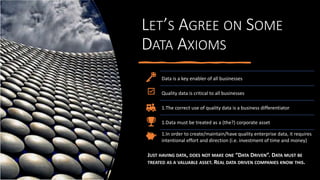
LET’S AGREE ON SOME
DATA AXIOMS
Data is a key enabler of all businesses
Quality data is critical to all businesses
1.The correct use of quality data is a business differentiator
1.Data must be treated as a (the?) corporate asset
1.In order to create/maintain/have quality enterprise data, it requires
intentional effort and direction (i.e. investment of time and money)
JUST HAVING DATA, DOES NOT MAKE ONE “DATA DRIVEN”. DATA MUST BE
TREATED AS A VALUABLE ASSET. REAL DATA DRIVEN COMPANIES KNOW THIS.
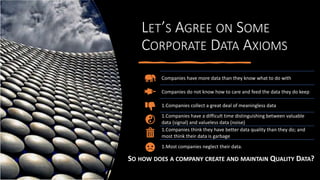
LET’S AGREE ON SOME
CORPORATE DATA AXIOMS
SO HOW DOES A COMPANY CREATE AND MAINTAIN QUALITY DATA?
Companies have more data than they know what to do with
Companies do not know how to care and feed the data they do keep
1.Companies collect a great deal of meaningless data
1.Companies have a difficult time distinguishing between valuable
data (signal) and valueless data (noise)
1.Companies think they have better data quality than they do; and
most think their data is garbage
1.Most companies neglect their data.
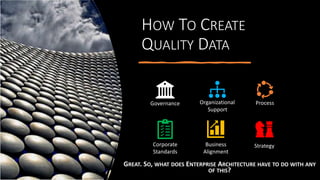
HOW TO CREATE
QUALITY DATA
Governance Organizational
Support
Process
Corporate
Standards
Business
Alignment
Strategy
GREAT. SO, WHAT DOES ENTERPRISE ARCHITECTURE HAVE TO DO WITH ANY
OF THIS?
FIRST - WHAT IS ENTERPRISE
ARCHITECTURE?
CIO.com published this definition:
“Enterprise architecture is the process by which organizations
standardize and organize IT infrastructure to align with
business goals. These strategies support digital
transformation, IT growth, and the modernization of IT.“
“Enterprise architecture (EA) is the practice of analyzing,
designing, planning, and implementing enterprise analysis to
successfully execute on business strategies…”
https://www.cio.com/article/222421/what-is-enterprise-architecture-a-framework-for-transformation.html
NO MENTION OF DATA IN THE DEFINITION. WHERE IS THE LINK
BETWEEN ENTERPRISE ARCHITECTURE AND DATA?
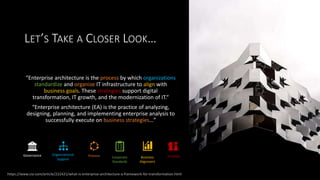
LET’S TAKE A CLOSER LOOK…
“Enterprise architecture is the process by which organizations
standardize and organize IT infrastructure to align with
business goals. These strategies support digital
transformation, IT growth, and the modernization of IT.“
“Enterprise architecture (EA) is the practice of analyzing,
designing, planning, and implementing enterprise analysis to
successfully execute on business strategies…”
https://www.cio.com/article/222421/what-is-enterprise-architecture-a-framework-for-transformation.html
Governance Organizational
Support
Process Corporate
Standards
Business
Alignment
Strategy
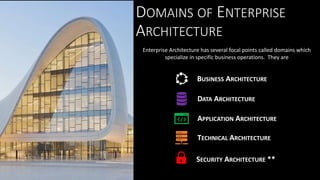
DOMAINS OF ENTERPRISE
ARCHITECTURE
Enterprise Architecture has several focal points called domains which
specialize in specific business operations. They are
BUSINESS ARCHITECTURE
DATA ARCHITECTURE
APPLICATION ARCHITECTURE
TECHNICAL ARCHITECTURE
SECURITY ARCHITECTURE **
BUSINESS ARCHITECTURE
• Business architecture refers to the process of
creating a blueprint or a structural framework for an
organization. It involves documenting and modeling
the key elements of an organization's structure,
such as its goals, processes, capabilities,
stakeholders, and resources.
• The purpose of business architecture is to provide a
clear and concise view of how an organization
operates and how it aligns with its goals and
objectives. It helps organizations to identify areas of
improvement, optimize their processes, and align
their business strategies with their overall goals.
• Business architecture can be used in various
contexts, including organizational design, process
improvement, and technology implementation. It is
an essential component of enterprise architecture,
which is the process of aligning an organization's
business and technology strategies.
• Overall, business architecture provides a holistic
and integrated view of an organization's structure,
enabling decision-makers to make informed choices
and achieve their desired outcomes.
SINCE EVERYONE IS BONKERS OVER
CHATGPT, I ASKED CHATGPT TO TELL
ME WHAT BUSINESS ARCHITECTURE IS
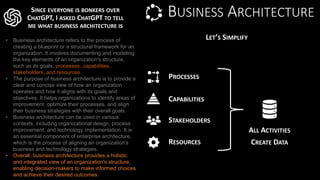
LET’S SIMPLIFY
PROCESSES
CAPABILITIES
STAKEHOLDERS
RESOURCES
ALL ACTIVITIES
CREATE DATA
DATA ARCHITECTURE
CHATGPT, WHAT'S YOUR TAKE ON
DATA ARCHITECTURE?
Data architecture refers to the design and organization of data assets
within an organization, including databases, data warehouses, data
lakes, and other data repositories. It involves defining the rules,
policies, standards, and procedures for managing and using data
effectively.
The primary goal of data architecture is to ensure that data is accurate,
consistent, accessible, and secure, and that it is used effectively to
support business operations and decision-making. This includes
defining the data structures, data models, and data flows that enable
data to be processed, analyzed, and shared across the organization.
Data architecture also plays a crucial role in managing the lifecycle of
data, from its creation to its disposal. This includes defining data
retention policies, data quality standards, data privacy and security
measures, and data governance frameworks.
Data architecture is a critical component of information technology (IT)
and enterprise architecture, as it helps organizations to align their data
assets with their business objectives and overall strategies. It enables
organizations to leverage data as a strategic asset and gain insights that
can improve their operational efficiency, customer experience, and
competitive advantage.
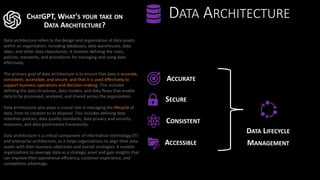
DATA LIFECYCLE
MANAGEMENT
ACCURATE
SECURE
CONSISTENT
ACCESSIBLE
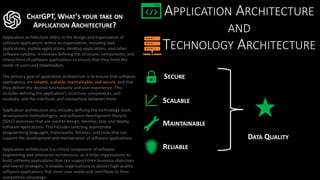
APPLICATION ARCHITECTURE
AND
TECHNOLOGY ARCHITECTURE
CHATGPT, WHAT'S YOUR TAKE ON
APPLICATION ARCHITECTURE?
Application architecture refers to the design and organization of
software applications within an organization, including web
applications, mobile applications, desktop applications, and other
software systems. It involves defining the structure, components, and
interactions of software applications to ensure that they meet the
needs of users and stakeholders.
The primary goal of application architecture is to ensure that software
applications are reliable, scalable, maintainable, and secure, and that
they deliver the desired functionality and user experience. This
includes defining the application's structure, components, and
modules, and the interfaces and interactions between them.
Application architecture also includes defining the technology stack,
development methodologies, and software development lifecycle
(SDLC) processes that are used to design, develop, test, and deploy
software applications. This includes selecting appropriate
programming languages, frameworks, libraries, and tools that can
support the development and maintenance of software applications.
Application architecture is a critical component of software
engineering and enterprise architecture, as it helps organizations to
build software applications that can support their business objectives
and overall strategies. It enables organizations to deliver high-quality
software applications that meet user needs and contribute to their
competitive advantage.
SCALABLE
RELIABLE
DATA QUALITY
SECURE
MAINTAINABLE
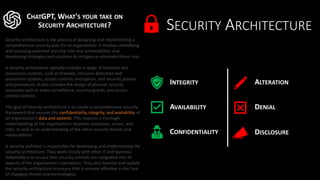
SECURITY ARCHITECTURE
CHATGPT, WHAT'S YOUR TAKE ON
SECURITY ARCHITECTURE?
Security architecture is the process of designing and implementing a
comprehensive security plan for an organization. It involves identifying
and assessing potential security risks and vulnerabilities and
developing strategies and solutions to mitigate or eliminate those risks.
A security architecture typically includes a range of technical and
procedural controls, such as firewalls, intrusion detection and
prevention systems, access controls, encryption, and security policies
and procedures. It also includes the design of physical security
measures such as video surveillance, security guards, and access
control systems.
The goal of security architecture is to create a comprehensive security
framework that ensures the confidentiality, integrity, and availability of
an organization's data and systems. This requires a thorough
understanding of the organization's business processes, assets, and
risks, as well as an understanding of the latest security threats and
vulnerabilities.
A security architect is responsible for developing and implementing the
security architecture. They work closely with other IT and business
stakeholders to ensure that security controls are integrated into all
aspects of the organization's operations. They also monitor and update
the security architecture to ensure that it remains effective in the face
of changing threats and technologies.
INTEGRITY
AVAILABILITY
CONFIDENTIALITY
DENIAL
ALTERATION
DISCLOSURE
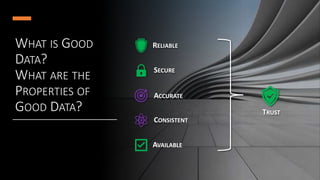
WHAT IS GOOD
DATA?
WHAT ARE THE
PROPERTIES OF
GOOD DATA?
RELIABLE
SECURE
ACCURATE
CONSISTENT
AVAILABLE
TRUST
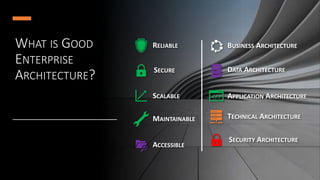
WHAT IS GOOD
ENTERPRISE
ARCHITECTURE?
RELIABLE
SECURE
ACCESSIBLE
SCALABLE
MAINTAINABLE
BUSINESS ARCHITECTURE
DATA ARCHITECTURE
APPLICATION ARCHITECTURE
TECHNICAL ARCHITECTURE
SECURITY ARCHITECTURE
WHAT IS THE
RELATIONSHIP
BETWEEN ENTERPRISE
ARCHITECTURE AND
DATA?
TRUST
“GOOD DECISIONS ON GOOD DATA,
ARE GREAT DECISIONS”(ME, AGAIN)
I WANT TO THANK YOU FOR THE
OPPORTUNITY TO PRESENT TO YOU AND
ALLOWING TO ME RAMBLE ON.
MIKE GLOVER (APRIL, 2023)
https://www.linkedin.com/in/mjglover5/

april2023.pptx

  • 1.
    “GOOD DECISIONS ONBAD DATA, ARE BAD DECISIONS” - (ME, WAY TOO LONG AGO)
  • 2.
    THE RELATIONSHIP BETWEENENTERPRISE ARCHITECTURE AND DATA MIKE GLOVER APRIL 25, 2023
  • 3.
    AGENDA • Quick Introduction •Why This Topic? • What is Enterprise Architecture? • Domains of Architecture • What is “Good Data”? • The Relationship between Enterprise Architecture and Data
  • 4.
    QUICK INTRODUCTION Mike Glover ITExecutive (CIO, CTO,CISO) and Active Geek TOGAF Certified Master Enterprise Architect Certified Information Security Manager (CISM) Occasional lecturer at the University of Toronto (Department of Computer Science) 5th Degree black belt and karate instructor Dad to a pug and a blind rescue squirrel
  • 5.
    WHY THIS TOPIC? Datahas become a much debated/discussed topic in the last 15-20 years 10+ Years Ago “Business Intelligence” was the corporate rage Topics like Big Data, Machine Learning, AI have all exploded in the last 5+ years Companies who are “data driven”, outperform their competition Most companies assert they are “Data Driven” Most companies are not “Data Driven” WHY THE DISPARITY? HOW CAN A COMPANY CLAIM TO BE DATA DRIVEN WHEN THEY ARE NOT?
  • 6.
    LET’S AGREE ONSOME DATA AXIOMS Data is a key enabler of all businesses Quality data is critical to all businesses 1.The correct use of quality data is a business differentiator 1.Data must be treated as a (the?) corporate asset 1.In order to create/maintain/have quality enterprise data, it requires intentional effort and direction (i.e. investment of time and money) JUST HAVING DATA, DOES NOT MAKE ONE “DATA DRIVEN”. DATA MUST BE TREATED AS A VALUABLE ASSET. REAL DATA DRIVEN COMPANIES KNOW THIS.
  • 7.
    LET’S AGREE ONSOME CORPORATE DATA AXIOMS SO HOW DOES A COMPANY CREATE AND MAINTAIN QUALITY DATA? Companies have more data than they know what to do with Companies do not know how to care and feed the data they do keep 1.Companies collect a great deal of meaningless data 1.Companies have a difficult time distinguishing between valuable data (signal) and valueless data (noise) 1.Companies think they have better data quality than they do; and most think their data is garbage 1.Most companies neglect their data.
  • 8.
    HOW TO CREATE QUALITYDATA Governance Organizational Support Process Corporate Standards Business Alignment Strategy GREAT. SO, WHAT DOES ENTERPRISE ARCHITECTURE HAVE TO DO WITH ANY OF THIS?
  • 9.
    FIRST - WHATIS ENTERPRISE ARCHITECTURE? CIO.com published this definition: “Enterprise architecture is the process by which organizations standardize and organize IT infrastructure to align with business goals. These strategies support digital transformation, IT growth, and the modernization of IT.“ “Enterprise architecture (EA) is the practice of analyzing, designing, planning, and implementing enterprise analysis to successfully execute on business strategies…” https://www.cio.com/article/222421/what-is-enterprise-architecture-a-framework-for-transformation.html NO MENTION OF DATA IN THE DEFINITION. WHERE IS THE LINK BETWEEN ENTERPRISE ARCHITECTURE AND DATA?
  • 10.
    LET’S TAKE ACLOSER LOOK… “Enterprise architecture is the process by which organizations standardize and organize IT infrastructure to align with business goals. These strategies support digital transformation, IT growth, and the modernization of IT.“ “Enterprise architecture (EA) is the practice of analyzing, designing, planning, and implementing enterprise analysis to successfully execute on business strategies…” https://www.cio.com/article/222421/what-is-enterprise-architecture-a-framework-for-transformation.html Governance Organizational Support Process Corporate Standards Business Alignment Strategy
  • 11.
    DOMAINS OF ENTERPRISE ARCHITECTURE EnterpriseArchitecture has several focal points called domains which specialize in specific business operations. They are BUSINESS ARCHITECTURE DATA ARCHITECTURE APPLICATION ARCHITECTURE TECHNICAL ARCHITECTURE SECURITY ARCHITECTURE **
  • 12.
    BUSINESS ARCHITECTURE • Businessarchitecture refers to the process of creating a blueprint or a structural framework for an organization. It involves documenting and modeling the key elements of an organization's structure, such as its goals, processes, capabilities, stakeholders, and resources. • The purpose of business architecture is to provide a clear and concise view of how an organization operates and how it aligns with its goals and objectives. It helps organizations to identify areas of improvement, optimize their processes, and align their business strategies with their overall goals. • Business architecture can be used in various contexts, including organizational design, process improvement, and technology implementation. It is an essential component of enterprise architecture, which is the process of aligning an organization's business and technology strategies. • Overall, business architecture provides a holistic and integrated view of an organization's structure, enabling decision-makers to make informed choices and achieve their desired outcomes. SINCE EVERYONE IS BONKERS OVER CHATGPT, I ASKED CHATGPT TO TELL ME WHAT BUSINESS ARCHITECTURE IS LET’S SIMPLIFY PROCESSES CAPABILITIES STAKEHOLDERS RESOURCES ALL ACTIVITIES CREATE DATA
  • 13.
    DATA ARCHITECTURE CHATGPT, WHAT'SYOUR TAKE ON DATA ARCHITECTURE? Data architecture refers to the design and organization of data assets within an organization, including databases, data warehouses, data lakes, and other data repositories. It involves defining the rules, policies, standards, and procedures for managing and using data effectively. The primary goal of data architecture is to ensure that data is accurate, consistent, accessible, and secure, and that it is used effectively to support business operations and decision-making. This includes defining the data structures, data models, and data flows that enable data to be processed, analyzed, and shared across the organization. Data architecture also plays a crucial role in managing the lifecycle of data, from its creation to its disposal. This includes defining data retention policies, data quality standards, data privacy and security measures, and data governance frameworks. Data architecture is a critical component of information technology (IT) and enterprise architecture, as it helps organizations to align their data assets with their business objectives and overall strategies. It enables organizations to leverage data as a strategic asset and gain insights that can improve their operational efficiency, customer experience, and competitive advantage. DATA LIFECYCLE MANAGEMENT ACCURATE SECURE CONSISTENT ACCESSIBLE
  • 14.
    APPLICATION ARCHITECTURE AND TECHNOLOGY ARCHITECTURE CHATGPT,WHAT'S YOUR TAKE ON APPLICATION ARCHITECTURE? Application architecture refers to the design and organization of software applications within an organization, including web applications, mobile applications, desktop applications, and other software systems. It involves defining the structure, components, and interactions of software applications to ensure that they meet the needs of users and stakeholders. The primary goal of application architecture is to ensure that software applications are reliable, scalable, maintainable, and secure, and that they deliver the desired functionality and user experience. This includes defining the application's structure, components, and modules, and the interfaces and interactions between them. Application architecture also includes defining the technology stack, development methodologies, and software development lifecycle (SDLC) processes that are used to design, develop, test, and deploy software applications. This includes selecting appropriate programming languages, frameworks, libraries, and tools that can support the development and maintenance of software applications. Application architecture is a critical component of software engineering and enterprise architecture, as it helps organizations to build software applications that can support their business objectives and overall strategies. It enables organizations to deliver high-quality software applications that meet user needs and contribute to their competitive advantage. SCALABLE RELIABLE DATA QUALITY SECURE MAINTAINABLE
  • 15.
    SECURITY ARCHITECTURE CHATGPT, WHAT'SYOUR TAKE ON SECURITY ARCHITECTURE? Security architecture is the process of designing and implementing a comprehensive security plan for an organization. It involves identifying and assessing potential security risks and vulnerabilities and developing strategies and solutions to mitigate or eliminate those risks. A security architecture typically includes a range of technical and procedural controls, such as firewalls, intrusion detection and prevention systems, access controls, encryption, and security policies and procedures. It also includes the design of physical security measures such as video surveillance, security guards, and access control systems. The goal of security architecture is to create a comprehensive security framework that ensures the confidentiality, integrity, and availability of an organization's data and systems. This requires a thorough understanding of the organization's business processes, assets, and risks, as well as an understanding of the latest security threats and vulnerabilities. A security architect is responsible for developing and implementing the security architecture. They work closely with other IT and business stakeholders to ensure that security controls are integrated into all aspects of the organization's operations. They also monitor and update the security architecture to ensure that it remains effective in the face of changing threats and technologies. INTEGRITY AVAILABILITY CONFIDENTIALITY DENIAL ALTERATION DISCLOSURE
  • 16.
    WHAT IS GOOD DATA? WHATARE THE PROPERTIES OF GOOD DATA? RELIABLE SECURE ACCURATE CONSISTENT AVAILABLE TRUST
  • 17.
    WHAT IS GOOD ENTERPRISE ARCHITECTURE? RELIABLE SECURE ACCESSIBLE SCALABLE MAINTAINABLE BUSINESSARCHITECTURE DATA ARCHITECTURE APPLICATION ARCHITECTURE TECHNICAL ARCHITECTURE SECURITY ARCHITECTURE
  • 18.
    WHAT IS THE RELATIONSHIP BETWEENENTERPRISE ARCHITECTURE AND DATA? TRUST “GOOD DECISIONS ON GOOD DATA, ARE GREAT DECISIONS”(ME, AGAIN)
  • 19.
    I WANT TOTHANK YOU FOR THE OPPORTUNITY TO PRESENT TO YOU AND ALLOWING TO ME RAMBLE ON. MIKE GLOVER (APRIL, 2023) https://www.linkedin.com/in/mjglover5/