Supporting further and higher education
Digital Preservation, e-
journals and e-prints
Chinese National Academy of Sciences
July04
Neil Beagrie, BL/JISC Partnership Manager
2
Overview
• Digital Challenges
• JISC archiving e-journals study
• JISC preservation of e-prints
study
• Sources of advice
• Questions?
3
New digital challenges
• Media Degradation - media degrades and
information is easily destroyed without
adequate care
• Technological Obsolescence- only
accessible through hardware and software
-rapid obsolescence eg BBC Domesday
• Authenticity - electronic records easily
amended and have to be moved through
new technologies
• Licensing access to content and
implications for future preservation and
access
4
Predicted Growth of Serials
Publications (after EPS)
0
2,000
4,000
6,000
8,000
10,000
12,000
14,000
16,0002001
2002
2003
2004
2005
2006
2007
2008
2009
2010
2011
2012
All serials
(print + e-)
Dual
form
e-only
serials
5
Archiving E- Publications
JISC study by Maggie Jones
available from:
<http:// www. jisc. ac. uk/ index. cfm? name=
project_epub_ archiving>
• Final report
• digest of reading
• report of libraries survey
• report of Archiving Workshop
6
Background
• PSLI 1996- 1998
– site licences with 4 publishers - focus on
print
• NESLI 1999- 2002
– Encouraged a move by libraries towards
electronic access
– Encouraged publishers to permit print
cancellations
• Study commissioned as part of
implementation of JISC Continuing
Access and Digital Preservation
Strategy
7
e- journals - advantages
• Most commonly cited reasons for
moving to e- only:
– convenience (24/ 7 access)
– potential space savings
– improved access to a greater
number of titles
– increasing needs and expectations of
users
8
Issues
• Few journals are solely in digital form at this
stage but parallel print/ e- access can only be
regarded either as interim or partial
equivalents
• What guarantees do libraries have when they
licence access to digital material they don’t
own (and it is served from outside national
boundaries)?
• Concerns about continued access following
termination of a licence are a major inhibiting
factor for libraries wishing to move to e- only
access
9
NESLI Model Licence
• Developed collaboratively
between publishers and libraries
• Since 1999 has included clauses
relating to continued access to
material already paid for following
termination of licence
• Assumes the licence cost includes
“perpetual access”
10
NESLI Archiving Clauses
• Clause 2.2.2 provides three
options:
– Following termination of licence,
continued access to be delivered:
– online from publishers server or third
party
– archival copy delivered to Licensee
– archival copy delivered to a central
archiving facility operated on
behalf of HE
11
Archiving by publishers
• Short-medium term option
-Business model doesn’t include
preservation for common good
• Publishers don’t necessarily hold
all archival rights
• Vary greatly in size, business
model, strategic directions
• Libraries have concerns about
publishers taking on this role
12
Archiving by the Library
• The “archival copy” referred to in
the licence tends to be CD- ROM
• Libraries do not want to
undertake this role
• Random distribution of effort
• There is a strong sense of wanting
to find a national solution offering
a reliable service
13
Central Archiving Facility
• Doesn’t currently exist and will be
expensive to establish
• A central service which would provide
libraries with the assurance they need
without undermining publishers
business models
– What should it look like?
– How would it operate?
– How would it be funded?
14
Archiving Workshop
• 26 invited delegates attended a
Workshop on 17th February 2003
• Considered organisational
options; related developments;
legal issues; business models
• Assumed that the status quo
needs to be improved
• Needed to decide on plan of
action to move things forward
15
Models outside UK
• Outcomes of Mellon projects
– New organisations will be necessary
to act in the broad interests of the
scholarly community and mediate the
interest of libraries and publishers
–JSTOR e-archiving pilot
• LOCKSS consortium (JISC currently
assessing LOCKSS)
• national library acting as official
archive for publisher (KB/ Elsevier
agreement)
• OCLC Digital Archive
16
UK Legal Deposit
• Enabling legislation has been passed.
Regulations need to be drafted to enact for
specific categories of material
• Substantial achievement (1 of only 7
worldwide)
• Major infrastructure (DOMS) being developed
at BL for these and other digital materials
• However
– significant number of e-journals used by UK HE will
be sourced internationally and outside UK
jurisdiction
– Full solution to E-journal archiving challenges will
need to be wider than UK
– Access needs/rights of purchasers in universities
and legal deposit public access rights are different
17
Workshop conclusions
• Any solution must be an active collaboration
between libraries and publishers (and
possibly wider than this eg learned societies)
• Publishers’ servers are probably the best
means of access in the short- medium term
• The option of providing an archival copy to
individual libraries is not recommended
• Unlikely to be a single point solution - central
co-ordination needs to be established to
evaluate and ensure ongoing access
• JISC will seek to implement and move
forward study recommendations (series of
collaborations may be involved in this)
18
Summary -why do we need
preservation of e-journals?
• If you are purchasing e-journals:
• Need for citation, future access and use
• Parallel print and paper will diverge –
electronic content will be different
• doing nothing means maintaining both
electronic and paper
• fundamental change from print -licensing
access to electronic content
• presents new challenges for continuing access
and preservation
• New solutions and collaborations beginning to
emerge
19
Preservation of E- Prints
• JISC funding development of
institutional repositories for e-prints, e-
theses etc under its FAIR programme
(more later).
• JISC preservation feasibility study by
Hamish James et al-Final report
available from:
<
http://www.jisc.ac.uk/uploaded_documents/e-prints_report_fin
>
• JISC funding call 04/04 to implement
main recommendations
20
04/04 Supporting Institutional
Digital Preservation and Asset
Management
• Theme one: Institutional Management
Support and Collaboration (policy,
procedures, roles, training)
• Theme two: Digital Preservation
Assessment Tools
• Theme three: Institutional Repository
Infrastructure Development
(replication, file format conversion,
preservation network)
• Closing date 21 July
Further Advice and
Guidance
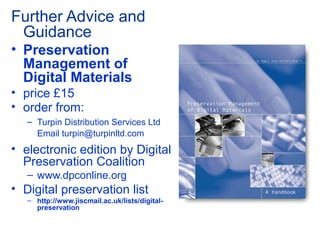
• Preservation
Management of
Digital Materials
• price £15
• order from:
– Turpin Distribution Services Ltd
Email turpin@turpinltd.com
• electronic edition by Digital
Preservation Coalition
– www.dpconline.org
• Digital preservation list
– http://www.jiscmail.ac.uk/lists/digital-
preservation

20yrs: 2004 iPRES Beijing e-journals

  • 1.
    Supporting further andhigher education Digital Preservation, e- journals and e-prints Chinese National Academy of Sciences July04 Neil Beagrie, BL/JISC Partnership Manager
  • 2.
    2 Overview • Digital Challenges •JISC archiving e-journals study • JISC preservation of e-prints study • Sources of advice • Questions?
  • 3.
    3 New digital challenges •Media Degradation - media degrades and information is easily destroyed without adequate care • Technological Obsolescence- only accessible through hardware and software -rapid obsolescence eg BBC Domesday • Authenticity - electronic records easily amended and have to be moved through new technologies • Licensing access to content and implications for future preservation and access
  • 4.
    4 Predicted Growth ofSerials Publications (after EPS) 0 2,000 4,000 6,000 8,000 10,000 12,000 14,000 16,0002001 2002 2003 2004 2005 2006 2007 2008 2009 2010 2011 2012 All serials (print + e-) Dual form e-only serials
  • 5.
    5 Archiving E- Publications JISCstudy by Maggie Jones available from: <http:// www. jisc. ac. uk/ index. cfm? name= project_epub_ archiving> • Final report • digest of reading • report of libraries survey • report of Archiving Workshop
  • 6.
    6 Background • PSLI 1996-1998 – site licences with 4 publishers - focus on print • NESLI 1999- 2002 – Encouraged a move by libraries towards electronic access – Encouraged publishers to permit print cancellations • Study commissioned as part of implementation of JISC Continuing Access and Digital Preservation Strategy
  • 7.
    7 e- journals -advantages • Most commonly cited reasons for moving to e- only: – convenience (24/ 7 access) – potential space savings – improved access to a greater number of titles – increasing needs and expectations of users
  • 8.
    8 Issues • Few journalsare solely in digital form at this stage but parallel print/ e- access can only be regarded either as interim or partial equivalents • What guarantees do libraries have when they licence access to digital material they don’t own (and it is served from outside national boundaries)? • Concerns about continued access following termination of a licence are a major inhibiting factor for libraries wishing to move to e- only access
  • 9.
    9 NESLI Model Licence •Developed collaboratively between publishers and libraries • Since 1999 has included clauses relating to continued access to material already paid for following termination of licence • Assumes the licence cost includes “perpetual access”
  • 10.
    10 NESLI Archiving Clauses •Clause 2.2.2 provides three options: – Following termination of licence, continued access to be delivered: – online from publishers server or third party – archival copy delivered to Licensee – archival copy delivered to a central archiving facility operated on behalf of HE
  • 11.
    11 Archiving by publishers •Short-medium term option -Business model doesn’t include preservation for common good • Publishers don’t necessarily hold all archival rights • Vary greatly in size, business model, strategic directions • Libraries have concerns about publishers taking on this role
  • 12.
    12 Archiving by theLibrary • The “archival copy” referred to in the licence tends to be CD- ROM • Libraries do not want to undertake this role • Random distribution of effort • There is a strong sense of wanting to find a national solution offering a reliable service
  • 13.
    13 Central Archiving Facility •Doesn’t currently exist and will be expensive to establish • A central service which would provide libraries with the assurance they need without undermining publishers business models – What should it look like? – How would it operate? – How would it be funded?
  • 14.
    14 Archiving Workshop • 26invited delegates attended a Workshop on 17th February 2003 • Considered organisational options; related developments; legal issues; business models • Assumed that the status quo needs to be improved • Needed to decide on plan of action to move things forward
  • 15.
    15 Models outside UK •Outcomes of Mellon projects – New organisations will be necessary to act in the broad interests of the scholarly community and mediate the interest of libraries and publishers –JSTOR e-archiving pilot • LOCKSS consortium (JISC currently assessing LOCKSS) • national library acting as official archive for publisher (KB/ Elsevier agreement) • OCLC Digital Archive
  • 16.
    16 UK Legal Deposit •Enabling legislation has been passed. Regulations need to be drafted to enact for specific categories of material • Substantial achievement (1 of only 7 worldwide) • Major infrastructure (DOMS) being developed at BL for these and other digital materials • However – significant number of e-journals used by UK HE will be sourced internationally and outside UK jurisdiction – Full solution to E-journal archiving challenges will need to be wider than UK – Access needs/rights of purchasers in universities and legal deposit public access rights are different
  • 17.
    17 Workshop conclusions • Anysolution must be an active collaboration between libraries and publishers (and possibly wider than this eg learned societies) • Publishers’ servers are probably the best means of access in the short- medium term • The option of providing an archival copy to individual libraries is not recommended • Unlikely to be a single point solution - central co-ordination needs to be established to evaluate and ensure ongoing access • JISC will seek to implement and move forward study recommendations (series of collaborations may be involved in this)
  • 18.
    18 Summary -why dowe need preservation of e-journals? • If you are purchasing e-journals: • Need for citation, future access and use • Parallel print and paper will diverge – electronic content will be different • doing nothing means maintaining both electronic and paper • fundamental change from print -licensing access to electronic content • presents new challenges for continuing access and preservation • New solutions and collaborations beginning to emerge
  • 19.
    19 Preservation of E-Prints • JISC funding development of institutional repositories for e-prints, e- theses etc under its FAIR programme (more later). • JISC preservation feasibility study by Hamish James et al-Final report available from: < http://www.jisc.ac.uk/uploaded_documents/e-prints_report_fin > • JISC funding call 04/04 to implement main recommendations
  • 20.
    20 04/04 Supporting Institutional DigitalPreservation and Asset Management • Theme one: Institutional Management Support and Collaboration (policy, procedures, roles, training) • Theme two: Digital Preservation Assessment Tools • Theme three: Institutional Repository Infrastructure Development (replication, file format conversion, preservation network) • Closing date 21 July
  • 21.
    Further Advice and Guidance •Preservation Management of Digital Materials • price £15 • order from: – Turpin Distribution Services Ltd Email turpin@turpinltd.com • electronic edition by Digital Preservation Coalition – www.dpconline.org • Digital preservation list – http://www.jiscmail.ac.uk/lists/digital- preservation

Editor's Notes

  • #3 The work within the programme has been broken down into 4 areas. &amp;lt;click&amp;gt; Firstly, museums and images. Many museums hold information that could usefully be shared with others for research purposes, and museums are also keen to make more people aware of their collections. Projects are based at university museums in Cambridge and London. Many institutions also hold collections of images and a project in Bristol is investigating how these can be made more available through the use of OAI. E-prints is an area I have already mentioned. Production of research outputs also includes theses and the projects are investigating the sharing of e-prints and electronic theses between institutions. Thirdly, it is important that in making institutional assets available, it is possible to deliver these alongside other information sources, both internal and external. Such delivery might be through either an institutional portal or a virtual learning environment and there are projects in place examining both. And finally, disclosure of any data raises issues of IPR and ownership, and the programme has a key study examining the IPR issues of using OAI to ensure rights are assigned where they need to be. &amp;lt;click&amp;gt;