Definition of Conflict
“Conflict is an expressed struggle between
at least two interdependent parties who
perceive incompatible goals, scare
resources, and interference from others in
achieving their goals.”
Burton – Human Needs
 Burton says that conflict stems from
unsatisfied human needs
 In conflict, people represent their interests,
but not their underlying needs; however,
they will use power and coercion to meet
those needs
Galtung – Structural Violence
 Inequalities embedded in the social
structure lead to violence and conflict.
 Unless those underlying inequalities are
solved, then violence will continue
 Prime example is lower-class people dying
because health care resources are
granted to the upper-class
Coser – social function of conflict
 Conflict is not always dysfunctional for the
relationship within which it occurs; often, conflict
is necessary to maintain such a relationship
 Conflict not only generates new norms, new
institutions…it may be said to be stimulating
directly in the economic and technological realm.
 If Coser is correct, and conflict serves a socially
useful function, then should conflicts be
resolved?
Game Theory
 Zero-sum game
 fixed pie
 People assume that they can either win or
lose.
 If I win a quarter, they lose a quarter – the
sum is always zero
 you give up nothing, because it means the
other side wins what you give up
HISTORY
 Social movements:
 Gandhi and nonviolence – movement to free
India of British Rule
 Women’s suffrage movement, 1848-1920
 Lech Walesa and Solidarity in Poland
 Nelson Mandela/Desmond Tutu and the
movement against Apartheid in South Africa
 Based off each other, and off Thoreau’s
essay “Civil Disobedience.”
HISTORY
 Thoreau said:
 Two times when open rebellion is justified:
 when the injustice is no longer occasional but
a major characteristic
 when the machine (government) demands
that people cooperate with injustice.
 Thoreau declared that, “If the government
requires you to be the agent of injustice to
another, then, I say, break the law.”
Escalation of conflict
 Conflicts escalate in both scope and
severity
 Conflicts can escalate constructively or
destructively
Destructive Conflict
 Characteristics of destructive escalation
 parties become less flexible
 goals are narrowly defined and rigid
 primary goal is to defeat the other party – assumes
the other side must lose
 becomes protracted and intractable
 Characteristics of destructive agreements
 damages relationships
 promotes inequality & power imbalance
 outcomes are imposed unilaterally
 often requires redress or revenge
 outcomes are often oppressive to one side
 DOES NOT SOLVE UNDERLYING CAUSES
Constructive Conflicts
 Constructive conflicts are not the absence of
destructive elements
 Characteristics of constructive escalation
 interaction changes often
 flexible goals/objectives
 guided by belief that all parties can win
 Characteristics of constructive agreements
 strengthens relationships
 restores equality
 recognizing the other parties as legitimate
 using benefits/promises rather than threats/coercion
 find mutually acceptable solutions
 Conflict is actually solved
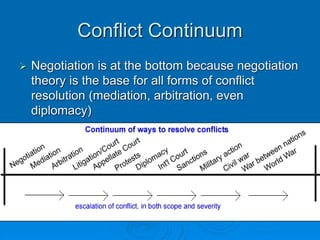
Conflict Continuum
 Negotiation is at the bottom because negotiation
theory is the base for all forms of conflict
resolution (mediation, arbitration, even
diplomacy)
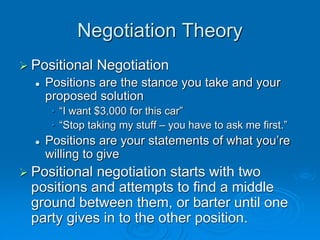
Negotiation Theory
 Positional Negotiation
 Positions are the stance you take and your
proposed solution
• “I want $3,000 for this car”
• “Stop taking my stuff – you have to ask me first.”
 Positions are your statements of what you’re
willing to give
 Positional negotiation starts with two
positions and attempts to find a middle
ground between them, or barter until one
party gives in to the other position.
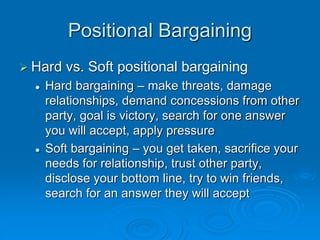
Positional Bargaining
 Hard vs. Soft positional bargaining
 Hard bargaining – make threats, damage
relationships, demand concessions from other
party, goal is victory, search for one answer
you will accept, apply pressure
 Soft bargaining – you get taken, sacrifice your
needs for relationship, trust other party,
disclose your bottom line, try to win friends,
search for an answer they will accept
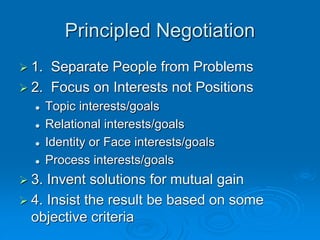
Principled Negotiation
 1. Separate People from Problems
 2. Focus on Interests not Positions
 Topic interests/goals
 Relational interests/goals
 Identity or Face interests/goals
 Process interests/goals
 3. Invent solutions for mutual gain
 4. Insist the result be based on some
objective criteria
Separate people from problems
 Negotiators are people first
 every party in a negotiation has emotions and ego,
and can have misunderstandings
 The relationship needs to be taken into account
in all negotiations
 Perceptions – does truth matter?
 understand their perceptions to come up with better
solutions
 Emotions – the higher the stakes, the higher
emotions run
 Communication – all negotiations have
misunderstandings
Negotiation Interests not Positions
 Positions are something you decided on –
what you’re demanding as a solution
 Interests are what got you there
 For every interest, there are several
positions you could take, and vice-versa
 To negotiate interests, identify them
 ask why? what are they getting from position
 ask why not? what are they not getting
 most common interests are needs-based
Types of Interests
 T.R.I.P.
 Topic, relational, identity/face, process
 Topic and Process interests
 external, negotiable, substantive, tangible,
expressed
 Relational and Identity interests
 internal, non-negotiable, usually not
expressed aloud, intangible (values)
 DRIVE all conflicts
Topic and Process Goals
 Topic interests:
 what do we want? what are we fighting for?
 either both parties have the same goal, or
both parties have opposing goals
 Process interests:
 what communication process will we use?
 process goals appear when low-power party
cries unjust process or unfair fight
Relational Goals
 Who are we to each other?
 How will we be treated?
 How much influence do we have over the
other?
 How interdependent are we?
 At the heart of all conflicts, but rarely
articulated
 Relational goals must be met in order to
solve underlying issues
Face or Identity Goals
 Who am I in this conflict?
 You can save or damage your own face or
the other’s face
 If face is destroyed, it must be restored
(saved) before any other conflict goal can
be addressed
 When face is damaged:
 people dig into their positions
 creates losers who “get back at you” next time
Ways to restore face
 How we save our own face:
 rationalize actions
 claim unjust intimidation
 dig into our position
 damage other’s face
 How we save other’s face:
 help increase their self-esteem
 avoid giving orders or directives
 listen carefully and legitimize their concerns
 No one wants to look like the loser
More about types of interests
 Interests overlap
 all conflicts have multiple goals
 relational and identity goals are always
present
 different goals have primacy
 parties in conflict rarely have same goals with
same primacy
 Interests are disguised
 relational and face goals are presented as
topic and process goals
More about interests
 Goals/Interests change
 goals change as they’re met or as they’re
frustrated
 Prospective goals
 what you want as you’re preparing
 Transactive goals
 goals that emerge during the conflict
• shift as negotiation occurs
• can become destructive (esp. face)
• can be sacrificed (esp. topic)
 Retrospective goals – set up for next time
Invent Solutions for Mutual Gain
 Easiest solution in a negotiation is to split
the difference between the positions
 In order to have more options to choose
from, you need more solutions
 Brainstorm
 Broaden your options
• shuttle between the specific and the general
• invent options of differing strength
• change scope
 Make a bigger pie (game theory)
• look for shared interests and goals
• split differing interests
 Turn it into reaching a common goal
Insist on Objective Criteria
 Use a “Fair Standard”
 market value, such as “blue-book value”
 professional standards
 precedent
 scientific judgment
 Use a “Fair Procedure”
 Flip a coin, lottery, use a 3rd party, “I divide, you
choose”
 Agree to the principles first
 Not a way to strengthen your position – a fair
standard must be fair for both parties

Approaches to Conflict(2bhgffffffffff).ppt

  • 1.
    Definition of Conflict “Conflictis an expressed struggle between at least two interdependent parties who perceive incompatible goals, scare resources, and interference from others in achieving their goals.”
  • 2.
    Burton – HumanNeeds  Burton says that conflict stems from unsatisfied human needs  In conflict, people represent their interests, but not their underlying needs; however, they will use power and coercion to meet those needs
  • 3.
    Galtung – StructuralViolence  Inequalities embedded in the social structure lead to violence and conflict.  Unless those underlying inequalities are solved, then violence will continue  Prime example is lower-class people dying because health care resources are granted to the upper-class
  • 4.
    Coser – socialfunction of conflict  Conflict is not always dysfunctional for the relationship within which it occurs; often, conflict is necessary to maintain such a relationship  Conflict not only generates new norms, new institutions…it may be said to be stimulating directly in the economic and technological realm.  If Coser is correct, and conflict serves a socially useful function, then should conflicts be resolved?
  • 5.
    Game Theory  Zero-sumgame  fixed pie  People assume that they can either win or lose.  If I win a quarter, they lose a quarter – the sum is always zero  you give up nothing, because it means the other side wins what you give up
  • 6.
    HISTORY  Social movements: Gandhi and nonviolence – movement to free India of British Rule  Women’s suffrage movement, 1848-1920  Lech Walesa and Solidarity in Poland  Nelson Mandela/Desmond Tutu and the movement against Apartheid in South Africa  Based off each other, and off Thoreau’s essay “Civil Disobedience.”
  • 7.
    HISTORY  Thoreau said: Two times when open rebellion is justified:  when the injustice is no longer occasional but a major characteristic  when the machine (government) demands that people cooperate with injustice.  Thoreau declared that, “If the government requires you to be the agent of injustice to another, then, I say, break the law.”
  • 8.
    Escalation of conflict Conflicts escalate in both scope and severity  Conflicts can escalate constructively or destructively
  • 9.
    Destructive Conflict  Characteristicsof destructive escalation  parties become less flexible  goals are narrowly defined and rigid  primary goal is to defeat the other party – assumes the other side must lose  becomes protracted and intractable  Characteristics of destructive agreements  damages relationships  promotes inequality & power imbalance  outcomes are imposed unilaterally  often requires redress or revenge  outcomes are often oppressive to one side  DOES NOT SOLVE UNDERLYING CAUSES
  • 10.
    Constructive Conflicts  Constructiveconflicts are not the absence of destructive elements  Characteristics of constructive escalation  interaction changes often  flexible goals/objectives  guided by belief that all parties can win  Characteristics of constructive agreements  strengthens relationships  restores equality  recognizing the other parties as legitimate  using benefits/promises rather than threats/coercion  find mutually acceptable solutions  Conflict is actually solved
  • 11.
    Conflict Continuum  Negotiationis at the bottom because negotiation theory is the base for all forms of conflict resolution (mediation, arbitration, even diplomacy)
  • 13.
    Negotiation Theory  PositionalNegotiation  Positions are the stance you take and your proposed solution • “I want $3,000 for this car” • “Stop taking my stuff – you have to ask me first.”  Positions are your statements of what you’re willing to give  Positional negotiation starts with two positions and attempts to find a middle ground between them, or barter until one party gives in to the other position.
  • 14.
    Positional Bargaining  Hardvs. Soft positional bargaining  Hard bargaining – make threats, damage relationships, demand concessions from other party, goal is victory, search for one answer you will accept, apply pressure  Soft bargaining – you get taken, sacrifice your needs for relationship, trust other party, disclose your bottom line, try to win friends, search for an answer they will accept
  • 15.
    Principled Negotiation  1.Separate People from Problems  2. Focus on Interests not Positions  Topic interests/goals  Relational interests/goals  Identity or Face interests/goals  Process interests/goals  3. Invent solutions for mutual gain  4. Insist the result be based on some objective criteria
  • 16.
    Separate people fromproblems  Negotiators are people first  every party in a negotiation has emotions and ego, and can have misunderstandings  The relationship needs to be taken into account in all negotiations  Perceptions – does truth matter?  understand their perceptions to come up with better solutions  Emotions – the higher the stakes, the higher emotions run  Communication – all negotiations have misunderstandings
  • 17.
    Negotiation Interests notPositions  Positions are something you decided on – what you’re demanding as a solution  Interests are what got you there  For every interest, there are several positions you could take, and vice-versa  To negotiate interests, identify them  ask why? what are they getting from position  ask why not? what are they not getting  most common interests are needs-based
  • 18.
    Types of Interests T.R.I.P.  Topic, relational, identity/face, process  Topic and Process interests  external, negotiable, substantive, tangible, expressed  Relational and Identity interests  internal, non-negotiable, usually not expressed aloud, intangible (values)  DRIVE all conflicts
  • 19.
    Topic and ProcessGoals  Topic interests:  what do we want? what are we fighting for?  either both parties have the same goal, or both parties have opposing goals  Process interests:  what communication process will we use?  process goals appear when low-power party cries unjust process or unfair fight
  • 20.
    Relational Goals  Whoare we to each other?  How will we be treated?  How much influence do we have over the other?  How interdependent are we?  At the heart of all conflicts, but rarely articulated  Relational goals must be met in order to solve underlying issues
  • 21.
    Face or IdentityGoals  Who am I in this conflict?  You can save or damage your own face or the other’s face  If face is destroyed, it must be restored (saved) before any other conflict goal can be addressed  When face is damaged:  people dig into their positions  creates losers who “get back at you” next time
  • 22.
    Ways to restoreface  How we save our own face:  rationalize actions  claim unjust intimidation  dig into our position  damage other’s face  How we save other’s face:  help increase their self-esteem  avoid giving orders or directives  listen carefully and legitimize their concerns  No one wants to look like the loser
  • 23.
    More about typesof interests  Interests overlap  all conflicts have multiple goals  relational and identity goals are always present  different goals have primacy  parties in conflict rarely have same goals with same primacy  Interests are disguised  relational and face goals are presented as topic and process goals
  • 24.
    More about interests Goals/Interests change  goals change as they’re met or as they’re frustrated  Prospective goals  what you want as you’re preparing  Transactive goals  goals that emerge during the conflict • shift as negotiation occurs • can become destructive (esp. face) • can be sacrificed (esp. topic)  Retrospective goals – set up for next time
  • 25.
    Invent Solutions forMutual Gain  Easiest solution in a negotiation is to split the difference between the positions  In order to have more options to choose from, you need more solutions  Brainstorm  Broaden your options • shuttle between the specific and the general • invent options of differing strength • change scope  Make a bigger pie (game theory) • look for shared interests and goals • split differing interests  Turn it into reaching a common goal
  • 26.
    Insist on ObjectiveCriteria  Use a “Fair Standard”  market value, such as “blue-book value”  professional standards  precedent  scientific judgment  Use a “Fair Procedure”  Flip a coin, lottery, use a 3rd party, “I divide, you choose”  Agree to the principles first  Not a way to strengthen your position – a fair standard must be fair for both parties