Diagnostic Approach to
Myeloproliferative Neoplasms
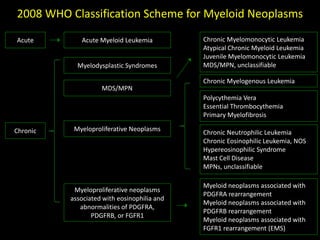
2008 WHO Classification Scheme for Myeloid Neoplasms

Acute        Acute Myeloid Leukemia          Chronic Myelomonocytic Leukemia
                                             Atypical Chronic Myeloid Leukemia
                                             Juvenile Myelomonocytic Leukemia
            Myelodysplastic Syndromes        MDS/MPN, unclassifiable

                                             Chronic Myelogenous Leukemia
                    MDS/MPN
                                             Polycythemia Vera
                                             Essential Thrombocythemia
                                             Primary Myelofibrosis

Chronic    Myeloproliferative Neoplasms      Chronic Neutrophilic Leukemia
                                             Chronic Eosinophilic Leukemia, NOS
                                             Hypereosinophilic Syndrome
                                             Mast Cell Disease
                                             MPNs, unclassifiable

                                             Myeloid neoplasms associated with
           Myeloproliferative neoplasms
                                             PDGFRA rearrangement
          associated with eosinophilia and
                                             Myeloid neoplasms associated with
             abnormalities of PDGFRA,
                                             PDGFRB rearrangement
                 PDGFRB, or FGFR1
                                             Myeloid neoplasms associated with
                                             FGFR1 rearrangement (EMS)
• A 55 year-old man presents for routine
  evaluation
• CBC reveals erythrocytosis with mild
  leukocytosis and thrombocytosis:
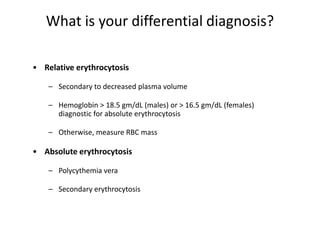
What is your differential diagnosis?

• Relative erythrocytosis

    – Secondary to decreased plasma volume

    – Hemoglobin > 18.5 gm/dL (males) or > 16.5 gm/dL (females)
      diagnostic for absolute erythrocytosis

    – Otherwise, measure RBC mass

• Absolute erythrocytosis

    – Polycythemia vera

    – Secondary erythrocytosis
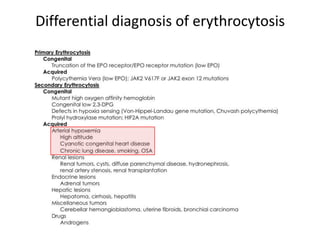
Differential diagnosis of erythrocytosis
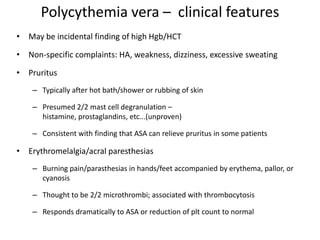
Polycythemia vera – clinical features
• May be incidental finding of high Hgb/HCT

• Non-specific complaints: HA, weakness, dizziness, excessive sweating

• Pruritus
    – Typically after hot bath/shower or rubbing of skin

    – Presumed 2/2 mast cell degranulation –
      histamine, prostaglandins, etc...(unproven)

    – Consistent with finding that ASA can relieve pruritus in some patients

• Erythromelalgia/acral paresthesias
    – Burning pain/parasthesias in hands/feet accompanied by erythema, pallor, or
      cyanosis

    – Thought to be 2/2 microthrombi; associated with thrombocytosis

    – Responds dramatically to ASA or reduction of plt count to normal
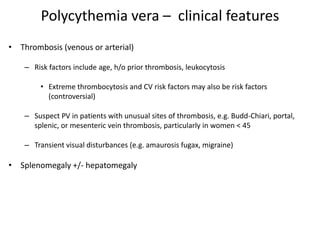
Polycythemia vera – clinical features
• Thrombosis (venous or arterial)

    – Risk factors include age, h/o prior thrombosis, leukocytosis

        • Extreme thrombocytosis and CV risk factors may also be risk factors
          (controversial)

    – Suspect PV in patients with unusual sites of thrombosis, e.g. Budd-Chiari, portal,
      splenic, or mesenteric vein thrombosis, particularly in women < 45

    – Transient visual disturbances (e.g. amaurosis fugax, migraine)

• Splenomegaly +/- hepatomegaly
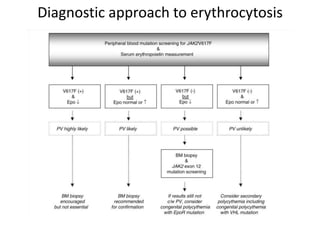
Diagnostic approach to erythrocytosis
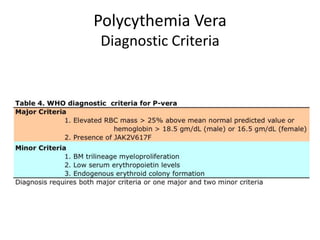
Polycythemia Vera
Diagnostic Criteria
Polycythemia Vera
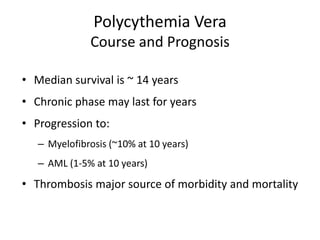
              Course and Prognosis

• Median survival is ~ 14 years
• Chronic phase may last for years
• Progression to:
   – Myelofibrosis (~10% at 10 years)
   – AML (1-5% at 10 years)
• Thrombosis major source of morbidity and mortality
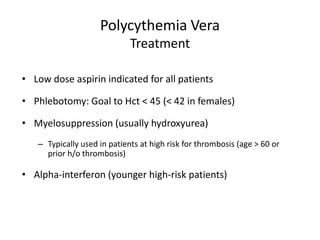
Polycythemia Vera
                             Treatment

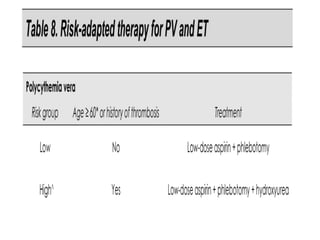
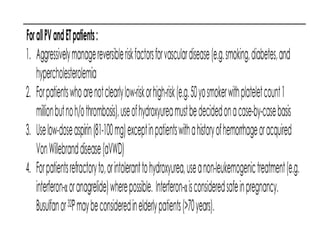
• Low dose aspirin indicated for all patients

• Phlebotomy: Goal to Hct < 45 (< 42 in females)

• Myelosuppression (usually hydroxyurea)
   – Typically used in patients at high risk for thrombosis (age > 60 or
     prior h/o thrombosis)

• Alpha-interferon (younger high-risk patients)
• A 66 year-old woman presents with
  headaches and recurrent TIA symptoms
• CBC reveals thrombocytosis:
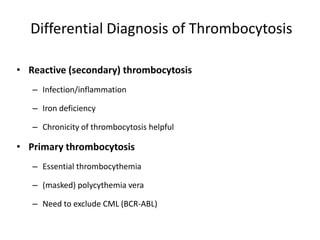
Differential Diagnosis of Thrombocytosis

• Reactive (secondary) thrombocytosis
   – Infection/inflammation

   – Iron deficiency

   – Chronicity of thrombocytosis helpful

• Primary thrombocytosis
   – Essential thrombocythemia

   – (masked) polycythemia vera

   – Need to exclude CML (BCR-ABL)
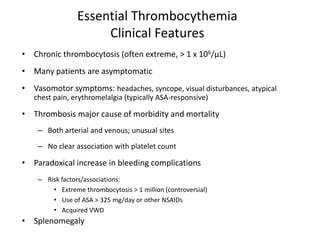
Essential Thrombocythemia
                      Clinical Features
• Chronic thrombocytosis (often extreme, > 1 x 10⁶/µL)
• Many patients are asymptomatic
• Vasomotor symptoms: headaches, syncope, visual disturbances, atypical
   chest pain, erythromelalgia (typically ASA-responsive)

• Thrombosis major cause of morbidity and mortality
    – Both arterial and venous; unusual sites
    – No clear association with platelet count

• Paradoxical increase in bleeding complications
    – Risk factors/associations:
        • Extreme thrombocytosis > 1 million (controversial)
        • Use of ASA > 325 mg/day or other NSAIDs
        • Acquired VWD
• Splenomegaly
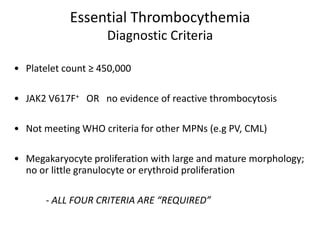
Essential Thrombocythemia
                    Diagnostic Criteria

• Platelet count ≥ 450,000

• JAK2 V617F+ OR no evidence of reactive thrombocytosis

• Not meeting WHO criteria for other MPNs (e.g PV, CML)

• Megakaryocyte proliferation with large and mature morphology;
  no or little granulocyte or erythroid proliferation

       - ALL FOUR CRITERIA ARE “REQUIRED”
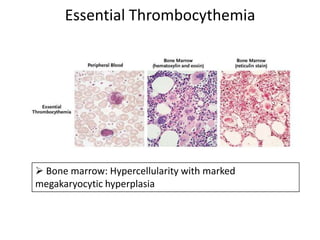
Essential Thrombocythemia


 Bone marrow: Hypercellularity with marked
megakaryocytic hyperplasia
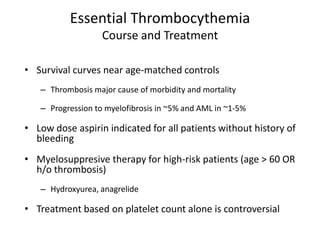
Essential Thrombocythemia
                   Course and Treatment

• Survival curves near age-matched controls
   – Thrombosis major cause of morbidity and mortality

   – Progression to myelofibrosis in ~5% and AML in ~1-5%

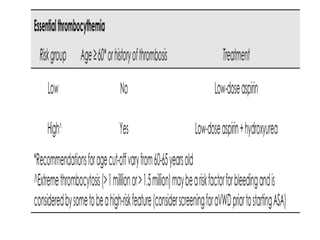
• Low dose aspirin indicated for all patients without history of
  bleeding
• Myelosuppresive therapy for high-risk patients (age > 60 OR
  h/o thrombosis)
   – Hydroxyurea, anagrelide

• Treatment based on platelet count alone is controversial
• A 57 year-old man presents with
  fatigue, anorexia, and night sweats
• He also complains of abdominal discomfort
  and early satiety
• CBC reveals pancytopenia with an abnormal
  peripheral smear
Seg 35, bands 20, metamyelocytes 10, myelocytes 8, promyelocytes 4, blasts 3, teardrop
RBCs, nRBCs
Primary Myelofibrosis
                 Differential Diagnosis

• Reactive myelofibrosis
   – Marrow infiltration with cancer
   – Infections (mycobacterial or fungus)
   – Myelodysplasia
• Other MPNs
• Work-up
   – Bone marrow biopsy
   – Genetic testing for JAK2 V617F and BCR-ABL
Primary myelofibrosis – clinical features

• Severe fatigue, weight loss, fevers, night sweats

• Splenomegaly, often massive
     – LUQ discomfort/pain, early satiety

• Hepatomegaly
     – Portal HTN related to HSMG – ascites, varices, UGIB

     – Portal vein thrombosis

• Extramedullary hematopoiesis
     – Foci can occur in almost any organ

•   Cytopenias (but can also have leukocytosis, thrombocytosis)

•   Leukoerythroblastic reaction
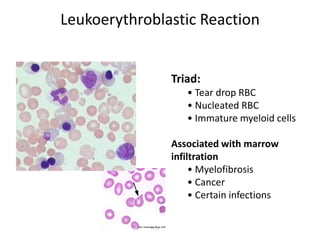
Leukoerythroblastic Reaction


               Triad:
                  • Tear drop RBC
                  • Nucleated RBC
                  • Immature myeloid cells

               Associated with marrow
               infiltration
                    • Myelofibrosis
                    • Cancer
                    • Certain infections
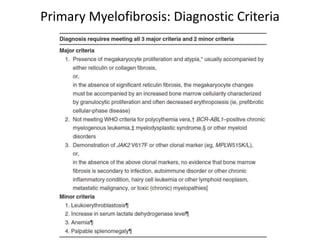
Primary Myelofibrosis: Diagnostic Criteria
Primary Myelofibrosis


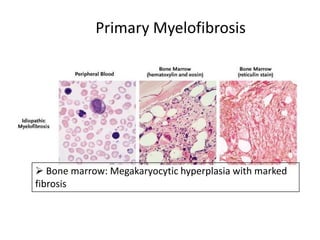
 Bone marrow: Megakaryocytic hyperplasia with marked
fibrosis
Primary Myelofibrosis
                  Course and Prognosis


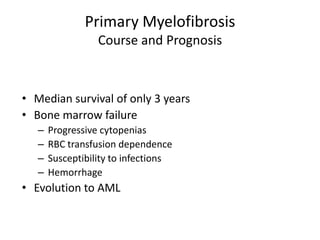
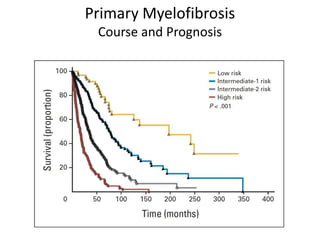
• Median survival of only 3 years
• Bone marrow failure
   –   Progressive cytopenias
   –   RBC transfusion dependence
   –   Susceptibility to infections
   –   Hemorrhage
• Evolution to AML
Primary Myelofibrosis
                       Course and Prognosis
DIPSS:
• Age >65 years: 1 point
• Leukocyte count >25,000/microL: 1 point
• Hemoglobin <10 g/dL: 2 points
• Circulating blast cells ≥1 percent: 1 point
• Presence of constitutional symptoms: 1 point
  DIPSS category                 Points          DIPSS-plus   DIPSS-plus
                                                 points       category
  Low-risk                       0               0            0
  Intermediate-1                 1-2             1            1
  Intermediate-2                 3-4             2            2-3
  High-risk                      5-6             3            4-6
  Unfavorable karyotype                          1
  Platelets < 10,000/microL                      1
  RBC transfusion-dependence                     1
Primary Myelofibrosis
 Course and Prognosis
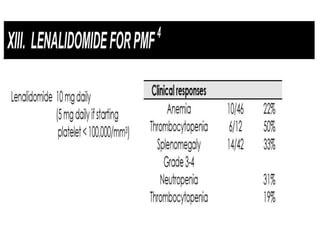
Primary myelofibrosis – treatment

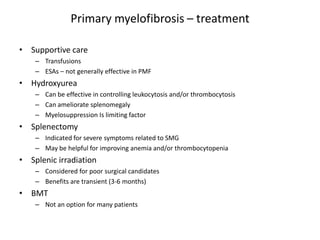
• Supportive care
    – Transfusions
    – ESAs – not generally effective in PMF
• Hydroxyurea
    – Can be effective in controlling leukocytosis and/or thrombocytosis
    – Can ameliorate splenomegaly
    – Myelosuppression Is limiting factor
• Splenectomy
    – Indicated for severe symptoms related to SMG
    – May be helpful for improving anemia and/or thrombocytopenia
• Splenic irradiation
    – Considered for poor surgical candidates
    – Benefits are transient (3-6 months)
• BMT
    – Not an option for many patients
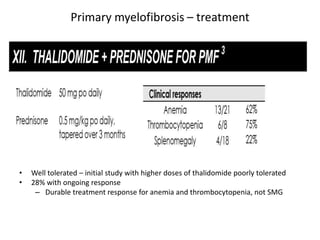
Primary myelofibrosis – treatment


•   Well tolerated – initial study with higher doses of thalidomide poorly tolerated
•   28% with ongoing response
     – Durable treatment response for anemia and thrombocytopenia, not SMG
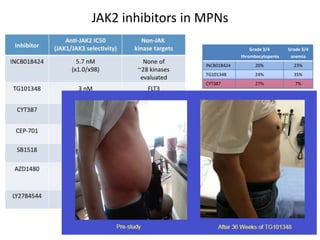
JAK2 inhibitors in MPNs

                                         Grade 3/4      Grade 3/4
                                     thrombocytopenia    anemia
                   INCB018424             20%             23%
                   TG101348               24%             35%
                   CYT387                 27%              7%


                              Anemia response by IWG
                            INCB018424           8%
                            TG101348             0%
                            CYT387              50%

approach to MPN

  • 1.
  • 2.
    2008 WHO ClassificationScheme for Myeloid Neoplasms Acute Acute Myeloid Leukemia Chronic Myelomonocytic Leukemia Atypical Chronic Myeloid Leukemia Juvenile Myelomonocytic Leukemia Myelodysplastic Syndromes MDS/MPN, unclassifiable Chronic Myelogenous Leukemia MDS/MPN Polycythemia Vera Essential Thrombocythemia Primary Myelofibrosis Chronic Myeloproliferative Neoplasms Chronic Neutrophilic Leukemia Chronic Eosinophilic Leukemia, NOS Hypereosinophilic Syndrome Mast Cell Disease MPNs, unclassifiable Myeloid neoplasms associated with Myeloproliferative neoplasms PDGFRA rearrangement associated with eosinophilia and Myeloid neoplasms associated with abnormalities of PDGFRA, PDGFRB rearrangement PDGFRB, or FGFR1 Myeloid neoplasms associated with FGFR1 rearrangement (EMS)
  • 3.
    • A 55year-old man presents for routine evaluation • CBC reveals erythrocytosis with mild leukocytosis and thrombocytosis:
  • 4.
    What is yourdifferential diagnosis? • Relative erythrocytosis – Secondary to decreased plasma volume – Hemoglobin > 18.5 gm/dL (males) or > 16.5 gm/dL (females) diagnostic for absolute erythrocytosis – Otherwise, measure RBC mass • Absolute erythrocytosis – Polycythemia vera – Secondary erythrocytosis
  • 5.
  • 6.
    Polycythemia vera –clinical features • May be incidental finding of high Hgb/HCT • Non-specific complaints: HA, weakness, dizziness, excessive sweating • Pruritus – Typically after hot bath/shower or rubbing of skin – Presumed 2/2 mast cell degranulation – histamine, prostaglandins, etc...(unproven) – Consistent with finding that ASA can relieve pruritus in some patients • Erythromelalgia/acral paresthesias – Burning pain/parasthesias in hands/feet accompanied by erythema, pallor, or cyanosis – Thought to be 2/2 microthrombi; associated with thrombocytosis – Responds dramatically to ASA or reduction of plt count to normal
  • 7.
    Polycythemia vera –clinical features • Thrombosis (venous or arterial) – Risk factors include age, h/o prior thrombosis, leukocytosis • Extreme thrombocytosis and CV risk factors may also be risk factors (controversial) – Suspect PV in patients with unusual sites of thrombosis, e.g. Budd-Chiari, portal, splenic, or mesenteric vein thrombosis, particularly in women < 45 – Transient visual disturbances (e.g. amaurosis fugax, migraine) • Splenomegaly +/- hepatomegaly
  • 8.
    Diagnostic approach toerythrocytosis
  • 9.
  • 10.
    Polycythemia Vera Course and Prognosis • Median survival is ~ 14 years • Chronic phase may last for years • Progression to: – Myelofibrosis (~10% at 10 years) – AML (1-5% at 10 years) • Thrombosis major source of morbidity and mortality
  • 11.
    Polycythemia Vera Treatment • Low dose aspirin indicated for all patients • Phlebotomy: Goal to Hct < 45 (< 42 in females) • Myelosuppression (usually hydroxyurea) – Typically used in patients at high risk for thrombosis (age > 60 or prior h/o thrombosis) • Alpha-interferon (younger high-risk patients)
  • 12.
    • A 66year-old woman presents with headaches and recurrent TIA symptoms • CBC reveals thrombocytosis:
  • 13.
    Differential Diagnosis ofThrombocytosis • Reactive (secondary) thrombocytosis – Infection/inflammation – Iron deficiency – Chronicity of thrombocytosis helpful • Primary thrombocytosis – Essential thrombocythemia – (masked) polycythemia vera – Need to exclude CML (BCR-ABL)
  • 14.
    Essential Thrombocythemia Clinical Features • Chronic thrombocytosis (often extreme, > 1 x 10⁶/µL) • Many patients are asymptomatic • Vasomotor symptoms: headaches, syncope, visual disturbances, atypical chest pain, erythromelalgia (typically ASA-responsive) • Thrombosis major cause of morbidity and mortality – Both arterial and venous; unusual sites – No clear association with platelet count • Paradoxical increase in bleeding complications – Risk factors/associations: • Extreme thrombocytosis > 1 million (controversial) • Use of ASA > 325 mg/day or other NSAIDs • Acquired VWD • Splenomegaly
  • 15.
    Essential Thrombocythemia Diagnostic Criteria • Platelet count ≥ 450,000 • JAK2 V617F+ OR no evidence of reactive thrombocytosis • Not meeting WHO criteria for other MPNs (e.g PV, CML) • Megakaryocyte proliferation with large and mature morphology; no or little granulocyte or erythroid proliferation - ALL FOUR CRITERIA ARE “REQUIRED”
  • 16.
    Essential Thrombocythemia  Bonemarrow: Hypercellularity with marked megakaryocytic hyperplasia
  • 17.
    Essential Thrombocythemia Course and Treatment • Survival curves near age-matched controls – Thrombosis major cause of morbidity and mortality – Progression to myelofibrosis in ~5% and AML in ~1-5% • Low dose aspirin indicated for all patients without history of bleeding • Myelosuppresive therapy for high-risk patients (age > 60 OR h/o thrombosis) – Hydroxyurea, anagrelide • Treatment based on platelet count alone is controversial
  • 21.
    • A 57year-old man presents with fatigue, anorexia, and night sweats • He also complains of abdominal discomfort and early satiety • CBC reveals pancytopenia with an abnormal peripheral smear Seg 35, bands 20, metamyelocytes 10, myelocytes 8, promyelocytes 4, blasts 3, teardrop RBCs, nRBCs
  • 22.
    Primary Myelofibrosis Differential Diagnosis • Reactive myelofibrosis – Marrow infiltration with cancer – Infections (mycobacterial or fungus) – Myelodysplasia • Other MPNs • Work-up – Bone marrow biopsy – Genetic testing for JAK2 V617F and BCR-ABL
  • 23.
    Primary myelofibrosis –clinical features • Severe fatigue, weight loss, fevers, night sweats • Splenomegaly, often massive – LUQ discomfort/pain, early satiety • Hepatomegaly – Portal HTN related to HSMG – ascites, varices, UGIB – Portal vein thrombosis • Extramedullary hematopoiesis – Foci can occur in almost any organ • Cytopenias (but can also have leukocytosis, thrombocytosis) • Leukoerythroblastic reaction
  • 24.
    Leukoerythroblastic Reaction Triad: • Tear drop RBC • Nucleated RBC • Immature myeloid cells Associated with marrow infiltration • Myelofibrosis • Cancer • Certain infections
  • 25.
  • 26.
    Primary Myelofibrosis  Bonemarrow: Megakaryocytic hyperplasia with marked fibrosis
  • 27.
    Primary Myelofibrosis Course and Prognosis • Median survival of only 3 years • Bone marrow failure – Progressive cytopenias – RBC transfusion dependence – Susceptibility to infections – Hemorrhage • Evolution to AML
  • 28.
    Primary Myelofibrosis Course and Prognosis DIPSS: • Age >65 years: 1 point • Leukocyte count >25,000/microL: 1 point • Hemoglobin <10 g/dL: 2 points • Circulating blast cells ≥1 percent: 1 point • Presence of constitutional symptoms: 1 point DIPSS category Points DIPSS-plus DIPSS-plus points category Low-risk 0 0 0 Intermediate-1 1-2 1 1 Intermediate-2 3-4 2 2-3 High-risk 5-6 3 4-6 Unfavorable karyotype 1 Platelets < 10,000/microL 1 RBC transfusion-dependence 1
  • 29.
  • 30.
    Primary myelofibrosis –treatment • Supportive care – Transfusions – ESAs – not generally effective in PMF • Hydroxyurea – Can be effective in controlling leukocytosis and/or thrombocytosis – Can ameliorate splenomegaly – Myelosuppression Is limiting factor • Splenectomy – Indicated for severe symptoms related to SMG – May be helpful for improving anemia and/or thrombocytopenia • Splenic irradiation – Considered for poor surgical candidates – Benefits are transient (3-6 months) • BMT – Not an option for many patients
  • 31.
    Primary myelofibrosis –treatment • Well tolerated – initial study with higher doses of thalidomide poorly tolerated • 28% with ongoing response – Durable treatment response for anemia and thrombocytopenia, not SMG
  • 33.
    JAK2 inhibitors inMPNs Grade 3/4 Grade 3/4 thrombocytopenia anemia INCB018424 20% 23% TG101348 24% 35% CYT387 27% 7% Anemia response by IWG INCB018424 8% TG101348 0% CYT387 50%