Approach
to intestinal
obstruction
MODERATOR: DR UMAMAHESHWARI MAM
PRESENTER : DR VASANTH KUMAR L
INTESTINAL
OBSTRUCTION
A mechanical or functional obstruction of the
intestines, preventing the normal transit of the
products of digestion.
Clinical
feature
pain: colicky in nature & usually the first symptom.
abdominal distention: more obvious in low
intestinal obstruction &large bowel obstruction but
less in high intestinal obstruction.
absolute constipation-failure to pass feces & flatus.
vomiting: early in high obstruction but late or even
absent in low obstruction.
O/E:
-dehydrated if large amount of vomiting had
occurred.
-tachycardia.
-raise in temperature suggest strangulation.
Small bowel
obstruction
Aim of imaging is to find:
 Is the small bowel obstructed?
 How severe is the obstruction?
 where is it located?
 what is its cause?
 strangulation present?
Abdominal radiograph
Supine or prone
1. Dilated gas or fluid-filled small
bowel (>3 cm)
2. Dilated stomach
3. Small bowel dilated out of
proportion to colon
4. Stretch sign
5. Absence of rectal gas
6. Gasless abdomen
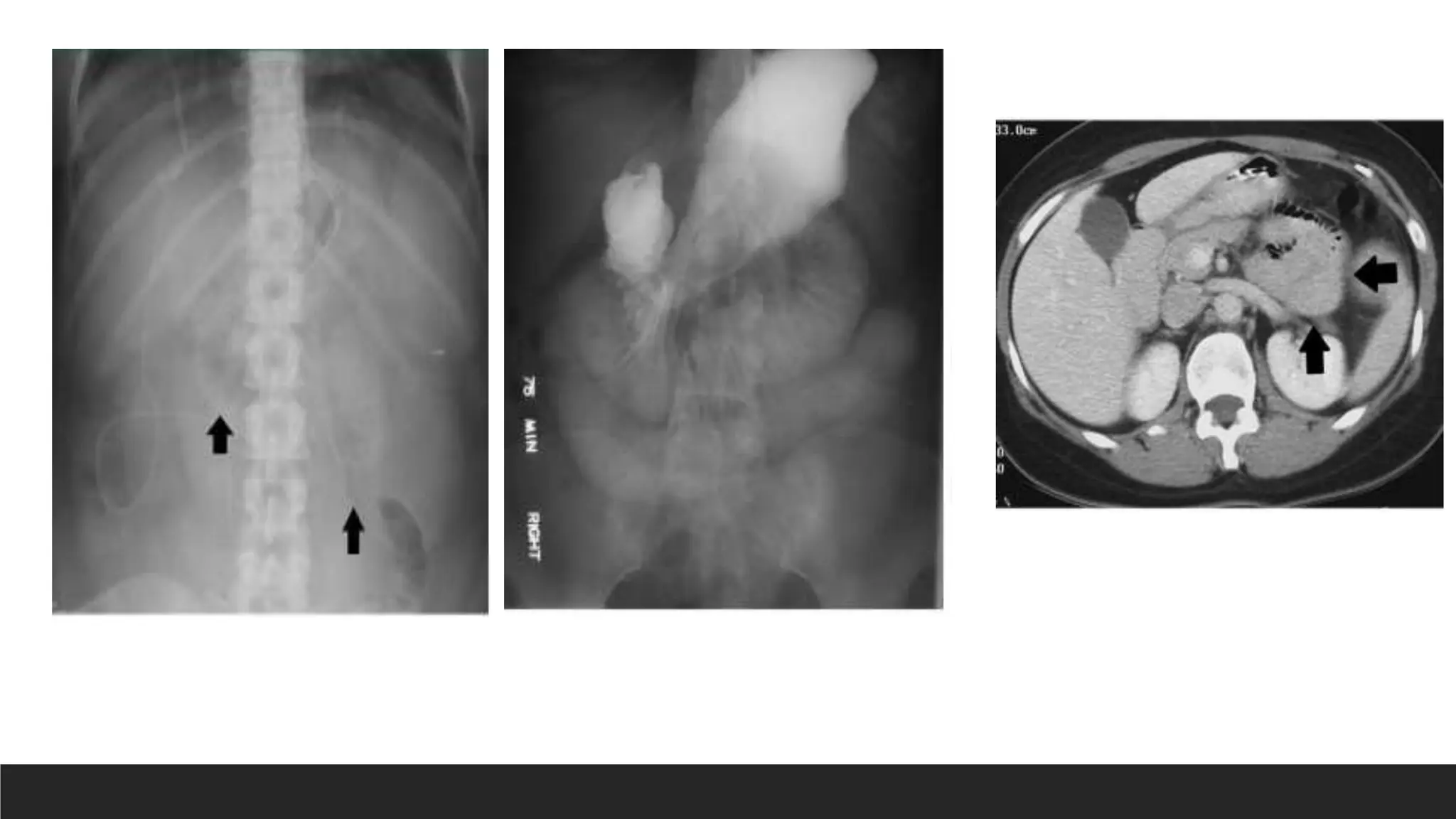
7. Pseudotumor sign
Upright or left lateral decubitus
1. Multiple air fluid levels
2. Air fluid levels longer than 2.5 cm
3. Air fluid levels in same loop of small bowel
of unequal heights
4. String of beads sign
supine upright
String of
pearls sign
enteroclysis
Sonography
Peristalsis of the dilated segment is increased, as
shown by the to-and-fro or whirling motion of the
bowel contents
Level of the obstruction is determined by means of
the location of the bowel loops and the pattern of
the valvulae conniventes.
Cause of the SBO may be determined by examining
the area of transition from the dilated to normal
bowel
The severity of the obstruction can also be assessed.
The presence of free fluid between dilated small
bowel loops, aperistalsis, and wall thickening (>3
mm) in a fluid-filled distended bowel segment
suggests bowel ischaemia/perforation.
USG
Findings at
Multidetector
CT
CT criteria for SBO are the presence of dilated small
bowel loops (diameter >2.5 cm from outer wall to
outer wall) proximally to normal-caliber or collapsed
loops distally
Severity of obstruction
• A low-grade partial SBO is considered present when there is
sufficient flow of contrast material through the point of
obstruction
•High-grade partial SBO is diagnosed when there is some
stasis and delay in the passage of the contrast medium.
•Can be also determined by the degree of distal collapse,
proximal bowel dilatation, and the presence of the “small bowel
feces” sign.
•In a high-grade obstruction, there is a 50% difference in caliber
between the proximal dilated bowel and the distal collapsed
bowel.
Small bowel
feces sign
Transition
Point
This approach should begin in a retrograde fashion by
starting at the rectum and proceeding proximally toward
the cecum, ileum, and jejunum. If the transition point is
located proximally (jejunum or duodenum), the position
should be confirmed by using an antegrade approach,
starting at the stomach.
The transition point is determined by identifying a
caliber change between the dilated proximal and collapsed
distal small bowel loops .
Cause of the Obstruction
A rule of thumb never to forget is that the answer is almost always in the transition point.
 Most intrinsic bowel lesions are seen at the transition point and manifest as localized mural
thickening.
 Most extrinsic causes are seen adjacent to the transition point and usually have associated
extraintestinal manifestations.
Most intraluminal causes manifest as endoluminal “foreign objects” with imaging characteristics
different from those of the remaining enteric content.
Intrinsic Causes of SBO
Crohn Disease
SBO in Crohn disease can be a manifestation of three clinical situations.
It can result from the acute presentation of the disease characterized by bowel luminal
narrowing secondary to the transmural acute inflammatory process.
 It can be a manifestation of long-standing disease, which usually results in cicatricial stenosis
of affected segments.
Finally, it can be secondary to adhesions, incisional hernias, exacerbation of the inflammatory
condition, or postoperative strictures in patients who have undergone previous intestinal surgery
Neoplasia
Small bowel involvement by metastatic cancer is more common than involvement by primary
neoplasms
Intrinsic small bowel neoplasms constitute less than 2% of gastrointestinal malignancies.
When a small bowel adenocarcinoma manifests as SBO, it is usually at an advanced state and
shows pronounced, asymmetric, and irregular mural thickening at the transition point.
Metastasis more frequent in the form of peritoneal carcinomatosis, which is suggested when
extrinsic serosal disease involving the small bowel wall is seen in association with a transition
point.
Intussusception
Accounting for less than 5% of SBO.
Only lead-point intussusceptions secondary to neoplasms, adhesions, or foreign
bodies are associated with SBO. Transient intussusceptions are not associated with
this condition.
At CT, the presence of a bowel-within-bowel configuration with or without
mesenteric fat and mesenteric vessels is pathognomonic for int.ussusception,
A leading mass as the cause of the intussusception can be identified.
Radiation Enteritis
Radiation enteritis causes obstruction in the late phase 1 year after radiation therapy,
usually to the pelvis.
SBO primarily by producing adhesive and fibrotic changes in the mesentery.
changes produced within the bowel include luminal narrowing and dysmotility
induced by radiation serositis.
CT shows narrowing of the lumen secondary to mural thickening, an angular bowel
wall due to adhesions, and retraction of the mesentery .
Hematomas
Intramural small bowel hematoma may occur secondary to anticoagulant therapy,
iatrogenic intervention, or trauma. usually due to luminal narrowing..
nonenhanced CT should be performed, as it will show a spontaneously
hyperattenuating clot
Vascular Causes
Occlusion or stenosis of the mesenteric arterial or venous vascular supply to the
bowel usually produces bowel ischemia, which subsequently causes wall thickening,
resulting in SBO.
CT shows thrombosis or occlusion of the mesenteric vessels and also thickening of
the bowel wall in the affected loops with noncircumferential or asymmetric wall
enhancement.
In advanced cases, a bowel infarct may be present, which manifests at CT as
pneumatosis and air in the portal venous system
Extrinsic Causes of SBO
Adhesions
main cause of SBO, ranging from 50%–80% of all cases.
Mainly post-operative, but can also occur secondary to peritonitis.
Diagnosis: abrupt change in the caliber of the bowel is seen without any
associated mass lesion, significant inflammation, or bowel wall thickening at the
transition point.
Combined with history of abdominal surgery and associated kinking and tethering
of the adjacent nonobstructed bowel usually suggests the diagnosis.
Hernias
second most common cause of SBO, responsible for 10% of cases.
s. They are broadly classified as external or internal.
 An external hernia results from a defect in the abdominal and pelvic wall at sites
of congenital weakness or previous surgery .
The less common internal hernia occurs when there is protrusion of the viscera
through the peritoneum or mesentery and into a compartment within the abdominal
cavity.
Endometriosis
Endometrial implants are typically located on the antimesenteric edge of the bowel,
and their appearance is variable.
The typical appearance of intestinal endometriosis is a solid nodule with positive
enhancement contiguous with or penetrating the thickened bowel wall.
When the endometriotic lesion infiltrates the submucosa, it typically appears as a
hypoattenuating layer between the muscularis and the mucosa
Intraluminal Causes of SBO
Gallstone Ileus
Gallstone ileus is a rare complication of recurrent cholecystitis, caused by migration of a large
gallstone through a biliary intestinal fistula with subsequent impaction in the small bowel.
 CT findings are pathognomonic, corresponding to the radiographic triad of pneumobilia, ectopic
gallstone, and SBO
Distal Intestinal Obstruction Syndrome.
occurs in older children and adults with cystic fibrosis.
The obstruction is secondary to impaction of thick stool, which is probably related to
inadequately controlled intestinal absorption secondary to pancreatic insufficiency.
At CT, the findings consist of SBO with feculent filling defects in the small bowel.
SBO Simple or Complicated
SBO can be divided into two types: simple obstructions and closed-loop obstructions.
Simple obstruction of the bowel is considered when the bowel is occluded at one or several
points along its course
Closed-loop obstructions are diagnosed when a bowel loop of variable length is occluded at two
adjacent points along its course.
closed-loop obstruction
CT: Axial scans reveal a characteristic fixed radial distribution of several dilated, usually fluid-filled
bowel loops with stretched and prominent mesenteric vessels converging toward the point of
torsion.
The configuration can be U-shaped or C-shaped, depending on the orientation of the closed loop.
 narrow pedicle can be formed, leading to torsion of the loops and producing a small bowel
volvulus.
At CT, a “beak sign” is seen at the site of the torsion as a fusiform tapering, and occasionally a
“whirl sign” can be seen, reflecting rotation of the bowel loops around the fixed point of
obstruction
Strangulation
Defined as a closed-loop obstruction associated with intestinal ischemia.
Specific finding: lack of wall enhancement. asymmetric enhancement or even delayed
enhancement may also be found. Localized fluid and hemorrhage in the mesentery can also be
seen.
Non specific: thickening and increased attenuation of the affected bowel wall, a halo or “target
sign,” pneumatosis intestinalis, and gas in the portal vein.
Large bowel obstruction
LBO is four to five times less frequent than SBO
emergency surgery or colonoscopy is usually required to relieve the obstruction
Colonic obstruction is most often seen in elderly individuals
Large bowel
obstruction-
CAUSES
• colorectal carcinoma (most common, 50-60%)
• pelvic tumours; direct spread or metastatic disease
Malignancy
Colonic diverticulitis
• caecal volvulus (1-3%)
• sigmoid volvulus (3-8%)
Volvulus
Ischaemic stricture
Faecal impaction (most common cause in
debilitated elderly)
Clinical presentation
The signs and symptoms of LBO are often insidious in contrast to the abrupt onset of symptoms
seen in most SBOs;
Presentation is typically with abdominal pain, distension and failure of passage of flatus and stool
 Eventually signs of peritonism, sepsis and shock develop, when perforation occurs.
LBO caused by obstruction in the left colon manifests earlier than that caused by obstruction in
the right colon
◦ because the lumen of the sigmoid and descending colon is smaller
◦ and the stool is more inspissated in the distal colon
Radiography
Normal colonic caliber ranges from 3 to 8 cm, with the largest diameter in the cecum;
colon is dilated when it is greater than 6 cm and the cecum when larger than 9 cm in
diameter.
Air-fluid levels are suggest that the cause is more acute - colonic fluid has not been present
long enough to be absorbed
In advanced cases one may see the stigmata of an ischemic colon
small bowel dilatation, depends on
◦ duration of obstruction
◦ Incompetence of IC valve
CT
CT is the imaging modality of choice for the diagnosis of the cause of LBO
CT can be used to diagnose intraluminal,mural, and extramural causes of LBO
detection of inflammation and bowel ischemia
Colorectal carcinoma
Common sites-sigmoid colon and splenic flexure.
The most common site of perforation[3%–8%] in LBO is not at the site of the tumor but
at the cecum
Barium enema
seen as filling defects
appear as exophytic or sessile masses
may be circumferential -apple core sign
CT
Asymmetric and short-segment colonic wall thickening
or an enhancing soft-tissue mass centered in the colon that narrows the colonic lumen
Pericolonic lymph nodes
Acute colonic volvulus
If the twist is greater than 360°, the volvulus is unlikely to
resolve without intervention.
Sigmoid volvulus is three to four times more common than
cecal volvulus
volvulus of the transverse colon and splenic flexure is very
rare
Sigmoid volvulus
Frimann dahl's sign
“northern exposure” sign
Caecal volvulus
Diverticulitis
A complication of diverticulosis with elderly patients being most at risk
Can present with LBO due to bowel wall edema and pericolonic inflammation
Obstruction occurs in the setting of multiple episodes of diverticulitis, which
causes narrowing and stricture formation
Imaging features
CT is the modality of choice for the diagnosis and staging of diverticulitis.
 Appearances include: pericolic stranding, often disproportionately prominent
compared to the amount of bowel wall thickening
segmental thickening of the bowel wall with hyperemia, which is typically longer
segment (>10 cm) than malignant lesions
enhancement of the colonic wall
◦ usually has inner and outer high-attenuation layers, with a thick middle layer of
low attenuation
diverticular perforation
◦ extravasation of air and fluid into the pelvis and peritoneal cavity
abscess formation (seen in up to 30% of cases)
◦ may contain fluid, gas or both
fistula formation
◦ gas in the bladder
◦ direct visualisation of fistulous tract
Colocolonic intussusception.
LBO due to hernia
LBO due to Crohn colitis
Adynamic obstruction
Paralytic ileus
- absence of neural activity
Pseudo obstruction
- imbalance of neural activity
-sympathetic overactivity
-parasympathetic suppression
Paralytic ileus
Causes
-post operative
-abdominal sepsis
-metabolic;uremia and hypokalemia
-CVA/spinal injury
characterized by diffuse small- and large bowel dilatation without a transition
point
Acute colonic pseudo obstruction (ACPO /Ogilvie
syndrome)
secondary to interruption of sympathetic innervation of the colon
ACPO is most common in male patients over 60 years of age, and most are already
hospitalized with a severe illness
Is a disorder of bowel which symptomatically, clinically and radiologically may mimic
intestinal obstruction.
Pseudo-obstruction can present with a sudden painless enlargement of
the proximal colon accompanied by distension.
Bowel sounds are normal or high-pitched, but should not be absent.
Despite the absence of mechanical obstruction, patients can nonetheless
go on to bowel necrosis and perforation (especially if dilatation is severe)
which in turn can go on to become generalized peritonitis.
It may be acute and self-limiting and associated with inflammatory, infectious,
traumatic, metabolic conditions or certain drugs
A large proportion of patients - idiopathic intestinal pseudo-obstruction
Large quantity of bowel gas is usually present and there may be gastric, small-
or large-bowel distension with associated fluid levels just as great as in true
obstruction.
Imaging can be performed to exclude true organic obstruction - without
evidence of an abrupt transition point or mechanically obstructing
lesion.
It is important to note, however, that a gradual transition point is
frequently present, usually at or near the splenic flexure
Summary
REFERENCES
Review of Small-Bowel Obstruction: The Diagnosis and When to
Worry-338 radiology.rsna.org, Radiology: Volume 275: Number 2—May
2015
Small bowel obstruction:what to look for-
pubs.rsna.org/doi/full/10.1148/rg.292085514
Large-Bowel Obstruction in the Adult:Classic Radiographic and CT
Findings, Etiology, and Mimics-RSNA,Radiology: Volume 275:
Number3—june 2015
Textbook of gastrointestinal radiology – by GORE and LEVINE

Approach to intestinal obstructions.pptx

  • 1.
    Approach to intestinal obstruction MODERATOR: DRUMAMAHESHWARI MAM PRESENTER : DR VASANTH KUMAR L
  • 2.
    INTESTINAL OBSTRUCTION A mechanical orfunctional obstruction of the intestines, preventing the normal transit of the products of digestion.
  • 3.
    Clinical feature pain: colicky innature & usually the first symptom. abdominal distention: more obvious in low intestinal obstruction &large bowel obstruction but less in high intestinal obstruction. absolute constipation-failure to pass feces & flatus. vomiting: early in high obstruction but late or even absent in low obstruction. O/E: -dehydrated if large amount of vomiting had occurred. -tachycardia. -raise in temperature suggest strangulation.
  • 4.
    Small bowel obstruction Aim ofimaging is to find:  Is the small bowel obstructed?  How severe is the obstruction?  where is it located?  what is its cause?  strangulation present?
  • 6.
    Abdominal radiograph Supine orprone 1. Dilated gas or fluid-filled small bowel (>3 cm) 2. Dilated stomach 3. Small bowel dilated out of proportion to colon 4. Stretch sign 5. Absence of rectal gas 6. Gasless abdomen 7. Pseudotumor sign Upright or left lateral decubitus 1. Multiple air fluid levels 2. Air fluid levels longer than 2.5 cm 3. Air fluid levels in same loop of small bowel of unequal heights 4. String of beads sign
  • 7.
  • 10.
  • 11.
  • 12.
    Sonography Peristalsis of thedilated segment is increased, as shown by the to-and-fro or whirling motion of the bowel contents Level of the obstruction is determined by means of the location of the bowel loops and the pattern of the valvulae conniventes. Cause of the SBO may be determined by examining the area of transition from the dilated to normal bowel The severity of the obstruction can also be assessed. The presence of free fluid between dilated small bowel loops, aperistalsis, and wall thickening (>3 mm) in a fluid-filled distended bowel segment suggests bowel ischaemia/perforation.
  • 13.
  • 14.
    Findings at Multidetector CT CT criteriafor SBO are the presence of dilated small bowel loops (diameter >2.5 cm from outer wall to outer wall) proximally to normal-caliber or collapsed loops distally
  • 15.
    Severity of obstruction •A low-grade partial SBO is considered present when there is sufficient flow of contrast material through the point of obstruction •High-grade partial SBO is diagnosed when there is some stasis and delay in the passage of the contrast medium. •Can be also determined by the degree of distal collapse, proximal bowel dilatation, and the presence of the “small bowel feces” sign. •In a high-grade obstruction, there is a 50% difference in caliber between the proximal dilated bowel and the distal collapsed bowel.
  • 17.
  • 18.
    Transition Point This approach shouldbegin in a retrograde fashion by starting at the rectum and proceeding proximally toward the cecum, ileum, and jejunum. If the transition point is located proximally (jejunum or duodenum), the position should be confirmed by using an antegrade approach, starting at the stomach. The transition point is determined by identifying a caliber change between the dilated proximal and collapsed distal small bowel loops .
  • 19.
    Cause of theObstruction A rule of thumb never to forget is that the answer is almost always in the transition point.  Most intrinsic bowel lesions are seen at the transition point and manifest as localized mural thickening.  Most extrinsic causes are seen adjacent to the transition point and usually have associated extraintestinal manifestations. Most intraluminal causes manifest as endoluminal “foreign objects” with imaging characteristics different from those of the remaining enteric content.
  • 21.
  • 22.
    Crohn Disease SBO inCrohn disease can be a manifestation of three clinical situations. It can result from the acute presentation of the disease characterized by bowel luminal narrowing secondary to the transmural acute inflammatory process.  It can be a manifestation of long-standing disease, which usually results in cicatricial stenosis of affected segments. Finally, it can be secondary to adhesions, incisional hernias, exacerbation of the inflammatory condition, or postoperative strictures in patients who have undergone previous intestinal surgery
  • 24.
    Neoplasia Small bowel involvementby metastatic cancer is more common than involvement by primary neoplasms Intrinsic small bowel neoplasms constitute less than 2% of gastrointestinal malignancies. When a small bowel adenocarcinoma manifests as SBO, it is usually at an advanced state and shows pronounced, asymmetric, and irregular mural thickening at the transition point. Metastasis more frequent in the form of peritoneal carcinomatosis, which is suggested when extrinsic serosal disease involving the small bowel wall is seen in association with a transition point.
  • 26.
    Intussusception Accounting for lessthan 5% of SBO. Only lead-point intussusceptions secondary to neoplasms, adhesions, or foreign bodies are associated with SBO. Transient intussusceptions are not associated with this condition. At CT, the presence of a bowel-within-bowel configuration with or without mesenteric fat and mesenteric vessels is pathognomonic for int.ussusception, A leading mass as the cause of the intussusception can be identified.
  • 28.
    Radiation Enteritis Radiation enteritiscauses obstruction in the late phase 1 year after radiation therapy, usually to the pelvis. SBO primarily by producing adhesive and fibrotic changes in the mesentery. changes produced within the bowel include luminal narrowing and dysmotility induced by radiation serositis. CT shows narrowing of the lumen secondary to mural thickening, an angular bowel wall due to adhesions, and retraction of the mesentery .
  • 30.
    Hematomas Intramural small bowelhematoma may occur secondary to anticoagulant therapy, iatrogenic intervention, or trauma. usually due to luminal narrowing.. nonenhanced CT should be performed, as it will show a spontaneously hyperattenuating clot
  • 32.
    Vascular Causes Occlusion orstenosis of the mesenteric arterial or venous vascular supply to the bowel usually produces bowel ischemia, which subsequently causes wall thickening, resulting in SBO. CT shows thrombosis or occlusion of the mesenteric vessels and also thickening of the bowel wall in the affected loops with noncircumferential or asymmetric wall enhancement. In advanced cases, a bowel infarct may be present, which manifests at CT as pneumatosis and air in the portal venous system
  • 35.
  • 36.
    Adhesions main cause ofSBO, ranging from 50%–80% of all cases. Mainly post-operative, but can also occur secondary to peritonitis. Diagnosis: abrupt change in the caliber of the bowel is seen without any associated mass lesion, significant inflammation, or bowel wall thickening at the transition point. Combined with history of abdominal surgery and associated kinking and tethering of the adjacent nonobstructed bowel usually suggests the diagnosis.
  • 38.
    Hernias second most commoncause of SBO, responsible for 10% of cases. s. They are broadly classified as external or internal.  An external hernia results from a defect in the abdominal and pelvic wall at sites of congenital weakness or previous surgery . The less common internal hernia occurs when there is protrusion of the viscera through the peritoneum or mesentery and into a compartment within the abdominal cavity.
  • 40.
    Endometriosis Endometrial implants aretypically located on the antimesenteric edge of the bowel, and their appearance is variable. The typical appearance of intestinal endometriosis is a solid nodule with positive enhancement contiguous with or penetrating the thickened bowel wall. When the endometriotic lesion infiltrates the submucosa, it typically appears as a hypoattenuating layer between the muscularis and the mucosa
  • 42.
  • 43.
    Gallstone Ileus Gallstone ileusis a rare complication of recurrent cholecystitis, caused by migration of a large gallstone through a biliary intestinal fistula with subsequent impaction in the small bowel.  CT findings are pathognomonic, corresponding to the radiographic triad of pneumobilia, ectopic gallstone, and SBO
  • 45.
    Distal Intestinal ObstructionSyndrome. occurs in older children and adults with cystic fibrosis. The obstruction is secondary to impaction of thick stool, which is probably related to inadequately controlled intestinal absorption secondary to pancreatic insufficiency. At CT, the findings consist of SBO with feculent filling defects in the small bowel.
  • 47.
    SBO Simple orComplicated SBO can be divided into two types: simple obstructions and closed-loop obstructions. Simple obstruction of the bowel is considered when the bowel is occluded at one or several points along its course Closed-loop obstructions are diagnosed when a bowel loop of variable length is occluded at two adjacent points along its course.
  • 48.
    closed-loop obstruction CT: Axialscans reveal a characteristic fixed radial distribution of several dilated, usually fluid-filled bowel loops with stretched and prominent mesenteric vessels converging toward the point of torsion. The configuration can be U-shaped or C-shaped, depending on the orientation of the closed loop.  narrow pedicle can be formed, leading to torsion of the loops and producing a small bowel volvulus. At CT, a “beak sign” is seen at the site of the torsion as a fusiform tapering, and occasionally a “whirl sign” can be seen, reflecting rotation of the bowel loops around the fixed point of obstruction
  • 50.
    Strangulation Defined as aclosed-loop obstruction associated with intestinal ischemia. Specific finding: lack of wall enhancement. asymmetric enhancement or even delayed enhancement may also be found. Localized fluid and hemorrhage in the mesentery can also be seen. Non specific: thickening and increased attenuation of the affected bowel wall, a halo or “target sign,” pneumatosis intestinalis, and gas in the portal vein.
  • 52.
    Large bowel obstruction LBOis four to five times less frequent than SBO emergency surgery or colonoscopy is usually required to relieve the obstruction Colonic obstruction is most often seen in elderly individuals
  • 53.
    Large bowel obstruction- CAUSES • colorectalcarcinoma (most common, 50-60%) • pelvic tumours; direct spread or metastatic disease Malignancy Colonic diverticulitis • caecal volvulus (1-3%) • sigmoid volvulus (3-8%) Volvulus Ischaemic stricture Faecal impaction (most common cause in debilitated elderly)
  • 54.
    Clinical presentation The signsand symptoms of LBO are often insidious in contrast to the abrupt onset of symptoms seen in most SBOs; Presentation is typically with abdominal pain, distension and failure of passage of flatus and stool  Eventually signs of peritonism, sepsis and shock develop, when perforation occurs. LBO caused by obstruction in the left colon manifests earlier than that caused by obstruction in the right colon ◦ because the lumen of the sigmoid and descending colon is smaller ◦ and the stool is more inspissated in the distal colon
  • 55.
    Radiography Normal colonic caliberranges from 3 to 8 cm, with the largest diameter in the cecum; colon is dilated when it is greater than 6 cm and the cecum when larger than 9 cm in diameter. Air-fluid levels are suggest that the cause is more acute - colonic fluid has not been present long enough to be absorbed In advanced cases one may see the stigmata of an ischemic colon small bowel dilatation, depends on ◦ duration of obstruction ◦ Incompetence of IC valve
  • 57.
    CT CT is theimaging modality of choice for the diagnosis of the cause of LBO CT can be used to diagnose intraluminal,mural, and extramural causes of LBO detection of inflammation and bowel ischemia
  • 58.
    Colorectal carcinoma Common sites-sigmoidcolon and splenic flexure. The most common site of perforation[3%–8%] in LBO is not at the site of the tumor but at the cecum Barium enema seen as filling defects appear as exophytic or sessile masses may be circumferential -apple core sign CT Asymmetric and short-segment colonic wall thickening or an enhancing soft-tissue mass centered in the colon that narrows the colonic lumen Pericolonic lymph nodes
  • 60.
    Acute colonic volvulus Ifthe twist is greater than 360°, the volvulus is unlikely to resolve without intervention. Sigmoid volvulus is three to four times more common than cecal volvulus volvulus of the transverse colon and splenic flexure is very rare
  • 61.
  • 63.
  • 65.
  • 66.
    Diverticulitis A complication ofdiverticulosis with elderly patients being most at risk Can present with LBO due to bowel wall edema and pericolonic inflammation Obstruction occurs in the setting of multiple episodes of diverticulitis, which causes narrowing and stricture formation
  • 67.
    Imaging features CT isthe modality of choice for the diagnosis and staging of diverticulitis.  Appearances include: pericolic stranding, often disproportionately prominent compared to the amount of bowel wall thickening segmental thickening of the bowel wall with hyperemia, which is typically longer segment (>10 cm) than malignant lesions enhancement of the colonic wall ◦ usually has inner and outer high-attenuation layers, with a thick middle layer of low attenuation
  • 68.
    diverticular perforation ◦ extravasationof air and fluid into the pelvis and peritoneal cavity abscess formation (seen in up to 30% of cases) ◦ may contain fluid, gas or both fistula formation ◦ gas in the bladder ◦ direct visualisation of fistulous tract
  • 70.
  • 71.
    LBO due tohernia
  • 72.
    LBO due toCrohn colitis
  • 73.
    Adynamic obstruction Paralytic ileus -absence of neural activity Pseudo obstruction - imbalance of neural activity -sympathetic overactivity -parasympathetic suppression
  • 74.
    Paralytic ileus Causes -post operative -abdominalsepsis -metabolic;uremia and hypokalemia -CVA/spinal injury characterized by diffuse small- and large bowel dilatation without a transition point
  • 76.
    Acute colonic pseudoobstruction (ACPO /Ogilvie syndrome) secondary to interruption of sympathetic innervation of the colon ACPO is most common in male patients over 60 years of age, and most are already hospitalized with a severe illness Is a disorder of bowel which symptomatically, clinically and radiologically may mimic intestinal obstruction.
  • 77.
    Pseudo-obstruction can presentwith a sudden painless enlargement of the proximal colon accompanied by distension. Bowel sounds are normal or high-pitched, but should not be absent. Despite the absence of mechanical obstruction, patients can nonetheless go on to bowel necrosis and perforation (especially if dilatation is severe) which in turn can go on to become generalized peritonitis.
  • 78.
    It may beacute and self-limiting and associated with inflammatory, infectious, traumatic, metabolic conditions or certain drugs A large proportion of patients - idiopathic intestinal pseudo-obstruction Large quantity of bowel gas is usually present and there may be gastric, small- or large-bowel distension with associated fluid levels just as great as in true obstruction. Imaging can be performed to exclude true organic obstruction - without evidence of an abrupt transition point or mechanically obstructing lesion. It is important to note, however, that a gradual transition point is frequently present, usually at or near the splenic flexure
  • 79.
  • 80.
    REFERENCES Review of Small-BowelObstruction: The Diagnosis and When to Worry-338 radiology.rsna.org, Radiology: Volume 275: Number 2—May 2015 Small bowel obstruction:what to look for- pubs.rsna.org/doi/full/10.1148/rg.292085514 Large-Bowel Obstruction in the Adult:Classic Radiographic and CT Findings, Etiology, and Mimics-RSNA,Radiology: Volume 275: Number3—june 2015 Textbook of gastrointestinal radiology – by GORE and LEVINE

Editor's Notes

  • #8 Images in a 50-year-old man with abdominal pain, nausea, and vomiting. (a) Supine abdominal radiograph shows dilated small-bowel loops out of proportion to gas in the colon. (b) Upright abdominal radiograph shows multiple air fluid levels (large and small arrows), fluid levels greater than 2.5 cm (large arrows), and fluid levels of unequal heights in the same dilated loop of small bowel (horizontal black lines).
  • #9 Images in a 60-year-old man with abdominal pain. (a) Supine abdominal radiograph demonstrates soft-tissue mass midabdomen (arrows). (b) Supine radiograph from upper gastrointestinal series demonstrates the soft-tissue mass is actually due to fluid-filled dilated small bowel secondary to SBO. (c) Intravenous contrast-enhanced axial CT scan through midabdomen demonstrates fluid-filled loops of small bowel (arrows) responsible for the pseudotumor sign.
  • #10 Small bowel gas arranged in low attenuation stripes perpendicular to the long axils of bowel,ssmall amount of gas separated by vovulae culuventis in a fluid filled bowel
  • #11 caused by slow resorption of intraluminal air leaving small bubbles trapped between the folds of the valvulae conniventes
  • #12 —Enteroclysis. 54-year-old woman with adhesional small-bowel obstruction. Spot film from enteroclysis shows small-bowel loop narrowing (arrow) due to postoperative adhesion.
  • #14 Sonogram of the ileum shows a dilated fluid-filled bowel loop with a caliber of more than 3 cm (dotted line). The absence of valvulae conniventes allows the obstruction to be localized to the ileum. There is a thickened bowel wall with a stratified echo pattern
  • #16 , so that diluted oral contrast material appears in the distended proximal bowel and minimal contrast material appears in the collapsed distal loops
  • #17 Axial CT scan shows a disparity in caliber between distended proximal small bowel loops (diameter >3 cm) (dotted line) and collapsed distal small bowel loops (arrows). Simple complete SBO secondary to intussusception. Axial CT scan shows distended small bowel loops with intraluminal positive contrast material (arrows) proximal to an intussusception with a targetlike appearance (*). Completely collapsed bowel loops without intraluminal contrast material (arrowhead) are seen beyond the intussusception. Low-grade partial SBO. Axial CT scan shows distended jejunal loops (arrows) proximal to an intussusception (*) filled with intraluminal positive oral contrast material. There is sufficient flow of contrast material through the intussusception to fill distal small bowel loops (arrowheads).
  • #18 Small bowel feces sign in a patient with high-grade SBO secondary to postoperative adhesions. Axial CT scan shows gas bubbles mixed with particulate matter (*), a finding that represents the small bowel feces sign. Note the collapsed bowel loops (arrow) distal to the obstruction point.
  • #24 SBO secondary to the acute presentation of Crohn disease. Axial CT scan shows a dilated small bowel loop with a diameter of more than 2.5 cm (S) proximal to the thickened terminal ileum (arrow). Circle = transition point. SBO due to the stenotic phase of Crohn disease. (a) Axial CT scan shows fluid-filled dilated small bowel loops with intraluminal positive contrast material of different dilutions (*). At the terminal ileum, a transition point with a thickened bowel wall and mural stratification (arrowheads) and perienteric hypervascularity are identified. (b) Photograph of the gross specimen shows the narrowed lumen of the involved segment (arrowheads) and a dilated bowel loop proximally (*); this bowel loop corresponds to one of the bowel loops seen on the CT image (* in a).
  • #26 SBO secondary to adenocarcinoma. Axial CT scan shows asymmetric and irregular mural thickening of an ileal loop (arrow), which causes dilatation of the proximal small bowel. SBO secondary to adenocarcinoma of the cecum with ileocecal valve involvement. (a) Axial CT scan shows dilatation of small bowel loops (S) and the cecum (*) proximal to a stenotic cancer of the cecum (arrow) that involves the terminal ileum. (b) Photograph of the gross specimen shows involvement of the ileocecal valve (arrow) by the neoplasm (dotted line)
  • #28 SBO caused by intussusception and an adhesive band. (a, b) Axial CT scans show the intussusceptum (arrow in a) invaginating into the intussuscipiens (* in a) secondary to a submucosal tumor (T in b). The intussuscipiens is dilated because of an adhesion (arrowhead in b). (c) Photograph of the gross specimen shows the submucosal tumor as a large polypoid mass (arrow).
  • #30 SBO secondary to radiation enteropathy. Axial CT scans show markedly distended small bowel loops (S in a) secondary to narrowing of the lumen from mural thickening and fibrous strictures (arrows).
  • #32 SBO secondary to a spontaneous bowel hematoma in an overcoagulated patient. Axial nonenhanced CT scan shows circumferential hyperattenuating mural thickening of the ileum with luminal narrowing (arrows), which causes proximal small bowel distention
  • #34 SBO secondary to thrombosis of the superior mesenteric vein. (a) Coronal CT scan shows thrombosis of the superior mesenteric vein (arrow) in association with circumferential wall thickening of ileal loops (*) due to submucosal edema. S = dilated small bowel loop. (b) Photograph of the gross specimen shows an infarcted small bowel loop that has hemorrhagic mucosa with thickened valvulae. (18) SBO due to intestinal ischemia secondary to arterial occlusion. Coronal maximum intensity projection (a) and axial (b) CT scans show an endoluminal defect of the superior mesenteric artery (arrow) due to thrombosis. S in b = proximal dilated small bowel loops.
  • #35 Ischemic small bowel secondary to superior mesenteric artery thrombosis. Axial CT scans show thrombosis of the superior mesenteric artery (arrowhead in a) and pneumatosis intestinalis with air in the vasa recta of the mesentery (arrows in b).
  • #37 Diadnosis of exclusion because adhesive bands are not seen at conventional CT.
  • #38 SBO secondary to adhesions after abdominal surgery. Axial CT scan shows an abrupt change in bowel caliber at the transition zone (arrow). Otherwise, the involved bowel wall and lumen and the adjacent organs have a normal appearance, which allows exclusion of other possible causes
  • #40 SBO secondary to an inguinal hernia. Axial CT scan shows small bowel dilatation (S) due to an incarcerated inguinal hernia (H). The transition point (arrow) is lateral to the inferior epigastric artery (arrowhead).
  • #42 MIP) of a coronal contrast-enhanced CT image showing the presence of two enhanced peritoneal nodules (*) and dilatation of the small bowel.  SBO secondary to intestinal endometriosis. (a) Coronal CT scan shows distended fluid-filled small bowel loops (S). The transition point appears as circumferential mural thickening with a hypoattenuating outer layer (arrow). (b) Photograph of the gross specimen shows the stricture due to fibrosis secondary to endometriotic implants
  • #45 Gallstone ileus. (a) Axial CT scan shows pneumobilia (arrow) and the gallbladder (gb) adjacent to the gastric antrum. (b) CT scan shows an impacted gallstone (*) in the distal jejunum with proximal bowel dilatation (S).
  • #47 SBO in a patient with distal intestinal obstruction syndrome. Axial CT scan shows markedly dilated small bowel loops with feculent contents (S).
  • #50 Closed-loop SBOs secondary to postoperative adhesions. (a) Axial CT scan shows a radial distribution of small bowel loops with a U-shaped configuration (dotted line) and stretched mesenteric vessels converging toward the site of torsion. (b) Oblique coronal CT scan shows incarcerated small bowel with a Cshaped configuration (dotted line).
  • #52 Strangulated SBO due to adhesions. (a) Axial CT scan shows gas in the intrahepatic portal veins (arrow). (b) Axial CT scan shows dilated small bowel loops (S) proximal to infarcted bowel segments, which demonstrate pneumatosis
  • #57 Anteroposterior supine abdominal radiograph in a 67-year-old man with LBO shows dilated ascending, transverse, and descending colon. A transition point is identified in the region of splenic flexure from an obstructing colon carcinoma (arrow) CT scout radiograph in a 51-year-old woman with chronic abdominal pain and cecal ileus shows a distended and medially displaced cecum (arrow). Gas is present throughout the entire colon. CT showed no colonic obstruction.
  • #60 Images in a 76-year-old man with LBO from a descending colon cancer. (a) CT scout image shows air-filled dilated colon terminating in the left upper quadrant (arrow). (b) Midline coronal reformatted CT image of the abdomen and pelvis after administration of intravenous contrast material shows obstructing left colonic adenocarcinoma (white arrow) with adjacent perforation and abscess (black arrow).
  • #64 he Frimann-Dahl sign is a diagnostic sign demonstrated when three dense lines, representing the sigmoid walls, are seen converging to the site of obstruction in sigmoid volvulus and associated with empty rectal gas 1.
  • #65 .(a) CT scout image shows dilated, air-filled colon terminating in markedly dilated sigmoid colon folded upon itself with its apex (the “coffee bean sign”) in the midline upper abdomen (black arrow). The sigmoid also conforms to an “upside down U” configuration. There is no gas in the rectum (white arrow). (b) Midline coronal reformatted CT image of the abdomen and pelvis shows dilated, stool-filled colon proximal to the volvulus (black arrow) with a distal “whirl” of the mesentery at the point of volvulus (white arrow) sigmoid volvulus shows a “beak” sign at the site of torsion (white arrow). Some contrast material is noted to pass above the level of obstruction (black arrow). Residual CT contrast material is seen in the renal collecting systems and bladder (arrowheads).
  • #66 (a) Image shows displaced cecum in the mid abdomen, with its apex located in the left upper quadrant (arrow). The ileocecal valve is displaced toward the left upper quadrant as well (arrowhead). (b) Image after administration of intravenous contrast material demonstrates the “whirl” sign (arrow), confirming the cecal volvulus originating in the right lower quadrant (arrow).
  • #70 (a) CT scout image shows air-filled dilated colon terminating in the left pelvis (arrow) (b) Transverse CT image of the pelvis after the administration of intravenous contrast material shows dilated, stool-filled large bowel extending into the pelvis where the sigmoid colon is thick walled and inflamed (white arrow). There is fluid in the root of the mesentery (black arrow).
  • #71 Images in a 64-year-old man with LBO caused by a colocolonic intussusception. (a) CT scout image shows air-filled dilated colon terminating abruptly in the left upper quadrant (arrow). (b) Coronal reformatted CT image of the abdomen and pelvis shows a transverse colonic intussusception (arrow). The lead point for the obstruction was a tubulo-villous adenoma.
  • #72 Anterior transverse CT image of the abdomen and pelvis in a 67-year-old man with LBO caused by a colon-containing ventral hernia. Image obtained after administration of oral and intravenous contrast material shows dilated, fluid-filled cecum (black arrow) and a portion of colon obstructed in a ventral hernia (white arrow)
  • #73 Images in a 59-year-old man with LBO caused by Crohn colitis involving the distal descending colon. (a) CT scout image demonstrates substantial colonic distension with stool. Arrow marks the site of obstruction. (b) Midline coronal reformatted CT image shows wall thickening and hyperenhancement of the mucosa of the descending colon with a distal stricture from Crohn colitis (arrow).