

Apprenticeship 2016-2020
Overview of the market for the next 4
years
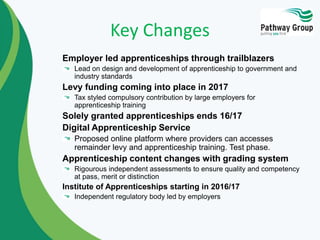
Key Changes
Employer led apprenticeships through trailblazers
Lead on design and development of apprenticeship to government and
industry standards
Levy funding coming into place in 2017
Tax styled compulsory contribution by large employers for
apprenticeship training
Solely granted apprenticeships ends 16/17
Digital Apprenticeship Service
Proposed online platform where providers can accesses
remainder levy and apprenticeship training. Test phase.
Apprenticeship content changes with grading system
Rigourous independent assessments to ensure quality and competency
at pass, merit or distinction
Institute of Apprenticeships starting in 2016/17
Independent regulatory body led by employers
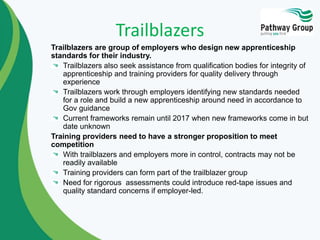
Trailblazers
Trailblazers are group of employers who design new apprenticeship
standards for their industry.
Trailblazers also seek assistance from qualification bodies for integrity of
apprenticeship and training providers for quality delivery through
experience
Trailblazers work through employers identifying new standards needed
for a role and build a new apprenticeship around need in accordance to
Gov guidance
Current frameworks remain until 2017 when new frameworks come in but
date unknown
Training providers need to have a stronger proposition to meet
competition
With trailblazers and employers more in control, contracts may not be
readily available
Training providers can form part of the trailblazer group
Need for rigorous assessments could introduce red-tape issues and
quality standard concerns if employer-led.
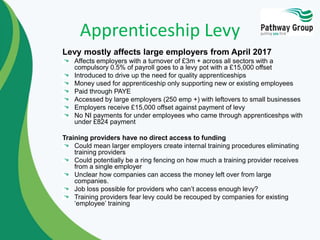
Apprenticeship Levy
Levy mostly affects large employers from April 2017
Affects employers with a turnover of £3m + across all sectors with a
compulsory 0.5% of payroll goes to a levy pot with a £15,000 offset
Introduced to drive up the need for quality apprenticeships
Money used for apprenticeship only supporting new or existing employees
Paid through PAYE
Accessed by large employers (250 emp +) with leftovers to small businesses
Employers receive £15,000 offset against payment of levy
No NI payments for under employees who came through apprenticeshps with
under £824 payment
Training providers have no direct access to funding
Could mean larger employers create internal training procedures eliminating
training providers
Could potentially be a ring fencing on how much a training provider receives
from a single employer
Unclear how companies can access the money left over from large
companies.
Job loss possible for providers who can’t access enough levy?
Training providers fear levy could be recouped by companies for existing
‘employee’ training
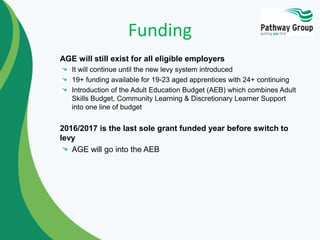
Funding
AGE will still exist for all eligible employers
It will continue until the new levy system introduced
19+ funding available for 19-23 aged apprentices with 24+ continuing
Introduction of the Adult Education Budget (AEB) which combines Adult
Skills Budget, Community Learning & Discretionary Learner Support
into one line of budget
2016/2017 is the last sole grant funded year before switch to
levy
AGE will go into the AEB
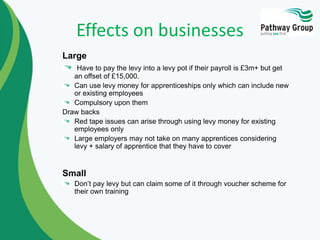
Effects on businesses
Large
Have to pay the levy into a levy pot if their payroll is £3m+ but get
an offset of £15,000.
Can use levy money for apprenticeships only which can include new
or existing employees
Compulsory upon them
Draw backs
Red tape issues can arise through using levy money for existing
employees only
Large employers may not take on many apprentices considering
levy + salary of apprentice that they have to cover
Small
Don’t pay levy but can claim some of it through voucher scheme for
their own training
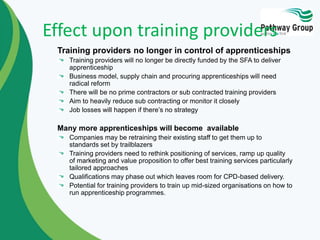
Effect upon training providers
Training providers no longer in control of apprenticeships
Training providers will no longer be directly funded by the SFA to deliver
apprenticeship
Business model, supply chain and procuring apprenticeships will need
radical reform
There will be no prime contractors or sub contracted training providers
Aim to heavily reduce sub contracting or monitor it closely
Job losses will happen if there’s no strategy
Many more apprenticeships will become available
Companies may be retraining their existing staff to get them up to
standards set by trailblazers
Training providers need to rethink positioning of services, ramp up quality
of marketing and value proposition to offer best training services particularly
tailored approaches
Qualifications may phase out which leaves room for CPD-based delivery.
Potential for training providers to train up mid-sized organisations on how to
run apprenticeship programmes.
Expert views on new changes
CBI director Carolyn Fairbarn believes the changes could lead to job losses in
sectors such as retail with reference to their recent annual report stating 5/6
businesses consider reforms costly and beaurocratic.
Learning and Work Institute Chief Executive David Hughes said that the new
funding allocation means employers and will essentially be paying for
apprenticeships through extension of loans
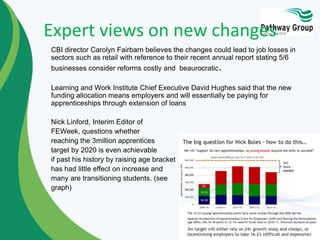
Nick Linford, Interim Editor of
FEWeek, questions whether
reaching the 3million apprentices
target by 2020 is even achievable
if past his history by raising age bracket
has had little effect on increase and
many are transitioning students. (see
graph)
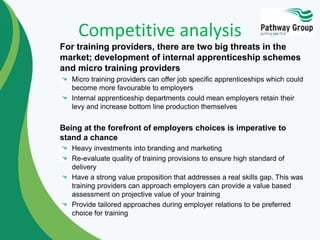
Competitive analysis
For training providers, there are two big threats in the
market; development of internal apprenticeship schemes
and micro training providers
Micro training providers can offer job specific apprenticeships which could
become more favourable to employers
Internal apprenticeship departments could mean employers retain their
levy and increase bottom line production themselves
Being at the forefront of employers choices is imperative to
stand a chance
Heavy investments into branding and marketing
Re-evaluate quality of training provisions to ensure high standard of
delivery
Have a strong value proposition that addresses a real skills gap. This was
training providers can approach employers can provide a value based
assessment on projective value of your training
Provide tailored approaches during employer relations to be preferred
choice for training

Apprenticeship 2016 2020

  • 1.
    Apprenticeship 2016-2020 Overview ofthe market for the next 4 years
  • 2.
    Key Changes Employer ledapprenticeships through trailblazers Lead on design and development of apprenticeship to government and industry standards Levy funding coming into place in 2017 Tax styled compulsory contribution by large employers for apprenticeship training Solely granted apprenticeships ends 16/17 Digital Apprenticeship Service Proposed online platform where providers can accesses remainder levy and apprenticeship training. Test phase. Apprenticeship content changes with grading system Rigourous independent assessments to ensure quality and competency at pass, merit or distinction Institute of Apprenticeships starting in 2016/17 Independent regulatory body led by employers
  • 3.
    Trailblazers Trailblazers are groupof employers who design new apprenticeship standards for their industry. Trailblazers also seek assistance from qualification bodies for integrity of apprenticeship and training providers for quality delivery through experience Trailblazers work through employers identifying new standards needed for a role and build a new apprenticeship around need in accordance to Gov guidance Current frameworks remain until 2017 when new frameworks come in but date unknown Training providers need to have a stronger proposition to meet competition With trailblazers and employers more in control, contracts may not be readily available Training providers can form part of the trailblazer group Need for rigorous assessments could introduce red-tape issues and quality standard concerns if employer-led.
  • 4.
    Apprenticeship Levy Levy mostlyaffects large employers from April 2017 Affects employers with a turnover of £3m + across all sectors with a compulsory 0.5% of payroll goes to a levy pot with a £15,000 offset Introduced to drive up the need for quality apprenticeships Money used for apprenticeship only supporting new or existing employees Paid through PAYE Accessed by large employers (250 emp +) with leftovers to small businesses Employers receive £15,000 offset against payment of levy No NI payments for under employees who came through apprenticeshps with under £824 payment Training providers have no direct access to funding Could mean larger employers create internal training procedures eliminating training providers Could potentially be a ring fencing on how much a training provider receives from a single employer Unclear how companies can access the money left over from large companies. Job loss possible for providers who can’t access enough levy? Training providers fear levy could be recouped by companies for existing ‘employee’ training
  • 5.
    Funding AGE will stillexist for all eligible employers It will continue until the new levy system introduced 19+ funding available for 19-23 aged apprentices with 24+ continuing Introduction of the Adult Education Budget (AEB) which combines Adult Skills Budget, Community Learning & Discretionary Learner Support into one line of budget 2016/2017 is the last sole grant funded year before switch to levy AGE will go into the AEB
  • 6.
    Effects on businesses Large Haveto pay the levy into a levy pot if their payroll is £3m+ but get an offset of £15,000. Can use levy money for apprenticeships only which can include new or existing employees Compulsory upon them Draw backs Red tape issues can arise through using levy money for existing employees only Large employers may not take on many apprentices considering levy + salary of apprentice that they have to cover Small Don’t pay levy but can claim some of it through voucher scheme for their own training
  • 7.
    Effect upon trainingproviders Training providers no longer in control of apprenticeships Training providers will no longer be directly funded by the SFA to deliver apprenticeship Business model, supply chain and procuring apprenticeships will need radical reform There will be no prime contractors or sub contracted training providers Aim to heavily reduce sub contracting or monitor it closely Job losses will happen if there’s no strategy Many more apprenticeships will become available Companies may be retraining their existing staff to get them up to standards set by trailblazers Training providers need to rethink positioning of services, ramp up quality of marketing and value proposition to offer best training services particularly tailored approaches Qualifications may phase out which leaves room for CPD-based delivery. Potential for training providers to train up mid-sized organisations on how to run apprenticeship programmes.
  • 8.
    Expert views onnew changes CBI director Carolyn Fairbarn believes the changes could lead to job losses in sectors such as retail with reference to their recent annual report stating 5/6 businesses consider reforms costly and beaurocratic. Learning and Work Institute Chief Executive David Hughes said that the new funding allocation means employers and will essentially be paying for apprenticeships through extension of loans Nick Linford, Interim Editor of FEWeek, questions whether reaching the 3million apprentices target by 2020 is even achievable if past his history by raising age bracket has had little effect on increase and many are transitioning students. (see graph)
  • 9.
    Competitive analysis For trainingproviders, there are two big threats in the market; development of internal apprenticeship schemes and micro training providers Micro training providers can offer job specific apprenticeships which could become more favourable to employers Internal apprenticeship departments could mean employers retain their levy and increase bottom line production themselves Being at the forefront of employers choices is imperative to stand a chance Heavy investments into branding and marketing Re-evaluate quality of training provisions to ensure high standard of delivery Have a strong value proposition that addresses a real skills gap. This was training providers can approach employers can provide a value based assessment on projective value of your training Provide tailored approaches during employer relations to be preferred choice for training