So, You Want to Go to Grad
School?

    A Stand-Alone Instructional
            Resource
               By
         Andrew Murray
Purpose
   This resource will acquaint you with
    the five main pieces of information that
    most graduate schools use when
    admitting students

   When prompted, choose the option
    that best matches you!
The “Fab Five”
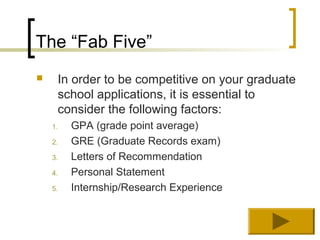
    In order to be competitive on your graduate
     school applications, it is essential to
     consider the following factors:
    1.   GPA (grade point average)
    2.   GRE (Graduate Records exam)
    3.   Letters of Recommendation
    4.   Personal Statement
    5.   Internship/Research Experience
Grade Point Average
   Grades are important, as they are a long term
    indicator of how well you perform as a student
   They reflect your motivation and your ability to do
    consistent and successful academic work
   Admissions committees not only look at your GPA,
    but also at your major GPA as well as your
    cumulative (overall) score
   Many grad schools will expect a 3.0 or better GPA
    for admission, although the specific requirements
    often differ
Grade Point Average


“My GPA is where it   “I think I can make my
   should be to be         GPA better before I
   competitive”            apply to grad school”
How do I make my GPA
better?
   Success on your transcript is all about
    working hard IN and OUT of the classroom
   Tips:
       In class: Take notes, ask questions, talk to your
        professor before/after class
       Out of class: Form study groups, visit your
        professor during office hours, use academic
        resources on campus (Writing Center, Academic
        Learning Center, Academic Advisors, etc.)
Graduate Records Exam
(GRE)
   Prospective graduate school applicants from all
    around the world take the GRE
   GRE scores are used by admissions or fellowship
    panels to supplement your undergraduate records,
    recommendation letters and other qualifications for
    graduate-level study
   The GRE assesses the kinds of thinking (verbal
    reasoning, quantitative reasoning, analytical writing)
    you’ll do in graduate school to show you are ready
    for the rigors of a professional education
Graduate Records Exam
    (GRE)


   “I am prepared for       “I need more
    the GRE and don’t         information on the
    have any questions”       GRE… what’s my
                              next step?”
More Info on the GRE
   http://www.ets.org/gre
       GRE home page, a great place to start!

   http://www.ets.org/gre/revised_general
    /prepare
       Free test prep materials!
Letters of Recommendation
   A well-written recommendation letter provides admissions
    committees with information that isn't found elsewhere in the
    application

   A recommendation letter is a detailed discussion, from a
    faculty member, of the personal qualities, accomplishments,
    and experiences that make you unique and perfect for the
    programs to which you've applied

   It’s important to consider your letter writers carefully and give
    them plenty of time to write, as these letters are essential to
    entrance into your graduate program

   You’ll need at least three (3) letters!
Letters of Recommendation


   “I already know three        “I have no idea who
    great faculty                 could write my letters.
    members / job                 How do I choose a
    supervisors that can          letter writer?”
    write effective letters
    on my behalf”
What You Need to Know About:
Letters of Recommendation
   How do I choose my letter writers?
       Choose faculty members or job supervisors with whom
        you have lots of productive and positive experience
       Don’t be afraid to ask, “Do you feel you can write me a
        strong letter of reference?
   Make writing the letter “easy”
       Provide all necessary information and materials
           Resume
           Questions or topics to discuss
           Addressed envelopes with stamps
           Timeline for completion
       Give your letter writers time
           Your writers are busy… give them at least a month to craft
            and send your letters
Personal Statement
   Graduate programs will often assign specific
    topics that applicants must address in
    writing their personal statement

   The graduate admissions essay is a critical
    part of the graduate application because it is
    through this essay that applicants speak
    directly to the committee and demonstrate
    their unique fit to the program
Personal Statement
   “I’ve already written      “I would like to
    my statement and            learn more about
    consulted with              how to write the
    writing                     best personal
    professionals… I’m          statement I can…
    good to go!”                who can I talk to?”
More Info on: Personal
Statement
   Use your resources on campus:
       Talk to faculty members / academic
        advisors
       Writing “professionals”
           The Writing Center
           Faculty with credentials in writing/language
Research / Internship
Experience
   Internships and research experiences allow
    you to express your passion and learn more
    about issues in your chosen field that
    interest you!

   Internships and research experience bolster
    your resume for grad school and future
    employers, and allow you to gain practical
    knowledge that textbooks cannot provide
Research / Internship
Experience
   “I already have two or       “I have less than two
    more years of work            years experience.
    experience in the field       Where can I pursue
    related to my                 this experience? What
    program… I’m all set!”        resources might be
                                  available to me?”
Research / Internships:
Resources!
   Research:
       Typically, your professors are scholars in your
        major and are conducting research… consult
        them, or the academic department, to become a
        research assistant
   Internships:
       Career Services or Service Learning are great
        places to start
   Both:
       Your academic advisor can connect you a lot of
        these resources!
Beginning the Journey
   At this point, you now have the knowledge
    needed to begin the application process
   Be sure to refer to the school’s website for
    specific requirements
   Give yourself time to apply! Don’t rush!
   Finally, utilize your academic advisor and
    favorite faculty members… they’d love to
    help you!
For a Refresher…
   GPA

   GRE

   Letters of Recommendation

   Personal Statement

   Research / Internship Experience


   Back to the Beginning


   How do I contact the author of this presentation?
Thank You!
   For more information on this
    presentation, please contact:

             Andrew Murray
     Andrew.Leon.Murray@gmail.com
        Michigan State University

So, You Want to Go to Grad School?

  • 1.
    So, You Wantto Go to Grad School? A Stand-Alone Instructional Resource By Andrew Murray
  • 2.
    Purpose  This resource will acquaint you with the five main pieces of information that most graduate schools use when admitting students  When prompted, choose the option that best matches you!
  • 3.
    The “Fab Five”  In order to be competitive on your graduate school applications, it is essential to consider the following factors: 1. GPA (grade point average) 2. GRE (Graduate Records exam) 3. Letters of Recommendation 4. Personal Statement 5. Internship/Research Experience
  • 4.
    Grade Point Average  Grades are important, as they are a long term indicator of how well you perform as a student  They reflect your motivation and your ability to do consistent and successful academic work  Admissions committees not only look at your GPA, but also at your major GPA as well as your cumulative (overall) score  Many grad schools will expect a 3.0 or better GPA for admission, although the specific requirements often differ
  • 5.
    Grade Point Average “MyGPA is where it “I think I can make my should be to be GPA better before I competitive” apply to grad school”
  • 6.
    How do Imake my GPA better?  Success on your transcript is all about working hard IN and OUT of the classroom  Tips:  In class: Take notes, ask questions, talk to your professor before/after class  Out of class: Form study groups, visit your professor during office hours, use academic resources on campus (Writing Center, Academic Learning Center, Academic Advisors, etc.)
  • 7.
    Graduate Records Exam (GRE)  Prospective graduate school applicants from all around the world take the GRE  GRE scores are used by admissions or fellowship panels to supplement your undergraduate records, recommendation letters and other qualifications for graduate-level study  The GRE assesses the kinds of thinking (verbal reasoning, quantitative reasoning, analytical writing) you’ll do in graduate school to show you are ready for the rigors of a professional education
  • 8.
    Graduate Records Exam (GRE)  “I am prepared for  “I need more the GRE and don’t information on the have any questions” GRE… what’s my next step?”
  • 9.
    More Info onthe GRE  http://www.ets.org/gre  GRE home page, a great place to start!  http://www.ets.org/gre/revised_general /prepare  Free test prep materials!
  • 10.
    Letters of Recommendation  A well-written recommendation letter provides admissions committees with information that isn't found elsewhere in the application  A recommendation letter is a detailed discussion, from a faculty member, of the personal qualities, accomplishments, and experiences that make you unique and perfect for the programs to which you've applied  It’s important to consider your letter writers carefully and give them plenty of time to write, as these letters are essential to entrance into your graduate program  You’ll need at least three (3) letters!
  • 11.
    Letters of Recommendation  “I already know three  “I have no idea who great faculty could write my letters. members / job How do I choose a supervisors that can letter writer?” write effective letters on my behalf”
  • 12.
    What You Needto Know About: Letters of Recommendation  How do I choose my letter writers?  Choose faculty members or job supervisors with whom you have lots of productive and positive experience  Don’t be afraid to ask, “Do you feel you can write me a strong letter of reference?  Make writing the letter “easy”  Provide all necessary information and materials  Resume  Questions or topics to discuss  Addressed envelopes with stamps  Timeline for completion  Give your letter writers time  Your writers are busy… give them at least a month to craft and send your letters
  • 13.
    Personal Statement  Graduate programs will often assign specific topics that applicants must address in writing their personal statement  The graduate admissions essay is a critical part of the graduate application because it is through this essay that applicants speak directly to the committee and demonstrate their unique fit to the program
  • 14.
    Personal Statement  “I’ve already written  “I would like to my statement and learn more about consulted with how to write the writing best personal professionals… I’m statement I can… good to go!” who can I talk to?”
  • 15.
    More Info on:Personal Statement  Use your resources on campus:  Talk to faculty members / academic advisors  Writing “professionals”  The Writing Center  Faculty with credentials in writing/language
  • 16.
    Research / Internship Experience  Internships and research experiences allow you to express your passion and learn more about issues in your chosen field that interest you!  Internships and research experience bolster your resume for grad school and future employers, and allow you to gain practical knowledge that textbooks cannot provide
  • 17.
    Research / Internship Experience  “I already have two or  “I have less than two more years of work years experience. experience in the field Where can I pursue related to my this experience? What program… I’m all set!” resources might be available to me?”
  • 18.
    Research / Internships: Resources!  Research:  Typically, your professors are scholars in your major and are conducting research… consult them, or the academic department, to become a research assistant  Internships:  Career Services or Service Learning are great places to start  Both:  Your academic advisor can connect you a lot of these resources!
  • 19.
    Beginning the Journey  At this point, you now have the knowledge needed to begin the application process  Be sure to refer to the school’s website for specific requirements  Give yourself time to apply! Don’t rush!  Finally, utilize your academic advisor and favorite faculty members… they’d love to help you!
  • 20.
    For a Refresher…  GPA  GRE  Letters of Recommendation  Personal Statement  Research / Internship Experience  Back to the Beginning  How do I contact the author of this presentation?
  • 21.
    Thank You!  For more information on this presentation, please contact: Andrew Murray Andrew.Leon.Murray@gmail.com Michigan State University