1
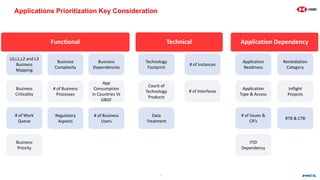
Applications Prioritization Key Consideration
Functional Technical Application Dependency
L0,L1,L2 and L3
Business
Mapping
Business
Complexity
Business
Criticality
# of Business
Processes
# of Work
Queue
Regulatory
Aspects
Application
Readiness
Remediation
Category
Application
Type & Access
Inflight
Projects
Business
Priority
RTB & CTB
Technology
Footprint
# of Instances
Count of
Technology
Products
# of Issues &
CR’s
Data
Treatment
App
Consumption
in Countries Vs
GBGF
Business
Dependencies
# of Interfaces
# of Business
Users
ITID
Dependency
2
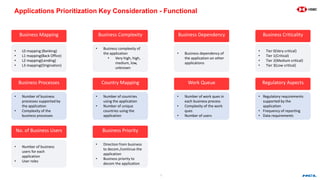
Applications Prioritization Key Consideration - Functional
Business Mapping
• L0 mapping (Banking)
• L1 mapping(Back Office)
• L2 mapping(Lending)
• L3 mapping(Origination)
Business Complexity
• Business complexity of
the application
• Very high, high,
medium, low,
unknown
Business Dependency
• Business dependency of
the application on other
applications
Business Criticality
• Tier 0(Very critical)
• Tier 1(Critical)
• Tier 2(Medium critical)
• Tier 3(Low critical)
Business Processes
• Number of business
processes supported by
the application
• Complexity of the
business processes
Country Mapping
• Number of countries
using the application
• Number of unique
countries using the
application
Work Queue
• Number of work ques in
each business process
• Complexity of the work
ques
• Number of users
Regulatory Aspects
• Regulatory requirements
supported by the
application
• Frequency of reporting
• Data requirements
No. of Business Users
• Number of business
users for each
application
• User roles
Business Priority
• Direction from business
to decom./continue the
application
• Business priority to
decom the application
3
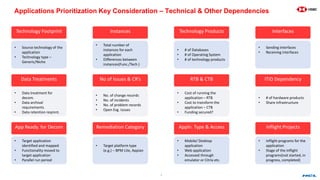
Applications Prioritization Key Consideration – Technical & Other Dependencies
Technology Footprint
• Source technology of the
application
• Technology type –
Generic/Niche
Instances
• Total number of
instances for each
application
• Differences between
instances(Func./Tech.)
Technology Products
• # of Databases
• # of Operating System
• # of technology products
Interfaces
• Sending interfaces
• Receiving interfaces
Data Treatments
• Data treatment for
decom.
• Data archival
requirements
• Data retention reqmnt.
No of Issues & CR’s
• No. of change records
• No. of incidents
• No. of problem records
• Open Evg. issues
RTB & CTB
• Cost of running the
application – RTB
• Cost to transform the
application – CTB
• Funding secured?
ITID Dependency
• # of hardware products
• Share infrastructure
App Ready. for Decom
• Target application
identified and mapped
• Functionality moved to
target application
• Parallel run period
Remediation Category
• Target platform type
(e.g.) – BPM Lite, Appian
Appln. Type & Access
• Mobile/ Desktop
application
• Web application
• Accessed through
emulator or Citrix etc.
Inflight Projects
• Inflight programs for the
application
• Stage of the inflight
programs(not started, in
progress, completed)
4
Applications Prioritization | GWIS Wave Planning for Decommission
Guiding Principles:
Applications with high RTB cost are considered for early decommission (wherever possible) to provide
synergies(47% benefits realized in wave 1 & 2)
Application performing similar functions have been consolidated for wave planning wherever possible to provide
business value realization
Length of a wave depends on the complexity of the applications in that wave
Interdependencies between GWIS applications have been factored into wave planning
Wave planning does not consider the current target state status of the applications
5
Applications Prioritization | GWIS Applications Move Group Sequencing
Move Group 1 Move Group 2 Move Group 3 Move Group 4 Move Group 5
Applications part of fast track
without dependency
1.1
Applications part of the fast
track with dependency
 All other applications
without any dependency
in loans and credit cards
 High cost and low
complexity
 Business complexity and
cost to transform is
medium
 Sending and receiving
interfaces are less than 5
 Business complexity is
very high
 Cost to transform is
medium
 Most of the other details
are unknown
 Business complexity and cost to
transform is very high
 Application is highly critical
 No. of sending & receiving
interfaces and business users are
very high
1.2
6
7
3
2 2 2 2
5
2
3
6
1 1
1
8
6
1
4
1
1 1
2
1
2
1
1
3
5
3
7
4
1
2
1
0
5
10
15
20
25
Account Open.
and Main.
ATM &
Cheque
Channels Credit Card Loans &
Mortgages
Others Payments Unit Trust, Ins.
& PF
Move Group 1 SMG 1.1 Move Group 1 SMG 1.2 Move Group 2
Move Group 3 Move Group 4 Move Group 5
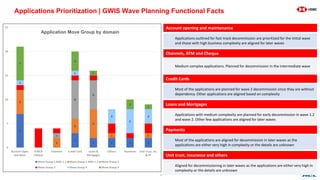
Applications Prioritization | GWIS Wave Planning Functional Facts
Application Move Group by domain
Medium complex applications. Planned for decommission in the intermediate wave
Applications with medium complexity are planned for early decommission in wave 1.2
and wave 2. Other few applications are aligned for later waves
Most of the applications are aligned for decommission in later waves as the
applications are either very high in complexity or the details are unknown
Aligned for decommissioning in later waves as the applications are either very high in
complexity or the details are unknown
Most of the applications are planned for wave 2 decommission since they are without
dependency. Other applications are aligned based on complexity
Applications outlined for fast-track decommission are prioritized for the initial wave
and those with high business complexity are aligned for later waves
Account opening and maintenance
Channels, ATM and Cheque
Credit Cards
Loans and Mortgages
Payments
Unit trust, Insurance and others
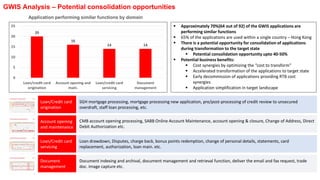
Application performing similar functions by domain
20
16
14 14
0
5
10
15
20
25
Loan/credit card
origination
Account opening and
main.
Loan/credit card
servicing
Document
management
GWIS Analysis – Potential consolidation opportunities
 Approximately 70%(64 out of 92) of the GWIS applications are
performing similar functions
 65% of the applications are used within a single country – Hong Kong
 There is a potential opportunity for consolidation of applications
during transformation to the target state
 Potential consolidation opportunity upto 40-50%
 Potential business benefits:
 Cost synergies by optimizing the “cost to transform”
 Accelerated transformation of the applications to target state
 Early decommission of applications providing RTB cost
synergies
 Application simplification in target landscape
Loan/Credit card
origination
Account opening
and maintenance
Loan/Credit card
servicing
Document
management
SGH mortgage processing, mortgage processing new application, pre/post-processing of credit review to unsecured
overdraft, staff loan processing, etc.
CMB account opening processing, SABB Online Account Maintenance, account opening & closure, Change of Address, Direct
Debit Authorization etc.
Loan drawdown, Disputes, charge back, bonus points redemption, change of personal details, statements, card
replacement, authorization, loan main. etc.
Document indexing and archival, document management and retrieval function, deliver the email and fax request, trade
doc. image capture etc.
8
Functional Consolidation | Account Opening & Maintenance
9
Functional Consolidation | Document Management
10
Functional Consolidation | Loan/Credit Card Origination
11
Functional Consolidation | Loan/Credit card servicing
Copyright © 2020 HCL Technologies Limited | www.hcltech.com
Appendix
Deep dive of the sub functions
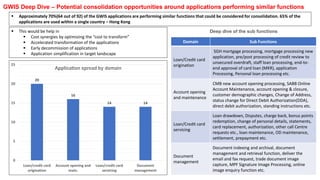
Application spread by domain
Domain Sub Functions
Loan/Credit card
origination
SGH mortgage processing, mortgage processing new
application, pre/post processing of credit review to
unsecured overdraft, staff loan processing, end-to-
end approval of card loan (MKR), application
Processing, Personal loan processing etc.
Account opening
and maintenance
CMB new account opening processing, SABB Online
Account Maintenance, account opening & closure,
customer demographic changes, Change of Address,
status change for Direct Debit Authorization(DDA),
direct debit authorization, standing instructions etc.
Loan/Credit card
servicing
Loan drawdown, Disputes, charge back, bonus points
redemption, change of personal details, statements,
card replacement, authorization, other call Centre
requests etc., loan maintenance, OD maintenance,
settlement, prepayment etc.
Document
management
Document indexing and archival, document
management and retrieval function, deliver the
email and fax request, trade document image
capture, MPF Signature Image Processing, online
image enquiry function etc.
20
16
14 14
0
5
10
15
20
25
Loan/credit card
origination
Account opening and
main.
Loan/credit card
servicing
Document
management
GWIS Deep Dive – Potential consolidation opportunities around applications performing similar functions
 Approximately 70%(64 out of 92) of the GWIS applications are performing similar functions that could be considered for consolidation. 65% of the
applications are used within a single country – Hong Kong
 This would be help in
 Cost synergies by optimizing the “cost to transform”
 Accelerated transformation of the applications
 Early decommission of applications
 Application simplification in target landscape
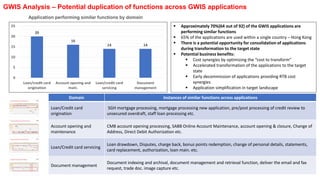
Application performing similar functions by domain
20
16
14 14
0
5
10
15
20
25
Loan/credit card
origination
Account opening and
main.
Loan/credit card
servicing
Document
management
GWIS Analysis – Potential duplication of functions across GWIS applications
 Approximately 70%(64 out of 92) of the GWIS applications are
performing similar functions
 65% of the applications are used within a single country – Hong Kong
 There is a potential opportunity for consolidation of applications
during transformation to the target state
 Potential business benefits:
 Cost synergies by optimizing the “cost to transform”
 Accelerated transformation of the applications to the target
state
 Early decommission of applications providing RTB cost
synergies
 Application simplification in target landscape
Domain Instances of similar functions across applications
Loan/Credit card
origination
SGH mortgage processing, mortgage processing new application, pre/post processing of credit review to
unsecured overdraft, staff loan processing etc.
Account opening and
maintenance
CMB account opening processing, SABB Online Account Maintenance, account opening & closure, Change of
Address, Direct Debit Authorization etc.
Loan/Credit card servicing
Loan drawdown, Disputes, charge back, bonus points redemption, change of personal details, statements,
card replacement, authorization, loan main. etc.
Document management
Document indexing and archival, document management and retrieval function, deliver the email and fax
request, trade doc. image capture etc.
15
Applications Prioritization | GWIS Wave Planning Functional View (1/2)
Application spread by waves*
Overall considerations:
 Applications with high RTB cost are considered for early decommission (wherever
possible) to provide synergies(47% benefits realized in wave 1 & 2)
 Application performing similar functions have been consolidated for wave
planning wherever possible to provide business value realization
 Length of a wave depends on the complexity of the applications in that wave
 Interdependencies between GWIS applications have been factored into wave
planning
 Wave planning does not consider the current target state status of the
applications
Tranche wise considerations:
 Tranche 1 Wave 1.1 – Applications part of fast track without dependency
 Tranche 1 Wave 1.2 – Applications part of fast track with dependency and other
without dependency applications
 Tranche 1 Wave 2 – All other applications without any dependency in loans and
credit cards(high cost and low complexity)
 Tranche 1 Wave 3
 Business complexity and cost to transform is medium
 Sending and receiving interfaces are less than 5
 Tranche 1 Wave 4
 Business complexity is very high
 Cost to transform is medium
 Most of the other details are unknown
 Tranche 1 Wave 5
 Business complexity and cost to transform is very high
 Application is highly critical
 No. of sending & receiving interfaces and business users are very high
High level considerations in wave planning
18 18
15
13 13
15
0
2
4
6
8
10
12
14
16
18
20
Tranche 1 Wave 1.1Tranche 1 Wave 1.2 Tranche 1 Wave 2 Tranche 1 Wave 3 Tranche 1 Wave 4 Tranche 1 Wave 5
*Total number of GWIS applications - 92
16
Applications Prioritization | GWIS Wave Planning for Decommission
Guiding Principles:
 Applications with high RTB cost are considered for early decommission (wherever possible) to provide synergies(47%
benefits realized in wave 1 & 2)
 Application performing similar functions have been consolidated for wave planning wherever possible to provide
business value realization
 Length of a wave depends on the complexity of the applications in that wave
 Interdependencies between GWIS applications have been factored into wave planning
 Wave planning does not consider the current target state status of the applications
Move Group 1
Move Group 2
Move Group 3
Move Group 4
Move Group 5
Applications part of fast track without dependency
1.1
1.2 Applications part of fast track with dependency and other without dependency applications
 All other applications without any dependency in loans and credit cards
 High cost and low complexity
 Business complexity and cost to transform is medium
 Sending and receiving interfaces are less than 5
 Business complexity is very high
 Cost to transform is medium
 Most of the other details are unknown
 Business complexity and cost to transform is very high
 Application is highly critical
 No. of sending & receiving interfaces and business users are very high
17
Applications Prioritization | GWIS Wave Planning Functional Facts
 Account opening and maintenance:
 Applications outlined for fast-track decommission are
prioritized for initial wave and those with high business
complexity are aligned for later waves
 Channels, ATM and Cheque:
 Medium complex applications. Planned for decommission in the
intermediate wave
 Credit Cards:
 Most of the applications are planned for wave 2 decommission
since they are without dependency. Other applications are
aligned based on complexity
 Loans and Mortgages:
 Applications with medium complexity are planned for early
decommission in wave 1.2 and wave 2. Other few applications
are aligned for later waves
 Payments:
 Most of the applications are aligned for decommission in later
waves as the applications are either very high in complexity or
the details are unknown
 Unit trust, Insurance and others:
 Aligned for decommission in later waves as the applications are
either very high in complexity or the details are unknown
Key Inferences
Application spread by domain
7
3
2 2 2 2
5
2
3
6
1 1
1
8
6
1
4
1
1 1
2
1
2
1
1
3
5
3
7
4
1
2
1
0
5
10
15
20
25
Account Open.
and Main.
ATM &
Cheque
Channels Credit Card Loans &
Mortgages
Others Payments Unit Trust, Ins.
& PF
MG1 SMG 1.1 MG1 SMG 1.2 MG2 MG3 MG4 MG5
MG – Move Group; SMG – Sub Move Group

Applications Prioritization Key Consideration.pptx

  • 1.
    1 Applications Prioritization KeyConsideration Functional Technical Application Dependency L0,L1,L2 and L3 Business Mapping Business Complexity Business Criticality # of Business Processes # of Work Queue Regulatory Aspects Application Readiness Remediation Category Application Type & Access Inflight Projects Business Priority RTB & CTB Technology Footprint # of Instances Count of Technology Products # of Issues & CR’s Data Treatment App Consumption in Countries Vs GBGF Business Dependencies # of Interfaces # of Business Users ITID Dependency
  • 2.
    2 Applications Prioritization KeyConsideration - Functional Business Mapping • L0 mapping (Banking) • L1 mapping(Back Office) • L2 mapping(Lending) • L3 mapping(Origination) Business Complexity • Business complexity of the application • Very high, high, medium, low, unknown Business Dependency • Business dependency of the application on other applications Business Criticality • Tier 0(Very critical) • Tier 1(Critical) • Tier 2(Medium critical) • Tier 3(Low critical) Business Processes • Number of business processes supported by the application • Complexity of the business processes Country Mapping • Number of countries using the application • Number of unique countries using the application Work Queue • Number of work ques in each business process • Complexity of the work ques • Number of users Regulatory Aspects • Regulatory requirements supported by the application • Frequency of reporting • Data requirements No. of Business Users • Number of business users for each application • User roles Business Priority • Direction from business to decom./continue the application • Business priority to decom the application
  • 3.
    3 Applications Prioritization KeyConsideration – Technical & Other Dependencies Technology Footprint • Source technology of the application • Technology type – Generic/Niche Instances • Total number of instances for each application • Differences between instances(Func./Tech.) Technology Products • # of Databases • # of Operating System • # of technology products Interfaces • Sending interfaces • Receiving interfaces Data Treatments • Data treatment for decom. • Data archival requirements • Data retention reqmnt. No of Issues & CR’s • No. of change records • No. of incidents • No. of problem records • Open Evg. issues RTB & CTB • Cost of running the application – RTB • Cost to transform the application – CTB • Funding secured? ITID Dependency • # of hardware products • Share infrastructure App Ready. for Decom • Target application identified and mapped • Functionality moved to target application • Parallel run period Remediation Category • Target platform type (e.g.) – BPM Lite, Appian Appln. Type & Access • Mobile/ Desktop application • Web application • Accessed through emulator or Citrix etc. Inflight Projects • Inflight programs for the application • Stage of the inflight programs(not started, in progress, completed)
  • 4.
    4 Applications Prioritization |GWIS Wave Planning for Decommission Guiding Principles: Applications with high RTB cost are considered for early decommission (wherever possible) to provide synergies(47% benefits realized in wave 1 & 2) Application performing similar functions have been consolidated for wave planning wherever possible to provide business value realization Length of a wave depends on the complexity of the applications in that wave Interdependencies between GWIS applications have been factored into wave planning Wave planning does not consider the current target state status of the applications
  • 5.
    5 Applications Prioritization |GWIS Applications Move Group Sequencing Move Group 1 Move Group 2 Move Group 3 Move Group 4 Move Group 5 Applications part of fast track without dependency 1.1 Applications part of the fast track with dependency  All other applications without any dependency in loans and credit cards  High cost and low complexity  Business complexity and cost to transform is medium  Sending and receiving interfaces are less than 5  Business complexity is very high  Cost to transform is medium  Most of the other details are unknown  Business complexity and cost to transform is very high  Application is highly critical  No. of sending & receiving interfaces and business users are very high 1.2
  • 6.
    6 7 3 2 2 22 5 2 3 6 1 1 1 8 6 1 4 1 1 1 2 1 2 1 1 3 5 3 7 4 1 2 1 0 5 10 15 20 25 Account Open. and Main. ATM & Cheque Channels Credit Card Loans & Mortgages Others Payments Unit Trust, Ins. & PF Move Group 1 SMG 1.1 Move Group 1 SMG 1.2 Move Group 2 Move Group 3 Move Group 4 Move Group 5 Applications Prioritization | GWIS Wave Planning Functional Facts Application Move Group by domain Medium complex applications. Planned for decommission in the intermediate wave Applications with medium complexity are planned for early decommission in wave 1.2 and wave 2. Other few applications are aligned for later waves Most of the applications are aligned for decommission in later waves as the applications are either very high in complexity or the details are unknown Aligned for decommissioning in later waves as the applications are either very high in complexity or the details are unknown Most of the applications are planned for wave 2 decommission since they are without dependency. Other applications are aligned based on complexity Applications outlined for fast-track decommission are prioritized for the initial wave and those with high business complexity are aligned for later waves Account opening and maintenance Channels, ATM and Cheque Credit Cards Loans and Mortgages Payments Unit trust, Insurance and others
  • 7.
    Application performing similarfunctions by domain 20 16 14 14 0 5 10 15 20 25 Loan/credit card origination Account opening and main. Loan/credit card servicing Document management GWIS Analysis – Potential consolidation opportunities  Approximately 70%(64 out of 92) of the GWIS applications are performing similar functions  65% of the applications are used within a single country – Hong Kong  There is a potential opportunity for consolidation of applications during transformation to the target state  Potential consolidation opportunity upto 40-50%  Potential business benefits:  Cost synergies by optimizing the “cost to transform”  Accelerated transformation of the applications to target state  Early decommission of applications providing RTB cost synergies  Application simplification in target landscape Loan/Credit card origination Account opening and maintenance Loan/Credit card servicing Document management SGH mortgage processing, mortgage processing new application, pre/post-processing of credit review to unsecured overdraft, staff loan processing, etc. CMB account opening processing, SABB Online Account Maintenance, account opening & closure, Change of Address, Direct Debit Authorization etc. Loan drawdown, Disputes, charge back, bonus points redemption, change of personal details, statements, card replacement, authorization, loan main. etc. Document indexing and archival, document management and retrieval function, deliver the email and fax request, trade doc. image capture etc.
  • 8.
    8 Functional Consolidation |Account Opening & Maintenance
  • 9.
    9 Functional Consolidation |Document Management
  • 10.
    10 Functional Consolidation |Loan/Credit Card Origination
  • 11.
    11 Functional Consolidation |Loan/Credit card servicing
  • 12.
    Copyright © 2020HCL Technologies Limited | www.hcltech.com Appendix
  • 13.
    Deep dive ofthe sub functions Application spread by domain Domain Sub Functions Loan/Credit card origination SGH mortgage processing, mortgage processing new application, pre/post processing of credit review to unsecured overdraft, staff loan processing, end-to- end approval of card loan (MKR), application Processing, Personal loan processing etc. Account opening and maintenance CMB new account opening processing, SABB Online Account Maintenance, account opening & closure, customer demographic changes, Change of Address, status change for Direct Debit Authorization(DDA), direct debit authorization, standing instructions etc. Loan/Credit card servicing Loan drawdown, Disputes, charge back, bonus points redemption, change of personal details, statements, card replacement, authorization, other call Centre requests etc., loan maintenance, OD maintenance, settlement, prepayment etc. Document management Document indexing and archival, document management and retrieval function, deliver the email and fax request, trade document image capture, MPF Signature Image Processing, online image enquiry function etc. 20 16 14 14 0 5 10 15 20 25 Loan/credit card origination Account opening and main. Loan/credit card servicing Document management GWIS Deep Dive – Potential consolidation opportunities around applications performing similar functions  Approximately 70%(64 out of 92) of the GWIS applications are performing similar functions that could be considered for consolidation. 65% of the applications are used within a single country – Hong Kong  This would be help in  Cost synergies by optimizing the “cost to transform”  Accelerated transformation of the applications  Early decommission of applications  Application simplification in target landscape
  • 14.
    Application performing similarfunctions by domain 20 16 14 14 0 5 10 15 20 25 Loan/credit card origination Account opening and main. Loan/credit card servicing Document management GWIS Analysis – Potential duplication of functions across GWIS applications  Approximately 70%(64 out of 92) of the GWIS applications are performing similar functions  65% of the applications are used within a single country – Hong Kong  There is a potential opportunity for consolidation of applications during transformation to the target state  Potential business benefits:  Cost synergies by optimizing the “cost to transform”  Accelerated transformation of the applications to the target state  Early decommission of applications providing RTB cost synergies  Application simplification in target landscape Domain Instances of similar functions across applications Loan/Credit card origination SGH mortgage processing, mortgage processing new application, pre/post processing of credit review to unsecured overdraft, staff loan processing etc. Account opening and maintenance CMB account opening processing, SABB Online Account Maintenance, account opening & closure, Change of Address, Direct Debit Authorization etc. Loan/Credit card servicing Loan drawdown, Disputes, charge back, bonus points redemption, change of personal details, statements, card replacement, authorization, loan main. etc. Document management Document indexing and archival, document management and retrieval function, deliver the email and fax request, trade doc. image capture etc.
  • 15.
    15 Applications Prioritization |GWIS Wave Planning Functional View (1/2) Application spread by waves* Overall considerations:  Applications with high RTB cost are considered for early decommission (wherever possible) to provide synergies(47% benefits realized in wave 1 & 2)  Application performing similar functions have been consolidated for wave planning wherever possible to provide business value realization  Length of a wave depends on the complexity of the applications in that wave  Interdependencies between GWIS applications have been factored into wave planning  Wave planning does not consider the current target state status of the applications Tranche wise considerations:  Tranche 1 Wave 1.1 – Applications part of fast track without dependency  Tranche 1 Wave 1.2 – Applications part of fast track with dependency and other without dependency applications  Tranche 1 Wave 2 – All other applications without any dependency in loans and credit cards(high cost and low complexity)  Tranche 1 Wave 3  Business complexity and cost to transform is medium  Sending and receiving interfaces are less than 5  Tranche 1 Wave 4  Business complexity is very high  Cost to transform is medium  Most of the other details are unknown  Tranche 1 Wave 5  Business complexity and cost to transform is very high  Application is highly critical  No. of sending & receiving interfaces and business users are very high High level considerations in wave planning 18 18 15 13 13 15 0 2 4 6 8 10 12 14 16 18 20 Tranche 1 Wave 1.1Tranche 1 Wave 1.2 Tranche 1 Wave 2 Tranche 1 Wave 3 Tranche 1 Wave 4 Tranche 1 Wave 5 *Total number of GWIS applications - 92
  • 16.
    16 Applications Prioritization |GWIS Wave Planning for Decommission Guiding Principles:  Applications with high RTB cost are considered for early decommission (wherever possible) to provide synergies(47% benefits realized in wave 1 & 2)  Application performing similar functions have been consolidated for wave planning wherever possible to provide business value realization  Length of a wave depends on the complexity of the applications in that wave  Interdependencies between GWIS applications have been factored into wave planning  Wave planning does not consider the current target state status of the applications Move Group 1 Move Group 2 Move Group 3 Move Group 4 Move Group 5 Applications part of fast track without dependency 1.1 1.2 Applications part of fast track with dependency and other without dependency applications  All other applications without any dependency in loans and credit cards  High cost and low complexity  Business complexity and cost to transform is medium  Sending and receiving interfaces are less than 5  Business complexity is very high  Cost to transform is medium  Most of the other details are unknown  Business complexity and cost to transform is very high  Application is highly critical  No. of sending & receiving interfaces and business users are very high
  • 17.
    17 Applications Prioritization |GWIS Wave Planning Functional Facts  Account opening and maintenance:  Applications outlined for fast-track decommission are prioritized for initial wave and those with high business complexity are aligned for later waves  Channels, ATM and Cheque:  Medium complex applications. Planned for decommission in the intermediate wave  Credit Cards:  Most of the applications are planned for wave 2 decommission since they are without dependency. Other applications are aligned based on complexity  Loans and Mortgages:  Applications with medium complexity are planned for early decommission in wave 1.2 and wave 2. Other few applications are aligned for later waves  Payments:  Most of the applications are aligned for decommission in later waves as the applications are either very high in complexity or the details are unknown  Unit trust, Insurance and others:  Aligned for decommission in later waves as the applications are either very high in complexity or the details are unknown Key Inferences Application spread by domain 7 3 2 2 2 2 5 2 3 6 1 1 1 8 6 1 4 1 1 1 2 1 2 1 1 3 5 3 7 4 1 2 1 0 5 10 15 20 25 Account Open. and Main. ATM & Cheque Channels Credit Card Loans & Mortgages Others Payments Unit Trust, Ins. & PF MG1 SMG 1.1 MG1 SMG 1.2 MG2 MG3 MG4 MG5 MG – Move Group; SMG – Sub Move Group