Introduction to Designing with
AI Agents
Frantz Lohier, PhD – Sr AI and robotics strategist
Amazon AWS – WWSO organization
© 2025 Amazon AWS
Agenda
• Introduction and definitions, types of agents
• Agents and autonomy
• Architecture components
• Multi-agent architectures
• Popular agent frameworks
© 2025 Amazon AWS 2
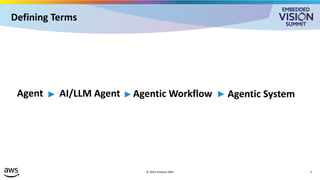
Defining Terms
© 2025 Amazon AWS 3
Agent AI/LLM Agent Agentic Workflow Agentic System
Defining Terms
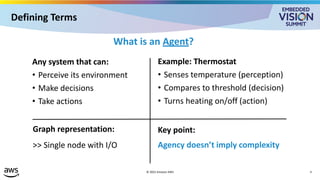
What is an Agent?
Any system that can:
• Perceive its environment
• Make decisions
• Take actions
Example: Thermostat
• Senses temperature (perception)
• Compares to threshold (decision)
• Turns heating on/off (action)
Graph representation:
>> Single node with I/O
Key point:
Agency doesn’t imply complexity
© 2025 Amazon AWS 4
Defining Terms
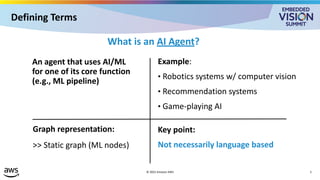
What is an AI Agent?
An agent that uses AI/ML
for one of its core function
(e.g., ML pipeline)
Example:
• Robotics systems w/ computer vision
• Recommendation systems
• Game-playing AI
Graph representation:
>> Static graph (ML nodes)
Key point:
Not necessarily language based
© 2025 Amazon AWS 5
Defining Terms
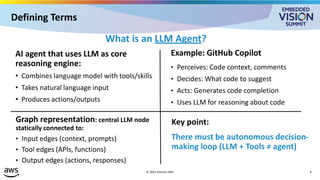
What is an LLM Agent?
AI agent that uses LLM as core
reasoning engine:
• Combines language model with tools/skills
• Takes natural language input
• Produces actions/outputs
Example: GitHub Copilot
• Perceives: Code context, comments
• Decides: What code to suggest
• Acts: Generates code completion
• Uses LLM for reasoning about code
Graph representation: central LLM node
statically connected to:
• Input edges (context, prompts)
• Tool edges (APIs, functions)
• Output edges (actions, responses)
Key point:
There must be autonomous decision-
making loop (LLM + Tools ≠ agent)
© 2025 Amazon AWS 6
Defining Terms
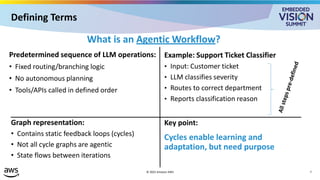
What is an Agentic Workflow?
Predetermined sequence of LLM operations:
• Fixed routing/branching logic
• No autonomous planning
• Tools/APIs called in defined order
Example: Support Ticket Classifier
• Input: Customer ticket
• LLM classifies severity
• Routes to correct department
• Reports classification reason
Graph representation:
• Contains static feedback loops (cycles)
• Not all cycle graphs are agentic
• State flows between iterations
Key point:
Cycles enable learning and
adaptation, but need purpose
© 2025 Amazon AWS 7
Defining Terms
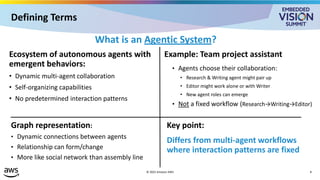
What is an Agentic System?
Ecosystem of autonomous agents with
emergent behaviors:
• Dynamic multi-agent collaboration
• Self-organizing capabilities
• No predetermined interaction patterns
Example: Team project assistant
• Agents choose their collaboration:
• Research & Writing agent might pair up
• Editor might work alone or with Writer
• New agent roles can emerge
• Not a fixed workflow (Research→Writing→Editor)
Graph representation:
• Dynamic connections between agents
• Relationship can form/change
• More like social network than assembly line
Key point:
Differs from multi-agent workflows
where interaction patterns are fixed
© 2025 Amazon AWS 8
Agency and Autonomy
© 2025 Amazon AWS 9
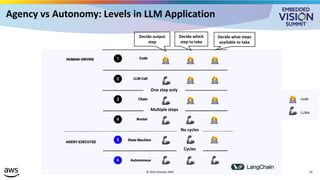
Agency vs Autonomy: Levels in LLM Application
© 2025 Amazon AWS
No cycles
Cycles
One step only
Multiple steps
Decide what steps
available to take
Decide which
step to take
Decide output
step
10
Agent Architecture Components
© 2025 Amazon AWS 11
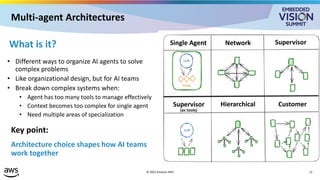
Multi-agent Architectures
© 2025 Amazon AWS 12
What is it?
• Different ways to organize AI agents to solve
complex problems
• Like organizational design, but for AI teams
• Break down complex systems when:
• Agent has too many tools to manage effectively
• Context becomes too complex for single agent
• Need multiple areas of specialization
Key point:
Architecture choice shapes how AI teams
work together
Single Agent Network Supervisor
Supervisor Hierarchical Customer
(as tools)
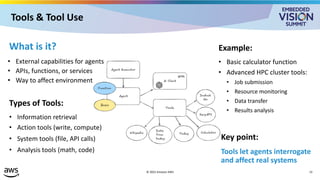
Tools & Tool Use
© 2025 Amazon AWS 13
What is it?
• External capabilities for agents
• APIs, functions, or services
• Way to affect environment
Key point:
Tools let agents interrogate
and affect real systems
Types of Tools:
• Information retrieval
• Action tools (write, compute)
• System tools (file, API calls)
• Analysis tools (math, code)
Example:
• Basic calculator function
• Advanced HPC cluster tools:
• Job submission
• Resource monitoring
• Data transfer
• Results analysis
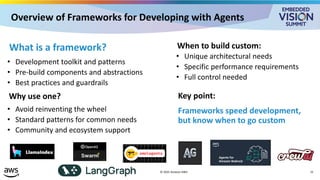
Overview of Frameworks for Developing with Agents
© 2025 Amazon AWS 14
Overview of Frameworks for Developing with Agents
© 2025 Amazon AWS 15
What is a framework?
• Development toolkit and patterns
• Pre-build components and abstractions
• Best practices and guardrails
Why use one?
• Avoid reinventing the wheel
• Standard patterns for common needs
• Community and ecosystem support
When to build custom:
• Unique architectural needs
• Specific performance requirements
• Full control needed
Key point:
Frameworks speed development,
but know when to go custom
Conclusion and Q&A
© 2025 Amazon AWS 16
© 2025 Amazon AWS 17
Key Remarks and Take-aways
• Agentic AI is currently hyper-hyped with confusion on terms and scope
• The technology is progressing very fast*. Paired with techniques like RAG, agentic systems
are very powerful decision-making tools for dynamic data analysis
• Companies are building libraries of ready-to-use agentic systems; similar to AI frontier
models, there will be “blue-print” agentic systems models for targeted industries and use-
cases
• Cloud-computing and datacenters will be instrumental in scaling up the compute and data
storage demand
*The AI agent public database is listing 67 agentic systems by 2025: https://aiagentindex.mit.edu/
Energy market simulation example:
https://aws.amazon.com/blogs/hpc/simulating-complex-systems-with-llm-driven-agents-leveraging-aws-
parallelcluster-for-scalable-ai-experiments/
© 2025 Amazon AWS 18
Additional Resources
Towards effective genAI multi-agent collaboration: Design and evaluation
for enterprise applications:
https://www.amazon.science/publications/towards-effective-genai-multi-agent-collaboration-design-and-
evaluation-for-enterprise-applications
Engineering with AI Agents:
https://www.youtube.com/watch?v=FosQ9_zRtHE