Web Applications (In)Security
Reconnaissance
Topics Covered:
• Web Application Analysis
• Web Application Mapping
Module 2–Chapter 1
Web Applications Analysis
Topics Covered:
• Wireshark
• BrowserPlugins
• Proxies
• Scanners
• Fuzzers
Module 2–Chapter 1
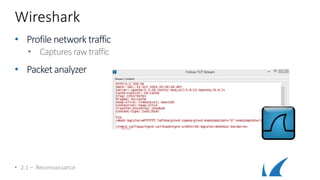
Wireshark
• Profile networktraffic
• Capturesrawtraffic
• Packetanalyzer
• 2.1 – Reconnaissance
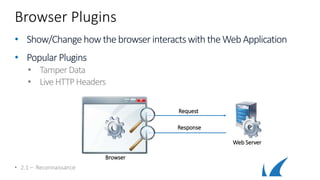
Browser Plugins
• Show/ChangehowthebrowserinteractswiththeWeb Application
• PopularPlugins
• TamperData
• LiveHTTPHeaders
• 2.1 – Reconnaissance
Web Server
Request
Response
Browser
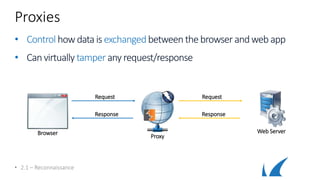
Proxies
• Control howdatais exchangedbetweenthebrowserandweb app
• Canvirtually tamper any request/response
• 2.1 – Reconnaissance
Web Server
Request
Response
Request
Response
Browser
Proxy
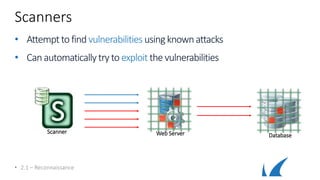
Scanners
• Attemptto find vulnerabilities usingknownattacks
• Canautomatically try to exploitthe vulnerabilities
• 2.1 – Reconnaissance
Web Server Database
Scanner
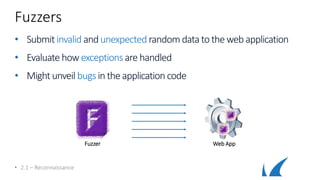
Fuzzers
• Submit invalid andunexpectedrandomdatatotheweb application
• Evaluate how exceptionsare handled
• Mightunveil bugsintheapplication code
• 2.1 – Reconnaissance
Web AppFuzzer
Web Applications Mapping
Topics Covered:
• Web Applications Mapping
• Spiders
2.1–Reconnaissance
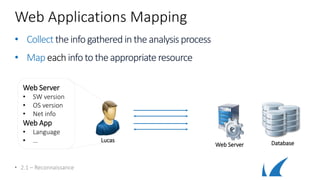
Web Applications Mapping
• Collect theinfogatheredin theanalysisprocess
• Mapeach infoto the appropriate resource
• 2.1 – Reconnaissance
Database
Web Server
• SW version
• OS version
• Net info
Web App
• Language
• …
Web Server
Lucas
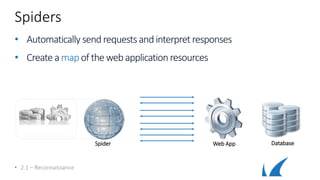
Spiders
• Automatically sendrequestsandinterpretresponses
• Create a map of the web application resources
• 2.1 – Reconnaissance
Web AppSpider Database
Web Applications Attacks
Topics Covered:
• OWASP TOP 10 – 2013
• AdditionalRisks
Module 2–Chapter 2
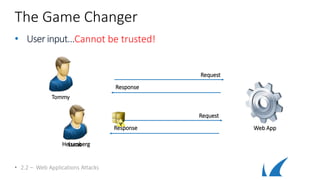
The Game Changer
• 2.2 – Web Applications Attacks
Tommy
HeisenbergLucas
• Userinput…Cannot be trusted!
Web App
Request
Response
Request
Response
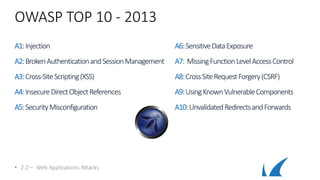
OWASP TOP 10 - 2013
A1:Injection
A2:BrokenAuthenticationandSessionManagement
A3:Cross-SiteScripting(XSS)
A4:InsecureDirectObjectReferences
A5:SecurityMisconfiguration
• 2.2 – Web Applications Attacks
A6:SensitiveDataExposure
A7: MissingFunctionLevelAccessControl
A8:CrossSiteRequestForgery(CSRF)
A9:UsingKnownVulnerableComponents
A10:UnvalidatedRedirectsandForwards
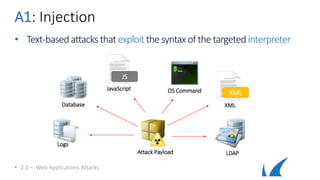
A1: Injection
• Text-basedattacksthatexploit thesyntax of thetargetedinterpreter
• 2.2 – Web Applications Attacks
OS Command
Database
Logs
XML
XML
JavaScript
JS
LDAPAttack Payload
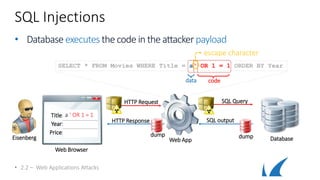
SQL Injections
• Database executesthecode in theattackerpayload
• 2.2 – Web Applications Attacks
SELECT * FROM Movies WHERE Title = a‘ OR 1 = 1 ORDER BY Year
data code
escape character
HTTP Request
HTTP Response
SQL Query
SQL output
Database
Web Browser
Title:
Year:
Price:
a ‘ OR 1 = 1
Eisenberg Web App
dumpdump
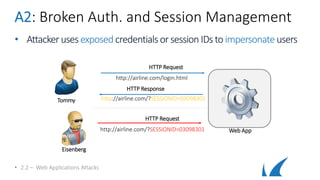
A2: Broken Auth. and Session Management
• Attackerusesexposed credentialsor session IDs to impersonate users
• 2.2 – Web Applications Attacks
Tommy
Eisenberg
HTTP Request
http://airline.com/login.html
HTTP Response
http://airline.com/?SESSIONID=03098301
Web App
HTTP Request
http://airline.com/?SESSIONID=03098301
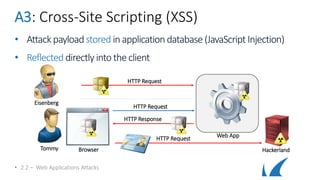
A3: Cross-Site Scripting (XSS)
• Attackpayload storedin applicationdatabase(JavaScript Injection)
• Reflected directlyinto the client
• 2.2 – Web Applications Attacks
Eisenberg
Tommy
HTTP Request
HTTP Request
HTTP Response
Browser
HTTP Request
Hackerland
Web App
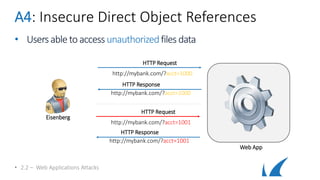
A4: Insecure Direct Object References
• Usersable to accessunauthorizedfiles data
• 2.2 – Web Applications Attacks
Eisenberg
HTTP Request
http://mybank.com/?acct=1000
HTTP Response
http://mybank.com/?acct=1000
HTTP Request
http://mybank.com/?acct=1001
HTTP Response
http://mybank.com/?acct=1001
Web App
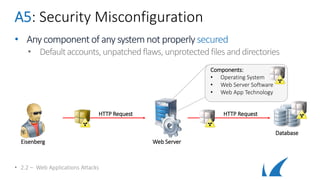
A5: Security Misconfiguration
• Anycomponent of anysystemnot properly secured
• Defaultaccounts,unpatchedflaws,unprotectedfilesanddirectories
• 2.2 – Web Applications Attacks
Eisenberg
HTTP Request
Components:
• Operating System
• Web Server Software
• Web App Technology
Database
HTTP Request
Web Server
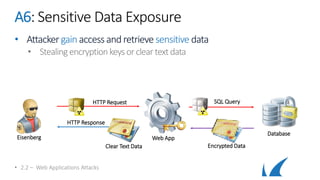
A6: Sensitive Data Exposure
• Attackergain accessandretrieve sensitive data
• Stealingencryptionkeysorcleartextdata
• 2.2 – Web Applications Attacks
Eisenberg
HTTP Request
Web App
Database
HTTP Response
Encrypted Data
SQL Query
Clear Text Data
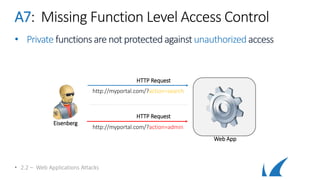
A7: Missing Function Level Access Control
• Private functionsare notprotectedagainstunauthorizedaccess
• 2.2 – Web Applications Attacks
Eisenberg
HTTP Request
http://myportal.com/?action=search
HTTP Request
http://myportal.com/?action=admin
Web App
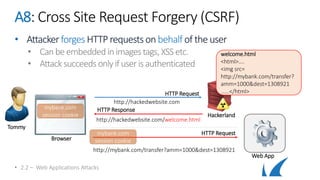
A8: Cross Site Request Forgery (CSRF)
• Attackerforges HTTP requestsonbehalf of theuser
• Canbeembeddedinimagestags,XSSetc.
• Attacksucceedsonlyifuserisauthenticated
• 2.2 – Web Applications Attacks
Tommy
Hackerland
Web App
Browser
HTTP Request
http://hackedwebsite.com
http://hackedwebsite.com/welcome.html
HTTP Response
HTTP Request
http://mybank.com/transfer?amm=1000&dest=1308921
mybank.com
session cookie
welcome.html
<html>….
<img src=
http://mybank.com/transfer?
amm=1000&dest=1308921
……</html>
mybank.com
session cookie
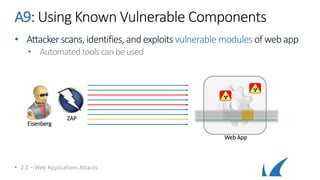
A9: Using Known Vulnerable Components
• Attackerscans, identifies, andexploits vulnerable modules of webapp
• Automatedtoolscanbeused
• 2.2 – Web Applications Attacks
Eisenberg
ZAP
Web App
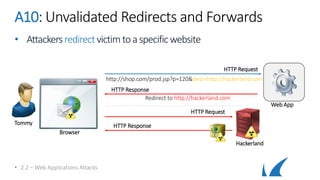
A10: Unvalidated Redirects and Forwards
• Attackersredirectvictim toa specific website
• 2.2 – Web Applications Attacks
HTTP Request
HTTP Response
HTTP Request
Hackerland
Web App
Tommy
Browser
http://shop.com/prod.jsp?p=120&dest=http://hackerland.com
HTTP Response
Redirect to http://hackerland.com
Additional Risks
Topics Covered:
• Clickjacking
• Application Denialof Service
• Information Leakage
Module 2–Chapter 2
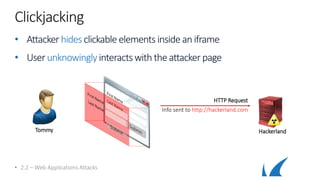
Clickjacking
• Attackerhidesclickableelements insideaniframe
• User unknowinglyinteractswith theattackerpage
• 2.2 – Web Applications Attacks
Tommy Hackerland
HTTP Request
Info sent to http://hackerland.com
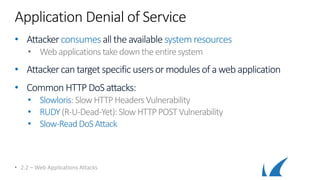
Application Denial of Service
• Attackerconsumes all theavailable systemresources
• Webapplicationstakedowntheentire system
• Attackercantargetspecific usersor modules of aweb application
• Common HTTP DoS attacks:
• Slowloris: SlowHTTPHeadersVulnerability
• RUDY(R-U-Dead-Yet):Slow HTTPPOSTVulnerability
• Slow-ReadDoSAttack
• 2.2 – Web Applications Attacks
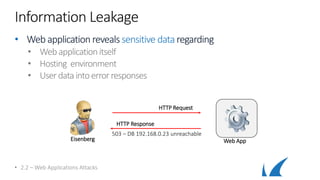
Information Leakage
• Web application reveals sensitive data regarding
• Webapplicationitself
• Hosting environment
• Userdataintoerrorresponses
• 2.2 – Web Applications Attacks
Eisenberg Web App
HTTP Request
HTTP Response
503 – DB 192.168.0.23 unreachable

application security basics

  • 1.
  • 2.
    Reconnaissance Topics Covered: • WebApplication Analysis • Web Application Mapping Module 2–Chapter 1
  • 3.
    Web Applications Analysis TopicsCovered: • Wireshark • BrowserPlugins • Proxies • Scanners • Fuzzers Module 2–Chapter 1
  • 4.
    Wireshark • Profile networktraffic •Capturesrawtraffic • Packetanalyzer • 2.1 – Reconnaissance
  • 5.
    Browser Plugins • Show/ChangehowthebrowserinteractswiththeWebApplication • PopularPlugins • TamperData • LiveHTTPHeaders • 2.1 – Reconnaissance Web Server Request Response Browser
  • 6.
    Proxies • Control howdataisexchangedbetweenthebrowserandweb app • Canvirtually tamper any request/response • 2.1 – Reconnaissance Web Server Request Response Request Response Browser Proxy
  • 7.
    Scanners • Attemptto findvulnerabilities usingknownattacks • Canautomatically try to exploitthe vulnerabilities • 2.1 – Reconnaissance Web Server Database Scanner
  • 8.
    Fuzzers • Submit invalidandunexpectedrandomdatatotheweb application • Evaluate how exceptionsare handled • Mightunveil bugsintheapplication code • 2.1 – Reconnaissance Web AppFuzzer
  • 9.
    Web Applications Mapping TopicsCovered: • Web Applications Mapping • Spiders 2.1–Reconnaissance
  • 10.
    Web Applications Mapping •Collect theinfogatheredin theanalysisprocess • Mapeach infoto the appropriate resource • 2.1 – Reconnaissance Database Web Server • SW version • OS version • Net info Web App • Language • … Web Server Lucas
  • 11.
    Spiders • Automatically sendrequestsandinterpretresponses •Create a map of the web application resources • 2.1 – Reconnaissance Web AppSpider Database
  • 12.
    Web Applications Attacks TopicsCovered: • OWASP TOP 10 – 2013 • AdditionalRisks Module 2–Chapter 2
  • 13.
    The Game Changer •2.2 – Web Applications Attacks Tommy HeisenbergLucas • Userinput…Cannot be trusted! Web App Request Response Request Response
  • 14.
    OWASP TOP 10- 2013 A1:Injection A2:BrokenAuthenticationandSessionManagement A3:Cross-SiteScripting(XSS) A4:InsecureDirectObjectReferences A5:SecurityMisconfiguration • 2.2 – Web Applications Attacks A6:SensitiveDataExposure A7: MissingFunctionLevelAccessControl A8:CrossSiteRequestForgery(CSRF) A9:UsingKnownVulnerableComponents A10:UnvalidatedRedirectsandForwards
  • 15.
    A1: Injection • Text-basedattacksthatexploitthesyntax of thetargetedinterpreter • 2.2 – Web Applications Attacks OS Command Database Logs XML XML JavaScript JS LDAPAttack Payload
  • 16.
    SQL Injections • Databaseexecutesthecode in theattackerpayload • 2.2 – Web Applications Attacks SELECT * FROM Movies WHERE Title = a‘ OR 1 = 1 ORDER BY Year data code escape character HTTP Request HTTP Response SQL Query SQL output Database Web Browser Title: Year: Price: a ‘ OR 1 = 1 Eisenberg Web App dumpdump
  • 17.
    A2: Broken Auth.and Session Management • Attackerusesexposed credentialsor session IDs to impersonate users • 2.2 – Web Applications Attacks Tommy Eisenberg HTTP Request http://airline.com/login.html HTTP Response http://airline.com/?SESSIONID=03098301 Web App HTTP Request http://airline.com/?SESSIONID=03098301
  • 18.
    A3: Cross-Site Scripting(XSS) • Attackpayload storedin applicationdatabase(JavaScript Injection) • Reflected directlyinto the client • 2.2 – Web Applications Attacks Eisenberg Tommy HTTP Request HTTP Request HTTP Response Browser HTTP Request Hackerland Web App
  • 19.
    A4: Insecure DirectObject References • Usersable to accessunauthorizedfiles data • 2.2 – Web Applications Attacks Eisenberg HTTP Request http://mybank.com/?acct=1000 HTTP Response http://mybank.com/?acct=1000 HTTP Request http://mybank.com/?acct=1001 HTTP Response http://mybank.com/?acct=1001 Web App
  • 20.
    A5: Security Misconfiguration •Anycomponent of anysystemnot properly secured • Defaultaccounts,unpatchedflaws,unprotectedfilesanddirectories • 2.2 – Web Applications Attacks Eisenberg HTTP Request Components: • Operating System • Web Server Software • Web App Technology Database HTTP Request Web Server
  • 21.
    A6: Sensitive DataExposure • Attackergain accessandretrieve sensitive data • Stealingencryptionkeysorcleartextdata • 2.2 – Web Applications Attacks Eisenberg HTTP Request Web App Database HTTP Response Encrypted Data SQL Query Clear Text Data
  • 22.
    A7: Missing FunctionLevel Access Control • Private functionsare notprotectedagainstunauthorizedaccess • 2.2 – Web Applications Attacks Eisenberg HTTP Request http://myportal.com/?action=search HTTP Request http://myportal.com/?action=admin Web App
  • 23.
    A8: Cross SiteRequest Forgery (CSRF) • Attackerforges HTTP requestsonbehalf of theuser • Canbeembeddedinimagestags,XSSetc. • Attacksucceedsonlyifuserisauthenticated • 2.2 – Web Applications Attacks Tommy Hackerland Web App Browser HTTP Request http://hackedwebsite.com http://hackedwebsite.com/welcome.html HTTP Response HTTP Request http://mybank.com/transfer?amm=1000&dest=1308921 mybank.com session cookie welcome.html <html>…. <img src= http://mybank.com/transfer? amm=1000&dest=1308921 ……</html> mybank.com session cookie
  • 24.
    A9: Using KnownVulnerable Components • Attackerscans, identifies, andexploits vulnerable modules of webapp • Automatedtoolscanbeused • 2.2 – Web Applications Attacks Eisenberg ZAP Web App
  • 25.
    A10: Unvalidated Redirectsand Forwards • Attackersredirectvictim toa specific website • 2.2 – Web Applications Attacks HTTP Request HTTP Response HTTP Request Hackerland Web App Tommy Browser http://shop.com/prod.jsp?p=120&dest=http://hackerland.com HTTP Response Redirect to http://hackerland.com
  • 26.
    Additional Risks Topics Covered: •Clickjacking • Application Denialof Service • Information Leakage Module 2–Chapter 2
  • 27.
    Clickjacking • Attackerhidesclickableelements insideaniframe •User unknowinglyinteractswith theattackerpage • 2.2 – Web Applications Attacks Tommy Hackerland HTTP Request Info sent to http://hackerland.com
  • 28.
    Application Denial ofService • Attackerconsumes all theavailable systemresources • Webapplicationstakedowntheentire system • Attackercantargetspecific usersor modules of aweb application • Common HTTP DoS attacks: • Slowloris: SlowHTTPHeadersVulnerability • RUDY(R-U-Dead-Yet):Slow HTTPPOSTVulnerability • Slow-ReadDoSAttack • 2.2 – Web Applications Attacks
  • 29.
    Information Leakage • Webapplication reveals sensitive data regarding • Webapplicationitself • Hosting environment • Userdataintoerrorresponses • 2.2 – Web Applications Attacks Eisenberg Web App HTTP Request HTTP Response 503 – DB 192.168.0.23 unreachable