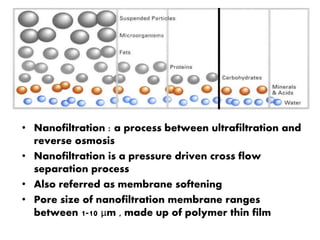
• Nanofiltration : a process between ultrafiltration and
reverse osmosis
• Nanofiltration is a pressure driven cross flow
separation process
• Also referred as membrane softening
• Pore size of nanofiltration membrane ranges
between 1-10 μm , made up of polymer thin film
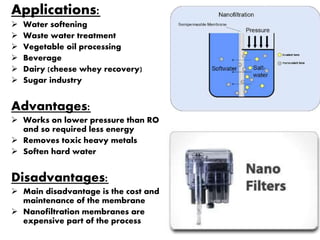
Applications:
 Water softening
 Waste water treatment
 Vegetable oil processing
 Beverage
 Dairy (cheese whey recovery)
 Sugar industry
Advantages:
 Works on lower pressure than RO
and so required less energy
 Removes toxic heavy metals
 Soften hard water
Disadvantages:
 Main disadvantage is the cost and
maintenance of the membrane
 Nanofiltration membranes are
expensive part of the process
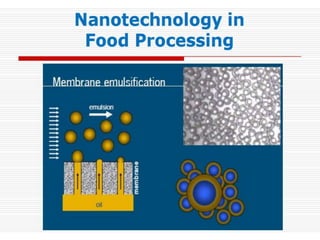
• Membrane emulsification (ME) is a relatively novel technique for
producing all types of single and multiple emulsions
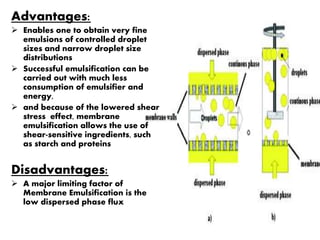
• The dispersed phase is forced through the pores of a
microporous membrane directly into the continuous phase.
• Emulsified droplets are formed and detached at the end of the pores
with a drop-by-drop mechanism
• distinguishing feature is that the resulting droplet size is controlled
primarily by the choice of the membrane and not by the generation
of turbulent droplet break-up
Advantages:
 Enables one to obtain very fine
emulsions of controlled droplet
sizes and narrow droplet size
distributions
 Successful emulsification can be
carried out with much less
consumption of emulsifier and
energy,
 and because of the lowered shear
stress effect, membrane
emulsification allows the use of
shear-sensitive ingredients, such
as starch and proteins
Disadvantages:
 A major limiting factor of
Membrane Emulsification is the
low dispersed phase flux
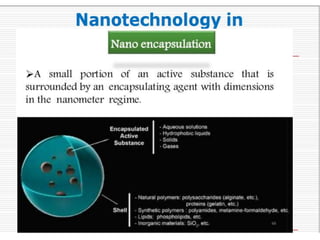
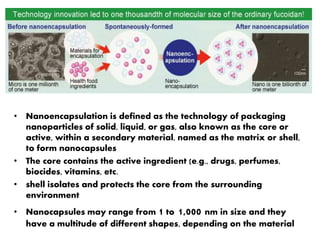
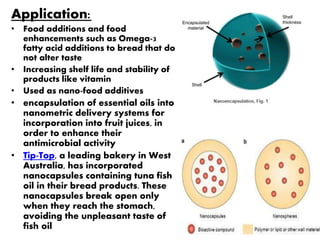
• Nanoencapsulation is defined as the technology of packaging
nanoparticles of solid, liquid, or gas, also known as the core or
active, within a secondary material, named as the matrix or shell,
to form nanocapsules
• The core contains the active ingredient (e.g., drugs, perfumes,
biocides, vitamins, etc.
• shell isolates and protects the core from the surrounding
environment
• Nanocapsules may range from 1 to 1,000 nm in size and they
have a multitude of different shapes, depending on the material
Application:
• Food additions and food
enhancements such as Omega-3
fatty acid additions to bread that do
not alter taste
• Increasing shelf life and stability of
products like vitamin
• Used as nano-food additives
• encapsulation of essential oils into
nanometric delivery systems for
incorporation into fruit juices, in
order to enhance their
antimicrobial activity
• Tip-Top, a leading bakery in West
Australia, has incorporated
nanocapsules containing tuna fish
oil in their bread products. These
nanocapsules break open only
when they reach the stomach,
avoiding the unpleasant taste of
fish oil
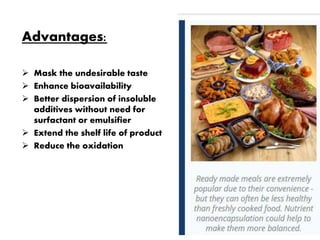
Advantages:
 Mask the undesirable taste
 Enhance bioavailability
 Better dispersion of insoluble
additives without need for
surfactant or emulsifier
 Extend the shelf life of product
 Reduce the oxidation
REFRENCES
• http://www.sciencedirect.com/science/article/pii/S02608
77408005700
• http://www.sciencedirect.com/science/article/pii/S09242
24414001356
• http://www.azonano.com/article.aspx?ArticleID=1875

Application of nanotechnology in food processing

  • 3.
    • Nanofiltration :a process between ultrafiltration and reverse osmosis • Nanofiltration is a pressure driven cross flow separation process • Also referred as membrane softening • Pore size of nanofiltration membrane ranges between 1-10 μm , made up of polymer thin film
  • 4.
    Applications:  Water softening Waste water treatment  Vegetable oil processing  Beverage  Dairy (cheese whey recovery)  Sugar industry Advantages:  Works on lower pressure than RO and so required less energy  Removes toxic heavy metals  Soften hard water Disadvantages:  Main disadvantage is the cost and maintenance of the membrane  Nanofiltration membranes are expensive part of the process
  • 6.
    • Membrane emulsification(ME) is a relatively novel technique for producing all types of single and multiple emulsions • The dispersed phase is forced through the pores of a microporous membrane directly into the continuous phase. • Emulsified droplets are formed and detached at the end of the pores with a drop-by-drop mechanism • distinguishing feature is that the resulting droplet size is controlled primarily by the choice of the membrane and not by the generation of turbulent droplet break-up
  • 7.
    Advantages:  Enables oneto obtain very fine emulsions of controlled droplet sizes and narrow droplet size distributions  Successful emulsification can be carried out with much less consumption of emulsifier and energy,  and because of the lowered shear stress effect, membrane emulsification allows the use of shear-sensitive ingredients, such as starch and proteins Disadvantages:  A major limiting factor of Membrane Emulsification is the low dispersed phase flux
  • 9.
    • Nanoencapsulation isdefined as the technology of packaging nanoparticles of solid, liquid, or gas, also known as the core or active, within a secondary material, named as the matrix or shell, to form nanocapsules • The core contains the active ingredient (e.g., drugs, perfumes, biocides, vitamins, etc. • shell isolates and protects the core from the surrounding environment • Nanocapsules may range from 1 to 1,000 nm in size and they have a multitude of different shapes, depending on the material
  • 10.
    Application: • Food additionsand food enhancements such as Omega-3 fatty acid additions to bread that do not alter taste • Increasing shelf life and stability of products like vitamin • Used as nano-food additives • encapsulation of essential oils into nanometric delivery systems for incorporation into fruit juices, in order to enhance their antimicrobial activity • Tip-Top, a leading bakery in West Australia, has incorporated nanocapsules containing tuna fish oil in their bread products. These nanocapsules break open only when they reach the stomach, avoiding the unpleasant taste of fish oil
  • 11.
    Advantages:  Mask theundesirable taste  Enhance bioavailability  Better dispersion of insoluble additives without need for surfactant or emulsifier  Extend the shelf life of product  Reduce the oxidation
  • 12.