APPLE IN CHINA CASE STUDY
Done by:
 Rawan Haddad
 Selma Bourafai
 Sheikabdulla Babulal
 Ranjit Koppa Lakshman
 Riccardo Cacciola
1. Categorize and identify the major risks that Apple has recently already faced
(experienced to date) in China based on at least one horizon scanning method (WT
from SWOT, PESTLE, and/or SPECTRES) and/or the EMLV Risks Checklists.
(Note: it’s ok if no relevant information is available for some categories in these
methods.)
2. Judging from the case study snippets and what you know of current events, what
new or continuing risks might Apple face in China in the near future? Explain.
3. What risks might Apple face in other countries as a result of the way it is operating
in China? Explain.
4. Apply the Fishbone Diagram, 5Whys, or 5w2h method to identify factors that may
have contributed to at least one major risk you identified when answering question
1
1. Identifying Apple risks by using WT from SWOT Analysis
Weaknesses:
 High selling price, which might put-off price sensitive customers
 Accessibility to product. There are only 4 Apple stores in China
 Chinese customers are unwilling to pay for some of the apps
Threats:
 Very competitive market; there is a lot of competition from local brands. Apple’s China
smartphone market share slid to 9% in the second quarter from 12% in the first quarter,
landing it in fifth place behind Huawei, Oppo, Vivo and Xiaomi.
 Political issues with rise of anti-US sentiment, with many Chinese consumers smashing
their phones during protests to express patriotic sentiments.
 Cyber security issues. Apple faced a hacking scandal in 2017, where China was hacking
iPhone users’ phones.
 Copyright issues
2. The new or continuing risks might Apple face in China in the near
future
- One of the major risks Apple faces today in China is the trade war between the US and
the China due to the rising tariffs imposed by the US on Chinese goods so production in
China is becoming difficult and costly.
- Therefore, with the rise in tariffs, Apple products could experience increase in prices,
potentially alienating further price-sensitive customers.
- Not only prices would increase but costs could potentially increase as well as the trade
war escalates since Apple products are assembled and shipped from China, particularly if
duties are introduced on these products. If Apple decides to move its production
elsewhere then that could result in a disturbance in its supply chain and Apple would
need to find new suppliers.
- Another issue at hand in case the trade war escalates are the restrictions the Chinese
government could impose on Apple operations, making it harder to sell its products in
China causing Apple to face further losses in one of its biggest markets.
- Consequently, with the continuous trade war, pressure may be placed on Apple to move
its operations to other countries and to spread out its global supply chain since if Apple
persists on its reliance on China, it could leave the company vulnerable to China.
- Finally, the trade war could lead to a plunge in Apple stock because, as mentioned
previously, China is a major manufacturing base and a sizable market for its products.
-
3. Risks might Apple face in other countries as a result of the way it is
operating in China
A censorship bug iPhone crash brought Apple into the height of controversy in 2017 when users
noticed whenever a Taiwanese flag appeared on an iPhone, the app that displayed it crashed.
Since then, there has been allegations that because Apple was trying to appease the Chinese
government, this bug would not have been introduced in the first place.
This raises concerns about Apple, who has long outlined its commitment to human rights and
free speech, to operate under similar conditions in other countries. In 2020, shareholders in fact
raised these concerns about Apple’s ties to China and the company’s role in censoring content.
There is a possibility that Apple while operating in other countries will face similar tension
between its stated principles and local laws. This could result in a decline in the brand’s
reputation as there is rising sentiment from some that Apple was “placing its commercial
interests over their need to access information.”
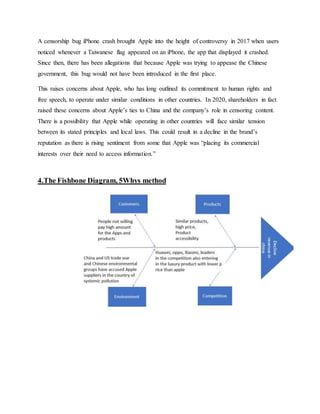
4.The Fishbone Diagram, 5Whys method
References
https://www.spglobal.com/marketintelligence/en/news-insights/blog/esg-hits-the-mainstream-
for-european-private-equity-sponsors
https://fortune.com/2020/09/04/apple-china-censorship-human-rights/
https://www.wsj.com/articles/as-apples-services-grow-in-china-so-does-its-censorship-risk-
1501752605

Apple china case study

  • 1.
    APPLE IN CHINACASE STUDY Done by:  Rawan Haddad  Selma Bourafai  Sheikabdulla Babulal  Ranjit Koppa Lakshman  Riccardo Cacciola 1. Categorize and identify the major risks that Apple has recently already faced (experienced to date) in China based on at least one horizon scanning method (WT from SWOT, PESTLE, and/or SPECTRES) and/or the EMLV Risks Checklists. (Note: it’s ok if no relevant information is available for some categories in these methods.) 2. Judging from the case study snippets and what you know of current events, what new or continuing risks might Apple face in China in the near future? Explain. 3. What risks might Apple face in other countries as a result of the way it is operating in China? Explain. 4. Apply the Fishbone Diagram, 5Whys, or 5w2h method to identify factors that may have contributed to at least one major risk you identified when answering question 1 1. Identifying Apple risks by using WT from SWOT Analysis Weaknesses:  High selling price, which might put-off price sensitive customers  Accessibility to product. There are only 4 Apple stores in China  Chinese customers are unwilling to pay for some of the apps Threats:  Very competitive market; there is a lot of competition from local brands. Apple’s China smartphone market share slid to 9% in the second quarter from 12% in the first quarter, landing it in fifth place behind Huawei, Oppo, Vivo and Xiaomi.
  • 2.
     Political issueswith rise of anti-US sentiment, with many Chinese consumers smashing their phones during protests to express patriotic sentiments.  Cyber security issues. Apple faced a hacking scandal in 2017, where China was hacking iPhone users’ phones.  Copyright issues 2. The new or continuing risks might Apple face in China in the near future - One of the major risks Apple faces today in China is the trade war between the US and the China due to the rising tariffs imposed by the US on Chinese goods so production in China is becoming difficult and costly. - Therefore, with the rise in tariffs, Apple products could experience increase in prices, potentially alienating further price-sensitive customers. - Not only prices would increase but costs could potentially increase as well as the trade war escalates since Apple products are assembled and shipped from China, particularly if duties are introduced on these products. If Apple decides to move its production elsewhere then that could result in a disturbance in its supply chain and Apple would need to find new suppliers. - Another issue at hand in case the trade war escalates are the restrictions the Chinese government could impose on Apple operations, making it harder to sell its products in China causing Apple to face further losses in one of its biggest markets. - Consequently, with the continuous trade war, pressure may be placed on Apple to move its operations to other countries and to spread out its global supply chain since if Apple persists on its reliance on China, it could leave the company vulnerable to China. - Finally, the trade war could lead to a plunge in Apple stock because, as mentioned previously, China is a major manufacturing base and a sizable market for its products. - 3. Risks might Apple face in other countries as a result of the way it is operating in China
  • 3.
    A censorship bugiPhone crash brought Apple into the height of controversy in 2017 when users noticed whenever a Taiwanese flag appeared on an iPhone, the app that displayed it crashed. Since then, there has been allegations that because Apple was trying to appease the Chinese government, this bug would not have been introduced in the first place. This raises concerns about Apple, who has long outlined its commitment to human rights and free speech, to operate under similar conditions in other countries. In 2020, shareholders in fact raised these concerns about Apple’s ties to China and the company’s role in censoring content. There is a possibility that Apple while operating in other countries will face similar tension between its stated principles and local laws. This could result in a decline in the brand’s reputation as there is rising sentiment from some that Apple was “placing its commercial interests over their need to access information.” 4.The Fishbone Diagram, 5Whys method
  • 4.