Presented
by
Dr. Arun B. Sawarkar
1. Bee Biology
B.P. Arts, S.M.A. Science & K.K.C. Commerce
College, Chalisgaon, Dist- Jalgaon (MS)
(Honeybee species)
Phylum: Arthropoda
Class: Insecta
Subclass: Pterygota
Division: Endopterygota
Order: Hymenoptera
Family: Apidae
Genus: Apis
Species: i) dorsata ii) cerana iii) florea iv) mellifera
(Exoskeleton, jointed appendages)
(Body-head, thorax and abdomen, paired wings and
three pairs of legs)
(one or two pairs of wings)
(Life cycle stages- Egg, larva, pupa and adult,
Ex: Butterfly, beetle, honeybee)
(Membranous wings, Forewings larger than hind
wings, coupling apparatus, Ex: Ants, Bees & wasps)
(Social bees Ex: honeybees, bumblebees)
Classification
 Honey bees are worldwide in distribution.
 They are highly organized social insects living in colonies.
 They are known for their art of manufacturing honey and bee-wax.
 They are active throughout the year but winter season they do little
work and do not rear the brood.
 They exhibit polymorphism and good division of labour.
 The worker communicates to the other workers by performing dances
known as dance language of the bees.
Habit and habitats
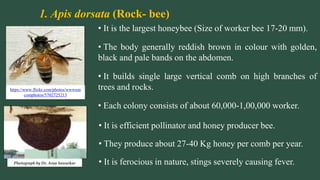
1. Apis dorsata (Rock- bee)
• It is the largest honeybee (Size of worker bee 17-20 mm).
• The body generally reddish brown in colour with golden,
black and pale bands on the abdomen.
• It builds single large vertical comb on high branches of
trees and rocks.
• Each colony consists of about 60,000-1,00,000 worker.
https://www.flickr.com/photos/wwwssn
comphotos/5702725213
Photograph by Dr. Arun Sawarkar
• It is efficient pollinator and honey producer bee.
• They produce about 27-40 Kg honey per comb per year.
• It is ferocious in nature, stings severely causing fever.
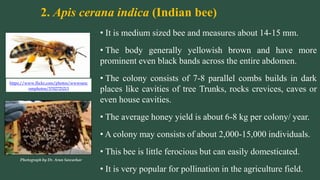
2. Apis cerana indica (Indian bee)
• It is medium sized bee and measures about 14-15 mm.
• The body generally yellowish brown and have more
prominent even black bands across the entire abdomen.
• The colony consists of 7-8 parallel combs builds in dark
places like cavities of tree Trunks, rocks crevices, caves or
even house cavities.
• The average honey yield is about 6-8 kg per colony/ year.
• A colony may consists of about 2,000-15,000 individuals.
• This bee is little ferocious but can easily domesticated.
• It is very popular for pollination in the agriculture field.
Photograph by Dr. Arun Sawarkar
https://www.flickr.com/photos/wwwssnc
omphotos/5702725213
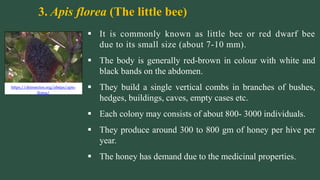
3. Apis florea (The little bee)
Photograph by Dr. Arun Sawarkarhttps://deinsectos.org/abejas/apis-
florea/
 It is commonly known as little bee or red dwarf bee
due to its small size (about 7-10 mm).
 The body is generally red-brown in colour with white and
black bands on the abdomen.
 They build a single vertical combs in branches of bushes,
hedges, buildings, caves, empty cases etc.
 Each colony may consists of about 800- 3000 individuals.
 They produce around 300 to 800 gm of honey per hive per
year.
 The honey has demand due to the medicinal properties.
4. Apis mellifera (The European bee)
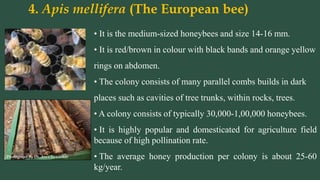
Photograph by Dr. Arun Sawarkar
• It is the medium-sized honeybees and size 14-16 mm.
• It is red/brown in colour with black bands and orange yellow
rings on abdomen.
• The colony consists of many parallel combs builds in dark
places such as cavities of tree trunks, within rocks, trees.
• A colony consists of typically 30,000-1,00,000 honeybees.
• It is highly popular and domesticated for agriculture field
because of high pollination rate.
• The average honey production per colony is about 25-60
kg/year.
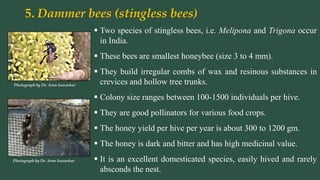
5. Dammer bees (stingless bees)
 Two species of stingless bees, i.e. Melipona and Trigona occur
in India.
 These bees are smallest honeybee (size 3 to 4 mm).
 They build irregular combs of wax and resinous substances in
crevices and hollow tree trunks.
 Colony size ranges between 100-1500 individuals per hive.
 They are good pollinators for various food crops.
 The honey yield per hive per year is about 300 to 1200 gm.
 The honey is dark and bitter and has high medicinal value.
 It is an excellent domesticated species, easily hived and rarely
absconds the nest.
Photograph by Dr. Arun Sawarkar
THANKS
Like Share Subscribe
https://www.youtube.com/channel/UCf9sdWSOBSks1K_XWMrPyUQ/

Apiculture: Honeybee Species

  • 1.
    Presented by Dr. Arun B.Sawarkar 1. Bee Biology B.P. Arts, S.M.A. Science & K.K.C. Commerce College, Chalisgaon, Dist- Jalgaon (MS) (Honeybee species)
  • 2.
    Phylum: Arthropoda Class: Insecta Subclass:Pterygota Division: Endopterygota Order: Hymenoptera Family: Apidae Genus: Apis Species: i) dorsata ii) cerana iii) florea iv) mellifera (Exoskeleton, jointed appendages) (Body-head, thorax and abdomen, paired wings and three pairs of legs) (one or two pairs of wings) (Life cycle stages- Egg, larva, pupa and adult, Ex: Butterfly, beetle, honeybee) (Membranous wings, Forewings larger than hind wings, coupling apparatus, Ex: Ants, Bees & wasps) (Social bees Ex: honeybees, bumblebees) Classification
  • 3.
     Honey beesare worldwide in distribution.  They are highly organized social insects living in colonies.  They are known for their art of manufacturing honey and bee-wax.  They are active throughout the year but winter season they do little work and do not rear the brood.  They exhibit polymorphism and good division of labour.  The worker communicates to the other workers by performing dances known as dance language of the bees. Habit and habitats
  • 4.
    1. Apis dorsata(Rock- bee) • It is the largest honeybee (Size of worker bee 17-20 mm). • The body generally reddish brown in colour with golden, black and pale bands on the abdomen. • It builds single large vertical comb on high branches of trees and rocks. • Each colony consists of about 60,000-1,00,000 worker. https://www.flickr.com/photos/wwwssn comphotos/5702725213 Photograph by Dr. Arun Sawarkar • It is efficient pollinator and honey producer bee. • They produce about 27-40 Kg honey per comb per year. • It is ferocious in nature, stings severely causing fever.
  • 5.
    2. Apis ceranaindica (Indian bee) • It is medium sized bee and measures about 14-15 mm. • The body generally yellowish brown and have more prominent even black bands across the entire abdomen. • The colony consists of 7-8 parallel combs builds in dark places like cavities of tree Trunks, rocks crevices, caves or even house cavities. • The average honey yield is about 6-8 kg per colony/ year. • A colony may consists of about 2,000-15,000 individuals. • This bee is little ferocious but can easily domesticated. • It is very popular for pollination in the agriculture field. Photograph by Dr. Arun Sawarkar https://www.flickr.com/photos/wwwssnc omphotos/5702725213
  • 6.
    3. Apis florea(The little bee) Photograph by Dr. Arun Sawarkarhttps://deinsectos.org/abejas/apis- florea/  It is commonly known as little bee or red dwarf bee due to its small size (about 7-10 mm).  The body is generally red-brown in colour with white and black bands on the abdomen.  They build a single vertical combs in branches of bushes, hedges, buildings, caves, empty cases etc.  Each colony may consists of about 800- 3000 individuals.  They produce around 300 to 800 gm of honey per hive per year.  The honey has demand due to the medicinal properties.
  • 7.
    4. Apis mellifera(The European bee) Photograph by Dr. Arun Sawarkar • It is the medium-sized honeybees and size 14-16 mm. • It is red/brown in colour with black bands and orange yellow rings on abdomen. • The colony consists of many parallel combs builds in dark places such as cavities of tree trunks, within rocks, trees. • A colony consists of typically 30,000-1,00,000 honeybees. • It is highly popular and domesticated for agriculture field because of high pollination rate. • The average honey production per colony is about 25-60 kg/year.
  • 8.
    5. Dammer bees(stingless bees)  Two species of stingless bees, i.e. Melipona and Trigona occur in India.  These bees are smallest honeybee (size 3 to 4 mm).  They build irregular combs of wax and resinous substances in crevices and hollow tree trunks.  Colony size ranges between 100-1500 individuals per hive.  They are good pollinators for various food crops.  The honey yield per hive per year is about 300 to 1200 gm.  The honey is dark and bitter and has high medicinal value.  It is an excellent domesticated species, easily hived and rarely absconds the nest. Photograph by Dr. Arun Sawarkar Photograph by Dr. Arun Sawarkar
  • 9.