Package ‘python-chess’(https://pypi.python.org/pypi/python-
chess)
Title: python-chess Stable: Python 2 and 3
Version: 0.17.0 Author/ Maintainer: Niklas Fiekas
Description: A pure Python chess library with move generation and
validation, Polyglot opening book probing, PGN reading and writing,
Gaviota tablebase probing, Syzygy tablebase probing, and UCI engine
communication.
Install via cmd:
>pip install python-chess[uci, gaviota]
>jupyter notebook
(https://media.readthedocs.org/pdf/python-chess/latest/python-chess.pdf)
Yao Yao: MSDS 6306 – 401 HW13 API Presentation
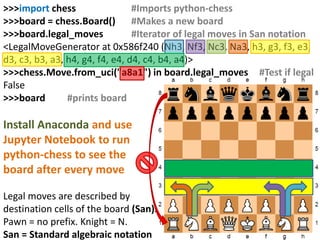
>>>import chess #Imports python-chess
>>>board = chess.Board() #Makes a new board
>>>board.legal_moves #Iterator of legal moves in San notation
<LegalMoveGenerator at 0x586f240 (Nh3, Nf3, Nc3, Na3, h3, g3, f3, e3,
d3, c3, b3, a3, h4, g4, f4, e4, d4, c4, b4, a4)>
>>>chess.Move.from_uci("a8a1") in board.legal_moves #Test if legal
False
>>>board #prints board
Install Anaconda and use
Jupyter Notebook to run
python-chess to see the
board after every move
Legal moves are described by
destination cells of the board (San).
Pawn = no prefix. Knight = N.
San = Standard algebraic notation
>>>board = chess.Board('rnbqkbnr/8/8/ppP1pppp/PP2PPPP/2p5/4N3/
RNBQKB1R w KQkq - 0 11') #Imports custom board from FEN
>>>board.legal_moves #Legal moves in San notation
<LegalMoveGenerator at 0x588fef0 (Nd4, Ng3, Nexc3, Ng1, Rh3, Rh2,
Rg1, Bh3, Bg2, Kf2, Qxd8+, Qd7+, Qd6, Qd5, Qd4, Qd3, Qb3, Qd2, Qc2,
Be3, Ba3, Bd2, Bb2, Nbxc3, Na3, Nd2, Ra3, Ra2, hxg5, gxh5, gxf5, fxg5,
fxe5, exf5, bxa5, axb5, c6)>
>>>board #prints board
Legal moves are destination cells
(If redundant, infix start column)
Pawn No Prefix
Rook R Prefix
Knight N Prefix
Bishop B Prefix
Queen Q Prefix
King K Prefix
Check + Suffix
Capture x Infix
SanNotation
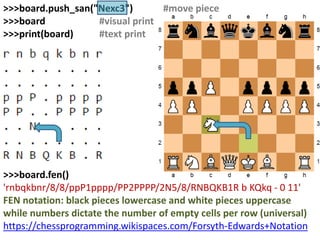
>>>board.push_san("Nexc3") #move piece
>>>board #visual print
>>>print(board) #text print
>>>board.fen()
'rnbqkbnr/8/8/ppP1pppp/PP2PPPP/2N5/8/RNBQKB1R b KQkq - 0 11'
FEN notation: black pieces lowercase and white pieces uppercase
while numbers dictate the number of empty cells per row (universal)
https://chessprogramming.wikispaces.com/Forsyth-Edwards+Notation
>>>board.pop() #undo move
>>>board #chess object
>>>print(board.move_stack)
deque([Move.from_uci('a2a4'),
Move.from_uci('a7a5'),
Move.from_uci('b2b4'),
…
Move.from_uci('d4c5'),
Move.from_uci('c4c3')])
#Prints the UCI sequence of moves
from what moves are regarded as
legal per move to recreate the
chessboard (start and destination)
UCI is the code for the universal chess interface used by chess.com and
all other chess programming tools to import the code to another
interface (does not include piece prefix, check suffix, or capture infix):
https://chessprogramming.wikispaces.com/UCI
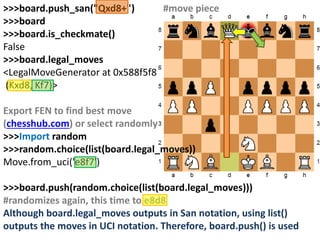
>>>board.push_san("Qxd8+") #move piece
>>>board
>>>board.is_checkmate()
False
>>>board.legal_moves
<LegalMoveGenerator at 0x588f5f8
(Kxd8, Kf7)>
Export FEN to find best move
(chesshub.com) or select randomly
>>>Import random
>>>random.choice(list(board.legal_moves))
Move.from_uci('e8f7')
>>>board.push(random.choice(list(board.legal_moves)))
#randomizes again, this time to e8d8
Although board.legal_moves outputs in San notation, using list()
outputs the moves in UCI notation. Therefore, board.push() is used
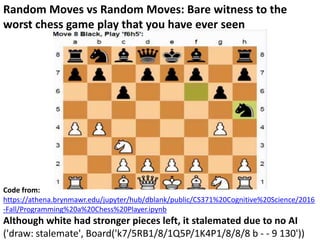
Random Moves vs Random Moves: Bare witness to the
worst chess game play that you have ever seen
Code from:
https://athena.brynmawr.edu/jupyter/hub/dblank/public/CS371%20Cognitive%20Science/2016
-Fall/Programming%20a%20Chess%20Player.ipynb
Although white had stronger pieces left, it stalemated due to no AI
('draw: stalemate', Board('k7/5RB1/8/1Q5P/1K4P1/8/8/8 b - - 9 130'))
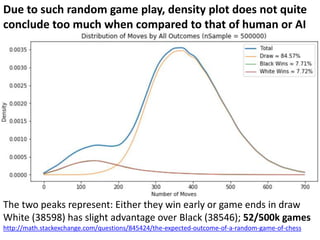
Due to such random game play, density plot does not quite
conclude too much when compared to that of human or AI
The two peaks represent: Either they win early or game ends in draw
White (38598) has slight advantage over Black (38546); 52/500k games
http://math.stackexchange.com/questions/845424/the-expected-outcome-of-a-random-game-of-chess
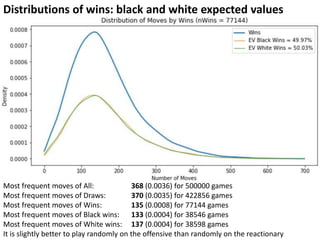
Distributions of wins: black and white expected values
Most frequent moves of All: 368 (0.0036) for 500000 games
Most frequent moves of Draws: 370 (0.0035) for 422856 games
Most frequent moves of Wins: 135 (0.0008) for 77144 games
Most frequent moves of Black wins: 133 (0.0004) for 38546 games
Most frequent moves of White wins: 137 (0.0004) for 38598 games
It is slightly better to play randomly on the offensive than randomly on the reactionary
from queue import Queue
import chess, random, _thread
import pandas as pd
import numpy as np
import matplotlib.pyplot as plt
import scipy.stats
def outcome(board):
if board.is_checkmate():
if board.turn:
return "Black"
else:
return "White"
else:
return "Draw"
#calc total moves
def moves(board):
if board.turn:
return board.fullmove_number * 2 - 1
else:
return board.fullmove_number * 2 - 2
def play(i):
board = chess.Board()
while not board.is_game_over():
board.push(random.choice(list(board.legal_moves)))
return i, outcome(board), moves(board)
def thread_wrapper(i, func, stat, q):
def run():
q.put(func)
stat[i] = True
return run
workers = 500000 #change this to 1000
status = [False for i in range(workers)]
q = Queue()
for i in range(workers):
_thread.start_new_thread(thread_wrapper(i, play(i), status,
q), tuple())
while not all(status):
pass
results = []
while not q.empty():
results.append(q.get())
results_df = pd.DataFrame(results, columns=['game_n',
'outcome', 'moves'])
#TODO process the results
results_df.to_csv('my_file.csv')
black = results_df.loc[results_df['outcome'] == 'Black']
white = results_df.loc[results_df['outcome'] == 'White']
draw = results_df.loc[results_df['outcome'] == 'Draw']
win = results_df.loc[results_df['outcome'] != 'Draw']
Total = len(results_df.index)
Wins = len(win.index)
PercentBlack = "Black Wins ≈ %s" %
('{0:.2%}'.format(len(black.index)/Total))
PercentWhite = "White Wins ≈ %s" %
('{0:.2%}'.format(len(white.index)/Total))
PercentDraw = "Draw ≈ %s" %
('{0:.2%}'.format(len(draw.index)/Total))
AllTitle = 'Distribution of Moves by All Outcomes (nSample =
%s)' % workers
a = draw.moves
b = black.moves
c = white.moves
kdea = scipy.stats.gaussian_kde(a)
kdeb = scipy.stats.gaussian_kde(b)
kdec = scipy.stats.gaussian_kde(c)
grid = np.arange(700)
#weighted kde curves
wa = kdea(grid)*(len(a)/float(len(a)+len(b)+len(c)))
wb = kdeb(grid)*(len(b)/float(len(a)+len(b)+len(c)))
wc = kdec(grid)*(len(c)/float(len(a)+len(b)+len(c)))
total = wa+wb+wc
wtotal = wb+wc
plt.figure(figsize=(10,5))
plt.plot(grid, total, lw=2, label="Total")
plt.plot(grid, wa, lw=1, label=PercentDraw)
plt.plot(grid, wb, lw=1, label=PercentBlack)
plt.plot(grid, wc, lw=1, label=PercentWhite)
plt.title(AllTitle)
plt.ylabel('Density')
plt.xlabel('Number of Moves')
plt.legend()
plt.show()
ExpectedBlack = "EV Black Wins ≈ %s" %
('{0:.2%}'.format(len(black.index)/Wins))
ExpectedWhite = "EV White Wins ≈ %s" %
('{0:.2%}'.format(len(white.index)/Wins))
WinTitle = 'Distribution of Moves by Wins (nWins = %s)' %
Wins
plt.figure(figsize=(10,5))
plt.plot(grid, wtotal, lw=2, label="Wins")
plt.plot(grid, wb, lw=1, label=ExpectedBlack)
plt.plot(grid, wc, lw=1, label=ExpectedWhite)
plt.title(WinTitle)
plt.ylabel('Density')
plt.xlabel('Number of Moves')
plt.legend()
plt.show()
print("Most frequent moves of All:", grid[total.argmax()],
round(max(total), 4), "for", Total, "games")
print("Most frequent moves of Draws:", grid[wa.argmax()],
round(max(wa), 4), "for", len(draw.index), "games")
print("Most frequent moves of Wins:", grid[wtotal.argmax()],
round(max(wtotal), 4), "for", Wins, "games")
print("Most frequent moves of Black wins:",
grid[wb.argmax()], round(max(wb), 4), "for", len(black.index),
"games")
print("Most frequent moves of White wins:",
grid[wc.argmax()], round(max(wc), 4), "for", len(white.index),
"games")

API Python Chess: Distribution of Chess Wins based on random moves

  • 1.
    Package ‘python-chess’(https://pypi.python.org/pypi/python- chess) Title: python-chessStable: Python 2 and 3 Version: 0.17.0 Author/ Maintainer: Niklas Fiekas Description: A pure Python chess library with move generation and validation, Polyglot opening book probing, PGN reading and writing, Gaviota tablebase probing, Syzygy tablebase probing, and UCI engine communication. Install via cmd: >pip install python-chess[uci, gaviota] >jupyter notebook (https://media.readthedocs.org/pdf/python-chess/latest/python-chess.pdf) Yao Yao: MSDS 6306 – 401 HW13 API Presentation
  • 2.
    >>>import chess #Importspython-chess >>>board = chess.Board() #Makes a new board >>>board.legal_moves #Iterator of legal moves in San notation <LegalMoveGenerator at 0x586f240 (Nh3, Nf3, Nc3, Na3, h3, g3, f3, e3, d3, c3, b3, a3, h4, g4, f4, e4, d4, c4, b4, a4)> >>>chess.Move.from_uci("a8a1") in board.legal_moves #Test if legal False >>>board #prints board Install Anaconda and use Jupyter Notebook to run python-chess to see the board after every move Legal moves are described by destination cells of the board (San). Pawn = no prefix. Knight = N. San = Standard algebraic notation
  • 3.
    >>>board = chess.Board('rnbqkbnr/8/8/ppP1pppp/PP2PPPP/2p5/4N3/ RNBQKB1Rw KQkq - 0 11') #Imports custom board from FEN >>>board.legal_moves #Legal moves in San notation <LegalMoveGenerator at 0x588fef0 (Nd4, Ng3, Nexc3, Ng1, Rh3, Rh2, Rg1, Bh3, Bg2, Kf2, Qxd8+, Qd7+, Qd6, Qd5, Qd4, Qd3, Qb3, Qd2, Qc2, Be3, Ba3, Bd2, Bb2, Nbxc3, Na3, Nd2, Ra3, Ra2, hxg5, gxh5, gxf5, fxg5, fxe5, exf5, bxa5, axb5, c6)> >>>board #prints board Legal moves are destination cells (If redundant, infix start column) Pawn No Prefix Rook R Prefix Knight N Prefix Bishop B Prefix Queen Q Prefix King K Prefix Check + Suffix Capture x Infix SanNotation
  • 4.
    >>>board.push_san("Nexc3") #move piece >>>board#visual print >>>print(board) #text print >>>board.fen() 'rnbqkbnr/8/8/ppP1pppp/PP2PPPP/2N5/8/RNBQKB1R b KQkq - 0 11' FEN notation: black pieces lowercase and white pieces uppercase while numbers dictate the number of empty cells per row (universal) https://chessprogramming.wikispaces.com/Forsyth-Edwards+Notation
  • 5.
    >>>board.pop() #undo move >>>board#chess object >>>print(board.move_stack) deque([Move.from_uci('a2a4'), Move.from_uci('a7a5'), Move.from_uci('b2b4'), … Move.from_uci('d4c5'), Move.from_uci('c4c3')]) #Prints the UCI sequence of moves from what moves are regarded as legal per move to recreate the chessboard (start and destination) UCI is the code for the universal chess interface used by chess.com and all other chess programming tools to import the code to another interface (does not include piece prefix, check suffix, or capture infix): https://chessprogramming.wikispaces.com/UCI
  • 6.
    >>>board.push_san("Qxd8+") #move piece >>>board >>>board.is_checkmate() False >>>board.legal_moves <LegalMoveGeneratorat 0x588f5f8 (Kxd8, Kf7)> Export FEN to find best move (chesshub.com) or select randomly >>>Import random >>>random.choice(list(board.legal_moves)) Move.from_uci('e8f7') >>>board.push(random.choice(list(board.legal_moves))) #randomizes again, this time to e8d8 Although board.legal_moves outputs in San notation, using list() outputs the moves in UCI notation. Therefore, board.push() is used
  • 7.
    Random Moves vsRandom Moves: Bare witness to the worst chess game play that you have ever seen Code from: https://athena.brynmawr.edu/jupyter/hub/dblank/public/CS371%20Cognitive%20Science/2016 -Fall/Programming%20a%20Chess%20Player.ipynb Although white had stronger pieces left, it stalemated due to no AI ('draw: stalemate', Board('k7/5RB1/8/1Q5P/1K4P1/8/8/8 b - - 9 130'))
  • 8.
    Due to suchrandom game play, density plot does not quite conclude too much when compared to that of human or AI The two peaks represent: Either they win early or game ends in draw White (38598) has slight advantage over Black (38546); 52/500k games http://math.stackexchange.com/questions/845424/the-expected-outcome-of-a-random-game-of-chess
  • 9.
    Distributions of wins:black and white expected values Most frequent moves of All: 368 (0.0036) for 500000 games Most frequent moves of Draws: 370 (0.0035) for 422856 games Most frequent moves of Wins: 135 (0.0008) for 77144 games Most frequent moves of Black wins: 133 (0.0004) for 38546 games Most frequent moves of White wins: 137 (0.0004) for 38598 games It is slightly better to play randomly on the offensive than randomly on the reactionary
  • 10.
    from queue importQueue import chess, random, _thread import pandas as pd import numpy as np import matplotlib.pyplot as plt import scipy.stats def outcome(board): if board.is_checkmate(): if board.turn: return "Black" else: return "White" else: return "Draw" #calc total moves def moves(board): if board.turn: return board.fullmove_number * 2 - 1 else: return board.fullmove_number * 2 - 2 def play(i): board = chess.Board() while not board.is_game_over(): board.push(random.choice(list(board.legal_moves))) return i, outcome(board), moves(board) def thread_wrapper(i, func, stat, q): def run(): q.put(func) stat[i] = True return run workers = 500000 #change this to 1000 status = [False for i in range(workers)] q = Queue() for i in range(workers): _thread.start_new_thread(thread_wrapper(i, play(i), status, q), tuple()) while not all(status): pass results = [] while not q.empty(): results.append(q.get()) results_df = pd.DataFrame(results, columns=['game_n', 'outcome', 'moves']) #TODO process the results results_df.to_csv('my_file.csv') black = results_df.loc[results_df['outcome'] == 'Black'] white = results_df.loc[results_df['outcome'] == 'White'] draw = results_df.loc[results_df['outcome'] == 'Draw'] win = results_df.loc[results_df['outcome'] != 'Draw'] Total = len(results_df.index) Wins = len(win.index) PercentBlack = "Black Wins ≈ %s" % ('{0:.2%}'.format(len(black.index)/Total)) PercentWhite = "White Wins ≈ %s" % ('{0:.2%}'.format(len(white.index)/Total)) PercentDraw = "Draw ≈ %s" % ('{0:.2%}'.format(len(draw.index)/Total)) AllTitle = 'Distribution of Moves by All Outcomes (nSample = %s)' % workers a = draw.moves b = black.moves c = white.moves kdea = scipy.stats.gaussian_kde(a) kdeb = scipy.stats.gaussian_kde(b) kdec = scipy.stats.gaussian_kde(c) grid = np.arange(700) #weighted kde curves wa = kdea(grid)*(len(a)/float(len(a)+len(b)+len(c))) wb = kdeb(grid)*(len(b)/float(len(a)+len(b)+len(c))) wc = kdec(grid)*(len(c)/float(len(a)+len(b)+len(c))) total = wa+wb+wc wtotal = wb+wc plt.figure(figsize=(10,5)) plt.plot(grid, total, lw=2, label="Total") plt.plot(grid, wa, lw=1, label=PercentDraw) plt.plot(grid, wb, lw=1, label=PercentBlack) plt.plot(grid, wc, lw=1, label=PercentWhite) plt.title(AllTitle) plt.ylabel('Density') plt.xlabel('Number of Moves') plt.legend() plt.show() ExpectedBlack = "EV Black Wins ≈ %s" % ('{0:.2%}'.format(len(black.index)/Wins)) ExpectedWhite = "EV White Wins ≈ %s" % ('{0:.2%}'.format(len(white.index)/Wins)) WinTitle = 'Distribution of Moves by Wins (nWins = %s)' % Wins plt.figure(figsize=(10,5)) plt.plot(grid, wtotal, lw=2, label="Wins") plt.plot(grid, wb, lw=1, label=ExpectedBlack) plt.plot(grid, wc, lw=1, label=ExpectedWhite) plt.title(WinTitle) plt.ylabel('Density') plt.xlabel('Number of Moves') plt.legend() plt.show() print("Most frequent moves of All:", grid[total.argmax()], round(max(total), 4), "for", Total, "games") print("Most frequent moves of Draws:", grid[wa.argmax()], round(max(wa), 4), "for", len(draw.index), "games") print("Most frequent moves of Wins:", grid[wtotal.argmax()], round(max(wtotal), 4), "for", Wins, "games") print("Most frequent moves of Black wins:", grid[wb.argmax()], round(max(wb), 4), "for", len(black.index), "games") print("Most frequent moves of White wins:", grid[wc.argmax()], round(max(wc), 4), "for", len(white.index), "games")