AP Environmental Science
Timeline
August 2013
What are some ecological lessons we
can learn from past events?
What events strike a chord with you?
Why?
In the past, individuals could often affect
huge change. Do you think individuals can
have the same impact in today’s world?
Why?
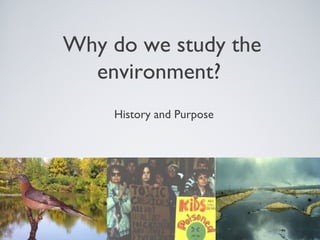
Why do we study the
environment?
History and Purpose
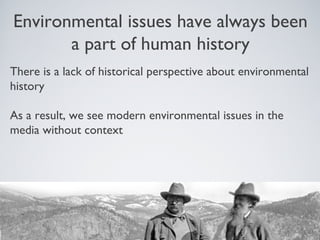
Environmental issues have always been
a part of human history
There is a lack of historical perspective about environmental
history
As a result, we see modern environmental issues in the
media without context
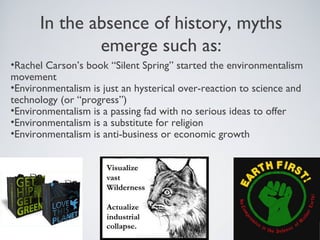
In the absence of history, myths
emerge such as:
•Rachel Carson’s book “Silent Spring” started the environmentalism
movement
•Environmentalism is just an hysterical over-reaction to science and
technology (or “progress”)
•Environmentalism is a passing fad with no serious ideas to offer
•Environmentalism is a substitute for religion
•Environmentalism is anti-business or economic growth
What are some ecological lessons we
can learn from past events?
What events strike a chord with you?
Why?
In the past, individuals could often affect
huge change. Do you think individuals can
have the same impact in today’s world?
Why?
Three “revolutions” are significant in the
development of environmental science
1.Agricultural Revolution
2.Industrial-Medical Revolution
3.Information-Globalization Revolution
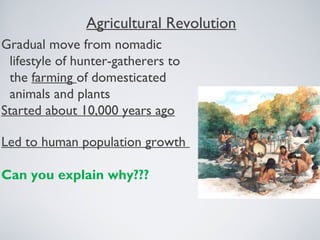
Agricultural Revolution
Gradual move from nomadic
lifestyle of hunter-gatherers to
the farming of domesticated
animals and plants
Started about 10,000 years ago
Led to human population growth
Can you explain why???
Ancient Times
Air pollution from wood burning, dust, tanneries,
sewage
Water pollution from dumping sewage and
garbage
Deforestation with the rise of Greek and Italian
civilization
start to rely on passive solar heating more
Soil conservation practiced in China, India, and
Peru
erosion a problem in hilly regions
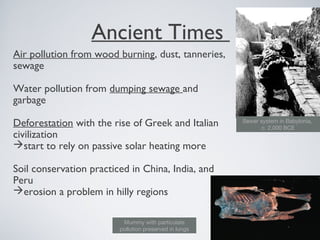
Sewer system in Babylonia,
c. 2,000 BCE
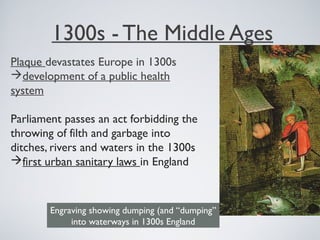
Mummy with particulate
pollution preserved in lungs
1300s - The Middle Ages
Plaque devastates Europe in 1300s
development of a public health
system
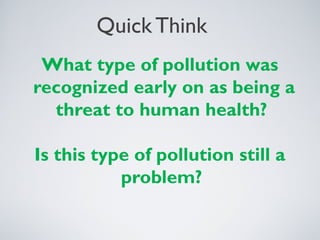
Parliament passes an act forbidding the
throwing of filth and garbage into
ditches, rivers and waters in the 1300s
first urban sanitary laws in England
Engraving showing dumping (and “dumping”
into waterways in 1300s England
Quick Think
What type of pollution was
recognized early on as being a
threat to human health?
Is this type of pollution still a
problem?
1600s - Renaissance
Deforestation for building and fuel in England,
France, Germany in 1600s leave large areas
bare
Switch to the use of coal for fuel
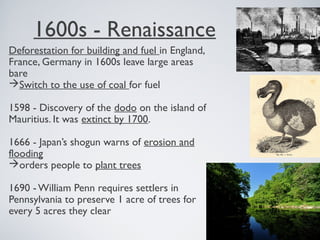
1598 - Discovery of the dodo on the island of
Mauritius. It was extinct by 1700.
1666 - Japan’s shogun warns of erosion and
flooding
orders people to plant trees
1690 - William Penn requires settlers in
Pennsylvania to preserve 1 acre of trees for
every 5 acres they clear
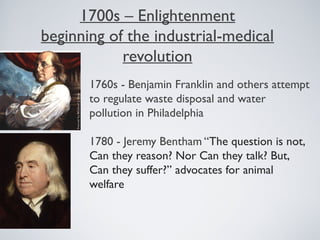
1700s – Enlightenment
beginning of the industrial-medical
revolution
1760s - Benjamin Franklin and others attempt
to regulate waste disposal and water
pollution in Philadelphia
1780 - Jeremy Bentham “The question is not,
Can they reason? Nor Can they talk? But,
Can they suffer?” advocates for animal
welfare
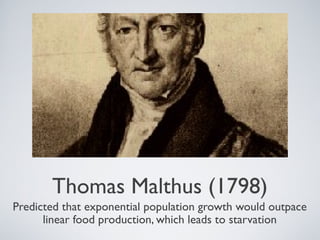
Thomas Malthus (1798)
Predicted that exponential population growth would outpace
linear food production, which leads to starvation
Quick Think
Industry and medicine are
considered good things by most
people (and they are!).
Why might these two things
contribute to environmental
problems?
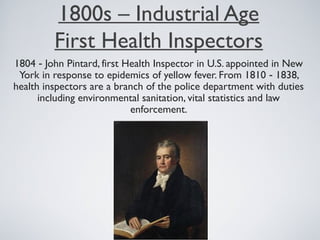
1800s – Industrial Age
First Health Inspectors
1804 - John Pintard, first Health Inspector in U.S. appointed in New
York in response to epidemics of yellow fever. From 1810 - 1838,
health inspectors are a branch of the police department with duties
including environmental sanitation, vital statistics and law
enforcement.
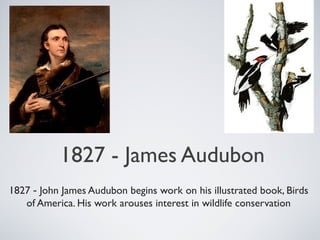
1827 - James Audubon
1827 - John James Audubon begins work on his illustrated book, Birds
of America. His work arouses interest in wildlife conservation
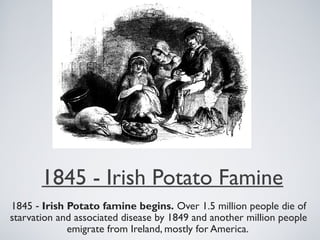
1845 - Irish Potato Famine
1845 - Irish Potato famine begins. Over 1.5 million people die of
starvation and associated disease by 1849 and another million people
emigrate from Ireland, mostly for America.
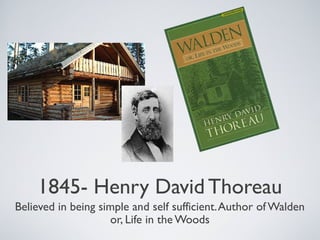
1845- Henry David Thoreau
Believed in being simple and self sufficient.Author of Walden
or, Life in the Woods
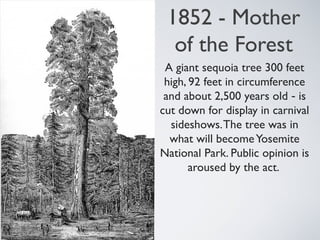
1852 - Mother
of the Forest
A giant sequoia tree 300 feet
high, 92 feet in circumference
and about 2,500 years old - is
cut down for display in carnival
sideshows.The tree was in
what will becomeYosemite
National Park. Public opinion is
aroused by the act.
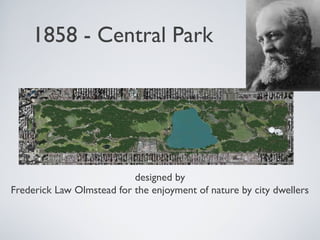
1858 - Central Park
designed by
Frederick Law Olmstead for the enjoyment of nature by city dwellers
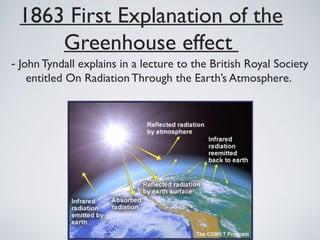
1863 First Explanation of the
Greenhouse effect
- John Tyndall explains in a lecture to the British Royal Society
entitled On Radiation Through the Earth’s Atmosphere.
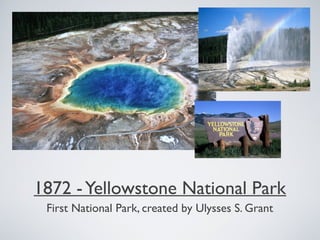
1872 -Yellowstone National Park
First National Park, created by Ulysses S. Grant
Quick Think
How are individuals shaping
the way people think about
and respond to the
environment during the
1800s?
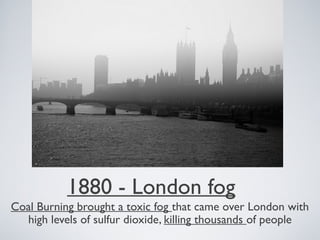
1880 - London fog
Coal Burning brought a toxic fog that came over London with
high levels of sulfur dioxide, killing thousands of people
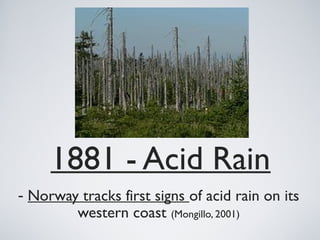
1881 - Acid Rain
- Norway tracks first signs of acid rain on its
western coast (Mongillo, 2001)
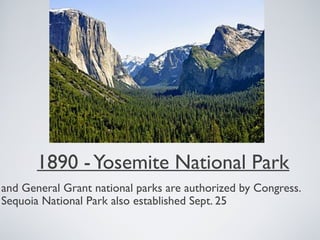
1890 -Yosemite National Park
and General Grant national parks are authorized by Congress.
Sequoia National Park also established Sept. 25
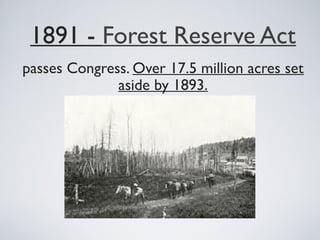
1891 - Forest Reserve Act
passes Congress. Over 17.5 million acres set
aside by 1893.
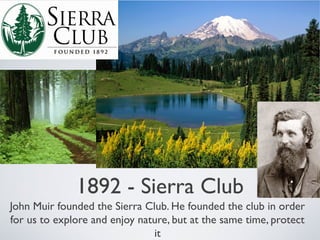
1892 - Sierra Club
John Muir founded the Sierra Club. He founded the club in order
for us to explore and enjoy nature, but at the same time, protect
it
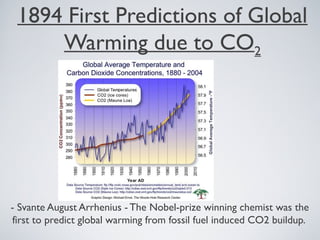
1894 First Predictions of Global
Warming due to CO2
- Svante August Arrhenius - The Nobel-prize winning chemist was the
first to predict global warming from fossil fuel induced CO2 buildup.
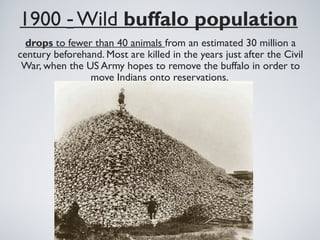
1900 - Wild buffalo population
drops to fewer than 40 animals from an estimated 30 million a
century beforehand. Most are killed in the years just after the Civil
War, when the US Army hopes to remove the buffalo in order to
move Indians onto reservations.
Quick Think
On the one hand, we have air pollution, the
destruction of entire species, and acid rain.
On the other hand, we have the creation of
national parks, forest reserves, and clubs
dedicated to preserving nature.
Why do you think we can be so split in how we
manage the environment?
Do you think people are still this way?
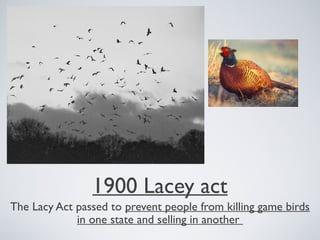
1900 Lacey act
The Lacy Act passed to prevent people from killing game birds
in one state and selling in another
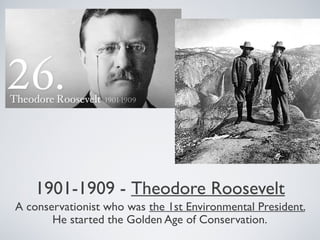
1901-1909 - Theodore Roosevelt
A conservationist who was the 1st Environmental President.
He started the Golden Age of Conservation.
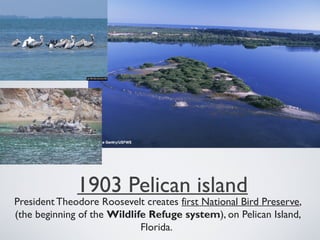
1903 Pelican island
President Theodore Roosevelt creates first National Bird Preserve,
(the beginning of the Wildlife Refuge system), on Pelican Island,
Florida.
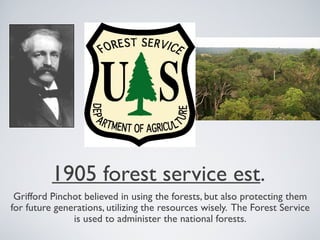
1905 forest service est.
Grifford Pinchot believed in using the forests, but also protecting them
for future generations, utilizing the resources wisely. The Forest Service
is used to administer the national forests.
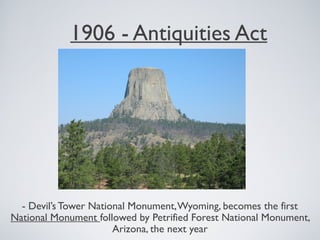
1906 - Antiquities Act
- Devil’s Tower National Monument,Wyoming, becomes the first
National Monument followed by Petrified Forest National Monument,
Arizona, the next year
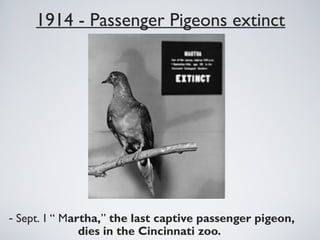
1914 - Passenger Pigeons extinct
- Sept. 1 “ Martha,” the last captive passenger pigeon,
dies in the Cincinnati zoo. 
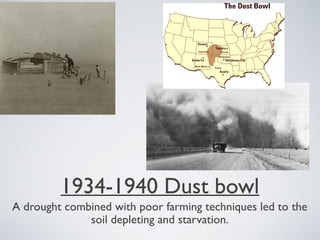
1934-1940 Dust bowl
A drought combined with poor farming techniques led to the
soil depleting and starvation.
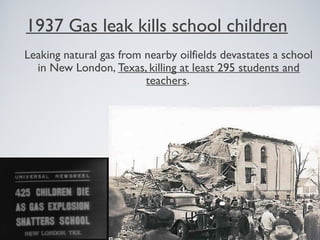
1937 Gas leak kills school children
Leaking natural gas from nearby oilfields devastates a school
in New London, Texas, killing at least 295 students and
teachers.
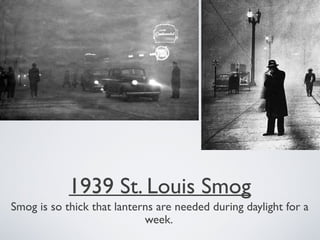
1939 St. Louis Smog
Smog is so thick that lanterns are needed during daylight for a
week.
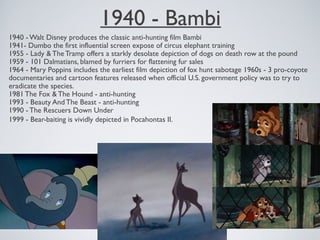
1940 - Bambi
1940 - Walt Disney produces the classic anti-hunting film Bambi
1941- Dumbo the first influential screen expose of circus elephant training
1955 - Lady & The Tramp offers a starkly desolate depiction of dogs on death row at the pound
1959 - 101 Dalmatians, blamed by furriers for flattening fur sales
1964 - Mary Poppins includes the earliest film depiction of fox hunt sabotage 1960s - 3 pro-coyote
documentaries and cartoon features released when official U.S. government policy was to try to
eradicate the species.
1981 The Fox & The Hound - anti-hunting
1993 - Beauty And The Beast - anti-hunting
1990 - The Rescuers Down Under
1999 - Bear-baiting is vividly depicted in Pocahontas II.
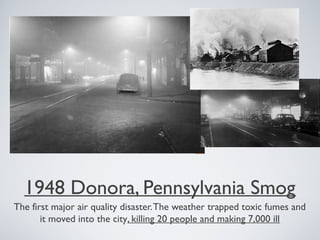
1948 Donora, Pennsylvania Smog
The first major air quality disaster.The weather trapped toxic fumes and
it moved into the city, killing 20 people and making 7,000 ill
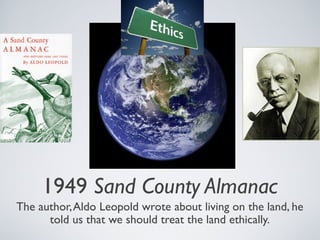
1949 Sand County Almanac
The author,Aldo Leopold wrote about living on the land, he
told us that we should treat the land ethically.
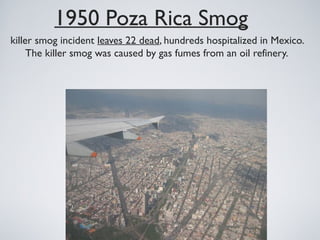
1950 Poza Rica Smog
killer smog incident leaves 22 dead, hundreds hospitalized in Mexico.
The killer smog was caused by gas fumes from an oil refinery.
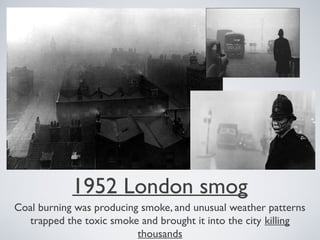
1952 London smog
Coal burning was producing smoke, and unusual weather patterns
trapped the toxic smoke and brought it into the city killing
thousands
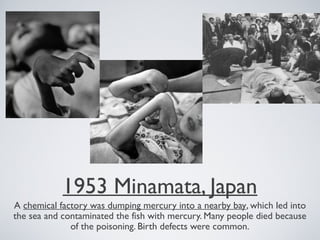
1953 Minamata, Japan
A chemical factory was dumping mercury into a nearby bay, which led into
the sea and contaminated the fish with mercury. Many people died because
of the poisoning. Birth defects were common.
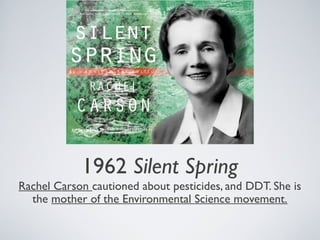
1962 Silent Spring
Rachel Carson cautioned about pesticides, and DDT. She is
the mother of the Environmental Science movement.
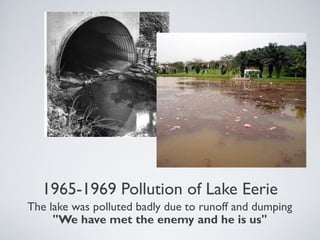
1965-1969 Pollution of Lake Eerie
The lake was polluted badly due to runoff and dumping
"We have met the enemy and he is us"
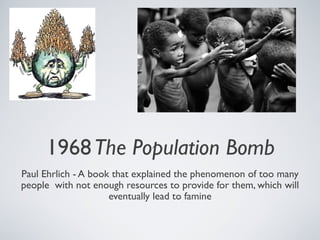
1968The Population Bomb
Paul Ehrlich - A book that explained the phenomenon of too many
people with not enough resources to provide for them, which will
eventually lead to famine
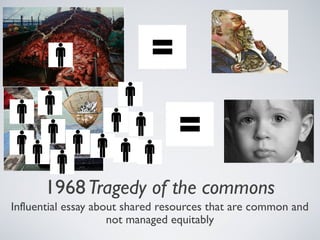
1968Tragedy of the commons
Influential essay about shared resources that are common and
not managed equitably
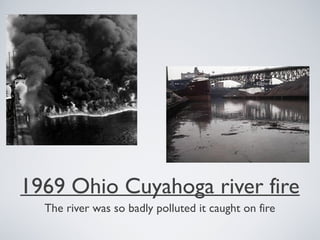
1969 Ohio Cuyahoga river fire
The river was so badly polluted it caught on fire
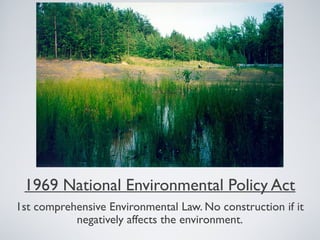
1969 National Environmental Policy Act
1st comprehensive Environmental Law. No construction if it
negatively affects the environment.
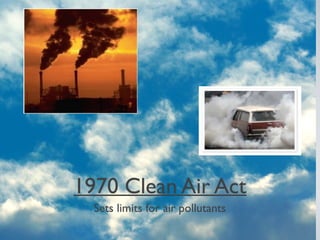
1970 Clean Air Act
Sets limits for air pollutants
1970 EPA established
Nixon established the EPA
1970 first earth day
April 22nd
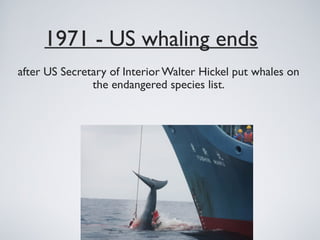
1971 - US whaling ends
after US Secretary of Interior Walter Hickel put whales on
the endangered species list.
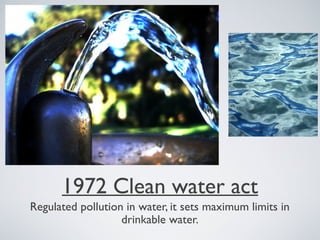
1972 Clean water act
Regulated pollution in water, it sets maximum limits in
drinkable water.
Quick Think
After many environmental tragedies that harmed
thousands of people, laws were created to help
protect people and ensure they had access to safe
water and clean air. Laws were also created to
preserve and protect wildlife.
Do you think it was necessary to pass laws (that
come with penalties) in order to get people and
companies to “do the right thing”?
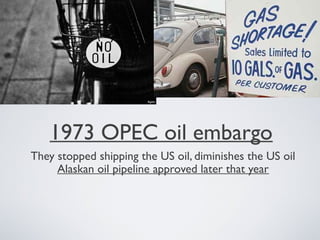
1973 OPEC oil embargo
They stopped shipping the US oil, diminishes the US oil
Alaskan oil pipeline approved later that year
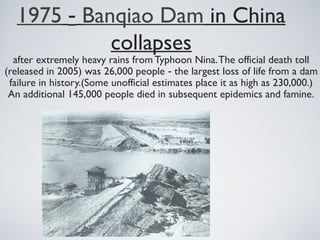
1975 - Banqiao Dam in China
collapses
after extremely heavy rains from Typhoon Nina.The official death toll
(released in 2005) was 26,000 people - the largest loss of life from a dam
failure in history.(Some unofficial estimates place it as high as 230,000.)
An additional 145,000 people died in subsequent epidemics and famine.
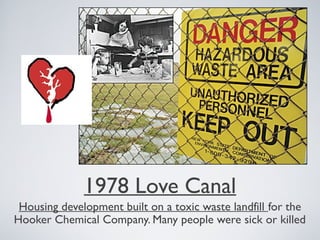
1978 Love Canal
Housing development built on a toxic waste landfill for the
Hooker Chemical Company. Many people were sick or killed
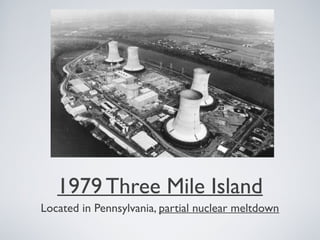
1979 Three Mile Island
Located in Pennsylvania, partial nuclear meltdown
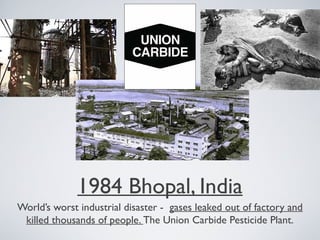
1984 Bhopal, India
World’s worst industrial disaster - gases leaked out of factory and
killed thousands of people. The Union Carbide Pesticide Plant.
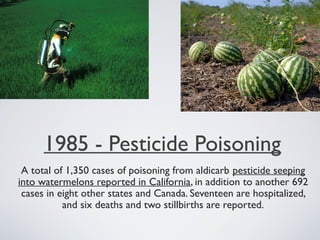
1985 - Pesticide Poisoning
A total of 1,350 cases of poisoning from aldicarb pesticide seeping
into watermelons reported in California, in addition to another 692
cases in eight other states and Canada. Seventeen are hospitalized,
and six deaths and two stillbirths are reported.
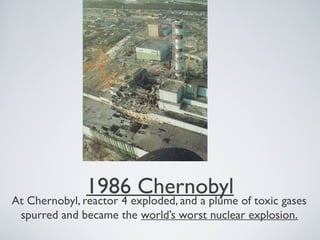
1986 ChernobylAt Chernobyl, reactor 4 exploded, and a plume of toxic gases
spurred and became the world’s worst nuclear explosion.
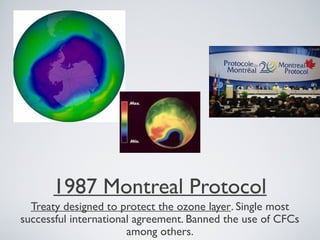
1987 Montreal Protocol
Treaty designed to protect the ozone layer. Single most
successful international agreement. Banned the use of CFCs
among others.
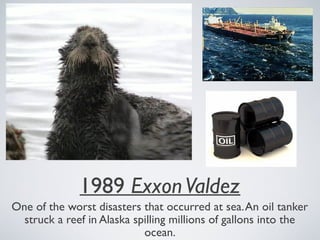
1989 ExxonValdez
One of the worst disasters that occurred at sea.An oil tanker
struck a reef in Alaska spilling millions of gallons into the
ocean.
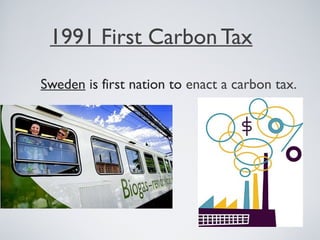
1991 First Carbon Tax
Sweden is first nation to enact a carbon tax.
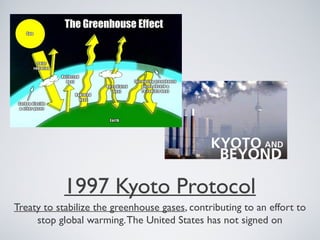
1997 Kyoto Protocol
Treaty to stabilize the greenhouse gases, contributing to an effort to
stop global warming.The United States has not signed on
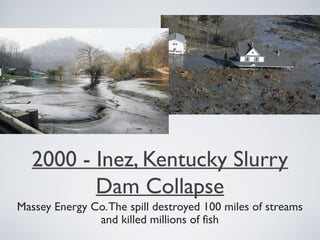
2000 - Inez, Kentucky Slurry
Dam Collapse
Massey Energy Co.The spill destroyed 100 miles of streams
and killed millions of fish
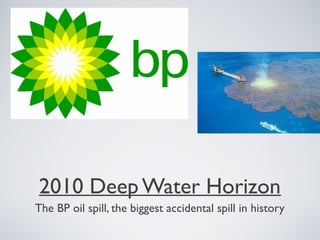
2010 Deep Water Horizon
The BP oil spill, the biggest accidental spill in history
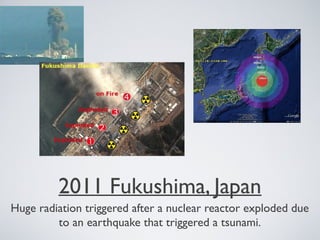
2011 Fukushima, Japan
Huge radiation triggered after a nuclear reactor exploded due
to an earthquake that triggered a tsunami.
What are some ecological lessons
we can learn from past events?
What events strike a chord with
you? Why?
In the past, individuals could often
affect huge change. Do you think
individuals can have the same impact
in today’s world? Why?

APES Environmental science timeline

  • 1.
  • 2.
    What are someecological lessons we can learn from past events? What events strike a chord with you? Why? In the past, individuals could often affect huge change. Do you think individuals can have the same impact in today’s world? Why?
  • 3.
    Why do westudy the environment? History and Purpose
  • 4.
    Environmental issues havealways been a part of human history There is a lack of historical perspective about environmental history As a result, we see modern environmental issues in the media without context
  • 5.
    In the absenceof history, myths emerge such as: •Rachel Carson’s book “Silent Spring” started the environmentalism movement •Environmentalism is just an hysterical over-reaction to science and technology (or “progress”) •Environmentalism is a passing fad with no serious ideas to offer •Environmentalism is a substitute for religion •Environmentalism is anti-business or economic growth
  • 6.
    What are someecological lessons we can learn from past events? What events strike a chord with you? Why? In the past, individuals could often affect huge change. Do you think individuals can have the same impact in today’s world? Why?
  • 7.
    Three “revolutions” aresignificant in the development of environmental science 1.Agricultural Revolution 2.Industrial-Medical Revolution 3.Information-Globalization Revolution
  • 8.
    Agricultural Revolution Gradual movefrom nomadic lifestyle of hunter-gatherers to the farming of domesticated animals and plants Started about 10,000 years ago Led to human population growth Can you explain why???
  • 9.
    Ancient Times Air pollutionfrom wood burning, dust, tanneries, sewage Water pollution from dumping sewage and garbage Deforestation with the rise of Greek and Italian civilization start to rely on passive solar heating more Soil conservation practiced in China, India, and Peru erosion a problem in hilly regions Sewer system in Babylonia, c. 2,000 BCE Mummy with particulate pollution preserved in lungs
  • 10.
    1300s - TheMiddle Ages Plaque devastates Europe in 1300s development of a public health system Parliament passes an act forbidding the throwing of filth and garbage into ditches, rivers and waters in the 1300s first urban sanitary laws in England Engraving showing dumping (and “dumping” into waterways in 1300s England
  • 11.
    Quick Think What typeof pollution was recognized early on as being a threat to human health? Is this type of pollution still a problem?
  • 12.
    1600s - Renaissance Deforestationfor building and fuel in England, France, Germany in 1600s leave large areas bare Switch to the use of coal for fuel 1598 - Discovery of the dodo on the island of Mauritius. It was extinct by 1700. 1666 - Japan’s shogun warns of erosion and flooding orders people to plant trees 1690 - William Penn requires settlers in Pennsylvania to preserve 1 acre of trees for every 5 acres they clear
  • 13.
    1700s – Enlightenment beginningof the industrial-medical revolution 1760s - Benjamin Franklin and others attempt to regulate waste disposal and water pollution in Philadelphia 1780 - Jeremy Bentham “The question is not, Can they reason? Nor Can they talk? But, Can they suffer?” advocates for animal welfare
  • 14.
    Thomas Malthus (1798) Predictedthat exponential population growth would outpace linear food production, which leads to starvation
  • 15.
    Quick Think Industry andmedicine are considered good things by most people (and they are!). Why might these two things contribute to environmental problems?
  • 16.
    1800s – IndustrialAge First Health Inspectors 1804 - John Pintard, first Health Inspector in U.S. appointed in New York in response to epidemics of yellow fever. From 1810 - 1838, health inspectors are a branch of the police department with duties including environmental sanitation, vital statistics and law enforcement.
  • 17.
    1827 - JamesAudubon 1827 - John James Audubon begins work on his illustrated book, Birds of America. His work arouses interest in wildlife conservation
  • 18.
    1845 - IrishPotato Famine 1845 - Irish Potato famine begins. Over 1.5 million people die of starvation and associated disease by 1849 and another million people emigrate from Ireland, mostly for America.
  • 19.
    1845- Henry DavidThoreau Believed in being simple and self sufficient.Author of Walden or, Life in the Woods
  • 20.
    1852 - Mother ofthe Forest A giant sequoia tree 300 feet high, 92 feet in circumference and about 2,500 years old - is cut down for display in carnival sideshows.The tree was in what will becomeYosemite National Park. Public opinion is aroused by the act.
  • 21.
    1858 - CentralPark designed by Frederick Law Olmstead for the enjoyment of nature by city dwellers
  • 22.
    1863 First Explanationof the Greenhouse effect - John Tyndall explains in a lecture to the British Royal Society entitled On Radiation Through the Earth’s Atmosphere.
  • 23.
    1872 -Yellowstone NationalPark First National Park, created by Ulysses S. Grant
  • 24.
    Quick Think How areindividuals shaping the way people think about and respond to the environment during the 1800s?
  • 25.
    1880 - Londonfog Coal Burning brought a toxic fog that came over London with high levels of sulfur dioxide, killing thousands of people
  • 26.
    1881 - AcidRain - Norway tracks first signs of acid rain on its western coast (Mongillo, 2001)
  • 27.
    1890 -Yosemite NationalPark and General Grant national parks are authorized by Congress. Sequoia National Park also established Sept. 25
  • 28.
    1891 - ForestReserve Act passes Congress. Over 17.5 million acres set aside by 1893.
  • 29.
    1892 - SierraClub John Muir founded the Sierra Club. He founded the club in order for us to explore and enjoy nature, but at the same time, protect it
  • 30.
    1894 First Predictionsof Global Warming due to CO2 - Svante August Arrhenius - The Nobel-prize winning chemist was the first to predict global warming from fossil fuel induced CO2 buildup.
  • 31.
    1900 - Wildbuffalo population drops to fewer than 40 animals from an estimated 30 million a century beforehand. Most are killed in the years just after the Civil War, when the US Army hopes to remove the buffalo in order to move Indians onto reservations.
  • 32.
    Quick Think On theone hand, we have air pollution, the destruction of entire species, and acid rain. On the other hand, we have the creation of national parks, forest reserves, and clubs dedicated to preserving nature. Why do you think we can be so split in how we manage the environment? Do you think people are still this way?
  • 33.
    1900 Lacey act TheLacy Act passed to prevent people from killing game birds in one state and selling in another
  • 34.
    1901-1909 - TheodoreRoosevelt A conservationist who was the 1st Environmental President. He started the Golden Age of Conservation.
  • 35.
    1903 Pelican island PresidentTheodore Roosevelt creates first National Bird Preserve, (the beginning of the Wildlife Refuge system), on Pelican Island, Florida.
  • 36.
    1905 forest serviceest. Grifford Pinchot believed in using the forests, but also protecting them for future generations, utilizing the resources wisely. The Forest Service is used to administer the national forests.
  • 37.
    1906 - AntiquitiesAct - Devil’s Tower National Monument,Wyoming, becomes the first National Monument followed by Petrified Forest National Monument, Arizona, the next year
  • 38.
    1914 - PassengerPigeons extinct - Sept. 1 “ Martha,” the last captive passenger pigeon, dies in the Cincinnati zoo. 
  • 39.
    1934-1940 Dust bowl Adrought combined with poor farming techniques led to the soil depleting and starvation.
  • 40.
    1937 Gas leakkills school children Leaking natural gas from nearby oilfields devastates a school in New London, Texas, killing at least 295 students and teachers.
  • 41.
    1939 St. LouisSmog Smog is so thick that lanterns are needed during daylight for a week.
  • 42.
    1940 - Bambi 1940- Walt Disney produces the classic anti-hunting film Bambi 1941- Dumbo the first influential screen expose of circus elephant training 1955 - Lady & The Tramp offers a starkly desolate depiction of dogs on death row at the pound 1959 - 101 Dalmatians, blamed by furriers for flattening fur sales 1964 - Mary Poppins includes the earliest film depiction of fox hunt sabotage 1960s - 3 pro-coyote documentaries and cartoon features released when official U.S. government policy was to try to eradicate the species. 1981 The Fox & The Hound - anti-hunting 1993 - Beauty And The Beast - anti-hunting 1990 - The Rescuers Down Under 1999 - Bear-baiting is vividly depicted in Pocahontas II.
  • 43.
    1948 Donora, PennsylvaniaSmog The first major air quality disaster.The weather trapped toxic fumes and it moved into the city, killing 20 people and making 7,000 ill
  • 44.
    1949 Sand CountyAlmanac The author,Aldo Leopold wrote about living on the land, he told us that we should treat the land ethically.
  • 45.
    1950 Poza RicaSmog killer smog incident leaves 22 dead, hundreds hospitalized in Mexico. The killer smog was caused by gas fumes from an oil refinery.
  • 46.
    1952 London smog Coalburning was producing smoke, and unusual weather patterns trapped the toxic smoke and brought it into the city killing thousands
  • 47.
    1953 Minamata, Japan Achemical factory was dumping mercury into a nearby bay, which led into the sea and contaminated the fish with mercury. Many people died because of the poisoning. Birth defects were common.
  • 48.
    1962 Silent Spring RachelCarson cautioned about pesticides, and DDT. She is the mother of the Environmental Science movement.
  • 49.
    1965-1969 Pollution ofLake Eerie The lake was polluted badly due to runoff and dumping "We have met the enemy and he is us"
  • 50.
    1968The Population Bomb PaulEhrlich - A book that explained the phenomenon of too many people with not enough resources to provide for them, which will eventually lead to famine
  • 51.
    1968Tragedy of thecommons Influential essay about shared resources that are common and not managed equitably
  • 52.
    1969 Ohio Cuyahogariver fire The river was so badly polluted it caught on fire
  • 53.
    1969 National EnvironmentalPolicy Act 1st comprehensive Environmental Law. No construction if it negatively affects the environment.
  • 54.
    1970 Clean AirAct Sets limits for air pollutants
  • 55.
    1970 EPA established Nixonestablished the EPA
  • 56.
    1970 first earthday April 22nd
  • 57.
    1971 - USwhaling ends after US Secretary of Interior Walter Hickel put whales on the endangered species list.
  • 58.
    1972 Clean wateract Regulated pollution in water, it sets maximum limits in drinkable water.
  • 59.
    Quick Think After manyenvironmental tragedies that harmed thousands of people, laws were created to help protect people and ensure they had access to safe water and clean air. Laws were also created to preserve and protect wildlife. Do you think it was necessary to pass laws (that come with penalties) in order to get people and companies to “do the right thing”?
  • 60.
    1973 OPEC oilembargo They stopped shipping the US oil, diminishes the US oil Alaskan oil pipeline approved later that year
  • 61.
    1975 - BanqiaoDam in China collapses after extremely heavy rains from Typhoon Nina.The official death toll (released in 2005) was 26,000 people - the largest loss of life from a dam failure in history.(Some unofficial estimates place it as high as 230,000.) An additional 145,000 people died in subsequent epidemics and famine.
  • 62.
    1978 Love Canal Housingdevelopment built on a toxic waste landfill for the Hooker Chemical Company. Many people were sick or killed
  • 63.
    1979 Three MileIsland Located in Pennsylvania, partial nuclear meltdown
  • 64.
    1984 Bhopal, India World’sworst industrial disaster - gases leaked out of factory and killed thousands of people. The Union Carbide Pesticide Plant.
  • 65.
    1985 - PesticidePoisoning A total of 1,350 cases of poisoning from aldicarb pesticide seeping into watermelons reported in California, in addition to another 692 cases in eight other states and Canada. Seventeen are hospitalized, and six deaths and two stillbirths are reported.
  • 66.
    1986 ChernobylAt Chernobyl,reactor 4 exploded, and a plume of toxic gases spurred and became the world’s worst nuclear explosion.
  • 67.
    1987 Montreal Protocol Treatydesigned to protect the ozone layer. Single most successful international agreement. Banned the use of CFCs among others.
  • 68.
    1989 ExxonValdez One ofthe worst disasters that occurred at sea.An oil tanker struck a reef in Alaska spilling millions of gallons into the ocean.
  • 69.
    1991 First CarbonTax Sweden is first nation to enact a carbon tax.
  • 70.
    1997 Kyoto Protocol Treatyto stabilize the greenhouse gases, contributing to an effort to stop global warming.The United States has not signed on
  • 71.
    2000 - Inez,Kentucky Slurry Dam Collapse Massey Energy Co.The spill destroyed 100 miles of streams and killed millions of fish
  • 72.
    2010 Deep WaterHorizon The BP oil spill, the biggest accidental spill in history
  • 73.
    2011 Fukushima, Japan Hugeradiation triggered after a nuclear reactor exploded due to an earthquake that triggered a tsunami.
  • 74.
    What are someecological lessons we can learn from past events? What events strike a chord with you? Why? In the past, individuals could often affect huge change. Do you think individuals can have the same impact in today’s world? Why?

Editor's Notes

  • #5 Surprising? Evidence in texts, historical documents, etc. Goes by many names in the past including: conservation, public health, municipal housekeeping, and home ecology. “Environmental” is a modern term
  • #6 These myths make it seem like environmental concerns can be safely ignored. Nothing could be further from the truth.  The modern global environmental crisis requires an understanding of history that is only recently becoming available.
  • #11 A brief and incomplete history, to be sure!
  • #13 Industrial revolution
  • #15 Reverend "The power of population is indefinitely greater than the power in the earth to produce subsistence for man“ Common view was humanity was moving toward a utopian society.
  • #19 The problem was not only the failure of the potato crop, but rather, the laws which encouraged English landowners to export grain back to England. Irish historians today regard the disaster as one of history’s great genocides.
  • #36 In all, by 1909 the Roosevelt administration creates 42 million acres of national forests, 53 national wildlife refuges and 18 areas of special interest,- including the Grand Canyon. The record will not bet equaled until Bill Clinton’s last year in office.
  • #38 gives a president the power to designate national monuments on his own accord, giving them nearly the same protection as if Congress had declared them national parks or wilderness areas
  • #41 One lesson learned: natural gas needs odorants - so that people can tell when gas is leaking. Regulations requiring natural gas suppliers to add odorants are quickly adopted in the wake of the tragedy.
  • #42 The smog episode sparks a crusade by the St. Louis Post Dispatch which, in 1940, is rewarded with the first Pulitzer Prize for what would later be called environmental reporting.
  • #66 The incident is the worst US outbreak of pesticide poisoning in history. Still, it would take until 2010 for EPA to ban aldicarb