Update: TransPAC3and America Connects to EuropeJames WilliamsDirector, International NetworkingIndiana Universitywilliams@indiana.edu
TopicsACE and TP3 current statusNetwork-based services - revisitedStimulating research and education with better tools - revisitedWorking together – continuedOpenFlow – a new opportunity for collaboration
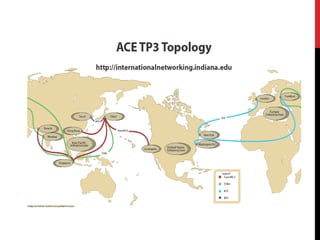
TransPAC3 – Connecting Asia and the US BackgroundUS lead partner:  Indiana UniversityPartners:  APAN, TEIN3, NICT-Japan, NII-Japan, CERNET – China, DLT, others…Multiple 10G connections from the US to Asia, 40/100G optionConnections continued to Southeast Asia and South Asia via partnersConnection to TEIN3 network provides link to EuropeConnection to Internet2/NLR on US West CoastAsian part of TP3-TEIN3-GN3-ACE global network
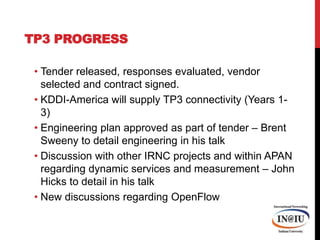
TP3 ProgressTender released, responses evaluated, vendor selected and contract signed.KDDI-America will supply TP3 connectivity (Years 1-3)Engineering plan approved as part of tender – Brent Sweeny to detail engineering in his talkDiscussion with other IRNC projects and within APAN regarding dynamic services and measurement – John Hicks to detail in his talkNew discussions regarding OpenFlow
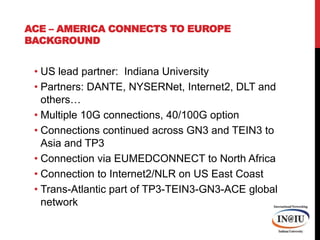
ACE – America Connects to EuropeBackgroundUS lead partner:  Indiana UniversityPartners: DANTE, NYSERNet, Internet2, DLT and others…Multiple 10G connections, 40/100G optionConnections continued across GN3 and TEIN3 to Asia and TP3Connection via EUMEDCONNECT to North AfricaConnection to Internet2/NLR on US East CoastTrans-Atlantic part of TP3-TEIN3-GN3-ACE global network
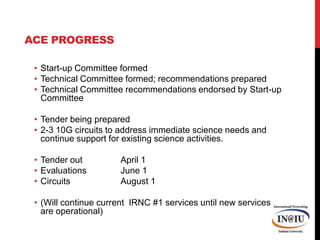
ACE ProgressStart-up Committee formedTechnical Committee formed; recommendations preparedTechnical Committee recommendations endorsed by Start-up CommitteeTender being prepared2-3 10G circuits to address immediate science needs and continue support for existing science activities.Tender out 		April 1Evaluations 	June 1Circuits 	August 1 (Will continue current  IRNC #1 services until new servicesare operational)
Network-based Services: Accountability and ServiceUtilization statistics in a useable forme-2-e measurement – what researchers are really concerned aboutCustom networks and connections (dynamic circuits provisioned by researchers)As networks and network operations  become more transparent, network operators must become more accountable.  As networks become “more global” network operators must develop tools and mechanisms for shared/distributed operations.  See: http://groups.geni.net/geni/wiki/K-GENISecurity, security, security….how can we cooperatively attack this problem? One possible component:  http://www.ren-isac.net/ses/
Stimulating Research and Education through Better ToolsDevelopment of tools to make researcher-provisioned connections and networks much simpler (no engineer involvement). Better collaboration tools using “social media-based” tools – for example, see the following:  https://hubzero.org/Researcher-specific tools, such as the Science DMZ need to be discussed and possibly deployed.  See references…Possible new ways of “thinking about networking” – OpenFlow as the prime example.  See upcoming slide.Outreach activities, particularly in developing areas, designed to increase international research and education collaborations -- see the following: http://usindiaworkshop.indiana.edu/
Working Together  (cont.)The provisioning task is simple (sort of), it is the coordination task that now needs the attention; now we need an array of cooperative activities…“develop world class IT infrastructure to enable and facilitate world class science…to accelerate the uptake of research results to help achieve competiveness through innovation”…not a direct quote and not my words…but well-said. In the rush for “universal broadband connectivity”, we cannot lose sight of (be distracted from) the critical need for science support.  See the Steve Cotter presentation at the recent Clemson Joint Techs.We must work together to develop integrated  international R/E network infrastructure, extending networking to developing areas in new forms and addressing the impending “flood of data” from many sources (bio, climate, HEP, astro).  Global network connectivity and the development of a global R/E workspace is a global task; we all need to coordinate  globally to achieve our goals [APAN, DANTE, GLIF, ISOC etc…]/
OpenFlow – a new area for research and cooperationIndiana University has made a new, substantial investment in OpenFlow (software defined networking [SDN]) including lab space, an educational activity and significant resources focused on software development.“…lab or center focused on the mission of building collaborations among researchers, students and IT networking staff around Software-Defined Networks to catalyze the creation of new SDN-based technologies and transition these technologies from research labs to production networks” – IU internal documentIU is developing partnerships within the US with both public and private organizations.ACE and TP3 are very interested in developing international OpenFlow partnerships leading to a global OpenFlowtestbed (and more generally, a global R/E network research testbed).Speak with me or Chris Small (from the FIT WG presentation) for additional information….
Visit our web siteSee us on Facebookhttp://internationalnetworking.indiana.edu/http://www.facebook.com/pages/International-Networking-at-IU/175680739126765
Interesting LinksIN@IU 			http://internationalnetworking@iu.eduAPAN:  			http://www.apan.netDANTE:			http://www.dante.net/NSF IRNC program:		http://www.irnclinks.netGlobalNOC:		http://globalnoc.iu.eduOpenFlow:			 http://www.openflowswitch.org/ESnet pages fasterdatahttp://fasterdata.es.net/ESnet home		 http://www.es.net/Eli Dart talk		 http://events.internet2.edu/2011/jt-clemson/agenda.cfm?go=session&id=10001539&event=1150Jim Williams: 		 williams@indiana.edu

APAN31 - ACE & TransPAC3 (update)

  • 1.
    Update: TransPAC3and AmericaConnects to EuropeJames WilliamsDirector, International NetworkingIndiana Universitywilliams@indiana.edu
  • 2.
    TopicsACE and TP3current statusNetwork-based services - revisitedStimulating research and education with better tools - revisitedWorking together – continuedOpenFlow – a new opportunity for collaboration
  • 3.
    TransPAC3 – ConnectingAsia and the US BackgroundUS lead partner: Indiana UniversityPartners: APAN, TEIN3, NICT-Japan, NII-Japan, CERNET – China, DLT, others…Multiple 10G connections from the US to Asia, 40/100G optionConnections continued to Southeast Asia and South Asia via partnersConnection to TEIN3 network provides link to EuropeConnection to Internet2/NLR on US West CoastAsian part of TP3-TEIN3-GN3-ACE global network
  • 4.
    TP3 ProgressTender released,responses evaluated, vendor selected and contract signed.KDDI-America will supply TP3 connectivity (Years 1-3)Engineering plan approved as part of tender – Brent Sweeny to detail engineering in his talkDiscussion with other IRNC projects and within APAN regarding dynamic services and measurement – John Hicks to detail in his talkNew discussions regarding OpenFlow
  • 5.
    ACE – AmericaConnects to EuropeBackgroundUS lead partner: Indiana UniversityPartners: DANTE, NYSERNet, Internet2, DLT and others…Multiple 10G connections, 40/100G optionConnections continued across GN3 and TEIN3 to Asia and TP3Connection via EUMEDCONNECT to North AfricaConnection to Internet2/NLR on US East CoastTrans-Atlantic part of TP3-TEIN3-GN3-ACE global network
  • 6.
    ACE ProgressStart-up CommitteeformedTechnical Committee formed; recommendations preparedTechnical Committee recommendations endorsed by Start-up CommitteeTender being prepared2-3 10G circuits to address immediate science needs and continue support for existing science activities.Tender out April 1Evaluations June 1Circuits August 1 (Will continue current IRNC #1 services until new servicesare operational)
  • 8.
    Network-based Services: Accountabilityand ServiceUtilization statistics in a useable forme-2-e measurement – what researchers are really concerned aboutCustom networks and connections (dynamic circuits provisioned by researchers)As networks and network operations become more transparent, network operators must become more accountable. As networks become “more global” network operators must develop tools and mechanisms for shared/distributed operations. See: http://groups.geni.net/geni/wiki/K-GENISecurity, security, security….how can we cooperatively attack this problem? One possible component: http://www.ren-isac.net/ses/
  • 9.
    Stimulating Research andEducation through Better ToolsDevelopment of tools to make researcher-provisioned connections and networks much simpler (no engineer involvement). Better collaboration tools using “social media-based” tools – for example, see the following: https://hubzero.org/Researcher-specific tools, such as the Science DMZ need to be discussed and possibly deployed. See references…Possible new ways of “thinking about networking” – OpenFlow as the prime example. See upcoming slide.Outreach activities, particularly in developing areas, designed to increase international research and education collaborations -- see the following: http://usindiaworkshop.indiana.edu/
  • 10.
    Working Together (cont.)The provisioning task is simple (sort of), it is the coordination task that now needs the attention; now we need an array of cooperative activities…“develop world class IT infrastructure to enable and facilitate world class science…to accelerate the uptake of research results to help achieve competiveness through innovation”…not a direct quote and not my words…but well-said. In the rush for “universal broadband connectivity”, we cannot lose sight of (be distracted from) the critical need for science support. See the Steve Cotter presentation at the recent Clemson Joint Techs.We must work together to develop integrated international R/E network infrastructure, extending networking to developing areas in new forms and addressing the impending “flood of data” from many sources (bio, climate, HEP, astro). Global network connectivity and the development of a global R/E workspace is a global task; we all need to coordinate globally to achieve our goals [APAN, DANTE, GLIF, ISOC etc…]/
  • 11.
    OpenFlow – anew area for research and cooperationIndiana University has made a new, substantial investment in OpenFlow (software defined networking [SDN]) including lab space, an educational activity and significant resources focused on software development.“…lab or center focused on the mission of building collaborations among researchers, students and IT networking staff around Software-Defined Networks to catalyze the creation of new SDN-based technologies and transition these technologies from research labs to production networks” – IU internal documentIU is developing partnerships within the US with both public and private organizations.ACE and TP3 are very interested in developing international OpenFlow partnerships leading to a global OpenFlowtestbed (and more generally, a global R/E network research testbed).Speak with me or Chris Small (from the FIT WG presentation) for additional information….
  • 12.
    Visit our websiteSee us on Facebookhttp://internationalnetworking.indiana.edu/http://www.facebook.com/pages/International-Networking-at-IU/175680739126765
  • 13.
    Interesting LinksIN@IU http://internationalnetworking@iu.eduAPAN: http://www.apan.netDANTE: http://www.dante.net/NSF IRNC program: http://www.irnclinks.netGlobalNOC: http://globalnoc.iu.eduOpenFlow: http://www.openflowswitch.org/ESnet pages fasterdatahttp://fasterdata.es.net/ESnet home http://www.es.net/Eli Dart talk http://events.internet2.edu/2011/jt-clemson/agenda.cfm?go=session&id=10001539&event=1150Jim Williams: williams@indiana.edu