Apache Spark 2x Cookbook Cloudready Recipes For
Analytics And Data Science 2nd Rishi Yadav
download
https://ebookbell.com/product/apache-spark-2x-cookbook-
cloudready-recipes-for-analytics-and-data-science-2nd-rishi-
yadav-6810068
Explore and download more ebooks at ebookbell.com
Here are some recommended products that we believe you will be
interested in. You can click the link to download.
Apache Spark 2x Machine Learning Cookbook Amirghodsi Siamak
https://ebookbell.com/product/apache-spark-2x-machine-learning-
cookbook-amirghodsi-siamak-35447458
Apache Spark 2x Machine Learning Cookbook Over 100 Recipes To Simplify
Machine Learning Model Implementations With Spark Siamak Amirghodsi
Meenakshi Rajendran Broderick Hall Shuen Mei Amirghodsi
https://ebookbell.com/product/apache-spark-2x-machine-learning-
cookbook-over-100-recipes-to-simplify-machine-learning-model-
implementations-with-spark-siamak-amirghodsi-meenakshi-rajendran-
broderick-hall-shuen-mei-amirghodsi-23140990
Hadoop Realwork Solutions Cookbook Over 90 Handson Recipes To Help You
Learn And Master The Intricacies Of Apache Hadoop 2x Yarn Hive Pig
Oozie Flume Sqoop Apache Spark And Mahout Second Edition Deshpande
https://ebookbell.com/product/hadoop-realwork-solutions-cookbook-
over-90-handson-recipes-to-help-you-learn-and-master-the-intricacies-
of-apache-hadoop-2x-yarn-hive-pig-oozie-flume-sqoop-apache-spark-and-
mahout-second-edition-deshpande-11376940
Mastering Apache Spark 2x Scale Your Machine Learning And Deep
Learning Systems With Sparkml Deeplearning4j And H2o 2nd Edition Romeo
Kienzler
https://ebookbell.com/product/mastering-apache-spark-2x-scale-your-
machine-learning-and-deep-learning-systems-with-sparkml-
deeplearning4j-and-h2o-2nd-edition-romeo-kienzler-7213900
Apache Spark 2 For Beginners Rajanarayanan Thottuvaikkatumana
https://ebookbell.com/product/apache-spark-2-for-beginners-
rajanarayanan-thottuvaikkatumana-43824702
Apache Spark 2 For Beginners Develop Largescale Distributed Data
Processing Applications Using Spark 2 In Scala And Python
Rajanarayanan Thottuvaikkatumana
https://ebookbell.com/product/apache-spark-2-for-beginners-develop-
largescale-distributed-data-processing-applications-using-spark-2-in-
scala-and-python-rajanarayanan-thottuvaikkatumana-10833918
Apache Spark 2 Data Processing And Realtime Analytics Master Complex
Big Data Processing Stream Analytics And Machine Learning With Apache
Spark Romeo Kienzler
https://ebookbell.com/product/apache-spark-2-data-processing-and-
realtime-analytics-master-complex-big-data-processing-stream-
analytics-and-machine-learning-with-apache-spark-romeo-
kienzler-11391018
Beginning Apache Spark 2 With Resilient Distributed Datasets Spark Sql
Structured Streaming And Spark Machine Learning Library Hien Luu
https://ebookbell.com/product/beginning-apache-spark-2-with-resilient-
distributed-datasets-spark-sql-structured-streaming-and-spark-machine-
learning-library-hien-luu-7213898
Beginning Apache Spark 2 With Resilient Distributed Datasets Spark Sql
Structured Streaming And Spark Machine Learning Library Hien Luu
https://ebookbell.com/product/beginning-apache-spark-2-with-resilient-
distributed-datasets-spark-sql-structured-streaming-and-spark-machine-
learning-library-hien-luu-11068224
Contents
1: Getting Started with Apache Spark
Chapter 1: Getting Started with Apache Spark
Introduction
Leveraging�Databricks Cloud
Deploying Spark using Amazon EMR
Installing Spark from binaries
Building the Spark source code with Maven
Launching Spark on Amazon EC2
Deploying Spark on a cluster in standalone mode
Deploying Spark on a cluster with Mesos
Deploying Spark on a cluster with YARN
Understanding SparkContext and SparkSession
Understanding resilient distributed dataset - RDD
2: Developing Applications with Spark
Chapter 2: Developing Applications with Spark
Introduction
Exploring the Spark shell
Developing a Spark applications in Eclipse with Maven
Developing a Spark applications in Eclipse with SBT
Developing a Spark application in IntelliJ IDEA with Maven
Developing a Spark application in IntelliJ IDEA with SBT
Developing applications using the Zeppelin notebook
Setting up Kerberos to do authentication
Enabling Kerberos authentication for Spark
3: Spark SQL
Chapter 3: Spark SQL
Understanding the evolution of schema awareness
Understanding the Catalyst optimizer
Inferring schema using case classes
Programmatically specifying the schema
Understanding the Parquet format
Loading and saving data using the JSON format
Loading and saving data from relational databases
Loading and saving data from an arbitrary source
Understanding joins
Analyzing nested structures
4: Working with External Data Sources
Chapter 4: Working with External Data Sources
Introduction
Loading data from the local filesystem
Loading data from HDFS
Loading data from Amazon S3
Loading data from Apache Cassandra
5: Spark Streaming
Chapter 5: Spark Streaming
Introduction
WordCount using Structured Streaming
Taking a closer look at Structured Streaming
Streaming Twitter data
Streaming using Kafka
Understanding streaming challenges
6: Getting Started with Machine Learning
Chapter 6: Getting Started with Machine Learning
Introduction
Creating vectors
Calculating correlation
Understanding feature engineering
Understanding Spark ML
Understanding hyperparameter tuning
7: Supervised Learning with MLlib � Regression
Chapter 7: Supervised Learning with MLlib � Regression
Introduction
Using linear regression
Understanding the cost function
Doing linear regression with lasso
Doing ridge regression
8: Supervised Learning with MLlib � Classification
Chapter 8: Supervised Learning with MLlib � Classification
Introduction
Doing classification using logistic regression
Doing binary classification using SVM
Doing classification using decision trees
Doing classification using random forest
Doing classification using gradient boosted trees
Doing classification with Na�ve Bayes
9: Unsupervised Learning
Chapter 9: Unsupervised Learning
Introduction
Clustering using k-means
Dimensionality reduction with principal component analysis
Dimensionality reduction with singular value decomposition
10: Recommendations Using Collaborative Filtering
Chapter 10: Recommendations Using Collaborative Filtering
Introduction
Collaborative filtering using explicit feedback
Collaborative filtering using implicit feedback
11: Graph Processing Using GraphX and GraphFrames
Chapter 11: Graph Processing Using GraphX and GraphFrames
Introduction
Fundamental operations on graphs
Using PageRank
Finding connected components
Performing neighborhood aggregation
Understanding GraphFrames
12: Optimizations and Performance Tuning
Chapter 12: Optimizations and Performance Tuning
Optimizing memory
Leveraging speculation
Optimizing joins
Using compression to improve performance
Using serialization to improve performance
Optimizing the level of parallelism
Understanding project Tungsten
Chapter 1. Getting Started with Apache
Spark
In this chapter, we will set up Spark and configure it. This chapter contains the
following recipes:
Leveraging Databricks Cloud
Deploying Spark using Amazon EMR
Installing Spark from binaries
Building the Spark source code with Maven
Launching Spark on Amazon EC2
Deploying Spark on a cluster in standalone mode
Deploying Spark on a cluster with Mesos
Deploying Spark on a cluster with YARN
Understanding SparkContext and SparkSession
Understanding Resilient Distributed Datasets (RDD)
Introduction
Apache Spark is a general-purpose cluster computing system to process big
data workloads. What sets Spark apart from its predecessors, such as
Hadoop MapReduce, is its speed, ease of use, and sophisticated analytics.
It was originally developed at AMPLab, UC Berkeley, in 2009. It was made
open source in 2010 under the BSD license and switched to the Apache 2.0
license in 2013. Toward the later part of 2013, the creators of Spark founded
Databricks to focus on Spark's development and future releases.
Databricks offers Spark as a service in the Amazon Web Services(AWS)
Cloud, called Databricks Cloud. In this book, we are going to maximize the use
of AWS as a data storage layer.
Talking about speed, Spark can achieve subsecond latency on big data
workloads. To achieve such low latency, Spark makes use of memory for
storage. In MapReduce, memory is primarily used for the actual computation.
Spark uses memory both to compute and store objects.
Spark also provides a unified runtime connecting to various big data storage
sources, such as HDFS, Cassandra, and S3. It also provides a rich set of high-
level libraries for different big data compute tasks, such as machine learning,
SQLprocessing, graph processing, and real-time streaming. These libraries
make development faster and can be combined in an arbitrary fashion.
Though Spark is written in Scala--and this book only focuses on recipes on
Scala--it also supports Java, Python, and R.
Spark is an open source community project, and everyone uses the pure open
source Apache distributions for deployments, unlike Hadoop, which has
multiple distributions available with vendor enhancements.
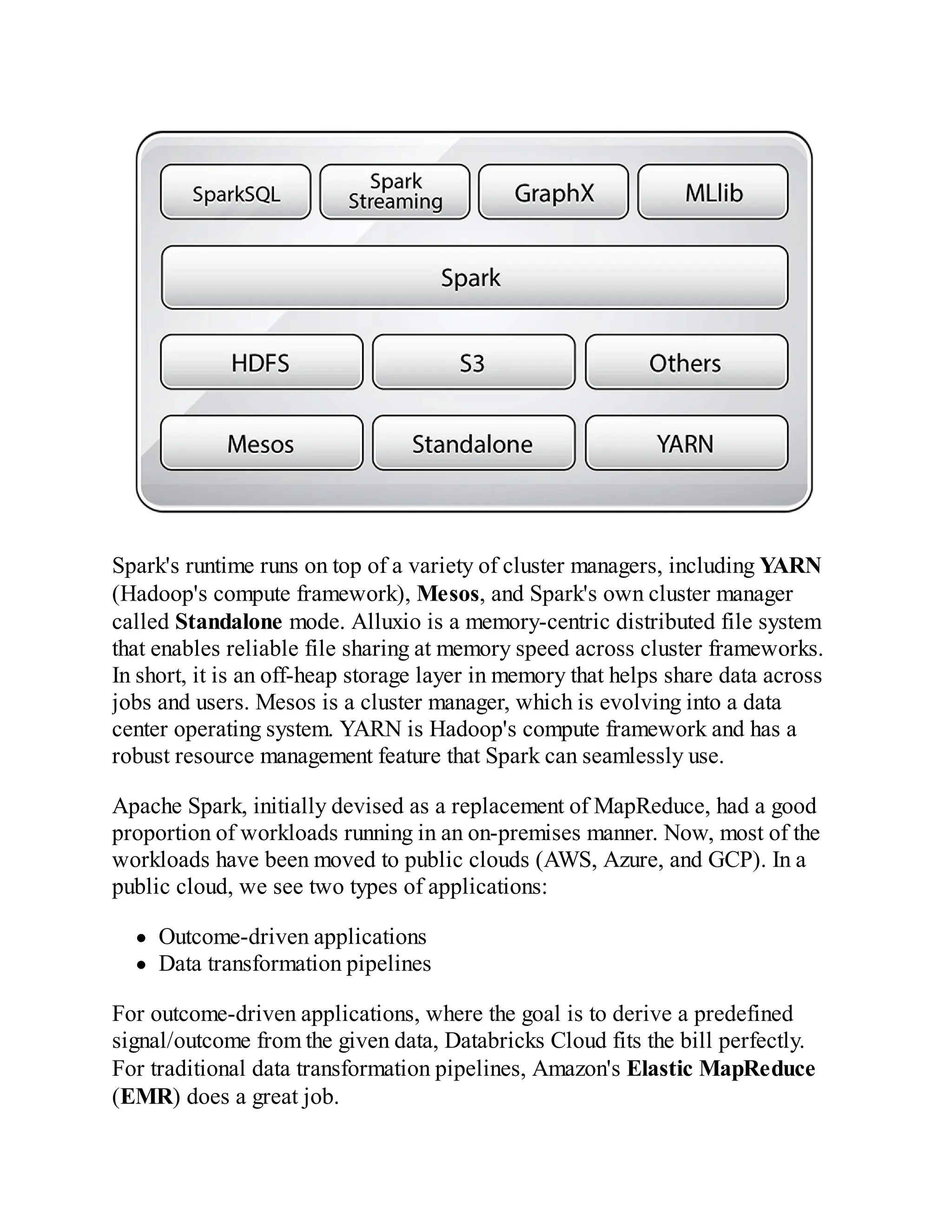
The following figure shows the Spark ecosystem:
Spark's runtime runs on top of a variety of cluster managers, including YARN
(Hadoop's compute framework), Mesos, and Spark's own cluster manager
called Standalone mode. Alluxio is a memory-centric distributed file system
that enables reliable file sharing at memory speed across cluster frameworks.
In short, it is an off-heap storage layer in memory that helps share data across
jobs and users. Mesos is a cluster manager, which is evolving into a data
center operating system. YARN is Hadoop's compute framework and has a
robust resource management feature that Spark can seamlessly use.
Apache Spark, initially devised as a replacement of MapReduce, had a good
proportion of workloads running in an on-premises manner. Now, most of the
workloads have been moved to public clouds (AWS, Azure, and GCP). In a
public cloud, we see two types of applications:
Outcome-driven applications
Data transformation pipelines
For outcome-driven applications, where the goal is to derive a predefined
signal/outcome from the given data, Databricks Cloud fits the bill perfectly.
For traditional data transformation pipelines, Amazon's Elastic MapReduce
(EMR) does a great job.
Leveraging Databricks Cloud
Databricks is the company behind Spark. It has a cloud platform that takes out
all of the complexity of deploying Spark and provides you with a ready-to-go
environment with notebooks for various languages. Databricks Cloud also has
a community edition that provides one node instance with 6 GB of RAM for
free. It is a great starting place for developers. The Spark cluster that is
created also terminates after 2 hours of sitting idle.
Note
All the recipes in this book can be run on either the InfoObjects
Sandbox or Databricks Cloud community edition. The entire data
for the recipes in this book has also been ported to a public bucket
called sparkcookbook on S3. Just put these recipes on the
Databricks Cloud community edition, and they will work
seamlessly.
How to do it...
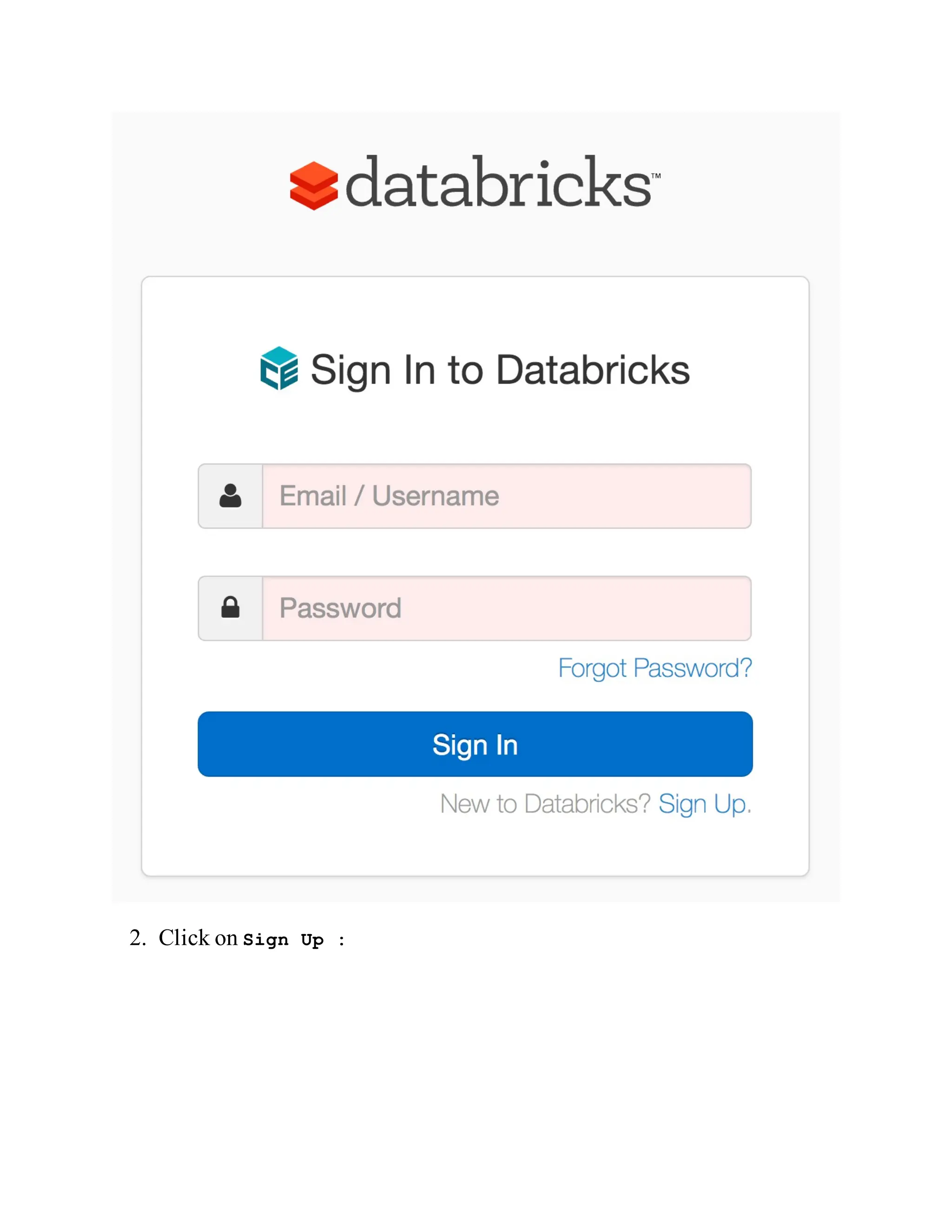
1. Go to https://community.cloud.databricks.com:
2. Click on Sign Up :
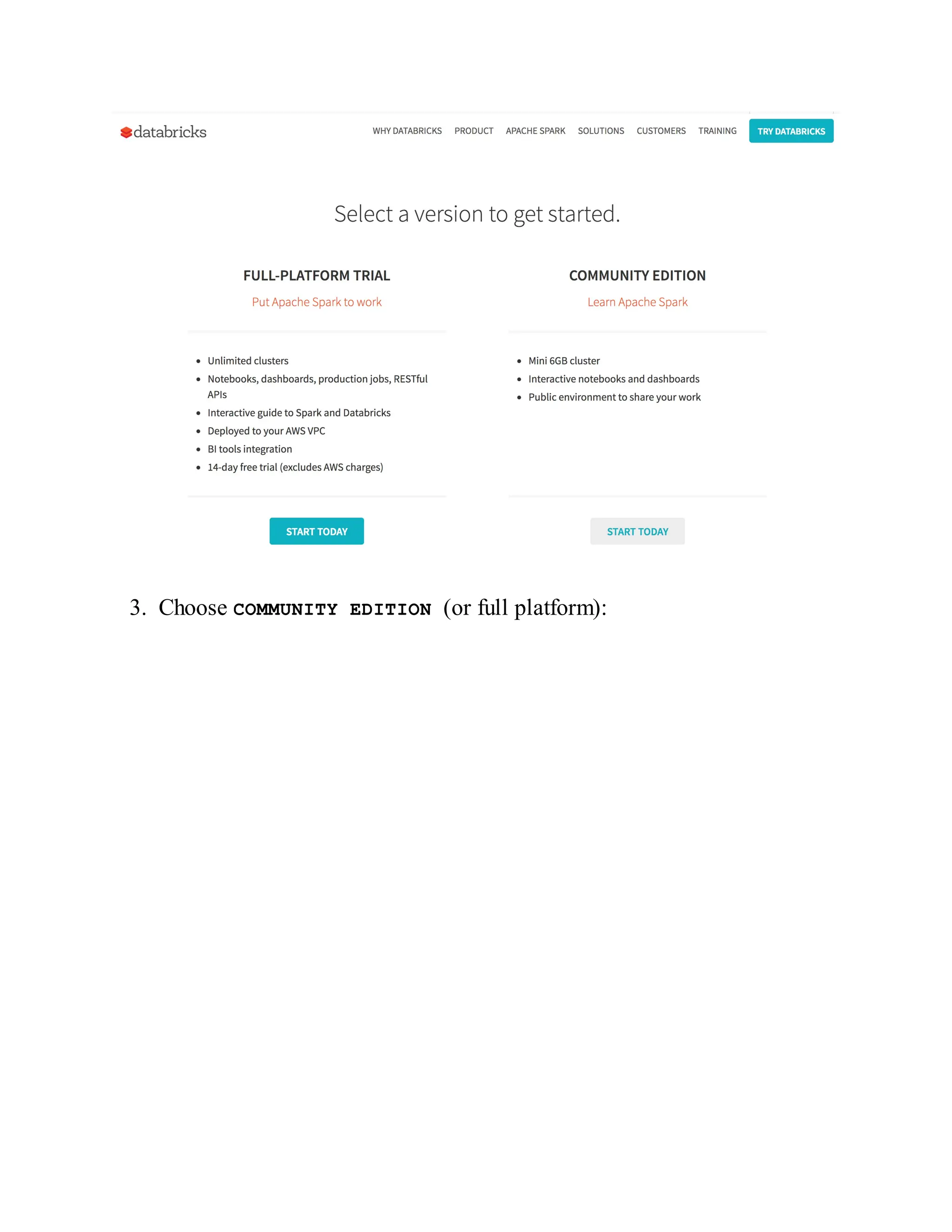
3. Choose COMMUNITY EDITION (or full platform):
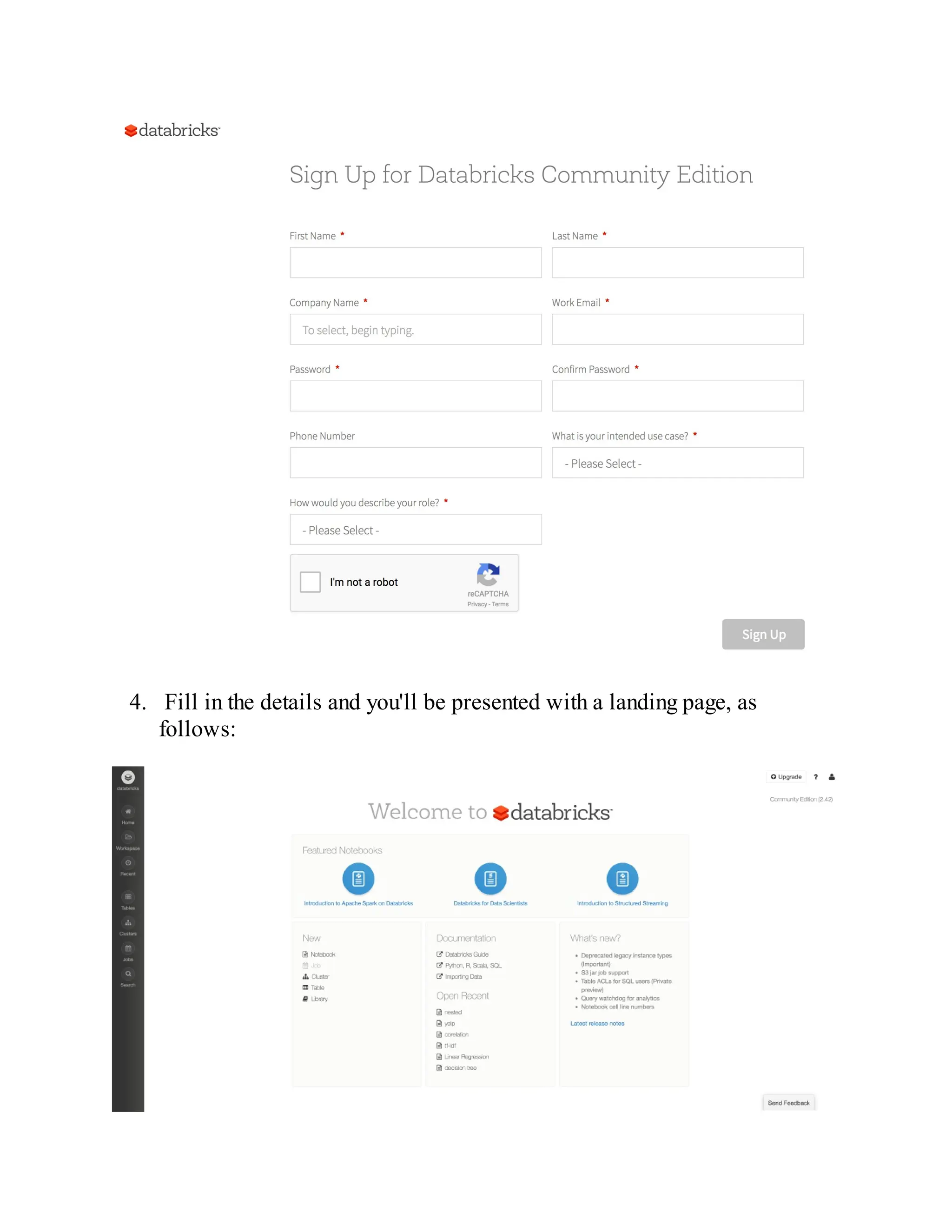
4. Fill in the details and you'll be presented with a landing page, as
follows:
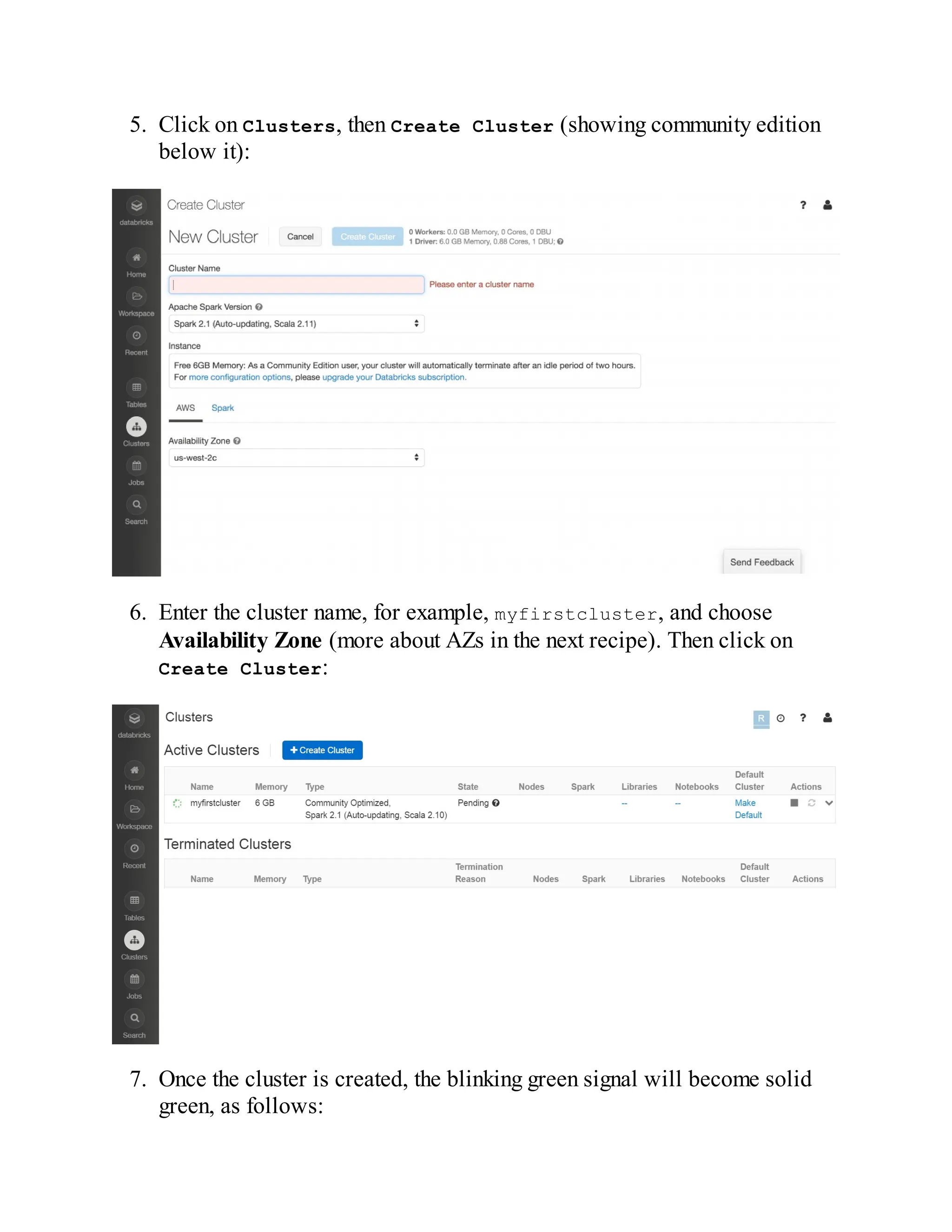
5. Click on Clusters, then Create Cluster (showing community edition
below it):
6. Enter the cluster name, for example, myfirstcluster, and choose
Availability Zone (more about AZs in the next recipe). Then click on
Create Cluster:
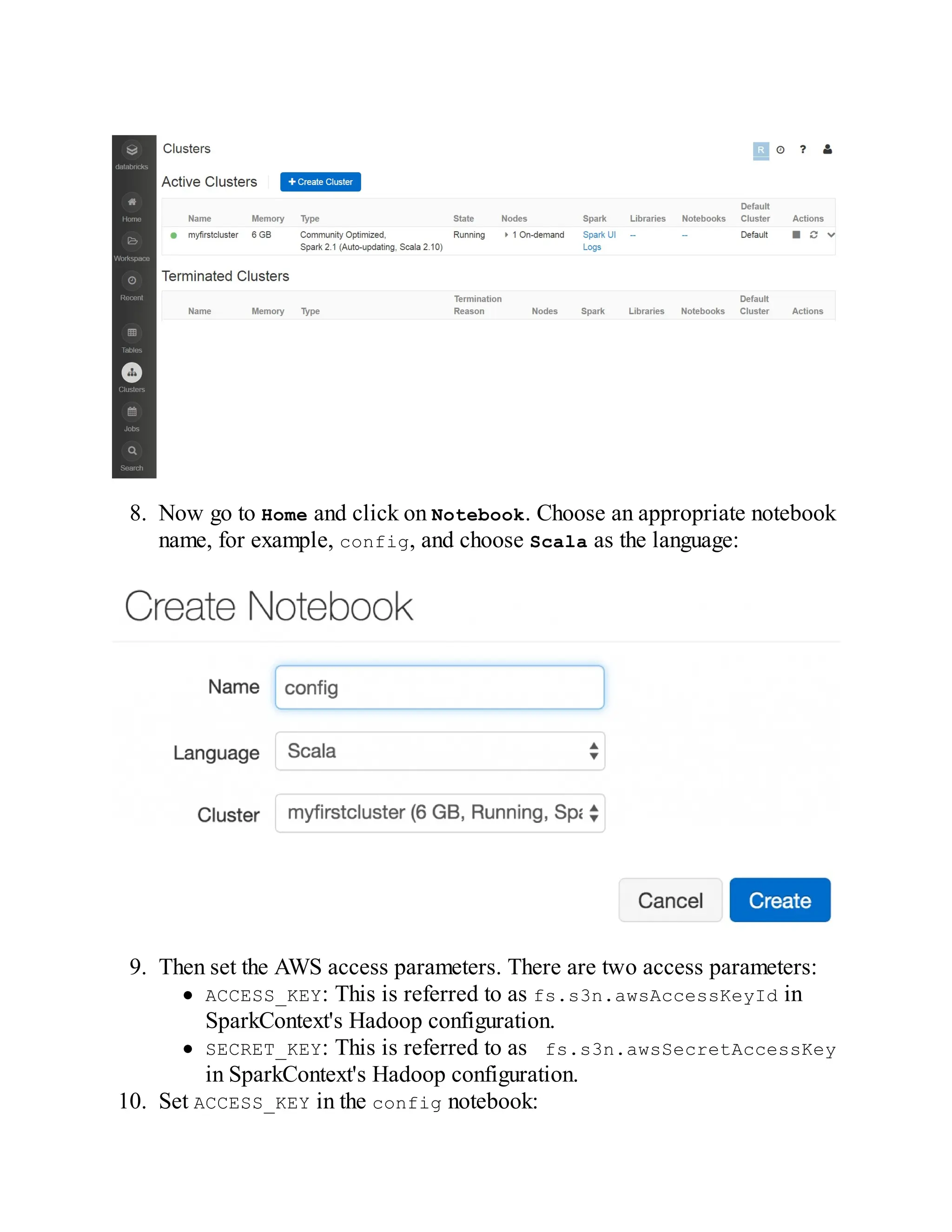
7. Once the cluster is created, the blinking green signal will become solid
green, as follows:
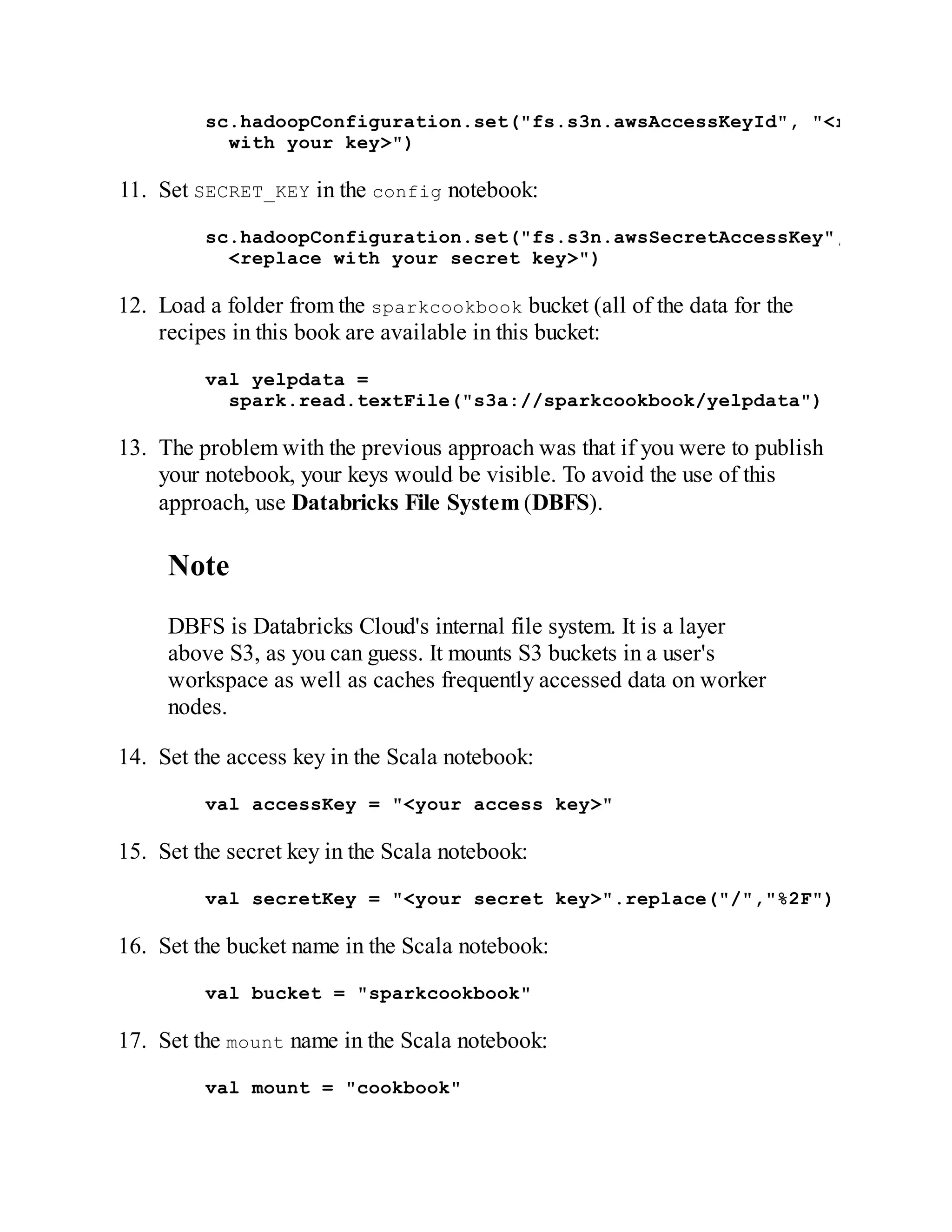
8. Now go to Home and click on Notebook. Choose an appropriate notebook
name, for example, config, and choose Scala as the language:
9. Then set the AWS access parameters. There are two access parameters:
ACCESS_KEY: This is referred to as fs.s3n.awsAccessKeyId in
SparkContext's Hadoop configuration.
SECRET_KEY: This is referred to as fs.s3n.awsSecretAccessKey
in SparkContext's Hadoop configuration.
10. Set ACCESS_KEY in the config notebook:
sc.hadoopConfiguration.set("fs.s3n.awsAccessKeyId", "<replace
with your key>")
11. Set SECRET_KEY in the config notebook:
sc.hadoopConfiguration.set("fs.s3n.awsSecretAccessKey","
<replace with your secret key>")
12. Load a folder from the sparkcookbook bucket (all of the data for the
recipes in this book are available in this bucket:
val yelpdata =
spark.read.textFile("s3a://sparkcookbook/yelpdata")
13. The problem with the previous approach was that if you were to publish
your notebook, your keys would be visible. To avoid the use of this
approach, use Databricks File System (DBFS).
Note
DBFS is Databricks Cloud's internal file system. It is a layer
above S3, as you can guess. It mounts S3 buckets in a user's
workspace as well as caches frequently accessed data on worker
nodes.
14. Set the access key in the Scala notebook:
val accessKey = "<your access key>"
15. Set the secret key in the Scala notebook:
val secretKey = "<your secret key>".replace("/","%2F")
16. Set the bucket name in the Scala notebook:
val bucket = "sparkcookbook"
17. Set the mount name in the Scala notebook:
val mount = "cookbook"
18. Mount the bucket:
dbutils.fs.mount(s"s3a://$accessKey:$secretKey@$bucket"
s"/mnt/$mount")
19. Display the contents of the bucket:
display(dbutils.fs.ls(s"/mnt/$mount"))
Note
The rest of the recipes will assume that you would have set up
AWS credentials.
How it works...
Let's look at the key concepts in Databricks Cloud.
Cluster
The concept of clusters is self-evident. A cluster contains a master node and
one or more slave nodes. These nodes are EC2 nodes, which we are going to
learn more about in the next recipe.
Notebook
Notebook is the most powerful feature of Databricks Cloud. You can write
your code in Scala/Python/R or a simple SQLnotebook. These notebooks
cover the whole 9 yards. You can use notebooks to write code like a
programmer, use SQLlike an analyst, or do visualization like a Business
Intelligence (BI) expert.
Table
Tables enable Spark to run SQLqueries.
Library
Library is the section where you upload the libraries you would like to attach
to your notebooks. The beauty is that you do not have to upload libraries
manually; you can simply provide the Maven parameters and it would find the
library for you and attach it.
Deploying Spark using Amazon EMR
There is a reason why deploying Spark on Amazon EMR is added as one of the
first recipes in this edition of the book. The majority of the production
deployments of Spark happen on EMR (in fact, the majority, and increasingly
so, big data deployments happen on EMR). If you understand this recipe well,
you may skip the rest of the recipes in this chapter, unless you are doing an on-
premises deployment.
Note
Since this topic is of paramount importance in the current context,
a lot more theory is being provided than what a typical cookbook
would have. You can skip the theory section and directly go to the
How to do it.. section, but I encourage you not to do so.
What it represents is much bigger than what it looks
What EMR represents is far more than meets the eye. Most of the enterprise
workloads are migrating to public clouds at an accelerated pace. Once
migrated, these workloads get rearchitected to leverage cloud-based services
as opposed to simply using it as Infrastructure as a Service (IaaS). EC2 is
an IaaS compute service of AWS, while EMR is the leading Platform as a
Service (PaaS) service of AWS, with more big data workloads running on
EMR than the alternatives combined.
EMR's architecture
Hadoop's core feature is data locality, that is, taking compute to where the
data is. AWS disrupts this concept by separating storage and compute. AWS
has multiple storage options, including the following:
Amazon S3: S3 is general-purpose object storage.
Amazon Redshift: This is a distributed cloud data warehouse.
Amazon DynamoDB: This is a NoSQLdatabase.
Amazon Aurora: This is a cloud-based relational database.
Amazon S3 is the cheapest and most reliable cloud storage available, and this
makes it the first choice, unless there is a compelling reason not to do so. EMR
also supports attaching elastic block storage (EBS) volumes to compute
instances (EC2) in order to provide a lower latency option.
Which option to choose depends upon what type of cluster is being created.
There are two types of clusters:
Persistent cluster: It runs 24 x 7. Here, there is a continuous analysis of
data for use cases such as fraud detection in the financial industry or
clickstream analytics in ad tech. For these purposes, HDFS mounted on
EBS is a good choice.
Transient cluster: Here, workloads are run inconsistently, for example,
genome sequencing or holiday surge in retail. In this case, the cluster is
only spawned when needed, making Elastic Map Reduce File System
(EMRFS) based on S3 a better choice.
How to do it...
1. Log in to https://aws.amazon.com with your credentials.
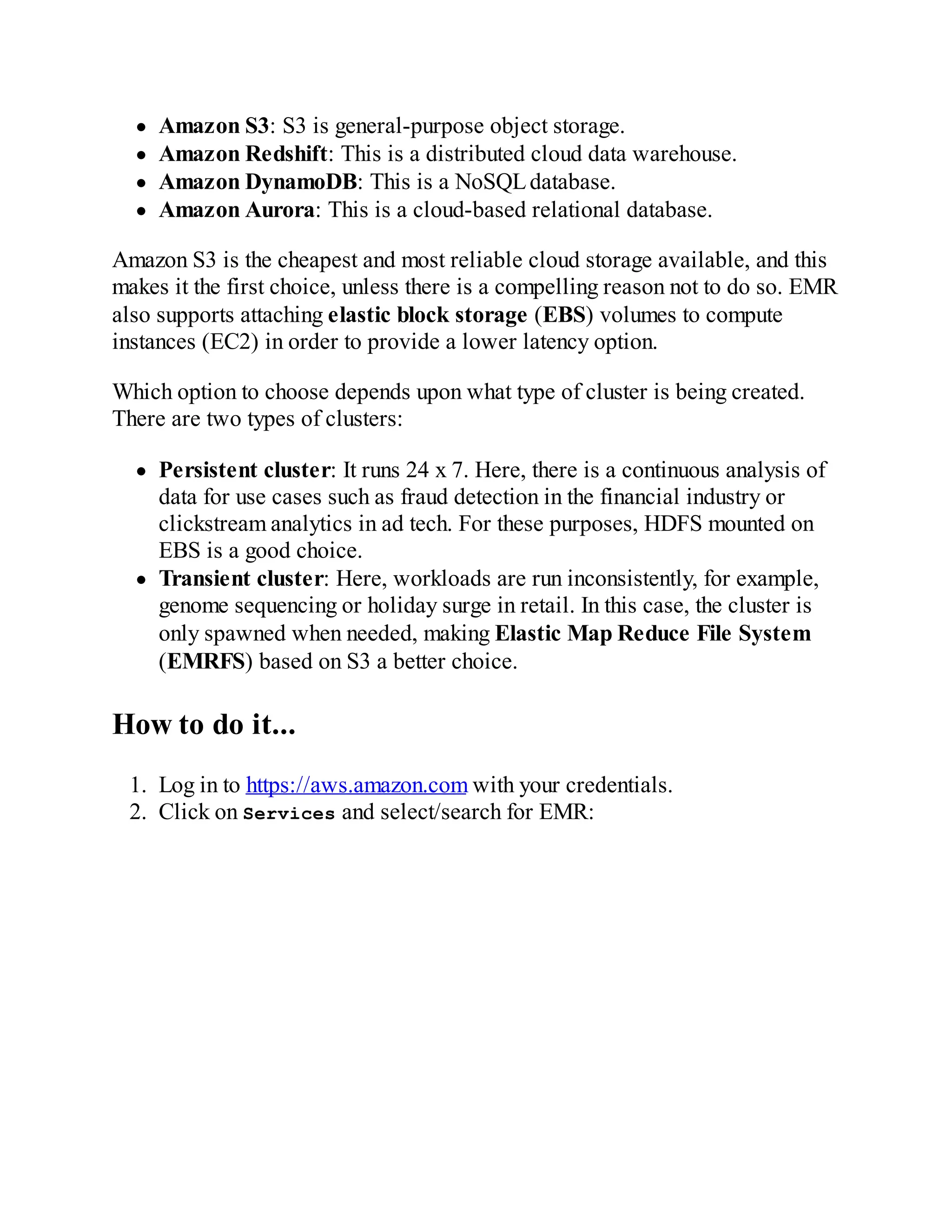
2. Click on Services and select/search for EMR:
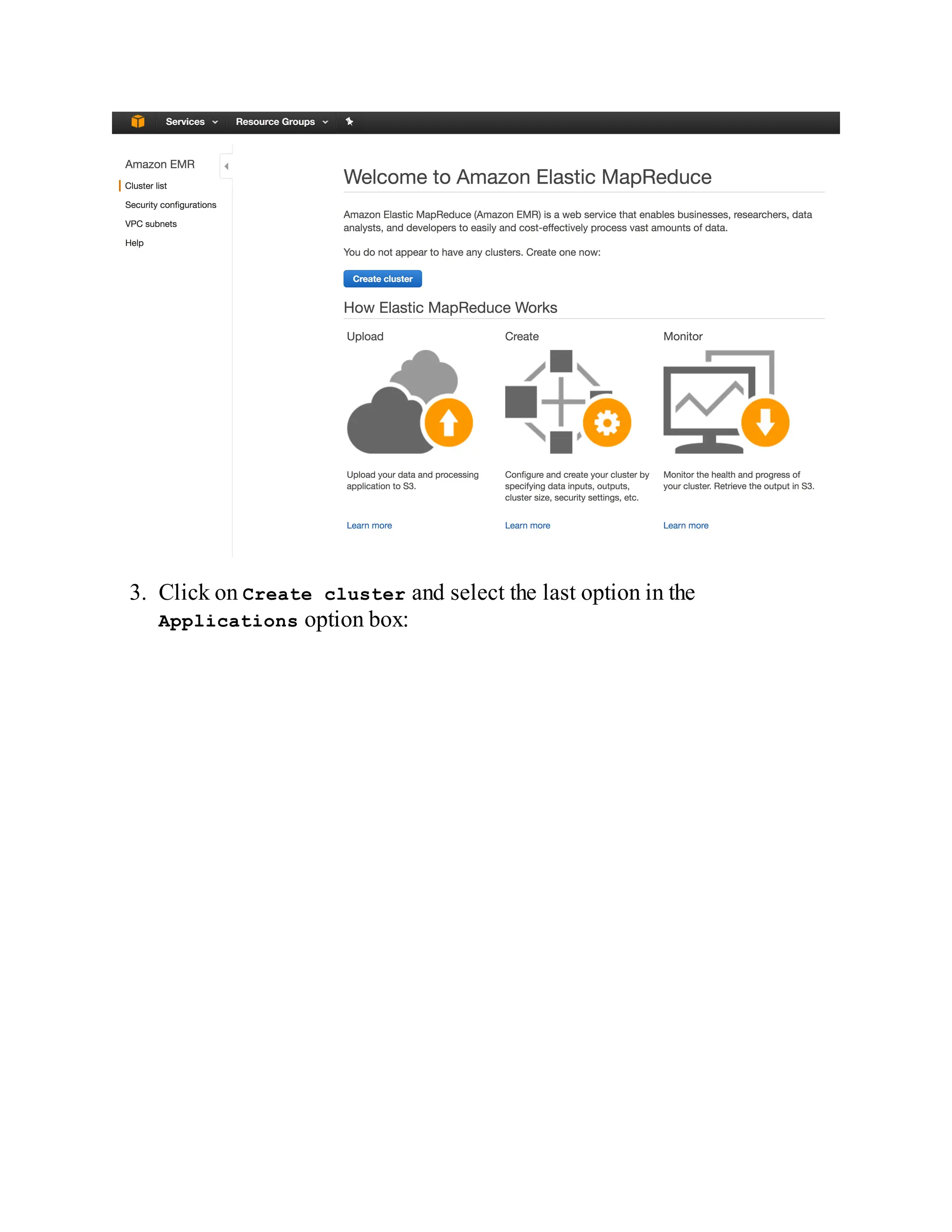
3. Click on Create cluster and select the last option in the
Applications option box:
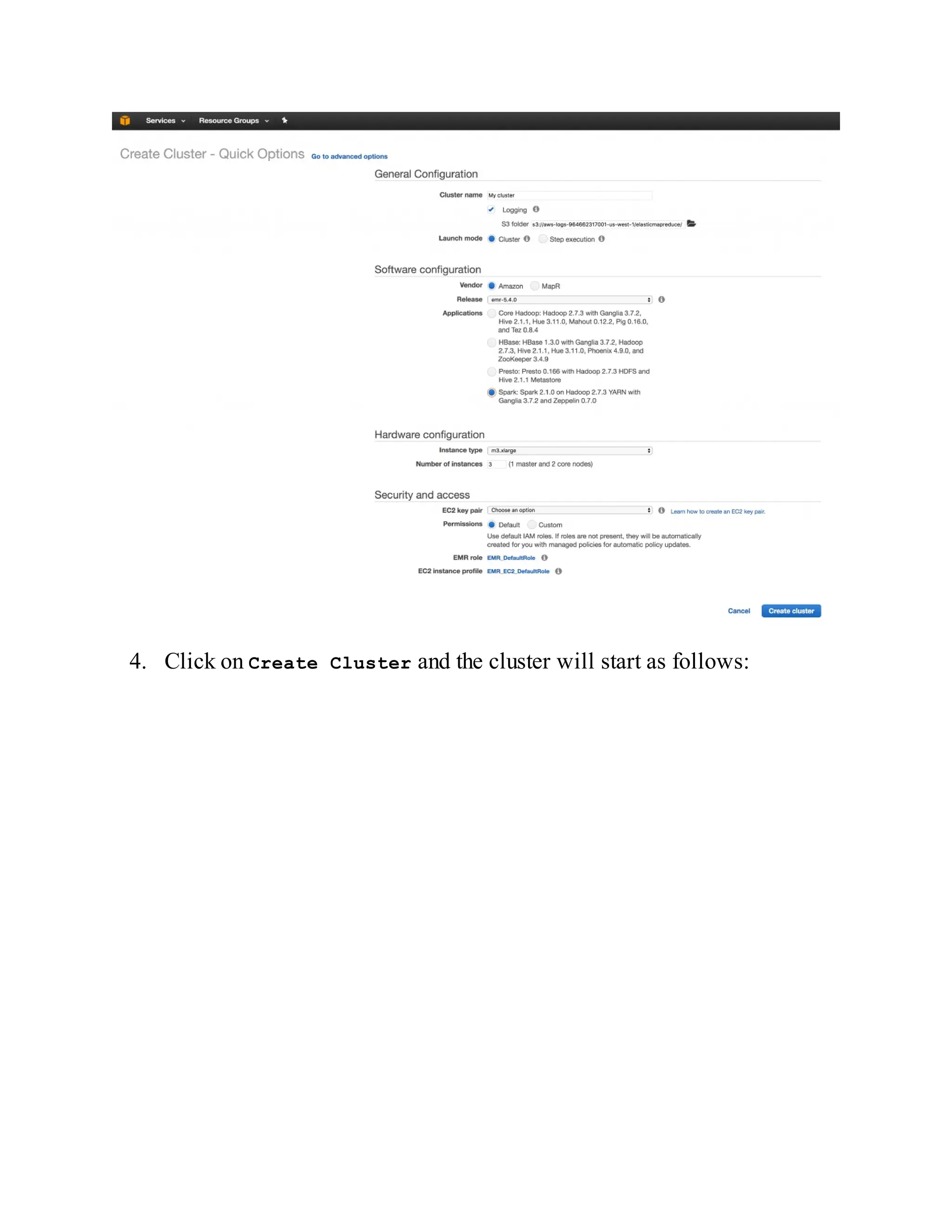
4. Click on Create Cluster and the cluster will start as follows:
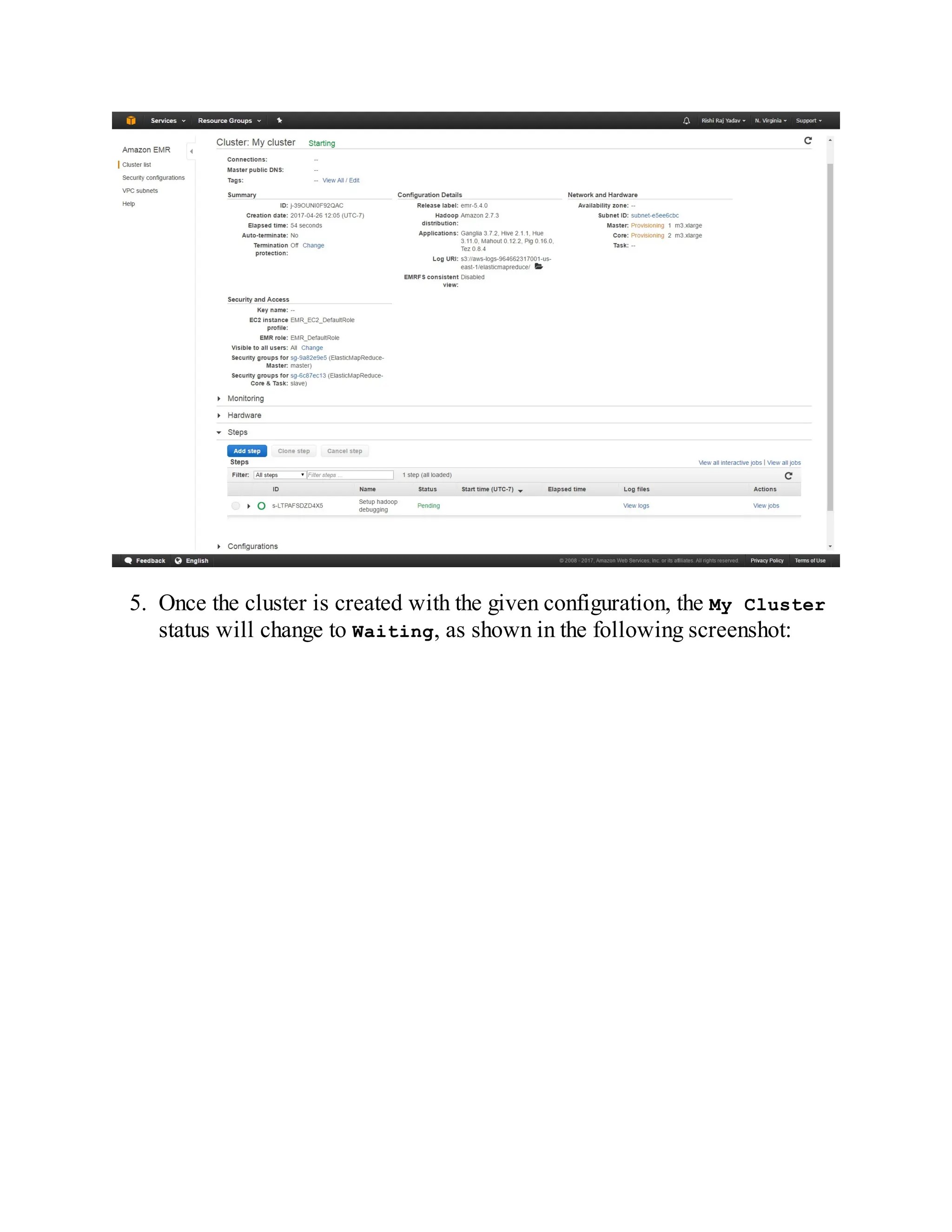
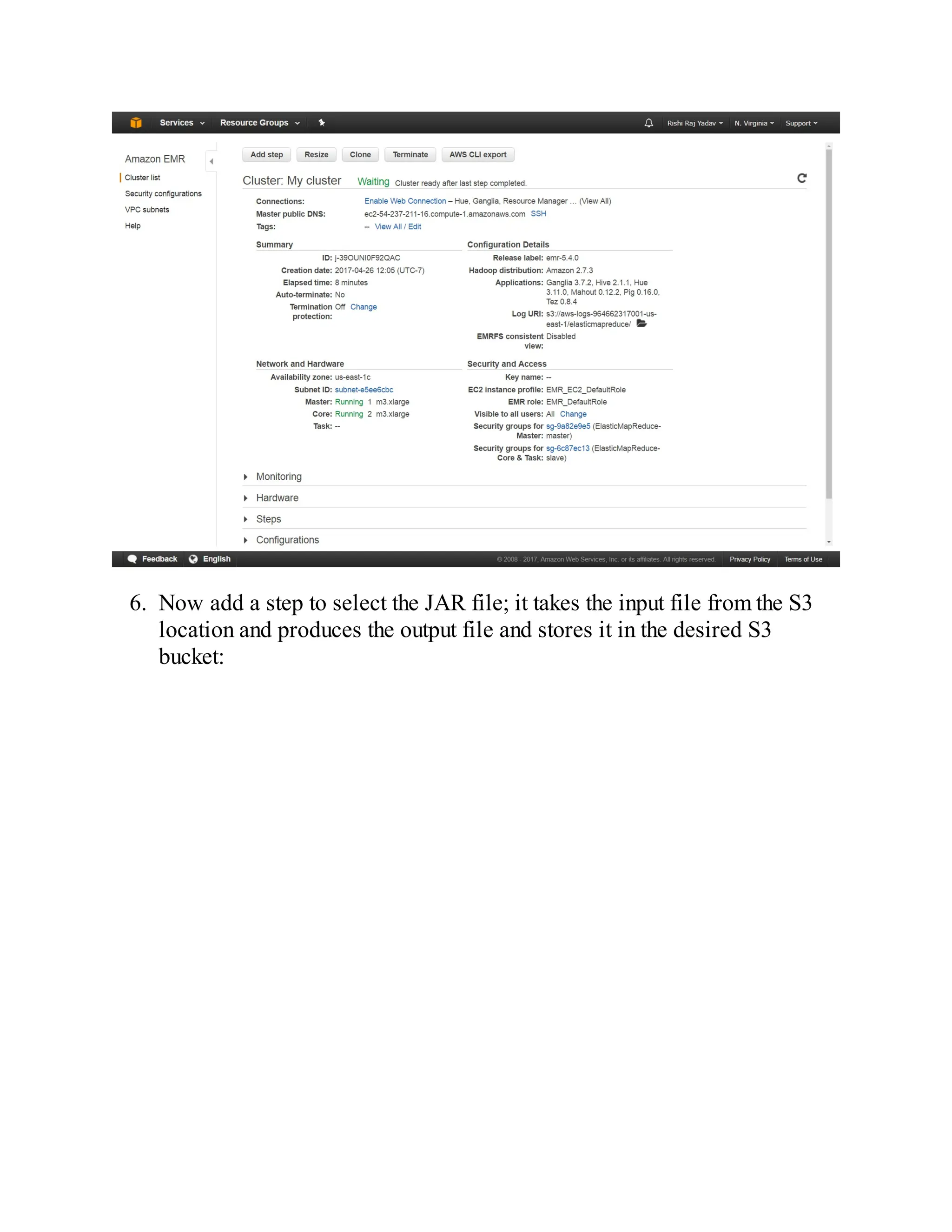
5. Once the cluster is created with the given configuration, the My Cluster
status will change to Waiting, as shown in the following screenshot:
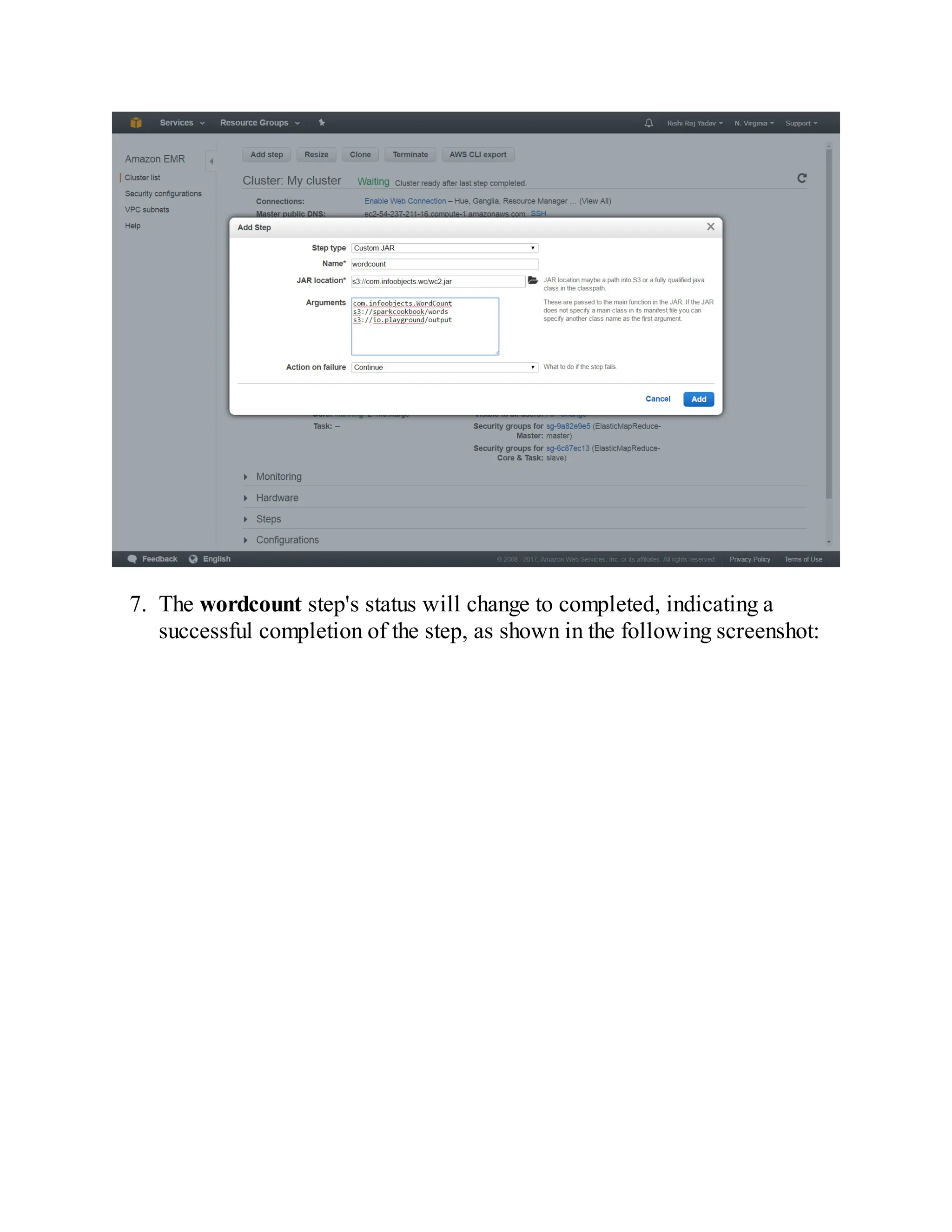
6. Now add a step to select the JAR file; it takes the input file from the S3
location and produces the output file and stores it in the desired S3
bucket:
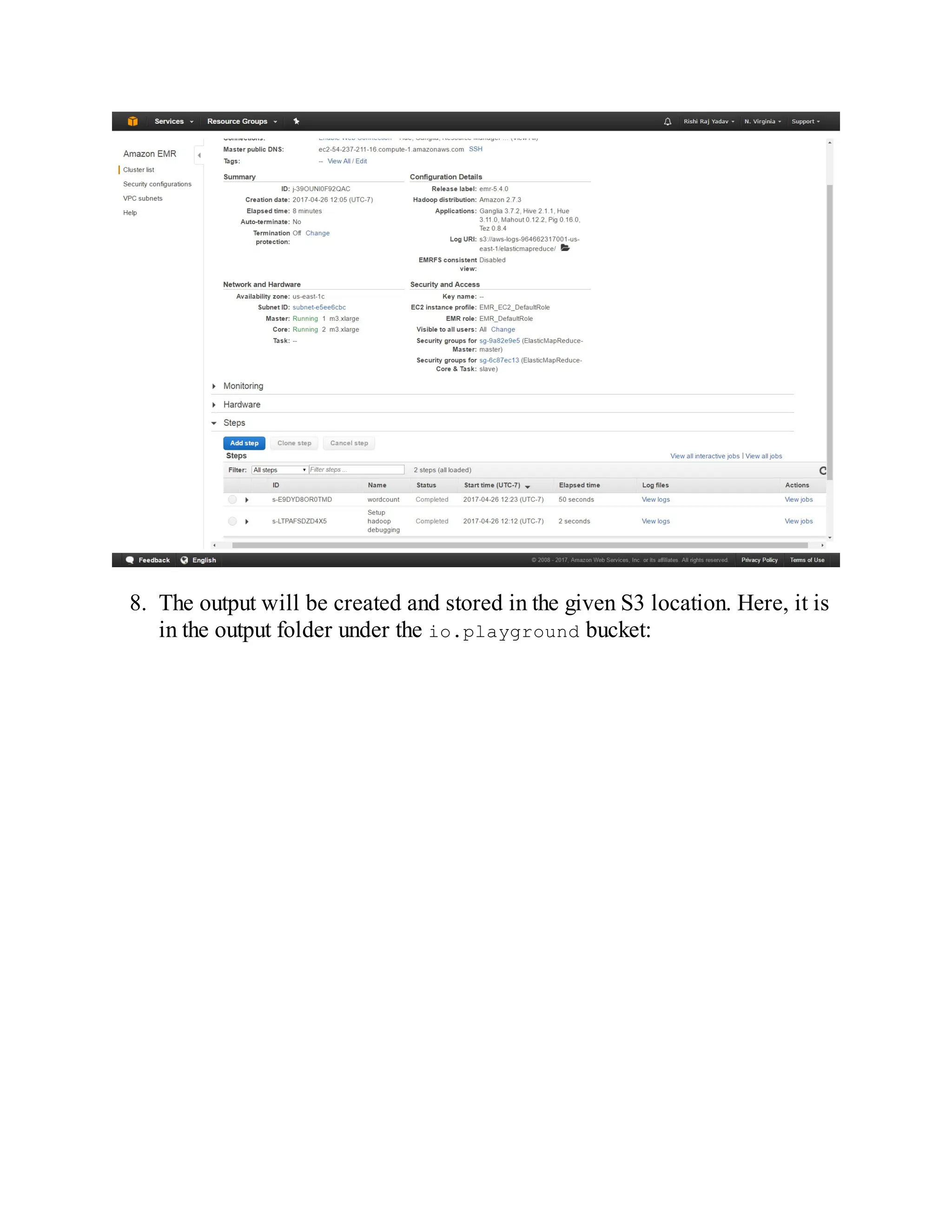
7. The wordcount step's status will change to completed, indicating a
successful completion of the step, as shown in the following screenshot:
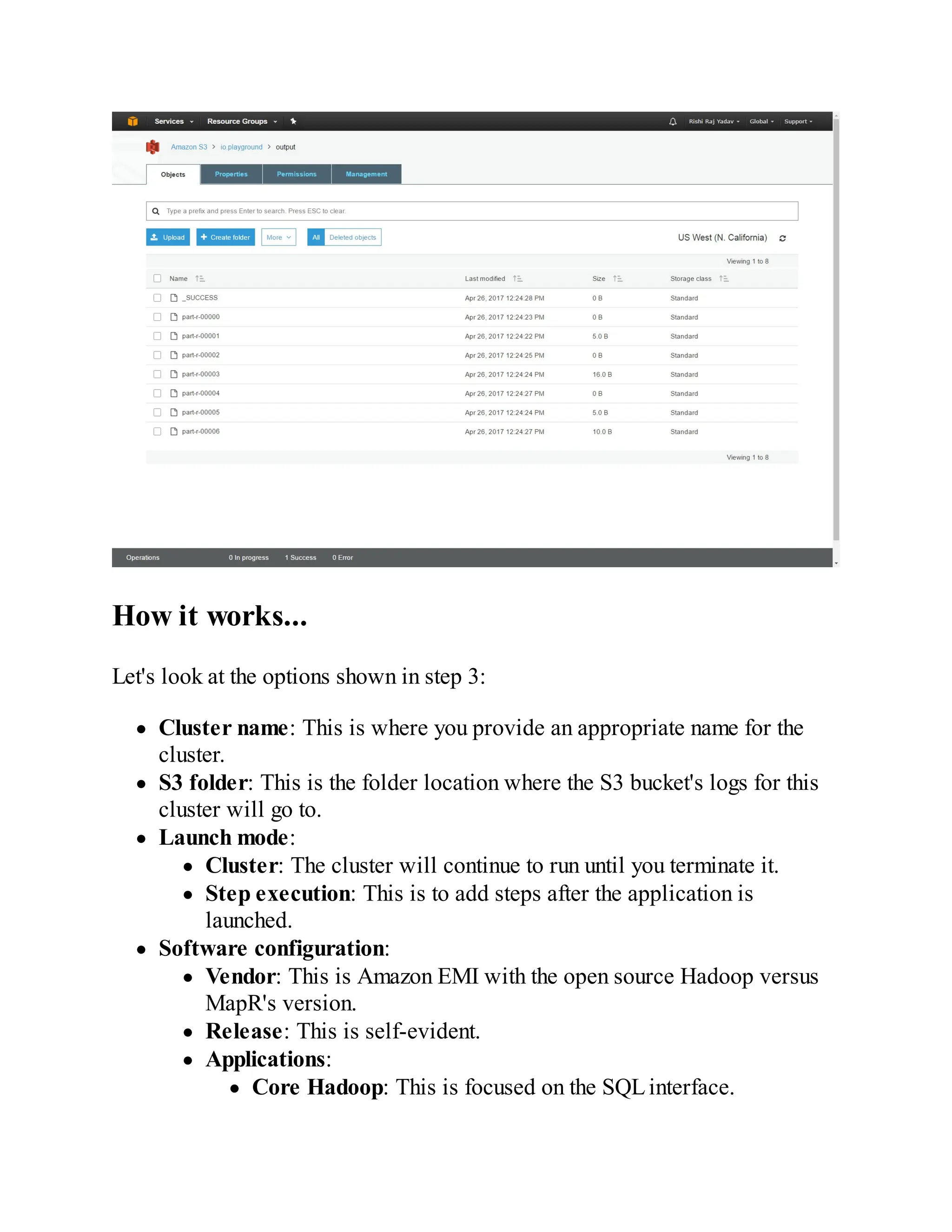
8. The output will be created and stored in the given S3 location. Here, it is
in the output folder under the io.playground bucket:
How it works...
Let's look at the options shown in step 3:
Cluster name: This is where you provide an appropriate name for the
cluster.
S3 folder: This is the folder location where the S3 bucket's logs for this
cluster will go to.
Launch mode:
Cluster: The cluster will continue to run until you terminate it.
Step execution: This is to add steps after the application is
launched.
Software configuration:
Vendor: This is Amazon EMI with the open source Hadoop versus
MapR's version.
Release: This is self-evident.
Applications:
Core Hadoop: This is focused on the SQLinterface.
HBase: This is focused on partial no-SQL-oriented workloads.
Presto: This is focused on ad-hoc query processing.
Spark: This is focused on Spark.
Hardware configuration:
Instance type: This topic will be covered in detail in the next
section.
Number of instances: This refers to the number of nodes in the
cluster. One of them will be the master node and the rest slave
nodes.
Security and access:
EC2 key pair: You can associate an EC2 key pair with the cluster
that you can use to connect to it via SSH.
Permissions: You can allow other users besides the default Hadoop
user to submit jobs.
EMR role: This allows EMR to call other AWS services, such as
EC2, on your behalf.
EC2 instance profile: This provides access to other AWS services,
such as S3 and DynamoDB, via the EC2 instances that are launched
by EMR.
EC2 instance types
EC2 instances are the most expensive part of a company's AWS bill. So,
selecting the right instance type is the key through which you can optimize your
bill. The following section is a quick overview of the different instance types.
Instance types, both in the cloud and on premises, are defined by four factors:
Number of cores
Memory
Storage (size and type)
Network performance
To see a quick illustration of how these factors affect each other, visit
http://youtube.com/infoobjects.
In the EC2 world, these factors have been modified slightly to vCPU. vCPU is
a virtualized unit of:
Memory
Storage (size and type)
Network performance
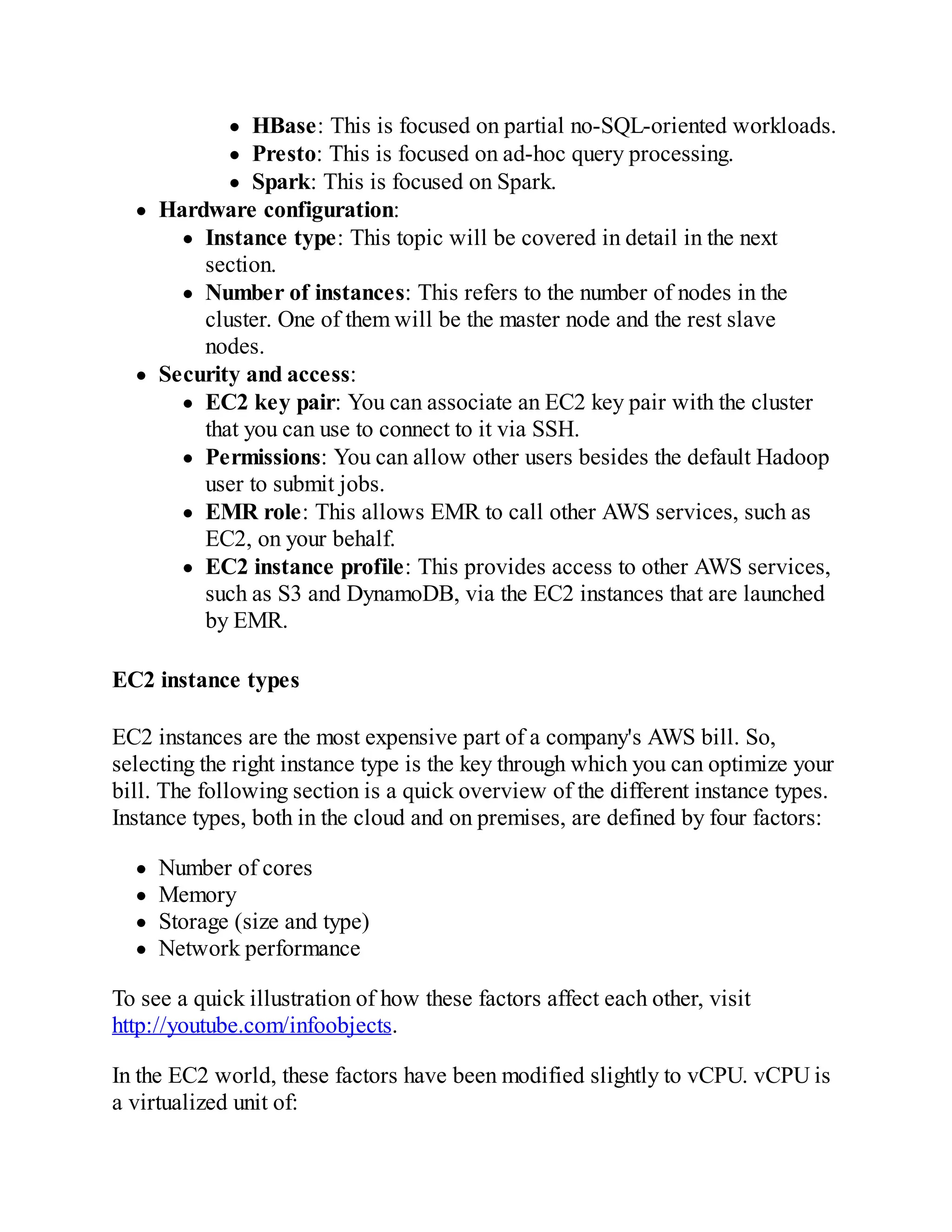
Instance type families are defined by the ratio of these factors, especially
vCPU to memory. In a given family, this ratio remains unchanged (T2
excluded). Different instance families serve different purposes, almost like
different types of automobiles. In fact, we are going to use the automobile
metaphor in this section to illustrate these families.
T2 - Free Tier Burstable (EBS only)
The T2 instance type is a gateway drug in the AWS world, the reason being it
belongs to Free Tier. Developers who sign up for AWS get this instance type
for up to a year. This tier has six subtypes:
Instance Type vCPUsCPU Credit/HrMemory (GiB)
t2.micro 1 6 1
t2.small 1 12 2
t2.medium 2 24 4
t2.large 2 36 6
t2.xlarge 4 54 6
t2.2xlarge 8 81 32
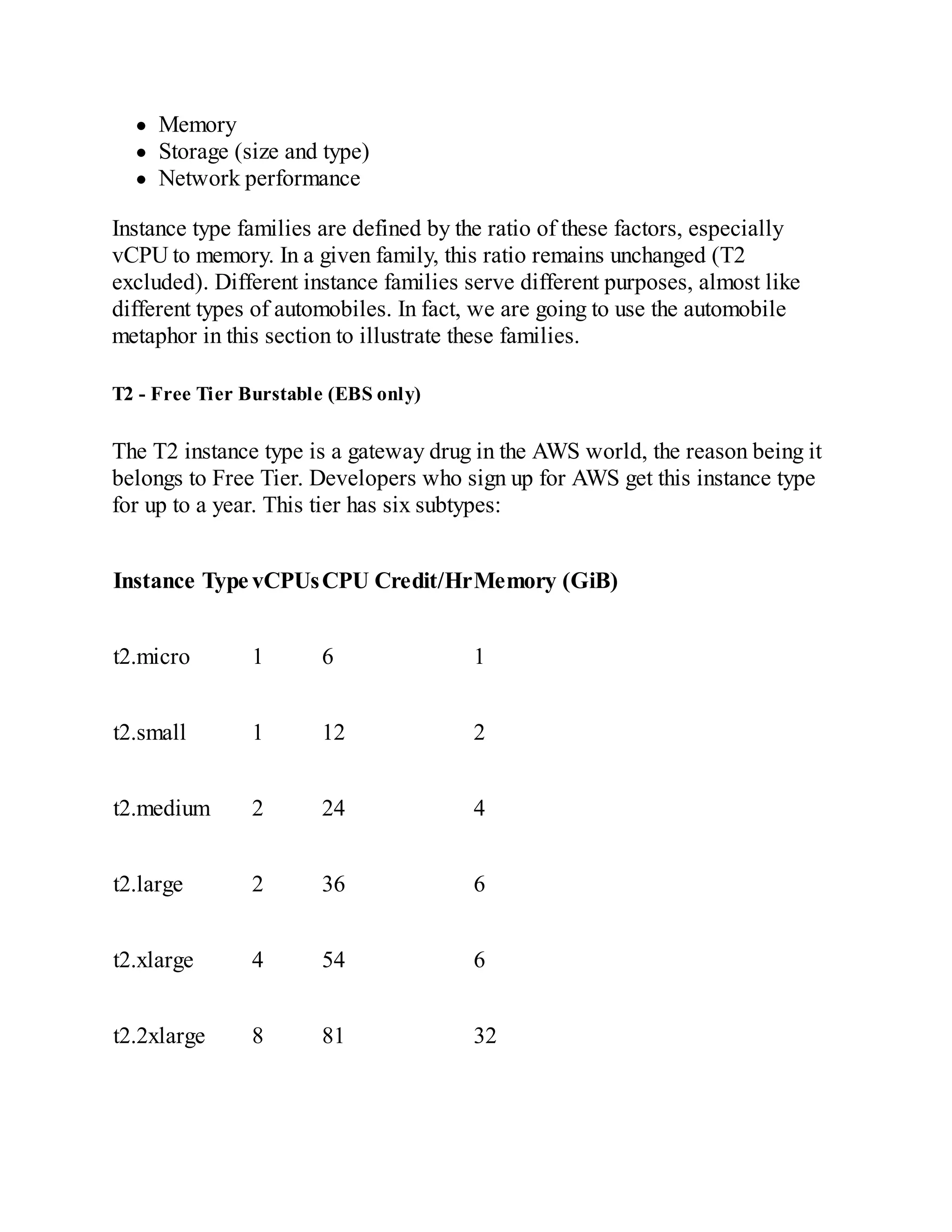
M4 - General purpose (EBS only)
M4 is the instance type you use when in doubt. Developers who sign up for
AWS get this instance type for up to a year. This tier has six subtypes:
Instance Type vCPUsMemory (GiB)Dedicated Bandwidth
m4.large 2 8 450 mbps
m4.xlarge 4 16 750 mbps
m4.2xlarge 8 32 1,000 mbps
m4.4xlarge 16 64 2,000 mbps
m4.10xlarge 40 160 4,000 mbps
m4.16xlarge 64 256 10,000 mbps
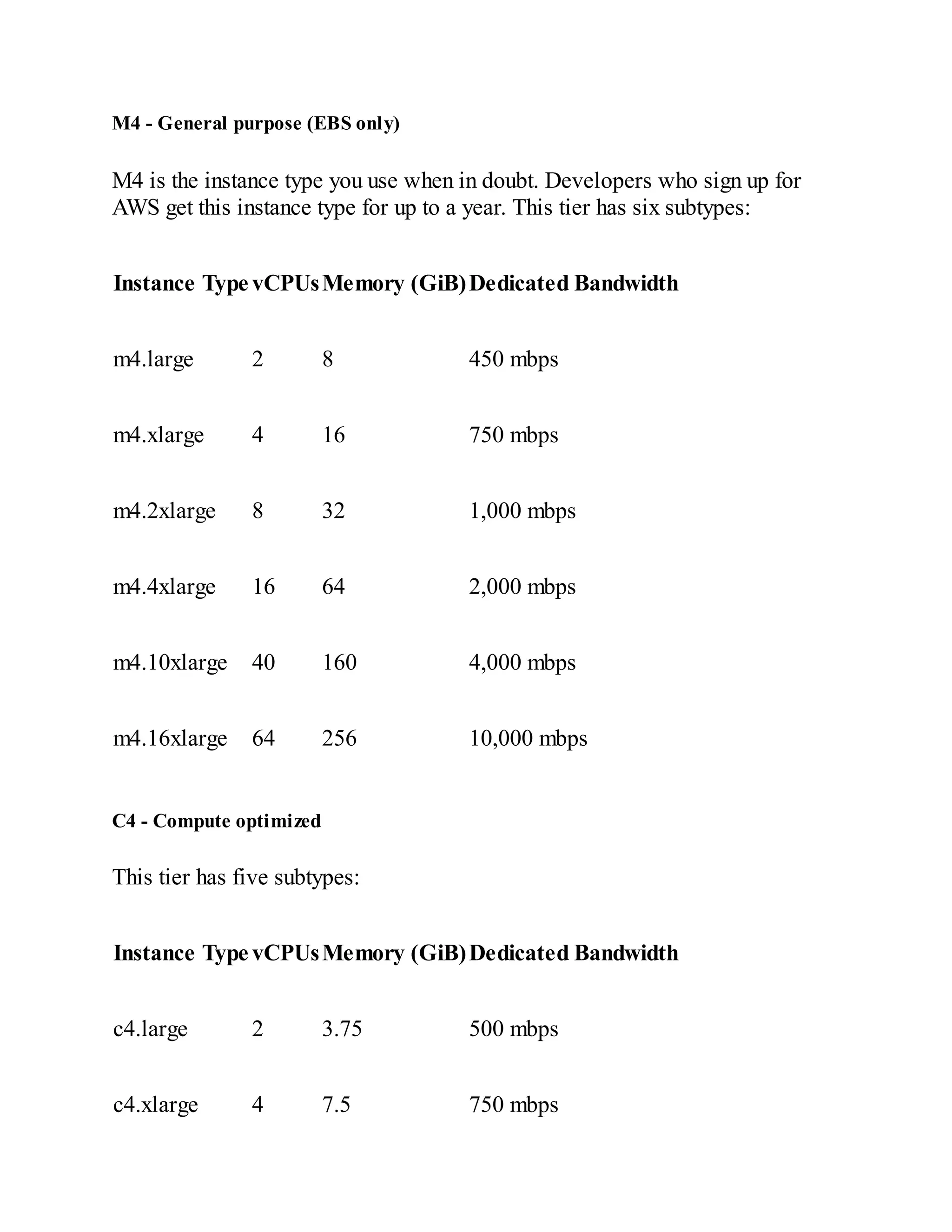
C4 - Compute optimized
This tier has five subtypes:
Instance Type vCPUsMemory (GiB)Dedicated Bandwidth
c4.large 2 3.75 500 mbps
c4.xlarge 4 7.5 750 mbps
c4.2xlarge 8 15 1,000 mbps
c4.4xlarge 16 30 2,000 mbps
c4.8xlarge 36 60 4,000 mbps
X1 - Memory optimized
This tier has two subtypes:
Instance Type vCPUsMemory (GiB)Dedicated Bandwidth
x1.16xlarge 2 8 450 mbps
x1.32xlarge 4 16 750 mbps
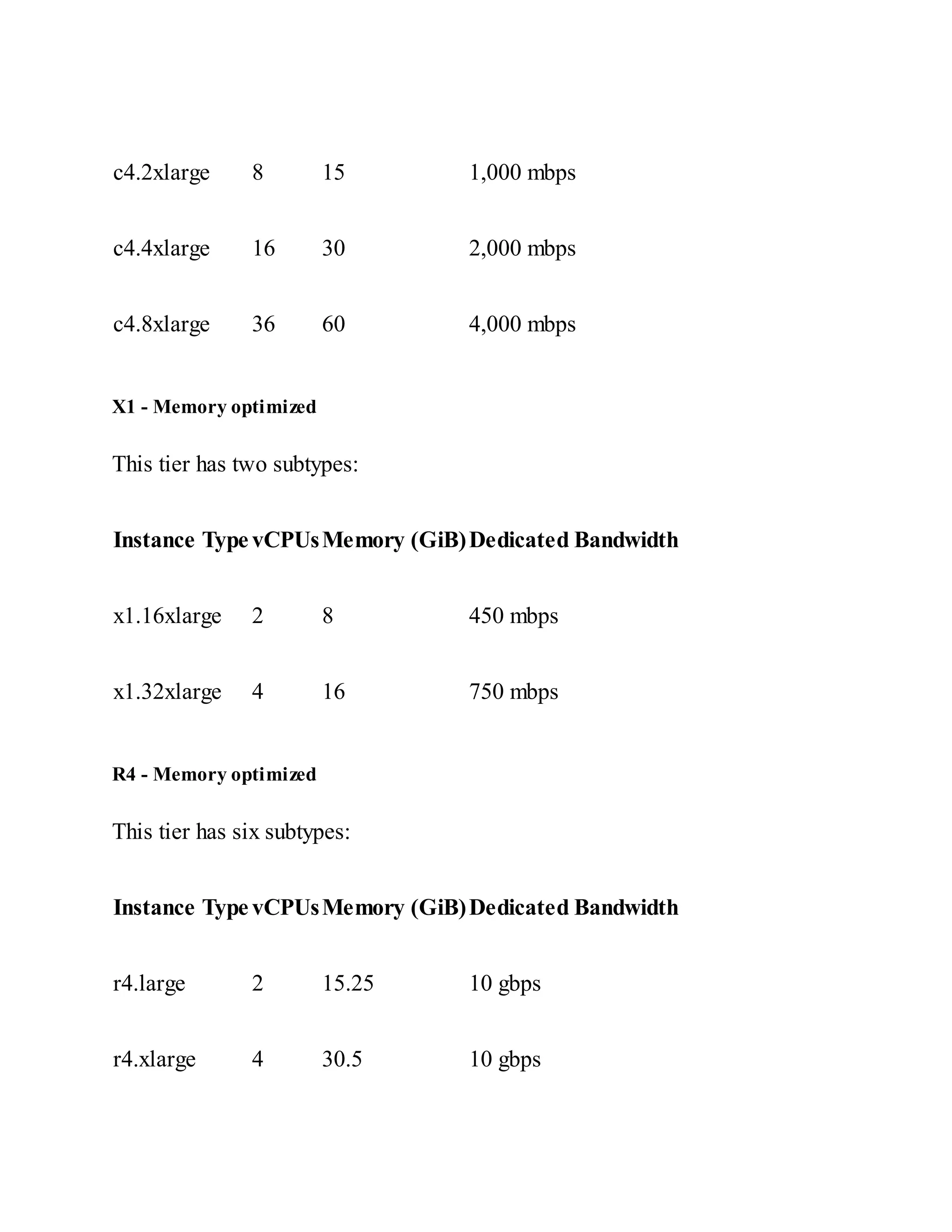
R4 - Memory optimized
This tier has six subtypes:
Instance Type vCPUsMemory (GiB)Dedicated Bandwidth
r4.large 2 15.25 10 gbps
r4.xlarge 4 30.5 10 gbps
r4.2xlarge 8 61 10 gbps
r4.4xlarge 16 122 10 gbps
r4.8xlarge 32 244 10 gbps
r4.16xlarge 64 488 20 gbps
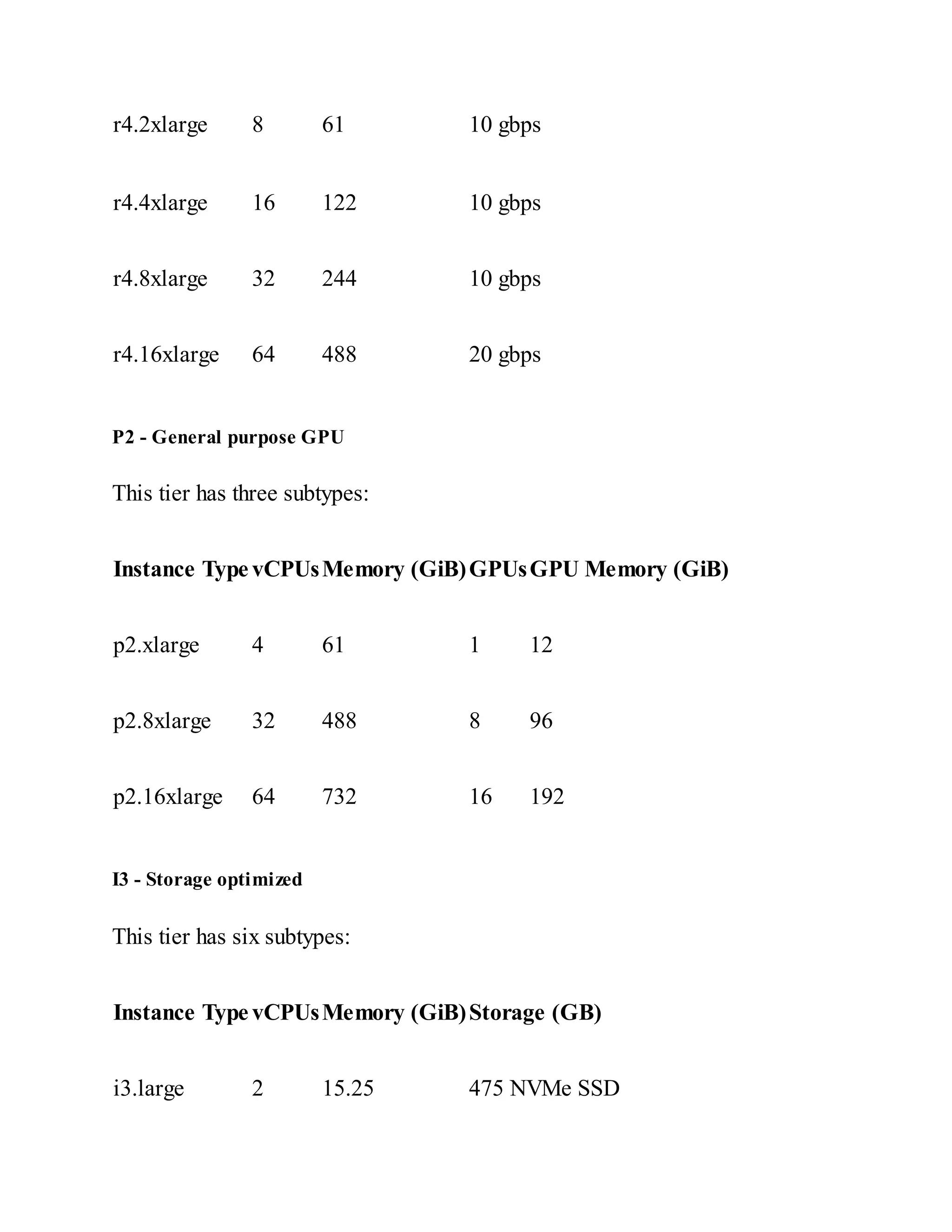
P2 - General purpose GPU
This tier has three subtypes:
Instance Type vCPUsMemory (GiB)GPUsGPU Memory (GiB)
p2.xlarge 4 61 1 12
p2.8xlarge 32 488 8 96
p2.16xlarge 64 732 16 192
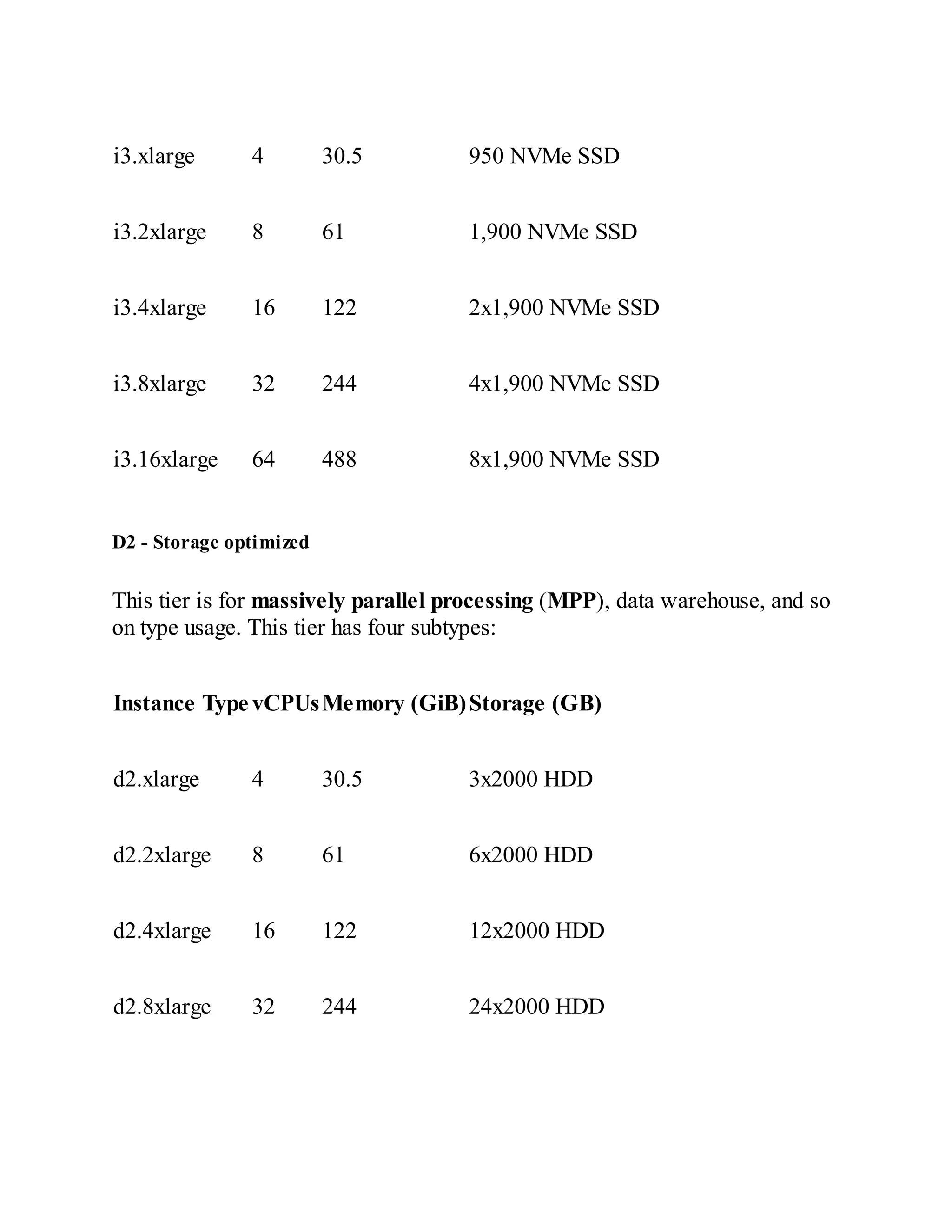
I3 - Storage optimized
This tier has six subtypes:
Instance Type vCPUsMemory (GiB)Storage (GB)
i3.large 2 15.25 475 NVMe SSD
i3.xlarge 4 30.5 950 NVMe SSD
i3.2xlarge 8 61 1,900 NVMe SSD
i3.4xlarge 16 122 2x1,900 NVMe SSD
i3.8xlarge 32 244 4x1,900 NVMe SSD
i3.16xlarge 64 488 8x1,900 NVMe SSD
D2 - Storage optimized
This tier is for massively parallel processing (MPP), data warehouse, and so
on type usage. This tier has four subtypes:
Instance Type vCPUsMemory (GiB)Storage (GB)
d2.xlarge 4 30.5 3x2000 HDD
d2.2xlarge 8 61 6x2000 HDD
d2.4xlarge 16 122 12x2000 HDD
d2.8xlarge 32 244 24x2000 HDD
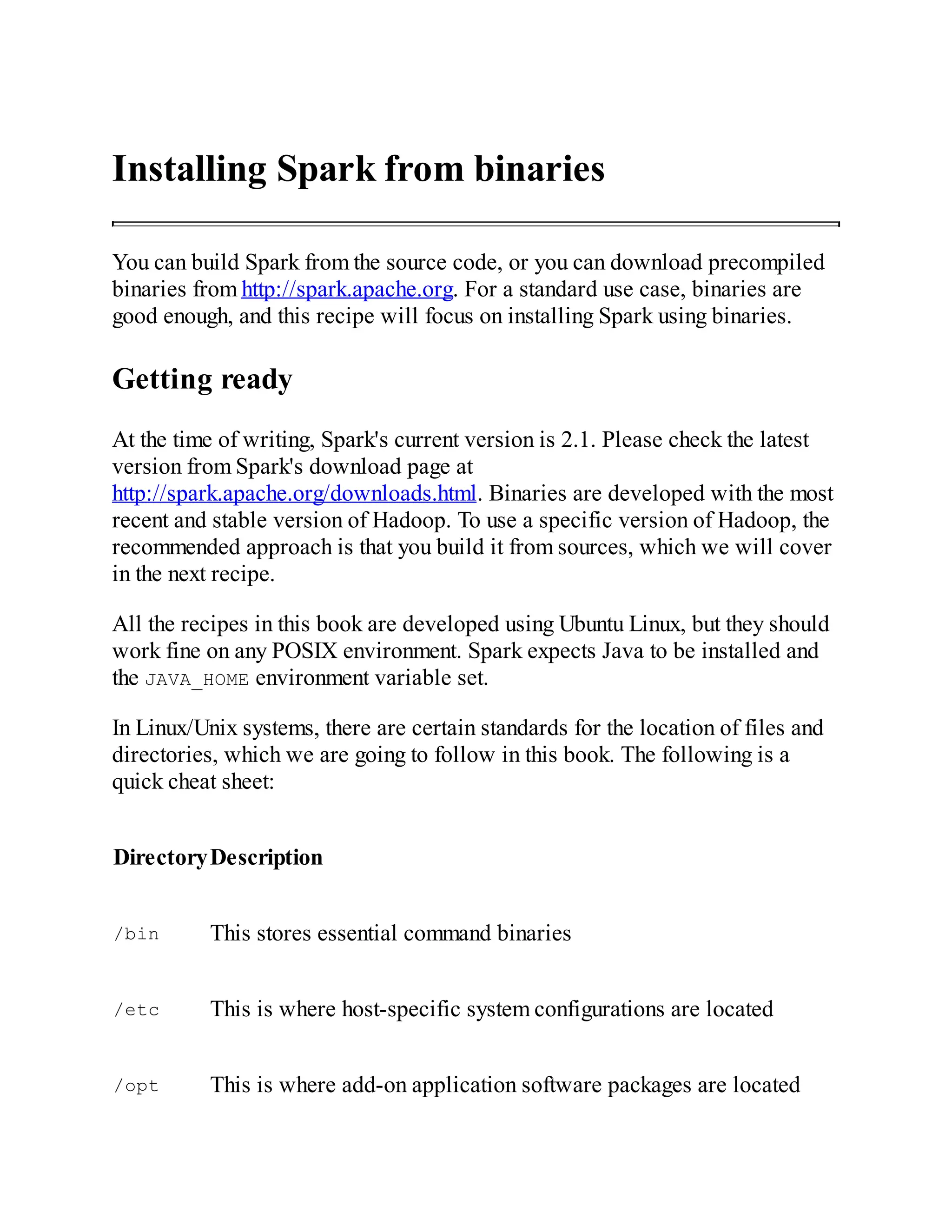
Installing Spark from binaries
You can build Spark from the source code, or you can download precompiled
binaries from http://spark.apache.org. For a standard use case, binaries are
good enough, and this recipe will focus on installing Spark using binaries.
Getting ready
At the time of writing, Spark's current version is 2.1. Please check the latest
version from Spark's download page at
http://spark.apache.org/downloads.html. Binaries are developed with the most
recent and stable version of Hadoop. To use a specific version of Hadoop, the
recommended approach is that you build it from sources, which we will cover
in the next recipe.
All the recipes in this book are developed using Ubuntu Linux, but they should
work fine on any POSIX environment. Spark expects Java to be installed and
the JAVA_HOME environment variable set.
In Linux/Unix systems, there are certain standards for the location of files and
directories, which we are going to follow in this book. The following is a
quick cheat sheet:
DirectoryDescription
/bin This stores essential command binaries
/etc This is where host-specific system configurations are located
/opt This is where add-on application software packages are located
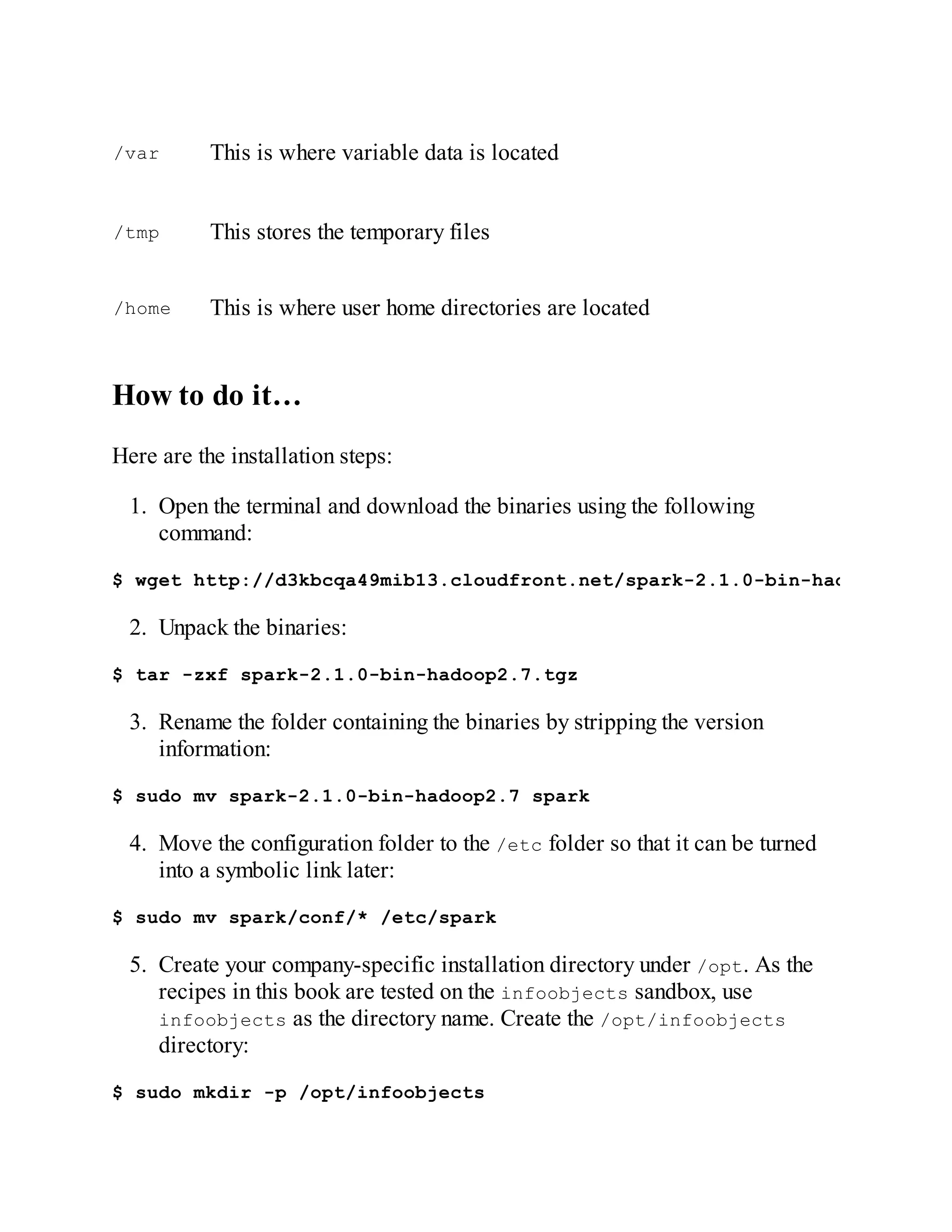
/var This is where variable data is located
/tmp This stores the temporary files
/home This is where user home directories are located
How to do it…
Here are the installation steps:
1. Open the terminal and download the binaries using the following
command:
$ wget http://d3kbcqa49mib13.cloudfront.net/spark-2.1.0-bin-hadoop2.7.tgz
2. Unpack the binaries:
$ tar -zxf spark-2.1.0-bin-hadoop2.7.tgz
3. Rename the folder containing the binaries by stripping the version
information:
$ sudo mv spark-2.1.0-bin-hadoop2.7 spark
4. Move the configuration folder to the /etc folder so that it can be turned
into a symbolic link later:
$ sudo mv spark/conf/* /etc/spark
5. Create your company-specific installation directory under /opt. As the
recipes in this book are tested on the infoobjects sandbox, use
infoobjects as the directory name. Create the /opt/infoobjects
directory:
$ sudo mkdir -p /opt/infoobjects
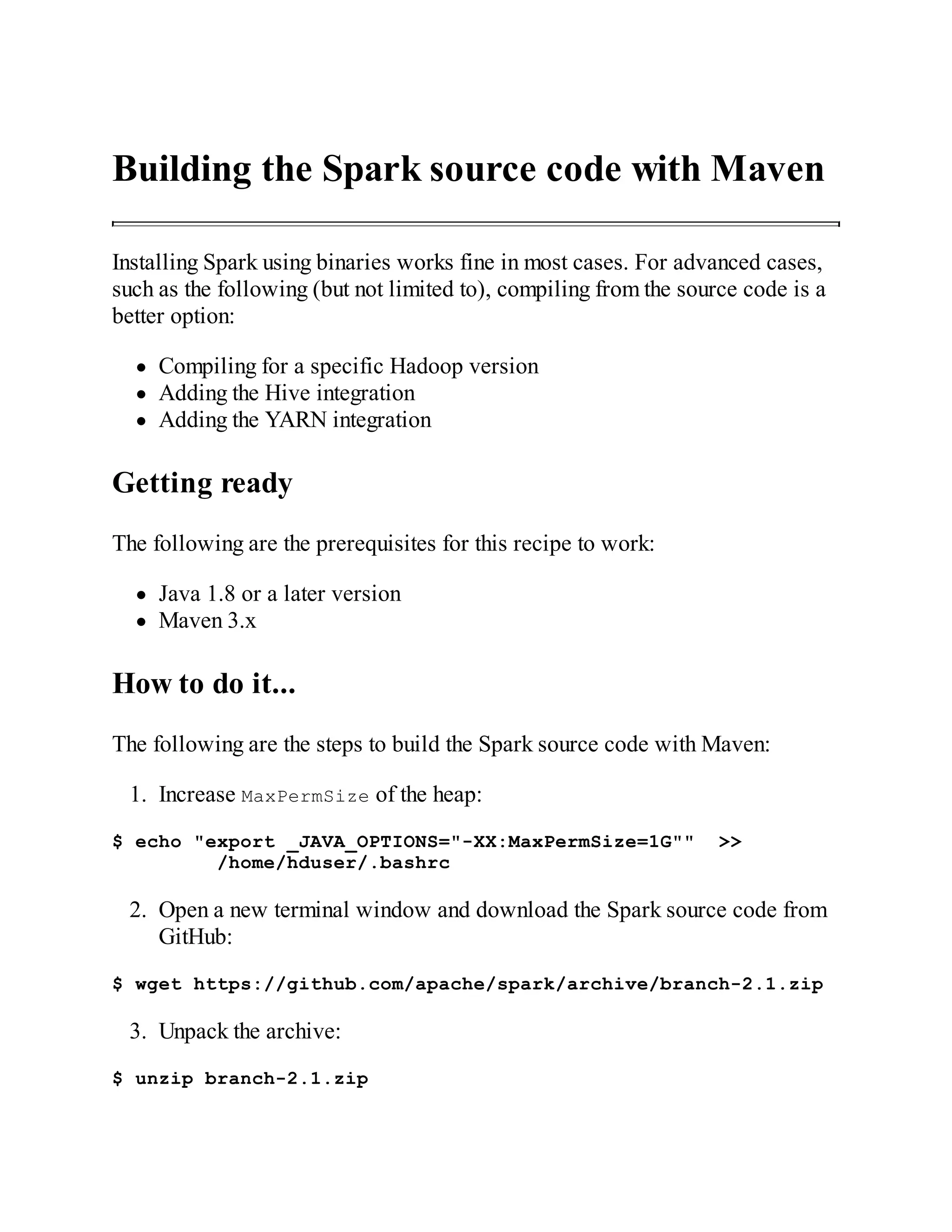
6. Move the spark directory to /opt/infoobjects, as it's an add-on
software package:
$ sudo mv spark /opt/infoobjects/
7. Change the permissions of the spark home directory, namely 0755 =
user:read-write-execute group:read-execute world:read-
execute:
$ sudo chmod -R 755 /opt/infoobjects/spark
8. Move to the spark home directory:
$ cd /opt/infoobjects/spark
9. Create the symbolic link:
$ sudo ln -s /etc/spark conf
10. Append Spark binaries path to PATH in .bashrc:
$ echo "export PATH=$PATH:/opt/infoobjects/spark/bin" >> /home/hduser/.b
11. Open a new terminal.
12. Create the log directory in /var:
$ sudo mkdir -p /var/log/spark
13. Make hduser the owner of Spark's log directory:
$ sudo chown -R hduser:hduser /var/log/spark
14. Create Spark's tmp directory:
$ mkdir /tmp/spark
15. Configure Spark with the help of the following command lines:
$ cd /etc/spark
$ echo "export HADOOP_CONF_DIR=/opt/infoobjects/hadoop/etc/hadoop"
$ echo "export YARN_CONF_DIR=/opt/infoobjects/hadoop/etc/Hadoop" >>
$ echo "export SPARK_LOG_DIR=/var/log/spark" >> spark-env.sh
$ echo "export SPARK_WORKER_DIR=/tmp/spark" >> spark-env.sh
16. Change the ownership of the spark home directory to root:
$ sudo chown -R root:root /opt/infoobjects/spark
Building the Spark source code with Maven
Installing Spark using binaries works fine in most cases. For advanced cases,
such as the following (but not limited to), compiling from the source code is a
better option:
Compiling for a specific Hadoop version
Adding the Hive integration
Adding the YARN integration
Getting ready
The following are the prerequisites for this recipe to work:
Java 1.8 or a later version
Maven 3.x
How to do it...
The following are the steps to build the Spark source code with Maven:
1. Increase MaxPermSize of the heap:
$ echo "export _JAVA_OPTIONS="-XX:MaxPermSize=1G"" >>
/home/hduser/.bashrc
2. Open a new terminal window and download the Spark source code from
GitHub:
$ wget https://github.com/apache/spark/archive/branch-2.1.zip
3. Unpack the archive:
$ unzip branch-2.1.zip
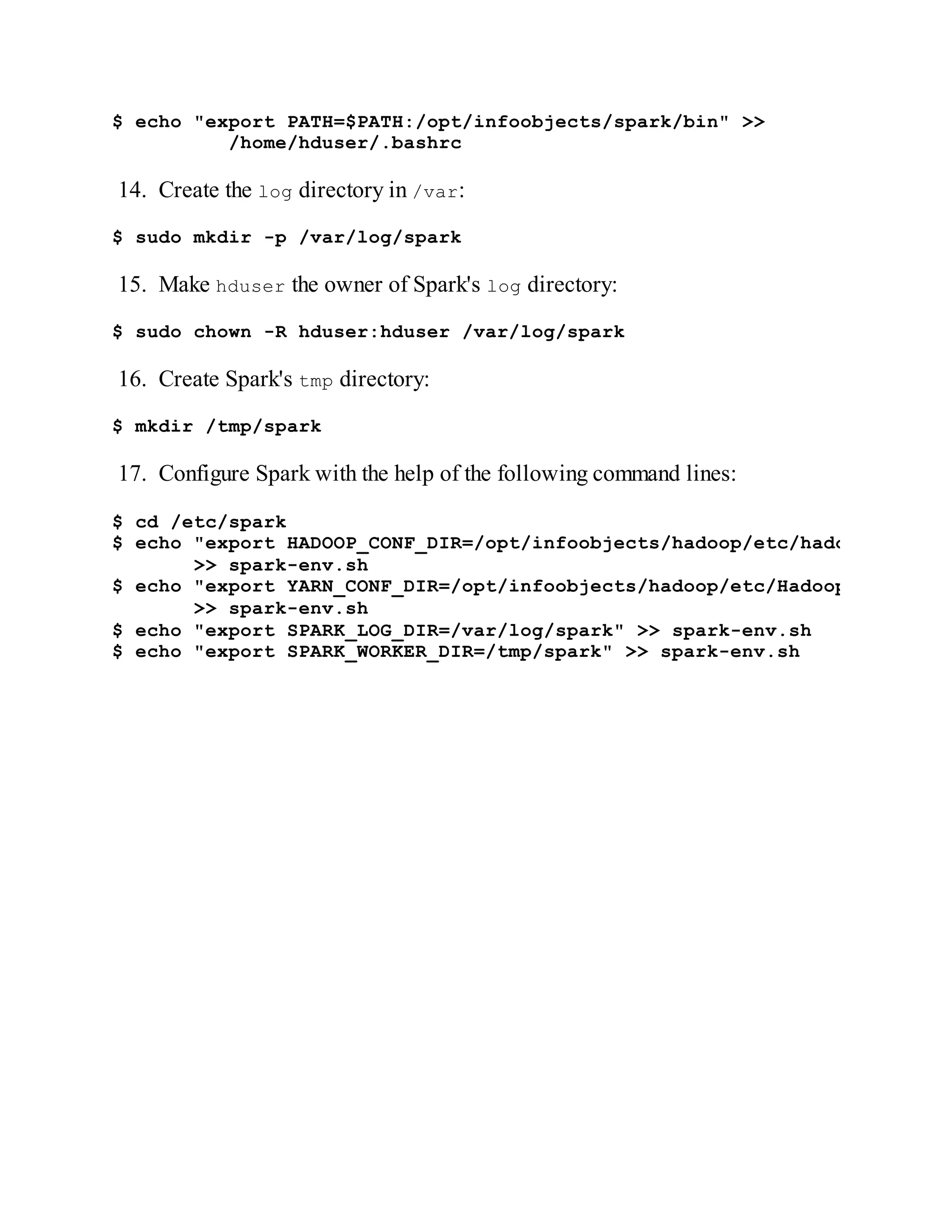
4. Rename unzipped folder to spark:
$ mv spark-branch-2.1 spark
5. Move to the spark directory:
$ cd spark
6. Compile the sources with the YARN-enabled, Hadoop version 2.7, and
Hive-enabled flags and skip the tests for faster compilation:
$ mvn -Pyarn -Phadoop-2.7 -Dhadoop.version=2.7.0 -Phive -
DskipTests clean package
7. Move the conf folder to the etc folder so that it can be turned into a
symbolic link:
$ sudo mv spark/conf /etc/
8. Move the spark directory to /opt as it's an add-on software package:
$ sudo mv spark /opt/infoobjects/spark
9. Change the ownership of the spark home directory to root:
$ sudo chown -R root:root /opt/infoobjects/spark
10. Change the permissions of the spark home directory, namely 0755 =
user:rwx group:r-x world:r-x:
$ sudo chmod -R 755 /opt/infoobjects/spark
11. Move to the spark home directory:
$ cd /opt/infoobjects/spark
12. Create a symbolic link:
$ sudo ln -s /etc/spark conf
13. Put the Spark executable in the path by editing .bashrc:
$ echo "export PATH=$PATH:/opt/infoobjects/spark/bin" >>
/home/hduser/.bashrc
14. Create the log directory in /var:
$ sudo mkdir -p /var/log/spark
15. Make hduser the owner of Spark's log directory:
$ sudo chown -R hduser:hduser /var/log/spark
16. Create Spark's tmp directory:
$ mkdir /tmp/spark
17. Configure Spark with the help of the following command lines:
$ cd /etc/spark
$ echo "export HADOOP_CONF_DIR=/opt/infoobjects/hadoop/etc/hadoop"
>> spark-env.sh
$ echo "export YARN_CONF_DIR=/opt/infoobjects/hadoop/etc/Hadoop"
>> spark-env.sh
$ echo "export SPARK_LOG_DIR=/var/log/spark" >> spark-env.sh
$ echo "export SPARK_WORKER_DIR=/tmp/spark" >> spark-env.sh
Launching Spark on Amazon EC2
Amazon Elastic Compute Cloud (Amazon EC2) is a web service that
provides resizable compute instances in the cloud. Amazon EC2 provides the
following features:
On-demand delivery of IT resources via the Internet
Provisioning of as many instances as you like
Payment for the hours during which you use instances, such as your utility
bill
No setup cost, no installation, and no overhead at all
Shutting down or terminating instances when you no longer need them
Making such instances available on familiar operating systems
EC2 provides different types of instances to meet all your compute needs, such
as general-purpose instances, microinstances, memory-optimized instances,
storage-optimized instances, and others. They also have a Free Tier of
microinstances for trial purposes.
Getting ready
The spark-ec2 script comes bundled with Spark and makes it easy to launch,
manage, and shut down clusters on Amazon EC2.
Before you start, do the following things: log in to the Amazon AWS account
via http://aws.amazon.com.
1. Click on Security Credentials under your account name in the top-
right corner.
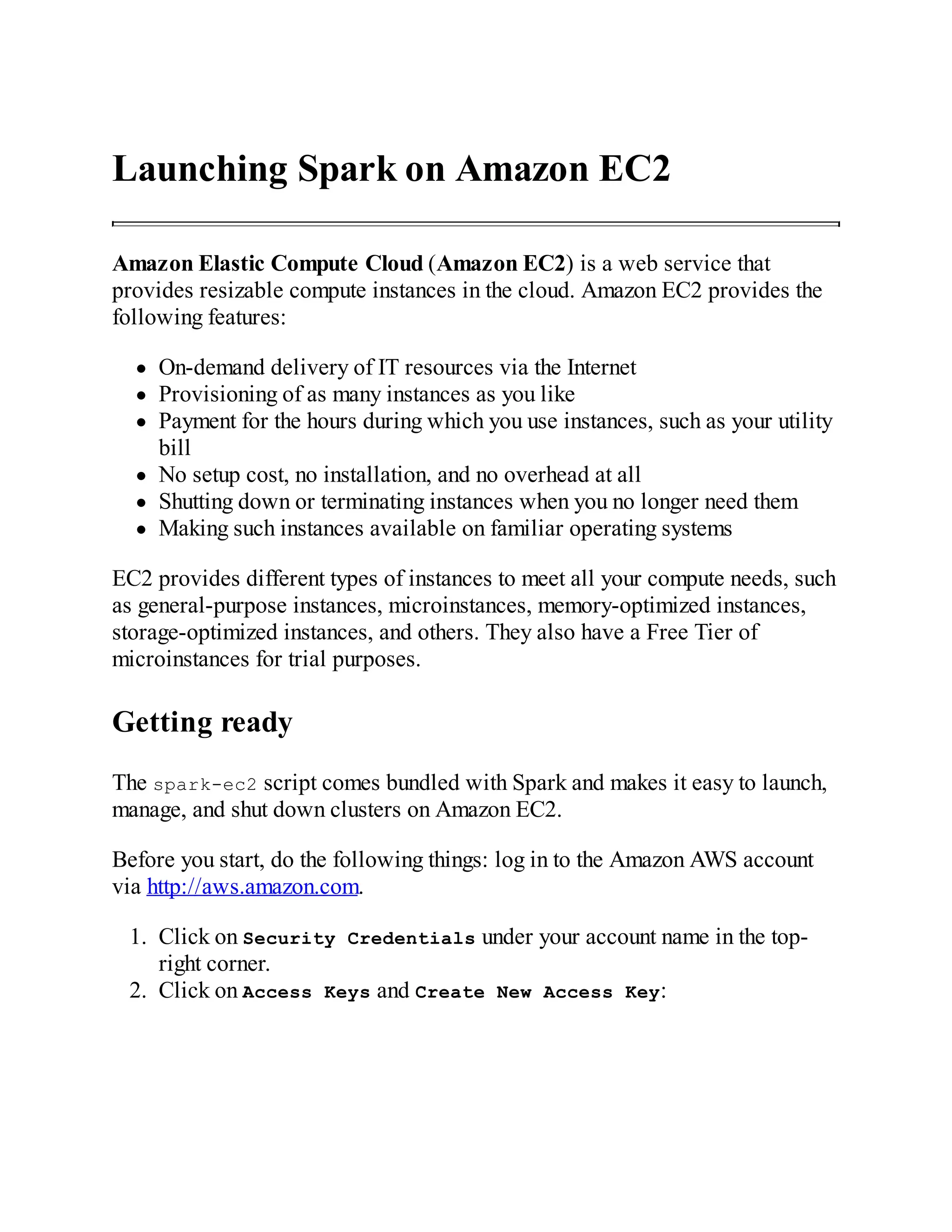
2. Click on Access Keys and Create New Access Key:
3. Download the key file (let's save it in the /home/hduser/kp folder as
spark-kp1.pem).
4. Set permissions on the key file to 600.
5. Set environment variables to reflect access key ID and secret
access key (replace the sample values with your own values):
$ echo "export AWS_ACCESS_KEY_ID="AKIAOD7M2LOWATFXFKQ"" >> /home/hduser/.
$ echo "export
AWS_SECRET_ACCESS_KEY="+Xr4UroVYJxiLiY8DLT4DLT4D4sxc3ijZGMx1D3pfZ2
/home/hduser/.bashrc
$ echo "export PATH=$PATH:/opt/infoobjects/spark/ec2" >> /home/hduser/.ba
How to do it…
1. Spark comes bundled with scripts to launch the Spark cluster on Amazon
EC2. Let's launch the cluster using the following command:
$ cd /home/hduser
$ spark-ec2 -k <key-pair> -i <key-file> -s <num-slaves> launch <cluster-n
<key-pair> - name of EC2 keypair created in AWS
<key-file> the private key file you downloaded
<num-slaves> number of slave nodes to launch
<cluster-name> name of the cluster
2. Launch the cluster with the example value:
$ spark-ec2 -k kp-spark -i /home/hduser/keypairs/kp-spark.pem --hadoop-ma
version 2 -s 3 launch spark-cluster
3. Sometimes, the default availability zones are not available; in that case,
retry sending the request by specifying the specific availability zone you
are requesting:
$ spark-ec2 -k kp-spark -i /home/hduser/keypairs/kp-spark.pem -z us-east
hadoop-major-version 2 -s 3 launch spark-cluster
4. If your application needs to retain data after the instance shuts down,
attach EBS volume to it (for example, 10 GB space):
$ spark-ec2 -k kp-spark -i /home/hduser/keypairs/kp-spark.pem --hadoop-m
version 2 -ebs-vol-size 10 -s 3 launch spark-cluster
5. If you use Amazon's spot instances, here is the way to do it:
$ spark-ec2 -k kp-spark -i /home/hduser/keypairs/kp-spark.pem -spot-pric
--hadoop-major-version 2 -s 3 launch spark-cluster
Note
Spot instances allow you to name your own price for Amazon
EC2's computing capacity. You simply bid for spare Amazon EC2
instances and run them whenever your bid exceeds the current spot
price, which varies in real time and is based on supply and
demand (source: www.amazon.com).
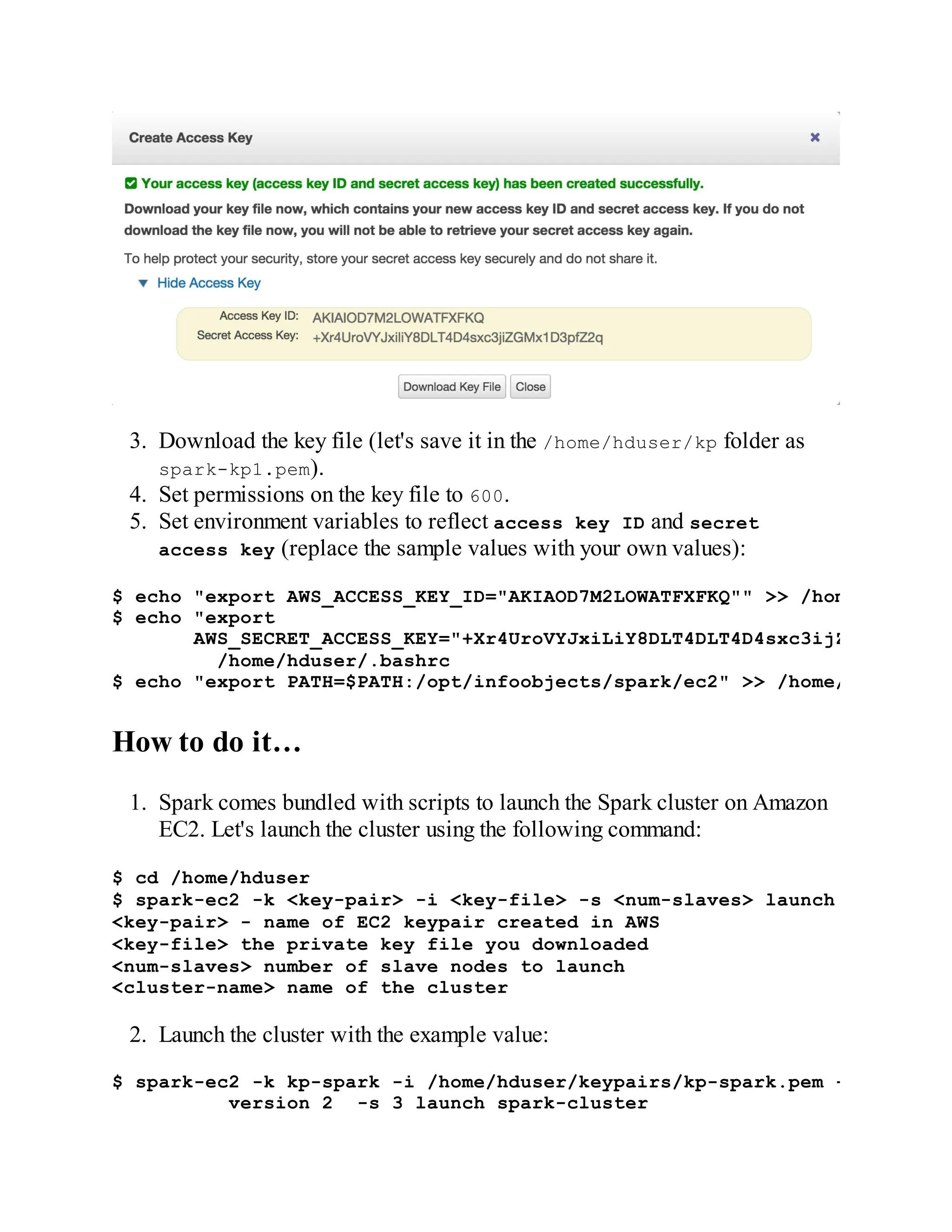
6. After completing the preceding launch process, check the status of the
cluster by going to the webUI URLthat will be printed at the end:
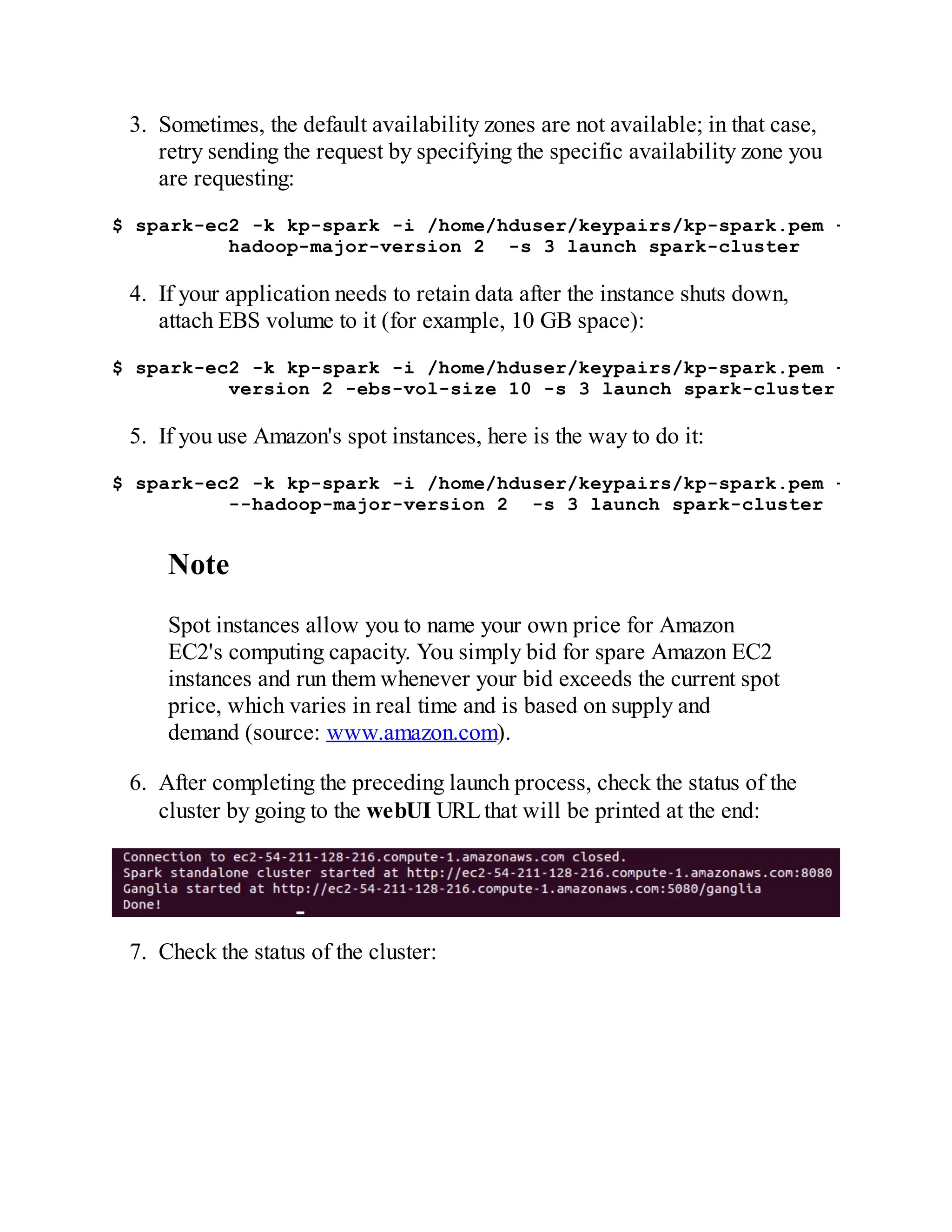
7. Check the status of the cluster:
8. Now, to access the Spark cluster on EC2, connect to the master node
using secure shell protocol (SSH):
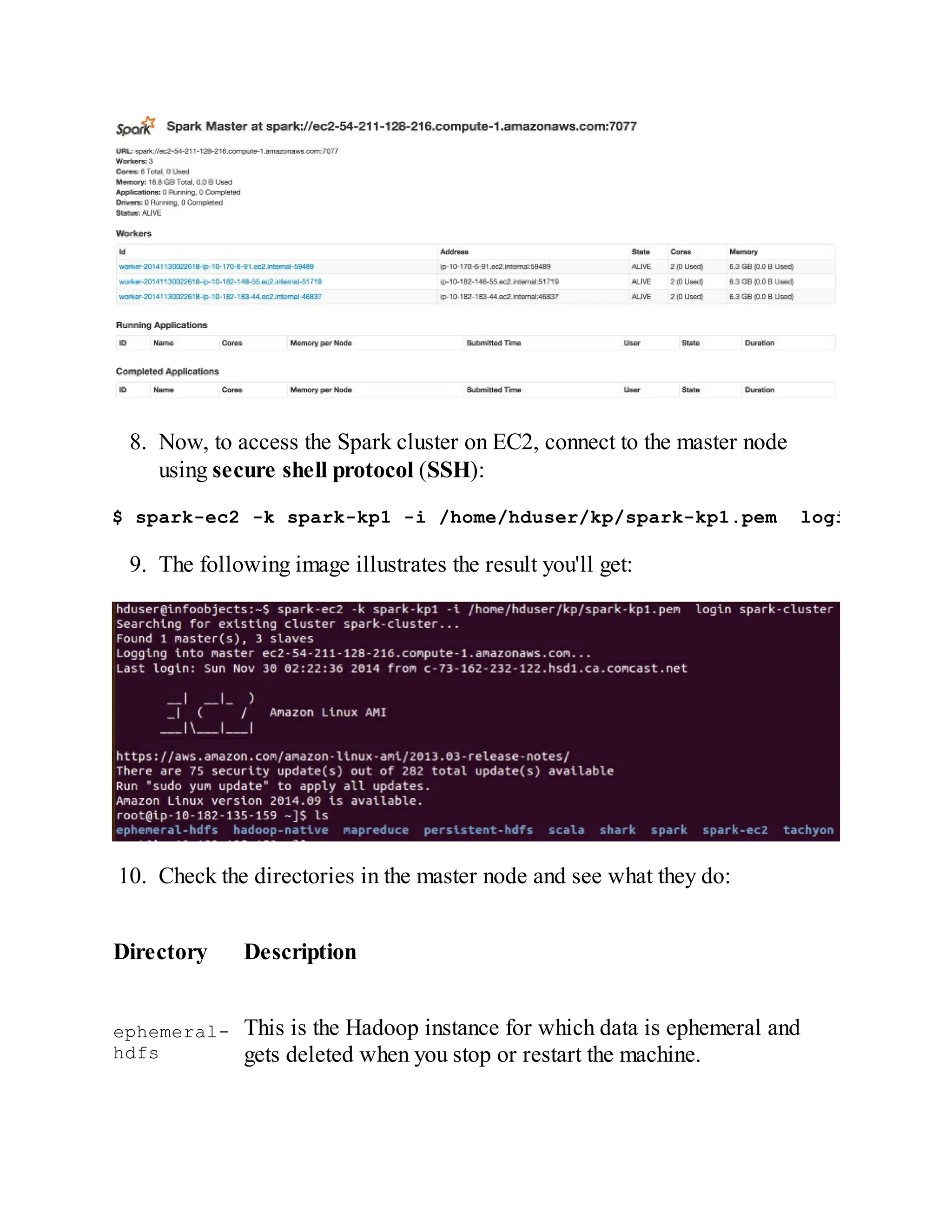
$ spark-ec2 -k spark-kp1 -i /home/hduser/kp/spark-kp1.pem login spark-cl
9. The following image illustrates the result you'll get:
10. Check the directories in the master node and see what they do:
Directory Description
ephemeral-
hdfs
This is the Hadoop instance for which data is ephemeral and
gets deleted when you stop or restart the machine.
persistent-
hdfs
Each node has a very small amount of persistent storage
(approximately 3 GB). If you use this instance, data will be
retained in that space.
hadoop-
native
This refers to the native libraries that support Hadoop, such as
snappy compression libraries.
scala This refers to the Scala installation.
shark
This refers to the Shark installation (Shark is no longer
supported and is replaced by Spark SQL).
spark This refers to the Spark installation.
spark-ec2 This refers to the files that support this cluster deployment.
tachyon This refers to the Tachyon installation.
11. Check the HDFS version in an ephemeral instance:
$ ephemeral-hdfs/bin/hadoop version
Hadoop 2.0.0-chd4.2.0
12. Check the HDFS version in a persistent instance with the following
command:
$ persistent-hdfs/bin/hadoop version
Hadoop 2.0.0-chd4.2.0
13. Change the configuration level of the logs:
$ cd spark/conf
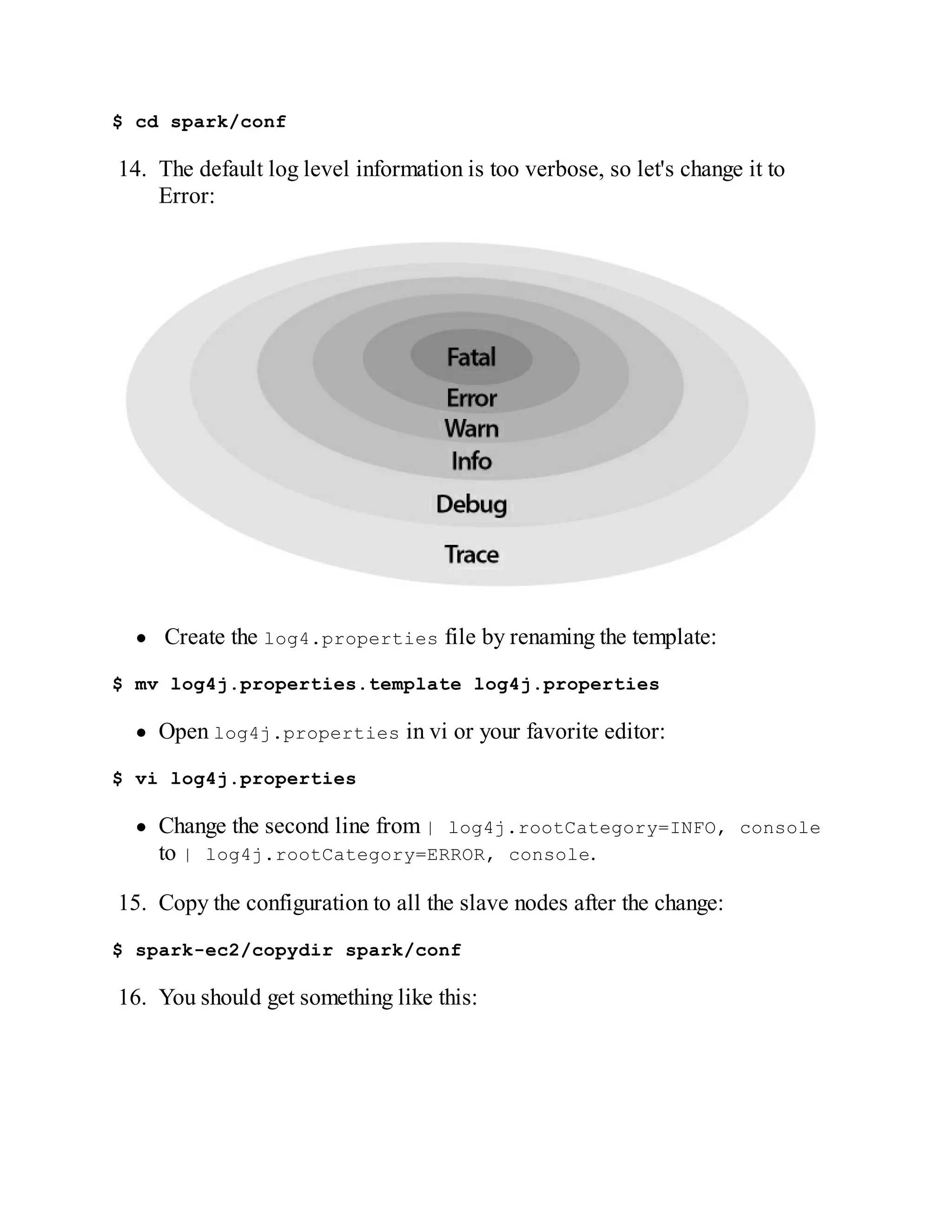
14. The default log level information is too verbose, so let's change it to
Error:
Create the log4.properties file by renaming the template:
$ mv log4j.properties.template log4j.properties
Open log4j.properties in vi or your favorite editor:
$ vi log4j.properties
Change the second line from | log4j.rootCategory=INFO, console
to | log4j.rootCategory=ERROR, console.
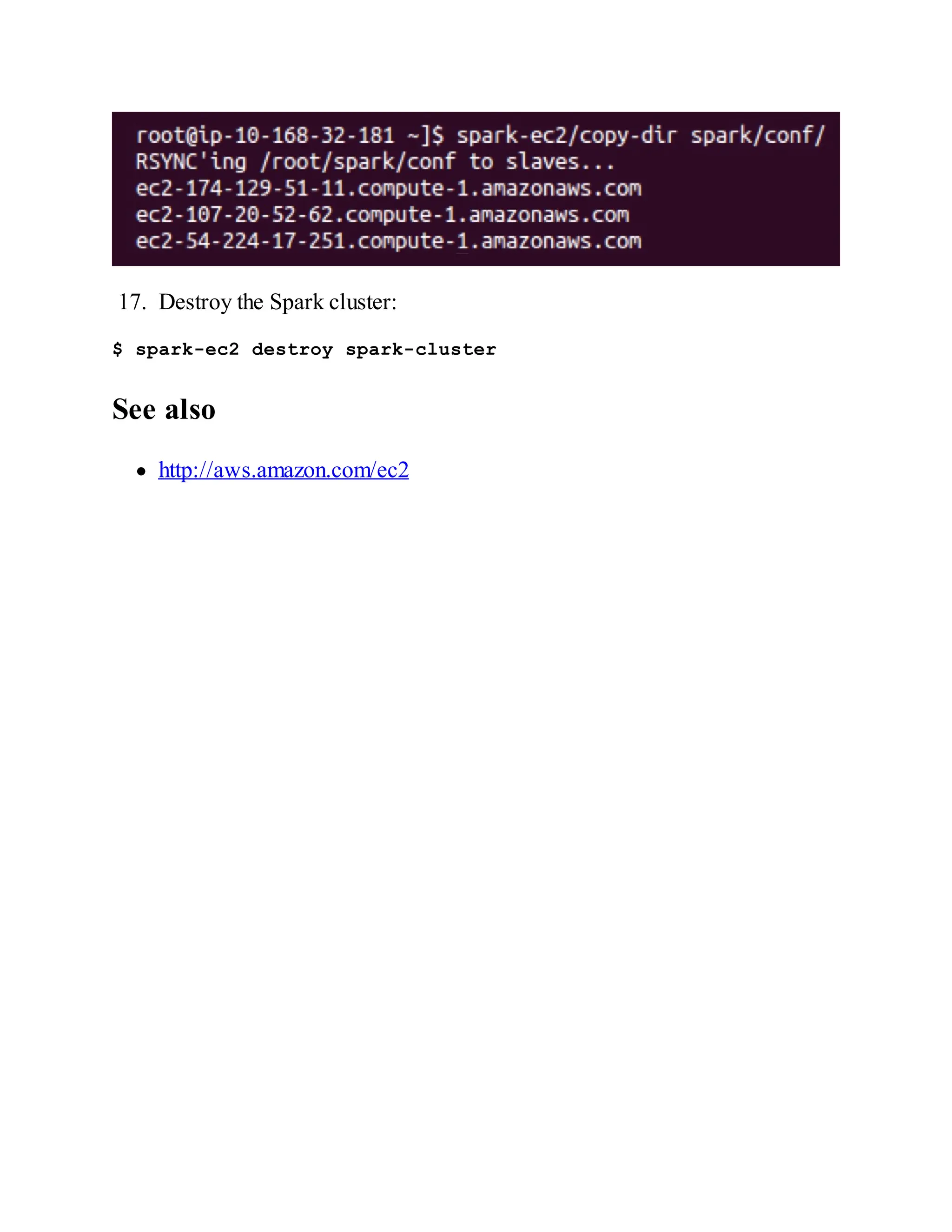
15. Copy the configuration to all the slave nodes after the change:
$ spark-ec2/copydir spark/conf
16. You should get something like this:
17. Destroy the Spark cluster:
$ spark-ec2 destroy spark-cluster
See also
http://aws.amazon.com/ec2
Deploying Spark on a cluster in standalone
mode
Compute resources in a distributed environment need to be managed so that
resource utilization is efficient and every job gets a fair chance to run. Spark
comes with its own cluster manager, which is conveniently called standalone
mode. Spark also supports working with YARN and Mesos cluster managers.
The cluster manager you choose should be mostly driven by both legacy
concerns and whether other frameworks, such as MapReduce, share the same
compute resource pool. If your cluster has legacy MapReduce jobs running and
all of them cannot be converted into Spark jobs, it is a good idea to use YARN
as the cluster manager. Mesos is emerging as a data center operating system to
conveniently manage jobs across frameworks, and it is very compatible with
Spark.
If the Spark framework is the only framework in your cluster, then the
standalone mode is good enough. As Spark is evolving as a technology, you
will see more and more use cases of Spark being used as the standalone
framework, serving all your big data compute needs. For example, some jobs
may use Apache Mahout at present because MLlib does not have a specific
machine-learning library, which the job needs. As soon as MLlib gets its
library, this particular job can be moved to Spark.
Getting ready
Let's consider a cluster of six nodes as an example setup--one master and five
slaves (replace them with the actual node names in your cluster):
Master
m1.zettabytes.com
Slaves
s1.zettabytes.com
s2.zettabytes.com
s3.zettabytes.com
s4.zettabytes.com
s5.zettabytes.com
How to do it…
1. Since Spark's standalone mode is the default, all you need to do is have
Spark binaries installed on both master and slave machines. Put
/opt/infoobjects/spark/sbin in the path on every node:
$ echo "export PATH=$PATH:/opt/infoobjects/spark/sbin" >> /home/hduser/.b
2. Start the standalone master server (SSH to master first):
hduser@m1.zettabytes.com~] start-master.sh
Note
Master, by default, starts on port 7077, which slaves use to
connect to it. It also has a web UI at port 8088.
3. Connect to the master node using a Secure Shell (SSH) connection and
then start the slaves:
hduser@s1.zettabytes.com~] spark-class org.apache.spark.deploy.worker.Wor
spark://m1.zettabytes.com:7077
Argument Meaning
-h
<ipaddress/HOST> and--
host <ipaddress/HOST>
IP address/DNS service to listen on
-p <port> and --port
Port for the service to listen on
<port>
--webui-port <port>
This is the port for the web UI (by default, 8080
is for the master and 8081 for the worker)
-c <cores> and --cores
<cores>
These refer to the total CPU core Spark
applications that can be used on a machine
(worker only)
-m <memory> and --memory
<memory>
These refer to the total RAM Spark applications
that can be used on a machine (worker only)
-d <dir> and --work-dir
<dir>
These refer to the directory to use for scratch
space and job output logs
Note
For fine-grained configuration, the above parameters work with
both master and slaves. Rather than manually starting master and
slave daemons on each node, it can also be accomplished using
cluster launch scripts. Cluster launch scripts are outside the scope
of this book. Please refer to books about Chef or Puppet.
4. First, create the conf/slaves file on a master node and add one line per
slave hostname (using an example of five slave nodes, replace the
following slave DNS with the DNS of the slave nodes in your cluster):
hduser@m1.zettabytes.com~] echo "s1.zettabytes.com" >> conf/slaves
hduser@m1.zettabytes.com~] echo "s2.zettabytes.com" >> conf/slaves
hduser@m1.zettabytes.com~] echo "s3.zettabytes.com" >> conf/slaves
hduser@m1.zettabytes.com~] echo "s4.zettabytes.com" >> conf/slaves
hduser@m1.zettabytes.com~] echo "s5.zettabytes.com" >> conf/slaves
Once the slave machine is set up, you can call the following scripts to
start/stop the cluster:
Script name Purpose
start-master.shStarts a master instance on the host machine
start-slaves.shStarts a slave instance on each node of the slaves file
start-all.sh Starts both the master and slaves
stop-master.sh Stops the master instance on the host machine
stop-slaves.sh Stops the slave instance on all the nodes of the slaves file
stop-all.sh Stops both the master and slaves
5. Connect an application to the cluster through Scala code:
val sparkContext = new SparkContext(new
SparkConf().setMaster("spark://m1.zettabytes.com:7077")Setting
spark-shell
6. Connect to the cluster through Spark shell:
$ spark-shell --master spark://master:7077
How it works…
In standalone mode, Spark follows the master-slave architecture, very much
like Hadoop, MapReduce, and YARN. The compute master daemon is called
Spark master and runs on one master node. Spark master can be made highly
available using ZooKeeper. You can also add more standby masters on the fly
if needed.
The compute slave daemon is called a worker, and it exists on each slave
node. The worker daemon does the following:
Reports the availability of the compute resources on a slave node, such as
the number of cores, memory, and others, to the Spark master
Spawns the executor when asked to do so by the Spark master
Restarts the executor if it dies
There is, at most, one executor per application, per slave machine.
Both Spark master and the worker are very lightweight. Typically, memory
allocation between 500 MB to 1 GB is sufficient. This value can be set in
conf/spark-env.sh by setting the SPARK_DAEMON_MEMORY parameter. For
example, the following configuration will set the memory to 1 gigabits for both
the master and worker daemon. Make sure you have sudo as the super user
before running it:
$ echo "export SPARK_DAEMON_MEMORY=1g" >> /opt/infoobjects/spark/conf/sp
By default, each slave node has one worker instance running on it. Sometimes,
you may have a few machines that are more powerful than others. In that case,
you can spawn more than one worker on that machine with the following
configuration (only on those machines):
$ echo "export SPARK_WORKER_INSTANCES=2" >> /opt/infoobjects/spark/conf/
The Spark worker, by default, uses all the cores on the slave machine for its
executors. If you would like to limit the number of cores the worker could use,
you can set it to the number of your choice (for example, 12), using the
following configuration:
$ echo "export SPARK_WORKER_CORES=12" >> /opt/infoobjects/spark/conf/spa
The Spark worker, by default, uses all of the available RAM (1 GB for
executors). Note that you cannot allocate how much memory each specific
executor will use (you can control this from the driver configuration). To
Exploring the Variety of Random
Documents with Different Content
back
back
back
Welcome to our website – the perfect destination for book lovers and
knowledge seekers. We believe that every book holds a new world,
offering opportunities for learning, discovery, and personal growth.
That’s why we are dedicated to bringing you a diverse collection of
books, ranging from classic literature and specialized publications to
self-development guides and children's books.
More than just a book-buying platform, we strive to be a bridge
connecting you with timeless cultural and intellectual values. With an
elegant, user-friendly interface and a smart search system, you can
quickly find the books that best suit your interests. Additionally,
our special promotions and home delivery services help you save time
and fully enjoy the joy of reading.
Join us on a journey of knowledge exploration, passion nurturing, and
personal growth every day!
ebookbell.com

Apache Spark 2x Cookbook Cloudready Recipes For Analytics And Data Science 2nd Rishi Yadav
  • 1.
    Apache Spark 2xCookbook Cloudready Recipes For Analytics And Data Science 2nd Rishi Yadav download https://ebookbell.com/product/apache-spark-2x-cookbook- cloudready-recipes-for-analytics-and-data-science-2nd-rishi- yadav-6810068 Explore and download more ebooks at ebookbell.com
  • 2.
    Here are somerecommended products that we believe you will be interested in. You can click the link to download. Apache Spark 2x Machine Learning Cookbook Amirghodsi Siamak https://ebookbell.com/product/apache-spark-2x-machine-learning- cookbook-amirghodsi-siamak-35447458 Apache Spark 2x Machine Learning Cookbook Over 100 Recipes To Simplify Machine Learning Model Implementations With Spark Siamak Amirghodsi Meenakshi Rajendran Broderick Hall Shuen Mei Amirghodsi https://ebookbell.com/product/apache-spark-2x-machine-learning- cookbook-over-100-recipes-to-simplify-machine-learning-model- implementations-with-spark-siamak-amirghodsi-meenakshi-rajendran- broderick-hall-shuen-mei-amirghodsi-23140990 Hadoop Realwork Solutions Cookbook Over 90 Handson Recipes To Help You Learn And Master The Intricacies Of Apache Hadoop 2x Yarn Hive Pig Oozie Flume Sqoop Apache Spark And Mahout Second Edition Deshpande https://ebookbell.com/product/hadoop-realwork-solutions-cookbook- over-90-handson-recipes-to-help-you-learn-and-master-the-intricacies- of-apache-hadoop-2x-yarn-hive-pig-oozie-flume-sqoop-apache-spark-and- mahout-second-edition-deshpande-11376940 Mastering Apache Spark 2x Scale Your Machine Learning And Deep Learning Systems With Sparkml Deeplearning4j And H2o 2nd Edition Romeo Kienzler https://ebookbell.com/product/mastering-apache-spark-2x-scale-your- machine-learning-and-deep-learning-systems-with-sparkml- deeplearning4j-and-h2o-2nd-edition-romeo-kienzler-7213900
  • 3.
    Apache Spark 2For Beginners Rajanarayanan Thottuvaikkatumana https://ebookbell.com/product/apache-spark-2-for-beginners- rajanarayanan-thottuvaikkatumana-43824702 Apache Spark 2 For Beginners Develop Largescale Distributed Data Processing Applications Using Spark 2 In Scala And Python Rajanarayanan Thottuvaikkatumana https://ebookbell.com/product/apache-spark-2-for-beginners-develop- largescale-distributed-data-processing-applications-using-spark-2-in- scala-and-python-rajanarayanan-thottuvaikkatumana-10833918 Apache Spark 2 Data Processing And Realtime Analytics Master Complex Big Data Processing Stream Analytics And Machine Learning With Apache Spark Romeo Kienzler https://ebookbell.com/product/apache-spark-2-data-processing-and- realtime-analytics-master-complex-big-data-processing-stream- analytics-and-machine-learning-with-apache-spark-romeo- kienzler-11391018 Beginning Apache Spark 2 With Resilient Distributed Datasets Spark Sql Structured Streaming And Spark Machine Learning Library Hien Luu https://ebookbell.com/product/beginning-apache-spark-2-with-resilient- distributed-datasets-spark-sql-structured-streaming-and-spark-machine- learning-library-hien-luu-7213898 Beginning Apache Spark 2 With Resilient Distributed Datasets Spark Sql Structured Streaming And Spark Machine Learning Library Hien Luu https://ebookbell.com/product/beginning-apache-spark-2-with-resilient- distributed-datasets-spark-sql-structured-streaming-and-spark-machine- learning-library-hien-luu-11068224
  • 5.
  • 6.
    1: Getting Startedwith Apache Spark Chapter 1: Getting Started with Apache Spark Introduction Leveraging�Databricks Cloud Deploying Spark using Amazon EMR Installing Spark from binaries Building the Spark source code with Maven Launching Spark on Amazon EC2 Deploying Spark on a cluster in standalone mode Deploying Spark on a cluster with Mesos Deploying Spark on a cluster with YARN Understanding SparkContext and SparkSession Understanding resilient distributed dataset - RDD 2: Developing Applications with Spark Chapter 2: Developing Applications with Spark Introduction Exploring the Spark shell Developing a Spark applications in Eclipse with Maven Developing a Spark applications in Eclipse with SBT Developing a Spark application in IntelliJ IDEA with Maven Developing a Spark application in IntelliJ IDEA with SBT Developing applications using the Zeppelin notebook Setting up Kerberos to do authentication Enabling Kerberos authentication for Spark 3: Spark SQL Chapter 3: Spark SQL Understanding the evolution of schema awareness Understanding the Catalyst optimizer Inferring schema using case classes Programmatically specifying the schema Understanding the Parquet format Loading and saving data using the JSON format Loading and saving data from relational databases Loading and saving data from an arbitrary source Understanding joins Analyzing nested structures 4: Working with External Data Sources
  • 7.
    Chapter 4: Workingwith External Data Sources Introduction Loading data from the local filesystem Loading data from HDFS Loading data from Amazon S3 Loading data from Apache Cassandra 5: Spark Streaming Chapter 5: Spark Streaming Introduction WordCount using Structured Streaming Taking a closer look at Structured Streaming Streaming Twitter data Streaming using Kafka Understanding streaming challenges 6: Getting Started with Machine Learning Chapter 6: Getting Started with Machine Learning Introduction Creating vectors Calculating correlation Understanding feature engineering Understanding Spark ML Understanding hyperparameter tuning 7: Supervised Learning with MLlib � Regression Chapter 7: Supervised Learning with MLlib � Regression Introduction Using linear regression Understanding the cost function Doing linear regression with lasso Doing ridge regression 8: Supervised Learning with MLlib � Classification Chapter 8: Supervised Learning with MLlib � Classification Introduction Doing classification using logistic regression Doing binary classification using SVM Doing classification using decision trees Doing classification using random forest Doing classification using gradient boosted trees
  • 8.
    Doing classification withNa�ve Bayes 9: Unsupervised Learning Chapter 9: Unsupervised Learning Introduction Clustering using k-means Dimensionality reduction with principal component analysis Dimensionality reduction with singular value decomposition 10: Recommendations Using Collaborative Filtering Chapter 10: Recommendations Using Collaborative Filtering Introduction Collaborative filtering using explicit feedback Collaborative filtering using implicit feedback 11: Graph Processing Using GraphX and GraphFrames Chapter 11: Graph Processing Using GraphX and GraphFrames Introduction Fundamental operations on graphs Using PageRank Finding connected components Performing neighborhood aggregation Understanding GraphFrames 12: Optimizations and Performance Tuning Chapter 12: Optimizations and Performance Tuning Optimizing memory Leveraging speculation Optimizing joins Using compression to improve performance Using serialization to improve performance Optimizing the level of parallelism Understanding project Tungsten
  • 9.
    Chapter 1. GettingStarted with Apache Spark In this chapter, we will set up Spark and configure it. This chapter contains the following recipes: Leveraging Databricks Cloud Deploying Spark using Amazon EMR Installing Spark from binaries Building the Spark source code with Maven Launching Spark on Amazon EC2 Deploying Spark on a cluster in standalone mode Deploying Spark on a cluster with Mesos Deploying Spark on a cluster with YARN Understanding SparkContext and SparkSession Understanding Resilient Distributed Datasets (RDD)
  • 10.
    Introduction Apache Spark isa general-purpose cluster computing system to process big data workloads. What sets Spark apart from its predecessors, such as Hadoop MapReduce, is its speed, ease of use, and sophisticated analytics. It was originally developed at AMPLab, UC Berkeley, in 2009. It was made open source in 2010 under the BSD license and switched to the Apache 2.0 license in 2013. Toward the later part of 2013, the creators of Spark founded Databricks to focus on Spark's development and future releases. Databricks offers Spark as a service in the Amazon Web Services(AWS) Cloud, called Databricks Cloud. In this book, we are going to maximize the use of AWS as a data storage layer. Talking about speed, Spark can achieve subsecond latency on big data workloads. To achieve such low latency, Spark makes use of memory for storage. In MapReduce, memory is primarily used for the actual computation. Spark uses memory both to compute and store objects. Spark also provides a unified runtime connecting to various big data storage sources, such as HDFS, Cassandra, and S3. It also provides a rich set of high- level libraries for different big data compute tasks, such as machine learning, SQLprocessing, graph processing, and real-time streaming. These libraries make development faster and can be combined in an arbitrary fashion. Though Spark is written in Scala--and this book only focuses on recipes on Scala--it also supports Java, Python, and R. Spark is an open source community project, and everyone uses the pure open source Apache distributions for deployments, unlike Hadoop, which has multiple distributions available with vendor enhancements. The following figure shows the Spark ecosystem:
  • 11.
    Spark's runtime runson top of a variety of cluster managers, including YARN (Hadoop's compute framework), Mesos, and Spark's own cluster manager called Standalone mode. Alluxio is a memory-centric distributed file system that enables reliable file sharing at memory speed across cluster frameworks. In short, it is an off-heap storage layer in memory that helps share data across jobs and users. Mesos is a cluster manager, which is evolving into a data center operating system. YARN is Hadoop's compute framework and has a robust resource management feature that Spark can seamlessly use. Apache Spark, initially devised as a replacement of MapReduce, had a good proportion of workloads running in an on-premises manner. Now, most of the workloads have been moved to public clouds (AWS, Azure, and GCP). In a public cloud, we see two types of applications: Outcome-driven applications Data transformation pipelines For outcome-driven applications, where the goal is to derive a predefined signal/outcome from the given data, Databricks Cloud fits the bill perfectly. For traditional data transformation pipelines, Amazon's Elastic MapReduce (EMR) does a great job.
  • 12.
    Leveraging Databricks Cloud Databricksis the company behind Spark. It has a cloud platform that takes out all of the complexity of deploying Spark and provides you with a ready-to-go environment with notebooks for various languages. Databricks Cloud also has a community edition that provides one node instance with 6 GB of RAM for free. It is a great starting place for developers. The Spark cluster that is created also terminates after 2 hours of sitting idle. Note All the recipes in this book can be run on either the InfoObjects Sandbox or Databricks Cloud community edition. The entire data for the recipes in this book has also been ported to a public bucket called sparkcookbook on S3. Just put these recipes on the Databricks Cloud community edition, and they will work seamlessly. How to do it... 1. Go to https://community.cloud.databricks.com:
  • 13.
    2. Click onSign Up :
  • 14.
    3. Choose COMMUNITYEDITION (or full platform):
  • 15.
    4. Fill inthe details and you'll be presented with a landing page, as follows:
  • 16.
    5. Click onClusters, then Create Cluster (showing community edition below it): 6. Enter the cluster name, for example, myfirstcluster, and choose Availability Zone (more about AZs in the next recipe). Then click on Create Cluster: 7. Once the cluster is created, the blinking green signal will become solid green, as follows:
  • 17.
    8. Now goto Home and click on Notebook. Choose an appropriate notebook name, for example, config, and choose Scala as the language: 9. Then set the AWS access parameters. There are two access parameters: ACCESS_KEY: This is referred to as fs.s3n.awsAccessKeyId in SparkContext's Hadoop configuration. SECRET_KEY: This is referred to as fs.s3n.awsSecretAccessKey in SparkContext's Hadoop configuration. 10. Set ACCESS_KEY in the config notebook:
  • 18.
    sc.hadoopConfiguration.set("fs.s3n.awsAccessKeyId", "<replace with yourkey>") 11. Set SECRET_KEY in the config notebook: sc.hadoopConfiguration.set("fs.s3n.awsSecretAccessKey"," <replace with your secret key>") 12. Load a folder from the sparkcookbook bucket (all of the data for the recipes in this book are available in this bucket: val yelpdata = spark.read.textFile("s3a://sparkcookbook/yelpdata") 13. The problem with the previous approach was that if you were to publish your notebook, your keys would be visible. To avoid the use of this approach, use Databricks File System (DBFS). Note DBFS is Databricks Cloud's internal file system. It is a layer above S3, as you can guess. It mounts S3 buckets in a user's workspace as well as caches frequently accessed data on worker nodes. 14. Set the access key in the Scala notebook: val accessKey = "<your access key>" 15. Set the secret key in the Scala notebook: val secretKey = "<your secret key>".replace("/","%2F") 16. Set the bucket name in the Scala notebook: val bucket = "sparkcookbook" 17. Set the mount name in the Scala notebook: val mount = "cookbook"
  • 19.
    18. Mount thebucket: dbutils.fs.mount(s"s3a://$accessKey:$secretKey@$bucket" s"/mnt/$mount") 19. Display the contents of the bucket: display(dbutils.fs.ls(s"/mnt/$mount")) Note The rest of the recipes will assume that you would have set up AWS credentials. How it works... Let's look at the key concepts in Databricks Cloud. Cluster The concept of clusters is self-evident. A cluster contains a master node and one or more slave nodes. These nodes are EC2 nodes, which we are going to learn more about in the next recipe. Notebook Notebook is the most powerful feature of Databricks Cloud. You can write your code in Scala/Python/R or a simple SQLnotebook. These notebooks cover the whole 9 yards. You can use notebooks to write code like a programmer, use SQLlike an analyst, or do visualization like a Business Intelligence (BI) expert. Table Tables enable Spark to run SQLqueries.
  • 20.
    Library Library is thesection where you upload the libraries you would like to attach to your notebooks. The beauty is that you do not have to upload libraries manually; you can simply provide the Maven parameters and it would find the library for you and attach it.
  • 21.
    Deploying Spark usingAmazon EMR There is a reason why deploying Spark on Amazon EMR is added as one of the first recipes in this edition of the book. The majority of the production deployments of Spark happen on EMR (in fact, the majority, and increasingly so, big data deployments happen on EMR). If you understand this recipe well, you may skip the rest of the recipes in this chapter, unless you are doing an on- premises deployment. Note Since this topic is of paramount importance in the current context, a lot more theory is being provided than what a typical cookbook would have. You can skip the theory section and directly go to the How to do it.. section, but I encourage you not to do so. What it represents is much bigger than what it looks What EMR represents is far more than meets the eye. Most of the enterprise workloads are migrating to public clouds at an accelerated pace. Once migrated, these workloads get rearchitected to leverage cloud-based services as opposed to simply using it as Infrastructure as a Service (IaaS). EC2 is an IaaS compute service of AWS, while EMR is the leading Platform as a Service (PaaS) service of AWS, with more big data workloads running on EMR than the alternatives combined. EMR's architecture Hadoop's core feature is data locality, that is, taking compute to where the data is. AWS disrupts this concept by separating storage and compute. AWS has multiple storage options, including the following:
  • 22.
    Amazon S3: S3is general-purpose object storage. Amazon Redshift: This is a distributed cloud data warehouse. Amazon DynamoDB: This is a NoSQLdatabase. Amazon Aurora: This is a cloud-based relational database. Amazon S3 is the cheapest and most reliable cloud storage available, and this makes it the first choice, unless there is a compelling reason not to do so. EMR also supports attaching elastic block storage (EBS) volumes to compute instances (EC2) in order to provide a lower latency option. Which option to choose depends upon what type of cluster is being created. There are two types of clusters: Persistent cluster: It runs 24 x 7. Here, there is a continuous analysis of data for use cases such as fraud detection in the financial industry or clickstream analytics in ad tech. For these purposes, HDFS mounted on EBS is a good choice. Transient cluster: Here, workloads are run inconsistently, for example, genome sequencing or holiday surge in retail. In this case, the cluster is only spawned when needed, making Elastic Map Reduce File System (EMRFS) based on S3 a better choice. How to do it... 1. Log in to https://aws.amazon.com with your credentials. 2. Click on Services and select/search for EMR:
  • 23.
    3. Click onCreate cluster and select the last option in the Applications option box:
  • 24.
    4. Click onCreate Cluster and the cluster will start as follows:
  • 25.
    5. Once thecluster is created with the given configuration, the My Cluster status will change to Waiting, as shown in the following screenshot:
  • 26.
    6. Now adda step to select the JAR file; it takes the input file from the S3 location and produces the output file and stores it in the desired S3 bucket:
  • 27.
    7. The wordcountstep's status will change to completed, indicating a successful completion of the step, as shown in the following screenshot:
  • 28.
    8. The outputwill be created and stored in the given S3 location. Here, it is in the output folder under the io.playground bucket:
  • 29.
    How it works... Let'slook at the options shown in step 3: Cluster name: This is where you provide an appropriate name for the cluster. S3 folder: This is the folder location where the S3 bucket's logs for this cluster will go to. Launch mode: Cluster: The cluster will continue to run until you terminate it. Step execution: This is to add steps after the application is launched. Software configuration: Vendor: This is Amazon EMI with the open source Hadoop versus MapR's version. Release: This is self-evident. Applications: Core Hadoop: This is focused on the SQLinterface.
  • 30.
    HBase: This isfocused on partial no-SQL-oriented workloads. Presto: This is focused on ad-hoc query processing. Spark: This is focused on Spark. Hardware configuration: Instance type: This topic will be covered in detail in the next section. Number of instances: This refers to the number of nodes in the cluster. One of them will be the master node and the rest slave nodes. Security and access: EC2 key pair: You can associate an EC2 key pair with the cluster that you can use to connect to it via SSH. Permissions: You can allow other users besides the default Hadoop user to submit jobs. EMR role: This allows EMR to call other AWS services, such as EC2, on your behalf. EC2 instance profile: This provides access to other AWS services, such as S3 and DynamoDB, via the EC2 instances that are launched by EMR. EC2 instance types EC2 instances are the most expensive part of a company's AWS bill. So, selecting the right instance type is the key through which you can optimize your bill. The following section is a quick overview of the different instance types. Instance types, both in the cloud and on premises, are defined by four factors: Number of cores Memory Storage (size and type) Network performance To see a quick illustration of how these factors affect each other, visit http://youtube.com/infoobjects. In the EC2 world, these factors have been modified slightly to vCPU. vCPU is a virtualized unit of:
  • 31.
    Memory Storage (size andtype) Network performance Instance type families are defined by the ratio of these factors, especially vCPU to memory. In a given family, this ratio remains unchanged (T2 excluded). Different instance families serve different purposes, almost like different types of automobiles. In fact, we are going to use the automobile metaphor in this section to illustrate these families. T2 - Free Tier Burstable (EBS only) The T2 instance type is a gateway drug in the AWS world, the reason being it belongs to Free Tier. Developers who sign up for AWS get this instance type for up to a year. This tier has six subtypes: Instance Type vCPUsCPU Credit/HrMemory (GiB) t2.micro 1 6 1 t2.small 1 12 2 t2.medium 2 24 4 t2.large 2 36 6 t2.xlarge 4 54 6 t2.2xlarge 8 81 32
  • 32.
    M4 - Generalpurpose (EBS only) M4 is the instance type you use when in doubt. Developers who sign up for AWS get this instance type for up to a year. This tier has six subtypes: Instance Type vCPUsMemory (GiB)Dedicated Bandwidth m4.large 2 8 450 mbps m4.xlarge 4 16 750 mbps m4.2xlarge 8 32 1,000 mbps m4.4xlarge 16 64 2,000 mbps m4.10xlarge 40 160 4,000 mbps m4.16xlarge 64 256 10,000 mbps C4 - Compute optimized This tier has five subtypes: Instance Type vCPUsMemory (GiB)Dedicated Bandwidth c4.large 2 3.75 500 mbps c4.xlarge 4 7.5 750 mbps
  • 33.
    c4.2xlarge 8 151,000 mbps c4.4xlarge 16 30 2,000 mbps c4.8xlarge 36 60 4,000 mbps X1 - Memory optimized This tier has two subtypes: Instance Type vCPUsMemory (GiB)Dedicated Bandwidth x1.16xlarge 2 8 450 mbps x1.32xlarge 4 16 750 mbps R4 - Memory optimized This tier has six subtypes: Instance Type vCPUsMemory (GiB)Dedicated Bandwidth r4.large 2 15.25 10 gbps r4.xlarge 4 30.5 10 gbps
  • 34.
    r4.2xlarge 8 6110 gbps r4.4xlarge 16 122 10 gbps r4.8xlarge 32 244 10 gbps r4.16xlarge 64 488 20 gbps P2 - General purpose GPU This tier has three subtypes: Instance Type vCPUsMemory (GiB)GPUsGPU Memory (GiB) p2.xlarge 4 61 1 12 p2.8xlarge 32 488 8 96 p2.16xlarge 64 732 16 192 I3 - Storage optimized This tier has six subtypes: Instance Type vCPUsMemory (GiB)Storage (GB) i3.large 2 15.25 475 NVMe SSD
  • 35.
    i3.xlarge 4 30.5950 NVMe SSD i3.2xlarge 8 61 1,900 NVMe SSD i3.4xlarge 16 122 2x1,900 NVMe SSD i3.8xlarge 32 244 4x1,900 NVMe SSD i3.16xlarge 64 488 8x1,900 NVMe SSD D2 - Storage optimized This tier is for massively parallel processing (MPP), data warehouse, and so on type usage. This tier has four subtypes: Instance Type vCPUsMemory (GiB)Storage (GB) d2.xlarge 4 30.5 3x2000 HDD d2.2xlarge 8 61 6x2000 HDD d2.4xlarge 16 122 12x2000 HDD d2.8xlarge 32 244 24x2000 HDD
  • 36.
    Installing Spark frombinaries You can build Spark from the source code, or you can download precompiled binaries from http://spark.apache.org. For a standard use case, binaries are good enough, and this recipe will focus on installing Spark using binaries. Getting ready At the time of writing, Spark's current version is 2.1. Please check the latest version from Spark's download page at http://spark.apache.org/downloads.html. Binaries are developed with the most recent and stable version of Hadoop. To use a specific version of Hadoop, the recommended approach is that you build it from sources, which we will cover in the next recipe. All the recipes in this book are developed using Ubuntu Linux, but they should work fine on any POSIX environment. Spark expects Java to be installed and the JAVA_HOME environment variable set. In Linux/Unix systems, there are certain standards for the location of files and directories, which we are going to follow in this book. The following is a quick cheat sheet: DirectoryDescription /bin This stores essential command binaries /etc This is where host-specific system configurations are located /opt This is where add-on application software packages are located
  • 37.
    /var This iswhere variable data is located /tmp This stores the temporary files /home This is where user home directories are located How to do it… Here are the installation steps: 1. Open the terminal and download the binaries using the following command: $ wget http://d3kbcqa49mib13.cloudfront.net/spark-2.1.0-bin-hadoop2.7.tgz 2. Unpack the binaries: $ tar -zxf spark-2.1.0-bin-hadoop2.7.tgz 3. Rename the folder containing the binaries by stripping the version information: $ sudo mv spark-2.1.0-bin-hadoop2.7 spark 4. Move the configuration folder to the /etc folder so that it can be turned into a symbolic link later: $ sudo mv spark/conf/* /etc/spark 5. Create your company-specific installation directory under /opt. As the recipes in this book are tested on the infoobjects sandbox, use infoobjects as the directory name. Create the /opt/infoobjects directory: $ sudo mkdir -p /opt/infoobjects

  • 38.
    6. Move thespark directory to /opt/infoobjects, as it's an add-on software package: $ sudo mv spark /opt/infoobjects/ 7. Change the permissions of the spark home directory, namely 0755 = user:read-write-execute group:read-execute world:read- execute: $ sudo chmod -R 755 /opt/infoobjects/spark 8. Move to the spark home directory: $ cd /opt/infoobjects/spark 9. Create the symbolic link: $ sudo ln -s /etc/spark conf 10. Append Spark binaries path to PATH in .bashrc: $ echo "export PATH=$PATH:/opt/infoobjects/spark/bin" >> /home/hduser/.b 11. Open a new terminal. 12. Create the log directory in /var: $ sudo mkdir -p /var/log/spark 13. Make hduser the owner of Spark's log directory: $ sudo chown -R hduser:hduser /var/log/spark 14. Create Spark's tmp directory: $ mkdir /tmp/spark 15. Configure Spark with the help of the following command lines: $ cd /etc/spark $ echo "export HADOOP_CONF_DIR=/opt/infoobjects/hadoop/etc/hadoop" $ echo "export YARN_CONF_DIR=/opt/infoobjects/hadoop/etc/Hadoop" >> $ echo "export SPARK_LOG_DIR=/var/log/spark" >> spark-env.sh
  • 39.
    $ echo "exportSPARK_WORKER_DIR=/tmp/spark" >> spark-env.sh 16. Change the ownership of the spark home directory to root: $ sudo chown -R root:root /opt/infoobjects/spark
  • 40.
    Building the Sparksource code with Maven Installing Spark using binaries works fine in most cases. For advanced cases, such as the following (but not limited to), compiling from the source code is a better option: Compiling for a specific Hadoop version Adding the Hive integration Adding the YARN integration Getting ready The following are the prerequisites for this recipe to work: Java 1.8 or a later version Maven 3.x How to do it... The following are the steps to build the Spark source code with Maven: 1. Increase MaxPermSize of the heap: $ echo "export _JAVA_OPTIONS="-XX:MaxPermSize=1G"" >> /home/hduser/.bashrc 2. Open a new terminal window and download the Spark source code from GitHub: $ wget https://github.com/apache/spark/archive/branch-2.1.zip 3. Unpack the archive: $ unzip branch-2.1.zip
  • 41.
    4. Rename unzippedfolder to spark: $ mv spark-branch-2.1 spark 5. Move to the spark directory: $ cd spark 6. Compile the sources with the YARN-enabled, Hadoop version 2.7, and Hive-enabled flags and skip the tests for faster compilation: $ mvn -Pyarn -Phadoop-2.7 -Dhadoop.version=2.7.0 -Phive - DskipTests clean package 7. Move the conf folder to the etc folder so that it can be turned into a symbolic link: $ sudo mv spark/conf /etc/ 8. Move the spark directory to /opt as it's an add-on software package: $ sudo mv spark /opt/infoobjects/spark 9. Change the ownership of the spark home directory to root: $ sudo chown -R root:root /opt/infoobjects/spark 10. Change the permissions of the spark home directory, namely 0755 = user:rwx group:r-x world:r-x: $ sudo chmod -R 755 /opt/infoobjects/spark 11. Move to the spark home directory: $ cd /opt/infoobjects/spark 12. Create a symbolic link: $ sudo ln -s /etc/spark conf 13. Put the Spark executable in the path by editing .bashrc:
  • 42.
    $ echo "exportPATH=$PATH:/opt/infoobjects/spark/bin" >> /home/hduser/.bashrc 14. Create the log directory in /var: $ sudo mkdir -p /var/log/spark 15. Make hduser the owner of Spark's log directory: $ sudo chown -R hduser:hduser /var/log/spark 16. Create Spark's tmp directory: $ mkdir /tmp/spark 17. Configure Spark with the help of the following command lines: $ cd /etc/spark $ echo "export HADOOP_CONF_DIR=/opt/infoobjects/hadoop/etc/hadoop" >> spark-env.sh $ echo "export YARN_CONF_DIR=/opt/infoobjects/hadoop/etc/Hadoop" >> spark-env.sh $ echo "export SPARK_LOG_DIR=/var/log/spark" >> spark-env.sh $ echo "export SPARK_WORKER_DIR=/tmp/spark" >> spark-env.sh
  • 43.
    Launching Spark onAmazon EC2 Amazon Elastic Compute Cloud (Amazon EC2) is a web service that provides resizable compute instances in the cloud. Amazon EC2 provides the following features: On-demand delivery of IT resources via the Internet Provisioning of as many instances as you like Payment for the hours during which you use instances, such as your utility bill No setup cost, no installation, and no overhead at all Shutting down or terminating instances when you no longer need them Making such instances available on familiar operating systems EC2 provides different types of instances to meet all your compute needs, such as general-purpose instances, microinstances, memory-optimized instances, storage-optimized instances, and others. They also have a Free Tier of microinstances for trial purposes. Getting ready The spark-ec2 script comes bundled with Spark and makes it easy to launch, manage, and shut down clusters on Amazon EC2. Before you start, do the following things: log in to the Amazon AWS account via http://aws.amazon.com. 1. Click on Security Credentials under your account name in the top- right corner. 2. Click on Access Keys and Create New Access Key:
  • 44.
    3. Download thekey file (let's save it in the /home/hduser/kp folder as spark-kp1.pem). 4. Set permissions on the key file to 600. 5. Set environment variables to reflect access key ID and secret access key (replace the sample values with your own values): $ echo "export AWS_ACCESS_KEY_ID="AKIAOD7M2LOWATFXFKQ"" >> /home/hduser/. $ echo "export AWS_SECRET_ACCESS_KEY="+Xr4UroVYJxiLiY8DLT4DLT4D4sxc3ijZGMx1D3pfZ2 /home/hduser/.bashrc $ echo "export PATH=$PATH:/opt/infoobjects/spark/ec2" >> /home/hduser/.ba How to do it… 1. Spark comes bundled with scripts to launch the Spark cluster on Amazon EC2. Let's launch the cluster using the following command: $ cd /home/hduser $ spark-ec2 -k <key-pair> -i <key-file> -s <num-slaves> launch <cluster-n <key-pair> - name of EC2 keypair created in AWS <key-file> the private key file you downloaded <num-slaves> number of slave nodes to launch <cluster-name> name of the cluster 2. Launch the cluster with the example value: $ spark-ec2 -k kp-spark -i /home/hduser/keypairs/kp-spark.pem --hadoop-ma version 2 -s 3 launch spark-cluster
  • 45.
    3. Sometimes, thedefault availability zones are not available; in that case, retry sending the request by specifying the specific availability zone you are requesting: $ spark-ec2 -k kp-spark -i /home/hduser/keypairs/kp-spark.pem -z us-east hadoop-major-version 2 -s 3 launch spark-cluster 4. If your application needs to retain data after the instance shuts down, attach EBS volume to it (for example, 10 GB space): $ spark-ec2 -k kp-spark -i /home/hduser/keypairs/kp-spark.pem --hadoop-m version 2 -ebs-vol-size 10 -s 3 launch spark-cluster 5. If you use Amazon's spot instances, here is the way to do it: $ spark-ec2 -k kp-spark -i /home/hduser/keypairs/kp-spark.pem -spot-pric --hadoop-major-version 2 -s 3 launch spark-cluster Note Spot instances allow you to name your own price for Amazon EC2's computing capacity. You simply bid for spare Amazon EC2 instances and run them whenever your bid exceeds the current spot price, which varies in real time and is based on supply and demand (source: www.amazon.com). 6. After completing the preceding launch process, check the status of the cluster by going to the webUI URLthat will be printed at the end: 7. Check the status of the cluster:
  • 46.
    8. Now, toaccess the Spark cluster on EC2, connect to the master node using secure shell protocol (SSH): $ spark-ec2 -k spark-kp1 -i /home/hduser/kp/spark-kp1.pem login spark-cl 9. The following image illustrates the result you'll get: 10. Check the directories in the master node and see what they do: Directory Description ephemeral- hdfs This is the Hadoop instance for which data is ephemeral and gets deleted when you stop or restart the machine.
  • 47.
    persistent- hdfs Each node hasa very small amount of persistent storage (approximately 3 GB). If you use this instance, data will be retained in that space. hadoop- native This refers to the native libraries that support Hadoop, such as snappy compression libraries. scala This refers to the Scala installation. shark This refers to the Shark installation (Shark is no longer supported and is replaced by Spark SQL). spark This refers to the Spark installation. spark-ec2 This refers to the files that support this cluster deployment. tachyon This refers to the Tachyon installation. 11. Check the HDFS version in an ephemeral instance: $ ephemeral-hdfs/bin/hadoop version Hadoop 2.0.0-chd4.2.0 12. Check the HDFS version in a persistent instance with the following command: $ persistent-hdfs/bin/hadoop version Hadoop 2.0.0-chd4.2.0 13. Change the configuration level of the logs:
  • 48.
    $ cd spark/conf 14.The default log level information is too verbose, so let's change it to Error: Create the log4.properties file by renaming the template: $ mv log4j.properties.template log4j.properties Open log4j.properties in vi or your favorite editor: $ vi log4j.properties Change the second line from | log4j.rootCategory=INFO, console to | log4j.rootCategory=ERROR, console. 15. Copy the configuration to all the slave nodes after the change: $ spark-ec2/copydir spark/conf 16. You should get something like this:
  • 49.
    17. Destroy theSpark cluster: $ spark-ec2 destroy spark-cluster See also http://aws.amazon.com/ec2
  • 50.
    Deploying Spark ona cluster in standalone mode Compute resources in a distributed environment need to be managed so that resource utilization is efficient and every job gets a fair chance to run. Spark comes with its own cluster manager, which is conveniently called standalone mode. Spark also supports working with YARN and Mesos cluster managers. The cluster manager you choose should be mostly driven by both legacy concerns and whether other frameworks, such as MapReduce, share the same compute resource pool. If your cluster has legacy MapReduce jobs running and all of them cannot be converted into Spark jobs, it is a good idea to use YARN as the cluster manager. Mesos is emerging as a data center operating system to conveniently manage jobs across frameworks, and it is very compatible with Spark. If the Spark framework is the only framework in your cluster, then the standalone mode is good enough. As Spark is evolving as a technology, you will see more and more use cases of Spark being used as the standalone framework, serving all your big data compute needs. For example, some jobs may use Apache Mahout at present because MLlib does not have a specific machine-learning library, which the job needs. As soon as MLlib gets its library, this particular job can be moved to Spark. Getting ready Let's consider a cluster of six nodes as an example setup--one master and five slaves (replace them with the actual node names in your cluster): Master m1.zettabytes.com Slaves s1.zettabytes.com s2.zettabytes.com
  • 51.
    s3.zettabytes.com s4.zettabytes.com s5.zettabytes.com How to doit… 1. Since Spark's standalone mode is the default, all you need to do is have Spark binaries installed on both master and slave machines. Put /opt/infoobjects/spark/sbin in the path on every node: $ echo "export PATH=$PATH:/opt/infoobjects/spark/sbin" >> /home/hduser/.b 2. Start the standalone master server (SSH to master first): hduser@m1.zettabytes.com~] start-master.sh Note Master, by default, starts on port 7077, which slaves use to connect to it. It also has a web UI at port 8088. 3. Connect to the master node using a Secure Shell (SSH) connection and then start the slaves: hduser@s1.zettabytes.com~] spark-class org.apache.spark.deploy.worker.Wor spark://m1.zettabytes.com:7077 Argument Meaning -h <ipaddress/HOST> and-- host <ipaddress/HOST> IP address/DNS service to listen on -p <port> and --port Port for the service to listen on
  • 52.
    <port> --webui-port <port> This isthe port for the web UI (by default, 8080 is for the master and 8081 for the worker) -c <cores> and --cores <cores> These refer to the total CPU core Spark applications that can be used on a machine (worker only) -m <memory> and --memory <memory> These refer to the total RAM Spark applications that can be used on a machine (worker only) -d <dir> and --work-dir <dir> These refer to the directory to use for scratch space and job output logs Note For fine-grained configuration, the above parameters work with both master and slaves. Rather than manually starting master and slave daemons on each node, it can also be accomplished using cluster launch scripts. Cluster launch scripts are outside the scope of this book. Please refer to books about Chef or Puppet. 4. First, create the conf/slaves file on a master node and add one line per slave hostname (using an example of five slave nodes, replace the following slave DNS with the DNS of the slave nodes in your cluster): hduser@m1.zettabytes.com~] echo "s1.zettabytes.com" >> conf/slaves hduser@m1.zettabytes.com~] echo "s2.zettabytes.com" >> conf/slaves hduser@m1.zettabytes.com~] echo "s3.zettabytes.com" >> conf/slaves hduser@m1.zettabytes.com~] echo "s4.zettabytes.com" >> conf/slaves hduser@m1.zettabytes.com~] echo "s5.zettabytes.com" >> conf/slaves Once the slave machine is set up, you can call the following scripts to
  • 53.
    start/stop the cluster: Scriptname Purpose start-master.shStarts a master instance on the host machine start-slaves.shStarts a slave instance on each node of the slaves file start-all.sh Starts both the master and slaves stop-master.sh Stops the master instance on the host machine stop-slaves.sh Stops the slave instance on all the nodes of the slaves file stop-all.sh Stops both the master and slaves 5. Connect an application to the cluster through Scala code: val sparkContext = new SparkContext(new SparkConf().setMaster("spark://m1.zettabytes.com:7077")Setting spark-shell 6. Connect to the cluster through Spark shell: $ spark-shell --master spark://master:7077 How it works… In standalone mode, Spark follows the master-slave architecture, very much like Hadoop, MapReduce, and YARN. The compute master daemon is called Spark master and runs on one master node. Spark master can be made highly
  • 54.
    available using ZooKeeper.You can also add more standby masters on the fly if needed. The compute slave daemon is called a worker, and it exists on each slave node. The worker daemon does the following: Reports the availability of the compute resources on a slave node, such as the number of cores, memory, and others, to the Spark master Spawns the executor when asked to do so by the Spark master Restarts the executor if it dies There is, at most, one executor per application, per slave machine. Both Spark master and the worker are very lightweight. Typically, memory allocation between 500 MB to 1 GB is sufficient. This value can be set in conf/spark-env.sh by setting the SPARK_DAEMON_MEMORY parameter. For example, the following configuration will set the memory to 1 gigabits for both the master and worker daemon. Make sure you have sudo as the super user before running it: $ echo "export SPARK_DAEMON_MEMORY=1g" >> /opt/infoobjects/spark/conf/sp By default, each slave node has one worker instance running on it. Sometimes, you may have a few machines that are more powerful than others. In that case, you can spawn more than one worker on that machine with the following configuration (only on those machines): $ echo "export SPARK_WORKER_INSTANCES=2" >> /opt/infoobjects/spark/conf/ The Spark worker, by default, uses all the cores on the slave machine for its executors. If you would like to limit the number of cores the worker could use, you can set it to the number of your choice (for example, 12), using the following configuration: $ echo "export SPARK_WORKER_CORES=12" >> /opt/infoobjects/spark/conf/spa The Spark worker, by default, uses all of the available RAM (1 GB for executors). Note that you cannot allocate how much memory each specific executor will use (you can control this from the driver configuration). To
  • 55.
    Exploring the Varietyof Random Documents with Different Content
  • 56.
  • 57.
  • 59.
  • 60.
    Welcome to ourwebsite – the perfect destination for book lovers and knowledge seekers. We believe that every book holds a new world, offering opportunities for learning, discovery, and personal growth. That’s why we are dedicated to bringing you a diverse collection of books, ranging from classic literature and specialized publications to self-development guides and children's books. More than just a book-buying platform, we strive to be a bridge connecting you with timeless cultural and intellectual values. With an elegant, user-friendly interface and a smart search system, you can quickly find the books that best suit your interests. Additionally, our special promotions and home delivery services help you save time and fully enjoy the joy of reading. Join us on a journey of knowledge exploration, passion nurturing, and personal growth every day! ebookbell.com