Cardiovascular Anatomy (adapted from another slideshow on slideshare.com)
The Capillary Beds
The Cardiovascular System Heart – the pump Vasculature – the conduits Pulmonary circuit Systemic circuit
The Vasculature A closed system of vessels that moves blood around the body Arterial vessels: aorta, arteries, arterioles (vascular resistance) Carry blood away from the  heart to the: Capillary beds Venous vessels: venules, veins, venae cavae  Carry blood toward the heart
 
3 layers of an artery 1. Adventitia: tough covering. 2. Media: muscle and elastic membrane 3. Intima: delicate inner lining.
 
 
The Heart A 4-chambered organ located in the middle mediastinum


CABG video 1:26ff Cardiac bypass surgery.
Functional Purpose of the Heart Four Chamber pump that provides blood supply to: Systemic circulation  left heart Pulmonary circulation  right heart Right and left atria: receiving chambers Right and left ventricles: pumping chambers Suspended at the base by the great vessels
Heart Wall Epicardium Outer layer, inner visceral layer of  pericardium Myocardium Middle muscle layer, interlacing bundles of fiber Endocardium Inside of the heart, covers valves
Myocardium specialized muscle Performs the work of the heart Makes up the majority of the mass
Heart Wall Figure 20.4
Cardiac Chambers
Right Atrium (RA) Receives blood from the body or systemic venous circulation Forms the right cardiac border Receives blood from vena cava (SVC & IVC) and coronary sinus
Right Ventricle (RV) Provides blood flow to the pulmonary circuit Low pressure pump <35 mmHg Crescent-shaped  wraps around the LV Most anterior heart structure
Left Atrium (LA) Receives blood from the lungs (oxygenated) Smooth walled except appendage Most posterior cardiac chamber Receive blood through right and left pulmonary veins
Left Ventricle (LV) Provides blood flow to the systemic circuit High pressure pump >100 mmHg Egg shaped (ellipse)  Forms the left cardiac border
Structural Differences between the Left and Right Ventricles Figure 20.7a-c
Cardiac Tissues Annuli fibrosi Non-conducting fibrous connective tissue Referred to as the skeleton Forms support for the valves tissue (annulus) Separates the atria and ventricles and ventricles and great vessels
Valves of the Heart Figure 20.8a
Atrioventricular:  Mitral and Tricuspid Separate the atria and their respective ventricles Tricuspid, Bicuspid Attached at the base to the annulus and at the tips to the papillary muscles via chordae tendinea
 
Semilunar: Aortic and Pulmonic Separate the ventricles and their respective arteries Three cusp, attached at the base to the annulus Pressure sensitive valve, opening and closing activated by change in pressure
Coronary Arteries Supplies blood supply to the heart Two primary arteries from the aorta Left Left Main Left Anterior Descending  Circumflex Right Right  Posterior Descending
Heart Casts - Muscle Removed
Left Main LAD Diagonal Septal perforators Circumflex Left atrial branch Obtuse Marginal
Right Coronary Artery RA, RV, Inferior LV, SA Node, AV Node Conus branch  (RVOT) Sinus node branch ( SA node, RA) RV Branches Acute Marginal branches  (RV) AV nodal artery  (AV node, IAS) Posterior descending artery  (inferior IVS) Left ventricular branch-PLA’s  (inferior LV)
Conus branch Sinus node branch Acute Marginal Posterior descending artery Left ventricular branch RV  branch
RAO   Circumflex LAD Diagonal Septal
LAD
Evolution of fibrous plaque LDL Monocyte endothelium Cell adhesion factors Foam Cells  1 1. LDL enters 2. & Oxidizes 3. Monocytes adhere & 4. cross intima become macrophages macrophage 5. Macrophages Eat Fat become Foam cells 6. muscle cells multiply & 7.  enter intima 8. Muscle cells die & harden plaque -Calcium develops
 
Fuster V, et al.  N Eng J Med  1992;326:311-318.  2.  Photos courtesy of Boehringer Ingleheim International GmbH, by Lennart Nilsson  Braunwald E, et al.  2002  http://www.acc.org/clinical/guidelines/unstable/unstable.pdf
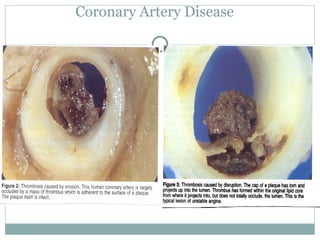
Coronary Artery Disease
Aortic valve Normal aortic valve area is 2.5 to 4.0 cm 2 Diseased aortic valve. Narrowed opening.
Ap3

  • 1.
    Cardiovascular Anatomy (adaptedfrom another slideshow on slideshare.com)
  • 2.
  • 3.
    The Cardiovascular SystemHeart – the pump Vasculature – the conduits Pulmonary circuit Systemic circuit
  • 4.
    The Vasculature Aclosed system of vessels that moves blood around the body Arterial vessels: aorta, arteries, arterioles (vascular resistance) Carry blood away from the heart to the: Capillary beds Venous vessels: venules, veins, venae cavae Carry blood toward the heart
  • 5.
  • 6.
    3 layers ofan artery 1. Adventitia: tough covering. 2. Media: muscle and elastic membrane 3. Intima: delicate inner lining.
  • 7.
  • 8.
  • 9.
    The Heart A4-chambered organ located in the middle mediastinum
  • 10.
  • 11.
  • 12.
  • 13.
    CABG video 1:26ffCardiac bypass surgery.
  • 14.
    Functional Purpose ofthe Heart Four Chamber pump that provides blood supply to: Systemic circulation left heart Pulmonary circulation right heart Right and left atria: receiving chambers Right and left ventricles: pumping chambers Suspended at the base by the great vessels
  • 15.
    Heart Wall EpicardiumOuter layer, inner visceral layer of pericardium Myocardium Middle muscle layer, interlacing bundles of fiber Endocardium Inside of the heart, covers valves
  • 16.
    Myocardium specialized musclePerforms the work of the heart Makes up the majority of the mass
  • 17.
  • 18.
  • 19.
    Right Atrium (RA)Receives blood from the body or systemic venous circulation Forms the right cardiac border Receives blood from vena cava (SVC & IVC) and coronary sinus
  • 20.
    Right Ventricle (RV)Provides blood flow to the pulmonary circuit Low pressure pump <35 mmHg Crescent-shaped wraps around the LV Most anterior heart structure
  • 21.
    Left Atrium (LA)Receives blood from the lungs (oxygenated) Smooth walled except appendage Most posterior cardiac chamber Receive blood through right and left pulmonary veins
  • 22.
    Left Ventricle (LV)Provides blood flow to the systemic circuit High pressure pump >100 mmHg Egg shaped (ellipse) Forms the left cardiac border
  • 23.
    Structural Differences betweenthe Left and Right Ventricles Figure 20.7a-c
  • 24.
    Cardiac Tissues Annulifibrosi Non-conducting fibrous connective tissue Referred to as the skeleton Forms support for the valves tissue (annulus) Separates the atria and ventricles and ventricles and great vessels
  • 25.
    Valves of theHeart Figure 20.8a
  • 26.
    Atrioventricular: Mitraland Tricuspid Separate the atria and their respective ventricles Tricuspid, Bicuspid Attached at the base to the annulus and at the tips to the papillary muscles via chordae tendinea
  • 27.
  • 28.
    Semilunar: Aortic andPulmonic Separate the ventricles and their respective arteries Three cusp, attached at the base to the annulus Pressure sensitive valve, opening and closing activated by change in pressure
  • 29.
    Coronary Arteries Suppliesblood supply to the heart Two primary arteries from the aorta Left Left Main Left Anterior Descending Circumflex Right Right Posterior Descending
  • 30.
    Heart Casts -Muscle Removed
  • 31.
    Left Main LADDiagonal Septal perforators Circumflex Left atrial branch Obtuse Marginal
  • 32.
    Right Coronary ArteryRA, RV, Inferior LV, SA Node, AV Node Conus branch (RVOT) Sinus node branch ( SA node, RA) RV Branches Acute Marginal branches (RV) AV nodal artery (AV node, IAS) Posterior descending artery (inferior IVS) Left ventricular branch-PLA’s (inferior LV)
  • 33.
    Conus branch Sinusnode branch Acute Marginal Posterior descending artery Left ventricular branch RV branch
  • 34.
    RAO Circumflex LAD Diagonal Septal
  • 35.
  • 36.
    Evolution of fibrousplaque LDL Monocyte endothelium Cell adhesion factors Foam Cells 1 1. LDL enters 2. & Oxidizes 3. Monocytes adhere & 4. cross intima become macrophages macrophage 5. Macrophages Eat Fat become Foam cells 6. muscle cells multiply & 7. enter intima 8. Muscle cells die & harden plaque -Calcium develops
  • 37.
  • 38.
    Fuster V, etal. N Eng J Med 1992;326:311-318. 2. Photos courtesy of Boehringer Ingleheim International GmbH, by Lennart Nilsson Braunwald E, et al. 2002 http://www.acc.org/clinical/guidelines/unstable/unstable.pdf
  • 39.
  • 40.
    Aortic valve Normalaortic valve area is 2.5 to 4.0 cm 2 Diseased aortic valve. Narrowed opening.

Editor's Notes

  • #31 These are casts of human coronary arteries and ventricles with the muscle dissolved away. So, what we see are the interior contents of the chambers and vessels as on an angiogram. Note the color legend. Each persons coronary arrangement is different, especially the crux area which determines coronary dominance. This model is fairly normal, except here the diagonals arise perpendicularly to the LAD. From Hurst, Atlas of the Heart.
  • #37 Schematic of the evolution of the atherosclerotic plaque. Accumulation of lipoprotein particles in the intima. The modification of these lipoproteins is depicted by the darker color. Modifications include oxidation and glycation. Oxidative stress including products found in modified lipoproprotiens can induce local cytokine elaboration. The cytokines thus induce increased expression of adhesion molecules for leukocytes that cause their attachment and chemoattractant molecules that direct their migration into the intima. Blood monocytes, on entering the artery wall in response to chemoattractant cytokines such as monocyte chemoattractant protein 1 (MCP-1), encounter stimuli such as macrophage colony stimulating factor (M-CSF) that can augment their expression of scavenger receptors. Scavenger receptors mediate the uptake of modified lipoprotein particles and promote the development of foam cells. Macrophage foam cells are a source of mediators such as further cytokines and effector molecules such as hypochlorous acid, superoxide anion (02-), and matrix metalloproteinases. Smooth muscle cells in the intima divide, and other smooth muscle cells migrate into the intima from the media. Smooth muscle cells can then divide promoting extracellular matrix accumulation in the growing atherosclerotic plaque. In this manner, the fatty streak can evolve into a fibrofatty lesion. In later stages, calcification can occur (not depicted) and fibrosis continues, sometimes accompanied by smooth muscle cell death (including programmed cell death, or apoptosis), yielding a relatively acellular fibrous capsule surrounding a lipid-rich core that may also contain dying or dead cells and their detritus. LDL = low-density lipoprotein; IL-1 = interleukin-1.