By: Camille Amadeo, Chynna Paris, Rileigh Boyd, Tra’vecia McGee
AP Style?
★ What is AP Style?
-The AP Stylebook, is an English grammar style and usage guide
created by American journalists working for or connected with the
Associated Press over the last century to standardize mass
communications
★ Why is AP style important?
-It serves as the ultimate resource when writing and formatting
material, ensuring consistency across platforms and publications.
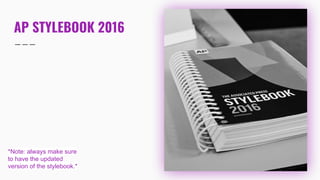
AP STYLEBOOK 2016
*Note: always make sure
to have the updated
version of the stylebook.*
Months/dates/times
★ Use Arabic figures, without st, nd, rd or th.
★ A month with a specific date (Jan., Feb., Aug., Sept., Nov. and Dec.)
★ When a phrase lists only a month and year, spell out the month
and do not separate the month and the year with commas.
★ When a phrase refers to a month, day and year, set off the year
with commas.
★ Use figures except for noon and midnight
★ Use periods in between p.m. and a.m.
Names & titles
★ Book titles
-Capitalize and place quotation marks around almost all
composition titles, but not reference, newspaper or magazine
names.
★ Proper titles and job titles
-Capitalized and abbreviated when placed before a person’s
name, titles that follow a person’s name are generally spelled out
and not capitalized
Examples: Executive Director Mark Smith; Mark Smith, executive director
Numbers
★ Spell out certain numbers
-Numbers one through nine; use figures for numbers 10 and
higher.
-Numbers at beginning of sentences
-Never spell out years
Examples: Ten thousand people marched on the field; 2018 will be the year we beat
Bama.
Capitalization
★ Capital Case
-Formal titles directly before a name (Ex. Director Miranda Thomas)
-Common nouns part of proper names
-Capitalize the first letter of a full-sentence quote.
Example: Jones said, “All of us were excited.”
★ Lower Case
-Formal titles on their own
-Job descriptions (in general)
-Directions if used alone ( Ex. Go north down main street.)
Apostrophes & quotes
★ When a full-sentence quotation is introduced or followed by
attribution, place a comma between them, unless the quote is a
question.
Example: “All of us were excited,” Jones said. “Were we all excited?” Jones asked.
★ Apostrophes usually show possession, so usually you shouldn’t
use them to make acronyms and numbers plural.
-An exception is with individual letters such as in grading.
Example: 1970s; ABCs; she received six 4s; she received six A’s.
Additional tips
★ Toward
-In ap style the s is not included in the word toward
★ Percent
-Percent is always a word not a symbol (%)
★ Email
-Only use a hyphen with other e-terms: e-books, e-buisness,
e-commerce.

AP STYLE for Beginners

  • 1.
    By: Camille Amadeo,Chynna Paris, Rileigh Boyd, Tra’vecia McGee
  • 2.
    AP Style? ★ Whatis AP Style? -The AP Stylebook, is an English grammar style and usage guide created by American journalists working for or connected with the Associated Press over the last century to standardize mass communications ★ Why is AP style important? -It serves as the ultimate resource when writing and formatting material, ensuring consistency across platforms and publications.
  • 3.
    AP STYLEBOOK 2016 *Note:always make sure to have the updated version of the stylebook.*
  • 4.
    Months/dates/times ★ Use Arabicfigures, without st, nd, rd or th. ★ A month with a specific date (Jan., Feb., Aug., Sept., Nov. and Dec.) ★ When a phrase lists only a month and year, spell out the month and do not separate the month and the year with commas. ★ When a phrase refers to a month, day and year, set off the year with commas. ★ Use figures except for noon and midnight ★ Use periods in between p.m. and a.m.
  • 5.
    Names & titles ★Book titles -Capitalize and place quotation marks around almost all composition titles, but not reference, newspaper or magazine names. ★ Proper titles and job titles -Capitalized and abbreviated when placed before a person’s name, titles that follow a person’s name are generally spelled out and not capitalized Examples: Executive Director Mark Smith; Mark Smith, executive director
  • 6.
    Numbers ★ Spell outcertain numbers -Numbers one through nine; use figures for numbers 10 and higher. -Numbers at beginning of sentences -Never spell out years Examples: Ten thousand people marched on the field; 2018 will be the year we beat Bama.
  • 7.
    Capitalization ★ Capital Case -Formaltitles directly before a name (Ex. Director Miranda Thomas) -Common nouns part of proper names -Capitalize the first letter of a full-sentence quote. Example: Jones said, “All of us were excited.” ★ Lower Case -Formal titles on their own -Job descriptions (in general) -Directions if used alone ( Ex. Go north down main street.)
  • 8.
    Apostrophes & quotes ★When a full-sentence quotation is introduced or followed by attribution, place a comma between them, unless the quote is a question. Example: “All of us were excited,” Jones said. “Were we all excited?” Jones asked. ★ Apostrophes usually show possession, so usually you shouldn’t use them to make acronyms and numbers plural. -An exception is with individual letters such as in grading. Example: 1970s; ABCs; she received six 4s; she received six A’s.
  • 9.
    Additional tips ★ Toward -Inap style the s is not included in the word toward ★ Percent -Percent is always a word not a symbol (%) ★ Email -Only use a hyphen with other e-terms: e-books, e-buisness, e-commerce.