BY:
MS. ANUBHA RAINA
MSC NURSING 1ST YEAR
INTRODUCTION
The National Rural Health Mission was
launched on 12 April 2005 , to provide
accessible ,and quality health care to the
rural population, especially the vulnerable
groups
DEFINITION
NRHM was launched by the Union Government on April 12 , 2005 for a period 7
years. It has been extended up to 2017 to improve health care services in rural
areas. It is implemented throughout the country but special focus is put on 18
states. These include Himachal Pradesh and Jammu & Kashmir ; 8 North-
Eastern states: Assam , Arunachal Pradesh ,Manipur ,Meghalaya ,Mizoram ,
Nagaland , Sikkim and Tripura; and 8 empowered Action Group States: Bihar
Jharkhand , Madhya Pradesh and Chhattisgarh , Uttar Pradesh, Uttaranchal
,Odisha and Rajasthan
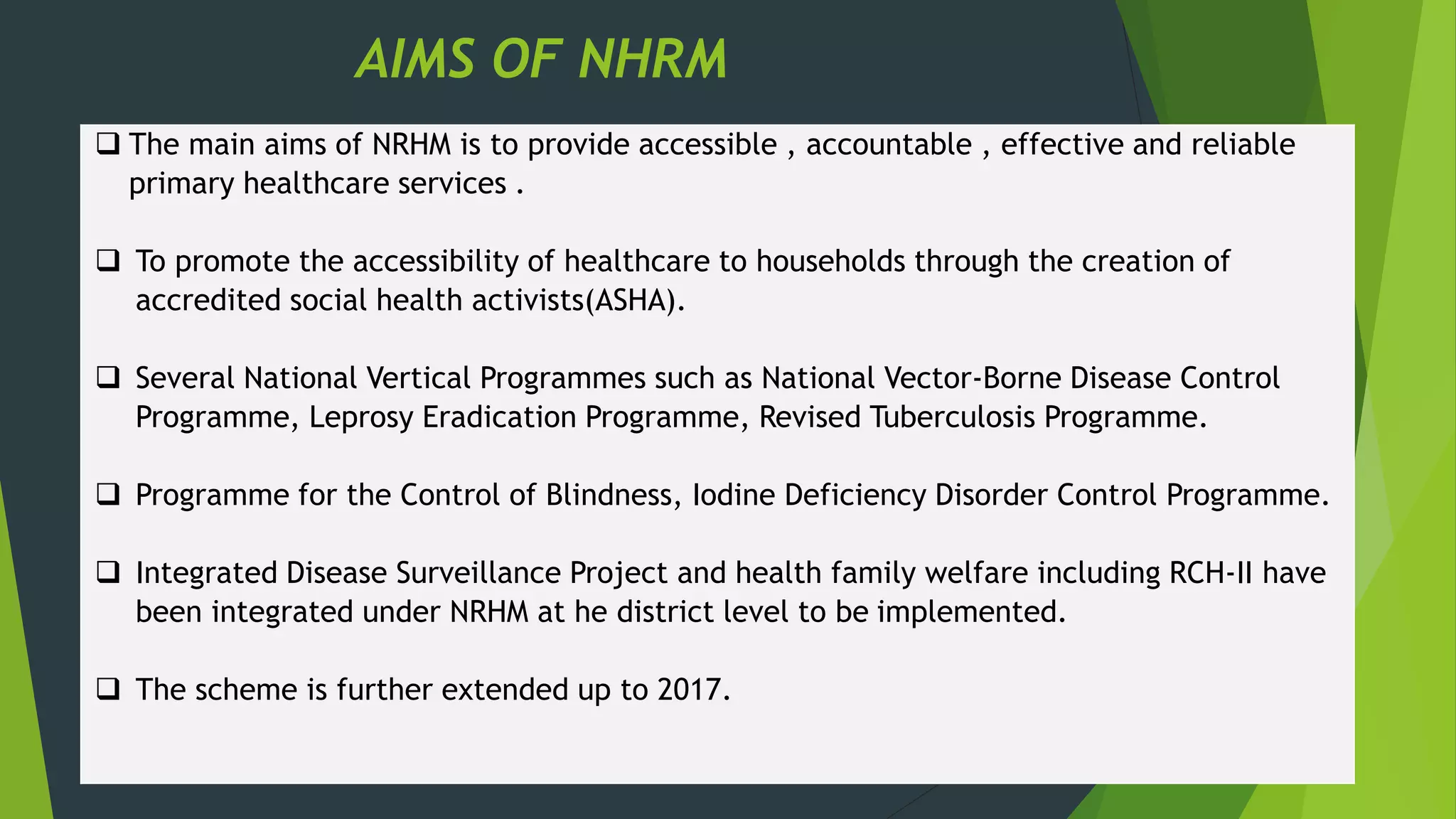
AIMS OF NHRM
 The main aims of NRHM is to provide accessible , accountable , effective and reliable
primary healthcare services .
 To promote the accessibility of healthcare to households through the creation of
accredited social health activists(ASHA).
 Several National Vertical Programmes such as National Vector-Borne Disease Control
Programme, Leprosy Eradication Programme, Revised Tuberculosis Programme.
 Programme for the Control of Blindness, Iodine Deficiency Disorder Control Programme.
 Integrated Disease Surveillance Project and health family welfare including RCH-II have
been integrated under NRHM at he district level to be implemented.
 The scheme is further extended up to 2017.
GOALS OF NHRM
 Reduction in Infant Rate and Maternal Mortality Rate by 50 percent from
existing levels in the next 7years.
 Universal access to public health services : such as women’s health
,child’s health, drinking water, sanitation, immunization ,nutrition etc.
 Prevention and control of communicable and non- communicable diseases
including locally endemic diseases.
 Universal access to integrated comprehensive primary health care.
 Assuring population stabilization ,gender and demographic balance.
 Promotion of healthy life style.
OBJECTIVES OF ASHA
ASHA: Provision of trained and supported village health
activist
Health action plan: To involve community in preparing health
action plans by Panchayath.
IPHS: Strengthening SC/PHC/CHC by developing IPHS
FRU: Increase utilization of first referral units from less than
20% to 75%.
Strengthening district level management of health
AYUSH
CORE STRATEGIES
 Train and enhance capacity of Panchayat Raj institutions to
own, control and manage public health services.
 Promote access to improved health care at household level
through the female health activist.
 Health plan for each village through village health committee
of the Panchayat.
 Strengthening sub center through an united fund to enable local
planning and action.
CONTI………
 Strengthening existing PHC’s and CHC’c.
 Preparation and implementation of an intersect district health plan
prepared by the district health mission .
 Strengthening capacities for data collection, assessment and review
for evidence based planning, monitoring and supervision.
 Developing capacities for preventive health care at all levels by
promoting healthy life styles, reduction in tobacco consumption,
alcohol etc.
SUPLEMENTORY STRATEGIES
1. Regulation of private sector to ensure availability of quality service
to citizens at reasonable cost.
2. Mainstreaming AYUSH – revitalizing local health traditions.
3. Reorienting medical education to support rural health issues including
regulation of Medical care and Medical Ethics.
4. Effective and viable risk pooling and social health insurance to
provide health security to the poor by ensuring accessible, affordable,
accountable and good quality hospital care.
STRENGTHENING SUB-CENTRE
 Each sub-centre will have an Untied Fund for local action @ Rs. 10,000
per annum. This Fund will be deposited in a joint Bank Account of the
ANM & Sarpanch and operated by the ANM, in consultation with the
Village Health Committee.
 Supply of essential drugs, both allopathic and AYUSH, to the Sub-
centers.
 In case of additional Outlays, Multipurpose Workers (Male)/Additional
ANMs wherever needed, sanction of new Sub-centers as per 2001
population norm, and upgrading existing Sub-centers, including
buildings for Sub-centers functioning in rented premises will be
considered.
STRENGTHNING PRIMARY HEALTH
CENTRES
 Mission aims at Strengthening PHC for quality preventive, promotive, curative,
supervisory and outreach services, through:
 Adequate and regular supply of essential quality drugs and equipment including
Supply of Auto Disabled Syringes for immunization) to PHCs .
 Provision of 24 hour service in 50% PHCs by addressing shortage of doctors,
especially in high focus States Observance of Standard treatment guidelines &
protocols.
 Intensification of ongoing communicable disease control programs, new programs
for control of non- communicable diseases, up gradation of 100% PHCs for 24 hours
referral service, and provision of 2nd doctor at PHC level (I male, 1 female) would
be undertaken on the basis of felt need.
STRENGTHNING CHCs FOR FIRST
REFERRAL CARE
 Operationalizing 3222 existing Community Health Centers (30-50
beds) as 24 Hour First Referral Units, including posting of
anesthetists.
 Codification of new Indian Public Health Standards, setting norms
for infrastructure, staff, equipment, management etc. for CHCs.
 Promotion of Stakeholder Committees (Rogi Kalyan Samitis) for
hospital management.
 Developing standards of services and costs in hospital care.
CONTI……..
 Develop, display and ensure compliance to Citizen’s Charter at CHC/PHC
level.
 In case of additional Outlays, creation of new Community Health
Centres(30-50 beds) to meet the population norm as per Census 2001,
and bearing their recurring costs for the Mission period could be
considered.
INSTITUTIONAL SET
INSTITUTIONAL SET UP OF NRHM
 AT NATIONAL LEVEL: MISSION STEERING GROUP , -chairman is union
minister of health and family welfare.
 AT STATE LEVEL : STATE HEALTH MISSION - led by CM.
 AT DISTRICT LEVEL : DISTRICT HEALTH MISSION - Led by chairman
of ZILA PARISHAD
DISTRICT HEALTH MISSION :
Core unit in planning, budgeting and implementation of the
programme.
FUNCTION
Selection and training of ASHA.
Organising health camps at ANGANWADI .
Mainstreaming AYUSH.
Upgrading CHCs to IPHS.
 Outreach services through mobile medical units.
ROLE OF STATE GOVERNMENTS UNDER
NRHM
The Mission covers the entire country. There
are18 high focus States. Government of India
would provide funding in these 18 high focus
States. Other States would fund interventions
like ASHA, and up gradation of SC/PHC/CHC.
ROLE OF PANCHAYATI RAJ
INSTITUTIONS
 The Mission envisages the following roles for PRIs:
 The District Health Mission to be led by the Zila Parishad. The DHM will
control, guide and manage all public health institutions in the district, Sub-
centers, PHCs and CHCs.
 ASHAs would be selected by and be accountable to the Village Panchayat.
 The Village Health Committee of the Panchayat would prepare the Village
Health Plan.
 Each sub-centre will have an Untied Fund for local action @ Rs. 10,000 per
annum. This Fund will be deposited in a joint Bank Account of the ANM &
Sarpanch and operated by the ANM, in consultation with the Village Health
Committee.
COMPONENT A:ASHA
o Every village will have a female ASHA
o Chosen by and accountable to the panchayat .
o Prototype training material for ASHA to be developed at
National level subject to State level modifications.
o ASHA act as the interface between the community and
the public health system.
CONTI……..
o She will facilitate preparation and implementation of the
Village Health Plan .
o Anganwadi worker
o ANM
o Functionaries of other Departments Self Help Group
members.
o She will be given a Drug Kit (generic AYUSH and allopathic
formulations for common ailments.
RESPONSIBILITY OF ASHA
 To create awareness among the community regarding
nutrition, basic sanitation, hygienic practices, healthy
living.
 Counsel women on birth preparedness, importance of safe
delivery, breast feeding, complementary feeding,
immunization, contraception, STDs.
 Encourage the community to get involved in health related
services.
CONTI…….
 Escort/ accompany pregnant women, children requiring
treatment and admissions to the nearest PHC’s.
 Primary medical care for minor ailment such as diarrhea,
fevers.
 Provider of DOTS.
 ASHA would be incentivized for promoting household toilets
by the Mission.
SUMMARY
The National Rural Health Mission (2005-2012) seeks to provide effective
healthcare to rural population throughout the country. Its main is to provide
the accessible, affordable, accountable effective and reliable services to
population through PHC and bridging the gap in rural health care through
the creation of ASHA (Accrediated social health activist)worker. The goals of
NRHM is the reduction in infant mortality rate (IMR), maternal mortality
rate, prevention and control of communicable and non- communicable
diseases, revitalize local health tradition and mainstream AYUSH and
promotion of healthy life styles.
CONCLUSION
At last , we now concluded the primary goal of NRHM is to address the
health needs of rural population and to provide the health services to
rural poor people in an accessible and affordable prices therefore
created a worker called ASHA which will be the first port of cal for any
health related demands of deprived section of the population, especially
women and children, who find difficult to access health services.
Anubha Raina.pptx NRHM

Anubha Raina.pptx NRHM

  • 1.
    BY: MS. ANUBHA RAINA MSCNURSING 1ST YEAR
  • 2.
    INTRODUCTION The National RuralHealth Mission was launched on 12 April 2005 , to provide accessible ,and quality health care to the rural population, especially the vulnerable groups
  • 3.
    DEFINITION NRHM was launchedby the Union Government on April 12 , 2005 for a period 7 years. It has been extended up to 2017 to improve health care services in rural areas. It is implemented throughout the country but special focus is put on 18 states. These include Himachal Pradesh and Jammu & Kashmir ; 8 North- Eastern states: Assam , Arunachal Pradesh ,Manipur ,Meghalaya ,Mizoram , Nagaland , Sikkim and Tripura; and 8 empowered Action Group States: Bihar Jharkhand , Madhya Pradesh and Chhattisgarh , Uttar Pradesh, Uttaranchal ,Odisha and Rajasthan
  • 4.
    AIMS OF NHRM The main aims of NRHM is to provide accessible , accountable , effective and reliable primary healthcare services .  To promote the accessibility of healthcare to households through the creation of accredited social health activists(ASHA).  Several National Vertical Programmes such as National Vector-Borne Disease Control Programme, Leprosy Eradication Programme, Revised Tuberculosis Programme.  Programme for the Control of Blindness, Iodine Deficiency Disorder Control Programme.  Integrated Disease Surveillance Project and health family welfare including RCH-II have been integrated under NRHM at he district level to be implemented.  The scheme is further extended up to 2017.
  • 5.
    GOALS OF NHRM Reduction in Infant Rate and Maternal Mortality Rate by 50 percent from existing levels in the next 7years.  Universal access to public health services : such as women’s health ,child’s health, drinking water, sanitation, immunization ,nutrition etc.  Prevention and control of communicable and non- communicable diseases including locally endemic diseases.  Universal access to integrated comprehensive primary health care.  Assuring population stabilization ,gender and demographic balance.  Promotion of healthy life style.
  • 6.
    OBJECTIVES OF ASHA ASHA:Provision of trained and supported village health activist Health action plan: To involve community in preparing health action plans by Panchayath. IPHS: Strengthening SC/PHC/CHC by developing IPHS FRU: Increase utilization of first referral units from less than 20% to 75%. Strengthening district level management of health AYUSH
  • 7.
    CORE STRATEGIES  Trainand enhance capacity of Panchayat Raj institutions to own, control and manage public health services.  Promote access to improved health care at household level through the female health activist.  Health plan for each village through village health committee of the Panchayat.  Strengthening sub center through an united fund to enable local planning and action.
  • 8.
    CONTI………  Strengthening existingPHC’s and CHC’c.  Preparation and implementation of an intersect district health plan prepared by the district health mission .  Strengthening capacities for data collection, assessment and review for evidence based planning, monitoring and supervision.  Developing capacities for preventive health care at all levels by promoting healthy life styles, reduction in tobacco consumption, alcohol etc.
  • 9.
    SUPLEMENTORY STRATEGIES 1. Regulationof private sector to ensure availability of quality service to citizens at reasonable cost. 2. Mainstreaming AYUSH – revitalizing local health traditions. 3. Reorienting medical education to support rural health issues including regulation of Medical care and Medical Ethics. 4. Effective and viable risk pooling and social health insurance to provide health security to the poor by ensuring accessible, affordable, accountable and good quality hospital care.
  • 10.
    STRENGTHENING SUB-CENTRE  Eachsub-centre will have an Untied Fund for local action @ Rs. 10,000 per annum. This Fund will be deposited in a joint Bank Account of the ANM & Sarpanch and operated by the ANM, in consultation with the Village Health Committee.  Supply of essential drugs, both allopathic and AYUSH, to the Sub- centers.  In case of additional Outlays, Multipurpose Workers (Male)/Additional ANMs wherever needed, sanction of new Sub-centers as per 2001 population norm, and upgrading existing Sub-centers, including buildings for Sub-centers functioning in rented premises will be considered.
  • 11.
    STRENGTHNING PRIMARY HEALTH CENTRES Mission aims at Strengthening PHC for quality preventive, promotive, curative, supervisory and outreach services, through:  Adequate and regular supply of essential quality drugs and equipment including Supply of Auto Disabled Syringes for immunization) to PHCs .  Provision of 24 hour service in 50% PHCs by addressing shortage of doctors, especially in high focus States Observance of Standard treatment guidelines & protocols.  Intensification of ongoing communicable disease control programs, new programs for control of non- communicable diseases, up gradation of 100% PHCs for 24 hours referral service, and provision of 2nd doctor at PHC level (I male, 1 female) would be undertaken on the basis of felt need.
  • 12.
    STRENGTHNING CHCs FORFIRST REFERRAL CARE  Operationalizing 3222 existing Community Health Centers (30-50 beds) as 24 Hour First Referral Units, including posting of anesthetists.  Codification of new Indian Public Health Standards, setting norms for infrastructure, staff, equipment, management etc. for CHCs.  Promotion of Stakeholder Committees (Rogi Kalyan Samitis) for hospital management.  Developing standards of services and costs in hospital care.
  • 13.
    CONTI……..  Develop, displayand ensure compliance to Citizen’s Charter at CHC/PHC level.  In case of additional Outlays, creation of new Community Health Centres(30-50 beds) to meet the population norm as per Census 2001, and bearing their recurring costs for the Mission period could be considered. INSTITUTIONAL SET
  • 14.
    INSTITUTIONAL SET UPOF NRHM  AT NATIONAL LEVEL: MISSION STEERING GROUP , -chairman is union minister of health and family welfare.  AT STATE LEVEL : STATE HEALTH MISSION - led by CM.  AT DISTRICT LEVEL : DISTRICT HEALTH MISSION - Led by chairman of ZILA PARISHAD DISTRICT HEALTH MISSION : Core unit in planning, budgeting and implementation of the programme.
  • 15.
    FUNCTION Selection and trainingof ASHA. Organising health camps at ANGANWADI . Mainstreaming AYUSH. Upgrading CHCs to IPHS.  Outreach services through mobile medical units.
  • 16.
    ROLE OF STATEGOVERNMENTS UNDER NRHM The Mission covers the entire country. There are18 high focus States. Government of India would provide funding in these 18 high focus States. Other States would fund interventions like ASHA, and up gradation of SC/PHC/CHC.
  • 17.
    ROLE OF PANCHAYATIRAJ INSTITUTIONS  The Mission envisages the following roles for PRIs:  The District Health Mission to be led by the Zila Parishad. The DHM will control, guide and manage all public health institutions in the district, Sub- centers, PHCs and CHCs.  ASHAs would be selected by and be accountable to the Village Panchayat.  The Village Health Committee of the Panchayat would prepare the Village Health Plan.  Each sub-centre will have an Untied Fund for local action @ Rs. 10,000 per annum. This Fund will be deposited in a joint Bank Account of the ANM & Sarpanch and operated by the ANM, in consultation with the Village Health Committee.
  • 18.
    COMPONENT A:ASHA o Everyvillage will have a female ASHA o Chosen by and accountable to the panchayat . o Prototype training material for ASHA to be developed at National level subject to State level modifications. o ASHA act as the interface between the community and the public health system.
  • 19.
    CONTI…….. o She willfacilitate preparation and implementation of the Village Health Plan . o Anganwadi worker o ANM o Functionaries of other Departments Self Help Group members. o She will be given a Drug Kit (generic AYUSH and allopathic formulations for common ailments.
  • 20.
    RESPONSIBILITY OF ASHA To create awareness among the community regarding nutrition, basic sanitation, hygienic practices, healthy living.  Counsel women on birth preparedness, importance of safe delivery, breast feeding, complementary feeding, immunization, contraception, STDs.  Encourage the community to get involved in health related services.
  • 21.
    CONTI…….  Escort/ accompanypregnant women, children requiring treatment and admissions to the nearest PHC’s.  Primary medical care for minor ailment such as diarrhea, fevers.  Provider of DOTS.  ASHA would be incentivized for promoting household toilets by the Mission.
  • 22.
    SUMMARY The National RuralHealth Mission (2005-2012) seeks to provide effective healthcare to rural population throughout the country. Its main is to provide the accessible, affordable, accountable effective and reliable services to population through PHC and bridging the gap in rural health care through the creation of ASHA (Accrediated social health activist)worker. The goals of NRHM is the reduction in infant mortality rate (IMR), maternal mortality rate, prevention and control of communicable and non- communicable diseases, revitalize local health tradition and mainstream AYUSH and promotion of healthy life styles.
  • 23.
    CONCLUSION At last ,we now concluded the primary goal of NRHM is to address the health needs of rural population and to provide the health services to rural poor people in an accessible and affordable prices therefore created a worker called ASHA which will be the first port of cal for any health related demands of deprived section of the population, especially women and children, who find difficult to access health services.