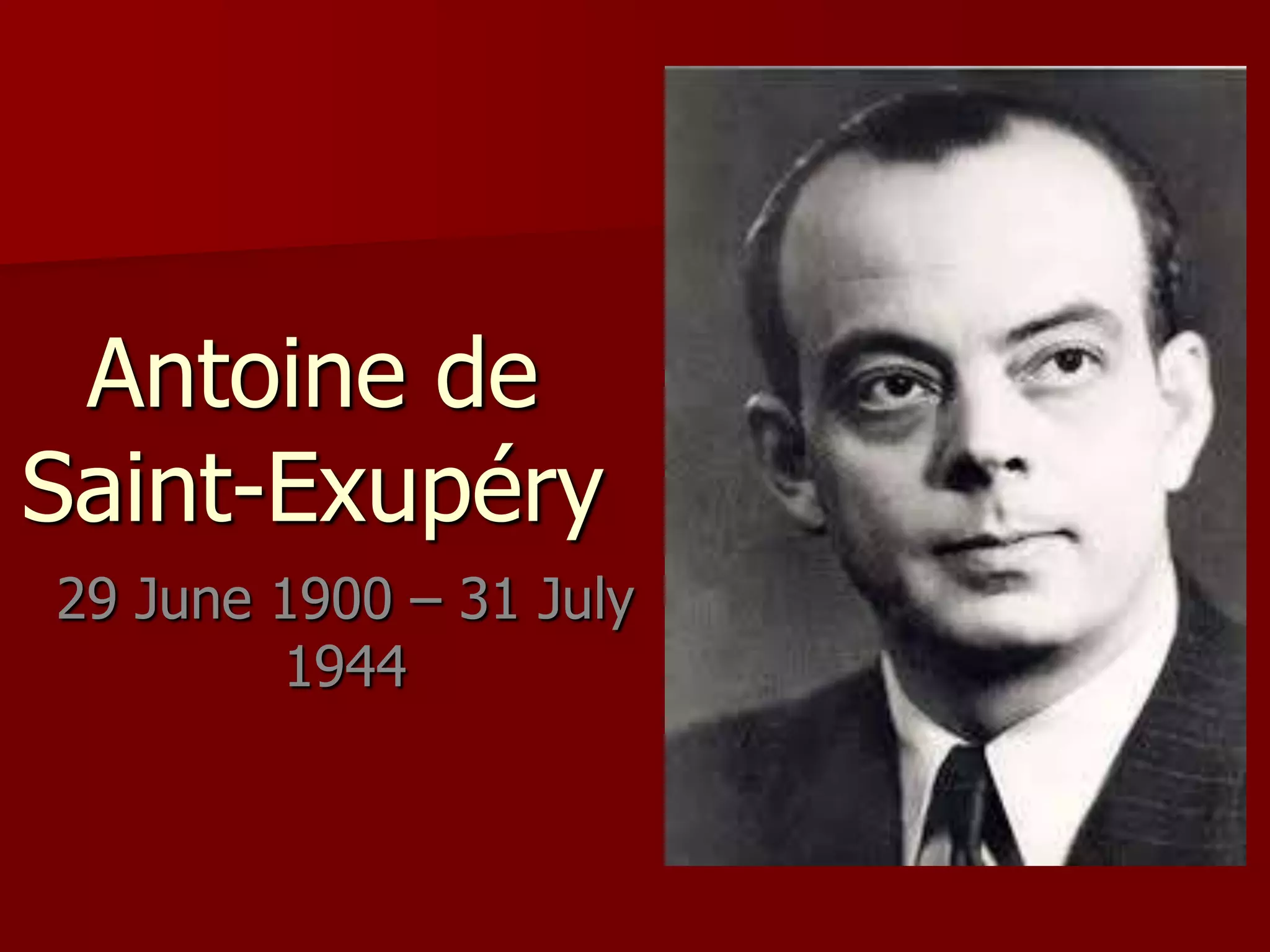
Antoine de
Saint-Exupéry
29 June 1900 – 31 July
1944
Outline
 Biography
 Youth and aviation
 Writing career
 The Little Prince
 Saint-Exupery in the WWII
 Disappearance
 Honours
 Quotes
Biography
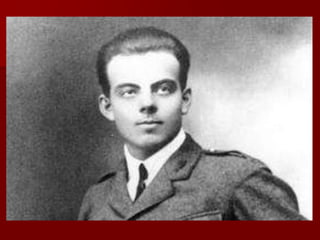
Antoine de Saint-Exupéry was born on 29
June 1900 and died on 31 July 1944.
He was a famous french
aristocrat, writer, poet and pioneering
aviator.
He became a laureate of several of France’s
highest literary awards and also won the
U.S. National Book Award.
Youth and aviation
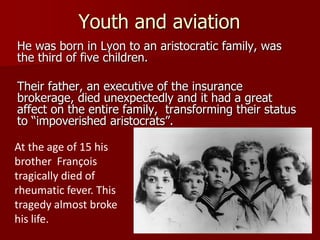
He was born in Lyon to an aristocratic family, was
the third of five children.
Their father, an executive of the insurance
brokerage, died unexpectedly and it had a great
affect on the entire family, transforming their status
to “impoverished aristocrats”.
At the age of 15 his
brother François
tragically died of
rheumatic fever. This
tragedy almost broke
his life.
 In his early years he failed twice his final
exams at a preparatory Naval Academy.
 Saint-Exupéry entered the École des
Beaux-Arts as an auditor to study
architecture for 15 months without
graduating it.
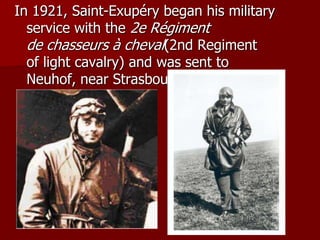
In 1921, Saint-Exupéry began his military
service with the 2e Régiment
de chasseurs à cheval(2nd Regiment
of light cavalry) and was sent to
Neuhof, near Strasbourg.
 By 1926, Saint-Exupéry became one of the
pioneers of international postal flight
 He worked for Aeropostale between
Toulouse and Dakar
 In 1929, Saint-Exupéry was transferred
to Argentina, where he was appointed
director of the Aeroposta
Argentina airline.
Writing career
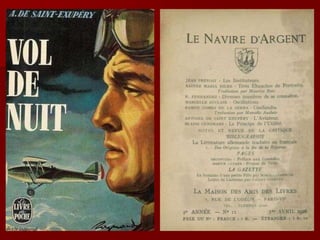
 Saint-Exupéry's first
novella, L'Aviateur (The Aviator), was
published in a short-lived literary
magazine le Navire d'argent (The Silver
Ship)
 The 1931 publication of Vol de nuit (Night
Flight) established Saint-Exupéry as a
rising star in the literary world. He won
the prix Femina
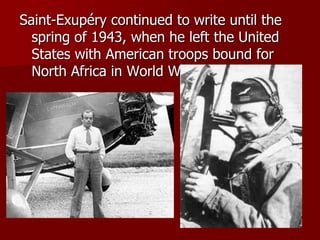
Saint-Exupéry continued to write until the
spring of 1943, when he left the United
States with American troops bound for
North Africa in World War II.
The Little Prince
 first published in 1943
 is both the most-read and most-translated
book in the French language
 was voted the best book of the 20th
century in France. Translated into more
than 250 languages and dialects
Saint-Exupery in the WWII
 In April 1943 Saint-Exupéry departed with an
American military convoy for Algiers, to fly with
the Free French Air Force and fight with
the Allies in a Mediterranean-based squadron
 Saint-Exupéry had been suffering pain and
immobility due to his many previous crash
injuries, to the extent that he could not dress
himself in his own flight suit or even turn his
head leftwards to check for enemy aircraft
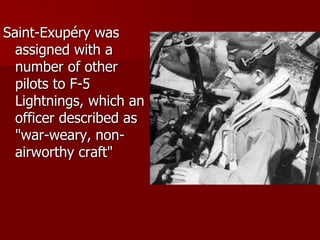
Saint-Exupéry was
assigned with a
number of other
pilots to F-5
Lightnings, which an
officer described as
"war-weary, non-
airworthy craft"
Disappearance
 Saint-Exupéry's last assigned reconnaissance
mission was to collect intelligence on German
troop movements in and around the Rhone
Valley preceding the Allied invasion of southern
France ("Operation Dragoon").
 But he did not return, dramatically vanishing
without a trace. Word of his disappearance
shortly spread across the literary world and then
into international headlines.
Honours
 Saint-Exupéry is commemorated with an
inscription in the Panthéon in
Paris, France's repository of historical
greats.
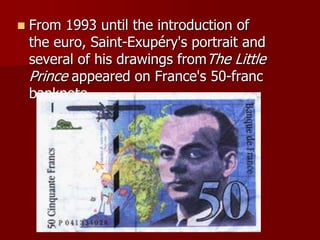
 From 1993 until the introduction of
the euro, Saint-Exupéry's portrait and
several of his drawings fromThe Little
Prince appeared on France's 50-franc
banknote
Quotes
 Love does not consist in gazing at each
other, but in looking outward together in the
same direction.
 It is only with the heart that one can see rightly;
what is essential is invisible to the eye.
 Tell me who admires and loves you, and I will
tell you who you are.
 The time for action is now. It's never too late to
do something.

Antoine de Saint-Exupery

  • 1.
    Antoine de Saint-Exupéry 29 June1900 – 31 July 1944
  • 2.
    Outline  Biography  Youthand aviation  Writing career  The Little Prince  Saint-Exupery in the WWII  Disappearance  Honours  Quotes
  • 3.
    Biography Antoine de Saint-Exupérywas born on 29 June 1900 and died on 31 July 1944. He was a famous french aristocrat, writer, poet and pioneering aviator. He became a laureate of several of France’s highest literary awards and also won the U.S. National Book Award.
  • 5.
    Youth and aviation Hewas born in Lyon to an aristocratic family, was the third of five children. Their father, an executive of the insurance brokerage, died unexpectedly and it had a great affect on the entire family, transforming their status to “impoverished aristocrats”. At the age of 15 his brother François tragically died of rheumatic fever. This tragedy almost broke his life.
  • 6.
     In hisearly years he failed twice his final exams at a preparatory Naval Academy.  Saint-Exupéry entered the École des Beaux-Arts as an auditor to study architecture for 15 months without graduating it.
  • 7.
    In 1921, Saint-Exupérybegan his military service with the 2e Régiment de chasseurs à cheval(2nd Regiment of light cavalry) and was sent to Neuhof, near Strasbourg.
  • 8.
     By 1926,Saint-Exupéry became one of the pioneers of international postal flight  He worked for Aeropostale between Toulouse and Dakar  In 1929, Saint-Exupéry was transferred to Argentina, where he was appointed director of the Aeroposta Argentina airline.
  • 9.
    Writing career  Saint-Exupéry'sfirst novella, L'Aviateur (The Aviator), was published in a short-lived literary magazine le Navire d'argent (The Silver Ship)  The 1931 publication of Vol de nuit (Night Flight) established Saint-Exupéry as a rising star in the literary world. He won the prix Femina
  • 11.
    Saint-Exupéry continued towrite until the spring of 1943, when he left the United States with American troops bound for North Africa in World War II.
  • 12.
    The Little Prince first published in 1943  is both the most-read and most-translated book in the French language  was voted the best book of the 20th century in France. Translated into more than 250 languages and dialects
  • 14.
    Saint-Exupery in theWWII  In April 1943 Saint-Exupéry departed with an American military convoy for Algiers, to fly with the Free French Air Force and fight with the Allies in a Mediterranean-based squadron  Saint-Exupéry had been suffering pain and immobility due to his many previous crash injuries, to the extent that he could not dress himself in his own flight suit or even turn his head leftwards to check for enemy aircraft
  • 15.
    Saint-Exupéry was assigned witha number of other pilots to F-5 Lightnings, which an officer described as "war-weary, non- airworthy craft"
  • 16.
    Disappearance  Saint-Exupéry's lastassigned reconnaissance mission was to collect intelligence on German troop movements in and around the Rhone Valley preceding the Allied invasion of southern France ("Operation Dragoon").  But he did not return, dramatically vanishing without a trace. Word of his disappearance shortly spread across the literary world and then into international headlines.
  • 17.
    Honours  Saint-Exupéry iscommemorated with an inscription in the Panthéon in Paris, France's repository of historical greats.
  • 18.
     From 1993until the introduction of the euro, Saint-Exupéry's portrait and several of his drawings fromThe Little Prince appeared on France's 50-franc banknote
  • 19.
    Quotes  Love doesnot consist in gazing at each other, but in looking outward together in the same direction.  It is only with the heart that one can see rightly; what is essential is invisible to the eye.  Tell me who admires and loves you, and I will tell you who you are.  The time for action is now. It's never too late to do something.