CoCo San Sustainable Farm
Carolyn Phinney, Ph.D.
President and Executive Director
A Project of AgLantis TM
PROBLEM 1: Nutritional Poverty
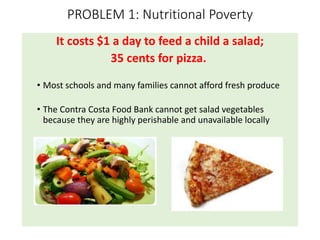
It costs $1 a day to feed a child a salad;
35 cents for pizza.
• Most schools and many families cannot afford fresh produce
• The Contra Costa Food Bank cannot get salad vegetables
because they are highly perishable and unavailable locally
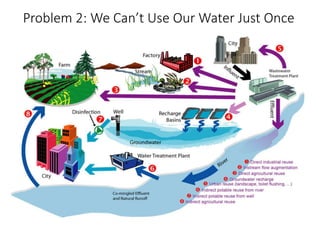
Problem 2: We Can’t Use Our Water Just Once
PROPOSED SOLUTION
Low-cost, sustainably grown, local, produce
• 14.8 acres of public surplus buffer land
• Recycled, agricultural-grade water discharged into the Bay
• Recycled water is high in nitrogen, providing free fertilizer
• Food Bank will pick up and distribute to clients and schools
using existing transportation and distribution systems
We deploy under-utilized resources to nearly eliminate
4 of the major costs of food production:
LAND, WATER, FERTILIZER, and TRANSPORTATION.
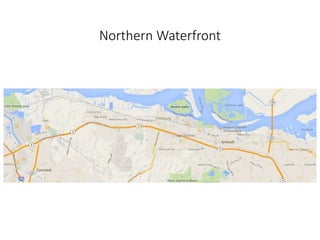
Northern Waterfront
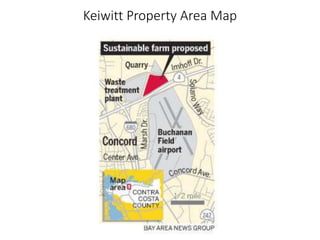
Keiwitt Property Area Map
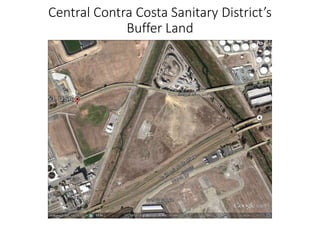
Central Contra Costa Sanitary District’s
Buffer Land
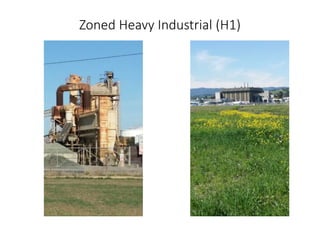
Zoned Heavy Industrial (H1)
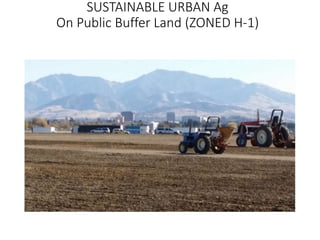
SUSTAINABLE URBAN Ag
On Public Buffer Land (ZONED H-1)
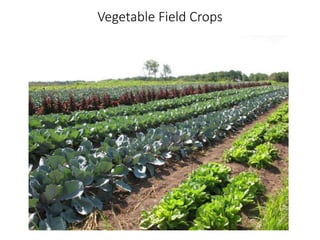
Vegetable Field Crops
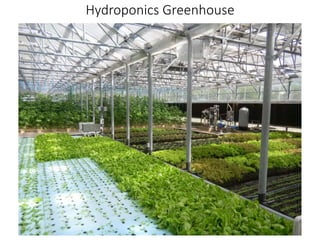
Hydroponics Greenhouse
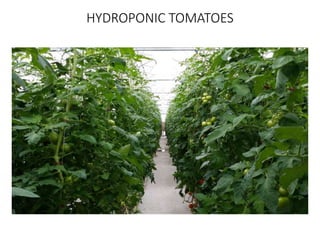
HYDROPONIC TOMATOES
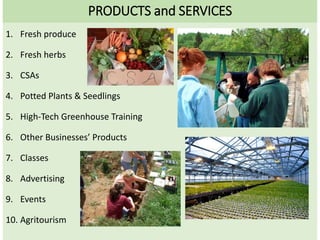
PRODUCTS and SERVICES
1. Fresh produce
2. Fresh herbs
3. CSAs
4. Potted Plants & Seedlings
5. High-Tech Greenhouse Training
6. Other Businesses’ Products
7. Classes
8. Advertising
9. Events
10. Agritourism
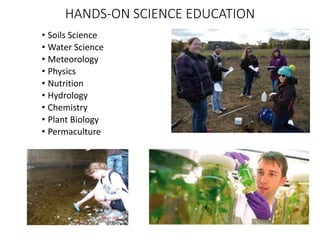
HANDS-ON SCIENCE EDUCATION
• Soils Science
• Water Science
• Meteorology
• Physics
• Nutrition
• Hydrology
• Chemistry
• Plant Biology
• Permaculture
HANDS-ON ENGINEERING, CONSTRUCTION
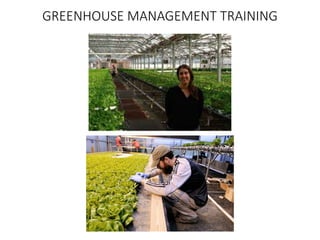
GREENHOUSE MANAGEMENT TRAINING
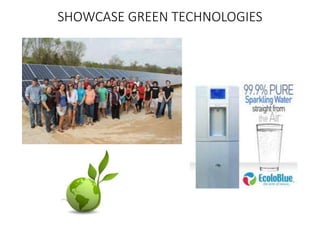
SHOWCASE GREEN TECHNOLOGIES
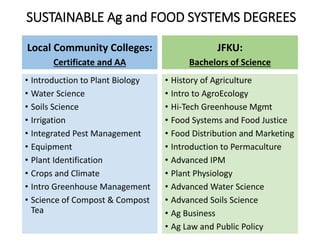
SUSTAINABLE Ag and FOOD SYSTEMS DEGREES
Local Community Colleges:
Certificate and AA
• Introduction to Plant Biology
• Water Science
• Soils Science
• Irrigation
• Integrated Pest Management
• Equipment
• Plant Identification
• Crops and Climate
• Intro Greenhouse Management
• Science of Compost & Compost
Tea
JFKU:
Bachelors of Science
• History of Agriculture
• Intro to AgroEcology
• Hi-Tech Greenhouse Mgmt
• Food Systems and Food Justice
• Food Distribution and Marketing
• Introduction to Permaculture
• Advanced IPM
• Plant Physiology
• Advanced Water Science
• Advanced Soils Science
• Ag Business
• Ag Law and Public Policy
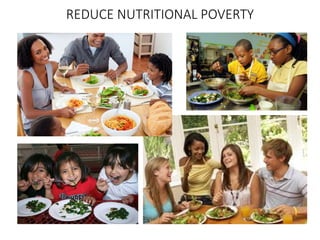
REDUCE NUTRITIONAL POVERTY
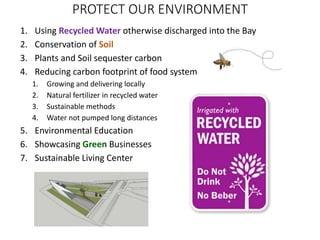
PROTECT OUR ENVIRONMENT
1. Using Recycled Water otherwise discharged into the Bay
2. Conservation of Soil
3. Plants and Soil sequester carbon
4. Reducing carbon footprint of food system
1. Growing and delivering locally
2. Natural fertilizer in recycled water
3. Sustainable methods
4. Water not pumped long distances
5. Environmental Education
6. Showcasing Green Businesses
7. Sustainable Living Center
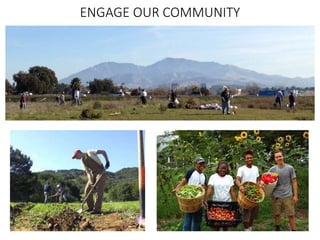
ENGAGE OUR COMMUNITY
SCALABLE
1 TRILLION GALLONS
5,000+ ACRES BUFFER LAND
160,000 HUNGRY; 40,000 CHILDREN
1. Ironhouse Sanitary District
2. Delta Diablo Sanitation District
3. Dublin-San Ramon Service District
4. Rodeo Sanitary District
5. West County Sanitary District
6. EBMUD
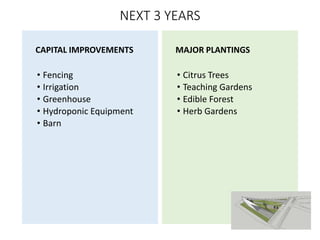
NEXT 3 YEARS
CAPITAL IMPROVEMENTS
• Fencing
• Irrigation
• Greenhouse
• Hydroponic Equipment
• Barn
MAJOR PLANTINGS
• Citrus Trees
• Teaching Gardens
• Edible Forest
• Herb Gardens
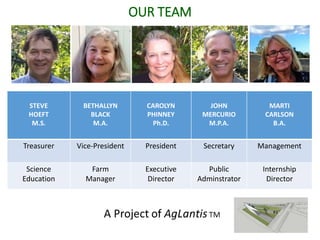
OUR TEAM
STEVE
HOEFT
M.S.
BETHALLYN
BLACK
M.A.
CAROLYN
PHINNEY
Ph.D.
JOHN
MERCURIO
M.P.A.
MARTI
CARLSON
B.A.
Treasurer Vice-President President Secretary Management
Science
Education
Farm
Manager
Executive
Director
Public
Adminstrator
Internship
Director
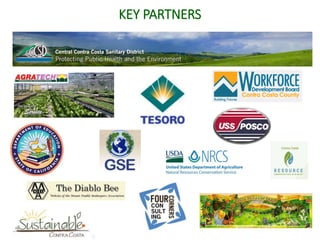
KEY PARTNERS
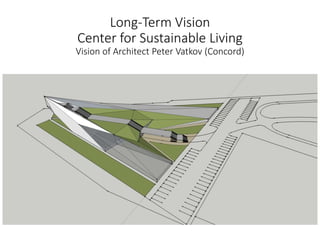
Long-Term Vision
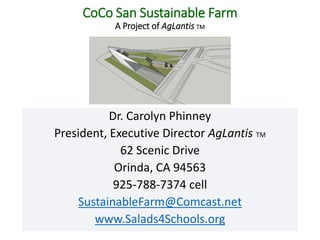
Center for Sustainable Living
Vision of Architect Peter Vatkov (Concord)
CoCo San Sustainable Farm
A Project of AgLantis TM
Dr. Carolyn Phinney
President, Executive Director AgLantis TM
62 Scenic Drive
Orinda, CA 94563
925-788-7374 cell
SustainableFarm@Comcast.net
www.Salads4Schools.org

Antioch rotary presentation 3 18 2015

  • 1.
    CoCo San SustainableFarm Carolyn Phinney, Ph.D. President and Executive Director A Project of AgLantis TM
  • 2.
    PROBLEM 1: NutritionalPoverty It costs $1 a day to feed a child a salad; 35 cents for pizza. • Most schools and many families cannot afford fresh produce • The Contra Costa Food Bank cannot get salad vegetables because they are highly perishable and unavailable locally
  • 3.
    Problem 2: WeCan’t Use Our Water Just Once
  • 4.
    PROPOSED SOLUTION Low-cost, sustainablygrown, local, produce • 14.8 acres of public surplus buffer land • Recycled, agricultural-grade water discharged into the Bay • Recycled water is high in nitrogen, providing free fertilizer • Food Bank will pick up and distribute to clients and schools using existing transportation and distribution systems We deploy under-utilized resources to nearly eliminate 4 of the major costs of food production: LAND, WATER, FERTILIZER, and TRANSPORTATION.
  • 5.
  • 6.
  • 7.
    Central Contra CostaSanitary District’s Buffer Land
  • 8.
  • 9.
    SUSTAINABLE URBAN Ag OnPublic Buffer Land (ZONED H-1)
  • 10.
  • 11.
  • 12.
  • 13.
    PRODUCTS and SERVICES 1.Fresh produce 2. Fresh herbs 3. CSAs 4. Potted Plants & Seedlings 5. High-Tech Greenhouse Training 6. Other Businesses’ Products 7. Classes 8. Advertising 9. Events 10. Agritourism
  • 14.
    HANDS-ON SCIENCE EDUCATION •Soils Science • Water Science • Meteorology • Physics • Nutrition • Hydrology • Chemistry • Plant Biology • Permaculture
  • 15.
  • 16.
  • 17.
  • 18.
    SUSTAINABLE Ag andFOOD SYSTEMS DEGREES Local Community Colleges: Certificate and AA • Introduction to Plant Biology • Water Science • Soils Science • Irrigation • Integrated Pest Management • Equipment • Plant Identification • Crops and Climate • Intro Greenhouse Management • Science of Compost & Compost Tea JFKU: Bachelors of Science • History of Agriculture • Intro to AgroEcology • Hi-Tech Greenhouse Mgmt • Food Systems and Food Justice • Food Distribution and Marketing • Introduction to Permaculture • Advanced IPM • Plant Physiology • Advanced Water Science • Advanced Soils Science • Ag Business • Ag Law and Public Policy
  • 19.
  • 20.
    PROTECT OUR ENVIRONMENT 1.Using Recycled Water otherwise discharged into the Bay 2. Conservation of Soil 3. Plants and Soil sequester carbon 4. Reducing carbon footprint of food system 1. Growing and delivering locally 2. Natural fertilizer in recycled water 3. Sustainable methods 4. Water not pumped long distances 5. Environmental Education 6. Showcasing Green Businesses 7. Sustainable Living Center
  • 21.
  • 22.
    SCALABLE 1 TRILLION GALLONS 5,000+ACRES BUFFER LAND 160,000 HUNGRY; 40,000 CHILDREN 1. Ironhouse Sanitary District 2. Delta Diablo Sanitation District 3. Dublin-San Ramon Service District 4. Rodeo Sanitary District 5. West County Sanitary District 6. EBMUD
  • 23.
    NEXT 3 YEARS CAPITALIMPROVEMENTS • Fencing • Irrigation • Greenhouse • Hydroponic Equipment • Barn MAJOR PLANTINGS • Citrus Trees • Teaching Gardens • Edible Forest • Herb Gardens
  • 24.
    OUR TEAM STEVE HOEFT M.S. BETHALLYN BLACK M.A. CAROLYN PHINNEY Ph.D. JOHN MERCURIO M.P.A. MARTI CARLSON B.A. Treasurer Vice-PresidentPresident Secretary Management Science Education Farm Manager Executive Director Public Adminstrator Internship Director
  • 25.
  • 26.
    Long-Term Vision Center forSustainable Living Vision of Architect Peter Vatkov (Concord)
  • 27.
    CoCo San SustainableFarm A Project of AgLantis TM Dr. Carolyn Phinney President, Executive Director AgLantis TM 62 Scenic Drive Orinda, CA 94563 925-788-7374 cell SustainableFarm@Comcast.net www.Salads4Schools.org