








ANTI-MONEY LAUNDERING
       18th MAY 2012
INTRODUCTION
WHO?
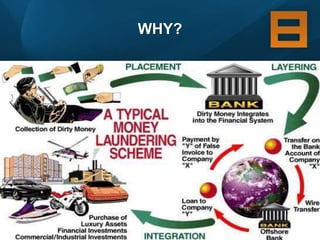
WHY?
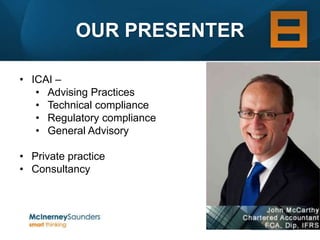
OUR PRESENTER

• ICAI –
   • Advising Practices
   • Technical compliance
   • Regulatory compliance
   • General Advisory

• Private practice
• Consultancy
1.   Latest legislation
2.   Solicitors and AML
3.   Credit Unions and AML
4.   Reporting suspicions
5.   Practical approach
6.   Where can it all go wrong?
• Applicable from 15 July 2010

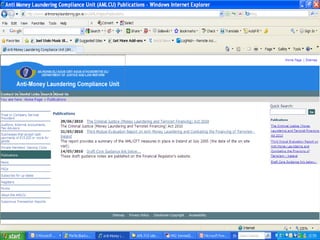
• Anti Money Laundering Compliance Unit of
  the Department of Justice

• Http://www.antimoneylaundering.gov.ie/en/A
  ML/Pages/Home
Obtain information reasonably warranted...on the
purpose and intended nature of a business relationship
with a customer prior to the establishment of a business
relationship S.35(1)
If unable to obtain such information.....shall not provide
the service.... S. 35(2)
Monitor dealings, scrutinise source of wealth or of funds
used for transactions to check:
 – Consistency with knowledge of business patterns
 – Any knowledge of involvement in ML or terrorist
    financing
Prior to establishing business relationship
Section 33(2) –
Identify the customer
Verify the documents can be relied upon to confirm
customer’s identity
Identify any beneficial owner ..and taking any measures
‘reasonably warranted by the risk of money laundering or
terrorism’
Section 33(5) ...the designated person shall take
reasonable steps to verify the identity of the customer or
beneficial owner, .....as soon as practicable
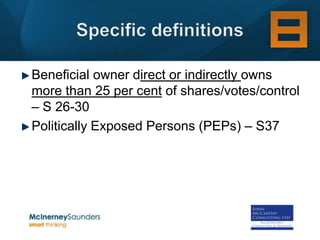
Beneficial owner direct or indirectly owns
more than 25 per cent of shares/votes/control
– S 26-30
Politically Exposed Persons (PEPs) – S37
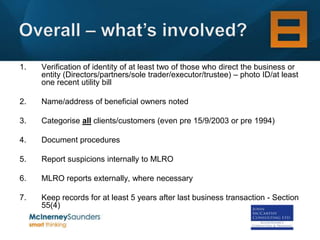
1.   Verification of identity of at least two of those who direct the business or
     entity (Directors/partners/sole trader/executor/trustee) – photo ID/at least
     one recent utility bill

2.   Name/address of beneficial owners noted

3.   Categorise all clients/customers (even pre 15/9/2003 or pre 1994)

4.   Document procedures

5.   Report suspicions internally to MLRO

6.   MLRO reports externally, where necessary

7.   Keep records for at least 5 years after last business transaction - Section
     55(4)
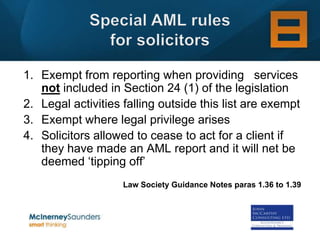
1. Exempt from reporting when providing services
   not included in Section 24 (1) of the legislation
2. Legal activities falling outside this list are exempt
3. Exempt where legal privilege arises
4. Solicitors allowed to cease to act for a client if
   they have made an AML report and it will net be
   deemed ‘tipping off’
                    Law Society Guidance Notes paras 1.36 to 1.39
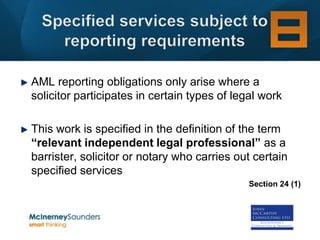
AML reporting obligations only arise where a
solicitor participates in certain types of legal work

This work is specified in the definition of the term
“relevant independent legal professional” as a
barrister, solicitor or notary who carries out certain
specified services
                                              Section 24 (1)
Have a Risk Committee (as required n the Final
Report of the Commission on Credit Unions – April
2012)
Customers with no ID – pre 1994
The need to classify all customers into low,
medium and high risk and say why
Junior member accounts – get ID of
parent/guardian
Dormant accounts – being closed after a period or
commence usage again unexpectedly
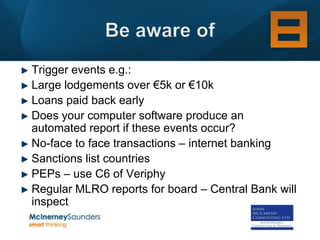
Trigger events e.g.:
Large lodgements over €5k or €10k
Loans paid back early
Does your computer software produce an
automated report if these events occur?
No-face to face transactions – internet banking
Sanctions list countries
PEPs – use C6 of Veriphy
Regular MLRO reports for board – Central Bank will
inspect
What are my responsibilities?
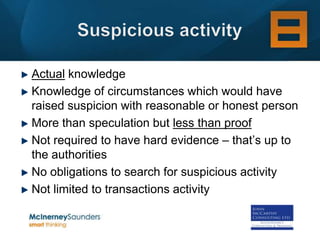
Actual knowledge
Knowledge of circumstances which would have
raised suspicion with reasonable or honest person
More than speculation but less than proof
Not required to have hard evidence – that’s up to
the authorities
No obligations to search for suspicious activity
Not limited to transactions activity
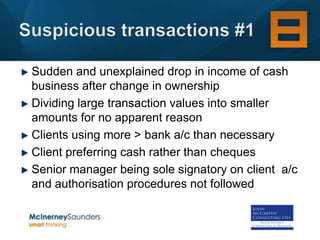
Sudden and unexplained drop in income of cash
business after change in ownership
Dividing large transaction values into smaller
amounts for no apparent reason
Clients using more > bank a/c than necessary
Client preferring cash rather than cheques
Senior manager being sole signatory on client a/c
and authorisation procedures not followed
High incidence of international transactions for no
apparent purpose
Any transaction activity which did not appear to make
sense
A client who is always changing their mind about what
the transactions in the business are for
Lodgements made from distant branches for no real
reason
Client reluctant to give Know Your Clint (KYC)
information
Third party payments for no apparent reason
Repayment of loans within short period
Any activity which might generate a different tax
outcome if all facts were known to the Revenue
Customer whose lifestyle is at odds with known
sources of income
Long standing employees/customers/suppliers of
clients
Falsified invoices/lack of proper books
Insurance broker struck off by CRO for consistently
late annual returns – duty to tell the Financial
Regulator – breach of licensing requirement –
‘money laundering’ as well
Illegal directors’ loans
Charity giving ‘overseas’ aid – is the subject of the
aid legitimate? How robust are the charity’s
clearance procedures?
Hotel/restaurant not implementing fire safety
regulations due to the recession
Minister for Justice may designate certain places outside the
EU if ‘satisfied that they do not have adequate procedures in
place for the detection and prevention of money laundering or
terrorist financing’

It’s compulsory (under S 43) to report clients who do business
with these territories

http://www.finance.gov.ie/viewdoc.asp?fn=/documents/Financi
alSanctions2008/Finsanctionsindex08.htm

http://www.centralbank.ie/regulation/processes/Intfs/Pages/No
tifications.aspx

FATF list
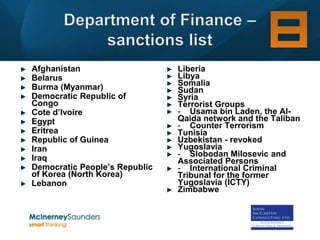
Afghanistan                    Liberia
Belarus                        Libya
Burma (Myanmar)                Somalia
                               Sudan
Democratic Republic of         Syria
Congo                          Terrorist Groups
Cote d’Ivoire                  - Usama bin Laden, the Al-
Egypt                          Qaida network and the Taliban
                               - Counter Terrorism
Eritrea                        Tunisia
Republic of Guinea             Uzbekistan - revoked
Iran                           Yugoslavia
Iraq                           - Slobodan Milosevic and
                               Associated Persons
Democratic People’s Republic   - International Criminal
of Korea (North Korea)         Tribunal for the former
Lebanon                        Yugoslavia (ICTY)
                               Zimbabwe
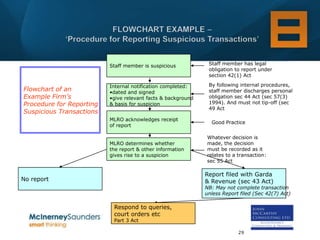
Staff member is suspicious           Staff member has legal
                                                                obligation to report under
                                                                section 42(1) Act

                           Internal notification completed:     By following internal procedures,
Flowchart of an            •dated and signed                    staff member discharges personal
Example Firm’s             •give relevant facts & background    obligation sec 44 Act (sec 57(3)
Procedure for Reporting    & basis for suspicion                1994). And must not tip-off (sec
                                                                49 Act
Suspicious Transactions’
                           MLRO acknowledges receipt
                                                                 Good Practice
                           of report

                                                               Whatever decision is
                           MLRO determines whether             made, the decision
                           the report & other information      must be recorded as it
                           gives rise to a suspicion           relates to a transaction:
                                                               sec 55 Act

                                                               Report filed with Garda
No report                                                      & Revenue (sec 43 Act)
                                                               NB: May not complete transaction
                                                               unless Report filed (Sec 42(7) Act)

                            Respond to queries,
                            court orders etc
                            Part 3 Act

                                                                            29
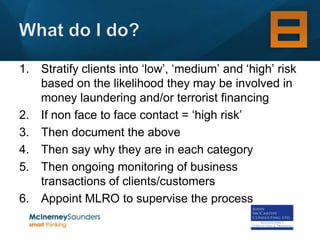
1. Stratify clients into ‘low’, ‘medium’ and ‘high’ risk
   based on the likelihood they may be involved in
   money laundering and/or terrorist financing
2. If non face to face contact = ‘high risk’
3. Then document the above
4. Then say why they are in each category
5. Then ongoing monitoring of business
   transactions of clients/customers
6. Appoint MLRO to supervise the process
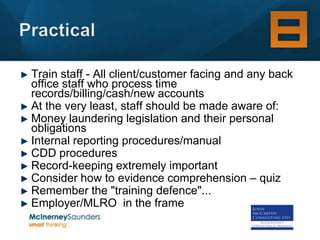
Train staff - All client/customer facing and any back
office staff who process time
records/billing/cash/new accounts
At the very least, staff should be made aware of:
Money laundering legislation and their personal
obligations
Internal reporting procedures/manual
CDD procedures
Record-keeping extremely important
Consider how to evidence comprehension – quiz
Remember the "training defence"...
Employer/MLRO in the frame
Start dealing with clients/customers before the ID obtained
In a Credit Union – just cannot do it
In a service business - put clients without full ID on a watch
list/restricted list
Once you have billed them and got paid, you have laundered their
money
Accepting ID by post or fax
Accepting certified ID from a non-designated or independent person
Accepting ID from another professional/financial institution without
actually obtaining the documents
Not assessing clients/customers into risk categories and saying why
Not identifying PEPs and treating them as ‘high’ risk
Accepting cash up front from a client
Special AML training required by FexCo for handling foreign exchange
transactions in a credit union
Why today?

•   Need for technical update
•   Opportunities from the legislation!!!
•   Opportunities from today - networking
•   Share our marketing strategy
LEGAL FIRMS

•   Law Society                  • Helping firms support their
•   Profitability                  clients
•   Cash Flow                    • CAT - Planning – Filing Tax
•   Monthly/Annual Reporting       returns
•   Tax compliance               • CGT – complex issues
•   Advice on                    • Buying/Selling a Business
•   Tax - Strategy –Succession   • Buying/Selling a property
•   Payroll services             • Dealing with an insolvency
                                 • Setting up a business
                                 • Forensic accounting –
                                   litigation support
CREDIT UNIONS

•   Audit                 • Advice on:
•   Accounting               –   Corporate Governance
•   Internal Audit           –   Amalgamations
•   Support supervisors      –   Results improvement
                             –   Tax issues
•   Monthly Reporting
                             –   Capital Projects
•   Tax compliance
•   Payroll
WHAT CAN
                       CREDIT UNIONS DO?


• Market to solicitors
    – Loans to clients for legal cases
    – Budgeting accounts for their personal clients
    – Deposits for their clients
• Market to Accountants
    –   Loans for small business clients
    –   Loans for asset finance
    –   Personal credit for tax payments
    –   Promote savings
    –   Promote family finance
    –   Promote Gifts to children/grandchildren
• Advertise on their website
• Have information at their premises
WHAT CAN
                        SOLICITORS DO?


Market to CREDIT UNIONS                    Market to ACCOUNTANTS
•   Regulatory compliance                       • Specialist services
•   Review Legal Agreements                     • Debt collection
                                                • Family law advice
•   Property issues
                                                • Commercial agreements
•   Debt collection                             • Look for relationships with
•   Security for loans                            their clients
•   Information for their clients               • Contribute to accountant’s
•   Advice desk for members                       newsletters
•   Wills service for members
                       Advertise on their websites
                    Have information at their premises
CONCLUSION

HELP OURSELVES                  HELP OTHERS
  BY:
                                •   RECOMMEND
•   EXCEEDING         MUTUAL        OTHERS
    EXPECTATIONS      SUPPORT   •   MAKE
•   ASKING FOR                      INTRODUCTIONS
    REFERRALS                   •   SHARE
•   NETWORKING                      INFORMATION
    EFFECTIVELY                 •   CORPORATE
•   RECOMMENDING                    SOCIAL
    OTHERS                          RESPONSIBILITY

Anti-Money Laundering Seminar

  • 1.
  • 2.
  • 3.
  • 4.
  • 5.
    OUR PRESENTER • ICAI– • Advising Practices • Technical compliance • Regulatory compliance • General Advisory • Private practice • Consultancy
  • 6.
    1. Latest legislation 2. Solicitors and AML 3. Credit Unions and AML 4. Reporting suspicions 5. Practical approach 6. Where can it all go wrong?
  • 8.
    • Applicable from15 July 2010 • Anti Money Laundering Compliance Unit of the Department of Justice • Http://www.antimoneylaundering.gov.ie/en/A ML/Pages/Home
  • 10.
    Obtain information reasonablywarranted...on the purpose and intended nature of a business relationship with a customer prior to the establishment of a business relationship S.35(1) If unable to obtain such information.....shall not provide the service.... S. 35(2) Monitor dealings, scrutinise source of wealth or of funds used for transactions to check: – Consistency with knowledge of business patterns – Any knowledge of involvement in ML or terrorist financing
  • 11.
    Prior to establishingbusiness relationship Section 33(2) – Identify the customer Verify the documents can be relied upon to confirm customer’s identity Identify any beneficial owner ..and taking any measures ‘reasonably warranted by the risk of money laundering or terrorism’ Section 33(5) ...the designated person shall take reasonable steps to verify the identity of the customer or beneficial owner, .....as soon as practicable
  • 12.
    Beneficial owner director indirectly owns more than 25 per cent of shares/votes/control – S 26-30 Politically Exposed Persons (PEPs) – S37
  • 13.
    1. Verification of identity of at least two of those who direct the business or entity (Directors/partners/sole trader/executor/trustee) – photo ID/at least one recent utility bill 2. Name/address of beneficial owners noted 3. Categorise all clients/customers (even pre 15/9/2003 or pre 1994) 4. Document procedures 5. Report suspicions internally to MLRO 6. MLRO reports externally, where necessary 7. Keep records for at least 5 years after last business transaction - Section 55(4)
  • 15.
    1. Exempt fromreporting when providing services not included in Section 24 (1) of the legislation 2. Legal activities falling outside this list are exempt 3. Exempt where legal privilege arises 4. Solicitors allowed to cease to act for a client if they have made an AML report and it will net be deemed ‘tipping off’ Law Society Guidance Notes paras 1.36 to 1.39
  • 16.
    AML reporting obligationsonly arise where a solicitor participates in certain types of legal work This work is specified in the definition of the term “relevant independent legal professional” as a barrister, solicitor or notary who carries out certain specified services Section 24 (1)
  • 19.
    Have a RiskCommittee (as required n the Final Report of the Commission on Credit Unions – April 2012) Customers with no ID – pre 1994 The need to classify all customers into low, medium and high risk and say why Junior member accounts – get ID of parent/guardian Dormant accounts – being closed after a period or commence usage again unexpectedly
  • 20.
    Trigger events e.g.: Largelodgements over €5k or €10k Loans paid back early Does your computer software produce an automated report if these events occur? No-face to face transactions – internet banking Sanctions list countries PEPs – use C6 of Veriphy Regular MLRO reports for board – Central Bank will inspect
  • 21.
    What are myresponsibilities?
  • 22.
    Actual knowledge Knowledge ofcircumstances which would have raised suspicion with reasonable or honest person More than speculation but less than proof Not required to have hard evidence – that’s up to the authorities No obligations to search for suspicious activity Not limited to transactions activity
  • 23.
    Sudden and unexplaineddrop in income of cash business after change in ownership Dividing large transaction values into smaller amounts for no apparent reason Clients using more > bank a/c than necessary Client preferring cash rather than cheques Senior manager being sole signatory on client a/c and authorisation procedures not followed
  • 24.
    High incidence ofinternational transactions for no apparent purpose Any transaction activity which did not appear to make sense A client who is always changing their mind about what the transactions in the business are for Lodgements made from distant branches for no real reason Client reluctant to give Know Your Clint (KYC) information Third party payments for no apparent reason
  • 25.
    Repayment of loanswithin short period Any activity which might generate a different tax outcome if all facts were known to the Revenue Customer whose lifestyle is at odds with known sources of income Long standing employees/customers/suppliers of clients
  • 26.
    Falsified invoices/lack ofproper books Insurance broker struck off by CRO for consistently late annual returns – duty to tell the Financial Regulator – breach of licensing requirement – ‘money laundering’ as well Illegal directors’ loans Charity giving ‘overseas’ aid – is the subject of the aid legitimate? How robust are the charity’s clearance procedures? Hotel/restaurant not implementing fire safety regulations due to the recession
  • 27.
    Minister for Justicemay designate certain places outside the EU if ‘satisfied that they do not have adequate procedures in place for the detection and prevention of money laundering or terrorist financing’ It’s compulsory (under S 43) to report clients who do business with these territories http://www.finance.gov.ie/viewdoc.asp?fn=/documents/Financi alSanctions2008/Finsanctionsindex08.htm http://www.centralbank.ie/regulation/processes/Intfs/Pages/No tifications.aspx FATF list
  • 28.
    Afghanistan Liberia Belarus Libya Burma (Myanmar) Somalia Sudan Democratic Republic of Syria Congo Terrorist Groups Cote d’Ivoire - Usama bin Laden, the Al- Egypt Qaida network and the Taliban - Counter Terrorism Eritrea Tunisia Republic of Guinea Uzbekistan - revoked Iran Yugoslavia Iraq - Slobodan Milosevic and Associated Persons Democratic People’s Republic - International Criminal of Korea (North Korea) Tribunal for the former Lebanon Yugoslavia (ICTY) Zimbabwe
  • 29.
    Staff member issuspicious Staff member has legal obligation to report under section 42(1) Act Internal notification completed: By following internal procedures, Flowchart of an •dated and signed staff member discharges personal Example Firm’s •give relevant facts & background obligation sec 44 Act (sec 57(3) Procedure for Reporting & basis for suspicion 1994). And must not tip-off (sec 49 Act Suspicious Transactions’ MLRO acknowledges receipt Good Practice of report Whatever decision is MLRO determines whether made, the decision the report & other information must be recorded as it gives rise to a suspicion relates to a transaction: sec 55 Act Report filed with Garda No report & Revenue (sec 43 Act) NB: May not complete transaction unless Report filed (Sec 42(7) Act) Respond to queries, court orders etc Part 3 Act 29
  • 31.
    1. Stratify clientsinto ‘low’, ‘medium’ and ‘high’ risk based on the likelihood they may be involved in money laundering and/or terrorist financing 2. If non face to face contact = ‘high risk’ 3. Then document the above 4. Then say why they are in each category 5. Then ongoing monitoring of business transactions of clients/customers 6. Appoint MLRO to supervise the process
  • 32.
    Train staff -All client/customer facing and any back office staff who process time records/billing/cash/new accounts At the very least, staff should be made aware of: Money laundering legislation and their personal obligations Internal reporting procedures/manual CDD procedures Record-keeping extremely important Consider how to evidence comprehension – quiz Remember the "training defence"... Employer/MLRO in the frame
  • 34.
    Start dealing withclients/customers before the ID obtained In a Credit Union – just cannot do it In a service business - put clients without full ID on a watch list/restricted list Once you have billed them and got paid, you have laundered their money Accepting ID by post or fax Accepting certified ID from a non-designated or independent person Accepting ID from another professional/financial institution without actually obtaining the documents Not assessing clients/customers into risk categories and saying why Not identifying PEPs and treating them as ‘high’ risk Accepting cash up front from a client Special AML training required by FexCo for handling foreign exchange transactions in a credit union
  • 36.
    Why today? • Need for technical update • Opportunities from the legislation!!! • Opportunities from today - networking • Share our marketing strategy
  • 37.
    LEGAL FIRMS • Law Society • Helping firms support their • Profitability clients • Cash Flow • CAT - Planning – Filing Tax • Monthly/Annual Reporting returns • Tax compliance • CGT – complex issues • Advice on • Buying/Selling a Business • Tax - Strategy –Succession • Buying/Selling a property • Payroll services • Dealing with an insolvency • Setting up a business • Forensic accounting – litigation support
  • 38.
    CREDIT UNIONS • Audit • Advice on: • Accounting – Corporate Governance • Internal Audit – Amalgamations • Support supervisors – Results improvement – Tax issues • Monthly Reporting – Capital Projects • Tax compliance • Payroll
  • 39.
    WHAT CAN CREDIT UNIONS DO? • Market to solicitors – Loans to clients for legal cases – Budgeting accounts for their personal clients – Deposits for their clients • Market to Accountants – Loans for small business clients – Loans for asset finance – Personal credit for tax payments – Promote savings – Promote family finance – Promote Gifts to children/grandchildren • Advertise on their website • Have information at their premises
  • 40.
    WHAT CAN SOLICITORS DO? Market to CREDIT UNIONS Market to ACCOUNTANTS • Regulatory compliance • Specialist services • Review Legal Agreements • Debt collection • Family law advice • Property issues • Commercial agreements • Debt collection • Look for relationships with • Security for loans their clients • Information for their clients • Contribute to accountant’s • Advice desk for members newsletters • Wills service for members Advertise on their websites Have information at their premises
  • 41.
    CONCLUSION HELP OURSELVES HELP OTHERS BY: • RECOMMEND • EXCEEDING MUTUAL OTHERS EXPECTATIONS SUPPORT • MAKE • ASKING FOR INTRODUCTIONS REFERRALS • SHARE • NETWORKING INFORMATION EFFECTIVELY • CORPORATE • RECOMMENDING SOCIAL OTHERS RESPONSIBILITY