Current issues with
meningococcal vaccine
programmes in the UK

Dr Mary Ramsay, Head of Immunisation, Public Health England
Meningococcal serogroup C (MCC)
conjugate vaccination in the UK

In 1999, in response to increase in
serogroup C meningococcal disease

•

the UK was first country to introduce conjugate vaccine
for meningococcal disease

Incidence too low to undertake efficacy trials

•
•

Licensed on the basis of protective levels of serum
bactericidal antibodies that were superior to plain
polysaccharide vaccine
Evidence of immunological memory

Vaccine used following the model of Hib
Miller E, Salisbury D, Ramsay M. Vaccine 2001;20 Suppl 1:S58-67.
Group C infections by age
Isolates referred to PHLS, 1998/9
120
100
80
60
40
20

0
<1 1 2 3 4 5 6 7 8 9 10 11 12 13 14 15 16 17 18 19 20 21 22 23 24
MCC vaccine implementation
in the UK
Vaccine given with the routine schedule at 2, 3 and 4
months of age
• Coverage of >90% rapidly achieved
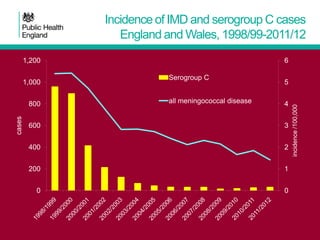
Based on pre-vaccine epidemiology, catch-up for all
children <18 years of age completed in 2000
• Coverage exceeded 85% in all cohorts up to 16 years
Immediate dramatic impact on disease rates
• Impact now sustained for over 10 years
• Less than 30 cases reported each year (many in
unvaccinated adults not raised in the UK)
Incidence of IMD and serogroup C cases
England and Wales, 1998/99-2011/12

1,000

cases

800

6
Serogroup C
all meningococcal disease

5
4

600

3

400

2

200

1

0

0

incidence /100,000

1,200
Vaccine effectiveness by time since
routine infant vaccine
Time since
vaccination

VE (%)

95% confidence
interval

Within a year

96.7%

(88.6%,99.1%)

12-23 months

71.2%

(-1150%,95.9%)

24-35 month

75.3%

(-998%,96.7%)

36+ months

48.7%

(-2025%,91.8%)
Evidence of herd immunity
Incidence per 105 in 15-17 year olds

cases/100,000 persons

9
8

Pre-vaccine

65% reduction in rate in
unvaccinated cohort 2000/01
83% reduction in rate in
unvaccinated cohort 2002/03

7

6
5

4

unvaccinated

3
2

vaccinated

1
0
98/99
Ramsay ME et al. BMJ. 2003;326:365-6.

00/01

00/01
Nasopharyngeal carriage rates of serogroup
C Neisseria meningitidis, UK adolescents
3.00%
2.50%
2.00%
-71%

-81%

1.50%
1.00%

0.50%
0.00%
1999

Maiden MC et al. J Infect Dis. 2008;197:737-43.

2000

2001
Summary of MCC impact
Despite declining protection, major reduction in
MenC incidence and deaths
• Assumption of long term protection was wrong

Main reason for dramatic and sustained impact was
indirect (herd) protection
• Due to decline in carriage rates in teenagers covered by
catch-up programme

Catch-up programme covering all ages to 18 years
vital for control of meningococcal disease
How can we sustain long term control?
Meningococcal serogroup C seroprevalence
by age, 1996-9, 2000-4, and 2009

1996-99
100
90

% with SBA titre >=8

80
70
60

50
40
30
20
10
0

2000-2004

2009
Results of seroprevalence studies
Antibody response in infants and in catch up programme
was strongly related to age
Antibody levels in those vaccinated below 5 years of age
have declined
Booster dose added to routine schedule at 12 months
•

Meningococcal SBA decay pattern post booster is very similar to
that post primary vaccination*

By 2009, major immunity gap in children aged 1-14 years
BUT, models predict no resurgence of disease for several
years
* Borrow R et al. Clin Vaccine Immunol. 2010;17:154-9.
Eligibility and coverage of MenC by vaccination in NHS, 2014
Adult
catch up

< 25%

Sixth form
catch up
Secondary school
catch up

65-74%

83-88%

Primary school
catch up

85-88%

GP Pre-school
catch-up

77%

Toddler
catch-up

85%

Routine MenC
3 dose

>90%

Routine MenC
2+1 or 3+1 doses

>90%

Age in 2014

1-9
years

10-14
years

15
years

16-19
years

20-26
years

27-31
years

32-33
years

34-39
years

Year of Birth 2005-2013 2000-2004 1999 1995-1998 1988-1994 1983-1987 1981-1982 1975-1980

Teenage booster
Rationale for new schedule
• Need to balance short term protection in infants with long
term disease control
-

MenC protection in infancy can be achieved with single dose of
some vaccines
Toddler booster response excellent but not long term

• Control is being maintained by high levels of antibody in
school age and adult catch-up cohorts
-

Sustaining indirect protection will require boosting in older children

• Booster to be introduced in year 10 during 13-14
academic year
- University catch-up for older children from 2014-15
Eligibility and coverage of MenC by vaccination in NHS, 2014
Adult
catch up

< 25%

Sixth form
catch up
Secondary school
catch up

65-74%

83-88%

Primary school
catch up

85-88%

GP Pre-school
catch-up

77%

Toddler
catch-up

85%

Routine MenC
3 dose

>90%

Routine MenC
2+1 or 3+1 doses

>90%

Age in 2014

1-9
years

10-14
years

15
years

16-19
years

20-26
years

27-31
years

32-33
years

34-39
years

Year of Birth 2005-2013 2000-2004 1999 1995-1998 1988-1994 1983-1987 1981-1982 1975-1980
Teenage booster 2014

University catch-up
Which vaccines should the UK use for
the new MenC schedule?
• Not all conjugates are the same
•

Based on experience so far would prefer to use the
most immunogenic vaccines

• Infant protection with a single dose of MenC is
only sufficient with two vaccines
•
•

Menjugate / NeisVac C are preferred
Meningitec in infancy would require two doses

• Toddler booster response is combined with Hib
•

Is also affected by choice of priming vaccine, but high
levels are usually achieved
Which vaccines should the UK use for
the new MenC schedule?

• Response to teenage boosters likely to be good
with any MenC containing vaccine
•

Potential to use multivalent vaccine

• Three quadrivalent vaccines now available
•
•
•

Menveo (Novartis) CRM197 conjugate (licensed)
Neimenrix (GSK) Tetanus conjugate
Menactra (SPMSD) Diphtheria conjugate

• Recent study completed in 16-19 year olds with
Menveo and Neimenrix
•

Both vaccines provided protection for ≥98% of
adolescents against all four serotypes
Non-B Meningococcal cases by year
(2006/7-2011/12, England & Wales)
100

Number of Cases

C

W135

Y

Other

80
60
40
20
0
2006/2007 2007/2008 2008/2009 2009/2010 2010/2011 2011/2012

Epidemiological Year
Conclusions
Conjugate vaccination against MenC has been hugely
successful
For continued control probable need high antibody levels in
the age group where carriage occurs
•

Important to vaccinate adolescents

The 1 + 1 + 1 schedule is likely to be both effective and
efficient
Use of broader vaccines in teenagers will boost MenC
antibody and have potential to prevent other serogroups
•

unlikely to be justifiable unless cost neutral or incidence of these
increase

Current issues with meningococcal vaccine programmes in the UK

  • 1.
    Current issues with meningococcalvaccine programmes in the UK Dr Mary Ramsay, Head of Immunisation, Public Health England
  • 2.
    Meningococcal serogroup C(MCC) conjugate vaccination in the UK In 1999, in response to increase in serogroup C meningococcal disease • the UK was first country to introduce conjugate vaccine for meningococcal disease Incidence too low to undertake efficacy trials • • Licensed on the basis of protective levels of serum bactericidal antibodies that were superior to plain polysaccharide vaccine Evidence of immunological memory Vaccine used following the model of Hib Miller E, Salisbury D, Ramsay M. Vaccine 2001;20 Suppl 1:S58-67.
  • 3.
    Group C infectionsby age Isolates referred to PHLS, 1998/9 120 100 80 60 40 20 0 <1 1 2 3 4 5 6 7 8 9 10 11 12 13 14 15 16 17 18 19 20 21 22 23 24
  • 4.
    MCC vaccine implementation inthe UK Vaccine given with the routine schedule at 2, 3 and 4 months of age • Coverage of >90% rapidly achieved Based on pre-vaccine epidemiology, catch-up for all children <18 years of age completed in 2000 • Coverage exceeded 85% in all cohorts up to 16 years Immediate dramatic impact on disease rates • Impact now sustained for over 10 years • Less than 30 cases reported each year (many in unvaccinated adults not raised in the UK)
  • 5.
    Incidence of IMDand serogroup C cases England and Wales, 1998/99-2011/12 1,000 cases 800 6 Serogroup C all meningococcal disease 5 4 600 3 400 2 200 1 0 0 incidence /100,000 1,200
  • 6.
    Vaccine effectiveness bytime since routine infant vaccine Time since vaccination VE (%) 95% confidence interval Within a year 96.7% (88.6%,99.1%) 12-23 months 71.2% (-1150%,95.9%) 24-35 month 75.3% (-998%,96.7%) 36+ months 48.7% (-2025%,91.8%)
  • 7.
    Evidence of herdimmunity Incidence per 105 in 15-17 year olds cases/100,000 persons 9 8 Pre-vaccine 65% reduction in rate in unvaccinated cohort 2000/01 83% reduction in rate in unvaccinated cohort 2002/03 7 6 5 4 unvaccinated 3 2 vaccinated 1 0 98/99 Ramsay ME et al. BMJ. 2003;326:365-6. 00/01 00/01
  • 8.
    Nasopharyngeal carriage ratesof serogroup C Neisseria meningitidis, UK adolescents 3.00% 2.50% 2.00% -71% -81% 1.50% 1.00% 0.50% 0.00% 1999 Maiden MC et al. J Infect Dis. 2008;197:737-43. 2000 2001
  • 9.
    Summary of MCCimpact Despite declining protection, major reduction in MenC incidence and deaths • Assumption of long term protection was wrong Main reason for dramatic and sustained impact was indirect (herd) protection • Due to decline in carriage rates in teenagers covered by catch-up programme Catch-up programme covering all ages to 18 years vital for control of meningococcal disease How can we sustain long term control?
  • 10.
    Meningococcal serogroup Cseroprevalence by age, 1996-9, 2000-4, and 2009 1996-99 100 90 % with SBA titre >=8 80 70 60 50 40 30 20 10 0 2000-2004 2009
  • 11.
    Results of seroprevalencestudies Antibody response in infants and in catch up programme was strongly related to age Antibody levels in those vaccinated below 5 years of age have declined Booster dose added to routine schedule at 12 months • Meningococcal SBA decay pattern post booster is very similar to that post primary vaccination* By 2009, major immunity gap in children aged 1-14 years BUT, models predict no resurgence of disease for several years * Borrow R et al. Clin Vaccine Immunol. 2010;17:154-9.
  • 12.
    Eligibility and coverageof MenC by vaccination in NHS, 2014 Adult catch up < 25% Sixth form catch up Secondary school catch up 65-74% 83-88% Primary school catch up 85-88% GP Pre-school catch-up 77% Toddler catch-up 85% Routine MenC 3 dose >90% Routine MenC 2+1 or 3+1 doses >90% Age in 2014 1-9 years 10-14 years 15 years 16-19 years 20-26 years 27-31 years 32-33 years 34-39 years Year of Birth 2005-2013 2000-2004 1999 1995-1998 1988-1994 1983-1987 1981-1982 1975-1980 Teenage booster
  • 13.
    Rationale for newschedule • Need to balance short term protection in infants with long term disease control - MenC protection in infancy can be achieved with single dose of some vaccines Toddler booster response excellent but not long term • Control is being maintained by high levels of antibody in school age and adult catch-up cohorts - Sustaining indirect protection will require boosting in older children • Booster to be introduced in year 10 during 13-14 academic year - University catch-up for older children from 2014-15
  • 14.
    Eligibility and coverageof MenC by vaccination in NHS, 2014 Adult catch up < 25% Sixth form catch up Secondary school catch up 65-74% 83-88% Primary school catch up 85-88% GP Pre-school catch-up 77% Toddler catch-up 85% Routine MenC 3 dose >90% Routine MenC 2+1 or 3+1 doses >90% Age in 2014 1-9 years 10-14 years 15 years 16-19 years 20-26 years 27-31 years 32-33 years 34-39 years Year of Birth 2005-2013 2000-2004 1999 1995-1998 1988-1994 1983-1987 1981-1982 1975-1980 Teenage booster 2014 University catch-up
  • 15.
    Which vaccines shouldthe UK use for the new MenC schedule? • Not all conjugates are the same • Based on experience so far would prefer to use the most immunogenic vaccines • Infant protection with a single dose of MenC is only sufficient with two vaccines • • Menjugate / NeisVac C are preferred Meningitec in infancy would require two doses • Toddler booster response is combined with Hib • Is also affected by choice of priming vaccine, but high levels are usually achieved
  • 16.
    Which vaccines shouldthe UK use for the new MenC schedule? • Response to teenage boosters likely to be good with any MenC containing vaccine • Potential to use multivalent vaccine • Three quadrivalent vaccines now available • • • Menveo (Novartis) CRM197 conjugate (licensed) Neimenrix (GSK) Tetanus conjugate Menactra (SPMSD) Diphtheria conjugate • Recent study completed in 16-19 year olds with Menveo and Neimenrix • Both vaccines provided protection for ≥98% of adolescents against all four serotypes
  • 17.
    Non-B Meningococcal casesby year (2006/7-2011/12, England & Wales) 100 Number of Cases C W135 Y Other 80 60 40 20 0 2006/2007 2007/2008 2008/2009 2009/2010 2010/2011 2011/2012 Epidemiological Year
  • 18.
    Conclusions Conjugate vaccination againstMenC has been hugely successful For continued control probable need high antibody levels in the age group where carriage occurs • Important to vaccinate adolescents The 1 + 1 + 1 schedule is likely to be both effective and efficient Use of broader vaccines in teenagers will boost MenC antibody and have potential to prevent other serogroups • unlikely to be justifiable unless cost neutral or incidence of these increase