19 Horril et al.
International Journal of Microbiology and Mycology | IJMM |
pISSN: 2309-4796
http://www.innspub.net
Vol. 19, No. 3, p. 19-25, 2024
Antimicrobial properties of selected propolis samples
Nadina A. Horril1
, Santana N. Martinez1
, Elmer-Rico E. Mojica*2
1
Department of Biology, Pace University, One Pace Plaza, New York, NY, USA
2
Department of Chemistry and Physical Sciences, Pace University, One Pace Plaza, New York,
NY, USA
Keywords: Propolis, Antimicrobial, Diffusion assay
Publication date: September 10, 2024
Abstract
Propolis, a natural resinous substance collected by honeybees from buds and exudates of plants, is
known for its use in the beehive as a protective barrier against intruders. It is widely used as a
popular remedy in folk medicine and as a constituent of bio-cosmetics. Recently, it is extensively
used in food and beverages to improve health and prevent diseases. Depending on the season, bee
species, vegetation and the area of collection, the chemical composition of propolis are
qualitatively and quantitatively variable, resulting in diverse biological properties. In this project,
the antimicrobial activity of several propolis samples obtained from various parts of the world
(Europe, Australia, USA and the Philippines) was determined. The propolis samples were extracted
with ethanol and the extracts were assayed with Gram-positive and Gram-negative
microorganisms. Results demonstrate that propolis is effective against a range of opportunistic
pathogens, with the samples from Russia and Washington showing the most potent antibacterial
activity, inhibiting seven microorganisms each. The propolis from the Philippines (Bicol and Laguna)
also exhibited notable antimicrobial effects, although to a slightly lesser extent.
* Corresponding Author: Elmer-Rico E. Mojica  emojica@pace.edu
Open Access RESEARCH PAPER
20 Horril et al.
Introduction
Propolis is a natural resinous substance collected
by honeybees from the buds and exudates of
plants. In the hive, propolis serves a crucial role
as a defensive barrier, repairing combs by sealing
holes and cracks, and reinforcing the comb
borders to prevent pathogenic invasions.
Additionally, bees use propolis to trap intruders
that breach the hive, further safeguarding the
colony (Sawaya et al., 2011).
Propolis is renowned for its wide array of
bioactive properties, including anti-inflammatory,
anti-tumor, cytotoxic, hepatoprotective, and
immunomodulatory effects. However, its most
vital property is its ability to inhibit pathogenic
microbial invasions (Liberio et al., 2011). The
chemical composition of propolis is highly
variable, influenced by factors such as the
season, type of bee, local vegetation, and the
geographical area of collection (Lotti et al.,
2011). This diversity in composition results in
varying degrees of bioactivity among different
propolis samples. The synergistic effects of these
diverse compounds make propolis particularly
effective against microorganisms, as the
variability in its composition makes it difficult for
pathogens to develop resistance. Each propolis
sample presents a unique combination of
bioactive compounds, reducing the likelihood that
microorganisms can adapt to and recognize the
antimicrobial agents within it.
Given the substantial evidence of propolis's
antimicrobial properties and the diversity of its
chemical makeup, a key question arises: which
propolis samples are the most potent in inhibiting
microbial growth, and what specific properties
contribute to their enhanced efficacy against
pathogens? By analyzing propolis samples from
various regions around the world, we can identify
which areas produce the most antimicrobial-rich
propolis. This information could pave the way for
a more targeted search for antimicrobial agents
that not only have potent effects but also pose a
lower risk of fostering pathogen resistance.
In this study, we surveyed bee propolis samples
from different global regions to evaluate their
antimicrobial activity against both Gram-positive
and Gram-negative bacteria. Through this
comparative analysis, we aim to determine which
propolis samples exhibit the strongest
antimicrobial properties and to explore the
underlying factors that contribute to their
effectiveness. This research could lead to the
discovery of new, natural antimicrobial agents
with the potential to combat infections while
mitigating the growing problem of antibiotic
resistance.
Materials and methods
Bacterial cultures
There were fourteen microorganisms (seven
Gram positive and seven Gram-negative) that
were used in the experiment. The gram positive
bacteria used were Bacillus megaterium,
Micrococcus luteus, Rhodococcus rhodochrous,
Saphyloccus epidermidis, Sporosarcina urease,
Staphylococcus aureus and Streptomycs griseus,
while the Gram-negative bacteria used were
Branhamella catarrhalis, Escherichia coli,
Pseudomonas aeroginosa, Pseudomonas putida,
Rhodospirillum rubrum, Sarcina aurantiaca and
Serratia marcesens. These bacterial cultures were
all purchased from Carolina. These cultures were
inoculated into tryptic soy broth (TSB) using
sterile technique and incubated for 48 hours at
37°C.
Propolis extracts
Propolis samples were obtained from eight
different places around world. These places are
Washington and California in the US, Australia,
Latvia, Russia, and the Philippines (Quezon, Bicol
and Laguna). The collected propolis sample was
air-dried, weighed and macerated with absolute
ethanol (10 mL for 1 g sample) a week. The
macerated extract was filtered through Whatman
21 Horril et al.
#41 filter paper to obtain the liquid extract to be
used in the assay.
Microbial assays
Autoclaved disks comprised of filter paper soaked
into each individual propolis sample extract and
then left to air dry to remove the ethanol. Each
microorganism was inoculated into a Petri-plate
containing tryptic soy agar (TSA) using a lazy L
spreader for even bacterial distribution. Each
autoclave disk soak with propolis extract was
placed in its appropriately labeled section on the
plate that were then incubated at 37˚C for 48
hours. The microbial zone of inhibition around the
soaked disks were analyzed to determine the
efficacy of the propolis extract in hindering
bacterial growth. The extract was not effective if
any growth appeared around the disk. If the zone
of inhibition was less than a ½ cm, it indicated
slight bacterial inhibition by the extract. If the
zone of inhibition was greater than ½ cm, it
denoted great bacterial inhibition. Ampicillin
solution was used as the positive control while
autoclaved disk soaked in ethanol was used as
negative control.
Results and discussion
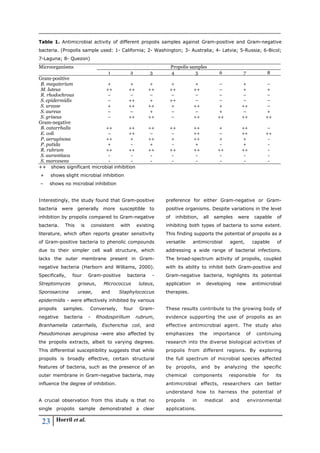
In the present study, the antimicrobial properties
of propolis samples from different geographical
regions, including Russia, Washington, Bicol, and
Laguna, were assessed against both Gram-
negative and Gram-positive bacteria. The results,
presented in Table 1 and illustrated in Fig. 1,
show that propolis is effective against a wide
range of opportunistic pathogens. The data
indicate that the most potent antimicrobial effects
were observed with the propolis samples from
Russia and Washington, which produced the
largest zones of inhibition on the agar plates.
These samples demonstrated strong activity
against both Gram-positive and Gram-negative
bacteria without showing a preference for either
type, confirming the broad-spectrum nature of
their antimicrobial properties.
The antimicrobial activity of propolis has been
extensively documented in the literature, with
numerous studies highlighting its effectiveness
against a variety of microorganisms. Previous
research has demonstrated that propolis exhibits
significant antibacterial activity against
Staphylococcus aureus (Krol et al., 1993),
Streptococcus mutans (Koo et al., 2002),
Streptococcus pyogenes (Bosio et al., 2000),
Salmonella spp. (Orsi et al., 2005), anaerobic
bacteria in the human oral cavity (Santos et al.,
2002), and other pathogens, including
Mycobacterium species (Bankova et al., 2000).
The underlying mechanism of propolis's
antimicrobial activity is complex, involving at
least 200 different compounds identified in
various propolis samples. These compounds
include fatty acids, phenolic acids and esters,
flavonoids, terpenes, β-steroids, aromatic
aldehydes and alcohols, sesquiterpenes,
naphthalene, and stilbene derivatives (Walker
and Crane, 1987; Greenway et al., 1991;
Bankova et al., 2000). Among these, phenolic
compounds, particularly flavonoids such as
pinocembrin, galangin, and pinobanksin, have
been frequently cited as key contributors to the
antimicrobial activity of propolis (Krol et al.,
1993; Burdock, 1998; Castaldo and Capasso,
2002).
Specifically, the propolis from Russia and
Washington exhibited significant inhibition
against seven microorganisms, surpassing the
performance of other samples. This aligns with
previous studies that have highlighted the
powerful antimicrobial effects of flavonoid-rich
propolis, as these compounds are known to
disrupt microbial cell membranes, inhibit enzyme
activity, and interfere with bacterial metabolism
(Wang, 2000). The strong inhibition observed
with these samples suggests that their flavonoid
content, particularly pinocembrin and galangin,
may be responsible for their heightened
antimicrobial activity.
22 Horril et al.
Fig. 1. Antimicrobial activity of propolis samples on microorganisms used in this study
The propolis sample from Bicol also showed
substantial antimicrobial activity, inhibiting six
different microorganisms (Table 1). However, it
exhibited only slight inhibition against four
additional microorganisms, suggesting a slightly
narrower spectrum of activity compared to the
Russian and Washington samples. This could be
attributed to variations in the chemical
composition of the Bicol propolis, potentially
reflecting differences in the local flora and
environmental conditions that influence the types
and concentrations of bioactive compounds
present.
The propolis from Laguna demonstrated
significant inhibition against five microorganisms,
with slight inhibition observed in four others.
While this sample was not as potent as those
from Russia and Washington, it still exhibited a
notable level of antimicrobial activity, reinforcing
the idea that propolis from different regions
possesses unique antimicrobial properties due to
its diverse chemical composition. This diversity in
activity underscores the importance of regional
factors in shaping the biological properties of
propolis, as the variation in local plant sources
directly impacts the types and concentrations of
bioactive compounds available to the bees.
In terms of microbial resistance, certain bacteria,
such as Serratia marcescens, Rhodococcus
rhodochrous, and Staphylococcus aurantiaca,
were notably resistant to the propolis samples,
showing minimal to no inhibition. This resistance
could be due to the inherent biological
characteristics of these microorganisms, such as
robust cell walls or efflux mechanisms that
reduce the efficacy of antimicrobial agents. The
resistance observed in these strains highlights
the need for further research to understand the
specific mechanisms by which certain bacteria
resist propolis, and whether higher
concentrations or alternative formulations of
propolis could overcome this resistance.
23 Horril et al.
Table 1. Antimicrobial activity of different propolis samples against Gram-positive and Gram-negative
bacteria. (Propolis sample used: 1- California; 2- Washington; 3- Australia; 4- Latvia; 5-Russia; 6-Bicol;
7-Laguna; 8- Quezon)
Microorganisms Propolis samples
1 2 3 4 5 6 7 8
Gram-positive
B. megaterium + + + + + – + –
M. luteus ++ ++ ++ ++ ++ – + +
R. rhodochrous – – – – – – – –
S. epidermidis – ++ + ++ – – – –
S. urease + ++ ++ + ++ + ++ –
S. aureus – – + – – + – +
S. griseus – ++ ++ – ++ ++ ++ ++
Gram-negative
B. catarrhalis ++ ++ ++ ++ ++ + ++ –
E. coli – ++ – – ++ – ++ ++
P. aeruginosa ++ + ++ + ++ + + -
P. putida + - + - + - + -
R. rubrum ++ ++ ++ ++ ++ ++ ++ -
S. aurantiaca - - - - - - - -
S. marcesens - - - - - - - -
++ shows significant microbial inhibition
+ shows slight microbial inhibition
– shows no microbial inhibition
Interestingly, the study found that Gram-positive
bacteria were generally more susceptible to
inhibition by propolis compared to Gram-negative
bacteria. This is consistent with existing
literature, which often reports greater sensitivity
of Gram-positive bacteria to phenolic compounds
due to their simpler cell wall structure, which
lacks the outer membrane present in Gram-
negative bacteria (Harborn and Williams, 2000).
Specifically, four Gram-positive bacteria -
Streptomyces griseus, Micrococcus luteus,
Sporosarcina ureae, and Staphylococcus
epidermidis - were effectively inhibited by various
propolis samples. Conversely, four Gram-
negative bacteria - Rhodospirillum rubrum,
Branhamella catarrhalis, Escherichia coli, and
Pseudomonas aeruginosa -were also affected by
the propolis extracts, albeit to varying degrees.
This differential susceptibility suggests that while
propolis is broadly effective, certain structural
features of bacteria, such as the presence of an
outer membrane in Gram-negative bacteria, may
influence the degree of inhibition.
A crucial observation from this study is that no
single propolis sample demonstrated a clear
preference for either Gram-negative or Gram-
positive organisms. Despite variations in the level
of inhibition, all samples were capable of
inhibiting both types of bacteria to some extent.
This finding supports the potential of propolis as a
versatile antimicrobial agent, capable of
addressing a wide range of bacterial infections.
The broad-spectrum activity of propolis, coupled
with its ability to inhibit both Gram-positive and
Gram-negative bacteria, highlights its potential
application in developing new antimicrobial
therapies.
These results contribute to the growing body of
evidence supporting the use of propolis as an
effective antimicrobial agent. The study also
emphasizes the importance of continuing
research into the diverse biological activities of
propolis from different regions. By exploring
the full spectrum of microbial species affected
by propolis, and by analyzing the specific
chemical components responsible for its
antimicrobial effects, researchers can better
understand how to harness the potential of
propolis in medical and environmental
applications.
24 Horril et al.
Moreover, the development of environmentally
friendly antibacterial agents derived from propolis
presents a significant opportunity to address the
challenges posed by chemically synthesized
antibiotics, which contribute to environmental
degradation and the rise of antibiotic-resistant
bacteria. The diverse chemical composition of
propolis, which includes compounds that act
synergistically, reduces the likelihood of microbial
resistance developing. This is particularly
important in the current global context, where
the overuse and misuse of antibiotics have led to
an alarming increase in resistant strains. Propolis,
with its natural origin and multifaceted
antimicrobial properties, represents a promising
alternative to traditional antibiotics.
Conclusion
Results of this study underscore the significant
potential of propolis as a natural antimicrobial
agent. The propolis samples from Russia,
Washington, Bicol, and Laguna have all
demonstrated varying degrees of effectiveness
against a range of microorganisms, with the
Russian and Washington samples showing
particularly strong activity. These findings suggest
that propolis could be developed into a viable
alternative to synthetic antimicrobial agents,
offering a sustainable and effective solution to
combating bacterial infections while mitigating the
environmental impact and reducing the risk of
antibiotic resistance. Further research into the
chemical composition and biological activities of
propolis will be essential in unlocking its full
potential for medical and environmental
applications.
References
Bankova VS, De Castro SL, Marcucci MC.
2000. Propolis: recent advances in chemistry and
plant origin. Apidologie 31, 3–15.
Bosio K, Avanzini C, D’avolio A, Ozimo O,
Savoia D. 2000. In vitro activity of propolis
against Streptococcus pyogenes. Lett Appl
Microbiol 31, 174-177.
Burdock GA. 1998. Review of the biological
properties and toxicity of bee propolis (propolis).
Food Chem Toxicol 36, 347–363.
Castaldo S, Capasso F. 2002. Propolis, an old
remedy used in modern medicine. Fitoterapia
73(Suppl. 1), S1-S6.
De Castro SL, Soeiro MNC, Meirelles MNL.
1992. Trypanosoma cruzi: Effect of
phenothiazines on the parasite and on its
interaction with host cells. Mem Inst Oswaldo
Cruz 87, 209–215.
Greenaway W, May J, Scaysbrook T, Whatley
FR. 1991. Identification by gas chromatography–
mass spectrometry of 150 compounds in propolis.
Z Naturforsch 46C, 111–121.
Gu Q, Zhang Y, Zhong L. 2001. Study on
extracting activity of propolis. Acta Agric
Zhejiangensis 13, 161–164.
Harborne JB, Williams CA. 2000. Advances in
flavonoids research since 1992. Phytochemistry
55, 481–504.
Koo H, Rosalen PL, Cury JA, Park YK, Bowen
WH. 2002. Effects of compounds found in
propolis on Streptococcus mutans growth and on
glucosyltransferase activity. Antimicrob Agents
Chemother 46, 1302-1309.
Krol W, Scheller S, Shani J, Pietsz G, Czuba
Z. 1993. Synergistic effect of ethanolic extract of
propolis and antibiotics on the growth of
Staphylococcus aureus. Arzneimittelforschung
43, 607-609.
Liberio SA, Pereira ALA, Dutra RP, Reis AS,
Araújo MJAM, Mattar NS, Silva LA, Ribeiro
MNS, Nascimento FRF, Guerra RNM,
Monteiro-Neto V. 2011. Antimicrobial activity
against oral pathogens and immunomodulatory
effects and toxicity of geopropolis produced by
the stingless bee Melipona fasciculata Smith. BMC
Complement Altern Med 11, 108.
25 Horril et al.
Lotti C, Migliani de Castro GM, Reis de Sa LF,
da Silva BdAFS, Tessis AC, Piccinelli AL,
Rastrelli L, Ferreira-Pereira A. 2011. Inhibition
of Saccharomyces cerevisiae Pdr5p by a natural
compound extracted from Brazilian red propolis.
Rev Bras Farmacogn 21(5), 901-907.
Orsi RO, Sforcin JM, Rall VLM, Funari SRC,
Barbosa L, Fernandes Júnior A. 2005.
Susceptibility profile of Salmonella against the
antibacterial activity of propolis produced in two
regions of Brazil. J Venom Anim Toxins Incl Trop
Dis 11, 109-116.
Santos FA, Bastos EMA, Uzeda B, Carvalho
MAR, Farias ESA, Braga FC. 2002.
Antibacterial activity of Brazilian propolis and
fractions against oral anaerobic bacteria. J
Ethnopharmacol 80, 1-7.
Sawaya ACHF, da Silva Cunha IB, Marcucci
MC. 2011. Analytical methods applied to diverse
types of Brazilian propolis. Chem Cent J 5, 27.
Shvarzbeyn J, Huleihel M. 2011. Effect of
propolis and caffeic acid phenethyl ester (CAPE)
on NFκB activation by HTLV-1 Tax. Antiviral Res
90, 108-115.
Trusheva B, Trunkova D, Bankova V. 2007.
Different extraction methods of biologically active
components from propolis: a preliminary study.
Chem Cent J 1, 13.
Walker P, Crane E. 1987. Constituents of
propolis. Apidologie 18, 327-334.
Wang HK. 2000. The therapeutic potential of
flavonoids. Expert Opin Investig Drugs 9, 2103-
2119.

Antimicrobial properties of selected propolis samples

  • 1.
    19 Horril etal. International Journal of Microbiology and Mycology | IJMM | pISSN: 2309-4796 http://www.innspub.net Vol. 19, No. 3, p. 19-25, 2024 Antimicrobial properties of selected propolis samples Nadina A. Horril1 , Santana N. Martinez1 , Elmer-Rico E. Mojica*2 1 Department of Biology, Pace University, One Pace Plaza, New York, NY, USA 2 Department of Chemistry and Physical Sciences, Pace University, One Pace Plaza, New York, NY, USA Keywords: Propolis, Antimicrobial, Diffusion assay Publication date: September 10, 2024 Abstract Propolis, a natural resinous substance collected by honeybees from buds and exudates of plants, is known for its use in the beehive as a protective barrier against intruders. It is widely used as a popular remedy in folk medicine and as a constituent of bio-cosmetics. Recently, it is extensively used in food and beverages to improve health and prevent diseases. Depending on the season, bee species, vegetation and the area of collection, the chemical composition of propolis are qualitatively and quantitatively variable, resulting in diverse biological properties. In this project, the antimicrobial activity of several propolis samples obtained from various parts of the world (Europe, Australia, USA and the Philippines) was determined. The propolis samples were extracted with ethanol and the extracts were assayed with Gram-positive and Gram-negative microorganisms. Results demonstrate that propolis is effective against a range of opportunistic pathogens, with the samples from Russia and Washington showing the most potent antibacterial activity, inhibiting seven microorganisms each. The propolis from the Philippines (Bicol and Laguna) also exhibited notable antimicrobial effects, although to a slightly lesser extent. * Corresponding Author: Elmer-Rico E. Mojica  emojica@pace.edu Open Access RESEARCH PAPER
  • 2.
    20 Horril etal. Introduction Propolis is a natural resinous substance collected by honeybees from the buds and exudates of plants. In the hive, propolis serves a crucial role as a defensive barrier, repairing combs by sealing holes and cracks, and reinforcing the comb borders to prevent pathogenic invasions. Additionally, bees use propolis to trap intruders that breach the hive, further safeguarding the colony (Sawaya et al., 2011). Propolis is renowned for its wide array of bioactive properties, including anti-inflammatory, anti-tumor, cytotoxic, hepatoprotective, and immunomodulatory effects. However, its most vital property is its ability to inhibit pathogenic microbial invasions (Liberio et al., 2011). The chemical composition of propolis is highly variable, influenced by factors such as the season, type of bee, local vegetation, and the geographical area of collection (Lotti et al., 2011). This diversity in composition results in varying degrees of bioactivity among different propolis samples. The synergistic effects of these diverse compounds make propolis particularly effective against microorganisms, as the variability in its composition makes it difficult for pathogens to develop resistance. Each propolis sample presents a unique combination of bioactive compounds, reducing the likelihood that microorganisms can adapt to and recognize the antimicrobial agents within it. Given the substantial evidence of propolis's antimicrobial properties and the diversity of its chemical makeup, a key question arises: which propolis samples are the most potent in inhibiting microbial growth, and what specific properties contribute to their enhanced efficacy against pathogens? By analyzing propolis samples from various regions around the world, we can identify which areas produce the most antimicrobial-rich propolis. This information could pave the way for a more targeted search for antimicrobial agents that not only have potent effects but also pose a lower risk of fostering pathogen resistance. In this study, we surveyed bee propolis samples from different global regions to evaluate their antimicrobial activity against both Gram-positive and Gram-negative bacteria. Through this comparative analysis, we aim to determine which propolis samples exhibit the strongest antimicrobial properties and to explore the underlying factors that contribute to their effectiveness. This research could lead to the discovery of new, natural antimicrobial agents with the potential to combat infections while mitigating the growing problem of antibiotic resistance. Materials and methods Bacterial cultures There were fourteen microorganisms (seven Gram positive and seven Gram-negative) that were used in the experiment. The gram positive bacteria used were Bacillus megaterium, Micrococcus luteus, Rhodococcus rhodochrous, Saphyloccus epidermidis, Sporosarcina urease, Staphylococcus aureus and Streptomycs griseus, while the Gram-negative bacteria used were Branhamella catarrhalis, Escherichia coli, Pseudomonas aeroginosa, Pseudomonas putida, Rhodospirillum rubrum, Sarcina aurantiaca and Serratia marcesens. These bacterial cultures were all purchased from Carolina. These cultures were inoculated into tryptic soy broth (TSB) using sterile technique and incubated for 48 hours at 37°C. Propolis extracts Propolis samples were obtained from eight different places around world. These places are Washington and California in the US, Australia, Latvia, Russia, and the Philippines (Quezon, Bicol and Laguna). The collected propolis sample was air-dried, weighed and macerated with absolute ethanol (10 mL for 1 g sample) a week. The macerated extract was filtered through Whatman
  • 3.
    21 Horril etal. #41 filter paper to obtain the liquid extract to be used in the assay. Microbial assays Autoclaved disks comprised of filter paper soaked into each individual propolis sample extract and then left to air dry to remove the ethanol. Each microorganism was inoculated into a Petri-plate containing tryptic soy agar (TSA) using a lazy L spreader for even bacterial distribution. Each autoclave disk soak with propolis extract was placed in its appropriately labeled section on the plate that were then incubated at 37˚C for 48 hours. The microbial zone of inhibition around the soaked disks were analyzed to determine the efficacy of the propolis extract in hindering bacterial growth. The extract was not effective if any growth appeared around the disk. If the zone of inhibition was less than a ½ cm, it indicated slight bacterial inhibition by the extract. If the zone of inhibition was greater than ½ cm, it denoted great bacterial inhibition. Ampicillin solution was used as the positive control while autoclaved disk soaked in ethanol was used as negative control. Results and discussion In the present study, the antimicrobial properties of propolis samples from different geographical regions, including Russia, Washington, Bicol, and Laguna, were assessed against both Gram- negative and Gram-positive bacteria. The results, presented in Table 1 and illustrated in Fig. 1, show that propolis is effective against a wide range of opportunistic pathogens. The data indicate that the most potent antimicrobial effects were observed with the propolis samples from Russia and Washington, which produced the largest zones of inhibition on the agar plates. These samples demonstrated strong activity against both Gram-positive and Gram-negative bacteria without showing a preference for either type, confirming the broad-spectrum nature of their antimicrobial properties. The antimicrobial activity of propolis has been extensively documented in the literature, with numerous studies highlighting its effectiveness against a variety of microorganisms. Previous research has demonstrated that propolis exhibits significant antibacterial activity against Staphylococcus aureus (Krol et al., 1993), Streptococcus mutans (Koo et al., 2002), Streptococcus pyogenes (Bosio et al., 2000), Salmonella spp. (Orsi et al., 2005), anaerobic bacteria in the human oral cavity (Santos et al., 2002), and other pathogens, including Mycobacterium species (Bankova et al., 2000). The underlying mechanism of propolis's antimicrobial activity is complex, involving at least 200 different compounds identified in various propolis samples. These compounds include fatty acids, phenolic acids and esters, flavonoids, terpenes, β-steroids, aromatic aldehydes and alcohols, sesquiterpenes, naphthalene, and stilbene derivatives (Walker and Crane, 1987; Greenway et al., 1991; Bankova et al., 2000). Among these, phenolic compounds, particularly flavonoids such as pinocembrin, galangin, and pinobanksin, have been frequently cited as key contributors to the antimicrobial activity of propolis (Krol et al., 1993; Burdock, 1998; Castaldo and Capasso, 2002). Specifically, the propolis from Russia and Washington exhibited significant inhibition against seven microorganisms, surpassing the performance of other samples. This aligns with previous studies that have highlighted the powerful antimicrobial effects of flavonoid-rich propolis, as these compounds are known to disrupt microbial cell membranes, inhibit enzyme activity, and interfere with bacterial metabolism (Wang, 2000). The strong inhibition observed with these samples suggests that their flavonoid content, particularly pinocembrin and galangin, may be responsible for their heightened antimicrobial activity.
  • 4.
    22 Horril etal. Fig. 1. Antimicrobial activity of propolis samples on microorganisms used in this study The propolis sample from Bicol also showed substantial antimicrobial activity, inhibiting six different microorganisms (Table 1). However, it exhibited only slight inhibition against four additional microorganisms, suggesting a slightly narrower spectrum of activity compared to the Russian and Washington samples. This could be attributed to variations in the chemical composition of the Bicol propolis, potentially reflecting differences in the local flora and environmental conditions that influence the types and concentrations of bioactive compounds present. The propolis from Laguna demonstrated significant inhibition against five microorganisms, with slight inhibition observed in four others. While this sample was not as potent as those from Russia and Washington, it still exhibited a notable level of antimicrobial activity, reinforcing the idea that propolis from different regions possesses unique antimicrobial properties due to its diverse chemical composition. This diversity in activity underscores the importance of regional factors in shaping the biological properties of propolis, as the variation in local plant sources directly impacts the types and concentrations of bioactive compounds available to the bees. In terms of microbial resistance, certain bacteria, such as Serratia marcescens, Rhodococcus rhodochrous, and Staphylococcus aurantiaca, were notably resistant to the propolis samples, showing minimal to no inhibition. This resistance could be due to the inherent biological characteristics of these microorganisms, such as robust cell walls or efflux mechanisms that reduce the efficacy of antimicrobial agents. The resistance observed in these strains highlights the need for further research to understand the specific mechanisms by which certain bacteria resist propolis, and whether higher concentrations or alternative formulations of propolis could overcome this resistance.
  • 5.
    23 Horril etal. Table 1. Antimicrobial activity of different propolis samples against Gram-positive and Gram-negative bacteria. (Propolis sample used: 1- California; 2- Washington; 3- Australia; 4- Latvia; 5-Russia; 6-Bicol; 7-Laguna; 8- Quezon) Microorganisms Propolis samples 1 2 3 4 5 6 7 8 Gram-positive B. megaterium + + + + + – + – M. luteus ++ ++ ++ ++ ++ – + + R. rhodochrous – – – – – – – – S. epidermidis – ++ + ++ – – – – S. urease + ++ ++ + ++ + ++ – S. aureus – – + – – + – + S. griseus – ++ ++ – ++ ++ ++ ++ Gram-negative B. catarrhalis ++ ++ ++ ++ ++ + ++ – E. coli – ++ – – ++ – ++ ++ P. aeruginosa ++ + ++ + ++ + + - P. putida + - + - + - + - R. rubrum ++ ++ ++ ++ ++ ++ ++ - S. aurantiaca - - - - - - - - S. marcesens - - - - - - - - ++ shows significant microbial inhibition + shows slight microbial inhibition – shows no microbial inhibition Interestingly, the study found that Gram-positive bacteria were generally more susceptible to inhibition by propolis compared to Gram-negative bacteria. This is consistent with existing literature, which often reports greater sensitivity of Gram-positive bacteria to phenolic compounds due to their simpler cell wall structure, which lacks the outer membrane present in Gram- negative bacteria (Harborn and Williams, 2000). Specifically, four Gram-positive bacteria - Streptomyces griseus, Micrococcus luteus, Sporosarcina ureae, and Staphylococcus epidermidis - were effectively inhibited by various propolis samples. Conversely, four Gram- negative bacteria - Rhodospirillum rubrum, Branhamella catarrhalis, Escherichia coli, and Pseudomonas aeruginosa -were also affected by the propolis extracts, albeit to varying degrees. This differential susceptibility suggests that while propolis is broadly effective, certain structural features of bacteria, such as the presence of an outer membrane in Gram-negative bacteria, may influence the degree of inhibition. A crucial observation from this study is that no single propolis sample demonstrated a clear preference for either Gram-negative or Gram- positive organisms. Despite variations in the level of inhibition, all samples were capable of inhibiting both types of bacteria to some extent. This finding supports the potential of propolis as a versatile antimicrobial agent, capable of addressing a wide range of bacterial infections. The broad-spectrum activity of propolis, coupled with its ability to inhibit both Gram-positive and Gram-negative bacteria, highlights its potential application in developing new antimicrobial therapies. These results contribute to the growing body of evidence supporting the use of propolis as an effective antimicrobial agent. The study also emphasizes the importance of continuing research into the diverse biological activities of propolis from different regions. By exploring the full spectrum of microbial species affected by propolis, and by analyzing the specific chemical components responsible for its antimicrobial effects, researchers can better understand how to harness the potential of propolis in medical and environmental applications.
  • 6.
    24 Horril etal. Moreover, the development of environmentally friendly antibacterial agents derived from propolis presents a significant opportunity to address the challenges posed by chemically synthesized antibiotics, which contribute to environmental degradation and the rise of antibiotic-resistant bacteria. The diverse chemical composition of propolis, which includes compounds that act synergistically, reduces the likelihood of microbial resistance developing. This is particularly important in the current global context, where the overuse and misuse of antibiotics have led to an alarming increase in resistant strains. Propolis, with its natural origin and multifaceted antimicrobial properties, represents a promising alternative to traditional antibiotics. Conclusion Results of this study underscore the significant potential of propolis as a natural antimicrobial agent. The propolis samples from Russia, Washington, Bicol, and Laguna have all demonstrated varying degrees of effectiveness against a range of microorganisms, with the Russian and Washington samples showing particularly strong activity. These findings suggest that propolis could be developed into a viable alternative to synthetic antimicrobial agents, offering a sustainable and effective solution to combating bacterial infections while mitigating the environmental impact and reducing the risk of antibiotic resistance. Further research into the chemical composition and biological activities of propolis will be essential in unlocking its full potential for medical and environmental applications. References Bankova VS, De Castro SL, Marcucci MC. 2000. Propolis: recent advances in chemistry and plant origin. Apidologie 31, 3–15. Bosio K, Avanzini C, D’avolio A, Ozimo O, Savoia D. 2000. In vitro activity of propolis against Streptococcus pyogenes. Lett Appl Microbiol 31, 174-177. Burdock GA. 1998. Review of the biological properties and toxicity of bee propolis (propolis). Food Chem Toxicol 36, 347–363. Castaldo S, Capasso F. 2002. Propolis, an old remedy used in modern medicine. Fitoterapia 73(Suppl. 1), S1-S6. De Castro SL, Soeiro MNC, Meirelles MNL. 1992. Trypanosoma cruzi: Effect of phenothiazines on the parasite and on its interaction with host cells. Mem Inst Oswaldo Cruz 87, 209–215. Greenaway W, May J, Scaysbrook T, Whatley FR. 1991. Identification by gas chromatography– mass spectrometry of 150 compounds in propolis. Z Naturforsch 46C, 111–121. Gu Q, Zhang Y, Zhong L. 2001. Study on extracting activity of propolis. Acta Agric Zhejiangensis 13, 161–164. Harborne JB, Williams CA. 2000. Advances in flavonoids research since 1992. Phytochemistry 55, 481–504. Koo H, Rosalen PL, Cury JA, Park YK, Bowen WH. 2002. Effects of compounds found in propolis on Streptococcus mutans growth and on glucosyltransferase activity. Antimicrob Agents Chemother 46, 1302-1309. Krol W, Scheller S, Shani J, Pietsz G, Czuba Z. 1993. Synergistic effect of ethanolic extract of propolis and antibiotics on the growth of Staphylococcus aureus. Arzneimittelforschung 43, 607-609. Liberio SA, Pereira ALA, Dutra RP, Reis AS, Araújo MJAM, Mattar NS, Silva LA, Ribeiro MNS, Nascimento FRF, Guerra RNM, Monteiro-Neto V. 2011. Antimicrobial activity against oral pathogens and immunomodulatory effects and toxicity of geopropolis produced by the stingless bee Melipona fasciculata Smith. BMC Complement Altern Med 11, 108.
  • 7.
    25 Horril etal. Lotti C, Migliani de Castro GM, Reis de Sa LF, da Silva BdAFS, Tessis AC, Piccinelli AL, Rastrelli L, Ferreira-Pereira A. 2011. Inhibition of Saccharomyces cerevisiae Pdr5p by a natural compound extracted from Brazilian red propolis. Rev Bras Farmacogn 21(5), 901-907. Orsi RO, Sforcin JM, Rall VLM, Funari SRC, Barbosa L, Fernandes Júnior A. 2005. Susceptibility profile of Salmonella against the antibacterial activity of propolis produced in two regions of Brazil. J Venom Anim Toxins Incl Trop Dis 11, 109-116. Santos FA, Bastos EMA, Uzeda B, Carvalho MAR, Farias ESA, Braga FC. 2002. Antibacterial activity of Brazilian propolis and fractions against oral anaerobic bacteria. J Ethnopharmacol 80, 1-7. Sawaya ACHF, da Silva Cunha IB, Marcucci MC. 2011. Analytical methods applied to diverse types of Brazilian propolis. Chem Cent J 5, 27. Shvarzbeyn J, Huleihel M. 2011. Effect of propolis and caffeic acid phenethyl ester (CAPE) on NFκB activation by HTLV-1 Tax. Antiviral Res 90, 108-115. Trusheva B, Trunkova D, Bankova V. 2007. Different extraction methods of biologically active components from propolis: a preliminary study. Chem Cent J 1, 13. Walker P, Crane E. 1987. Constituents of propolis. Apidologie 18, 327-334. Wang HK. 2000. The therapeutic potential of flavonoids. Expert Opin Investig Drugs 9, 2103- 2119.