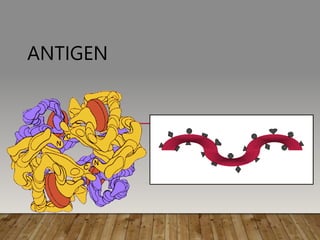
ANTIGEN
1 CONCEPT OF ANTIGEN
• Antigens are substances that induce a
specific immune response and
subsequently react with the products of a
specific immune response.
• An antigen is a molecule that stimulates an
immune response.
• The word originated from antibody
generation
• The modern definition encompasses all
substances that can be recognized by the
adaptive immune system.
• Tolerogen - An antigen that invokes a
specific immune non-responsiveness due
to its molecular form. If its molecular form
is changed, a tolerogen can become an
immunogen.
• Allergen - An allergen is a substance that
causes the allergic reaction. The
(detrimental) reaction may result after
exposure via ingestion, inhalation, injection
or contact with skin.
ANTIGENS CAN BE CLASSIFIED IN ORDER OF
THEIR ORIGINS
• Exogenous antigens
Entered the body from the outside, for
example by inhalation, ingestion, or injection.
By endocytosis or phagocytosis, these antigens
are taken into the antigen-presenting cells
(APCs) and processed into fragments.
• Endogenous antigens
Endogenous antigens have been generated
within the cell, as a result of normal cell
metabolism, or because of viral or intracellular
bacterial infection.
Autoantigens
An autoantigen is usually a normal
protein or complex of proteins (and
sometimes DNA or RNA) that is
recognized by the immune system of
patients suffering from a specific
autoimmune disease.
Tumor antigens
Tumor antigens are those antigens that are
presented by the MHC I molecules on the
surface of tumor cells
They are called tumor-specific antigens (TSAs)
and typically result from a tumor specific
mutation.
2 CHARACTERISTICS OF ANTIGEN
★ Immunogenicity
The capacity to stimulate the production
of antibodies or cell-mediated immune
responses.
★ Antigenicity: The ability to bind
antibody.
♣ Complete antigen
♣ Incomplete antigen, also
known as
hapten.
Incomplete antigens have antigenic
determinants, but cannot induce immune
responses because they lack one or more of
the important attributes needed for this
function, eg hapten
3 PROPERTIES OF ANTIGENICITY
• Foreignness
• Specificity
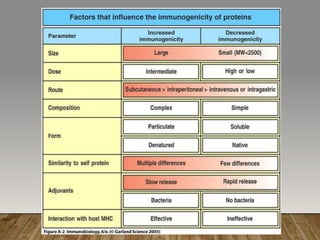
• Complexity
• High molecular weight(10K -10 M KDA)
• Dose
• Route of Administration
• SUSCEPTIBILITY TO TISSUE ENZYMES
• Repeated dose
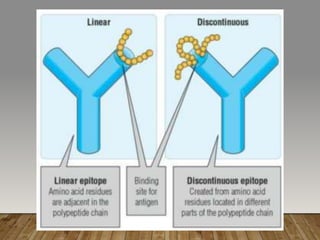
4 ANTIGENIC EPITOPES
Epitope,or,Antigenic determinants, are
the portions of antigen molecules that
physically interact with paratopes
(combining sites) of immune response
molecules and therefore actually
"determine" antigen specificity
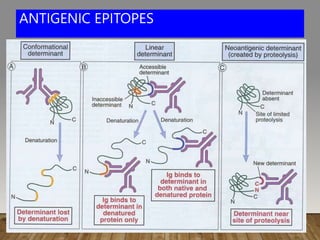
ANTIGENIC EPITOPES
♣ Specificity depends upon conformation, or
three-dimensional shape, which is a
combination of tertiary and quaternary
structure ... supported by primary and
secondary structure
♣ Typical size is hard to pinpoint, but
sequences of up to 16 amino acids in
certain protein antigens have been shown
to interact with their complementary
paratope.
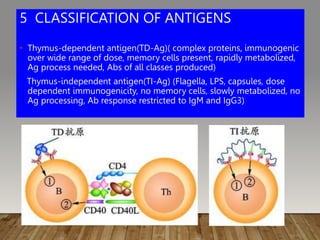
5 CLASSIFICATION OF ANTIGENS
• Thymus-dependent antigen(TD-Ag)( complex proteins, immunogenic
over wide range of dose, memory cells present, rapidly metabolized,
Ag process needed, Abs of all classes produced)
Thymus-independent antigen(TI-Ag) (Flagella, LPS, capsules, dose
dependent immunogenicity, no memory cells, slowly metabolized, no
Ag processing, Ab response restricted to IgM and IgG3)
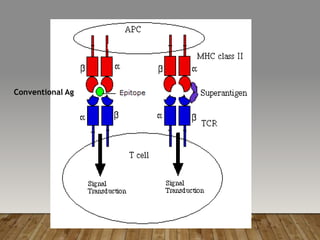
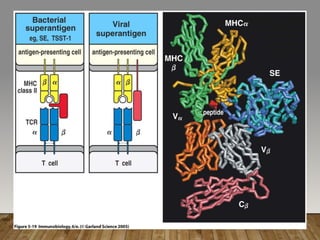
6 SUPERANTIGEN
Molecules that are potent T lymphocyte
mitogens and simultaneously bind to class
II MHC molecules
 Often associated with staphylococcal
products and are involved in
enterotoxemias and toxic shock syndrome
in humans.
Can n A
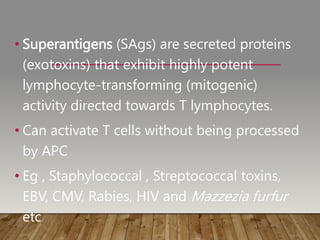
• Superantigens (SAgs) are secreted proteins
(exotoxins) that exhibit highly potent
lymphocyte-transforming (mitogenic)
activity directed towards T lymphocytes.
• Can activate T cells without being processed
by APC
• Eg , Staphylococcal , Streptococcal toxins,
EBV, CMV, Rabies, HIV and Mazzezia furfur
etc
• Compared to a normal antigen-induced T-
cell response where 0.001-0.0001% of the
body’s T-cells are activated, SAgs are
capable of activating up to 20% of the
body’s T-cells. This causes a massive
immune response that is not specific to any
particular epitope on the SAg.
Conventional Ag
7 ADJUVANT
Adjuvant: The Latin "adjuvans"
means to help, particularly to reach a
goal.
An adjuvant is a substance that helps
and enhances the pharmacological
effect of a drug or increases the ability
of an antigen to stimulate the immune
system.
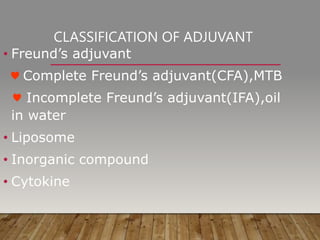
CLASSIFICATION OF ADJUVANT
• Freund’s adjuvant
♥ Complete Freund’s adjuvant(CFA),MTB
♥ Incomplete Freund’s adjuvant(IFA),oil
in water
• Liposome
• Inorganic compound
• Cytokine
MECHANISMS OF ADJUVANTS
• Prolonged persistence of immunogen
molecules at the site of injection.
• Enhancement of co-stimulatory signals.
• Induction of granuloma formation.
• Stimulation of lymphocyte proliferation
in a non-specific manner.
8 OTHER ANTIGENS
8-1 Heterophilic antigen : A kind of common
antigen, existing in human, animals, and
microbes.
Fossman antigen.
8-2 Xenogenic antigen
This antigen comes from different genus
and generic. For example, pathogenic
antigen.
8-3 Allogenic antigen
The specific antigen exists in different
individuals. Blood type antigens
8-4 Autoantigen
A pathological term.
sperm antigen
THANK YOU!

Antigen-Lecture-51 (1).ppt

  • 1.
  • 2.
    1 CONCEPT OFANTIGEN • Antigens are substances that induce a specific immune response and subsequently react with the products of a specific immune response.
  • 3.
    • An antigenis a molecule that stimulates an immune response. • The word originated from antibody generation • The modern definition encompasses all substances that can be recognized by the adaptive immune system.
  • 4.
    • Tolerogen -An antigen that invokes a specific immune non-responsiveness due to its molecular form. If its molecular form is changed, a tolerogen can become an immunogen.
  • 5.
    • Allergen -An allergen is a substance that causes the allergic reaction. The (detrimental) reaction may result after exposure via ingestion, inhalation, injection or contact with skin.
  • 6.
    ANTIGENS CAN BECLASSIFIED IN ORDER OF THEIR ORIGINS • Exogenous antigens Entered the body from the outside, for example by inhalation, ingestion, or injection. By endocytosis or phagocytosis, these antigens are taken into the antigen-presenting cells (APCs) and processed into fragments.
  • 7.
    • Endogenous antigens Endogenousantigens have been generated within the cell, as a result of normal cell metabolism, or because of viral or intracellular bacterial infection.
  • 8.
    Autoantigens An autoantigen isusually a normal protein or complex of proteins (and sometimes DNA or RNA) that is recognized by the immune system of patients suffering from a specific autoimmune disease.
  • 9.
    Tumor antigens Tumor antigensare those antigens that are presented by the MHC I molecules on the surface of tumor cells They are called tumor-specific antigens (TSAs) and typically result from a tumor specific mutation.
  • 10.
    2 CHARACTERISTICS OFANTIGEN ★ Immunogenicity The capacity to stimulate the production of antibodies or cell-mediated immune responses.
  • 11.
    ★ Antigenicity: Theability to bind antibody. ♣ Complete antigen ♣ Incomplete antigen, also known as hapten.
  • 12.
    Incomplete antigens haveantigenic determinants, but cannot induce immune responses because they lack one or more of the important attributes needed for this function, eg hapten
  • 13.
    3 PROPERTIES OFANTIGENICITY • Foreignness • Specificity • Complexity • High molecular weight(10K -10 M KDA) • Dose • Route of Administration • SUSCEPTIBILITY TO TISSUE ENZYMES • Repeated dose
  • 14.
    4 ANTIGENIC EPITOPES Epitope,or,Antigenicdeterminants, are the portions of antigen molecules that physically interact with paratopes (combining sites) of immune response molecules and therefore actually "determine" antigen specificity
  • 15.
  • 16.
    ♣ Specificity dependsupon conformation, or three-dimensional shape, which is a combination of tertiary and quaternary structure ... supported by primary and secondary structure
  • 17.
    ♣ Typical sizeis hard to pinpoint, but sequences of up to 16 amino acids in certain protein antigens have been shown to interact with their complementary paratope.
  • 19.
    5 CLASSIFICATION OFANTIGENS • Thymus-dependent antigen(TD-Ag)( complex proteins, immunogenic over wide range of dose, memory cells present, rapidly metabolized, Ag process needed, Abs of all classes produced) Thymus-independent antigen(TI-Ag) (Flagella, LPS, capsules, dose dependent immunogenicity, no memory cells, slowly metabolized, no Ag processing, Ab response restricted to IgM and IgG3)
  • 20.
    6 SUPERANTIGEN Molecules thatare potent T lymphocyte mitogens and simultaneously bind to class II MHC molecules  Often associated with staphylococcal products and are involved in enterotoxemias and toxic shock syndrome in humans. Can n A
  • 21.
    • Superantigens (SAgs)are secreted proteins (exotoxins) that exhibit highly potent lymphocyte-transforming (mitogenic) activity directed towards T lymphocytes. • Can activate T cells without being processed by APC • Eg , Staphylococcal , Streptococcal toxins, EBV, CMV, Rabies, HIV and Mazzezia furfur etc
  • 22.
    • Compared toa normal antigen-induced T- cell response where 0.001-0.0001% of the body’s T-cells are activated, SAgs are capable of activating up to 20% of the body’s T-cells. This causes a massive immune response that is not specific to any particular epitope on the SAg.
  • 23.
  • 25.
    7 ADJUVANT Adjuvant: TheLatin "adjuvans" means to help, particularly to reach a goal. An adjuvant is a substance that helps and enhances the pharmacological effect of a drug or increases the ability of an antigen to stimulate the immune system.
  • 26.
    CLASSIFICATION OF ADJUVANT •Freund’s adjuvant ♥ Complete Freund’s adjuvant(CFA),MTB ♥ Incomplete Freund’s adjuvant(IFA),oil in water • Liposome • Inorganic compound • Cytokine
  • 27.
    MECHANISMS OF ADJUVANTS •Prolonged persistence of immunogen molecules at the site of injection. • Enhancement of co-stimulatory signals. • Induction of granuloma formation. • Stimulation of lymphocyte proliferation in a non-specific manner.
  • 28.
    8 OTHER ANTIGENS 8-1Heterophilic antigen : A kind of common antigen, existing in human, animals, and microbes. Fossman antigen. 8-2 Xenogenic antigen This antigen comes from different genus and generic. For example, pathogenic antigen.
  • 29.
    8-3 Allogenic antigen Thespecific antigen exists in different individuals. Blood type antigens 8-4 Autoantigen A pathological term. sperm antigen
  • 31.