ANTIBIOTICS
LEARNING OBJECTIVES:
Upon completion of this chapter, you will be able to;
 1. Explain how an antibiotic is selected for use in a particular clinical situation.
 2. Describe therapeutic actions, indications, pharmacokinetics, contraindications, most
common adverse reactions, and important drug–drug interactions associated with each
of the classes of antibiotics.
 3. Discuss the use of antibiotics across the lifespan.
 4. Compare and contrast prototype drugs for each class of antibiotics with other drugs in
that class.
 5. Outline nursing considerations for patients receiving each class of antibiotic.
Antibiotics—chemicals that inhibit specific bacteria—to deal with each new
threat.
Antibiotics are made in three ways: By living microorganisms, by synthetic
manufacture, and in some cases through genetic engineering. Antibiotics may
either be bacteriostatic (preventing the growth of bacteria) or bactericidal
(killing bacteria directly), although several antibiotics are both bactericidal
and bacteriostatic, depending on the concentration of the particular drug.
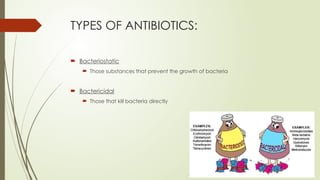
TYPES OF ANTIBIOTICS:
 Bacteriostatic
 Those substances that prevent the growth of bacteria
 Bactericidal
 Those that kill bacteria directly
SIGNS OF INFECTION:
 Fever
 Lethargy
 Slow-wave sleep induction
 Classic signs of inflammation (redness, swelling, heat, and pain)
GOAL OF ANTIBIOTIC THERAPY:
 Decrease the population of the invading bacteria to a point where the
human immune system can effectively deal with the invader
BACTERIA CLASSIFICATION
 Gram-positive
 The cell wall retains a stain or resists decolorization with alcohol
 Gram-negative
 The cell wall loses a stain or is decolorized by alcohol
 Aerobic
 Depend on oxygen for survival
 Anaerobic
 Do not use oxygen
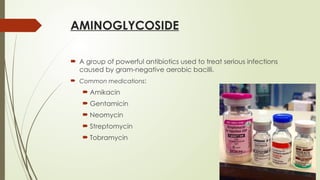
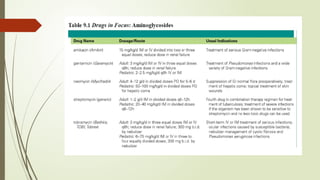
AMINOGLYCOSIDE
 A group of powerful antibiotics used to treat serious infections
caused by gram-negative aerobic bacilli.
 Common medications:
 Amikacin
 Gentamicin
 Neomycin
 Streptomycin
 Tobramycin
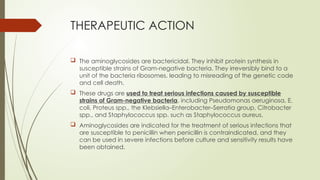
THERAPEUTIC ACTION
 The aminoglycosides are bactericidal. They inhibit protein synthesis in
susceptible strains of Gram-negative bacteria. They irreversibly bind to a
unit of the bacteria ribosomes, leading to misreading of the genetic code
and cell death.
 These drugs are used to treat serious infections caused by susceptible
strains of Gram-negative bacteria, including Pseudomonas aeruginosa, E.
coli, Proteus spp., the Klebsiella–Enterobacter–Serratia group, Citrobacter
spp., and Staphylococcus spp. such as Staphylococcus aureus.
 Aminoglycosides are indicated for the treatment of serious infections that
are susceptible to penicillin when penicillin is contraindicated, and they
can be used in severe infections before culture and sensitivity results have
been obtained.
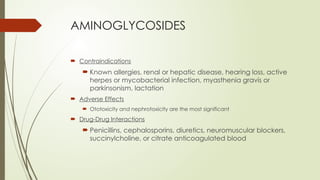
AMINOGLYCOSIDES
 Contraindications
 Known allergies, renal or hepatic disease, hearing loss, active
herpes or mycobacterial infection, myasthenia gravis or
parkinsonism, lactation
 Adverse Effects
 Ototoxicity and nephrotoxicity are the most significant
 Drug-Drug Interactions
 Penicillins, cephalosporins, diuretics, neuromuscular blockers,
succinylcholine, or citrate anticoagulated blood
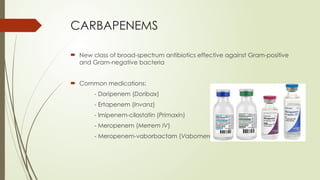
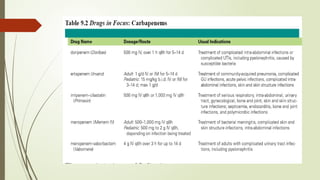
CARBAPENEMS
 New class of broad-spectrum antibiotics effective against Gram-positive
and Gram-negative bacteria
 Common medications:
- Doripenem (Doribax)
- Ertapenem (Invanz)
- Imipenem-cilastatin (Primaxin)
- Meropenem (Merrem IV)
- Meropenem-vaborbactam (Vabomere)
INDICATIONS:
 Treatment of serious infections caused by susceptible bacteria
 Actions: Inhibit cell membrane synthesis in susceptible bacteria, leading to cell
death
CARBAPENEMS
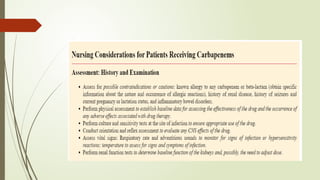
 Contraindications-
 Known allergy to any of the carbapenms or betalactams; seizure
disorders, meningitis, pregnancy and lactation
 Adverse Effects-
 Pseudomembranous colitis, Clostridium difficile diarrhea, and nausea
and vomiting can lead to serious dehydration and electrolyte
imbalances, as well as to new serious infections/superinfections
 Drug-drug interactions
 Valproic acid
 Meropenem
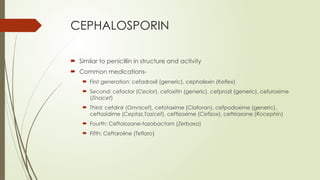
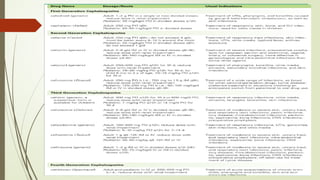
CEPHALOSPORIN
 Similar to penicillin in structure and activity
 Common medications-
 First generation: cefadroxil (generic), cephalexin (Keflex)
 Second: cefaclor (Ceclor), cefoxitin (generic), cefprozil (generic), cefuroxime
(Zinacef)
 Third: cefdinir (Omnicef), cefotaxime (Claforan), cefpodoxime (generic),
ceftazidime (Ceptaz,Tazicef), ceftizoxime (Cefizox), ceftriaxone (Rocephin)
 Fourth: Ceftolozane-tazobactam (Zerbaxa)
 Fifth: Ceftaroline (Teflaro)
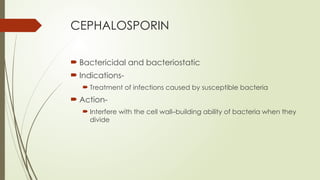
CEPHALOSPORIN
 Bactericidal and bacteriostatic
 Indications-
 Treatment of infections caused by susceptible bacteria
 Action-
 Interfere with the cell wall–building ability of bacteria when they
divide
CEPHALOSPORIN
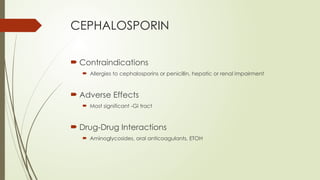
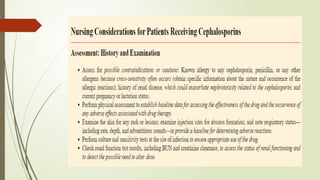
 Contraindications
 Allergies to cephalosporins or penicillin, hepatic or renal impairment
 Adverse Effects
 Most significant -GI tract
 Drug-Drug Interactions
 Aminoglycosides, oral anticoagulants, ETOH
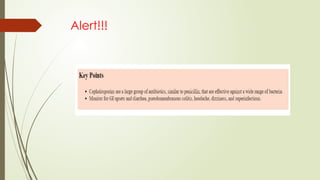
Alert!!!
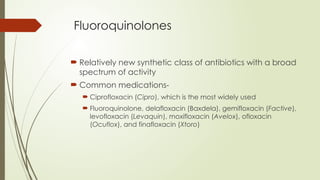
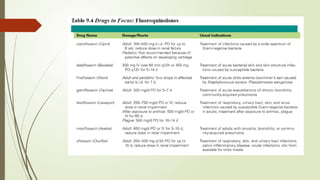
Fluoroquinolones
 Relatively new synthetic class of antibiotics with a broad
spectrum of activity
 Common medications-
 Ciprofloxacin (Cipro), which is the most widely used
 Fluoroquinolone, delafloxacin (Baxdela), gemifloxacin (Factive),
levofloxacin (Levaquin), moxifloxacin (Avelox), ofloxacin
(Ocuflox), and finafloxacin (Xtoro)
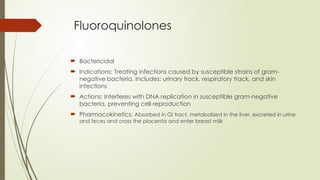
Fluoroquinolones
 Bactericidal
 Indications: Treating infections caused by susceptible strains of gram-
negative bacteria. Includes: urinary track, respiratory track, and skin
infections
 Actions: Interferes with DNA replication in susceptible gram-negative
bacteria, preventing cell reproduction
 Pharmacokinetics: Absorbed in GI tract, metabolized in the liver, excreted in urine
and feces and cross the placenta and enter breast milk
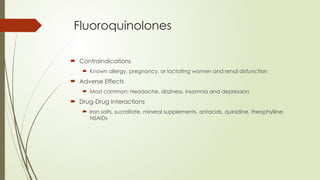
Fluoroquinolones
 Contraindications
 Known allergy, pregnancy, or lactating women and renal disfunction
 Adverse Effects
 Most common: Headache, dizziness, insomnia and depression
 Drug-Drug Interactions
 Iron salts, sucralfate, mineral supplements, antacids, quinidine, theophylline,
NSAIDs
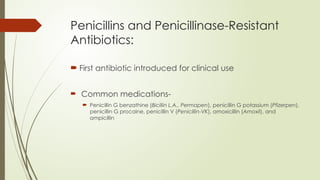
Penicillins and Penicillinase-Resistant
Antibiotics:
 First antibiotic introduced for clinical use
 Common medications-
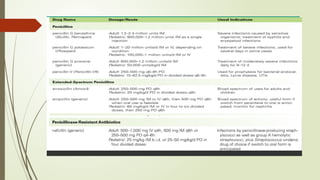
 Penicillin G benzathine (Bicillin L.A., Permapen), penicillin G potassium (Pfizerpen),
penicillin G procaine, penicillin V (Penicillin-VK), amoxicillin (Amoxil), and
ampicillin
Penicillins and Penicillinase-Resistant
Antibiotics:
 Bactericidal
 Indications- Severe infections caused by sensitive organisms and broad
spectrum use
 Actions- Interfere with the ability of susceptible bacteria to build their cell
walls
 Pharmacokinetics- rapidly absorbed from the GI tract, reaching peak
levels in 1 hour. excreted unchanged in the urine and enter breast milk
Penicillins and Penicillinase-Resistant
Antibiotics:
 Contraindications - Allergies to penicillin or cephalosporins, renal
disease, use cautiously in patients who are pregnant or lactating
 Adverse Effects-
 Most significant GI tract
 Drug–Drug Interactions-
 Tetracyclines, parenteral aminoglycosides
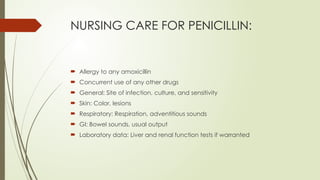
NURSING CARE FOR PENICILLIN:
 Allergy to any amoxicillin
 Concurrent use of any other drugs
 General: Site of infection, culture, and sensitivity
 Skin: Color, lesions
 Respiratory: Respiration, adventitious sounds
 GI: Bowel sounds, usual output
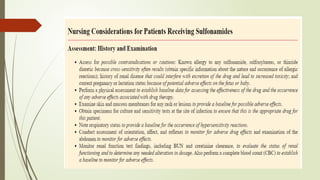
 Laboratory data: Liver and renal function tests if warranted
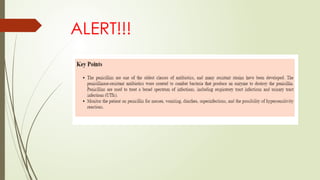
ALERT!!!
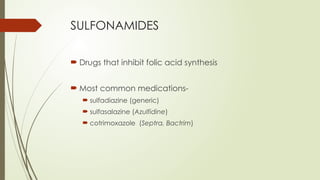
SULFONAMIDES
 Drugs that inhibit folic acid synthesis
 Most common medications-
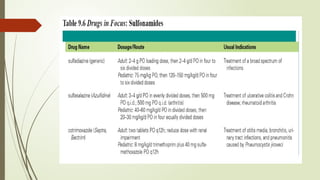
 sulfadiazine (generic)
 sulfasalazine (Azulfidine)
 cotrimoxazole (Septra, Bactrim)
SULFONAMIDES:
 Bacteriostatic
 Action-
 block para-aminobenzoic acid to prevent the synthesis of folic
acid in susceptible bacteria
 Indications-
 Treatment of infections caused by gram-negative and gram-
positive bacteria
 Pharmacokinetics
 Well absorbed from the GI tract
 Metabolized in the liver, excreted in the urine and are teratogenic
SULFONAMIDES:
 Contraindications-
 Known allergy to any sulfonamide, thiazide diuretics and
pregnancy
 Adverse Effects-
 GI symptoms; Renal effects related to the filtration of the drug
 Drug-Drug Interactions-
 tolbutamide, tolazamide, glyburide, glipizide, or chlorpropamide
and cyclosporine
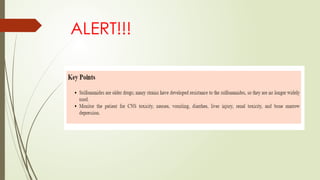
ALERT!!!
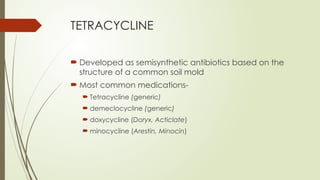
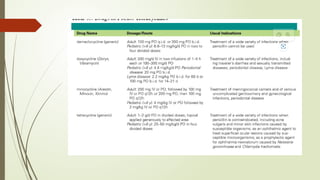
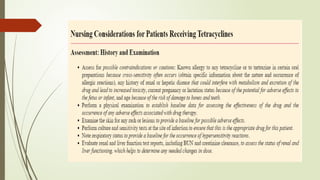
TETRACYCLINE
 Developed as semisynthetic antibiotics based on the
structure of a common soil mold
 Most common medications-
 Tetracycline (generic)
 demeclocycline (generic)
 doxycycline (Doryx, Acticlate)
 minocycline (Arestin, Minocin)
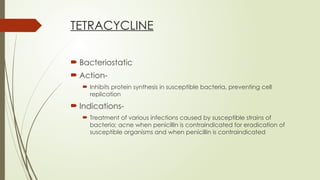
TETRACYCLINE
 Bacteriostatic
 Action-
 Inhibits protein synthesis in susceptible bacteria, preventing cell
replication
 Indications-
 Treatment of various infections caused by susceptible strains of
bacteria; acne when penicillin is contraindicated for eradication of
susceptible organisms and when penicillin is contraindicated
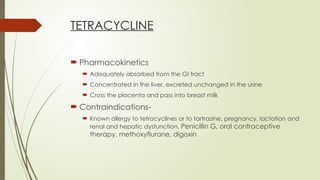
TETRACYCLINE
 Pharmacokinetics
 Adequately absorbed from the GI tract
 Concentrated in the liver, excreted unchanged in the urine
 Cross the placenta and pass into breast milk
 Contraindications-
 Known allergy to tetracyclines or to tartrazine, pregnancy, lactation and
renal and hepatic dysfunction, Penicillin G, oral contraceptive
therapy, methoxyflurane, digoxin
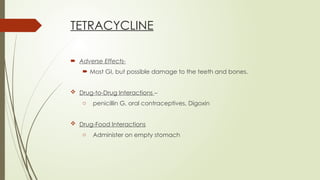
TETRACYCLINE
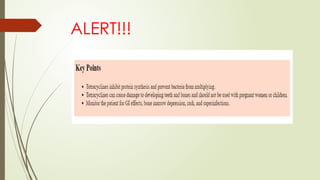
 Adverse Effects-
 Most GI, but possible damage to the teeth and bones.
 Drug-to-Drug Interactions –
o penicillin G, oral contraceptives, Digoxin
 Drug-Food Interactions
o Administer on empty stomach
ALERT!!!
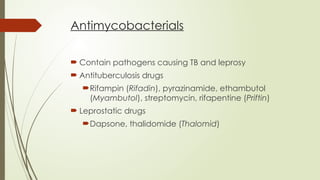
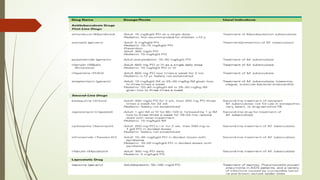
Antimycobacterials
 Contain pathogens causing TB and leprosy
 Antituberculosis drugs
Rifampin (Rifadin), pyrazinamide, ethambutol
(Myambutol), streptomycin, rifapentine (Priftin)
 Leprostatic drugs
Dapsone, thalidomide (Thalomid)
Antimycobacterials
 Action-
 Act on the DNA of the bacteria leading to lack of growth and
eventual bacterial death for TB and Leprosy
 Indications- Treatment of TB and Leprosy
 Pharmacokinetics-
 Well absorbed from the GI tract
 Metabolized in the liver, excreted in the urine, cross the placenta
and enter breast
Antimycobacterials
 Contraindications
 Allergy, renal or hepatic failure, CNS dysfunction and pregnancy
 Adverse Effects
 CNS effects and GI irritation
 Drug-Drug Interactions
 Rifampin and INH can cause liver toxicity
ANTIBIOTICS.pptx presentation medications

ANTIBIOTICS.pptx presentation medications

  • 1.
  • 2.
    LEARNING OBJECTIVES: Upon completionof this chapter, you will be able to;  1. Explain how an antibiotic is selected for use in a particular clinical situation.  2. Describe therapeutic actions, indications, pharmacokinetics, contraindications, most common adverse reactions, and important drug–drug interactions associated with each of the classes of antibiotics.  3. Discuss the use of antibiotics across the lifespan.  4. Compare and contrast prototype drugs for each class of antibiotics with other drugs in that class.  5. Outline nursing considerations for patients receiving each class of antibiotic.
  • 3.
    Antibiotics—chemicals that inhibitspecific bacteria—to deal with each new threat. Antibiotics are made in three ways: By living microorganisms, by synthetic manufacture, and in some cases through genetic engineering. Antibiotics may either be bacteriostatic (preventing the growth of bacteria) or bactericidal (killing bacteria directly), although several antibiotics are both bactericidal and bacteriostatic, depending on the concentration of the particular drug.
  • 4.
    TYPES OF ANTIBIOTICS: Bacteriostatic  Those substances that prevent the growth of bacteria  Bactericidal  Those that kill bacteria directly
  • 5.
    SIGNS OF INFECTION: Fever  Lethargy  Slow-wave sleep induction  Classic signs of inflammation (redness, swelling, heat, and pain)
  • 6.
    GOAL OF ANTIBIOTICTHERAPY:  Decrease the population of the invading bacteria to a point where the human immune system can effectively deal with the invader
  • 7.
    BACTERIA CLASSIFICATION  Gram-positive The cell wall retains a stain or resists decolorization with alcohol  Gram-negative  The cell wall loses a stain or is decolorized by alcohol  Aerobic  Depend on oxygen for survival  Anaerobic  Do not use oxygen
  • 8.
    AMINOGLYCOSIDE  A groupof powerful antibiotics used to treat serious infections caused by gram-negative aerobic bacilli.  Common medications:  Amikacin  Gentamicin  Neomycin  Streptomycin  Tobramycin
  • 10.
    THERAPEUTIC ACTION  Theaminoglycosides are bactericidal. They inhibit protein synthesis in susceptible strains of Gram-negative bacteria. They irreversibly bind to a unit of the bacteria ribosomes, leading to misreading of the genetic code and cell death.  These drugs are used to treat serious infections caused by susceptible strains of Gram-negative bacteria, including Pseudomonas aeruginosa, E. coli, Proteus spp., the Klebsiella–Enterobacter–Serratia group, Citrobacter spp., and Staphylococcus spp. such as Staphylococcus aureus.  Aminoglycosides are indicated for the treatment of serious infections that are susceptible to penicillin when penicillin is contraindicated, and they can be used in severe infections before culture and sensitivity results have been obtained.
  • 11.
    AMINOGLYCOSIDES  Contraindications  Knownallergies, renal or hepatic disease, hearing loss, active herpes or mycobacterial infection, myasthenia gravis or parkinsonism, lactation  Adverse Effects  Ototoxicity and nephrotoxicity are the most significant  Drug-Drug Interactions  Penicillins, cephalosporins, diuretics, neuromuscular blockers, succinylcholine, or citrate anticoagulated blood
  • 13.
    CARBAPENEMS  New classof broad-spectrum antibiotics effective against Gram-positive and Gram-negative bacteria  Common medications: - Doripenem (Doribax) - Ertapenem (Invanz) - Imipenem-cilastatin (Primaxin) - Meropenem (Merrem IV) - Meropenem-vaborbactam (Vabomere)
  • 15.
    INDICATIONS:  Treatment ofserious infections caused by susceptible bacteria  Actions: Inhibit cell membrane synthesis in susceptible bacteria, leading to cell death
  • 16.
    CARBAPENEMS  Contraindications-  Knownallergy to any of the carbapenms or betalactams; seizure disorders, meningitis, pregnancy and lactation  Adverse Effects-  Pseudomembranous colitis, Clostridium difficile diarrhea, and nausea and vomiting can lead to serious dehydration and electrolyte imbalances, as well as to new serious infections/superinfections  Drug-drug interactions  Valproic acid  Meropenem
  • 18.
    CEPHALOSPORIN  Similar topenicillin in structure and activity  Common medications-  First generation: cefadroxil (generic), cephalexin (Keflex)  Second: cefaclor (Ceclor), cefoxitin (generic), cefprozil (generic), cefuroxime (Zinacef)  Third: cefdinir (Omnicef), cefotaxime (Claforan), cefpodoxime (generic), ceftazidime (Ceptaz,Tazicef), ceftizoxime (Cefizox), ceftriaxone (Rocephin)  Fourth: Ceftolozane-tazobactam (Zerbaxa)  Fifth: Ceftaroline (Teflaro)
  • 20.
    CEPHALOSPORIN  Bactericidal andbacteriostatic  Indications-  Treatment of infections caused by susceptible bacteria  Action-  Interfere with the cell wall–building ability of bacteria when they divide
  • 21.
    CEPHALOSPORIN  Contraindications  Allergiesto cephalosporins or penicillin, hepatic or renal impairment  Adverse Effects  Most significant -GI tract  Drug-Drug Interactions  Aminoglycosides, oral anticoagulants, ETOH
  • 23.
  • 24.
    Fluoroquinolones  Relatively newsynthetic class of antibiotics with a broad spectrum of activity  Common medications-  Ciprofloxacin (Cipro), which is the most widely used  Fluoroquinolone, delafloxacin (Baxdela), gemifloxacin (Factive), levofloxacin (Levaquin), moxifloxacin (Avelox), ofloxacin (Ocuflox), and finafloxacin (Xtoro)
  • 26.
    Fluoroquinolones  Bactericidal  Indications:Treating infections caused by susceptible strains of gram- negative bacteria. Includes: urinary track, respiratory track, and skin infections  Actions: Interferes with DNA replication in susceptible gram-negative bacteria, preventing cell reproduction  Pharmacokinetics: Absorbed in GI tract, metabolized in the liver, excreted in urine and feces and cross the placenta and enter breast milk
  • 27.
    Fluoroquinolones  Contraindications  Knownallergy, pregnancy, or lactating women and renal disfunction  Adverse Effects  Most common: Headache, dizziness, insomnia and depression  Drug-Drug Interactions  Iron salts, sucralfate, mineral supplements, antacids, quinidine, theophylline, NSAIDs
  • 29.
    Penicillins and Penicillinase-Resistant Antibiotics: First antibiotic introduced for clinical use  Common medications-  Penicillin G benzathine (Bicillin L.A., Permapen), penicillin G potassium (Pfizerpen), penicillin G procaine, penicillin V (Penicillin-VK), amoxicillin (Amoxil), and ampicillin
  • 31.
    Penicillins and Penicillinase-Resistant Antibiotics: Bactericidal  Indications- Severe infections caused by sensitive organisms and broad spectrum use  Actions- Interfere with the ability of susceptible bacteria to build their cell walls  Pharmacokinetics- rapidly absorbed from the GI tract, reaching peak levels in 1 hour. excreted unchanged in the urine and enter breast milk
  • 32.
    Penicillins and Penicillinase-Resistant Antibiotics: Contraindications - Allergies to penicillin or cephalosporins, renal disease, use cautiously in patients who are pregnant or lactating  Adverse Effects-  Most significant GI tract  Drug–Drug Interactions-  Tetracyclines, parenteral aminoglycosides
  • 33.
    NURSING CARE FORPENICILLIN:  Allergy to any amoxicillin  Concurrent use of any other drugs  General: Site of infection, culture, and sensitivity  Skin: Color, lesions  Respiratory: Respiration, adventitious sounds  GI: Bowel sounds, usual output  Laboratory data: Liver and renal function tests if warranted
  • 34.
  • 35.
    SULFONAMIDES  Drugs thatinhibit folic acid synthesis  Most common medications-  sulfadiazine (generic)  sulfasalazine (Azulfidine)  cotrimoxazole (Septra, Bactrim)
  • 37.
    SULFONAMIDES:  Bacteriostatic  Action- block para-aminobenzoic acid to prevent the synthesis of folic acid in susceptible bacteria  Indications-  Treatment of infections caused by gram-negative and gram- positive bacteria  Pharmacokinetics  Well absorbed from the GI tract  Metabolized in the liver, excreted in the urine and are teratogenic
  • 38.
    SULFONAMIDES:  Contraindications-  Knownallergy to any sulfonamide, thiazide diuretics and pregnancy  Adverse Effects-  GI symptoms; Renal effects related to the filtration of the drug  Drug-Drug Interactions-  tolbutamide, tolazamide, glyburide, glipizide, or chlorpropamide and cyclosporine
  • 40.
  • 41.
    TETRACYCLINE  Developed assemisynthetic antibiotics based on the structure of a common soil mold  Most common medications-  Tetracycline (generic)  demeclocycline (generic)  doxycycline (Doryx, Acticlate)  minocycline (Arestin, Minocin)
  • 43.
    TETRACYCLINE  Bacteriostatic  Action- Inhibits protein synthesis in susceptible bacteria, preventing cell replication  Indications-  Treatment of various infections caused by susceptible strains of bacteria; acne when penicillin is contraindicated for eradication of susceptible organisms and when penicillin is contraindicated
  • 44.
    TETRACYCLINE  Pharmacokinetics  Adequatelyabsorbed from the GI tract  Concentrated in the liver, excreted unchanged in the urine  Cross the placenta and pass into breast milk  Contraindications-  Known allergy to tetracyclines or to tartrazine, pregnancy, lactation and renal and hepatic dysfunction, Penicillin G, oral contraceptive therapy, methoxyflurane, digoxin
  • 45.
    TETRACYCLINE  Adverse Effects- Most GI, but possible damage to the teeth and bones.  Drug-to-Drug Interactions – o penicillin G, oral contraceptives, Digoxin  Drug-Food Interactions o Administer on empty stomach
  • 47.
  • 48.
    Antimycobacterials  Contain pathogenscausing TB and leprosy  Antituberculosis drugs Rifampin (Rifadin), pyrazinamide, ethambutol (Myambutol), streptomycin, rifapentine (Priftin)  Leprostatic drugs Dapsone, thalidomide (Thalomid)
  • 50.
    Antimycobacterials  Action-  Acton the DNA of the bacteria leading to lack of growth and eventual bacterial death for TB and Leprosy  Indications- Treatment of TB and Leprosy  Pharmacokinetics-  Well absorbed from the GI tract  Metabolized in the liver, excreted in the urine, cross the placenta and enter breast
  • 51.
    Antimycobacterials  Contraindications  Allergy,renal or hepatic failure, CNS dysfunction and pregnancy  Adverse Effects  CNS effects and GI irritation  Drug-Drug Interactions  Rifampin and INH can cause liver toxicity