Making Sense of it All Chris Ansell Professor, Dept. of Political Science University of California, Berkeley
“ Sensemaking is a diagnostic process directed at constructing plausible interpretations of ambiguous cues that are sufficient to sustain action.”  (Weick, 2007, 57).
“ When assessing the severity of a disaster and the relief that is needed, people face problems of ambiguity and equivocality. Sensemaking describes the resources that influence how well people can handle these problems, which can be a starting point for designing supporting IS.” (Muhren and Van de Walle 2009, 8)
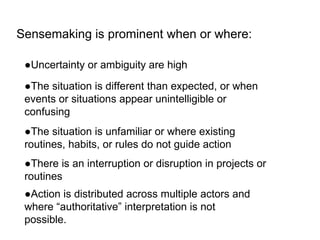
Sensemaking is prominent when or where: ● Uncertainty or ambiguity are high ● The situation is unfamiliar or where existing routines, habits, or rules do not guide action ● Action is distributed across multiple actors and where “authoritative” interpretation is not possible. ● The situation is different than expected, or when events or situations appear unintelligible or confusing ● There is an interruption or disruption in projects or routines
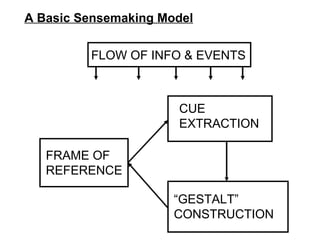
FRAME OF REFERENCE CUE EXTRACTION “ GESTALT” CONSTRUCTION A Basic Sensemaking Model FLOW OF INFO & EVENTS
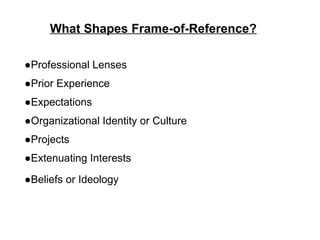
What Shapes Frame-of-Reference? ● Professional Lenses ● Prior Experience ● Expectations ● Organizational Identity or Culture ● Projects ● Extenuating Interests ● Beliefs or Ideology
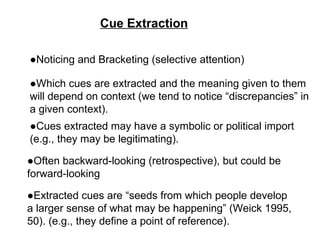
Cue Extraction ● Noticing and Bracketing (selective attention) ● Often backward-looking (retrospective), but could be forward-looking ● Extracted cues are “seeds from which people develop a larger sense of what may be happening” (Weick 1995, 50). (e.g., they define a point of reference). ● Which cues are extracted and the meaning given to them will depend on context (we tend to notice “discrepancies” in a given context). ● Cues extracted may have a symbolic or political import (e.g., they may be legitimating).
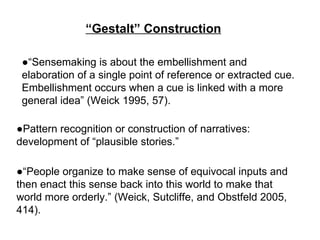
“ Gestalt” Construction ●“ People organize to make sense of equivocal inputs and then enact this sense back into this world to make that world more orderly.” (Weick, Sutcliffe, and Obstfeld 2005, 414). ● Pattern recognition or construction of narratives: development of “plausible stories.” ●“ Sensemaking is about the embellishment and elaboration of a single point of reference or extracted cue.  Embellishment occurs when a cue is linked with a more general idea” (Weick 1995, 57).
CONTEXT “ Mad Cows” WHO GETS  MOBILIZED? “ Veterinary Scientists” FRAME OF  REFERENCE “ Animal Health Problem” GESTALT  CONSTRUCTION “ Scapie in Cows” EXTENUATING INTERESTS & IDENTITIES “ Protecting British Agricultural Interests” CUE EXTRACTION “ Analysis of brain tissue” Sensemaking in the UK’s Response to BSE
Context 1 “ Patients with Unusual Symptoms” Who Gets  Mobilized? CDC, NY DOH Gestalt  Construction “ St. Louis Encephalitis” (SLE) Discrepant Cues “ Mixed Evidence” “ Birds don’t die of SLE” Context 2 “ Birds Dying” Who Gets  Mobilized? “ Zoo Pathologist” Distributed Sensemaking: West Nile Virus Gestalt Construction “ Animal-Human Connection”
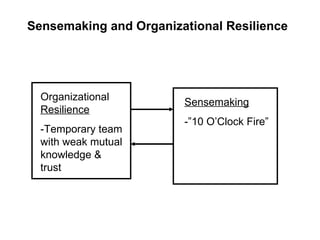
Sensemaking and Organizational Resilience Organizational  Resilience -Temporary team with weak mutual knowledge & trust  Sensemaking -”10 O’Clock Fire”
Information and Decision Support for Sensemaking (Muhren and Van de Walle) ● Support conversations via real-time communications ● IS can help to support a sense of shared identify among users ● IS can help identify salient cues by providing historical data ● Continuous situational updates can provide for stable sense of what is going on ● IS can help to support an exchange of interpretations
Karl Weick. 2005. “Managing the Unexpected: Complexity as Distributed Sensemaking,” in McDaniel and Driebe (eds.),  Uncertainty and Surprise in Complex Systems . UCS 4: 51-65. Karl Weick. 1995.  Sensemaking in Organizations . Thousands Oaks, CA: Sage Publications. References Gary Klein. 1999.  Sources of Power: How People Make Decisions.  Cambridge, MA: MIT Press. Karl Weick, Kathleen Sutcliffe, and David Obstfeld. 2005. “Organizing and the Process of Sensemaking,”  Organization Science , 16, 4: 409-421. Karl Weick. 1993. “The Collapse of Sensemaking in Organizations: The Mann Gulch Disaster,”  Administrative Science Quarterly, 38, 4: 628-652. Willem Muhren and Bartel Van de Walle. 2009. “Sensemaking and Information Management in Humanitarian Disaster Response: Observations from the TRIPLEX Exercise,” Proceedings of the 6 th  Annual ISCRAM Conference.

Ansell sensemaking lecture

  • 1.
    Making Sense ofit All Chris Ansell Professor, Dept. of Political Science University of California, Berkeley
  • 2.
    “ Sensemaking isa diagnostic process directed at constructing plausible interpretations of ambiguous cues that are sufficient to sustain action.” (Weick, 2007, 57).
  • 3.
    “ When assessingthe severity of a disaster and the relief that is needed, people face problems of ambiguity and equivocality. Sensemaking describes the resources that influence how well people can handle these problems, which can be a starting point for designing supporting IS.” (Muhren and Van de Walle 2009, 8)
  • 4.
    Sensemaking is prominentwhen or where: ● Uncertainty or ambiguity are high ● The situation is unfamiliar or where existing routines, habits, or rules do not guide action ● Action is distributed across multiple actors and where “authoritative” interpretation is not possible. ● The situation is different than expected, or when events or situations appear unintelligible or confusing ● There is an interruption or disruption in projects or routines
  • 5.
    FRAME OF REFERENCECUE EXTRACTION “ GESTALT” CONSTRUCTION A Basic Sensemaking Model FLOW OF INFO & EVENTS
  • 6.
    What Shapes Frame-of-Reference?● Professional Lenses ● Prior Experience ● Expectations ● Organizational Identity or Culture ● Projects ● Extenuating Interests ● Beliefs or Ideology
  • 7.
    Cue Extraction ●Noticing and Bracketing (selective attention) ● Often backward-looking (retrospective), but could be forward-looking ● Extracted cues are “seeds from which people develop a larger sense of what may be happening” (Weick 1995, 50). (e.g., they define a point of reference). ● Which cues are extracted and the meaning given to them will depend on context (we tend to notice “discrepancies” in a given context). ● Cues extracted may have a symbolic or political import (e.g., they may be legitimating).
  • 8.
    “ Gestalt” Construction●“ People organize to make sense of equivocal inputs and then enact this sense back into this world to make that world more orderly.” (Weick, Sutcliffe, and Obstfeld 2005, 414). ● Pattern recognition or construction of narratives: development of “plausible stories.” ●“ Sensemaking is about the embellishment and elaboration of a single point of reference or extracted cue. Embellishment occurs when a cue is linked with a more general idea” (Weick 1995, 57).
  • 9.
    CONTEXT “ MadCows” WHO GETS MOBILIZED? “ Veterinary Scientists” FRAME OF REFERENCE “ Animal Health Problem” GESTALT CONSTRUCTION “ Scapie in Cows” EXTENUATING INTERESTS & IDENTITIES “ Protecting British Agricultural Interests” CUE EXTRACTION “ Analysis of brain tissue” Sensemaking in the UK’s Response to BSE
  • 10.
    Context 1 “Patients with Unusual Symptoms” Who Gets Mobilized? CDC, NY DOH Gestalt Construction “ St. Louis Encephalitis” (SLE) Discrepant Cues “ Mixed Evidence” “ Birds don’t die of SLE” Context 2 “ Birds Dying” Who Gets Mobilized? “ Zoo Pathologist” Distributed Sensemaking: West Nile Virus Gestalt Construction “ Animal-Human Connection”
  • 11.
    Sensemaking and OrganizationalResilience Organizational Resilience -Temporary team with weak mutual knowledge & trust Sensemaking -”10 O’Clock Fire”
  • 12.
    Information and DecisionSupport for Sensemaking (Muhren and Van de Walle) ● Support conversations via real-time communications ● IS can help to support a sense of shared identify among users ● IS can help identify salient cues by providing historical data ● Continuous situational updates can provide for stable sense of what is going on ● IS can help to support an exchange of interpretations
  • 13.
    Karl Weick. 2005.“Managing the Unexpected: Complexity as Distributed Sensemaking,” in McDaniel and Driebe (eds.), Uncertainty and Surprise in Complex Systems . UCS 4: 51-65. Karl Weick. 1995. Sensemaking in Organizations . Thousands Oaks, CA: Sage Publications. References Gary Klein. 1999. Sources of Power: How People Make Decisions. Cambridge, MA: MIT Press. Karl Weick, Kathleen Sutcliffe, and David Obstfeld. 2005. “Organizing and the Process of Sensemaking,” Organization Science , 16, 4: 409-421. Karl Weick. 1993. “The Collapse of Sensemaking in Organizations: The Mann Gulch Disaster,” Administrative Science Quarterly, 38, 4: 628-652. Willem Muhren and Bartel Van de Walle. 2009. “Sensemaking and Information Management in Humanitarian Disaster Response: Observations from the TRIPLEX Exercise,” Proceedings of the 6 th Annual ISCRAM Conference.