Hydraulics 2 Coursework 1 David Apsley
Answer 1
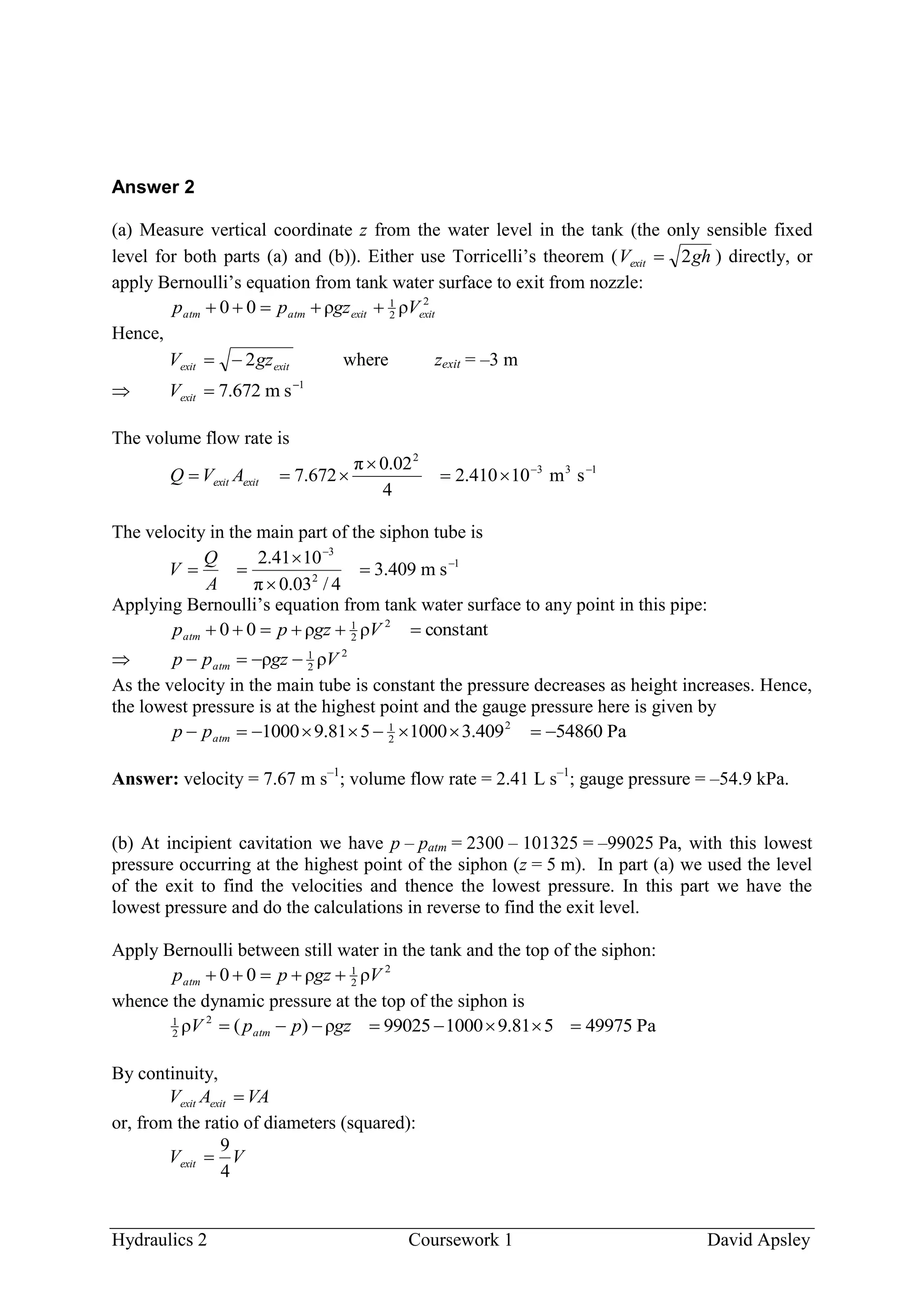
(a) By continuity between sections A and B the flow per unit width is (in metre-second units):
 
50.23
)]1ln[cosh(1.0)]3ln[cosh(1.04.040
)]110ln[cosh(
10
1
40
d)]110tanh(1[404.0
4.0
0
4.0
0













yy
yyUq A
 1
sm75.58
4.0
50.23 
AU
Answer: UA = 58.8 m s–1
.
(b) From the steady-state momentum principle, per unit width:
4.0ρd)]110tanh(1[)40(ρ4.0)( 2
4.0
0
22



 ABA UyyFpp (*)
The integral is




4.0
0
2
d)]110(tanh)110tanh(21[ yyyI
or, using θsech1θtanh 22
 ,
 
9994.0
))1tanh(3(tanh1.0)]1ln[cosh()]3ln[cosh(2.08.0
)110tanh(
10
1
)110cosh(ln
10
2
2
d)]110(sech)110tanh(22[
4.0
0
4.0
0
2













yyy
yyyI
Substituting in (*):
4.076.582.19994.0402.14.02000 22
 F
 N5.538F
Answer: force = 538 N.
(c) Note that, as there is an upstream boundary layer due to the lower wall and an adverse
pressure gradient due to high-pressure upstream of the spar, there is separation and
recirculation upstream as well as downstream.
Hydraulics 2 Coursework 1 David Apsley
Answer 2
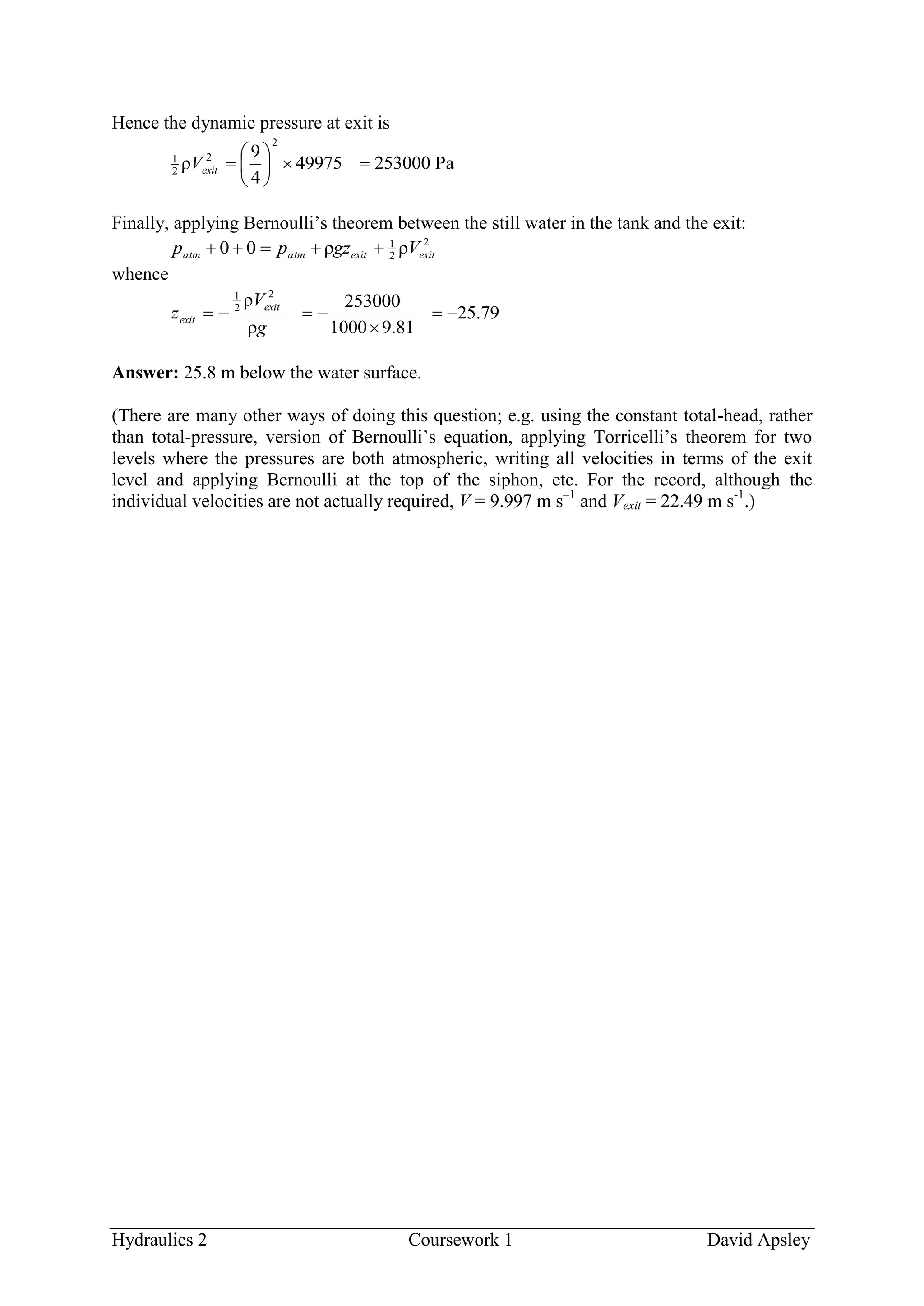
(a) Measure vertical coordinate z from the water level in the tank (the only sensible fixed
level for both parts (a) and (b)). Either use Torricelli’s theorem ( ghVexit 2 ) directly, or
apply Bernoulli’s equation from tank water surface to exit from nozzle:
2
2
1
ρρ00 exitexitatmatm Vgzpp 
Hence,
exitexit gzV 2 where zexit = –3 m
 1
sm672.7 
exitV
The volume flow rate is
133
2
sm10410.2
4
02.0π
672.7 


 exitexit AVQ
The velocity in the main part of the siphon tube is
1
2
3
sm409.3
4/03.0π
1041.2 





A
Q
V
Applying Bernoulli’s equation from tank water surface to any point in this pipe:
constantρρ00 2
2
1
 Vgzppatm
 2
2
1
ρρ Vgzpp atm 
As the velocity in the main tube is constant the pressure decreases as height increases. Hence,
the lowest pressure is at the highest point and the gauge pressure here is given by
Pa54860409.31000581.91000 2
2
1
 atmpp
Answer: velocity = 7.67 m s–1
; volume flow rate = 2.41 L s–1
; gauge pressure = –54.9 kPa.
(b) At incipient cavitation we have p – patm = 2300 – 101325 = –99025 Pa, with this lowest
pressure occurring at the highest point of the siphon (z = 5 m). In part (a) we used the level
of the exit to find the velocities and thence the lowest pressure. In this part we have the
lowest pressure and do the calculations in reverse to find the exit level.
Apply Bernoulli between still water in the tank and the top of the siphon:
2
2
1
ρρ00 Vgzppatm 
whence the dynamic pressure at the top of the siphon is
Pa49975581.9100099025ρ)(ρ 2
2
1
 gzppV atm
By continuity,
VAAV exitexit 
or, from the ratio of diameters (squared):
VVexit
4
9

Hydraulics 2 Coursework 1 David Apsley
Hence the dynamic pressure at exit is
Pa25300049975
4
9
ρ
2
2
2
1






exitV
Finally, applying Bernoulli’s theorem between the still water in the tank and the exit:
2
2
1
ρρ00 exitexitatmatm Vgzpp 
whence
79.25
81.91000
253000
ρ
ρ 2
2
1



g
V
z exit
exit
Answer: 25.8 m below the water surface.
(There are many other ways of doing this question; e.g. using the constant total-head, rather
than total-pressure, version of Bernoulli’s equation, applying Torricelli’s theorem for two
levels where the pressures are both atmospheric, writing all velocities in terms of the exit
level and applying Bernoulli at the top of the siphon, etc. For the record, although the
individual velocities are not actually required, V = 9.997 m s–1
and Vexit = 22.49 m s-1
.)
Hydraulics 2 Coursework 1 David Apsley
Answer 3
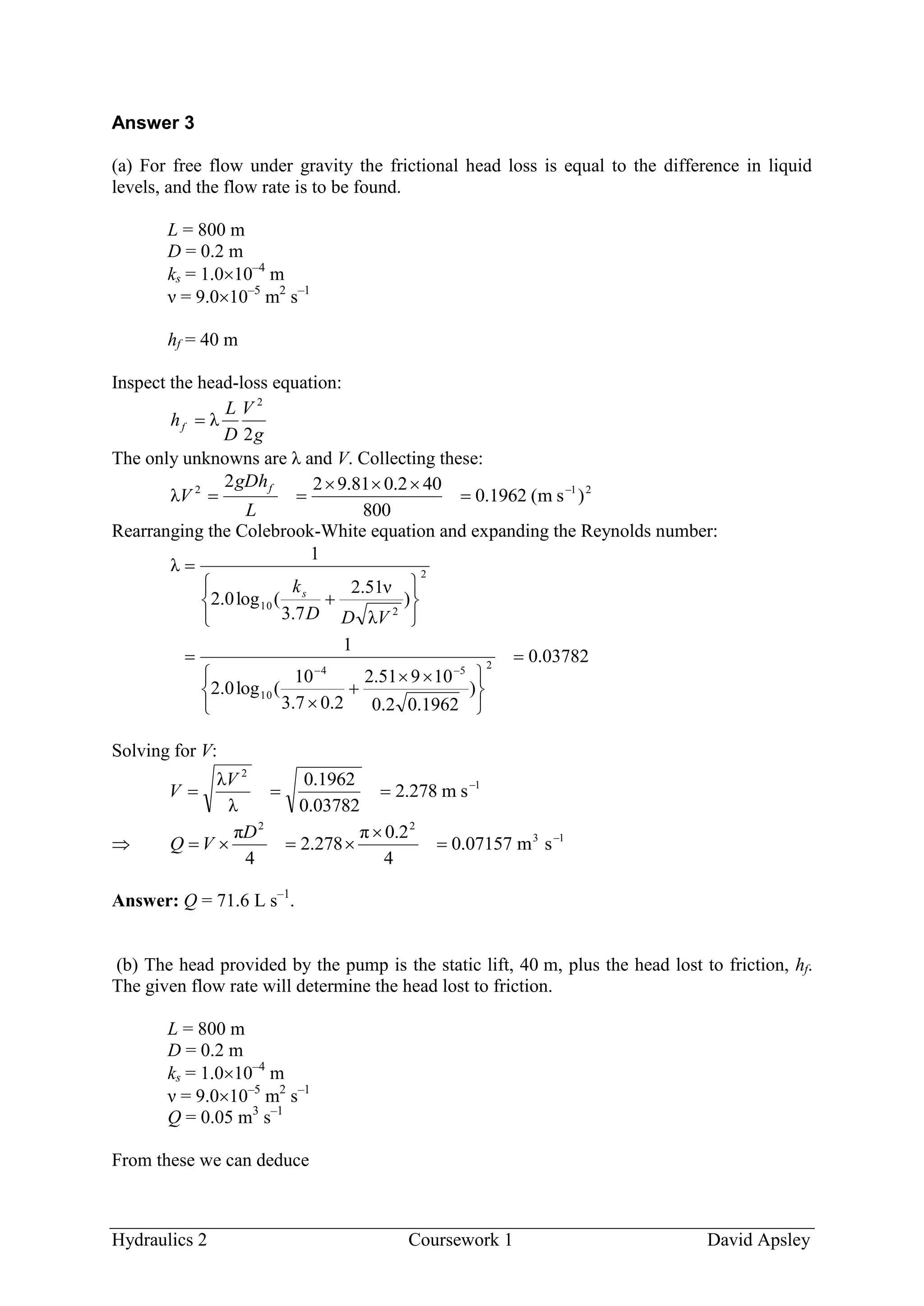
(a) For free flow under gravity the frictional head loss is equal to the difference in liquid
levels, and the flow rate is to be found.
L = 800 m
D = 0.2 m
ks = 1.010–4
m
ν = 9.010–5
m2
s–1
hf = 40 m
Inspect the head-loss equation:
g
V
D
L
hf
2
λ
2

The only unknowns are λ and V. Collecting these:
212
)sm(1962.0
800
402.081.922
λ 



L
gDh
V
f
Rearranging the Colebrook-White equation and expanding the Reynolds number:
03782.0
)
1962.02.0
10951.2
2.07.3
10
(log0.2
1
)
λ
ν51.2
7.3
(log0.2
1
λ
254
10
2
2
10






 












VDD
ks
Solving for V:
1
2
sm278.2
03782.0
1962.0
λ
λ 

V
V
 13
22
sm07157.0
4
2.0π
278.2
4
π 



D
VQ
Answer: Q = 71.6 L s–1
.
(b) The head provided by the pump is the static lift, 40 m, plus the head lost to friction, hf.
The given flow rate will determine the head lost to friction.
L = 800 m
D = 0.2 m
ks = 1.010–4
m
ν = 9.010–5
m2
s–1
Q = 0.05 m3
s–1
From these we can deduce
Hydraulics 2 Coursework 1 David Apsley
1
22
sm592.1
2.0π
05.04
π
4 




D
Q
V
3538
100.9
2.0592.1
ν
Re 5



 
VD
Inspect the head-loss equation:
g
V
D
L
hf
2
λ
2

hf will be known if we can find λ.
Rearranging the Colebrook-White equation:
24
10
2
10 )
λ3538
51.2
2.07.3
10
(log0.2
1
)
λRe
51.2
7.3
(log0.2
1
λ



















D
ks
Hence,
24
4
10 )
λ
10094.7
10351.1(log0.2
1
λ





 




Iteration gives λ = 0.04187.
Hence, the frictional head loss is
m63.21
81.92
592.1
2.0
800
04187.0
2
λ
22



g
V
D
L
hf
The total head to be provided by the pump is
m63.6163.2140 pumpH
Answer: Hpump = 61.6 m.

Ans1

  • 1.
    Hydraulics 2 Coursework1 David Apsley Answer 1 (a) By continuity between sections A and B the flow per unit width is (in metre-second units):   50.23 )]1ln[cosh(1.0)]3ln[cosh(1.04.040 )]110ln[cosh( 10 1 40 d)]110tanh(1[404.0 4.0 0 4.0 0              yy yyUq A  1 sm75.58 4.0 50.23  AU Answer: UA = 58.8 m s–1 . (b) From the steady-state momentum principle, per unit width: 4.0ρd)]110tanh(1[)40(ρ4.0)( 2 4.0 0 22     ABA UyyFpp (*) The integral is     4.0 0 2 d)]110(tanh)110tanh(21[ yyyI or, using θsech1θtanh 22  ,   9994.0 ))1tanh(3(tanh1.0)]1ln[cosh()]3ln[cosh(2.08.0 )110tanh( 10 1 )110cosh(ln 10 2 2 d)]110(sech)110tanh(22[ 4.0 0 4.0 0 2              yyy yyyI Substituting in (*): 4.076.582.19994.0402.14.02000 22  F  N5.538F Answer: force = 538 N. (c) Note that, as there is an upstream boundary layer due to the lower wall and an adverse pressure gradient due to high-pressure upstream of the spar, there is separation and recirculation upstream as well as downstream.
  • 2.
    Hydraulics 2 Coursework1 David Apsley Answer 2 (a) Measure vertical coordinate z from the water level in the tank (the only sensible fixed level for both parts (a) and (b)). Either use Torricelli’s theorem ( ghVexit 2 ) directly, or apply Bernoulli’s equation from tank water surface to exit from nozzle: 2 2 1 ρρ00 exitexitatmatm Vgzpp  Hence, exitexit gzV 2 where zexit = –3 m  1 sm672.7  exitV The volume flow rate is 133 2 sm10410.2 4 02.0π 672.7     exitexit AVQ The velocity in the main part of the siphon tube is 1 2 3 sm409.3 4/03.0π 1041.2       A Q V Applying Bernoulli’s equation from tank water surface to any point in this pipe: constantρρ00 2 2 1  Vgzppatm  2 2 1 ρρ Vgzpp atm  As the velocity in the main tube is constant the pressure decreases as height increases. Hence, the lowest pressure is at the highest point and the gauge pressure here is given by Pa54860409.31000581.91000 2 2 1  atmpp Answer: velocity = 7.67 m s–1 ; volume flow rate = 2.41 L s–1 ; gauge pressure = –54.9 kPa. (b) At incipient cavitation we have p – patm = 2300 – 101325 = –99025 Pa, with this lowest pressure occurring at the highest point of the siphon (z = 5 m). In part (a) we used the level of the exit to find the velocities and thence the lowest pressure. In this part we have the lowest pressure and do the calculations in reverse to find the exit level. Apply Bernoulli between still water in the tank and the top of the siphon: 2 2 1 ρρ00 Vgzppatm  whence the dynamic pressure at the top of the siphon is Pa49975581.9100099025ρ)(ρ 2 2 1  gzppV atm By continuity, VAAV exitexit  or, from the ratio of diameters (squared): VVexit 4 9 
  • 3.
    Hydraulics 2 Coursework1 David Apsley Hence the dynamic pressure at exit is Pa25300049975 4 9 ρ 2 2 2 1       exitV Finally, applying Bernoulli’s theorem between the still water in the tank and the exit: 2 2 1 ρρ00 exitexitatmatm Vgzpp  whence 79.25 81.91000 253000 ρ ρ 2 2 1    g V z exit exit Answer: 25.8 m below the water surface. (There are many other ways of doing this question; e.g. using the constant total-head, rather than total-pressure, version of Bernoulli’s equation, applying Torricelli’s theorem for two levels where the pressures are both atmospheric, writing all velocities in terms of the exit level and applying Bernoulli at the top of the siphon, etc. For the record, although the individual velocities are not actually required, V = 9.997 m s–1 and Vexit = 22.49 m s-1 .)
  • 4.
    Hydraulics 2 Coursework1 David Apsley Answer 3 (a) For free flow under gravity the frictional head loss is equal to the difference in liquid levels, and the flow rate is to be found. L = 800 m D = 0.2 m ks = 1.010–4 m ν = 9.010–5 m2 s–1 hf = 40 m Inspect the head-loss equation: g V D L hf 2 λ 2  The only unknowns are λ and V. Collecting these: 212 )sm(1962.0 800 402.081.922 λ     L gDh V f Rearranging the Colebrook-White equation and expanding the Reynolds number: 03782.0 ) 1962.02.0 10951.2 2.07.3 10 (log0.2 1 ) λ ν51.2 7.3 (log0.2 1 λ 254 10 2 2 10                     VDD ks Solving for V: 1 2 sm278.2 03782.0 1962.0 λ λ   V V  13 22 sm07157.0 4 2.0π 278.2 4 π     D VQ Answer: Q = 71.6 L s–1 . (b) The head provided by the pump is the static lift, 40 m, plus the head lost to friction, hf. The given flow rate will determine the head lost to friction. L = 800 m D = 0.2 m ks = 1.010–4 m ν = 9.010–5 m2 s–1 Q = 0.05 m3 s–1 From these we can deduce
  • 5.
    Hydraulics 2 Coursework1 David Apsley 1 22 sm592.1 2.0π 05.04 π 4      D Q V 3538 100.9 2.0592.1 ν Re 5      VD Inspect the head-loss equation: g V D L hf 2 λ 2  hf will be known if we can find λ. Rearranging the Colebrook-White equation: 24 10 2 10 ) λ3538 51.2 2.07.3 10 (log0.2 1 ) λRe 51.2 7.3 (log0.2 1 λ                    D ks Hence, 24 4 10 ) λ 10094.7 10351.1(log0.2 1 λ            Iteration gives λ = 0.04187. Hence, the frictional head loss is m63.21 81.92 592.1 2.0 800 04187.0 2 λ 22    g V D L hf The total head to be provided by the pump is m63.6163.2140 pumpH Answer: Hpump = 61.6 m.