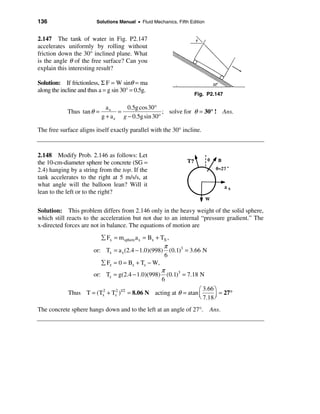
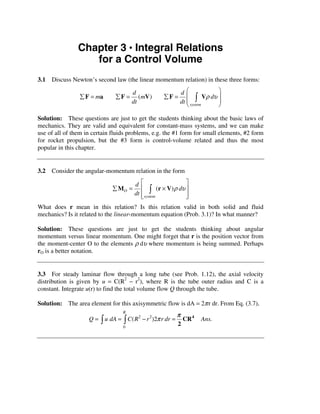
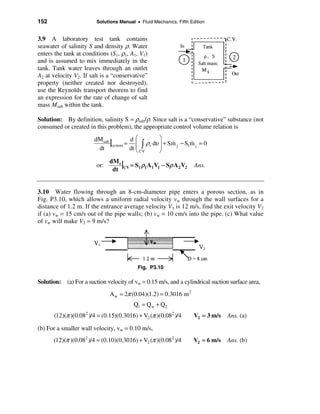
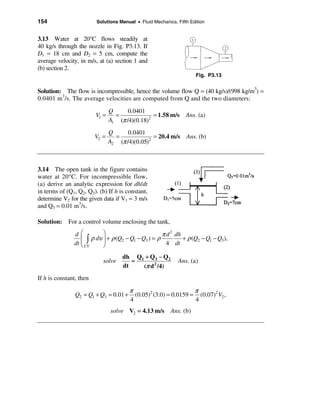
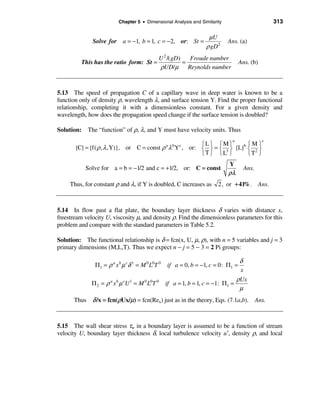
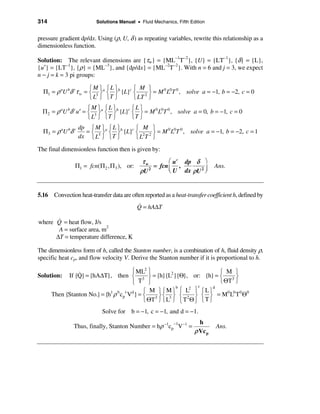
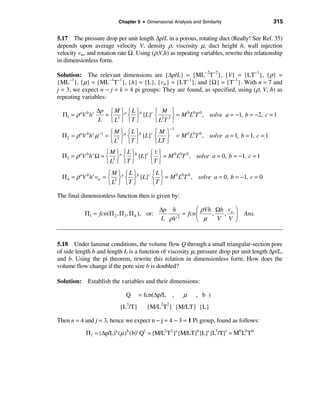
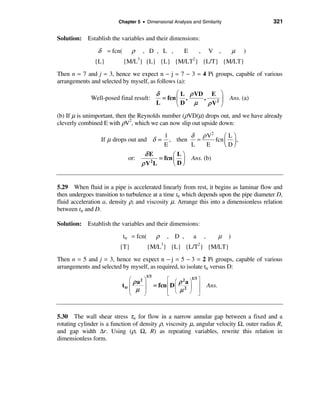
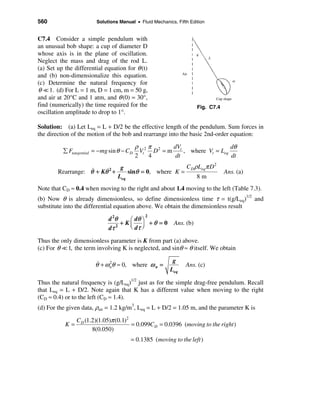
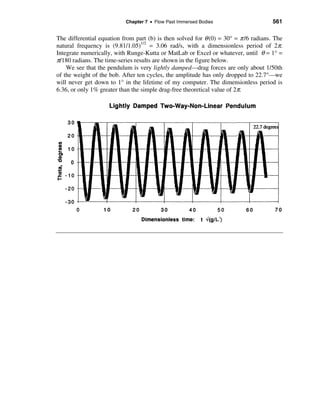
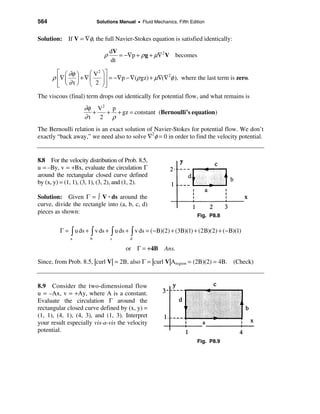
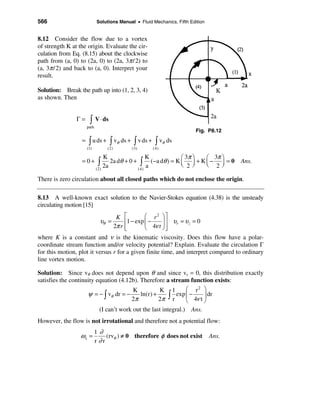
Chapter 1 • Introduction
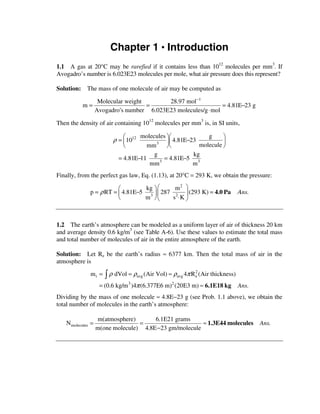
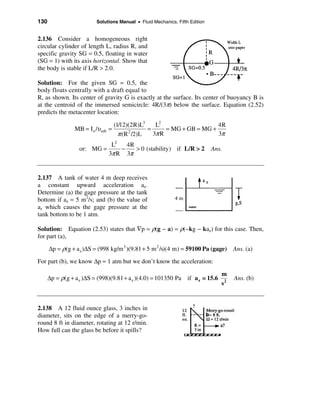
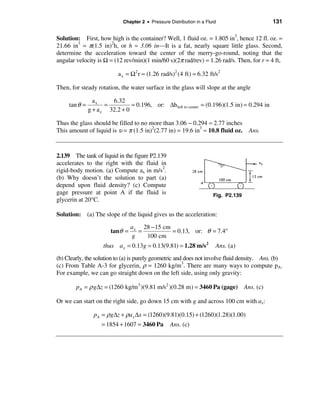
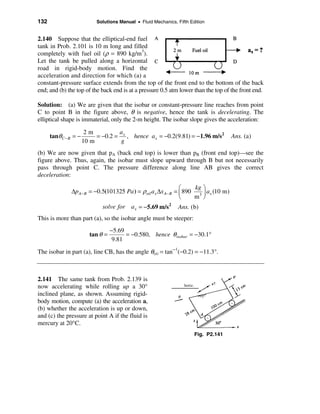
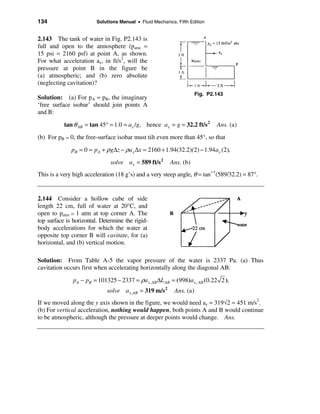
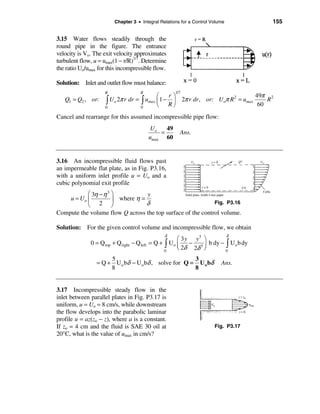
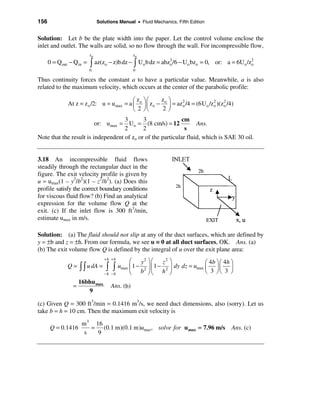
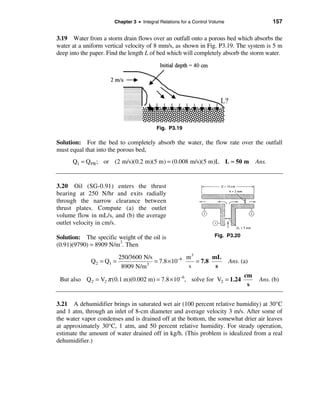
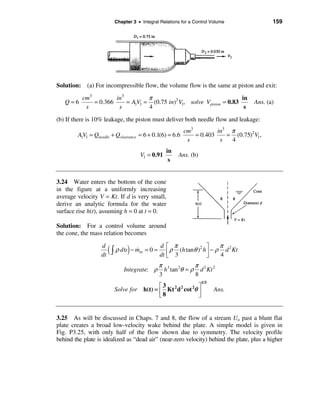
1.1 A gas at 20°C may be rarefied if it contains less than 1012 molecules per mm3. If
Avogadro’s number is 6.023E23 molecules per mole, what air pressure does this represent?

Solution:    The mass of one molecule of air may be computed as

                    Molecular weight       28.97 mol −1
            m=                       =                          = 4.81E−23 g
                   Avogadro’s number 6.023E23 molecules/g ⋅ mol

Then the density of air containing 1012 molecules per mm3 is, in SI units,

                             æ      molecules öæ              g     ö
                         ρ = ç 1012       3    ÷ç 4.81E−23          ÷
                             è        mm       øè          molecule ø
                                         g               kg
                           = 4.81E−11       3
                                              = 4.81E−5 3
                                       mm                m
Finally, from the perfect gas law, Eq. (1.13), at 20°C = 293 K, we obtain the pressure:

                         æ        kg ö æ      m2 ö
              p = ρ RT = ç 4.81E−5 3 ÷ ç 287 2 ÷ (293 K) = 4.0 Pa Αns.
                         è        m øè       s ⋅K ø


1.2 The earth’s atmosphere can be modeled as a uniform layer of air of thickness 20 km
and average density 0.6 kg/m3 (see Table A-6). Use these values to estimate the total mass
and total number of molecules of air in the entire atmosphere of the earth.

Solution: Let Re be the earth’s radius ≈ 6377 km. Then the total mass of air in the
atmosphere is

              m t = ò ρ dVol = ρavg (Air Vol) ≈ ρavg 4π R 2 (Air thickness)
                                                          e

                    = (0.6 kg/m 3 )4π (6.377E6 m)2 (20E3 m) ≈ 6.1E18 kg       Ans.
Dividing by the mass of one molecule ≈ 4.8E−23 g (see Prob. 1.1 above), we obtain the
total number of molecules in the earth’s atmosphere:

                   m(atmosphere)       6.1E21 grams
   N molecules =                  =                     ≈ 1.3E44 molecules           Ans.
                   m(one molecule) 4.8E −23 gm/molecule
2                       Solutions Manual • Fluid Mechanics, Fifth Edition


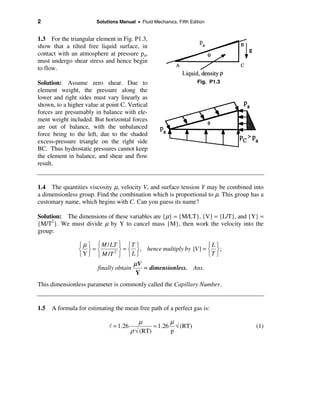
1.3 For the triangular element in Fig. P1.3,
show that a tilted free liquid surface, in
contact with an atmosphere at pressure pa,
must undergo shear stress and hence begin
to flow.

Solution: Assume zero shear. Due to                                  Fig. P1.3
element weight, the pressure along the
lower and right sides must vary linearly as
shown, to a higher value at point C. Vertical
forces are presumably in balance with ele-
ment weight included. But horizontal forces
are out of balance, with the unbalanced
force being to the left, due to the shaded
excess-pressure triangle on the right side
BC. Thus hydrostatic pressures cannot keep
the element in balance, and shear and flow
result.


1.4 The quantities viscosity µ, velocity V, and surface tension Y may be combined into
a dimensionless group. Find the combination which is proportional to µ. This group has a
customary name, which begins with C. Can you guess its name?

Solution: The dimensions of these variables are {µ} = {M/LT}, {V} = {L/T}, and {Y} =
{M/T2}. We must divide µ by Y to cancel mass {M}, then work the velocity into the
group:

                ì µ ü ì M / LT ü ì T ü                            ìLü
                í ý=í        2 ý = í ý , hence multiply by {V } = í ý ;
                î Y þ î M /T þ î L þ                              îT þ
                                         µV
                        finally obtain      = dimensionless. Ans.
                                          Y
This dimensionless parameter is commonly called the Capillary Number.


1.5 A formula for estimating the mean free path of a perfect gas is:

                                           µ           µ
                             l = 1.26            = 1.26 √ (RT)                       (1)
                                        ρ √ (RT)       p
Chapter 1 • Introduction                            3

where the latter form follows from the ideal-gas law, ρ = p/RT. What are the dimensions
of the constant “1.26”? Estimate the mean free path of air at 20°C and 7 kPa. Is air
rarefied at this condition?

Solution: We know the dimensions of every term except “1.26”:

                            ìMü       ìMü         ì L2 ü
            {l} = {L} {µ} = í ý {ρ} = í 3 ý {R} = í 2 ý {T} = {Θ}
                            î LT þ    îL þ        îT Θþ
   Therefore the above formula (first form) may be written dimensionally as

                                         {M/L⋅T}
                  {L} = {1.26?}                               = {1.26?}{L}
                                  {M/L } √ [{L2 /T 2 ⋅ Θ}{Θ}]
                                        3


Since we have {L} on both sides, {1.26} = {unity}, that is, the constant is dimensionless.
The formula is therefore dimensionally homogeneous and should hold for any unit system.

    For air at 20°C = 293 K and 7000 Pa, the density is ρ = p/RT = (7000)/[(287)(293)] =
0.0832 kg/m3. From Table A-2, its viscosity is 1.80E−5 N ⋅ s/m2. Then the formula predict
a mean free path of
                                     1.80E−5
                   l = 1.26                           ≈ 9.4E−7 m    Ans.
                              (0.0832)[(287)(293)]1/2
This is quite small. We would judge this gas to approximate a continuum if the physical
scales in the flow are greater than about 100 l, that is, greater than about 94 µm.


1.6 If p is pressure and y is a coordinate, state, in the {MLT} system, the dimensions of
the quantities (a) ∂p/∂y; (b) ò p dy; (c) ∂ 2 p/∂y2; (d) ∇p.

Solution: (a) {ML−2T−2}; (b) {MT−2}; (c) {ML−3T−2}; (d) {ML−2T−2}


1.7 A small village draws 1.5 acre-foot of water per day from its reservoir. Convert this
water usage into (a) gallons per minute; and (b) liters per second.

Solution: One acre = (1 mi2/640) = (5280 ft)2/640 = 43560 ft2. Therefore 1.5 acre-ft =
65340 ft3 = 1850 m3. Meanwhile, 1 gallon = 231 in3 = 231/1728 ft3. Then 1.5 acre-ft of
water per day is equivalent to

                        ft 3 æ 1728 gal ö æ 1 day ö       gal
            Q = 65340        ç        3 ÷ç        ÷ ≈ 340               Ans. (a)
                        day è 231 ft ø è 1440 min ø       min
4                       Solutions Manual • Fluid Mechanics, Fifth Edition


Similarly, 1850 m3 = 1.85E6 liters. Then a metric unit for this water usage is:
                       æ         L öæ 1       day ö      L
                   Q = ç 1.85E6     ÷ç            ÷ ≈ 21             Ans. (b)
                       è        day ø è 86400 sec ø      s


1.8 Suppose that bending stress σ in a beam depends upon bending moment M and
beam area moment of inertia I and is proportional to the beam half-thickness y. Suppose
also that, for the particular case M = 2900 in⋅lbf, y = 1.5 in, and I = 0.4 in4, the predicted
stress is 75 MPa. Find the only possible dimensionally homogeneous formula for σ.

Solution: We are given that σ = y fcn(M,I) and we are not to study up on strength of
materials but only to use dimensional reasoning. For homogeneity, the right hand side
must have dimensions of stress, that is,
                                            ì M ü
                  {σ } = {y}{fcn(M,I)}, or: í 2 ý = {L}{fcn(M,I)}
                                            î LT þ
                                                                 ì M ü
              or: the function must have dimensions {fcn(M,I)} = í 2 2 ý
                                                                 îL T þ
Therefore, to achieve dimensional homogeneity, we somehow must combine bending
moment, whose dimensions are {ML2T –2}, with area moment of inertia, {I} = {L4}, and
end up with {ML–2T –2}. Well, it is clear that {I} contains neither mass {M} nor time {T}
dimensions, but the bending moment contains both mass and time and in exactly the com-
bination we need, {MT –2}. Thus it must be that σ is proportional to M also. Now we
have reduced the problem to:
                          ì M ü       ì ML2 ü
        σ = yM fcn(I), or í 2 ý = {L} í 2 ý{fcn(I)}, or: {fcn(I)} = {L−4 }
                          î LT þ      î T þ
We need just enough I’s to give dimensions of {L–4}: we need the formula to be exactly
inverse in I. The correct dimensionally homogeneous beam bending formula is thus:
                                My
                         σ =C      , where {C} = {unity} Ans.
                                 I
The formula admits to an arbitrary dimensionless constant C whose value can only be
obtained from known data. Convert stress into English units: σ = (75 MPa)/(6894.8) =
10880 lbf/in2. Substitute the given data into the proposed formula:
                     lbf     My    (2900 lbf ⋅in)(1.5 in)
         σ = 10880      2
                          =C    =C                        , or: C ≈ 1.00        Ans.
                     in       I          0.4 in 4
The data show that C = 1, or σ = My/I, our old friend from strength of materials.
Chapter 1 • Introduction                               5

1.9 The dimensionless Galileo number, Ga, expresses the ratio of gravitational effect to
viscous effects in a flow. It combines the quantities density ρ, acceleration of gravity g,
length scale L, and viscosity µ. Without peeking into another textbook, find the form of
the Galileo number if it contains g in the numerator.

Solution: The dimensions of these variables are {ρ} = {M/L3}, {g} = {L/T2}, {L} =
{L}, and {µ} = {M/LT}. Divide ρ by µ to eliminate mass {M} and then combine with g
and L to eliminate length {L} and time {T}, making sure that g appears only to the first
power:

                                 ì ρ ü ì M / L3 ü ì T ü
                                 í ý=í          ý=í 2ý
                                 î µ þ î M / LT þ î L þ

while only {g} contains {T}. To keep {g} to the 1st power, we need to multiply it by
{ρ/µ}2. Thus {ρ/µ}2{g} = {T2/L4}{L/T2} = {L−3}.
   We then make the combination dimensionless by multiplying the group by L3. Thus
we obtain:
                                            2
                                     æρö              ρ 2 gL3 gL3
               Galileo number = Ga = ç ÷ ( g)( L )3 =        = 2       Ans.
                                     èµø                µ2    ν


1.10 The Stokes-Oseen formula [10] for drag on a sphere at low velocity V is:
                                                9π
                                F = 3πµ DV +       ρ V 2 D2
                                                16

where D = sphere diameter, µ = viscosity, and ρ = density. Is the formula homogeneous?

Solution: Write this formula in dimensional form, using Table 1-2:

                                             ì 9π ü
                      {F} = {3π }{µ}{D}{V} + í ý{ρ}{V}2 {D}2 ?
                                             î 16 þ
                                                  ìMüì L ü
                                                          2
                     ì ML ü      ìMü    ìL ü
                 or: í 2 ý = {1} í ý{L} í ý + {1} í 3 ý í 2 ý {L2} ?
                     îT þ        î LT þ îT þ      îL þîT þ

where, hoping for homogeneity, we have assumed that all constants (3,π,9,16) are pure,
i.e., {unity}. Well, yes indeed, all terms have dimensions {ML/T2}! Therefore the Stokes-
Oseen formula (derived in fact from a theory) is dimensionally homogeneous.
6                      Solutions Manual • Fluid Mechanics, Fifth Edition


1.11 Test, for dimensional homogeneity, the following formula for volume flow Q
through a hole of diameter D in the side of a tank whose liquid surface is a distance h
above the hole position:

                                      Q = 0.68D2 gh

where g is the acceleration of gravity. What are the dimensions of the constant 0.68?

Solution: Write the equation in dimensional form:
                       ì L3 ü ?       2 ì L ü
                                                    1/ 2
                                                                                ì L3 ü
                 {Q} = í ý = {0.68?}{L } í 2 ý             {L}  1/ 2
                                                                       = {0.68} í ý
                       îTþ               îT þ                                   îTþ

Thus, since D2 ( gh ) has provided the correct volume-flow dimensions, {L3/T}, it follows
that the constant “0.68” is indeed dimensionless Ans. The formula is dimensionally
homogeneous and can be used with any system of units. [The formula is very similar to the
valve-flow formula Q = Cd A o (∆p/ ρ ) discussed at the end of Sect. 1.4, and the number
“0.68” is proportional to the “discharge coefficient” Cd for the hole.]


1.12 For low-speed (laminar) flow in a tube of radius ro, the velocity u takes the form

                                            ∆p 2 2
                                     u=B
                                            µ
                                               (
                                               ro − r      )
where µ is viscosity and ∆p the pressure drop. What are the dimensions of B?

Solution: Using Table 1-2, write this equation in dimensional form:

                      {∆p} 2         ìL ü       {M/LT 2} 2          ì L2 ü
            {u} = {B}      {r }, or: í ý = {B?}         {L } = {B?} í ý ,
                       {µ}           îT þ        {M/LT}             îTþ
                                 or: {B} = {L–1} Ans.

The parameter B must have dimensions of inverse length. In fact, B is not a constant, it
hides one of the variables in pipe flow. The proper form of the pipe flow relation is

                                            ∆p 2 2
                                     u=C
                                            Lµ
                                                (
                                               ro − r       )
where L is the length of the pipe and C is a dimensionless constant which has the
theoretical laminar-flow value of (1/4)—see Sect. 6.4.
Chapter 1 • Introduction                              7

1.13 The efficiency η of a pump is defined as

                                             Q∆p
                                     η=
                                          Input Power

where Q is volume flow and ∆p the pressure rise produced by the pump. What is η if
∆p = 35 psi, Q = 40 L/s, and the input power is 16 horsepower?

Solution: The student should perhaps verify that Q∆p has units of power, so that η is a
dimensionless ratio. Then convert everything to consistent units, for example, BG:

            L        ft 2          lbf      lbf                         ft⋅lbf
   Q = 40     = 1.41      ; ∆p = 35 2 = 5040 2 ; Power = 16(550) = 8800
            s         s            in       ft                             s
                       (1.41 ft 3 /s)(5040 lbf /ft 2 )
                  η=                                   ≈ 0.81 or 81% Ans.
                             8800 ft⋅lbf /s

Similarly, one could convert to SI units: Q = 0.04 m3/s, ∆p = 241300 Pa, and input power =
16(745.7) = 11930 W, thus h = (0.04)(241300)/(11930) = 0.81. Ans.


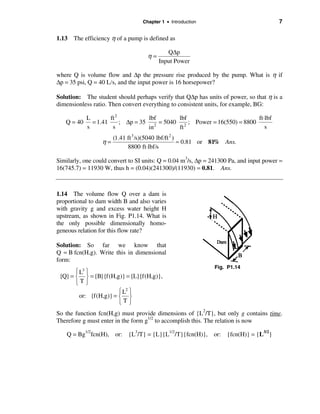
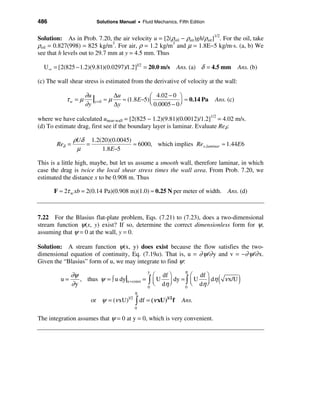
1.14 The volume flow Q over a dam is
proportional to dam width B and also varies
with gravity g and excess water height H
upstream, as shown in Fig. P1.14. What is
the only possible dimensionally homo-
geneous relation for this flow rate?

Solution: So far we know that
Q = B fcn(H,g). Write this in dimensional
form:
                                                                Fig. P1.14
       ì L3 ü
 {Q} = í ý = {B}{f(H,g)} = {L}{f(H,g)},
       îTþ
                        ì L2 ü
         or: {f(H,g)} = í ý
                        îTþ
So the function fcn(H,g) must provide dimensions of {L2/T}, but only g contains time.
Therefore g must enter in the form g1/2 to accomplish this. The relation is now

    Q = Bg1/2fcn(H), or: {L3/T} = {L}{L1/2/T}{fcn(H)}, or:           {fcn(H)} = {L3/2}
8                       Solutions Manual • Fluid Mechanics, Fifth Edition


In order for fcn(H) to provide dimensions of {L3/2}, the function must be a 3/2 power.
Thus the final desired homogeneous relation for dam flow is:

              Q = CBg1/2H3/2, where C is a dimensionless constant Ans.


1.15 As a practical application of Fig. P1.14, often termed a sharp-crested weir, civil
engineers use the following formula for flow rate: Q ≈ 3.3 BH3/2, with Q in ft3/s and B
and H in feet. Is this formula dimensionally homogeneous? If not, try to explain the
difficulty and how it might be converted to a more homogeneous form.

Solution: Clearly the formula cannot be dimensionally homogeneous, because B and H
do not contain the dimension time. The formula would be invalid for anything except
English units (ft, sec). By comparing with the answer to Prob. 1.14 just above, we see
that the constant “3.3” hides the square root of the acceleration of gravity.


1.16 Test the dimensional homogeneity of the boundary-layer x-momentum equation:
                                   ∂u      ∂u    ∂p          ∂τ
                              ρu      + ρv    =−    + ρ gx +
                                   ∂x      ∂y    ∂x          ∂y

Solution: This equation, like all theoretical partial differential equations in mechanics,
is dimensionally homogeneous. Test each term in sequence:

       ì ∂ u ü ì ∂ u ü M L L/T ì M ü ì ∂ p ü M/LT
                                                  2
                                                     ì M ü
       íρ u  ý = íρ v ý= 3    = í 2 2 ý; í ý =      =í 2 2ý
       î ∂ xþ î ∂yþ L T L       î L T þ î∂ x þ L     îL T þ
                             M L ì M ü ì ∂τ ü M/LT 2 ì M ü
                {ρ g x } =         =í        ý; í ý =    =í 2 2ý
                             L3 T 2 î L2 T 2 þ î ∂ x þ L  îL T þ

All terms have dimension {ML–2T –2}. This equation may use any consistent units.


1.17 Investigate the consistency of the Hazen-Williams formula from hydraulics:
                                                              0.54
                                                 2.63 æ∆p ö
                                     Q = 61.9D       ç    ÷
                                                     è L ø

What are the dimensions of the constant “61.9”? Can this equation be used with
confidence for a variety of liquids and gases?
Chapter 1 • Introduction                               9

Solution: Write out the dimensions of each side of the equation:
                                                                                  0.54
                 ì L3 ü ?            ì ∆p ü
                                            0.54
                                                                 ì M/LT 2 ü
           {Q} = í ý = {61.9}{D2.63} í ý         = {61.9}{L2.63} í        ý
                 îTþ                 îLþ                         î L þ

The constant 61.9 has fractional dimensions: {61.9} = {L1.45T0.08M–0.54} Ans.
    Clearly, the formula is extremely inconsistent and cannot be used with confidence
for any given fluid or condition or units. Actually, the Hazen-Williams formula, still
in common use in the watersupply industry, is valid only for water flow in smooth
pipes larger than 2-in. diameter and turbulent velocities less than 10 ft/s and (certain)
English units. This formula should be held at arm’s length and given a vote of “No
Confidence.”


1.18* (“*” means “difficult”—not just a
plug-and-chug, that is) For small particles at
low velocities, the first (linear) term in Stokes’
drag law, Prob. 1.10, is dominant, hence
F = KV, where K is a constant. Suppose
a particle of mass m is constrained to move horizontally from the initial position x = 0
with initial velocity V = Vo. Show (a) that its velocity will decrease exponentially with
time; and (b) that it will stop after travelling a distance x = mVo/K.

Solution: Set up and solve the differential equation for forces in the x-direction:
                                                                 V            t
                                            dV               dV      m
         å Fx = − Drag = ma x , or: −KV = m    , integrate ò    = −ò   dt
                                            dt            V
                                                              V    0
                                                                     K
                                                                 o
                                          t
         Solve V = Vo e − mt/K   and x = ò V dt =
                                                     mVo
                                                      K
                                                             (
                                                         1 − e − mt/K   )   Ans. (a,b)
                                          0

Thus, as asked, V drops off exponentially with time, and, as t → ∞, x = mVo /K.


1.19 Marangoni convection arises when a surface has a difference in surface
tension along its length. The dimensionless Marangoni number M is a combination
of thermal diffusivity α = k/(ρcp ) (where k is the thermal conductivity), length scale
L , viscosity µ, and surface tension difference δY . If M is proportional to L , find
its form.
10                     Solutions Manual • Fluid Mechanics, Fifth Edition


Solution: List the dimensions: {α} = {L2/T}, {L} = {L}, {µ} = {M/LT}, {δY} = {M/T2}.
We divide δ Y by µ to get rid of mass dimensions, then divide by α to eliminate time:
              ìδ Y ü
              í    ý= 2
              î µ þ T M
                        {
                        M LT
                                } ìL ü
                               = í ý , then í
                                  îT þ
                                              ìδ Y 1 ü ì L T ü ì 1 ü
                                                     ý=í      =
                                                            2ý í ý
                                              î µ α þ îT L þ î L þ
                                                               δ YL
        Multiply by L and we obtain the Marangoni number: M =        Ans.
                                                                µα


1.20C (“C” means computer-oriented, although this one can be done analytically.) A
baseball, with m = 145 g, is thrown directly upward from the initial position z = 0 and
Vo = 45 m/s. The air drag on the ball is CV2, where C ≈ 0.0010 N ⋅ s2/m2. Set up a
differential equation for the ball motion and solve for the instantaneous velocity V(t) and
position z(t). Find the maximum height zmax reached by the ball and compare your results
with the elementary-physics case of zero air drag.

Solution: For this problem, we include the weight of the ball, for upward motion z:
                                                            V                   t
                                      dV                            dV
      å Fz = −ma z , or: −CV − mg = m                       ò               = − ò dt = −t
                                2
                                         , solve
                                      dt                   Vo
                                                                g + CV 2 /m     0

                      mg     æ       Cg ö        m é cos(φ − t √ (gC/m) ù
          Thus V =       tan ç φ − t
                             ç          ÷ and z = ln ê                  ú
                      C      è       m ÷ø        C ë        cosφ        û

where φ = tan –1[Vo √ (C/mg)] . This is cumbersome, so one might also expect some
students simply to program the differential equation, m(dV/dt) + CV2 = −mg, with a
numerical method such as Runge-Kutta.
    For the given data m = 0.145 kg, Vo = 45 m/s, and C = 0.0010 N⋅s2/m2, we compute

                                mg         m           Cg                m
       φ = 0.8732 radians,         = 37.72   ,            = 0.2601 s−1 ,   = 145 m
                                C          s           m                 C

Hence the final analytical formulas are:

                           æ mö
                         V ç in ÷ = 37.72 tan(0.8732 − .2601t)
                           è    sø
                                             é cos(0.8732 − 0.2601t) ù
                   and z(in meters) = 145 ln ê                       ú
                                             ë      cos(0.8732)      û
The velocity equals zero when t = 0.8732/0.2601 ≈ 3.36 s, whence we evaluate the
maximum height of the baseball as zmax = 145 ln[sec(0.8734)] ≈ 64.2 meters. Ans.
Chapter 1 • Introduction                              11

    For zero drag, from elementary physics formulas, V = Vo − gt and z = Vot − gt2/2, we
calculate that
                           Vo   45                     V2   (45)2
          t max height =      =    ≈ 4.59 s and z max = o =       ≈ 103.2 m
                           g 9.81                      2g 2(9.81)
Thus drag on the baseball reduces the maximum height by 38%. [For this problem I
assumed a baseball of diameter 7.62 cm, with a drag coefficient CD ≈ 0.36.]


1.21 The dimensionless Grashof number, Gr, is a combination of density ρ, viscosity µ,
temperature difference ∆T, length scale L, the acceleration of gravity g, and the
coefficient of volume expansion β, defined as β = (−1/ρ)(∂ρ/∂T)p. If Gr contains both g
and β in the numerator, what is its proper form?

Solution: Recall that {µ/ρ} = {L2/T} and eliminates mass dimensions. To eliminate tem-
perature, we need the product {β∆Τ} = {1}. Then {g} eliminates {T}, and L3 cleans it all up:
                     Thus the dimensionless Gr = ρ 2 gβ∆TL3 /µ 2       Ans.


1.22* According to the theory of Chap. 8,
as a uniform stream approaches a cylinder
of radius R along the line AB shown in
Fig. P1.22, –∞ < x < –R, the velocities are

      u = U ∞ (1 − R 2 /x 2 ); v = w = 0
                                                                   Fig. P1.22
Using the concepts from Ex. 1.5, find (a) the maximum flow deceleration along AB; and
(b) its location.

Solution: We see that u slows down monotonically from U∞ at A to zero at point B,
x = −R, which is a flow “stagnation point.” From Example 1.5, the acceleration (du/dt) is
       du ∂ u    ∂u          æ R2 ö é      æ 2R 2 ö ù U 2 æ 2  2 ö      x
         =    +u    = 0 + U∞ ç1 − 2 ÷ ê U∞ ç + 3 ÷ú = ∞ ç 3 − 5 ÷ , ζ =
       dt ∂ t    ∂x          è   x øê ë    è x øú R è ζ
                                                    û         ζ ø       R
This acceleration is negative, as expected, and reaches a minimum near point B, which is
found by differentiating the acceleration with respect to x:
               d æ du ö       2 5
                  ç ÷ = 0 if ζ = , or
                                                  x
                                                    |max decel. ≈ −1.291 Ans. (b)
               dx è dt ø        3                 R
                                                                          2
        Substituting ζ = −1.291 into (du/dt) gives
                                                        du
                                                           |min = −0.372 U∞     Ans. (a)
                                                        dt               R
12                            Solutions Manual • Fluid Mechanics, Fifth Edition


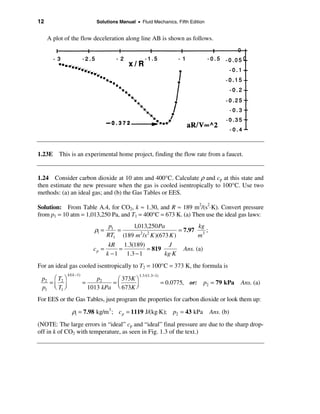
     A plot of the flow deceleration along line AB is shown as follows.


1.23E    This is an experimental home project, finding the flow rate from a faucet.


1.24 Consider carbon dioxide at 10 atm and 400°C. Calculate ρ and cp at this state and
then estimate the new pressure when the gas is cooled isentropically to 100°C. Use two
methods: (a) an ideal gas; and (b) the Gas Tables or EES.

Solution: From Table A.4, for CO2, k ≈ 1.30, and R ≈ 189 m2/(s2⋅K). Convert pressure
from p1 = 10 atm = 1,013,250 Pa, and T1 = 400°C = 673 K. (a) Then use the ideal gas laws:
                                      p1     1,013,250 Pa             kg
                              ρ1 =       =      2 2
                                                               = 7.97 3 ;
                                     RT1 (189 m /s K )(673 K )       m
                                      kR 1.3(189)          J
                             cp =         =        = 819               Ans. (a)
                                     k − 1 1.3 − 1       kg⋅K
For an ideal gas cooled isentropically to T2 = 100°C = 373 K, the formula is
             k /( k −1)                          1.3 /(1.3−1)
 p2 æ T2 ö                     p2    æ 373K ö
   =                      =         =ç      ÷                   = 0.0775, or: p2 = 79 kPa   Ans. (a)
 p1 ç T1 ÷
     è ø                    1013 kPa è 673K ø
For EES or the Gas Tables, just program the properties for carbon dioxide or look them up:

                ρ1 = 7.98 kg/m 3 ; c p = 1119 J/(kg⋅K); p2 = 43 kPa Ans. (b)
(NOTE: The large errors in “ideal” cp and “ideal” final pressure are due to the sharp drop-
off in k of CO2 with temperature, as seen in Fig. 1.3 of the text.)
Chapter 1 • Introduction                                 13

1.25 A tank contains 0.9 m3 of helium at 200 kPa and 20°C. Estimate the total mass of
this gas, in kg, (a) on earth; and (b) on the moon. Also, (c) how much heat transfer, in
MJ, is required to expand this gas at constant temperature to a new volume of 1.5 m3?

Solution: First find the density of helium for this condition, given R = 2077 m2/(s2⋅K)
from Table A-4. Change 20°C to 293 K:

                                  p            200000 N/m 2
                      ρHe =            =                        ≈ 0.3286 kg/m 3
                              R He T       (2077 J/kg⋅K)(293 K)

Now mass is mass, no matter where you are. Therefore, on the moon or wherever,

               m He = ρHeυ = (0.3286 kg/m 3)(0.9 m 3) ≈ 0.296 kg             Ans. (a,b)

For part (c), we expand a constant mass isothermally from 0.9 to 1.5 m3. The first law of
thermodynamics gives

             dQadded − dWby gas = dE = mc v ∆T = 0 since T2 = T1 (isothermal)

Then the heat added equals the work of expansion. Estimate the work done:

                                                            dυ
                  2           2                         2
                                  m
          W1-2 = ò p dυ = ò         RT dυ = mRT         ò      = mRT ln(υ2 /υ1),
                  1           1
                                  υ                     1
                                                            υ
    or: W1-2 = (0.296 kg)(2077 J/kg⋅K)(293 K)ln(1.5/0.9) = Q1-2 ≈ 92000 J                 Ans. (c)


1.26 A tire has a volume of 3.0 ft3 and a ‘gage’ pressure of 32 psi at 75°F. If the
ambient pressure is sea-level standard, what is the weight of air in the tire?

Solution: Convert the temperature from 75°F to 535°R. Convert the pressure to psf:

          p = (32 lbf/in 2 )(144 in 2 /ft 2 ) + 2116 lbf/ft 2 = 4608 + 2116 ≈ 6724 lbf/ft 2

From this compute the density of the air in the tire:

                          p          6724 lbf/ft 2
                ρair =      =                              = 0.00732 slug/ft 3
                         RT (1717 ft⋅lbf/slug ⋅°R)(535° R)

Then the total weight of air in the tire is

           Wair = ρ gυ = (0.00732 slug/ft 3 )(32.2 ft/s2 )(3.0 ft 3 ) ≈ 0.707 lbf     Ans.
14                           Solutions Manual • Fluid Mechanics, Fifth Edition


1.27 Given temperature and specific volume data for steam at 40 psia [Ref. 13]:

               T, °F:            400       500          600          700          800
               v, ft3/lbm:       12.624    14.165       15.685       17.195       18.699

Is the ideal gas law reasonable for this data? If so, find a least-squares value for the gas
constant R in m2/(s2⋅K) and compare with Table A-4.

Solution: The units are awkward but we can compute R from the data. At 400°F,

              pV (40 lbf/in 2 )(144 in 2 /ft 2 )(12.624 ft 3 /lbm)(32.2 lbm/slug)         ft⋅lbf
“R”400° F =      =                                                                ≈ 2721
               T                          (400 + 459.6)°R                                slug°R

The metric conversion factor, from the inside cover of the text, is “5.9798”: Rmetric =
2721/5.9798 = 455.1 m2/(s2⋅K). Not bad! This is only 1.3% less than the ideal-gas approxi-
mation for steam in Table A-4: 461 m2/(s2⋅K). Let’s try all the five data points:
                T, °F:            400          500      600          700         800
                R, m2/(s2⋅K):     455          457      459          460         460
The total variation in the data is only ±0.6%. Therefore steam is nearly an ideal gas in
this (high) temperature range and for this (low) pressure. We can take an average value:

                                                         1 5             J
     p = 40 psia, 400°F ≤ T ≤ 800°F: R steam ≈             å R i ≈ 458 kg ⋅ K ± 0.6% Ans.
                                                         5 i=1

With such a small uncertainty, we don’t really need to perform a least-squares analysis,
but if we wanted to, it would go like this: We wish to minimize, for all data, the sum of
the squares of the deviations from the perfect-gas law:
                                           2
                         æ pV ö
                             5
                                                                     ∂E         5
                                                                                   æ pV ö
       Minimize E = å ç R − i ÷                 by differentiating      = 0 = å2çR − i ÷
                    i =1 è  Ti ø                                     ∂R       i =1 è  Ti ø
                                       p 5 Vi 40(144) é 12.624 18.699 ù
              Thus R least-squares =     å T = 5 ê 860°R + L + 1260°R ú (32.2)
                                       5 i =1 i       ë               û
For this example, then, least-squares amounts to summing the (V/T) values and converting
the units. The English result shown above gives Rleast-squares ≈ 2739 ft⋅lbf/slug⋅°R. Convert
this to metric units for our (highly accurate) least-squares estimate:

                        R steam ≈ 2739/5.9798 ≈ 458 ± 0.6% J/kg⋅K             Ans.
Chapter 1 • Introduction                                15

1.28 Wet air, at 100% relative humidity, is at 40°C and 1 atm. Using Dalton’s law of
partial pressures, compute the density of this wet air and compare with dry air.

Solution: Change T from 40°C to 313 K. Dalton’s law of partial pressures is

                                                         ma       m
                      p tot = 1 atm = pair + p water =      Ra T + w R w T
                                                         υ         υ
                                               paυ p wυ
                   or: m tot = m a + m w =         +              for an ideal gas
                                               Ra T R w T

where, from Table A-4, Rair = 287 and Rwater = 461 m2/(s2⋅K). Meanwhile, from Table A-5, at
40°C, the vapor pressure of saturated (100% humid) water is 7375 Pa, whence the partial
pressure of the air is pa = 1 atm − pw = 101350 − 7375 = 93975 Pa.
    Solving for the mixture density, we obtain

       ma + m w   p     p     93975     7375                         kg
  ρ=            = a + w =            +         = 1.046 + 0.051 ≈ 1.10 3                  Ans.
          υ      R a T R w T 287(313) 461(313)                       m

By comparison, the density of dry air for the same conditions is

                                          p   101350       kg
                            ρdry air =      =        = 1.13 3
                                         RT 287(313)       m

Thus, at 40°C, wet, 100% humidity, air is lighter than dry air, by about 2.7%.


1.29 A tank holds 5 ft3 of air at 20°C and 120 psi (gage). Estimate the energy in ft-lbf
required to compress this air isothermally from one atmosphere (14.7 psia = 2116 psfa).

Solution: Integrate the work of compression, assuming an ideal gas:

                                                          æυ ö
                       2           2
                                         mRT                              æp ö
              W1-2 = − ò p dυ = − ò          dυ = −mRT ln ç 2 ÷ = p2υ2 ln ç 2 ÷
                       1           1
                                          υ               è υ1 ø          è p1 ø
where the latter form follows from the ideal gas law for isothermal changes. For the given
numerical data, we obtain the quantitative work done:

                   æp ö æ               lbf ö             æ 134.7 ö
   W1-2 = p 2υ2 ln ç 2 ÷ = ç 134.7 × 144 2 ÷ (5 ft 3 ) ln ç         ≈ 215,000 ft⋅ lbf
                                                          è 14.7 ÷
                                                                                        Ans.
                   è p1 ø  è            ft  ø                     ø
16                        Solutions Manual • Fluid Mechanics, Fifth Edition


1.30 Repeat Prob. 1.29 if the tank is filled with compressed water rather than air. Why
is the result thousands of times less than the result of 215,000 ft⋅lbf in Prob. 1.29?

Solution: First evaluate the density change of water. At 1 atm, ρ o ≈ 1.94 slug/ft3. At
120 psi(gage) = 134.7 psia, the density would rise slightly according to Eq. (1.22):

                          æ ρ ö
                                           7
            p 134.7
              =     ≈ 3001ç      ÷ − 3000, solve ρ ≈ 1.940753 slug/ft ,
                                                                     3
            po 14.7       è 1.94 ø
                  Hence m water = ρυ = (1.940753)(5 ft 3 ) ≈ 9.704 slug

The density change is extremely small. Now the work done, as in Prob. 1.29 above, is

                                      m dρ         ∆ρ
             2        2                2
                            æmö
     W1-2 = −ò p dυ = ò   pdç ÷ = ò p      ≈ pavg m 2               for a linear pressure rise
                            èρø 1      ρ           ρavg
                                         2
             1        1


             æ 14.7 + 134.7      lbf ö             æ 0.000753 ft 3 ö
Hence W1-2 ≈ ç              × 144 2 ÷ (9.704 slug) ç               ÷ ≈ 21 ft⋅ lbf            Ans.
             è       2           ft ø              è 1.94042 slug ø
[Exact integration of Eq. (1.22) would give the same numerical result.] Compressing
water (extremely small ∆ρ) takes ten thousand times less energy than compressing air,
which is why it is safe to test high-pressure systems with water but dangerous with air.


1.31 The density of water for 0°C < T < 100°C is given in Table A-1. Fit this data to a
least-squares parabola, ρ = a + bT + cT2, and test its accuracy vis-a-vis Table A-1.
Finally, compute ρ at T = 45°C and compare your result with the accepted value of ρ ≈
990.1 kg/m3.

Solution: The least-squares parabola which fits the data of Table A-1 is:

            ρ (kg/m3) ≈ 1000.6 – 0.06986T – 0.0036014T2, T in °C Ans.

When compared with the data, the accuracy is less than ±1%. When evaluated at the
particular temperature of 45°C, we obtain

           ρ45°C ≈ 1000.6 – 0.06986(45) – 0.003601(45)2 ≈ 990.2 kg/m3 Ans.

This is excellent accuracya good fit to good smooth data.
   The data and the parabolic curve-fit are shown plotted on the next page. The curve-fit
does not display the known fact that ρ for fresh water is a maximum at T = +4°C.
Chapter 1 • Introduction                          17


1.32 A blimp is approximated by a prolate spheroid 90 m long and 30 m in diameter.
Estimate the weight of 20°C gas within the blimp for (a) helium at 1.1 atm; and (b) air at
1.0 atm. What might the difference between these two values represent (Chap. 2)?

Solution: Find a handbook. The volume of a prolate spheroid is, for our data,

                         2        2
                      υ = π LR 2 = π (90 m)(15 m)2 ≈ 42412 m 3
                         3        3

Estimate, from the ideal-gas law, the respective densities of helium and air:

                                      pHe    1.1(101350)         kg
                    (a) ρ helium =         =             ≈ 0.1832 3 ;
                                     R He T 2077(293)            m
                                   pair    101350         kg
                    (b) ρ air =          =         ≈ 1.205 3 .
                                  R air T 287(293)        m

Then the respective gas weights are

                        æ       kg öæ      mö
        WHe = ρ He gυ = ç 0.1832 3 ÷ç 9.81 2 ÷ (42412 m 3 ) ≈ 76000 N       Ans. (a)
                        è       m øè       s ø
        Wair = ρ air gυ = (1.205)(9.81)(42412) ≈ 501000 N       Ans. (b)

The difference between these two, 425000 N, is the buoyancy, or lifting ability, of the
blimp. [See Section 2.8 for the principles of buoyancy.]
18                          Solutions Manual • Fluid Mechanics, Fifth Edition


1.33 Experimental data for density of mercury versus pressure at 20°C are as follows:

                    p, atm:           1           500          1000        1500       2000
                    ρ, kg/m3:         13545       13573        13600       13625      13653

Fit this data to the empirical state relation for liquids, Eq. (1.19), to find the best values of
B and n for mercury. Then, assuming the data are nearly isentropic, use these values to
estimate the speed of sound of mercury at 1 atm and compare with Table 9.1.

Solution: This can be done (laboriously) by the method of least-squares, but we can
also do it on a spreadsheet by guessing, say, n ≈ 4,5,6,7,8 and finding the average B for
each case. For this data, almost any value of n > 1 is reasonably accurate. We select:

                             Mercury: n ≈ 7, B ≈ 35000 ± 2% Ans.

The speed of sound is found by differentiating Eq. (1.19) and then taking the square root:
                                              n −1                                     1/ 2
                                 æ ρ ö                                é n(B + 1)po ù
                                                   , hence a|ρ = ρo ≈ ê
                 dp po
                   ≈    n(B + 1) ç ÷                                               ú
                 dρ ρ o          è ρo ø                               ë    ρo      û
it being assumed here that this equation of state is “isentropic.” Evaluating this relation
for mercury’s values of B and n, we find the speed of sound at 1 atm:
                                                                  1/ 2
                             é (7)(35001)(101350 N/m 2 ) ù
                a mercury   ≈ê                           ú               ≈ 1355 m/s   Ans.
                             ë       13545 kg/m 3        û
This is about 7% less than the value of 1450 m/s listed in Table 9.1 for mercury.


1.34 Consider steam at the following state near the saturation line: (p1, T1) = (1.31 MPa,
290°C). Calculate and compare, for an ideal gas (Table A.4) and the Steam Tables (or the
EES software), (a) the density ρ1; and (b) the density ρ2 if the steam expands
isentropically to a new pressure of 414 kPa. Discuss your results.

Solution: From Table A.4, for steam, k ≈ 1.33, and R ≈ 461 m2/(s2⋅K). Convert T1 =
563 K. Then,

                             p1     1,310,000 Pa             kg
                   ρ1=          =                     = 5.05 3                 Ans. (a)
                            RT1 (461 m /s K )(563 K )
                                       2 2
                                                            m
                            1/k
     ρ2   ρ
                                                  1/1.33
             æp ö                  æ 414 kPa ö                                         kg
        = 2 =ç 2÷                 =ç                       = 0.421, or: ρ2 = 2.12
                                   è 1310 kPa ÷
                                                                                              Ans. (b)
     ρ1 5.05 è p1 ø                           ø                                        m3
Chapter 1 • Introduction                                 19

For EES or the Steam Tables, just program the properties for steam or look it up:

       EES real steam:    ρ1 = 5.23 kg/m 3    Ans. (a),        ρ2 = 2.16 kg/m 3   Ans. (b)

The ideal-gas error is only about 3%, even though the expansion approached the saturation line.


1.35 In Table A-4, most common gases (air, nitrogen, oxygen, hydrogen, CO, NO)
have a specific heat ratio k = 1.40. Why do argon and helium have such high values?
Why does NH3 have such a low value? What is the lowest k for any gas that you know?

Solution: In elementary kinetic theory of gases [8], k is related to the number of
“degrees of freedom” of the gas: k ≈ 1 + 2/N, where N is the number of different modes
of translation, rotation, and vibration possible for the gas molecule.
    Example: Monotomic gas, N = 3 (translation only), thus k ≈ 5/3
This explains why helium and argon, which are monatomic gases, have k ≈ 1.67.
    Example: Diatomic gas, N = 5 (translation plus 2 rotations), thus k ≈ 7/5
This explains why air, nitrogen, oxygen, NO, CO and hydrogen have k ≈ 1.40.
    But NH3 has four atoms and therefore more than 5 degrees of freedom, hence k will
be less than 1.40 (the theory is not too clear what “N” is for such complex molecules).
    The lowest k known to this writer is for uranium hexafluoride, 238UF6, which is a very
complex, heavy molecule with many degrees of freedom. The estimated value of k for
this heavy gas is k ≈ 1.06.


1.36 The bulk modulus of a fluid is defined as B = ρ (∂ p/∂ρ)S. What are the dimensions
of B? Estimate B (in Pa) for (a) N2O, and (b) water, at 20°C and 1 atm.

Solution: The density units cancel in the definition of B and thus its dimensions are the
same as pressure or stress:

                                                  ì M ü
                             {B} = {p} = {F/L2} = í 2 ý         Ans.
                                                  î LT þ
(a) For an ideal gas, p = Cρ k for an isentropic process, thus the bulk modulus is:

                                        d
                   Ideal gas: B = ρ       (Cρ k ) = ρ kCρ k −1 = kCρ k = kp
                                       dρ

For N 2 O, from Table A-4, k ≈ 1.31, so BN2O = 1.31 atm = 1.33E5 Pa          Ans. (a)
20                        Solutions Manual • Fluid Mechanics, Fifth Edition


    For water at 20°C, we could just look it up in Table A-3, but we more usefully try to
estimate B from the state relation (1-22). Thus, for a liquid, approximately,
             d
     B≈ ρ      [po {(B + 1)( ρ / ρo )n − B}] = n(B + 1)p o ( ρ / ρ o )n = n(B + 1)p o   at 1 atm
            dρ
For water, B ≈ 3000 and n ≈ 7, so our estimate is
                  Bwater ≈ 7(3001)po = 21007 atm ≈ 2.13E9 Pa              Ans. (b)
This is 2.7% less than the value B = 2.19E9 Pa listed in Table A-3.


1.37 A near-ideal gas has M = 44 and cv = 610 J/(kg⋅K). At 100°C, what are (a) its
specific heat ratio, and (b) its speed of sound?

Solution: The gas constant is R = Λ/Μ = 8314/44 ≈ 189 J/(kg⋅K). Then
 c v = R/(k − 1), or: k = 1 + R/c v = 1 + 189/610 ≈ 1.31 Ans. (a) [It is probably N 2 O]
With k and R known, the speed of sound at 100ºC = 373 K is estimated by

             a = kRT = 1.31[189 m 2 /(s2 ⋅ K)](373 K) ≈ 304 m/s                 Ans. (b)


1.38 In Fig. P1.38, if the fluid is glycerin
at 20°C and the width between plates is
6 mm, what shear stress (in Pa) is required
to move the upper plate at V = 5.5 m/s?
What is the flow Reynolds number if “L” is
taken to be the distance between plates?
                                                                        Fig. P1.38
Solution: (a) For glycerin at 20°C, from Table 1.4, µ ≈ 1.5 N · s/m2. The shear stress is
found from Eq. (1) of Ex. 1.8:
                          µV (1.5 Pa⋅s)(5.5 m/s)
                     τ=      =                   ≈ 1380 Pa             Ans. (a)
                           h     (0.006 m)
The density of glycerin at 20°C is 1264 kg/m3. Then the Reynolds number is defined by
Eq. (1.24), with L = h, and is found to be decidedly laminar, Re < 1500:
                    ρVL (1264 kg/m 3 )(5.5 m/s)(0.006 m)
             Re L =    =                                 ≈ 28 Ans. (b)
                     µ            1.5 kg/m ⋅ s
Chapter 1 • Introduction                               21

1.39 Knowing µ ≈ 1.80E−5 Pa · s for air at 20°C from Table 1-4, estimate its viscosity at
500°C by (a) the Power-law, (b) the Sutherland law, and (c) the Law of Corresponding
States, Fig. 1.5. Compare with the accepted value µ(500°C) ≈ 3.58E−5 Pa · s.

Solution: First change T from 500°C to 773 K. (a) For the Power-law for air, n ≈ 0.7,
and from Eq. (1.30a),
                                                     0.7
                                           æ 773 ö                       kg
              µ = µo (T/To ) ≈ (1.80E − 5) ç
                                n
                                                           ≈ 3.55E − 5          Ans. (a)
                                           è 293 ÷
                                                 ø                       m⋅ s

This is less than 1% low. (b) For the Sutherland law, for air, S ≈ 110 K, and from Eq. (1.30b),
                    é (T/To )1.5 (To + S) ù               é (773/293)1.5 (293 + 110) ù
             µ = µo ê                     ú ≈ (1.80E − 5) ê                          ú
                    ë      (T + S)        û               ë      (773 + 110)         û
                             kg
               = 3.52E − 5           Ans. (b)
                            m⋅ s
This is only 1.7% low. (c) Finally use Fig. 1.5. Critical values for air from Ref. 3 are:

               Air: µc ≈ 1.93E − 5 Pa⋅s Tc ≈ 132 K             (“mixture” estimates)

At 773 K, the temperature ratio is T/Tc = 773/132 ≈ 5.9. From Fig. 1.5, read µ/µc ≈ 1.8.
Then our critical-point-correlation estimate of air viscosity is only 3% low:

                                                                 kg
                    µ ≈ 1.8µc = (1.8)(1.93E−5) ≈ 3.5E−5                   Ans. (c)
                                                                 m⋅ s


1.40 Curve-fit the viscosity data for water in Table A-1 in the form of Andrade’s equation,

                    æ Bö
          µ ≈ A exp ç ÷ where T is in °K and A and B are curve-fit constants.
                    èTø

Solution: This is an alternative formula to the log-quadratic law of Eq. (1.31). We have
eleven data points for water from Table A-1 and can perform a least-squares fit to
Andrade’s equation:
                          11
                                                                    ∂E         ∂E
       Minimize E = å [ µ i − A exp(B/Ti )]2 , then set                = 0 and    =0
                         i =1                                       ∂A         ∂B

The result of this minimization is:     A ≈ 0.0016 kg/m⋅s, B ≈ 1903°K.               Ans.
22                      Solutions Manual • Fluid Mechanics, Fifth Edition


   The data and the Andrade’s curve-fit are plotted. The error is ±7%, so Andrade’s
equation is not as accurate as the log-quadratic correlation of Eq. (1.31).


1.41 Some experimental values of µ for argon gas at 1 atm are as follows:

     T, °K:         300         400         500         600           700          800
     µ, kg/m · s:   2.27E–5     2.85E–5     3.37E–5     3.83E–5       4.25E–5      4.64E–5

Fit these values to either (a) a Power-law, or (b) a Sutherland law, Eq. (1.30a,b).

Solution: (a) The Power-law is straightforward: put the values of µ and T into, say,
“Cricket Graph”, take logarithms, plot them, and make a linear curve-fit. The result is:
                                                               0.73
                                                æ T °K ö
                    Power-law fit: µ ≈ 2.29E −5 ç       ÷             Ans. (a)
                                                è 300 K ø

Note that the constant “2.29E–5” is slightly higher than the actual viscosity “2.27E–5”
at T = 300 K. The accuracy is ±1% and would be poorer if we replaced 2.29E–5 by
2.27E–5.
    (b) For the Sutherland law, unless we rewrite the law (1.30b) drastically, we don’t
have a simple way to perform a linear least-squares correlation. However, it is no trouble
to perform the least-squares summation, E = Σ[µi – µo(Ti/300)1.5(300 + S)/(Ti + S)]2 and
minimize by setting ∂ E/∂ S = 0. We can try µo = 2.27E–5 kg/m⋅s for starters, and it works
fine. The best-fit value of S ≈ 143°K with negligible error. Thus the result is:

                                    µ          (T/300)1.5 (300 + 143 K)
         Sutherland law:                     ≈                                   Ans. (b)
                              2.27E−5 kg/m⋅s        (T + 143 K)
Chapter 1 • Introduction                                  23

We may tabulate the data and the two curve-fits as follows:

   T, °K:                       300        400         500        600          700        800
   µ × E5, data:                2.27       2.85        3.37       3.83         4.25       4.64
   µ × E5, Power-law:           2.29       2.83        3.33       3.80         4.24       4.68
   µ × E5, Sutherland:          2.27       2.85        3.37       3.83         4.25       4.64


1.42 Some experimental values of µ of helium at 1 atm are as follows:

     T, °K:           200        400           600           800          1000        1200
     µ, kg/m ⋅ s:     1.50E–5    2.43E–5       3.20E–5       3.88E–5      4.50E–5     5.08E–5

Fit these values to either (a) a Power-law, or (b) a Sutherland law, Eq. (1.30a,b).

Solution: (a) The Power-law is straightforward: put the values of µ and T into, say,
“Cricket Graph,” take logarithms, plot them, and make a linear curve-fit. The result is:
                                                                        0.68
                                                     æ T °K ö
              Power-law curve-fit: µ He ≈ 1.505E − 5 ç       ÷                 Ans. (a)
                                                     è 200 K ø

The accuracy is less than ±1%. (b) For the Sutherland fit, we can emulate Prob. 1.41 and
perform the least-squares summation, E = Σ[µi – µo(Ti/200)1.5(200 + S)/(Ti + S)]2 and
minimize by setting ∂ E/∂ S = 0. We can try µo = 1.50E–5 kg/m·s and To = 200°K for
starters, and it works OK. The best-fit value of S ≈ 95.1°K. Thus the result is:

                             µ Helium       (T/200)1.5 (200 + 95.1° K)
    Sutherland law:                       ≈                            ± 4% Ans. (b)
                         1.50E−5 kg/m ⋅ s        (T + 95.1° K)

For the complete range 200–1200°K, the Power-law is a better fit. The Sutherland law
improves to ±1% if we drop the data point at 200°K.


1.43 Yaws et al. [ref. 34] suggest a 4-constant curve-fit formula for liquid viscosity:

                    log10 µ ≈ A + B/T + CT + DT 2, with T in absolute units.

(a) Can this formula be criticized on dimensional grounds? (b) If we use the formula
anyway, how do we evaluate A,B,C,D in the least-squares sense for a set of N data points?
24                          Solutions Manual • Fluid Mechanics, Fifth Edition


Solution: (a) Yes, if you’re a purist: A is dimensionless, but B,C,D are not. It would be
more comfortable to this writer to write the formula in terms of some reference
temperature To:

         log10 µ ≈ A + B(To /T) + C(T/To ) + D(T/To )2 , (dimensionless A,B,C,D)

(b) For least squares, express the square error as a summation of data-vs-formula
differences:
                    N                                                N
                                                                2
               E = å é A + B/Ti + CTi + DT 2 − log10 µ i ù = å f 2
                     ë                     i             û       i          for short.
                    i =1                                            i =1

Then evaluate ∂ E /∂ A = 0, ∂ E /∂ B = 0, ∂ E /∂ C = 0, and ∂ E /∂ D = 0, to give four
simultaneous linear algebraic equations for (A,B,C,D):
                           å fi = 0; å fi /Ti = 0; å fi Ti = 0; å fi T 2 = 0,
                                                                       i

                             where fi = A + B/Ti + CTi + DTi2 − log10 µ i
Presumably this was how Yaws et al. [34] computed (A,B,C,D) for 355 organic liquids.


1.44 The viscosity of SAE 30 oil may vary considerably, according to industry-agreed
specifications [SAE Handbook, Ref. 26]. Comment on the following data and fit the data
to Andrade’s equation from Prob. 1.41.

       T, °C:                 0          20          40         60         80        100
       µSAE30, kg/m · s:      2.00       0.40        0.11       0.042      0.017     0.0095

Solution: At lower temperatures, 0°C < T < 60°C, these values are up to fifty per cent
higher than the curve labelled “SAE 30 Oil” in Fig. A-1 of the Appendix. However, at 100°C,
the value 0.0095 is within the range specified by SAE for this oil: 9.3 < ν < 12.5 mm2/s,
if its density lies in the range 760 < ρ < 1020 kg/m3, which it surely must. Therefore a
surprisingly wide difference in viscosity-versus-temperature still makes an oil “SAE 30.”
To fit Andrade’s law, µ ≈ A exp(B/T), we must make a least-squares fit for the 6 data points
above (just as we did in Prob. 1.41):
                                                         2
                                é  6
                                           æ B öù           ∂E         ∂E
     Andrade fit: With E = å ê µ i − A exp ç ÷ ú , then set    = 0 and    =0
                           i =1 ë          è Ti ø û         ∂A         ∂B
This formulation produces the following results:

                                                             kg       æ 6245 K ö
       Least-squares of µ versus T: µ ≈ 2.35E−10                  exp ç
                                                                      è T° K ÷
                                                                                    Ans. (#1)
                                                             m⋅ s              ø
Chapter 1 • Introduction                                25

These results (#1) are pretty terrible, errors of ±50%, even though they are “least-
squares.” The reason is that µ varies over three orders of magnitude, so the fit is biased to
higher µ.
    An alternate fit to Andrade’s equation would be to plot ln(µ) versus 1/T (°K) on, say,
“Cricket Graph,” and then fit the resulting near straight line by least squares. The result is:

                                   1              kg       æ 5476 K ö
     Least-squares of ln(µ ) versus : µ ≈ 3.31E−9      exp ç
                                                           è T° K ÷
                                                                                Ans. (#2)
                                   T              m⋅ s              ø

The accuracy is somewhat better, but not great, as follows:

      T, °C:              0         20          40        60       80          100
      µSAE30, kg/m ⋅ s:   2.00      0.40        0.11      0.042    0.017       0.0095
      Curve-fit #1:       2.00      0.42        0.108     0.033    0.011       0.0044
      Curve-fit #2:       1.68      0.43        0.13      0.046    0.018       0.0078

Neither fit is worth writing home about. Andrade’s equation is not accurate for SAE 30 oil.


1.45 A block of weight W slides down an
inclined plane on a thin film of oil, as in
Fig. P1.45 at right. The film contact area
is A and its thickness h. Assuming a linear
velocity distribution in the film, derive an
analytic expression for the terminal velocity
V of the block.                                                   Fig. P1.45

Solution: Let “x” be down the incline, in the direction of V. By “terminal” velocity we
mean that there is no acceleration. Assume a linear viscous velocity distribution in the
film below the block. Then a force balance in the x direction gives:

                                                   æ Vö
                    å Fx = W sinθ − τ A = W sinθ − ç µ ÷ A = ma x = 0,
                                                   è hø
                                               hW sin θ
                             or: Vterminal =               Ans.
                                                 µA


1.46 Find the terminal velocity in Prob. P1.45 if m = 6 kg, A = 35 cm2, θ = 15°, and the
film is 1-mm thick SAE 30 oil at 20°C.
26                     Solutions Manual • Fluid Mechanics, Fifth Edition


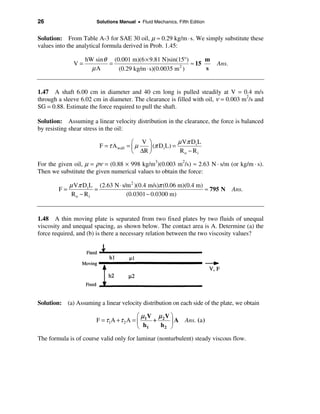
Solution: From Table A-3 for SAE 30 oil, µ ≈ 0.29 kg/m · s. We simply substitute these
values into the analytical formula derived in Prob. 1.45:

                   hW sin θ (0.001 m)(6 × 9.81 N)sin(15°)      m
              V=           =                              ≈ 15             Ans.
                     µA       (0.29 kg/m ⋅ s)(0.0035 m )
                                                      2
                                                               s


1.47 A shaft 6.00 cm in diameter and 40 cm long is pulled steadily at V = 0.4 m/s
through a sleeve 6.02 cm in diameter. The clearance is filled with oil, ν = 0.003 m2/s and
SG = 0.88. Estimate the force required to pull the shaft.

Solution: Assuming a linear velocity distribution in the clearance, the force is balanced
by resisting shear stress in the oil:

                                        æ V ö              µ Vπ Di L
                         F = τ A wall = ç µ  ÷ (π D i L) =
                                        è ∆R ø              Ro − Ri

For the given oil, µ = ρν = (0.88 × 998 kg/m3)(0.003 m2/s) ≈ 2.63 N · s/m (or kg/m · s).
Then we substitute the given numerical values to obtain the force:

             µ Vπ D i L (2.63 N ⋅ s/m 2 )(0.4 m/s)π (0.06 m)(0.4 m)
        F=             =                                            ≈ 795 N Ans.
              Ro − Ri               (0.0301 − 0.0300 m)


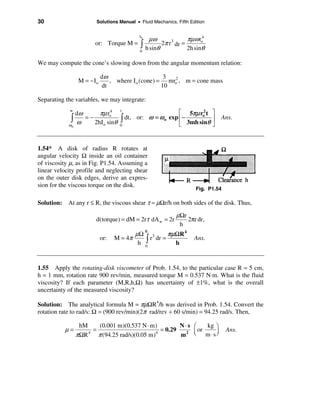
1.48 A thin moving plate is separated from two fixed plates by two fluids of unequal
viscosity and unequal spacing, as shown below. The contact area is A. Determine (a) the
force required, and (b) is there a necessary relation between the two viscosity values?


Solution: (a) Assuming a linear velocity distribution on each side of the plate, we obtain

                                          æµ V µ Vö
                       F = τ 1A + τ 2 A = ç 1 + 2 ÷ A          Ans. (a )
                                          è h1  h2 ø

The formula is of course valid only for laminar (nonturbulent) steady viscous flow.
Chapter 1 • Introduction                                     27

(b) Since the center plate separates the two fluids, they may have separate, unrelated
shear stresses, and there is no necessary relation between the two viscosities.


1.49 An amazing number of commercial and laboratory devices have been developed to
measure fluid viscosity, as described in Ref. 27. Consider a concentric shaft, as in Prob. 1.47,
but now fixed axially and rotated inside the sleeve. Let the inner and outer cylinders have
radii ri and ro, respectively, with total sleeve length L. Let the rotational rate be Ω (rad/s)
and the applied torque be M. Using these parameters, derive a theoretical relation for the
viscosity µ of the fluid between the cylinders.

Solution: Assuming a linear velocity distribution in the annular clearance, the shear stress is
                                                ∆V     Ωri
                                       τ =µ        ≈µ
                                                ∆r    ro − ri

This stress causes a force dF = τ dA = τ (ri dθ)L on each element of surface area of the inner
shaft. The moment of this force about the shaft axis is dM = ri dF. Put all this together:
                                         2π
                                                    Ωri              2πµΩri3 L
                         M = ò ri dF =   ò    ri µ         ri L dθ =
                                         0
                                                   ro − ri             ro − ri
                                                                  {
                 Solve for the viscosity: µ ≈ Μ ( rο − ri ) 2πΩri3 L        }    Ans.


1.50 A simple viscometer measures the time t for a solid sphere to fall a distance L
through a test fluid of density ρ. The fluid viscosity µ is then given by

                                          Wnet t             2 ρ DL
                                    µ≈              if t ≥
                                         3π DL                  µ
where D is the sphere diameter and Wnet is the sphere net weight in the fluid.
(a) Show that both of these formulas are dimensionally homogeneous. (b) Suppose that a
2.5 mm diameter aluminum sphere (density 2700 kg/m3) falls in an oil of density 875 kg/m3.
If the time to fall 50 cm is 32 s, estimate the oil viscosity and verify that the inequality is valid.

Solution: (a) Test the dimensions of each term in the two equations:
      ìMü     ì W t ü ì ( ML/T 2 )(T ) ü ì M ü
{µ} = í ý and í net ý = í                 ý = í ý Yes, dimensions OK.
      î LT þ  î (3π )DL þ î (1)( L )( L ) þ î LT þ
                ì 2 ρ DL ü ì (1)( M /L3 )( L )( L ) ü
 {t} = {T } and í        ý=í                        ý = {T } Yes, dimensions OK. Ans. (a)
                î µ þ î            M /LT            þ
28                          Solutions Manual • Fluid Mechanics, Fifth Edition


(b) Evaluate the two equations for the data. We need the net weight of the sphere in the fluid:

     Wnet = ( ρsphere − ρfluid )g(Vol )fluid = (2700 − 875 kg/m 3)(9.81 m/s2 )(π /6)(0.0025 m)3
          = 0.000146 N
                            Wnet t   (0.000146 N )(32 s)        kg
              Then µ =             =                     = 0.40                 Ans. (b)
                            3π DL 3π (0.0025 m)(0.5 m)          m⋅s
                                          2ρDL 2(875 kg/m3)(0.0025 m)(0.5 m)
            Check t = 32 s compared to         =
                                             µ          0.40 kg/m ⋅ s
                      = 5.5 s OK, t is greater


1.51 Use the theory of Prob. 1.50 for a shaft 8 cm long, rotating at 1200 r/min, with
ri = 2.00 cm and ro = 2.05 cm. The measured torque is M = 0.293 N·m. What is the fluid
viscosity? If the experimental uncertainties are: L (±0.5 mm), M (±0.003 N-m), Ω (±1%),
and ri and ro (±0.02 mm), what is the uncertainty in the viscosity determination?

Solution: First change the rotation rate to Ω = (2π/60)(1200) = 125.7 rad/s. Then the
analytical expression derived in Prob. 1.50 directly above is

              M(R o − R i ) (0.293 N ⋅ m)(0.0205 − 0.0200 m)           kg
         µ=                =                                    ≈ 0.29                     Ans.
               2πΩR i L
                     3
                                æ       rad ö                          m⋅ s
                             2π ç 125.7               3
                                            ÷ (0.02 m) (0.08 m)
                                è        s  ø

It might be SAE 30W oil! For estimating overall uncertainty, since the formula involves
five things, the total uncertainty is a combination of errors, each expressed as a fraction:

                            0.003                 0.04
                     SM =         = 0.0102; S∆R =      = 0.08; SΩ = 0.01
                            0.293                  0.5
                                   æ 0.02 ö               0.5
                     SR3 = 3SR = 3 ç      ÷ = 0.003; SL =     = 0.00625
                                   è 20 ø                 80

One might dispute the error in ∆R—here we took it to be the sum of the two (±0.02-mm)
errors. The overall uncertainty is then expressed as an rms computation [Refs. 30 and 31
of Chap. 1]:

                 (
         Sµ = √ S2 + S2 R + S2 + S2 3 + S2
                 m    ∆      Ω    R      L     )
             = [(0.0102)2 + (0.08)2 + (0.01)2 + (0.003)2 + (0.00625)2 ] ≈ 0.082            Ans.
Chapter 1 • Introduction                               29

The total error is dominated by the 8% error in the estimate of clearance, (Ro – Ri). We
might state the experimental result for viscosity as

                                                               kg
                      µexp ≈ 0.29 ± 8.2% = 0.29 ± 0.024                Ans.
                                                               m⋅ s


1.52 The belt in Fig. P1.52 moves at steady velocity V and skims the top of a tank of oil
of viscosity µ. Assuming a linear velocity profile, develop a simple formula for the belt-
drive power P required as a function of (h, L, V, B, µ). Neglect air drag. What power P in
watts is required if the belt moves at 2.5 m/s over SAE 30W oil at 20°C, with L = 2 m,
b = 60 cm, and h = 3 cm?


                                          Fig. P1.52

Solution: The power is the viscous resisting force times the belt velocity:

                                             æ Vö                  L
                    P = τ oil A belt Vbelt ≈ ç µ ÷ (bL)V = µ V 2 b       Ans.
                                             è hø                  h

(b) For SAE 30W oil, µ ≈ 0.29 kg/m ⋅ s. Then, for the given belt parameters,
                                         2
                 æ      kg ö æ      mö          2.0 m      kg ⋅ m 2
  P = µ V bL/h = ç 0.29
         2
                               ç 2.5 ÷ (0.6 m)        ≈ 73          = 73 W          Ans. (b)
                 è      m ⋅s ÷ è
                             ø      sø         0.03 m        s3


1.53* A solid cone of base ro and initial
angular velocity ωo is rotating inside a
conical seat. Neglect air drag and derive a
formula for the cone’s angular velocity
ω(t) if there is no applied torque.

Solution: At any radial position r < ro on                             Fig. P1.53
the cone surface and instantaneous rate ω,

                                                 æ rω öæ       dr          ö
                         d(Torque) = rτ dA w = r ç µ  ÷ç 2π r              ÷,
                                                 è h øè       sinθ         ø
30                       Solutions Manual • Fluid Mechanics, Fifth Edition

                                             ro
                                                   µω                πµω ro4
                        or: Torque M = ò                 2π r 3 dr =
                                             0
                                                  h sinθ             2h sinθ

We may compute the cone’s slowing down from the angular momentum relation:

                            dω                      3
                  M = −Io      , where I o (cone) = mro , m = cone mass
                                                      2
                            dt                     10

Separating the variables, we may integrate:
            w
                 dω      πµ ro4
                                    t
                                                            é 5πµ ro t ù
                                                                    2

            ò    ω
                    =−
                       2hI o sinθ   ò   dt, or: ω = ω o exp ê −        ú
                                                            ë 3mh sinθ û
                                                                                 Ans.
            ωo                      0


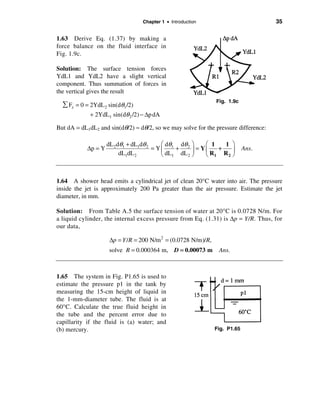
1.54* A disk of radius R rotates at
angular velocity Ω inside an oil container
of viscosity µ, as in Fig. P1.54. Assuming a
linear velocity profile and neglecting shear
on the outer disk edges, derive an expres-
sion for the viscous torque on the disk.
                                                                        Fig. P1.54

Solution: At any r ≤ R, the viscous shear τ ≈ µΩr/h on both sides of the disk. Thus,

                                                       µΩr
                         d(torque) = dM = 2rτ dA w = 2r     2πr dr,
                                                         h
                                         µΩ 3        πµΩR 4
                                            R

                                          h ò
                            or:   M = 4π      r dr =          Ans.
                                            0
                                                       h


1.55 Apply the rotating-disk viscometer of Prob. 1.54, to the particular case R = 5 cm,
h = 1 mm, rotation rate 900 rev/min, measured torque M = 0.537 N·m. What is the fluid
viscosity? If each parameter (M,R,h,Ω) has uncertainty of ±1%, what is the overall
uncertainty of the measured viscosity?

Solution: The analytical formula M = πµΩR4/h was derived in Prob. 1.54. Convert the
rotation rate to rad/s: Ω = (900 rev/min)(2π rad/rev ÷ 60 s/min) = 94.25 rad/s. Then,

                  hM     (0.001 m)(0.537 N ⋅ m)           N⋅ s æ    kg ö
          µ=           =                           = 0.29   2 ç
                                                                 or    ÷             Ans.
                 πΩR 4
                         π (94.25 rad/s)(0.05 m) 4
                                                          m è m ⋅sø
Chapter 1 • Introduction                              31

For uncertainty, looking at the formula for µ, we have first powers in h, M, and Ω and a
fourth power in R. The overall uncertainty estimate [see Eq. (1.44) and Ref. 31] would be
                                     1/ 2
       Sµ ≈ éS2 + S2 + S2 + (4SR )2 ù
            ë h     M    Ω          û
          ≈ [(0.01) + (0.01) + (0.01)2 + {4(0.01)}2 ]1/ 2 ≈ 0.044 or: ±4.4% Ans.
                   2        2


The uncertainty is dominated by the 4% error due to radius measurement. We might
report the measured viscosity as µ ≈ 0.29 ± 4.4% kg/m·s or 0.29 ± 0.013 kg/m·s.


1.56* For the cone-plate viscometer in
Fig. P1.56, the angle is very small, and the
gap is filled with test liquid µ. Assuming a
linear velocity profile, derive a formula for
the viscosity µ in terms of the torque M
and cone parameters.                                            Fig. P1.56


Solution: For any radius r ≤ R, the liquid gap is h = r tanθ. Then
                                            æ   Ωr ö æ         dr ö
                d(Torque) = dM = τ dA w r = ç µ      ÷ ç 2π r cosθ ÷ r, or
                                            è r tanθ ø è           ø
                   2πΩµ 2          2πΩµ R                  3M sinθ
                          R                  3
                M=        ò r dr = 3sinθ , or: µ = 2πΩR 3 Ans.
                    sin θ 0


1.57 Apply the cone-plate viscometer of Prob. 1.56 above to the special case R = 6 cm,
θ = 3°, M = 0.157 N ⋅ m, and a rotation rate of 600 rev/min. What is the fluid viscosity? If
each parameter (M,R,Ω,θ) has an uncertainty of ±1%, what is the uncertainty of µ?

Solution: We derived a suitable linear-velocity-profile formula in Prob. 1.56. Convert
the rotation rate to rad/s: Ω = (600 rev/min)(2π rad/rev ÷ 60 s/min) = 62.83 rad/s. Then,
              3M sinθ   3(0.157 N ⋅ m)sin(3°)         N⋅ s æ    kg ö
         µ=           =                        = 0.29      ç or    ÷           Ans.
              2πΩR 3 2π (62.83 rad/s)(0.06 m)3        m2 è m ⋅ s ø
For uncertainty, looking at the formula for µ, we have first powers in θ, M, and Ω and a
third power in R. The overall uncertainty estimate [see Eq. (1.44) and Ref. 31] would be
                                     1/ 2
       Sµ = éSθ + S2 + S2 + (3SR )2 ù
            ë
               2
                    M    Ω          û
          ≈ [(0.01) + (0.01) + (0.01)2 + {3(0.01)}2 ]1/ 2 = 0.035, or: ±3.5%
                   2        2
                                                                                 Ans.
The uncertainty is dominated by the 3% error due to radius measurement. We might
report the measured viscosity as µ ≈ 0.29 ± 3.5% kg/m·s or 0.29 ± 0.01 kg/m·s.
32                         Solutions Manual • Fluid Mechanics, Fifth Edition


1.58 The laminar-pipe-flow example of Prob. 1.14 leads to a capillary viscometer [27],
using the formula µ = π r o4∆p/(8LQ). Given ro = 2 mm and L = 25 cm. The data are
               Q, m3/hr:         0.36         0.72         1.08          1.44     1.80
               ∆p, kPa:          159          318          477           1274     1851
Estimate the fluid viscosity. What is wrong with the last two data points?

Solution: Apply our formula, with consistent units, to the first data point:

                                   π ro4 ∆p π (0.002 m)4 (159000 N/m 2 )        N ⋅s
         ∆p = 159 kPa: µ ≈                 =                       3
                                                                         ≈ 0.040 2
                                    8LQ      8(0.25 m)(0.36/3600 m /s)          m

Do the same thing for all five data points:
        ∆p, kPa:           159          318          477          1274          1851
        µ, N·s/m :  2
                           0.040        0.040        0.040        0.080(?)      0.093(?) Ans.
The last two estimates, though measured properly, are incorrect. The Reynolds number of the
capillary has risen above 2000 and the flow is turbulent, which requires a different formula.


1.59 A solid cylinder of diameter D, length L, density ρs falls due to gravity inside a tube of
diameter Do. The clearance, (Do − D) = D, is filled with a film of viscous fluid (ρ,µ). Derive
a formula for terminal fall velocity and apply to SAE 30 oil at 20°C for a steel cylinder with
D = 2 cm, Do = 2.04 cm, and L = 15 cm. Neglect the effect of any air in the tube.

Solution: The geometry is similar to Prob. 1.47, only vertical instead of horizontal. At
terminal velocity, the cylinder weight should equal the viscous drag:

                                                        π 2     é     V      ù
             a z = 0: ΣFz = − W + Drag = − ρsg            D L + êµ           ú π DL,
                                                        4       ë (Do − D)/2 û
                                       ρs gD (Do − D)
                          or: V =                          Ans.
                                             8µ

For the particular numerical case given, ρsteel ≈ 7850 kg/m3. For SAE 30 oil at 20°C,
µ ≈ 0.29 kg/m·s from Table 1.4. Then the formula predicts
                    ρsgD(Do − D) (7850 kg/m 3 )(9.81 m/s2 )(0.02 m)(0.0204 − 0.02 m)
      Vterminal =               =
                        8µ                         8(0.29 kg/m ⋅ s)
               ≈ 0.265 m/s       Ans.
Chapter 1 • Introduction                           33

1.60 A highly viscous (non-turbulent) fluid fills the gap between two long concentric
cylinders of radii a and b > a, respectively. If the outer cylinder is fixed and the inner
cylinder moves steadily at axial velocity U, the fluid will move at the axial velocity:

                                                  U ln(b/r )
                                           vz =
                                                   ln(b/a )

See Fig. 4.2 for a definition of the velocity component vz. Sketch this velocity distribution
between the cylinders and comment. Find expressions for the shear stresses at both the
inner and outer cylinder surfaces and explain why they are different.

Solution: Evaluate the shear stress at each cylinder by the Newtonian law, Eq. (1.23):

                             d é U ln(b/r ) ù   µU æ 1 ö         µU
               τ inner = µ      ê ln(b/a) ú = ln(b/a) ç r ÷ = a ln( b/a)     Ans.
                             dr ë           û         è ør =a
                             d é U ln(b/r ) ù    µU æ 1 ö          µU
               τ outer = µ      ê ln(b/a ) ú = ln(b/a ) ç r ÷ = b ln( b/a)   Ans.
                             dr ë           û           è ør = b

They are not the same because the outer cylinder area is larger. For equilibrium, we need
the inner and outer axial forces to be the same, which means τinnera = τouterb.
    A sketch of vz(r), from the logarithmic formula above, is shown for a relatively wide
annulus, a/b = 0.8. The velocity profile is seen to be nearly linear.


1.61 An air-hockey puck has m = 50 g and D = 9 cm. When placed on a 20°C air
table, the blower forms a 0.12-mm-thick air film under the puck. The puck is struck
with an initial velocity of 10 m/s. How long will it take the puck to (a) slow down to 1 m/s;
(b) stop completely? Also (c) how far will the puck have travelled for case (a)?

Solution: For air at 20°C take µ ≈ 1.8E−5 kg/m·s. Let A be the bottom area of the
puck, A = πD2 /4. Let x be in the direction of travel. Then the only force acting in the
34                        Solutions Manual • Fluid Mechanics, Fifth Edition


x direction is the air drag resisting the motion, assuming a linear velocity distribution in
the air:

                                      V     dV
              å Fx = −τ A = − µ         A=m    , where h = air film thickness
                                      h     dt

Separate the variables and integrate to find the velocity of the decelerating puck:

                                                                   µA
                   V              t
                        dV
                    ò      = −K ò dt, or V = Vo e − Kt , where K =
                   Vo
                         V      0
                                                                   mh

Integrate again to find the displacement of the puck:
                                          t
                                                     Vo
                                      x = ò V dt =      [1 − e − Kt ]
                                         0
                                                     K

Apply to the particular case given: air, µ ≈ 1.8E−5 kg/m·s, m = 50 g, D = 9 cm, h = 0.12 mm,
Vo = 10 m/s. First evaluate the time-constant K:

                        µ A (1.8E−5 kg/m ⋅ s)[(π /4)(0.09 m)2 ]
                 K=        =                                    ≈ 0.0191 s −1
                        mh       (0.050 kg)(0.00012 m)

(a) When the puck slows down to 1 m/s, we obtain the time:
                                                           −1
           V = 1 m/s = Vo e − Kt = (10 m/s) e −(0.0191 s        )t
                                                                     , or t ≈ 121 s    Ans. (a)

(b) The puck will stop completely only when e–Kt = 0, or: t = ∞                  Ans. (b)
(c) For part (a), the puck will have travelled, in 121 seconds,

                 Vo                   10 m/s
            x=      (1 − e − Kt ) =          −1
                                                [1 − e −(0.0191)(121) ] ≈ 472 m       Ans. (c)
                 K                  0.0191 s

This may perhaps be a little unrealistic. But the air-hockey puck does accelerate slowly!


1.62 The hydrogen bubbles in Fig. 1.13 have D ≈ 0.01 mm. Assume an “air-water”
interface at 30°C. What is the excess pressure within the bubble?

Solution: At 30°C the surface tension from Table A-1 is 0.0712 N/m. For a droplet or
bubble with one spherical surface, from Eq. (1.32),
                               2Y 2(0.0712 N/m)
                        ∆p =      =             ≈ 28500 Pa                    Ans.
                                R   (5E−6 m)
Chapter 1 • Introduction                           35

1.63 Derive Eq. (1.37) by making a
force balance on the fluid interface in
Fig. 1.9c.

Solution: The surface tension forces
YdL1 and YdL2 have a slight vertical
component. Thus summation of forces in
the vertical gives the result
                                                                Fig. 1.9c
  å Fz = 0 = 2YdL 2 sin(dθ1 /2)
             + 2YdL1 sin(dθ 2 /2) − ∆p dA

But dA = dL1dL2 and sin(dθ/2) ≈ dθ/2, so we may solve for the pressure difference:

                     dL 2 dθ1 + dL1dθ 2    æ dθ  dθ ö   æ 1   1 ö
            ∆p = Y                      = Yç 1 + 2 ÷ = Yç   +    ÷           Ans.
                           dL1dL 2         è dL1 dL 2 ø è R1 R 2 ø


1.64 A shower head emits a cylindrical jet of clean 20°C water into air. The pressure
inside the jet is approximately 200 Pa greater than the air pressure. Estimate the jet
diameter, in mm.

Solution: From Table A.5 the surface tension of water at 20°C is 0.0728 N/m. For
a liquid cylinder, the internal excess pressure from Eq. (1.31) is ∆p = Y/R. Thus, for
our data,

                      ∆p = Y /R = 200 N/m 2 = (0.0728 N/m)/R,
                     solve R = 0.000364 m, D = 0.00073 m         Ans.


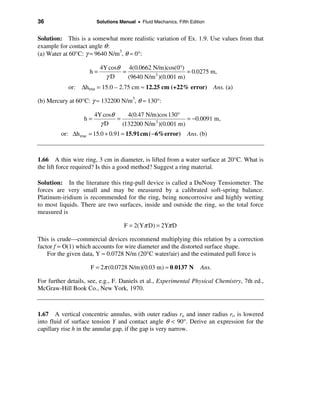
1.65 The system in Fig. P1.65 is used to
estimate the pressure p1 in the tank by
measuring the 15-cm height of liquid in
the 1-mm-diameter tube. The fluid is at
60°C. Calculate the true fluid height in
the tube and the percent error due to
capillarity if the fluid is (a) water; and
(b) mercury.                                                    Fig. P1.65
36                      Solutions Manual • Fluid Mechanics, Fifth Edition


Solution: This is a somewhat more realistic variation of Ex. 1.9. Use values from that
example for contact angle θ :
(a) Water at 60°C: γ ≈ 9640 N/m3, θ ≈ 0°:

                          4Y cosθ 4(0.0662 N/m)cos(0°)
                     h=          =                        = 0.0275 m,
                            γD     (9640 N/m 3 )(0.001 m)
            or: ∆htrue = 15.0 – 2.75 cm ≈ 12.25 cm (+22% error) Ans. (a)

(b) Mercury at 60°C: γ ≈ 132200 N/m3, θ ≈ 130°:

                       4Y cosθ     4(0.47 N/m)cos 130°
                  h=           =                          = −0.0091 m,
                         γD      (132200 N/m 3 )(0.001 m)
         or: ∆h true = 15.0 + 0.91 ≈ 15.91cm ( −6%error)         Ans. (b)


1.66 A thin wire ring, 3 cm in diameter, is lifted from a water surface at 20°C. What is
the lift force required? Is this a good method? Suggest a ring material.

Solution: In the literature this ring-pull device is called a DuNouy Tensiometer. The
forces are very small and may be measured by a calibrated soft-spring balance.
Platinum-iridium is recommended for the ring, being noncorrosive and highly wetting
to most liquids. There are two surfaces, inside and outside the ring, so the total force
measured is

                                    F = 2(Yπ D) = 2Yπ D

This is crude—commercial devices recommend multiplying this relation by a correction
factor f = O(1) which accounts for wire diameter and the distorted surface shape.
    For the given data, Y ≈ 0.0728 N/m (20°C water/air) and the estimated pull force is

                     F = 2π (0.0728 N/m)(0.03 m) ≈ 0.0137 N            Ans.

For further details, see, e.g., F. Daniels et al., Experimental Physical Chemistry, 7th ed.,
McGraw-Hill Book Co., New York, 1970.


1.67 A vertical concentric annulus, with outer radius ro and inner radius ri, is lowered
into fluid of surface tension Y and contact angle θ < 90°. Derive an expression for the
capillary rise h in the annular gap, if the gap is very narrow.
Chapter 1 • Introduction                                  37


Solution: For the figure above, the force balance on the annular fluid is

                                                          (        )
                            Y cosθ (2π ro + 2π ri ) = ρ gπ ro − ri2 h
                                                            2


Cancel where possible and the result is
                               h = 2Y cosθ /{ ρ g(ro − ri )}    Ans.


1.68* Analyze the shape η(x) of the
water-air interface near a wall, as shown.
Assume small slope, R−1 ≈ d2η/dx2. The
pressure difference across the interface is
∆p ≈ ρgη, with a contact angle θ at x = 0
and a horizontal surface at x = ∞. Find an                             Fig. P1.68
expression for the maximum height h.

Solution: This is a two-dimensional surface-tension problem, with single curvature. The
surface tension rise is balanced by the weight of the film. Therefore the differential equation is
                                           Y   d 2η       æ dη    ö
                             ∆p = ρ gη =     ≈Y 2         ç    = 1÷
                                           R   dx         è dx    ø
This is a second-order differential equation with the well-known solution,
                       η = C1 exp[Kx] + C2 exp[ −Kx], K = ( ρ g/Y)
To keep η from going infinite as x = ∞, it must be that C1 = 0. The constant C2 is found
from the maximum height at the wall:
                             η|x =0 = h = C2 exp(0), hence C2 = h
Meanwhile, the contact angle shown above must be such that,
                           dη
                              |x=0 = −cot(θ ) = −hK, thus h = cotθ
                           dx                                  K
38                        Solutions Manual • Fluid Mechanics, Fifth Edition


The complete (small-slope) solution to this problem is:

                  η = h exp[− ( ρ g/Y)1/2 x], where h = (Y/ρg)1/2 cotθ          Ans.

The formula clearly satisfies the requirement that η = 0 if x = ∞. It requires “small slope”
and therefore the contact angle should be in the range 70° < θ < 110°.


1.69 A solid cylindrical needle of diameter
d, length L, and density ρn may “float” on a
liquid surface. Neglect buoyancy and assume
a contact angle of 0°. Calculate the maxi-
mum diameter needle able to float on the
                                                                       Fig. P1.69
surface.

Solution: The needle “dents” the surface downward and the surface tension forces are
upward, as shown. If these tensions are nearly vertical, a vertical force balance gives:

                                        π                          8Y
                  å Fz = 0 = 2YL − ρ g d 2 L, or: d max ≈                     Ans. (a)
                                        4                          πρ g

(b) Calculate dmax for a steel needle (SG ≈ 7.84) in water at 20°C. The formula becomes:

               8Y              8(0.073 N/m)
     d max =       =                                    ≈ 0.00156 m ≈ 1.6 mm             Ans. (b)
               πρg   π (7.84 × 998 kg/m 3 )(9.81 m/s2 )


1.70 Derive an expression for the capillary-
height change h, as shown, for a fluid of
surface tension Y and contact angle θ be-
tween two parallel plates W apart. Evaluate
h for water at 20°C if W = 0.5 mm.

Solution: With b the width of the plates
into the paper, the capillary forces on each
                                                                       Fig. P1.70
wall together balance the weight of water
held above the reservoir free surface:

                                                            2Y cosθ
                       ρ gWhb = 2(Yb cosθ ), or: h ≈                      Ans.
                                                             ρ gW
Chapter 1 • Introduction                             39

For water at 20°C, Y ≈ 0.0728 N/m, ρg ≈ 9790 N/m3, and θ ≈ 0°. Thus, for W = 0.5 mm,

                          2(0.0728 N/m)cos 0°
                  h=                            ≈ 0.030 m ≈ 30 mm        Ans.
                        (9790 N/m 3 )(0.0005 m)


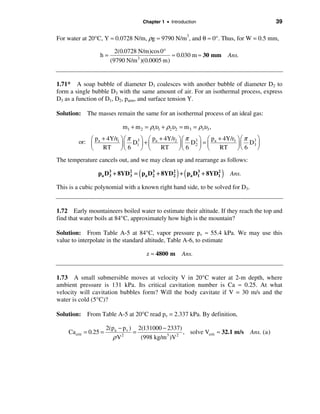
1.71* A soap bubble of diameter D1 coalesces with another bubble of diameter D2 to
form a single bubble D3 with the same amount of air. For an isothermal process, express
D3 as a function of D1, D2, patm, and surface tension Y.

Solution: The masses remain the same for an isothermal process of an ideal gas:

                             m1 + m 2 = ρ1υ1 + ρ2υ2 = m 3 = ρ3υ3 ,
              p + 4Y/r1 ö æ π 3 ö æ pa + 4Y/r2 ö æ π 3 ö æ pa + 4Y/r3 ö æ π 3 ö
        or: æ a
            ç             ç D1 ÷ + ç           ÷ ç 6 D2 ÷ = ç         ÷ ç 6 D3 ÷
            è   RT ÷ è 6ø       ø è    RT      øè       ø è   RT      øè       ø
The temperature cancels out, and we may clean up and rearrange as follows:

                     3       3      (         2       3
                                                       ) (
                 pa D3 + 8YD 2 = pa D 2 + 8YD 2 + pa D1 + 8YD1
                                      3                      2
                                                                     )   Ans.

This is a cubic polynomial with a known right hand side, to be solved for D3.


1.72 Early mountaineers boiled water to estimate their altitude. If they reach the top and
find that water boils at 84°C, approximately how high is the mountain?

Solution: From Table A-5 at 84°C, vapor pressure pv ≈ 55.4 kPa. We may use this
value to interpolate in the standard altitude, Table A-6, to estimate

                                         z ≈ 4800 m      Ans.


1.73 A small submersible moves at velocity V in 20°C water at 2-m depth, where
ambient pressure is 131 kPa. Its critical cavitation number is Ca ≈ 0.25. At what
velocity will cavitation bubbles form? Will the body cavitate if V = 30 m/s and the
water is cold (5°C)?

Solution: From Table A-5 at 20°C read pv = 2.337 kPa. By definition,

                       2(pa − p v ) 2(131000 − 2337)
    Ca crit = 0.25 =               =                  , solve Vcrit ≈ 32.1 m/s   Ans. (a )
                         ρ V2        (998 kg/m 3 )V 2
40                        Solutions Manual • Fluid Mechanics, Fifth Edition


If we decrease water temperature to 5°C, the vapor pressure reduces to 863 Pa, and the
density changes slightly, to 1000 kg/m3. For this condition, if V = 30 m/s, we compute:

                                        2(131000 − 863)
                                 Ca =                   ≈ 0.289
                                          (1000)(30)2

This is greater than 0.25, therefore the body will not cavitate for these conditions. Ans. (b)


1.74 A propeller is tested in a water tunnel at 20°C (similar to Fig. 1.12a). The lowest
pressure on the body can be estimated by a Bernoulli-type relation, pmin = po − ρV2/2,
where po = 1.5 atm and V is the tunnel average velocity. If V = 18 m/s, will there be
cavitation? If so, can we change the water temperature and avoid cavitation?

Solution: At 20°C, from Table A-5, pv = 2.337 kPa. Compute the minimum pressure:
                                                                         2
                      1                         1æ    kg öæ   mö
       p min = po −     ρ V 2 = 1.5(101350 Pa) − ç 998 3 ÷ç 18 ÷ = −9650 Pa (??)
                      2                         2è    m øè    sø

The predicted pressure is less than the vapor pressure, therefore the body will cavitate.
[The actual pressure would not be negative; a cavitation bubble would form.]
   Since the predicted pressure is negative; no amount of cooling—even to T = 0°C,
where the vapor pressure is zero, will keep the body from cavitating at 18 m/s.


1.75 Oil, with a vapor pressure of 20 kPa, is delivered through a pipeline by equally-
spaced pumps, each of which increases the oil pressure by 1.3 MPa. Friction losses in the
pipe are 150 Pa per meter of pipe. What is the maximum possible pump spacing to avoid
cavitation of the oil?

Solution: The absolute maximum length L occurs when the pump inlet pressure is
slightly greater than 20 kPa. The pump increases this by 1.3 MPa and friction drops the
pressure over a distance L until it again reaches 20 kPa. In other words, quite simply,

           1.3 MPa = 1,300,000 Pa = (150 Pa/m)L, or L max ≈ 8660 m            Ans.

It makes more sense to have the pump inlet at 1 atm, not 20 kPa, dropping L to about 8 km.


1.76 Estimate the speed of sound of steam at 200°C and 400 kPa, (a) by an ideal-gas
approximation (Table A.4); and (b) using EES (or the Steam Tables) and making small
isentropic changes in pressure and density and approximating Eq. (1.38).
Chapter 1 • Introduction                              41

Solution: (a) For steam, k ≈ 1.33 and R = 461 m2/s2·K. The ideal gas formula predicts:

          a ≈ √(kRT) = √{1.33(461 m 2 /s2 ⋅ K)(200 + 273 K)} ≈ 539 m/s        Ans. (a)

(b) We use the formula a = √(∂p/ ∂ρ)s ≈ √{∆p|s/∆ρ|s} for small isentropic changes in p
and ρ. From EES, at 200°C and 400 kPa, the entropy is s = 1.872 kJ/kg·K. Raise and
lower the pressure 1 kPa at the same entropy. At p = 401 kPa, ρ = 1.87565 kg/m3. At
p = 399 kPa, ρ = 1.86849 kg/m3. Thus ∆ρ = 0.00716 kg/m3, and the formula for sound
speed predicts:

         a ≈ √{∆p|s /∆ρ |s} = √{(2000 N/m 2 )/(0.00358 kg/m 3 )} = 529 m/s      Ans. (b)

Again, as in Prob. 1.34, the ideal gas approximation is within 2% of a Steam-Table solution.


1.77 The density of gasoline varies with pressure approximately as follows:

                         p, atm:      1         500       1000    1500
                       ρ, lbm/ft3:    42.45     44.85     46.60   47.98

Estimate (a) its speed of sound, and (b) its bulk modulus at 1 atm.

Solution: For a crude estimate, we could just take differences of the first two points:

                        ì (500 − 1)(2116) lbf/ft 2 ü             ft     m
    a ≈ (∆p/∆ρ ) ≈ í                                   3ý
                                                          ≈ 3760 ≈ 1150    Ans. (a)
                        î (44.85 − 42.45)/32.2 slug/ft þ         s      s
                                                             lbf
     B ≈ ρ a 2 = [42.45/32.2 slug/ft 3](3760 ft/s)2 ≈ 1.87E7 2 ≈ 895 MPa Ans. (b)
                                                             ft
For more accuracy, we could fit the data to the nonlinear equation of state for liquids,
Eq. (1.22). The best-fit result for gasoline (data above) is n ≈ 8.0 and B ≈ 900.
    Equation (1.22) is too simplified to show temperature or entropy effects, so we
assume that it approximates “isentropic” conditions and thus differentiate:

               p                                      dp n(B + 1)pa
                  ≈ (B + 1)( ρ / ρa )n − B, or: a 2 =    ≈          ( ρ / ρa )n −1
               pa                                     dρ    ρa
                           or, at 1 atm, a liquid ≈ n(B + 1)pa / ρa

The bulk modulus of gasoline is thus approximately:

       “Β” = ρ
                 dp
                    |1 atm = n(B + 1)pa = (8.0)(901)(101350 Pa) ≈ 731 MPa       Ans. (b)
                 dρ
42                       Solutions Manual • Fluid Mechanics, Fifth Edition


And the speed of sound in gasoline is approximately,

                                                                                 m
            a1 atm = [(8.0)(901)(101350 Pa)/(680 kg/m 3 )]1/2 ≈ 1040                 Ans. (a)
                                                                                 s


1.78 Sir Isaac Newton measured sound speed by timing the difference between
seeing a cannon’s puff of smoke and hearing its boom. If the cannon is on a mountain
5.2 miles away, estimate the air temperature in °C if the time difference is (a) 24.2 s;
(b) 25.1 s.

Solution: Cannon booms are finite (shock) waves and travel slightly faster than sound
waves, but what the heck, assume it’s close enough to sound speed:

          ∆x 5.2(5280)(0.3048)         m
(a) a ≈      =                 = 345.8   = 1.4(287)T, T ≈ 298 K ≈ 25°C                           Ans. (a)
          ∆t       24.2                s
          ∆x 5.2(5280)(0.3048)         m
(b) a ≈      =                 = 333.4   = 1.4(287)T, T ≈ 277 K ≈ 4°C                           Ans. (b)
          ∆t        25.1               s


1.79 Even a tiny amount of dissolved gas can drastically change the speed of sound of a
gas-liquid mixture. By estimating the pressure-volume change of the mixture, Olson [40]
gives the following approximate formula:

                                                        pg K l
                        amixture ≈
                                     [ x ρ g + (1 − x ) ρl ][ xK l + (1 − x ) pg ]

where x is the volume fraction of gas, K is the bulk modulus, and subscripts l and g
denote the liquid and gas, respectively. (a) Show that the formula is dimensionally
homogeneous. (b) For the special case of air bubbles (density 1.7 kg/m3 and pressure 150 kPa)
in water (density 998 kg/m3 and bulk modulus 2.2 GPa), plot the mixture speed of sound
in the range 0 ≤ x ≤ 0.002 and discuss.

Solution: (a) Since x is dimensionless and K dimensions cancel between the numerator
and denominator, the remaining dimensions are pressure divided by density:

                {amixture} = [{p}/{ρ}]1/2 = [(M/LT 2 )/(M/L3 )]1/ 2 = [L2 /T 2 ]1/ 2
                          = L/T Yes, homogeneous                 Ans. (a)
Chapter 1 • Introduction                                    43

(b) For the given data, a plot of sound speed versus gas volume fraction is as follows:


The difference in air and water compressibility is so great that the speed drop-off is quite sharp.


1.80* A two-dimensional steady velocity field is given by u = x2 – y2, v = –2xy. Find
the streamline pattern and sketch a few lines. [Hint: The differential equation is exact.]

Solution: Equation (1.44) leads to the differential equation:
                 dx dy     dx      dy
                    =  = 2      =      , or: (2xy)dx + (x 2 − y 2 )dy = 0
                  u   v x −y  2
                                  −2xy
As hinted, this equation is exact, that is, it has the form dF = (∂ F/∂ x)dx + (∂ F/∂ y)dy = 0.
We may check this readily by noting that ∂ /∂ y(2xy) = ∂ /∂ x(x2 − y2) = 2x = ∂ 2F/∂ x ∂ y. Thus
we may integrate to give the formula for streamlines:
                                F = x 2 y − y 3 /3 + constant    Ans.
This represents (inviscid) flow in a series of 60° corners, as shown in Fig. E4.7a of the
text. [This flow is also discussed at length in Section 4.7.]


1.81 Repeat Ex. 1.13 by letting the velocity components increase linearly with time:
                                       V = Kxti − Kytj + 0k

Solution: The flow is unsteady and two-dimensional, and Eq. (1.44) still holds:
                                          dx dy      dx   dy
                          Streamline:        = , or:    =
                                           u  v      Kxt −Kyt
44                      Solutions Manual • Fluid Mechanics, Fifth Edition


The terms K and t both vanish and leave us with the same result as in Ex. 1.13, that is,

                          ò dx/x = −ò dy/y,         or: xy = C        Ans.

The streamlines have exactly the same “stagnation flow” shape as in Fig. 1.13.
However, the flow is accelerating, and the mass flow between streamlines is
constantly increasing.


1.82 A velocity field is given by u = V cosθ, v = V sinθ, and w = 0, where V and θ are
constants. Find an expression for the streamlines of this flow.

Solution: Equation (1.44) may be used to find the streamlines:

                      dx dy    dx     dy         dy
                         =  =      =       , or:    = tanθ
                       u   v V cosθ V sinθ       dx
                        Solution: y = (tanθ )x + constant              Ans.

The streamlines are straight parallel lines which make an angle θ with the x axis. In
other words, this velocity field represents a uniform stream V moving upward at
angle θ.


1.83* A two-dimensional unsteady velocity field is given by u = x(1 + 2t), v = y. Find
the time-varying streamlines which pass through some reference point (xo,yo). Sketch
some.

Solution: Equation (1.44) applies with time as a parameter:

              dx    dx      dy dy               1
                 =        =   = , or: ln(y) =        ln(x) + constant
               u x(1 + 2t) v    y             1 + 2t
                        or: y = Cx1/(1+ 2t) , where C is a constant

In order for all streamlines to pass through y = yo at x = xo , the constant must be
such that:

                                  y = yo ( x / xo )1/(1+ 2t)   Ans.

Some streamlines are plotted on the next page and are seen to be strongly time-varying.
Chapter 1 • Introduction                              45


1.84* Modify Prob. 1.83 to find the equation of the pathline which passes through the
point (xo, yo) at t = 0. Sketch this pathline.

Solution: The pathline is computed by integration, over time, of the velocities:
               dx                         dx                                      2
                  = u = x(1 + 2t), or: ò     = ò (1 + 2t) dt, or: x = x o e t + t
               dt                          x
               dy                  dy
                  = v = y, or: ò      = ò dt, or: y = y o e t
               dt                   y
We have implemented the initial conditions (x, y) = (xo, yo) at t = 0. [We were very lucky, as
planned for this problem, that u did not depend upon y and v did not depend upon x.] Now
eliminate t between these two to get a geometric expression for this particular pathline:
      x = x o exp{ln(y/y o ) + ln 2 (y/y o )}   This pathline is shown in the sketch below.
46                       Solutions Manual • Fluid Mechanics, Fifth Edition


1.85-a Report to the class on the achievements of Evangelista Torricelli.

Solution: Torricelli’s biography is taken from a goldmine of information which I did not
put in the references, preferring to let the students find it themselves: C. C. Gillespie (ed.),
Dictionary of Scientific Biography, 15 vols., Charles Scribner’s Sons, New York, 1976.
    Torricelli (1608–1647) was born in Faenza, Italy, to poor parents who recognized his
genius and arranged through Jesuit priests to have him study mathematics, philosophy,
and (later) hydraulic engineering under Benedetto Castelli. His work on dynamics of
projectiles attracted the attention of Galileo himself, who took on Torricelli as an
assistant in 1641. Galileo died one year later, and Torricelli was appointed in his place as
“mathematician and philosopher” by Duke Ferdinando II of Tuscany. He then took up
residence in Florence, where he spent his five happiest years, until his death in 1647. In
1644 he published his only known printed work, Opera Geometrica, which made him
famous as a mathematician and geometer.
    In addition to many contributions to geometry and calculus, Torricelli was the first to
show that a zero-drag projectile formed a parabolic trajectory. His tables of trajectories
for various angles and initial velocities were used by Italian artillerymen. He was an
excellent machinist and constructed—and sold—the very finest telescope lenses in Italy.
    Torricelli’s hydraulic studies were brief but stunning, leading Ernst Mach to proclaim
him the ‘founder of hydrodynamics.’ He deduced his theorem that the velocity of efflux
from a hole in a tank was equal to √(2gh), where h is the height of the free surface above
the hole. He also showed that the efflux jet was parabolic and even commented on water-
droplet breakup and the effect of air resistance. By experimenting with various liquids in
closed tubes—including mercury (from mines in Tuscany)—he thereby invented the
barometer. From barometric pressure (about 30 feet of water) he was able to explain why
siphons did not work if the elevation change was too large. He also was the first to
explain that winds were produced by temperature and density differences in the atmo-
sphere and not by “evaporation.”


1.85-b   Report to the class on the achievements of Henri de Pitot.

Solution: The following notes are abstracted from the Dictionary of Scientific Biography
(see Prob. 1.85-a).
    Pitot (1695–1771) was born in Aramon, France, to patrician parents. He hated to study
and entered the military instead, but only for a short time. Chance reading of a textbook
obtained in Grenoble led him back to academic studies of mathematics, astronomy, and
engineering. In 1723 he became assistant to Réamur at the French Academy of Sciences
and in 1740 became a civil engineer upon his appointment as a director of public works in
Languedoc Province. He retired in 1756 and returned to Aramon until his death in 1771.
    Pitot’s research was apparently mediocre, described as “competent solutions to
minor problems without lasting significance”not a good recommendation for tenure
nowadays! His lasting contribution was the invention, in 1735, of the instrument which
Chapter 1 • Introduction                                  47

bears his name: a glass tube bent at right angles and inserted into a moving stream with
the opening facing upstream. The water level in the tube rises a distance h above the
surface, and Pitot correctly deduced that the stream velocity ≈ √(2gh). This is still a
basic instrument in fluid mechanics.


1.85-c Report to the class on the achievements of Antoine Chézy.

Solution: The following notes are from Rouse and Ince [Ref. 23].
    Chézy (1718–1798) was born in Châlons-sur-Marne, France, studied engineering at the Ecole
des Ponts et Chaussées and then spent his entire career working for this school, finally being
appointed Director one year before his death. His chief contribution was to study the flow in open
channels and rivers, resulting in a famous formula, used even today, for the average velocity:
                                       V ≈ const AS/P
where A is the cross-section area, S the bottom slope, and P the wetted perimeter, i.e., the
length of the bottom and sides of the cross-section. The “constant” depends primarily on
the roughness of the channel bottom and sides. [See Chap. 10 for further details.]


1.85-d   Report to the class on the achievements of Gotthilf Heinrich Ludwig Hagen.

Solution: The following notes are from Rouse and Ince [Ref. 23].
    Hagen (1884) was born in Königsberg, East Prussia, and studied there, having among
his teachers the famous mathematician Bessel. He became an engineer, teacher, and
writer and published a handbook on hydraulic engineering in 1841. He is best known for
his study in 1839 of pipe-flow resistance, for water flow at heads of 0.7 to 40 cm,
diameters of 2.5 to 6 mm, and lengths of 47 to 110 cm. The measurements indicated that
the pressure drop was proportional to Q at low heads and proportional (approximately) to
Q2 at higher heads, where “strong movements” occurred—turbulence. He also showed
that ∆p was approximately proportional to D−4.
    Later, in an 1854 paper, Hagen noted that the difference between laminar and turbulent
flow was clearly visible in the efflux jet, which was either “smooth or fluctuating,” and in
glass tubes, where sawdust particles either “moved axially” or, at higher Q, “came into
whirling motion.” Thus Hagen was a true pioneer in fluid mechanics experimentation.
Unfortunately, his achievements were somewhat overshadowed by the more widely
publicized 1840 tube-flow studies of J. L. M. Poiseuille, the French physician.


1.85-e Report to the class on the achievements of Julius Weisbach.

Solution: The following notes are abstracted from the Dictionary of Scientific Biography
(see Prob. 1.85-a) and also from Rouse and Ince [Ref. 23].
48                      Solutions Manual • Fluid Mechanics, Fifth Edition


     Weisbach (1806–1871) was born near Annaberg, Germany, the 8th of nine children
of working-class parents. He studied mathematics, physics, and mechanics at Göttingen
and Vienna and in 1931 became instructor of mathematics at Freiberg Gymnasium. In
1835 he was promoted to full professor at the Bergakademie in Freiberg. He published
15 books and 59 papers, primarily on hydraulics. He was a skilled laboratory worker and
summarized his results in Experimental-Hydraulik (Freiberg, 1855) and in the Lehrbuch
der Ingenieur- und Maschinen-Mechanik (Brunswick, 1845), which was still in print
60 years later. There were 13 chapters on hydraulics in this latter treatise. Weisbach
modernized the subject of fluid mechanics, and his discussions and drawings of flow
patterns would be welcome in any 20th century textbook—see Rouse and Ince [23] for
examples.
     Weisbach was the first to write the pipe-resistance head-loss formula in modern form:
hf(pipe) = f(L/D)(V2/2g), where f was the dimensionless ‘friction factor,’ which Weisbach
noted was not a constant but related to the pipe flow parameters [see Sect. 6.4]. He was also
the first to derive the “weir equation” for volume flow rate Q over a dam of crest length L:

                              é         3/2
                                            æ V2 ö ù 2
                                                  3/2
                   2       1/2 æ   V2 ö
                Q ≈ Cw (2g) êç H +               ÷ ú
                                      ÷ − ç 2g ø ú ≈ 3 Cw (2g) H
                                                              1/2 3/2
                   3          êè   2g ø     è
                              ë                       û

where H is the upstream water head level above the dam crest and Cw is a
dimensionless weir coefficient ≈ O(unity). [see Sect. 10.7] In 1860 Weisbach received
the first Honorary Membership awarded by the German engineering society, the Verein
Deutscher Ingenieure.


1.85-f Report to the class on the achievements of George Gabriel Stokes.

Solution: The following notes are abstracted from the Dictionary of Scientific
Biography (see Prob. 1.85-a).
    Stokes (1819–1903) was born in Skreen, County Sligo, Ireland, to a clergical family
associated for generations with the Church of Ireland. He attended Bristol College and
Cambridge University and, upon graduation in 1841, was elected Fellow of Pembroke
College, Cambridge. In 1849, he became Lucasian Professor at Cambridge, a post once
held by Isaac Newton. His 60-year career was spent primarily at Cambridge and resulted
in many honors: President of the Cambridge Philosophical Society (1859), secretary
(1854) and president (1885) of the Royal Society of London, member of Parliament
(1887–1891), knighthood (1889), the Copley Medal (1893), and Master of Pembroke
College (1902). A true ‘natural philosopher,’ Stokes systematically explored hydro-
dynamics, elasticity, wave mechanics, diffraction, gravity, acoustics, heat, meteorology,
and chemistry. His primary research output was from 1840–1860, for he later became tied
down with administrative duties.
Chapter 1 • Introduction                             49

   In hydrodynamics, Stokes has several formulas and fields named after him:
   (1)   The equations of motion of a linear viscous fluid: the Navier-Stokes equations.
   (2)   The motion of nonlinear deep-water surface waves: Stokes waves.
   (3)   The drag on a sphere at low Reynolds number: Stokes’ formula, F = 3πµVD.
   (4)   Flow over immersed bodies for Re << 1: Stokes flow.
   (5)   A metric (CGS) unit of kinematic viscosity, ν : 1 cm2/s = 1 stoke.
   (6)   A relation between the 1st and 2nd coefficients of viscosity: Stokes’ hypothesis.
   (7)   A stream function for axisymmetric flow: Stokes’ stream function [see Chap. 8].
Although Navier, Poisson, and Saint-Venant had made derivations of the equations of
motion of a viscous fluid in the 1820’s and 1830’s, Stokes was quite unfamiliar with the
French literature. He published a completely independent derivation in 1845 of the
Navier-Stokes equations [see Sect. 4.3], using a ‘continuum-calculus’ rather than a
‘molecular’ viewpoint, and showed that these equations were directly analogous to the
motion of elastic solids. Although not really new, Stokes’ equations were notable for
being the first to replace the mysterious French ‘molecular coefficient’ ε by the
coefficient of absolute viscosity, µ.


1.85-g    Report to the class on the achievements of Moritz Weber.

Solution: The following notes are from Rouse and Ince [Ref. 23].
    Weber (1871–1951) was professor of naval mechanics at the Polytechnic Institute of
Berlin. He clarified the principles of similitude (dimensional analysis) in the form used
today. It was he who named the Froude number and the Reynolds number in honor of
those workers. In a 1919 paper, he developed a dimensionless surface-tension (capillarity)
parameter [see Sect. 5.4] which was later named the Weber number in his honor.


1.85-h    Report to the class on the achievements of Theodor von Kármán.

Solution: The following notes are abstracted from the Dictionary of Scientific Biography
(see Prob. 1.85-a). Another good reference is his ghost-written (by Lee Edson) auto-
biography, The Wind and Beyond, Little-Brown, Boston, 1967.
    Kármán (1881–1963) was born in Budapest, Hungary, to distinguished and well-
educated parents. He attended the Technical University of Budapest and in 1906 received
a fellowship to Göttingen, where he worked for six years with Ludwig Prandtl, who had
just developed boundary layer theory. He received a doctorate in 1912 from Göttingen
and was then appointed director of aeronautics at the Polytechnic Institute of Aachen. He
remained at Aachen until 1929, when he was named director of the newly formed
Guggenheim Aeronautical Laboratory at the California Institute of Technology. Kármán
50                      Solutions Manual • Fluid Mechanics, Fifth Edition


developed CalTech into a premier research center for aeronautics. His leadership spurred
the growth of the aerospace industry in southern California. He helped found the Jet
Propulsion Laboratory and the Aerojet General Corporation. After World War II, Kármán
founded a research arm for NATO, the Advisory Group for Aeronautical Research and
Development, whose renowned educational institute in Brussels is now called the Von
Kármán Center.
    Kármán was uniquely skilled in integrating physics, mathematics, and fluid mechanics
into a variety of phenomena. His most famous paper was written in 1912 to explain the
puzzling alternating vortices shed behind cylinders in a steady-flow experiment conducted
by K. Hiemenz, one of Kármán’s students—these are now called Kármán vortex streets
[see Fig. 5.2a]. Shed vortices are thought to have caused the destruction by winds of the
Tacoma Narrows Bridge in 1940 in Washington State.
    Kármán wrote 171 articles and 5 books and his methods had a profound influence on
fluid mechanics education in the 20th century.


1.85-i   Report to the class on the achievements of Paul Richard Heinrich Blasius.

Solution: The following notes are from Rouse and Ince [Ref. 23].
    Blasius (1883–1970) was Ludwig Prandtl’s first graduate student at Göttingen. His
1908 dissertation gave the analytic solution for the laminar boundary layer on a flat plate
[see Sect. 7.4]. Then, in two papers in 1911 and 1913, he gave the first demonstration that
pipe-flow resistance could be nondimensionalized as a plot of friction factor versus
                                                                               −
Reynolds number—the first “Moody-type” chart. His correlation, f ≈ 0.316 Re d 1/4, is still
is use today. He later worked on analytical solutions of boundary layers with variable
pressure gradients.


1.85-j Report to the class on the achievements of Ludwig Prandtl.

Solution: The following notes are from Rouse and Ince [Ref. 23].
    Ludwig Prandtl (1875–1953) is described by Rouse and Ince [23] as the father of modern
fluid mechanics. Born in Munich, the son of a professor, Prandtl studied engineering and
received a doctorate in elasticity. But his first job as an engineer made him aware of the lack
of correlation between theory and experiment in fluid mechanics. He conducted research
from 1901–1904 at the Polytechnic Institute of Hanover and presented a seminal paper in
1904, outlining the new concept of “boundary layer theory.” He was promptly hired as
professor and director of applied mechanics at the University of Gottingen, where he
remained throughout his career. He, and his dozens of famous students, started a new
“engineering science” of fluid mechanics, emphasizing (1) mathematical analysis based upon
by physical reasoning; (2) new experimental techniques; and (3) new and inspired flow-
visualization schemes which greatly increased our understanding of flow phenomena.
Chapter 1 • Introduction                               51

     In addition to boundary-layer theory, Prandtl made important contributions to
(1) wing theory; (2) turbulence modeling; (3) supersonic flow; (4) dimensional analysis; and
(5) instability and transition of laminar flow. He was a legendary engineering professor.


1.85-k   Report to the class on the achievements of Osborne Reynolds.

Solution: The following notes are from Rouse and Ince [Ref. 23].
    Osborne Reynolds (1842–1912) was born in Belfast, Ireland, to a clerical family and
studied mathematics at Cambridge University. In 1868 he was appointed chair of
engineering at a college which is now known as the University of Manchester Institute
of Science and Technology (UMIST). He wrote on wide-ranging topics—mechanics,
electricity, navigation—and developed a new hydraulics laboratory at UMIST. He was
the first person to demonstrate cavitation, that is, formation of vapor bubbles due to high
velocity and low pressure. His most famous experiment, still performed in the
undergraduate laboratory at UMIST (see Fig. 6.5 in the text) demonstrated transition of
laminar pipe flow into turbulence. He also showed in this experiment that the viscosity
was very important and led him to the dimensionless stability parameter ρVD/µ now
called the Reynolds number in his honor. Perhaps his most important paper, in 1894,
extended the Navier-Stokes equations (see Eqs. 4.38 of the text) to time-averaged
randomly fluctuating turbulent flow, with a result now called the Reynolds equations of
turbulence. Reynolds also contributed to the concept of the control volume which forms
the basis of integral analysis of flow (Chap. 3).


1.85-l   Report to the class on the achievements of John William Strutt, Lord Rayleigh.

Solution: The following notes are from Rouse and Ince [Ref. 23].
     John William Strutt (1842–1919) was born in Essex, England, and inherited the title
Lord Rayleigh. He studied at Cambridge University and was a traditional hydro-
dynamicist in the spirit of Euler and Stokes. He taught at Cambridge most of his life and
also served as president of the Royal Society. He is most famous for his work (and his
textbook) on the theory of sound. In 1904 he won the Nobel Prize for the discovery of
argon gas. He made at least five important contributions to hydrodynamics: (1) the
equations of bubble dynamics in liquids, now known as Rayleigh-Plesset theory; (2) the
theory of nonlinear surface waves; (3) the capillary (surface tension) instability of jets;
(4) the “heat-transfer analogy” to laminar flow; and (5) dimensional similarity, especially
related to viscosity data for argon gas and later generalized into group theory which
previewed Buckingham’s Pi Theorem. He ended his career as president, in 1909, of the
first British committee on aeronautics.
52                     Solutions Manual • Fluid Mechanics, Fifth Edition


1.85-m Report to the class on the achievements of Daniel Bernoulli.

Solution: The following notes are from Rouse and Ince [Ref. 23].
    Daniel Bernoulli (1700–1782) was born in Groningen, Holland, his father, Johann,
being a Dutch professor. He studied at the University of Basel, Switzerland, and taught
mathematics for a few years at St. Petersburg, Russia. There he wrote, and published in
1738, his famous treatise Hydrodynamica, for which he is best known. This text
contained numerous ingenious drawings illustrating various flow phenomena. Bernoulli
used energy concepts to establish proportional relations between kinetic and potential
energy, with pressure work added only in the abstract. Thus he never actually derived the
famous equation now bearing his name (Eq. 3.77 of the text), later derived in 1755 by his
friend Leonhard Euler. Daniel Bernoulli never married and thus never contributed
additional members to his famous family of mathematicians.


1.85-n   Report to the class on the achievements of Leonhard Euler.

Solution: The following notes are from Rouse and Ince [Ref. 23].
    Leonhard Euler (1707–1783) was born in Basel, Switzerland, and studied mathematics
under Johann Bernoulli, Daniel’s father. He succeeded Daniel Bernoulli as professor of
mathematics at the St. Petersburg Academy, leaving there in 1741 to join the faculty of
Berlin University. He lost his sight in 1766 but continued to work, aided by a prodigious
memory, and produced a vast output of scientific papers, dealing with mathematics,
optics, mechanics, hydrodynamics, and celestial mechanics (for which he is most famous
today). His famous paper of 1755 on fluid flow derived the full inviscid equations of fluid
motion (Eqs. 4.36 of the text) now called Euler’s equations. He used a fixed coordinate
system, now called the Eulerian frame of reference. The paper also presented, for the first
time, the correct form of Bernoulli’s equation (Eq. 3.77 of the text). Separately, in 1754
he produced a seminal paper on the theory of reaction turbines, leading to Euler’s turbine
equation (Eq. 11.11 of the text).
Chapter 1 • Introduction                              53

      FUNDAMENTALS OF ENGINEERING EXAM PROBLEMS: Answers

FE-1.1 The absolute viscosity µ of a fluid is primarily a function of
        (a) density (b) temperature (c) pressure (d) velocity (e) surface tension
FE-1.2 If a uniform solid body weighs 50 N in air and 30 N in water, its specific gravity is
                         (a) 1.5 (b) 1.67 (c) 2.5 (d) 3.0 (e) 5.0
FE-1.3 Helium has a molecular weight of 4.003. What is the weight of 2 cubic meters
of helium at 1 atmosphere and 20°C?
                  (a) 3.3 N (b) 6.5 N (c) 11.8 N (d) 23.5 N (e) 94.2 N
FE-1.4 An oil has a kinematic viscosity of 1.25E–4 m2/s and a specific gravity of 0.80.
What is its dynamic (absolute) viscosity in kg/(m · s)?
                        (a) 0.08 (b) 0.10 (c) 0.125 (d) 1.0 (e) 1.25
FE-1.5 Consider a soap bubble of diameter 3 mm. If the surface tension coefficient is
0.072 N/m and external pressure is 0 Pa gage, what is the bubble’s internal gage pressure?
               (a) −24 Pa (b) +48 Pa (c) +96 Pa (d) +192 Pa (e) −192 Pa
FE-1.6 The only possible dimensionless group which combines velocity V, body size L,
fluid density ρ, and surface tension coefficient σ is:
                (a) Lρσ /V (b) ρVL2/σ (c) ρσ V 2/L (d) σ LV2/ρ (e) ρ LV2/σ
FE-1.7 Two parallel plates, one moving at 4 m/s and the other fixed, are separated by
a 5-mm-thick layer of oil of specific gravity 0.80 and kinematic viscosity 1.25E−4 m2/s.
What is the average shear stress in the oil?
                   (a) 80 Pa (b) 100 Pa (c) 125 Pa (d) 160 Pa (e) 200 Pa
FE-1.8 Carbon dioxide has a specific heat ratio of 1.30 and a gas constant of 189 J/(kg·°C).
If its temperature rises from 20°C to 45°C, what is its internal energy rise?
       (a) 12.6 kJ/kg (b) 15.8 kJ/kg (c) 17.6 kJ/kg (d) 20.5 kJ/kg (e) 25.1 kJ/kg
FE-1.9 A certain water flow at 20°C has a critical cavitation number, where bubbles
form, Ca ≈ 0.25, where Ca = 2(pa − pvap)/(ρV2). If pa = 1 atm and the vapor pressure is
0.34 psia, for what water velocity will bubbles form?
             (a) 12 mi/hr (b) 28 mi/hr (c) 36 mi/hr (d) 55 mi/hr (e) 63 mi/hr
FE-1.10 A steady incompressible flow, moving through a contraction section of length L,
has a one-dimensional average velocity distribution given by u ≈ Uo(1 + 2x/L). What is its
convective acceleration at the end of the contraction, x = L?
                   (a) Uo2/L (b) 2Uo2/L (c) 3Uo2/L (d) 4Uo2/L (e) 6Uo2/L
54                         Solutions Manual • Fluid Mechanics, Fifth Edition


                              COMPREHENSIVE PROBLEMS

C1.1 Sometimes equations can be developed and practical problems solved by knowing
nothing more than the dimensions of the key parameters. For example, consider the heat
loss through a window in a building. Window efficiency is rated in terms of “R value,”
which has units of ft2·hr·°F/Btu. A certain manufacturer offers a double-pane window with
R = 2.5 and also a triple-pane window with R = 3.4. Both windows are 3 ft by 5 ft. On
a given winter day, the temperature difference between inside and outside is 45°F.
(a) Develop and equation for window heat loss Q, in time period ∆t, as a function of
window area A, R value, and temperature difference ∆T. How much heat is lost through the
above (a) double-pane window, or (b) triple-pane window, in 24 hours? (c) Suppose the
building is heated with propane gas, at $1.25 per gallon, burning at 80% efficiency.
Propane has 90,000 Btu of available energy per gallon. In a 24-hour period, how much
money would a homeowner save, per window, by installing a triple-pane rather than a
double-pane window? (d) Finally, suppose the homeowner buys 20 such triple-pane
windows for the house. A typical winter equals about 120 heating days at ∆T = 45°F.
Each triple-pane window costs $85 more than the double-pane window. Ignoring interest
and inflation, how many years will it take the homeowner to make up the additional cost of
the triple-pane windows from heating bill savings?

Solution: (a) The function Q = fcn(∆t, R, A, ∆T) must have units of Btu. The only
combination of units which accomplishes this is:

          ∆t∆T A                              (24 hr )(45°F )(3 ft ⋅ 5 ft )
     Q=             Ans.       Thus Qlost =                                 = 6480 Btu   Ans. (a)
            R                                    2.5 ft 2 ⋅ hr ⋅ °F /Btu
(b) Triple-pane window: use R = 3.4 instead of 2.5 to obtain Q3-pane = 4760 Btu Ans. (b)

(c) The savings, using propane, for one triple-pane window for one 24-hour period is:

                 $1.25/gal                          1
     ∆Cost =                 (6480 − 4760 Btu)                = $0.030 = 3 cents         Ans. (c)
               90000 Btu/gal                   0.80efficiency

(d) Extrapolate to 20 windows, 120 cold days per year, and $85 extra cost per window:

                                       $85/window
       Pay−back time =                                           = 24 years          Ans. (d)
                            (0.030$/window/day)(120 days/ year )

Not a good investment. We are using ‘$’ and ‘windows’ as “units” in our equations!
Chapter 1 • Introduction                                     55

C1.2 When a person ice-skates, the ice surface actually melts beneath the blades, so
that he or she skates on a thin film of water between the blade and the ice. (a) Find an
expression for total friction force F on the bottom of the blade as a function of skater
velocity V, blade length L, water film thickness h, water viscosity µ, and blade width W.
(b) Suppose a skater of mass m, moving at constant speed Vo, suddenly stands stiffly with
skates pointed directly forward and allows herself to coast to a stop. Neglecting air
resistance, how far will she travel (on two blades) before she stops? Give the answer X
as a function of (Vo, m, L, h, µ, W). (c) Compute X for the case Vo = 4 m/s, m = 100 kg,
L = 30 cm, W = 5 mm, and h = 0.1 mm. Do you think our assumption of negligible air
resistance was a good one?

Solution: (a) The skate bottom and the melted ice are like two parallel plates:

                                  V            µVLW
                           τ =µ     , F =τ A =                  Ans. (a)
                                  h              h

(b) Use F = ma to find the stopping distance:

                   2 µVLW            dV
   ΣFx = − F = −          = ma x = m
                      h              dt
         (the ‘2’ is for two blades)

Separate and integrate once to find the
velocity, once again to find the distance
traveled:
                                                −2 µ LW           ∞
         dV      2 µ LW                                 t                    Vo mh
     ò   V
            = −ò
                   mh
                        dt , or: V = Vo e         mh      ,   X = ò V dt =
                                                                             2 µ LW
                                                                                      Ans. (b)
                                                                  0

(c) Apply our specific numerical values to a 100-kg (!) person:
                        (4.0 m/s)(100 kg)(0.0001 m)
             X=                                          = 7460 m (!)           Ans. (c)
                   2(1.788 E−3 kg/m ⋅ s)(0.3 m)(0.005 m)
We could coast to the next town on ice skates! It appears that our assumption of
negligible air drag was grossly incorrect.


C1.3 Two thin flat plates are tilted at an angle α and placed in a tank of known surface
tension Y and contact angle θ, as shown. At the free surface of the liquid in the tank, the
two plates are a distance L apart, and of width b into the paper. (a) What is the total
z-directed force, due to surface tension, acting on the liquid column between plates? (b) If
the liquid density is ρ, find an expression for Y in terms of the other variables.
56                       Solutions Manual • Fluid Mechanics, Fifth Edition


Solution: (a) Considering the right side of
the liquid column, the surface tension acts
tangent to the local surface, that is, along the
dashed line at right. This force has
magnitude F = Yb, as shown. Its vertical
component is F cos(θ − α), as shown. There
are two plates. Therefore, the total z-directed
force on the liquid column is
                             Fvertical = 2Yb cos(θ – α) Ans. (a)

(b) The vertical force in (a) above holds up the entire weight of the liquid column
between plates, which is W = ρg{bh(L − h tanα)}. Set W equal to F and solve for
                     U = [ρgbh(L − h tanα)]/[2 cos(θ − α)]           Ans. (b)


C1.4 Oil of viscosity µ and density ρ
drains steadily down the side of a tall, wide
vertical plate, as shown. The film is fully
developed, that is, its thickness δ and
velocity profile w(x) are independent of
distance z down the plate. Assume that the
atmosphere offers no shear resistance to the
film surface.
(a) Sketch the approximate shape of the
velocity profile w(x), keeping in mind the
boundary conditions.
Chapter 1 • Introduction                       57

(b) Suppose film thickness d is measured, along with the slope of the velocity profile at
the wall, (dw/dx)wall, with a laser-Doppler anemometer (Chap. 6). Find an expression for
µ as a function of ρ, δ, (dw/dx)wall, and g. Note that both w and (dw/dx)wall will be
negative as shown.

Solution: (a) The velocity profile must
be such that there is no slip (w = 0) at the
wall and no shear (dw/dx = 0) at the film
surface. This is shown at right. Ans. (a)
(b) Consider a freebody of any vertical
length H of film, as at right. Since there is
no acceleration (fully developed film), the
weight of the film must exactly balance the
shear force on the wall:

W = ρ g(Hδ b) =τ wall (Hb), τ wall = − µ
                                            dw
                                               |wall
                                            dx

Solve this equality for the fluid viscosity:
                 − ρ gδ
         µ=                      Ans. (b)
              ( dw/ dx )wall


C1.5 Viscosity can be measured by flow through a thin-bore or capillary tube if the
flow rate is low. For length L, (small) diameter D = L, pressure drop ∆p, and (low)
volume flow rate Q, the formula for viscosity is µ = D4∆p/(CLQ), where C is a
constant. (a) Verify that C is dimensionless. The following data are for water flowing
through a 2-mm-diameter tube which is 1 meter long. The pressure drop is held
constant at ∆p = 5 kPa.

                               T, °C:        10.0      40.0        70.0
                               Q, L/min:     0.091     0.179       0.292

(b) Using proper SI units, determine an average value of C by accounting for the variation
with temperature of the viscosity of water.

Solution: (a) Check the dimensions of the formula and solve for {C}:
                                                 −1 −2
                         ì M ü ì D ∆p ü ì L ( ML T ) ü ì M ü
                                   4       4
                   {µ} = í ý = í      ý =í                 ý=í        ý,
                         î LT þ î CLQ þ î{C}( L )( L3 /T ) þ î LT {C} þ
                        therefore {C} = {1} Dimensionless Ans. (a)
58                            Solutions Manual • Fluid Mechanics, Fifth Edition


(b) Use the given data, with values of µwater from Table A.1, to evaluate C, with L = 1 m,
D = 0.002 m, and ∆p = 5000 Pa. Convert the flow rate from L/min to m3/s.

               T, °C:                       10.0             40.0           70.0
                      3
               Q, m /s:                     1.52E−6          2.98E−6        4.87E−6
               µwater, kg/m-s:              1.307E−3         0.657E−3       0.405E−3
               C = D4∆p/(µLQ):              40.3             40.9           40.6

The estimated value of C = 40.6 ± 0.3. The theoretical value (Chap. 4) is C = 128/π = 40.74.


C1.6 The rotating-cylinder viscometer in Fig. C1.6 shears the fluid in a narrow
clearance, ∆r, as shown. Assume a linear velocity distribution in the gaps. If the driving
torque M is measured, find an expression for µ by (a) neglecting, and (b) including the
bottom friction.

Solution: (a) The fluid in the annular region has the same shear stress analysis as
Prob. 1.49:
                                                   2π
                                                         æ ΩR ö             ΩR3 L
               M = ò R dF = ò ( R)(τ ) dA          ò    Rçµ   ÷ RL dθ = 2πµ       ,
                                                   0     è ∆R ø              ∆R
                                                M ∆R
                                    or: µ =                  Ans. (a)
                                               2πΩR3 L
(b) Now add in the moment of the (variable) shear stresses on the bottom of the cylinder:

                          R
                        æ Ωr ö
Mbottom = ò rτ dA = ò r ç µ    2π r dr
                        è ∆R ÷
                             ø
                          0

            2πΩµ            2πΩµ R 4
                  R

             ∆R ò
        =          r 3 dr =
                 0
                              4 ∆R

                 2πΩµ R3 L 2πΩµ R 4
 Thus Mtotal   =          +
                    ∆R       4 ∆R
                      M ∆R
Solve for µ =                              Ans. (b)
                2π Ω R3 ( L + R/4)

                                                                           Fig. C1.6
Chapter 1 • Introduction                                     59

C1.7 SAE 10W oil at 20°C flows past a flat surface, as in Fig. 1.4(b). The velocity
profile u(y) is measured, with the following results:

            y, m:        0.0      0.003       0.006      0.009     0.012       0.015
            u, m/s:      0.0      1.99        3.94       5.75      7.29        8.46

Using your best interpolating skills, estimate the shear stress in the oil (a) at the wall (y = 0);
and (b) at y = 15 mm.

Solution: For SAE10W oil, from Table A.3, read µ = 0.104 kg/m·s. We need to
estimate the derivative (du/dy) at the two values of y, then compute τ = µ(du/dy).
Method 1: Use a Newton-Raphson three-point derivative estimate.
   At three equally-spaced points, du/dy|yo ≈ (−3uo + 4u1 − u2 )/(2∆y). Thus
(a) at y = 0: du/dy | y =0 ≈ [ −3(0.00) + 4(1.99) − (3.94)]/(2{0.003}) = 670 s−1
              Then τ = µ (du/dy) = (670 s−1 )(0.104 kg/m ⋅ s) ≈ 70 Pa         Ans. (a)
(b) at y = 0.015 m: du/dy |y =0 ≈ [3(8.46) − 4(7.29) + (5.75)]/(2{0.003}) = 328 s−1
              Then τ = µ (du/dy) = (328 s−1 )(0.104 kg/m ⋅ s) ≈ 34 Pa         Ans. (b)

Method 2: Type the six data points into Excel and run a cubic “trendline” fit. The result is

                               u ≈ 656.2y + 4339.8y 2 − 699163y3

Differentiating this polynomial at y = 0 gives du/dy ≈ 656.2 s −1 , τ ≈ 68 Pa            Ans. (a)
                                                                         −1
Differentiating this polynomial at y = 0.015 gives du/dy ≈ 314 s , τ ≈ 33 Pa              Ans. (b)


C1.8 A mechanical device, which uses the rotating cylinder of Fig. C1.6, is the Stormer
viscometer [Ref. 27 of Chap. 1]. Instead of being driven at constant Ω, a cord is wrapped
around the shaft and attached to a falling weight W. The time t to turn the shaft a given number
of revolutions (usually 5) is measured and correlated with viscosity. The Stormer formula is

                                          t = Aµ /(W − B)

where A and B are constants which are determined by calibrating the device with a known
fluid. Here are calibration data for a Stormer viscometer tested in glycerol, using a weight
of 50 N:

               µ, kg/m·s:       0.23       0.34        0.57       0.84        1.15
               t, sec:          15         23          38         56          77
60                       Solutions Manual • Fluid Mechanics, Fifth Edition


(a) Find reasonable values of A and B to fit this calibration data. [Hint: The data are not
very sensitive to the value of B.] (b) A more viscous fluid is tested with a 100-N weight
and the measured time is 44 s. Estimate the viscosity of this fluid.

Solution: (a) The data fit well, with a standard deviation of about 0.17 s in the value of
t, to the values

                             A ≈ 3000 and B ≈ 3.5 Ans. (a)

(b) With a new fluid and a new weight, the values of A and B should nevertheless be
the same:

                     Aµ     3000 µ                                           kg
       t = 44 s ≈        =            ,       solve for µ new fluid ≈ 1.42         Ans. (b)
                    W − B 100 N − 3.5                                        m⋅s
Chapter 2 • Pressure Distribution
                         in a Fluid
2.1 For the two-dimensional stress field
in Fig. P2.1, let

     σ xx = 3000 psf σ yy = 2000 psf
               σ xy = 500 psf

Find the shear and normal stresses on plane
AA cutting through at 30°.

Solution: Make cut “AA” so that it just
hits the bottom right corner of the element.
                                                                   Fig. P2.1
This gives the freebody shown at right.
Now sum forces normal and tangential to
side AA. Denote side length AA as “L.”
å Fn,AA = 0 = σ AA L
       − (3000 sin 30 + 500 cos30)L sin 30
       − (2000 cos 30 + 500 sin 30)L cos 30

Solve for σ AA ≈ 2683 lbf/ft 2     Ans. (a)
å Ft,AA = 0 = τ AA L − (3000 cos30 − 500 sin 30)L sin 30 − (500 cos30 − 2000 sin 30)L cos30
                          Solve for τ AA ≈ 683 lbf/ft 2    Ans. (b)


2.2 For the stress field of Fig. P2.1, change the known data to σxx = 2000 psf, σyy = 3000 psf,
and σn(AA) = 2500 psf. Compute σxy and the shear stress on plane AA.

Solution: Sum forces normal to and tangential to AA in the element freebody above,
with σn(AA) known and σxy unknown:

                  å Fn,AA = 2500L − (σ xy cos30° + 2000 sin 30°)L sin 30°
                            − (σ xy sin 30° + 3000 cos 30°)L cos30° = 0
          Solve for σ xy = (2500 − 500 − 2250)/0.866 ≈ − 289 lbf/ft 2      Ans. (a)
62                       Solutions Manual • Fluid Mechanics, Fifth Edition


In like manner, solve for the shear stress on plane AA, using our result for σxy:

                   å Ft,AA = τ AA L − (2000 cos30 ° + 289sin 30°)L sin 30°
                             + (289 cos30° + 3000 sin 30°)L cos30° = 0
                   Solve for τ AA = 938 − 1515 ≈ − 577 lbf/ft 2        Ans. (b)

This problem and Prob. 2.1 can also be solved using Mohr’s circle.


2.3 A vertical clean glass piezometer tube has an inside diameter of 1 mm. When a
pressure is applied, water at 20°C rises into the tube to a height of 25 cm. After correcting
for surface tension, estimate the applied pressure in Pa.

Solution: For water, let Y = 0.073 N/m, contact angle θ = 0°, and γ = 9790 N/m3. The
capillary rise in the tube, from Example 1.9 of the text, is

                            2Y cosθ    2(0.073 N /m) cos(0°)
                   hcap =           =                         = 0.030 m
                              γR      (9790 N /m3 )(0.0005 m)
Then the rise due to applied pressure is less by that amount: hpress = 0.25 m − 0.03 m = 0.22 m.
The applied pressure is estimated to be p = γhpress = (9790 N/m3)(0.22 m) ≈ 2160 Pa Ans.


2.4 Given a flow pattern with isobars po − Bz + Cx2 = constant. Find an expression
x = fcn(z) for the family of lines everywhere parallel to the local pressure gradient ∇p.

Solution: Find the slope (dx/dz) of the isobars and take the negative inverse and
integrate:

     d                                 dx          dx                     −1
        (p o − Bz + Cx 2 ) = − B + 2Cx    = 0, or:    |p =const = B =
     dz                                dz          dz            2Cx (dx/dz)gradient

     Thus
            dx
               |gradient = − 2Cx , integrate ò dx = ò −2C dz , x = const e −2Cz/B     Ans.
            dz                B                 x       B


2.5 Atlanta, Georgia, has an average altitude of 1100 ft. On a U.S. standard day, pres-
sure gage A reads 93 kPa and gage B reads 105 kPa. Express these readings in gage or
vacuum pressure, whichever is appropriate.
Chapter 2 • Pressure Distribution in a Fluid                           63

Solution: We can find atmospheric pressure by either interpolating in Appendix Table A.6
or, more accurately, evaluate Eq. (2.27) at 1100 ft ≈ 335 m:
                          g/RB                                                    5.26
              æ Bz ö                            é (0.0065 K/m)(335 m) ù
      pa = po ç 1 − ÷            = (101.35 kPa) ê1 −                  ú                  ≈ 97.4 kPa
              è    To ø                         ë       288.16 K      û

Therefore:
          Gage A = 93 kPa − 97.4 kPa = −4.4 kPa (gage) = + 4.4 kPa (vacuum)
          Gage B = 105 kPa − 97.4 kPa = + 7.6 kPa (gage) Ans.


2.6 Express standard atmospheric pressure as a head, h = p/ρ g, in (a) feet of ethylene
glycol; (b) inches of mercury; (c) meters of water; and (d) mm of methanol.

Solution: Take the specific weights, γ = ρ g, from Table A.3, divide patm by γ :

(a) Ethylene glycol: h = (2116 lbf/ft2)/(69.7 lbf/ft3) ≈ 30.3 ft Ans. (a)

(b) Mercury: h = (2116 lbf/ft2)/(846 lbf/ft3) = 2.50 ft ≈ 30.0 inches Ans. (b)

(c) Water: h = (101350 N/m2)/(9790 N/m3) ≈ 10.35 m                     Ans. (c)

(d) Methanol: h = (101350 N/m2)/(7760 N/m3) = 13.1 m ≈ 13100 mm Ans. (d)


2.7 The deepest point in the ocean is 11034 m in the Mariana Tranch in the Pacific. At
this depth γseawater ≈ 10520 N/m3. Estimate the absolute pressure at this depth.

Solution: Seawater specific weight at the surface (Table 2.1) is 10050 N/m3. It seems
quite reasonable to average the surface and bottom weights to predict the bottom
pressure:

                                    æ 10050 + 10520 ö
p bottom ≈ p o + γ abg h = 101350 + ç               ÷ (11034) = 1.136E8 Pa ≈ 1121 atm                 Ans.
                                    è       2       ø


2.8 A diamond mine is 2 miles below sea level. (a) Estimate the air pressure at this
depth. (b) If a barometer, accurate to 1 mm of mercury, is carried into this mine, how
accurately can it estimate the depth of the mine?
64                        Solutions Manual • Fluid Mechanics, Fifth Edition


Solution: (a) Convert 2 miles = 3219 m and use a linear-pressure-variation estimate:
Then p ≈ pa + γ h = 101,350 Pa + (12 N/m 3 )(3219 m) = 140,000 Pa ≈ 140 kPa           Ans. (a)
Alternately, the troposphere formula, Eq. (2.27), predicts a slightly higher pressure:
      p ≈ pa (1 − Bz/To )5.26 = (101.3 kPa)[1 − (0.0065 K/m)( −3219 m)/288.16 K]5.26
                              = 147 kPa Ans. (a)
(b) The gage pressure at this depth is approximately 40,000/133,100 ≈ 0.3 m Hg or
300 mm Hg ±1 mm Hg or ±0.3% error. Thus the error in the actual depth is 0.3% of 3220 m
or about ±10 m if all other parameters are accurate. Ans. (b)


2.9 Integrate the hydrostatic relation by assuming that the isentropic bulk modulus,
B = ρ(∂p/∂ρ)s, is constant. Apply your result to the Mariana Trench, Prob. 2.7.

Solution: Begin with Eq. (2.18) written in terms of B:
                                          ρ
                                               dρ
                                                         z
                    B                                 g        1 1     gz
      dp = − ρg dz = dρ, or:
                    ρ                     ò    ρ 2
                                                   = − ò dz = − +
                                                      B0       ρ ρo
                                                                    = − , also integrate:
                                                                       B
                                          ρo
                         p            ρ
                                           dρ
                         ò    dp = B ò
                                            ρ
                                                  to obtain p − po = B ln(ρ/ρo )
                         po          ρo

Eliminate ρ between these two formulas to obtain the desired pressure-depth relation:

                   æ    gρ z ö
     p = po − B ln ç 1 + o ÷          Ans. (a) With Bseawater ≈ 2.33E9 Pa from Table A.3,
                   è     B ø
                                                é (9.81)(1025)( − 11034) ù
                p Trench = 101350 − (2.33E9) ln ê1 +                     ú
                                                ë         2.33E9         û
                         = 1.138E8 Pa ≈ 1123 atm Ans. (b)


2.10 A closed tank contains 1.5 m of SAE 30 oil, 1 m of water, 20 cm of mercury, and
an air space on top, all at 20°C. If pbottom = 60 kPa, what is the pressure in the air space?

Solution: Apply the hydrostatic formula down through the three layers of fluid:
              p bottom = pair + γ oil h oil + γ water h water + γ mercury h mercury
      or: 60000 Pa = pair + (8720 N/m 3 )(1.5 m) + (9790)(1.0 m) + (133100)(0.2 m)
Solve for the pressure in the air space: pair ≈ 10500 Pa Ans.
Chapter 2 • Pressure Distribution in a Fluid                 65

2.11 In Fig. P2.11, sensor A reads 1.5 kPa
(gage). All fluids are at 20°C. Determine
the elevations Z in meters of the liquid
levels in the open piezometer tubes B
and C.

Solution: (B) Let piezometer tube B be
an arbitrary distance H above the gasoline-
glycerin interface. The specific weights are
γair ≈ 12.0 N/m3, γgasoline = 6670 N/m3, and
γglycerin = 12360 N/m3. Then apply the                                Fig. P2.11
hydrostatic formula from point A to point B:

 1500 N/m 2 + (12.0 N/m 3 )(2.0 m) + 6670(1.5 − H) − 6670(Z B − H − 1.0) = p B = 0 (gage)
      Solve for ZB = 2.73 m (23 cm above the gasoline-air interface) Ans. (b)

Solution (C): Let piezometer tube C be an arbitrary distance Y above the bottom. Then

    1500 + 12.0(2.0) + 6670(1.5) + 12360(1.0 − Y) − 12360(ZC − Y) = pC = 0 (gage)

   Solve for ZC = 1.93 m (93 cm above the gasoline-glycerin interface) Ans. (c)


2.12 In Fig. P2.12 the tank contains water
and immiscible oil at 20°C. What is h in
centimeters if the density of the oil is
898 kg/m3?

Solution: For water take the density =
998 kg/m3. Apply the hydrostatic relation
from the oil surface to the water surface,
skipping the 8-cm part:

    patm + (898)(g)(h + 0.12)                                         Fig. P2.12

         − (998)(g)(0.06 + 0.12) = patm ,
  Solve for h ≈ 0.08 m ≈ 8.0 cm        Ans.
66                      Solutions Manual • Fluid Mechanics, Fifth Edition


2.13 In Fig. P2.13 the 20°C water and
gasoline are open to the atmosphere and
are at the same elevation. What is the
height h in the third liquid?

Solution: Take water = 9790 N/m3 and
gasoline = 6670 N/m3. The bottom pressure
must be the same whether we move down
through the water or through the gasoline
into the third fluid:                                                Fig. P2.13

      p bottom = (9790 N/m 3 )(1.5 m) + 1.60(9790)(1.0) = 1.60(9790)h + 6670(2.5 − h)
                                Solve for h = 1.52 m Ans.


2.14 The closed tank in Fig. P2.14 is at
20°C. If the pressure at A is 95 kPa
absolute, determine p at B (absolute). What
percent error do you make by neglecting
the specific weight of the air?

Solution: First compute ρA = pA/RT =
(95000)/[287(293)] ≈ 1.13 kg/m3, hence γA ≈
(1.13)(9.81) ≈ 11.1 N/m3. Then proceed around
                                                                     Fig. P2.14
hydrostatically from point A to point B:
                                                               æp ö
     95000 Pa + (11.1 N/m 3 )(4.0 m) + 9790(2.0) − 9790(4.0) − ç B ÷ (9.81)(2.0) = pB
                                                               è RT ø
                     Solve for p B ≈ 75450 Pa Accurate answer.
If we neglect the air effects, we get a much simpler relation with comparable accuracy:
         95000 + 9790(2.0) − 9790(4.0) ≈ p B ≈ 75420 Pa          Approximate answer.


2.15 In Fig. P2.15 all fluids are at 20°C.
Gage A reads 15 lbf/in2 absolute and gage B
reads 1.25 lbf/in2 less than gage C. Com-
pute (a) the specific weight of the oil; and
(b) the actual reading of gage C in lbf/in2
absolute.


                                                                     Fig. P2.15
Chapter 2 • Pressure Distribution in a Fluid                        67

Solution: First evaluate γair = (pA/RT)g = [15 × 144/(1717 × 528)](32.2) ≈ 0.0767 lbf/ft3.
Take γwater = 62.4 lbf/ft3. Then apply the hydrostatic formula from point B to point C:
                 p B + γ oil (1.0 ft) + (62.4)(2.0 ft) = pC = p B + (1.25)(144) psf
                            Solve for γ oil ≈ 55.2 lbf/ft 3       Ans. (a)
With the oil weight known, we can now apply hydrostatics from point A to point C:
          pC = p A + å ρgh = (15)(144) + (0.0767)(2.0) + (55.2)(2.0) + (62.4)(2.0)
                          or: pC = 2395 lbf/ft 2 = 16.6 psi         Ans. (b)


2.16 Suppose one wishes to construct a barometer using ethanol at 20°C (Table A-3) as
the working fluid. Account for the equilibrium vapor pressure in your calculations and
determine how high such a barometer should be. Compare this with the traditional
mercury barometer.

Solution: From Table A.3 for ethanol at 20°C, ρ = 789 kg/m3 and pvap = 5700 Pa. For a
column of ethanol at 1 atm, the hydrostatic equation would be
     patm − pvap = ρeth gh eth , or: 101350 Pa − 5700 Pa = (789 kg/m 3 )(9.81 m/s2 )h eth
                                 Solve for h eth ≈ 12.4 m        Ans.
A mercury barometer would have hmerc ≈ 0.76 m and would not have the high vapor pressure.


2.17 All fluids in Fig. P2.17 are at 20°C.
If p = 1900 psf at point A, determine the
pressures at B, C, and D in psf.

Solution: Using a specific weight of
62.4 lbf/ft3 for water, we first compute pB
and pD:
                                                                         Fig. P2.17

        p B = p A − γ water (z B − z A ) = 1900 − 62.4(1.0 ft) = 1838 lbf/ ft 2    Ans. (pt. B)
        p D = pA + γ water (z A − z D ) = 1900 + 62.4(5.0 ft) = 2212 lbf/ft    2
                                                                                   Ans. (pt. D)
Finally, moving up from D to C, we can neglect the air specific weight to good accuracy:
       pC = p D − γ water (z C − z D ) = 2212 − 62.4(2.0 ft) = 2087 lbf/ft 2       Ans. (pt. C)
The air near C has γ ≈ 0.074 lbf/ft times 6 ft yields less than 0.5 psf correction at C.
                                      3
68                       Solutions Manual • Fluid Mechanics, Fifth Edition


2.18 All fluids in Fig. P2.18 are at 20°C.
If atmospheric pressure = 101.33 kPa and
the bottom pressure is 242 kPa absolute,
what is the specific gravity of fluid X?

Solution: Simply apply the hydrostatic
formula from top to bottom:
           p bottom = p top + å γ h,
                                                                      Fig. P2.18
     or: 242000 = 101330 + (8720)(1.0) + (9790)(2.0) + γ X (3.0) + (133100)(0.5)
                                                               15273
            Solve for γ X = 15273 N/m 3 , or: SG X =                 = 1.56    Ans.
                                                                9790


2.19 The U-tube at right has a 1-cm ID
and contains mercury as shown. If 20 cm3
of water is poured into the right-hand leg,
what will be the free surface height in each
leg after the sloshing has died down?

Solution: First figure the height of water
added:
                                   π
                        20 cm 3 = (1 cm)2 h, or h = 25.46 cm
                                   4
Then, at equilibrium, the new system must have 25.46 cm of water on the right, and a
30-cm length of mercury is somewhat displaced so that “L” is on the right, 0.1 m on the
bottom, and “0.2 − L” on the left side, as shown at right. The bottom pressure is constant:
     patm + 133100(0.2 − L) = patm + 9790(0.2546) + 133100(L), or: L ≈ 0.0906 m
                Thus right-leg-height = 9.06 + 25.46 = 34.52 cm Ans.
                      left-leg-height = 20.0 − 9.06 = 10.94 cm Ans.


2.20 The hydraulic jack in Fig. P2.20 is
filled with oil at 56 lbf/ft3. Neglecting
piston weights, what force F on the
handle is required to support the 2000-lbf
weight shown?


                                                                      Fig. P2.20
Chapter 2 • Pressure Distribution in a Fluid                 69

Solution: First sum moments clockwise about the hinge A of the handle:

                                   å M A = 0 = F(15 + 1) − P(1),
              or:   F = P/16, where P is the force in the small (1 in) piston.
Meanwhile figure the pressure in the oil from the weight on the large piston:

                                    W        2000 lbf
                         poil =         =                 = 40744 psf,
                                   A3-in (π /4)(3/12 ft)2
                                                       πæ 1ö
                                                                   2
                    Hence P = poil Asmall     = (40744) ç ÷ = 222 lbf
                                                       4 è 12 ø
Therefore the handle force required is F = P/16 = 222/16 ≈ 14 lbf Ans.


2.21 In Fig. P2.21 all fluids are at 20°C.
Gage A reads 350 kPa absolute. Determine
(a) the height h in cm; and (b) the reading
of gage B in kPa absolute.

Solution: Apply the hydrostatic formula
from the air to gage A:

              p A = pair + å γ h                                       Fig. P2.21

                 = 180000 + (9790)h + 133100(0.8) = 350000 Pa,
                              Solve for h ≈ 6.49 m          Ans. (a)
Then, with h known, we can evaluate the pressure at gage B:
           p B = 180000 + 9790(6.49 + 0.80) = 251000 Pa ≈ 251 kPa             Ans. (b)


2.22 The fuel gage for an auto gas tank
reads proportional to the bottom gage
pressure as in Fig. P2.22. If the tank
accidentally contains 2 cm of water plus
gasoline, how many centimeters “h” of air
remain when the gage reads “full” in error?

                                                                       Fig. P2.22
70                         Solutions Manual • Fluid Mechanics, Fifth Edition


Solution: Given γgasoline = 0.68(9790) = 6657 N/m3, compute the pressure when “full”:

                  pfull = γ gasoline (full height) = (6657 N/m 3 )(0.30 m) = 1997 Pa
Set this pressure equal to 2 cm of water plus “Y” centimeters of gasoline:

          pfull = 1997 = 9790(0.02 m) + 6657Y, or Y ≈ 0.2706 m = 27.06 cm
Therefore the air gap h = 30 cm − 2 cm(water) − 27.06 cm(gasoline) ≈ 0.94 cm Ans.


2.23 In Fig. P2.23 both fluids are at 20°C.
If surface tension effects are negligible,
what is the density of the oil, in kg/m3?

Solution: Move around the U-tube from
left atmosphere to right atmosphere:
      pa + (9790 N/m 3 )(0.06 m)
         − γ oil (0.08 m) = pa ,
        solve for γ oil ≈ 7343 N/m 3 ,                                  Fig. P2.23
     or: ρoil = 7343/9.81 ≈ 748 kg/ m       3
                                                Ans.


2.24 In Prob. 1.2 we made a crude integration of atmospheric density from Table A.6
and found that the atmospheric mass is approximately m ≈ 6.08E18 kg. Can this result be
used to estimate sea-level pressure? Can sea-level pressure be used to estimate m?

Solution: Yes, atmospheric pressure is essentially a result of the weight of the air
above. Therefore the air weight divided by the surface area of the earth equals sea-level
pressure:
                      Wair     m air g     (6.08E18 kg)(9.81 m/s2 )
       psea-level =          =           ≈                          ≈ 117000 Pa        Ans.
                      A earth 4π R 2
                                   earth       4π (6.377E6 m)2
This is a little off, thus our mass estimate must have been a little off. If global average
sea-level pressure is actually 101350 Pa, then the mass of atmospheric air must be more
nearly

                  A earth psea-level 4π (6.377E6 m)2 (101350 Pa)
        m air =                     ≈                            ≈ 5.28E18 kg          Ans.
                          g                   9.81 m/s2
Chapter 2 • Pressure Distribution in a Fluid                                  71

2.25 Venus has a mass of 4.90E24 kg and a radius of 6050 km. Assume that its atmo-
sphere is 100% CO2 (actually it is about 96%). Its surface temperature is 730 K, decreas-
ing to 250 K at about z = 70 km. Average surface pressure is 9.1 MPa. Estimate the pressure on
Venus at an altitude of 5 km.

Solution: The value of “g” on Venus is estimated from Newton’s law of gravitation:

                              Gm Venus (6.67E−11)(4.90E24 kg)
                  gVenus =       2
                                       =               2
                                                              ≈ 8.93 m/s2
                               R Venus      (6.05E6 m)
Now, from Table A.4, the gas constant for carbon dioxide is R CO2 ≈ 189 m 2 /(s2 ⋅ K). And
we may estimate the Venus temperature lapse rate from the given information:

                                     ∆T 730 − 250 K
                          BVenus ≈      ≈           ≈ 0.00686 K/m
                                     ∆z   70000 m
Finally the exponent in the p(z) relation, Eq. (2.27), is “n” = g/RB = (8.93)/(189 × 0.00686) ≈
6.89. Equation (2.27) may then be used to estimate p(z) at z = 10 km on Venus:
                                                                              6.89
                                         é 0.00686 K/m(5000 m) ù
  p 5 km   ≈ po (1 − Bz/To ) ≈ (9.1 MPa) ê1 −
                          n
                                                               ú                     ≈ 6.5 MPa       Ans.
                                         ë        730 K        û


2.26* A polytropic atmosphere is defined by the Power-law p/po = (ρ/ρo)m, where m is
an exponent of order 1.3 and po and ρo are sea-level values of pressure and density.
(a) Integrate this expression in the static atmosphere and find a distribution p(z).
(b) Assuming an ideal gas, p = ρRT, show that your result in (a) implies a linear
temperature distribution as in Eq. (2.25). (c) Show that the standard B = 0.0065 K/m is
equivalent to m = 1.235.

Solution: (a) In the hydrostatic Eq. (2.18) substitute for density in terms of pressure:
                                                                  p
                                                                               ρo g
                                                                                        z
                                                                       dp
                dp = − ρg dz = −[ ρo ( p/ po )                    ò         = − 1/m ò dz
                                             1/m
                                                   ]g dz, or:           1/m
                                                                  po   p       po 0
                                                                                   m/( m −1)
                                                       p é ( m − 1) gz ù
     Integrate and rearrange to get the result           = ê1 −              ú                 Ans. (a)
                                                       po ë     m( po / ρo ) û

(b) Use the ideal-gas relation to relate pressure ratio to temperature ratio for this process:
                               m                 m                                 ( m −1)/m
                  p æ ρö     æ p RTo ö                                 T æ pö
                     =ç ÷ =ç                          Solve for          =
                  p o è ρo ø è RT po ÷
                                     ø                                 To ç po ÷
                                                                           è ø
72                        Solutions Manual • Fluid Mechanics, Fifth Edition


                                                           T é (m − 1)gz ù
            Using p/po from Ans. (a), we obtain              = ê1 −      ú        Ans. (b)
                                                           To ë     mRTo û
Note that, in using Ans. (a) to obtain Ans. (b), we have substituted po/ρo = RTo.
(c) Comparing Ans. (b) with the text, Eq. (2.27), we find that lapse rate “B” in the text is
equal to (m − 1)g/(mR). Solve for m if B = 0.0065 K/m:
                 g                    9.81 m/s 2
         m=         =                                              = 1.235          Ans. (c)
              g − BR 9.81 m/s 2 − (0.0065 K /m)(287 m 2 /s 2 − R )


2.27 This is an experimental problem: Put a card or thick sheet over a glass of water,
hold it tight, and turn it over without leaking (a glossy postcard works best). Let go of the
card. Will the card stay attached when the glass is upside down? Yes: This is essentially a
water barometer and, in principle, could hold a column of water up to 10 ft high!


2.28 What is the uncertainty in using pressure measurement as an altimeter? A gage on
an airplane measures a local pressure of 54 kPa with an uncertainty of 3 kPa. The lapse
rate is 0.006 K/m with an uncertainty of 0.001 K/m. Effective sea-level temperature is
10°C with an uncertainty of 5°C. Effective sea-level pressure is 100 kPa with an
uncertainty of 2 kPa. Estimate the plane’s altitude and its uncertainty.

Solution: Based on average values in Eq. (2.27), (p = 54 kPa, po = 100 kPa, B = 0.006 K/m,
To = 10°C), zavg ≈ 4835 m. Considering each variable separately (p, po, B, To), their predicted
variations in altitude, from Eq. (2.27), are 8.5%, 3.1%, 0.9%, and 1.8%, respectively. Thus
measured local pressure is the largest cause of altitude uncertainty. According to uncertainty
theory, Eq. (1.43), the overall uncertainty is δz = [(8.5)2 + (3.1)2 + (0.9)2 + (1.8)2]1/2 = 9.3%, or
about 450 meters. Thus we can state the altitude as z ≈ 4840 ± 450 m. Ans.


2.29 Show that, for an adiabatic atmosphere, p = C(ρ)k, where C is constant, that
                                                k/(k −1)
                                é (k − 1)gz ù
                        p/p o = ê1 −                       , where k = c p /c v
                                ë    kRTo ú û
Compare this formula for air at 5 km altitude with the U.S. standard atmosphere.

Solution: Introduce the adiabatic assumption into the basic hydrostatic relation (2.18):
                                dp          d(Cρ k )            dρ
                                   = − ρg =          = kCρ k −1
                                dz            dz                dz
Chapter 2 • Pressure Distribution in a Fluid              73

Separate the variables and integrate:
                                           g         Cρ k−1    gz
                   ò   Cρ k− 2 dρ = − ò      dz, or:        = − + constant
                                           k         k −1      k
The constant of integration is related to z = 0, that is, “constant” = Cρo −1 /(k − 1). Divide
                                                                         k

this constant out and rewrite the relation above:
                          k −1
                  æ ρö                  (k − 1)gz
                  çρ ÷           = 1−         k −1
                                                   = (p/po )(k −1)/k   since p = Cρ k
                  è oø                   kCρo
Finally, note that Cρo −1 = Cρo / ρ o = po / ρo = RTo , where To is the surface temperature.
                       k        k

Thus the final desired pressure relation for an adiabatic atmosphere is
                                                            k/(k −1)
                                    p é (k − 1)gz ù
                                      = ê1 −      ú                    Ans.
                                    po ë     kRTo û
At z = 5,000 m, Table A.6 gives p = 54008 Pa, while the adiabatic formula, with k = 1.40,
gives p = 52896 Pa, or 2.1% lower.


2.30 A mercury manometer is connected
at two points to a horizontal 20°C water-
pipe flow. If the manometer reading is h =
35 cm, what is the pressure drop between
the two points?

Solution: This is a classic manometer
relation. The two legs of water of height b
cancel out:

                        p1 + 9790b + 9790h − 133100h − 9790b = p2
               p1 − p2 = (133,100 − 9790 N/m 3 )(0.35 m) ≈ 43100 Pa                 Ans.


2.31 In Fig. P2.31 determine ∆p between points A and B. All fluids are at 20°C.


                                                 Fig. P2.31
74                      Solutions Manual • Fluid Mechanics, Fifth Edition


Solution: Take the specific weights to be
                 Benzene:     8640 N/m3            Mercury:     133100 N/m3
                 Kerosene: 7885 N/m3                 Water:        9790 N/m3
and γair will be small, probably around 12 N/m3. Work your way around from A to B:
      p A + (8640)(0.20 m) − (133100)(0.08) − (7885)(0.32) + (9790)(0.26) − (12)(0.09)
         = p B , or, after cleaning up, p A − p B ≈ 8900 Pa      Ans.


2.32 For the manometer of Fig. P2.32, all
fluids are at 20°C. If pB − pA = 97 kPa,
determine the height H in centimeters.

Solution: Gamma = 9790 N/m3 for water
and 133100 N/m3 for mercury and
(0.827)(9790) = 8096 N/m3 for Meriam red
oil. Work your way around from point A to
point B:
p A − (9790 N/m 3 )(H meters) − 8096(0.18)
                                                                     Fig. P2.32
     +133100(0.18 + H + 0.35) = p B = p A + 97000.
     Solve for H ≈ 0.226 m = 22.6 cm        Ans.


2.33 In Fig. P2.33 the pressure at point A
is 25 psi. All fluids are at 20°C. What is the
air pressure in the closed chamber B?

Solution: Take γ = 9790 N/m3 for water,
8720 N/m3 for SAE 30 oil, and (1.45)(9790) =
14196 N/m3 for the third fluid. Convert the
                                                                     Fig. P2.33
pressure at A from 25 lbf/in2 to 172400 Pa.
Compute hydrostatically from point A to
point B:

        p A + å γ h = 172400 − (9790 N/m 3)(0.04 m) + (8720)(0.06) − (14196)(0.10)
                   = pB = 171100 Pa ÷ 47.88 ÷ 144 = 24.8 psi        Ans.
Chapter 2 • Pressure Distribution in a Fluid                     75


2.34 To show the effect of manometer
dimensions, consider Fig. P2.34. The
containers (a) and (b) are cylindrical and
are such that pa = pb as shown. Suppose the
oil-water interface on the right moves up a
distance ∆h < h. Derive a formula for the
difference pa − pb when (a) d = D; and
(b) d = 0.15D. What is the % difference?
                                                                         Fig. P2.34


Solution: Take γ = 9790 N/m3 for water and 8720 N/m3 for SAE 30 oil. Let “H” be the
height of the oil in reservoir (b). For the condition shown, pa = pb, therefore

               γ water (L + h) = γ oil (H + h), or: H = (γ water /γ oil )(L + h) − h          (1)

Case (a), d = D: When the meniscus rises ∆h, there will be no significant change in
reservoir levels. Therefore we can write a simple hydrostatic relation from (a) to (b):

                        pa + γ water (L + h − ∆h) − γ oil (H + h − ∆h) = p b ,
                        or: pa − pb = ∆h( γ water − γ oil )      Ans. (a)

where we have used Eq. (1) above to eliminate H and L. Putting in numbers to compare
later with part (b), we have ∆p = ∆h(9790 − 8720) = 1070 ∆h, with ∆h in meters.

Case (b), d = 0.15D. Here we must account for reservoir volume changes. For a rise
∆h < h, a volume (π/4)d 2 ∆h of water leaves reservoir (a), decreasing “L” by
∆h(d/D)2 , and an identical volume of oil enters reservoir (b), increasing “H” by the
same amount ∆h(d/D)2 . The hydrostatic relation between (a) and (b) becomes, for
this case,

           pa + γ water [L − ∆h(d/D)2 + h − ∆h] − γ oil [H + ∆h(d/D)2 + h − ∆h] = p b ,
              or: pa − pb = ∆h[ γ water (1 + d 2 / D2 ) − γ oil (1 − d 2 /D 2 )]   Ans. (b)

where again we have used Eq. (1) to eliminate H and L. If d is not small, this is a
considerable difference, with surprisingly large error. For the case d = 0.15 D, with water
and oil, we obtain ∆p = ∆h[1.0225(9790) − 0.9775(8720)] ≈ 1486 ∆h or 39% more
than (a).
76                     Solutions Manual • Fluid Mechanics, Fifth Edition


2.35 Water flows upward in a pipe
slanted at 30°, as in Fig. P2.35. The
mercury manometer reads h = 12 cm. What
is the pressure difference between points
(1) and (2) in the pipe?

Solution: The vertical distance between
points 1 and 2 equals (2.0 m)tan 30° or
1.155 m. Go around the U-tube hydro-
statically from point 1 to point 2:
        p1 + 9790h − 133100h
                                                                    Fig. P2.35
           − 9790(1.155 m) = p2 ,
            or: p1 − p 2 = (133100 − 9790)(0.12) + 11300 = 26100 Pa          Ans.


2.36 In Fig. P2.36 both the tank and the slanted tube are open to the atmosphere. If L =
2.13 m, what is the angle of tilt φ of the tube?


                                         Fig. P2.36

Solution: Proceed hydrostatically from the oil surface to the slanted tube surface:
               pa + 0.8(9790)(0.5) + 9790(0.5) − 9790(2.13sin φ ) = pa ,
                              8811
                or: sin φ =         = 0.4225, solve φ ≈ 25° Ans.
                             20853

2.37 The inclined manometer in Fig. P2.37
contains Meriam red oil, SG = 0.827.
Assume the reservoir is very large. If the
inclined arm has graduations 1 inch apart,
what should θ be if each graduation repre-
sents 1 psf of the pressure pA?
                                                                    Fig. P2.37
Chapter 2 • Pressure Distribution in a Fluid                  77

Solution: The specific weight of the oil is (0.827)(62.4) = 51.6 lbf/ft3. If the reservoir
level does not change and ∆L = 1 inch is the scale marking, then
                          lbf                              æ     lbf ö æ 1 ö
            p A (gage) = 1 2 = γ oil ∆z = γ oil ∆L sin θ = ç 51.6 3 ÷ ç ft ÷ sin θ ,
                          ft                               è     ft ø è 12 ø
                        or: sin θ = 0.2325 or: θ = 13.45° Ans.


2.38 In the figure at right, new tubing
contains gas whose density is greater
than the outside air. For the dimensions
shown, (a) find p 1 (gage). (b) Find the
error caused by assuming ρtube = ρair.
(c) Evaluate the error if ρm = 860, ρa =
1.2, and ρt = 1.5 kg/m 3 , H = 1.32 m, and
h = 0.58 cm.

Solution: (a) Work hydrostatically around
the manometer:
                                                                      Fig. P2.38
                          p1 + ρt gH = pa + ρm gh + ρa g( H − h ),
                    or: p1 gage = ( ρm − ρa ) gh − ( ρt − ρa ) gH Ans. (a)
(b) From (a), the error is the last term: Error = −( ρt − ρa ) gH Ans. (b)
(c) For the given data, the normal reading is (860 − 1.2)(9.81)(0.0058) = 48.9 Pa, and
            Error = −(1.50 − 1.20)(9.81)(1.32) = − 3.88 Pa ( about 8%) Ans. (c)


2.39 In Fig. P2.39 the right leg of the
manometer is open to the atmosphere. Find
the gage pressure, in Pa, in the air gap in
the tank. Neglect surface tension.

Solution: The two 8-cm legs of air are
negligible (only 2 Pa). Begin at the right
mercury interface and go to the air gap:
0 Pa-gage + (133100 N/m 3 )(0.12 + 0.09 m)
  − (0.8 × 9790 N/m 3 )(0.09 − 0.12 − 0.08 m)
     = pairgap
                                                                      Fig. P2.39
 or: pairgap = 27951 Pa – 2271 Pa ≈ 25700 Pa-gage           Ans.
78                          Solutions Manual • Fluid Mechanics, Fifth Edition


2.40 In Fig. P2.40 the pressures at A and B are the same, 100 kPa. If water is
introduced at A to increase pA to 130 kPa, find and sketch the new positions of the
mercury menisci. The connecting tube is a uniform 1-cm in diameter. Assume no change
in the liquid densities.


                                                Fig. P2.40

Solution: Since the tube diameter is constant, the volume of mercury will displace a
distance ∆h down the left side, equal to the volume increase on the right side; ∆h = ∆L. Apply
the hydrostatic relation to the pressure change, beginning at the right (air/mercury) interface:
              p B + γ Hg (∆L sin θ + ∆h) − γ W (∆h + ∆L sin θ ) = p Α      with ∆h = ∆L
      or: 100,000 + 133100(∆h)(1 + sin15°) − 9790(∆h)(1 + sin15°) = p A = 130,000 Pa
     Solve for ∆h = (30,000 Pa)/[(133100 – 9790 N/m 2 )(1 + sin15°)] = 0.193 m            Ans.

The mercury in the left (vertical) leg will drop 19.3 cm, the mercury in the right (slanted)
leg will rise 19.3 cm along the slant and 0.05 cm in vertical elevation.


2.41 The system in Fig. P2.41 is at 20°C.
Determine the pressure at point A in
pounds per square foot.

Solution: Take the specific weights of
water and mercury from Table 2.1. Write
the hydrostatic formula from point A to the
water surface:
                                                                           Fig. P2.41

                                  æ 6       ö         æ 10 ö       æ 5ö                    lbf
     p A + (0.85)(62.4 lbf/ft 3 ) ç      ft ÷ − (846) ç ÷ + (62.4) ç ÷ = patm = (14.7)(144) 2
                                  è 12      ø         è 12 ø       è 12 ø                  ft
                                Solve for p A = 2770 lbf/ft 2       Ans.
Chapter 2 • Pressure Distribution in a Fluid                         79


2.42 Small pressure differences can be
measured by the two-fluid manometer in
Fig. P2.42, where ρ2 is only slightly larger
than ρ1. Derive a formula for pA − pB if the
reservoirs are very large.

Solution: Apply the hydrostatic formula
from A to B:                                                            Fig. P2.42

                              p A + ρ1gh1 − ρ2 gh − ρ1g(h1 − h) = p B
                           Solve for p A − pB = ( ρ2 − ρ1 ) gh        Ans.

If (ρ2 − ρ1) is very small, h will be very large for a given ∆p (a sensitive manometer).


2.43 The traditional method of measuring blood pressure uses a sphygmomanometer,
first recording the highest (systolic) and then the lowest (diastolic) pressure from which
flowing “Korotkoff” sounds can be heard. Patients with dangerous hypertension can
exhibit systolic pressures as high as 5 lbf/in2. Normal levels, however, are 2.7 and 1.7 lbf/in2,
respectively, for systolic and diastolic pressures. The manometer uses mercury and air as
fluids. (a) How high should the manometer tube be? (b) Express normal systolic and
diastolic blood pressure in millimeters of mercury.

Solution: (a) The manometer height must be at least large enough to accommodate the
largest systolic pressure expected. Thus apply the hydrostatic relation using 5 lbf/in2 as
the pressure,

             h = pB /ρg = (5 lbf/in 2 )(6895 Pa/lbf/in 2 )/(133100 N/m3 ) = 0.26 m
                        So make the height about 30 cm.              Ans. (a)

(b) Convert the systolic and diastolic pressures by dividing them by mercury’s specific
weight.

        h systolic = (2.7 lbf/in 2 )(144 in 2 /ft 2 )/(846 lbf/ft 3 ) = 0.46 ft Hg = 140 mm Hg
        h diastolic = (1.7 lbf/in 2 )(144 in 2 /ft 2 )/(846 lbf/ft 3 ) = 0.289 ft Hg = 88 mm Hg
The systolic/diastolic pressures are thus 140/88 mm Hg. Ans. (b)
80                       Solutions Manual • Fluid Mechanics, Fifth Edition


2.44 Water flows downward in a pipe at
45°, as shown in Fig. P2.44. The mercury
manometer reads a 6-in height. The pressure
drop p2 − p1 is partly due to friction and
partly due to gravity. Determine the total
pressure drop and also the part due to
friction only. Which part does the
manometer read? Why?

                                                                         Fig. P2.44

Solution: Let “h” be the distance down from point 2 to the mercury-water interface in
the right leg. Write the hydrostatic formula from 1 to 2:

                              æ                6ö      æ 6ö
                    p1 + 62.4 ç 5sin 45° + h + ÷ − 846 ç ÷ − 62.4h = p2 ,
                              è               12 ø     è 12 ø
                  p1 − p2 = (846 − 62.4)(6/12) − 62.4(5sin 45°) = 392 − 221
                              .... friction loss...   ..gravity head..
                         lbf
                          = 171Ans.
                          ft 2
The manometer reads only the friction loss of 392 lbf/ft 2 , not the gravity head of
221 psf.


2.45 Determine the gage pressure at point A
in Fig. P2.45, in pascals. Is it higher or lower
than Patmosphere?

Solution: Take γ = 9790 N/m3 for water
and 133100 N/m3 for mercury. Write the
hydrostatic formula between the atmosphere
and point A:
  patm + (0.85)(9790)(0.4 m)
       − (133100)(0.15 m) − (12)(0.30 m)
                                                                         Fig. P2.45
       + (9790)(0.45 m) = p A ,

                  or: pA = patm − 12200 Pa = 12200 Pa (vacuum) Ans.
Chapter 2 • Pressure Distribution in a Fluid                  81


2.46 In Fig. P2.46 both ends of the
manometer are open to the atmosphere.
Estimate the specific gravity of fluid X.

Solution: The pressure at the bottom of the
manometer must be the same regardless of
which leg we approach through, left or right:

     patm + (8720)(0.1) + (9790)(0.07)
          + γ X (0.04) (left leg)
                                                                      Fig. P2.46
          = patm + (8720)(0.09) + (9790)(0.05) + γ X (0.06) (right leg)
                                                        14150
                   or: γ X = 14150 N/m3 , SG X =              ≈ 1.45      Ans.
                                                         9790


2.47 The cylindrical tank in Fig. P2.47
is being filled with 20°C water by a pump
developing an exit pressure of 175 kPa.
At the instant shown, the air pressure is
110 kPa and H = 35 cm. The pump stops
when it can no longer raise the water
pressure. Estimate “H” at that time.
                                                                      Fig. P2.47

Solution: At the end of pumping, the bottom water pressure must be 175 kPa:
                                    pair + 9790H = 175000
Meanwhile, assuming isothermal air compression, the final air pressure is such that
                        pair   Vol old   π R 2(0.75 m)   0.75
                             =         =               =
                      110000 Vol new π R 2(1.1 m − H) 1.1 − H
where R is the tank radius. Combining these two gives a quadratic equation for H:
             0.75(110000)
                          + 9790H = 175000, or H 2 − 18.98H + 11.24 = 0
                1.1 − H
The two roots are H = 18.37 m (ridiculous) or, properly, H = 0.614 m Ans.


2.48 Conduct an experiment: Place a thin wooden ruler on a table with a 40% overhang,
as shown. Cover it with 2 full-size sheets of newspaper. (a) Estimate the total force on top
82                       Solutions Manual • Fluid Mechanics, Fifth Edition


of the newspaper due to air pressure.
(b) With everyone out of the way, perform
a karate chop on the outer end of the ruler.
(c) Explain the results in b.

Results: (a) Newsprint is about 27 in (0.686 m)
by 22.5 in (0.572 m). Thus the force is:
 F = pA = (101325 Pa )(0.686 m)(0.572 m)
     = 39700 N! Ans.
                                                                      Fig. P2.48

(b) The newspaper will hold the ruler, which will probably break due to the chop. Ans.
(c) Chop is fast, air does not have time to rush in, partial vacuum under newspaper. Ans.


2.49 An inclined manometer, similar in
concept to Fig. P2.37, has a vertical
cylinder reservoir whose cross-sectional
area is 35 times that of the tube. The fluid
is ethylene glycol at 20°C. If θ = 20° and the
fluid rises 25 cm above its zero-difference
level, measured along the slanted tube,
what is the actual pressure difference being
measured?

Solution: The volume of the fluid rising into the tube, πd2∆h/4, must equal the volume
decrease in the reservoir. Thus H decreases by (d/D)2 ∆h where,
                         ∆h = L sin θ = (0.25 m)sin 20° = 0.0855 m
                         ∆H = (d/D)2 ∆h = ∆h/35 = 0.0024 m
Applying the hydrostatic relation,
                                    pa + γ (−∆H) − γ∆h = pb
      pa − p b = γ (∆H + ∆h) = (1117 kg/m 3 )(9.81 m/s2 )(0.0855 m + 0.0024 m) = 963 Pa
          ∆p ≈ 963 Pa Ans.


2.50 A vat filled with oil (SG = 0.85) is 7 m long and 3 m deep and has a trapezoidal
cross-section 2 m wide at the bottom and 4 m wide at the top, as shown in Fig. P2.50.
Compute (a) the weight of oil in the vat; (b) the force on the vat bottom; and (c) the force
on the trapezoidal end panel.
Chapter 2 • Pressure Distribution in a Fluid                         83


Solution: (a) The total volume of oil in the vat is (3 m)(7 m)(4 m + 2 m)/2 = 63 m3.
Therefore the weight of oil in the vat is

           W = γ oil (Vol) = (0.85)(9790 N/m 3 )(63 m 3 ) = 524, 000 N         Ans. (a)
(b) The force on the horizontal bottom surface of the vat is

      Fbottom = γ oil h CG A bottom = (0.85)(9790)(3 m)(2 m)(7 m) = 350, 000 N         Ans. (b)

Note that F is less than the total weight of oil—the student might explain why they differ?
(c) I found in my statics book that the centroid of this trapezoid is 1.33 m below the
surface, or 1.67 m above the bottom, as shown. Therefore the side-panel force is
        Fside = γ oil h CG Aside = (0.85)(9790)(1.33 m)(9 m 2 ) = 100, 000 N         Ans. (c)
These are large forces. Big vats have to be strong!


2.51 Gate AB in Fig. P2.51 is 1.2 m long
and 0.8 m into the paper. Neglecting
atmospheric-pressure effects, compute the
force F on the gate and its center of
pressure position X.

Solution: The centroidal depth of the
gate is
                                                                        Fig. P2.51

                            h CG = 4.0 + (1.0 + 0.6)sin 40° = 5.028 m,
      hence FAB = γ oil h CG A gate = (0.82 × 9790)(5.028)(1.2 × 0.8) = 38750 N            Ans.
The line of action of F is slightly below the centroid by the amount
                           I xx sin θ    (1/12)(0.8)(1.2)3sin 40°
                 y CP   =−            =−                          = −0.0153 m
                             h CG A         (5.028)(1.2 × 0.8)
Thus the position of the center of pressure is at X = 0.6 + 0.0153 ≈ 0.615 m Ans.
84                      Solutions Manual • Fluid Mechanics, Fifth Edition


2.52 A vertical lock gate is 4 m wide and separates 20°C water levels of 2 m and 3 m,
respectively. Find the moment about the bottom required to keep the gate stationary.

Solution: On the side of the gate where the water measures 3 m, F1 acts and has an hCG
of 1.5 m; on the opposite side, F2 acts with an hCG of 1 m.


          F1 = γ h CG1A1 = (9790)(1.5)(3)(4) = 176,220 N
          F2 = γ h CG2 A 2 = (9790)(1.0)(2)(4) = 78,320 N

        y CP1 = [ −(1/12)(4)(3)3 sin 90°]/[(1.5)(4)(3)] = −0.5 m; so F1 acts at 1.5 – 0.5
             = 1.0 m above B
        y CP2 = [ −(1/12)(4)(2)3 sin 90°]/[(1)(4)(2)] = −0.333 m; F2 acts at 1.0 – 0.33
             = 0.67 m above B
Taking moments about points B (see the figure),
                    å M B = (176,220 N)(1.0 m) – (78,320 N)(0.667 m)
                           = 124,000 N ⋅ m; M bottom = 124 kN ⋅ m.


2.53 Panel ABC in the slanted side of a
water tank (shown at right) is an isoceles
triangle with vertex at A and base BC = 2 m.
Find the water force on the panel and its
line of action.

Solution: (a) The centroid of ABC is 2/3
of the depth down, or 8/3 m from the
surface. The panel area is (1/2)(2 m)(5 m) =
5 m2. The water force is
           FABC = γ h CG A panel = (9790)(2.67 m)(5 m 2 ) = 131, 000 N      Ans. (a)
Chapter 2 • Pressure Distribution in a Fluid                        85

(b) The moment of inertia of ABC is (1/36)(2 m)(5 m)3 = 6.94 m4. From Eq. (2.44),
       y CP = − I xx sin θ /(h CG A panel ) = −6.94 sin (53°)/[2.67(5)] = −0.417 m     Ans. (b)
The center of pressure is 3.75 m down from A, or 1.25 m up from BC.


2.54 In Fig. P2.54, the hydrostatic force F is the same on the bottom of all three
containers, even though the weights of liquid above are quite different. The three bottom
shapes and the fluids are the same. This is called the hydrostatic paradox. Explain why it
is true and sketch a freebody of each of the liquid columns.


                                             Fig. P2.54

Solution: The three freebodies are shown below. Pressure on the side-walls balances
the forces. In (a), downward side-pressure components help add to a light W. In (b) side
pressures are horizontal. In (c) upward side pressure helps reduce a heavy W.


2.55 Gate AB in Fig. P2.55 is 5 ft wide
into the paper, hinged at A, and restrained
by a stop at B. Compute (a) the force on
stop B; and (b) the reactions at A if h = 9.5 ft.

Solution: The centroid of AB is 2.0 ft
below A, hence the centroidal depth is
h + 2 − 4 = 7.5 ft. Then the total hydrostatic
force on the gate is                                                     Fig. P2.55

                   F = γ h CG A gate = (62.4 lbf/ft 3 )(7.5 ft)(20 ft 2 ) = 9360 lbf
86                      Solutions Manual • Fluid Mechanics, Fifth Edition


The C.P. is below the centroid by the amount
           I xx sin θ (1/12)(5)(4)3 sin 90°
  y CP = −           =
             h CG A        (7.5)(20)
       = − 0.178 ft
This is shown on the freebody of the gate
at right. We find force Bx with moments
about A:
     å M A = Bx (4.0) − (9360)(2.178) = 0,
  or: Bx = 5100 lbf     (to left) Ans. (a)
The reaction forces at A then follow from equilibrium of forces (with zero gate weight):
               å Fx = 0 = 9360 − 5100 − A x , or: A x = 4260 lbf            (to left)
               å Fz = 0 = A z + Wgate ≈ A z , or: A z = 0 lbf       Ans. (b)


2.56 For the gate of Prob. 2.55 above, stop “B” breaks if the force on it equals 9200 lbf.
For what water depth h is this condition reached?

Solution: The formulas must be written in terms of the unknown centroidal depth:
                   h CG = h − 2 F = γ h CG A = (62.4)h CG (20) = 1248h CG
                              I XX sin θ    (1/12)(5)(4)3sin 90°    1.333
                   y CP = −              =−                      =−
                                h CG A            h CG (20)          h CG
Then moments about A for the freebody in Prob. 2.155 above will yield the answer:
                                   æ     1.333 ö
 å M A = 0 = 9200(4) − (1248h CG ) ç 2 +         , or h CG = 14.08 ft, h = 16.08 ft Ans.
                                   è      h CG ÷
                                               ø


2.57 The tank in Fig. P2.57 is 2 m wide
into the paper. Neglecting atmospheric
pressure, find the resultant hydrostatic
force on panel BC, (a) from a single
formula; (b) by computing horizontal and
vertical forces separately, in the spirit of
curved surfaces.


                                                                     Fig. P2.57
Chapter 2 • Pressure Distribution in a Fluid                             87

Solution: (a) The resultant force F, may be found by simply applying the hydrostatic
relation
    F = γ h CG A = (9790 N/m 3 )(3 + 1.5 m)(5 m × 2 m) = 440,550 N = 441 kN               Ans. (a)

(b) The horizontal force acts as though BC were vertical, thus hCG is halfway down from
C and acts on the projected area of BC.
                 FH = (9790)(4.5)(3 × 2) = 264,330 N = 264 kN              Ans. (b)

The vertical force is equal to the weight of fluid above BC,
            FV = (9790)[(3)(4) + (1/2)(4)(3)](2) = 352,440 = 352 kN            Ans. (b)

The resultant is the same as part (a): F = [(264)2 + (352)2]1/2 = 441 kN.


2.58 In Fig. P2.58, weightless cover gate
AB closes a circular opening 80 cm in
diameter when weighed down by the 200-kg
mass shown. What water level h will dislodge
the gate?

Solution: The centroidal depth is exactly                    Fig. P2.58
equal to h and force F will be upward on the gate. Dislodging occurs when F equals the
weight:

                                             π
             F = γ h CG A gate = (9790 N/m 3 ) h
                                               (0.8 m)2 = W = (200)(9.81) N
                                             4
                                Solve for h = 0.40 m Ans.


2.59 Gate AB has length L, width b into
the paper, is hinged at B, and has negligible
weight. The liquid level h remains at the
top of the gate for any angle θ. Find an
analytic expression for the force P, per-
pendicular to AB, required to keep the gate
in equilibrium.

Solution: The centroid of the gate remains
at distance L/2 from A and depth h/2 below
88                           Solutions Manual • Fluid Mechanics, Fifth Edition


the surface. For any θ, then, the hydrostatic force is F = γ (h/2)Lb. The moment of inertia
of the gate is (1/12)bL3, hence yCP = −(1/12)bL3sinθ/[(h/2)Lb], and the center of pressure
is (L/2 − yCP) from point B. Summing moments about hinge B yields

                   PL = F(L/2 − y CP ), or: P = (γ hb/4)( L − L2 sin θ /3h)       Ans.


2.60 The pressure in the air gap is 8000 Pa
gage. The tank is cylindrical. Calculate the
net hydrostatic force (a) on the bottom of
the tank; (b) on the cylindrical sidewall
CC; and (c) on the annular plane panel BB.

Solution: (a) The bottom force is simply
equal to bottom pressure times bottom area:

  p bottom = pair + ρwater g ∆z = 8000 Pa
                 + (9790 N/m3 )(0.25 + 0.12 m)
                                                                       Fig. P2.60
               = 11622 Pa-gage
     Fbottom   = p bottom A bottom = (11622 Pa)(π /4)(0.36 m)2 = 1180 N Ans. (a)
(b) The net force on the cylindrical sidewall CC is zero due to symmetry. Ans. (b)
(c) The force on annular region CC is, like part (a), the pressure at CC times the area of CC:

          pCC = pair + ρwater g ∆z CC = 8000 Pa + (9790 N/m 3 )(0.25 m) = 10448 Pa-gage

          FCC = pCC A CC = (10448 Pa)(π /4)[(0.36 m)2 − (0.16 m)2 ] = 853 N            Ans. (c)


2.61 Gate AB in Fig. P2.61 is a homo-
geneous mass of 180 kg, 1.2 m wide into
the paper, resting on smooth bottom B. All
fluids are at 20°C. For what water depth h
will the force at point B be zero?

Solution: Let γ = 12360 N/m3 for glycerin
and 9790 N/m3 for water. The centroid of

                                                                          Fig. P2.61
Chapter 2 • Pressure Distribution in a Fluid                   89


AB is 0.433 m vertically below A, so hCG =
2.0 − 0.433 = 1.567 m, and we may compute
the glycerin force and its line of action:

 Fg = γ hA = (12360)(1.567)(1.2) = 23242 N
              (1/12)(1.2)(1)3sin 60°
 y CP,g = −                          = −0.0461 m
                   (1.567)(1.2)

These are shown on the freebody at right.
The water force and its line of action are
shown without numbers, because they
depend upon the centroidal depth on the
water side:
                              Fw = (9790)h CG (1.2)

                                        (1/12)(1.2)(1)3 sin 60°    0.0722
                             y CP = −                           =−
                                               h CG (1.2)           h CG

The weight of the gate, W = 180(9.81) = 1766 N, acts at the centroid, as shown above.
Since the force at B equals zero, we may sum moments counterclockwise about A to find
the water depth:
                        å M A = 0 = (23242)(0.5461) + (1766)(0.5cos60°)
                                        − (9790)h CG (1.2)(0.5 + 0.0722/h CG )

              Solve for h CG,water = 2.09 m, or: h = h CG + 0.433 = 2.52 m             Ans.


2.62 Gate AB in Fig. P2.62 is 15 ft long
and 8 ft wide into the paper, hinged at B
with a stop at A. The gate is 1-in-thick
steel, SG = 7.85. Compute the 20°C
water level h for which the gate will start
to fall.

Solution: Only the length (h csc 60°) of                                  Fig. P2.62
the gate lies below the water. Only this part
90                        Solutions Manual • Fluid Mechanics, Fifth Edition


contributes to the hydrostatic force shown
in the freebody at right:

                              æ hö
        F = γ h CG A = (62.4) ç ÷ (8h csc 60°)
                              è 2ø
          = 288.2h 2 (lbf)
             (1/12)(8)(h csc 60°)3sin 60°
      y CP = −
                  (h/2)(8h csc 60°)
             h
          = − csc 60°
             6
The weight of the gate is (7.85)(62.4 lbf/ft3)(15 ft)(1/12 ft)(8 ft) = 4898 lbf. This weight
acts downward at the CG of the full gate as shown (not the CG of the submerged
portion). Thus, W is 7.5 ft above point B and has moment arm (7.5 cos 60° ft) about B.
    We are now in a position to find h by summing moments about the hinge line B:

     å M B = (10000)(15) − (288.2h 2 )[(h/2)csc 60° − (h/6) csc 60°] − 4898(7.5cos 60°) = 0,
           or: 110.9h3 = 150000 − 18369, h = (131631/110.9)1/3 = 10.6 ft            Ans.


2.63 The tank in Fig. P2.63 has a 4-cm-
diameter plug which will pop out if the
hydrostatic force on it reaches 25 N. For
20°C fluids, what will be the reading h on
the manometer when this happens?

Solution: The water depth when the plug
pops out is

                                  π (0.04)2
 F = 25 N = γ h CG A = (9790)h CG                                      Fig. P2.63
                                      4
            or h CG = 2.032 m

It makes little numerical difference, but the mercury-water interface is a little deeper than
this, by the amount (0.02 sin 50°) of plug-depth, plus 2 cm of tube length. Thus

                 patm + (9790)(2.032 + 0.02 sin 50° + 0.02) − (133100)h = patm ,
                                    or: h ≈ 0.152 m        Ans.
Chapter 2 • Pressure Distribution in a Fluid                   91


2.64 Gate ABC in Fig. P2.64 has a fixed
hinge at B and is 2 m wide into the paper.
If the water level is high enough, the gate
will open. Compute the depth h for which
this happens.

Solution: Let H = (h − 1 meter) be the
depth down to the level AB. The forces on
AB and BC are shown in the freebody at                                  Fig. P2.64
right. The moments of these forces about B
are equal when the gate opens:
         å M B = 0 = γ H(0.2)b(0.1)
                   æ Hö      æ Hö
               = γ ç ÷ (Hb) ç ÷
                   è 2ø      è 3ø
        or: H = 0.346 m,
             h = H + 1 = 1.346 m       Ans.
This solution is independent of both the water
density and the gate width b into the paper.


2.65 Gate AB in Fig. P2.65 is semi-
circular, hinged at B, and held by a
horizontal force P at point A. Determine
the required force P for equilibrium.

Solution: The centroid of a semi-circle
is at 4R/3π ≈ 1.273 m off the bottom, as
shown in the sketch at right. Thus it is
3.0 − 1.273 = 1.727 m down from the force P.                            Fig. P2.65
The water force F is
                                     π
   F = γ h CG A = (9790)(5.0 + 1.727) (3)2
                                     2
                = 931000 N
The line of action of F lies below the CG:
                             I xx sin θ    (0.10976)(3)4 sin 90°
                  y CP = −              =−                        = −0.0935 m
                               h CG A       (5 + 1.727)(π /2)(3)2
Then summing moments about B yields the proper support force P:
          å M B = 0 = (931000)(1.273 − 0.0935) − 3P, or: P = 366000 N                Ans.
92                        Solutions Manual • Fluid Mechanics, Fifth Edition


2.66 Dam ABC in Fig. P2.66 is 30 m wide
into the paper and is concrete (SG ≈ 2.40).
Find the hydrostatic force on surface AB
and its moment about C. Could this force tip
the dam over? Would fluid seepage under
the dam change your argument?

Solution: The centroid of surface AB is
                                                                       Fig. P2.66
40 m deep, and the total force on AB is
     F = γ h CG A = (9790)(40)(100 × 30)
                  = 1.175E9 N
The line of action of this force is two-thirds
of the way down along AB, or 66.67 m
from A. This is seen either by inspection
(A is at the surface) or by the usual
formula:

                          I xx sin θ    (1/12)(30)(100)3sin(53.13°)
               y CP = −              =−                             = −16.67 m
                            h CG A             (40)(30 × 100)
to be added to the 50-m distance from A to the centroid, or 50 + 16.67 = 66.67 m. As
shown in the figure, the line of action of F is 2.67 m to the left of a line up from C normal
to AB. The moment of F about C is thus
                M C = FL = (1.175E9)(66.67 − 64.0) ≈ 3.13E9 N ⋅ m             Ans.
This moment is counterclockwise, hence it cannot tip over the dam. If there were seepage
under the dam, the main support force at the bottom of the dam would shift to the left of
point C and might indeed cause the dam to tip over.


2.67 Generalize Prob. 2.66 with length
AB as “H”, length BC as “L”, and angle
ABC as “q ”, with width “b” into the paper.
If the dam material has specific gravity
“SG”, with no seepage, find the critical
angle θc for which the dam will just tip
over to the right. Evaluate this expression
for SG = 2.40.

Solution: By geometry, L = Hcosθ and
the vertical height of the dam is Hsinq. The                           Fig. P2.67
Chapter 2 • Pressure Distribution in a Fluid             93

force F on surface AB is γ (H/2)(sinθ)Hb, and its position is at 2H/3 down from point A,
as shown in the figure. Its moment arm about C is thus (H/3 − Lcosθ). Meanwhile the
weight of the dam is W = (SG)γ (L/2)H(sinθ)b, with a moment arm L/3 as shown. Then
summation of clockwise moments about C gives, for critical “tip-over” conditions,
              æ H           ö éH         ù é          L         ùæ Lö
 å MC = 0 = ç γ sin θ Hb÷ ê − L cos θ ú − êSG(γ ) H sin θ b ú ç ÷ with L = H cos θ .
              è 2           øë3          û ë          2         ûè 3ø
                                                    1
                            Solve for cos2θ c =            Ans.
                                                 3 + SG
Any angle greater than θc will cause tip-over to the right. For the particular case of
concrete, SG ≈ 2.40, cosθc ≈ 0.430, or θc ≈ 64.5°, which is greater than the given angle
θ = 53.13° in Prob. 2.66, hence there was no tipping in that problem.


2.68 Isosceles triangle gate AB in
Fig. P2.68 is hinged at A and weighs 1500 N.
What horizontal force P is required at point
B for equilibrium?

Solution: The gate is 2.0/sin 50° = 2.611 m
long from A to B and its area is 1.3054 m2.
Its centroid is 1/3 of the way down from A,
                                                                          Fig. P2.68
so the centroidal depth is 3.0 + 0.667 m. The
force on the gate is
F = γ h CG A = (0.83)(9790)(3.667)(1.3054)
             = 38894 N
The position of this force is below the
centroid:
                         I xx sin θ
              y CP = −
                           h CG A

                         (1/ 36)(1.0)(2.611)3sin 50°
                  =−                                 = −0.0791 m
                               (3.667)(1.3054)
The force and its position are shown in the freebody at upper right. The gate weight of
1500 N is assumed at the centroid of the plate, with moment arm 0.559 meters about point A.
Summing moments about point A gives the required force P:
                å M A = 0 = P(2.0) + 1500(0.559) − 38894(0.870 + 0.0791),
                                  Solve for P = 18040 N           Ans.
94                       Solutions Manual • Fluid Mechanics, Fifth Edition


2.69 Panel BCD is semicircular and line
BC is 8 cm below the surface. Determine
(a) the hydrostatic force on the panel; and
(b) the moment of this force about D.

Solution: (a) The radius of BCD is 5 cm.
Its centroid is at 4R/3π or 4(5 cm)/3π =
2.12 cm down along the slant from BC to D.
Then the vertical distance down to the cen-
troid is hCG = 8 cm + (2.12 cm) cos (53.13°) =
9.27 cm.
                                                                      Fig. P2.69
    The force is the centroidal pressure
times the panel area:
         F = γ h CG A = (9790 N/m 3 )(0.0927 m)(π /2)(0.05 m)2 = 3.57 N            Ans. (a)

(b) Point D is (0.05 − 0.0212) = 0.288 cm from the centroid. The moment of F about D
is thus

                M D = (3.57 N)(0.05 m − 0.0212 m) = 0.103 N ⋅ m              Ans. (b)


2.70 The cylindrical tank in Fig. P2.70
has a 35-cm-high cylindrical insert in the
bottom. The pressure at point B is 156 kPa.
Find (a) the pressure in the air space; and
(b) the force on the top of the insert.
Neglect air pressure outside the tank.

Solution: (a) The pressure in the air
space can be found by working upwards
hydrostatically from point B:
156,000 Pa − (9790 N/m 3)(0.35 + 0.26 m)
  = pair ≈ 150,000 Pa = 150 kPa Ans. (a)
                                                                      Fig. P2.70
(b) The force on top of the insert is simply the pressure on the insert times the insert area:

            p insert top = 156,000 Pa − (9790 N/m3 )(0.35 m) = 152,600 Pa
            Finsert = pinsert A insert = (152600 Pa)(π /4)(0.1 m)2 = 1200 N      Ans. (b)
Chapter 2 • Pressure Distribution in a Fluid            95


2.71 In Fig. P2.71 gate AB is 3 m wide
into the paper and is connected by a rod
and pulley to a concrete sphere (SG =
2.40). What sphere diameter is just right to
close the gate?

Solution: The centroid of AB is 10 m
down from the surface, hence the hydrostatic
force is                                                                Fig. P2.71
         F = γ h CG A = (9790)(10)(4 × 3)
           = 1.175E6 N
The line of action is slightly below the
centroid:

            (1/12)(3)(4)3sin 90°
  y CP   =−                      = −0.133 m
                  (10)(12)
Sum moments about B in the freebody at
right to find the pulley force or weight W:

         å M B = 0 = W(6 + 8 + 4 m) − (1.175E6)(2.0 − 0.133 m), or W = 121800 N

Set this value equal to the weight of a solid concrete sphere:

                                 π 3              π
     W = 121800 N = γ concrete     D = (2.4)(9790) D3 , or: Dsphere = 2.15 m Ans.
                                 6                6


2.72 Gate B is 30 cm high and 60 cm
wide into the paper and hinged at the top.
What is the water depth h which will first
cause the gate to open?

Solution: The minimum height needed to
open the gate can be assessed by calculating
the hydrostatic force on each side of the gate                          Fig. P2.72
and equating moments about the hinge. The
air pressure causes a force, Fair, which acts
on the gate at 0.15 m above point D.
                           Fair = (10,000 Pa)(0.3 m)(0.6 m) = 1800 N
96                        Solutions Manual • Fluid Mechanics, Fifth Edition


Since the air pressure is uniform, Fair acts at the centroid of the gate, or 15 cm below the
hinge. The force imparted by the water is simply the hydrostatic force,
       Fw = (γ h CG A)w = (9790 N/m 3 )(h − 0.15 m)(0.3 m)(0.6 m) = 1762.2h − 264.3

This force has a center of pressure at,
                           1
                             (0.6)(0.3)3 (sin90) 0.0075
                 y CP   = 12                    =          with h in meters
                           (h − 0.15)(0.3)(0.6)   h − 0.15

Sum moments about the hinge and set equal to zero to find the minimum height:
        å M hinge = 0 = (1762.2h − 264.3)[0.15 + (0.0075/(h − 0.15))] − (1800)(0.15)

This is quadratic in h, but let’s simply solve by iteration: h = 1.12 m Ans.


2.73 Weightless gate AB is 5 ft wide into
the paper and opens to let fresh water out
when the ocean tide is falling. The hinge at
A is 2 ft above the freshwater level. Find h
when the gate opens.

Solution: There are two different hydro-                               Fig. P2.73
static forces and two different lines of
action. On the water side,
Fw = γ h CG A = (62.4)(5)(10 × 5) = 15600 lbf

positioned at 3.33 ft above point B. In the
seawater,

                            æ hö
        Fs = (1.025 × 62.4) ç ÷ (5h)
                            è 2ø
           = 159.9h (lbf)
                    2


positioned at h/3 above point B. Summing moments about hinge point A gives the
desired seawater depth h:
                   å M A = 0 = (159.9h 2 )(12 − h/3) − (15600)(12 − 3.33),
           or 53.3h 3 − 1918.8h 2 + 135200 = 0, solve for h = 9.85 ft               Ans.
Chapter 2 • Pressure Distribution in a Fluid            97


2.74 Find the height H in Fig. P2.74 for
which the hydrostatic force on the rect-
angular panel is the same as the force on
the semicircular panel below. Find the
force on each panel and set them equal:

Frect = γ h CG A rect = γ (H/2)[(2R)(H)] = γ RH 2
Fsemi = γ h CG Asemi = γ (H + 4R/3π )[(π /2)R 2 ]                       Fig. P2.74

Set them equal, cancel γ : RH2 = (π /2)R2H + 2R3/3, or: H2 − (π /2)RH − 2R2/3 = 0

Solution:     H = R[π /4 + {(π /4)2 + 2/3}1/2 ] ≈ 1.92R       Ans.


2.75 Gate AB in the figure is hinged at A,
has width b into the paper, and makes
smooth contact at B. The gate has density
ρS and uniform thickness t. For what gate
density, expressed as a function of (h, t, ρ, θ),
will the gate just begin to lift off the
bottom? Why is your answer independent
of L and b?

Solution: Gate weight acts down at the
center between A and B. The hydrostatic                     Fig. P2.75
force acts at two-thirds of the way down the
gate from A. When “beginning to lift off,” there is no force at B. Summing moments
about A yields

                           L          2L          h
                       W     cosθ = F    , F = ρ g bL, W = ρs gbLt
                           2           3          2

Combine and solve for the density of the gate. L and b and g drop out!

                                                2h
                                      ρs =            ρ   Ans.
                                             3 t cosθ


2.76 Panel BC in Fig. P2.76 is circular. Compute (a) the hydrostatic force of the
water on the panel; (b) its center of pressure; and (c) the moment of this force about
point B.
98                       Solutions Manual • Fluid Mechanics, Fifth Edition


Solution: (a) The hydrostatic force on the
gate is:
F = γ h CG A
  = (9790 N/m3 )(4.5 m)sin 50°(π )(1.5 m)2
  = 239 kN Ans. (a)

(b) The center of pressure of the force is:
                             π 4
                 I xx sin θ 4 r sinθ
         yCP   =           =
                   hCG A      hCG A
                                                                      Fig. P2.76
                    π
                       (1.5)4 sin 50°
               =     4                    = 0.125 m Ans. (b)
                 (4.5 sin 50°)(π )(1.52 )
Thus y is 1.625 m down along the panel from B (or 0.125 m down from the center of
the circle).
(c) The moment about B due to the hydrostatic force is,

           M B = (238550 N)(1.625 m) = 387,600 N ⋅ m = 388 kN ⋅ m              Ans. (c)


2.77 Circular gate ABC is hinged at B.
Compute the force just sufficient to keep
the gate from opening when h = 8 m.
Neglect atmospheric pressure.

Solution: The hydrostatic force on the
gate is
     F = γ h CG A = (9790)(8 m)(π m 2 )
                                                                      Fig. P2.77
        = 246050 N
This force acts below point B by the distance
                                I xx sin θ    (π /4)(1)4sin 90°
                     y CP = −              =−                   = −0.03125 m
                                 h CG A            (8)(π )
Summing moments about B gives P(1 m) = (246050)(0.03125 m),              or P ≈ 7690 N Ans.
Chapter 2 • Pressure Distribution in a Fluid                 99

2.78 Analyze Prob. 2.77 for arbitrary depth h and gate radius R and derive a formula for
the opening force P. Is there anything unusual about your solution?

Solution: Referring to Fig. P2.77, the force F and its line of action are given by

                               F = γ h CG A = γ h(π R 2 )
                                       I xx sin θ    (π /4)R 4sin 90°    R2
                            y CP = −              =−                  =−
                                        h CG A            h(π R 2 )      4h

Summing moments about the hinge line B then gives

                                             æ R2 ö             π
                     å M B = 0 = (γ hπ R 2 ) ç ÷ − P(R), or: P = γ R 3               Ans.
                                             è 4h ø             4

What is unusual, at least to non-geniuses, is that the result is independent of depth h.


2.79 Gate ABC in Fig. P2.79 is 1-m-
square and hinged at B. It opens auto-
matically when the water level is high
enough. Neglecting atmospheric pressure,
determine the lowest level h for which the
gate will open. Is your result independent
of the liquid density?                                                    Fig. P2.79

Solution: The gate will open when the
hydrostatic force F on the gate is above B,
that is, when

             I xx sin θ
  | y CP|=
              h CG A
             (1/12)(1 m)(1 m)3sin 90°
        =                             < 0.1 m,
                 (h + 0.5 m)(1 m 2 )

                          or: h + 0.5 > 0.833 m, or: h > 0.333 m              Ans.

Indeed, this result is independent of the liquid density.
100                        Solutions Manual • Fluid Mechanics, Fifth Edition


2.80 For the closed tank of Fig. P2.80, all
fluids are at 20°C and the air space is
pressurized. If the outward net hydrostatic
force on the 40-cm by 30-cm panel at the
bottom is 8450 N, estimate (a) the pressure
in the air space; and (b) the reading h on
the manometer.

Solution: The force on the panel yields
water (gage) pressure at the centroid of the                            Fig. P2.80
panel:

           F = 8450 N = pCG A = p CG (0.3 × 0.4 m 2 ), or p CG = 70417 Pa (gage)

This is the water pressure 15 cm above the bottom. Now work your way back through the
two liquids to the air space:

        pair space = 70417 Pa − (9790)(0.80 − 0.15) − 8720(0.60) = 58800 Pa          Ans. (a)

Neglecting the specific weight of air, we move out through the mercury to the atmosphere:

        58800 Pa − (133100 N/m 3 )h = patm = 0 (gage), or: h = 0.44 m                Ans. (b)


2.81 Gate AB is 7 ft into the paper and
weighs 3000 lbf when submerged. It is
hinged at B and rests against a smooth wall
at A. Find the water level h which will just
cause the gate to open.

Solution: On the right side, hCG = 8 ft, and
        F2 = γ h CG2 A 2                                                Fig. P2.81
           = (62.4)(8)(70) = 34944 lbf
              (1/12)(7)(10)3 sin(53.13°)
      y CP2 = −
                        (8)(70)
           = −0.833 ft
Chapter 2 • Pressure Distribution in a Fluid                   101

On the right side, we have to write everything in terms of the centroidal depth hCG1 = h + 4 ft:
                               F1 = (62.4)(h CG1 )(70) = 4368h CG1
                                    (1/12)(7)(10)3 sin(53.13°)    6.67
                          y CP1 = −                            =−
                                             h CG1 (70)           h CG1
Then we sum moments about B in the freebody above, taking FA = 0 (gate opening):

                               æ     6.67 ö
         å M B = 0 = 4368h CG1 ç 5 −         − 34944(5 − 0.833) − 3000(5cos 53.13°),
                               è     h CG1 ÷
                                           ø
                           183720
             or: h CG1 =          = 8.412 ft, or: h = h CG1 − 4 = 4.41 ft              Ans.
                            21840


2.82 The dam in Fig. P2.82 is a quarter-
circle 50 m wide into the paper. Determine
the horizontal and vertical components of
hydrostatic force against the dam and the
point CP where the resultant strikes the dam.                             Fig. P2.82

Solution: The horizontal force acts as if
the dam were vertical and 20 m high:

   FH = γ h CG A vert
      = (9790 N/m 3 )(10 m)(20 × 50 m 2 )
      = 97.9 MN         Ans.

This force acts 2/3 of the way down or 13.33 m from the surface, as in the figure at right.
The vertical force is the weight of the fluid above the dam:

                                                 π
            FV = γ (Vol)dam = (9790 N/m 3 )        (20 m)2 (50 m) = 153.8 MN Ans.
                                                 4

This vertical component acts through the centroid of the water above the dam, or 4R/3π =
4(20 m)/3π = 8.49 m to the right of point A, as shown in the figure. The resultant
hydrostatic force is F = [(97.9 MN)2 + (153.8 MN)2]1/2 = 182.3 MN acting down at an
angle of 32.5° from the vertical. The line of action of F strikes the circular-arc dam AB at
the center of pressure CP, which is 10.74 m to the right and 3.13 m up from point A, as
shown in the figure. Ans.
102                       Solutions Manual • Fluid Mechanics, Fifth Edition


2.83 Gate AB is a quarter-circle 10 ft
wide and hinged at B. Find the force F just
sufficient to keep the gate from opening.
The gate is uniform and weighs 3000 lbf.

Solution: The horizontal force is computed                             Fig. P2.83
as if AB were vertical:
 FH = γ h CG A vert = (62.4)(4 ft)(8 × 10 ft 2 )
      = 19968 lbf acting 5.33 ft below A
The vertical force equals the weight of the
missing piece of water above the gate, as
shown below.

FV = (62.4)(8)(8 × 10) − (62.4)(π /4)(8)2 (10)
   = 39936 − 31366 = 8570 lbf


The line of action x for this 8570-lbf force is found by summing moments from above:

           å M B (of FV ) = 8570x = 39936(4.0) − 31366(4.605), or x = 1.787 ft

Finally, there is the 3000-lbf gate weight W, whose centroid is 2R/π = 5.093 ft from
force F, or 8.0 − 5.093 = 2.907 ft from point B. Then we may sum moments about hinge B
to find the force F, using the freebody of the gate as sketched at the top-right of
this page:

      å M B (clockwise) = 0 = F(8.0) + (3000)(2.907) − (8570)(1.787) − (19968)(2.667),
                                          59840
                                or F =          = 7480 lbf      Ans.
                                           8.0
Chapter 2 • Pressure Distribution in a Fluid                    103


2.84 Determine (a) the total hydrostatic
force on curved surface AB in Fig. P2.84
and (b) its line of action. Neglect atmospheric
pressure and assume unit width into the
paper.

Solution: The horizontal force is
                                                                       Fig. P2.84

     FH = γ h CG A vert = (9790 N/m3 )(0.5 m)(1 × 1 m 2 ) = 4895 N at 0.667 m below B.
For the cubic-shaped surface AB, the weight
of water above is computed by integration:
               1
                              3
      FV = γ b ò (1 − x3 )dx = γ b
               0
                              4
          = (3/4)(9790)(1.0) = 7343 N


The line of action (water centroid) of the vertical force also has to be found by integration:
                                          1

                                          ò x(1 − x )dx
                                                  3

                               ò x dA                         3/10
                          x=          =   0
                                                          =        = 0.4 m
                                ò dA       1
                                                              3/4
                                          ò (1 − x ) dx
                                                  3

                                          0
The vertical force of 7343 N thus acts at 0.4 m to the right of point A, or 0.6 m to the left
of B, as shown in the sketch above. The resultant hydrostatic force then is
  Ftotal = [(4895)2 + (7343)2 ]1/2 = 8825 N acting at 56.31° down and to the right. Ans.
This result is shown in the sketch at above right. The line of action of F strikes the
vertical above point A at 0.933 m above A, or 0.067 m below the water surface.


2.85 Compute the horizontal and vertical
components of the hydrostatic force on the
quarter-circle panel at the bottom of the
water tank in Fig. P2.85.

Solution: The horizontal component is

     FH = γ h CG A vert = (9790)(6)(2 × 6)
         = 705000 N     Ans. (a)                                       Fig. P2.85
104                    Solutions Manual • Fluid Mechanics, Fifth Edition


The vertical component is the weight of the fluid above the quarter-circle panel:

                      FV = W(2 by 7 rectangle) − W(quarter-circle)
                         = (9790)(2 × 7 × 6) − (9790)(π /4)(2)2 (6)
                         = 822360 − 184537 = 638000 N Ans. (b)


2.86 The quarter circle gate BC in
Fig. P2.86 is hinged at C. Find the
horizontal force P required to hold the gate
stationary. The width b into the paper
is 3 m.

Solution: The horizontal component of                               Fig. P2.86
water force is

                FH = γ h CG A = (9790 N/m 3 )(1 m)[(2 m)(3 m)] = 58,740 N

This force acts 2/3 of the way down or 1.333 m down from the surface (0.667 m
up from C). The vertical force is the weight of the quarter-circle of water above
gate BC:
              FV = γ (Vol)water = (9790 N/m 3 )[(π /4)(2 m)2 (3 m)] = 92,270 N
F V acts down at (4R/3π) = 0.849 m to the left of C. Sum moments clockwise about
point C:
      å MC = 0 = (2 m)P − (58740 N)(0.667 m) – (92270 N)(0.849 m) = 2P − 117480
                      Solve for P = 58,700 N = 58. 7 kN Ans.


2.87 The bottle of champagne (SG =
0.96) in Fig. P2.87 is under pressure as
shown by the mercury manometer reading.
Compute the net force on the 2-in-radius
hemispherical end cap at the bottom of the
bottle.

Solution: First, from the manometer, com-
pute the gage pressure at section AA in the
                                                                    Fig. P2.87
Chapter 2 • Pressure Distribution in a Fluid                  105

champagne 6 inches above the bottom:
                             æ 2 ö                     æ 4 ö
        p AA + (0.96 × 62.4) ç   ft ÷ − (13.56 × 62.4) ç   ft = patmosphere = 0 (gage),
                             è 12 ø                    è 12 ÷ø
                                 or: PAA = 272 lbf/ft 2 (gage)

Then the force on the bottom end cap is vertical only (due to symmetry) and equals the
force at section AA plus the weight of the champagne below AA:

       F = FV = pAA (Area)AA + W6-in cylinder − W2-in hemisphere
                π
         = (272) (4/12)2 + (0.96 × 62.4)π (2/12)2 (6/12) − (0.96 × 62.4)(2π /3)(2/12)3
                 4
         = 23.74 + 2.61 − 0.58 ≈ 25.8 lbf Ans.


2.88 Circular-arc Tainter gate ABC
pivots about point O. For the position
shown, determine (a) the hydrostatic force
on the gate (per meter of width into the
paper); and (b) its line of action. Does the
force pass through point O?

Solution: The horizontal hydrostatic
force is based on vertical projection:
                                                                       Fig. P2.88

              FH = γ h CG A vert = (9790)(3)(6 × 1) = 176220 N at 4 m below C

The vertical force is upward and equal to the
weight of the missing water in the segment
ABC shown shaded below. Reference to a
good handbook will give you the geometric
properties of a circular segment, and you
may compute that the segment area is
         2
3.261 m and its centroid is 5.5196 m from
point O, or 0.3235 m from vertical line AC,
as shown in the figure. The vertical (upward)
hydrostatic force on gate ABC is thus
 FV = γ A ABC(unit width) = (9790)(3.2611)
    = 31926 N at 0.4804 m from B
106                       Solutions Manual • Fluid Mechanics, Fifth Edition


The net force is thus F = [FH + FV ]1/ 2 = 179100 N per meter of width, acting upward to
                               2    2

the right at an angle of 10.27° and passing through a point 1.0 m below and 0.4804 m
to the right of point B. This force passes, as expected, right through point O.


2.89 The tank in the figure contains
benzene and is pressurized to 200 kPa
(gage) in the air gap. Determine the vertical
hydrostatic force on circular-arc section AB
and its line of action.

Solution: Assume unit depth into the
paper. The vertical force is the weight of
benzene plus the force due to the air
pressure:
                                                                       Fig. P2.89

                  π                                                        N
           FV =     (0.6)2 (1.0)(881)(9.81) + (200,000)(0.6)(1.0) = 122400          Ans.
                  4                                                        m

Most of this (120,000 N/m) is due to the air pressure, whose line of action is in the
middle of the horizontal line through B. The vertical benzene force is 2400 N/m and has a
line of action (see Fig. 2.13 of the text) at 4R/(3π) = 25.5 cm to the right or A.
    The moment of these two forces about A must equal to moment of the combined
(122,400 N/m) force times a distance X to the right of A:

      (120000)(30 cm) + (2400)(25.5 cm) = 122400( X ), solve for X = 29.9 cm               Ans.

The vertical force is 122400 N/m (down), acting at 29.9 cm to the right of A.


2.90 A 1-ft-diameter hole in the bottom
of the tank in Fig. P2.90 is closed by a
45° conical plug. Neglecting plug weight,
compute the force F required to keep the
plug in the hole.

Solution: The part of the cone that is
inside the water is 0.5 ft in radius and h =
0.5/tan(22.5°) = 1.207 ft high. The force F
                                                                       Fig. P2.90
equals the air gage pressure times the hole
Chapter 2 • Pressure Distribution in a Fluid            107

area plus the weight of the water above the plug:

           F = p gage A hole + W3-ft-cylinder − W1.207-ft-cone
                        π                π                  éæ 1 ö π          ù
             = (3 × 144) (1 ft)2 + (62.4) (1)2 (3) − (62.4) êç ÷ (1)2 (1.207) ú
                        4                4                  ëè 3 ø 4          û
             = 339.3 + 147.0 − 19.7 = 467 lbf           Ans.


2.91 The hemispherical dome in Fig. P2.91
weighs 30 kN and is filled with water and
attached to the floor by six equally-
spaced bolts. What is the force in each
bolt required to hold the dome down?

Solution: Assuming no leakage, the
hydrostatic force required equals the weight                            Fig. P2.91
of missing water, that is, the water in a 4-
m-diameter cylinder, 6 m high, minus the
hemisphere and the small pipe:

            Ftotal = W2-m-cylinder − W2-m-hemisphere − W3-cm-pipe
                  = (9790)π (2)2 (6) − (9790)(2π /3)(2)3 − (9790)(π /4)(0.03)2 (4)
                  = 738149 − 164033 − 28 = 574088 N

The dome material helps with 30 kN of weight, thus the bolts must supply 574088−30000
or 544088 N. The force in each of 6 bolts is 544088/6 or Fbolt ≈ 90700 N Ans.


2.92 A 4-m-diameter water tank consists
of two half-cylinders, each weighing
4.5 kN/m, bolted together as in Fig. P2.92.
If the end caps are neglected, compute the
force in each bolt.

Solution: Consider a 25-cm width of
upper cylinder, as at right. The water
pressure in the bolt plane is

      p1 = γ h = (9790)(4) = 39160 Pa                                   Fig. P2.92
108                      Solutions Manual • Fluid Mechanics, Fifth Edition


Then summation of vertical forces on this
25-cm-wide freebody gives

å Fz = 0 = p1A1 − Wwater − Wtank − 2Fbolt

  = (39160)(4 × 0.25) − (9790)(π /2)(2)2 (0.25)
    −(4500)/4 − 2Fbolt ,

                             Solve for Fone bolt = 11300 N           Ans.


2.93 In Fig. P2.93 a one-quadrant spherical
shell of radius R is submerged in liquid of
specific weight γ and depth h > R. Derive an
analytic expression for the hydrodynamic
force F on the shell and its line of action.

Solution: The two horizontal components
are identical in magnitude and equal to the
force on the quarter-circle side panels, whose                           Fig. P2.93
centroids are (4R/3π) above the bottom:
                                                                æ     4R ö π 2
             Horizontal components: Fx = Fy = γ h CG A vert = γ ç h −    ÷ R
                                                                è     3π ø 4
Similarly, the vertical component is the weight of the fluid above the spherical surface:

                                        æπ     ö     æ1 4      ö    π   æ    2R ö
           Fz = Wcylinder − Wsphere = γ ç R 2 h÷ − γ ç    π R3 ÷ = γ R2 ç h − ÷
                                        è4     ø     è8 3      ø    4   è     3 ø

There is no need to find the (complicated) centers of pressure for these three components,
for we know that the resultant on a spherical surface must pass through the center. Thus
                                  1/2        π 2é                                1/2
          F = é Fx + Fy + Fz2 ù
              ë
                 2    2
                              û         =γ     R ë(h − 2R/3)2 + 2(h − 4R/3π )2 ù
                                                                               û       Ans.
                                             4


2.94 The 4-ft-diameter log (SG = 0.80)
in Fig. P2.94 is 8 ft long into the paper
and dams water as shown. Compute the
net vertical and horizontal reactions at
point C.
                                                                         Fig. P2.94
Chapter 2 • Pressure Distribution in a Fluid                   109


Solution: With respect to the sketch at
right, the horizontal components of hydro-
static force are given by
     Fh1 = (62.4)(2)(4 × 8) = 3994 lbf
     Fh2 = (62.4)(1)(2 × 8) = 998 lbf
The vertical components of hydrostatic
force equal the weight of water in the
shaded areas:
                                           π
                               Fv1 = (62.4) (2)2 (8) = 3137 lbf
                                           2
                                           π
                               Fv2 = (62.4) (2)2 (8) = 1568 lbf
                                           4
The weight of the log is Wlog = (0.8 × 62.4)π(2)2(8) = 5018 lbf. Then the reactions at C
are found by summation of forces on the log freebody:
              å Fx = 0 = 3994 − 998 − Cx , or C x = 2996 lbf               Ans.
              å Fz = 0 = Cz − 5018 + 3137 + 1568, or Cz = 313 lbf                 Ans.


2.95 The uniform body A in the figure
has width b into the paper and is in static
equilibrium when pivoted about hinge O.
What is the specific gravity of this body
when (a) h = 0; and (b) h = R?

Solution: The water causes a horizontal
and a vertical force on the body, as shown:
           R       R
  FH = γ     Rb at   above O,
           2       3
           π 2      4R
  FV = γ     R b at    to the left of O
           4        3π
These must balance the moment of the body weight W about O:

                     γ R 2 b æ R ö γπ R 2 b æ 4 R ö γ sπ R 2 b æ 4 R ö           æ Rö
            å MO =           ç ÷+           ç     ÷−           ç     ÷ − γ s Rhb ç ÷ = 0
                       2 è 3ø         4 è 3π ø          4 è 3π ø                 è 2ø
110                     Solutions Manual • Fluid Mechanics, Fifth Edition


                                                               −1
                                                γs é2 h ù
                        Solve for: SGbody =       =   +             Ans.
                                                γ ê3 Rú
                                                    ë   û
For h = 0, SG = 3/2 Ans. (a). For h = R, SG = 3/5 Ans. (b).


2.96 Curved panel BC is a 60° arc,
perpendicular to the bottom at C. If the
panel is 4 m wide into the paper, estimate
the resultant hydrostatic force of the water
on the panel.

Solution: The horizontal force is,

  FH = γ h CG A h                                                     Fig. P2.96
      = (9790 N/m )[2 + 0.5(3sin 60°) m]
                    3

        × [(3sin 60°)m(4 m)]
      = 335,650 N

The vertical component equals the weight
of water above the gate, which is the sum
of the rectangular piece above BC, and the
curvy triangular piece of water just above
arc BC—see figure at right. (The curvy-
triangle calculation is messy and is not
shown here.)

          FV = γ (Vol)above BC = (9790 N/m 3 )[(3.0 + 1.133 m 2 )(4 m)] = 161,860 N

The resultant force is thus,

              FR = [(335,650)2 + (161,860)2 ]1/2 = 372,635 N = 373 kN         Ans.

This resultant force acts along a line which passes through point O at

                               θ = tan −1 (161,860/335,650) = 25.7°
Chapter 2 • Pressure Distribution in a Fluid              111


2.97 Gate AB is a 3/8th circle, 3 m wide
into the paper, hinged at B and resting on a
smooth wall at A. Compute the reaction
forces at A and B.

Solution: The two hydrostatic forces are
     Fh = γ h CG A h
        = (10050)(4 − 0.707)(1.414 × 3)
        = 140 kN
     Fv = weight above AB = 240 kN
To find the reactions, we need the lines of
action of these two forces—a laborious task
which is summarized in the figure at right. Then summation of moments on the gate, about
B, gives
  å M B,clockwise = 0 = (140)(0.70) + (240)(1.613) − FA (3.414), or FA = 142 kN       Ans.
Finally, summation of vertical and horizontal forces gives
                       å Fz = Bz + 142 sin 45° − 240 = 0, or Bz = 139 kN
                       å Fx = Bx − 142 cos 45° = 0, or Bx = 99 kN            Ans.


2.98 Gate ABC in Fig. P2.98 is a quarter
circle 8 ft wide into the paper. Compute the
horizontal and vertical hydrostatic forces
on the gate and the line of action of the
resultant force.

Solution: The horizontal force is
                                                                         Fig. P2.98
  Fh = γ h CG A h = (62.4)(2.828)(5.657 × 8)
     = 7987 lbf ←
located at
               (1/12)(8)(5.657)3
   y cp = −                      = −0.943 ft
              (2.828)(5.657 × 8)
    Area ABC = (π /4)(4)2 − (4 sin 45°)2
             = 4.566 ft 2
                       Thus Fv = γ Vol ABC = (62.4)(8)(4.566) = 2280 lbf ↑
112                         Solutions Manual • Fluid Mechanics, Fifth Edition


The resultant is found to be
 FR = [(7987)2 + (2280)2 ]1/2 = 8300 lbf         acting at θ = 15.9° through the center O. Ans.


2.99 A 2-ft-diam sphere weighing 400 kbf
closes the 1-ft-diam hole in the tank
bottom. Find the force F to dislodge the
sphere from the hole.

Solution: NOTE: This problem is
laborious! Break up the system into regions
I,II,III,IV, & V. The respective volumes are:
                                                                         Fig. P2.99
      υ III = 0.0539 ft 3 ; υ II = 0.9419 ft 3
      υ IV = υI = υ V = 1.3603 ft 3
Then the hydrostatic forces are:
  Fdown = γυ II = (62.4)(0.9419) = 58.8 lbf
      Fup = γ (υ I + υ V ) = (62.4)(2.7206)
          = 169.8 lbf

Then the required force is F = W + Fdown − Fup = 400 + 59 − 170 = 289 lbf ↑ Ans.


2.100 Pressurized water fills the tank in
Fig. P2.100. Compute the hydrostatic force
on the conical surface ABC.

Solution: The gage pressure is equivalent
to a fictitious water level h = p/γ =
150000/9790 = 15.32 m above the gage or
8.32 m above AC. Then the vertical force
on the cone equals the weight of fictitious                             Fig. P2.100
water above ABC:

 FV = γ Volabove
               éπ              1π 2 ù
      = (9790) ê (2)2 (8.32) +    (2) (4)ú
               ë4              34        û
      = 297, 000 N Ans.
Chapter 2 • Pressure Distribution in a Fluid                    113

2.101 A fuel tank has an elliptical cross-section as shown, with gasoline in the (vented)
top and water in the bottom half. Estimate the total hydrostatic force on the flat end panel
of the tank. The major axis is 3 m wide. The minor axis is 2 m high.


Solution: The centroids of the top and bottom halves are 4(1 m)/(3π) = 0.424 m from
the center, as shown. The area of each half ellipse is (π/2)(1 m)(1.5 m) = 2.356 m2. The
forces on panel #1 in the gasoline and on panel #2 in the water are:

              F1 = ρ1gh CG1A1 = (680)(9.81)(0.576)(2.356) = 9050 N
              F2 = pCG2 A 2 = [680(1.0) + 998(0.424)](9.81)(2.356) = 25500 N

Then the total hydrostatic force on the end plate is 9050 + 25500 ≈ 34600 N Ans.


2.102 A cubical tank is 3 × 3 × 3 m and is layered with 1 meter of fluid of specific
gravity 1.0, 1 meter of fluid with SG = 0.9, and 1 meter of fluid with SG = 0.8. Neglect
atmospheric pressure. Find (a) the hydrostatic force on the bottom; and (b) the force on a
side panel.

Solution: (a) The force on the bottom is the bottom pressure times the bottom area:

        Fbot = p bot A bot = (9790 N/m 3 )[(0.8 × 1 m) + (0.9 × 1 m) + (1.0 × 1 m)](3 m)2
                        = 238, 000 N      Ans. (a)
(b) The hydrostatic force on the side panel is the sum of the forces due to each layer:

Fside = å γ h CG Aside = (0.8 × 9790 N/m 3 )(0.5 m)(3 m 2 ) + (0.9 × 9790 N/m 3 )(1.5 m)(3 m 2 )
                       + (9790 N/m 3 )(2.5 m)(3 m 2 ) = 125, 000 kN        Ans. (b)
114                     Solutions Manual • Fluid Mechanics, Fifth Edition


2.103 A solid block, of specific gravity
0.9, floats such that 75% of its volume is in
water and 25% of its volume is in fluid X,
which is layered above the water. What is
the specific gravity of fluid X?

Solution: The block is sketched at right.
A force balance is

                       0.9γ (HbL) = γ (0.75HbL) + SG Xγ (0.25HbL)
                        0.9 − 0.75 = 0.25SG X , SGX = 0.6          Ans.


2.104 The can in Fig. P2.104 floats in
the position shown. What is its weight in
newtons?

Solution: The can weight simply equals
the weight of the displaced water:
                                                                    Fig. P2.104
                                       π
               W = γυdisplaced = (9790) (0.09 m)2 (0.08 m) = 5.0 N          Ans.
                                       4


2.105 Archimedes, when asked by King Hiero if the new crown was pure gold
(SG = 19.3), found the crown weight in air to be 11.8 N and in water to be 10.9 N. Was
it gold?

Solution: The buoyancy is the difference between air weight and underwater weight:
                    B = Wair − Wwater = 11.8 − 10.9 = 0.9 N = γ waterυcrown
               But also Wair = (SG)γ waterυcrown , so Win water = B(SG − 1)
      Solve for SG crown = 1 + Win water /B = 1 + 10.9/0.9 = 13.1 (not pure gold) Ans.


2.106 A spherical helium balloon is 2.5 m in diameter and has a total mass of 6.7 kg.
When released into the U. S. Standard Atmosphere, at what altitude will it settle?
Chapter 2 • Pressure Distribution in a Fluid                     115

Solution: The altitude can be determined by calculating the air density to provide the
proper buoyancy and then using Table A.3 to find the altitude associated with this density:
              ρair = m balloon /Volsphere = (6.7 kg)/[π (2.5 m 3 )/6] = 0.819 kg/m 3
From Table A.3, atmospheric air has ρ = 0.819 kg/m3 at an altitude of about 4000 m. Ans.


2.107 Repeat Prob. 2.62 assuming that
the 10,000 lbf weight is aluminum (SG =
2.71) and is hanging submerged in the water.

Solution: Refer back to Prob. 2.62 for
details. The only difference is that the force
applied to gate AB by the weight is less
due to buoyancy:

                             (SG − 1)           2.71 − 1
                    Fnet =            γυ body =          (10000) = 6310 lbf
                               SG                2.71
This force replaces “10000” in the gate moment relation (see Prob. 2.62):

                                          æh         h       ö
       å M B = 0 = 6310(15) − (288.2h 2 ) ç csc 60° − csc 60°÷ − 4898(7.5cos 60°)
                                          è2         6       ø
                   or: h 3 = 76280/110.9 = 688, or: h = 8.83 ft             Ans.


2.108 A yellow pine rod (SG = 0.65) is
5 cm by 5 cm by 2.2 m long. How much
lead (SG = 11.4) is needed at one end so
that the rod will float vertically with 30 cm
out of the water?

Solution: The weight of wood and lead
must equal the buoyancy of immersed
wood and lead:
                                 Wwood + Wlead = Bwood + Blead ,
     or: (0.65)(9790)(0.05) (2.2) + 11.4(9790)υ lead = (9790)(0.05) (1.9) + 9790υlead
                           2                                       2


    Solve for υ lead = 0.000113 m 3       whence Wlead = 11.4(9790)υ lead = 12.6 N     Ans.
116                    Solutions Manual • Fluid Mechanics, Fifth Edition


2.109 The float level h of a hydrometer is
a measure of the specific gravity of the
liquid. For stem diameter D and total
weight W, if h = 0 represents SG = 1.0,
derive a formula for h as a function of W,
D, SG, and γo for water.

Solution: Let submerged volume be υo
                                                                   Fig. P2.109
when SG = 1. Let A = πD2/4 be the area of
the stem. Then
                                                           W(SG − 1)
             W = γ oυo = (SG)γ o (υo − Ah), or: h =                          Ans.
                                                          SGγ o (π D 2 /4)


2.110 An average table tennis ball has a
diameter of 3.81 cm and a mass of 2.6 gm.
Estimate the (small) depth h at which the
ball will float in water at 20°C and sea-
level standard air if air buoyancy is
(a) neglected; or (b) included.

Solution: For both parts we need the volume of the submerged spherical segment:
                                           π h2                                  kg
   W = 0.0026(9.81) = 0.0255 N = ρ water g      (3 R − h), R = 0.01905 m, ρ = 998 3
                                             3                                   m
(a) Air buoyancy is neglected. Solve for h ≈ 0.00705 m = 7.05 mm Ans. (a)
(b) Also include air buoyancy on the exposed sphere volume in the air:
                                            é4             ù                kg
             0.0255 N = ρ w gυseg + ρ air g ê π R3 − υ seg ú , ρ air = 1.225 3
                                            ë3             û                m
The air buoyancy is only one-80 of the water. Solve h = 7.00 mm Ans. (b)
                               th


2.111 A hot-air balloon must support its
own weight plus a person for a total weight
of 1300 N. The balloon material has a mass
of 60 g/m2. Ambient air is at 25°C and
1 atm. The hot air inside the balloon is at
70°C and 1 atm. What diameter spherical
balloon will just support the weight?
Neglect the size of the hot-air inlet vent.
Chapter 2 • Pressure Distribution in a Fluid                    117

Solution: The buoyancy is due to the difference between hot and cold air density:
                p       101350              kg            101350             kg
    ρcold =         =                = 1.185 3 ; ρhot =               = 1.030 3
              RTcold (287)(273 + 25)        m           287(273 + 70)        m
The buoyant force must balance the known payload of 1300 N:
                                                                     π 3
                   W = 1300 N = ∆ρ g Vol = (1.185 − 1.030)(9.81)       D ,
                                                                     6
                   Solve for D3 = 1628 or Dballoon          ≈ 11.8 m Ans.
Check to make sure the balloon material is not excessively heavy:

 W(balloon) = (0.06 kg/m 2 )(9.81 m/s2 )(π )(11.8 m)2 ≈ 256 N OK, only 20% of Wtotal .


2.112 The uniform 5-m-long wooden rod in the figure is tied to the bottom by a string.
Determine (a) the string tension; and (b) the specific gravity of the wood. Is it also
possible to determine the inclination angle θ?


                                         Fig. P2.112

Solution: The rod weight acts at the middle, 2.5 m from point C, while the buoyancy is
2 m from C. Summing moments about C gives
                  å MC = 0 = W(2.5sin θ ) − B(2.0 sin θ ), or W = 0.8B
                     But B = (9790)(π /4)(0.08 m)2 (4 m) = 196.8 N.
 Thus W = 0.8B = 157.5 N = SG(9790)(π /4)(0.08)2 (5 m), or: SG ≈ 0.64               Ans. (b)
Summation of vertical forces yields
                String tension T = B − W = 196.8 − 157.5 ≈ 39 N          Ans. (a)
These results are independent of the angle θ, which cancels out of the moment balance.
118                     Solutions Manual • Fluid Mechanics, Fifth Edition


2.113 A spar buoy is a rod weighted to
float vertically, as in Fig. P2.113. Let the
buoy be maple wood (SG = 0.6), 2 in by
2 in by 10 ft, floating in seawater (SG =
1.025). How many pounds of steel (SG =
7.85) should be added at the bottom so that
h = 18 in?                                                          Fig. P2.113

Solution: The relevant volumes needed are

                           2 æ 2ö                                    Wsteel
          Spar volume =      ç ÷ (10) = 0.278 ft ; Steel volume =
                                                3
                          12 è 12 ø                               7.85(62.4)
                                                 2 æ 2ö
                    Immersed spar volume =         ç ÷ (8.5) = 0.236 ft
                                                                        3
                                                12 è 12 ø

The vertical force balance is: buoyancy B = Wwood + Wsteel,

                             é           Wsteel ù
             or: 1.025(62.4) ê 0.236 +              = 0.6(62.4)(0.278) + Wsteel
                             ë         7.85(62.4) ú
                                                  û
      or: 15.09 + 0.1306Wsteel = 10.40 + Wsteel , solve for Wsteel ≈ 5.4 lbf           Ans.


2.114 The uniform rod in the figure is
hinged at B and in static equilibrium when
2 kg of lead (SG = 11.4) are attached at its
end. What is the specific gravity of the rod
material? What is peculiar about the rest
angle θ = 30°?

Solution: First compute buoyancies: Brod = 9790(π/4)(0.04)2(8) = 98.42 N, and Wlead =
2(9.81) = 19.62 N, Blead = 19.62/11.4 = 1.72 N. Sum moments about B:

           å M B = 0 = (SG − 1)(98.42)(4 cos 30°) + (19.62 − 1.72)(8cos 30°) = 0
                           Solve for SGrod = 0.636          Ans. (a)

The angle θ drops out! The rod is neutrally stable for any tilt angle!      Ans. (b)
Chapter 2 • Pressure Distribution in a Fluid                       119


2.115 The 2 inch by 2 inch by 12 ft spar
buoy from Fig. P2.113 has 5 lbm of steel
attached and has gone aground on a rock. If
the rock exerts no moments on the spar,
compute the angle of inclination θ.

Solution: Let ζ be the submerged length
of spar. The relevant forces are:

                      æ 2 öæ 2 ö
  Wwood = (0.6)(64.0) ç ÷ ç ÷ (12) = 12.8 lbf         at distance 6 sin θ to the right of A ↓
                      è 12 ø è 12 ø
                    æ 2 öæ 2 ö                                  ζ
  Buoyancy = (64.0) ç ÷ ç ÷ ζ = 1.778ζ           at distance      sin θ to the right of A ↑
                    è 12 ø è 12 ø                               2

The steel force acts right through A. Take moments about A:

                                                            æζ      ö
                        å M A = 0 = 12.8(6 sin θ ) − 1.778ζ ç sin θ ÷
                                                            è2      ø
              Solve for ζ 2 = 86.4, or ζ = 9.295 ft (submerged length )

Thus the angle of inclination θ = cos−1 (8.0/9.295) = 30.6°        Ans.


2.116 When the 12-cm cube in the figure
is immersed in 20°C ethanol, it is balanced
on the beam scale by a 2-kg mass. What is
the specific gravity of the cube?

Solution: The scale force is 2(9.81) =
19.62 N. The specific weight of ethanol is
7733 N/m3. Then                                                      Fig. P2.116

                    F = 19.62 = (W − B)cube = (γ cube − 7733)(0.12 m)3

               Solve for γ cube = 7733 + 19.62/(0.12)3 ≈ 19100 N/m 3        Ans.
120                     Solutions Manual • Fluid Mechanics, Fifth Edition


2.117 The balloon in the figure is filled
with helium and pressurized to 135 kPa
and 20°C. The balloon material has a mass
of 85 g/m2. Estimate (a) the tension in the
mooring line, and (b) the height in the
standard atmosphere to which the balloon
will rise if the mooring line is cut.                               Fig. P2.117

Solution: (a) For helium, from Table A-4, R = 2077 m2/s2/K, hence its weight is
                                       é 135000 ù           éπ      3ù
            Whelium = ρ He gυballoon = ê           ú (9.81) ê 6 (10) ú = 1139 N
                                       ë 2077(293) û        ë        û
Meanwhile, the total weight of the balloon material is
                              æ       kg ö æ     mö
                   Wballoon = ç 0.085 2 ÷ ç 9.81 2 ÷ [π (10 m)2 ] = 262 N
                              è      m øè        s ø
Finally, the balloon buoyancy is the weight of displaced air:
                                        é 100000 ù          éπ      3ù
                Bair = ρair gυballoon = ê          ú (9.81) ê 6 (10) ú = 6108 N
                                        ë 287(293) û        ë        û
The difference between these is the tension in the mooring line:
          Tline = Bair − Whelium − Wballoon = 6108 − 1139 − 262 ≈ 4700 N     Ans. (a)
(b) If released, and the balloon remains at 135 kPa and 20°C, equilibrium occurs when
the balloon air buoyancy exactly equals the total weight of 1139 + 262 = 1401 N:
                                               π                          kg
                Bair = 1401 N = ρ air (9.81)     (10)3 , or: ρ air ≈ 0.273 3
                                               6                          m
From Table A-6, this standard density occurs at approximately

                                  Z ≈ 12, 800 m      Ans. (b)


2.118 A 14-in-diameter hollow sphere of
steel (SG = 7.85) has 0.16 in wall thickness.
How high will this sphere float in 20°C
water? How much weight must be added
inside to make the sphere neutrally
buoyant?
Chapter 2 • Pressure Distribution in a Fluid                       121

Solution: The weight of the steel is

                                                   π éæ 14 ö æ 13.68 ö ù
                                                            3         3
                    Wsteel   = γ Vol = (7.85)(62.4) êç ÷ − ç         ÷ ú
                                                   6 êè 12 ø è 12 ø ú
                                                     ë                  û
                             = 27.3 lbf

This is equivalent to 27.3/62.4 = 0.437 ft3 of displaced water, whereas υsphere = 0.831 ft3.
   Therefore the sphere floats slightly above its midline, such that the sphere segment
volume, of height h in the figure, equals the displaced volume:

                                             π 2           π
                  υsegment = 0.437 ft 3 =      h (3R − h) = h 2 [3(7/12) − h]
                                             3             3
                             Solve for h = 0.604 ft ≈ 7.24 in         Ans.

In order for the sphere to be neutrally buoyant, we need another (0.831 − 0.437) = 0.394 ft3
of displaced water, so we need additional weight ∆W = 62.4(0.394) ≈ 25 lbf. Ans.


2.119 With a 5-lbf-weight placed at one
end, the uniform wooden beam in the
figure floats at an angle θ with its upper
right corner at the surface. Determine (a) θ;
(b) γwood.                                                              Fig. P2.119

Solution: The total wood volume is (4/12)2(9) = 1 ft3. The exposed distance h = 9tanθ.
The vertical forces are

           å Fz = 0 = (62.4)(1.0) − (62.4)(h/2)(9)(4/12) − (SG)(62.4)(1.0) − 5 lbf

The moments of these forces about point C at the right corner are:

          å MC = 0 = γ (1)(4.5) − γ (1.5h)(6 ft) − (SG)(γ )(1)(4.5 ft) + (5 lbf)(0 ft)

where γ = 62.4 lbf/ft3 is the specific weight of water. Clean these two equations up:

               1.5h = 1 − SG − 5/γ       (forces)       2.0h = 1 − SG (moments)

Solve simultaneously for SG ≈ 0.68 Ans. (b); h = 0.16 ft; θ ≈ 1.02°                   Ans. (a)
122                     Solutions Manual • Fluid Mechanics, Fifth Edition


2.120 A uniform wooden beam (SG =
0.65) is 10 cm by 10 cm by 3 m and hinged
at A. At what angle will the beam float in
20°C water?

Solution: The total beam volume is
3(.1)2 = 0.03 m3, and therefore its weight is
W = (0.65)(9790)(0.03) = 190.9 N, acting
at the centroid, 1.5 m down from point A.
Meanwhile, if the submerged length is H,                            Fig. P2.120
the buoyancy is B = (9790)(0.1)2H = 97.9H
newtons, acting at H/2 from the lower end.
Sum moments about point A:

                  å M A = 0 = (97.9H)(3.0 − H/2) cos θ − 190.9(1.5cos θ ),
                    or: H(3 − H/2) = 2.925, solve for H ≈ 1.225 m
Geometry: 3 − H = 1.775 m is out of the water, or: sinθ = 1.0/1.775, or θ ≈ 34.3° Ans.


2.121 The uniform beam in the figure is of
size L by h by b, with b,h = L. A uniform
heavy sphere tied to the left corner causes
the beam to float exactly on its diagonal.
Show that this condition requires (a) γ b =
γ /3; and (b) D = [Lhb/{π(SG − 1)}]1/3.

Solution: The beam weight W = γ bLhb
and acts in the center, at L/2 from the left
corner, while the buoyancy, being a perfect                         Fig. P2.121
triangle of displaced water, equals B =
γ Lhb/2 and acts at L/3 from the left corner.
Sum moments about the left corner, point C:
           å MC = 0 = (γ b Lhb)(L/2) − (γ Lhb/2)(L/3), or: γ b = γ /3 Ans. (a)
Then summing vertical forces gives the required string tension T on the left corner:

           å Fz = 0 = γ Lbh/2 − γ b Lbh − T, or T = γ Lbh/6 since γ b = γ /3
                                                                                  1/3
                                          π                 é Lhb ù
  But also T = (W − B)sphere   = (SG − 1)γ D3 , so that D = ê            ú              Ans. (b)
                                          6                 ë π (SG − 1) û
Chapter 2 • Pressure Distribution in a Fluid                   123


2.122 A uniform block of steel (SG =
7.85) will “float” at a mercury-water
interface as in the figure. What is the ratio
of the distances a and b for this condition?

Solution: Let w be the block width into
the paper and let γ be the water specific                              Fig. P2.122
weight. Then the vertical force balance on
the block is
                          7.85γ (a + b)Lw = 1.0γ aLw + 13.56γ bLw,
                                                          a 13.56 − 7.85
       or: 7.85a + 7.85b = a + 13.56b, solve for            =            = 0.834     Ans.
                                                          b   7.85 − 1


2.123 A spherical balloon is filled with helium at sea level. Helium and balloon
material together weigh 500 N. If the net upward lift force on the balloon is also 500 N,
what is the diameter of the balloon?

Solution: Since the net upward force is 500 N, the buoyancy force is 500 N plus the
weight of the balloon and helium, or B = 1000 N. From Table A.3, the density of air at
sea level is 1.2255 kg/m3.
                     B = 1000 N = ρair gVballoon = (1.2255)(9.81)(π /6)D3
                                       D = 5. 42 m      Ans.


2.124 A balloon weighing 3.5 lbf is 6 ft
in diameter. If filled with hydrogen at 18 psia
and 60°F and released, at what U.S.
standard altitude will it be neutral?

Solution: Assume that it remains at 18 psia and 60°F. For hydrogen, from Table A-4,
R ≈ 24650 ft2/(s2⋅°R). The density of the hydrogen in the balloon is thus
                              p     18(144)
                    ρH 2 =      =                 ≈ 0.000202 slug/ft 3
                             RT (24650)(460 + 60)
In the vertical force balance for neutral buoyancy, only the outside air density is unknown:
                                               π                       π
     å Fz = Bair − WH2 − Wballoon = ρair (32.2) (6)3 − (0.000202)(32.2) (6)3 − 3.5 lbf
                                               6                       6
124                     Solutions Manual • Fluid Mechanics, Fifth Edition


                     Solve for ρair ≈ 0.00116 slug/ft 3 ≈ 0.599 kg/m 3
From Table A-6, this density occurs at a standard altitude of 6850 m ≈ 22500 ft. Ans.


2.125 Suppose the balloon in Prob. 2.111 is constructed with a diameter of 14 m, is
filled at sea level with hot air at 70°C and 1 atm, and released. If the hot air remains at
70°C, at what U.S. standard altitude will the balloon become neutrally buoyant?

Solution: Recall from Prob. 2.111 that the hot air density is p/RThot ≈ 1.030 kg/m3.
Assume that the entire weight of the balloon consists of its material, which from Prob. 2.111
had a density of 60 grams per square meter of surface area. Neglect the vent hole. Then
the vertical force balance for neutral buoyancy yields the air density:

           å Fz = Bair − Whot − Wballoon
                              π                     π
                 = ρair (9.81) (14)3 − (1.030)(9.81) (14)3 − (0.06)(9.81)π (14)2
                              6                     6
                              Solve for ρair ≈ 1.0557 kg/m 3 .
From Table A-6, this air density occurs at a standard altitude of 1500 m. Ans.


2.126 A block of wood (SG = 0.6) floats
in fluid X in Fig. P2.126 such that 75% of
its volume is submerged in fluid X. Estimate
the gage pressure of the air in the tank.

Solution: In order to apply the hydro-
static relation for the air pressure calcula-
tion, the density of Fluid X must be found.
The buoyancy principle is thus first applied.
                                                                       Fig. P2.126
Let the block have volume V. Neglect the
buoyancy of the air on the upper part of the
block. Then

          0.6γ water V = γ X (0.75V) + γ   air   (0.25V) ; γ X ≈ 0.8γ water = 7832 N /m 3

The air gage pressure may then be calculated by jumping from the left interface into fluid X:
   0 Pa-gage − (7832 N/m 3 )(0.4 m) = pair = −3130 Pa-gage = 3130 Pa-vacuum                 Ans.
Chapter 2 • Pressure Distribution in a Fluid                 125


2.127* Consider a cylinder of specific
gravity S < 1 floating vertically in water
(S = 1), as in Fig. P2.127. Derive a formula
for the stable values of D/L as a function of
S and apply it to the case D/L = 1.2.

Solution: A vertical force balance
provides a relation for h as a function of S
and L,                                                                Fig. P2.127

   γπ D2 h/4 = Sγπ D2 L/4, thus h = SL
To compute stability, we turn Eq. (2.52), centroid G, metacenter M, center of buoyancy B:

                      π
                        ( D/2)4                                     D2
   MB = I o /vsub   = 4         = MG + GB and substituting h = SL,      = MG + GB
                        π                                          16SL
                           Dh
                        4

where GB = L/2 − h/2 = L/2 − SL/2 = L(1 − S)/2. For neutral stability, MG = 0. Substituting,

               D2        L                          D
                    = 0 + (1 − S ) solving for D/L,   = 8 S(1 − S )            Ans.
              16 SL      2                          L

For D/L = 1.2, S2 − S − 0.18 = 0 giving       0 ≤ S ≤ 0.235 and 0.765 ≤ S ≤ 1 Ans.


2.128 The iceberg of Fig. 2.20 can be
idealized as a cube of side length L as
shown. If seawater is denoted as S = 1, the
iceberg has S = 0.88. Is it stable?

Solution: The distance h is determined by
      γ w hL2 = Sγ w L3 , or: h = SL                                  Fig. P2.128

The center of gravity is at L/2 above the bottom, and B is at h/2 above the bottom. The
metacenter position is determined by Eq. (2.52):

                                         L4 /12 L2   L
                       MB = I o /υsub   = 2 =      =   = MG + GB
                                          L h 12h 12S
126                      Solutions Manual • Fluid Mechanics, Fifth Edition


Noting that GB = L/2 − h/2 = L(1 − S)/2, we may solve for the metacentric height:
                  L L                        1
          MG =      − (1 − S) = 0 if S2 − S + = 0, or: S = 0.211 or 0.789
                 12S 2                       6
Instability: 0.211 < S < 0.789. Since the iceberg has S = 0.88 > 0.789, it is stable. Ans.


2.129 The iceberg of Prob. 2.128 may
become unstable if its width decreases.
Suppose that the height is L and the depth
into the paper is L but the width decreases
to H < L. Again with S = 0.88 for the
iceberg, determine the ratio H/L for which
the iceberg becomes unstable.

Solution: As in Prob. 2.128, the submerged distance h = SL = 0.88L, with G at L/2
above the bottom and B at h/2 above the bottom. From Eq. (2.52), the distance MB is
                     Io   LH3 /12   H2                  æ L SL ö
               MB =     =         =    = MG + GB = MG + ç −
                    υsub HL(SL) 12SL                    è2 2 ÷ ø

Then neutral stability occurs when MG = 0, or

       H2  L                    H
          = (1 − S), or           = [6S(1 − S)]1/2 = [6(0.88)(1 − 0.88)]1/2 = 0.796   Ans.
      12SL 2                    L


2.130 Consider a wooden cylinder (SG =
0.6) 1 m in diameter and 0.8 m long.
Would this cylinder be stable if placed to
float with its axis vertical in oil (SG = 0.85)?

Solution: A vertical force balance gives

        0.85π R 2 h = 0.6π R 2 (0.8 m),
            or: h = 0.565 m
The point B is at h/2 = 0.282 m above the bottom. Use Eq. (2.52) to predict the meta-
center location:
            MB = I o /υsub = [π (0.5)4 /4] /[π (0.5)2 (0.565)] = 0.111 m = MG + GB
Chapter 2 • Pressure Distribution in a Fluid                 127

Now GB = 0.4 m − 0.282 m = 0.118 m, hence MG = 0.111 − 0.118 = −0.007 m.
This float position is thus slightly unstable. The cylinder would turn over. Ans.


2.131 A barge is 15 ft wide and floats
with a draft of 4 ft. It is piled so high with
gravel that its center of gravity is 3 ft above
the waterline, as shown. Is it stable?

Solution: Example 2.10 applies to this
case, with L = 7.5 ft and H = 4 ft:
                 L2 H (7.5 ft)2 4 ft
          MA =     − =         −     = 2.69 ft,             where “A” is the waterline
                 3H 2  3(4 ft)   2
Since G is 3 ft above the waterline, MG = 2.69 − 3.0 = −0.31 ft, unstable. Ans.


2.132 A solid right circular cone has SG =
0.99 and floats vertically as shown. Is this a
stable position?

Solution: Let r be the radius at the surface
and let z be the exposed height. Then                                 Fig. P2.132
                                 π 2                       π          z r
                å Fz = 0 = γ w     (R h − r 2 z) − 0.99γ w R 2 h, with = .
                                 3                         3          h R
                                         z
                                  Thus       = (0.01)1/3 = 0.2154
                                         h
The cone floats at a draft ζ = h − z = 0.7846h. The centroid G is at 0.25h above the
bottom. The center of buoyancy B is at the centroid of a frustrum of a (submerged) cone:
                    0.7846h æ R 2 + 2Rr + 3r 2 ö
               ζ=           ç 2                ÷ = 0.2441h above the bottom
                       4    è R + Rr + r 2 ø
Then Eq. (2.52) predicts the position of the metacenter:
                         Io    π (0.2154R)4 /4            R2
                 MB =        =                 = 0.000544    = MG + GB
                        υsub      0.99π R 2 h             h
                      = MG + (0.25h − 0.2441h) = MG + 0.0594h
           Thus MG > 0 (stability) if (R/h)2 ≥ 10.93 or R/h ≥ 3.31 Ans.
128                     Solutions Manual • Fluid Mechanics, Fifth Edition


2.133 Consider a uniform right circular
cone of specific gravity S < 1, floating with
its vertex down in water, S = 1.0. The base
radius is R and the cone height is H, as
shown. Calculate and plot the stability
parameter MG of this cone, in dimensionless
form, versus H/R for a range of cone
specific gravities S < 1.

Solution: The cone floats at height h and radius r such that B = W, or:

                      π 2         π 2            h3   r3
                        r h(1.0) = R H (S ), or:    =    = S <1
                      3           3              H 3 R3
Thus r/R = h/H = S1/3 = ζ for short. Now use the stability relation:

                     æ 3 H 3h ö  I    π r 4 /4 3ζ R 2
      MG + GB = MG + ç    − ÷= o = 2          =
                     è 4    4 ø υ sub π r h/3   4H
                                                MG 3 æ R 2        ö
      Non-dimensionalize in the final form:       = ç ζ 2 − 1 + ζ ÷ , ζ = S1/3   Ans.
                                                H  4è H           ø

This is plotted below. Floating cones pointing down are stable unless slender, R = H.
Chapter 2 • Pressure Distribution in a Fluid              129


2.134 When floating in water (SG = 1),
an equilateral triangular body (SG = 0.9)
might take two positions, as shown at right.
Which position is more stable? Assume
large body width into the paper.
                                                                        Fig. P2.134
Solution: The calculations are similar to the floating cone of Prob. 2.132. Let the
triangle be L by L by L. List the basic results.
(a) Floating with point up: Centroid G is 0.289L above the bottom line, center of buoyancy B
is 0.245L above the bottom, hence GB = (0.289 − 0.245)L ≈ 0.044L. Equation (2.52) gives
                    MB = I o /υsub = 0.0068L = MG + GB = MG + 0.044L
                       Hence MG = −0.037L Unstable                    Ans. (a)
(b) Floating with point down: Centroid G is 0.577L above the bottom point, center of
buoyancy B is 0.548L above the bottom point, hence GB = (0.577 − 0.548)L ≈ 0.0296L.
Equation (2.52) gives
                   MB = I o /υsub = 0.1826L = MG + GB = MG + 0.0296L
                        Hence MG = +0.153L Stable                   Ans. (b)


2.135 Consider a homogeneous right
circular cylinder of length L, radius R, and
specific gravity SG, floating in water (SG = 1)
with its axis vertical. Show that the body is
stable if
           R/L > [2SG(1 − SG)]1/2

Solution: For a given SG, the body floats
with a draft equal to (SG)L, as shown. Its
center of gravity G is at L/2 above the
bottom. Its center of buoyancy B is at
(SG)L/2 above the bottom. Then Eq. (2.52)
predicts the metacenter location:
                                π R 4 /4   R2                  L     L
           MB = I o /υsub =              =     = MG + GB = MG + − SG
                              π R (SG)L 4(SG)L
                                 2
                                                               2     2
                Thus MG > 0 (stability) if R 2 /L2 > 2SG(1 − SG)                 Ans.

For example, if SG = 0.8, stability requires that R/L > 0.566.
130                       Solutions Manual • Fluid Mechanics, Fifth Edition


2.136 Consider a homogeneous right
circular cylinder of length L, radius R, and
specific gravity SG = 0.5, floating in water
(SG = 1) with its axis horizontal. Show that
the body is stable if L/R > 2.0.

Solution: For the given SG = 0.5, the
body floats centrally with a draft equal to
R, as shown. Its center of gravity G is exactly at the surface. Its center of buoyancy B is
at the centroid of the immersed semicircle: 4R/(3π) below the surface. Equation (2.52)
predicts the metacenter location:

                                    (1/12)(2R)L3    L2                   4R
                 MB = I o /υsub =                =      = MG + GB = MG +
                                      π (R /2)L
                                          2
                                                   3π R                  3π
                             L2   4R
                   or: MG =     −    > 0 (stability) if L/R > 2               Ans.
                            3π R 3π


2.137 A tank of water 4 m deep receives
a constant upward acceleration az.
Determine (a) the gage pressure at the tank
bottom if az = 5 m2/s; and (b) the value of
az which causes the gage pressure at the
tank bottom to be 1 atm.

Solution: Equation (2.53) states that ∇p = ρ(g − a) = ρ(−kg − kaz) for this case. Then,
for part (a),

      ∆p = ρ(g + a z )∆S = (998 kg/m 3 )(9.81 + 5 m 2 /s)(4 m) = 59100 Pa (gage) Ans. (a)
For part (b), we know ∆p = 1 atm but we don’t know the acceleration:

                                                                                 m
      ∆p = ρ(g + a z )∆S = (998)(9.81 + a z )(4.0) = 101350 Pa if a z = 15.6          Ans. (b)
                                                                                 s2


2.138 A 12 fluid ounce glass, 3 inches in
diameter, sits on the edge of a merry-go-
round 8 ft in diameter, rotating at 12 r/min.
How full can the glass be before it spills?
Chapter 2 • Pressure Distribution in a Fluid                     131

Solution: First, how high is the container? Well, 1 fluid oz. = 1.805 in3, hence 12 fl. oz. =
21.66 in3 = π(1.5 in)2h, or h ≈ 3.06 in—It is a fat, nearly square little glass. Second,
determine the acceleration toward the center of the merry-go-round, noting that the
angular velocity is Ω = (12 rev/min)(1 min/60 s)(2π rad/rev) = 1.26 rad/s. Then, for r = 4 ft,

                           a x = Ω2 r = (1.26 rad/s)2 (4 ft) = 6.32 ft/s2

Then, for steady rotation, the water surface in the glass will slope at the angle

                 ax     6.32
     tan θ =          =         = 0.196, or: ∆h left to center = (0.196)(1.5 in) = 0.294 in
               g + a z 32.2 + 0

Thus the glass should be filled to no more than 3.06 − 0.294 ≈ 2.77 inches
This amount of liquid is υ = π (1.5 in)2(2.77 in) = 19.6 in3 ≈ 10.8 fluid oz. Ans.


2.139 The tank of liquid in the figure P2.139
accelerates to the right with the fluid in
rigid-body motion. (a) Compute ax in m/s2.
(b) Why doesn’t the solution to part (a)
depend upon fluid density? (c) Compute
gage pressure at point A if the fluid is                               Fig. P2.139
glycerin at 20°C.

Solution: (a) The slope of the liquid gives us the acceleration:

                                 a x 28 − 15 cm
                        tanθ =      =           = 0.13, or: θ = 7.4°
                                 g    100 cm
                     thus a x = 0.13g = 0.13(9.81) = 1.28 m/s 2         Ans. (a)
(b) Clearly, the solution to (a) is purely geometric and does not involve fluid density. Ans. (b)
(c) From Table A-3 for glycerin, ρ = 1260 kg/m3. There are many ways to compute pA.
For example, we can go straight down on the left side, using only gravity:

        p A = ρ g∆z = (1260 kg/m 3 )(9.81 m/s2 )(0.28 m) = 3460 Pa (gage) Ans. (c)

Or we can start on the right side, go down 15 cm with g and across 100 cm with ax:

                 pA = ρ g∆z + ρa x ∆x = (1260)(9.81)(0.15) + (1260)(1.28)(1.00)
                    = 1854 + 1607 = 3460 Pa        Ans. (c)
132                        Solutions Manual • Fluid Mechanics, Fifth Edition


2.140 Suppose that the elliptical-end fuel
tank in Prob. 2.101 is 10 m long and filled
completely with fuel oil (ρ = 890 kg/m3).
Let the tank be pulled along a horizontal
road in rigid-body motion. Find the
acceleration and direction for which (a) a
constant-pressure surface extends from the top of the front end to the bottom of the back
end; and (b) the top of the back end is at a pressure 0.5 atm lower than the top of the front end.

Solution: (a) We are given that the isobar or constant-pressure line reaches from point
C to point B in the figure above, θ is negative, hence the tank is decelerating. The
elliptical shape is immaterial, only the 2-m height. The isobar slope gives the acceleration:

                       2m          a
      tanθC − B = −        = −0.2 = x , hence ax = −0.2(9.81) = −1.96 m/s 2          Ans. (a)
                      10 m          g
(b) We are now given that pA (back end top) is lower than pB (front end top)—see the
figure above. Thus, again, the isobar must slope upward through B but not necessarily
pass through point C. The pressure difference along line AB gives the correct
deceleration:

                                                              æ     kg ö
               ∆pA− B = −0.5(101325 Pa ) = ρoil a x ∆x A− B = ç 890 3 ÷ ax (10 m)
                                                              è    m ø
                             solve for a x = −5.69 m/s 2        Ans. (b)
This is more than part (a), so the isobar angle must be steeper:
                                  −5.69
                        tan θ =         = −0.580, hence θ isobar = −30.1°
                                   9.81
The isobar in part (a), line CB, has the angle θ(a) = tan−1(−0.2) = −11.3°.


2.141 The same tank from Prob. 2.139 is
now accelerating while rolling up a 30°
inclined plane, as shown. Assuming rigid-
body motion, compute (a) the acceleration a,
(b) whether the acceleration is up or down,
and (c) the pressure at point A if the fluid is
mercury at 20°C.
                                                                       Fig. P2.141
Chapter 2 • Pressure Distribution in a Fluid                        133

Solution: The free surface is tilted at the angle θ = −30° + 7.41° = −22.59°. This angle
must satisfy Eq. (2.55):

                          tan θ = tan(−22.59°) = −0.416 = a x /(g + a z )

But the 30° incline constrains the acceleration such that ax = 0.866a, az = 0.5a. Thus

                            0.866a                          m
       tan θ = −0.416 =               , solve for a ≈ − 3.80 2 (down) Ans. (a, b)
                          9.81 + 0.5a                       s

The cartesian components are aX = −3.29 m/s2 and aZ = −1.90 m/s2.
(c) The distance ∆S normal from the surface down to point A is (28 cosθ) cm. Thus

      p A = ρ[a 2 + (g + a z )2 ]1/2 = (13550)[(−3.29)2 + (9.81 − 1.90)2 ]1/2 (0.28 cos 7.41°)
                x

                                  ≈ 32200 Pa (gage) Ans. (c)


2.142 The tank of water in Fig. P2.142 is
12 cm wide into the paper. If the tank is
accelerated to the right in rigid-body
motion at 6 m/s2, compute (a) the water
depth at AB, and (b) the water force on
panel AB.

Solution: From Eq. (2.55),
                                                                       Fig. P2.142

                                           6.0
                        tan θ = a x /g =        = 0.612, or θ ≈ 31.45°
                                           9.81

Then surface point B on the left rises an additional ∆z = 12 tanθ ≈ 7.34 cm,

                    or: water depth AB = 9 + 7.34 ≈ 16.3 cm             Ans. (a)

The water pressure on AB varies linearly due to gravity only, thus the water force is

                                 æ 0.163 ö
        FAB = p CG A AB = (9790) ç      m÷ (0.163 m)(0.12 m) ≈ 15.7 N                Ans. (b)
                                 è 2     ø
134                      Solutions Manual • Fluid Mechanics, Fifth Edition


2.143 The tank of water in Fig. P2.143 is
full and open to the atmosphere (patm =
15 psi = 2160 psf) at point A, as shown.
For what acceleration ax, in ft/s2, will the
pressure at point B in the figure be
(a) atmospheric; and (b) zero absolute
(neglecting cavitation)?
                                                                       Fig. P2.143
Solution: (a) For pA = pB, the imaginary
‘free surface isobar’ should join points A
and B:

           tan θ AB = tan 45° = 1.0 = a x /g, hence ax = g = 32.2 ft/s 2       Ans. (a)
(b) For pB = 0, the free-surface isobar must tilt even more than 45°, so that

              pB = 0 = pA + ρ g∆z − ρax ∆x = 2160 + 1.94(32.2)(2) − 1.94 ax (2),
                               solve a x = 589 ft/s 2     Ans. (b)
This is a very high acceleration (18 g’s) and a very steep angle, θ = tan−1(589/32.2) = 87°.


2.144 Consider a hollow cube of side
length 22 cm, full of water at 20°C, and
open to patm = 1 atm at top corner A. The
top surface is horizontal. Determine the rigid-
body accelerations for which the water at
opposite top corner B will cavitate, for (a)
horizontal, and (b) vertical motion.

Solution: From Table A-5 the vapor pressure of the water is 2337 Pa. (a) Thus
cavitation occurs first when accelerating horizontally along the diagonal AB:

               pA − pB = 101325 − 2337 = ρax , AB ∆L AB = (998)ax , AB (0.22 2 ),
                             solve a x , AB = 319 m/s 2     Ans. (a)
If we moved along the y axis shown in the figure, we would need ay = 319√2 = 451 m/s2.
(b) For vertical acceleration, nothing would happen, both points A and B would continue
to be atmospheric, although the pressure at deeper points would change. Ans.
Chapter 2 • Pressure Distribution in a Fluid                135


2.145 A fish tank 16-in by 27-in by
14-inch deep is carried in a car which
may experience accelerations as high as
6 m/s2. Assuming rigid-body motion, estimate
the maximum water depth to avoid
spilling. Which is the best way to align
the tank?

Solution: The best way is to align the 16-inch width with the car’s direction of motion,
to minimize the vertical surface change ∆z. From Eq. (2.55) the free surface angle will be

                             6.0                     16 ′′
      tan θ max = a x /g =        = 0.612, thus ∆z =       tan θ = 4.9 inches (θ = 31.5°)
                             9.81                     2
Thus the tank should contain no more than 14 − 4.9 ≈ 9.1 inches of water. Ans.


2.146 The tank in Fig. P2.146 is filled
with water and has a vent hole at point A.
It is 1 m wide into the paper. Inside is a
10-cm balloon filled with helium at
130 kPa. If the tank accelerates to the
right at 5 m/s/s, at what angle will the
balloon lean? Will it lean to the left or to
the right?
                                                                          Fig. P2.146

Solution: The acceleration sets up
pressure isobars which slant down and to
the right, in both the water and in the
helium. This means there will be a
buoyancy force on the balloon up and to
the right, as shown at right. It must be
balanced by a string tension down and to
the left. If we neglect balloon material
weight, the balloon leans up and to the
right at angle

                                        æa ö           æ 5.0 ö
                             θ = tan −1 ç x ÷ = tan −1 ç       ≈ 27°
                                                       è 9.81÷
                                                                          Ans.
                                        è gø                 ø

measured from the vertical. This acceleration-buoyancy effect may seem counter-intuitive.
136                      Solutions Manual • Fluid Mechanics, Fifth Edition


2.147 The tank of water in Fig. P2.147
accelerates uniformly by rolling without
friction down the 30° inclined plane. What
is the angle θ of the free surface? Can you
explain this interesting result?

Solution: If frictionless, Σ F = W sinθ = ma
along the incline and thus a = g sin 30° = 0.5g.
                                                                     Fig. P2.147

                              ax      0.5g cos 30°
             Thus tan θ =          =                 ; solve for θ = 30° ! Ans.
                            g + a z g − 0.5g sin 30°

The free surface aligns itself exactly parallel with the 30° incline.


2.148 Modify Prob. 2.146 as follows: Let
the 10-cm-diameter sphere be concrete (SG =
2.4) hanging by a string from the top. If the
tank accelerates to the right at 5 m/s/s, at
what angle will the balloon lean? Will it
lean to the left or to the right?

Solution: This problem differs from 2.146 only in the heavy weight of the solid sphere,
which still reacts to the acceleration but not due to an internal “pressure gradient.” The
x-directed forces are not in balance. The equations of motion are
                           å Fx = m sphere a x = Bx + TX ,
                                                       π
                        or: Tx = a x (2.4 − 1.0)(998) (0.1)3 = 3.66 N
                                                       6
                           å Fz = 0 = Bz + Tz − W,
                                                      π
                        or: Tz = g(2.4 − 1.0)(998) (0.1)3 = 7.18 N
                                                      6
                                                                 æ 3.66 ö
             Thus T = (Tx + Tz2 )1/2 = 8.06 N acting at θ = atan ç
                        2
                                                                          = 27°
                                                                 è 7.18 ÷
                                                                        ø

The concrete sphere hangs down and to the left at an angle of 27°. Ans.
Chapter 2 • Pressure Distribution in a Fluid               137


2.149 The waterwheel in Fig. P2.149 lifts
water with 1-ft-diameter half-cylinder
blades. The wheel rotates at 10 r/min. What
is the water surface angle θ at pt. A?

Solution: Convert Ω = 10 r/min = 1.05
rad/s. Use an average radius R = 6.5 ft.
Then
                                                                     Fig. P2.149

                 a x = Ω2 R = (1.05)2 (6.5) ≈ 7.13 ft/s2     toward the center
                 Thus tan θ = a x /g = 7.13 / 32.2, or: θ = 12.5°           Ans.


2.150 A cheap accelerometer can be
made from the U-tube at right. If L =
18 cm and D = 5 mm, what will h be if
ax = 6 m/s2?

Solution: We assume that the diameter is
so small, D = L, that the free surface is a
“point.” Then Eq. (2.55) applies, and
                                                                     Fig. P2.150

                                     6.0
                       tan θ = a x /g =   = 0.612, or θ = 31.5°
                                    9.81
                  Then h = (L/2) tan θ = (9 cm)(0.612) = 5.5 cm Ans.
Since h = (9 cm)ax/g, the scale readings are indeed linear in ax, but I don’t recommend it
as an actual accelerometer, there are too many inaccuracies and disadvantages.


2.151 The U-tube in Fig. P2.151 is open
at A and closed at D. What uniform accel-
eration ax will cause the pressure at point C
to be atmospheric? The fluid is water.

Solution: If pressures at A and C are
the same, the “free surface” must join
these points:
                                                                     Fig. P2.151

                        θ = 45°, a x = g tan θ = g = 32.2 ft/s 2     Ans.
138                     Solutions Manual • Fluid Mechanics, Fifth Edition


2.152 A 16-cm-diameter open cylinder
27 cm high is full of water. Find the central
rigid-body rotation rate for which (a) one-
third of the water will spill out; and (b) the
bottom center of the can will be exposed.

Solution: (a) One-third will spill out if the
resulting paraboloid surface is 18 cm deep:

                            Ω2 R 2 Ω2 (0.08 m)2
               h = 0.18 m =       =             , solve for Ω2 = 552,
                             2g      2(9.81)
                           Ω = 23.5 rad/s = 224 r/min       Ans. (a)
(b) The bottom is barely exposed if the paraboloid surface is 27 cm deep:

                   Ω2 (0.08 m)2
      h = 0.27 m =              , solve for Ω = 28.8 rad/s = 275 r/min      Ans. (b)
                     2(9.81)


2.153 Suppose the U-tube in Prob. 2.150
is not translated but instead is rotated about
the right leg at 95 r/min. Find the level h in
the left leg if L = 18 cm and D = 5 mm.

Solution: Convert Ω = 95 r/min = 9.95
rad/s. Then “R” = L = 18 cm, and, since
D = L,

                              Ω2 R 2 (9.95)2 (0.18)2
                          ∆h =          =                 = 0.082 m,
                               4g             4(9.81)
                          thus h left leg = 9 + 8.2 = 17.2 cm Ans.


2.154 A very deep 18-cm-diameter can
has 12 cm of water, overlaid with 10 cm
of SAE 30 oil. It is rotated about the
center in rigid-body motion at 150 r/min.
(a) What will be the shapes of the
interfaces? (b) What and where will be the
maximum fluid pressure?
Chapter 2 • Pressure Distribution in a Fluid              139

Solution: Convert Ω = 150 r/min = 15.7 rad/s. (a) The parabolic surfaces which result
are entirely independent of the fluid density, hence both interfaces will curl up into the
same-shape paraboloid, with a deflection ∆h up at the wall and down in the center:

                         Ω2 R 2 (15.7)2 (0.09)2
                  ∆h =         =                = 0.051 m = 5.1 cm             Ans. (a)
                          4g        4(9.81)
(b) The fluid pressure will be highest at point B in the bottom corner. We can compute
this by moving straight down through the oil and water at the wall, with gravity only:
    p B = ρoil g∆z oil + ρwater g∆z water
        = (891)(9.81)(0.1 m) + (998)(9.81)(0.051 + 0.12 m) = 2550 Pa (gage) Ans. (b)


2.155 For what uniform rotation rate in
r/min about axis C will the U-tube fluid in
Fig. P2.155 take the position shown? The
fluid is mercury at 20°C.

Solution: Let ho be the height of the
free surface at the centerline. Then, from
Eq. (2.64),
                                                                          Fig. P2.155

                      Ω2 R 2             Ω2 R 2
          zB = ho +        B
                             ; zA = ho +      A
                                                ; R B = 0.05 m and R A = 0.1 m
                       2g                 2g
                                                    Ω2
                    Subtract: z A − z B = 0.08 m =        [(0.1)2 − (0.05)2 ],
                                                  2(9.81)
                                             rad         r
                              solve Ω = 14.5     = 138         Ans.
                                              s        min

The fact that the fluid is mercury does not enter into this “kinematic” calculation.


2.156 Suppose the U-tube of Prob. 2.151
is rotated about axis DC. If the fluid is
water at 122°F and atmospheric pressure is
2116 psfa, at what rotation rate will the
fluid begin to vaporize? At what point in
the tube will this happen?
140                      Solutions Manual • Fluid Mechanics, Fifth Edition


Solution: At 122°F = 50°C, from Tables A-1 and A-5, for water, ρ = 988 kg/m3 (or
1.917 slug/ft3) and pv = 12.34 kPa (or 258 psf). When spinning around DC, the free surface
comes down from point A to a position below point D, as shown. Therefore the fluid
pressure is lowest at point D (Ans.). With h as shown in the figure,

           p D = p vap = 258 = patm − ρgh = 2116 − 1.917(32.2)h, h = Ω2 R 2 /(2g)

Solve for h ≈ 30.1 ft (!) Thus the drawing is wildly distorted and the dashed line falls far
below point C! (The solution is correct, however.)

      Solve for Ω2 = 2(32.2)(30.1)/(1 ft)2       or: Ω = 44 rad/s = 420 rev/min. Ans.


2.157 The 45° V-tube in Fig. P2.157
contains water and is open at A and
closed at C. (a) For what rigid-body
rotation rate will the pressure be equal at
points B and C? (b) For the condition of
part (a), at what point in leg BC will the
pressure be a minimum?
                                                                     Fig. P2.157

Solution: (a) If pressures are equal at B and C, they must lie on a constant-pressure
paraboloid surface as sketched in the figure. Taking zB = 0, we may use Eq. (2.64):

                     Ω2 R 2 Ω2 (0.3)2                      rad      rev
      zC = 0.3 m =         =          , solve for Ω = 8.09     = 77                Ans. (a)
                      2g     2(9.81)                        s       min

(b) The minimum pressure in leg BC occurs where the highest paraboloid pressure
contour is tangent to leg BC, as sketched in the figure. This family of paraboloids has the
formula

                 Ω2 r 2
        z = zo +        = r tan 45°, or: z o + 3.333r 2 − r = 0 for a pressure contour
                  2g
            The minimum occurs when dz/dr = 0, or r ≈ 0.15 m                 Ans. (b)

The minimum pressure occurs halfway between points B and C.
Chapter 2 • Pressure Distribution in a Fluid                 141


2.158* It is desired to make a 3-m-
diameter parabolic telescope mirror by
rotating molten glass in rigid-body motion
until the desired shape is achieved and then
cooling the glass to a solid. The focus of
the mirror is to be 4 m from the mirror,
measured along the centerline. What is the
proper mirror rotation rate, in rev/min?

Solution: We have to review our math book, or Mark’s Manual, to recall that the focus F
of a parabola is the point for which all points on the parabola are equidistant from both
the focus and a so-called “directrix” line (which is one focal length below the mirror).
For the focal length h and the z-r axes shown in the figure, the equation of the parabola is
given by r2 = 4hz, with h = 4 m for our example.
Meanwhile the equation of the free-surface of the liquid is given by z = r2Ω2/(2g).
Set these two equal to find the proper rotation rate:

                        r 2 Ω2 r 2              g 9.81
                   z=         =    , or: Ω 2 =   =     = 1.226
                          2g    4h             2h 2(4)
                                        rad æ 60 ö
                   Thus Ω = 1.107           ç    ÷ = 10.6 rev/min         Ans.
                                         s è 2π ø
The focal point F is far above the mirror itself. If we put in r = 1.5 m and calculate the
mirror depth “L” shown in the figure, we get L ≈ 14 centimeters.


2.159 The three-legged manometer in
Fig. P2.159 is filled with water to a depth
of 20 cm. All tubes are long and have equal
small diameters. If the system spins at
angular velocity Ω about the central tube,
(a) derive a formula to find the change of
height in the tubes; (b) find the height in
cm in each tube if Ω = 120 rev/min. [HINT:
The central tube must supply water to both                            Fig. P2.159
the outer legs.]

Solution: (a) The free-surface during rotation is visualized as the red dashed line in
Fig. P2.159. The outer right and left legs experience an increase which is one-half that
of the central leg, or ∆hO = ∆hC/2. The total displacement between outer and center
menisci is, from Eq. (2.64) and Fig. 2.23, equal to Ω 2R2/(2g). The center meniscus
142                      Solutions Manual • Fluid Mechanics, Fifth Edition


falls two-thirds of this amount and feeds the outer tubes, which each rise one-third of
this amount above the rest position:

                    1           Ω 2 R2                 2            Ω 2 R2
        ∆houter =     ∆htotal =            ∆hcenter = − ∆htotal = −          Ans. (a)
                    3            6g                    3             3g
For the particular case R = 10 cm and Ω = 120 r/min = (120)(2π/60) = 12.57 rad/s, we obtain
                         Ω2 R 2 (12.57 rad/s)2 (0.1 m)2
                               =                        = 0.0805 m;
                          2g         2(9.81 m/s2 )
                 ∆hO ≈ 0.027 m (up) ∆hC ≈ −0.054 m (down) Ans. (b)
Chapter 2 • Pressure Distribution in a Fluid                  143

      FUNDAMENTALS OF ENGINEERING EXAM PROBLEMS: Answers

FE-2.1 A gage attached to a pressurized nitrogen tank reads a gage pressure of 28 inches
of mercury. If atmospheric pressure is 14.4 psia, what is the absolute pressure in the tank?
             (a) 95 kPa (b) 99 kPa (c) 101 kPa (d) 194 kPa (e) 203 kPa
FE-2.2 On a sea-level standard day, a pressure gage, moored below the surface of the
ocean (SG = 1.025), reads an absolute pressure of 1.4 MPa. How deep is the instrument?
                  (a) 4 m (b) 129 m (c) 133 m (d) 140 m (e) 2080 m
FE-2.3 In Fig. FE-2.3, if the oil in region
B has SG = 0.8 and the absolute pressure
at point A is 1 atmosphere, what is the
absolute pressure at point B?
 (a) 5.6 kPa (b) 10.9 kPa (c) 106.9 kPa
        (d) 112.2 kPa (e) 157.0 kPa

                                                                      Fig. FE-2.3
FE-2.4 In Fig. FE-2.3, if the oil in region B has SG = 0.8 and the absolute pressure at
point B is 14 psia, what is the absolute pressure at point B?
                (a) 11 kPa (b) 41 kPa (c) 86 kPa (d) 91 kPa (e) 101 kPa
FE-2.5 A tank of water (SG = 1.0) has a gate in its vertical wall 5 m high and 3 m wide.
The top edge of the gate is 2 m below the surface. What is the hydrostatic force on the gate?
              (a) 147 kN (b) 367 kN (c) 490 kN (d) 661 kN (e) 1028 kN
FE-2.6 In Prob. FE-2.5 above, how far below the surface is the center of pressure of the
hydrostatic force?
                 (a) 4.50 m (b) 5.46 m (c) 6.35 m (d) 5.33 m (e) 4.96 m
FE-2.7 A solid 1-m-diameter sphere floats at the interface between water (SG = 1.0) and
mercury (SG = 13.56) such that 40% is in the water. What is the specific gravity of the sphere?
                        (a) 6.02 (b) 7.28 (c) 7.78 (d) 8.54 (e) 12.56
FE-2.8 A 5-m-diameter balloon contains helium at 125 kPa absolute and 15°C, moored
in sea-level standard air. If the gas constant of helium is 2077 m2/(s2·K) and balloon
material weight is neglected, what is the net lifting force of the balloon?
                    (a) 67 N (b) 134 N (c) 522 N (d) 653 N (e) 787 N
FE-2.9 A square wooden (SG = 0.6) rod, 5 cm by 5 cm by 10 m long, floats vertically
in water at 20°C when 6 kg of steel (SG = 7.84) are attached to the lower end. How high
above the water surface does the wooden end of the rod protrude?
                     (a) 0.6 m (b) 1.6 m (c) 1.9 m (d) 2.4 m (e) 4.0 m
FE-2.10 A floating body will always be stable when its
  (a) CG is above the center of buoyancy (b) center of buoyancy is below the waterline
 (c) center of buoyancy is above its metacenter (d) metacenter is above the center of buoyancy
                                (e) metacenter is above the CG
144                      Solutions Manual • Fluid Mechanics, Fifth Edition


                            COMPREHENSIVE PROBLEMS

C2.1 Some manometers are constructed as in the figure at
right, with one large reservoir and one small tube open to the
atmosphere. We can then neglect movement of the reservoir
level. If the reservoir is not large, its level will move, as in
the figure. Tube height h is measured from the zero-pressure
level, as shown.
(a) Let the reservoir pressure be high, as in the Figure, so its level
goes down. Write an exact Expression for p1gage as a function of
h, d, D, and gravity g. (b) Write an approximate expression for p1gage, neglecting the movement
of the reservoir. (c) Suppose h = 26 cm, pa = 101 kPa, and ρm = 820 kg/m3. Estimate the ratio
(D/d) required to keep the error in (b) less than 1.0% and also < 0.1%. Neglect surface tension.

Solution: Let H be the downward movement of the reservoir. If we neglect air density,
the pressure difference is p1 − pa = ρmg(h + H). But volumes of liquid must balance:
                           π 2       π
                             D H = d 2 h, or: H = (d /D)2 h
                           4         4
Then the pressure difference (exact except for air density) becomes
                        p1 − pa = p1 gage = ρm gh(1 + d 2 / D2 ) Ans. (a)
If we ignore the displacement H, then p1gage ≈ ρmgh Ans. (b)

(c) For the given numerical values, h = 26 cm and ρm = 820 kg/m3 are irrelevant, all that
matters is the ratio d/D. That is,
                        ∆pexact − ∆papprox         ( d /D ) 2
            Error E =                        =                , or : D/d = (1 − E )/E
                              ∆pexact            1 + (d /D)2
For E = 1% or 0.01, D/d = [(1 − 0.01)/0.01]1/2 ≥ 9.95 Ans. (c-1%)
For E = 0.1% or 0.001, D/d = [(1 − 0.001)/0.001]1/2 ≥ 31.6 Ans. (c-0.1%)


C2.2 A prankster has added oil, of specific gravity SGo,
to the left leg of the manometer at right. Nevertheless, the
U-tube is still to be used to measure the pressure in the
air tank. (a) Find an expression for h as a function of H
and other parameters in the problem.
(b) Find the special case of your result when ptank = pa.
(c) Suppose H = 5 cm, pa = 101.2 kPa, SGo = 0.85, and
ptank is 1.82 kPa higher than pa. Calculate h in cm,
ignoring surface tension and air density effects.
Chapter 2 • Pressure Distribution in a Fluid                 145

Solution: Equate pressures at level i in the tube:
                               p i = pa + ρgH + ρw g(h − H) = p tank ,
                      ρ = SG o ρw (ignore the column of air in the right leg)
                                          ptk − pa
                        Solve for: h =             + H (1 − SGo ) Ans. (a)
                                            ρw g
If ptank = pa, then
                                    h = H (1 − SGo ) Ans. (b)
(c) For the particular numerical values given above, the answer to (a) becomes
           1820 Pa
      h=             + 0.05(1 − 0.85) = 0.186 + 0.0075 = 0.193 m = 19.3 cm      Ans. (c)
           998(9.81)
Note that this result is not affected by the actual value of atmospheric pressure.


C2.3 Professor F. Dynamics, riding the merry-go-round with his son, has brought along
his U-tube manometer. (You never know when a manometer might come in handy.) As
shown in Fig. C2.2, the merry-go-round spins at constant angular velocity and the manometer
legs are 7 cm apart. The manometer center is 5.8 m from the axis of rotation. Determine
the height difference h in two ways: (a) approximately, by assuming rigid body
translation with a equal to the average manometer acceleration; and (b) exactly, using
rigid-body rotation theory. How good is the approximation?


Solution: (a) Approximate: The average acceleration of
the manometer is RavgΩ2 = 5.8[6(2π /60)]2 = 2.29 rad/s
toward the center of rotation, as shown. Then

         tan(θ ) = a/g = 2.29/9.81 = h/(7 cm) = 0.233
              Solve for h = 1.63 cm         Ans. (a)
146                      Solutions Manual • Fluid Mechanics, Fifth Edition


(b) Exact: The isobar in the figure at right would be on the parabola z = C + r2Ω2/(2g),
where C is a constant. Apply this to the left leg (z1) and right leg (z2). As above, the
rotation rate is Ω = 6.0*(2π /60) = 0.6283 rad/s. Then

                          Ω2 2 2          (0.6283)2
            h = z2 − z1 =    (r2 − r1 ) =           [(5.8 + 0.035)2 − (5.8 − 0.035)2 ]
                          2g               2(9.81)
                                        = 0.0163 m Ans. (b)
This is nearly identical to the approximate answer (a), because R ? ∆r.


C2.4 A student sneaks a glass of cola onto a roller coaster ride. The glass is cylindrical,
twice as tall as it is wide, and filled to the brim. He wants to know what percent of the cola
he should drink before the ride begins, so that none of it spills during the big drop, in which
the roller coaster achieves 0.55-g acceleration at a 45° angle below the horizontal. Make the
calculation for him, neglecting sloshing and assuming that the glass is vertical at all times.

Solution: We have both horizontal and ver-
tical acceleration. Thus the angle of tilt α is

              ax     0.55g cos 45°
  tan α =         =                  = 0.6364
            g + az g − 0.55g sin 45°

Thus α = 32.47°. The tilted surface strikes the
centerline at Rtanα = 0.6364R below the top.
So the student should drink the cola until its
rest position is 0.6364R below the top. The
percentage drop in liquid level (and therefore
liquid volume) is
                                        0.6364 R
                    % removed =                  = 0.159 or: 15.9% Ans.
                                           4R


C2.5 Dry adiabatic lapse rate is defined as DALR = –dT/dz when T and p vary
isentropically. Assuming T = Cpa, where a = (γ – 1)/γ, γ = cp/cv, (a) show that DALR =
g(γ – 1)/(γ R), R = gas constant; and (b) calculate DALR for air in units of °C/km.

Solution: Write T(p) in the form T/To = (p/po)a and differentiate:
                            a −1
         dT        æ pö            1 dp                                       dp
            = To a ç ÷                   , But for the hydrostatic condition:    = −ρg
         dz        è po ø          po dz                                      dz
Chapter 2 • Pressure Distribution in a Fluid                       147

Substitute ρ = p/RT for an ideal gas, combine above, and rewrite:
                              a −1                               a                      a
     dT   T          æ pö             p      ag æ T ö æ p ö   T æ pö
        =− o        aç ÷                g = − ç o ÷ ç ÷ . But: o ç ÷ = 1 (isentropic)
     dz   po         è po ø          RT      R è T ø è po ø    T è po ø
Therefore, finally,
                                     dT          ag (γ − 1)g
                                −       = DALR =   =                         Ans. (a)
                                     dz          R    γR
(b) Regardless of the actual air temperature and pressure, the DALR for air equals

                         |s = (1.4 − 1)(9.81 2m/s ) = 0.00977 °C = 9.77 °C
                                                 2
                      dT
        DALR = −                                                                            Ans. (b)
                      dz       1.4(287 m 2 /s /°C )            m        km


C2.6 Use the approximate pressure-density relation for a “soft” liquid,
                                     dp = a 2 dρ, or p = p o + a 2 (ρ − ρo )
to derive a formula for the density distribution ρ(z) and pressure distribution p(z) in a
column of soft liquid. Then find the force F on a vertical wall of width b, extending from
z = 0 down to z = −h, and compare with the incompressible result F = ρogh2b/2.

Solution: Introduce this p(ρ) relation into the hydrostatic relation (2.18) and integrate:
                                                      ρ
                                          dρ
                                                                  z
                                                   g dz                    2
     dp = a dρ = −γ dz = − ρ g dz, or: ò
            2
                                             = − ò 2 , or: ρ = ρo e − gz/a                       Ans.
                                       ρo
                                           ρ     0 a

assuming constant a2. Substitute into the p(ρ) relation to obtain the pressure distribution:
                                                                      2
                                            p ≈ po + a 2 ρo [e − gz/a − 1]                              (1)
Since p(z) increases with z at a greater than linear rate, the center of pressure will always
be a little lower than predicted by linear theory (Eq. 2.44). Integrate Eq. (1) above,
neglecting po, into the pressure force on a vertical plate extending from z = 0 to z = −h:
                −h              0
                                                   2                   é a2      2         ù
        F = − ò pb dz =         ò  a 2 ρo (e − gz/a − 1)b dz = ba 2 ρo ê ( e gh/a − 1) − h ú   Ans.
                0               −h                                     ëg                  û
In the limit of small depth change relative to the “softness” of the liquid, h = a 2 /g, this
reduces to the linear formula F = ρogh2b/2 by expanding the exponential into the first
three terms of its series. For “hard” liquids, the difference in the two formulas is
negligible. For example, for water (a ≈ 1490 m/s) with h = 10 m and b = 1 m, the linear
formula predicts F = 489500 N while the exponential formula predicts F = 489507 N.
Chapter 3 • Integral Relations
                   for a Control Volume
3.1   Discuss Newton’s second law (the linear momentum relation) in these three forms:

                                       d                       dæ           ö
                 å F = ma       åF =      (mV )      åF =         ç ò Vρ dυ ÷
                                       dt                      dt ç system  ÷
                                                                  è         ø

Solution: These questions are just to get the students thinking about the basic laws of
mechanics. They are valid and equivalent for constant-mass systems, and we can make
use of all of them in certain fluids problems, e.g. the #1 form for small elements, #2 form
for rocket propulsion, but the #3 form is control-volume related and thus the most
popular in this chapter.


3.2 Consider the angular-momentum relation in the form

                                        d é                 ù
                              å MO =       ê ò (r × V) ρ dυ ú
                                        dt ê system         ú
                                           ë                û
What does r mean in this relation? Is this relation valid in both solid and fluid
mechanics? Is it related to the linear-momentum equation (Prob. 3.1)? In what manner?

Solution: These questions are just to get the students thinking about angular
momentum versus linear momentum. One might forget that r is the position vector from
the moment-center O to the elements ρ dυ where momentum is being summed. Perhaps
rO is a better notation.


3.3 For steady laminar flow through a long tube (see Prob. 1.12), the axial velocity
distribution is given by u = C(R2 − r2), where R is the tube outer radius and C is a
constant. Integrate u(r) to find the total volume flow Q through the tube.

Solution: The area element for this axisymmetric flow is dA = 2π r dr. From Eq. (3.7),
                                                              π
                                   R
                    Q = ò u dA = ò C ( R 2 − r 2 )2π r dr =     CR 4   Ans.
                                   0
                                                              2
Chapter 3 • Integral Relations for a Control Volume                 149

3.4 Discuss whether the following flows are steady or unsteady: (a) flow near an
automobile moving at 55 m/h; (b) flow of the wind past a water tower; (c) flow in a pipe
as the downstream valve is opened at a uniform rate; (d) river flow over a spillway of a
dam; and (e) flow in the ocean beneath a series of uniform propagating surface waves.

Solution: (a) steady (except for vortex shedding) in a frame fixed to the auto.
(b) steady (except for vortex shedding) in a frame fixed to the water tower.
(c) unsteady by its very nature (accelerating flow).
(d) steady except for fluctuating turbulence.
(e) Uniform periodic waves are steady when viewed in a frame fixed to the waves.


3.5 A theory proposed by S. I. Pai in 1953 gives the following velocity values u(r) for
turbulent (high-Reynolds number) airflow in a 4-cm-diameter tube:

        r, cm     0        0.25    0.5      0.75     1.0      1.25    1.5      1.75   2.0
        u, m/s    6.00     5.97    5.88     5.72     5.51     5.23    4.89     4.43   0.00

Comment on these data vis-a-vis laminar flow, Prof. 3.3. Estimate, as best you can, the
total volume flow Q through the tube, in m3/s.

Solution: The data can be plotted in the figure below.


As seen in the figure, the flat (turbulent) velocities do not resemble the parabolic laminar-
flow profile of Prob. 3.3. (The discontinuity at r = 1.75 cm is an artifact—we need more
150                        Solutions Manual • Fluid Mechanics, Fifth Edition


data for 1.75 < r < 2.0 cm.) The volume flow, Q = ò u(2π r)dr, can be estimated by a
numerical quadrature formula such as Simpson’s rule. Here there are nine data points:
                                                                                     æ ∆r ö
       Q = 2π (r1u1 + 4r2u2 + 2r3u3 + 4r4u4 + 2r5u5 + 4r6u6 + 2r7u7 + 4r8u8 + r9u9 ) ç ÷
                                                                                     è 3 ø
                        For the given data, Q ≈ 0.0059 m 3 /s           Ans.


3.6 When a gravity-driven liquid jet
issues from a slot in a tank, as in Fig. P3.6,
an approximation for the exit velocity
distribution is u ≈ 2g(h − z), where h is
the depth of the jet centerline. Near the
slot, the jet is horizontal, two-dimensional,
and of thickness 2L, as shown. Find a
general expression for the total volume
flow Q issuing from the slot; then take the                             Fig. P3.6
limit of your result if L = h.

Solution: Let the slot width be b into the paper. Then the volume flow from Eq. (3.7) is
                       +L
                                                    2b
        Q = ò u dA =   ò    [2g(h − z)]1/2 b dz =      √(2g)[(h + L)3/2 − (h − L)3/2 ] Ans.
                       −L
                                                     3

In the limit of L = h, this formula reduces to          Q ≈ (2Lb) (2gh)        Ans.


3.7 In Chap. 8 a theory gives the velocities for flow past a cylinder:
                                      v r = U cosθ (1 − R 2 /r 2 )
                                     vθ = − U sinθ (1 + R 2 /r 2 )

Compute the volume flow Q passing through surface CC in the figure.


                                              Fig. P3.7
Chapter 3 • Integral Relations for a Control Volume                      151

Solution: This problem is quite laborious and illustrates the difficulty of working with
polar velocity components passing through a cartesian (plane) surface. From Eq. (3.7),
                                    +R
             Q = ò (V ⋅ n) dA =      ò (vr cosθ − vθ sinθ )b dy,      where y = r sinθ
                                    −R

We have to integrate over surface CC, where r varies from 2R to 2.24R and θ varies from
153.4° to 206.6°. Inserting the velocity components as given we obtain
            +R
       Q=    ò   [U cos2θ (1 − R 2 /r 2 ) + U sin 2θ (1 + R 2 /r 2 )]b dy |x =−2R = 1.6URb   Ans.
            −R

The integration is messy. In Chaps. 4&8 we find the result easily using the stream function.


3.8 Three pipes steadily deliver water at
20°C to a large exit pipe in Fig. P3.8. The
velocity V2 = 5 m/s, and the exit flow rate
Q4 = 120 m3/h. Find (a) V1; (b) V3; and
(c) V4 if it is known that increasing Q3 by
20% would increase Q4 by 10%.

Solution: (a) For steady flow we have
Q1 + Q2 + Q3 = Q4, or                                                      Fig. P3.8

                                    V1 A1 + V2 A2 + V3 A3 = V4 A4                                    (1)

Since 0.2Q3 = 0.1Q4, and Q4 = (120 m3/h)(h/3600 s) = 0.0333 m3/s,

                                Q4 (0.0333 m 3 /s)
                         V3 =        =             = 5.89 m/s           Ans. (b)
                                2 A3   π      2
                                         (0.06 )
                                       2

Substituting into (1),

   æπ ö                æπ ö                  æπ ö
V1 ç ÷ (0.04 2 ) + (5) ç ÷ (0.052 ) + (5.89) ç ÷ (0.06 2 ) = 0.0333          V1 = 5.45 m/s      Ans. (a)
   è4ø                 è4ø                   è4ø

From mass conservation, Q4 = V4A4

                 (0.0333 m 3 /s) = V4 (π )(0.06 2 )/4       V4 = 5.24 m/s        Ans. (c)
152                     Solutions Manual • Fluid Mechanics, Fifth Edition


3.9 A laboratory test tank contains
seawater of salinity S and density ρ. Water
enters the tank at conditions (S1, ρ1, A1, V1)
and is assumed to mix immediately in the
tank. Tank water leaves through an outlet
A2 at velocity V2. If salt is a “conservative”
property (neither created nor destroyed),
use the Reynolds transport theorem to find
an expression for the rate of change of salt
mass Msalt within the tank.

Solution: By definition, salinity S = ρsalt/ρ. Since salt is a “conservative” substance (not
consumed or created in this problem), the appropriate control volume relation is
                                           æ        ö
                       dMsalt
                              |system = d ç ò ρs dυ ÷ + Sm 2 − S1m 1 = 0
                                                         &       &
                        dt              dt ç CV
                                           è
                                                    ÷
                                                    ø

                        or:
                              dM s
                                   | = S ρ A V − Sρ A2 V2
                               dt CV 1 1 1 1
                                                                    Ans.


3.10 Water flowing through an 8-cm-diameter pipe enters a porous section, as in
Fig. P3.10, which allows a uniform radial velocity vw through the wall surfaces for a
distance of 1.2 m. If the entrance average velocity V1 is 12 m/s, find the exit velocity V2
if (a) vw = 15 cm/s out of the pipe walls; (b) vw = 10 cm/s into the pipe. (c) What value
of vw will make V2 = 9 m/s?


                                          Fig. P3.10

Solution: (a) For a suction velocity of vw = 0.15 m/s, and a cylindrical suction surface area,
                              A w = 2π (0.04)(1.2) = 0.3016 m 2
                                        Q1 = Qw + Q2
      (12)(π )(0.082 )/4 = (0.15)(0.3016) + V2 (π )(0.082 )/4       V2 = 3 m/s   Ans. (a)

(b) For a smaller wall velocity, vw = 0.10 m/s,
      (12)(π )(0.082 )/4 = (0.10)(0.3016) + V2 (π )(0.082 )/4       V2 = 6 m/s   Ans. (b)
Chapter 3 • Integral Relations for a Control Volume                     153

(c) Setting the outflow V2 to 9 m/s, the wall suction velocity is,
    (12)(π )(0.082 )/4 = (v w )(0.3016) + (9)(π )(0.082 )/4        v w = 0.05 m/s = 5 cm/s out


3.11 A room contains dust at uniform concentration C = ρdust/ρ. It is to be cleaned by
introducing fresh air at an inlet section Ai, Vi and exhausting the room air through an
outlet section. Find an expression for the rate of change of dust mass in the room.
Solution: This problem is very similar to Prob. 3.9 on the previous page, except that
here Ci = 0 (dustfree air). Refer to the figure in Prob. 3.9. The dust mass relation is
                                            æ           ö
                   dM dust
                           |system = 0 = d ç ò ρdust dυ ÷ + Cout mout − Cin m in,
                                                                 &          &
                     dt                  dt ç CV
                                            è
                                                        ÷
                                                        ø

              or, since Cin = 0, we obtain
                                                   dM dust
                                                           |CV = − CρAo Vo Ans.
                                                      dt
To complete the analysis, we would need to make an overall fluid mass balance.


3.12 The pipe flow in Fig. P3.12 fills a cylindrical tank as shown. At time t = 0, the water
depth in the tank is 30 cm. Estimate the time required to fill the remainder of the tank.


                                            Fig. P3.12

Solution: For a control volume enclosing the tank and the portion of the pipe below the tank,
                                  d é
                                         ρ dv ù + mout − min = 0
                                  dt ë ò
                                                  &      &
                                              û
                                dh
                              ρπ R2 + (ρ AV )out − (ρ AV )in = 0
                                dt
              dh       4        é     æπö                      ù
                 =           2 ê
                                  998 ç ÷ (0.122 )(2.5 − 1.9) ú = 0.0153 m/s,
              dt 998(π )(0.75 ) ë     è 4ø                     û
                                 ∆t = 0.7/0.0153 = 46 s       Ans.
154                      Solutions Manual • Fluid Mechanics, Fifth Edition


3.13 Water at 20°C flows steadily at
40 kg/s through the nozzle in Fig. P3.13. If
D1 = 18 cm and D2 = 5 cm, compute the
average velocity, in m/s, at (a) section 1 and
(b) section 2.
                                                                      Fig. P3.13


Solution: The flow is incompressible, hence the volume flow Q = (40 kg/s)/(998 kg/m3) =
0.0401 m3/s. The average velocities are computed from Q and the two diameters:

                                Q      0.0401
                         V1 =     =              = 1.58 m/s      Ans. (a)
                                A1 (π /4)(0.18)2

                                Q      0.0401
                         V2 =     =              = 20.4 m/s      Ans. (b)
                                A2 (π /4)(0.05)2


3.14 The open tank in the figure contains
water at 20°C. For incompressible flow,
(a) derive an analytic expression for dh/dt
in terms of (Q1, Q2, Q3). (b) If h is constant,
determine V2 for the given data if V1 = 3 m/s
and Q3 = 0.01 m3/s.

Solution: For a control volume enclosing the tank,

               dæ           ö                         π d 2 dh
                  çò   ρ dυ ÷ + ρ (Q2 − Q1 − Q3 ) = ρ          + ρ (Q2 − Q1 − Q3),
               dt ç CV
                  è
                            ÷
                            ø                           4 dt

                                     dh Q1 + Q3 − Q2
                            solve       =                     Ans. (a)
                                     dt   (π d 2 /4)
If h is constant, then

                                        π                         π
                Q2 = Q1 + Q3 = 0.01 +     (0.05)2 (3.0) = 0.0159 = (0.07)2 V2 ,
                                        4                         4
                                solve V2 = 4.13 m/s       Ans. (b)
Chapter 3 • Integral Relations for a Control Volume            155


3.15 Water flows steadily through the
round pipe in the figure. The entrance
velocity is Vo. The exit velocity approximates
turbulent flow, u = umax(1 − r/R)1/7. Determine
the ratio Uo/umax for this incompressible flow.

Solution: Inlet and outlet flow must balance:

                                                                             49π 2
                     R                 R                1/7
                                       æ    rö
   Q1 = Q2 , or: ò Uo 2π r dr = ò umax ç 1 − ÷ 2π r dr , or: U oπ R 2 = umax     R
                 0              0      è Rø                                   60
Cancel and rearrange for this assumed incompressible pipe flow:
                                              Uo   49
                                                 =        Ans.
                                             umax 60


3.16 An incompressible fluid flows past
an impermeable flat plate, as in Fig. P3.16,
with a uniform inlet profile u = Uo and a
cubic polynomial exit profile
           æ 3η − η 3 ö           y
    u ≈ Uo ç          ÷ where η =
           è 2 ø                  δ                          Fig. P3.16

Compute the volume flow Q across the top surface of the control volume.

Solution: For the given control volume and incompressible flow, we obtain
                                                   δ                           δ
                                                        æ 3 y y3 ö
              0 = Q top + Q right − Q left   = Q + ò Uo ç    −      b dy − ò U o b dy
                                                   0    è 2δ 2δ 3 ÷
                                                                  ø        0

                      5                               3
                 = Q + U o bδ − U o bδ , solve for Q = U o bδ             Ans.
                      8                               8


3.17 Incompressible steady flow in the
inlet between parallel plates in Fig. P3.17 is
uniform, u = Uo = 8 cm/s, while downstream
the flow develops into the parabolic laminar
profile u = az(zo − z), where a is a constant.
If zo = 4 cm and the fluid is SAE 30 oil at                            Fig. P3.17
20°C, what is the value of umax in cm/s?
156                           Solutions Manual • Fluid Mechanics, Fifth Edition


Solution: Let b be the plate width into the paper. Let the control volume enclose the
inlet and outlet. The walls are solid, so no flow through the wall. For incompressible flow,
                         zo                    zo
      0 = Qout − Qin =   ò az(zo − z)b dz − ò Uo b dz = abzo /6 − Uo bzo = 0,       or: a = 6Uo /zo
                                                                3                                 2

                         0                     0

Thus continuity forces the constant a to have a particular value. Meanwhile, a is also
related to the maximum velocity, which occurs at the center of the parabolic profile:

                                           æ z öæ       z ö
              At z = z o /2: u = u max = a ç o ÷ ç z o − o ÷ = az o /4 = (6U o /z 2 )(zo /4)
                                                                  2
                                                                                  o
                                                                                       2

                                           è 2 øè        2ø
                                    3       3               cm
                         or: u max = Uo = (8 cm/s) = 12            Ans.
                                    2       2                 s
Note that the result is independent of zo or of the particular fluid, which is SAE 30 oil.


3.18 An incompressible fluid flows
steadily through the rectangular duct in the
figure. The exit velocity profile is given by
u ≈ umax(1 – y2/b2)(1 – z2/h2). (a) Does this
profile satisfy the correct boundary conditions
for viscous fluid flow? (b) Find an analytical
expression for the volume flow Q at the
exit. (c) If the inlet flow is 300 ft3/min,
estimate umax in m/s.

Solution: (a) The fluid should not slip at any of the duct surfaces, which are defined by
y = ±b and z = ±h. From our formula, we see u ≡ 0 at all duct surfaces, OK. Ans. (a)
(b) The exit volume flow Q is defined by the integral of u over the exit plane area:
                                 +h +b
                                              æ y2 ö æ z 2 ö                   æ 4 b ö æ 4h ö
              Q = ò ò u dA =     ò ò     umax ç 1 − 2 ÷ ç 1 − 2 ÷ dy dz = umax ç ÷ ç ÷
                                 −h −b        è b øè h ø                       è 3 øè 3 ø
                    16bhu max
                =                   Ans. (b)
                       9

(c) Given Q = 300 ft3/min = 0.1416 m3/s, we need duct dimensions, also (sorry). Let us
take b = h = 10 cm. Then the maximum exit velocity is
                     m 3 16
      Q = 0.1416        = (0.1 m)(0.1 m)umax, solve for u max = 7.96 m/s                    Ans. (c)
                      s   9
Chapter 3 • Integral Relations for a Control Volume                     157

3.19 Water from a storm drain flows over an outfall onto a porous bed which absorbs the
water at a uniform vertical velocity of 8 mm/s, as shown in Fig. P3.19. The system is 5 m
deep into the paper. Find the length L of bed which will completely absorb the storm water.


                                          Fig. P3.19

Solution: For the bed to completely absorb the water, the flow rate over the outfall
must equal that into the porous bed,
      Q1 = Q PB ; or (2 m/s)(0.2 m)(5 m) = (0.008 m/s)(5 m)L L ≈ 50 m                   Ans.


3.20 Oil (SG-0.91) enters the thrust
bearing at 250 N/hr and exits radially
through the narrow clearance between
thrust plates. Compute (a) the outlet
volume flow in mL/s, and (b) the average
outlet velocity in cm/s.

Solution: The specific weight of the oil is                          Fig. P3.20
(0.91)(9790) = 8909 N/m3. Then
                          250/3600 N/s               m3       mL
             Q 2 = Q1 =             3
                                       = 7.8 × 10 −6    = 7.8                Ans. (a)
                           8909 N/m                   s        s
                                                                                   cm
 But also Q 2 = V2 π (0.1 m)(0.002 m) = 7.8 × 10 −6, solve for V2 = 1.24                 Ans. (b)
                                                                                    s


3.21 A dehumidifier brings in saturated wet air (100 percent relative humidity) at 30°C
and 1 atm, through an inlet of 8-cm diameter and average velocity 3 m/s. After some of
the water vapor condenses and is drained off at the bottom, the somewhat drier air leaves
at approximately 30°C, 1 atm, and 50 percent relative humidity. For steady operation,
estimate the amount of water drained off in kg/h. (This problem is idealized from a real
dehumidifier.)
158                      Solutions Manual • Fluid Mechanics, Fifth Edition


Solution: Recall that “relative humidity” is the ratio of water-vapor density present in
the air to the saturated vapor density at the same temperature. From Tables A-4 and A-5
for water at 30°C, Rgas = 461 J/(kg · °K) and pvap = 4242 Pa. Then, at 100% humidity,
                                    pvap          4242
                         ρvapor =          =              = 0.0304 kg/m 3
                                    RT         (461)(303)
Meanwhile, the inlet volume flow of wet air is Qin = AV = (π/4)(0.08 m)2(3 m/s) = 0.0151 m3/s.
It follows that the mass of water vapor entering is ρvapQin = 4.58E−4 kg/s. If the air leaves
at 50% relative humidity, exactly half of this is drained away:

                                                                     kg
                    &
                    m drained away = (1/2)(4.58E − 4)(3600) ≈ 0.82           Ans.
                                                                     hr


3.22 The converging-diverging nozzle
shown in Fig. P3.22 expands and accelerates
dry air to supersonic speeds at the exit, where
p2 = 8 kPa and T2 = 240 K. At the throat,
p1 = 284 kPa, T1 = 665 K, and V1 = 517 m/s.
For steady compressible flow of an ideal gas,
estimate (a) the mass flow in kg/h, (b) the
velocity V2, and (c) the Mach number Ma2.                             Fig. P3.22

Solution: The mass flow is given by the throat conditions:

                    é 284000 kg ù π              æ    mö          kg
       m = ρ1A1V1 = ê
       &                          3ú
                                       (0.01 m)2 ç 517 ÷ = 0.0604                   Ans. (a)
                    ë (287)(665) m û 4           è    sø           s
For steady flow, this must equal the mass flow at the exit:

               kg               é 8000 ù π                              m
      0.0604      = ρ2 A 2 V2 = ê          ú 4 (0.025) V2, or V2 ≈ 1060 s
                                                      2
                                                                                     Ans. (b)
                s               ë 287(240) û
Recall from Eq. (1.39) that the speed of sound of an ideal gas = (kRT)1/2. Then

                                                            1060
         Mach number at exit: Ma = V2 /a 2 =                             ≈ 3.41 Ans. (c)
                                                      [1.4(287)(240)]1/2


3.23 The hypodermic needle in the figure contains a liquid (SG = 1.05). If the serum is
to be injected steadily at 6 cm3/s, how fast should the plunger be advanced (a) if leakage
in the plunger clearance is neglected; and (b) if leakage is 10 percent of the needle flow?
Chapter 3 • Integral Relations for a Control Volume                159


Solution: (a) For incompressible flow, the volume flow is the same at piston and exit:
           cm3         in3         π                                    in
   Q=6         = 0.366     = A1V1 = (0.75 in)2 V1, solve Vpiston = 0.83               Ans. (a)
            s           s          4                                     s

(b) If there is 10% leakage, the piston must deliver both needle flow and leakage:
                                                             cm3         in3 π
         A1V1 = Qneedle + Qclearance = 6 + 0.1(6) = 6.6          = 0.403    = (0.75)2 V1,
                                                              s           s  4
                                                     in
                                         V1 = 0.91        Ans. (b)
                                                      s


3.24 Water enters the bottom of the cone
in the figure at a uniformly increasing
average velocity V = Kt. If d is very small,
derive an analytic formula for the water
surface rise h(t), assuming h = 0 at t = 0.

Solution: For a control volume around
the cone, the mass relation becomes

                                                  d é π                      π 2
                   d
                   dt
                        ( ò ρ dυ ) − m
                                     &in   =0=
                                                  dt ë
                                                                    2 ù
                                                     ê ρ 3 (h tanθ ) h ú − ρ 4 d Kt
                                                                       û
                                                 π 3 2        π
                               Integrate: ρ        h tan θ = ρ d 2 Kt 2
                                                 3            8
                                                                        1/3
                                                  é3                ù
                          Solve for        h(t) = ê Kt 2 d 2 cot 2θ ú         Ans.
                                                  ë8                û


3.25 As will be discussed in Chaps. 7 and 8, the flow of a stream Uo past a blunt flat
plate creates a broad low-velocity wake behind the plate. A simple model is given in
Fig. P3.25, with only half of the flow shown due to symmetry. The velocity profile
behind the plate is idealized as “dead air” (near-zero velocity) behind the plate, plus a higher
160                        Solutions Manual • Fluid Mechanics, Fifth Edition


velocity, decaying vertically above the wake according to the variation u ≈ Uo + ∆Ue−z/L, where
L is the plate height and z = 0 is the top of the wake. Find ∆U as a function of stream speed Uo.


                                             Fig. P3.25

Solution: For a control volume enclosing the upper half of the plate and the section
where the exponential profile applies, extending upward to a large distance H such that
exp(–H/L) ≈ 0, we must have inlet and outlet volume flows the same:
               H                  H
                                                                        æ    Lö
      Q in =    ò    U o dz = Q out = ò (U o + ∆U e − z/L ) dz, or: U o ç H + ÷ = U o H + ∆UL
               − L/2                  0                                 è    2ø
                                                                   1
                            Cancel U o H and solve for ∆U ≈ U o Ans.
                                                                   2


3.26 A thin layer of liquid, draining from
an inclined plane, as in the figure, will have
a laminar velocity profile u = Uo(2y/h − y2/h2),
where Uo is the surface velocity. If the
plane has width b into the paper, (a) deter-
mine the volume rate of flow of the film.
(b) Suppose that h = 0.5 in and the flow
rate per foot of channel width is 1.25 gal/min.
Estimate Uo in ft/s.

Solution: (a) The total volume flow is computed by integration over the flow area:
                                   h
                                        æ 2 y y2 ö    2
                     Q = ò Vn dA = ò Uo ç − 2 ÷ b dy = U o bh            Ans. (a)
                                   0    è h h ø       3
(b) Evaluate the above expression for the given data:
                         gal            ft 3 2        2            æ 0.5 ö
                Q = 1.25     = 0.002785     = Uo bh = Uo (1.0 ft ) ç    ft ÷ ,
                         min             s    3       3            è 12 ø
                                                 ft
                             solve for Uo = 0.10     Ans. (b)
                                                 s
Chapter 3 • Integral Relations for a Control Volume                     161


3.27 The cone frustum in the figure
contains incompressible liquid to depth h.
A solid piston of diameter d penetrates the
surface at velocity V. Derive an analytic
expression for the rate of rise dh/dt of the
liquid surface.


Solution: The piston motion is equivalent to a volume flow Qin = VApiston into the
liquid. A control volume around the frustum tank yields

                                  d ìπ                                                    π 2
   d
   dt
        ( ò ρ dυ ) − m
                     &
                     in   =0= ρ
                                  dt î 3
                                                      2                 2           ü
                                     í [( R + h tanθ ) (h + R cotθ ) − R ( R cotθ )]ý − ρV d
                                                                                    þ     4
                                           d                                         3
                 Cancel ρ and π :             (3 R 2 h + 3 Rh 2 tanθ + h 3 tan 2θ ) = Vd 2
                                           dt                                        4
                                                dh             Vd 2
          Differentiate and rearrange:             =                                         Ans.
                                                dt 4R 2 + 8Rh tanθ + 4h 2 tan 2θ


3.28 According to Torricelli’s theorem, the
velocity of a fluid draining from a hole in a
tank is V ≈ (2gh)1/2, where h is the depth of
water above the hole, as in Fig. P3.28. Let
the hole have area Ao and the cylindrical
tank have bottom area Ab. Derive a formula
for the time to drain the tank from an initial
depth ho.                                                                   Fig. P3.28

Solution: For a control volume around the tank,
                                           d é
                                                  ρ dv ù + mout = 0
                                           dt ë ò
                                                           &
                                                       û

                                           dh
                                    ρ Ab      = − mout = − ρ Ao 2gh
                                                  &
                                           dt
                           0         t
                                dh   A 2g                       Ab    ho
                           ò       =ò o
                                 h 0 Ab
                                          dt;              t=
                                                                Ao    2g
                                                                            Ans.
                           ho
162                          Solutions Manual • Fluid Mechanics, Fifth Edition


3.29 In elementary compressible-flow theory
(Chap. 9), compressed air will exhaust from a
small hole in a tank at the mass flow rate
m ≈ C ρ , where ρ is the air density in the tank
 &
and C is a constant. If ρo is the initial density in
a tank of volume v, derive a formula for the
density change ρ(t) after the hole is opened.
Apply your formula to the following case: a
spherical tank of diameter 50 cm, with initial
pressure 300 kPa and temperature 100°C, and
a hole whose initial exhaust rate is 0.01 kg/s.
Find the time required for the tank density to
drop by 50 percent.

Solution: For a control volume enclosing the tank and the exit jet, we obtain

                        0=
                             d
                             dt
                                   ( ò ρ dv ) + m
                                                &   out ,   or: v
                                                                    dρ
                                                                    dt
                                                                       = − m out = − Cρ,
                                                                           &

                             ρ
                                  dρ               ρ
                                              t
                                        C                   é C ù
                      or:    ò    ρ
                                     = − ò dt, or:
                                        v0         ρo
                                                      ≈ exp ê − t ú
                                                            ë v û
                                                                                     Ans.
                             ρo

Now apply this formula to the given data. If po = 300 kPa and To = 100°C = 373°K,
then ρo = p/RT = (300,000)/[287(373)] ≈ 2.80 kg/m3. This establishes the constant “C”:
                                  kg     æ     kg ö                  m3
         m o = Cρo = 0.01
         &                           = C ç 2.80 3 ÷ , or C ≈ 0.00357    for this hole.
                                   s     è     m ø                    s

The tank volume is v = (π /6)D3 = (π /6)(0.5 m)3 ≈ 0.00654 m 3 . Then we require

                                          é 0.00357 ù
                       ρ / ρo = 0.5 = exp ê −      t if t ≈ 1.3 s Ans.
                                          ë 0.00654 ú
                                                    û


3.30 A wedge splits a sheet of 20°C
water, as shown in Fig. P3.30. Both
wedge and sheet are very long into the
paper. If the force required to hold the
wedge stationary is F = 124 N per meter
of depth into the paper, what is the angle θ
of the wedge?
                                                                                Fig. P3.30
Chapter 3 • Integral Relations for a Control Volume                    163

Solution: Since the wedge is very deep, assume uniform flow (neglect and effects) and
apply momentum,
       å Fx = − F = − minuin Where min = (ρ AV ) = (998)(0.04 × 1)(6) = 239.5 kg/s
                      &            &
                                                      æ     éθ ù ö
                         (124 N /m)(1 m) = (239.5)(6) ç cos ê ú − 1÷
                                                      è     ë2û ø
                                         θ = 48° Ans.


3.31 A bellows may be modeled as a
deforming wedge-shaped volume as in
Fig. P3.31. The check valve on the left
(pleated) end is closed during the stroke.
If b is the bellows width into the paper,
derive an expression for outlet mass flow
mo as a function of stroke θ(t).
 &

Solution: For a control volume enclosing
the bellows and the outlet flow, we obtain                            Fig. P3.31
                      d
                         ( ρυ ) + m out = 0, where υ = bhL = bL2 tan θ
                                  &
                      dt
                                               d                                   dθ
     since L is constant, solve for m o = −
                                    &             ( ρ bL2 tan θ ) = − ρ bL2 sec 2θ      Ans.
                                               dt                                  dt


3.32 Water at 20°C flows through the
piping junction in the figure, entering section
1 at 20 gal/min. The average velocity at
section 2 is 2.5 m/s. A portion of the flow is
diverted through the showerhead, which
contains 100 holes of 1-mm diameter.
Assuming uniform shower flow, estimate the
exit velocity from the showerhead jets.

Solution: A control volume around sections (1, 2, 3) yields
                        Q1 = Q2 + Q3 = 20 gal/min = 0.001262 m 3/s.
Meanwhile, with V2 = 2.5 m/s known, we can calculate Q2 and then Q3:
                                         π                     m3
                     Q2 = V2 A2 = (2.5 m) (0.02 m)2 = 0.000785    ,
                                         4                      s
164                     Solutions Manual • Fluid Mechanics, Fifth Edition


                                                                             m3
               hence Q3 = Q1 − Q2 = 0.001262 − 0.000785 = 0.000476
                                                                              s
                                                             m3 π
              Each hole carries Q3 /100 = 0.00000476            = (0.001)2 V jet ,
                                                              s  4
                                                    m
                              solve V jet = 6.06          Ans.
                                                    s


3.33 In some wind tunnels the test section
is perforated to suck out fluid and provide a
thin viscous boundary layer. The test section
wall in Fig. P3.33 contains 1200 holes of
5-mm diameter each per square meter of
wall area. The suction velocity through each
hole is Vr = 8 m/s, and the test-section                             Fig. P3.33
entrance velocity is V1 = 35 m/s. Assuming
incompressible steady flow of air at 20°C,
compute (a) Vo, (b) V2, and (c) Vf, in m/s.

Solution: The test section wall area is (π)(0.8 m)(4 m) = 10.053 m2, hence the total
number of holes is (1200)(10.053) = 12064 holes. The total suction flow leaving is


             Qsuction = NQ hole = (12064)(π /4)(0.005 m)2 (8 m/s) ≈ 1.895 m 3 /s
                                                π               π
                (a) Find Vo : Q o = Q1 or Vo       (2.5)2 = (35) (0.8)2,
                                                 4              4
                                                m
                            solve for Vo ≈ 3.58      Ans. (a)
                                                s
                                             π                    π
               (b) Q 2 = Q1 − Qsuction = (35)  (0.8)2 − 1.895 = V2 (0.8)2 ,
                                             4                    4
                                               m
                                or: V2 ≈ 31.2       Ans. (b)
                                               s
                                                π                 π
               (c) Find Vf : Q f = Q 2      or Vf  (2.2)2 = (31.2) (0.8)2 ,
                                                4                 4
                                                m
                            solve for Vf ≈ 4.13       Ans. (c)
                                                 s
Chapter 3 • Integral Relations for a Control Volume                   165


3.34 A rocket motor is operating steadily,
as shown in Fig. P3.34. The products of
combustion flowing out the exhaust nozzle
approximate a perfect gas with a molecular
weight of 28. For the given conditions
calculate V2 in ft/s.

Solution: Exit gas: Molecular weight =
28, thus Rgas = 49700/28 = 1775 ft2/(s2⋅°R).
Then,                                                                    Fig. P3.34

                                   p    15(144) psf
                    ρexit gas =      =                  ≈ 0.000780 slug/ft 2
                                  RT (1775)(1100 + 460)

For mass conservation, the exit mass flow must equal fuel + oxygen entering = 0.6 slug/s:

                                             π æ 5.5 ö
                                                          2
                  slug                                                         ft
   m exit = 0.6
   &                   = ρe Ae Ve = (0.00078) ç      ÷ Ve, solve for Ve ≈ 4660                Ans.
                    s                        4 è 12 ø                          s


3.35 In contrast to the liquid rocket in
Fig. P3.34, the solid-propellant rocket in
Fig. P3.35 is self-contained and has no
entrance ducts. Using a control-volume
analysis for the conditions shown in
                                                                         Fig. P3.35
Fig. P3.35, compute the rate of mass loss
of the propellant, assuming that the exit gas
has a molecular weight of 28.

Solution: With M = 28, R = 8313/28 =297 m2/(s2⋅K), hence the exit gas density is
                                       p   90,000 Pa
                            ρexit =      =            = 0.404 kg/m 3
                                      RT (297)(750 K)

For a control volume enclosing the rocket engine and the outlet flow, we obtain

                                         d
                                            (m CV ) + m out = 0,
                                                      &
                                         dt
      d                                                                                  kg
or:      (m propellant ) = −m exit = − ρ e A e Ve = −(0.404)(π /4)(0.18)2 (1150) ≈ −11.8
                            &                                                                   Ans.
      dt                                                                                  s
166                           Solutions Manual • Fluid Mechanics, Fifth Edition


3.36 The jet pump in Fig. P3.36 injects
water at U1 = 40 m/s through a 3-in pipe and
entrains a secondary flow of water U2 = 3 m/s
in the annular region around the small pipe.
The two flows become fully mixed down-
stream, where U3 is approximately constant.
For steady incompressible flow, compute
U3 in m/s.

Solution: First modify the units: D1 = 3 in = 0.0762 m, D2 = 10 in = 0.254 m. For
incompressible flow, the volume flows at inlet and exit must match:
                                π                 π                            π
   Q1 + Q 2 = Q3, or:             (0.0762)2 (40) + [(0.254)2 − (0.0762)2 ](3) = (0.254)2 U 3
                                4                 4                            4
                                     Solve for U 3 ≈ 6.33 m/s              Ans.


3.37 A solid steel cylinder, 4.5 cm in
diameter and 12 cm long, with a mass of
1500 grams, falls concentrically through a
5-cm-diameter vertical container filled with
oil (SG = 0.89). Assuming the oil is incom-
pressible, estimate the oil average velocity
in the annular clearance between cylinder
and container (a) relative to the container;
and (b) relative to the cylinder.

Solution: (a) The fixed CV shown is
relative to the container, thus:

                            π 2       π                                 d2
      Qcyl = Qoil , or:       d Vcyl = ( D 2 − d 2 )Voil , thus Voil = 2     Vcyl                Ans. (a)
                            4         4                               D − d2

For the given dimensions (d = 4.5 cm and D = 5.0 cm), Voil = 4.26 Vcylinder.
(b) If the CV moves with the cylinder we obtain, relative to the cylinder,
                                                                 D2
             Voil relative to cylinder = Vpart ( a) + Vcyl =            Vcyl ≈ 5.26Vcyl   Ans. (b)
                                                               D2 − d 2
Chapter 3 • Integral Relations for a Control Volume                    167


3.38 An incompressible fluid is squeezed
between two disks by downward motion Vo
of the upper disk. Assuming 1-dimensional
radial outflow, find the velocity V(r).

Solution: Let the CV enclose the disks
and have an upper surface moving down at
speed Vo. There is no inflow. Thus
                                                                       Fig. P3.38

                  dæ          ö                    d
                     ç ò ρ dυ ÷ + ò ρ Vout dA = 0 = ( ρπ r h) + ρ 2π rh V,
                                                          2
                  dt ç CV
                     è
                              ÷
                              ø CS                 dt
                            dh                 dh
                  or: r 2      + 2rhV = 0, but    = − Vo (the disk velocity)
                            dt                 dt

As the disk spacing drops, h(t) ≈ ho − Vot, the outlet velocity is V = Vor/(2h). Ans.


3.39 For the elbow duct in Fig. P3.39,
SAE 30 oil at 20°C enters section 1 at
350 N/s, where the flow is laminar, and exits
at section 2, where the flow is turbulent:
                                             1/7
           æ    r2 ö                æ    r ö
u1 ≈ Vav,1 ç 1 − 2 ÷     u2 ≈ Vav,2 ç 1 − ÷                            Fig. P3.39
           è R1 ø                   è R2 ø
Assuming steady incompressible flow, compute the force, and its direction, of the oil on
the elbow due to momentum change only (no pressure change or friction effects) for
(a) unit momentum-flux correction factors and (b) actual correction factors β1 and β2.

Solution: For SAE 30 oil, γ = 8720 N/m3, thus Q = 350/8720 = 0.0401 m3/s. This flow
Q must equal the integrated volume flow through each section:
                                                                           m                m
    Q = 0.0401 = π (0.05)2 Vav,1 = π (0.03)2 Vav,2 , or Vax,1 = 5.11         , Vav,2 = 14.2
                                                                           s                s
Now apply the linear momentum relation to a CV enclosing the inlet and outlet, noting
from Eqs. (3.43), p. 136, that β1 ≈ 1.333 (laminar) and β2 ≈ 1.020 (turbulent):
                Fx = β 2 ρ A 2 Vav,2 cosθ − β1 ρ A1Vav,1; Fy = β 2 ρ A 2 Vav,2 sin θ
                                2                   2                     2


(a) If we neglect the momentum-flux correction factors, β ≈ 1.0, we obtain
 Fx = (890)π (0.03)2 (14.2)2 cos 30° − (890)π (0.05)2 (5.11)2 = 439 − 183 ≈ 256 N       Ans. (a)
168                        Solutions Manual • Fluid Mechanics, Fifth Edition


                     Fy = (890)π (0.03)2 (14.2)2 sin 30° ≈ 254 N            Ans. (a)
Whereas, if we include correction factors β1 ≈ 1.333 and β2 ≈ 1.020, we obtain
      Fx = (1.020)(439) − (1.333)(183) ≈ 205 N;            Fy = (1.020)(254) ≈ 259 N Ans. (b)


3.40 The water jet in Fig. P3.40 strikes
normal to a fixed plate. Neglect gravity and
friction, and compute the force F in
newtons required to hold the plate fixed.

Solution: For a CV enclosing the plate
and the impinging jet, we obtain:
                                                                            Fig. P3.40
 å Fx = − F = m up u up + m down udown − m ju j
              &           &              &
        = −m j u j , m j = ρ A jVj
           &         &
                  Thus F = ρ A jVj2 = (998)π (0.05)2 (8)2 ≈ 500 N ← Ans.


3.41 In Fig. P3.41 the vane turns the water
jet completely around. Find the maximum
jet velocity Vo for a force Fo.

Solution: For a CV enclosing the vane
and the inlet and outlet jets,                                              Fig. P3.41

                    å Fx = − Fo = m out uout − m in u in = m jet (− Vo ) − m jet (+ Vo )
                                  &            &           &               &
                                                                        Fo
                 or: Fo = 2 ρo A o Vo , solve for Vo =
                                    2
                                                                                     Ans.
                                                                  2 ρo (π /4)Do
                                                                              2


3.42 A liquid of density ρ flows through
the sudden contraction in Fig. P3.42 and
exits to the atmosphere. Assume uniform
conditions (p1, V1, D1) at section 1 and
(p2, V2, D2) at section 2. Find an expression
for the force F exerted by the fluid on the
contraction.

                                                                            Fig. P3.42
Chapter 3 • Integral Relations for a Control Volume                   169

Solution: Since the flow exits directly to the atmosphere, the exit pressure equals
atmospheric: p2 = pa. Let the CV enclose sections 1 and 2, as shown. Use our trick (page 129
of the text) of subtracting pa everywhere, so that the only non-zero pressure on the CS is at
section 1, p = p1 – pa. Then write the linear momentum relation with x to the right:
             å Fx = F − (p1 − pa )A1 = m 2 u2 − m1u1, where m2 = m1 = ρ1A1V1
                                       &        &           &    &
  But u 2 = −V2     and u1 = −V1. Solve for Fon fluid = (p1 − pa )A1 + ρ1A1V1 (−V2 + V1 )

Meanwhile, from continuity, we can relate the two velocities:
              Q1 = Q 2 , or (π /4)D1 V1 = (π /4)D2 V2 , or: V2 = V1 (D1 /D 2 )
                                   2             2                    2    2


Finally, the force of the fluid on the wall is equal and opposite to Fon fluid, to the left:
                                                                      π 2
                                                   (
                                                   ë     2   )
           Ffluid on wall = (p1 − pa )A1 − ρ1A1V12 é D1 D2 − 1ù , A1 = D1
                                                      2
                                                              û       4
                                                                                    Ans.

The pressure term is larger than the momentum term, thus F > 0 and acts to the left.


3.43 Water at 20°C flows through a
5-cm-diameter pipe which has a 180°
vertical bend, as in Fig. P3.43. The total
length of pipe between flanges 1 and 2 is
75 cm. When the weight flow rate is
230 N/s, p1 = 165 kPa, and p2 = 134 kPa.
Neglecting pipe weight, determine the total
force which the flanges must withstand for
this flow.                                                             Fig. P3.43

Solution: Let the CV cut through the flanges and surround the pipe bend. The mass flow rate
is (230 N/s)/(9.81 m/s2) = 23.45 kg/s. The volume flow rate is Q = 230/9790 = 0.0235 m3/s.
Then the pipe inlet and exit velocities are the same magnitude:
                                              0.0235 m 3/s          m
                        V1 = V2 = V = Q/A =                  ≈ 12.0
                                            (π /4)(0.05 m) 2
                                                                    s

Subtract pa everywhere, so only p1 and p2 are non-zero. The horizontal force balance is:
                                                       &        &
      å Fx = Fx,flange + (p1 − pa )A1 + (p2 − pa )A2 = m 2 u2 − m1u1
                            π                      π
            = Fx,fl + (64000)   (0.05)2 + (33000) (0.05)2 = (23.45)(−12.0 − 12.0 m/s)
                             4                     4
                        or: Fx,flange = −126 − 65 − 561 ≈ −750 N Ans.
170                       Solutions Manual • Fluid Mechanics, Fifth Edition


The total x-directed force on the flanges acts to the left. The vertical force balance is

                                                          π
         å Fy = Fy,flange = Wpipe + Wfluid = 0 + (9790)     (0.05)2 (0.75) ≈ 14 N Ans.
                                                          4

Clearly the fluid weight is pretty small. The largest force is due to the 180° turn.


3.44 Consider uniform flow past a cylinder with a V-shaped wake, as shown. Pressures
at (1) and (2) are equal. Let b be the width into the paper. Find a formula for the force F
on the cylinder due to the flow. Also compute CD = F/(ρU2Lb).


                                            Fig. P3.44

Solution: The proper CV is the entrance (1) and exit (2) plus streamlines above
and below which hit the top and bottom of the wake, as shown. Then steady-flow
continuity yields,
                                                 L
                                                      Uæ yö
                  0 = ò ρ u dA − ò ρ u dA = 2 ò ρ       ç 1 + ÷ b dy − 2 ρ UbH,
                      2            1             0
                                                      2 è Lø

where 2H is the inlet height. Solve for H = 3L/4.
    Now the linear momentum relation is used. Note that the drag force F is to the
right (force of the fluid on the body) thus the force F of the body on fluid is to the left.
We obtain,
                                           L
                                               Uæ     yö Uæ     yö
   å Fx = 0 = ò uρ u dA − ò uρ u dA = 2 ò        ç 1 + ÷ ρ ç 1 + ÷ b dy − 2Hρ U b = −Fdrag
                                                                               2

              2             1              0
                                               2 è Lø 2 è Lø

                      3L               3          7          1
          Use H =        , then Fdrag = ρ U 2 Lb − ρ U 2 Lb ≈ ρ U 2 Lb            Ans.
                       4               2          6          3

The dimensionless force, or drag coefficient F/(ρU2Lb), equals CD = 1/3. Ans.
Chapter 3 • Integral Relations for a Control Volume                      171

3.45 In Fig. P3.45 a perfectly balanced
700-N weight and platform are supported
by a steady water jet. What is the proper jet
velocity?

Solution: For a CV surrounding the weight,
platform, and jet, vertical forces yield,
                                                                          Fig. P3.45

           å Fy = − W = m left Vleft + m right Vright − m o Vo = 0 + 0 − ( ρ o A o Vo )Vo
                        &              &                &

                                     π                                         m
     Thus W = 700 N = (998)            (0.05)2 Vo , solve for Vo = Vjet = 18.9
                                                2
                                                                                            Ans.
                                     4                                         s


3.46 When a jet strikes an inclined plate,
it breaks into two jets of equal velocity V
but unequal fluxes αQ at (2) and (1 – α)Q
at (3), as shown. Find α, assuming that the
tangential force on the plate is zero. Why
doesn’t the result depend upon the properties
of the jet flow?
                                                                          Fig. P3.46
Solution: Let the CV enclose all three jets and the surface of the plate. Analyze the
force and momentum balance tangential to the plate:
       å Ft = Ft = 0 = m 2 V + m 3(−V) − m1V cosθ
                       &       &         &
                                                                   1
            = α mV − (1 − α )m V − m V cosθ = 0, solve for α =
                &            &     &                                 (1 + cosθ ) Ans.
                                                                   2
The jet mass flow cancels out. Jet (3) has a fractional flow (1 − α) = (1/2)(1 − cosθ).


3.47 A liquid jet Vj of diameter Dj strikes a fixed cone and deflects back as a conical sheet
at the same velocity. Find the cone angle θ for which the restraining force F = (3/2)ρAjVj2.


                                              Fig. P3.47
172                      Solutions Manual • Fluid Mechanics, Fifth Edition


Solution: Let the CV enclose the cone, the jet, and the sheet. Then,
         å Fx = − F = m out uout − m in u in = m(−Vj cosθ ) − mVj , where m = ρ A jVj
                      &            &           &              &           &

                                             3                        1
      Solve for F = ρ A jV 2 (1 + cosθ ) =
                           j                   ρ A jV 2
                                                      j   if cosθ =       or θ = 60°   Ans.
                                             2                        2


3.48 The small boat is driven at steady speed Vo by compressed air issuing from a
3-cm-diameter hole at Ve = 343 m/s and pe = 1 atm, Te = 30°C. Neglect air drag. The hull
drag is kVo2, where k = 19 N ⋅ s2/m2. Estimate the boat speed Vo.


                                             Fig. P3.48

Solution: For a CV enclosing the boat and moving to the right at boat speed Vo ,
the air appears to leave the left side at speed (Vo + Ve ). The air density is p e /RTe ≈
1.165 kg/m 3 . The only mass flow across the CS is the air moving to the left. The
force balance is
               å Fx = −Drag = − kVo = mout uout = [ ρe Ae (Vo + Ve )](−Vo − Ve ),
                                  2
                                      &

            or: ρ e Ae (Vo + Ve )2 = kVo , (1.165)(π /4)(0.03)2 (Vo + 343)2 = 19V2
                                       2
                                                                                 o

   work out the numbers: (Vo + 343) = Vo √ (23060), solve for Vo = 2.27 m/s             Ans.


3.49 The horizontal nozzle in Fig. P3.49
has D1 = 12 in, D2 = 6 in, with p1 = 38 psia
and V2 = 56 ft/s. For water at 20°C, find
the force provided by the flange bolts to
hold the nozzle fixed.

Solution: For an open jet, p2 = pa =
15 psia. Subtract pa everywhere so the only                           Fig. P3.49
nonzero pressure is p1 = 38 − 15 = 23 psig.
Chapter 3 • Integral Relations for a Control Volume                    173

The mass balance yields the inlet velocity:
        π             π               ft
   V1     (12)2 = (56) (6)2 , V1 = 14
        4             4               s
The density of water is 1.94 slugs per cubic
foot. Then the horizontal force balance is
                                       π
              å Fx = − Fbolts + (23 psig) (12 in)2 = m 2 u2 − m1u1 = m(V2 − V1 )
                                                     &        &        &
                                        4
                                       π        æ    ft ö æ        ft ö
     Compute Fbolts     = 2601 − (1.94) (1 ft)2 ç 14 ÷ ç 56 − 14 ÷ ≈ 1700 lbf           Ans.
                                       4        è    s øè          sø


3.50 The jet engine in Fig. P3.50 admits
air at 20°C and 1 atm at (1), where A1 =
0.5 m2 and V1 = 250 m/s. The fuel-air ratio
is 1:30. The air leaves section (2) at 1 atm,
V2 = 900 m/s, and A2 = 0.4 m2. Compute
the test stand support reaction Rx needed.

Solution: ρ1 = p/RT = 101350/[287(293)] =                              Fig. P3.50
1.205 kg/m3. For a CV enclosing the engine,
                                                               æ    1 ö
         m1 = ρ1A1V1 = (1.205)(0.5)(250) = 151 kg/s, m 2 = 151 ç 1 + ÷ = 156 kg/s
         &                                           &
                                                               è 30 ø
    å Fx = R x = m 2 u2 − m1u1 − m fuel u fuel = 156(900) − 151(250) − 0 ≈ 102, 000 N
                 &        &      &                                                       Ans.


3.51 A liquid jet of velocity Vj and area Aj strikes a single 180° bucket on a turbine
wheel rotating at angular velocity Ω. Find an expression for the power P delivered. At
what Ω is the power a maximum? How does the analysis differ if there are many buckets,
so the jet continually strikes at least one?


                                            Fig. P3.51
174                     Solutions Manual • Fluid Mechanics, Fifth Edition


Solution: Let the CV enclose the bucket
and jet and let it move to the right at bucket
velocity V = ΩR, so that the jet enters the
CV at relative speed (Vj − ΩR). Then,
                         &       &
      å Fx = − Fbucket = muout − muin
           = m[ −(Vj − ΩR)] − m[Vj − ΩR]
             &                  &

                       or: Fbucket = 2m(Vj − ΩR) = 2 ρ A j (Vj − ΩR)2 ,
                                      &

               and the power is P = ΩRFbucket = 2 ρ A jΩR(Vj − ΩR)2           Ans.

Maximum power is found by differentiating this expression:

                dP             Vj              æ               8          ö
                   = 0 if ΩR =            Ans. ç whence Pmax =    ρ A jV3 ÷
                dΩ
                                                                        j
                               3               è               27         ø

If there were many buckets, then the full jet mass flow would be available for work:

                                                              1                       Vj
 m available = ρ A jVj , P = 2 ρ A j VjΩR(Vj − ΩR), Pmax =
 &                                                              ρ A jV 3
                                                                       j    at ΩR =        Ans.
                                                              2                       2


3.52 The vertical gate in a water channel is partially open, as in Fig. P3.52.
Assuming no change in water level and a hydrostatic pressure distribution, derive an
expression for the streamwise force Fx on one-half of the gate as a function of (ρ, h,
w, θ, V1). Apply your result to the case of water at 20°C, V1 = 0.8 m/s, h = 2 m, w = 1.5 m,
and θ = 50°.


Solution: Let the CV enclose sections (1) and (2), the centerline, and the inside of the
gate, as shown. The volume flows are

                                                        W          1
                       V1Wh = V2 Bh, or: V2 = V1          = V1
                                                        B      1 − sin θ
Chapter 3 • Integral Relations for a Control Volume                         175


since B = W − W sinθ. The problem is unrealistically idealized by letting the water depth
remain constant, whereas actually the depth would decrease at section 2. Thus we have
no net hydrostatic pressure force on the CV in this model! The force balance reduces to
     å Fx = Fgate on fluid = mV2 − mV1 , where m = ρ WhV1 and V2 = V1 /(1 − sin θ )
                             &     &           &
                                            2é       1        ù
          Solve for Ffluid on gate = − ρ WhV1 ê            − 1ú ( to the left ) Ans.
                                              ë (1 − sinθ ) û
This is unrealistic—the pressure force would turn this gate force around to the right. For
the particular data given, W = 1.5 m, θ = 50°, B = W(1 − sinθ ) = 0.351 m, V1 = 0.8 m/s,
thus V2 = V1/(1 − sin 50°) = 3.42 m/s, ρ = 998 kg/m3, h = 2 m. Thus compute
                                                 é      1        ù
            Ffluid on gate = (998)(2)(1.5)(0.8)2 ê            − 1ú ≈ 6300 N ←         Ans.
                                                 ë 1 − sin 50° û


3.53 Consider incompressible flow in the
entrance of a circular tube, as in Fig. P3.53.
The inlet flow is uniform, u1 = Uo. The flow
at section 2 is developed pipe flow. Find
the wall drag force F as a function of (p1,
p2, ρ, Uo, R) if the flow at section 2 is
                       æ     r2 ö                                        Fig. P3.53
(a) Laminar: u2 = umax ç 1 − 2 ÷
                       è R ø
                                  1/7
                         æ    rö
(b) Turbulent: u2 ≈ umax ç 1 − ÷
                         è Rø
Solution: The CV encloses the inlet and outlet and is just inside the walls of the tube.
We don’t need to establish a relation between umax and Uo by integration, because the
results for these two profiles are given in the text. Note that Uo = uav at section (2). Now
use these results as needed for the balance of forces:
                                      R
     å Fx = (p1 − p2 )π R − Fdrag = ò u 2 ( ρ u2 2π r dr) − Uo ( ρπ R 2U o ) = ρπ R 2U 2 ( β 2 − 1)
                          2
                                                                                       o
                                       0
176                      Solutions Manual • Fluid Mechanics, Fifth Edition


We simply insert the appropriate momentum-flux factors β from p. 136 of the text:
(a) Laminar: Fdrag = (p1 − p2 )π R 2 − (1/3) ρπ R 2 U o
                                                      2
                                                              Ans. (a)
(b) Turbulent, β 2 ≈ 1.020: Fdrag = (p1 − p2 )π R 2 − 0.02 ρπ R 2 U o
                                                                    2
                                                                              Ans. (b)


3.54 For the pipe-flow reducing section
of Fig. P3.54, D1 = 8 cm, D2 = 5 cm, and p2 =
1 atm. All fluids are at 20°C. If V1 = 5 m/s
and the manometer reading is h = 58 cm,
estimate the total horizontal force resisted
by the flange bolts.
                                                                         Fig. P3.54

Solution: Let the CV cut through the bolts and through section 2. For the given
manometer reading, we may compute the upstream pressure:
           p1 − p2 = (γ merc − γ water )h = (132800 − 9790)(0.58 m) ≈ 71300 Pa (gage)
Now apply conservation of mass to determine the exit velocity:
      Q1 = Q2 , or (5 m/s)(π /4)(0.08 m)2 = V2 (π /4)(0.05)2 , solve for V2 ≈ 12.8 m/s
Finally, write the balance of horizontal forces:
                              å Fx = − Fbolts + p1,gage A1 = m(V2 − V1 ),
                                                             &
                              π                π
       or: Fbolts = (71300)     (0.08)2 − (998) (0.08)2 (5.0)[12.8 − 5.0] ≈ 163 N Ans.
                              4                4

3.55 In Fig. P3.55 the jet strikes a vane
which moves to the right at constant velocity
Vc on a frictionless cart. Compute (a) the force
Fx required to restrain the cart and (b) the
power P delivered to the cart. Also find the
cart velocity for which (c) the force Fx is a
maximum and (d) the power P is a maximum.
                                                                         Fig. P3.55

Solution: Let the CV surround the vane and cart and move to the right at cart speed.
The jet strikes the vane at relative speed Vj − Vc. The cart does not accelerate, so the
horizontal force balance is
                 å Fx = − Fx = [ ρ A j (Vj − Vc )](Vj − Vc ) cosθ − ρ A j (Vj − Vc )2
              or: Fx = ρ A j (Vj − Vc )2 (1 − cosθ ) Ans. (a)
Chapter 3 • Integral Relations for a Control Volume                 177


       The power delivered is P = Vc Fx = ρ A jVc (Vj − Vc )2 (1 − cosθ ) Ans. (b)
       The maximum force occurs when the cart is fixed, or: Vc = 0 Ans. (c)
       The maximum power occurs when dP/dVc = 0, or: Vc = Vj /3 Ans. (d)


3.56 Water at 20°C flows steadily through
the box in Fig. P3.56, entering station
(1) at 2 m/s. Calculate the (a) horizontal;
and (b) vertical forces required to hold the
box stationary against the flow momentum.

Solution: (a) Summing horizontal forces,
        å Fx = Rx = mout uout − minuin
                    &           &                                     Fig. P3.56
                  éæ π ö              ù                  éæ π ö           ù
       Rx = (998) êç ÷ (0.032 )(5.56) ú (− 5.56) − (998) êç ÷ (0.052 )(2) ú (− 2)(cos65°)
                  ëè 4 ø              û                  ëè 4 ø           û
          = − 18.46 N Ans.
                                  Rx = 18.5 N to the left
                                          æπ ö
          å Fy = Ry = − minuin = −(998) ç ÷ (0.052 )(2)(−2 sin 65°) = 7.1 N up
                         &
                                          è4ø


3.57 Water flows through the duct in
Fig. P3.57, which is 50 cm wide and 1 m
deep into the paper. Gate BC completely
closes the duct when β = 90°. Assuming one-
dimensional flow, for what angle β will the
force of the exit jet on the plate be 3 kN?

Solution: The steady flow equation
applied to the duct, Q1 = Q2, gives the jet                           Fig. P3.57
velocity as V2 = V1(1 – sinβ). Then for a
force summation for a control volume
around the jet’s impingement area,
                                                                          2
                                                             é 1         ù
                  å Fx = F = m jV j = ρ (h1 − h1 sin β )( D) ê
                             &                                             (V12 )
                                                             ë 1 − sin β ú
                                                                         û
                  é ρ h1DV12 ù
                 −1                 −1 é  (998)(0.5)(1)(1.2)2 ù
          β = sin ê1 −       ú = sin ê1 −                     ú = 49.5°             Ans.
                  ê
                  ë     F    ú
                             û         ë        3000          û
178                     Solutions Manual • Fluid Mechanics, Fifth Edition


3.58 The water tank in Fig. P3.58 stands
on a frictionless cart and feeds a jet of
diameter 4 cm and velocity 8 m/s, which is
deflected 60° by a vane. Compute the
tension in the supporting cable.

Solution: The CV should surround the
tank and wheels and cut through the cable                           Fig. P3.58
and the exit water jet. Then the horizontal
force balance is
                                                       æπ ö
   å Fx = Tcable = m out uout = ( ρ AVj )Vj cosθ = 998 ç ÷ (0.04)2 (8)2 cos60° = 40 N
                   &                                                                     Ans.
                                                       è4ø


3.59 A pipe flow expands from (1) to (2),
causing eddies as shown. Using the given
CV and assuming p = p1 on the corner
annular ring, show that the downstream
pressure is given by, neglecting wall
friction,

                    2 æ A öæ    A ö
       p2 = p1 + ρ V1 ç 1 ÷ç 1 − 1 ÷
                      è A 2 øè A 2 ø                                Fig. P3.59

Solution: From mass conservation, V1A1 = V2A2. The balance of x-forces gives
 å Fx = p1A1 + pwall (A 2 − A1 ) − p2 A 2 = m(V2 − V1 ), where m = ρ A1V1 , V2 = V1A1 /A 2
                                            &                  &

                                                                A1 2 æ     A ö
        If p wall = p1 as given, this reduces to p 2 = p1 + ρ      V1 ç 1 − 1 ÷   Ans.
                                                                A2    è    A2 ø


3.60 Water at 20°C flows through the
elbow in Fig. P3.60 and exits to the atmo-
sphere. The pipe diameter is D1 = 10 cm,
while D2 = 3 cm. At a weight flow rate of
150 N/s, the pressure p1 = 2.3 atm (gage).
Neglect-ing the weight of water and elbow,
estimate the force on the flange bolts at
section 1.

                                                                    Fig. P3.60
Chapter 3 • Integral Relations for a Control Volume               179

Solution: First, from the weight flow, compute Q = (150 N/s)/(9790 N/m3) = 0.0153 m3/s.
Then the velocities at (1) and (2) follow from the known areas:
                Q    0.0153            m                  Q       0.0153           m
         V1 =     =              = 1.95 ;          V2 =      =              = 21.7
                A1 (π /4)(0.1) 2
                                       s                  A 2 (π /4)(0.03)2
                                                                                   s

The mass flow is ρA1V1 = (998)(π /4)(0.1)2(1.95) ≈ 15.25 kg/s. Then the balance of forces
in the x-direction is:
                                           &      &     &
                  å Fx = − Fbolts + p1A1 = mu 2 − mu1 = m( −V2 cos 40° − V1 )
                                      π
  solve for Fbolts = (2.3 × 101350)     (0.1)2 + 15.25(21.7 cos 40° + 1.95) ≈ 2100 N Ans.
                                      4


3.61 A 20°C water jet strikes a vane on a
tank with frictionless wheels, as shown.
The jet turns and falls into the tank without
spilling. If θ = 30°, estimate the horizontal
force F needed to hold the tank stationary.

Solution: The CV surrounds the tank and
wheels and cuts through the jet, as shown.
We have to assume that the splashing into                          Fig. P3.61
the tank does not increase the x-momentum
of the water in the tank. Then we can write
the CV horizontal force relation:
             å Fx = − F =
                           d
                          dt ò
                                (
                               uρ dυ    )
                                     tank
                                          − m in u in = 0 − mVjet independent of θ
                                            &               &

                                        slug ö π æ 2 ö æ
                                                           2          2
                                  æ                          ft ö
         Thus F =    ρ A jV 2
                            j   = ç 1.94 3 ÷ ç      ft ÷ ç 50 ÷ ≈ 106 lbf          Ans.
                                  è      ft ø 4 è 12 ø è     sø


3.62 Water at 20°C exits to the standard
sea-level atmosphere through the split
nozzle in Fig. P3.62. Duct areas are
A1 = 0.02 m2 and A2 = A3 = 0.008 m2. If
p1 = 135 kPa (absolute) and the flow rate is
Q2 = Q3 = 275 m3/h, compute the force on
the flange bolts at section 1.

                                                                      Fig. P3.62
180                      Solutions Manual • Fluid Mechanics, Fifth Edition


Solution: With the known flow rates, we can compute the various velocities:
                        275/3600 m 3 /s       m       550/3600        m
              V2 = V3 =           2
                                        = 9.55 ; V1 =          = 7.64
                          0.008 m             s         0.02          s
The CV encloses the split nozzle and cuts through the flange. The balance of forces is
       å Fx = − Fbolts + p1,gage A1 = ρ Q 2 (− V2 cos 30°) + ρ Q 3 (−V3 cos30°) − ρ Q1 (+ V1 ),

                     æ 275 ö                     æ 550 ö
 or: Fbolts = 2(998) ç      ÷ (9.55cos30°) + 998 ç      ÷ (7.64) + (135000 − 101350)(0.02)
                     è 3600 ø                    è 3600 ø
            = 1261 + 1165 + 673 ≈ 3100 N         Ans.


3.63 The sluice gate in Fig. P3.63 can
control and measure flow in open channels.
At sections 1 and 2, the flow is uniform and
the pressure is hydrostatic. The channel
width is b into the paper. Neglecting bottom
friction, derive an expression for the force F
required to hold the gate. For what condition
h2/h1 is the force largest? For very low
velocity V1 = gh1, for what value of h2/h1
            2                                                          Fig. P3.63
will the force be one-half of the maximum?

Solution: The CV encloses the inlet and exit and the whole gate, as shown. From mass
conservation, the velocities are related by
                              V1h1b = V2 h 2 b, or: V2 = V1 (h1 /h 2 )
The bottom pressures at sections 1&2 equal ρgh1 and ρgh2, respectively. The horizontal
force balance is
                         1               1
           å Fx = − Fgate +ρ gh1 (h1b) − ρ gh2 (h2 b) = m(V2 − V1 ), m = ρ h1bV1
                                                         &            &
                         2               2
                              1                                2 éh     ù
           Solve for Fgate = ρ gbh1 [1 − (h 2 /h1 )2 ] − ρ h1bV1 ê 1 − 1ú Ans.
                                       2
                              2                                  ë h2   û
For everything held constant except h2, the maximum force occurs when
                                                                               1/3
                                                                  h 2 æ V1 ö
                                            (           )
                                                                         2
           dF                                           1/3
                = 0 which yields h 2 = V12 h1 /g
                                            2
                                                              or:    ≈ç    ÷         Ans.
           dh 2                                                   h1 è gh1 ø
                                                                                 (
Finally, for very low velocity, only the first term holds: F ≈ (1/2)ρ gb h1 − h 2 . In this
                                                                          2
                                                                                2           )
case the maximum force occurs when h2 = 0, or Fmax = (1/2)ρgbh1 . (Clearly this is the
                                                                    2
Chapter 3 • Integral Relations for a Control Volume                          181

special case of the earlier results for Fmax when V1 = 0.) Then for this latter case of very
low velocity,
                            F = (1/2)Fmax      when h 2 = h1 /√ 2. Ans.


3.64 The 6-cm-diameter 20°C water jet
in Fig. P3.64 strikes a plate containing a
hole of 4-cm diameter. Part of the jet
passes through the hole, and part is
deflected. Determine the horizontal force
required to hold the plate.

Solution: First determine the incoming
flow and the flow through the hole:
                                                                             Fig. P3.64

                  π                       m3           π                      m2
         Q in =     (0.06)2 (25) = 0.0707    , Q hole = (0.04)2 (25) = 0.0314
                  4                        s           4                       s
Then, for a CV enclosing the plate and the two jets, the horizontal force balance is
                                 &               &                 &                &
               å Fx = − Fplate = m hole u hole + m upper u upper + m lower ulower − m in u in
                      = (998)(0.0314)(25) + 0 + 0 − (998)(0.0707)(25)
                      = 784 − 1764, solve for F ≈ 980 N (to left) Ans.


3.65 The box in Fig. P3.65 has three 0.5-in
holes on the right side. The volume flows of
20°C water shown are steady, but the details of
the interior are not known. Compute the force,
if any, which this water flow causes on the box.

Solution: First we need to compute the
velocities through the various holes:                                        Fig. P3.65

                                 0.1 ft 3 /s
          Vtop = Vbottom =                   = 73.3 ft/s; Vmiddle = 2Vtop = 146.6 ft/s
                             (π /4)(0.5/12)2
Pretty fast, but do-able, I guess. Then make a force balance for a CV enclosing the box:
       å Fx = Fbox = −m in u in + 2m top u top , where u in = − Vmiddle
                      &            &                                              and utop = Vtop
           Solve for Fbox = (1.94)(0.2)(146.6) + 2(1.94)(0.1)(73.3) ≈ 85 lbf                    Ans.
182                     Solutions Manual • Fluid Mechanics, Fifth Edition


3.66 The tank in Fig. P3.66 weighs 500 N
empty and contains 600 L of water at 20°C.
Pipes 1 and 2 have D = 6 cm and Q =
300 m3/hr. What should the scale reading
W be, in newtons?

Solution: Let the CV surround the tank,
cut through the two jets, and slip just under                       Fig. P3.66
the tank bottom, as shown. The relevant jet
velocities are

                                    Q (300/3600) m 3 /s
                        V1 = V2 =    =                  ≈ 29.5 m/s
                                    A (π /4)(0.06 m)2

The scale reads force “P” on the tank bottom. Then the vertical force balance is
                  å Fz = P − Wtank − Wwater = m2 v2 − m1v1 = m[0 − (−V1 )]
                                              &       &      &

                                                  æ 300 ö
         Solve for P = 500 + 9790(0.6 m 3 ) + 998 ç      ÷ (29.5) ≈ 8800 N       Ans.
                                                  è 3600 ø


3.67 Gravel is dumped from a hopper, at a rate of 650 N/s, onto a moving belt, as in
Fig. P3.67. The gravel then passes off the end of the belt. The drive wheels are 80 cm in
diameter and rotate clockwise at 150 r/min. Neglecting system friction and air drag,
estimate the power required to drive this belt.


                                          Fig. P3.67

Solution: The CV goes under the gravel on the belt and cuts through the inlet and
outlet gravel streams, as shown. The no-slip belt velocity must be

                                       é    rev    rad 1 min ù                m
          Vbelt = Voutlet = ΩR wheel = ê150     2π           ú (0.4 m) ≈ 6.28 s
                                       ë    min    rev 60 s û
Chapter 3 • Integral Relations for a Control Volume                    183

Then the belt applies tangential force F to the gravel, and the force balance is
                      å Fx = Fon belt = m out uout − m in u in , but u in = 0.
                                        &            &

                                &       æ 650 kg öæ      mö
                   Then Fbelt = mVout = ç        ÷ç 6.28  ÷ = 416 N
                                        è 9.81 s øè      sø
    The power required to drive the belt is P = FVbelt = (416)(6.28) ≈ 2600 W           Ans.


3.68 The rocket in Fig. P3.68 has a super-
sonic exhaust, and the exit pressure pe is
not necessarily equal to pa. Show that the
force F required to hold this rocket on the
test stand is F = ρeAeVe2 + Ae(pe − pa). Is
this force F what we term the thrust of the
rocket?                                                                Fig. P3.68

Solution: The appropriate CV surrounds the entire rocket and cuts through the exit jet.
Subtract pa everywhere so only exit pressure ≠ 0. The horizontal force balance is
     å Fx = F − (pe − pa )Ae = me u e − m f u f − m o uo , but u f = u o = 0, m e = ρe Ae Ve
                               &        &         &                           &

                  Thus F = ρe Ae V e + (pe − pa )Ae
                                   2
                                                            (the thrust ) Ans.


3.69 A uniform rectangular plate, 40 cm
long and 30 cm deep into the paper, hangs in
air from a hinge at its top, 30-cm side. It is
struck in its center by a horizontal 3-cm-
diameter jet of water moving at 8 m/s. If the
gate has a mass of 16 kg, estimate the angle
at which the plate will hang from the vertical.
                                                                       Fig. P3.69
Solution: The plate orientation can be
found through force and moment balances,

                                                 æπ ö
                   å Fx = Fj = − minuin = −(998) ç ÷ (0.032 )(82 ) = 45.1 N
                                 &
                                                 è 4ø
             å M B = 0 = −(45)(0.02)(sinθ ) + (16)(9.81)(0.02)(cosθ ) θ = 16°
184                      Solutions Manual • Fluid Mechanics, Fifth Edition


3.70 The dredger in Fig. P3.70 is loading
sand (SG = 2.6) onto a barge. The sand
leaves the dredger pipe at 4 ft/s with a weight
flux of 850 lbf/s. Estimate the tension on the
mooring line caused by this loading process.

Solution: The CV encloses the boat and cuts                          Fig. P3.70
through the cable and the sand flow jet. Then,
                        å Fx = − Tcable = −m sand usand = −m Vsand cosθ ,
                                           &               &

                               æ 850 slug ö æ ft ö
                  or: Tcable = ç          ÷ ç 4 ÷ cos30° ≈ 91 lbf            Ans.
                               è 32.2 s ø è s ø


3.71 Suppose that a deflector is deployed
at the exit of the jet engine of Prob. 3.50, as
shown in Fig. P3.71. What will the reaction
Rx on the test stand be now? Is this reaction
sufficient to serve as a braking force during
airplane landing?

Solution: From Prob. 3.50, recall that the
                                                                     Fig. P3.71
essential data was
                                          &              &
              V1 = 250 m/s, V2 = 900 m/s, m1 = 151 kg/s, m 2 = 156 kg/s
The CV should enclose the entire engine and also the deflector, cutting through the support
and the 45° exit jets. Assume (unrealistically) that the exit velocity is still 900 m/s. Then,
        å Fx = R x = m out uout − m in u in, where uout = − Vout cos 45° and u in = V1
                     &            &

          Then R x = −156(900 cos 45°) − 151(250) = −137,000 N
               The support reaction is to the left and equals 137 kN           Ans.


3.72 A thick elliptical cylinder immersed
in a water stream creates the idealized wake
shown. Upstream and downstream pressures
are equal, and Uo = 4 m/s, L = 80 cm. Find the
drag force on the cylinder per unit width into
the paper. Also compute the dimensionless
drag coefficient CD = 2F/(ρ Uo2bL).
                                                                     Fig. P3.72
Chapter 3 • Integral Relations for a Control Volume                185

Solution: This is a ‘numerical’ version of the “analytical” body-drag Prob. 3.44. The
student still must make a CV analysis similar to Prob. P3.44 of this Manual. The wake is
exactly the same shape, so the result from Prob. 3.44 holds here also:
                           1           1
                 Fdrag =     ρ U o Lb = (998)(4)2 (0.8)(1.0) ≈ 4260 N
                                 2
                                                                              Ans.
                           3           3
The drag coefficient is easily calculated from the above result: CD = 2/3. Ans.


3.73 A pump in a tank of water directs a jet
at 45 ft/s and 200 gal/min against a vane, as
shown in the figure. Compute the force F to
hold the cart stationary if the jet follows
(a) path A; or (b) path B. The tank holds
550 gallons of water at this instant.

Solution: The CV encloses the tank and
passes through jet B.
(a) For jet path A, no momentum flux crosses                 Fig. P3.73
the CV, therefore F = 0 Ans. (a)
(b) For jet path B, there is momentum flux, so the x-momentum relation yields:
                                  å Fx = F = mout uout = m jet uB
                                             &           &
Now we don’t really know uB exactly, but we make the reasonable assumption that the jet
trajectory is frictionless and maintains its horizontal velocity component, that is, uB ≈
Vjet cos 60°. Thus we can estimate
                    æ      slug ö æ 200 ft 3 ö
          F = muB = ç 1.94
              &                  ÷ç          ÷ (45cos60°) ≈ 19.5 lbf            Ans. (b)
                    è       ft 3 ø è 448.8 s ø


3.74 Water at 20°C flows down a vertical 6-cm-diameter tube at 300 gal/min, as in the
figure. The flow then turns horizontally and exits through a 90° radial duct segment 1 cm
thick, as shown. If the radial outflow is uniform and steady, estimate the forces (Fx, Fy, Fz)
required to support this system against fluid momentum changes.
186                      Solutions Manual • Fluid Mechanics, Fifth Edition


Solution: First convert 300 gal/min = 0.01893 m3/s, hence the mass flow is ρQ = 18.9 kg/s.
The vertical-tube velocity (down) is Vtube = 0.01893/[(π/4)(0.06)2] = −6.69 k m/s. The
exit tube area is (π/2)R∆h = (π/2)(0.15)(0.01) = 0.002356 m2, hence Vexit = Q/Aexit =
0.01893/0.002356 = 8.03 m/s. Now estimate the force components:
                                      +45°
       å Fx = Fx = ò uout dmout =
                           &           ò     −Vexit sinθ ρ ∆hR dθ ≡ 0       Ans. (a)
                                      −45°
                                                +45°
       å Fy = Fy = ò vout dmout − mvin =
                           &      &              ò     −Vexit cosθ ρ ∆hR dθ − 0 = −Vexit ρ∆hR 2
                                                −45°

   or: Fy = −(8.03)(998)(0.01)(0.15) 2 ≈ −17 N                   Ans. (b)
       å Fz = Fz = m(wout − win ) = (18.9 kg/s)[0 − (−6.69 m/s)] ≈ +126 N
                   &                                                                   Ans. (c)


3.75 A liquid jet of density r and area A
strikes a block and splits into two jets, as
shown in the figure. All three jets have the
same velocity V. The upper jet exits at angle
θ and area αA, the lower jet turns down at
90° and area (1 − α)A. (a) Derive a formula
for the forces (Fx,Fy) required to support
the block against momentum changes.
(b) Show that Fy = 0 only if α ≥ 0.5.
(c) Find the values of α and θ for which both
Fx and Fy are zero.

Solution: (a) Set up the x- and y-momentum relations:

          å Fx = Fx = α m(−V cosθ ) − m(−V ) where m = ρ AV of the inlet jet
                        &             &            &
          å Fy = Fy = α mV sinθ + (1 − α )m(−V )
                        &                 &

Clean this up for the final result:
                             Fx = mV(1 − α cosθ )
                                  &
                             Fy = mV(α sin θ + α − 1) Ans. (a)
                                  &
(b) Examining Fy above, we see that it can be zero only when,
                                                         1−α
                                               sinθ =
                                                          α
      But this makes no sense if α < 0.5, hence Fy = 0 only if α ≥ 0.5. Ans. (b)
Chapter 3 • Integral Relations for a Control Volume            187

(c) Examining Fx, we see that it can be zero only if cosθ = 1/α, which makes no sense
unless α = 1, θ = 0°. This situation also makes Fx = 0 above (sinθ = 0). Therefore the only
scenario for which both forces are zero is the trivial case for which all the flow goes
horizontally across a flat block:
                       Fx = Fy = 0 only if: α = 1, θ = 0°         Ans. (c)


3.76 A two-dimensional sheet of water,
10 cm thick and moving at 7 m/s, strikes a
fixed wall inclined at 20° with respect to
the jet direction. Assuming frictionless flow,
find (a) the normal force on the wall per
meter of depth, and the widths of the sheet
deflected (b) upstream, and (c) downstream                            Fig. P3.76
along the wall.

Solution: (a) The force normal to the wall is due to the jet’s momentum,
               å FN = − minuin = −(998)(0.1)(72 )(cos 70°) = 1670 N / m Ans.
                        &

(b) Assuming V1 = V2 = V3 = Vjet, VjA1 = VjA2 + VjA3              where,
                 A 2 = A1 sinθ = (0.1)(1)(sin 20°) = 0.034 m ≈ 3 cm           Ans.

(c) Similarly, A3 = A1 cosθ = (0.1)(1)(cos 20°) = 0.094 m ≈ 9.4 cm Ans.


3.77 Water at 20°C flows steadily through
a reducing pipe bend, as in Fig. P3.77.
Known conditions are p1 = 350 kPa, D1 =
25 cm, V1 = 2.2 m/s, p2 = 120 kPa, and D2 =
8 cm. Neglecting bend and water weight,
estimate the total force which must be
resisted by the flange bolts.

Solution: First establish the mass flow
and exit velocity:                                                    Fig. P3.77

                  æπ ö                    kg       æπ ö                          m
 m = ρ1A1V1 = 998 ç ÷ (0.25)2 (2.2) = 108
 &                                           = 998 ç ÷ (0.08)2 V2 , or V2 = 21.5
                  è4ø                      s       è4ø                           s
188                      Solutions Manual • Fluid Mechanics, Fifth Edition


The CV surrounds the bend and cuts through the flanges. The force balance is

  å Fx = − Fbolts + p1,gage A1 + p 2,gage A 2 = m 2 u2 − m1u1, where u2 = −V2
                                                &        &                               and u1 = V1
                                π                            π
 or Fbolts = (350000 − 100000)    (0.25)2 + (120000 − 100000) (0.08)2 + 108(21.5 + 2.2)
                                4                            4
           = 12271 + 101 + 2553 ≈ 14900 N Ans.


3.78 A fluid jet of diameter D1 enters a
cascade of moving blades at absolute
velocity V1 and angle β1, and it leaves at
absolute velocity V1 and angle β2, as in
Fig. P3.78. The blades move at velocity u.
Derive a formula for the power P delivered
to the blades as a function of these
parameters.

Solution: Let the CV enclose the blades                                     Fig. P3.78
and move upward at speed u, so that the
flow appears steady in that frame, as shown
at right. The relative velocity Vo may be
eliminated by the law of cosines:

         Vo = V1 + u2 − 2V1u cos β1
          2    2


            = V 2 + u 2 − 2V2 u cos β 2
                2


      solve for u =
                              (
                        (1/2) V1 − V 2
                               2
                                     2    )
                      V1 cos β1 − V2 cos β 2

Then apply momentum in the direction of blade motion:

          å Fy = Fvanes = m jet (Vo1y − Vo2y ) = m(V1 cos β1 − V2 cos β 2 ), m = ρ A1V1
                          &                      &                           &

The power delivered is P = Fu, which causes the parenthesis “cos β ” terms to cancel:


                                  P = Fu =
                                              1
                                              2
                                                &   (
                                                m jet V1 − V 2
                                                       2     2
                                                                 )   Ans.
Chapter 3 • Integral Relations for a Control Volume              189


3.79 Air at 20°C and 1 atm enters the
bottom of an 85° conical flowmeter duct at
a mass flow rate of 0.3 kg/s, as shown in the
figure. It supports a centered conical body
by steady annular flow around the cone and
exits at the same velocity as it enters.
Estimate the weight of the body in newtons.

Solution: First estimate the velocity from the known inlet duct size:
                                 p      101350          kg
                              ρair = =         = 1.205 3 ,
                                RT 287(293)             m
                                           π                          m
              thus m = 0.3 = ρ AV = (1.205) (0.1)2 V , solve V = 31.7
                   &
                                            4                         s
Then set up the vertical momentum equation, the unknown is the body weight:
                    å Fz = −W = mV cos 42.5° − mV = mV (cos 42.5° − 1)
                                &              &    &
                  Thus Wcone = (0.3)(31.7)(1 − cos 42.5°) = 2.5 N             Ans.


3.80 A river (1) passes over a “drowned”
weir as shown, leaving at a new condition
(2). Neglect atmospheric pressure and assume
hydrostatic pressure at (1) and (2). Derive an
expression for the force F exerted by the river
on the obstacle. Neglect bottom friction.                              Fig. P3.80

Solution: The CV encloses (1) and (2) and cuts through the gate along the bottom, as
shown. The volume flow and horizontal force relations give
                                           V1bh1 = V2 bh 2
                                 1              1
              å Fx = − Fweir +     ρ gh1 (h1b) − ρ gh 2 (h 2 b) = ( ρ h1bV1 )(V2 − V1)
                                 2              2

Note that, except for the different geometry, the analysis is exactly the same as for the
sluice gate in Prob. 3.63. The force result is the same, also:

                                                      2æh       ö
                    Fweir =
                              1
                              2
                                      2
                                       (    2   )
                                ρ gb h1 − h 2 − ρ h1bV1 ç 1 − 1 ÷
                                                        è h2    ø
                                                                          Ans.
190                       Solutions Manual • Fluid Mechanics, Fifth Edition


3.81 Torricelli’s idealization of efflux
from a hole in the side of a tank is
V ≈ 2 gh, as shown in Fig. P3.81. The
tank weighs 150 N when empty and
contains water at 20°C. The tank bottom
is on very smooth ice (static friction
coefficient ζ ≈ 0.01). For what water depth
h will the tank just begin to move to
the right?
                                                                          Fig. P3.81

Solution: The hole diameter is 9 cm. The CV encloses the tank as shown. The coefficient
of static friction is ζ = 0.01. The x-momentum equation becomes

                å Fx = −ζ Wtank = mu out = −m Vhole = − ρ AV 2 = − ρ A(2gh)
                                  &         &
               é      π                              ù       æπ ö
      or: 0.01 ê(9790) (1 m)2 (h + 0.3 + 0.09) + 150 ú = 998 ç ÷ (0.09)2 (2)(9.81)h
               ë      4                              û       è4ø
                                  Solve for h ≈ 0.66 m           Ans.


3.82 The model car in Fig. P3.82 weighs
17 N and is to be accelerated from rest by
a 1-cm-diameter water jet moving at 75 m/s.
Neglecting air drag and wheel friction,
estimate the velocity of the car after it has
moved forward 1 m.                                                        Fig. P3.82


Solution: The CV encloses the car, moves to the left at accelerating car speed V(t), and
cuts through the inlet and outlet jets, which leave the CS at relative velocity Vj − V. The
force relation is Eq. (3.50):
            å Fx − ò a rel dm = 0 − m car a car = m out u out − m in u in = −2m jet (Vj − V),
                                                  &             &             &
                                              dV
                                  or: m car      = 2ρ A j (Vj − V)2
                                              dt

Except for the factor of “2,” this is identical to the “cart” analysis of Example 3.12 on
page 140 of the text. The solution, for V = 0 at t = 0, is given there:

                 V 2 Kt                     2ρ A j       2(998)(π /4)(0.01)2
          V=              , where K =                =                       = 0.0905 m −1
                   j
               1 + VjKt                     m car            (17/9.81)
Chapter 3 • Integral Relations for a Control Volume             191

                                                                                  t
                               509t
          Thus V (in m/s) =                  and then compute distance S = ò V dt
                            1 + 6.785t                                            0

The initial acceleration is 509 m/s2, quite large. Assuming the jet can follow the car
without dipping, the car reaches S = 1 m at t ≈ 0.072 s, where V ≈ 24.6 m/s. Ans.


3.83 Gasoline at 20°C is flowing at V1 =
12 m/s in a 5-cm-diameter pipe when it
encounters a 1-m length of uniform radial
wall suction. After the suction, the velocity
has dropped to 10 m/s. If p1 = 120 kPa,
estimate p2 if wall friction is neglected.

Solution: The CV cuts through sections 1 and 2 and the inside of the walls. We
compute the mass flow at each section, taking ρ ≈ 680 kg/m3 for gasoline:

      &        æπ ö                     kg
                                             &         æπ ö                     kg
      m1 = 680 ç ÷ (0.05)2 (12) = 16.02    ; m 2 = 680 ç ÷ (0.05)2 (10) = 13.35
               è4ø                       s             è4ø                       s

The difference, 16.02 − 13.35 = 2.67 kg/s, is sucked through the walls. If wall friction is
neglected, the force balance (taking the momentum correction factors β ≈ 1.0) is:
                                                                  π
                                    &        &
             å Fx = p1A1 − p2 A 2 = m 2 V2 − m1V1 = (120000 − p2 ) (0.05)2
                                                                  4
                  = (13.35)(10) − (16.02)(12), solve for p2 ≈ 150 kPa Ans.


3.84 Air at 20°C and 1 atm flows in a
25-cm-diameter duct at 15 m/s, as in
Fig. P3.84. The exit is choked by a 90° cone,
as shown. Estimate the force of the airflow
on the cone.

Solution: The CV encloses the cone, as
shown. We need to know exit velocity. The
exit area is approximated as a ring of                               Fig. P3.84
diameter 40.7 cm and thickness 1 cm:

              π                      m3                                            m
 Q = A1V1 =     (0.25)2 (15) = 0.736    = A 2 V2 ≈ π (0.407)(0.01)V2, or V2 ≈ 57.6
              4                       s                                            s
192                      Solutions Manual • Fluid Mechanics, Fifth Edition


The air density is ρ = p/RT = (101350)/[287(293)] ≈ 1.205 kg/m3. We are not given any
pressures on the cone so we consider momentum only. The force balance is
      å Fx = Fcone = m(uout − u in ) = (1.205)(0.736)(57.6 cos 45° − 15) ≈ 22.8 N
                     &                                                                     Ans.
The force on the cone is to the right because we neglected pressure forces.


3.85 The thin-plate orifice in Fig. P3.85
causes a large pressure drop. For 20°C water
flow at 500 gal/min, with pipe D = 10 cm
and orifice d = 6 cm, p1 − p2 ≈ 145 kPa. If
the wall friction is negligible, estimate the
force of the water on the orifice plate.
                                                                        Fig. P3.85

Solution: The CV is inside the pipe walls, cutting through the orifice plate, as shown.
At least to one-dimensional approximation, V1 = V2, so there is no momentum change.
The force balance yields the force of the plate on the fluid:
              å Fx = − Fplate on fluid + p1A1 − p2 A 2 − τ wall A wall = m(V2 − V1 ) ≈ 0
                                                                         &
                                                          π
          Since τ wall ≈ 0, we obtain Fplate = (145000)      (0.1)2 ≈ 1140 N Ans.
                                                           4
The force of the fluid on the plate is opposite to the sketch, or to the right.


3.86 For the water-jet pump of Prob. 3.36,
add the following data: p1 = p2 = 25 lbf/in2,
and the distance between sections 1 and 3
is 80 in. If the average wall shear stress
between sections 1 and 3 is 7 lbf/ft2, esti-
mate the pressure p3. Why is it higher than p1?

                                                                        Fig. P3.36

Solution: The CV cuts through sections 1, 2, 3 and along the inside pipe walls. Recall
from Prob. 3.36 that mass conservation led to the calculation V3 ≈ 6.33 m/s. Convert data
to SI units: L = 80 in = 2.032 m, p1 = p2 = 25 psi = 172.4 kPa, and τwall = 7 psf = 335 Pa.
We need mass flows for each of the three sections:
                                   æπ ö                    kg
                         m1 = 998 ç ÷ (0.0762)2 (40) ≈ 182
                          &                                   ;
                                   è4ø                      s
              æπ ö                                 kg                           kg
    m 2 = 998 ç ÷ [(0.254)2 − (0.0762)2 ](3) ≈ 138
    &                                                 and m 3 ≈ 182 + 138 ≈ 320
                                                            &
              è4ø                                   s                            s
Chapter 3 • Integral Relations for a Control Volume              193

Then the horizontal force balance will yield the (high) downstream pressure:
  å Fx = p1 (A1 + A 2 ) − p3 A3 − τ wallπ D2 L = m 3 V3 − m 2 V2 − m1V1
                                                 &        &        &
                           π
        = (172400 − p3 )     (0.254)2 − 335π (0.254)(2.032) = 320(6.33) − 138(3) − 182(40)
                           4
                                 Solve for p3 ≈ 274000 Pa        Ans.
The pressure is high because the primary inlet kinetic energy at section (1) is converted
by viscous mixing to pressure-type energy at the exit.


3.87 Figure P3.87 simulates a manifold
flow, with fluid removed from a porous
wall or perforated section of pipe. Assume
incompressible flow with negligible wall
friction and small suction Vw = V1 .. If
(p1, V1, Vw, ρ, D) are known, derive
expressions for (a) V2 and (b) p2.
                                                                        Fig. P3.87

Solution: The CV cuts through sections 1 and 2 and runs along the duct wall, as shown.
Assuming incompressible flow, mass conservation gives

                                                         π 2                π 2
                            5D
                                    æ     x ö
          V1A1 = V2 A 2 +    ò   Vw ç 1 −   ÷ π D dx = V2 D + 2.5π Vw D = V1 D
                                                                       2

                             0      è 5D ø               4                  4
                Assuming Vw = V1, solve for V2 = V1 − 10Vw                     Ans. (a)
Then use this result while applying the momentum relation to the same CV:
                                     π 2
                å Fx = (p1 − p 2 )     D − ò τ w dA w = m 2 u 2 − m1u1 + ò u w dm w
                                                        &         &             &
                                     4
Since τw ≈ 0 and uw ≈ 0 and the area A1 cancels out, we obtain the simple result

                                 (         )
                 p2 = p1 + ρ V1 − V 2 = p1 + 20ρ Vw (V1 − 5Vw ) Ans. (b)
                              2     2


3.88 The boat in Fig. P3.88 is jet-propelled
by a pump which develops a volume flow
rate Q and ejects water out the stem at
velocity Vj. If the boat drag force is F = kV2,
where k is a constant, develop a formula for
the steady forward speed V of the boat.                                 Fig. P3.88
194                           Solutions Manual • Fluid Mechanics, Fifth Edition


Solution: Let the CV move to the left at boat speed V and enclose the boat and the
pump’s inlet and exit. Then the momentum relation is

        å Fx = kV 2 = m pump (Vj + V − Vinlet ) ≈ ρ Q(Vj + V) if we assume Vinlet = Vj
                      &

If, further, V = Vj , then the approximate solution is: V ≈ (ρ QVj/k)1/2              Ans.
If V and Vj are comparable, then we solve a quadratic equation:

                                                                     ρQ
                            V ≈ ζ + [ζ 2 + 2ζ Vj ]1/2, where ζ =               Ans.
                                                                     2k


3.89 Consider Fig. P3.36 as a general problem for analysis of a mixing ejector pump. If
all conditions (p, ρ, V) are known at sections 1 and 2 and if the wall friction is negligible,
derive formulas for estimating (a) V3 and (b) p3.

Solution: Use the CV in Prob. 3.86 but use symbols throughout. For volume flow,

        π 2     π 2          π 2
        4       4
                        (    4
                                   )
      V1 D1 + V2 D2 − D1 = V3 D2, or: V3 = V1α + V2 (1 − α ), α = (D1 /D2 )2
                       2
                                                                                                    (A)

Now apply x-momentum, assuming (quite reasonably) that p1 = p2:

                        π 2                 π 2 2      π 2              π 2 2
           (p1 − p3 )
                        4
                          D2 − τ wπ D2 L = ρ D2 V3 − ρ
                                            4          4
                                                               1(  2
                                                                        4
                                                                           )
                                                         D2 − D2 V 2 − ρ D1 V1
                                                                                             2
                      4Lτ w                                          æD ö
  Clean up: p3 = p1 −       + ρ éα V1 + (1 − α )V2 − V 2 ù where α = ç 1 ÷
                                ë
                                    2            2
                                                       3û                                        Ans.
                       D2                                            è D2 ø
You have to insert V3 into this answer from Eq. (A) above, but the algebra is messy.


3.90 As shown in Fig. P3.90, a liquid
column of height h is confined in a vertical
tube of cross-sectional area A by a stopper.
At t = 0 the stopper is suddenly removed,
exposing the bottom of the liquid to
atmospheric pressure. Using a control-
volume analysis of mass and vertical
momentum, derive the differential equation
for the downward motion V(t) of the liquid.
Assume one-dimensional, incompressible,
frictionless flow.                                                        Fig. P3.90
Chapter 3 • Integral Relations for a Control Volume                 195

Solution: Let the CV enclose the cylindrical blob of liquid. With density, area, and the
blob volume constant, mass conservation requires that V = V(t) only. The CV accelerates
downward at blob speed V(t). Vertical (downward) force balance gives

              å Fdown − ò a rel dm =
                                       d
                                       dt
                                            (ò V
                                               down ρ      )
                                                        dυ + m out Vout − m in Vin = 0
                                                             &            &

                           or: m blob g + ∆p A − τ w A w − am blob = 0
                                                                          dV
          Since ∆p = 0 and τ = 0, we are left with a blob =                  =g      Ans.
                                                                          dt


3.91 Extend Prob. 3.90 to include a linear (laminar) average wall shear stress of the form
τ ≈ cV, where c is a constant. Find V(t), assuming that the wall area remains constant.

Solution: The downward momentum relation from Prob. 3.90 above now becomes
                                          dV        dV                      cπ DL
        0 = m blob g − τ wπ DL − m blob      , or      + ζ V = g, where ζ =
                                          dt        dt                      m blob
where we have inserted the laminar shear τ = cV. The blob mass equals ρ(π/4)D2L. For
V = 0 at t = 0, the solution to this equation is
                         g                          cπ DL 4c
                    V=     (1 − e −ζ t ), where ζ =        =               Ans.
                         ζ                          m blob   ρD


3.92 A more involved version of Prob. 3.90
is the elbow-shaped tube in Fig. P3.92, with
constant cross-sectional area A and diameter
 D = h, L. Assume incompressible flow,
neglect friction, and derive a differential
equation for dV/dt when the stopper is
opened. Hint: Combine two control volumes,
one for each leg of the tube.                                           Fig. P3.92

Solution: Use two CV’s, one for the
vertical blob and one for the horizontal
blob, connected as shown by pressure.
196                    Solutions Manual • Fluid Mechanics, Fifth Edition


From mass conservation, V1 = V2 = V(t). For CV’s #1 and #2,
                                                                                 dV
             å Fdown − ò a rel dm = ∆(mv) = 0 = (patm − p I )A + ρ gAh − m1
                                      &                                                   (No. 1)
                                                                                 dt
                                                                            dV
                 å Fx − ò a rel dm = ∆(mu) = 0 = (p I − patm )A + 0 − m 2
                                       &                                                  (No. 2)
                                                                            dt
Add these two together. The pressure terms cancel, and we insert the two blob masses:
                                         dV          dV     h
                ρ gAh − ( ρ Ah + ρ AL)      = 0, or:    =g                  Ans.
                                         dt          dt    L+h


3.93 Extend Prob. 3.92 to include a linear (laminar) average wall shear stress of the form
τ ≈ cV, where c is a constant. Find V(t), assuming that the wall area remains constant.

Solution: For the same two CV’s as in Prob. 3.92 above, we add wall shears:
                                                              dV
                            ∆pA + ρ gAh − (cV)π Dh = m1                                   (No. 1)
                                                              dt
                                                             dV
                              −∆pA + 0 − (cV)π DL = m 2                                   (No. 2)
                                                             dt
Add together, divide by (ρA), A = πD2/4, and rearrange into a 1st order linear ODE:
           dV æ 4c ö      gh
             +ç     ÷V =             subject to V = 0 at t = 0, h = h o            Ans.
           dt è ρ D ø    L+h
The blob length (L + h) could be assumed constant, but h = h(t). We could substitute for
V = −dh/dt and rewrite this relation as a 2nd order ODE for h(t), but we will not proceed
any further with an analytical solution to this differential equation.


3.94 Attempt a numerical solution of Prob. 3.93 for SAE 30 oil at 20°C. Let h = 20 cm,
L = 15 cm, and D = 4 mm. Use the laminar shear approximation from Sec. 6.4: τ ≈
8µV/D, where µ is the fluid viscosity. Account for the decrease in wall area wetted by the
fluid. Solve for the time required to empty (a) the vertical leg and (b) the horizontal leg.

Solution: For SAE 30 oil, µ ≈ 0.29 kg/(m · s) and ρ ≈ 917 kg/m3. For laminar flow as
given, c = 8µ/D, so the coefficient (4c/ρD) = 4[8(0.29)/0.004]/[917(0.004)] ≈ 632 s−1.
[The flow is highly damped.] Then the basic differential equation becomes
                                                         t
             dV           9.81h
                + 632V =          , with h = 0.2 − ò V dt and V(0) = 0
             dt          0.15 + h                  0
Chapter 3 • Integral Relations for a Control Volume                           197

We may solve this numerically, e.g., by Runge-Kutta or a spreadsheet or whatever.
After h reaches zero, we keep h = 0 and should decrease L = 0.15 − ò V dt until L = 0.
The results are perhaps startling: the highly damped system (lubricating oil in a
capillary tube) quickly reaches a ‘terminal’ (near-zero-acceleration) velocity in 16 ms
and then slowly moves down until h ≈ 0, t ≈ 70 s. The flow stops, and the horizontal leg
will not empty.
    The computed values of V and h for the author’s solution are as follows:

   t, s:        0      5          10          15         20         30     40       50     60         70
   V, m/s: 0           0.008 0.007 0.006 0.005 0.003 0.001 0.000 0.000 0.000
   h, m:        0.2 0.162 0.121 0.089 0.063 0.028 0.011 0.004 0.001 0.000


3.95 Attempt a numerical solution of Prob. 3.93 for mercury at 20°C. Let h = 20 cm,
L = 15 cm, and D = 4 mm. For mercury the flow will be turbulent, with the wall
shear stress estimated from Sec. 6.4: τ ≈ 0.005ρV2 , where ρ is the fluid density.
Account for the decrease in wall area wetted by the fluid. Solve for the time
required to empty (a) the vertical leg and (b) the horizontal leg. Compare with a
frictionless flow solution.

Solution: For this turbulent case the differential equation becomes

                                                          dV      π
            −τπ D(h + L) + ρ gΑh = ρ A(h + L)                , A = D2            and τ = 0.005ρ V 2
                                                          dt      4
                                             dV 0.02V 2    gh
     Clean this up and rewrite:                 +       =     , V = 0 and h = 0.2 at t = 0
                                             dt    D      h+L

We insert L = 0.15 m and d = 0.004 m and solve numerically. Note that the fluid density
and viscosity have been eliminated by this ‘highly turbulent flow’ assumption. This time
the heavy, low-viscosity fluid does have momentum to empty the horizontal tube in 0.65 s.
The vertical tube is emptied (h = 0) in approximately 0.34 sec.
    The computed values of V and h and L for the author’s solution are as follows:

    t, s:       0          0.1         0.2         0.3        0.34       0.4      0.5     0.6    0.65
    V, m/s      0          0.507       0.768       0.763      0.690      0.570    0.442   0.362 0.330
    h, m:       0.2        0.173       0.107       0.029      0.0        0.0      0.0     0.0    0.0
    L, m:       0.15       0.15        0.15        0.15       0.15       0.109    0.059   0.019 0.0
198                      Solutions Manual • Fluid Mechanics, Fifth Edition


3.96 Extend Prob. 3.90 to the case of the
liquid motion in a frictionless U-tube whose
liquid column is displaced a distance Z
upward and then released, as in Fig. P3.96.
Neglect the short horizontal leg and combine
control-volume analyses for the left and
right legs to derive a single differential
equation for V(t) of the liquid column.

Solution: As in Prob. 3.92, break it up
                                                                     Fig. P3.96
into two moving CV’s, one for each leg, as
shown. By mass conservation, the velocity
V(t) is the same in each leg. Let pI be the
bottom pressure in the (very short) cross-
over leg. Neglect wall shear stress. Now
apply vertical momentum to each leg:

Leg#1:    å Fdown − ò a rel dm
                                        dV
         = (pa − p I )A + ρ gAh1 − m1      =0
                                        dt

                                                                     dV
               Leg#2: å Fup − ò a rel dm = (p I − pa )A − ρ gAh 2 − m 2  =0
                                                                      dt
Add these together. The pressure terms will cancel. Substitute for the h’s as follows:
                                                    dV                  dV        dV
         ρ gA(h1 − h 2 ) = ρ gA(2Z) = (m1 + m 2 )      = ρ A(h1 + h 2 )    = ρ AL
                                                    dt                  dt        dt
                            dZ                          d 2 Z 2g
             Since V = −       , we arrive at, finally,      +   Z=0          Ans.
                            dt                          dt 2 L
The solution is a simple harmonic oscillation: Z = C cos é t (2g/L) ù + D sin é t (2g/L) ù .
                                                         ë          û         ë          û


3.97 Extend Prob. 3.96 to include a linear (laminar) average wall shear stress resistance
of the form τ ≈ 8µV/D, where µ is the fluid viscosity. Find the differential equation for
dV/dt and then solve for V(t), assuming an initial displacement z = zo, V = 0 at t = 0. The
result should be a damped oscillation tending toward z = 0.

Solution: The derivation now includes wall shear stress on each leg (see Prob. 3.96):
                                                                             dV
           Leg#1: å Fdown − ò a rel dm = ∆p A + ρ gAh1 − τ wπ Dh1 − m1          =0
                                                                             dt
Chapter 3 • Integral Relations for a Control Volume                        199

                                                                                    dV
           Leg#2: å Fup − ò a rel dm = −∆p A − ρ gAh 2 − τ wπ Dh 2 − m 2               =0
                                                                                    dt
Again add these two together: the pressure terms cancel, and we obtain, if A = πD2/4,

                       d 2 Z 4τ w 2g                    8µ V
                             +   +   Z = 0, where τ w =                      Ans.
                       dt  2
                               ρD L                      D

The shear term is equal to the linear damping term (32µ/ρD2)(dZ/dt). If we assume an
initial static displacement Z = Zo, V = 0, at t = 0, we obtain the damped oscillation
                                                     ρ D2
            Z = Z o e − t/t* cos(ω t), where t* =             and ω = 2g/L           Ans.
                                                     16 µ


3.98 As an extension of Ex. 3.10, let the
plate and cart be unrestrained, with fric-
tionless wheels. Derive (a) the equation of
motion for cart velocity Vc(t); and (b) the
time required for the cart to accelerate to
90% of jet velocity. (c) Compute numerical
values for (b) using the data from Ex. 3.10
and a cart mass of 2 kg.

Solution: (a) Use Eq. (3.49) with arel equal to the cart acceleration and åFx = 0:

                                                     dVc
          å Fx − a x ,rel m = ò u ρV ⋅ n dA = − mc       = − ρ j A j (V j − Vc )2   Ans. (a)
                                                      dt

The above 1st-order differential equation can be solved by separating the variables:
                           Vc
                                    dVc
                                                 t
                                                                  ρ Aj
                           ò    (V j − Vc )2
                                             = K ò dt , where K =
                                                                  mc
                           0                     0

                        Vc    V j Kt                               9    9mc
          Solve for:       =           = 0.90 if        t 90% =       =             Ans. (b)
                        V j 1 + V j Kt                            KV j ρA jVj
                                                      9(2 kg)
 For the Example 3.10 data, t 90% =                                         ≈ 3.0 s            Ans. (c)
                                          (1000 kg/m )(0.0003 m 2 )(20 m/s)
                                                        3
200                          Solutions Manual • Fluid Mechanics, Fifth Edition


3.99 Let the rocket of Fig. E3.12 start at z = 0, with constant exit velocity and exit mass
flow, and rise vertically with zero drag. (a) Show that, as long as fuel burning continues,
the vertical height S(t) reached is given by

                                 Ve Mo                                 &
                                                                       mt
                           S=          [ζ ln ζ − ζ + 1], where ζ = 1 −
                                   m&                                  Mo

(b) Apply this to the case Ve = 1500 m/s and Mo = 1000 kg to find the height reached after
a burn of 30 seconds, when the final rocket mass is 400 kg.

Solution: (a) Ignoring gravity effects, integrate the equation of the projectile’s velocity
(from E3.12):
                                                  t
                                                    é        æ     mt ö ù
                                                                   &
                           S (t ) = ò V (t ) dt = ò ê −Ve ln ç 1 −    ÷ ú dt
                                                  0 ë        è Mo øû
                          &
                          mt                       m&
              Let ζ = 1 −     , then dζ = −            dt and the integral becomes,
                          Mo                       Mo
                             ζ
                     é − Mo ù                  æV M ö                ζ   æV M ö
      S(t ) = (−Ve ) ê
                         & ú
                     ë m û1
                              ò (ζ ln ζ ) dζ = ç em o ÷ [ζ ln ζ − ζ ]1 = ç em o ÷ [ζ ln ζ − ζ + 1]
                                               è & ø                     è & ø

(b) Substituting the numerical values given,

       ∆M M f − M o 1000 kg − 400 kg                       (20 kg/s)(30 s)
m=
&         =        =                 = 20 kg/s and ζ = 1 −                 = 0.40
       ∆t    ∆t           30 s                                1000 kg
                          (1500 m/s)(1000 kg)
         S (t = 30 s) =                       [0.4 ln(0.4) − (0.4) + 1] = 17, 500 m         Ans.
                               (20 kg/s)


3.100 Suppose that the solid-propellant rocket of Prob. 3.35 is built into a missile of
diameter 70 cm and length 4 m. The system weighs 1800 N, which includes 700 N of
propellant. Neglect air drag. If the missile is fired vertically from rest at sea level, estimate
(a) its velocity and height at fuel burnout and (b) the maximum height it will attain.

Solution: The theory of Example 3.12 holds until burnout. Now Mo = 1800/9.81 =
183.5 kg, and recall from Prob. 3.35 that Ve = 1150 m/s and the exit mass flow is 11.8 kg/s.
The fuel mass is 700/9.81 = 71.4 kg, so burnout will occur at tburnout = 71.4/11.8 = 6.05 s.
Then Example 3.12 predicts the velocity at burnout:

                              æ 11.8(6.05) ö                    m
                Vb = −1150 ln ç 1 −        ÷ − 9.81(6.05) ≈ 507                  Ans. (a)
                              è     183.5 ø                     s
Chapter 3 • Integral Relations for a Control Volume                      201

Meanwhile, Prob. 3.99 gives the formula for altitude reached at burnout:

          183.5(1150)                               1
   Sb =               [1 + (0.611){ln(0.611) − 1}] − (9.81)(0.605)2 ≈ 1393 m              Ans. (a)
             11.8                                   2

where “0.611” = 1 – 11.8(6.05)/183.5, that is, the mass ratio at burnout. After burnout,
with drag neglected, the missile moves as a falling body. Maximum height occurs at

                                     Vo 507
                              ∆t =     =    = 51.7 s, whence
                                     g 9.81
                      1
              S = So + g∆t 2 = 1393 + (1/2)(9.81)(51.7)2 ≈ 14500 m             Ans. (b)
                      2


3.101 Modify Prob. 3.100 by accounting for air drag on the missile F ≈ CρD2V 2, where
C ≈ 0.02, ρ is the air density, D is the missile diameter, and V is the missile velocity.
Solve numerically for (a) the velocity and altitude at burnout and (b) the maximum
altitude attained.

Solution: The CV vertical-momentum analysis of Prob. 3.100 is modified to include a
drag force resisting the upward acceleration:
                                                                                              4.26
     dV                                                                          æ T − Bz ö
   m    = mVe − mg − CD ρ D2 V 2, where m = m o − mt, and
          &                                       &                       ρ = ρo ç o      ÷
     dt                                                                          è To ø
                                                      kg            m
with numerical values m o = 183.5 kg, m = 11.8
                                      &                  , Ve = 1150 , D = 0.7 m, C D = 0.02
                                                       s            s

We may integrate this numerically, by Runge-Kutta or a spreadsheet or whatever, starting
with V = 0, z = 0, at t = 0. After burnout, t ≈ 6.05 s, we drop the thrust term. The density
is computed for the U.S. Standard Atmosphere from Table A-6. The writer’s numerical
solution is shown graphically on the next page. The particular values asked for in the
problem are as follows:

               At burnout, t = 6.05 s: V ≈ 470 m/s, z ≈ 1370 m                Ans. (a)
               At maximum altitude: t ≈ 40 s, z max ≈ 8000 m              Ans. (b)

We see that drag has a small effect during rocket thrust but a large effect afterwards.
202                       Solutions Manual • Fluid Mechanics, Fifth Edition


                            Problem 3.101 – NUMERICAL SOLUTION


3.102 As can often be seen in a kitchen
sink when the faucet is running, a high-
speed channel flow (V1, h1) may “jump” to
a low-speed, low-energy condition (V2, h2)
as in Fig. P3.102. The pressure at sections 1
and 2 is approximately hydrostatic, and
wall friction is negligible. Use the continuity
and momentum relations to find h2 and V2                               Fig. P3.102
in terms of (h1, V1).

Solution: The CV cuts through sections 1 and 2 and surrounds the jump, as shown.
Wall shear is neglected. There are no obstacles. The only forces are due to hydrostatic
pressure:
                       1              1
          å Fx = 0 =     ρ gh1 (h1b) − ρ gh 2 (h 2 b) = m(V2 − V1 ),
                                                        &
                       2              2
                       where m = ρ V1h1b = ρ V2 h 2 b
                                &

                                                           1 1
         Solve for V2 = V1 h1 /h 2       and h 2 /h1 = −    +  1 + 8V1 /(gh1)
                                                                     2
                                                                                     Ans.
                                                           2 2
Chapter 3 • Integral Relations for a Control Volume                 203

3.103 Suppose that the solid-propellant rocket of Prob. 3.35 is mounted on a 1000-kg
car to propel it up a long slope of 15°. The rocket motor weighs 900 N, which includes
500 N of propellant. If the car starts from rest when the rocket is fired, and if air drag
and wheel friction are neglected, estimate the maximum distance that the car will travel
up the hill.

Solution: This is a variation of Prob. 3.100, except that “g” is now replaced by “g sinθ.”
Recall from Prob. 3.35 that the rocket mass flow is 11.8 kg/s and its exit velocity is 1150 m/s.
The rocket fires for tb = (500/9.81)/11.8 = 4.32 sec, and the initial mass is Mo = (1000 +
900/9.81) = 1092 kg. Then the differential equation for uphill powered motion is

                                  dV
                              m      = mVe − mg sinθ , m = M o − mt
                                       &                         &
                                  dt
          This integrates to: V(t) = −Ve ln(1 − mt/Mo ) − gt sin θ
                                                &                            for t ≤ 4.32 s.

After burnout, the rocket coasts uphill with the usual falling-body formulas with “g sinθ.”
The distance travelled during rocket power is modified from Prob. 3.99:

                                                                         1
                  S = (Mo Ve /m)[1 + (1 − mt/M o ){ln(1 − mt/Mo ) − 1}] − gt 2 sin θ
                              &           &               &
                                                                         2

Apply these to the given data at burnout to obtain

                                               1
                  Vburnout = −1150 ln(0.9533) − (9.81)sin15°(4.32) ≈ 44.0 m/s
                                               2
                  1092(1150)                               1
     Sburnout =              [1 + 0.9533{ln(0.9533) − 1}] − (9.81)sin15°(4.32)2 ≈ 94 m
                     11.8                                  2

The rocket then coasts uphill a distance ∆S such that Vb2 = 2g∆S sinθ, or ∆S =
(44.0)2/[2(9.81)sin 15°] ≈ 381 m. The total distance travelled is 381 + 94 ≈ 475 m Ans.


3.104 A rocket is attached to a rigid
horizontal rod hinged at the origin as in
Fig. P3.104. Its initial mass is Mo, and its
                      &
exit properties are m and Ve relative to the
rocket. Set up the differential equation for
rocket motion, and solve for the angular
velocity ω (t) of the rod. Neglect gravity, air
drag, and the rod mass.                                                 Fig. P3.104
204                     Solutions Manual • Fluid Mechanics, Fifth Edition


Solution: The CV encloses the rocket and moves at (accelerating) rocket speed Ω(t).
The rocket arm is free to rotate, there is no force parallel to the rocket motion. Then
we have

                                                       dΩ
      å Ftangent = 0 − ò a rel dm = m(− Ve ), or mR
                                    &                     = mVe , where m = M o − mt
                                                            &                     &
                                                       dt
                                                               Ve æ       &
                                                                          mt ö
          Integrate, with Ω = 0 at t = 0, to obtain Ω = −        ln ç 1 −    ÷   Ans.
                                                               R è        Mo ø


3.105 Extend Prob. 3.104 to the case where the rocket has a linear air drag force F =
cV, where c is a constant. Assuming no burnout, solve for ω(t) and find the terminal
angular velocity, i.e., the final motion when the angular acceleration is zero. Apply to the
case Mo = 6 kg, R = 3 m, m = 0.05 kg/s, Ve = 1100 m/s, and c = 0.075 N·s/m to find the
angular velocity after 12 s of burning.

Solution: If linear resistive drag is added to Prob. 3.104, the equation of motion
becomes

                       &
                  dΩ mVe
              m      =     − CΩ, where m = Mo − mt, with Ω = 0 at t = 0
                                                &
                  dt     R

The solution is found by separation of variables:
                                                                         &
                                                       Bé æ        mt ö ù
                        Ω                                              C/m
                              dΩ
                                    t
                                        dt                         &
       &
If B = mVe /R, then     ò   B − CΩ ò M o − mt
                                  =
                                           &
                                              , or: Ω = ê1 − ç 1 −
                                                       Cê è
                                                                      ÷ ú
                                                                   Mo ø ú
                                                                                        Ans. (a)
                        0           0                   ë                  û
Strictly speaking, there is no terminal velocity, but if we set the acceleration equal to zero
in the basic differential equation, we obtain an estimate Ωterm = mVe/(RC). Ans. (b)
    For the given data, at t = 12 s, we obtain the angular velocity
                                     é               0.075
                                                           ù
                        (0.05)(1100) ê æ 0.05(12) ö 0.05 ú        rad
       At t = 12 s: Ω =               1 − ç1 −     ÷         ≈ 36                Ans. (c)
                        (3.0)(0.075) ê è       6.0 ø       ú      sec
                                     ê
                                     ë                     ú
                                                           û

3.106 Extend Prob. 3.104 to the case where the rocket has a quadratic air drag force F =
kV2, where k is a constant. Assuming no burnout, solve for ω(t) and find the terminal
angular velocity, i.e., the final motion when the angular acceleration is zero. Apply to the
case Mo = 6 kg, R = 3 m, m = 0.05 kg/s, Ve = 1100 m/s, and k = 0.0011 N·s2/m2 to find the
angular velocity after 12 s of burning.
Chapter 3 • Integral Relations for a Control Volume                 205

Solution: If quadratic drag is added to Prob. 3.104, the equation of motion becomes
                       &
                  dΩ mVe
              m      =     − kRΩ2 , where m = Mo − mt, with Ω = 0 at t = 0
                                                   &
                  dt     R
The writer has not solved this equation analytically, although it is possible. A numerical
solution results in the following results for this particular data (Ve = 1100 m/s, etc.):

t, sec:       0    3     6       9       12   15   20   30   40   50   60   70
Ω, rad/s:     0    9.2   18.4    27.3    35.6 43.1 53.5 66.7 72.0 73.9 74.4 74.5

The answer desired, Ω ≈ 36 rad/s at t = 12 s, is coincidentally the same as Prob. 3.105.
    Note that, in this case, the quadratic drag, being stronger at high Ω, causes the rocket
to approach terminal speed before the fuel runs out (assuming it has that much fuel):
                          dΩ               &
                                           mVe    0.05(1100)         rad
       Terminal speed,       = 0: Ωfinal =    2
                                                =           2
                                                              = 74.5                  Ans.
                          dt               kR     0.0011(3)           s


3.107 The cart in Fig. P3.107 moves at
constant velocity Vo = 12 m/s and takes on
water with a scoop 80 cm wide which dips
h = 2.5 cm into a pond. Neglect air drag
and wheel friction. Estimate the force
required to keep the cart moving.
                                                                      Fig. P3.107

Solution: The CV surrounds the cart and scoop and moves to the left at cart speed Vo.
Momentum within the cart fluid is neglected. The horizontal force balance is

     å Fx = − Thrust = −m scoop Vinlet , but Vinlet = Vo (water motion relative to scoop)
                        &
            Therefore Thrust = mVo = [998(0.025)(0.8)(12)](12) ≈ 2900 N
                               &                                                    Ans.


3.108 A rocket sled of mass M is to be
decelerated by a scoop, as in Fig. P3.108,
which has width b into the paper and dips into
the water a depth h, creating an upward jet at
60°. The rocket thrust is T to the left. Let the
initial velocity be Vo, and neglect air drag and
wheel friction. Find an expression for V(t) of
the sled for (a) T = 0 and (b) finite T ≠ 0.                          Fig. P3.108
206                         Solutions Manual • Fluid Mechanics, Fifth Edition


Solution: The CV surrounds the sled and scoop and moves to the left at sled speed V(t).
Let x be positive to the left. The horizontal force balance is
                       dV
        å Fx = T − M      = m out u out − m in u in = m( −V cosθ ) − m( −V), m = ρ bhV
                            &             &           &              &       &
                       dt
                                      dV
                       or: Msled         = T − CV 2, C = ρ bh(1 − cosθ )
                                      dt
Whether or not thrust T = 0, the variables can be separated and integrated:
                       V                  t
                             dV     C                   Vo
          (a) T = 0:   ò     V 2
                                 = − ò dt, or: V =
                                    M0             1 + CVo t/M
                                                                               Ans. (a)
                       Vo
                       V                      t
                              M dV
         (b) T > 0:    ò     T − CV 2 ò
                                     = dt, or: V = Vfinal tanh[α t + φ ] Ans. (b)
                       Vo             0

where    Vfinal = [T/ρ bg(1 − cosθ )]1/2, α = [Tρ bh(1 − cosθ )]1/2 /M, φ = tanh −1 (Vo /Vf )
This solution only applies when Vo < Vfinal, which may not be the case for a speedy sled.


3.109 Apply Prob. 3.108 to the following data: Mo = 900 kg, b = 60 cm, h = 2 cm, Vo =
120 m/s, with the rocket of Prob. 3.35 attached and burning. Estimate V after 3 sec.

Solution: Recall from Prob. 3.35 that the rocket had a thrust of 13600 N and an exit
mass flow of 11.8 kg/s. Then, after 3 s, the mass has only dropped to 900 – 11.8(3) = 865 kg,
so we can approximate that, over 3 seconds, the sled mass is near constant at about 882 kg.
Compute the “final” velocity if the rocket keeps burning:
                                                                                  1/2
                                                   é          13600              ù                m
        Vfinal = [T/{ρ bh(1 − cosθ )}]  1/2
                                                  =ê                             ú      ≈ 47.66
                                                   ë 998(0.6)(0.02)(1 − cos 60°) û                s
Thus solution (b) to Prob. 3.108 does not apply, since Vo = 120 m/s > Vfinal. We therefore
effect a numerical solution of the basic differential equation from Prob. 3.108:
      dV                                    dV                                   m
  M      = T − ρ bh(1 − cosθ )V 2 , or: 882    = 13600 − 5.988V 2, with Vo = 120
      dt                                    dt                                   s
The writer solved this on a spreadsheet for 0 < t < 3 sec. The results may be tabulated:
           t, sec:     0.0         0.5            1.0     1.5      2.0     2.5       3.0 sec
           V, m/s:     120.0       90.9           75.5    66.3     60.4    56.6      53.9 m/s
The sled has decelerated to 53.9 m/s, quite near its “steady” speed of about 46 m/s.
Chapter 3 • Integral Relations for a Control Volume                  207


3.110 The horizontal lawn sprinkler in
Fig. P3.110 has a water flow rate of
4.0 gal/min introduced vertically through
the center. Estimate (a) the retarding torque
required to keep the arms from rotating and                            Fig. P3.110
(b) the rotation rate (r/min) if there is no re-
tarding torque.

Solution: The flow rate is 4 gal/min = 0.008912 ft3/s, and ρ = 1.94 slug/ft3. The
velocity issuing from each arm is Vo = (0.008912/2)/[(π/4)(0.25/12 ft)2] ≈ 13.1 ft/s. Then:
                                  Vo   To
(a) From Example 3.15, ω =           −     and, if there is no motion (ω = 0),
                                  R ρ QR 2
            To = ρ QRVo = (1.94)(0.008912)(6/12)(13.1) ≈ 0.113 ft-lbf           Ans. (a)
                                              13.1 ft/s         rad       rev
(b) If To = 0, then ω no friction = Vo /R =             = 26.14     ≈ 250         Ans. (b)
                                               6/12 ft           s        min


3.111 In Prob. 3.60 find the torque caused
around flange 1 if the center point of exit 2
is 1.2 m directly below the flange center.

Solution: The CV encloses the elbow
and cuts through flange (1). Recall from
Prob. 3.60 that D1 = 10 cm, D2 = 3 cm,
weight flow = 150 N/s, whence V1 = 1.95 m/s
and V2 = 21.7 m/s. Let “O” be in the center                    Fig. P3.60
of flange (1). Then rO2 = −1.2j and rO1 = 0.
The pressure at (1) passes through O, thus causes no torque. The moment relation is

                   &                              æ 150 kg ö
      å M O = TO = m[(rO2 × V2 ) − (rO1 × V1 )] = ç        ÷ [(−1.2 j) × (−16.6 i − 13.9 j)]
                                                  è 9.81 s ø
                             or: TO = −305 k N ⋅ m Ans.


3.112 The wye joint in Fig. P3.112 splits
the pipe flow into equal amounts Q/2,
which exit, as shown, a distance Ro from
the axis. Neglect gravity and friction. Find
an expression for the torque T about the
x axis required to keep the system rotating
at angular velocity Ω.
                                                                       Fig. P3.112
208                              Solutions Manual • Fluid Mechanics, Fifth Edition


Solution: Let the CV enclose the junction, cutting through the inlet pipe and thus
exposing the required torque T. If y is “up” in the figure, the absolute exit velocities are

        Vupper = Vo cosθ i + Vo sin θ j + R o Ω k; Vlower = Vo cosθ i − Vo sin θ j − R o Ω k

where Vo = Q/(2A) is the exit velocity relative to the pipe walls. Then the moments about
the x axis are related to angular momentum fluxes by

            å Maxis = T i = ( ρ Q/2)(R o j) × Vupper + ( ρ Q/2)(− R o j) × Vlower − ρ Q(rinlet Vinlet )
                         ρQ 2                      ρQ 2
                     =
                          2
                             (
                            R o Ω i − R o Vo Ω k +  )
                                                    2
                                                           (                     )
                                                      R o Ω i + R o Vo Ω k − ρ Q(0)

Each arm contributes to the torque via relative velocity (ΩRo). Other terms with Vo cancel.

                           Final torque result: T = ρ QR 2 Ω = mR o Ω
                                                         o     & 2                Ans.


3.113 Modify Ex. 3.15 so that the arm
starts up from rest and spins up to its final
rotation speed. The moment of inertia of
the arm about O is Io. Neglect air drag.
Find dω /dt and integrate to determine ω (t),
assuming ω = 0 at t = 0.

Solution: The CV is shown. Apply clock-
wise moments:

   å M o − ò (r × a rel ) dm =       ò              &
                                          (r × V ) dm,
                                     CS
                                                            Fig. 3.14 View from above of a single arm of
                  dω
   or: − To − I o    = ρ Q(R 2ω − RVo ),                              a rotating lawn sprinkler.
                  dt

              dω ρ QR 2    ρ QRVo − To
      or:        +      ω=
              dt   Io          Io

Integrate this first-order linear differential equation, with ω = 0 at t = 0. The result is:

                                    æV    To ö é       − ρ QR 2 t/I o ù
                                 ω =ç o −     ÷ ê1 − e                  Ans.
                                    è R ρ QR ø ë
                                            2                         ú
                                                                      û
Chapter 3 • Integral Relations for a Control Volume              209


3.114 The 3-arm lawn sprinkler of
Fig. P3.114 receives 20°C water through
the center at 2.7 m3/hr. If collar friction is
neglected, what is the steady rotation rate
in rev/min for (a) θ = 0°; (b) θ = 40°?

Solution: The velocity exiting each arm is

          Q/3       2.7/[(3600)(3)]        m
 Vo =             =                 = 6.50
        (π /4)d 2
                    (π /4)(0.007) 2
                                           s                           Fig. P3.114

With negligible air drag and bearing friction,
the steady rotation rate (Example 3.15) is

                Vo cosθ                   (6.50) cos 0°         rad        rev
    ω final =             (a) θ = 0°: ω =               = 43.3      = 414       Ans. (a)
                   R                         0.15 m              s         min
                                                                            rev
                          (b) θ = 40° : ω = ω o cosθ = (414) cos 40° = 317       Ans. (b)
                                                                           min


3.115 Water at 20°C flows at 30 gal/min
through the 0.75-in-diameter double pipe
bend of Fig. P3.115. The pressures are p1 =
30 lbf/in2 and p2 = 24 lbf/in2. Compute the
torque T at point B necessary to keep the
pipe from rotating.

Solution: This is similar to Example 3.13,
of the text. The volume flow Q = 30 gal/min =                          Fig. P3.115
0.0668 ft3/s, and ρ = 1.94 slug/ft3. Thus the
mass flow ρQ = 0.130 slug/s. The velocity
in the pipe is
                                                   0.0668              ft
                           V1 = V2 = Q/A =                      = 21.8
                                              (π /4)(0.75/12) 2
                                                                       s

If we take torques about point B, then the distance “h1,” from p. 143, = 0, and h2 = 3 ft.
The final torque at point B, from “Ans. (a)” on p. 143 of the text, is

                                            π
  TB = h 2(p 2 A 2 + mV2 ) = (3 ft)[(24 psi) (0.75 in)2 + (0.130)(21.8)] ≈ 40 ft ⋅ lbf
                     &                                                                   Ans.
                                            4
210                     Solutions Manual • Fluid Mechanics, Fifth Edition


3.116 The centrifugal pump of Fig. P3.116
has a flow rate Q and exits the impeller at an
angle θ2 relative to the blades, as shown. The
fluid enters axially at section 1. Assuming
incompressible flow at shaft angular velocity
ω, derive a formula for the power P required
to drive the impeller.

Solution: Relative to the blade, the fluid
                                                                    Fig. P3.116
exits at velocity Vrel,2 tangent to the blade,
as shown in Fig. P3.116. But the Euler
turbine formula, Ans. (a) from Example 3.14
of the text,

  Torque T = ρ Q(r2 Vt2 − r1Vt1)
            ≈ ρ Qr2 Vt2 (assuming Vt1 ≈ 0)
involves the absolute fluid velocity tangential to the blade circle (see Fig. 3.13). To
derive this velocity we need the “velocity diagram” shown above, where absolute
exit velocity V2 is found by adding blade tip rotation speed ω r 2 to Vrel,2. With
trigonometry,

                                                            Q
      Vt2 = r2ω − Vn2 cot θ 2 , where Vn2 = Q/A exit =              is the normal velocity
                                                          2π r2 b 2

With torque T known, the power required is P = Tω. The final formula is:

                                   é       æ Q ö                ù
                        P = ρ Qr2ω ê r2ω − ç           ÷ cotθ 2 ú   Ans.
                                   ë       è 2π r2 b 2 ø        û


3.117 A simple turbomachine is con-
structed from a disk with two internal
ducts which exit tangentially through
square holes, as in the figure. Water at
20C enters the disk at the center, as
shown. The disk must drive, at 250 rev/min,
a small device whose retarding torque is
1.5 N⋅m. What is the proper mass flow
of water, in kg/s?
Chapter 3 • Integral Relations for a Control Volume           211

Solution: This problem is a disguised version of the lawn-sprinkler arm in Example 3.15.
For that problem, the steady rotating speed, with retarding torque To, was

             Vo   T
        ω=      − o 2 , where Vo is the exit velocity and R is the arm radius.
             R ρQR

Enter the given data, noting that Q = 2Vo ∆Lexit2 is the total volume flow from the two
arms:

           æ 2π ö rad     Vo             1.5 N ⋅ m                            m
   ω = 250 ç ÷        =       −                             , solve Vo = 6.11
           è 60 ø s                               2
                        0.16 m 998(2Vo )(0.02 m) (0.16 m) 2
                                                                              s

The required mass flow is thus,

                      æ    kg ö æ æ       möö                   kg
             m = ρQ = ç 998 3 ÷ ç 2 ç 6.11 ÷ ÷ (0.02 m)2 = 2.44
             &                                                                Ans.
                      è    m øè è         s øø                   s


3.118 Reverse the flow in Fig. P3.116, so
that the system operates as a radial-inflow
turbine. Assuming that the outflow into
section 1 has no tangential velocity, derive
an expression for the power P extracted by
the turbine.

Solution: The Euler turbine formula, “Ans. (a)” from Example 3.14 of the text, is valid
in reverse, that is, for a turbine with inflow at section 2 and outflow at section 1. The
torque developed is

                      To = ρ Q(r2 Vt2 − r1Vt1 ) ≈ ρ Qr2 Vt2    if Vt1 ≈ 0

The velocity diagram is reversed, as shown in the figure. The fluid enters the turbine
at angle θ2, which can only be ensured by a guide vane set at that angle. The absolute
tangential velocity component is directly related to inlet normal velocity, giving the
final result
                                                            Q
                             Vt2 = Vn2 cot θ 2 , Vn2 =             ,
                                                          2π r2 b2
                                             æ Q ö
                     thus P = ω To = ρ Qω r2 ç          ÷ cotθ 2       Ans.
                                             è 2π r2 b2 ø
212                       Solutions Manual • Fluid Mechanics, Fifth Edition


3.119 Revisit the turbine cascade system
of Prob. 3.78, and derive a formula for the
power P delivered, using the angular-
momentum theorem of Eq. (3.55).

Solution: To use the angular momentum
theorem, we need the inlet and outlet
velocity diagrams, as in the figure. The
Euler turbine formula becomes
                            To = ρ Q(r1Vt1 − r2 Vt2 ) ≈ ρ QR(Vt1 − Vt2 )

since the blades are at nearly constant radius R. From the velocity diagrams, we find
         Vt1 = u + Vn1 cot α1; Vt2 = u − Vn2 cot α 2 , where Vn1 = Vn2 = V1 cos β1

The normal velocities are equal by virtue of mass conservation across the blades. Finally,
                    P = ρ Qω R(Vt1 − Vt2 ) = ρ QuVn (cotα 1 + cotα 2 ) Ans.


3.120 A centrifugal pump delivers 4000 gal/min of water at 20°C with a shaft rotating
at 1750 rpm. Neglect losses. If r1 = 6 in, r2 = 14 in, b1 = b2 = 1.75 in, Vt1 = 10 ft/s, and Vt2 =
110 ft/s, compute the absolute velocities (a) V1 and (b) V2, and (c) the ideal horsepower
required.

Solution: First convert 4000 gal/min = 8.91 ft3/s and 1750 rpm = 183 rad/s. For water,
take ρ = 1.94 slug/ft3. The normal velocities are determined from mass conservation:
                     Q            8.91              ft         Q             ft
           Vn1 =          =                   = 19.5 ; Vn2 =          = 8.34
                   2π r1b1 2π (6/12)(1.75/12)       s        2π r2 b2        s

Then the desired absolute velocities are simply the resultants of Vt and Vn:
                                      ft                                        ft
   V1 = [(10)2 + (19.45)2 ]1/2 = 22          V2 = [(110)2 + (8.3)2 ]1/2 = 110        Ans. (a, b)
                                      s                                         s

The ideal power required is given by Euler’s formula:
            P = ρ Qω (r2 Vt2 − r1Vt1 ) = (1.94)(8.91)(183)[(14/12)(110) − (6/12)(10)]
                           ft-lbf
              = 391,000           ≈ 710 hp     Ans. (c)
                              s
Chapter 3 • Integral Relations for a Control Volume                   213


3.121 The pipe bend of Fig. P3.121 has
D1 = 27 cm and D2 = 13 cm. When water at
20°C flows through the pipe at 4000 gal/
min, p1 = 194 kPa (gage). Compute the
torque required at point B to hold the bend
stationary.

Solution: First convert Q = 4000 gal/
min = 0.252 m3/s. We need the exit velocity:                             Fig. P3.121

                              0.252             m                                           m
          V2 = Q/A 2 =                   = 19.0        Meanwhile, V1 = Q/A1 = 4.4
                          (π /4)(0.13) 2
                                                s                                           s

We don’t really need V1, because it passes through B and has no angular momentum. The
angular momentum theorem is then applied to point B:
                                                              &
               å M B = TB + r1 × p1A1 j + r2 × p2 A 2 (− i) = m(r2 × V2 − r1 × V1 )

But r1 and p2 are zero,
                   hence TB = m(r2 × V2 ) = ρ Q[(0.5i + 0.5 j) × (19.0i)]
                              &

Thus, finally, TB = (998)(0.252)(0.5)(19.0)(−k) ≈ −2400 k N · m (clockwise) Ans.


3.122 Extend Prob. 3.46 to the problem
of computing the center of pressure L of
the normal face Fn, as in Fig. P3.122. (At
the center of pressure, no moments are
required to hold the plate at rest.) Neglect
friction. Express your result in terms of the
sheet thickness h1 and the angle θ between
the plate and the oncoming jet 1.
                                                                        Fig. P3.122

Solution: Recall that in Prob. 3.46 of this Manual, we found h2 = (h1/2)(1 + cosθ) and
that h3 = (h1/2)(1 − cosθ). The force on the plate was Fn = ρQVsinθ. Take clockwise
moments about O and use the angular momentum theorem:

             å Mo = − Fn L = m 2 |r2O × V2 | z + m 3 |r3O × V3 | z − m1|r1O × V1 | z
                             &                   &                   &

                                                                                (
                    = ρ Vh 2 (h 2 V/2) + ρ Vh3 (− h3 V/2) − 0 = (1/2) ρ V 2 h 2 − h 3
                                                                              2
                                                                                    2
                                                                                        )
214                      Solutions Manual • Fluid Mechanics, Fifth Edition


            Thus L = −
                                     (
                          (1/2) ρ V 2 h 2 − h3
                                        2
                                             2
                                                 ) = − (h   2
                                                            2   − h3
                                                                   2
                                                                       ) =−1h       cotθ   Ans.
                               ρ V 2 h1sin θ           2h1sin θ
                                                                                1
                                                                          2
The latter result follows from the (h1, h2, h3) relations in 3.46. The C.P. is below point O.


3.123 The waterwheel in Fig. P3.123 is
being driven at 200 r/min by a 150-ft/s jet
of water at 20°C. The jet diameter is 2.5 in.
Assuming no losses, what is the horse-
power developed by the wheel? For what
speed Ω r/min will the horsepower developed
be a maximum? Assume that there are many
buckets on the waterwheel.

Solution: First convert Ω = 200 rpm =
20.9 rad/s. The bucket velocity = Vb =
ΩR = (20.9)(4) = 83.8 ft/s. From Prob. 3.51                                Fig. P3.123
of this Manual, if there are many buckets,
the entire (absolute) jet mass flow does the
work:

            P = m jet Vb (Vjet − Vb )(1 − cos165°) = ρ A jet Vjet Vb (Vjet − Vb )(1.966)
                &

                     π æ 2.5 ö
                                 2
              = (1.94) ç      ÷ (150)(83.8)(150 − 83.8)(1.966)
                     4 è 12 ø
                       ft ⋅ lbf
              = 108200          ≈ 197 hp Ans.
                           s
Prob. 3.51: Max. power is for Vb = Vjet/2 = 75 ft/s, or Ω = 18.75 rad/s = 179 rpm Ans.


3.124 A rotating dishwasher arm delivers at 60°C to six nozzles, as in Fig. P3.124. The
                                                                 3
total flow rate is 3.0 gal/min. Each nozzle has a diameter of 16 in. If the nozzle flows are
equal and friction is neglected, estimate the steady rotation rate of the arm, in r/min.


                                           Fig. P3.124
Chapter 3 • Integral Relations for a Control Volume                  215

Solution: First we need the mass flow and velocity from each hole “i,” i = 1 to 6:

             Q i (3.0/448.8)/6             ft           ρQ        æ 3/448.8 ö           slug
      Vi =      =                 2
                                    ≈ 5.81       &
                                                 mi =      = 1.94 ç         ÷ = 0.00216
             Ai          æ 3/16 ö          s             6        è 6 ø                   s
                  (π /4) ç      ÷
                         è 12 ø
Recall Example 3.15 from the text. For each hole, we need the absolute velocity, Vi − Ωri.
The angular momentum theorem is then applied to moments about point O:

               å M O = TO = å m i (riO × Vi, abs ) − m in Vin = å m i ri (Vi cos 40° − Ωri )
                              &                      &            &

All the velocities and mass flows from each hole are equal. Then, if TO = 0 (no friction),
        &
      å m i ri Vi cos 40°            å ri               5.33        rad
 Ω=                       = Vi cos40° 2 = (5.81)(0.766)      = 4.25     = 41 rpm               Ans.
                &
           å miri  2
                                     å ri               5.58         s


3.125 A liquid of density ρ flows through
a 90° bend as in Fig. P3.125 and issues
vertically from a uniformly porous section
of length L. Neglecting weight, find a
result for the support torque M required at
point O.


Solution: Mass conservation requires                    i
                                                                          Fig. P3.125
                               L
                                                                   dQ
                         Q = ò Vw (π d) dx = Vwπ dL, or:              = π dVw
                               0
                                                                   dx
Then the angular momentum theorem applied to moments about point O yields
                                                            L
                   å M O = TO =      ò   (rO × V )dm out = k ò (R + x)Vw ρπ dVw dx
                                                   &
                                    CS                      0

                                 ρπ dVw [(R + x)2 − R 2 ] |0
                               k                           L
                           =          2
                               2
                                                       æ    Lö
Substitute Vwπ dL = Q and clean up to obtain TO = ρ QVwç R + ÷ k                        Ans.
                                                       è    2ø
216                     Solutions Manual • Fluid Mechanics, Fifth Edition


3.126 Given is steady isothermal flow
of water at 20°C through the device in
Fig. P3.126. Heat-transfer, gravity, and
temperature effects are negligible. Known
data are D1 = 9 cm, Q1 = 220 m3/h, p1 =
150 kPa, D2 = 7 cm, Q2 = 100 m3/h, p2 =
225 kPa, D3 = 4 cm, and p3 = 265 kPa.
Compute the rate of shaft work done for
                                                                    Fig. P3.126
this device and its direction.

Solution: For continuity, Q3 = Q1 – Q2 = 120 m3/hr. Establish the velocities at each port:
       Q1 220/3600          m       100/3600           m        120/3600          m
V1 =     =            = 9.61 ; V2 =             = 7.22   ; V3 =            = 26.5
       A1 π (0.045) 2
                            s       π (0.035) 2
                                                       s        π (0.02) 2
                                                                                  s

With gravity and heat transfer and internal energy neglected, the energy equation becomes

             & &      &        æp   V2 ö       æp   V2 ö      æ p V2 ö
                           &               &               &
             Q − Ws − Wv = m 3 ç 3 + 3 ÷ + m 2 ç 2 + 2 ÷ − m1 ç 1 + 1 ÷ ,
                               è ρ3  2 ø       è ρ2  2 ø      è ρ1 2 ø

                 & s / ρ = 100 é 225000 + (7.22) ù + 120 é 265000 + (26.5) ù
                                                2                         2
           or: − W              ê                 ú      ê                  ú
                           3600 ë 998        2 û 3600 ë 998            2 û

                                 220 é150000 (9.61)2 ù
                            +        ê      +        ú
                                3600 ë 998      2 û

Solve for the shaft work:       &
                                Ws = 998(−6.99 − 20.56 + 12.00) ≈ −15500 W Ans.
                                                   (negative denotes work done on the fluid)


3.127 A power plant on a river, as in
Fig. P3.127, must eliminate 55 MW of
waste heat to the river. The river
conditions upstream are Q1 = 2.5 m3/s
and T1 = 18°C. The river is 45 m wide
and 2.7 m deep. If heat losses to the
atmosphere and ground are negligible,
estimate the downstream river conditions
(Q0, T0).


                                                                    Fig. P3.127
Chapter 3 • Integral Relations for a Control Volume                      217

Solution: For water, take cp ≈ 4280 J/kg · °C. For an overall CV enclosing the entire
sketch,
                                 & &                     &
                                 Q = m out (c p Tout ) − m in (c p Tin ),

or: 55, 000, 000 W ≈ (998 × 2.5)[4280Tout − 4280(18)], solve for Tout ≈ 23.15°C                 Ans.

The power plant flow is “internal” to the CV, hence Q out = Q in = 2.5 m 3 /s. Ans.


3.128 For the conditions of Prob. 3.127, if the power plant is to heat the nearby river
water by no more than 12°C, what should be the minimum flow rate Q, in m3/s, through
the plant heat exchanger? How will the value of Q affect the downstream conditions
(Qo, To)?

Solution: Now let the CV only enclose the power plant, so that the flow going through
the plant shows as an inlet and an outlet. The CV energy equation, with no work, gives
       &         &                &
       Q plant = m out c p Tout − m in c p Tin = (998)Q plant (4280)(12°C) since Q in = Q out

                                            55,000,000
                  Solve for Q plant =                     ≈ 1.07 m 3 /s       Ans.
                                          (998)(4280)(12)
It’s a lot of flow, but if the river water mixes well, the downstream flow is still the same.


3.129 Multnomah Falls in the Columbia River Gorge has a sheer drop of 543 ft. Use the
steady flow energy equation to estimate the water temperature rise, in °F, resulting.

Solution: For water, convert cp = 4200 × 5.9798 = 25100 ft·lbf/(slug·°F). Use the
steady flow energy equation in the form of Eq. (3.66), with “1” upstream at the top of
the falls:
                                1 2             1
                            ᐈ1 + V1 + gz1 = ᐈ2 + V 2 + gz 2 − q
                                                   2
                                2               2

Assume adiabatic flow, q = 0 (although evaporation might be important), and neglect the
kinetic energies, which are much smaller than the potential energy change. Solve for
                                                            32.2(543)
              ∆ᐈ = c p ∆T ≈ g(z1 − z 2 ), or: ∆T =                    ≈ 0.70° F   Ans.
                                                             25100
218                      Solutions Manual • Fluid Mechanics, Fifth Edition


3.130 When the pump in Fig. P3.130
draws 220 m3/h of water at 20°C from the
reservoir, the total friction head loss is 5 m.
The flow discharges through a nozzle to
the atmosphere Estimate the pump power
in kW delivered to the water.

Solution: Let “1” be at the reservoir surface
and “2” be at the nozzle exit, as shown. We
need to know the exit velocity:
                                                                     Fig. P3.130

                         220/3600            m
          V2 = Q/A 2 =               = 31.12   , while V1 ≈ 0 (reservoir surface)
                         π (0.025) 2
                                             s

Now apply the steady flow energy equation from (1) to (2):
                                2
                           p1 V1        p   V2
                              +   + z1 = 2 + 2 + z 2 + h f − h p ,
                           ρ g 2g       ρ g 2g

        or: 0 + 0 + 0 = 0 + (31.12)2 /[2(9.81)] + 2 + 5 − h p, solve for h p ≈ 56.4 m.

               The pump power P = ρgQhp = (998)(9.81)(220/3600)(56.4)
                                       = 33700 W = 33.7 kW Ans.


3.131 When the pump in Fig. P3.130 delivers 25 kW of power to the water, the friction
head loss is 4 m. Estimate (a) the exit velocity; and (b) the flow rate.

Solution: The energy equation just above must now be written with V2 and Q
unknown:
                             2
                            V2                               P     25000
            0+0+0 = 0+         + 2 + 4 − h p , where h p =     =
                            2g                             ρ gQ (998)(9.81)Q

                        Q
 and where V2 =               . Solve numerically by iteration: V2 ≈ 28.1 m/s       Ans. (a)
                   π (0.025)2
             and Q = (28.1)π(0.025)2 ≈ 0.0552 m3/s ≈ 200 m3/hr Ans. (b)
Chapter 3 • Integral Relations for a Control Volume        219


3.132 Consider a turbine extracting energy
from a penstock in a dam, as in the figure.
For turbulent flow (Chap. 6) the friction head
loss is hf = CQ2, where the constant C
depends upon penstock dimensions and
water physical properties. Show that, for a
given penstock and river flow Q, the
maximum turbine power possible is Pmax =
2ρgHQ/3 and occurs when Q = (H/3C)1/2.

Solution: Write the steady flow energy equation from point 1 on the upper surface to
point 2 on the lower surface:
                         p1 V12       p  V2
                            +   + H = 2 + 2 + 0 + h f + hturbine
                         ρ g 2g      ρ g 2g
But p1 = p2 = patm and V1 ≈ V2 ≈ 0. Thus the turbine head is given by

                                    ht = H − h f = H − CQ 2,
                       or: Power = P = ρ gQht = ρ gQH − ρ gCQ 3

Differentiate and set equal to zero for max power and appropriate flow rate:

                     dP
                        = ρ gH − 3 ρ gCQ 2 = 0 if Q = H/3C               Ans.
                     dQ

                                                         æ 2H ö
                     Insert Q in P to obtain Pmax = ρ gQ ç    ÷         Ans.
                                                         è 3 ø


3.133 The long pipe in Fig. 3.133 is filled
with water at 20°C. When valve A is
closed, p1 − p2 = 75 kPa. When the valve is
open and water flows at 500 m3/h, p1 − p2 =
160 kPa. What is the friction head loss
between 1 and 2, in m, for the flowing
condition?

                                                                     Fig. P3.133
220                       Solutions Manual • Fluid Mechanics, Fifth Edition


Solution: With the valve closed, there is no velocity or friction loss:
              p1       p                       p −p    75000
                 + z1 = 2 + z 2, or: z 2 − z1 = 1 2 =           ≈ 7.66 m
              ρg       ρg                        ρg   998(9.81)
When the valve is open, the velocity is the same at (1) and (2), thus “d” is not needed:
                       p1 − p 2 V1 − V2
                                 2    2
                                                        160000
   With flow: h f =            +        + (z1 − z2 ) =           + 0 − 7.66 ≈ 8.7 m        Ans.
                         ρg        2g                  998(9.81)


3.134 A 36-in-diameter pipeline carries oil
(SG = 0.89) at 1 million barrels per day
(bbl/day) (1 bbl = 42 U.S. gal). The friction
head loss is 13 ft/1000 ft of pipe. It is planned
to place pumping stations every 10 mi along
the pipe. Estimate the horsepower which
must be delivered to the oil by each pump.

Solution: Since ∆V and ∆z are zero, the energy equation reduces to
                     ∆p                   ft-loss         æ      ft ö
              hf =      , and h f = 0.013         (10 mi) ç 5280    ÷ ≈ 686 ft
                     ρg                   ft-pipe         è      mi ø

Convert the flow rate from 1E6 bbl/day to 29166 gal/min to 65.0 ft3/s. Then the power is
                                                               ft ⋅ lbf
          P = Q∆p = γ Qh f = (62.4)(65.0)(686) = 2.78E6                 ≈ 5060 hp   Ans.
                                                                   s


3.135 The pump-turbine system in
Fig. P3.135 draws water from the upper
reservoir in the daytime to produce power
for a city. At night, it pumps water from
lower to upper reservoirs to restore the
situation. For a design flow rate of 15,000 gal/
min in either direction, the friction head
loss is 17 ft. Estimate the power in kW
(a) extracted by the turbine and (b) delivered                        Fig. P3.135
by the pump.
Chapter 3 • Integral Relations for a Control Volume               221

Solution: (a) With the turbine, “1” is upstream:
                               2
                          p1 V1        p   V2
                             +   + z1 = 2 + 2 + z 2 + h f + h t ,
                          ρ g 2g       ρ g 2g

                           or: 0 + 0 + 150 = 0 + 0 + 25 + 17 = h t

Solve for ht = 108 ft. Convert Q = 15000 gal/min = 33.4 ft3/s. Then the turbine power is

                                                          ft ⋅ lbf
          P = γ Qh turb = (62.4)(33.4)(108) = 225,000              ≈ 410 hp   Ans. (a)
                                                              s

(b) For pump operation, point “2” is upstream:
                               2
                          p 2 V2        p   V2
                             +   + z 2 = 1 + 1 + z1 + h f − h p ,
                          ρ g 2g        ρ g 2g
                           or: 0 + 0 + 25 = 0 + 0 + 150 + 17 − h p

                                   Solve for h p ≈ 142 ft

The pump power is Ppump = γ Qhp = (62.4)(33.4)(142) = 296000 ft·lbf/s = 540 hp. Ans. (b)


3.136 Water at 20°C is delivered from one reservoir to another through a long 8-cm-
diameter pipe. The lower reservoir has a surface elevation z2 = 80 m. The friction loss in
the pipe is correlated by the formula hloss ≈ 17.5(V2/2g), where V is the average velocity
in the pipe. If the steady flow rate through the pipe is 500 gallons per minute, estimate the
surface elevation of the higher reservoir.

Solution: We may apply Bernoulli here,
                                           17.5V 2
                                    hf =           = z1 − z2
                                             2g
                                                                        2
                         é                                         ù
               17.5      ê (500 gal/min)(3.785 m 3 /gal)(min/60 s) ú
                         ê               π                         ú = z1 − 80 m
           2(9.81 m/s2 ) ê                      2
                                           (0.08 )                 ú
                         ë               4                         û

                                      z1 ≈ 115 m      Ans.
222                       Solutions Manual • Fluid Mechanics, Fifth Edition


3.137 A fireboat draws seawater (SG =
1.025) from a submerged pipe and discharges
it through a nozzle, as in Fig. P3.137. The
total head loss is 6.5 ft. If the pump efficiency
is 75 percent, what horsepower motor is
required to drive it?

Solution: For seawater, γ = 1.025(62.4) =
63.96 lbf/ft3. The energy equation becomes                            Fig. P3.137

                                 2
                            p1 V1        p   V2
                               +   + z1 = 2 + 2 + z 2 + h f − h p,
                            ρ g 2g       ρ g 2g
                                                 (120)2
                           or: 0 + 0 + 0 = 0 +           + 10 + 6.5 − h p
                                                 2(32.2)

Solve for hp = 240 ft. The flow rate is Q = V2A2 = (120)(π/4)(2/12)2 = 2.62 ft3/s. Then

                      γ Q hp     (63.96)(2.62)(240)         ft ⋅ lbf
          Ppump =              =                    = 53600          ≈ 97 hp Ans.
                    efficiency          0.75                    s


3.138 Students in the fluid mechanics lab at Penn State University use the device in the
figure to measure the viscosity of water: a tank and a capillary tube. The flow is laminar and
has negligible entrance loss, in which case Chap. 6 theory shows that hf = 32µLV/(ρgd2).
Students measure water temperature with a
thermometer and Q with a stopwatch and a
graduated cylinder. Density is measured by
weighing a known volume. (a) Write an
expression for µ as a function of these
variables. (b) Calculate µ for the following
actual data: T = 16.5°C, ρ = 998.7 kg/m3, d =
0.041 in, Q = 0.31 mL/s, L = 36.1 in, and
H = 0.153 m. (c) Compare this µ with the
published result for the same temperature.
(d) Compute the error which would occur
if one forgot to include the kinetic energy
correction factor. Is this correction important
here?
Chapter 3 • Integral Relations for a Control Volume             223

Solution: (a) Write the steady flow energy equation from top to bottom:

     p1 α1V12               p  α V2                       32 µ LV      α V2
        +     + ( H + L ) = 2 + 2 2 + 0 + h f , or: h f =         =H+L− 2 2
     ρ g 2g                ρg   2g                         ρ gd 2       2g

Noting that, in a tube, Q = Vπ d2/4, we may eliminate V in favor of Q and solve for the
fluid viscosity:
                              πρ gd 4           α ρQ
                         µ=           ( H + L) − 2            Ans. (a)
                              128 LQ            16π L

(b) For the given data, converting d = 0.041 in = 0.00104 m, L = 36.1 in = 0.917 m, and Q =
0.31 mL/s = 3.1E−7 m3/s, we may substitute in the above formula (a) and calculate

                π (998.7)(9.81)(0.00104)4                   2.0(998.7)(3.1E−7)
           µ=                             (0.153 + 0.917) −
                   128(0.917)(3.1E−7)                           16π (0.917)
                                                    kg
              = 0.001063 − 0.000013 ≈ 0.00105                Ans. (b)
                                                    m⋅ s

(c) The accepted value (see Appendix Table A-1) for water at 16.5°C is µ ≈ 1.11E−3 kg/m·s,
the error in the experiment is thus about −5.5%. Ans. (c)
(d) If we forgot the kinetic-energy correction factor α2 = 2.0 for laminar flow, the
calculation in part (b) above would result in

     µ = 0.001063 − 0.000007 ≈ 0.001056 kg/m ⋅ s (negligible 0.6% error) Ans. (d)

In this experiment, the dominant (first) term is the elevation change (H + L)—the
momentum exiting the tube is negligible because of the low velocity (0.36 m/s).


3.139 The horizontal pump in Fig. P3.139
discharges 20°C water at 57 m3/h. Neglecting
losses, what power in kW is delivered to the
water by the pump?

Solution: First we need to compute the                              Fig. P3.139
velocities at sections (1) and (2):

                  Q   57/3600         m       Q    57/3600          m
           V1 =     =           = 2.49 ; V2 =    =           = 22.4
                  A1 π (0.045)2       s       A 2 π (0.015)2        s
224                     Solutions Manual • Fluid Mechanics, Fifth Edition


Then apply the steady flow energy equation across the pump, neglecting losses:
                               2
                          p1 V1        p   V2
                             +   + z1 = 2 + 2 + z 2 + h f − h p ,
                          ρ g 2g       ρ g 2g

         120000 (2.49)2       400000 (22.4)2
   or:         +         +0 =       +         + 0 + 0 − h p, solve for h p ≈ 53.85 m
          9790   2(9.81)       9790   2(9.81)
                                           æ 57 ö
 Then the pump power is Pp = γ Qh p = 9790 ç      ÷ (53.85) = 8350 W = 8.4 kW             Ans.
                                           è 3600 ø


3.140 Steam enters a horizontal turbine at 350 lbf/in2 absolute, 580°C, and 12 ft/s and is
discharged at 110 ft/s and 25°C saturated conditions. The mass flow is 2.5 lbm/s, and the
heat losses are 7 Btu/lb of steam. If head losses are negligible, how much horsepower
does the turbine develop?

Solution: We have to use the Steam Tables to find the enthalpies. State (2) is saturated
vapor at 25°C = 77°F, for which we find h2 ≈ 1095.1 Btu/lbm ≈ 2.74E7 ft·lbf/slug. At
state (1), 350 psia and 580°C = 1076°F, we find h1 ≈ 1565.3 Btu/lbm ≈ 3.92E7 ft·lbf/slug.
The heat loss is 7 Btu/lbm ≈ 1.75E5 ft·lbf/slug. The steady flow energy equation is best
written on a per-mass basis:
                                          1 2       1 2
                            q − ws = h 2 + V2 − h1 − V1 , or:
                                          2         2
                                                                                    ft-lbf
  −1.75E5 − ws = 2.74E7 + (110)2 /2 − 3.92E7 − (12)2 /2, solve for ws ≈ 1.16E7
                                                                                     slug

The result is positive because work is done by the fluid. The turbine power at 100% is

                    æ 2.5 slug ö æ        ft ⋅ lbf ö          ft ⋅ lbf
      Pturb = mws = ç
              &                ÷ ç 1.16E7          ÷ = 901000          ≈ 1640 hp   Ans.
                    è 32.2 s ø è           slug ø                 s


3.141 Water at 20°C is pumped at 1500 gal/
min from the lower to the upper reservoir,
as in Fig. P3.141. Pipe friction losses are
approximated by hf ≈ 27V 2 /(2g), where V is
the average velocity in the pipe. If the
pump is 75 percent efficient, what horse-
power is needed to drive it?
                                                                    Fig. P3.141
Chapter 3 • Integral Relations for a Control Volume                   225

Solution: First evaluate the average velocity in the pipe and the friction head loss:

      1500         ft 3         Q    3.34           ft                          (17.0)2
 Q=         = 3.34      , so V = =           = 17.0              and h f = 27           ≈ 121 ft
      448.8         s           A π (3/12) 2
                                                    s                           2(32.2)

Then apply the steady flow energy equation:
                               2
                          p1 V1        p   V2
                             +   + z1 = 2 + 2 + z 2 + h f − h p ,
                          ρ g 2g       ρ g 2g
                          or: 0 + 0 + 50 = 0 + 0 + 150 + 121 − h p
                                                   γ Qh p (62.4)(3.34)(221)
                Thus h p = 221 ft, so Ppump =            =
                                                     η           0.75
                                                            ft ⋅ lbf
                                                 = 61600             ≈ 112 hp   Ans.
                                                                s


3.142 A typical pump has a head which,
for a given shaft rotation rate, varies with
the flow rate, resulting in a pump
performance curve as in Fig. P3.142.
Suppose that this pump is 75 percent
efficient and is used for the system in
Prob. 3.141. Estimate (a) the flow rate, in
gal/min, and (b) the horsepower needed to
drive the pump.
                                                                    Fig. P3.142

Solution: This time we do not know the flow rate, but the pump head is hp ≈ 300 −
50Q, with Q in cubic feet per second. The energy equation directly above becomes,
                                        V2                              π
      0 + 0 + 50 = 0 + 0 + 150 + (27)         − (300 − 50Q), where Q = V (0.5 ft)2
                                      2(32.2)                           4
      This becomes the quadratic Q 2 + 4.60Q − 18.4 = 0, solve for Q ≈ 2.57 ft 3 /s
                                          γ Qh p (62.4)(2.57)[300 − 50(2.57)]
             Then the power is Ppump =          =
                                            η                   0.75
                                                 ft ⋅ lbf
                                        = 36700           ≈ 67 hp Ans.
                                                     s
226                             Solutions Manual • Fluid Mechanics, Fifth Edition


3.143 The insulated tank in Fig. P3.143 is
to be filled from a high-pressure air supply.
Initial conditions in the tank are T = 20°C
and p = 200 kPa. When the valve is opened,
the initial mass flow rate into the tank is
0.013 kg/s. Assuming an ideal gas, estimate                                      Fig. P3.143
the initial rate of temperature rise of the air in
the tank.

Solution: For a CV surrounding the tank, with unsteady flow, the energy equation is
                             æ                     ö & &
        d
        dt
             ( ò e ρ dυ ) − m
                          in&çu+ +
                               ˆ
                                    p V2
                                    ρ 2
                                              + gz ÷ = Q − Wshaft = 0, neglect V 2 /2 and gz
                             è                     ø
                                 d                                      dT          dρ
                   Rewrite as       ( ρυ c v T) ≈ m in c p Tin = ρυ c v
                                                  &                        + c v Tυ
                                 dt                                     dt          dt

where ρ and T are the instantaneous conditions inside the tank. The CV mass flow gives
                                                                           dρ
                                   d
                                   dt
                                        ( ò ρ dυ ) − m
                                                     &   in   = 0, or: υ
                                                                           dt
                                                                              = m in
                                                                                &

Combine these two to eliminate υ(dρ/dt) and use the given data for air:

              dT              m(c p − c v )T
                              &                    (0.013)(1005 − 718)(293)         °C
                          =                    =                              ≈ 3.2            Ans.
                                  ρυ c v
                   tank
              dt                                   é 200000 ù         3              s
                                                   ê 287(293) ú (0.2 m )(718)
                                                   ë          û


3.144 The pump in Fig. P3.144 creates
a 20°C water jet oriented to travel a maxi-
mum horizontal distance. System friction
head losses are 6.5 m. The jet may be
approximated by the trajectory of friction-
less particles. What power must be deli-
                                                                                 Fig. P3.144
vered by the pump?

Solution: For maximum travel, the jet must exit at θ = 45°, and the exit velocity must be
                                                                  [2(9.81)(25)]1/2         m
                   V2 sin θ = 2g ∆z max             or: V2 =                       ≈ 31.32
                                                                      sin 45°              s

The steady flow energy equation for the piping system may then be evaluated:
                               p1 /γ + V1 /2g + z1 = p2 /γ + V 2 /2g + z 2 + h f − h p ,
                                        2                      2
Chapter 3 • Integral Relations for a Control Volume                 227


       or: 0 + 0 + 15 = 0 + (31.32)2 /[2(9.81)] + 2 + 6.5 − h p , solve for h p ≈ 43.5 m

                                     éπ               ù
        Then Ppump = γ Qh p = (9790) ê (0.05)2 (31.32)ú (43.5) ≈ 26200 W            Ans.
                                     ë4               û


3.145 The large turbine in Fig. P3.145
diverts the river flow under a dam as
shown. System friction losses are hf =
3.5V 2 /(2g), where V is the average velocity
in the supply pipe. For what river flow rate
in m3/s will the power extracted be 25 MW?
Which of the two possible solutions has a
better “conversion efficiency”?
                                                                      Fig. P3.145

Solution: The flow rate is the unknown, with the turbine power known:
          2
     p1 V1        p    V2
       +    + z1 = 2 + 2 + z 2 + h f + h turb , or: 0 + 0 + 50 = 0 + 0 + 10 + h f + h turb
     γ 2g          γ 2g
                                                                              Q
       where h f = 3.5Vpipe /(2g) and h p = Pp /(γ Q) and Vpipe =
                       2
                                                                         (π /4)D2 pipe

Introduce the given numerical data (e.g. Dpipe = 4 m, Ppump = 25E6 W) and solve:
     Q3 − 35410Q + 2.261E6 = 0, with roots Q = +76.5, + 137.9, and − 214.4 m 3 /s
The negative Q is nonsense. The large Q (=137.9) gives large friction loss, hf ≈ 21.5 m.
The smaller Q (= 76.5) gives hf ≈ 6.6 m, about right. Select Qriver ≈ 76.5 m3/s. Ans.


3.146 Kerosene at 20°C flows through the
pump in Fig. P3.146 at 2.3 ft3/s. Head losses
between 1 and 2 are 8 ft, and the pump
delivers 8 hp to the flow. What should the
mercury-manometer reading h ft be?

Solution: First establish the two velocities:
            Q      2.3 ft 3 /s
     V1 =     =
            A1 (π /4)(3/12 ft)2                                       Fig. P3.146
                 ft       1          ft
       = 46.9       ; V2 = V1 = 11.7
                 s        4          s
228                       Solutions Manual • Fluid Mechanics, Fifth Edition


For kerosene take ρ = 804 kg/m3 = 1.56 slug/ft3, or γk = 1.56(32.2) = 50.2 lbf/ft3. For
mercury take γm = 846 lbf/ft3. Then apply a manometer analysis to determine the pressure
difference between points 1 and 2:
                                                         æ     lbf ö                    lbf
      p2 − p1 = (γ m − γ k )h − γ k ∆z = (846 − 50.2)h − ç 50.2 3 ÷ (5 ft ) = 796h − 251 2
                                                         è      ft ø                     ft
Now apply the steady flow energy equation between points 1 and 2:
   p1 V12       p V2                                   P    8(550) ft ⋅lbf /s
      +   + z1 = 2 + 2 + z2 + h f − h p, where h p =      =                    = 38.1 ft
   γ k 2g       γ k 2g                               γ k Q (50.2)(2.3 ft 3 /s)

           p1   (46.9)2      p   (11.7)2                                       lbf
 Thus:        +         +0 = 2 +         + 5 + 8 − 38.1 ft Solve p2 − p1 = 2866 2
          50.2 2(32.2)      50.2 2(32.2)                                        ft
Now, with the pressure difference known, apply the manometer result to find h:
                                                     2866 + 251 lbf / ft 2
         p2 − p1 = 2866 = 796h − 251, or: h =                              = 3.92 ft     Ans.
                                                        796 lbf / ft 3


3.147 Repeat Prob. 3.49 by assuming that
p1 is unknown and using Bernoulli’s
equation with no losses. Compute the new
bolt force for this assumption. What is the
head loss between 1 and 2 for the data of
Prob. 3.49?

Solution: Use Bernoulli’s equation with
no losses to estimate p1 with ∆z = 0:                                 Fig. P3.49

               p1   (14)2   15(144) (56)2
                  +       ≈        +         , solve for p1,ideal ≈ 34.8 psia
               γ 2(32.2)     62.4    2(32.2)

From the x-momentum CV analysis of Prob. 3.49, the bolt force is given by
      Fbolts = p2,gage A 2 − m(V2 − V1 )
                             &
                                 π                æπ ö
            = (34.8 − 15)(144)     (1 ft)2 − 1.94 ç ÷ (1 ft)2 (14)(56 − 14) ≈ 1340 lbf     Ans.
                                 4                è4ø
Chapter 3 • Integral Relations for a Control Volume               229

We can estimate the friction head loss in Prob. 3.49 from the steady flow energy
equation, with p1 taken to be the value of 38 psia given in that problem:

        38(144) (14)2      15(144) (56)2
               +         =        +         + h f , solve for h f ≈ 7.4 ft        Ans.
         62.4    2(32.2)    62.4    2(32.2)


3.148 Reanalyze Prob. 3.54 to estimate
the manometer reading h by Bernoulli’s
equation. For the reading h = 58 cm in
Prob. 3.54, what is the head loss?

Solution: We were given V1 = 5 m/s.
Then, by mass conservation V2 = V1(8/5)2 ≈
                                                                     Fig. P3.54
12.8 m/s. Then find the upstream pressure
by Bernoulli’s equation with no losses:
       2        2
  p1 V1 p2 V 2           p1 52 101000 (12.8)2
    +    ≈   +    , or:    + =       +        , solve for p1 ≈ 170300 Pa
  ρ   2    ρ   2        998 2    998     2
Now apply the manometer formula to determine h:
                    p1 − p2 = 170300 − 101000 = (13550 − 998)(9.81)h,
                         solve for h = 0.563 m = 56.3 cm            Ans.
Estimate the friction head loss for the reading h = 58 cm in Prob. 3.54:
            2      2
        p1 V1 p2 V 2             172300    (5)2     101000 (12.8)2
          +   = +    + h f , or:        +         =       +         + hf
        γ 2g γ 2g                 9790    2(9.81)    9790   2(9.81)
                              Solve for h f ≈ 0.21 m         Ans.


3.149 A jet of alcohol strikes the vertical
plate in Fig. P3.149. A force F ≈ 425 N is
required to hold the plate stationary.
Assuming there are no losses in the
nozzle, estimate (a) the mass flow rate of
alcohol and (b) the absolute pressure at
section 1.
230                     Solutions Manual • Fluid Mechanics, Fifth Edition


Solution: A momentum analysis of the plate (e.g. Prob. 3.40) will give
                                                     π
                   F = mV2 = ρ A 2 V 2 = 0.79(998)
                       &             2
                                                       (0.02)2 V 2 = 425 N,
                                                                 2
                                                     4
                                     solve for V2 ≈ 41.4 m/s
             whence m = 0.79(998)(π /4)(0.02)2 (41.4) ≈ 10.3 kg/s
                    &                                                             Ans. (a)

We find V1 from mass conservation and then find p1 from Bernoulli with no losses:
                                                                                    2
                                                                    æ2ö
      Incompressible mass conservation: V1 = V2 (D2 /D1 )2 = (41.4) ç ÷ ≈ 6.63 m/s
                                                                    è5ø

   Bernoulli, z1 = z 2 : p1 = p2 +
                                     1
                                     2
                                        ( 2    2
                                                    )
                                       ρ V2 − V1 = 101000 +
                                                            0.79(998)
                                                                2
                                                                      [(41.4)2 − (6.63)2 ]


                           ≈ 760, 000 Pa        Ans. (b)


3.150 An airfoil at an angle of attack
α, as in Fig. P3.150, provides lift by
a Bernoulli effect, because the lower
surface slows the flow (high pressure)
and the upper surface speeds up the flow
(low pressure). If the foil is 1.5 m long
and 18 m wide into the paper, and the
ambient air is 5000 m standard atmo-
sphere, estimate the total lift if the average                             Fig. P3.150
velocities on upper and lower surfaces are
215 m/s and 185 m/s, respectively. Neglect
gravity.

Solution: A vertical force balance gives,
                        FLift = ( pl − pu ) Aplanform =
                                                          1
                                                          2
                                                             (         )
                                                            ρ Vu2 − Vl2 (bL )

                               1
                             = (0.7361)(2152 − 1852 )(18)(1.5)
                               2
                             = 119, 250 N = 119 kN Ans.
Chapter 3 • Integral Relations for a Control Volume               231


3.151 Water flows through a circular
nozzle, exits into the air as a jet, and strikes
a plate. The force required to hold the plate
steady is 70 N. Assuming frictionless one-
dimensional flow, estimate (a) the velocities
at sections (1) and (2); (b) the mercury man-
ometer reading h.

Solution: (a) First examine the momen-
tum of the jet striking the plate,
                                                                      Fig. P3.151
        å F = F = −minuin = − ρ A2V22
                   &

                               æπ ö
                 70 N = −(998) ç ÷ (0.032 )(V22 ) V2 = 9.96 m/s            Ans. (a)
                               è4ø
                                  æπ ö
                           (9.96) ç ÷ (0.032 )
                    VA
           Then V1 = 2 2 =        è4ø                     or V1 = 0.9 m/s       Ans. (a)
                     A1         π
                                   (0.12 )
                                4
(b) Applying Bernoulli,

                p2 − p1 =
                            1
                            2
                               (         ) 1
                              ρ V22 − V12 = (998)(9.962 − 0.92 ) = 49,100 Pa
                                           2
And from our manometry principles,
                             ∆p       49,100
                        h=      =                 ≈ 0.4 m          Ans. (b)
                             ρ g (133,100 − 9790)


3.152 A free liquid jet, as in Fig. P3.152,
has constant ambient pressure and small
losses; hence from Bernoulli’s equation
z + V 2/(2g) is constant along the jet. For the
fire nozzle in the figure, what are (a) the
minimum and (b) the maximum values of θ
for which the water jet will clear the corner
of the building? For which case will the jet                          Fig. P3.152
velocity be higher when it strikes the roof
of the building?
232                         Solutions Manual • Fluid Mechanics, Fifth Edition


Solution: The two extreme cases are when the jet just touches the corner A of the
building. For these two cases, Bernoulli’s equation requires that
                                                                                         ft
      V1 + 2gz1 = (100)2 + 2g(0) = VA + 2gz A = VA + 2(32.2)(50), or: VA = 82.3
       2                            2            2
                                                                                         s
The jet moves like a frictionless particle as in elementary particle dynamics:
                                        1
        Vertical motion: z = V1 sinθ t − gt 2 ; Horizontal motion: x = V1 cosθ t
                                        2

Eliminate “t” between these two and apply the result to point A:

                              gx 2                  (32.2)(40)2
   z A = 50 = x A tan θ −        A
                                      = 40 tan θ −               ; clean up and rearrange:
                            2V1 cos2θ
                              2
                                                   2(100)2 cos2θ

  tan θ = 1.25 + 0.0644 sec 2θ , solve for θ = 85.94°           Ans. (a) and 55.40°   Ans. (b)

Path (b) is shown in the figure, where the jet just grazes the corner A and goes over the
top of the roof. Path (a) goes nearly straight up, to z = 155 ft, then falls down to pt. A.


3.153 For the container of Fig. P3.153
use Bernoulli’s equation to derive a
formula for the distance X where the free
jet leaving horizontally will strike the floor,
as a function of h and H. For what ratio
h/H will X be maximum? Sketch the three
trajectories for h/H = 0.4, 0.5, and 0.6.
                                                                        Fig. P3.153
Solution: The velocity out the hole and
the time to fall from hole to ground are
given by

       Vo = 2g(H − h)         t fall = 2h/g

Then the distance travelled horizontally is

      X = Vo t fall = 2 h(H − h)       Ans.
Chapter 3 • Integral Relations for a Control Volume         233

Maximum X occurs at h = H/2, or Xmax = H. When h = 0.25H or 0.75H, the jet travels
out to H = 0.866H. These three trajectories are shown in the sketch on the previous page.


3.154 In Fig. P3.154 the exit nozzle is
horizontal. If losses are negligible, what
should the water level h cm be for the free
jet to just clear the wall?

Solution: The fall distance is 0.3 m =
(1/2)gt2, hence t = [2(0.3)/g]. The exit
velocity is V = √(2gh). Then

 x = 0.4 m = Vo t = (2gh)1/2 [2(0.3)/g]1/2
                                                                      Fig. P3.154
   = 2(0.3h)1/ 2 , or: h ≈ 0.133 m        Ans.


3.155 Bernoulli’s 1738 treatise Hydro-
dynamica contains many excellent sketches
of flow patterns. One, however, redrawn here
as Fig. P3.155, seems physically misleading.
What is wrong with the drawing?

Solution: If friction is neglected and the
exit pipe is fully open, then pressure in the
closed “piezometer” tube would be
atmospheric and the fluid would not rise at
all in the tube. The open jet coming from                             Fig. P3.155
the hole in the tube would have V ≈ √(2gh)
and would rise up to nearly the same height
as the water in the tank.


3.156 A blimp cruises at 75 mi/h through
sea-level standard air. A differential pressure
transducer connected between the nose and the
side of the blimp registers 950 Pa. Estimate
(a) the absolute pressure at the nose and (b) the
absolute velocity of the air near the blimp side.
234                          Solutions Manual • Fluid Mechanics, Fifth Edition


Solution: Assume that the nose reads “stagnation” pressure and the side reads the local side
pressure and senses a local velocity not equal to the blimp speed. The nose velocity is zero.
    Then Bernoulli’s equation, assuming ∆z = 0, yields
          1 2               1 2                                    1æ        kg ö 2
            ρVnose = pside + ρVside , or: pnose − pside = 950 Pa = ç 1.225 3 ÷ Vside
      pnose +
          2                 2                                      2è       m ø
                                            m
                    solve for Vside ≈ 39.4    = 88 mi/hr Ans. (b)
                                            s
Now relate Bernoulli to the ambient upstream conditions, Vblimp = 75 mi/hr = 33.5 m/s:
                           1                      1.225
          pnose = patm +     ρVvehicle = 101350 +
                                2
                                                        (33.5)2 = 102, 000 Pa     Ans. (a)
                           2                        2


3.157 The manometer fluid in Fig. P3.157
is mercury. Estimate the volume flow in the
tube if the flowing fluid is (a) gasoline and
(b) nitrogen, at 20°C and 1 atm.

Solution: For gasoline (a) take ρ = 1.32
slug/ft3. For nitrogen (b), R ≈ 297 J/kg ⋅ °C and
ρ = p/RT = (101350)/[(297)(293)] ≈ 1.165                        Fig. P3.157
kg/m = 0.00226 slug/ft . For mercury, take
       3                    3

ρ ≈ 26.34 slug/ft3. The pitot tube (2) reads stagnation pressure, and the wall hole (1) reads
static pressure. Thus Bernoulli’s relation becomes, with ∆z = 0,
                                    1
                             p1 +     ρ V1 = p 2 , or V1 = 2(p2 − p1 )/ ρ
                                         2
                                    2

The pressure difference is found from the manometer reading, for each fluid in turn:

         (a) Gasoline: ∆p = ( ρHg − ρ )γη = (26.34 − 1.32)(32.2)(1/12 ft) ≈ 67.1 lbf/ft 2

                                                        æ π öæ 3 ö
                                                                          2
                                   ft                                   ft 3
  V1 = [2(67.1)/1.32]  1/2
                             = 10.1 , Q = V1A1 = (10.1) ç ÷ ç ÷ = 0.495                Ans. (a)
                                   s                    è 4 ø è 12 ø     s

           (b) N 2 : ∆p = ( ρHg − ρ )gh = (26.34 − 0.00226)(32.2)(1/12) ≈ 70.7 lbf/ft 2

                                                            æ π öæ 3 ö
                                                                              2
                                        ft                                 ft 3
 V1 = [2(70.7)/0.00226]      1/2
                                   = 250 , Q = V1A1 = (250) ç ÷ ç ÷ ≈ 12.3                Ans. (b)
                                        s                   è 4 ø è 12 ø    s
Chapter 3 • Integral Relations for a Control Volume                          235


3.158 In Fig. P3.158 the flowing fluid is
CO2 at 20°C. Neglect losses. If p1 = 170 kPa
and the manometer fluid is Meriam red oil
(SG = 0.827), estimate (a) p2 and (b) the
gas flow rate in m3/h.

Solution: Estimate the CO2 density as ρ =
p/RT = (170000)/[189(293)] ≈ 3.07 kg/m3.
                                                                          Fig. P3.158
The manometer reading gives the down-
stream pressure:

           p1 − p 2 = ( ρoil − ρCO2 )gh = [0.827(998) − 3.07](9.81)(0.08) ≈ 645 Pa

                   Hence p2 = 170,000 − 645 ≈ 169400 Pa                   Ans. (a)

Now use Bernoulli to find V2, assuming p1 ≈ stagnation pressure (V1 = 0):

                                        1              1
                                 p1 +     ρ (0)2 ≈ p2 + ρ V 2 ,
                                                            2
                                        2              2

                                     2(p1 − p 2 )   2(645)        m
                       or: V2 =                   =        ≈ 20.5
                                         ρ           3.07         s

                                                                m3
        Then Q = V2 A 2 = (20.5)(π /4)(0.06) = 0.058 m /s ≈ 209
                                                       2            3
                                                                                         Ans. (b)
                                                                hr


3.159 Our D = 0.625-in-diameter hose is
too short, and it is 125 ft from the d =
0.375-in-diameter nozzle exit to the
garden. If losses are neglected, what is the
minimum gage pressure required, inside
the hose, to reach the garden?

Solution: Assume that the water jet from the hose approximates the trajectory of a
frictionless particle. Then ∆x = 125 ft can be translated to the jet velocity needed:
                                     2            2
                                   V jet       V jet
                ∆xmax = 125 ft =           =           , solve for V jet = 63.44 ft /s
                                    g          32.2
236                        Solutions Manual • Fluid Mechanics, Fifth Edition


Then write Bernoulli’s equation and continuity from outside to inside of the nozzle:

                           ρ 2 é æ d ö ù 1.94 slug/ ft 3 æ     ft ö é æ 0.375 ö ù
                                         4                         2           4
        pinside − patm   = V jet ê1 − ç ÷ ú =            ç 63.4 ÷ ê1 − ç      ÷ ú
                           2     ê èDø ú
                                 ë         û   2         è     s ø ê è 0.625 ø ú
                                                                     ë           û
                                 lbf
                         = 3400 2 Ans.
                                 ft


3.160 The air-cushion vehicle in Fig.
P3.160 brings in sea-level standard air
through a fan and discharges it at high
velocity through an annular skirt of 3-cm
clearance. If the vehicle weighs 50 kN,
estimate (a) the required airflow rate and
(b) the fan power in kW.

Solution: The air inside at section 1 is
                                                                       Fig. P3.160
nearly stagnant (V ≈ 0) and supports the
weight and also drives the flow out of the
interior into the atmosphere:

                                weight 50,000 N 1            1
      p1 ≈ po1: po1 − patm =          =           = ρ Vexit = (1.205)Vexit ≈ 1768 Pa
                                                       2              2
                                 area   π (3 m) 2
                                                   2         2

                                                                                     m3
      Solve for Vexit ≈ 54.2 m/s, whence Q e = A e Ve = π (6)(0.03)(54.2) = 30.6
                                                                                      s

Then the power required by the fan is P = Qe∆p = (30.6)(1768) ≈ 54000 W Ans.


3.161 A necked-down section in a pipe
flow, called a venturi, develops a low
throat pressure which can aspirate fluid
upward from a reservoir, as in Fig. P3.161.
Using Bernoulli’s equation with no losses,
derive an expression for the velocity V1
which is just sufficient to bring reservoir
fluid into the throat.
                                                                       Fig. P3.161
Chapter 3 • Integral Relations for a Control Volume                     237

Solution: Water will begin to aspirate into the throat when pa − p1 = ρgh. Hence:
                                                                           1              1
   Volume flow: V1 = V2 (D2 /D1 )2 ; Bernoulli (∆z = 0): p1 +                ρ V1 ≈ patm + ρ V2
                                                                                2             2
                                                                           2              2

                            ρ 4                     D              2gh
     Solve for pa − p1 =      (α − 1)V 2 ≥ ρ gh, α = 2 , or: V2 ≥
                                       2                                                 Ans.
                            2                       D1            α4 −1

                                                               2gh
                   Similarly, V1, min = α 2V2, min =                          Ans.
                                                          1 − (D1 /D2 )4


3.162 Suppose you are designing a 3 × 6-ft
air-hockey table, with 1/16-inch-diameter
holes spaced every inch in a rectangular
pattern (2592 holes total), the required jet
speed from each hole is 50 ft/s. You must
select an appropriate blower. Estimate the
volumetric flow rate (in ft3/min) and pressure
rise (in psi) required. Hint: Assume the air is
stagnant in the large manifold under the table
surface, and neglect frictional losses.

Solution: Assume an air density of about sea-level, 0.00235 slug/ft3. Apply Bernoulli’s
equation through any single hole, as in the figure:
                                         ρ 2        ρ 2
                                  p1 +     V1 = pa + V jet , or:
                                         2          2
                                ρ 2       0.00235             lbf        lbf
       ∆prequired = p1 − pa =     V jet =         (50)2 = 2.94 2 = 0.0204 2            Ans.
                                2            2                 ft        in
The total volume flow required is

                                               ft ö π æ 1/16 ö
                                                                       2
                                           æ
               Q = VA1−hole (# of holes) = ç 50 ÷ ç         ft ÷ (2592 holes)
                                           è   s ø 4 è 12      ø
                                                     ft 3       ft 3
                                            = 2.76        = 166            Ans.
                                                      s         min
It wasn’t asked, but the power required would be P = Q ∆p = (2.76 ft3/s)(2.94 lbf/ft2) =
8.1 ft·lbf/s, or about 11 watts.
238                      Solutions Manual • Fluid Mechanics, Fifth Edition


3.163 The liquid in Fig. P3.163 is
kerosine at 20°C. Estimate the flow rate
from the tank for (a) no losses and (b) pipe
losses hf ≈ 4.5V 2/(2g).

Solution: For kerosine let γ = 50.3 lbf/ft3.
Let (1) be the surface and (2) the exit jet:
                                                                      Fig. P3.163
                2            2
            p1 V1        p2 V2                                               V2
              +   + z1 =   +   + z 2 + h f , with z2 = 0 and V1 ≈ 0, h f = K
                                                                              2
            γ 2g         γ 2g                                                2g

                         V2                    p1 − p 2      (20 − 14.7)(144)
                              (1 + K) = z1 +            = 5+                  ≈ 20.2 ft
                          2
            Solve for
                         2g                       γ                50.3

We are asked to compute two cases (a) no losses; and (b) substantial losses, K ≈ 4.5:

                                                            πæ 1ö
                                     1/2                                 2
                é 2(32.2)(20.2) ù                ft                      ft 3
(a) K = 0: V2 = ê               ú          = 36.0 , Q = 36.0 ç ÷ ≈ 0.197                  Ans. (a)
                ë     1+ 0      û                s          4 è 12 ø      s

                                                       πæ 1ö
                                                                        2
                        2(32.2)(23.0)       ft                      ft 3
(b) K = 4.5: V2 =                     = 16.4 , Q = 16.4 ç ÷ ≈ 0.089                       Ans. (b)
                           1 + 4.5          s          4 è 12 ø      s


3.164 An open water jet exits from a
nozzle into sea-level air, as shown, and
strikes a stagnation tube. If the centerline
pressure at section (1) is 110 kPa and
losses are neglected, estimate (a) the mass
flow in kg/s; and (b) the height H of the
fluid in the tube.                                                    Fig. P3.164

Solution: Writing Bernoulli and continuity between pipe and jet yields jet velocity:

                   ρ 2 é æ D jet ö ù                         998 2 é æ 4 ö ù
                                   4                                           4
          p1 − pa = V jet ê1 − ç  ÷ ú = 110000 − 101350 =        V jet ê1 − ç ÷ ú ,
                   2      ê è D1 ø û
                          ë          ú                        2        ê è 12 ø ú
                                                                       ë         û
                                                      m
                                 solve V jet = 4.19
                                                      s
                                                  π                        kg
      Then the mass flow is m = ρ A jetV jet = 998 (0.04)2 (4.19) = 5.25
                               &                                               Ans. (a)
                                                  4                          s
Chapter 3 • Integral Relations for a Control Volume                     239

(b) The water in the stagnation tube will rise above the jet surface by an amount equal to
the stagnation pressure head of the jet:

                        V2             (4.19)2
           H = R jet   +    = 0.02 m +         = 0.02 + 0.89 = 0.91 m
                         jet
                                                                                     Ans. (b)
                         2g            2(9.81)


3.165 A venturi meter, shown in Fig.
P3.165, is a carefully designed constriction
whose pressure difference is a measure of
the flow rate in a pipe. Using Bernoulli’s
equation for steady incompressible flow
with no losses, show that the flow rate Q is
related to the manometer reading h by

               A2                2 gh( ρ M − ρ )
    Q=
          1 − ( D2 /D1 )   4            ρ                                   Fig. P3.165


where ρM is the density of the manometer
fluid.

Solution: First establish that the manometer reads the pressure difference between 1
and 2:

                                            p1 − p2 = ( ρM − ρ )gh                                     (1)

Then write incompressible Bernoulli’s equation and continuity between (1) and (2):
                      2        2
                 p1 V1 p2 V 2
       (∆z = 0):   +    ≈   +                      and V2 = V1 (D1 /D2 )2 , Q = A1V1 = A 2 V2
                 ρ   2    ρ   2

                                                                     A 2 2gh( ρM − ρ )/ρ
      Eliminate V2 and (p1 − p2 ) from (1) above: Q =                                           Ans.
                                                                          1 − (D2 /D1 )4


3.166 A wind tunnel draws in sea-level standard air from the room and accelerates it
into a 1-m by 1-m test section. A pressure transducer in the test section wall measures ∆p =
45 mm water between inside and outside. Estimate (a) the test section velocity in mi/hr;
and (b) the absolute pressure at the nose of the model.
240                      Solutions Manual • Fluid Mechanics, Fifth Edition


Solution: (a) First apply Bernoulli from the atmosphere (1) to (2), using the known ∆p:
                                                                         ρ 2         ρ
      pa − p 2 = 45 mm H 2 O = 441 Pa; ρa = 1.225 kg/m 3 ; p1 +            V 1 ≈ p2 + V 2
                                                                                        2
                                                                         2           2
                                                 2 ∆p   2(441)       m     mi
Since V1 ≈ 0 and p1 = pa , we obtain V2 =             =        = 26.8 = 60             Ans. (a)
                                                   ρ    1.225        s     hr

(b) Bernoulli from 1 to 3: both velocities = 0, so pnose = pa ≈ 101350 Pa. Ans. (b)


3.167 In Fig. P3.167 the fluid is gasoline
at 20°C at a weight flux of 120 N/s.
Assuming no losses, estimate the gage
pressure at section 1.

Solution: For gasoline, ρ = 680 kg/m3.
Compute the velocities from the given flow
rate:                                                                Fig. P3.167

                                   W&   120 N/s          m3
                              Q=      =          = 0.018    ,
                                   ρ g 680(9.81)          s
                           0.018          m          0.018           m
                  V1 =              = 3.58 ; V2 =             = 9.16
                         π (0.04) 2
                                          s       π (0.025) 2
                                                                     s

Now apply Bernoulli between 1 and 2:

       2
  p1 V 1        p    V2              p (3.58)2      0(gage) (9.16)2
    +    + gz1 ≈ 2 +    + gz 2 , or: 1 +       +0 ≈        +        + 9.81(12)
                      2
  ρ   2          ρ   2               ρ    2           680      2

                         Solve for p1 ≈ 104, 000 Pa (gage) Ans.
Chapter 3 • Integral Relations for a Control Volume                241


3.168 In Fig. P3.168 both fluids are at
20°C. If V1 = 1.7 ft/s and losses are ne-
glected, what should the manometer reading
h ft be?

Solution: By continuity, establish V2:
                                            ft
  V2 = V1 (D1 /D2 )2 = 1.7(3/1)2 = 15.3
                                            s

Now apply Bernoulli between 1 and 2 to
establish the pressure at section 2:
          ρ 2                 ρ
   p1 +     V 1 + ρ gz1 = p2 + V 2 + ρ gz 2 ,
                                 2
                                                                       Fig. P3.168
          2                   2

          or: p1 + (1.94/2)(1.7)2 + 0 ≈ 0 + (1.94/2)(15.3)2 + (62.4)(10), p1 = 848 psf

This is gage pressure. Now the manometer reads gage pressure, so
                    lbf
   p1 − pa = 848         = ( ρmerc − ρ water )gh = (846 − 62.4)h, solve for h ≈ 1.08 ft   Ans.
                    ft 2


3.169 Once it has been started by
sufficient suction, the siphon in Fig. P3.169
will run continuously as long as reservoir
fluid is available. Using Bernoulli’s
equation with no losses, show (a) that the
exit velocity V2 depends only upon gravity
and the distance H and (b) that the lowest
(vacuum) pressure occurs at point 3 and
depends on the distance L + H.                                         Fig. P3.169

Solution: Write Bernoulli from 1 to 2:
                     2            2                                2
                 p1 V1        p2 V2             pa            pa V 2
                   +   + z1 ≈   +   + z 2 , or:    + 0 + z1 ≈   +    + z2
                 γ 2g         γ 2g              γ             γ 2g

                     Solve for V2 = Vexit = 2g(z1 − z 2 ) = 2gH             Ans.
242                      Solutions Manual • Fluid Mechanics, Fifth Edition


Since the velocity is constant throughout the tube, at any point C inside the tube,
  p C + γ z C ≈ pa + γ z 2 , or, at point 3: p C, min = pa − γ (z3 − z 2 ) = pa − ρ g(L + H) Ans.


3.170 If losses are neglected in Fig.
P3.170, for what water level h will the flow
begin to form vapor cavities at the throat of
the nozzle?

Solution: Applying Bernoulli from (a) to (2)
gives Torricelli’s relation: V2 = √(2gh). Also,

   V1 = V2 (D2 /D1 )2 = V2 (8/5)2 = 2.56V2
                                                                     Fig. P3.170

Vapor bubbles form when p1 reaches the vapor pressure at 30°C, pvap ≈ 4242 Pa (from
Table A.5), while ρ ≈ 996 kg/m3 at 30°C (Table A.1). Apply Bernoulli between 1 and 2:
           2              2
      p1 V 1        p    V2              4242 (2.56V2 )2               2
                                                              100000 V 2
        +    + gz1 ≈ 2 +    + gz 2 , or:     +           +0 ≈       +    +0
      ρ   2          ρ   2               996      2             996   2
         Solve for V 2 = 34.62 = 2gh, or h = 34.62/[2(9.81)] ≈ 1.76 m
                     2                                                              Ans.


3.171 For the 40°C water flow in Fig.
P3.171, estimate the volume flow through
the pipe, assuming no losses; then explain
what is wrong with this seemingly innocent
question. If the actual flow rate is Q =
40 m3/h, compute (a) the head loss in ft and
(b) the constriction diameter D which causes
cavitation, assuming that the throat divides
the head loss equally and that changing the
                                                                     Fig. P3.171
constriction causes no additional losses.

Solution: Apply Bernoulli between 1 and 2:
             2            2
        p1 V 1        p2 V2
          +    + z1 ≈   +   + z 2 , or: 0 + 0 + 25 ≈ 0 + 0 + 10, or: 25 = 10 ??
        γ 2g          γ 2g
Chapter 3 • Integral Relations for a Control Volume                243

This is madness, what happened? The answer is that this problem cannot be free of losses.
There is a 15-m loss as the pipe-exit jet dissipates into the downstream reservoir. Ans. (a)
(b) Examining analysis (a) shows that the head loss is 15 meters. For water at 40°C, the
vapor pressure is 7375 Pa (Table A.5), and the density is 992 kg/m3 (Table A.1). Now
write Bernoulli between (1) and (3), assuming a head loss of 15/2 = 7.5 m:
          2              2
     p1 V1         p    V3        g                       Q 40/3600 0.0141
       +    + gz1 = 3 +    + gz3 + h f,total , where V3 =   =         =
     ρ   2          ρ   2         2                       A3 (π /4)D2   D2

                  101350                  7375 (0.0141/D2 )2
          Thus           + 0 + 9.81(25) ≈     +              + 0 + (9.81)(7.5)
                    992                   992        2
           Solve for D 4 ≈ 3.75E−7 m 4, or D ≈ 0.0248 m ≈ 25 mm                   Ans.

This corresponds to V3 ≈ 23 m/s.


3.172 The 35°C water flow of Fig.
P3.172 discharges to sea-level standard
atmosphere. Neglecting losses, for what
nozzle diameter D will cavitation begin to
occur? To avoid cavitation, should you
increase or decrease D from this critical
value?
                                                                    Fig. P3.172
Solution: At 35°C the vapor pressure of
water is approximately 5600 Pa (Table A.5).
Bernoulli from the surface to point 3 gives the
Torricelli result V3 = √(2gh) = √2(32.2)(6) ≈ 19.66 ft/s. We can ignore section 2 and write
Bernoulli from (1) to (3), with p1 = pvap and ∆z = 0:
                        2        2             2           2
                   p1 V1 p2 V 2          117 V 1 2116 V 3
                     +    ≈   +    , or:     +   ≈      +    ,
                   ρ   2    ρ   2        1.93 2    1.93   2
                                                              2
                                                  æ D ö
                                 but also V1 = V3 ç      ÷
                                                  è 1/12 ø
                                           ft
 Eliminate V1 and introduce V3 = 19.66        to obtain D 4 = 3.07E−4, D ≈ 0.132 ft      Ans.
                                           s

To avoid cavitation, we would keep D < 0.132 ft, which will keep p1 > pvapor.
244                       Solutions Manual • Fluid Mechanics, Fifth Edition


3.173 The horizontal wye fitting in Fig.
P3.173 splits the 20°C water flow rate
equally, if Q1 = 5 ft3/s and p1 = 25 lbf/in2
(gage) and losses are neglected, estimate
(a) p2, (b) p3, and (c) the vector force
required to keep the wye in place.

Solution: First calculate the velocities:
                                                                      Fig. P3.173
          Q       5.0              ft           2.5              ft            ft
   V1 =     =               = 25.46 ; V2 =                = 50.93 , V3 = 28.65
          A1 (π /4)(6/12) 2
                                   s       (π /4)(3/12) 2
                                                                 s             s

Then apply Bernoulli from 1 to 2 and then again from 1 to 3, assuming ∆z ≈ 0:
                ρ 2
   p 2 = p1 +
                2
                  (        )
                  V 1 − V 2 = 25(144) +
                          2
                                        1.94
                                          2
                                             [(25.46)2 − (50.93)2 ] ≈ 1713 psfg Ans. (a)

                ρ 2                       1.94
   p3 = p1 +      (V1 − V 2 ) = 25(144) +
                          3                    [(25.46)2 − (28.65)2 ] ≈ 3433 psfg Ans. (b)
                2                           2
(c) to compute the support force R (see figure above), put a CV around the entire wye:
  å Fx = R x + p1A1 − p2 A 2 sin30° − p3 A3 sin50° = ρ Q 2 V2 sin30° + ρ Q3 V3 sin50° − ρ Q1V1
       = R x + 707 − 42 − 229 = 124 + 106 − 247, or: R x = −453 lbf (to left) Ans. (c)
       å Fy = R y − p2 A 2 cos 30° + p3 A3 cos 50° = ρ Q 2 V2 cos30° + ρ Q3 (− V3 ) cos 50°
               = R y − 73 + 193 = 214 − 89, or: R y ≈ +5 lbf (up)         Ans. (c)


3.174 In Fig. P3.174 the piston drives
water at 20°C. Neglecting losses, estimate
the exit velocity V2 ft/s. If D2 is further
constricted, what is the maximum possible
value of V2?

Solution: Find p1 from a freebody of the                              Fig. P3.174
piston:
                                                            10.0 lbf            lbf
             å Fx = F + pa A1 − p1A1 , or: p1 − pa =                     ≈ 28.65 2
                                                          (π /4)(8/12) 2
                                                                                ft
Chapter 3 • Integral Relations for a Control Volume                    245

Now apply continuity and Bernoulli from 1 to 2:
                                                                    2        2
                                                     1         p1 V 1 pa V 2
                   V1A1 = V2 A 2 , or V1 =             V2 ;      +    ≈   +
                                                     4         ρ   2    ρ   2
                                                                               2(28.65)
          Introduce p1 − pa and substitute for V1 to obtain V 2 =                           ,
                                                                             1.94(1 − 1/16)
                                                              2


                                                        ft
                                           V2 = 5.61           Ans.
                                                        s
If we reduce section 2 to a pinhole, V2 will drop off slowly until V1 vanishes:

                                                               2(28.65)          ft
           Severely constricted section 2: V2 =                           ≈ 5.43          Ans.
                                                              1.94(1 − 0)        s


3.175 If the approach velocity is not too
high, a hump in the bottom of a water
channel causes a dip ∆h in the water level,
which can serve as a flow measurement.
If, as shown in Fig. P3.175, ∆h = 10 cm
when the bump is 30 cm high, what is the
volume flow Q1 per unit width, assuming
no losses? In general, is ∆h proportional
                                                                         Fig. P3.175
to Q1?

Solution: Apply continuity and Bernoulli between 1 and 2:
                             2
                            V1             V2                                2g∆h
         V1h1 = V2 h 2 ;          + h1 ≈        + h 2 + H, solve V 2 ≈
                                            2
                                                                   1                       Ans.
                             2g            2g                            (h1 /h 2 ) − 1
                                                                           2
                                                                                2

We see that ∆h is proportional to the square of V1 (or Q1), not the first power. For the
given numerical data, we may compute the approach velocity:

                                                               2(9.81)(0.1)          m
              h 2 = 2.0 − 0.3 − 0.1 = 1.6 m; V1 =                             = 1.87
                                                              [(2.0/1.6) − 1]
                                                                        2
                                                                                     s
                                                                       m3
                   whence Q1 = V1h1 = (1.87)(2.0) ≈ 3.74                         Ans.
                                                                       s⋅m
246                        Solutions Manual • Fluid Mechanics, Fifth Edition


3.176 In the spillway flow of Fig. P3.176,
the flow is assumed uniform and
hydrostatic at sections 1 and 2. If losses are
neglected, compute (a) V2 and (b) the force
per unit width of the water on the spillway.

Solution: For mass conservation,
                          5.0
       V2 = V1h1 /h 2 =       V1 = 7.14V1                              Fig. P3.176
                          0.7
(a) Now apply Bernoulli from 1 to 2:
                2             2                  2
            p1 V1       p    V2                 V1             (7.14V1 )2
              +   + h1 ≈ 2 +    + h 2 ; or: 0 +    + 5.0 ≈ 0 +            + 0.7
            γ 2g         γ   2g                 2g                 2g

                    2(9.81)(5.0 − 0.7)                m                      m
Solve for V 2 =
            1                          , or V1 = 1.30   , V2 = 7.14V1 = 9.28             Ans. (a)
                      [(7.14) − 1]
                             2
                                                      s                      s

(b) To find the force on the spillway (F ←), put a CV around sections 1 and 2 to obtain
                               γ 2 γ 2
                å Fx = − F +     h1 − h 2 = m(V2 − V1 ), or, using the given data,
                                            &
                               2     2
           1                                                                  N
      F=     (9790)[(5.0)2 − (0.7)2 ] − 998[(1.30)(5.0)](9.28 − 1.30) ≈ 68300        Ans. (b)
           2                                                                  m


3.177 For the water-channel flow of
Fig. P3.177, h1 = 1.5 m, H = 4 m, and V1 =
3 m/s. Neglecting losses and assuming
uniform flow at sections 1 and 2, find the
downstream depth h2, and show that two
realistic solutions are possible.

Solution: Combine continuity and Bernoulli
                                                                       Fig. P3.177
between 1 and 2:
                                  2
             h    3(1.5)         V1             V2             2
                                                              V1             (4.5/h 2 )2
      V2 = V1 1 =                   + h1 + H ≈    + h2 =         + 1.5 + 4 ≈             + h2
                                                 2
                         ;
             h2     h2           2g            2g        2(9.81)              2(9.81)
Chapter 3 • Integral Relations for a Control Volume                247


Combine into a cubic equation: h 3 − 5.959 h 2 + 1.032 = 0. The three roots are:
                                 2           2

                 h 2 = −0.403 m (impossible); h 2 = +5.93 m (subcritical);
                            h 2 = +0.432 m (supercritical) Ans.


3.178 For the water channel flow of Fig.
P3.178, h1 = 0.45 ft, H = 2.2 ft, and V1 =
16 ft/s. Neglecting losses and assuming
uniform flow at sections 1 and 2, find the
downstream depth h2. Show that two realistic
solutions are possible.

Solution: The analysis is quite similar to
                                                                     Fig. P3.178
Prob. 3.177 - continuity + Bernoulli:
                             2
            h1 16(0.45)     V1       V2               V12
                                                                     (7.2/h 2 )2
  V2 = V1      =        ;      + h1 = 2 + h 2 + H =         + 0.45 =             + h 2 + 2.2
            h2    h2        2g       2g             2(32.2)           2(32.2)

Combine into a cubic equation: h 3 − 2.225 h 2 + 0.805 = 0 . The three roots are:
                                 2
                                             2


                 h 2 = −0.540 ft (impossible); h 2 = +2.03 ft (subcritical);
                            h 2 = +0.735 ft (supercritical) Ans.


3.179 A cylindrical tank of diameter D
contains liquid to an initial height ho. At
time t = 0 a small stopper of diameter d is
removed from the bottom. Using Bernoulli’s
equation with no losses, derive (a) a
differential equation for the free-surface
height h(t) during draining and (b) an
expression for the time to to drain the entire
tank.

Solution: Write continuity and the unsteady Bernoulli relation from 1 to 2:

         ∂V
     2                                                                                 2
                p   V2         p V2                             A       æDö
     ò   ∂t
            ds + 2 + 2 + gz 2 = 1 + 1 + gz1; Continuity: V2 = V1 1 = V1 ç ÷
                 ρ   2          ρ   2                           A2      èdø
     1
248                              Solutions Manual • Fluid Mechanics, Fifth Edition


                             ∂V     dV
The integral term        ò   ∂t
                                ds ≈ 1 h is very small and will be neglected, and p1 = p2.. Then
                                     dt
                  12
     é 2gh ù                                                   dh
V1 ≈ ê                 , where α = (D/d)4; but also V1 = −        , separate and integrate:
     ëα − 1ú
           û                                                   dt
                                                                             2
      h
           dh      é 2g ù
                              1/2 t               é 1/2 ì g ü1/2 ù             æDö
                                                                                   4

      ò    h1/2
                = −ê
                   ëα − 1 ú
                          û
                                 ò    dt, or: h = ê ho − í
                                                  ê
                                                                    ý tú , α = ç ÷
                                                         î 2(α − 1) þ ú        èdø
                                                                                              Ans. (a)
   ho                             o               ë                    û
(b) the tank is empty when [] = 0 in (a) above, or tfinal = [2(α − 1)g/ho]1/2. Ans. (b)


3.180 The large tank of incompressible
liquid in Fig. P3.180 is at rest when, at t = 0,
the valve is opened to the atmosphere.
Assuming h ≈ constant (negligible velocities
and accelerations in the tank), use the
unsteady frictionless Bernoulli equation to
derive and solve a differential equation for
V(t) in the pipe.                                                            Fig. P3.180

Solution: Write unsteady Bernoulli from 1 to 2:

          ∂V
  2                2           2
                  V2          V1
  ò       ∂t
             ds +
                  2
                     + gz 2 ≈
                              2
                                 + gz1 , where p1 = p2 , V1 ≈ 0, z 2 ≈ 0, and z1 = h = const
  1

                                     dV                             dV
The integral approximately equals        L, so the diff. eqn. is 2L    + V 2 = 2gh
                                      dt                            dt
This first-order ordinary differential equation has an exact solution for V = 0 at t = 0:

                                         æV tö
                         V = Vfinal tanh ç final ÷ , where Vfinal = 2gh              Ans.
                                         è 2L ø


3.181 Modify Prob. 3.180 as follows. Let the top of the tank be enclosed and under
constant gage pressure po. Repeat the analysis to find V(t) in the pipe.
Chapter 3 • Integral Relations for a Control Volume                      249

Solution: The analysis is the same as Prob. 3.180, except that we now have a (constant)
surface-pressure term at point 1 which contributes to Vfinal:

       ∂V
   2            2               2
               V2          po V1          dV    V 2 po
   ò   ∂t
          ds +
               2
                  + gz 2 ≈
                           ρ
                             +
                               2
                                  + gz1 =
                                          dt
                                             L+
                                                2
                                                   =
                                                     ρ
                                                       + gh, with V = 0 at t = 0.
   1


                                        æV tö                                 2po
       The solution is: V = Vfinal tanh ç final ÷ , where Vfinal =                + 2gh   Ans.
                                        è 2L ø                                 ρ


3.182 The incompressible-flow form of Bernoulli’s relation, Eq. (3.77), is accurate only
for Mach numbers less than about 0.3. At higher speeds, variable density must be accounted
for. The most common assumption for compressible fluids is isentropic flow of an ideal gas,
or p = Cρk, where k = cp/cv. Substitute this relation into Eq. (3.75), integrate, and eliminate
the constant C. Compare your compressible result with Eq. (3.77) and comment.

Solution: We are to integrate the differential Bernoulli relation with variable density:

                         p = Cρ k , so dp = kCρ k −1 dρ , k = c p /c v

Substitute this into the Bernoulli relation:

                      dp                 kCρ k −1 dρ
                         + V dV + g dz =             + V dV + g dz = 0
                      ρ                     ρ
                                       k−2
                 Integrate:    ò kCρ         dρ + ò V dV + ò g dz = ò 0 = constant

The first integral equals kCρk–1/(k − 1) = kp/[ρ(k − 1)] from the isentropic relation. Thus
the compressible isentropic Bernoulli relation can be written in the form

                                 kp       V2
                                        +    + gz = constant       Ans.
                              (k − 1) ρ   2

It looks quite different from the incompressible relation, which only has “p/ρ.” It becomes
more clear when we make the ideal-gas substitution p/ρ = RT and cp = kR/(k − 1). Then we
obtain the equivalent of the adiabatic, no-shaft-work energy equation:

                                         V2
                                c pT +      + gz = constant      Ans.
                                         2
250                        Solutions Manual • Fluid Mechanics, Fifth Edition


3.183 The pump in Fig. P3.183 draws
gasoline at 20°C from a reservoir. Pumps
are in big trouble if the liquid vaporizes
(cavitates) before it enters the pump.
(a) Neglecting losses and assuming a flow
rate of 65 gal/min, find the limitations on
(x, y, z) for avoiding cavitation. (b) If pipe-
friction losses are included, what additional
limitations might be important?

Solution: (a) From Table A.3, ρ = 680 kg/
m3 and pv = 5.51E+4.
                     p1 − p2 ( pa + ρ gy) − pv
 z2 − z1 = y + z =          =
                       ρg           ρg
        (100,000 − 55,100)
y+z =                      + y z = 6.73 m
           (680)(9.81)
                                                                         Fig. P3.183

Thus make length z appreciably less than 6.73 (25% less), or z < 5 m. Ans. (a)
(b) Total pipe length (x + y + z) restricted by friction losses. Ans. (b)


3.184 For the system of Prob. 3.183, let the pump exhaust gasoline at 65 gal/min to the
atmosphere through a 3-cm-diameter opening, with no cavitation, when x = 3 m, y =
2.5 m, and z = 2 m. If the friction head loss is hloss ≈ 3.7(V 2/2g), where V is the average
velocity in the pipe, estimate the horsepower required to be delivered by the pump.

Solution: Since power is a function of hp, Bernoulli is required. Thus calculate the velocity,
                                             æ             m 3 /s ö
                                (65 gal/min) ç 6.3083 E−5
                          Q                  è            gal/min ÷
                                                                  ø
                     V=     =                                            = 5.8 m/s
                          A                   π
                                                (0.032 )
                                              4
The pump head may then be found,
                                  p1        p2                    V j2
                                     + z1 =    + z2 + h f − h p +
                                  γ         γ                     2g
        100,000 + (680)(9.81)(2.5)          100,000        3.7(5.82 )        (5.82 )
                                   − 2.5 =             +2+            − hp +
               (680)(9.81)                 (680)(9.81)      2(9.81)          2(9.81)
Chapter 3 • Integral Relations for a Control Volume              251


                                          h p = 10.05 m

           P = γ Qh p = (680)(9.81)(0.0041)(10.05) P = 275 W = 0.37 hp         Ans.


3.185 Water at 20°C flows through a
vertical tapered pipe at 163 m3/h. The
entrance diameter is 12 cm, and the pipe
diameter reduces by 3 mm for every 2 meter
rise in elevation. For frictionless flow, if the
entrance pressure is 400 kPa, at what
elevation will the fluid pressure be 100 kPa?

Solution: Bernouilli’s relation applies,

                                p1        Q2   p         Q2
                                   + z1 + 1 2 = 2 + z2 + 2 2                               (1)
                                γ        2 gA1  γ       2 gA2
Where,
                                    d 2 = d1 − 0.0015(z 2 − z1)                            (2)

Also, Q1 = Q2 = Q = (163 m3/h)(h/3600s) = 0.0453 m3/s; γ = 9790; z1 = 0.0; p1 = 400,000; and
p2 = 100,000. Using EES software to solve equations (1) and (2) simultaneously, the final
height is found to be z ≈ 27.2 m. The pipe diameter at this elevation is d2 = 0.079 m = 7.9 cm.
252                     Solutions Manual • Fluid Mechanics, Fifth Edition


      FUNDAMENTALS OF ENGINEERING EXAM PROBLEMS: Answers

FE3.1 In Fig. FE3.1 water exits from a nozzle into atmospheric pressure of 101 kPa. If
the flow rate is 160 gal/min, what is the average velocity at section 1?
           (a) 2.6 m/s (b) 0.81 m/s (c) 93 m/s (d) 23 m/s (e) 1.62 m/s
FE3.2 In Fig. FE3.1 water exits from a nozzle into atmospheric pressure of 101 kPa. If
the flow rate is 160 gal/min and friction is neglected, what is the gage pressure at section 1?
           (a) 1.4 kPa (b) 32 kPa (c) 43 kPa (d) 22 kPa (e) 123 kPa
FE3.3 In Fig. FE3.1 water exits from a nozzle into atmospheric pressure of 101 kPa. If
the exit velocity is V2 = 8 m/s and friction is neglected, what is the axial flange force
required to keep the nozzle attached to pipe 1?
           (a) 11 N (b) 36 N (c) 83 N (d) 123 N (e) 110 N
FE3.4 In Fig. FE3.1 water exits from a nozzle into atmospheric pressure of 101 kPa. If
the manometer fluid has a specific gravity of 1.6 and h = 66 cm, with friction neglected,
what is the average velocity at section 2?
           (a) 4.55 m/s (b) 2.4 m/s (c) 2.8 m/s (d) 5.55 m/s (e) 3.4 m/s
FE3.5 A jet of water 3 cm in diameter strikes normal to a plate as in Fig. FE3.5. If the
force required to hold the plate is 23 N, what is the jet velocity?
           (a) 2.85 m/s (b) 5.7 m/s (c) 8.1 m/s (d) 4.0 m/s (e) 23 m/s
FE3.6 A fireboat pump delivers water to a vertical nozzle with a 3:1 diameter ratio, as
in Fig. FE3.6. If friction is neglected and the flow rate is 500 gal/min, how high will the
outlet water jet rise?
           (a) 2.0 m (b) 9.8 m (c) 32 m (d) 64 m (e) 98 m
FE3.7 A fireboat pump delivers water to a vertical nozzle with a 3:1 diameter ratio, as
in Fig. FE3.6. If friction is neglected and the pump increases the pressure at section 1 to
51 kPa (gage), what will be the resulting flow rate?
  (a) 187 gal/min (b) 199 gal/min (c) 214 gal/min (d) 359 gal/min (e) 141 gal/min
FE3.8 A fireboat pump delivers water to a vertical nozzle with a 3:1 diameter ratio, as
in Fig. FE3.6. If duct and nozzle friction are neglected and the pump provides 12.3 feet of
head to the flow, what will be the outlet flow rate?
   (a) 85 gal/min (b) 120 gal/min (c) 154 gal/min (d) 217 gal/min (e) 285 gal/min
FE3.9 Water flowing in a smooth 6-cm-diameter pipe enters a venturi contraction with
a throat diameter of 3 cm. Upstream pressure is 120 kPa. If cavitation occurs in the throat
at a flow rate of 155 gal/min, what is the estimated fluid vapor pressure, assuming ideal
frictionless flow?
           (a) 6 kPa (b) 12 kPa (c) 24 kPa (d) 31 kPa (e) 52 kPa
FE3.10 Water flowing in a smooth 6-cm-diameter pipe enters a venturi contraction with
a throat diameter of 4 cm. Upstream pressure is 120 kPa. If the pressure in the throat is
50 kPa, what is the flow rate, assuming ideal frictionless flow?
  (a) 7.5 gal/min (b) 236 gal/min (c) 263 gal/min (d) 745 gal/min (e) 1053 gal/min
Chapter 3 • Integral Relations for a Control Volume        253


Fig. FE3.1                                          Fig. FE3.5


                         Fig. FE3.6
254                      Solutions Manual • Fluid Mechanics, Fifth Edition


                            COMPREHENSIVE PROBLEMS

C3.1 In a certain industrial process, oil of
density ρ flows through the inclined pipe in
the figure. A U-tube manometer with fluid
density ρm, measures the pressure difference
between points 1 and 2, as shown. The flow
is steady, so that fluids in the U-tube are
stationary. (a) Find an analytic expression
for p1 − p2 in terms of system parameters.
(b) Discuss the conditions on h necessary for
there to be no flow in the pipe. (c) What
about flow up, from 1 to 2? (d) What about
flow down, from 2 to 1?

Solution: (a) Start at 1 and work your way around the U-tube to point 2:
                          p1 + ρ gs + ρgh − ρm gh − ρgs − ρg∆z = p2 ,
            or:   p1 − p2 = ρ g∆z + ( ρm − ρ ) gh where ∆z = z 2 − z1        Ans. (a)
(b) If there is no flow, the pressure is entirely hydrostatic, therefore ∆p = ρg and, since
ρm ≠ ρ, it follows from Ans. (a) above that h = 0 Ans. (b)
(c) If h is positive (as in the figure above), p1 is greater than it would be for no flow,
because of head losses in the pipe. Thus, if h > 0, flow is up from 1 to 2. Ans. (c)
(d) If h is negative, p1 is less than it would be for no flow, because the head losses act
against hydrostatics. Thus, if h < 0, flow is down from 2 to 1. Ans. (d)
Note that h is a direct measure of flow, regardless of the angle θ of the pipe.


C3.2 A rigid tank of volume υ = 1.0 m3
is initially filled with air at 20°C and po =
100 kPa. At time t = 0, a vacuum pump is
turned on and evacuates air at a constant
volume flow rate Q = 80 L/min (regardless
of the pressure). Assume an ideal gas and an
isothermal process. (a) Set up a differential
equation for this flow. (b) Solve this equation
for t as a function of (υ, Q, p, po). (c) Com-
pute the time in minutes to pump the tank
down to p = 20 kPa. [Hint: Your answer
should lie between 15 and 25 minutes.]
Chapter 3 • Integral Relations for a Control Volume                  255

Solution: The control volume encloses the tank, as shown. The CV mass flow relation
becomes
                                d
                                dt
                                     ( ò ρ dυ ) + å m
                                                    &
                                                    out   − å min = 0
                                                              &

Assuming that ρ is constant throughout the tank, the integral equals ρυ, and we obtain
                dρ                     dρ      Q                    æ ρ ö     Qt
            υ
                dt
                   + ρ Q = 0, or:   ò ρ υ  = − ò dt , yielding ln ç ÷ = −
                                                                    è ρo ø     υ
Where ρo is the initial density. But, for an isothermal ideal gas, ρ/ρo = p/po. Thus the time
required to pump the tank down to pressure p is given by
                                    υ æ pö
                                  t=− ln ç ÷ Ans. (a, b)
                                    Q è po ø
(c) For our particular numbers, noting Q = 80 L/min = 0.080 m3/min, the time to pump a
1 m3 tank down from 100 to 20 kPa is
                               1.0 m 3    æ 20 ö
                      t=−              ln ç    ÷ = 20.1 min             Ans. (c)
                            0.08 m /min è 100 ø
                                   3


C3.3 Suppose the same steady water jet
as in Prob. 3.40 (jet velocity 8 m/s and jet
diameter 10 cm) impinges instead on a cup
cavity as shown in the figure. The water is
turned 180° and exits, due to friction, at
lower velocity, Ve = 4 m/s. (Looking from
the left, the exit jet is a circular annulus of
outer radius R and thickness h, flowing
toward the viewer.) The cup has a radius of
curvature of 25 cm. Find (a) the thickness h of
the exit jet, and (b) the force F required to
                                                               Fig. C3.3
hold the cupped object in place. (c) Compare
part (b) to Prob. 3.40, where F = 500 N, and give a physical explanation as to why F has
changed.

Solution: For a steady-flow control volume enclosing the block and cutting through the
jets, we obtain ΣQin = ΣQout, or:

               π 2                                                 V j D2
                 D j = Veπ [ R 2 − ( R − h )2 ], or: h = R − R 2 −
                                                                        j
          Vj                                                                       Ans. (a)
               4                                                   Ve 4
256                          Solutions Manual • Fluid Mechanics, Fifth Edition


For our particular numbers,

                           8 (0.1)2
       h = 0.25 − (0.25) −   2
                                    = 0.25 − 0.2398 = 0.0102 m = 1.02 cm                Ans. (a)
                           4 4

(b) Use the momentum relation, assuming no net pressure force except for F:

                                                                   π 2
         å Fx = − F = m jet (−Ve ) − m jet (V j ), or: F = ρ V j
                      &              &                               D j (V j + Ve ) Ans. (b)
                                                                   4
For our particular numbers:

                                 π
                   F = 998(8)      (0.1)2 (8 + 4) = 752 N to the left       Ans. (b)
                                 4
(c) The answer to Prob. 3.40 was 502 N. We get 50% more because we turned through
180°, not 90°. Ans. (c)


C3.4 The air flow beneath an air hockey
puck is very complex, especially since the air
jets from the table impinge on the puck at
various points asymmetrically. A reasonable
approximation is that, at any given time, the
gage pressure on the bottom of the puck is halfway between zero (atmospheric) and the
stagnation pressure of the impinging jets, po = 1/2 ρVjet2. (a) Find the velocity Vjet required to
support a puck of weight W and diameter d, with air density ρ as a parameter. (b) For W =
0.05 lbf and d = 2.5 inches, estimate the required jet velocity in ft/s.

Solution: (a) The puck has atmospheric pressure on the top and slightly higher on the
bottom:
                                    1æ    ρ 2 öπ 2                       4 W
      ( punder − pa ) Apuck = W =    ç 0 + V jet ÷ d , Solve for V jet =                 Ans. (a)
                                    2è    2      ø4                      d πρ

For our particular numbers, W = 0.05 lbf and d = 2.5 inches, we assume sea-level air,
ρ = 0.00237 slug/ft3, and obtain
                                 4            0.05 lbf
                  V jet =                                      = 50 ft/s     Ans. (b)
                            (2.5/12 ft) π (0.00237 slug/ft 3 )
Chapter 3 • Integral Relations for a Control Volume            257


C3.5 Neglecting friction sometimes leads
to odd results. You are asked to analyze and
discuss the following example in Fig. C3.5.
A fan blows air vertically through a duct
from section 1 to section 2, as shown.
Assume constant air density ρ. Neglecting
frictional losses, find a relation between the
required fan head hp and the flow rate and
the elevation change. Then explain what
may be an unexpected result.

Solution: Neglecting frictional losses, hf =
0, and Bernoulli becomes,

     p1 V12        p       V2
        +   + z1 = 2 + z2 + 2 − h p
     ρ g 2g       ρg       2g
                                                                       Fig. C3.5
      p1    V12    p + ρ g( z1 − z2 )      V22
         +   + z1 = 2                 +    + z2 − h p
      ρ g 2g             ρg             2g

Since the fan draws from and exhausts to atmosphere, V1 = V2 ≈ 0. Solving for hp,
                         hp = ρ g( z1 − z2 ) + ρ gz2 − ρ gz1 = 0     Ans.

Without friction, and with V1 = V2, the energy equation predicts that hp = 0! Because the
air has insignificant weight, as compared to a heavier fluid such as water, the power input
required to lift the air is also negligible.
Chapter 4 • Differential Relations
                         for a Fluid Particle
4.1   An idealized velocity field is given by the formula
                                    V = 4txi − 2t 2 yj + 4 xzk
Is this flow field steady or unsteady? Is it two- or three-dimensional? At the point (x, y, z) =
(–1, +1, 0), compute (a) the acceleration vector and (b) any unit vector normal to the
acceleration.

Solution: (a) The flow is unsteady because time t appears explicitly in the components.
(b) The flow is three-dimensional because all three velocity components are nonzero.
(c) Evaluate, by laborious differentiation, the acceleration vector at (x, y, z) = (−1, +1, 0).
     du ∂ u         ∂u     ∂u     ∂u
         =     +u      +v     +w      = 4x + 4tx(4t) − 2t 2 y(0) + 4xz(0) = 4x + 16t 2 x
     dt ∂ t         ∂x     ∂y     ∂z
     dv ∂ v         ∂v     ∂v     ∂v
         =     +u      +v     +w      = −4ty + 4tx(0) − 2t 2 y(−2t 2 ) + 4xz(0) = −4ty + 4t 4 y
     dt ∂ t         ∂x     ∂y     ∂z
    dw ∂ w          ∂w      ∂w      ∂w
         =      +u       +v     +w        = 0 + 4tx(4z) − 2t 2 y(0) + 4xz(4x) = 16txz + 16x 2 z
     dt     ∂t       ∂x     ∂y      ∂z
                        dV
                  or:      = (4x + 16t 2 x)i + (−4ty + 4t 4 y) j + (16txz + 16x 2 z)k
                        dt
                                               dV
    at (x, y, z) = (−1, +1, 0), we obtain         = −4(1 + 4t 2 )i − 4t(1 − t 3 ) j + 0 k Ans. (c)
                                               dt
(d) At (–1, +1, 0) there are many unit vectors normal to dV/dt. One obvious one is k. Ans.


4.2 Flow through the converging nozzle
in Fig. P4.2 can be approximated by the
one-dimensional velocity distribution
              æ 2x ö
       u ≈ Vo ç 1 + ÷ υ ≈ 0 w ≈ 0
              è    Lø
(a) Find a general expression for the fluid
acceleration in the nozzle. (b) For the
specific case Vo = 10 ft/s and L = 6 in,
compute the acceleration, in g’s, at the                             Fig. P4.2
entrance and at the exit.
Chapter 4 • Differential Relations for a Fluid Particle              259

Solution: Here we have only the single ‘one-dimensional’ convective acceleration:
                    du    ∂ u é æ 2 x ö ù 2Vo 2Vo2 æ         2x ö
                       =u    = êVo ç 1 + ÷ ú     =      ç1 +    ÷ Ans. (a)
                    dt    ∂x ë è         L øû L       L è    Lø
                               ft du 2(10)2 æ          2x ö
      For L = 6 ′′ and Vo = 10 ,         =       ç1 +     ÷ = 400(1 + 4x ), with x in feet
                                s     dt   6 /12 è 6 /12 ø
At x = 0, du/dt = 400 ft/s2 (12 g’s); at x = L = 0.5 ft, du/dt = 1200 ft/s2 (37 g’s). Ans. (b)


4.3     A two-dimensional velocity field is given by
                                    V = (x2 – y2 + x)i – (2xy + y)j
in arbitrary units. At (x, y) = (1, 2), compute (a) the accelerations ax and ay, (b) the
velocity component in the direction θ = 40°, (c) the direction of maximum velocity, and
(d) the direction of maximum acceleration.

Solution: (a) Do each component of acceleration:
           du     ∂u    ∂u
              =u     +v    = (x 2 − y 2 + x)(2x + 1) + (−2xy − y)(−2y) = a x
           dt     ∂x    ∂y
               dv      ∂v      ∂v
                   =u      +v      = (x 2 − y 2 + x)( −2y) + (−2xy − y)(−2x − 1) = a y
               dt      ∂x      ∂y
               At (x, y) = (1, 2), we obtain ax = 18i and ay = 26j Ans. (a)
(b) At (x, y) = (1, 2), V = –2i – 6j. A unit vector along a 40° line would be n = cos40°i +
sin40°j. Then the velocity component along a 40° line is
             V40° = V⋅n 40° = (−2 i − 6 j) ⋅ (cos 40°i + sin 40° j) ≈ 5.39 units     Ans. (b)

(c) The maximum acceleration is amax = [182 + 262]1/2 = 31.6 units at ∠55.3° Ans. (c, d)


4.4 Suppose that the temperature field T = 4x2 – 3y3, in arbitrary units, is associated
with the velocity field of Prob. 4.3. Compute the rate of change dT/dt at (x, y) = (2, 1).

Solution: For steady, two-dimensional flow, the rate of change of temperature is
                    dT    ∂T    ∂T
                       =u    +v    = ( x 2 − y 2 + x )(8 x ) + (−2 xy − y)(−9 y 2 )
                    dt    ∂x    ∂y
                 At (x, y) = (2, 1), dT/dt = (5)(16) – 5(–9) = 125 units             Ans.
260                       Solutions Manual • Fluid Mechanics, Fifth Edition


4.5 The velocity field near a stagnation point (see Example 1.10) may be written in
the form
                       U x         −U o y
                   u= o         v=         U o and L are constants
                        L             L
(a) Show that the acceleration vector is purely radial. (b) For the particular case L = 1.5 m,
if the acceleration at (x, y) = (1 m, 1 m) is 25 m/s2, what is the value of Uo?

Solution: (a) For two-dimensional steady flow, the acceleration components are

                    du    ∂u    ∂u æ    x ö æ Uo ö æ        yö      U2
                       =u    +v   = ç Uo ÷ ç     ÷ + ç − U o ÷ (0) = 2 x
                                                                      o
                    dt    ∂x    ∂y è    Lø è L ø è          Lø      L
                    dv    ∂v    ∂v æ      xö       æ      y ö æ U ö U2
                       =u    +v    = ç U o ÷ (0) + ç − U o ÷ ç − o ÷ = 2 y
                                                                       o
                    dt    ∂x    ∂y   è    L ø      è      L øè L ø L

   Therefore the resultant      a = (U 2 /L2 )(xi + yj) = (U o /L2 )r (purely radial)
                                       o
                                                             2
                                                                                             Ans. (a)
(b) For the given resultant acceleration of 25 m/s2 at (x, y) = (1 m, 1 m), we obtain

                    m U2              U2                              m
         |a| = 25     2
                        = 2 |r | =
                           o            o
                                           2
                                             2 m, solve for U o = 6.3                   Ans. (b)
                    s    L         (1.5 m)                            s


4.6 Assume that flow in the converging nozzle of Fig. P4.2 has the form V =
Vo(1 + 2x/L)i. Compute (a) the fluid acceleration at x = L; and (b) the time required for a
fluid particle to travel from x = 0 to x = L.

Solution: From Prob. 4.2, the general acceleration was computed to be

                     du    ∂ u 2Vo2 æ 2 x ö 6Vo2
                        =u    =     ç1 + ÷ =                 at x = L        Ans. (a)
                     dt    ∂x   L è     Lø   L

(b) The trajectory of a fluid particle is computed from the fact that u = dx/dt:
                                                       L                ∆t
                          dx      æ 2x ö                       dx
                       u=
                          dt
                             = Vo ç 1 + ÷ , or:
                                  è    Lø              ò   1 + 2 x /L ò
                                                                     = Vo dt ,
                                                       0              0
                                                  L
                              or:    ∆t0 − L =       ln(3) Ans. (b)
                                                 2Vo
Chapter 4 • Differential Relations for a Fluid Particle                   261


4.7 Consider a sphere of radius R immer-
sed in a uniform stream Uo, as shown in
Fig. P4.7. According to the theory of Chap. 8,
the fluid velocity along streamline AB is
given by
                                                                           Fig. P4.7
                       æ    R3 ö
           V = ui = Uo ç 1 + 3 ÷ i
                       è    x ø
Find (a) the position of maximum fluid acceleration along AB and (b) the time required
for a fluid particle to travel from A to B.

Solution: (a) Along this streamline, the fluid acceleration is one-dimensional:

      du    ∂u
         =u    = U o (1 + R 3 /x 3 )(−3U o R 3 /x 4 ) = −3U o R 3 (x −4 + R 3 x −7 ) for x ≤ − R
      dt    ∂x
The maximum occurs where d(ax)/dx = 0, or at x = –(7R3/4)1/3 ≈ –1.205R Ans. (a)
(b) The time required to move along this path from A to B is computed from
                                                         −R                  t
                        dx                                         dx
                   u=
                        dt
                           = U o (1 + R 3 /x 3 ), or:     ò    1 + R 3 /x 3 ò
                                                                           = U o dt,
                                                         −4R                0
                                                                                   −R
                         é    R     (x + R)2    R         æ 2x − R ö ù
             or: U o t = ê x − ln 2           +    tan −1 ç                 =∞
                         ë    6  x − Rx + R 2    3        è R 3 ÷ú øû
                                                                       −4 R


It takes an infinite time to actually reach the stagnation point, where the velocity is
zero. Ans. (b)


4.8 When a valve is opened, fluid flows
in the expansion duct of Fig. P4.8 accord-
ing to the approximation

                 æ     x ö      Ut
          V = iU ç 1 −   ÷ tanh
                 è 2L ø         L

Find (a) the fluid acceleration at (x, t) =
(L, L/U) and (b) the time for which the fluid
                                                                           Fig. P4.8
acceleration at x = L is zero. Why does the
fluid acceleration become negative after
condition (b)?
262                     Solutions Manual • Fluid Mechanics, Fifth Edition


Solution: This is a one-dimensional unsteady flow. The acceleration is

                ∂u    ∂u     æ    x öU      æ Ut ö  æ    x öæ U ö   æ Ut ö
         ax =      +u    = U ç 1 − ÷ sech 2 ç ÷ − U ç 1 − ÷ ç ÷ tanhç ÷
                ∂t    ∂x     è 2L ø L       è Lø    è 2L ø è 2L ø   è Lø

                           U2 æ    x öé     2 æ Ut ö 1  æ Ut ö ù
                         =    ç1 −   ÷ êsech ç ÷ − tanh ç ÷ ú
                           L è 2L ø ë         è L ø 2   è L øû

At (x, t) = (L, L/U), ax = (U2/L)(1/2)[sech2(1) – 0.5tanh(1)] ≈ 0.0196U2/L Ans. (a)
The acceleration becomes zero when

                           æ Ut ö 1     æ Ut ö     1      æ 2Ut ö
                    sech 2 ç ÷ = tanh ç ÷ , or       sinh ç       = 2,
                           è Lø 2       è Lø       2      è L ÷ ø
                                     Ut
                                 or:     ≈ 1.048 Ans. (b)
                                     L
The acceleration starts off positive, then goes through zero and turns negative as the
negative convective acceleration overtakes the decaying positive local acceleration.


4.9 An idealized incompressible flow has the proposed three-dimensional velocity
distribution
                                   V = 4xy2i + f(y)j – zy2k
Find the appropriate form of the function f(y) which satisfies the continuity relation.

Solution: Simply substitute the given velocity components into the incompressible
continuity equation:
             ∂u ∂ v ∂ w ∂                      ∂f ∂                       df
                 +    +      =     (4 xy 2 ) +    + (− zy 2 ) = 4 y 2 + − y 2 = 0
             ∂ x ∂ y ∂z ∂ x                    ∂ y ∂z                     dy
              df
         or:      = −3 y 2 . Integrate: f ( y) = ò (−3 y 2 )dy = − y 3 + constant Ans.
              dy


4.10 After discarding any constants of integration, determine the appropriate value of
the unknown velocities u or v which satisfy the equation of two-dimensional incompressible
continuity for:

                 (a) u = x2y; (b) v = x2y; (c) u = x2 – xy; (d) v = y2 – xy
Chapter 4 • Differential Relations for a Fluid Particle       263

Solution: Substitute the given component into continuity and solve for the unknown
component:
      ∂u ∂ v     ∂ 2       ∂v ∂v
(a)     +    =0=    (x y) + ;    = −2 xy, or: v = − xy 2 + f(x) Ans. (a)
      ∂x ∂ y     ∂x        ∂y ∂y
      ∂u ∂ v     ∂u ∂ 2       ∂u                   x3
(b)     +    =0=   +   (x y);    = − x 2, or: u = − + f(y) Ans. (b)
      ∂x ∂y      ∂x ∂y        ∂x                   3

    ∂u ∂ v     ∂ 2          ∂v ∂v                            y2
(c)   +    =0=    (x − xy) + ;    = −2 x + y, or: v = −2xy +    + f(x) Ans. (c)
    ∂x ∂y      ∂x           ∂y ∂y                            2

    ∂u ∂ v     ∂u ∂ 2          ∂u                           x2
(d)   +    =0=   +   (y − xy);    = −2 y + x or: u = −2xy +    + f(y) Ans. (d)
    ∂x ∂y      ∂x ∂y           ∂x                           2


4.11 Derive Eq. (4.12b) for cylindrical
coordinates by considering the flux of an
incompressible fluid in and out of the
elemental control volume in Fig. 4.2.

Solution: For the differential CV shown,

       ∂ρ
          dυol + å dm out − å dm in = 0
                    &          &
       ∂t
                                                                           Fig. 4.2
           ∂ρ æ dr ö                           ∂
              ç r + ÷ dθ dr dz + ρv r r dz dθ + (ρv r )dr(r + dr)dz dθ + ρvθ dz dr
           ∂t è     2ø                         ∂r
                 ∂                       æ dr ö         ∂         æ dr ö
             +     (ρvθ )dθ dz dr + ρvz ç r + ÷ dθ dr + (ρvz ) ç r + ÷ dθ dr
                ∂θ                       è    2ø        ∂z        è    2ø
                                              æ dr ö
              − ρvr r dz dθ − ρvθ dz dr − ρvz ç r + ÷ dθ dr = 0
                                              è    2ø

Cancel (dθ drdz) and higher-order (4th-order) differentials such as (drdθ dzdr) and,
finally, divide by r to obtain the final result:

                  ∂ρ 1 ∂               1 ∂             ∂
                    +     ( ρ rv r ) +      ( ρ vθ ) +    ( ρ v z ) = 0 Ans.
                  ∂t r ∂r              r ∂θ            ∂z
264                     Solutions Manual • Fluid Mechanics, Fifth Edition


4.12 Spherical polar coordinates (r, θ, φ)
are defined in Fig. P4.12. The cartesian
transformations are
               x = r sinθ cosφ
               y = r sinθ sinφ
               z = r cosθ
Do not show that the cartesian incompres-
sible continuity relation (4.12a) can be
transformed to the spherical polar form
                                                                     Fig. P4.12

                    1 ∂ 2            1 ∂                      1 ∂
                        (r υr ) +            (υθ sin θ ) +            (υφ ) = 0
                   r ∂r
                     2
                                  r sin θ ∂θ               r sin θ ∂φ

What is the most general form of υr when the flow is purely radial, that is, υθ and υφ
are zero?

Solution: Note to instructors: Do not assign the derivation part of this problem, it
takes years to achieve, the writer can’t do it successfully. The problem is only meant
to acquaint students with spherical coordinates. The second part is OK:

                             1 ∂ 2                                   1
      If υθ = υφ = 0, then        (r υr ) = 0, so, in general, υ r = 2 fcn(θ , φ )   Ans.
                             r ∂r
                              2
                                                                    r


4.13 A two dimensional velocity field is given by
                                         Ky                Kx
                                 u=−                υ=
                                       x + y2
                                        2
                                                         x + y2
                                                          2


where K is constant. Does this field satisfy incompressible continuity? Transform these
velocities to polar components υr and υθ. What might the flow represent?

Solution: Yes, continuity, ∂ u/∂ x + ∂ v/∂ y = 0, is satisfied. If you transform to polar
coordinates, x = rcosθ and y = rsinθ, you obtain

               K
 vr = 0 vθ =         which represents a potential vortex (see Section 4.10 of text). Ans.
               r
Chapter 4 • Differential Relations for a Fluid Particle          265

4.14 For incompressible polar-coordinate flow, what is the most general form of a
purely circulatory motion, υθ = υθ (r, θ, t) and υr = 0, which satisfies continuity?

Solution: If vr = 0, the plane polar coordinate continuity equation reduces to:
                         1 ∂ vθ
                                = 0, or: vθ = fcn(r) only Ans.
                         r ∂θ


4.15 What is the most general form of a purely radial polar-coordinate incompressible-
flow pattern, υr = υr(r, θ, t) and υθ = 0, which satisfies continuity?

Solution: If vθ = 0, the plane polar coordinate continuity equation reduces to:
                     1∂                        1
                           (rvr ) = 0, or: vr = fcn(θ ) only Ans.
                      r ∂r                     r


4.16 After discarding any constants of integration, determine the appropriate value of
the unknown velocities w or v which satisfy the equation of three-dimensional incompressible
continuity for:
               (a) u = x 2 yz, v = − y 2 x;       (b) u = x 2 + 3z 2 x, w = − z 3 + y 2

Solution: Substitute into incompressible continuity and solve for the unknown component:
        ∂u ∂ v ∂ w     ∂ 2          ∂               ∂w ∂w
  (a)      +   +   =0=    (x yz ) +    (− y 2 x ) +    ;    = −2 xyz + 2 yx,
        ∂ x ∂ y ∂z     ∂x           ∂y              ∂z   ∂z
                       or: w = − xyz 2 + 2 xyz         Ans. (a)
        ∂u ∂ v ∂ w     ∂ 2                ∂v ∂                  ∂v
  (b)     +   +    =0=    (x + 3z 2 x ) +    + ( − z 3 + y 2 );    = −2 x − 3z 2 + 3z 2
        ∂x ∂y ∂z       ∂x                 ∂ y ∂z                ∂y
                    or: v = − 2 xy Ans. (b)


4.17 A reasonable approximation for the
two-dimensional incompressible laminar
boundary layer on the flat surface in
Fig. P4.17 is
            æ 2 y y2 ö
        u =Uç − 2÷         for y ≤ δ
            èδ δ ø
                                                                          Fig. P4.17
          where δ ≈ Cx1/2 , C = const
266                       Solutions Manual • Fluid Mechanics, Fifth Edition


(a) Assuming a no-slip condition at the wall, find an expression for the velocity component
v(x, y) for y ≤ δ. (b) Then find the maximum value of v at the station x = 1 m, for the
particular case of airflow, when U = 3 m/s and δ = 1.1 cm.

Solution: The two-dimensional incompressible continuity equation yields
                                                                          y
       ∂v    ∂u      æ −2 y dδ 2 y 2 dδ ö              dδ æ y y 2 ö
                                                                        dy| x =const
                                                       dx ò ç δ 2 δ 3 ÷
          =−    = −U ç 2      + 3         , or: v = 2U           −
       ∂y    ∂x      è δ dx δ dx ÷      ø                 0 è         ø
                       dδ æ y2      y3 ö          dδ    C    δ
            or: v = 2U    ç 2δ 2 − 3δ 3 ÷ , where dx = 2 x = 2 x                        Ans. (a)
                       dx è             ø
(b) We see that v increases monotonically with y, thus vmax occurs at y = δ :
                                  Uδ (3 m/s )(0.011 m)          m
                vmax = v|y =δ =      =                 = 0.0055                   Ans. (b)
                                  6x      6(1 m)                s
This estimate is within 4% of the exact vmax computed from boundary layer theory.


4.18 A piston compresses gas in a cylinder
by moving at constant speed V, as in                       V = constant
                                                                                                 p(t)
Fig. P4.18. Let the gas density and length at
t = 0 be ρo and Lo, respectively. Let the gas
velocity vary linearly from u = V at the                                                     x
piston face to u = 0 at x = L. If the gas density                                 x=0              x = L(t)
varies only with time, find an expression                                     Fig. P4.18
for ρ(t).

Solution: The one-dimensional unsteady continuity equation reduces to

      ∂ρ ∂         dρ    ∂u               æ    xö
        +   (ρu) =    + ρ , where u = V ç 1 − ÷ , L = L o − Vt, ρ = ρ(t) only
      ∂t ∂x        dt    ∂x               è Lø
                                                    ρ
                    ∂u                                dρ
                                                            t
                          V                                      dt
            Enter      =−   and separate variables: ò    = Vò
                   ∂x     L                         ρ
                                                       ρ    o
                                                              L o − Vt
                                                                 o

                                                                   æ Lo ö
        The solution is ln( ρ/ρo ) = − ln(1 − Vt/L o ), or: ρ = ρo ç                             Ans.
                                                                   è L o − Vt ÷
                                                                              ø


4.19 An incompressible flow field has the cylinder components υθ = Cr, υz = K(R2 – r2),
υr = 0, where C and K are constants and r ≤ R, z ≤ L. Does this flow satisfy continuity?
What might it represent physically?
Chapter 4 • Differential Relations for a Fluid Particle                 267

Solution: We check the incompressible continuity relation in cylindrical coordinates:

           1∂             1 ∂ vθ ∂ v z
                (rv r ) +       +      = 0 = 0 + 0 + 0 satisfied identically         Ans.
           r ∂r           r ∂θ    ∂z
This flow also satisfies (cylindrical) momentum and could represent laminar flow inside a
tube of radius R whose outer wall (r = R) is rotating at uniform angular velocity.


4.20 A two-dimensional incompressible velocity field has u = K(1 – e–ay), for x ≤ L and
0 ≤ y ≤ ∞. What is the most general form of v(x, y) for which continuity is satisfied and
v = vo at y = 0? What are the proper dimensions for constants K and a?

Solution: We can find the appropriate velocity v from two-dimensional continuity:
                ∂v    ∂u    ∂
                   =−    = − [K(1 − e − ay )] = 0, or: v = fcn(x) only
                ∂y    ∂x    ∂x
       Since v = vo    at y = 0 for all x, then it must be that v = vo = const          Ans.
The dimensions of K are {K} = {L/T} and the dimensions of a are {L–1}. Ans.


4.21 Air flows under steady, approximately
one-dimensional conditions through the
conical nozzle in Fig. P4.21. If the speed of
sound is approximately 340 m/s, what is the
minimum nozzle-diameter ratio De/Do for
which we can safely neglect compressibility
effects if Vo = (a) 10 m/s and (b) 30 m/s?

Solution: If we apply one-dimensional                                   Fig. P4.21
continuity to this duct,

                     π 2            π
               ρo Vo   Do = ρe Ve D2 , or Vo ≈ Ve (D e /D o )2 if ρo ≈ ρe
                                       e
                     4              4
To avoid compressibility corrections, we require (Eq. 4.18) that Ma ≤ 0.3 or, in this case,
the highest velocity (at the exit) should be Ve ≤ 0.3(340) = 102 m/s. Then we compute

         (De /Do )min = (Vo /Ve )1/2 = (Vo /102)1/2 = 0.31 if Vo = 10 m/s Ans. (a)
                                                    = 0.54 if Vo = 30 m/s Ans. (b)
268                     Solutions Manual • Fluid Mechanics, Fifth Edition


4.22 A flow field in the x-y plane is described by u = Uo = constant, v = Vo = constant.
Convert these velocities into plane polar coordinate velocities, vr and vθ.

Solution: Each pair of components must
add to give the total velocity, as seen in the
sketch at right.
    The geometry of the figure shows that

      vr = U o cos θ + Vo sin θ;
      vθ = − U o sin θ + Vo cos θ   Ans.
                                                                      Fig. P4.22


4.23 A tank volume V contains gas at conditions (ρ0, p0, T0). At time t = 0 it is
punctured by a small hole of area A. According to the theory of Chap. 9, the mass flow
out of such a hole is approximately proportional to A and to the tank pressure. If the tank
temperature is assumed constant and the gas is ideal, find an expression for the variation
of density within the tank.

Solution: This problem is a realistic approximation of the “blowdown” of a high-
pressure tank, where the exit mass flow is choked and thus proportional to tank pressure.
For a control volume enclosing the tank and cutting through the exit jet, the mass relation is
        d                             d
          (m tank ) + m exit = 0, or:
                      &                  (ρυ ) = −m exit = − CpA, where C = constant
                                                  &
       dt                             dt
                                                              p(t)                 t
                         p                                           dp    CRTo A
          Introduce ρ =
                        RTo
                                    and separate variables:    ò     p
                                                                        =−
                                                                             υ ò
                                                                                    dt
                                                               po                 o

The solution is an exponential decay of tank density: p = po exp(–CRToAt/υ). Ans.


4.24 Reconsider Fig. P4.17 in the following general way. It is known that the boundary
layer thickness δ(x) increases monotonically and that there is no slip at the wall (y = 0).
Further, u(x, y) merges smoothly with the outer stream flow, where u ≈ U = constant
outside the layer. Use these facts to prove that (a) the component υ(x, y) is positive
everywhere within the layer, (b) υ increases parabolically with y very near the wall, and
(c) υ is a maximum at y = δ.

Solution: (a) First, if δ is continually increasing with x, then u is continually decreasing
with x in the boundary layer, that is, ∂ u/∂ x < 0, hence ∂ v/∂ y = –∂ u/∂ x > 0 everywhere. It
follows that, if ∂ v/∂ y > 0 and v = 0 at y = 0, then v(x, y) > 0 for all y ≤ δ. Ans. (a)
Chapter 4 • Differential Relations for a Fluid Particle                    269

(b) At the wall, u must be approximately linear with y, if τw ≥ 0:
                                ∂u    df       df           ∂v    ∂ u æ df ö
Near wall: u ≈ y f(x), or          = y , where    < 0. Then    =−    =
                                                                  ∂ x ç dx ÷
                                                                             y
                                ∂x    dx       dx           ∂y         è ø
                                                y        2
                                   æ df ö       æ df ö y
          Thus, near the wall, v ≈ ç ÷ ò y dy ≈ ç ÷        Parabolic                Ans. (b)
                                   è dx ø 0     è dx ø 2
(c) At y = δ, u → U, then ∂ u/∂ x ≈ 0 there and thus ∂ v/∂ y ≈ 0, or v = vmax. Ans. (c)


4.25 An incompressible flow in polar
coordinates is given by
                        æ     bö
           vr = K cos θ ç 1 − 2 ÷
                        è r ø
                          æ     bö
           vθ = − K sin θ ç 1 + 2 ÷
                          è r ø
Does this field satisfy continuity? For
consistency, what should the dimensions of
constants K and b be? Sketch the surface
where vr = 0 and interpret.                                               Fig. P4.25

Solution: Substitute into plane polar coordinate continuity:
  1∂            1 ∂ vθ    ? 1 ∂ é          æ bö ù 1 ∂           é          æ     b öù
  r ∂r
       (rvr ) +
                r ∂θ
                       = 0=      ê K cos θ ç r − r ÷ ú + r ∂θ
                            r ∂r ë         è       øû           ê −K sin θ ç 1 + r 2 ÷ ú = 0 Satisfied
                                                                           è         øû
                                                                ë
The dimensions of K must be velocity, {K} = {L/T}, and b must be area, {b} = {L2}. The
surfaces where vr = 0 are the y-axis and the circle r = √b, as shown above. The pattern
represents inviscid flow of a uniform stream past a circular cylinder (Chap. 8).


4.26 Curvilinear, or streamline, coordinates
are defined in Fig. P4.26, where n is normal
to the streamline in the plane of the radius of
curvature R. Show that Euler’s frictionless
momentum equation (4.36) in streamline
coordinates becomes
          ∂V + V ∂V = − 1 ∂ p + g           (1)
           ∂t     ∂s      ρ ∂s      s

              ∂θ V 2       1 ∂p                                           Fig. P4.26
         −V     −      =−       +g          (2)
              ∂t R         ρ ∂n n
270                     Solutions Manual • Fluid Mechanics, Fifth Edition


Further show that the integral of Eq. (1) with respect to s is none other than our old friend
Bernoulli’s equation (3.76).

Solution: This a laborious derivation, really, the problem is only meant to acquaint
the student with streamline coordinates. The second part is not too hard, though.
Multiply the streamwise momentum equation by ds and integrate:
                ∂V                dp           dp                   dp
                    ds + V dV = − + gs ds = − ρ − g sin θ ds = − ρ − g dz
                ∂t                ρ2
                            ∂V
                          2                    2
                                     V 2 − V1
                                            2
                                                 dp
  Integrate from 1 to 2: ò      ds +          +ò
                                                  ρ + g( z 2 − z1 ) = 0 (Bernoulli) Ans.
                                       2

                          1
                            ∂t           2     1


4.27 A frictionless, incompressible steady-flow field is given by
                                        V = 2xyi – y2j
in arbitrary units. Let the density be ρ0 = constant and neglect gravity. Find an expression
for the pressure gradient in the x direction.

Solution: For this (gravity-free) velocity, the momentum equation is
           æ ∂V     ∂V ö
          ρçu    +v       = −∇p, or: ρo [(2xy)(2yi) + (− y 2 )(2xi − 2yj)] = −∇p
           è ∂x      ∂y ÷
                        ø
                                                        ∂p
            Solve for ∇p = − ρo (2xy 2 i + 2y 3 j), or:    = − ρo 2xy 2 Ans.
                                                        ∂x


4.28 If z is “up,” what are the conditions on constants a and b for which the velocity
field u = ay, υ = bx, w = 0 is an exact solution to the continuity and Navier-Stokes
equations for incompressible flow?

Solution: First examine the continuity equation:

         ∂u ∂v ∂w ?     ∂         ∂        ∂
            +   +   =0=    (ay) +    (bx) + (0) = 0 + 0 + 0 for all a and b
         ∂ x ∂ y ∂z     ∂x        ∂y       ∂z
Given gx = gy = 0 and w = 0, we need only examine x- and y-momentum:
       æ ∂u    ∂uö    ∂p     æ ∂ 2u ∂ 2u ö                         ∂p
      ρçu   +v   ÷ =−    + µ ç 2 + 2 ÷ = ρ [(ay)(0) + (bx)(a)] = −    + µ (0 + 0)
       è ∂x    ∂yø    ∂x     è∂x ∂y ø                              ∂x
       æ ∂v    ∂vö    ∂p     æ ∂ 2v ∂ 2v ö                        ∂p
      ρçu   +v   ÷ =−    + µ ç 2 + 2 ÷ = ρ[(ay)(b) + (bx)(0)] = −    + µ (0 + 0)
       è ∂x    ∂yø    ∂y     è ∂x ∂y ø                            ∂y
Chapter 4 • Differential Relations for a Fluid Particle                   271


            ∂p                    ∂p                       ρ
  Solve for     = − ρabx and          = − ρaby, or: p = − ab(x 2 + y 2 ) + const Ans.
            ∂x                    ∂y                       2
The given velocity field, u = ay and v = bx, is an exact solution independent of a or b. It
is not, however, an “irrotational” flow.


4.29 Consider a steady, two-dimensional, incompressible flow of a newtonian fluid
with the velocity field u = –2xy, v = y2 – x2, and w = 0. (a) Does this flow satisfy
conservation of mass? (b) Find the pressure field p(x, y) if the pressure at point (x = 0, y = 0)
is equal to pa.

Solution: Evaluate and check the incompressible continuity equation:
                   ∂u ∂ v ∂ w
                      +    +      = 0 = −2 y + 2 y + 0 ≡ 0 Yes! Ans. (a )
                   ∂ x ∂ y ∂z
(b) Find the pressure gradients from the Navier-Stokes x- and y-relations:
                  æ ∂u        ∂u        ∂u ö      ∂p      æ ∂ 2u ∂ 2u ∂ 2u ö
               ρ ç u + v + w ÷ = − + µ ç 2 + 2 + 2 ÷ , or:
                  è ∂x        ∂y        ∂z ø      ∂x      è ∂x     ∂ y ∂z ø
                                                ∂p                      ∂p
     ρ[ −2 xy(−2 y) + ( y 2 − x 2 )(−2 x )] = −    + µ (0 + 0 + 0), or:      = −2 ρ( xy 2 + x 3 )
                                                ∂x                      ∂x
and, similarly for the y-momentum relation,
                   æ ∂v   ∂v  ∂vö   ∂p   æ ∂ 2v ∂ 2v ∂ 2v ö
                 ρ ç u + v + w ÷ = − + µ ç 2 + 2 + 2 ÷ , or:
                   è ∂x   ∂y  ∂z ø  ∂y   è ∂x   ∂ y ∂z ø
                                                 ∂p                       ∂p
     ρ[ −2 xy(−2 x ) + ( y 2 − x 2 )(2 y)] = −      + µ (−2 + 2 + 0), or:    = −2 ρ( x 2 y + y3 )
                                                 ∂y                       ∂y
The two gradients ∂ p/∂ x and ∂ p/∂ y may be integrated to find p(x, y):
                      ∂p                     æ x 2 y2 x 4 ö
              p=ò         dx|y = Const = −2ρ ç       + ÷ + f ( y), then differentiate:
                      ∂x                     è 2      4ø
  ∂p                   df                                   df                           ρ
      = −2 ρ( x 2 y) +     = −2ρ( x 2 y + y3 ), whence         = −2 ρ y3 , or: f ( y) = − y 4 + C
  ∂y                   dy                                   dy                           2
                         ρ
        Thus: p = − (2 x 2 y 2 + x 4 + y 4 ) + C = pa at ( x, y) = (0, 0), or: C = pa
                         2
Finally, the pressure field for this flow is given by
                                        1
                             p = pa −     ρ (2x 2 y 2 + x 4 + y 4 ) Ans. (b)
                                        2
272                     Solutions Manual • Fluid Mechanics, Fifth Edition


4.30 Show that the two-dimensional flow field of Example 1.10 is an exact solution to
the incompressible Navier-Stokes equation. Neglecting gravity, compute the pressure
field p(x, y) and relate it to the absolute velocity V2 = u2 + v2. Interpret the result.

Solution: In Example 1.10, the velocities were u = Kx, v = –Ky, w = 0, K = constant.
This flow satisfies continuity identically. Let us try it in the two momentum equations:

        æ ∂u   ∂u ö                 ∂p          ∂p        ∂p
      ρ ç u + v ÷ = ρ[(Kx)K + 0] = − + µ∇2 u = − + 0, or:    = − ρK 2 x
        è ∂x   ∂yø                  ∂x          ∂x        ∂x
    æ ∂v     ∂vö                        ∂p           ∂p          ∂p
   ρçu    +v   ÷ = ρ [0 + (−Ky)(−K)] = − y + µ∇ v = − y + 0, or:
                                               2
                                                                    = − ρK2y
    è  ∂x    ∂yø                        ∂            ∂           ∂y
Integrate the two pressure gradients to obtain
               ρ                                 1
          p = − [(Kx)2 + (Ky)2 ] + const, or: p + ρ (u 2 + v 2 ) = const        Ans.
               2                                 2
The given velocity is an exact solution and the pressure satisfies Bernoulli’s equation.


4.31 According to potential theory (Chap. 8)
for the flow approaching a rounded two-
dimensional body, as in Fig. P4.31, the
velocity approaching the stagnation point is
given by u = U(1 – a2/x2), where a is the
nose radius and U is the velocity far
upstream. Compute the value and position
of the maximum viscous normal stress
                                                          Fig. P4.31
along this streamline. Is this also the position
of maximum fluid deceleration? Evaluate the maximum viscous normal stress if the fluid
is SAE 30 oil at 20°C, with U = 2 m/s and a = 6 cm.

Solution: (a) Along this line of symmetry the convective deceleration is one-dimensional:

                               ∂u     æ a2 ö æ 2a2 ö         æ a2 a 4 ö
                      ax = u      = U ç1 − 2 ÷ U ç 3 ÷ = 2U2 ç 3 − 5 ÷
                               ∂x     è x ø è x ø            èx x ø
                                         da x
 This has a maximum deceleration at           = 0, or at x = − √ (5/3) a = − 1.29a     Ans. (a)
                                         dx
The value of maximum deceleration at this point is a x,max = −0.372U 2/a.
Chapter 4 • Differential Relations for a Fluid Particle                        273

(b) The viscous normal stress along this line is given by

                ∂u      æ 2a 2 U ö                   4µ U
    τ xx = 2µ      = 2µ ç 3 ÷ with a maximum τ max =      at x = − a                         Ans. (b)
                ∂x      è x ø                         a
Thus maximum stress does not occur at the same position as maximum deceleration. For
SAE 30 oil at 20°C, we obtain the numerical result

                            kg             kg            4(0.29)(2.0)
   SAE 30 oil, ρ = 917          , µ = 0.29     , τ max =              ≈ 39 Pa                  Ans. (b)
                            m 3
                                           m⋅s            (0.06 m)


4.32 The answer to Prob. 4.14 is υθ = f(r) only. Do not reveal this to your friends if they
are still working on Prob. 4.14. Show that this flow field is an exact solution to the
Navier-Stokes equations (4.38) for only two special cases of the function f(r). Neglect
gravity. Interpret these two cases physically.

Solution:     Given vθ = f(r) and vr = vz = 0, we need only satisfy the θ-momentum relation:

                æ ∂v    v ∂v ö     1 ∂p   é 1 ∂ æ ∂ vθ ö 1 ∂ 2 vθ vθ ù
              ρ ç vr θ + θ θ ÷ = −      +µê       çr    ÷+ 2      − 2 ú,
                è   ∂r   r ∂θ ø    r ∂θ   ë r ∂ r è ∂ r ø r ∂θ
                                                                2
                                                                   r û

                                  é 1 d æ df ö       f ù             1      1
            or: ρ(0 + 0) = −0 + µ ê      ç r ÷ + 0 − 2 ú , or: f ′′ + f ′ − 2 f = 0
                                  ë r dr è dr ø     r û              r     r
This is the ‘equidimensional’ ODE and always has a solution in the form of a power-law,
f = Crn. The two relevant solutions for these particular coefficients are:
            f1 = C1r (solid-body rotation);       f2 = C2/r (irrotational vortex)         Ans.


4.33 From Prob. 4.15 the purely radial polar-coordinate flow which satisfies continuity is
υr = f(θ)/r, where f is an arbitrary function. Determine what particular forms of f(θ) satisfy
the full Navier-Stokes equations in polar-coordinate form from Eqs. (D.5) and (D.6).

Solution: To resolve this solution, we must substitute into both the r- and θ-momentum
relations from Appendix D. The results, assuming vr = f(θ)/r, are:
                            ∂p ρ 2 µ                       ∂ p 2µ
                   r-mom:     = 3 f + 3 f ′′; θ -momentum:    =   f ′.
                            ∂r r     r                     ∂θ r 2

Cross-differentiate to eliminate ∂ 2p/∂x∂y and obtain the ODE                µ f ′′′ + 2 ρ ff ′ + 4µ f ′ = 0
274                      Solutions Manual • Fluid Mechanics, Fifth Edition


This ODE has two types of solution, one very simple and one very complicated:
                            const
(1) f = constant, or: v r =       (a line source, as in Chap. 4) Ans.
                              r
(2) Elliptic-integral solution to the complete ODE above: these solutions, which vary in
many ways with θ, represent “Jeffrey-Hamel” flow between plates. Ans.
For further discussion of “Jeffrey-Hamel” flow, see pp. 168–172 of Ref. 5, Chap. 4.


4.34 A proposed three-dimensional incompressible flow field has the following vector
form:
                                    V = Kxi + Kyj – 2Kzk
(a) Determine if this field is a valid solution to continuity and Navier-Stokes. (b) If g = –gk,
find the pressure field p(x, y, z). (c) Is the flow irrotational?

Solution: (a) Substitute this field into the three-dimensional incompressible continuity
equation:
                ∂u ∂ v ∂ w ∂         ∂        ∂
                  +   +   =  (Kx ) +    (Ky) + ( −2 Kz )
                ∂x ∂y ∂z ∂x          ∂y       ∂z
                                = K + K − 2 K = 0 Yes, satisfied. Ans. (a)
(b) Substitute into the full incompressible Navier-Stokes equation (4.38). The laborious
results are:
                                              ∂p
          x − momentum: ρ( K 2 x + 0 + 0) = −    + µ (0 + 0 + 0)
                                              ∂x
                                                  ∂p
         y − momentum: ρ(0 + K 2 y + 0) = −          + µ (0 + 0 + 0)
                                                  ∂y
                                                             ∂p
          z − momentum: ρ{0 + 0 + (−2 Kz)( −2 K )} = −          + ρ(− g) + µ (0 + 0 + 0)
                                                             ∂z
Integrate each equation for the pressure and collect terms. The result is
                    p = p(0,0,0) – ρgz – (ρ/2)K2(x2 + y2 + 4z2) Ans. (b)
Note that the last term is identical to (ρ/2)(u2 + v2 + w2), in other words, Bernoulli’s
equation.
(c) For irrotational flow, the curl of the velocity field must be zero:

         ∇ × V = i(0 – 0) + j(0 – 0) + k(0 – 0) = 0 Yes, irrotational. Ans. (c)
Chapter 4 • Differential Relations for a Fluid Particle                              275


4.35 From the Navier-Stokes equations
for incompressible flow in polar coordinates                                          υθ (r)
(App. E for cylindrical coordinates), find
                                                                       r
the most general case of purely circulating
motion υθ (r), υr = υz = 0, for flow with no
                                                                      No slip             r=a
slip between two fixed concentric cylinders,
as in Fig. P4.35.
                                                                                                 r=b

Solution: The preliminary work for this                      Fig. P4.35
problem is identical to Prob. 4.32 on the previous page. That is, there are two possible
solutions for purely circulating motion υθ(r), hence
                 C2
    vθ = C1r +      , subject to vθ (a) = 0 = C1a + C2 /a and vθ (b) = 0 = C1b + C2 /b
                  r
This requires C1 = C2 = 0, or vθ = 0 (no steady motion possible between fixed walls) Ans.


                                                                                  y
4.36 A constant-thickness film of viscous                       g
liquid flows in laminar motion down a
plate inclined at angle θ, as in Fig. P4.36.
The velocity profile is                                               h


        u = Cy(2h – y) v = w = 0                                                           (y)


Find the constant C in terms of the specific                               θ
weight and viscosity and the angle θ. Find                                                                x
the volume flux Q per unit width in terms
                                                                               Fig. P4.36
of these parameters.

Solution: There is atmospheric pressure all along the surface at y = h, hence ∂p/∂x = 0.
The x-momentum equation can easily be evaluated from the known velocity profile:
            æ ∂u   ∂u ö   ∂p
          ρ ç u + v ÷ = − + ρgx + µ∇2 u, or: 0 = 0 + ρg sinθ + µ(−2C)
            è ∂x   ∂yø    ∂x
                                      ρ g sinθ
                        Solve for C =          Ans. (a)
                                         2µ
The flow rate per unit width is found by integrating the velocity profile and using C:

                                            2 3 ρ gh 3 sinθ
            h        h
       Q = ò u dy = ò Cy(2h − y) dy =         Ch =          per unit width                     Ans. (b)
            0        0
                                            3       3µ
276                      Solutions Manual • Fluid Mechanics, Fifth Edition


4.37 A viscous liquid of constant density
and viscosity falls due to gravity between
two parallel plates a distance 2h apart, as in
the figure. The flow is fully developed, that
is, w = w(x) only. There are no pressure
gradients, only gravity. Set up and solve
the Navier-Stokes equation for the velocity
profile w(x).

Solution: Only the z-component of Navier-
Stokes is relevant:                                                   Fig. P4.37

            dw              d2w               ρg
        ρ      = 0 = ρ g + µ 2 , or: w ′′ = −    , w( − h ) = w( + h ) = 0 (no-slip)
            dt              dx                µ

The solution is very similar to Eqs. (4.142) to (4.143) of the text:

                                        ρg 2
                                   w=      (h − x 2 ) Ans.
                                        2µ


4.38 Reconsider the angular-momentum
balance of Fig. 4.5 by adding a concentrated
body couple Cz about the z axis [6].
Determine a relation between the body couple
and shear stress for equilibrium. What are
the proper dimensions for Cz? (Body couples
are important in continuous media with
microstructure, such as granular materials.)

Solution: The couple Cz has to be
per unit volume to make physical sense in                              Fig. 4.5
Eq. (4.39):

 é              1 ∂τ xy      1 ∂τ yx ù                            1                       d 2θ
 êτ xy − τ yx +         dx −        dy ú dx dy dz + Cz dx dy dz = ρ dx dy dz(dx 2 + dy 2 ) 2
 ë              2 ∂x         2 ∂y      û                         12                       dt

Reduce to third order terms and cancel (dx dy dz): τyx − τxy = Cz Ans.
The concentrated couple allows the stress tensor to have unsymmetric shear stress terms.
Chapter 4 • Differential Relations for a Fluid Particle                   277

4.39 Problems involving viscous dissipation of energy are dependent on viscosity µ,
thermal conductivity k, stream velocity Uo, and stream temperature To. Group these
parameters into the dimensionless Brinkman number, which is proportional to µ.

Solution: Using the primary dimensions as mass M, length L, and time T, we obtain
                                                                   a      b
                                         ì M ü ì ML ü ì L ü
       Br = fcn(µ, k, U o , To ) = µ k = í ý í 3 ý í ý {Θ}c = M0 L0 T 0Θ0
                                       a     b c
                                           U o To
                                         î LT þ î T Θ þ î T þ
                                                              µ Uo
                                                                 2
             Solve for a = c = −1 and b = +2. Hence: Br =          Ans.
                                                              kTo


4.40 As mentioned in Sec. 4.11, the
velocity profile for laminar flow between
two plates, as in Fig. P4.40, is
           4umax y(h − y)
      u=                      υ=w=0
                h2
                                                             Fig. P4.40
If the wall temperature is Tw at both walls, use
the incompressible-flow energy equation (4.75) to solve for the temperature distribution
T(y) between the walls for steady flow.

Solution: Assume T = T(y) and use the energy equation with the known u(y):
                                   2                                                     2
           DT    d2 T   æ du ö                 d2T    é 4u           ù
      ρ cp    = k 2 + µ ç ÷ , or: ρ c p (0) = k 2 + µ ê max (h − 2y) ú , or:
                                                           2
           dt    dy     è dy ø                 dy     ë h            û
d2 T    16µ u 2                                   dT −16 µ u2              æ 2             4y 3      ö
     =−       max
                  (h 2 − 4hy + 4y 2 ), Integrate:    =       max
                                                                           ç h y − 2hy 2 +      + C1 ÷
dy 2
          kh 4
                                                  dy   kh  4
                                                                           è                3        ø
Before integrating again, note that dT/dy = 0 at y = h/2 (the symmetry condition), so C1 = –h3/6.
Now integrate once more:

                           16 µ u 2 æ 2 y 2     y3 y 4       ö
                       T=−        max
                                      çh    − 2h +     + C1y ÷ + C2
                              kh 4 è     2      3   3        ø
If T = Tw at y = 0 and at y = h, then C2 = Tw. The final solution is:

                                 8µ u 2       é y y 2 4y 3 2y 4 ù
                      T = Tw +        max
                                              ê − 2 + 3 − 4ú                  Ans.
                                    k         ë 3h h  3h   3h û
278                      Solutions Manual • Fluid Mechanics, Fifth Edition


4.41 The approximate velocity profile in
Prob. 3.18 for steady laminar flow through
a rectangular duct,
       u = umax[1 – (y/b)2][1 – (z/h)2]
satisfies the no-slip condition and gave a
reasonable volume flow estimate (which was
the point of Prob. 3.18). Show, however, that
it does not satisfy the Navier-Stokes equation
for duct flow with ∂ p/∂ x equal to a negative
                                                                      Fig. P4.41
constant. Extra credit: the EXACT solution!

Solution: The x-component of Navier-Stokes for fully-developed flow is
                             ∂p
              µ∇2u(x, y) =      = const < 0 (no acceleration, neglect gravity)
                             ∂x
But, in fact, the Laplacian of the above “u” approximation is NOT constant:
                           2 umax æ   z 2 ö 2 umax æ   y2 ö
            ∇ uapprox
               2
                        =−          1− 2 ÷ −      ÷ 1 − 2 ÷ ≠ constant             Ans.
                             b2 ç è   h ø     h2 ç è   b ø
It is nearly constant in the duct center (small y, z) but it is not exact. See Ref. 5, Ch. 4.


4.42 Suppose that we wish to analyze the rotating, partly-full cylinder of Fig. 2.23 as a
spin-up problem, starting from rest and continuing until solid-body-rotation is achieved.
What are the appropriate boundary and initial conditions for this problem?

Solution: Let V = V(r, z, t). The initial condition is: V(r, z, 0) = 0. The boundary
conditions are
Along the side walls: vθ(R, z, t) = RΩ, vr(R, z, t) = 0, vz(R, z, t) = 0.
At the bottom, z = 0: vθ(r, 0, t) = rΩ, vr(r, 0, t) = 0, vz(r, 0, t) = 0.
At the free surface, z = η : p = patm, τrz = τθz = 0.


4.43 For the draining liquid film of Fig.
P4.36, what are the appropriate boundary
conditions (a) at the bottom y = 0 and (b) at
the surface y = h?

                                                                      Fig. P4.36
Chapter 4 • Differential Relations for a Fluid Particle           279

Solution: The physically realistic conditions at the upper and lower surfaces are:
(a) at the bottom, y = 0, no-slip: u(0) = 0 Ans. (a)
                                              ∂u          ∂u
(b) At the surface, y = h, no shear stress, µ    = 0, or     ( h) = 0 Ans. (b)
                                              ∂y          ∂y


4.44 Suppose that we wish to analyze the
sudden pipe-expansion flow of Fig. P3.59,
using the full continuity and Navier-Stokes
equations. What are the proper boundary
conditions to handle this problem?

Solution: First, at all walls, one would
impose the no-slip condition: ur = uz = 0 at
all solid surfaces: at r = r1 in the small pipe,
at r = r2 in the large pipe, and also on the                       Fig. P3.59
flat-faced surface between the two.
     Second, at some position upstream in the small pipe, the complete velocity
distribution must be known: u1 = u1(r) at z = z1. [Possibly the paraboloid of Prob. 4.34.]
     Third, to be strictly correct, at some position downstream in the large pipe, the
complete velocity distribution must be known: u2 = u2(r) at z = z2. In numerical
(computer) studies, this is often simplified by using a “free outflow” condition, ∂ u/∂ z = 0.
     Finally, the pressure must be specified at either the inlet or the outlet section of the
flow, usually at the upstream section: p = p1(r) at z = z1.


4.45 Suppose that we wish to analyze the
U-tube oscillation flow of Fig. P3.96, using
the full continuity and Navier-Stokes
equations. What are the proper boundary
conditions to handle this problem?

Solution: This is an unsteady flow
problem, so we need an initial condition at
t = 0, z(left interface) = zo, z(right interface) =
                                                                 Fig. P3.96
–zo: u(r, z, 0) = 0 everywhere in the fluid
column. Second, during the unsteady motion, we need boundary conditions of no-slip at
the walls, u = 0 at r = R, and, if we neglect surface tension, known pressures at the two
free surfaces: p = patmosphere at both ends. Finally, not knowing inlet or exit velocities, we
would assume “free flow” at the interfaces: ∂ u/∂ z = 0.
280                     Solutions Manual • Fluid Mechanics, Fifth Edition


4.46 Fluid from a large reservoir at temperature To flows into a circular pipe of radius R.
The pipe walls are wound with an electric-resistance coil which delivers heat to the fluid
at a rate qw (energy per unit wall area). If we wish to analyze this problem by using the
full continuity, Navier-Stokes, and energy equations, what are the proper boundary
conditions for the analysis?

Solution: Letting z = 0 be the pipe entrance, we can state inlet conditions: typically
uz(r, 0) = U (a uniform inlet profile), ur(r, 0) = 0, and T(r, 0) = To, also uniform.
At the wall, r = R, the no-slip and known-heat-flux conditions hold: uz(R, z) = ur(R, z) = 0
and k(∂ T/∂ r) = qw at (R, z) (assuming that qw is positive for heat flow in).
At the exit, z = L, we would probably assume ‘free outflow’: ∂ uz/∂ z = ∂ T/∂ z = 0.
Finally, we would need to know the pressure at one point, probably the inlet, z = 0.


4.47 Given the incompressible flow V = 3yi + 2xj. Does this flow satisfy continuity? If
so, find the stream function ψ(x, y) and plot a few streamlines, with arrows.

Solution: With u = 3y and v = 2x, we
may check ∂ u/∂ x + ∂ v/∂ y = 0 + 0 = 0, OK.                                y

Find the streamlines from u = ∂ ψ/∂ y = 3y
and v = –∂ψ/∂x = 2x. Integrate to find
                 3 2
           ψ=      y − x2     Ans.
                 2
                                                                                51°
Set ψ = 0, ±1, ±2, etc. and plot some                                                 39°
                                                                                            x
streamlines at right: flow around corners of                         Fig. P4.47
half-angles 39° and 51°.


4.48 Consider the following two-dimensional incompressible flow, which clearly satisfies
continuity:
                            u = Uo = constant, v = Vo = constant
Find the stream function ψ(r, θ) of this flow, that is, using polar coordinates.

Solution: In cartesian coordinates the stream function is quite easy:
        u = ∂ψ/∂ y = Uo     and v = –∂ψ/∂x = Vo        or: ψ = Uoy – Vox + constant
But, in polar coordinates, y = rsinθ and x = rcosθ. Therefore the desired result is
                     ψ(r, θ) = Uor sinθ – Vor cosθ + constant Ans.
Chapter 4 • Differential Relations for a Fluid Particle                 281


4.49 Investigate the stream function ψ =
K(x2 – y2), K = constant. Plot the streamlines
in the full xy plane, find any stagnation
points, and interpret what the flow could
represent.

Solution: The velocities are given by

        ∂ψ               ∂ψ
   u=      = −2Ky; v = −    = −2Kx
        ∂y               ∂x
                                                                           Fig. P4.49
This is also stagnation flow, with the stream-
lines turned 45° from Prob. 4.48.


4.50 Investigate the polar-coordinate stream                       y
function ψ = Kr1/2sin 1 θ , K = constant.
                        2
Plot the streamlines in the full xy plane,
find any stagnation points, and interpret.
                                                                                        x

Solution: Simply set ψ/K = constant and
plot r versus θ. This represents inviscid
flow around a 180° turn. [See Fig. 8.14(e) of
the text.]                                                                 Fig. P4.50


                                                                       y
4.51 Investigate the polar-coordinate stream
function ψ = Kr2/3sin(2θ/3), K = constant.
Plot the streamlines in all except the
bottom right quadrant, and interpret.
                                                                                            x
                                                                           90°
Solution: Simply set ψ/K = constant and
plot r versus θ. This represents inviscid
flow around a 90° turn. [See Fig. 8.14(d) of
the text.]
                                                                           Fig. P4.51
282                          Solutions Manual • Fluid Mechanics, Fifth Edition


4.52 A two-dimensional, incompressible,
frictionless fluid is guided by wedge-
shaped walls into a small slot at the origin,
as in Fig. P4.52. The width into the paper is b,
and the volume flow rate is Q. At any
given distance r from the slot, the flow is
radial inward, with constant velocity. Find
an expression for the polar-coordinate
stream function of this flow.                                             Fig. P4.52

Solution: We can find velocity from continuity:

                               Q       Q      1 ∂ψ
                      vr = −     =−         =            from Eq. (4.101). Then
                               A    (π /4)rb r ∂θ
                                             4Q
                                      ψ =−      θ + constant     Ans.
                                             πb
This is equivalent to the stream function for a line sink, Eq. (4.131).


4.53 For the fully developed laminar-pipe-flow solution of Prob. 4.34, find the
axisymmetric stream function ψ(r, z). Use this result to determine the average velocity
V = Q/A in the pipe as a ratio of umax.

Solution: The given velocity distribution, vz = umax(1 – r2/R2), vr = 0, satisfies continuity,
so a stream function does exist and is found as follows:
                                    1 ∂ψ                       ær
                                                                  2
                                                                    r4 ö
      vz = umax (1 − r 2 /R 2 ) =        , solve for ψ = u max ç −        + f(z), now use in
                                    r ∂r                       è 2 4R 2 ÷
                                                                        ø

                      1 ∂ψ      df                              ær
                                                                   2
                                                                     r4 ö
         vr = 0 = −        = 0 + , thus f(z) = const, ψ = u max ç −                      Ans.
                      r ∂z      dz                              è 2 4R 2 ÷
                                                                         ø
We can find the flow rate and average velocity from the text for polar coordinates:
                                                  é      æ R2 R4 ö               ù π
      Q1-2 = 2π (ψ 2 −ψ 1 ), or: Q 0-R       = 2π ê umax ç   − 2 ÷ − umax (0 − 0)ú = R 2 umax
                                                  ê
                                                  ë      è 2 4R ø                ú 2
                                                                                 û
                                                                         1
                 Then Vavg = Q/A pipe = [(π /2)R 2 umax /(π R 2 )] =       umax   Ans.
                                                                         2
Chapter 4 • Differential Relations for a Fluid Particle                     283


4.54 An incompressible stream function
is defined by
                         U
          ψ ( x, y ) =    2
                            (3 x 2 y − y3 )
                         L
where U and L are (positive) constants.
Where in this chapter are the streamlines of
this flow plotted? Use this stream function to
find the volume flow Q passing through the                        Fig. E4.7
rectangular surface whose corners are defined by (x, y, z) = (2L, 0, 0), (2L, 0, b), (0, L, b),
and (0, L, 0). Show the direction of Q.

Solution: This flow, with velocities u = ∂ψ/∂ y = 3U/L2(x2 – y2), and v = –∂ψ/∂ x =
–6xyU/L2, is identical to Example 4.7 of the text, with “a” = 3U/L2. The streamlines are
plotted in Fig. E4.7. The volume flow per unit width between the points (2L, 0) and (0, L) is

                                      U           U
  Q/b = ψ (2L, 0) − ψ (0, L) =         2
                                         (0 − 0) − 2 [3(0)2 L − L3 ] = UL, or: Q = ULb             Ans.
                                      L           L
Since ψ at the lower point (2L, 0) is larger than at the upper point (0, L), the flow through
this diagonal plane is to the left, as per Fig. 4.9 of the text.


4.55 In spherical polar coordinates, as in Fig. P4.12, the flow is called axisymmetric if
υθ ≡ 0 and ∂ /∂φ ≡ 0, so that υr = υr(r, θ ) and υθ = υθ (r, θ ). Show that a stream function
ψ(r, θ ) exists for this case and is given by
                                          1 ∂ψ                      1 ∂ψ
                               υr =                     υθ = −
                                      r 2 sin θ ∂θ               r sin θ ∂ r
This is called the Stokes stream function [5, p. 204].

Solution: From Prob. 4.12 with zero velocity υφ , the continuity equation is
      1 ∂ 2             1 ∂                          ∂ 2                 ∂
           (r υr ) +            (υθ sin θ ) = 0, or:    (r υr sin θ ) +    (rυ sin θ ) = 0
      r ∂r
       2
                     r sin θ ∂θ                      ∂r                 ∂θ θ
                                                                             ∂ æ ∂ψ     ö ∂    æ ∂ψ    ö
Compare this to a stream function cross-differentiated form                             ÷+     ç−      ÷=0
                                                                             ∂ r ç ∂θ
                                                                                 è      ø ∂θ   è ∂r    ø
                                                 1 ∂ψ                     −1 ∂ψ
      It follows that:       υ r (Stokes) =             ; υθ (Stokes) =                         Ans.
                                              r sinθ ∂θ
                                               2
                                                                        r sinθ ∂ r
284                     Solutions Manual • Fluid Mechanics, Fifth Edition


4.56 Investigate the velocity potential
φ = Kxy, K = constant. Sketch the potential
lines in the full xy plane, find any
stagnation points, and sketch in by eye the
orthogonal streamlines. What could the
flow represent?

Solution: The potential lines, φ = constant,
are hyperbolas, as shown. The streamlines,                  Fig. P4.56
sketched in as normal to the φ lines, are also hyperbolas. The pattern represents plane
stagnation flow (Prob. 4.48) turned at 45°.


4.57 A two-dimensional incompressible flow field is defined by the velocity components
                                     æx yö                      y
                              u = 2V ç − ÷            v = −2V
                                     èL Lø                      L
where V and L are constants. If they exist, find the stream function and velocity potential.

Solution: First check continuity and irrotationality:
                            ∂ u ∂ v 2V 2V
                               +   =  −   = 0 ψ exists;
                            ∂x ∂y L     L
                          æ ∂ v ∂u ö  æ    2V ö
                 ∇ xV = k ç    − ÷ = kç0 +
                                      è       ÷ ≠ 0 φ does not exist
                          è ∂x ∂yø          L ø
To find the stream function ψ, use the definitions of u and v and integrate:

                     ∂ψ       æx yö              æ xy y 2 ö
                  u=     = 2V ç − ÷ , ∴ ψ = 2V ç −         ÷ + f ( x)
                      ∂y      èL Lø              è  L 2L ø
                                  ∂ψ 2Vy df            2Vy
                         Evaluate    =     +    = −v =
                                  ∂x   L     dx         L
                        df               æ 2 xy y  2ö
                 Thus      = 0 and ψ = V ç     − ÷ + const Ans.
                        dx               è L      Lø


4.58 Show that the incompressible velocity potential in plane polar coordinates φ(r,θ) is
such that
                                          ∂φ            1 ∂φ
                                   υr =          υθ =
                                          ∂r            r ∂θ
Chapter 4 • Differential Relations for a Fluid Particle                 285

Further show that the angular velocity about the z axis in such a flow would be given by
                                           1 ∂           1 ∂
                                  2ω z =        (rυθ ) −      (υr )
                                           r ∂r          r ∂θ
Finally show that φ as defined satisfies Laplace’s equation in polar coordinates for incom-
pressible flow.

Solution: All of these things are quite true and easy to show from their definitions. Ans.


4.59 Consider the two-dimensional incompressible velocity potential φ = xy + x2 – y2.
(a) Is it true that ∇2φ = 0, and, if so, what does this mean? (b) If it exists, find the stream
function ψ(x, y) of this flow. (c) Find the equation of the streamline which passes through
(x, y) = (2, 1).

Solution: (a) First check that ∇2φ = 0, which means that incompressible continuity is
satisfied.
                                    ∂ 2φ ∂ 2φ
                           ∇ 2φ =        +     = 0 + 2 − 2 = 0 Yes
                                    ∂ x 2 ∂ y2
(b) Now use φ to find u and v and then integrate to find ψ.
                  ∂φ            ∂ψ             y2
             u=      = y + 2x =    , hence ψ =    + 2 xy + f ( x )
                  ∂x            ∂y             2
                ∂φ              ∂ψ         df                  x2
             v=    = x − 2y = −    = −2 y − , hence f ( x ) = − + const
                ∂y              ∂x         dx                  2
                                                     1 2
       The final stream function is thus ψ =           ( y − x 2 ) + 2 xy + const    Ans. (b)
                                                     2
(c) The streamline which passes through (x, y) = (2, 1) is found by setting ψ = a constant:
                                              1 2                       3      5
                  At ( x, y) = (2, 1), ψ =      (1 − 2 2 ) + 2(2)(1) = − + 4 =
                                              2                         2      2
                                                      1 2                    5
           Thus the proper streamline is ψ =            ( y − x 2 ) + 2 xy =      Ans. (c)
                                                      2                      2
286                       Solutions Manual • Fluid Mechanics, Fifth Edition


4.60 Liquid drains from a small hole in a                                            z
tank, as shown in Fig. P4.60, such that the                       patm
velocity field set up is given by υr ≈ 0, υz ≈ 0,                                          r
                                                                                                        z=H
υθ = ωR2/r, where z = H is the depth of the
water far from the hole. Is this flow pattern
rotational or irrotational? Find the depth z0                    z=0
of the water at the radius r = R.
                                                                                                 r=R

Solution: From App. D, the angular                                          Fig. P4.60
velocity is
                            1∂            1 ∂
                     ωz =        (rvθ ) −      (vθ ) = 0 (IRROTATIONAL)
                            r ∂r          r ∂θ

Incompressible continuity is valid for this flow, hence Bernoulli’s equation holds at the
surface, where p = patm, both at infinity and at r = R:
                                  1                      1
                        patm +      ρVr2=∞ + ρgH = patm + ρVr2= R + ρgz o
                                  2                      2
                                                                                         ω 2R2
         Introduce Vr =∞ = 0 and Vr= R = ω R to obtain z o = H −                                 Ans.
                                                                                          2g


4.61 Investigate the polar-coordinate velocity potential φ = Kr cos 1 θ , K = constant.
                                                                    1/2
                                                                         2
Plot the potential lines in the full xy plane, sketch in by eye the orthogonal streamlines,
and interpret.
                                          y
                                 φ4
                             φ3                        φ lines
                            φ2                                         ψ lines
                            φ1
                                                                                 x


                                              Fig. P4.61


Solution: These are the φ lines associated with the 180°-turn streamlines from Prob. 4.50.
Chapter 4 • Differential Relations for a Fluid Particle                 287


4.62 Show that the linear Couette flow
between plates in Fig. 1.6 has a stream
function but no velocity potential. Why is
this so?

Solution: Given u = Vy/h, v = 0, check
continuity:

                                                                           Fig. 1.6

           ∂u ∂v ?
             +   = 0 = 0 + 0 ( Satisfied therefore ψ exists). Find ψ from
           ∂x ∂y
                Vy ∂ψ           ∂ψ                 V 2
           u=      =    , v=0=−    , solve for ψ =    y + const                       Ans.
                 h   ∂y         ∂x                 2h
Now check irrotationality:
                   ∂v ∂u ?        V
          2ω z =     −   = 0 = 0 − ≠ 0! ( Rotational, φ does not exist.) Ans.
                   ∂x ∂y          h


4.63 Find the two-dimensional velocity potential φ(r,θ) for the polar-coordinate flow
pattern υr = Q/r, υθ = K/r, where Q and K are constants.

Solution: Relate these velocity components to the polar-coordinate definition of φ :

              Q ∂φ       K 1 ∂φ
       vr =    =   , vθ = =     ; solve for φ = Q ln(r) + Kθ + const                     Ans.
              r ∂r       r r ∂θ


4.64 Show that the velocity potential φ(r, z) in axisymmetric cylindrical coordinates
(see Fig. 4.2 of the text) is defined by the formulas:
                                             ∂φ              ∂φ
                                      υr =            υz =
                                             ∂r              ∂z
Further show that for incompressible flow this potential satisfies Laplace’s equation in (r, z)
coordinates.

Solution: All of these things are quite true and are easy to show from their definitions. Ans.
288                           Solutions Manual • Fluid Mechanics, Fifth Edition


4.65 A two-dimensional incompressible
flow is defined by
                 Ky                   Kx
       u=−                     υ=
               x + y2
                 2
                                    x + y2
                                      2


where K = constant. Is this flow irrotational?
If so, find its velocity potential, sketch a
few potential lines, and interpret the flow
pattern.                                                                   Fig. P4.65

Solution: Evaluate the angular velocity:

           ∂v ∂u      K      2Kx 2        K      2Ky 2
  2ω z =      −   = 2     − 2         + 2     − 2          = 0 (Irrotational) Ans.
           ∂ x ∂ y x + y 2 (x + y 2 )2 x + y 2 (x + y 2 )2

Introduce the definition of velocity potential and integrate to get φ(x, y):

           ∂φ     Ky        ∂φ    Kx                            æ yö
      u=      =− 2     ; v=    = 2     , solve for φ = K tan −1 ç ÷ = Kθ                Ans.
           ∂x   x +y 2
                            ∂y x + y 2                          è xø
The φ lines are plotted above. They represent a counterclockwise line vortex.


4.66 A plane polar-coordinate velocity
potential is defined by
               K cos θ
            φ=          K = const
                  r
Find the stream function for this flow,
sketch some streamlines and potential lines,
and interpret the flow pattern.

Solution: Evaluate the velocities and                                      Fig. P4.66
thence find the stream function:
                            ∂φ    Kcosθ 1 ∂ψ         1 ∂φ   Ksinθ ∂ψ
                     vr =      =−      =      ; vθ =      =− 2 =−    ,
                            ∂r     r 2
                                         r ∂θ        r ∂θ    r    ∂r
                                                      Ksinθ
                                      solve ψ = −                Ans.
                                                        r
The streamlines and potential lines are shown above. This pattern is a line doublet.
Chapter 4 • Differential Relations for a Fluid Particle              289


4.67 A stream function for a plane,
irrotational, polar-coordinate flow is

    ψ = Cθ − K lnr C and K = const

Find the velocity potential for this flow.
Sketch some streamlines and potential
lines, and interpret the flow pattern.

Solution: If this problem is given early                          Fig. 4.14
enough (before Section 4.10 of the text), the
students will discover this pattern for themselves. It is a line source plus a line vortex, a
tornado-like flow, Eq. (4.134) and Fig. 4.14 of the text. Find the velocity potential:
            1 ∂ψ C ∂φ           ∂ψ K 1 ∂φ
     vr =        = =   ; vθ = −    = =     , solve φ = C ln(r) + Kθ                    Ans.
            r ∂θ  r ∂r          ∂r  r r ∂θ
The streamlines and potential lines are plotted above for negative C (a line sink).


4.68 Find the stream function and plot
some streamlines for the combination of a
line source m at (x, y) = (0, +a) and an
equal line source placed at (0, –a).

Solution: In the spirit of Eq. (4.133), we
add two sources together:
  ψ = Source @ (0, a) + Source @ (0, −a)
                æ y − aö        −1 æ y + a ö
     = m tan −1 ç      ÷ + m tan ç
                è x ø              è x ÷   ø
                                                                          Fig. P4.68
                                                        æ α+β ö
            Use the identity tan −1α + tan −1β = tan −1 ç                  to get
                                                        è 1 − αβ ÷
                                                                 ø
                                     æ   2xy  ö
                        ψ = m tan −1 ç 2     2÷
                                                              Ans.
                                     èx −y +a ø
                                           2


The latter form uses the trig identity tan–1α + tan–1β = tan–1[(α + β)/(1 – αβ)]. If we plot
lines of constant ψ (streamlines), we find the source-flow image pattern shown above.
290                         Solutions Manual • Fluid Mechanics, Fifth Edition


4.69 Find the stream function and plot some streamlines for the combination of a counter-
clockwise line vortex K at (x, y) = (+a, 0) and an equal line vortex placed at (–a, 0).

Solution: The combined stream function is
ψ = –K ln r1 – K ln r2 = –K ln[(x – a)2 + y2]1/2
    – K ln[(x + a)2 + y2]1/2
Plotting this, for various K = constant, reveals
the “cat’s-eye” pattern shown at right.


4.70 Take the limit of φ for the source-sink combination, Eq. (4.133), as strength m
becomes large and distance a becomes small, so that (ma) = constant. What happens?

Solution: Given φ = 1 m ln[{(x + a) + y }/{(x − a) + y }], divide [] by (x + a)2 and
                                        2    2          2   2
                         2
use the series form ln[(1 + ε)/(1 – ε)] = 2ε + 2ε2/3 + … the result is the line doublet:

                                                          2amx    λ cosθ
             φdoublet = lim|am = 0 (φsource + sink ) =          =        , λ = 2am     Ans.
                                                         x +y
                                                          2   2
                                                                    r2


4.71 Find the stream function and plot some streamlines for the combination of a
counterclockwise line vortex K at (x, y) = (+a, 0) and an opposite (clockwise) line vortex
placed at (–a, 0).

Solution: The combined stream function is
ψ = –K ln r1 + K ln r2 = –K ln[(x – a)2 + y2]1/2
    + K ln[(x + a)2 + y2]1/2
Plotting this, for various K = constant,
reveals the swirling “vortex-pair” pattern
shown at right. It is equivalent to an
“image” vortex pattern, as in Fig. 8.17(b) of
the text.
                                                                          Fig. P4.71
Chapter 4 • Differential Relations for a Fluid Particle                          291


4.72 A coastal power plant takes in                                                Manifold

cooling water through a vertical perforated
                                                                           Water
manifold, as in Fig. P4.72. The total volume
                                                                 25 cm/s                           8m
flow intake is 110 m3/s. Currents of 25 cm/s
flow past the manifold, as shown. Estimate
(a) how far downstream and (b) how far
normal to the paper the effects of the intake                                           110 m3/s
are felt in the ambient 8-m-deep waters.                                   Fig. P4.72

Solution: A top view of the flow is shown
at right. The sink strength is
           Q    110 m 3 /s        m2
     m=       =            = 2.19
          2π b 2π (8 m)            s
Then the appropriate lengths are:

    m 2.19 m 2 /s
  a= =            = 8.75 m          Ans. (a)
    U 0.25 m/s
  L = 2π a = 2π (8.75) = 55 m Ans. (b)


4.73 A two-dimensional Rankine half-
body, 8 cm thick, is placed in a water
tunnel at 20°C. The water pressure far up-
stream along the body centerline is 120 kPa.
What is the nose radius of the half-body?
At what tunnel flow velocity will cavitation
bubbles begin to form on the surface of the
body?

Solution: The nose radius is given by

                                    L 8 cm
                              a=      =    = 1.27 cm             Ans.
                                   2π   2π
At 20°C the vapor pressure of water is 2337 Pa. Maximum velocity occurs, as shown, on
the upper surface at θ ≈ 63°, where z ≈ 2.04a ≈ 2.6 cm and V ≈ 1.26U∞. Write the
Bernoulli equation between upstream and V, assuming the surface pressure is vaporizing:
                             ρ 2                    ρ 2
                      p∞ +     U ∞ + ρgz ∞ ≈ p vap + V max + ρgzsurface ,
                             2                      2
292                     Solutions Manual • Fluid Mechanics, Fifth Edition


                           998 2               998
            or: 120000 +      U ∞ + 0 = 2337 +     (1.26U ∞ )2 + 9790(0.026),
                            2                   2
                                                m
                              solve U ∞ ≈ 20         Ans.
                                                s


4.74 A small fish pond is approximated
by a half-body shape, as shown in Fig. P4.74.
Point O, which is 0.5 m from the left edge
of the pond, is a water source delivering
              3
about 0.63 m /s per meter of depth into the
paper. Find the point B along the axis where
the water velocity is approximately 25 cm/s.

Solution: We are given a = 0.5 m and Q =
0.63 m3/(s), hence the source strength from                  Fig. P4.74
Eq. (4.131) is m = Q/(2π b) = (0.63 m /s)/[2π (1 m)] = 0.1003 m2/s. The stream velocity
                                       3

is thus
                      U = m/a = (0.1003 m2/s)/(0.5 m) = 0.2005 m/s
Along line OB, the velocity is purely radial. We find point B from the known velocity:

                                               m             0.1003
                        VB = 0.25 m/s = U +       = 0.2005 +        ,
                                              rOB              rOB
                                hence rOB = 2.03 m         Ans.


4.75 Find the stream function and plot some streamlines for the combination of a line
source 2m at (x, y) = (+a, 0) and a line source m at (–a, 0). Are there any stagnation points
in the flow field?


                           m                                          2m
                                              S


                                          Fig. P4.75
Chapter 4 • Differential Relations for a Fluid Particle          293

Solution: The combined stream function is

                                        æ y ö           −1 æ y ö
                          ψ = 2m tan −1 ç      ÷ + m tan ç
                                        è x − aø           è x + a÷
                                                                  ø
The streamlines, viewed from up close, look like the drawing on the previous page. There
is one stagnation point, where 2m/r1 = m/r2, or at (x, y) = (–a/3, 0). Viewed from afar,
they look like the radial streamlines of a single source of strength 3m.


4.76 Air flows at 1.2 m/s along a flat wall
when it meets a jet of air issuing from a
slot at A. The jet volume flow is 0.4 m3/s
per m of width into the paper. If the jet is
approximated as a line source, (a) locate
the stagnation point S. (b) How far
vertically will the jet flow extend?                                    Fig. P4.76


Solution: The equivalent source strength is m = 0.4/π = 0.127 m2/s. Then, as in Figure 4.15
of the text, the stagnation point S is at a = m/U = 0.127/1.2 = 0.106 m from A. The
effective ‘half-body,’ shown as a dashed line in the figure, extends out to a distance equal
to π a = π (0.106) = 0.333 m above the wall. Ans.


4.77 A tornado is simulated by a line sink m = –1000 m2/s plus a line vortex K = +1600 m2/s.
Find the angle between any streamline and a radial line, and show that it is independent
of both r and θ. If this tornado forms in sea-level standard air, at what radius will the
local pressure be equivalent to 29 inHg?
294                     Solutions Manual • Fluid Mechanics, Fifth Edition


Solution: The combined stream function is
                       ψ = –K ln(r) – mθ, with the angle φ given by
                                          K/r K
                     tanφ = |vθ /v r| =      = = 1.6 independent of r, θ
                                          m/r m
                     The desired angle is       φ = tan–1(1.6) ≈ 58° Ans.
Local pressure = 29″Hg = 98 kPa at V = 75 m/s, or r = 25 meters. Ans.


4.78 We wish to study the flow due to a
line source of strength m placed at position
(x, y) = (0, +L), above the plane horizontal
wall y = 0. Using Bernoulli’s equation, find
(a) the point(s) of minimum pressure on the
plane wall and (b) the magnitude of the
maximum flow velocity along the wall.

Solution: The “wall” is produced by an
image source at (0, –L), as in Prob. 4.68.
Along the wall, y = 0, v = 0, U = m/L,
                                             2UL           x         2ULx
                    u = 2u one source =               ⋅ 2          = 2
                                          (x + L )
                                            2   2 1/2
                                                       (x + L )
                                                             2 1/2
                                                                    x + y2
                                                                                 m
  By differentiation, the maximum velocity occurs at x = L, or umax = U =            Ans. (b)
                                                                                 L
By Bernoulli’s equation, this is also the point of minimum pressure, at (x, y) = (L, 0):
                             1          1
            p min = p(0, 0) − ρu2 = po − ρ ( m/L )2
                                max                          at ( ± L, 0) Ans. (a)
                             2          2


4.79 Study the combined effect of the two
viscous flows in Fig. 4.16. That is, find u(y)
when the upper plate moves at speed V and
there is also a constant pressure gradient
(dp/dx). Is superposition possible? If so,
explain why. Plot representative velocity
profiles for (a) zero, (b) positive, and
(c) negative pressure gradients for the same
upper-wall speed V.                                                  Fig. 4.16
Chapter 4 • Differential Relations for a Fluid Particle                       295


Solution: The combined solution is
          V æ y ö h 2 æ dp ö æ y 2 ö
    u=      ç1 + ÷ +     ç − ÷ ç1 − ÷
          2 è h ø 2µ è dx ø è h 2 ø
The superposition is quite valid because the
convective acceleration is zero, hence what
remains is linear: ∇p = µ∇2V. Three
representative velocity profiles are plotted
at right for various (dp/dx).
                                                                         Fig. P4.79


4.80 An oil film drains steadily down the
side of a vertical wall, as shown. After an
initial development at the top of the wall,
the film becomes independent of z and of
constant thickness. Assume that w = w(x)
only that the atmosphere offers no shear
resistance to the film. (a) Solve Navier-Stokes
for w(x). (b) Suppose that film thickness and [∂ w/∂ x] at the wall are measured. Find an
expression which relates µ to this slope [∂ w/∂ x].
Solution: First, there is no pressure gradient ∂ p/∂ z because of the constant-pressure
atmosphere. The Navier-Stokes z-component is µd2w/dx2 = ρg, and the solution requires
w = 0 at x = 0 and (dw/dx) = 0 (no shear at the film edge) at x = δ. The solution is:
                    ρ gx
                w=       ( x − 2δ ) Ans. (a) NOTE: w is negative (down)
                     2µ
                    dw            ρgδ                            ρ gδ
The wall slope is       |wall = −     , or rearrange: µ = −                Ans. (b)
                     dx            µ                         [ dw/dx]wall

4.81 Modify the analysis of Fig. 4.17 to                                       Fixed
find the velocity vθ when the inner cylinder
is fixed and the outer cylinder rotates at
angular velocity Ω0. May this solution be                                                       ro
added to Eq. (4.146) to represent the flow
caused when both inner and outer cylinders                                 Ω                     υθ
                                                                                            r
rotate? Explain your conclusion.                                                       ri

Solution: We apply new boundary condi-                                   Fluid: ρ, µ

tions to Eq. (4.145) of the text:
               vθ = C1r + C2 /r;
      At r = ri , vθ = 0 = C1ri + C2 /ri                                  Fig. 4.17
296                      Solutions Manual • Fluid Mechanics, Fifth Edition


                             At r = ro , vθ = Ωo ro = C1ro + C2 /ro
                                                             æ r/ri − ri /r ö
          Solve for C1 and C2 . The final result: vθ = Ωo ro ç                     Ans.
                                                             è ro /ri − ri /ro ÷
                                                                               ø
This solution may indeed be added to the inner-rotation solution, Eq. (4.146), because the
convective acceleration is zero and hence the Navier-Stokes equation is linear.


4.82 A solid circular cylinder of radius R
rotates at angular velocity Ω in a viscous
incompressible fluid which is at rest far
from the cylinder, as in Fig. P4.82. Make
simplifying assumptions and derive the
governing differential equation and boundary
conditions for the velocity field vθ in the
fluid. Do not solve unless you are obsessed
with this problem. What is the steady-state                           Fig. P4.82
flow field for this problem?

Solution: We assume purely circulating motion: vz = vr = 0 and ∂/∂θ = 0. Thus the
remaining variables are vθ = fcn(r, t) and p = fcn(r, t). Continuity is satisfied identically,
and the θ-momentum equation reduces to a partial differential equation for vθ:

  ∂ vθ µ    é 1 ∂ æ ∂ vθ ö vθ ù
      =     ê r ∂ r ç r ∂ r ÷ − r 2 ú subject to vθ (R, t) = ΩR and vθ (∞, t) = 0         Ans.
   ∂t   ρ   ë       è       ø       û
I am not obsessed with this problem so will not attempt to find a solution. However, at
large times, or t = ∞, the steady state solution is vθ = ΩR2/r. Ans.


4.83 The flow pattern in bearing lubrication can be illustrated by Fig. P4.83, where a
viscous oil (ρ, µ) is forced into the gap h(x) between a fixed slipper block and a wall
moving at velocity U. If the gap is thin, h = L, it can be shown that the pressure and
velocity distributions are of the form p = p(x), u = u(y), υ = w = 0. Neglecting gravity,
reduce the Navier-Stokes equations (4.38) to a single differential equation for u(y). What
are the proper boundary conditions? Integrate and show that

                                     1 dp 2               æ yö
                               u=          ( y − yh ) + U ç 1 − ÷
                                    2 µ dx                è hø
where h = h(x) may be an arbitrary slowly varying gap width. (For further information on
lubrication theory, see Ref. 16.)
Chapter 4 • Differential Relations for a Fluid Particle          297


                                            Fig. P4.83

Solution: With u = u(y) and p = p(x) only in the gap, the x-momentum equation becomes

                  du      dp  ∂ 2u     d 2 u 1 dp
                 ρ = 0 = − + µ 2 , or:      =     = constant
                  dt      dx  ∂y       dy 2 µ dx
                               1 dp y 2
        Integrate twice: u =            + C1y + C2 , with u(0) = U and u(h) = 0
                               µ dx 2
With C1 and C2 evaluated, the solution is exactly as listed in the problem statement:

                                1 dp 2              æ    yö
                         u=           ( y − yh) + U ç 1 − ÷          Ans.
                               2 µ dx               è    hø


4.84 Consider a viscous film of liquid
draining uniformly down the side of a
vertical rod of radius a, as in Fig. P4.84.
At some distance down the rod the film
will approach a terminal or fully
developed draining flow of constant outer
radius b, with υz = υz(r), υθ = υr = 0.
Assume that the atmosphere offers no
shear resistance to the film motion. Derive
a differential equation for υz, state the
proper boundary conditions, and solve for
the film velocity distribution. How does
the film radius b relate to the total film
volume flow rate Q?                                                     Fig. P4.84
298                       Solutions Manual • Fluid Mechanics, Fifth Edition


Solution: With vz = fcn(r) only, the Navier-Stokes z-momentum relation is

                                    dv z      ∂p
                                ρ        =0=−    + ρg + µ ∇ 2 v z ,
                                     dt       ∂z
                1 d æ dv z ö    ρg                         ρgr 2
          or:        ç r   ÷ = − , Integrate twice: vz = −       + C1 ln(r) + C2
                r dr è dr ø     µ                           4µ
                                                         ∂ vz
 The proper B.C. are: u(a) = 0 (no-slip) and µ                (b) = 0 (no free-surface shear stress)
                                                          ∂r
                                              ρ gb 2 æ r ö ρ g 2
                The final solution is v z =         ln ç ÷ −    (r − a2 )         Ans.
                                               2µ      è a ø 4µ
                                                    πρ ga 4
                                    b
          The flow rate is Q = ò vz 2π r dr =               (− 3σ 4 − 1 + 4σ 2 + 4σ 4 lnσ ),
                                    a
                                                     8µ
                                                     b
                                        where σ =          Ans.
                                                     a


4.85 A flat plate of essentially infinite
width and breadth oscillates sinusoidally in its
own plane beneath a viscous fluid, as in
Fig. P4.85. The fluid is at rest far above the
plate. Making as many simplifying assump-
tions as you can, set up the governing
differential equation and boundary conditions
for finding the velocity field u in the fluid. Do
not solve (if you can solve it immediately,
you might be able to get exempted from the                              Fig. P4.85
balance of this course with credit).

Solution: Assume u = u(y, t) and ∂p/∂x = 0. The x-momentum relation is

                      æ ∂u ∂u  ∂uö   ∂p          æ ∂ 2u ∂ 2u ö
                    ρ ç + u + v ÷ = − + ρg x + µ ç 2 + 2 ÷ ,
                      è ∂t ∂x  ∂yø   ∂x          è ∂x   ∂y ø
                         æ ∂u        ö             æ    ∂ 2u ö
                   or: ρ ç    + 0 + 0÷ = 0 + 0 + µ ç 0 + 2 ÷ , or, finally:
                         è ∂t        ø             è    ∂y ø
         ∂ u µ ∂ 2u
            =       subject to: u(0, t) = U o sin(ω t ) and u(∞ , t ) = 0. Ans.
         ∂ t ρ ∂ y2
Chapter 4 • Differential Relations for a Fluid Particle                      299


4.86 SAE 10 oil at 20°C flows between
parallel plates 8 mm apart, as in Fig. P4.86.
A mercury manometer, with wall pressure
taps 1 m apart, registers a 6-cm height, as
shown. Estimate the flow rate of oil for this
condition.

Solution: Assuming laminar flow, this
                                                                         Fig. P4.86
geometry fits Eqs. (4.143, 144) of the text:
                                        2
                      2        æ dp ö h
             Vavg =     umax = ç ÷        , where h = plate half-width = 4 mm
                      3        è dx ø 3µ

For SAE 10W oil, take ρ = 870 kg/m3 and µ = 0.104 kg/m⋅s. The manometer reads

     ∆p = (ρHg – ρoil)g∆h = (13550 – 870)(9.81)(0.06) ≈ 7463 Pa for ∆x = L = 1m

                                 ∆p h 2 æ 7463 Pa ö (0.004)2         m
                   Then V =            =ç         ÷          ≈ 0.383
                                 ∆x 3µ è 1 m ø 3(0.104)              s

                                                                            m3
    The flow rate per unit width is       Q = VA = (0.383)(0.008) ≈ 0.00306                   Ans.
                                                                            s⋅m


4.87 SAE 30W oil at 20°C flows through                                                D = 9 cm
the 9-cm-diameter pipe in Fig. P4.87 at an
average velocity of 4.3 m/s. (a) Verify that                              V       SAE 30W Oil
the flow is laminar. (b) Determine the
volume flow rate in m3/h. (c) Calculate the
expected reading h of the mercury manom-                                    h
eter, in cm.
                                                                                                 Hg
Solution: (a) Check the Reynolds number.                                  2.5 m
For SAE 30W oil, from Appendix A.3, ρ =
891 kg/m3 and µ = 0.29 kg/(m⋅s). Then                                    Fig. P4.87


Red = ρVd/µ = (891 kg/m3)(4.3 m/s)(0.09 m)/[0.29 kg/(m⋅s)] = 1190 < 2000 Laminar Ans. (a)

(b) With average velocity known, the volume flow follows easily:

          Q = AV = [(π /4)(0.09 m)2](4.3 m/s)(3600 s/h) = 98.5 m3/h                Ans. (b)
300                     Solutions Manual • Fluid Mechanics, Fifth Edition


(c) The manometer measures the pressure drop over a 2.5 m length of pipe. From
Eq. (4.147),
                 m ∆p R 2   ∆p (0.045 m)2
         V = 4.3   =      =                    , solve for ∆p = 12320 Pa
                 s   L 8µ 2.5 m 8(0.29 kg/m⋅s)

∆pmano = 12320 = (ρmerc − ρoil )gh = (13550 − 891)(9.81)h, Solve h = 0.099 m       Ans. (c)


4.88 The viscous oil in Fig. P4.88 is set
into steady motion by a concentric inner
cylinder moving axially at velocity U
inside a fixed outer cylinder. Assuming
constant pressure and density and a purely
axial fluid motion, solve Eqs. (4.38) for the
fluid velocity distribution υz(r). What are
the proper boundary conditions?
                                                                     Fig. P4.88

Solution: If vz = fcn(r) only, the z-momentum equation (Appendix E) reduces to:
                dv z    ∂p                                     µ d æ dvz ö
               ρ     =−    + ρg z + µ ∇2 v z , or: 0 = 0 + 0 +      çr   ÷
                 dt     ∂z                                     r dr è dr ø
        The solution is vz = C1 ln(r) + C2, subject to vz(a) = U and vz(b) = 0
                     Solve for C1 = U/ln(a/b) and C2 = –C1 ln(b)
                                                          ln(r/b)
                      The final solution is:     vz = U              Ans.
                                                          ln(a/b)


4.89 Modify Prob. 4.88 so that the outer cylinder also moves to the left at constant
speed V. Find the velocity distribution υz(r). For what ratio V/U will the wall shear stress
be the same at both cylinder surfaces?

Solution: We merely modify the boundary conditions for the known solution in 4.88:
           vz = C1 ln(r) + C2, subject to vz(a) = U and vz(b) = –V
          Solve for C1 = (U + V)/ln(a/b) and C2 = U – (U + V)ln(a)/ln(a/b)
                                                       ln(r/a)
           The final solution is   v z = U + (U + V)                Ans.
                                                       ln(a/b)
The shear stress τ = µ(U + V)/[r ln(a/b)] and is never equal at both walls for any ratio of
V/U unless the clearance is vanishingly small, that is, unless a ≈ b. Ans.
Chapter 4 • Differential Relations for a Fluid Particle                  301

4.90 SAE 10W oil at 20°C flows through a straight horizontal pipe. The pressure
gradient is a constant 400 Pa/m. (a) What is the appropriate pipe diameter D in cm if the
Reynolds number ReD of the flow is to be exactly 1000? (b) For case a, what is the flow
rate Q in m3/h?

Solution: For SAE 10W oil, from Appendix A.3, ρ = 870 kg/m3 and µ = 0.104 kg/(m⋅s).
(a) Relate Vavg to pressure drop from Eq. (4.147) and set the Reynolds number equal to 1000:

                    ρ     ρ é ∆p R 2 ù            870 kg/m3 é        Pa ì ( D/2)2 ü ù
           Re D =     VD = ê         ú D = 1000 =              ê 400    í         ýú D
                    µ     µ ë L 8µ û              0.104 k /m⋅s ë     m î 8(0.104) ï û
                                                                                  þ
                                                  = 1.005E 6 D 3

                                     Solve for       D ≈ 0.100 m Ans. (a)
(b) Use your value for D to calculate

                    V = (∆p/L)(D/2)2/8µ = (400)(0.050)2/[8(0.104)] = 1.20 m/s.

       Then Q = AV = [(π/4)(0.100 m)2](1.20 m/s)(3600 s/h) = 34 m3/h                        Ans. (b)


4.91 Consider 2-D incompressible steady
Couette flow between parallel plates with
the upper plate moving at speed V, as in
Fig. 4.16a. Let the fluid be nonnewtonian,
with stress given by
                       c                     c                              c
              æ ∂u ö                 æ ∂vö                      a æ ∂u ∂ v ö
    τ xx   = aç ÷          τ yy   = aç ÷         τ xy = τ yx   = ç + ÷ ,          a and c are constants
              è ∂x ø                 è ∂yø                      2 è ∂y ∂x ø

Make all the same assumptions as in the derivation of Eq. (4.140). (a) Find the velocity
profile u(y). (b) How does the velocity profile for this case compare to that of a
newtonian fluid?

Solution: (a) Neglect gravity and pressure gradient. If u = u(y) and v = 0 at both walls,
then continuity specifies that v = 0 everywhere. Start with the x-momentum equation:

                                    æ ∂u   ∂u ö        ∂ p ∂τ xx ∂τ xy
                                  ρ ç u + v ÷ = ρg x −    +     +
                                    è ∂x   ∂yø         ∂x ∂x      ∂y
302                      Solutions Manual • Fluid Mechanics, Fifth Edition


Many terms drop out because v = 0 and τxx and ∂u/∂x = 0 (because u does not vary with x).
Thus we only have
              ∂τ xy d é a æ du ö c ù            du
                    =     ê ç ÷ ú = 0, or:         = constant , u = C1 y + C2
                ∂y    dy ê 2 è dy ø ú
                          ë         û
                                                dy
The boundary conditions are no-slip at both walls:
                                                                             V      V
 u(y = –h) = 0 = C1(–h) + C2; u(y = +h) = V = C1(+h) + C2, solve C1 = , C2 =
                                                                            2h      2
The final solution for the velocity profile is:
                                            V     V
                                  u( y) =      y+        Ans. (a)
                                            2h    2
This is exactly the same as Eq. (4.140) for the newtonian fluid! Ans. (b)


4.92 A tank of area Ao is draining in laminar flow through a pipe of diameter D and
length L, as shown in Fig. P4.92. Neglecting the exit-jet kinetic energy and assuming the
pipe flow is driven by the hydrostatic pressure at its entrance, derive a formula for the
tank level h(t) if its initial level is ho.


                                            Fig. P4.92

Solution: For laminar flow, the flow rate out is given by Eq. (4.147). A control volume
mass balance shows that this flow out is balanced by a tank level decrease:
                            π D 4 ∆p       dh
                    Qout =           = −A        where ∆p ≈ ρgh (t )
                           128µ L           dt
Thus we can separate the variables and integrate to find the tank level change:
             h
                  dh
                        t
                           π D 4 ρg                     é π D4 ρ g ù
             ò    h
                     = −ò
                          128µ LAo
                                    dt , or: h = ho exp ê −        tú
                                                        ë 128µ LAo û
                                                                             Ans.
             ho         0
Chapter 4 • Differential Relations for a Fluid Particle          303

4.93 A number of straight 25-cm-long microtubes, of diameter d, are bundled together
into a “honeycomb” whose total cross-sectional area is 0.0006 m2. The pressure drop
from entrance to exit is 1.5 kPa. It is desired that the total volume flow rate be 1 m3/h of
water at 20°C. (a) What is the appropriate microtube diameter? (b) How many
microtubes are in the bundle? (c) What is the Reynolds number of each microtube?

Solution: For water at 20°C, ρ = 998 kg/m3 and µ = 0.001 kg/m⋅s. Each microtube of
diameter D sees the same pressure drop. If there are N tubes,
          1 m3              π D 4 ∆p         π D 4 (1500 Pa)
   Q=          = NQtube = N          =N                           = 1.47 E 5 N D 4
        3600 s              128 µ L     128(0.001 kg/m⋅s)(0.25 m)
                                                                   0.0006 m 2
                    At the same time, N = Abundle /Atube =
                                                                   (π /4) D 2

 Combine to find    D2 = 2.47E−6 m2        or D = 0.00157 m and N = 310 Ans.(a, b)

With D known, compute V = Q/Abundle = Qtube/Atube = 0.462 m/s and

        ReD = ρVD/µ = (998)(0.462)(0.00157)/(0.001) = 724 (laminar) Ans. (c)
304                     Solutions Manual • Fluid Mechanics, Fifth Edition


      FUNDAMENTALS OF ENGINEERING EXAM PROBLEMS: Answers

Chapter 4 is not a favorite of the people who prepare the FE Exam. Probably not a single
problem from this chapter will appear on the exam, but if some did, they might be like these:
FE4.1 Given the steady, incompressible velocity distribution V = 3xi + Cyj + 0k, where
C is a constant, if conservation of mass is satisfied, the value of C should be
                            (a) 3 (b) 3/2 (c) 0 (d) –3/2 (e) –3
FE4.2 Given the steady velocity distribution V = 3xi + 0j + Cyk, where C is a constant,
if the flow is irrotational, the value of C should be
                            (a) 3 (b) 3/2 (c) 0 (d) –3/2 (e) –3
FE4.3 Given the steady, incompressible velocity distribution V = 3xi + Cyj + 0k, where
C is a constant, the shear stress τxx at the point (x, y, z) is given by
                    (a) 3µ (b) (3x + Cy)µ (c) 0 (d) Cµ (e) (3 + C)µ
Chapter 4 • Differential Relations for a Fluid Particle              305

                             COMPREHENSIVE PROBLEMS

C4.1 In a certain medical application, water at room temperature and pressure flows
through a rectangular channel of length L = 10 cm, width s = 1 cm, and gap thickness
b = 0.3 mm. The volume flow is sinusoidal, with amplitude Qo = 0.5 ml/s and frequency
f = 20 Hz, that is, Q = Qosin(2π f t).
(a) Calculate the maximum Reynolds number Re = Vb/ν, based on maximum average
velocity and gap thickness. Channel flow remains laminar for Re < 2000, otherwise it
will be turbulent. Is this flow laminar or turbulent?
(b) Assume quasi-steady flow, that is, solve as if the flow were steady at any given Q(t).
Find an expression for streamwise velocity u as a function of y, µ, dp/dx, and b, where
dp/dx is the pressure gradient required to drive the flow through the channel at flow rate Q.
Also estimate the maximum magnitude of velocity component u.
(c) Find an analytic expression for flow rate Q(t) as a function of dp/dx.
(d) Estimate the wall shear stress τw as a function of Q, f, µ, b, s, and time t.
(e) Finally, use the given numbers to estimate the wall shear amplitude, τwo, in Pa.

Solution: (a) Maximum flow rate is the
amplitude, Qo = 0.5 ml/s, hence average
velocity V = Q/A:

      Q     0.5E−6 m3/ s
 V=     =                   = 0.167 m /s
      bs (0.0003 m)(0.01 m)
              Vb (0.167)(0.0003)
      Re max =   =
               ν      (0.001/ 998)
            = 50 ( laminar) Ans. (a)

(b, c) The quasi-steady analysis is just like Eqs. (4.142−144) of the text, with “h” = b/2:

     − 1 dp æ b2    2ö          − 1 dp b2         2          − sb3 dp
  u=       ÷     − y ÷ , umax =           , Qmax = umax bs =                        Ans. (b, c)
     2 µ dx ç 4
            è        ø          2 µ dx 4          3          12 µ dx

                             du       b dp 6 µ Q 6 µ Qo
(d) Wall shear: τ wall = µ          =     =     =       sin(2πf t ) Ans. (d)
                             dy wall 2 dx   sb2   sb2

(e) For our given numerical values, the amplitude of wall shear stress is:

                             6µQo 6(0.001)(0.5E−6)
                    τ wo =        =                 = 3.3 Pa             Ans. (e)
                              sb2   (0.01)(0.0003)2
306                      Solutions Manual • Fluid Mechanics, Fifth Edition


C4.2 A belt moves upward at velocity V,
dragging a film of viscous liquid of
thickness h, as in Fig. C4.2. Near the belt,
the film moves upward due to no-slip. At
its outer edge, the film moves downward
due to gravity. Assuming that the only non-
zero velocity is v(x), with zero shear stress
at the outer film edge, derive a formula for
(a) v(x); (b) the average velocity Vavg in the
film; and (c) the wall velocity VC for which
there is no net flow either up or down.
(d) Sketch v(x) for case (c).

Solution: (a) The assumption of parallel
flow, u = w = 0 and v = v(x), satisfies conti-
nuity and makes the x- and z-momentum
equations irrelevant. We are left with the
                                                                      Fig. C4.2
y-momentum equation:

                    æ ∂v   ∂v  ∂vö   ∂v        æ ∂ 2v ∂ 2v ∂ 2v ö
                  ρ ç u + v + w ÷ = − − ρg + µ ç 2 + 2 + 2 ÷
                    è ∂x   ∂y  ∂zø   ∂y        è ∂x   ∂y ∂z ø
There is no convective acceleration, and the pressure gradient is negligible due to the free
surface. We are left with a second-order linear differential equation for v(x):

      d 2 v ρg                 dv ρ g                                   ρg x 2
           =        Integrate:   =    x + C1       Integrate again: v =        + C1 x + C2
      dx 2   µ                 dx µ                                     µ 2
At the free surface, x = h, τ = µ(dv/dx) = 0, hence C1 = –ρgh/µ. At the wall, v = V = C2.
The solution is
                                     ρ gh     ρg 2
                             v=V−         x+     x    Ans. (a)
                                      µ       2µ
(b) The average velocity is found by integrating the distribution v(x) across the film:
                                                            h
                                 1é     ρghx 2 ρ gx 3 ù      ρ gh2
                     h
                   1
           vavg   = ò v( x ) dx = êVx −       +       ú =V −                 Ans. (b)
                   h0            hë      2µ     6µ û0         3µ

(c) Since hvavg ≡ Q per unit depth into the paper, there is no net up-or-down flow when
                                  V = ρ gh2 / ( 3 µ )   Ans. (c)
Chapter 4 • Differential Relations for a Fluid Particle   307

(d) A graph of case (c) is shown below. Ans. (d)
Chapter 5 • Dimensional Analysis
                        and Similarity
5.1 For axial flow through a circular tube, the Reynolds number for transition to
turbulence is approximately 2300 [see Eq. (6.2)], based upon the diameter and average
velocity. If d = 5 cm and the fluid is kerosene at 20°C, find the volume flow rate in m /h
                                                                                       3

which causes transition.

Solution: For kerosene at 20°C, take ρ = 804 kg/m3 and µ = 0.00192 kg/m⋅s. The only
unknown in the transition Reynolds number is the fluid velocity:

                                ρ Vd (804)V(0.05)
               Re tr ≈ 2300 =       =             , solve for V = 0.11 m/s
                                 µ     0.00192
                            π                 m3               m3
        Then Q = VA = (0.11) (0.05) = 2.16E−4
                                   2
                                                 × 3600 ≈ 0.78                   Ans.
                            4                  s               hr


5.2 In flow past a thin flat body such as an airfoil, transition to turbulence occurs at about
Re = 1E6, based on the distance x from the leading edge of the wing. If an airplane flies at
450 mi/h at 8-km standard altitude and undergoes transition at the 12 percent chord position,
how long is its chord (wing length from leading to trailing edge)?

Solution: From Table A-6 at z = 8000 m, ρ ≈ 0.525 kg/m3, T ≈ 236°K, hence µ ≈
1.53E−5 kg/m⋅s. Convert U = 450 mi/hr ≈ 201 m/s. Then the transition Reynolds no. is

                   ρ Ux tr         (0.525)(201)(0.12C)
       Re x,tr =           = 106 =                     , solve for C ≈ 1.21 m Ans.
                     µ                   1.53E−5


5.3 An airplane has a chord length L = 1.2 m and flies at a Mach number of 0.7 in the
standard atmosphere. If its Reynolds number, based on chord length, is 7E6, how high is it
flying?

Solution: This is harder than Prob. 5.2 above, for we have to search in the U.S. Stan-
dard Atmosphere (Table A-6) to find the altitude with the right density and viscosity
Chapter 5 • Dimensional Analysis and Similarity                 309

and speed of sound. We can make a first guess of T ≈ 230 K, a ≈ √(kRT) ≈ 304 m/s,
U = 0.7a ≈ 213 m/s, and µ ≈ 1.51E−5 kg/m⋅s. Then our first estimate for density is
               ρ UC ρ (213)(1.2)
Re C = 7E6 =       ≈             , or ρ ≈ 0.44 kg/m 3 and Z ≈ 9500 m (Table A-6)
                 µ    1.51E−5
      Repeat and the process converges to ρ ≈ 0.41 kg/m3 or Z ≈ 10100 m Ans.


5.4 When tested in water at 20°C flowing at 2 m/s, an 8-cm-diameter sphere has a
measured drag of 5 N. What will be the velocity and drag force on a 1.5-m-diameter
weather balloon moored in sea-level standard air under dynamically similar conditions?

Solution: For water at 20°C take ρ ≈ 998 kg/m and µ ≈ 0.001 kg/m⋅s. For sea-level
                                                   3

standard air take ρ ≈ 1.2255 kg/m3 and µ ≈ 1.78E−5 kg/m⋅s. The balloon velocity follows
from dynamic similarity, which requires identical Reynolds numbers:
                    ρVD
       Re model =       |model = 998(2.0)(0.08) = 1.6E5 = Re proto = 1.2255Vballoon (1.5)
                     µ               0.001                                1.78E−5
or Vballoon ≈ 1.55 m/s. Then the two spheres will have identical drag coefficients:

                      F           5N                                     Fballoon
      CD,model =          =                   = 0.196 = CD,proto =
                    ρV D
                      2 2           2
                            998(2.0) (0.08) 2
                                                                   1.2255(1.55)2 (1.5)2
                                Solve for Fballoon ≈ 1.3 N       Ans.


5.5 An automobile has a characteristic length and area of 8 ft and 60 ft2, respectively.
When tested in sea-level standard air, it has the following measured drag force versus speed:

                             V, mi/h:          20        40          60
                             Drag, lbf:        31        115        249

The same car travels in Colorado at 65 mi/h at an altitude of 3500 m. Using dimensional
analysis, estimate (a) its drag force and (b) the horsepower required to overcome air drag.

Solution: For sea-level air in BG units, take ρ ≈ 0.00238 slug/ft3 and µ ≈ 3.72E−7 slug/ft·s.
Convert the raw drag and velocity data into dimensionless form:

                      V (mi/hr):           20           40           60
                      CD = F/(ρV2L2):      0.237        0.220        0.211
                      ReL = ρVL/µ:         1.50E6       3.00E6       4.50E6
310                        Solutions Manual • Fluid Mechanics, Fifth Edition


Drag coefficient plots versus Reynolds number in a very smooth fashion and is well fit
(to ±1%) by the Power-law formula CD ≈ 1.07ReL−0.106.
(a) The new velocity is V = 65 mi/hr = 95.3 ft/s, and for air at 3500-m Standard Altitude
(Table A-6) take ρ = 0.001675 slug/ft3 and µ = 3.50E−7 slug/ft⋅s. Then compute the new
Reynolds number and use our Power-law above to estimate drag coefficient:

                               ρVL (0.001675)(95.3)(8.0)
               ReColorado =       =                      = 3.65E 6, hence
                                µ        3.50 E−7
           1.07
CD ≈             0.106
                       = 0.2157, ∴ F = 0.2157(0.001675)(95.3)2 (8.0)2 = 210 lbf           Ans. (a)
       (3.65E 6)

(b) The horsepower required to overcome drag is

          Power = FV = (210)(95.3) = 20030 ft⋅lbf/s ÷ 550 = 36.4 hp            Ans. (b)


5.6 SAE 10 oil at 20°C flows past an 8-cm-diameter sphere. At flow velocities of 1, 2, and
3 m/s, the measured sphere drag forces are 1.5, 5.3, and 11.2 N, respectively. Estimate the
drag force if the same sphere is tested at a velocity of 15 m/s in glycerin at 20°C.

Solution: For SAE 10 oil at 20°C, take ρ ≈ 870 kg/m and µ ≈ 0.104 kg/m⋅s. Convert
                                                        3

the raw drag and velocity data into dimensionless form:

                         V (m/s):              1          2           3
                         F (newtons):          1.5        5.3         11.2
                         CD = F/(ρV2D2):       0.269      0.238       0.224
                         ReL = ρVD/µ:          669        1338        2008

Drag coefficient plots versus Reynolds number in a very smooth fashion and is well fit
(to ±1%) by the power-law formula CD ≈ 0.81ReL−0.17.
    The new velocity is V = 15 m/s, and for glycerin at 20°C (Table A-3), take ρ ≈ 1260 kg/m3
and µ ≈ 1.49 kg/m⋅s. Then compute the new Reynolds number and use our experimental
correlation to estimate the drag coefficient:

                         ρVD (1260)(15)(0.08)
         Re glycerin =      =                 = 1015 (within the range), hence
                          µ       1.49

  CD = 0.81/(1015)0.17 ≈ 0.250, or: Fglycerin = 0.250(1260)(15)2 (0.08)2 = 453 N            Ans.
Chapter 5 • Dimensional Analysis and Similarity                  311

5.7 A body is dropped on the moon (g = 1.62 m/s2) with an initial velocity of 12 m/s.
By using option 2 variables, Eq. (5.11), the ground impact occurs at t ** = 0.34 and
 S ** = 0.84. Estimate (a) the initial displacement, (b) the final displacement, and (c) the
time of impact.

Solution: (a) The initial displacement follows from the “option 2” formula, Eq. (5.12):
                                  1              (1.62)So         1
             S** = gSo /Vo + t** + t**2 = 0.84 =
                         2
                                                        2
                                                          + 0.34 + (0.34)2
                                  2                (12)           2
                              Solve for So ≈ 39 m          Ans. (a)
(b, c) The final time and displacement follow from the given dimensionless results:
         S** = gS/Vo = 0.84 = (1.62)S/(12)2 , solve for Sfinal ≈ 75 m
                   2
                                                                               Ans. (b)
          t** = gt/Vo = 0.34 = (1.62)t/(12), solve for t impact ≈ 2.52 s      Ans. (c)


5.8 The Morton number Mo, used to correlate bubble-dynamics studies, is a
dimensionless combination of acceleration of gravity g, viscosity µ, density ρ, and
surface tension coefficient Y. If Mo is proportional to g, find its form.

Solution: The relevant dimensions are {g} = {LT−2}, {µ} = {ML−1T−1}, {ρ} = {ML−3},
and {Y} = {MT−2}. To have g in the numerator, we need the combination:
                                                       a        b       c
                                       ì L üì M ü ìM ü ì M ü
            {Mo} = {g}{µ}a {ρ}b {Y}c = í 2 ý í ý í 3 ý í 2 ý = M 0 L0T 0
                                       î T þ î LT þ î L þ î T þ
                                                                      gµ 4
                Solve for a = 4, b = −1, c = −3, or: Mo =                    Ans.
                                                                      ρY3


5.9 The acceleration number, Ac, sometimes used in compressible-flow theory, is a
dimensionless combination of acceleration of gravity g, viscosity µ, density ρ, and bulk
modulus B. If Ac is inversely proportional to density, find its form.

Solution: The relevant dimensions are {g} = {LT−2}, {µ} = {ML−1T−1}, {ρ} = {ML−3},
and {B} = {ML−1T−2}. To have ρ in the denominator, we need the combination:
                                         ì L3 ü ì L üa ì M üb ì M üc
           {Ac} = {ρ −1}{g}a {µ}b {B}c = í ý í 2 ý í ý í 2 ý = M 0 L0T 0
                                         î M þ î T þ î LT þ î LT þ
                                                                B3
              Solve for a = −2, b = −2, c = 3, or: Ac =                 Ans.
                                                               ρµ 2 g 2
312                     Solutions Manual • Fluid Mechanics, Fifth Edition


5.10 Determine the dimension {MLTΘ} of the following quantities:

                   ∂u                                ∂ 2T            ∂u
                            2
           (a) ρ u    (b) ò ( p − p0 ) dA (c) ρ c p        (d) òòò ρ    dx dy dz
                   ∂x     1
                                                    ∂ x∂ y           ∂t

All quantities have their standard meanings; for example, ρ is density, etc.

Solution: Note that {∂ u/∂ x} = {U/L}, {ò p dA} = {pA}, etc. The results are:

                  ì M ü         ì ML ü      ì M ü         ì ML ü
              (a) í 2 2 ý ; (b) í 2 ý ; (c) í 3 2 ý ; (d) í 2 ý Ans.
                  îL T þ        îT þ        îL T þ        îT þ


5.11 For a particle moving in a circle, its centripetal acceleration takes the form
a = fcn(V, R), where V is its velocity and R the radius of its path. By pure dimensional
reasoning, rewrite this function in algebraic form.

Solution: The “function” of V and R must have acceleration units. Thus
                                                                            c
                                                         ì L ü ìL ü
             {a} = {f(V, R)}, or a = const V c R d , or: í 2 ý = í ý {L}d
                                                         îT þ îT þ

  Solve for c = 2 and d = −1, or, as expected, it can only be that a = const V2R−1     Ans.


5.12 The Stokes number, St, used in particle-dynamics studies, is a dimensionless
combination of five variables: acceleration of gravity g, viscosity µ, density ρ, particle
velocity U, and particle diameter D. (a) If St is proportional to µ and inversely proportional
to g, find its form. (b) Show that St is actually the quotient of two more traditional
dimensionless groups.

Solution: (a) The relevant dimensions are {g} = {LT −2}, {µ} = {ML−1T −1}, {ρ} = {ML−3},
{U} = {LT −1}, and {D} = {L}. To have µ in the numerator and g in the denominator, we
need the combination:

                                     ì M ü ì T ü ì M ü a ì L üb
                                               2
                       −1
         {St} = {µ}{g} {ρ} {U} {D} = í ý í ý í 3 ý í ý {L}c = M 0 L0T 0
                            a    b    c
                                     î LT þ î L þ î L þ î T þ
                                                 ï
Chapter 5 • Dimensional Analysis and Similarity                       313

                                                                  µU
              Solve for a = −1, b = 1, c = −2, or: St =                     Ans. (a)
                                                                 ρ gD 2
                                             U 2 /( gD)   Froude number
         This has the ratio form: St =                  =                        Ans. (b)
                                             ρUD/µ Reynolds number


5.13 The speed of propagation C of a capillary wave in deep water is known to be a
function only of density ρ, wavelength λ, and surface tension Y. Find the proper functional
relationship, completing it with a dimensionless constant. For a given density and
wavelength, how does the propagation speed change if the surface tension is doubled?

Solution: The “function” of ρ, λ, and Y must have velocity units. Thus
                                                                             a              c
                                                      ìLü ìMü          ìMü
       {C} = {f( ρ , λ ,Y)}, or C = const ρ λ Y , or: í ý = í 3 ý {L}b í 2 ý
                                                 a   b   c

                                                      îTþ îL þ         îT þ
                                                                            Y
           Solve for a = b = −1/2 and c = +1/2, or: C = const                      Ans.
                                                                            ρλ
     Thus, for constant ρ and λ, if Y is doubled, C increases as       2, or +41%. Ans.


5.14 In flow past a flat plate, the boundary layer thickness δ varies with distance x,
freestream velocity U, viscosity µ, and density ρ. Find the dimensionless parameters for this
problem and compare with the standard parameters in Table 5.2.

Solution: The functional relationship is δ = fcn(x, U, µ, ρ), with n = 5 variables and j = 3
primary dimensions (M,L,T). Thus we expect n − j = 5 − 3 = 2 Pi groups:

                                                                                δ
               Π1 = ρ a x b µ cδ 1 = M 0 L0T 0   if a = 0, b = −1, c = 0: Π1 =
                                                                                x
                                                                               ρUx
              Π 2 = ρ a x b µ cU 1 = M 0 L0T 0   if a = 1, b = 1, c = −1: Π1 =
                                                                                µ
      Thus δ /x = fcn(ρUx/µ) = fcn(Rex) just as in the theory, Eqs. (7.1a,b). Ans.


5.15 The wall shear stress τw in a boundary layer is assumed to be a function of stream
velocity U, boundary layer thickness δ, local turbulence velocity u′, density ρ, and local
314                      Solutions Manual • Fluid Mechanics, Fifth Edition


pressure gradient dp/dx. Using (ρ, U, δ ) as repeating variables, rewrite this relationship as a
dimensionless function.

Solution: The relevant dimensions are {τw} = {ML−1T−2}, {U} = {LT−1}, {δ} = {L},
{u′} = {LT−1}, {ρ} = {ML−3}, and {dp/dx} = {ML−2T−2}. With n = 6 and j = 3, we expect
n − j = k = 3 pi groups:

                      ìM ü ìL ü        ì M ü
  Π1 = ρ aU bδ cτ w = í 3 ýa í ýb {L}c í 2 ý = M 0 L0T 0 , solve a = −1, b = −2, c = 0
                      î L þ îT þ       î LT þ
                        ìM ü ìL ü        ìLü
  Π 2 = ρ aU bδ c u ′ = í 3 ýa í ýb {L}c í ý = M 0 L0T 0 , solve a = 0, b = −1, c = 0
                        î L þ îT þ       îT þ
                   dp ì M üa ì L üb   ì M ü
  Π3 = ρ aU bδ c     = í 3 ý í ý {L}c í 2 2 ý = M 0 L0T 0 , solve a = −1, b = −2, c = 1
                   dx î L þ î T þ     îL T þ
The final dimensionless function then is given by:
                                             τw         æ u′ dp δ ö
                Π1 = fcn(Π 2 , Π 3 ), or:         = fcn ç ,                   Ans.
                                            ρU  2
                                                        è U dx ρU 2 ÷
                                                                    ø


5.16 Convection heat-transfer data are often reported as a heat-transfer coefficient h, defined by
                                            &
                                            Q = hA∆T

       &
where Q = heat flow, J/s
       A = surface area, m2
      ∆T = temperature difference, K

The dimensionless form of h, called the Stanton number, is a combination of h, fluid density ρ,
specific heat cp, and flow velocity V. Derive the Stanton number if it is proportional to h.

                &                      ì ML2 ü                            ì M ü
Solution:   If {Q} = {hA∆T}, then í 3 ý = {h}{L2}{Θ}, or: {h} = í 3 ý
                                       î T þ                              î ΘT þ
                                                                 c
                                             ì M üìMü ì L ü ìLü
                                                         b    2         d
      Then {Stanton No.} = {h1 ρ b cp Vd } = í 3 ý í 3 ý í 2 ý í ý = M0 L0 T 0 Θ0
                                     c

                                             î ΘT þ î L þ î T Θ þ î T þ
                            Solve for b = −1, c = −1, and d = −1.
                                                           −1          h
               Thus, finally, Stanton Number = hρ −1cp V−1 =                  Ans.
                                                                     ρ Vc p
Chapter 5 • Dimensional Analysis and Similarity                  315

5.17 The pressure drop per unit length ∆p/L in a porous, rotating duct (Really! See Ref. 35)
depends upon average velocity V, density ρ, viscosity µ, duct height h, wall injection
velocity vw, and rotation rate Ω. Using (ρ,V,h) as repeating variables, rewrite this relationship
in dimensionless form.

Solution: The relevant dimensions are {∆p/L} = {ML−2T−2}, {V} = {LT−1}, {ρ} =
{ML−3}, {µ} = {ML−1T−1}, {h} = {L}, {vw} = {LT−1}, and {Ω} = {T−1}. With n = 7 and
j = 3, we expect n − j = k = 4 pi groups: They are found, as specified, using (ρ, V, h) as
repeating variables:

                    ∆p ì M üa ì L üb   ì M ü
  Π1 = ρ aV b h c     = í 3 ý í ý {L}c í 2 2 ý = M 0 L0T 0 , solve a = −1, b = −2, c = 1
                    L î L þ îT þ       îL T þ
                                                   −1
                          ìM ü ìL ü        ìMü
  Π 2 = ρ aV b h c µ −1 = í 3 ýa í ýb {L}c í    ý = M L T , solve a = 1, b = 1, c = 1
                                                     0 0 0
                          î L þ îT þ       î LT þ
                      ìM ü ìLü         ì1 ü
  Π3 = ρ aV b h c Ω = í 3 ýa í ýb {L}c í ý = M 0 L0T 0 , solve a = 0, b = −1, c = 1
                      î L þ îT þ       îT þ
                        ìM ü ìLü         ìL ü
  Π 4 = ρ aV b h c vw = í 3 ýa í ýb {L}c í ý = M 0 L0T 0 , solve a = 0, b = −1, c = 0
                        î L þ îT þ       îT þ

The final dimensionless function then is given by:

                                              ∆p h         æ ρVh Ωh vw ö
            Π1 = fcn(Π 2 , Π 3 , Π 4 ), or:          = fcn ç    ,  ,            Ans.
                                              L ρV 2
                                                           è µ    V V ÷ø


5.18 Under laminar conditions, the volume flow Q through a small triangular-section pore
of side length b and length L is a function of viscosity µ, pressure drop per unit length ∆p/L,
and b. Using the pi theorem, rewrite this relation in dimensionless form. How does the
volume flow change if the pore size b is doubled?

Solution: Establish the variables and their dimensions:

                               Q     = fcn(∆p/L ,        µ     , b )
                            {L3/T}      {M/L2T2} {M/LT} {L}

Then n = 4 and j = 3, hence we expect n − j = 4 − 3 = 1 Pi group, found as follows:

            Π1 = (∆p/L)a (µ )b (b)c Q1 = {M/L2 T2 }a {M/LT}b{L}c {L3/T}1 = M0 L0 T 0
316                      Solutions Manual • Fluid Mechanics, Fifth Edition


                M: a + b = 0; L: −2a – b + c + 3 = 0; T: −2a – b – 1 = 0,

                                solve a = −1, b = +1, c = −4
                                        Qµ
                              Π1 =             = constant      Ans.
                                     ( ∆p/L)b4

Clearly, if b is doubled, the flow rate Q increases by a factor of 16. Ans.


5.19 The period of oscillation T of a water surface wave is assumed to be a function of
density ρ, wavelength λ, depth h, gravity g, and surface tension Y. Rewrite this relationship
in dimensionless form. What results if Y is negligible?

Solution: Establish the variables and their dimensions:

                        T = fcn(       ρ    , λ , h ,       g ,       Y      )
                      {T}          {M/L3} {L} {L} {L/T2} {M/T2}

Then n = 6 and j = 3, hence we expect n − j = 6 − 3 = 3 Pi groups, capable of various
arrangements and selected by myself as follows:

                                                         æh Y ö
                  Typical final result: T(g/λ )1/2 = fcn ç ,     2 ÷
                                                                                 Ans.
                                                         è λ ρ gλ ø
                                                                         æhö
         If Y is negligible, ρ drops out also, leaving: T(g/λ )1/2 = fcn ç ÷            Ans.
                                                                         èλø


5.20 We can extend Prob. 5.18 to the case of laminar duct flow of a non-newtonian fluid,
for which the simplest relation for stress versus strain-rate is the power-law approximation:

                                               æ dθ ö
                                                        n
                                           τ =Cç ÷
                                               è dt ø

This is the analog of Eq. (1.23). The constant C takes the place of viscosity. If the exponent
n is less than (greater than) unity, the material simulates a pseudoplastic (dilatant) fluid, as
illustrated in Fig. 1.7. (a) Using the {MLT} system, determine the dimensions of C. (b) The
analog of Prob. 5.18 for Power-law laminar triangular-duct flow is Q = fcn(C, ∆p/L, b).
Rewrite this function in the form of dimensionless Pi groups.
Chapter 5 • Dimensional Analysis and Similarity                   317

Solution: The shear stress and strain rate have the dimensions {τ} = {ML−1T−2}, and
{dθ/dt} = {T−1}.
(a) Using these in the equation enables us to find the dimensions of C:
                                      n
                  ì M ü       ì1ü                ì M ü
                  í 2 ý = {C} í ý , hence {C } = í 2 − n ý Ans. (a)
                  î LT þ      îT þ               î LT þ
Now that we know {C}, combine it with {Q} = {L3T−1}, {∆p/L} = {ML−2T − 2}, and
{b} = {L}. Note that there are 4 variables and j = 3 {MLT}, hence we expect 4 − 3 = only
one pi group:
                  ì ∆p ü          ì L3 ü ì M ü       ì M ü
             {Q}a í ýb {L}c {C} = í ýa í 2 2 ýb {L}c í 2 − n ý = M 0 L0T 0 ,
                  îL þ            î T ï îL T þ
                                       þ             î LT þ
                              solve a = n, b = −1, c = −3n − 1

The one and only dimensionless pi group is thus:

                                     Q nC
                          Π1 =                     = constant   Ans. (b)
                                 ( ∆p/ L ) b3 n+ 1


5.21 In Example 5.1 we used the pi theorem to develop Eq. (5.2) from Eq. (5.1). Instead
of merely listing the primary dimensions of each variable, some workers list the powers of
each primary dimension for each variable in an array:

                                       F     L U ρ µ
                                  Mé 1       0 0  1 1ù
                                  Lê 1
                                    ê        1 1 −3 −1ú
                                                      ú
                                  T ê −2
                                    ë        0 −1 0 −1ú
                                                      û
This array of exponents is called the dimensional matrix for the given function. Show that
the rank of this matrix (the size of the largest nonzero determinant) is equal to j = n – k, the
desired reduction between original variables and the pi groups. This is a general property of
dimensional matrices, as noted by Buckingham [29].

Solution: The rank of a matrix is the size of the largest submatrix within which has a
non-zero determinant. This means that the constants in that submatrix, when considered
as coefficients of algebraic equations, are linearly independent. Thus we establish the
number of independent parameters—adding one more forms a dimensionless group. For
the example shown, the rank is three (note the very first 3 × 3 determinant on the left has
a non-zero determinant). Thus “j” = 3 for the drag force system of variables.
318                       Solutions Manual • Fluid Mechanics, Fifth Edition


5.22 The angular velocity Ω of a windmill is a function of windmill diameter D, wind
velocity V, air density ρ, windmill height H as compared to atmospheric boundary layer
height L, and the number of blades N: Ω = fcn(D, V, ρ, H/L, N). Viscosity effects are
negligible. Rewrite this function in terms of dimensionless Pi groups.

Solution: We have n = 6 variables, j = 3 dimensions (M, L, T), thus expect n − j = 3 Pi
groups. Since only ρ has mass dimensions, it drops out. After some thought, we realize
that H/L and N are already dimensionless! The desired dimensionless function becomes:
                                    ΩD       æH ö
                                       = fcn ç , N ÷           Ans.
                                     V       èL ø


5.23 The period T of vibration of a beam is a function of its length L, area moment of
inertia I, modulus of elasticity E, density ρ, and Poisson’s ratio σ. Rewrite this relation in
dimensionless form. What further reduction can we make if E and I can occur only in the
product form EI?

Solution: Establish the variables and their dimensions:
                        T = fcn( L , I ,           E       ,     ρ              ,    σ     )
                                          4            2                3
                       {T}        {L} {L } {M/LT } {M/L } {none}
Then n = 6 and j = 3, hence we expect n − j = 6 − 3 = 3 Pi groups, capable of various
arrangements and selected by myself as follows: [Note that σ must be a Pi group.]

                                               T   E       æ L4  ö
                       Typical final result:         = fcn ç , σ ÷                       Ans.
                                               L   ρ       è I   ø
                                                                    T               EI
        If E and I can only appear together as EI, then                                = fcn(σ ) Ans.
                                                                    L3              ρ


5.24 The lift force F on a missile is a function of its length L, velocity V, diameter D,
angle of attack α, density ρ, viscosity µ, and speed of sound a of the air. Write out the
dimensional matrix of this function and determine its rank. (See Prob. 5.21 for an
explanation of this concept.) Rewrite the function in terms of pi groups.

Solution: Establish the variables and their dimensions:

               F        = fcn( L , V , D , α ,                  ρ           ,        µ     ,    a   )
                   2                                                3
           {ML/T }             {L} {L/T} {L} {1} {M/L } {M/LT} {L/T}
Chapter 5 • Dimensional Analysis and Similarity                    319

Then n = 8 and j = 3, hence we expect n − j = 8 − 3 = 5 Pi groups. The matrix is

                                    F L    V D α
                                          ρ µ a
                           M: 1 0 0 0 0 1 1 0
                           L:  1 1 1 1 0 −3 −1 1
                           T: −2 0 −1 0 0 0 −1 −1

The rank of this matrix is indeed three, hence there are exactly 5 Pi groups, as follows:

                                        F          æ     ρ VL L V ö
              Typical final result:          = fcn ç α ,     ,  ,               Ans.
                                      ρV L
                                         2 2
                                                   è       µ   D a÷
                                                                  ø


5.25 When a viscous fluid is confined between two long concentric cylinders as in
Fig. 4.17, the torque per unit length T ′ required to turn the inner cylinder at angular velocity
Ω is a function of Ω, cylinder radii a and b, and viscosity µ. Find the equivalent
dimensionless function. What happens to the torque if both a and b are doubled?

Solution: Establish the variables and their dimensions:

                           T′       = fcn( Ω     , a , b ,         µ        )
                                2
                        {ML/T }           {1/T} {L} {L} {M/LT}

Then n = 5 and j = 3, hence we expect n − j = 5 − 3 = 2 Pi groups, capable of various
arrangements and selected by myself as follows:

                                                 T′         æbö
                        Typical final result:         = fcn ç ÷        Ans.
                                                µΩa 2
                                                            èaø

If both a and b are doubled, the ratio b/a remains the same, hence so does T′/(µ Ωa2), so the
torque T′ increases as (2)2, or a factor of 4. Ans.


5.26 A pendulum has an oscillation period T which is assumed to depend upon its
length L, bob mass m, angle of swing θ, and the acceleration of gravity. A pendulum 1 m
long, with a bob mass of 200 g, is tested on earth and found to have a period of 2.04 s when
swinging at 20°. (a) What is its period when it swings at 45°? A similarly constructed
pendulum, with L = 30 cm and m = 100 g, is to swing on the moon (g = 1.62 m/s2) at
θ = 20°. (b) What will be its period?
320                          Solutions Manual • Fluid Mechanics, Fifth Edition


Solution: First establish the variables and their dimensions so that we can do the
numbers:
                                T = fcn( L , m ,               g   , θ )
                              {T}          {L} {M} {L/T2} {1}
Then n = 5 and j = 3, hence we expect n − j = 5 − 3 = 2 Pi groups. They are unique:

                     g
                 T     = fcn(θ ) (mass drops out for dimensional reasons)
                     L

(a) If we change the angle to 45°, this changes Π2, hence we lose dynamic similarity and do
not know the new period. More testing is required. Ans. (a)
(b) If we swing the pendulum on the moon at the same 20°, we may use similarity:
                       1/2                             1/2                          1/2
                 æg ö                   æ 9.81 m/s2 ö                    æ 1.62 m/s2 ö
              T1 ç 1 ÷       = (2.04 s) ç           ÷        = 6.39 = T2 ç           ÷ ,
                 è L1 ø                 è 1.0 m ø                        è 0.3 m ø
                                      or: T2 = 2.75 s         Ans. (b)


5.27 In studying sand transport by ocean waves, A. Shields in 1936 postulated that the
bottom shear stress τ required to move particles depends upon gravity g, particle size d and
density ρp, and water density ρ and viscosity µ. Rewrite this in terms of dimensionless
groups (which led to the Shields Diagram in 1936).

Solution: There are six variables (τ, g, d, ρp, ρ, µ) and three dimensions (M, L, T),
hence we expect n − j = 6 − 3 = 3 Pi groups. The author used (ρ, g, d) as repeating
variables:

                                  τ         æ ρ g1/2 d 3/2 ρp ö
                                      = fcn ç             , ÷            Ans.
                                 ρ gd       è     µ        ρø
The shear parameter used by Shields himself was based on net weight: τ /[(ρp −ρ)gd].


5.28 A simply supported beam of diameter D, length L, and modulus of elasticity E is
subjected to a fluid crossflow of velocity V, density ρ, and viscosity µ. Its center deflection δ
is assumed to be a function of all these variables. (a) Rewrite this proposed function in
dimensionless form. (b) Suppose it is known that δ is independent of µ, inversely proportional
to E, and dependent only upon ρV 2, not ρ and V separately. Simplify the dimensionless
function accordingly.
Chapter 5 • Dimensional Analysis and Similarity                             321

Solution: Establish the variables and their dimensions:

                 δ = fcn(       ρ        , D , L ,            E       ,       V ,            µ   )
                                    3                             2
               {L}          {M/L } {L} {L} {M/LT } {L/T} {M/LT}
Then n = 7 and j = 3, hence we expect n − j = 7 − 3 = 4 Pi groups, capable of various
arrangements and selected by myself, as follows (a):

                                                 δ       æ L ρ VD E ö
              Well-posed final result:             = fcn ç ,     ,      ÷ Ans. (a)
                                                 L       èD µ      ρ V2 ø
(b) If µ is unimportant, then the Reynolds number (ρVD/µ) drops out, and we have already
cleverly combined E with ρV2, which we can now slip out upside down:
                                               1        δ ρ V2      æLö
                  If µ drops out and δ ∝         , then   =     fcn ç ÷ ,
                                               E        L    E      èDø
                                         δE        æLö
                              or:            = fcn ç ÷ Ans. (b)
                                        ρV L
                                          2
                                                   èDø


5.29 When fluid in a pipe is accelerated linearly from rest, it begins as laminar flow and
then undergoes transition to turbulence at a time ttr which depends upon the pipe diameter D,
fluid acceleration a, density ρ, and viscosity µ. Arrange this into a dimensionless relation
between ttr and D.

Solution: Establish the variables and their dimensions:
                            ttr = fcn(           ρ    , D ,       a       ,          µ   )
                          {T}                {M/L3} {L} {L/T2} {M/LT}
Then n = 5 and j = 3, hence we expect n − j = 5 − 3 = 2 Pi groups, capable of various
arrangements and selected by myself, as required, to isolate ttr versus D:
                                          1/3
                                æ        ö            é æ ρ 2 a ö1/3 ù
                                  ρ a2
                           t tr ç        ÷      = fcn ê D ç 2 ÷ ú             Ans.
                                ç µ      ÷            ê    µ ø û     ú
                                è        ø            ë è


5.30 The wall shear stress τw for flow in a narrow annular gap between a fixed and a
rotating cylinder is a function of density ρ, viscosity µ, angular velocity Ω, outer radius R,
and gap width ∆r. Using (ρ, Ω, R) as repeating variables, rewrite this relation in
dimensionless form.
322                     Solutions Manual • Fluid Mechanics, Fifth Edition


Solution: The relevant dimensions are {τw} = {ML−1T−2}, {ρ} = {ML−3}, {µ} =
{ML−1T−1}, {Ω} = {T−1}, {R} = {L}, and {∆r} = {L}. With n = 6 and j = 3, we expect
n − j = k = 3 pi groups. They are found, as specified, using (ρ, Ω, R) as repeating variables:

                       ìM ü ì1 ü        ì M ü
  Π1 = ρ a Ωb R cτ w = í 3 ýa í ýb {L}c í 2 ý = M 0 L0T 0 , solve a = −1, b = −2, c = −2
                       î L þ îT þ       î LT þ
                                                   −1
                          ìM ü ì1 ü        ìMü
  Π 2 = ρ a Ωb R c µ −1 = í 3 ýa í ýb {L}c í    ý = M L T , solve a = 1, b = 1, c = 2
                                                     0 0 0
                          î L þ îT þ       î LT þ
                       ìM ü ì1 ü
   Π = ρ a Ωb R c ∆r = í 3 ýa í ýb {L}c {L} = M 0 L0T 0 , solve a = 0, b = 0, c = −1
                       î L þ îT þ
The final dimensionless function has the form:

                                             τ wall        æ ρΩ R2 ∆r ö
               Π1 = fcn(Π 2 , Π 3 ), or:             = fcn ç      , ÷           Ans.
                                            ρΩ 2 R 2       è µ     Rø


5.31 The heat-transfer rate per unit area q to a body from a fluid in natural or gravitational
convection is a function of the temperature difference ∆T, gravity g, body length L, and
three fluid properties: kinematic viscosity ν, conductivity k, and thermal expansion
coefficient β. Rewrite in dimensionless form if it is known that g and β appear only as the
product gβ.

Solution: Establish the variables and their dimensions:

                q     = fcn( ∆T ,      g    , L , ν          ,    β ,       k     )
             {M/T3}         {Θ} {L/T2} {L} {L2/T} {1/Θ} {ML/ΘT3}
Then n = 7 and j = 4, hence we expect n − j = 7 − 4 = 3 Pi groups, capable of various
arrangements and selected by myself, as follows:

                                                          qL       æ     gL3 ö
                 If β and ∆T kept separate, then             = fcn ç β∆T, 2 ÷
                                                         k∆T       è     ν ø
If, in fact, β and ∆T must appear together, then Π2 and Π3 above combine and we get

                                 qL        æ β∆TgL3 ö
                                     = fcn ç        ÷            Ans.
                                k∆ T       è ν
                                                2
                                                    ø
                              Nusselt No.   Grashof Number
Chapter 5 • Dimensional Analysis and Similarity                      323


5.32 A weir is an obstruction in a channel
flow which can be calibrated to measure
the flow rate, as in Fig. P5.32. The volume
flow Q varies with gravity g, weir width b
into the paper, and upstream water height
H above the weir crest. If it is known that
Q is proportional to b, use the pi theorem
to find a unique functional relationship
Q(g, b, H).                                                             Fig. P5.32


Solution: Establish the variables and their dimensions:

                             Q     = fcn(     g , b , H )
                          {L3/T}            {L/T2} {L} {L}
Then n = 4 and j = 2, hence we expect n − j = 4 − 2 = 2 Pi groups, capable of various
arrangements and selected by myself, as follows:

      Q           æbö                                      Q
     1/25/2
            = fcn ç ÷ ; but if Q ∝ b, then we reduce to   1/2 3/2
                                                                  = constant           Ans.
    g H           èHø                                   bg H


5.33 A spar buoy (see Prob. 2.113) has a
period T of vertical (heave) oscillation
which depends upon the waterline cross-
sectional area A, buoy mass m, and fluid
specific weight γ. How does the period
change due to doubling of (a) the mass
and (b) the area? Instrument buoys should
have long periods to avoid wave
resonance. Sketch a possible long-period
buoy design.                                                            Fig. P5.33

Solution: Establish the variables and their dimensions:

                             T     = fcn( A , m ,            γ      )
                                              2               2 2
                             {T}            {L } {M} {M/L T }
Then n = 4 and j = 3, hence we expect n − j = 4 − 3 = 1 single Pi group, as follows:

                             Aγ
                         T      = dimensionless constant            Ans.
                             m
324                      Solutions Manual • Fluid Mechanics, Fifth Edition


Since we can’t do anything about γ, the specific weight of water, we can increase period T
by increasing buoy mass m and decreasing waterline area A. See the illustrative long-
period buoy in Figure P5.33.


5.34 To good approximation, the thermal conductivity k of a gas (see Ref. 8 of Chap. 1)
depends only on the density ρ, mean free path l, gas constant R, and absolute temperature T.
For air at 20°C and 1 atm, k ≈ 0.026 W/m⋅K and l ≈ 6.5E−8 m. Use this information to
determine k for hydrogen at 20°C and 1 atm if l ≈ 1.2E−7 m.

Solution: First establish the variables and their dimensions and then form a pi group:
                             k          = fcn(     ρ       , l ,       R   ,   T )
                     {ML/ΘT }       3
                                                 {M/L } {L} {L /T Θ} {Θ}
                                                       3           2   2


Thus n = 5 and j = 4, and we expect n − j = 5 − 4 = 1 single pi group, and the result is
                       k /( ρ R3/2T 1/2 l ) = a dimensionless constant = Π1
The value of Π1 is found from the air data, where ρ = 1.205 kg/m3 and R = 287 m2/s2⋅K:

                                        0.026
                  Π1,air =                                 = 3.99 = Π1,hydrogen
                             (1.205)(287)3/2 (293)(6.5E−8)

For hydrogen at 20°C and 1 atm, calculate ρ = 0.0839 kg/m3 with R = 4124 m2/s2⋅K. Then
                                 khydrogen                                                  W
 Π1 = 3.99 =                                               , solve for khydrogen = 0.182       Ans.
               (0.0839)(4124)3/2 (293)1/2 (1.2 E−7)                                        m⋅K
This is slightly larger than the accepted value for hydrogen of k ≈ 0.178 W/m⋅K.


5.35 The torque M required to turn the cone-plate viscometer in Fig. P5.35 depends upon
the radius R, rotation rate Ω, fluid viscosity µ, and cone angle θ. Rewrite this relation in
dimensionless form. How does the relation simplify if it is known that M is proportional to θ ?


                                                  Fig. P5.35
Chapter 5 • Dimensional Analysis and Similarity                   325

Solution: Establish the variables and their dimensions:
                           M = fcn( R , Ω , µ , θ )
                        {ML2/T2}   {L} {1/T} {M/LT} {1}
Then n = 5 and j = 3, hence we expect n − j = 5 − 3 = 2 Pi groups, capable of only one
reasonable arrangement, as follows:
               M                                   M
                     = fcn(θ ); if M ∝ θ , then          = constant                 Ans.
              µΩ R 3
                                                µ Ωθ R 3
See Prob. 1.56 of this Manual, for an analytical solution.


5.36 The rate of heat loss, Qloss through a window is a function of the temperature
difference ∆T, the surface area A, and the R resistance value of the window (in units of
ft2⋅hr⋅°F/Btu): Qloss = fcn(∆T, A, R). (a) Rewrite in dimensionless form. (b) If the temperature
difference doubles, how does the heat loss change?

Solution: First figure out the dimensions of R: {R} = {T3Θ/M}. Then note that n = 4
variables and j = 3 dimensions, hence we expect only 4 − 3 = one Pi group, and it is:
                       Qloss R                                   A ∆T
                Π1 =           = Const , or:    Qloss = Const               Ans. (a)
                       A ∆T                                       R
(b) Clearly (to me), Q ∝ ∆T: if ∆t doubles, Qloss also doubles. Ans. (b)


5.37 The pressure difference ∆p across an explosion or blast wave is a function of the
distance r from the blast center, time t, speed of sound a of the medium, and total energy E
in the blast. Rewrite this relation in dimensionless form (see Ref. 18, chap. 4, for further
details of blast-wave scaling). How does ∆p change if E is doubled?

Solution: Establish the variables and their dimensions:
                        ∆p       = fcn( r , t ,           a ,        E          )
                             2                                        2     2
                     {M/LT }            {L} {T} {L/T} {ML /T }
Then n = 5 and j = 3, hence we expect n − j = 5 − 3 = 2 Pi groups, capable of various
arrangements and selected by me, as follows:
                                   ∆pr 3       æ at ö
                                         = fcn ç ÷        Ans.
                                    E          è r ø
If E is doubled with (r, t, a) remaining the same, then ∆p is also doubled. Ans.
326                     Solutions Manual • Fluid Mechanics, Fifth Edition


5.38 The size d of droplets produced by a liquid spray nozzle is thought to depend upon
the nozzle diameter D, jet velocity U, and the properties of the liquid ρ, µ, and Y. Rewrite
this relation in dimensionless form.

Solution: Establish the variables and their dimensions:

                   d = fcn( D ,        U ,       ρ        ,       µ       ,        Y           )
                                                     3                                 2
                  {L}         {L} {L/T} {M/L } {M/LT} {M/T }

Then n = 6 and j = 3, hence we expect n − j = 6 − 3 = 3 Pi groups, capable of various
arrangements and selected by me, as follows:

                                          d       æ ρ UD ρ U 2 D ö
                  Typical final result:     = fcn ç     ,        ÷                     Ans.
                                          D       è µ      Y ø


5.39 In turbulent flow past a flat surface, the velocity u near the wall varies
approximately logarithmically with distance y from the wall and also depends upon
viscosity µ, density ρ, and wall shear stress τw. For a certain airflow at 20°C and 1 atm,
τw = 0.8 Pa and u = 15 m/s at y = 3.6 mm. Use this information to estimate the velocity
u at y = 6 mm.

Solution: Establish the variables and their dimensions:

                        u   = fcn( y ,         ρ ,            µ       ,       τw           )
                                                3                                  2
                    {L/T}           {L} {M/L } {M/LT} {M/LT }

Then n = 5 and j = 3, hence we expect n − j = 5 − 3 = 2 Pi groups, capable of
various arrangements and selected by me to form the traditional “u” versus “y,” as
follows:

                                                      u                   æ y (τ w ρ ) ö
             Ideal non-dimensionalization:                     ≈ const ln ç            ÷
                                                    (τ w / ρ )            ç    µ       ÷
                                                                          è            ø
The logarithmic relation is assumed in the problem, and the “constant” can be evaluated
from the given data. For air at 20°C, take ρ = 1.20 kg/m3, and µ = 1.8E−5 kg/m·s. Then

           15             é (0.0036)(0.8)1/2 (1.20)1/2 ù
                   ≈ C ln ê                            ú,         or: C ≈ 3.48 for this data
        (0.8/1.20)        ë        1.8E−5              û
Chapter 5 • Dimensional Analysis and Similarity                327

Further out, at y = 6 mm, we assume that the same logarithmic relation holds. Thus

                        u                é (0.006)(0.8)1/2 (1.2)1/2 ù               m
 At y = 6 mm:                  ≈ 3.48 ln ê                          ú , or u ≈ 16.4       Ans.
                    (0.8/1.20)           ë       1.8E−5             û               s


5.40 Reconsider the slanted-plate surface tension problem (see Fig. C1.1) as an exercise in
dimensional analysis. Let the capillary rise h vary only with fluid properties, bottom width,
gravity, and the two angles in Fig. C1.1. That is, h = fcn(ρ, Y, g, L, α, θ ). (a) Rewrite this
function in terms of dimensionless parameters. (b) Verify that the exact solution from
Prob. C1.1 is consistent with your result to part (a).

Solution: There are n = 7 variables and three dimensions (M, L, T), hence we expect
n − j = 7 − 3 = 4 Pi groups. (a) The author used (ρ, g, L) as repeating variables to yield

                               h       æ ρ gL2       ö
                                 = fcn ç       , θ, α÷         Ans. (a)
                               L       è Y           ø
(b) The exact solution to Prob. C1.1 is complicated, but is exactly of the form of (a):

                                 ö æ ρ gL ö
                                         2
                     hæ    h
                      ç 1 − tanα ÷ ç
                                 øè Y ÷
                                             = 2 cos(θ − α )             Ans. (b)
                     Lè    L               ø


5.41 A certain axial-flow turbine has an output torque M which is proportional to the
volume flow rate Q and also depends upon the density ρ, rotor diameter D, and rotation
rate Ω. How does the torque change due to a doubling of (a) D and (b) Ω?

Solution: List the variables and their dimensions, one of which can be M/Q, since M is
stated to be proportional to Q:

                                 M/Q = fcn( D ,            ρ       , Ω     )
                                                               3
                               {M/LT}            {L} {M/L } {1/T}
Then n = 4 and j = 3, hence we expect n − j = 4 − 3 = 1 single Pi group:

                                 M/Q
                                      = dimensionless constant
                                 ρΩD2
(a) If turbine diameter D is doubled, the torque M increases by a factor of 4. Ans. (a)
(b) If turbine speed Ω is doubled, the torque M increases by a factor of 2. Ans. (b)
328                        Solutions Manual • Fluid Mechanics, Fifth Edition


5.42 Non-dimensionalize the thermal energy partial differential equation (4.75) and its
boundary conditions (4.62), (4.63), and (4.70) by defining dimensionless temperature
T* = T/To , where To is the fluid inlet temperature, assumed constant. Use other
dimensionless variables as needed from Eqs. (5.23). Isolate all dimensionless parameters
which you find, and relate them to the list given in Table 5.2.

Solution: Recall the previously defined variables in addition to T* :
             u       x       Ut                         v or w              y or z
      u* =     ; x* = ; t* =    ; similarly, v* or w* =        ; y* or z* =
             U       L       L                            U                   L
Then the dimensionless versions of Eqs. (4.75, 62, 63, 70) result as follows:
                        dT* æ k ö               æ µU ö
              (4.75):      = ç        ÷ ∇* T* + ç
                                          2
                                                            ÷ Φ*
                        dt* è ρc p UL ø         è ρc p To L ø
                               1/Peclet Number           Eckert Number divided by Reynolds Number

                (4.62): T* |wall = Tw /To        (4.63): T* |inlet,exit = known function
                    ∂ T*
        (4.70):          |liquid = (k gas /k liquid ) ∂ T* |gas at a gas-liquid interface Ans.
                    ∂ z*                              ∂ z*


5.43 The differential equation of salt conservation for flowing seawater is

                        ∂S    ∂S    ∂S    ∂S    æ ∂ 2S ∂ 2S ∂ 2S ö
                           +u    +υ    +w    =κ ç 2 + 2 + 2 ÷
                        ∂t    ∂x    ∂y    ∂z    è∂ x   ∂y ∂z ø
where κ is a (constant) coefficient of diffusion, with typical units of square meters per
second, and S is the salinity in parts per thousand. Nondimensionalize this equation and
discuss any parameters which appear.

Solution: Recall the previously defined variables from Eq. (5.23):

             u       x       Ut                         v or w              y or z
      u* =     ; x* = ; t* =    ; similarly, v* or w* =        ; y* or z* =
             U       L       L                            U                   L

Substitute into this salt-conservation relation, noting that S itself is dimensionless:

                         ∂S        ∂S        ∂S        ∂S æ κ ö 2
                              + u*      + v*      + w*     =       ∇* S
                         ∂ t*      ∂ x*      ∂ y*      ∂ z* ç UL ÷
                                                             è   ø
There is only one parameter: κ /UL, or UL/κ = “diffusion” Reynolds number (Peclet No.).
Chapter 5 • Dimensional Analysis and Similarity                   329

5.44 The differential energy equation for incompressible two-dimensional flow through a
“Darcy-type” porous medium is approximately

                                σ ∂ p ∂T        σ ∂ p ∂T   ∂ 2T
                         ρ cp            + ρ cp          +k 2 =0
                                µ ∂x ∂x         µ ∂y ∂y    ∂y
where σ is the permeability of the porous medium. All other symbols have their usual
meanings. (a) What are the appropriate dimensions for σ ? (b) Nondimensionalize this
equation, using (L, U, ρ, To) as scaling constants, and discuss any dimensionless parameters
which arise.

Solution: (a) The only way to establish {σ} is by comparing two terms in the PDE:

                ì      σ ∂ p ∂ T ü ì ∂ 2T ü        ì M ü      ? ì M ü
                í ρc p           ý = í k 2 ý , or: í 3 3 ý{σ} = í 3 ý ,
                î      µ ∂x ∂x þ î ∂x þ    ï       îL T þ       î LT þ
                                  Thus {σ} = {L2} Ans. (a)
(b) Define dimensionless variables using the stated list of (L, U, ρ, To) for scaling:

                                 x       y        p          T
                         x* =      ; y* = ; p* =      ; T* =
                                 L       L       ρU 2
                                                             To

Substitution into the basic PDE above yields only a single dimensionless parameter:

          æ ∂ p* ∂ T* ∂ p* ∂ T* ö ∂ 2 T*                ρ 2 c p U 2σ
         ζç          +          ÷ +      = 0, where ζ =                       Ans. (b)
          è ∂ x* ∂ x* ∂ y* ∂ y* ø ∂ y*                       µk
                                       2


I don’t know the name of this parameter. It is related to the “Darcy-Rayleigh” number.


5.45 A model differential equation, for chemical reaction dynamics in a plug reactor, is
as follows:

                                     ∂C    ∂ 2C      ∂C
                                   u    = D 2 − kC −
                                     ∂x    ∂x        ∂t
where u is the velocity, D is a diffusion coefficient, k is a reaction rate, x is distance along
the reactor, and C is the (dimensionless) concentration of a given chemical in the reactor.
(a) Determine the appropriate dimensions of D and k. (b) Using a characteristic length
scale L and average velocity V as parameters, rewrite this equation in dimensionless form
and comment on any Pi groups appearing.
330                     Solutions Manual • Fluid Mechanics, Fifth Edition


Solution: (a) Since all terms in the equation contain C, we establish the dimensions of
k and D by comparing {k} and {D∂ 2/∂ x2} to {u∂ /∂ x}:
                            ì ∂2 ü      ì1ü         ì ∂ ü ìL üì 1 ü
                  {k} = {D} í 2 ý = {D} í 2 ý = {u} í ý = í ý í ý ,
                            î∂x ïþ      îL þ        î∂ x þ îT þ î L þ
                                ì1ü                      ì L2 ü
                   hence { k} = í ý and {D } =           í ý      Ans. (a)
                                îT þ                     îT ï þ
(b) To non-dimensionalize the equation, define u* = u/V , t* = Vt /L, and x* = x/L and sub-
stitute into the basic partial differential equation. The dimensionless result is

     ∂ C æ D ö ∂ 2 C æ kL ö    ∂C           VL
u*       =ç    ÷      −
                     2 ç  ÷ C−      , where    = mass-transfer Peclet number Ans. (b)
     ∂ x* è VL ø ∂ x* è V ø    ∂ t*         D


5.46 The differential equation for compressible inviscid flow of a gas in the xy plane is

            ∂ 2φ ∂ 2 2             2 ∂ φ
                                      2
                                                2 ∂ φ
                                                   2
                                                            ∂ 2φ
                + (u + υ ) + (u − a ) 2 + (υ − a ) 2 + 2uυ
                               2            2
                                                                  =0
            ∂ t2 ∂ t                 ∂x           ∂y       ∂ x∂ y
where φ is the velocity potential and a is the (variable) speed of sound of the gas.
Nondimensionalize this relation, using a reference length L and the inlet speed of sound ao
as parameters for defining dimensionless variables.

Solution: The appropriate dimensionless variables are u* = u/a o , t* = a o t/L, x* = x/L,
a* = a/a o , and φ * = φ /(a o L) . Substitution into the PDE for φ as above yields
 ∂ 2φ * ∂                        2 ∂ φ*
                                      2
                                                    2 ∂ φ*
                                                         2
                                                                      ∂ 2φ *
       +    (u* + v* ) + (u* − a* )
               2    2       2
                                          + (v* − a* )
                                               2
                                                             + 2u*v*          = 0 Ans.
 ∂ t*2 ∂ t*                         ∂ x*2              ∂ y*2         ∂ x*∂ y*
The PDE comes clean and there are no dimensionless parameters. Ans.


5.47 The differential equation for small-amplitude vibrations y(x, t) of a simple beam is
given by
                                       ∂ 2y   ∂ 4y
                                    ρ A 2 + EI 4 = 0
                                       ∂t     ∂x
where ρ = beam material density
      A = cross-sectional area
      I = area moment of inertia
      E = Young’s modulus
Chapter 5 • Dimensional Analysis and Similarity              331

Use only the quantities ρ, E, and A to nondimensionalize y, x, and t, and rewrite the
differential equation in dimensionless form. Do any parameters remain? Could they be
removed by further manipulation of the variables?

Solution: The appropriate dimensionless variables are
                                   y                E        x
                            y* =        ; t* = t      ; x* =
                                    A              ρA        A
Substitution into the PDE above yields a dimensionless equation with one parameter:
            ∂ 2 y* æ I ö ∂ 4 y*                               I
                   +ç 2÷        = 0; One geometric parameter: 2                Ans.
            ∂ t* è A ø ∂ x *
                 2            4
                                                             A
We could remove (I/A2) completely by redefining x* = x/I1/4 . Ans.


5.48 A smooth steel (SG = 7.86) sphere is immersed in a stream of ethanol at 20°C
moving at 1.5 m/s. Estimate its drag in N from Fig. 5.3a. What stream velocity would
quadruple its drag? Take D = 2.5 cm.

Solution: For ethanol at 20°C, take ρ ≈ 789 kg/m3 and µ ≈ 0.0012 kg/m⋅s. Then

               ρ UD 789(1.5)(0.025)
       ReD =       =                ≈ 24700; Read Fig. 5.3(a): CD,sphere ≈ 0.4
                 µ      0.0012
                           æ1ö      π           æ1ö             æπ ö
       Compute drag F = CD ç ÷ ρ U 2 D2 = (0.4) ç ÷ (789)(1.5)2 ç ÷ (0.025)2
                           è2ø      4           è2ø             è4ø
                      ≈ 0.17 N Ans.
Since CD ≈ constant in this range of ReD, doubling U quadruples the drag. Ans.


5.49 The sphere in Prob. 5.48 is dropped in gasoline at 20°C. Ignoring its acceleration
phase, what will its terminal (constant) fall velocity be, from Fig. 5.3a?

Solution: For gasoline at 20°C, take ρ ≈ 680 kg/m3 and µ ≈ 2.92E−4 kg/m⋅s. For steel
take ρ ≈ 7800 kg/m3. Then, in “terminal” velocity, the net weight equals the drag force:

                                                           π 3
                   Net weight = ( ρsteel − ρ gasoline )g     D = Drag force,
                                                           6
                                 π                         æ1ö         π
       or: (7800 − 680)(9.81)      (0.025)3 = 0.571 N = CD ç ÷ (680)U 2 (0.025)2
                                 6                         è2ø         4
332                       Solutions Manual • Fluid Mechanics, Fifth Edition


                                                                     m
                      Guess C D ≈ 0.4 and compute U ≈ 2.9                     Ans.
                                                                     s
Now check ReD = ρUD/µ = 680(2.9)(0.025)/(2.92E−4) ≈ 170000. Yes, CD ≈ 0.4, OK.


5.50 When a microorganism moves in a viscous fluid, inertia (fluid density) has a
negligible influence on the organism’s drag force. These are called creeping flows. The only
important parameters are velocity U, viscosity µ, and body length scale L. (a) Write this
relationship in dimensionless form. (b) The drag coefficient CD = F/(1/2 ρU2A) is not
appropriate for such flows. Define a more appropriate drag coefficient and call is Cc (for
creeping flow). (c) For a spherical organism, the drag force can be calculated exactly from
creeping-flow theory: F = 3πµUd. Evaluate both forms of the drag coefficient for creeping
flow past a sphere.

Solution: (a) If F = fcn(U, µ, L), then n = 4 and j = 3 (MLT), whence we expect n − j =
4 − 3 = only one pi group, which must therefore be a constant:
                       F
               Π1 =       = Const , or: Fcreeping flow = Const µ UL            Ans. (a)
                      µUL
(b) Clearly, the best ‘creeping’ coefficient is Π1 itself: Cc = F/(µUL). Ans. (b)
(c) If Fsphere = 3πµUd, then Cc = F/(µUd) = 3π. Ans. (c—creeping coeff.)
The standard (inappropriate) form of drag coefficient would be

      C D = (3πµUd )/(1/2 ρ U 2π d 2/4) = 24 µ /( ρ Ud) = 24/Red.       Ans. (c—standard)


5.51 A ship is towing a sonar array which approximates a submerged cylinder 1 ft in
diameter and 30 ft long with its axis normal to the direction of tow. If the tow speed is 12 kn
(1 kn = 1.69 ft/s), estimate the horsepower required to tow this cylinder. What will be the
frequency of vortices shed from the cylinder? Use Figs. 5.2 and 5.3.

Solution: For seawater at 20°C, take ρ ≈ 1.99 slug/ft3 and µ ≈ 2.23E−5 slug/ft·s. Convert
V = 12 knots ≈ 20.3 ft/s. Then the Reynolds number and drag of the towed cylinder is

               ρUD 1.99(20.3)(1.0)
      Re D =      =                ≈ 1.8E6. Fig. 5.3(a) cylinder: Read CD ≈ 0.3
                µ     2.23E−5
                      æ 1ö                 æ 1ö
          Then F = CD ç ÷ ρ U 2 DL = (0.3) ç ÷ (1.99)(20.3)2 (1)(30) ≈ 3700 lbf
                      è 2ø                 è 2ø
                 Power P = FU = (3700)(20.3) ÷ 550 ≈ 140 hp               Ans. (a)
Chapter 5 • Dimensional Analysis and Similarity                333

Data for cylinder vortex shedding is found from Fig. 5.2b. At a Reynolds number
ReD ≈ 1.8E6, read fD/U ≈ 0.24. Then

                                     StU (0.24)(20.3 ft /s)
                       fshedding =      =                   ≈ 5 Hz       Ans. (b)
                                      D       1.0 ft


5.52 A 1-in-diameter telephone wire is mounted in air at 20°C and has a natural vibration
frequency of 12 Hz. What wind velocity in ft/s will cause the wire to sing? At this condition
what will the average drag force per unit wire length be?

Solution: For air at 20°C, take ρ ≈ 0.00234 slug/ft3 and µ ≈ 3.76E−7 slug/ft·s. Then

                                               (12 Hz)(1/12 ft)            ft
                     Guess fFig. 5.2 ≈ 0.2 =                    , or U ≈ 5
                                                     U                     s
   Check Re D = ρ UD/µ = (0.00234)(5)(1/12)/3.76E−7 ≈ 2600: OK, f ≈ 0.2 (check)

For drag force, read Fig. 5.3(a) for a cylinder at ReD ≈ 2600: CD ≈ 1.2. Then

                   1                  æ1ö               æ 1ö               lbf
   Fper ft = C D     ρ U 2 DL = (1.2) ç ÷ (0.00234)(5)2 ç ÷ (1) ≈ 0.003              Ans. (b)
                   2                  è2ø               è 12 ø          ft-width


5.53 Vortex shedding can be used to
design a vortex flowmeter (Fig. 6.34). A
blunt rod stretched across the pipe sheds
vortices whose frequency is read by the
sensor downstream. Suppose the pipe
diameter is 5 cm and the rod is a cylinder of
diameter 8 mm. If the sensor reads 5400
counts per minute, estimate the volume flow
rate of water in m3/h. How might the meter
react to other liquids?
                                                                         Fig. 6.34
Solution: 5400 counts/min = 90 Hz = f.

                                     fD         90(0.008)              m
                         Guess          ≈ 0.2 =           , or U ≈ 3.6
                                      U            U                   s
334                      Solutions Manual • Fluid Mechanics, Fifth Edition


                            998(3.6)(0.008)
      Check Re D,water =                    ≈ 29000; Fig. 5.2: Read St ≈ 0.2, OK.
                                 0.001
If the centerline velocity is 3.6 m/s and the flow is turbulent, then Vavg ≈ 0.82Vcenter (see
Ex. 3.4 of the text). Then the pipe volume flow is approximately:

                                         π                  m3      m3
         Q = Vavg A pipe   = (0.82 × 3.6) (0.05 m) ≈ 0.0058
                                                  2
                                                               ≈ 21            Ans.
                                         4                   s      hr


5.54 A fishnet is made of 1-mm-diameter strings knotted into 2 × 2 cm squares. Estimate
the horsepower required to tow 300 ft2 of this netting at 3 kn in seawater at 20°C. The net
plane is normal to the flow direction.

Solution: For seawater at 20°C, take ρ ≈ 1025 kg/m3 and µ ≈ 0.00107 kg/m·s. Convert
V = 3 knots = 1.54 m/s. Then, considering the strings as “cylinders in crossflow,” the
Reynolds number is Re

                   ρ VD (1025)(1.54)(0.001)
          Re D =       =                    ≈ 1500; Fig. 5.3(a): CD,cyl ≈ 1.0
                     µ       0.00107

Drag of one 2-cm strand:
                       ρ 2            æ 1025 ö
              F = CD     V DL = (1.0) ç      ÷ (1.54) (0.001)(0.02) ≈ 0.0243 N
                                                     2
                       2              è 2 ø
Now 1 m2 of net contains 5000 of these 2-cm strands, and 300 ft2 = 27.9 m2 of net
contains (5000)(27.9) = 139400 strands total, for a total net force F = 139400(0.0243) ≈
3390 N ÷ 4.4482 = 762 lbf on the net. Then the horsepower required to tow the net is

            Power = FV = (3390 N)(1.54 m/s) = 5220 W ÷ 746 ≈ 7.0 hp          Ans.


5.55 The radio antenna on a car begins to vibrate wildly at 8 Hz when the car is driven at
45 mi/h over a rutted road which approximates a sine wave of amplitude 2 cm and
wavelength λ = 2.5 m. The antenna diameter is 4 mm. Is the vibration due to the road or to
vortex shedding?

Solution: Convert U = 45 mi/h = 20.1 m/s. Assume sea level air, ρ = 1.2 kg/m3,
µ = 1.8E−5 kg/m⋅s. Check the Reynolds number based on antenna diameter:
Red = (1.2)(20.1)(0.004)/(1.8E−5) = 5400. From Fig. 5.2b, read St ≈ 0.21 = (ω /2π)d/U =
(fshed)(0.004 m)/(20.1 m/s), or fshed ≈ 1060 Hz ≠ 8 Hz, so rule out vortex shedding.
Chapter 5 • Dimensional Analysis and Similarity                 335

Meanwhile, the rutted road introduces a forcing frequency froad = U/λ = (20.1 m/s)/(2.5 m) ≈
8.05 Hz. We conclude that this resonance is due to road roughness.


5.56 Flow past a long cylinder of square cross-section results in more drag than the
comparable round cylinder. Here are data taken in a water tunnel for a square cylinder of
side length b = 2 cm:

                     V, m/s:                     1.0      2.0       3.0       4.0
                     Drag, N/(m of depth):       21       85        191       335

(a) Use this data to predict the drag force per unit depth of wind blowing at 6 m/s, in air at
20°C, over a tall square chimney of side length b = 55 cm. (b) Is there any uncertainty in
your estimate?

Solution: Convert the data to the dimensionless form F/(ρV2bL) = fcn(ρVb/µ), like
Eq. (5.2). For air, take ρ = 1.2 kg/m3 and µ = 1.8E−5 kg/m⋅s. For water, take ρ = 998 kg/m3
and µ = 0.001 kg/m⋅s. Make a new table using the water data, with L = 1 m:

                     F/(ρV2bL):         1.05     1.06          1.06       1.05
                     ρVb/µ:             19960    39920         59880      79840

In this Reynolds number range, the force coefficient is approximately constant at about
1.055. Use this value to estimate the air drag on the large chimney:
                                                                2
                                             æ     kg ö æ m ö
Fair = CF ρ airVair (bL )chimney
                 2
                                   = (1.055) ç 1.2 3 ÷ ç 6 ÷ (0.55 m)(1 m) ≈ 25 N/m    Ans. (a)
                                             è    m øè s ø
(b) Yes, there is uncertainty, because Rechimney = 220,000 > Remodel = 80,000 or less.


5.57 The simply supported 1040 carbon-
steel rod of Fig. P5.57 is subjected to a
crossflow stream of air at 20°C and 1 atm.
For what stream velocity U will the rod
center deflection be approximately 1 cm?

Solution: For air at 20°C, take ρ ≈ 1.2 kg/m3
and µ ≈ 1.8E−5 kg/m·s. For carbon steel take                              Fig. P5.57
Young’s modulus E ≈ 29E6 psi ≈ 2.0E11 Pa.
336                             Solutions Manual • Fluid Mechanics, Fifth Edition


This is not an elasticity course, so just use the formula for center deflection of a simply-
supported beam:
                    FL3                     F(0.6)3
       δ center   =      = 0.01 m =                             , solve for F ≈ 218 N
                    48EI            48(2.0E11)[(π /4)(0.005)4 ]
                                                           ρ 2            æ 1.2 ö 2
       Guess CD ≈ 1.2, then F = 218 N = C D                  V DL = (1.2) ç     ÷ V (0.01)(0.6)
                                                           2              è 2 ø
Solve for V ≈ 225 m/s, check ReD = ρ VD/µ ≈ 150,000: OK, CD ≈ 1.2 from Fig. 5.3a.
   Then V ≈ 225 m/s, which is quite high subsonic speed, Mach number ≈ 0.66. Ans.


5.58 For the steel rod of Prob. 5.57, at what airstream velocity U will the rod begin to
vibrate laterally in resonance in its first mode (a half sine wave)? (Hint: Consult a vibration
text under “lateral beam vibration.”)

Solution: From a vibrations book, the first mode frequency for a simply-supported
slender beam is given by

                               EI
                  ωn = π 2             where m = ρsteelπ R 2 = beam mass per unit length
                              mL4
                                                                               1/2
                                      ω   π é 2.0E11(π /4)(0.005)4 ù
                             Thus fn = n = ê                         ú               ≈ 55.1 Hz
                                      2π 2 ë (7840)π (0.005)2 (0.6)4 û
The beam will resonate if its vortex shedding frequency is the same. Guess fD/U ≈ 0.2:
                                      fD         55.1(0.01)              m
                               St =      ≈ 0.2 =            , or U ≈ 2.8
                                       U             U                   s
                                                                                             m
      Check Re D = ρ VD/µ ≈ 1800. Fig. 5.2, OK, St ≈ 0.2. Then V ≈ 2.8                           Ans.
                                                                                             s


5.59 Modify Prob. 5.55 as follows. If the circular antenna is steel, with L = 60 cm, and the
car speed is 45 mi/h, what rod diameter would cause the natural vibration frequency to equal
the shedding frequency and thus be in a resonant condition?

Solution: For steel take Young’s modulus E = 2.1E11 Pa and ρ = 7840 kg/m3. Look up
the natural frequency of a circular-cross-section elastic cantilever beam and set the two
frequencies equal:

                         E R          2.1E11 R               0.21(2π U ) 0.21(2π )(20.1)
       ω n = 1.758            = 1.758             = ω shed ≈            =
                         ρ L2
                                       7840 0.6 2
                                                                 2R            2R
Chapter 5 • Dimensional Analysis and Similarity                           337


           solve for    R 2 = 0.000525, R = 0.0229 m, or: D ≈ 0.046 m                Ans.

By substituting back, we would find ωn = ωshed = 579 rad/s = 92 Hz. Thus, resonance is
possible in theory, but the large antenna diameter (nearly 2 inches) is ridiculous.


5.60 A prototype water pump has an impeller diameter of 2 ft and is designed to pump
12 ft3/s at 750 r/min. A 1-ft-diameter model pump is tested in 20°C air at 1800 r/min, and
Reynolds-number effects are found to be negligible. For similar conditions, what will the
volume flow of the model be in ft3/s? If the model pump requires 0.082 hp to drive it, what
horsepower is required for the prototype?

Solution: For air at 20°C, take ρ ≈ 0.00234 slug/ft3. For water at 20°C, take ρ ≈
1.94 slug/ft3. The proper Pi groups for this problem are P/ρΩ3 D5 = fcn(Q/ΩD3 , ρΩD2 /µ ).
Neglecting µ:

                   P         æ Q ö
                       = fcn ç      ÷ if Reynolds number is unimportant
                 ρΩ D
                   3 5
                             è ΩD 3 ø
                                                                         3
                                                            æ 1800 ö æ 1.0 ö       ft 3
      Then Q model = Q p (Ω m /Ω p )(Dm /D p )3 = 12 ç             ÷ç      ÷ ≈ 3.6       Ans.
                                                            è 750 ø è 2.0 ø         s
                                                                                         3       5
                                                                     æ 1.94 öæ 750 ö æ 2.0 ö
   Similarly, Pp = Pm ( ρ p / ρ m )(Ω p /Ω m )3 (D p /D m )5 = 0.082 ç          ÷ç      ÷ ç    ÷
                                                                     è 0.00234 øè 1800 ø è 1.0 ø
                                   or Pproto ≈ 157 hp Ans.


5.61 If viscosity is neglected, typical pump-
flow results are shown in Fig. P5.61 for a
model pump tested in water. The pressure
rise decreases and the power required
increases with the dimensionless flow coef-
ficient. Curve-fit expressions are given for
the data. Suppose a similar pump of 12-cm
diameter is built to move gasoline at 20°C
and a flow rate of 25 m3/h. If the pump
rotation speed is 30 r/s, find (a) the pressure
                                                                       Fig. P5.61
rise and (b) the power required.
338                    Solutions Manual • Fluid Mechanics, Fifth Edition


Solution: For gasoline at 20°C, take ρ ≈ 680 kg/m3 and µ ≈ 2.92E−4 kg/m⋅s. Convert
Q = 25 m3/hr = 0.00694 m3/s. Then we can evaluate the “flow coefficient”:

          Q       0.00694                    ∆p
              =             ≈ 0.134, whence       ≈ 6 − 120(0.134)2 ≈ 3.85
         ΩD 3
                (30)(0.12)3
                                            ρΩ D
                                              2 2


                                  P
                         and           ≈ 0.5 + 3(0.134) ≈ 0.902
                                ρΩ3 D5
With the dimensionless pressure rise and dimensionless power known, we thus find

                   ∆p = (3.85)(680)(30)2 (0.12)2 ≈ 34000 Pa        Ans. (a)
                    P = (0.902)(680)(30)3 (0.12)5 ≈ 410 W         Ans. (b)


5.62 Modify Prob. 5.61 so that the rotation speed is unknown but D = 12 cm and
Q = 25 m3/h. What is the maximum rotation speed for which the power will not exceed
300 W? What will the pressure rise be for this condition?

Solution: For gasoline at 20°C, take ρ ≈ 680 kg/m3. With power known, we solve for Ω:

        P         300               3(25/3600)                         rev
        3 5
            =               ≈ 0.5 +            , solve for Ωmax ≈ 26.5            Ans.
      ρΩ D    680Ω (0.12)
                   3      5
                                     Ω(0.12)3
                                                                        s
                                                                      2
                              ∆p                    é (25/3600) ù
                Then                      ≈ 6 − 120 ê           3ú
                                                                   ≈ 3.24,
                       680(26.5)2 (0.12)2           ë 26.5(0.12) û
                                or: ∆p ≈ 22300 Pa        Ans.


5.63 The pressure drop per unit length ∆p/L in smooth pipe flow is known to be a function
only of the average velocity V, diameter D, and fluid properties ρ and µ. The following data
were obtained for flow of water at 20°C in an 8-cm-diameter pipe 50 m long:

                   Q, m3/s      0.005       0.01       0.015       0.020
                   ∆p, Pa       5800        20,300     42,100      70,800

Verify that these data are slightly outside the range of Fig. 5.10. What is a suitable
power-law curve fit for the present data? Use these data to estimate the pressure drop for
Chapter 5 • Dimensional Analysis and Similarity                   339

flow of kerosene at 20°C in a smooth pipe of diameter 5 cm and length 200 m if the flow
rate is 50 m3/h.

Solution: For water at 20°C, take ρ ≈ 998 kg/m3 and µ ≈ 0.001 kg/m⋅s. In the spirit of
Fig. 5.10 and Example 5.7 in the text, we generate dimensionless ∆p and V:

                  Q, m3/s:          0.005       0.010      0.015         0.020
                  V = Q/A, m/s:     0.995       1.99       2.98          3.98
                  Re = ρVD/µ:       79400       158900     238300        317700
                  ρD3∆p/(Lµ2):      5.93E7      2.07E8     4.30E8        7.24E8

These data, except for the first point, exceed Re = 1E6 and are thus off to the right of the
plot in Fig. 5.10. They could fit a “1.75” Power-law, as in Ans. (c) as in Ex. 5.7 of the text,
but only to ±4%. They fit a “1.80” power-law much more accurately:
                                                         1.80
                             ρ∆pD3          æ ρ VD ö
                                   ≈ 0.0901 ç      ÷            ± 1%
                              Lµ            è µ ø
                                 2


For kerosene at 20°C, take ρ ≈ 804 kg/m3 and µ ≈ 1.92E−3 kg/m·s. The new length is 200 m,
the new diameter is 5 cm, and the new flow rate is 50 m3/hr. Then evaluate Re:

             50/3600            m             ρ VD 804(7.07)(0.05)
      V=                  ≈ 7.07 , and Re D =     =                ≈ 148100
           (π /4)(0.05) 2
                                s               µ     1.92E−3

                                                                         (804)∆p(0.05)3
         Then    ρ∆pD3 /(Lµ 2 ) ≈ 0.0901(148100)1.80 ≈ 1.83E8 =
                                                                        (200)(1.92E−3)2
                             Solve for ∆p ≈ 1.34E6 Pa            Ans.


5.64 The natural frequency ω of vibra-
tion of a mass M attached to a rod, as in
Fig. P5.64, depends only upon M and the
stiffness EI and length L of the rod. Tests
with a 2-kg mass attached to a 1040 carbon-
steel rod of diameter 12 mm and length
40 cm reveal a natural frequency of 0.9 Hz.
Use these data to predict the natural
frequency of a 1-kg mass attached to a 2024
aluminum-alloy rod of the same size.                                    Fig. P5.64
340                          Solutions Manual • Fluid Mechanics, Fifth Edition


Solution: For steel, E ≈ 29E6 psi ≈ 2.03E11 Pa. If ω = f(M, EI, L), then n = 4 and j = 3
(MLT), hence we get only 1 pi group, which we can evaluate from the steel data:

               ω (ML3 )1/2                   0.9[(2.0)(0.4)3 ]1/2
                           = constant =                               ≈ 0.0224
                 (EI)1/2                [(2.03E11)(π /4)(0.006)4 ]1/2
For 2024 aluminum, E ≈ 10.6E6 psi ≈ 7.4E10 Pa. Then re-evaluate the same pi group:

         ω (ML3 )1/2                 ω [(1.0)(0.4)3 ]1/2
 New                 = 0.0224 =                             , or ω alum ≈ 0.77 Hz Ans.
           (EI)1/2              [(7.4E10)(π/4)(0.006)4 ]1/2


5.65 In turbulent flow near a flat wall, the local velocity u varies only with distance y from
the wall, wall shear stress τw, and fluid properties ρ and µ. The following data were taken in the
University of Rhode Island wind tunnel for airflow, ρ = 0.0023 slug/ft3, µ = 3.81E−7 slug/(ft·s),
and τw = 0.029 lbf/ft2:

                y, in         0.021     0.035      0.055     0.080     0.12      0.16
                u, ft/s       50.6      54.2       57.6      59.7      63.5      65.9

(a) Plot these data in the form of dimensionless u versus dimensionless y, and suggest a
suitable power-law curve fit. (b) Suppose that the tunnel speed is increased until u = 90 ft/s
at y = 0.11 in. Estimate the new wall shear stress, in lbf/ft2.

Solution: Given that u = fcn(y, τw, ρ, µ), then n = 5 and j = 3 (MLT), so we expect
n − j = 5 − 3 = 2 pi groups, and they are traditionally chosen as follows (Chap. 6, Section 6.5):

             u        æ ρ u*y ö
                = fcn ç       ÷ , where u* = (τ w / ρ ) = the ‘friction velocity’
                                                       1/2
             u*       è µ ø
We may compute u * = (τw /ρ)1/2 = (0.029/0.0023)1/2 = 3.55 ft/s and then modify the given
data into dimensionless parameters:

               y, in:           0.021    0.035     0.055     0.080      0.12      0.16
               ρ u * y/µ :      38       63        98        143        214       286
               u/u*:            14.3     15.3      16.2      16.8       17.9      18.6

When plotted on log-log paper as follows, they form nearly a straight line:
Chapter 5 • Dimensional Analysis and Similarity                   341


The slope of the line is 0.13 and its intercept (at yu */ν = 1 ) is 8.9. Hence the formula:

                                 u/u* ≈ 8.9(yu*/ν )0.13 ± 1% Ans. (a)

Now if the tunnel speed is increased until u = 90 ft/s at y = 0.11 in, we may substitute in:
                                                     0.13
                 90       é 0.0023(0.11/12)u* ù
                    ≈ 8.9 ê                   ú             , solve for u* ≈ 4.89 ft/s
                 u*       ë     3.87E−7       û
            Solve for τ w = ρ u*2 = (0.0023)(4.89)2 ≈ 0.055 lbf /ft 2            Ans. (b)


5.66 A torpedo 8 m below the surface in 20°C seawater cavitates at a speed of 21 m/s
when atmospheric pressure is 101 kPa. If Reynolds-number and Froude-number effects are
negligible, at what speed will it cavitate when running at a depth of 20 m? At what depth
should it be to avoid cavitation at 30 m/s?

Solution: For seawater at 20°C, take ρ = 1025 kg/m3 and pv = 2337 Pa. With Reynolds
and Froude numbers neglected, the cavitation numbers must simply be the same:

               pa + ρ gz − p v                    101000 + (1025)(9.81)(8) − 2337
        Ca =                       for Flow 1 =                                   ≈ 0.396
                   ρ V2                                     (1025)(21)2
342                      Solutions Manual • Fluid Mechanics, Fifth Edition


                                                101000 + 1025(9.81)(20) − 2337
             (a) At z = 20 m: Ca = 0.396 =                                     ,
                                                           1025Va2
                                                  m
                                 or Va ≈ 27.2           Ans. (a)
                                                  s
                              m                101000 + 1025(9.81)z b − 2337
             (b) At Vb = 30     : Ca = 0.396 =                               ,
                              s                         1025(30)2
                                   or z b ≈ 26.5 m      Ans. (b)


5.67 A student needs to measure the drag on a prototype of characteristic length dp
moving at velocity Up in air at sea-level conditions. He constructs a model of characteristic
length dm, such that the ratio dp/dm = a factor f. He then measures the model drag under
dynamically similar conditions, in sea-level air. The student claims that the drag force on
the prototype will be identical to that of the model. Is this claim correct? Explain.

Solution: Assuming no compressibility effects, dynamic similarity requires that

                                  ρ mU m dm ρ pU p d p         U    dp
             Rem = Re p , or:              =           , whence m =    =f
                                     µm        µp              U p dm

Run the tunnel at “f ” times the prototype speed, then drag coefficients match:
                                                  2
                                Fm æ Um dm ö æ f ö
                                                     2
         Fm       Fp
              =           , or:   =ç         ÷ = ç ÷ = 1 Yes, drags are the same!
      ρ mUm dm ρ pU p d 2
          2 2       2
                        p       Fp ç U p d p ÷ è f ø
                                   è         ø


5.68 Consider viscous flow over a very small object. Analysis of the equations of motion
shows that the inertial terms are much smaller than viscous and pressure terms. Fluid density
drops out, and these are called creeping flows. The only important parameters are velocity U,
viscosity µ, and body length scale d. For three-dimensional bodies, like spheres, creeping-
flow analysis yields very good results. It is uncertain, however, if creeping flow applies to
two-dimensional bodies, such as cylinders, since even though the diameter may be very
small, the length of the cylinder is infinite. Let us see if dimensional analysis can help.
(a) Apply the Pi theorem to two-dimensional drag force F2-D as a function of the other
parameters. Be careful: two-dimensional drag has dimensions of force per unit length, not
simply force. (b) Is your analysis in part (a) physically plausible? If not, explain why not.
(c) It turns out that fluid density ρ cannot be neglected in analysis of creeping flow over two-
dimensional bodies. Repeat the dimensional analysis, this time including ρ as a variable, and
find the resulting nondimensional relation between the parameters in this problem.
Chapter 5 • Dimensional Analysis and Similarity               343

Solution: If we assume, as given, that F2-D = fcn(µ,U,d), then the dimensions are

               {F2-D } = {M /T 2}; {µ} = {Μ /LT }; {U} = {L/T }; {d} = {L}

Thus n = 4 and j = 3 (MLT), hence we expect n − j = only one Pi group, which is

                         F2-D
                  Π1 =        = Const , or: F2-D = Const µU              Ans. (a)
                         µU

(b) Is this physically plausible? No, because it states that the body drag is independent of
its size L. Therefore something has been left out of the analysis: ρ. Ans. (b)
(c) If density is added, we have F2-D = fcn(ρ,µ,U,d), and a second Pi group appears:

                 ρUd                              F         æ ρ Ud ö
          Π2 =       = Red ; Thus, realistically, 2-D = fcn ç      ÷ Ans. (c)
                  µ                               µU        è µ ø

Experimental data and theory for two-dimensional bodies agree with part (c).


5.69 A simple flow-measurement device
for streams and channels is a notch, of
angle α, cut into the side of a dam, as
shown in Fig. P5.69. The volume flow Q
depends only on α, the acceleration of
gravity g, and the height δ of the upstream
water surface above the notch vertex. Tests
of a model notch, of angle α = 55°, yield the                           Fig. P5.69
following flow rate data:

                           δ, cm:        10      20       30       40
                                3
                           Q, m /h:      8       47       126      263

(a) Find a dimensionless correlation for the data. (b) Use the model data to predict
the flow rate of a prototype notch, also of angle α = 55°, when the upstream height δ
is 3.2 m.

Solution: (a) The appropriate functional relation is Q = fcn(α, g, δ) and its dimensionless
form is Q/(g1/2δ 5/2) = fcn(α). Recalculate the data in this dimensionless form, with α
constant:

          Q/(g1/2δ 5/2) = 0.224 0.233 0.227 0.230 respectively Ans. (a)
344                       Solutions Manual • Fluid Mechanics, Fifth Edition


(b) The average coefficient in the data is about 0.23. Since the notch angle is still 55°, we
may use the formula to predict the larger flow rate:
                                                        1/2
                                              æ      mö
       Q prototype = 0.23g δ
                          1/2    5/2
                                       = 0.23 ç 9.81 2 ÷ (3.2 m)5/2 ≈ 13.2 m 3 /s    Ans. (b)
                                              è      s ø


5.70 A diamond-shaped body, of characteristic length 9 in, has the following measured
drag forces when placed in a wind tunnel at sea-level standard conditions:

               V, ft/s:         30            38        48         56         61
               F, lbf:          1.25          1.95      3.02       4.05       4.81

Use these data to predict the drag force of a similar 15-in diamond placed at similar
orientation in 20°C water flowing at 2.2 m/s.

Solution: For sea-level air, take ρ = 0.00237 slug/ft3, µ = 3.72E−7 slug/ft·s. For water
at 20°C, take ρ = 1.94 kg/m3, µ = 2.09E−5 slug/ft·s. Convert the model data into drag
coefficient and Reynolds number, taking Lm = 9 in = 0.75 ft:

            Vm, ft/s:           30            38         48         56          61
            F/(ρV L ):
                  2 2
                                0.667         0.649      0.630      0.621       0.621
            ρVL/µ:              143000        182000     229000     268000      291000

An excellent curve-fit to this data is the power-law
                                          CF ≈ 2.5Re −0.111 ± 1%
                                                     L

Now introduce the new case, Vproto = 2.2 m/s = 7.22 ft/s, Lproto = 15 in = 1.25 ft. Then
             1.94(7.22)(1.25)
Re L,proto =                  ≈ 837000, which is outside the range of the model data.
                 2.09E−5
Strictly speaking, we cannot use the model data to predict this new case. Ans.
If we wish to extrapolate to get an estimate, we obtain
                                     2.5                        Fproto
                   CF,proto ≈            0.111
                                               ≈ 0.550 ≈                     ,
                                 (837000)                1.94(7.22)2 (1.25)2
                                or: Fproto ≈ 87 lbf      Approximately


5.71 The pressure drop in a venturi meter (Fig. P3.165) varies only with the fluid density,
pipe approach velocity, and diameter ratio of the meter. A model venturi meter tested in
Chapter 5 • Dimensional Analysis and Similarity                  345

water at 20°C shows a 5-kPa drop when the approach velocity is 4 m/s. A geometrically
similar prototype meter is used to measure gasoline at 20°C and a flow rate of 9 m3/min. If
the prototype pressure gage is most accurate at 15 kPa, what should the upstream pipe
diameter be?

Solution: Given ∆p = fcn(ρ, V, d/D), then by dimensional analysis ∆p/(ρV2) = fcn(d/D).
For water at 20°C, take ρ = 998 kg/m3. For gasoline at 20°C, take ρ = 680 kg/m3. Then,
using the water ‘model’ data to obtain the function “fcn(d/D)”, we calculate

        ∆pm     5000                 ∆p p    15000                         m
             =            = 0.313 =        =         , solve for Vp ≈ 8.39
       ρm Vm (998)(4.0)
           2            2
                                    ρ p Vp (680)Vp
                                         2         2
                                                                           s

                  9 m3                  π
    Given Q =          = Vp A p = (8.39) D2 , solve for best Dp ≈ 0.151 m          Ans.
                                        4
                                          p
                 60 s


5.72 A one-fifteenth-scale model of a parachute has a drag of 450 lbf when tested at
20 ft/s in a water tunnel. If Reynolds-number effects are negligible, estimate the terminal
fall velocity at 5000-ft standard altitude of a parachutist using the prototype if chute and
chutist together weigh 160 lbf. Neglect the drag coefficient of the woman.

Solution: For water at 20°C, take ρ = 1.94 kg/m3. For air at 5000-ft standard altitude
(Table A-6) take ρ = 0.00205 kg/m3. If Reynolds number is unimportant, then the two
cases have the same drag-force coefficient:

                        Fm           450                       160
             CDm =           =                    = CDp =              ,
                     ρm Vm Dm 1.94(20) (Dp /15)
                         2 2          2         2
                                                          0.00205Vp D2
                                                                   2
                                                                     p

                                                      ft
                                solve Vp ≈ 24.5            Ans.
                                                      s


5.73 The power P generated by a certain windmill design depends upon its diameter D,
the air density ρ, the wind velocity V, the rotation rate Ω, and the number of blades n.
(a) Write this relationship in dimensionless form. A model windmill, of diameter 50 cm,
develops 2.7 kW at sea level when V = 40 m/s and when rotating at 4800 rev/min. (b) What
power will be developed by a geometrically and dynamically similar prototype, of diameter
5 m, in winds of 12 m/s at 2000 m standard altitude? (c) What is the appropriate rotation
rate of the prototype?
346                    Solutions Manual • Fluid Mechanics, Fifth Edition


Solution: (a) For the function P = fcn(D, ρ, V, Ω, n) the appropriate dimensions are {P} =
{ML2T−3}, {D} = {L}, {ρ} = {ML−3}, {V} = {L/T}, {Ω} = {T−1}, and {n} = {1}. Using
(D, ρ, V) as repeating variables, we obtain the desired dimensionless function:

                              P         æ ΩD ö
                                  = fcn ç   , n÷          Ans. (a)
                            ρD V
                              2 3
                                        è V    ø
(c) “Geometrically similar” means that n is the same for both windmills. For “dynamic
similarity,” the advance ratio (ΩD/V) must be the same:

           æ ΩD ö        (4800 r /min)(0.5 m)         æ ΩD ö        Ωproto (5 m)
           ç    ÷      =                      = 1.0 = ç     ÷     =              ,
           è V ø model        (40 m/s)                è V ø proto    12 m/s
                                               rev
                            or: Ωproto = 144           Ans. (c)
                                               min

(b) At 2000 m altitude, ρ = 1.0067 kg/m3. At sea level, ρ = 1.2255 kg/m3. Since ΩD/V and n
are the same, it follows that the power coefficients equal for model and prototype:

                     P           2700W                 Pproto
                         =                     =                    ,
                   ρD V
                     2 3                2
                           (1.2255)(0.5) (40)3
                                                 (1.0067)(5)2 (12)3
                        solve Pproto = 5990 W ≈ 6 kW          Ans. (b)


5.74 A one-tenth-scale model of a supersonic wing tested at 700 m/s in air at 20°C and
1 atm shows a pitching moment of 0.25 kN·m. If Reynolds-number effects are negligible,
what will the pitching moment of the prototype wing be flying at the same Mach number at
8-km standard altitude?

Solution: If Reynolds number is unimportant, then the dimensionless moment coefficient
M/(ρV2L3) must be a function only of the Mach number, Ma = V/a. For sea-level air, take ρ =
1.225 kg/m3 and sound speed a = 340 m/s. For air at 8000-m standard altitude (Table A-6),
take ρ = 0.525 kg/m3 and sound speed a = 308 m/s. Then

                     Vm 700                  Vp                       m
            Ma m =      =    = 2.06 = Ma p =     , solve for Vp ≈ 634
                     a m 340                 308                      s
                   æ ρ p Vp L3p
                          2
                                   ö                         2
                                            æ 0.525 ö æ 634 ö æ 10 ö
                                                                     3
      Then Mp = Mm ç               ÷ = 0.25 ç       ÷ç      ÷ ç ÷ ≈ 88 kN⋅m          Ans.
                   ç ρm Vm L3
                          2        ÷        è 1.225 ø è 700 ø è 1 ø
                   è          m    ø
Chapter 5 • Dimensional Analysis and Similarity                       347

5.75 A one-twelfth-scale model of an airplane is to be tested at 20°C in a pressurized
wind tunnel. The prototype is to fly at 240 m/s at 10-km standard altitude. What should
the tunnel pressure be in atm to scale both the Mach number and the Reynolds number
accurately?

Solution: For air at 10000-m standard altitude (Table A-6), take ρ = 0.4125 kg/m3,
µ = 1.47E−5 kg/m⋅s, and sound speed a = 299 m/s. At sea level, unless the pressure rise is
vast (it isn’t), T = 288°K and ρ = 1.225 kg/m3, µ = 1.80E−5 kg/m⋅s. Equate Ma and Re:

                           240
        Ma p = Vp /a p =       = 0.803 = Ma m = Vm /340, solve for Vmodel ≈ 273 m/s
                           299
           ρp Vp L p 0.4125(240)L p          ρm (273)(L p /12)                      kg
  Re p =            =               = Re m =                   , solve for ρm = 5.33 3
              µp        1.47E−5                  1.80E−5                            m

 Then, for an ideal gas, pmodel = ρmRTm = (5.33)(287)(293) ≈ 448,000 Pa = 4.42 atm Ans.


5.76 A 2-ft-long model of a ship is tested in a freshwater tow tank. The measured drag
may be split into “friction” drag (Reynolds scaling) and “wave” drag (Froude scaling). The
model data are as follows:

     Tow speed, ft/s:           0.8           1.6      2.4        3.2           4.0     4.8
     Friction drag, lbf:        0.016         0.057    0.122      0.208         0.315   0.441
     Wave drag, lbf:            0.002         0.021     0.083     0.253         0.509   0.697

The prototype ship is 150 ft long. Estimate its total drag when cruising at 15 kn in seawater
at 20°C.

Solution: For fresh water at 20°C, take ρ = 1.94 slug/ft3, µ = 2.09E−5 slug/ft⋅s.
Then evaluate the Reynolds numbers and the Froude numbers and respective force
coefficients:

 Vm, ft/s:              0.8             1.6           2.4          3.2            4.0         4.8
 Rem = VmLm/ν :         143000          297000        446000       594000         743000      892000
 CF,friction:           0.00322         0.00287       0.00273      0.00261        0.00254     0.00247
 Frm = Vm/√(gLm):       0.099           0.199         0.299        0.399          0.498       0.598
 CF, wave:              0.00040         0.00106       0.00186      0.00318        0.00410     0.00390
348                        Solutions Manual • Fluid Mechanics, Fifth Edition


For seawater, take ρ = 1.99 slug/ft3, µ = 2.23E−5 slug/ft⋅s. With Lp = 150 ft and Vp =
15 knots = 25.3 ft/s, evaluate
                     ρp Vp L p 1.99(25.3)(150)                     25.3
        Re proto =            =                ≈ 3.39E8; Frp =                ≈ 0.364
                        µp         2.23E−5                     [32.2(150)]1/2
                        For Fr ≈ 0.364, interpolate to CF,wave ≈ 0.0027
                                                                    2      2
Thus we can immediately estimate Fwave ≈ 0.0027(1.99)(25.3) (150) ≈ 77000 lbf. However,
as mentioned in Fig. 5.8 of the text, Rep is far outside the range of the friction force data,
therefore we must extrapolate as best we can. A power-law curve-fit is
                                0.0178                         0.0178
                CF,friction ≈            , hence CF,proto ≈               ≈ 0.00105
                                Re 0.144                    (3.39E8)0.144
      Thus Ffriction ≈ 0.00105(1.99)(25.3)2(150)2 ≈ 30000 lbf. Ftotal ≈ 107000 lbf. Ans.


5.77 A dam spillway is to be tested by using Froude scaling with a one-thirtieth-scale
model. The model flow has an average velocity of 0.6 m/s and a volume flow of 0.05 m3/s.
What will the velocity and flow of the prototype be? If the measured force on a certain part
of the model is 1.5 N, what will the corresponding force on the prototype be?

Solution: Given α = Lm/Lp = 1/30, Froude scaling requires that
                Vm    0.6         m       Q      0.05          m3
         Vp =      =         ≈ 3.3 ; Q p = 5m =          ≈ 246                   Ans. (a)
                √α (1/30)1/2      s       α /2 (1/30)5/2        s
The force scales in similar manner, assuming that the density remains constant (water):
           æ ρ p öæ Vp ö æ Lp ö
                            2        2               22
                                         æ 1 ö æ1ö
   Fp = Fm ç     ÷ç    ÷ ç    ÷ = Fm (1) ç    ÷ ç ÷ = (1.5)(30) ≈ 40500 N
                                                               3
                                                                                      Ans. (b)
           è ρ m øè Vm ø è Lm ø          è √α ø è α ø


5.78 A prototype spillway has a characteristic velocity of 3 m/s and a characteristic length
of 10 m. A small model is constructed by using Froude scaling. What is the minimum scale
ratio of the model which will ensure that its minimum Weber number is 100? Both flows
use water at 20°C.

Solution: For water at 20°C, ρ = 998 kg/m3 and Y = 0.073 N/m, for both model and
prototype. Evaluate the Weber number of the prototype:

                        ρ p Vp L p 998(3.0)2 (10.0)
                             2
              We p =              =                 ≈ 1.23E6; for Froude scaling,
                            Yp         0.073
Chapter 5 • Dimensional Analysis and Similarity                       349

                           2
    We m ρm æ Vm       ö       æ Lm   ö æ Yp   ö                            100
         =                                     ÷ = (1)( α ) (α )(1) = α =            if α = 0.0090
                                                           2           2
               ç       ÷       ç      ÷ç
    We p   ρ p ç Vp
               è
                       ÷
                       ø
                               çL
                               è p
                                      ÷ Y
                                      øè m     ø                          1.23E6

Thus the model Weber number will be ≥100 if α = Lm/Lp ≥ 0.0090 = 1/111. Ans.


5.79 An East Coast estuary has a tidal period of 12.42 h (the semidiurnal lunar tide) and
tidal currents of approximately 80 cm/s. If a one-five-hundredth-scale model is constructed
with tides driven by a pump and storage apparatus, what should the period of the model
tides be and what model current speeds are expected?

Solution: Given Tp = 12.42 hr, Vp = 80 cm/s, and α = Lm/Lp = 1/500. Then:

                                                      12.42
           Froude scaling: Tm = Tp α =                        = 0.555 hr ≈ 33 min    Ans. (a)
                                                       500
                                   Vm = Vp α = 80          (500) ≈ 3.6 cm/s      Ans. (b)


5.80 A prototype ship is 35 m long and designed to cruise at 11 m/s (about 21 kn). Its drag
is to be simulated by a 1-m-long model pulled in a tow tank. For Froude scaling find (a) the
tow speed, (b) the ratio of prototype to model drag, and (c) the ratio of prototype to model
power.

Solution: Given α = 1/35, then Froude scaling determines everything:
                               Vtow = Vm = Vp √α = 11/√ (35) ≈ 1.86 m/s
                                                                                   1
          Fm /Fp = (Vm /Vp )2 (L m /L p )2 = (√α )2 (α )2 = α 3 = (1/35)3 ≈                 Ans.
                                                                                 42900
                                                                                   1
                Pm /Pp = (Fm /Fp )(Vm /Vp ) = α 3 (√α ) = α 3.5 = 1/353.5 ≈
                                                                                 254000


5.81 An airplane, of overall length 55 ft, is designed to fly at 680 m/s at 8000-m standard
altitude. A one-thirtieth-scale model is to be tested in a pressurized helium wind tunnel at
20°C. What is the appropriate tunnel pressure in atm? Even at this (high) pressure, exact
dynamic similarity is not achieved. Why?

Solution: For air at 8000-m standard altitude (Table A-6), take ρ = 0.525 kg/m 3 ,
µ = 1.53E−5 kg/m⋅s, and sound speed a = 308 m/s. For helium at 20°C (Table A-4), take
350                           Solutions Manual • Fluid Mechanics, Fifth Edition


gas constant R = 2077 J/(kg·°K), µ = 1.97E−5 kg/m·s, and a = 1005 m/s. For similarity at
this supersonic speed, we must match both the Mach and Reynolds numbers. First
convert Lp = 55 ft = 16.8 m. Then

                        680                 V                           m
             Ma p =         = 2.21 = Ma m = m , solve for Vmodel ≈ 2219
                        308                1005                         s
                  ρ VL
         Re p =        |p = 0.525(680)(16.8) = 3.91E8 = Rem = ρHe (2219)(16.8/30)
                    µ           1.53E−5                             1.97E−5
                                                      p       p He
                      Solve for ρHe ≈ 6.21 kg/m 3 =      =             ,
                                                     RT (2077)(293)
                            or pHe ≈ 3.78 MPa = 37.3 atm Ans.

Even with Ma and Re matched, true dynamic similarity is not achieved, because the specific
heat ratio of helium, k ≈ 1.66, is not equal to kair ≈ 1.40.


5.82 A prototype ship is 400 ft long and has a wetted area of 30,000 ft2. A one-eightieth-
scale model is tested in a tow tank according to Froude scaling at speeds of 1.3, 2.0, and
2.7 kn (1 kn = 1.689 ft/s). The measured friction drag of the model at these speeds is 0.11,
0.24, and 0.41 lbf, respectively. What are the three prototype speeds? What is the estimated
prototype friction drag at these speeds if we correct for Reynolds-number discrepancy by
extrapolation?

Solution: For water at 20°C, take ρ = 1.94 slug/ft3, µ = 2.09E−5 slug/ft·s. Convert the
velocities to ft/sec. Calculate the Reynolds numbers for the model data:

                  Vm, ft/s:                2.19            3.38           4.56
                  Rem = ρVL/µ:             1.02E6          1.57E6         2.12E6
                                 2 2
                  CFm = F/ρV L :           0.000473        0.000433       0.000407

The data may be fit to the Power-law expression CFm ≈ 0.00805/Re0.205. The related
prototype speeds are given by Froude scaling, Vp = Vm/√α, where α = 1/80:

                        Vm, ft/s:       2.19        3.38       4.56
                        Vp, ft/s:       19.6        30.2       40.8      Ans. (a)

Then we may compute the prototype Reynolds numbers and friction drag coefficients:

                        Rep = ρVL/µ:           7.27E8      1.12E9       1.51E9
Chapter 5 • Dimensional Analysis and Similarity                      351

Estimate the friction-drag coefficients by extrapolating the Power-law fit listed previously:

         CFp = F/ρV2L2:        0.000123         0.000112         0.000106
         Fp = CFpρVp2Lp2:      14600 lbf        31800 lbf        54600 lbf      Ans. (b)

Among other approximations, this extrapolation assumes very smooth surfaces.


5.83 A one-fortieth-scale model of a ship’s propeller is tested in a tow tank at 1200 r/min
and exhibits a power output of 1.4 ft·lbf/s. According to Froude scaling laws, what should
the revolutions per minute and horsepower output of the prototype propeller be under
dynamically similar conditions?

Solution: Given α = 1/40, use Froude scaling laws:

                                                        1200         rev
             Ω p /Ωm = Tm /Tp = √α , thus Ω p =            1/2
                                                               ≈ 190         Ans. (a)
                                                       (40)          min
                           æ ρ p ö æ Ωp ö æ Dp ö
                                           3       5               3
                                                            æ 1 ö
                   Pp = Pm ç     ÷ç     ÷ ç    ÷ = (1.4)(1) ç    ÷ (40)
                                                                        5

                           è ρm ø è Ωm ø è D m ø            è 40 ø
                      = 567000 ÷ 550 = 1030 hp Ans. (b)


5.84 A prototype ocean-platform piling is expected to encounter currents of 150 cm/s and
waves of 12-s period and 3-m height. If a one-fifteenth-scale model is tested in a wave
channel, what current speed, wave period, and wave height should be encountered by the
model?

Solution: Given α = 1/15, apply straight Froude scaling (Fig. 5.6b) to these results:

                                                         150       cm
                          Velocity: Vm = Vp √α =              = 39
                                                         √ 15       s
                              12                                   3
     Period: Tm = Tp √α =          = 3.1 s; Height: H m = α H p =    = 0.20 m           Ans.
                              √ 15                                15


5.85 Solve Prob. 5.49, using the modified sphere-drag plot of Fig. 5.11.

Solution: Recall that the problem was to estimate the terminal velocity of a 2.5-cm-
diameter steel sphere falling in gasoline. For gasoline at 20°C, take ρ = 680 kg/m3 and
352                         Solutions Manual • Fluid Mechanics, Fifth Edition


µ = 2.92E−4 kg/m·s. For steel take ρ = 7800 kg/m3. Then the net sphere weight in
gasoline is
                                π 3                        π
              Wnet = ( ρs − ρ )g  D = (7800 − 680)(9.81) (0.025)3 = 0.571 N
                                6                           6
                                                              680(0.571)
            Fdrag   = Wnet , dimensionless force = ρ F/µ 2 =             ≈ 4.56E9
                                                             (2.92E−4)2
                                                       µ Re D (2.92E−4)(2E5)    m
   Fig. 5.11: read Re D ≈ 2E5, whence V =                    =               ≈3       Ans.
                                                        ρD       680(0.025)     s

You can’t read the graph any closer than that. We are very near the ‘transition’ point.


5.86 Solve Prob. 5.50, using the modified sphere-drag plot of Fig. 5.11.

Solution: Recall this problem is identical to Prob. 5.85 above except that the fluid is
glycerin, with ρ = 1260 kg/m3 and µ = 1.49 kg/m·s. Evaluate the net weight:

                                 π                           ρ F 1260(0.525)
   W = (7800 − 1260)(9.81)         (0.025)3 ≈ 0.525 N, whence 2 =            ≈ 298
                                 6                           µ     (1.49)2

From Fig. 5.11 read Re ≈ 15, or V = 15(1.49)/[1260(0.025)] ≈ 0.7 m/s. Ans.


5.87 In Prob. 5.62 it was difficult to solve
for Ω because it appeared in both power and
flow coefficients. Rescale the problem,
using the data of Fig. P5.61, to make a plot
of dimensionless power versus dimension-
less rotation speed. Enter this plot directly to
solve Prob. 5.62 for Ω.


                                                                        Fig. P5.61

Solution: Recall that the problem was to find the speed Ω for this pump family if D =
12 cm, Q = 25 m3/hr, and P = 300 W, in gasoline, ρ = 680 kg/m3 and µ = 2.92E−4 kg/m·s.
We can eliminate Ω from the power coefficient for a new type of coefficient:

                             P      Ω3 D9 PD 4                         Q
                    Π3 =           ⋅ 3 =       , to be plotted versus
                           ρΩ 3 D 5 Q     ρ Q3                        ΩD3
Chapter 5 • Dimensional Analysis and Similarity             353

The plot is shown below, as computed from the expressions in Fig. P5.61.


                                             Fig. P5.87

Below Π3 < 10,000, an excellent Power-law curve-fit is (Q/ΩD3 ) ≈ 1.43/Π 3 ± 1%.
                                                                         0.4

We use the given data to evaluate Π3 and hence compute Q/ΩD3:
             (300)(0.12)4                  Q       1.43              25/3600
      Π3 =                  = 273, whence      ≈           ≈ 0.152 =
           (680)(25/3600) 3
                                          ΩD 3
                                                 (273) 0.4
                                                                     Ω(0.12)3
                            Solve for Ω ≈ 26.5 rev/s         Ans.


5.88 Modify Prob. 5.62 as follows: Let Ω = 32 r/s and Q = 24 m3/h for a geometrically
similar pump. What is the maximum diameter if the power is not to exceed 340 W?
Solve this problem by rescaling the data of Fig. P5.61 to make a plot of dimensionless
power versus dimensionless diameter. Enter this plot directly to find the desired
diameter.

Solution: We can eliminate D from the power coefficient for an alternate coefficient:
                                   5/3
                  P      æ ΩD3 ö               P                              Q
           Π4 =         ⋅ç     ÷         =            , to be plotted versus
                ρΩ 3 D 5 è Q ø               ρΩ Q
                                                4/3
                                                  5/3
                                                                             ΩD3
354                    Solutions Manual • Fluid Mechanics, Fifth Edition


The plot is shown below, as computed from the expressions in Fig. P5.61.


                                           Fig. P5.88

Below Π4 < 1,000, an excellent Power-law curve-fit is (Q/ΩD3 ) ≈ 2.12/Π 0.85 ± 1%.
                                                                          4
We use the given data to evaluate Π4 and hence compute Q/ΩD3:
                   340                              Q       2.12                24/3600
   Π4 =                          = 20.8, whence         =             ≈ 0.161 =
                 4/3
         680(32) (24/3600)   5/3
                                                  ΩD  3
                                                          (20.8) 0.85
                                                                                 32D3
                              Solve for D ≈ 0.109 m Ans.

5.89 Knowing that ∆p is proportional to L, rescale the data of Example 5.7 to plot
dimensionless ∆p versus dimensionless diameter. Use this plot to find the diameter required
in the first row of data in Example 5.7 if the pressure drop is increased to 10 kPa for the
same flow rate, length, and fluid.

Solution: Recall that Example 5.7, where ∆p/L = fcn(ρ, V, µ, D), led to the correlation
                              1.75
      ρ D3∆p         æ ρ VD ö
             ≈ 0.155 ç      ÷        , which is awkward because D occurs on both sides.
       Lµ 2          è µ ø
Further, we need Q = (π/4)D2V, not V, for the desired correlation, because Q is known. We
form this by multiplying the equation by (ρ Q/Dµ) to get a new “∆p vs. D” correlation:
                          3                               1.75       3             4.75
             ρ D3 ∆p æ ρ Q ö ρ 4 Q3 ∆p         æ 4ρQ ö æ ρQ ö           æ ρQ ö
      Π3 =           ç     ÷ =         ≈ 0.155 ç      ÷ ç    ÷ ≈ 0.236 ç     ÷      (2)
              Lµ 2 è Dµ ø      Lµ 5            è πµ D ø è Dµ ø          è Dµ ø
Correlation “2” can now be used to solve for an unknown diameter. The data are the first
row of Example 5.7, with diameter unknown and a new pressure drop listed:
   L = 5 m; Q = 0.3 m 3/hr; ∆p = 10, 000 Pa; ρ = 680 kg/m3 ; µ = 2.92E−4 kg/m ⋅ s
Chapter 5 • Dimensional Analysis and Similarity                  355


                          (680)4 (0.3/3600)3 (10000)
        Evaluate Π 3 =                               ≈ 1.17E20 ≈ 0.236( ρ Q/Dµ )4.75
                               (5)(2.92E−4)   5


                          ρQ           (680)(0.3/3600)
             Solve for       ≈ 22700 =                 or D ≈ 0.0085 m
                          Dµ             D(2.92E−4)

This solution is restricted to smooth walls, for which the data in Ex. 5.7 was taken.


5.90 Knowing that ∆p is proportional to L, rescale the data of Example 5.7 to plot
dimensionless ∆p versus dimensionless viscosity. Use this plot to find the viscosity required
in the first row of data in Example 5.7 if the pressure drop is increased to 10 kPa for the
same flow rate, length, and density.

Solution: Recall that Example 5.7, where ∆p/L = fcn(ρ, V, µ, D), led to the correlation
                              1.75
     ρ D3∆p         æ ρ VD ö
            ≈ 0.155 ç      ÷         , which is awkward because µ occurs on both sides.
      Lµ 2          è µ ø
We can form a “µ-free” parameter by dividing the left side by Reynolds-number-squared:

                                ρ D3 ∆p/Lµ 2   ∆pD          0.155
                         Π4 =                =        ≈                                   (3)
                                 ( ρ VD/µ )2   ρ V 2 L ( ρ VD/µ )0.25
Correlation “3” can now be used to solve for an unknown viscosity. The data are the first
row of Example 5.7, with viscosity unknown and a new pressure drop listed:
                                                                           kg             m
  L = 5 m; D = 1 cm; Q = 0.3 m 3 /hr; ∆p = 10,000 Pa; ρ = 680                3
                                                                               ; V = 1.06
                                                                           m              s
                           (10000)(0.01)             ? 0.155
       Evaluate Π 4 =                       = 0.0262 = 0.25 , or Re ≈ 1230 ???
                         (680)(1.06)2 (5.0)            Re

This is a trap for the unwary: Re = 1230 is far below the range of the data in Ex. 5.7, for
which 15000 < Re < 95000. The solution cannot be trusted and in fact is quite incorrect, for
the flow would be laminar and follow an entirely different correlation. Ans.


5.91 Develop a plot of dimensionless ∆p versus dimensionless viscosity, as described in
Prob. 5.90. Suppose that L = 200 m, Q = 60 m3/h, and the fluid is kerosene at 20°C. Use
your plot to determine the minimum pipe diameter for which the pressure drop is no more
than 220 kPa.
356                    Solutions Manual • Fluid Mechanics, Fifth Edition


Solution: For kerosene at 20°C, take ρ = 804 kg/m3 and µ = 0.00192 kg/m⋅s . We have
to convert correlation “3” in Prob. 5.90 to use the known Q instead of the unknown V.
Substitute Q = (π/4)D2V into both sides of the correlation:

  π 2 ∆pD5        0.155                 π 2 (220000)D5        0.155 [π (0.00192)D]1/4
            ≈                 , or:                         ≈
  16 ρ Q 2 L (4 ρ Q/πµ D)0.25       16(804)(60/3600)2 (200)    [4(804)(60/3600)]1/4
                 Solve for D 4.75 = 5.25E−6, or D ≈ 0.0774 m               Ans.

This looks OK, but check Re = 4ρ Q/(πµD) ≈ 4(804)(60/3600)/[π (0.00192)(0.0774)] ≈
115,000—slightly to the right of the data in Eq. 5.7, Fig. 5.10. Extrapolation is somewhat
risky but in this case gives the correct diameter, whereas the extrapolation in Prob. 5.90
was completely incorrect.
Chapter 5 • Dimensional Analysis and Similarity                357

      FUNDAMENTALS OF ENGINEERING EXAM PROBLEMS: Answers

FE5.1 Given the parameters (U, L, g, ρ, µ) which affect a certain liquid flow problem.
The ratio V2/(Lg) is usually known as the
 (a) velocity head (b) Bernoulli head (c) Froude No. (d) kinetic energy (e) impact energy
FE5.2 A ship 150 m long, designed to cruise at 18 knots, is to be tested in a tow tank with
a model 3 m long. The appropriate tow velocity is
            (a) 0.19 m/s (b) 0.35 m/s (c) 1.31 m/s (d) 2.55 m/s (e) 8.35 m/s
FE5.3 A ship 150 m long, designed to cruise at 18 knots, is to be tested in a tow tank with
a model 3 m long. If the model wave drag is 2.2 N, the estimated full-size ship wave drag is
             (a) 5500 N (b) 8700 N (c) 38900 N (d) 61800 N (e) 275000 N
FE5.4 A tidal estuary is dominated by the semi-diurnal lunar tide, with a period of
12.42 hours. If a 1:500 model of the estuary is tested, what should be the model tidal
period?
                  (a) 4.0 s (b) 1.5 min (c) 17 min (d) 33 min (e) 64 min
FE5.5 A football, meant to be thrown at 60 mi/h in sea-level air (ρ = 1.22 kg/m3,
µ = 1.78E−5 N⋅s/m2) is to be tested using a one-quarter scale model in a water tunnel
(ρ = 998 kg/m3, µ = 0.0010 N⋅s/m2). For dynamic similarity, what is the proper model water
velocity?
        (a) 7.5 mi/hr (b) 15.0 mi/hr (c) 15.6 mi/hr (d) 16.5 mi/hr (e) 30 mi/hr
FE5.6 A football, meant to be thrown at 60 mi/h in sea-level air (ρ = 1.22 kg/m3,
µ = 1.78E−5 N⋅s/m2) is to be tested using a one-quarter scale model in a water tunnel
(ρ = 998 kg/m3, µ = 0.0010 N⋅s/m2). For dynamic similarity, what is the ratio of model force
to prototype force?
                       (a) 3.86:1 (b) 16:1 (c) 32:1 (d) 56.2:1 (e) 64:1
FE5.7 Consider liquid flow of density ρ, viscosity µ, and velocity U over a very small
model spillway of length scale L, such that the liquid surface tension coefficient Y is
important. The quantity ρU2L/Y in this case is important and is called the
   (a) capillary rise (b) Froude No. (c) Prandtl No. (d) Weber No. (e) Bond No.
FE5.8 If a stream flowing at velocity U past a body of length L causes a force F on the
body which depends only upon U, L and fluid viscosity µ, then F must be proportional to
                     (a) ρUL/µ (b) ρU2L2 (c) µU/L (d) µUL (e) UL/µ
FE5.9 In supersonic wind tunnel testing, if different gases are used, dynamic similarity
requires that the model and prototype have the same Mach number and the same
                (a) Euler number (b) speed of sound (c) stagnation enthalpy
                            (d) Froude number (e) specific heat ratio
FE5.10 The Reynolds number for a 1-ft-diameter sphere moving at 2.3 mi/hr through
seawater (specific gravity 1.027, viscosity 1.07E−3 N⋅s/m2) is approximately
                  (a) 300 (b) 3000 (c) 30,000 (d) 300,000 (e) 3,000,000
358                    Solutions Manual • Fluid Mechanics, Fifth Edition


                           COMPREHENSIVE PROBLEMS

C5.1 Estimating pipe wall friction is one of the most common tasks in fluids engineering.
For long circular, rough pipes in turbulent flow, wall shear τw is a function of density ρ,
viscosity µ, average velocity V, pipe diameter d, and wall roughness height ε. Thus,
functionally, we can write τw = fcn(ρ, µ, V, d, ε). (a) Using dimensional analysis, rewrite
this function in dimensionless form. (b) A certain pipe has d = 5 cm and ε = 0.25 mm. For
flow of water at 20°C, measurements show the following values of wall shear stress:
      Q (in gal/min)   ~     1.5        3.0         6.0        9.0         12.0   14.0
      τw (in Pa)       ~     0.05       0.18        0.37       0.64        0.86   1.25
Plot this data in the dimensionless form suggested by your part (a) and suggest a curve-fit
formula. Does your plot reveal the entire functional relation suggested in your part (a)?

Solution: (a) There are 6 variables and 3 primary dimensions, therefore we expect 3 Pi
groups. The traditional choices are:
                  τw         æ ρVd ε ö                   æ     εö
                       = fcn ç     , ÷ or: C f = fcn ç Re, ÷ Ans. (a)
                 ρV          è µ
                     2
                                     dø                  è     dø
(b) In nondimensionalizing and plotting the above data, we find that ε /d = 0.25 mm/50 mm =
0.005 for all the data. Therefore we only plot dimensionless shear versus Reynolds number,
using ρ = 998 kg/m3 and µ = 0.001 kg/m⋅s for water. The results are tabulated as follows:
                              V, m/s         Re               Cf
                           0.0481972        2405           0.021567
                           0.0963944        4810           0.019411
                           0.1927888        9620           0.009975
                           0.2891832        14430          0.007668
                           0.3855776        19240          0.005796
                           0.4498406        22447          0.00619
When plotted on log-log paper, Cf versus Re makes a slightly curved line.
   A reasonable power-law curve-fit is
shown on the chart: Cf ≈ 3.63Re−0.642 with
95% correlation. Ans. (b)
This curve is only for the narrow Reynolds
number range 2000−22000 and a single ε /d.
Chapter 5 • Dimensional Analysis and Similarity                 359

C5.2 When the fluid exiting a nozzle, as in Fig. P3.49, is a gas, instead of water,
compressibility may be important, especially if upstream pressure p1 is large and exit
diameter d2 is small. In this case, the difference (p1 − p2) is no longer controlling, and
                        &
the gas mass flow, m, reaches a maximum value which depends upon p1 and d2 and
also upon the absolute upstream temperature, T1, and the gas constant, R. Thus, functionally,
m = fcn(p1, d2, T1, R). (a) Using dimensional analysis, rewrite this function in dimensionless
 &
form. (b) A certain pipe has d2 = 1 mm. For flow of air, measurements show the
following values of mass flow through the nozzle:
               T1 (in °K)         ~         300       300      300      500        800
               p1 (in kPa)        ~         200       250      300      300        300
                &
               m (in kg/s)        ~       0.037     0.046    0.055    0.043      0.034
Plot this data in the dimensionless form suggested by your part (a). Does your plot reveal
the entire functional relation suggested in your part (a)?

Solution: (a) There are n = 5 variables and j = 4 dimensions (M, L, T, Θ), hence we expect
only n − j = 5 − 4 = 1 Pi group, which turns out to be
                                      &
                                      m RT1
                             Π1 =                 = Constant   Ans. (a)
                                       p1d 2
                                           2

(b) The data should yield a single measured value of Π1 for all five points:
            T1 (in °K)                ~     300       300      300        500      800
             &              2
             m (RT1 )/(p1d 2 ):             54.3      54.0     53.8       54.3     54.3
Thus the measured value of Π1 is about 54.3 ± 0.5 (dimensionless). The problem asks you
to plot this function, but since it is a constant, we shall not bother. Ans. (a, b)
PS: The correct value of Π1 (see Chap. 9) should be about 0.54, not 54. Sorry: The nozzle
diameter d2 was supposed to be 1 cm, not 1 mm.


C5.3 Reconsider the fully-developed drain-
ing vertical oil-film problem (see Fig. P4.80)
as an exercise in dimensional analysis. Let the
vertical velocity be a function only of distance
from the plate, fluid properties, gravity, and
film thickness. That is, w = fcn(x, ρ, µ, g, δ).
(a) Use the Pi theorem to rewrite this function
in terms of dimensionless parameters. (b) Verify
that the exact solution from Prob. 4.80 is
consistent with your result in part (a).
360                     Solutions Manual • Fluid Mechanics, Fifth Edition


Solution: There are n = 6 variables and j = 3 dimensions (M, L, T), hence we expect
only n − j = 6 − 3 = 3 Pi groups. The author selects (ρ, g, δ) as repeating variables,
whence

                                   w                µ               x
                           Π1 =          ; Π2 =            ; Π3 =
                                   gδ             ρ gδ 3            δ
Thus the expected function is

                               w         æ µ      xö
                                   = fcn ç       , ÷        Ans. (a)
                                gδ       è ρ gδ 3 δ ø

(b) The exact solution from Problem 4.80 can be written in just this form:

                       ρ gx                       w    µ     1 xæx   ö
                  w=        ( x − 2δ ), or:                =    ç − 2÷
                       2µ                         gδ ρ gδ 3 2 δ è δ  ø


                                            Π1       Π2       Π3

   Yes, the two forms of dimensionless function are the same. Ans. (b)


C5.4 The Taco Inc. Model 4013 centrifugal pump has an impeller of diameter D = 12.95 in.
When pumping 20°C water at Ω = 1160 rev/min, the measured flow rate Q and pressure rise
∆p are given by the manufacturer as follows:

            Q (gal/min)    ~       200     300     400      500     600     700
            ∆p (psi)       ~       36      35      34       32      29      23

(a) Assuming that ∆p = fcn(ρ, Q, D, Ω), use the Pi theorem to rewrite this function in
terms of dimensionless parameters and then plot the given data in dimensionless form.
(b) It is desired to use the same pump, running at 900 rev/min, to pump 20°C gasoline at
400 gal/min. According to your dimensionless correlation, what pressure rise ∆p is
expected, in lbf/in2?

Solution: There are n = 5 variables and j = 3 dimensions (M, L, T), hence we expect
n − j = 5 − 3 = 2 Pi groups. The author selects (ρ, D, Ω) as repeating variables, whence

                  ∆p           Q                    ∆p         æ Q ö
          Π1 =         ; Π2 =      , or:                 = fcn ç   3 ÷       Ans. (a)
                 ρΩ D
                   2 2
                              ΩD 3                 ρΩ D
                                                     2 2
                                                               è ΩD ø
Chapter 5 • Dimensional Analysis and Similarity                       361

Convert the data to this form, using Ω = 19.33 rev/s, D = 1.079 ft, ρ = 1.94 slug/ft3, and use
∆p in lbf/ft2, not psi, and Q in ft3/s, not gal/min:

      Q (gal/min)     ~     200        300         400        500           600      700
      ∆p/(ρΩ D ):
              2   2
                            6.14       5.97        5.80       5.46          4.95     3.92
      Q/(ΩD3):              0.0183     0.0275      0.0367     0.0458        0.0550   0.0642

The dimensionless plot of Π1 versus Π2 is shown below.


(b) The dimensionless chart above is valid for the new conditions, also. Convert 400 gal/min
to 0.891 ft3/s and Ω = 900 rev/min to 15 rev/s. Then evaluate Π2:

                                      Q       0.891
                              Π2 =        =            = 0.0473
                                     ΩD 3
                                            15(1.079)3

This value is entered in the chart above, from which we see that the corresponding value of
Π1 is about 5.4. For gasoline (Table A-3), ρ = 1.32 slug/ft3. Then this new running condition
with gasoline corresponds to

               ∆p         ∆p                              lbf    lbf
Π 2 = 5.4 =         =                , solve for ∆p = 1870 2 = 13 2                        Ans. (b)
              ρΩ D 1.32(15) (1.079)
                2 2        2       2
                                                           ft    in
362                    Solutions Manual • Fluid Mechanics, Fifth Edition


C5.5 Does an automobile radio antenna vibrate in resonance due to vortex shedding?
Consider an antenna of length L and diameter D. According to beam-vibration theory
[e.g. Kelly [34], p. 401], the first mode natural frequency of a solid circular cantilever
beam is ωn = 3.516[EI/(ρAL4)]1/2, where E is the modulus of elasticity, I is the area
moment of inertia, ρ is the beam material density, and A is the beam cross-section area.
(a) Show that ωn is proportional to the antenna radius R. (b) If the antenna is steel, with
L = 60 cm and D = 4 mm, estimate the natural vibration frequency, in Hz. (c) Compare
with the shedding frequency if the car moves at 65 mi/h.

Solution: (a) From Fig. 2.13 for a circular cross-section, A = π R2 and I = π R4/4. Then
the natural frequency is predicted to be:

                            Eπ R 4 /4         E R
              ω n = 3.516             = 1.758      = Const × RP            Ans. (a)
                            ρπ R L
                                2 4
                                              ρ L2
(b) For steel, E = 2.1E11 Pa and ρ = 7840 kg/m3. If L = 60 cm and D = 4 mm, then

                                2.1E11 0.002      rad
                  ω n = 1.758              2
                                             ≈ 51     ≈ 8 Hz         Ans. (b)
                                 7840 0.6          s

(c) For U = 65 mi/h = 29.1 m/s and sea-level air, check ReD = ρUD/µ = 1.2(29.1)(0.004)/
(0.000018) ≈ 7800. From Fig. 5.2b, read Strouhal number St ≈ 0.21. Then,

      ω shed D ω shed (0.004)                           rad
              =               ≈ 0.21, or: ω shed ≈ 9600     ≈ 1500 Hz Ans. (c)
       2π U      2π (29.1)                               s

Thus, for a typical antenna, the shedding frequency is far higher than the natural vibration
frequency.
Chapter 6 • Viscous Flow in Ducts
6.1 In flow past a sphere, the boundary layer becomes turbulent at about ReD ≈ 2.5E5. To
what air speed in mi/h does this correspond to a golf ball whose diameter is 1.6 in? Do the
pressure, temperature, and humidity of the air make any difference in your calculation?

Solution: For air at 20°C, take ρ = 1.2 kg/m3 and µ = 1.8E−5 kg/m⋅s. Convert D = 1.6 inches
to 0.0406 m. The critical Reynolds number is

                          ρVD 1.2V(0.0406)             m       mi
         Re D = 2.5E5 =      =             , or V = 92   ≈ 206                   Ans.
                           µ     1.8E−5                s       h
Since air density and viscosity change with pressure, temperature, and humidity, the
calculation does indeed depend upon the thermodynamic state of the air.


6.2 Air at approximately 1 atm flows through a horizontal 4-cm-diameter pipe. (a) Find a
formula for Qmax, the maximum volume flow for which the flow remains laminar, and plot
Qmax versus temperature in the range 0°C ≤ T ≤ 500°C. (b) Is your plot linear? If not, explain.

Solution: (a) First convert the Reynolds number from a velocity form to a volume flow form:
                Q                        ρVd 4ρQ
          V=          , therefore Re d =    =      ≤ 2300 for laminar flow
            (π /4)d 2
                                          µ   πµ d
                                                         2300π dµ
        Maximum laminar volume flow is given by Qmax =              Ans. (a)
                                                            4ρ
With d = 0.04 m = constant, get µ and ρ for air from Table A-2 and plot Qmax versus T °C:


                                          Fig. P6.2
364                     Solutions Manual • Fluid Mechanics, Fifth Edition


The curve is not quite linear because ν = µ/ρ is not quite linear with T for air in this
range. Ans. (b)


6.3 For a thin wing moving parallel to its chord line, transition to a turbulent boundary
layer occurs at a “local” Reynolds number Rex, where x is the distance from the leading
edge of the wing. The critical Reynolds number depends upon the intensity of turbulent
fluctuations in the stream and equals 2.8E6 if the stream is very quiet. A semiempirical
correlation for this case [Ref. 3 of Ch. 6] is

                                          −1 + (1 + 13.25ζ 2 )1/2
                                Re1/2 ≈
                                              0.00392ζ 2
                                  xcrit


where ζ is the tunnel-turbulence intensity in percent. If V = 20 m/s in air at 20°C, use this
formula to plot the transition position on the wing versus stream turbulence for ζ between
0 and 2 percent. At what value of ζ is xcrit decreased 50 percent from its value at ζ = 0?

Solution: This problem is merely to illustrate the strong effect of stream turbulence on
the transition point. For air at 20°C, take ρ = 1.2 kg/m3 and µ = 1.8E−5 kg/m⋅s. Compute
Rex,crit from the correlation and plot xtr = µRex/[ρ(20 m/s)] versus percent turbulence:


                                           Fig. P6.3

The value of xcrit decreases by half (to 1.07 meters) at ζ ≈ 0.42%. Ans.
Chapter 6 • Viscous Flow in Ducts                       365

6.4 For flow of SAE 30 oil through a 5-cm-diameter pipe, from Fig. A.1, for what flow
rate in m3/h would we expect transition to turbulence at (a) 20°C and (b) 100°C?

Solution: For SAE 30 oil take ρ = 891 kg/m 3 and take µ = 0.29 kg/m⋅s at 20°C (Table A.3)
and 0.01 kg/m-s at 100°C (Fig A.1). Write the critical Reynolds number in terms of flow
rate Q:
                                  ρVD 4ρQ            4(891 kg/m3 )Q
             (a) Recrit = 2300 =      =       =                          ,
                                   µ    πµ D π (0.29 kg/m⋅s)(0.05 m)
                                        m3          m3
                     solve Q = 0.0293       = 106         Ans. (a)
                                         s           h
                                  ρVD 4ρQ             4(891 kg/m3 )Q
             (b) Re crit = 2300 =     =       =                            ,
                                   µ    πµ D π (0.010 kg/m⋅s)(0.05 m)
                                         m3       m3
                       solve Q = 0.00101    = 3.6               Ans. (b)
                                          s       h


6.5 In flow past a body or wall, early
transition to turbulence can be induced by
placing a trip wire on the wall across the
flow, as in Fig. P6.5. If the trip wire in
Fig. P6.5 is placed where the local velocity
is U, it will trigger turbulence if Ud/ν = 850,
where d is the wire diameter [Ref. 3 of Ch. 6].
If the sphere diameter is 20 cm and transition
is observed at ReD = 90,000, what is the                            Fig. P6.5
diameter of the trip wire in mm?

Solution:    For the same U and ν,
                               Ud               UD
                        Re d =    = 850; Re D =     = 90000,
                               ν                 ν
                                 Re             æ 850 ö
                      or d = D d = (200 mm) ç             ≈ 1.9 mm
                                 Re D           è 90000 ÷
                                                        ø


6.6 A fluid at 20°C flows at 850 cm3/s through an 8-cm-diameter pipe. Determine the
entrance length if the fluid is (a) hydrogen; (b) air; (c) gasoline; (d) water; (e) mercury;
and (f) glycerin.

Solution: Tabulate the kinematic viscosities and compute ReD = VD/ν, where V = 4Q/
(πD2) = 4(850E−6 m3/s)/[π (0.08 m)2] = 0.169 m/s. Thus ReD = (0.169)(0.08)/ν = 0.0135/ν.
366                         Solutions Manual • Fluid Mechanics, Fifth Edition


Depending upon whether the flow is laminar (ReD < 2300) or turbulent (ReD > 2300) use
the formulas:
                             Lentrance                         L
               Laminar:                ≈ 0.06Re D ; Turbulent: entrance ≈ 4.4Re1/6
                                                                               D
                                D                                D

       Fluid              ν, m2/s       ReD        Type of flow       Lentr/D   Entrance Length
 (a) Hydrogen            1.08E−4      125            Laminar           7.5              0.6 m
 (b) Air                 1.5E−5       900            Laminar           54.0             4.32 m
 (c) Gasoline            4.3E−7       31400          Turbulent         24.7             1.98 m
 (d) Water               1.0E−6       13500          Turbulent         21.5             1.72 m
 (e) Mercury             1.15E−7      117000         Turbulent         30.8             2.46 m
 (f) Glycerin            1.18E−3      11.4           Laminar           0.68             0.055 m


6.7 Cola, approximated as pure water at 20°C, is to fill an 8-oz container (1 U.S. gal =
128 fl oz) through a 5-mm-diameter tube. Estimate the minimum filling time if the tube
flow is to remain laminar. For what cola (water) temperature would this minimum time
be 1 min?

Solution: For cola “water”, take ρ = 998 kg/m3 and µ = 0.001 kg/m⋅s. Convert 8 fluid
ounces = (8/128)(231 in3) ≈ 2.37E−4 m3. Then, if we assume transition at Re = 2300,
                         ρ VD 4 ρ Q                2300π (0.001)(0.005)           m3
      Re crit = 2300 =       =      , or: Q crit =                      ≈ 9.05E−6
                           µ   πµ D                       4(998)                   s
                   Then ∆tfill = υ/Q = 2.37E−4/9.05E−6 ≈ 26 s Ans. (a)

(b) We fill in exactly one minute if Qcrit = 2.37E−4/60 = 3.94E−6 m3/s. Then

                                     m 3 2300πν D
                 Q crit = 3.94E−6       =                 if ν water ≈ 4.36E−7 m 2 /s
                                      s     4

          From Table A-1, this kinematic viscosity occurs at           T ≈ 66°C Ans. (b)


6.8 When water at 20°C (ρ = 998 kg/m3, µ = 0.001 kg/m⋅s) flows through an 8-cm-
diameter pipe, the wall shear stress is 72 Pa. What is the axial pressure gradient (∂ p/∂ x)
if the pipe is (a) horizontal; and (b) vertical with the flow up?
Chapter 6 • Viscous Flow in Ducts                           367

Solution: Equation (6.9b) applies in both cases, noting that τw is negative:

                                          dp 2τ w 2(−72 Pa )         Pa
              (a) Horizontal:                =   =           = −3600               Ans. (a)
                                          dx   R    0.04 m           m

                     dp 2τ w      dz 1                               Pa
   (b) Vertical, up:    =    − ρg    = −3600 − 998(9.81) = − 13, 400                          Ans. (b)
                     dx   R       dx                                 m


6.9 A light liquid (ρ = 950 kg/m3) flows at an average velocity of 10 m/s through a
horizontal smooth tube of diameter 5 cm. The fluid pressure is measured at 1-m intervals
along the pipe, as follows:
                   x, m:            0        1        2       3       4       5     6
                   p, kPa:         304      273      255     240     226     213   200
Estimate (a) the total head loss, in meters; (b) the wall shear stress in the fully developed
section of the pipe; and (c) the overall friction factor.

Solution: As sketched in Fig. 6.6 of the text, the pressure drops fast in the entrance
region (31 kPa in the first meter) and levels off to a linear decrease in the “fully
developed” region (13 kPa/m for this data).
(a) The overall head loss, for ∆z = 0, is defined by Eq. (6.8) of the text:

                              ∆p 304,000 − 200,000 Pa
                      hf =       =                          = 11.2 m          Ans. (a)
                              ρ g (950 kg/m3 )(9.81 m/s 2 )

(b) The wall shear stress in the fully-developed region is defined by Eq. (6.9b):

     ∆p
        | fully developed = 13000 Pa = 4τ w = 4τ w , solve for τ w = 163 Pa               Ans. (b)
     ∆L                       1m        d    0.05 m

(c) The overall friction factor is defined by Eq. (6.10) of the text:
                                                                       2
                                  d 2g            æ 0.05 m ö 2(9.81 m/s )
       foverall = h f , overall        = (11.2 m) ç        ÷              = 0.0182       Ans. (c)
                                  L V2            è 6 m ø (10 m/s)
                                                                      2


NOTE: The fully-developed friction factor is only 0.0137.
368                         Solutions Manual • Fluid Mechanics, Fifth Edition


6.10 Water at 20°C (ρ = 998 kg/m3) flows through an inclined 8-cm-diameter pipe. At
sections A and B, pA = 186 kPa, VA = 3.2 m/s, zA = 24.5 m, while pB = 260 kPa, VB = 3.2 m/s,
and zB = 9.1 m. Which way is the flow going? What is the head loss?

Solution: Guess that the flow is from A to B and write the steady flow energy equation:
             2
        pA VA         p   V2                   186000          260000
          +    + z A = B + B + z B + h f , or:        + 24.5 =        + 9.1 + h f ,
        ρg 2 g        ρg 2g                     9790            9790
 or: 43.50 = 35.66 + h f , solve: h f = + 7.84 m Yes, flow is from A to B. Ans. (a, b)


6.11 Water at 20°C flows upward at 4 m/s in a 6-cm-diameter pipe. The pipe length
between points 1 and 2 is 5 m, and point 2 is 3 m higher. A mercury manometer,
connected between 1 and 2, has a reading h = 135 mm, with p1 higher. (a) What is the
pressure change (p1 − p2)? (b) What is the head loss, in meters? (c) Is the manometer reading
proportional to head loss? Explain. (d) What
is the friction factor of the flow?

Solution: A sketch of this situation is
shown at right. By moving through the
manometer, we obtain the pressure change
between points 1 and 2, which we compare
with Eq. (6.9b):
          p1 + γ w h − γ m h − γ w ∆z = p2 ,

                               æ               Nö              æ      Nö
             or:     p1 − p2 = ç 133100 − 9790 3 ÷ (0.135 m) + ç 9790 3 ÷ (3 m)
                               è              m ø              è     m ø
                              = 16650 + 29370 = 46,000 Pa        Ans. (a)
                                   ∆p         46000 Pa
      From Eq. (6.9b), h f =          − ∆z =            − 3 m = 4.7 − 3.0 = 1.7 m    Ans. (b)
                                   γw        9790 N /m3
                                                                            2
                                        d 2g           æ 0.06 m ö 2(9.81 m/s )
 The friction factor is        f = hf        = (1.7 m) ç                       = 0.025
                                                       è 5 m ÷ (4 m/s)2
                                                                                         Ans. (d)
                                        L V2                    ø

By comparing the manometer relation to the head-loss relation above, we find that:

        (γ m − γ w )
 hf =                h and thus head loss is proportional to manometer reading. Ans. (c)
            γw
Chapter 6 • Viscous Flow in Ducts                          369

NOTE: IN PROBLEMS 6.12 TO 6.99, MINOR LOSSES ARE NEGLECTED.


6.12 A 5-mm-diameter capillary tube is used as a viscometer for oils. When the flow
rate is 0.071 m3/h, the measured pressure drop per unit length is 375 kPa/m. Estimate the
viscosity of the fluid. Is the flow laminar? Can you also estimate the density of the fluid?

Solution: Assume laminar flow and use the pressure drop formula (6.12):
     ∆p ? 8Qµ                Pa ? 8(0.071/3600)µ                     kg
        =      , or: 375000     =                  , solve µ ≈ 0.292      Ans.
     L πR    4
                             m      π (0.0025) 4
                                                                     m⋅ s
                                                    kg
                            Guessing ρoil ≈ 900 3 ,
                                                    m
                     4 ρQ 4(900)(0.071/3600)
          check Re =     =                       ≈ 16 OK, laminar Ans.
                     πµd     π (0.292)(0.005)
It is not possible to find density from this data, laminar pipe flow is independent of density.


6.13 A soda straw is 20 cm long and 2 mm in diameter. It delivers cold cola,
approximated as water at 10°C, at a rate of 3 cm3/s. (a) What is the head loss through the
straw? What is the axial pressure gradient ∂p/∂x if the flow is (b) vertically up or
(c) horizontal? Can the human lung deliver this much flow?

Solution: For water at 10°C, take ρ = 1000 kg/m3 and µ = 1.307E−3 kg/m⋅s. Check Re:
                   4 ρ Q 4(1000)(3E−6 m 3 /s)
              Re =      =                     = 1460 (OK, laminar flow)
                   πµ d π (1.307E−3)(0.002)
                                128µ LQ 128(1.307E−3)(0.2)(3E−6)
Then, from Eq. (6.12), h f =            =                        ≈ 0.204 m             Ans. (a)
                                 πρgd 4   π (1000)(9.81)(0.002)4
If the straw is horizontal, then the pressure gradient is simply due to the head loss:

               ∆p
                  |horiz = ρgh f = 1000(9.81)(0.204 m) ≈ 9980 Pa        Ans. (c)
               L            L             0.2 m               m
If the straw is vertical, with flow up, the head loss and elevation change add together:

         ∆p
            |vertical = ρg(hf + ∆z) = 1000(9.81)(0.204 + 0.2) ≈ 19800 Pa      Ans. (b)
         L                  L                  0.2                    m
The human lung can certainly deliver case (c) and strong lungs can develop case (b) also.
370                      Solutions Manual • Fluid Mechanics, Fifth Edition


6.14 Water at 20°C is to be siphoned
through a tube 1 m long and 2 mm in
diameter, as in Fig. P6.14. Is there any
height H for which the flow might not be
laminar? What is the flow rate if H = 50 cm?
Neglect the tube curvature.
                                                                      Fig. P6.14

Solution: For water at 20°C, take ρ = 998 kg/m3 and µ = 0.001 kg/m⋅s. Write the steady
flow energy equation between points 1 and 2 above:
            patm 0 2       p     V2                          V2        32 µ L
                +    + z1 = atm + tube + z 2 + h f , or: H −    = hf =        V               (1)
             ρg 2g          ρg    2g                         2g        ρgd 2
                                       V2      32(0.001)(1.0)V                      m
      Enter data in Eq. (1): 0.5 −          =                   2
                                                                  , solve V ≈ 0.590
                                     2(9.81) (998)(9.81)(0.002)                     s
Equation (1) is quadratic in V and has only one positive root. The siphon flow rate is
                π                            m3           m3
      Q H=50 cm = (0.002)2 (0.590) = 1.85E−6    ≈ 0.0067      if H = 50 cm Ans.
                4                             s            h
            Check Re = (998)(0.590)(0.002) /(0.001) ≈ 1180 (OK, laminar flow)
It is possible to approach Re ≈ 2000 (possible transition to turbulent flow) for H < 1 m,
for the case of the siphon bent over nearly vertical. We obtain Re = 2000 at H ≈ 0.87 m.


6.15 Professor Gordon Holloway and his students at the University of New Brunswick
went to a fast-food emporium and tried to drink chocolate shakes (ρ ≈ 1200 kg/m3,
µ ≈ 6 kg/m⋅s) through fat straws 8 mm in diameter and 30 cm long. (a) Verify that their
human lungs, which can develop approximately 3000 Pa of vacuum pressure, would be
unable to drink the milkshake through the vertical straw. (b) A student cut 15 cm from his
straw and proceeded to drink happily. What rate of milkshake flow was produced by this
strategy?

Solution: (a) Assume the straw is barely inserted into the milkshake. Then the energy
equation predicts
                    2
               p1 V1        p2 V22
                  =   +z =     =     + z + hf
               ρg 2 g 1 ρg 2g 2
                                       (−3000 Pa )          V2
                    = 0+0+0 =                              + tube + 0.3 m + h f
                                 (1200 kg/m3 )(9.81 m/s 2 ) 2 g
                                             V2
        Solve for h f = 0.255 m − 0.3 m −      tube
                                                    < 0 which is impossible        Ans. (a)
                                              2g
Chapter 6 • Viscous Flow in Ducts                      371

(b) By cutting off 15 cm of vertical length and assuming laminar flow, we obtain a new
energy equation
                        V 2 32 µ LV               V2       32(6.0)(0.15)V
 h f = 0.255 − 0.15 −      =        = 0.105 m −        =                     = 38.23V
                        2g   ρ gd 2
                                                2(9.81) (1200)(9.81)(0.008)2
          Solve for V = 0.00275 m/s, Q = AV = (π /4)(0.008)2 (0.00275)
                                                   m3         cm 3
                                      Q = 1.4 E−7     = 0.14           Ans. (b)
                                                    s           s
Check the Reynolds number: Red = ρVd/µ = (1200)(0.00275)(0.008)/(6) = 0.0044 (Laminar).


6.16 Glycerin at 20°C is to be pumped through a horizontal smooth pipe at 3.1 m3/s. It
is desired that (1) the flow be laminar and (2) the pressure drop be no more than 100 Pa/m.
What is the minimum pipe diameter allowable?

Solution: For glycerin at 20°C, take ρ = 1260 kg/m3 and µ = 1.49 kg/m⋅s. We have two
different constraints to satisfy, a pressure drop and a Reynolds number:

           ∆p 128µQ       Pa                     128(1.49)(3.1)
             =      ≤ 100                (1);                   ≤ 100, d ≥ 1.17 m,
           L   π d4       m                           π d4
                        4ρQ                      4(1260)(3.1)
           or: Re =         ≤ 2000       (2);                 ≤ 2000, d ≥ 1.67 m
                        πµd                        π (1.49)d
The first of these is more restrictive. Thus the proper diameter is d ≥ 1.17 m. Ans.


6.17 A capillary viscometer measures the
time required for a specified volume υ of
liquid to flow through a small-bore glass
tube, as in Fig. P6.17. This transit time is
then correlated with fluid viscosity. For the
system shown, (a) derive an approximate
formula for the time required, assuming
laminar flow with no entrance and exit
losses. (b) If L = 12 cm, l = 2 cm, υ = 8 cm3,
and the fluid is water at 20°C, what
capillary diameter D will result in a transit
time t of 6 seconds?


                                                                    Fig. P6.17
372                       Solutions Manual • Fluid Mechanics, Fifth Edition


Solution: (a) Assume no pressure drop and neglect velocity heads. The energy equation
reduces to:

      p1 V12                            p  V2
         +   + z1 = 0 + 0 + ( L + l ) = 2 + 2 + z2 + h f = 0 + 0 + 0 + h f , or: h f ≈ L + l
      ρ g 2g                           ρ g 2g
                                       128µ LQ                                          υ
           For laminar flow, h f =                   and, for uniform draining, Q =
                                        πρgd 4                                          ∆t

                                                  128µ Lυ
                           Solve for     ∆t =                       Ans. (a)
                                                πρ gd 4 ( L + l )

(b) Apply to ∆t = 6 s. For water, take ρ = 998 kg/m3 and µ = 0.001 kg/m⋅s. Formula (a) predicts:
                                    128(0.001 kg/m⋅s)(0.12 m)(8 E−6 m3 )
                    ∆t = 6 s =                                                 ,
                                 π (998 kg/m3 )(9.81 m/s2 )d 4 (0.12 + 0.02 m)
                              Solve for d ≈ 0.0015 m            Ans. (b)


6.18 To determine the viscosity of a
liquid of specific gravity 0.95, you fill, to a
depth of 12 cm, a large container which
drains through a 30-cm-long vertical tube
attached to the bottom. The tube diameter
is 2 mm, and the rate of draining is found
to be 1.9 cm3/s. What is your estimate of
the fluid viscosity? Is the tube flow laminar?                             Fig. P6.18


Solution: The known flow rate and diameter enable us to find the velocity in the tube:

                                   Q   1.9 E−6 m3 /s           m
                             V=      =                 = 0.605
                                   A (π /4)(0.002 m) 2
                                                               s

Evaluate ρ liquid = 0.95(998) = 948 kg/m3. Write the energy equation between the top surface
and the tube exit:
                                   2
                              pa Vtop         p V2
                                =     + ztop = a +  + 0 + hf ,
                              ρg 2 g          ρg 2g
                             V 2 32µ LV (0.605)2   32 µ (0.3)(0.605)
                  or: 0.42 =    +       =        +
                             2g   ρgd 2
                                          2(9.81) 948(9.81)(0.002)2
Chapter 6 • Viscous Flow in Ducts                          373

Note that “L” in this expression is the tube length only (L = 30 cm).
                                          kg
                      Solve for µ = 0.00257    (laminar flow) Ans.
                                         m⋅ s
                             ρVd 948(0.605)(0.002)
                       Red =    =                  = 446 (laminar )
                              µ      0.00257


6.19 An oil (SG = 0.9) issues from the
pipe in Fig. P6.19 at Q = 35 ft3/h. What is
the kinematic viscosity of the oil in ft3/s? Is
the flow laminar?

Solution: Apply steady-flow energy:

    patm 02       p     V2
        +   + z1 = atm + 2 + z 2 + h f ,                            Fig. P6.19
     ρg 2g         ρg 2g
                  Q    35/3600            ft
 where V2 =         =              ≈ 7.13
                  A π (0.25 /12) 2
                                          s
                                                2
                                               V2        (7.13)2
                       Solve h f = z1 − z2 −      = 10 −         = 9.21 ft
                                               2g        2(32.2)
Assuming laminar pipe flow, use Eq. (6.12) to relate head loss to viscosity:
                    128ν LQ 128(6)(35/3600)ν               µ          ft 2
    h f = 9.21 ft =         =                   , solve ν = ≈ 3.76E−4               Ans.
                     π gd 4   π (32.2)(0.5/12)4            ρ           s
      Check Re = 4Q/(πν d) = 4(35/3600)/[π (3.76E−4)(0.5/12)] ≈ 790 (OK, laminar)


6.20 In Prob. 6.19 what will the flow rate be, in m3/h, if the fluid is SAE 10 oil at 20°C?

Solution: For SAE 10 oil at 20°C, take ρ = 1.69 slug/ft3 and µ =2.17E−3 slug/ft⋅s. The
steady flow energy analysis above gives, for laminar flow,

                   V2      32µ LV 32(2.17E−3)(6.0)V
    h f = 10 −           =        =                       = 4.41V (quadratic equation)
                 2(32.2)    ρgd 2   (1.69)(32.2)(0.5/12)2

                             π æ 0.5 ö
                                                  2
                       ft                               ft 3        m3
     Solve for V ≈ 2.25 , Q = ç      ÷ (2.25) = 0.00307      ≈ 0.31                Ans.
                       s     4 è 12 ø                    s          h
374                         Solutions Manual • Fluid Mechanics, Fifth Edition


6.21 In Tinyland, houses are less than a
foot high! The rainfall is laminar! The
drainpipe in Fig. P6.21 is only 2 mm in
diameter. (a) When the gutter is full, what
is the rate of draining? (b) The gutter is
designed for a sudden rainstorm of up to
5 mm per hour. For this condition, what is
the maximum roof area that can be drained
successfully? (c) What is Red?

Solution: If the velocity at the gutter
surface is neglected, the energy equation
reduces to

        V2                              32 µ LV                          Fig. P6.21
 ∆z =      + h f , where h f ,laminar =
        2g                               ρ gd 2
For water, take ρ = 998 kg/m3 and µ = 0.001 kg/m⋅s. (a) With ∆z known, this is a
quadratic equation for the pipe velocity V:
                            V2            32(0.001 kg/m⋅s)(0.2 m)V
                  0.2 m =           +                                   ,
                       2(9.81 m/s ) (998 kg/m3 )(9.81 m/s2 )(0.002 m)2
                                  2

                                                                     m
               or: 0.051V 2 + 0.1634V − 0.2 = 0, Solve for V = 0.945 ,
                                                                      s
               π            æ       mö            m 3
                                                                m 3
            Q = (0.002 m)2 ç 0.945 ÷ = 2.97E−6        = 0.0107      Ans. (a)
               4            è       s ø            s            h
(b) The roof area needed for maximum rainfall is 0.0107 m3/h ÷ 0.005 m/h = 2.14 m2. Ans. (b)
(c) The Reynolds number of the gutter is Red = (998)(0.945)(0.002)/(0.001) = 1890
laminar. Ans. (c)


6.22 A steady push on the piston in Fig. P6.22 causes a flow rate Q = 0.15 cm3/s
through the needle. The fluid has ρ = 900 kg/m3 and µ = 0.002 kg/(m⋅s). What force F is
required to maintain the flow?


                                              Fig. P6.22
Chapter 6 • Viscous Flow in Ducts                           375

Solution: Determine the velocity of exit from the needle and then apply the steady-flow
energy equation:

                                   Q      0.15
                            V1 =     =              = 306 cm/s
                                   A (π /4)(0.025)2
                   2
               p2 V2       p   V2
    Energy:      +   + z2 = 1 + 1 + z1 + h f1 + h f2 , with z1 = z 2 , V2 ≈ 0, h f2 ≈ 0
               ρg 2g       ρg 2g
Assume laminar flow for the head loss and compute the pressure difference on the piston:
              p 2 − p1         V 2 32(0.002)(0.015)(3.06) (3.06)2
                       = h f1 + 1 =                      +        ≈ 5.79 m
                 ρg            2g (900)(9.81)(0.00025)2 2(9.81)
                                                   π
            Then F = ∆pA piston = (900)(9.81)(5.79) (0.01)2 ≈ 4.0 N       Ans.
                                                   4


6.23 SAE 10 oil at 20°C flows in a vertical pipe of diameter 2.5 cm. It is found that the
pressure is constant throughout the fluid. What is the oil flow rate in m3/h? Is the flow up
or down?

Solution: For SAE 10 oil, take ρ = 870 kg/m3 and µ = 0.104 kg/m⋅s. Write the energy
equation between point 1 upstream and point 2 downstream:
              p1 V12          2
                          p2 V2
                +    +z =   +   + z 2 + h f , with p1 = p2 and V1 = V2
              ρg 2g 1 ρg 2g
          Thus h f = z1 − z2 > 0 by definition. Therefore, flow is down. Ans.
While flowing down, the pressure drop due to friction exactly balances the pressure rise
due to gravity. Assuming laminar flow and noting that ∆z = L, the pipe length, we get
                                          128µ LQ
                                   hf =           = ∆z = L,
                                           πρgd 4
                      π (8.70)(9.81)(0.025)4           m3        m3
            or: Q =                          = 7.87E−4    = 2.83           Ans.
                            128(0.104)                  s        h


6.24 Two tanks of water at 20°C are connected by a capillary tube 4 mm in diameter
and 3.5 m long. The surface of tank 1 is 30 cm higher than the surface of tank 2.
(a) Estimate the flow rate in m3/h. Is the flow laminar? (b) For what tube diameter will
Red be 500?
376                     Solutions Manual • Fluid Mechanics, Fifth Edition


Solution: For water, take ρ = 998 kg/m3 and µ = 0.001 kg/m⋅s. (a) Both tank surfaces
are at atmospheric pressure and have negligible velocity. The energy equation, when
neglecting minor losses, reduces to:

                                128µ LQ        128(0.001 kg/m⋅s)(3.5 m)Q
           ∆z = 0.3 m = h f =           =
                                 πρgd 4
                                          π (998 kg/m3 )(9.81 m/s2 )(0.004 m)4
                                               m3         m3
                   Solve for Q = 5.3E−6           = 0.019           Ans. (a)
                                                s         h
             Check Re d = 4ρQ/(πµ d ) = 4(998)(5.3E−6)/[π (0.001)(0.004)]
                       Re d = 1675 laminar. Ans. (a)
(b) If Red = 500 = 4ρQ/(πµd) and ∆z = hf, we can solve for both Q and d:

                                 4(998 kg/m3 )Q
                 Re d = 500 =                     , or Q = 0.000394d
                                π (0.001 kg/m⋅s)d
                             128(0.001 kg/m⋅s)(3.5 m)Q
             h f = 0.3 m =                                 , or Q = 20600d 4
                             π (998 kg/m3 )(9.81 m/s2 )d 4
   Combine these two to solve for Q = 1.05E−6 m 3 /s and d = 2.67 mm               Ans. (b)


6.25 For the configuration shown in
Fig. P6.25, the fluid is ethyl alcohol at
20°C, and the tanks are very wide. Find the
flow rate which occurs in m3/h. Is the flow
laminar?

Solution: For ethanol, take ρ =
789 kg/m3 and µ = 0.0012 kg/m⋅s. Write
the energy equation from upper free
surface (1) to lower free surface (2):                               Fig. P6.25

            p1   V12      p         2
                                   V2
               +  + z1 = 2 +         + z + h , with p1 = p2 and V1 ≈ V2 ≈ 0
            ρg 2g         ρg 2g 2 f
                                           128µ LQ 128(0.0012)(1.2 m)Q
             Then h f = z1 − z 2 = 0.9 m =         =
                                            πρgd 4   π (789)(9.81)(0.002)4
                 Solve for Q ≈ 1.90E−6 m 3 /s = 0.00684 m 3 /h.             Ans.
Check the Reynolds number Re = 4ρQ/(πµd) ≈ 795 − OK, laminar flow.
Chapter 6 • Viscous Flow in Ducts                                377

6.26 For the system in Fig. P6.25, if the fluid has density of 920 kg/m3 and the flow rate
is unknown, for what value of viscosity will the capillary Reynolds number exactly equal
the critical value of 2300?

Solution: Add to the energy analysis of Prob. 6.25 above that the Reynolds number
must equal 2300:

                              128µ L          128µ (1.2)      é 2300πµ (0.002) ù
              h f = 0.9 m =          Q=                     4 ê                ú
                              πρgd 4
                                        π (920)(9.81)(0.002) ë     4(920)      û
                            Solve for µ = 0.000823 kg/m⋅ s            Ans.


6.27 Let us attack Prob. 6.25 in symbolic
fashion, using Fig. P6.27. All parameters
are constant except the upper tank depth Z(t).
Find an expression for the flow rate Q(t) as
a function of Z(t). Set up a differential
equation, and solve for the time t0 to drain
the upper tank completely. Assume quasi-
steady laminar flow.

Solution: The energy equation of Prob. 6.25,
using symbols only, is combined with a
control-volume mass balance for the tank
to give the basic differential equation for Z(t):
                                                                        Fig. P6.27

                   32µ LV                        d éπ 2       π 2 ù            π 2
  energy: h f =           = h + Z; mass balance:    ê 4 D Z + 4 d L ú = −Q = − 4 d V,
                    ρgd 2
                                                 dt ë               û
                          π 2 dZ    π                 ρ gd 2
                    or:     D    = − d 2 V, where V =        (h + Z)
                          4   dt    4                 32µ L
Separate the variables and integrate, combining all the constants into a single “C”:

                                                               ρ gd 4
       Z              t
          dZ
       ò h+Z = −Cò dt, or: Z = (h + Zo )e − Ct − h, where C =                               Ans.
       Zo        0                                            32 µ LD2
                                                               1 æ      Z ö
             Tank drains completely when Z = 0, at t 0 =        ln ç 1 + o ÷         Ans.
                                                               C è       hø
378                       Solutions Manual • Fluid Mechanics, Fifth Edition


6.28 For straightening and smoothing an
airflow in a 50-cm-diameter duct, the duct
is packed with a “honeycomb” of thin straws
of length 30 cm and diameter 4 mm, as in
Fig. P6.28. The inlet flow is air at 110 kPa
and 20°C, moving at an average velocity of
6 m/s. Estimate the pressure drop across
the honeycomb.

Solution: For air at 20°C, take µ ≈
1.8E−5 kg/m⋅s and ρ = 1.31 kg/m3. There                                Fig. P6.28
would be approximately 12000 straws, but
each one would see the average velocity of
6 m/s. Thus

                                 32µ LV 32(1.8E−5)(0.3)(6.0)
                  ∆p laminar =         =                     ≈ 65 Pa          Ans.
                                   d2         (0.004)2

Check Re = ρVd/µ = (1.31)(6.0)(0.004)/(1.8E−5) ≈ 1750 OK, laminar flow.


6.29 Oil, with ρ = 890 kg/m3 and µ = 0.07 kg/m⋅s, flows through a horizontal pipe 15 m
long. The power delivered to the flow is 1 hp. (a) What is the appropriate pipe diameter if
the flow is at the laminar transition point? For this condition, what are (b) Q in m3/h; and
(c) τw in kPa?

Solution: (a, b) Set the Reynolds number equal to 2300 and the (laminar) power equal to 1 hp:

                                      (890 kg/m3 )Vd
                    Re d = 2300 =                       or Vd = 0.181 m 2 /s
                                        0.07 kg/m⋅s
                                            æπ     ö æ 32 µ LV ö æ π ö
      Power = 1 hp = 745.7 W = Q∆plaminar = ç d 2V ÷ ç          =      32(0.07)(15)V 2
                                            è4     ø è d2 ÷ ç 4 ÷
                                                               ø è ø
                                      m
                   Solve for V = 5.32      and d = 0.034 m Ans. (a)
                                      s
It follows that Q = (π /4)d 2V = (π /4)(0.034 m)2(5.32 m/s) = 0.00484 m3/s = 17.4 m3/h Ans. (b)
(c) From Eq. (6.12), the wall shear stress is

                  8µV 8(0.07 kg/m⋅s)(5.32 m/s)
           τw =      =                         = 88 Pa = 0.088 kPa              Ans. (c)
                   d         (0.034 m)
Chapter 6 • Viscous Flow in Ducts                          379


6.30 SAE 10 oil at 20°C flows through
the 4-cm-diameter vertical pipe of
Fig. P6.30. For the mercury manometer
reading h = 42 cm shown, (a) calculate the
volume flow rate in m3/h, and (b) state the
direction of flow.

Solution: For SAE 10 oil, take ρ =
870 kg/m3 and µ = 0.104 kg/m⋅s. The
pressure at the lower point (1) is
considerably higher than p2 according to the                        Fig. P6.30
manometer reading:
             p1 − p2 = ( ρHg − ρ oil )g∆h = (13550 − 870)(9.81)(0.42) ≈ 52200 Pa
                           ∆p/(ρoil g) = 52200/[870(9.81)] ≈ 6.12 m
This is more than 3 m of oil, therefore it must include a friction loss: flow is up. Ans. (b)
The energy equation between (1) and (2), with V1 = V2, gives

      p1 − p 2                                                               128µ LQ
               = z 2 − z1 + h f , or 6.12 m = 3 m + h f , or: h f ≈ 3.12 m =
        ρg                                                                    πρ gd 4
                    (6.12 − 3)π (870)(9.81)(0.04)4           m3        m3
   Compute Q =                                     = 0.00536    ≈ 19.3             Ans. (a)
                           128(0.104)(3.0)                    s        h

 Check Re = 4ρQ/(πµd) = 4(870)(0.00536)/[π (0.104)(0.04)] ≈ 1430 (OK, laminar flow).


6.31 Light oil, ρ = 880 kg/m3 and µ = 0.015 kg/(m⋅s), flows down a vertical 6-mm-
diameter tube due to gravity only. Estimate the volume flow rate in m3/h if (a) L = 1 m
and (b) L = 2 m. (c) Verify that the flow is laminar.

Solution: If the flow is due to gravity only, the head loss matches the elevation change:
                          128µ LQ           πρ gd 4
         h f = ∆z = L =            , or Q =               independent of pipe length
                           πρ gd 4          128µ
For this case,
                                                     m3          m3
    Q = π (880)(9.81)(0.006) /[128(0.015)] ≈ 1.83E−5
                               4
                                                        = 0.066        Ans. (a, b)
                                                      s            h
 Check Re = 4ρQ/(πµd) = 4(880)(1.83E−5)/[π (0.015)(0.006)] ≈ 228 (laminar). Ans. (c)
380                     Solutions Manual • Fluid Mechanics, Fifth Edition


6.32 SAE 30 oil at 20°C flows in the 3-
cm-diameter pipe in Fig. P6.32, which
slopes at 37°. For the pressure measure-
ments shown, determine (a) whether the
flow is up or down and (b) the flow rate
in m3/h.

Solution: For SAE 30 oil, take ρ = 891
kg/m3 and µ = 0.29 kg/m⋅s. Evaluate the
hydraulic grade lines:
                                                                     Fig. P6.32

                pB         180000                           500000
      HGL B =      + zB =           + 15 = 35.6 m; HGL A =           + 0 = 57.2 m
                ρg        891(9.81)                        891(9.81)

                     Since HGL A > HGL B the flow is up Ans. (a)

The head loss is the difference between hydraulic grade levels:

                                               128µ LQ      128(0.29)(25)Q
                h f = 57.2 − 35.6 = 21.6 m =            =
                                                πρ gd 4
                                                          π (891)(9.81)(0.03)4
                  Solve for Q = 0.000518 m 3 /s ≈ 1.86 m 3 /h         Ans. (b)

                Finally, check Re = 4ρQ/(πµd) ≈ 68 (OK, laminar flow).


6.33 In Problem 6.32, suppose it is desired to add a pump between A and B to drive the
oil upward from A to B at a rate of 3 kg/s. At 100% efficiency, what pump power is
required?


                                          Fig. P6.33
Chapter 6 • Viscous Flow in Ducts                         381

Solution: For SAE 30 oil at 20°C, ρ = 891 kg/m3 and µ = 0.29 kg/m⋅s. With mass flow
known, we can evaluate the pipe velocity:
                               m&       3 kg/s           m
                          V=      =                = 4.76 ,
                              ρ A 891π (0.015)   2
                                                         s
                                891(4.76)(0.03)
                   Check Red =                  = 439 (OK, laminar )
                                     0.29
Apply the steady flow energy equation between A and B:
         2
    pA VA         p   V2                        500000    180000
       +   + z A = B + B + zB + h f − hp , or:          =          + 15 + h f − hp
    ρ g 2g        ρ g 2g                       891(9.81) 891(9.81)
                  32µ LV 32(0.29)(25)(4.76)
   where h f =           =                  = 140.5 m, Solve for hpump = 118.9 m
                   ρgd 2   891(9.81)(0.03)2
The pump power is then given by

                               æ kg ö æ      mö
       Power = ρ gQhp = mghp = ç 3
                        &           ÷ ç 9.81 2 ÷ (118.9 m) = 3500 watts           Ans.
                               è s øè        s ø


6.34 Derive the time-averaged x-momentum equation (6.21) by direct substitution of
Eqs. (6.19) into the momentum equation (6.14). It is convenient to write the convective
acceleration as
                           du ∂ 2        ∂          ∂
                             =    (u ) +    (uv) + (uw)
                           dt ∂ x        ∂y         ∂z
which is valid because of the continuity relation, Eq. (6.14).

Solution: Into the x-momentum eqn. substitute u = u + u’, v = v + v’, etc., to obtain

      é∂                     ∂                          ∂                       ù
    ρ ê (u 2 + 2uu’ + u’2 ) + (v u + vu’ + v’u + v’u’) + (wu + wu’ + w’u + w’u’)ú
      ë∂x                    ∂y                         ∂z                      û
               ∂
          = − (p + p’) + ρg x + µ[∇2 (u + u’)]
              ∂x
Now take the time-average of the entire equation to obtain Eq. (6.21) of the text:

         é du ∂             ∂            ∂          ù     ∂p
        ρê +      ( u’2 ) +    ( u’v’) +    ( u’w’) ú = −    + ρ g x + µ∇ 2 ( u ) Ans.
         ë dt ∂ x           ∂y           ∂z         û     ∂x
382                        Solutions Manual • Fluid Mechanics, Fifth Edition


6.35 By analogy with Eq. (6.21) write the turbulent mean-momentum differential
equation for (a) the y direction and (b) the z direction. How many turbulent stress terms
appear in each equation? How many unique turbulent stresses are there for the total of
three directions?

Solution: You can re-derive, as in Prob. 6.34, or just permute the axes:
                     dv    ∂p          ∂ æ ∂v         ö ∂ æ ∂v         ö
          (a) y: ρ      =−    + ρ gy +   çµ   − ρ u’v’÷ + çµ   − ρ v’v’÷
                     dt    ∂y          ∂xè ∂x         ø ∂yè ∂y         ø
                                 ∂ æ ∂v         ö
                             +     çµ   − ρ v’w’÷
                                 ∂zè ∂z         ø
                     dw    ∂p          ∂ æ ∂w         ö ∂ æ ∂w         ö
        (b) z: ρ        =−    + ρ gz +   çµ   − ρ u’w’÷ + çµ   − ρ v’w’÷
                     dt    ∂z          ∂xè ∂x         ø ∂yè ∂y         ø
                               ∂ æ ∂w         ö
                           +     çµ   − ρ w’w’÷
                               ∂zè ∂z         ø


6.36 The following turbulent-flow velocity data u(y), for air at 75°F and 1 atm near a
smooth flat wall, were taken in the University of Rhode Island wind tunnel:
                y, in:           0.025   0.035      0.047      0.055      0.065
                u, ft/s:         51.2    54.2       56.8       57.6       59.1
Estimate (a) the wall shear stress and (b) the velocity u at y = 0.22 in.

Solution: For air at 75°F and 1 atm, take ρ = 0.00230 slug/ft3 and µ = 3.80E−7 slug/ft⋅s.
We fit each data point to the logarithmic-overlap law, Eq. (6.28):
              u 1 ρu*y      1     é 0.0023u*y ù
                ≈ ln   +B≈     ln ê             + 5.0, u* = τ w /ρ
              u* κ   µ     0.41 ë 3.80E−7 ú   û
Enter each value of u and y from the data and estimate the friction velocity u*:
       y, in:                    0.025      0.035           0.047      0.055      0.065
       u*, ft/s:                 3.58       3.58            3.59       3.56       3.56
       yu*/ν (approx):           45         63              85         99         117
Each point gives a good estimate of u*, because each point is within the logarithmic layer
in Fig. 6.10 of the text. The overall average friction velocity is
                   ft                                                lbf
      u* ≈ 3.57
       avg
                      ± 1%, τ w,avg = ρu*2 = (0.0023)(3.57)2 ≈ 0.0293 2             Ans. (a)
                   s                                                 ft
Chapter 6 • Viscous Flow in Ducts                        383

Out at y = 0.22 inches, we may estimate that the log-law still holds:

            ρu*y 0.0023(3.57)(0.22/12)               é 1                  ù
                =                      ≈ 396, u ≈ u* ê      ln(396) + 5.0 ú
             µ         3.80E − 7                     ë 0.41               û
                                                ft
                     or: u ≈ (3.57)(19.59) ≈ 70     Ans. (b)
                                                s
Figure 6.10 shows that this point (y+ ≈ 396) seems also to be within the logarithmic layer.


6.37 Two infinite plates a distance h
apart are parallel to the xz plane with the
upper plate moving at speed V, as in
Fig. P6.37. There is a fluid of viscosity µ
and constant pressure between the plates.
Neglecting gravity and assuming incompres-
sible turbulent flow u(y) between the plates,
                                                                Fig. P6.37
use the logarithmic law and appropriate
boundary conditions to derive a formula for dimensionless wall shear stress versus
dimensionless plate velocity. Sketch a typical shape of the profile u(y).

Solution: The shear stress between parallel plates is constant, so the centerline velocity
must be exactly u = V/2 at y = h/2. Anti-symmetric log-laws form, one with increasing
velocity for 0 < y < h/2, and one with decreasing velocity for h/2 < y < h, as shown below:
384                       Solutions Manual • Fluid Mechanics, Fifth Edition


The match-point at the center gives us a log-law estimate of the shear stress:

                V  1 æ hu* ö                                       1/2
                  ≈ ln ç
               2u* κ è 2ν ø÷ + B, κ ≈ 0.41, B ≈ 5.0, u* = (τ w /ρ )           Ans.

This is one form of “dimensionless shear stress.” The more normal form is friction
coefficient versus Reynolds number. Calculations from the log-law fit a Power-law
curve-fit expression in the range 2000 < Reh < 1E5:

                                     τw         0.018       0.018
                           Cf =             ≈             =          Ans.
                                  (1/2)ρV 2
                                              (ρVh/ν )1/4
                                                            Re1/4
                                                               h


6.38 Suppose in Fig. P6.37 that h = 3 cm, the fluid is water at 20°C (ρ = 998 kg/m3, µ =
0.001 kg/m⋅s), and the flow is turbulent, so that the logarithmic law is valid. If the shear
stress in the fluid is 15 Pa, estimate V in m/s.

Solution: Just as in Prob. 6.37, apply the log-law at the center between the wall, that is,
y = h/2, u = V/2. With τw known, we can evaluate u* immediately:

                          τw   15         m V /2 1 æ u * h/2 ö
                   u* =      =     = 0.123 ,    ≈ ln ç       ÷ + B,
                           ρ   998        s  u* κ è ν ø
             V /2   1    é 0.123(0.03/2) ù                                  m
      or:         =   ln ê               ú + 5.0 = 23.3, Solve for V ≈ 5.72 s           Ans.
            0.123 0.41 ë 0.001/998 û


6.39 By analogy with laminar shear, τ = µ du/dy. T. V. Boussinesq in 1877 postulated
that turbulent shear could also be related to the mean-velocity gradient τturb = ε du/dy,
where ε is called the eddy viscosity and is much larger than µ. If the logarithmic-overlap
law, Eq. (6.28), is valid with τ ≈ τw, show that ε ≈ κρu*y.

Solution: Differentiate the log-law, Eq. (6.28), to find du/dy, then introduce the eddy
viscosity into the turbulent stress relation:

                                 u  1 æ yu∗ ö           du u*
                            If     = ln ç   ÷ + B, then   =
                                 u* κ è ν ø             dy κ y
                                             du    u*
            Then, if   τ ≈ τ w ≡ ρu *2 = ε      =ε    , solve for ε = κρ u * y   Ans.
                                             dy    κy
Chapter 6 • Viscous Flow in Ducts                        385

6.40 Theodore von Kármán in 1930 theorized that turbulent shear could be represented
by τ turb = ε du/dy where ε = ρκ 2y2du/dy is called the mixing-length eddy viscosity and κ ≈
0.41 is Kármán’s dimensionless mixing-length constant [2,3]. Assuming that τ turb ≈ τw
near the wall, show that this expression can be integrated to yield the logarithmic-overlap
law, Eq. (6.28).

Solution: This is accomplished by straight substitution:

                                       du é 2 2 du ù du            du u*
             τ turb ≈ τ w = ρu*2 = ε     = ê ρκ y    ú , solve for   =
                                       dy ë       dy û dy          dy κ y
                                 u*     dy           u*
            Integrate:    ò du = κ ò     y
                                           , or: u =
                                                     κ
                                                        ln(y) + constant        Ans.

To convert this to the exact form of Eq. (6.28) requires fitting to experimental data.


6.41 Water at 20°C flows in a 9-cm-diameter pipe under fully developed conditions.
The centerline velocity is 10 m/s. Compute (a) Q, (b) V, (c) τw, and (d) ∆p for a 100-m
pipe length.

Solution: For water at 20°C, take ρ = 998 kg/m3 and µ = 0.001 kg/m⋅s. Check Re =
ρVD/µ ≈ 998(10)(0.09)/0.001 ≈ 900,000, surely a turbulent flow. Use the log-law:

 u ctr 1 æ Ru* ö          10   1    é 998(0.045)u* ù                         m
      ≈ ln ç   ÷ + B, or:    ≈   ln ê              ú + 5.0, solve u* ≈ 0.350 s
 u* κ è ν ø               u* 0.41 ë      0.001     û
                  Then τ w = ρu*2 = (998)(0.350)2 ≈ 122 Pa           Ans. (c)

We know that average velocity V is slightly less than centerline velocity, but we probably
wouldn’t know at this stage the formula for V from Eq. (6.43). So just make an estimate:
                                                            m
                         V ≈ 0.85u ctr = (0.85)(10) ≈ 8.5       Ans. (b)
                                                            s
                    Q = AV ≈ (π /4)(0.09)2 (8.5) ≈ 0.054 m 3 /s     Ans. (a)

Finally, assuming fully-developed horizontal flow, we use Eq. (6.9b) to compute ∆p:
                       2τ w ∆L 2(122 Pa)(100 m)
                ∆p =          =                 ≈ 542, 000 Pa          Ans. (d)
                          R        (0.045 m)
386                      Solutions Manual • Fluid Mechanics, Fifth Edition


6.42 It is clear by comparing Figs. 6.12b and 6.13 that the effects of sand roughness and
commercial (manufactured) roughness are not quite the same. Take the special case of
commercial roughness ratio ε /d = 0.001 in Fig. 6.13, and replot in the form of the wall-law
shift ∆B (Fig. 6.12a) versus the logarithm of ε+ = ε u∗/ν. Compare your plot with Eq. (6.45).

Solution: To make this plot we must relate ∆B to the Moody-chart friction factor. We
use Eq. (6.33) of the text, which is valid for any B, in this case, B = Bo − ∆B, where Bo ≈ 5.0:
       V 1 æ Ru* ö              3         V    8                             Ru* 1     f
         ≈ ln ç  ÷ + Bo − ∆B −    , where    =                     and          = Re d      (1)
       u* κ è ν ø              2κ         u*   f                              ν  2     8
Combine Eq. (1) with the Colebrook friction formula (6.48) and the definition of ε+:
                                 1               æ ε /d 2.51 ö
                                    ≈ −2.0 log10 ç     +                                  (2)
                                √f               è 3.7 Re √ f ÷
                                                              ø
                                          ε u* ε + ε            f
                              and ε + =        = d = Re                                   (3)
                                           ν     d       d      8
Equations (1, 2, 3) enable us to make the plot below of “commercial” log-shift ∆B, which
is similar to the ‘sand-grain’ shift predicted by Eq. (6.45): ∆Bsand ≈ (1/κ)ln(ε+) − 3.5.


                                                                              Ans.


                                           Fig. P6.42


6.43 Water at 20°C flows for 1 mi through a 3-in-diameter horizontal wrought-iron pipe
at 250 gal/min. Estimate the head loss and the pressure drop in this length of pipe.

Solution: For water at 20°C, take ρ = 1.94 slug/ft3 and µ = 2.09E−5 slug/ft⋅s. Convert
250 gal/min ÷ 448.8 = 0.557 ft3/s. For wrought iron take ε ≈ 0.00015 ft. Then compute
               0.557             ft      1.94(11.35)(3/12)
      V=                  = 11.35 ; Re =                   = 263000 (turbulent flow)
           (π /4)(3/12) 2
                                 s           2.09E−5
              ε 0.00015
                =       = 0.0006; Moody chart or Eq. (6.48): f ≈ 0.0189
              d   3/12
Chapter 6 • Viscous Flow in Ducts                                387

With f known, we compute the head loss and (horizontal) pressure drop as

                         L V2            æ 5280 ö 1(11.35)2
                hf = f        = (0.0189) ç      ÷           ≈ 800 ft        Ans. (a)
                         d 2g            è 3/12 ø 2(32.2)
                                                                     lbf
               and ∆p = ρ gh f = (1.94)(32.2)(800) ≈ 49900                   Ans. (b)
                                                                     ft 2


6.44 Mercury at 20°C flows through 4 meters of 7-mm-diameter glass tubing at an
average velocity of 5 m/s. Estimate the head loss in meters and the pressure drop in kPa.

Solution: For mercury at 20°C, take ρ = 13550 kg/m3 and µ = 0.00156 kg/m⋅s. Glass
tubing is considered hydraulically “smooth,” ε/d = 0. Compute the Reynolds number:

              ρVd 13550(5)(0.007)
      Red =      =                = 304,000; Moody chart smooth: f ≈ 0.0143
               µ     0.00156
                          L V2          æ 4.0 ö 5
                                                     2
                hf = f         = 0.0143 ç       ÷         = 10.4 m          Ans. (a)
                          d 2g          è 0.007 ø 2(9.81)
         ∆p = ρ gh f = (13550)(9.81)(10.4) = 1,380,000 Pa = 1380 kPa                Ans. (b)


6.45 Oil, SG = 0.88 and ν = 4E−5 m2/s, flows at 400 gal/min through a 6-inch asphalted
cast-iron pipe. The pipe is 0.5 miles long (2640 ft) and slopes upward at 8° in the flow
direction. Compute the head loss in feet and the pressure change.

Solution: First convert 400 gal/min = 0.891 ft3/s and ν = 0.000431 ft2/s. For asphalted
cast-iron, ε = 0.0004 ft, hence ε/d = 0.0004/0.5 = 0.0008. Compute V, Red, and f:

           0.891          ft       4.54(0.5)
    V=              = 4.54 ; Red =           = 5271; calculate                 f Moody = 0.0377
         π (0.25) 2
                          s        0.000431
                              L V2          æ 2640 ö (4.54)
                                                            2
              then h f = f         = 0.0377 ç                 = 63.8 ft        Ans. (a)
                              d 2g          è 0.5 ÷ 2(32.2)
                                                   ø

If the pipe slopes upward at 8°, the pressure drop must balance both friction and gravity:

                                                                             lbf
        ∆p = ρg(h f + ∆z ) = 0.88(62.4)[63.8 + 2640sin 8°] = 23700                  Ans. (b)
                                                                             ft 2
388                     Solutions Manual • Fluid Mechanics, Fifth Edition


6.46 Kerosene at 20°C is pumped at 0.15 m3/s through 20 km of 16-cm-diameter cast-
iron horizontal pipe. Compute the input power in kW required if the pumps are 85 percent
efficient.

Solution: For kerosene at 20°C, take ρ = 804 kg/m3 and µ = 1.92E−3 kg/m⋅s. For cast
iron take ε ≈ 0.26 mm, hence ε/d = 0.26/160 ≈ 0.001625. Compute V, Re, and f:
                   0.15             m        4 ρQ    4(804)(0.15)
         V=                  = 7.46   ; Re =      =                 ≈ 500,000
              (π /4)(0.16) 2
                                    s        πµ d π (0.00192)(0.16)
                        ε /d ≈ 0.001625: Moody chart: f ≈ 0.0226

                               L V2            æ 20000 ö (7.46)
                                                                2
                Then h f = f        = (0.0226) ç                  ≈ 8020 m
                               d 2g            è 0.16 ÷ 2(9.81)
                                                       ø
At 85% efficiency, the pumping power required is:

               ρgQh f 804(9.81)(0.15)(8020)
          P=         =                      ≈ 11.2E+6 W = 11.2 MW Ans.
                 η            0.85


6.47 The gutter and smooth drainpipe in
Fig. P6.47 remove rainwater from the roof
of a building. The smooth drainpipe is 7 cm
in diameter. (a) When the gutter is full,
estimate the rate of draining. (b) The gutter
is designed for a sudden rainstorm of up to
5 inches per hour. For this condition, what
is the maximum roof area that can be drained
successfully?

Solution: If the velocity at the gutter
surface is neglected, the energy equation
reduces to                                                           Fig. P6.47

               V2               L V2                 2 g∆z    2(9.81)(4.2)
          ∆z =    + hf , hf = f      , solve V 2 =         =
               2g               d 2g               1 + fL/d 1 + f (4.2/0.07)
For water, take ρ = 998 kg/m3 and µ = 0.001 kg/m⋅s. Guess f ≈ 0.02 to obtain the velocity
estimate V ≈ 6 m/s above. Then Red ≈ ρVd/µ ≈ (998)(6)(0.07)/(0.001) ≈ 428,000
(turbulent). Then, for a smooth pipe, f ≈ 0.0135, and V is changed slightly to 6.74 m/s.
After convergence, we obtain
                V = 6.77 m/s, Q = V (π /4)(0.07)2 = 0.026 m 3 /s        Ans. (a)
Chapter 6 • Viscous Flow in Ducts                        389

A rainfall of 5 in/h = (5/12 ft/h)(0.3048 m/ft)/(3600 s/h) = 0.0000353 m/s. The required
roof area is
            Aroof = Qdrain /Vrain = (0.026 m 3 /s)/0.0000353 m/s ≈ 740 m 2 Ans. (b)


6.48 Show that if Eq. (6.33) is accurate, the position in a turbulent pipe flow where
local velocity u equals average velocity V occurs exactly at r = 0.777R, independent of
the Reynolds number.

Solution: Simply find the log-law position y+ where u+ exactly equals V/u*:

                é 1 Ru*            3 ù ?      é 1 yu*          ù       1 y        3
         V = u* ê ln        +B–       ú = u* ê κ ln ν + Bú if κ ln R = − 2κ
                ëκ      ν         2κ û        ë                û
                                               r
       Since y = R – r, this is equivalent to    = 1 – e −3/2 = 1 – 0.223 ≈ 0.777 Ans.
                                              R


6.49 The tank-pipe system of Fig. P6.49
is to deliver at least 11 m3/h of water at 20°C
to the reservoir. What is the maximum
roughness height ε allowable for the pipe?

Solution: For water at 20°C, take ρ =
998 kg/m3 and µ = 0.001 kg/m⋅s. Evaluate
V and Re for the expected flow rate:                                Fig. P6.49

             Q   11/3600           m       ρVd 998(4.32)(0.03)
        V=     =             = 4.32 ; Re =    =                = 129000
             A (π /4)(0.03)2
                                   s        µ      0.001
The energy equation yields the value of the head loss:
           patm V12       p     V2                                  (4.32)2
               +    + z1 = atm + 2 + z 2 + h f       or h f = 4 −           = 3.05 m
            ρg 2g          ρg 2g                                    2(9.81)
                       L V2                æ 5.0 ö (4.32)
                                                          2
      But also h f = f      , or: 3.05 = f ç                , solve for f ≈ 0.0192
                       d 2g                è 0.03 ÷ 2(9.81)
                                                  ø
With f and Re known, we can find ε/d from the Moody chart or from Eq. (6.48):
           1                   é ε /d      2.51        ù            ε
              1/2
                  = −2.0 log10 ê      +            1/2 ú
                                                         , solve for ≈ 0.000394
      (0.0192)                 ë 3.7 129000(0.0192) û               d

         Then ε = 0.000394(0.03) ≈ 1.2E−5 m ≈ 0.012 mm (very smooth)              Ans.
390                           Solutions Manual • Fluid Mechanics, Fifth Edition


6.50 Ethanol at 20°C flows at 125 U.S. gal/min through a horizontal cast-iron pipe with
L = 12 m and d = 5 cm. Neglecting entrance effects, estimate (a) the pressure gradient, dp/dx;
(b) the wall shear stress, τw; and (c) the percent reduction in friction factor if the pipe
walls are polished to a smooth surface.

Solution: For ethanol (Table A-3) take ρ = 789 kg/m3 and µ = 0.0012 kg/m⋅s. Convert
125 gal/min to 0.00789 m3/s. Evaluate V = Q/A = 0.00789/[π (0.05)2/4] = 4.02 m/s.

         ρVd 789(4.02)(0.05)            ε 0.26 mm
 Red =      =                = 132,000,   =       = 0.0052 Then f Moody ≈ 0.0314
          µ      0.0012                 d   50 mm

                         f        0.0314
               (b) τ w =   ρV 2 =        (789)(4.02)2 = 50 Pa Ans. (b)
                         8           8
                     dp    4τ w −4(50)            Pa
               (a)      =−     =         = −4000        Ans. (a)
                     dx     d      0.05           m
                (c) Re = 132000,          fsmooth = 0.0170, hence the reduction in f is
                                     æ 0.0170 ö
                                     ç1 −
                                     è 0.0314 ÷
                                              ø
                                                = 46% Ans. (c)


6.51 The viscous sublayer (Fig. 6.10) is normally less than 1 percent of the pipe
diameter and therefore very difficult to probe with a finite-sized instrument. In an effort
to generate a thick sublayer for probing, Pennsylvania State University in 1964 built a
pipe with a flow of glycerin. Assume a smooth 12-in-diameter pipe with V = 60 ft/s and
glycerin at 20°C. Compute the sublayer thickness in inches and the pumping horsepower
required at 75 percent efficiency if L = 40 ft.

Solution: For glycerin at 20°C, take ρ = 2.44 slug/ft3 and µ = 0.0311 slug/ft⋅s. Then

             ρVd 2.44(60)(1 ft)
      Re =      =               = 4710 (barely turbulent!) Smooth: fMoody ≈ 0.0380
              µ     0.0311
                                                                   1/2
                                                 æ 0.0380 ö                       ft
                        Then u* = V(f/8)1/2 = 60 ç                       ≈ 4.13
                                                 è 8 ÷    ø                       s

The sublayer thickness is defined by y+ ≈ 5.0 = ρyu*/µ. Thus

                              5µ    5(0.0311)
                ysublayer ≈       =             = 0.0154 ft ≈ 0.185 inches             Ans.
                              ρ u* (2.44)(4.13)
Chapter 6 • Viscous Flow in Ducts                      391

With f known, the head loss and the power required can be computed:

                                 L V2            æ 40 ö (60)
                                                             2
                        hf = f        = (0.0380) ç ÷           ≈ 85 ft
                                 d 2g            è 1 ø 2(32.2)
          ρ gQh f    1                éπ          ù
     P=           =      (2.44)(32.2) ê (1)2 (60) ú (85) = 419000 ÷ 550 ≈ 760 hp Ans.
             η      0.75              ë4          û


6.52 The pipe flow in Fig. P6.52 is driven
by pressurized air in the tank. What gage
pressure p1 is needed to provide a 20°C
water flow rate Q = 60 m3/h?

Solution: For water at 20°C, take ρ =
998 kg/m3 and µ = 0.001 kg/m⋅s. Get V,
Re, f:
                60/3600           m
        V=                  = 8.49 ;
              (π /4)(0.05)2       s                                  Fig. P6.52
              998(8.49)(0.05)
       Re =                   ≈ 424000; fsmooth ≈ 0.0136
                  0.001
Write the energy equation between points (1) (the tank) and (2) (the open jet):
                       2
      p1 02        0 Vpipe                            L V2                  m
        +   + 10 =   +     + 80 + h f , where h f = f      and Vpipe = 8.49
      ρg 2g        ρg 2g                              d 2g                  s
                                     é          (8.49)2 ì           æ 170 ö ü ù
              Solve p1 = (998)(9.81) ê80 − 10 +         í1 + 0.0136 ç        ý
                                     ë          2(9.81) î           è 0.05 ÷ þ ú
                                                                           ø û
                       ≈ 2.38E6 Pa Ans.

[This is a gage pressure (relative to the pressure surrounding the open jet.)]


6.53 In Fig. P6.52 suppose p1 = 700 kPa and the fluid specific gravity is 0.68. If the
flow rate is 27 m3/h, estimate the viscosity of the fluid. What fluid in Table A-5 is the
likely suspect?
392                     Solutions Manual • Fluid Mechanics, Fifth Edition


Solution: Evaluate ρ = 0.68(998) = 679 kg/m3. Evaluate V = Q/A = (27/3600)/[π (0.025)2] =
3.82 m/s. The energy analysis of the previous problem now has f as the unknown:
   p1   700000         V2    L V2        (3.82)2 é      170 ù
      =         = ∆z +    +f      = 70 +         ê1 + f 0.05 ú , solve f = 0.0136
   ρg 679(9.81)        2g    d 2g        2(9.81) ë           û
                                                               679(3.82)(0.05)
               Smooth pipe: f = 0.0136, Red = 416000 =                         ,
                                                                      µ
                                                       kg
                              Solve µ = 0.00031               Ans.
                                                       m⋅ s

The density and viscosity are close to the likely suspect, gasoline. Ans.


6.54* A swimming pool W by Y by h deep is to be emptied by gravity through the long
pipe shown in Fig. P6.54. Assuming an average pipe friction factor fav and neglecting
minor losses, derive a formula for the time to empty the tank from an initial level ho.


                                          Fig. P6.54

Solution: With no driving pressure and negligible tank surface velocity, the energy
equation can be combined with a control-volume mass conservation:

                 V2       L V2                      π       2 gh           dh
        h( t ) =    + fav      , or: Qout = ApipeV = D 2             = −WY
                 2g       D 2g                      4    1 + fav L/D       dt

We can separate the variables and integrate for time to drain:

                  π 2
                                                                     (              )
                                      t            0
                          2g                    dh
                  4
                    D             ò dt = −WY ò h = −WY 0 − 2 ho
                      1 + fav L/D 0          ho

                                                                              1/2
                                                4WY     2 ho (1 + fav L/ D)
            Clean this up to obtain: tdrain   ≈                                         Ans.
                                                π D2             g
Chapter 6 • Viscous Flow in Ducts                             393


6.55 The reservoirs in Fig. P6.55 contain
water at 20°C. If the pipe is smooth with L =
4500 m and d = 4 cm, what will the flow
rate in m3/h be for ∆z = 100 m?

Solution: For water at 20°C, take ρ =
998 kg/m3 and µ = 0.001 kg/m⋅s. The energy
equation from surface 1 to surface 2 gives
                                                                         Fig. P6.55
          p1 = p2    and V1 = V2 ,
        thus h f = z1 − z 2 = 100 m
                                                2
                                   æ 4500 ö V
                    Then 100 m = f ç                , or fV 2 ≈ 0.01744
                                   è 0.04 ÷ 2(9.81)
                                          ø
Iterate with an initial guess of f ≈ 0.02, calculating V and Re and improving the guess:
                    1/2
     æ 0.01744 ö                      m        998(0.934)(0.04)
   V≈ç                    ≈ 0.934       , Re ≈                  ≈ 37300, fsmooth ≈ 0.0224
     è 0.02 ÷  ø                      s             0.001
                              1/2
                æ 0.01744 ö                   m
      Vbetter ≈ ç                   ≈ 0.883     , Re better ≈ 35300, fbetter ≈ 0.0226, etc......
                è 0.0224 ÷ø                   s

This process converges to
       f = 0.0227, Re = 35000, V = 0.877 m/s, Q ≈ 0.0011 m3 /s ≈ 4.0 m 3 /h. Ans.


6.56 Consider a horizontal 4-ft-diameter galvanized-iron pipe simulating the Alaska
Pipeline. The oil flow is 70 million U.S. gallons per day, at a density of 910 kg/m3 and
viscosity of 0.01 kg/m⋅s (see Fig. A.1 for SAE 30 oil at 100°C). Each pump along the line
raises the oil pressure to 8 MPa, which then drops, due to head loss, to 400 kPa at the
entrance to the next pump. Estimate (a) the appropriate distance between pumping
stations; and (b) the power required if the pumps are 88% efficient.

Solution: For galvanized iron take ε = 0.15 mm. Convert d = 4 ft = 1.22 m. Convert Q =
7E7 gal/day = 3.07 m3/s. The flow rate gives the velocity and Reynolds number:
             Q     3.07          m        ρVd 910(2.63)(1.22)
        V=     =           = 2.63 ; Red =    =                = 292,500
             A π (1.22) /4
                        2
                                 s         µ       0.01
                           ε 0.15 mm
                            =        = 0.000123,             f Moody ≈ 0.0157
                           d 1220 mm
394                       Solutions Manual • Fluid Mechanics, Fifth Edition


Relating the known pressure drop to friction factor yields the unknown pipe length:

                                                 Lρ 2             L æ 910 ö
          ∆p = 8,000,00 − 400,000 Pa = f             V = 0.0157      ç
                                                                                  2
                                                                          ÷ (2.63) ,
                                                 d 2            1.22 è 2 ø
                         Solve L = 188, 000 m = 117 miles           Ans. (a)
The pumping power required follows from the pressure drop and flow rate:

                                  Q ∆p       3.07(8 E 6 − 4 E 5)
                  Power =                  =                     = 2.65E 7 watts
                                Efficiency         0.88
                               = 26.5 MW (35,500 hp) Ans. (b)


6.57 Apply the analysis of Prob. 6.54 to the following data. Let W = 5 m, Y = 8 m, ho =
2 m, L = 15 m, D = 5 cm, and ε = 0. (a) By letting h = 1.5 m and 0.5 m as representative
depths, estimate the average friction factor. Then (b) estimate the time to drain the pool.

Solution: For water, take ρ = 998 kg/m3 and µ = 0.001 kg/m⋅s. The velocity in Prob. 6.54
is calculated from the energy equation:

                2 gh                                                      ρVD
       V=                  with f = fcn(Re D )smooth pipe and Re D =          , L/D = 300
             1 + fL/D                                                      µ
(a) With a bit of iteration for the Moody chart, we obtain ReD = 108,000 and f ≈
0.0177 at h = 1.5 m, and ReD = 59,000 and f ≈ .0202 at h = 0.5 m; thus the average
value fav ≈ 0.019. Ans. (a)
    The drain formula from Prob. 6.54 then predicts:
                        4WY      2ho (1 + fav L/D)    4(5)(8)    2(2)[1 + 0.019(300)]
            t drain ≈                              ≈
                        π D2             g           π (0.05)2           9.81
                   = 33700 s = 9.4 h        Ans. (b)


6.58 In Fig. P6.55 assume that the pipe is
cast iron with L = 550 m, d = 7 cm, and ∆z =
100 m. If an 80 percent efficient pump is
placed at point B, what input power is
required to deliver 160 m3/h of water upward
from reservoir 2 to 1?
                                                                       Fig. P6.55
Chapter 6 • Viscous Flow in Ducts                         395

Solution: For water at 20°C, take ρ = 998 kg/m3 and µ = 0.001 kg/m⋅s. Compute V, Re:

               Q   160/3600            m       998(11.55)(0.07)
          V=     =              ≈ 11.55 ; Re =                  ≈ 807000
               A (π /4)(0.07) 2
                                       s            0.001
               ε
                 |cast iron = 0.26 mm ≈ 0.00371; Moody chart: f ≈ 0.00280
               d               70 mm
The energy equation from surface 1 to surface 2, with a pump at B, gives
                                                           2
                                           æ 550 ö (11.55)
         h pump = ∆z + hf = 100 + (0.0280) ç      ÷          = 100 + 1494 ≈ 1594 m
                                           è 0.07 ø 2(9.81)
                ρ gQh p (998)(9.81)(160/3600)(1594)
      Power =           =                                = 8.67E5 W ≈ 867 kW Ans.
                   η                  0.80


6.59 The following data were obtained for flow of 20°C water at 20 m3/hr through a badly
corroded 5-cm-diameter pipe which slopes downward at an angle of 8°: p1 = 420 kPa,
z1 = 12 m, p2 = 250 kPa, z2 = 3 m. Estimate (a) the roughness ratio of the pipe; and (b) the
percent change in head loss if the pipe were smooth and the flow rate the same.

Solution: The pipe length is given indirectly as L = ∆z/sinθ = (9 m)/sin8° = 64.7 m.
The steady flow energy equation then gives the head loss:
            2
        p1 V1       p V2                    420000        250000
          +   + z1 = 2 + 2 + z2 + h f , or:        + 12 =        + 3 + hf ,
        ρg 2g       ρg 2 g                   9790          9790
                                   Solve h f = 26.4 m

Now relate the head loss to the Moody friction factor:

               L V2     64.7 (2.83)2                                     ε
h f = 26.4 = f      = f              , Solve f = 0.050, Re = 141000, Read ≈ 0.0211
               d 2g     0.05 2(9.81)                                     d
The estimated (and uncertain) pipe roughness is thus ε = 0.0211d ≈ 1.06 mm Ans. (a)
(b) At the same Red = 141000, fsmooth = 0.0168, or 66% less head loss. Ans. (b)


6.60 J. Nikuradse in 1932 suggested that smooth-wall turbulent pipe flow could be
approximated by a Power-law profile
                                                       1/N
                                                æ yö
                                      u/u CL   ≈ç ÷
                                                è Rø
396                         Solutions Manual • Fluid Mechanics, Fifth Edition


where y is distance from the wall and N ≈ 6 to 9. Find the best value of N which fits
Laufer’s data in Prob. C6.6. Then use your formula to estimate the pipe volume flow, and
compare with the measured value of 45 ft3/s.

Solution: Simply take the values of u and y from the data in Prob. C6.6 and evaluate
“N” ≈ ln(y/R)/ln(u/uCL) for each data point. The results may be tabulated:

    y/R =     0.898           0.794           0.588     0.383      0.216    0.154   0.093     0.037
  u/uCL =     0.997           0.988           0.959     0.908      0.847    0.818   0.771     0.690
   “N” =      35.7 (?)        19.1            12.7      9.9        9.2      9.3     9.1       8.9
Points near the wall are a good fit to N ≈ 9. Ans. Points near the center are not a good fit,
numerically, but they don’t look bad in the graph below, because u/uCL is near unity.


The Power-law may be integrated to find both V and Q:
                   R                   1/N
              1             æ R − rö                               2N 2
       V=
            π R2   ò   u CL ç
                            è R ÷  ø
                                             2π r dr = u CL
                                                              (N + 1)(2N + 1)
                                                                              = 0.853uCL    if N ≈ 9
                   0
                                              m      π                       m3      ft 3
  Then V ≈ 0.853(30.5) ≈ 26.0                   , Q = (0.247)2 (26.0) = 1.25    ≈ 44                   Ans.
                                              s      4                        s       s


6.61 What level h must be maintained in
Fig. P6.61 to deliver a flow rate of 0.015 ft3/s
through the 1 -in commercial-steel pipe?
             2


                                                                               Fig. P6.61
Chapter 6 • Viscous Flow in Ducts                       397

Solution: For water at 20°C, take ρ = 1.94 slug/ft3 and µ = 2.09E−5 slug/ft⋅s. For
commercial steel, take ε ≈ 0.00015 ft, or ε/d = 0.00015/(0.5/12) ≈ 0.0036. Compute
                                    Q      0.015             ft
                               V=     =                = 11.0 ;
                                    A (π /4)(0.5/12) 2
                                                             s
                ρVd 1.94(11.0)(0.5/12)
         Re =      =                   ≈ 42500 ε /d = 0.0036, fMoody ≈ 0.0301
                 µ       2.09E−5
The energy equation, with p1 = p2 and V1 ≈ 0, yields an expression for surface elevation:
                   V2 V2 æ     L ö (11.0)2 é          æ 80 ö ù
        h = hf +     =   ç 1+ f ÷ =        ê1 + 0.0301ç            ≈ 111 ft
                                                      è 0.5/12 ÷ ú
                                                                                  Ans.
                   2g 2g è     d ø 2(32.2) ë                   øû


6.62 Water at 20°C is to be pumped
through 2000 ft of pipe from reservoir 1 to
2 at a rate of 3 ft3/s, as shown in Fig. P6.62.
If the pipe is cast iron of diameter 6 in and
the pump is 75 percent efficient, what
horsepower pump is needed?

Solution: For water at 20°C, take ρ =
1.94 slug/ft3 and µ = 2.09E−5 slug/ft⋅s. For
cast iron, take ε ≈ 0.00085 ft, or ε/d =
0.00085/(6/12) ≈ 0.0017. Compute V, Re,                              Fig. P6.62
and f:

                                     Q       3              ft
                                V=     =              = 15.3 ;
                                     A (π /4)(6/12) 2
                                                            s

                ρVd 1.94(15.3)(6/12)
         Re =      =                 ≈ 709000 ε /d = 0.0017, fMoody ≈ 0.0227
                 µ      2.09E−5
The energy equation, with p1 = p2 and V1 ≈ V2 ≈ 0, yields an expression for pump head:

                          L V2                   æ 2000 ö (15.3)2
        h pump = ∆z + f        = 120 ft + 0.0227 ç      ÷         = 120 + 330 ≈ 450 ft
                          d 2g                   è 6/12 ø 2(32.2)
                      ρgQh p 1.94(32.2)(3.0)(450)
       Power: P =           =                     = 112200 ÷ 550 ≈ 204 hp Ans.
                        η            0.75
398                        Solutions Manual • Fluid Mechanics, Fifth Edition


6.63 A tank contains 1 m3 of water at
20°C and has a drawn-capillary outlet tube
at the bottom, as in Fig. P6.63. Find the
outlet volume flux Q in m3/h at this instant.

Solution: For water at 20°C, take ρ =
998 kg/m3 and µ = 0.001 kg/m⋅s. For
drawn tubing, take ε ≈ 0.0015 mm, or ε/d =
0.0015/40 ≈ 0.0000375. The steady-flow
energy equation, with p1 = p2 and V1 ≈ 0,
gives
                                                                        Fig. P6.63

                   L V2        V2       V2 æ    0.8 ö                   35.32
            hf = f      = ∆z −    , or:    ç1 +     f ÷ ≈ 1.8 m, V 2 ≈
                   d 2g        2g       2g è 0.04 ø                    1 + 20f
                                               1/2
                      é     35.32     ù                       m        998(5.21)(0.04)
 Guess f ≈ 0.015, V = ê               ú              ≈ 5.21     , Re =                 ≈ 208000
                      ë 1 + 20(0.015) û                       s            0.001
               fbetter ≈ 0.0158, Vbetter ≈ 5.18 m/s, Re ≈ 207000 (converged)
      Thus V ≈ 5.18 m/s, Q = (π /4)(0.04)2 (5.18) = 0.00651 m3 /s ≈ 23.4 m 3 /h. Ans.


6.64 Repeat Prob. 6.63 to find the flow rate if the fluid is SAE 10 oil. Is the flow
laminar or turbulent?

Solution: For SAE 10 oil at 20°C, take ρ = 870 kg/m3 and µ = 0.104 kg/m⋅s. For drawn
tubing, take ε ≈ 0.0015 mm, or ε/d = 0.0015/40 ≈ 0.0000375. Guess laminar flow:

                        V 2 ? 32 µ LV               V2     32(0.104)(0.8)V
        h f = 1.8 m −       =         , or: 1.8 −        =                 = 0.195V
                        2g     ρ gd 2
                                                  2(9.81) 870(9.81)(0.04)2
            Quadratic equation: V2 + 3.83V − 35.32 = 0, solve V = 4.33 m/s
            Check Re = (870)(4.33)(0.04)/(0.104) ≈ 1450 (OK, laminar)
So it is laminar flow, and Q = (π/4)(0.04)2(4.33) = 0.00544 m3/s = 19.6 m3/h. Ans.


6.65 In Prob. 6.63 the initial flow is turbulent. As the water drains out of the tank, will
the flow revert to laminar motion as the tank becomes nearly empty? If so, at what tank
depth? Estimate the time, in h, to drain the tank completely.
Chapter 6 • Viscous Flow in Ducts                             399

Solution: Recall that ρ = 998 kg/m3, µ = 0.001 kg/m⋅s, and ε/d ≈ 0.0000375. Let Z be
the depth of water in the tank (Z = 1 m in Fig. P6.63). When Z = 0, find the flow rate:

                                  2(9.81)(0.8)
     Z = 0, h f = 0.8 m, V 2 ≈                       converges to f = 0.0171, Re = 136000
                                    1 + 20f
                           V ≈ 3.42 m/s, Q ≈ 12.2 m 3 /h (Z = 0)

So even when the tank is empty, the flow is still turbulent. Ans.

                                        d                   d                      dZ
     The time to drain the tank is         (υ tank ) = − Q = (A tank Z) = (1 m 2 )    = − Q,
                                        dt                  dt                     dt
                                               0m
                                                    dZ æ 1 ö
                            or t drain = − ò          =         (1 m)
                                               1m
                                                    Q ç Q ÷ avg
                                                        è ø
So all we need is the average value of (1/Q) during the draining period. We know Q at Z = 0
and Z = 1 m, let’s check it also at Z = 0.5 m: Calculate Qmidway ≈ 19.8 m3/h. Then

     1
       |avg ≈ 1 é 1 + 4 + 1 ù ≈ 0.0544 h3 , t drain = 0.0544 h ≈ 3.3 min                Ans.
     Q        6 ê 23.4 19.8 12.2 ú
                ë                û     m


6.66 Ethyl alcohol at 20°C flows through a 10-cm horizontal drawn tube 100 m long.
The fully developed wall shear stress is 14 Pa. Estimate (a) the pressure drop, (b) the
volume flow rate, and (c) the velocity u at r = 1 cm.

Solution: For ethyl alcohol at 20°C, ρ = 789 kg/m3, µ = 0.0012 kg/m⋅s. For drawn tubing,
take ε ≈ 0.0015 mm, or ε/d = 0.0015/100 ≈ 0.000015. From Eq. (6.12),

                                 L         æ 100 ö
                     ∆p = 4τ w     = 4(14) ç     ÷ ≈ 56000 Pa        Ans. (a)
                                 d         è 0.1 ø
The wall shear is directly related to f, and we may iterate to find V and Q:

                   f                  8(14)             ε
              τ w = ρV 2 , or: fV 2 =       = 0.142 with = 0.000015
                   8                   789              d
                                         1/2
                           é 0.142 ù                    m        789(3.08)(0.1)
      Guess f ≈ 0.015, V = ê                   ≈ 3.08     , Re =                ≈ 202000
                           ë 0.015 ú
                                   û                    s           0.0012
            fbetter ≈ 0.0158, Vbetter ≈ 3.00 m/s, Re better ≈ 197000 (converged)
400                     Solutions Manual • Fluid Mechanics, Fifth Edition


Then V ≈ 3.00 m/s, and Q = (π/4)(0.1)2(3.00) = 0.0236 m3/s = 85 m3/h. Ans. (b)
Finally, the log-law Eq. (6.28) can estimate the velocity at r = 1 cm, “y” = R − r = 4 cm:
                                            1/2
                                    æτ ö
                                                             1/2
                                                   æ 14 ö                    m
                               u* = ç w ÷         =ç               = 0.133
                                                   è 789 ÷
                                                                               ;
                                    è ρø                 ø                   s
             u 1 é ρu*y ù        1      é 789(0.133)(0.04) ù
               ≈ ln ê   ú + B = 0.41 ln ê                  ú + 5.0 = 24.9
             u* κ ë µ û                 ë     0.0012       û
                Then u ≈ 24.9(0.133) ≈ 3.3 m/s at r = 1 cm. Ans. (c)


6.67 A straight 10-cm commercial-steel pipe is 1 km long and is laid on a constant slope
of 5°. Water at 20°C flows downward, due to gravity only. Estimate the flow rate in m3/h.
What happens if the pipe length is 2 km?

Solution: For water at 20°C, take ρ = 998 kg/m3 and µ = 0.001 kg/m⋅s. If the flow is
due to gravity only, then the head loss exactly balances the elevation change:
                               L V2
      h f = ∆z = L sin θ = f        , or fV 2 = 2gd sin θ = 2(9.81)(0.1)sin 5° ≈ 0.171
                               d 2g
Thus the flow rate is independent of the pipe length L if laid on a constant slope. Ans.
For commercial steel, take ε ≈ 0.046 mm, or ε/d ≈ 0.00046. Begin by guessing fully-
rough flow for the friction factor, and iterate V and Re and f:
                                       1/2
                        æ 0.171 ö                      m        998(3.23)(0.1)
        f ≈ 0.0164, V ≈ ç                     ≈ 3.23     , Re =                ≈ 322000
                        è 0.0164 ÷
                                 ø                     s            0.001
              fbetter ≈ 0.0179, Vbetter ≈ 3.09 m/s, Re ≈ 308000 (converged)
              Then Q ≈ (π /4)(0.1)2 (3.09) ≈ 0.0243 m 3 /s ≈ 87 m 3 /h. Ans.


6.68 The Moody chart, Fig. 6.13, is best for finding head loss (or ∆p) when Q, V, d, and
L are known. It is awkward for the “2nd” type of problem, finding Q when hf or ∆p are
known (see Ex. 6.9). Prepare a modified Moody chart whose abscissa is independent of Q
and V, using ε/d as a parameter, from which one can immediately read the ordinate to
find (dimensionless) Q or V. Use your chart to solve Example 6.9.

Solution: This problem was mentioned analytically in the text as Eq. (6.51). The
proper parameter which contains head loss only, and not flow rate, is ζ:
                           gd 3h f                          æ ε /d 1.775 ö
                      ζ=                Red = −(8ζ )1/2 log ç     +      ÷           Eq. (6.51)
                            Lν   2
                                                            è 3.7     ζ ø
Chapter 6 • Viscous Flow in Ducts                      401

We simply plot Reynolds number versus ζ for various ε/d, as shown below:


To solve Example 6.9, a 100-m-long, 30-cm-diameter pipe with a head loss of 8 m and
ε/d = 0.0002, we use that data to compute ζ = 5.3E7. The oil properties are ρ = 950 kg/m3
and ν = 2E−5 m2/s. Enter the chart above: let’s face it, the scale is very hard to read, but
we estimate, at ζ = 5.3E7, that 6E4 < Red < 9E4, which translates to a flow rate of
0.28 < Q < 0.42 m3/s. Ans. (Example 6.9 gave Q = 0.342 m3/s.)


6.69 For Prob. 6.62 suppose the only pump available can deliver only 80 hp to the fluid.
What is the proper pipe size in inches to maintain the 3 ft3/s flow rate?

Solution: For water at 20°C, take ρ = 1.94 slug/ft3 and µ = 2.09E−5 slug/ft⋅s. For cast
iron, take ε ≈ 0.00085 ft. We can’t specify ε/d because we don’t know d. The energy analysis
above is correct and should be modified to replace V by Q:

                          L (4Q/π d 2 )2           2000 [4(3.0)/π d2 ]2             f
          h p = 120 + f                  = 120 + f                      = 120 + 453 5
                          d    2g                    d     2(32.2)                 d
                           Power 80(550)               453 f
        But also h p =          =         = 235 = 120 + 5 , or: d 5 ≈ 3.94f
                            ρgQ 62.4(3.0)               d
402                        Solutions Manual • Fluid Mechanics, Fifth Edition


Guess f ≈ 0.02, calculate d, ε/d and Re and get a better f and iterate:

                                                               4 ρQ    4(1.94)(3.0)
        f ≈ 0.020, d ≈ [3.94(0.02)]1/5 ≈ 0.602 ft, Re =             =                 ,
                                                               πµd π (2.09E−5)(0.602)
                          ε 0.00085
  or Re ≈ 589000,           =       ≈ 0.00141, Moody chart: fbetter ≈ 0.0218 (repeat)
                          d   0.602
We are nearly converged. The final solution is f ≈ 0.0217, d ≈ 0.612 ft ≈ 7.3 in       Ans.


6.70 In Prob. 6.62 suppose the pipe is 6-inch-diameter cast iron and the pump delivers
75 hp to the flow. What flow rate Q in ft3/s results?

Solution: For water at 20°C, take ρ = 1.94 slug/ft3 and µ = 2.09E−5 slug/ft⋅s. For cast
iron, take ε ≈ 0.00085 ft, or ε/d = 0.00085/(6/12) ≈ 0.0017. The energy analysis holds:
                             ì        æ 2000 ö [4Q/π (6/12)2 ]2 ü           ft⋅lbf
      Power = ρgQh p = 62.4Q í120 + f ç      ÷                  ý = 75(550)
                             î        è 6/12 ø    2(32.2)       ï
                                                                þ              s

      Clean up: 661 ≈ Q(120 + 1611Q 2 f), solve by iteration using ε /d and Re
      Guess f ≈ 0.02, Q ≈ 2.29 ft 3 /s, Re = 4 ρQ/πµd ≈ 541000, then fbetter ≈ 0.0228
         Convergence is near: f ≈ 0.02284, Re ≈ 522000, Q ≈ 2.21 ft 3 /s. Ans.


6.71 It is desired to solve Prob. 6.62 for the most economical pump and cast-iron pipe
system. If the pump costs $125 per horsepower delivered to the fluid and the pipe costs
$7000 per inch of diameter, what are the minimum cost and the pipe and pump size to
maintain the 3 ft3/s flow rate? Make some simplifying assumptions.

Solution: For water at 20°C, take ρ = 1.94 slug/ft3 and µ = 2.09E−5 slug/ft⋅s. For cast
iron, take ε ≈ 0.00085 ft. Write the energy equation (from Prob. 6.62) in terms of Q and d:

              ρgQ               62.4(3.0) ì        æ 2000 ö [4(3.0)/π d ] ü
                                                                       2 2
                                                                                       154.2f
   Pin hp =       (∆z + h f ) =           í120 + f ç      ÷                ý = 40.84 +
              550                 550 î            è d ø 2(32.2) ï         þ             d5

      Cost = $125Php + $7000d inches = 125(40.84 + 154.2f/d 5 ) + 7000(12d), with d in ft.
                        Clean up: Cost ≈ $5105 + 19278f/d 5 + 84000d
Chapter 6 • Viscous Flow in Ducts                               403

Regardless of the (unknown) value of f, this Cost relation does show a minimum. If we
assume for simplicity that f is constant, we may use the differential calculus:

                 d(Cost)
                         |f ≈const = −5(19278)f + 84000, or d best ≈ (1.148 f)1/6
                  d(d )                  d6
                                                                       4 ρQ           ε
  Guess f ≈ 0.02, d ≈ [1.148(0.02)]1/6 ≈ 0.533 ft, Re =                     ≈ 665000,   ≈ 0.00159
                                                                       πµd            d
                     Then fbetter ≈ 0.0224, d better ≈ 0.543 ft (converged)
Result:     dbest ≈ 0.543 ft ≈ 6.5 in, Costmin ≈ $14300pump + $45600pipe ≈ $60000. Ans.


6.72 Modify Prob. P6.57 by letting the diameter be unknown. Find the proper pipe
diameter for which the pool will drain in about 2 hours flat.

Solution: Recall the data: Let W = 5 m, Y = 8 m, ho = 2 m, L = 15 m, and ε = 0, with
water, ρ = 998 kg/m3 and µ = 0.001 kg/m⋅s. We apply the same theory as Prob. 6.57:

             2 gh              4WY     2ho (1 + fav L/D)
 V=                , t drain ≈                           ,        fav = fcn(Re D ) for a smooth pipe.
          1 + fL/D             π D2            g

For the present problem, tdrain = 2 hours and D is the unknown. Use an average value h =
1 m to find fav. Enter these equations on EES (or you can iterate by hand) and the final
results are
      V = 2.36 m/s; Re D = 217,000;             fav ≈ 0.0154; D = 0.092 m ≈ 9.2 cm          Ans.


6.73 The Moody chart, Fig. 6.13, is best for finding head loss (or ∆p) when Q, V, d, and L
are known. It is awkward for the “3rd” type of problem, finding d when hf (or ∆p) and Q
are known (see Ex. 6.11). Prepare a modified Moody chart whose abscissa is independent
of d, using as a parameter ε non-dimensionalized without d, from which one can
immediately read the (dimensionless) ordinate to find d. Use your chart to solve Ex. 6.11.

Solution: An appropriate Pi group which does not contain d is β = (ghfQ3)/(Lν5).
Similarly, an appropriate roughness parameter without d is σ = (εν/Q). After a lot of
algebra, the Colebrook friction factor formula (6.48) becomes

                                    æ 128β ö
                                               1/2
                                                           é πσ Red     2.51Red ù
                                                                               3/2
                       5/2
                     Red     = −2.0 ç 3 ÷            log10 ê        +                 ú
                                    è π ø                  ë 14.8     (128β /π 3 )1/2 û
404                     Solutions Manual • Fluid Mechanics, Fifth Edition


A plot of this messy relation is given below.


To solve Example 6.11, a 100-m-long, unknown-diameter pipe with a head loss of 8 m,
flow rate of 0.342 m3/s, and ε = 0.06 mm, we use that data to compute β = 9.8E21 and
σ = 3.5E−6. The oil properties are ρ = 950 kg/m3 and ν = 2E−5 m2/s. Enter the chart
above: let’s face it, the scale is very hard to read, but we estimate, at β = 9.8E21 and σ =
3.5E−6, that 6E4 < Red < 8E4, which translates to a diameter of 0.27 < d < 0.36 m. Ans.
(Example 6.11 gave d = 0.3 m.)


6.74 In Fig. P6.67 suppose the fluid is gasoline at 20°C and h = 90 ft. What
commercial-steel pipe diameter is required for the flow rate to be 0.015 ft3/s?

Solution: For commercial steel, take ε ≈ 0.00015 ft. For gasoline, take ρ = 1.32 slug/ft3
and µ = 6.1E−6 slug/ft⋅s. From Prob. 6.61 the energy relation gives
           V2        (4Q/π d2 )2 æ      Lö               [4(0.015)/π d2 ]2 ì     80 ü
       h=     + hf =             ç 1 + f ÷ , or: 90 ft =                   í1 + f ý
           2g           2g       è      dø                   2(32.2)       î      dþ
                                                                             ε 0.00015
   Clean up: d ≈ 0.0158(1 + 80f/d)1/4 with f determined from Re and            =
                                                                             d      d
Because d appears implicitly in two places, considerable iteration is required:
                Guess f ≈ 0.02, d ≈ 0.0158[1 + 80(0.02)/d]1/4 ≈ 0.0401 ft,
            4 ρQ    4(1.32)(0.015)            ε
        Re =     =                 ≈ 103000,    ≈ 0.00374, fbetter ≈ 0.0290
            πµd π (6.1E−6)(0.0401)            d
      Converges to f ≈ 0.0290, Re ≈ 96000, d ≈ 0.0431 ft ≈ 0.52 inches Ans.
Chapter 6 • Viscous Flow in Ducts                             405


6.75 You wish to water your garden with
             5
100 ft of 8 -in-diameter hose whose rough-
ness is 0.011 in. What will be the delivery,
in ft3/s, if the gage pressure at the faucet is
60 lbf/in2? If there is no nozzle (just an
open hose exit), what is the maximum
horizontal distance the exit jet will carry?                          Fig. P6.75

Solution: For water, take ρ = 1.94 slug/ft3 and µ = 2.09E−5 slug/ft⋅s. We are given ε/d =
0.011/(5/8) ≈ 0.0176. For constant area hose, V1 = V2 and energy yields

           pfaucet             60 × 144 psf              L V2      100      V2
                   = h f , or:              = 138 ft = f      =f                  ,
            ρg                  1.94(32.2)               d 2g    (5/8)/12 2(32.2)
                                                                          ft
      or fV 2 ≈ 4.64. Guess f ≈ ffully rough = 0.0463, V ≈ 10.0              , Re ≈ 48400
                                                                          s
                    then fbetter ≈ 0.0472, Vfinal ≈ 9.91 ft/s (converged)
       The hose delivery then is Q = (π/4)(5/8/12)2(9.91) = 0.0211 ft3/s. Ans. (a)
From elementary particle-trajectory theory, the maximum horizontal distance X travelled
by the jet occurs at θ = 45° (see figure) and is X = V2/g = (9.91)2/(32.2) ≈ 3.05 ft Ans. (b),
which is pitiful. You need a nozzle on the hose to increase the exit velocity.


6.76 The small turbine in Fig. P6.76
extracts 400 W of power from the water
flow. Both pipes are wrought iron. Compute
the flow rate Q m3/h. Sketch the EGL and
HGL accurately.

Solution: For water, take ρ = 998 kg/m3
and µ = 0.001 kg/m⋅s. For wrought iron,
take ε ≈ 0.046 mm, hence ε/d1 = 0.046/60 ≈
0.000767 and ε/d2 = 0.046/40 ≈ 0.00115.                                Fig. P6.76
The energy equation, with V1 ≈ 0 and p1 =
p2, gives
                        2
                       V2                                       L1 V12                     2
                                                                                      L 2 V2
     z1 − z 2 = 20 m =    + h f2 + h f1 + h turbine , h f1 = f1         and h f2 = f2
                       2g                                       d1 2g                 d 2 2g
                                  P    400 W                         π 2      π 2
             Also, h turbine =      =                  and Q =         d1 V1 = d 2 V2
                                 ρgQ 998(9.81)Q                      4        4
406                        Solutions Manual • Fluid Mechanics, Fifth Edition


The only unknown is Q, which we may determine by iteration after an initial guess:
                                400           8f1L1Q 2 8f2 L 2 Q 2 8Q 2
                  h turb   =            = 20 − 2 5 − 2 5 − 2 4
                             998(9.81)Q        π gd1    π gd 2 π gd 2
                                m3              4 ρQ
         Guess Q = 0.003           , then Re1 =      = 63500, f1,Moody ≈ 0.0226,
                                 s              πµd1
                                   Re 2 = 95300, f2 ≈ 0.0228.

But, for this guess, hturb(left hand side) ≈ 13.62 m, hturb(right hand side) ≈ 14.53 m (wrong).
Other guesses converge to hturb ≈ 9.9 meters. For Q ≈ 0.00413 m3/s ≈ 15 m3/h. Ans.


6.77 Modify Prob. 6.76 into an economic analysis, as follows. Let the 40 m of wrought-
iron pipe have a uniform diameter d. Let the steady water flow available be Q = 30 m3/h.
The cost of the turbine is $4 per watt developed, and the cost of the piping is $75 per
centimeter of diameter. The power generated may be sold for $0.08 per kilowatt hour.
Find the proper pipe diameter for minimum payback time, i.e., minimum time for which
the power sales will equal the initial cost of the system.

Solution: With flow rate known, we need only guess a diameter and compute power
from the energy equation similar to Prob. 6.76:

                                                  V2 æ      Lö        8Q 2 æ     Lö
           P = ρgQh t , where h t = 20 m −           ç 1 + f ÷ = 20 − 2 4 ç 1 + f ÷
                                                  2g è      d ø      π gd  è     dø
                                                            æ P ö
   Then Cost = $4 * P + $75(100d) and Annual income = $0.08 ç
                                                            è 1000 ÷
                                                                     (24)(365)
                                                                   ø

The Moody friction factor is computed from Re = 4ρ Q/(πµd) and ε/d = 0.066/d(mm).
The payback time, in years, is then the cost divided by the annual income. For example,

        If d = 0.1 m, Re ≈ 106000, f ≈ 0.0200, ht ≈ 19.48 m, P = 1589.3 W
              Cost ≈ $7107 Income = $1,114/year Payback ≈ 6.38 years

Since the piping cost is very small (<$1000), both cost and income are nearly
proportional to power, hence the payback will be nearly the same (6.38 years) regardless
of diameter. There is an almost invisible minimum at d ≈ 7 cm, Re ≈ 151000, f ≈ 0.0201,
ht ≈ 17.0 m, Cost ≈ $6078, Income ≈ $973, Payback ≈ 6.25 years. However, as diameter d
decreases, we generate less power and gain little in payback time.
Chapter 6 • Viscous Flow in Ducts                           407


6.78 In Fig. P6.78 the connecting pipe is
commercial steel 6 cm in diameter. Estimate
the flow rate, in m3/h, if the fluid is water
at 20°C. Which way is the flow?

Solution: For water, take ρ = 998 kg/m3
and µ = 0.001 kg/m⋅s. For commercial
steel, take ε ≈ 0.046 mm, hence ε/d =
0.046/60 ≈ 0.000767. With p1, V1, and V2
all ≈ 0, the energy equation between                                   Fig. P6.78
surfaces (1) and (2) yields

                   p2                                  200000
    0 + 0 + z1 ≈      + 0 + z 2 + h f , or h f = 15 −           ≈ −5.43 m (flow to left) ←
                   ρg                                 998(9.81)
                                      L V2     50 V 2
     Guess turbulent flow: h f = f         =f              = 5.43, or: fV 2 ≈ 0.1278
                                      d 2g    0.06 2(9.81)
   ε
                                                                 1/2
                                                     æ 0.1278 ö             m
      = 0.00767, guess ffully rough ≈ 0.0184, V ≈ ç           ÷ ≈ 2.64         , Re = 158000
   d                                                 è 0.0184 ø              s
                                   m
 fbetter ≈ 0.0204, Vbetter = 2.50    , Re better ≈ 149700, f3rd iteration ≈ 0.0205 (converged)
                                   s
The iteration converges to
  f ≈ 0.0205, V ≈ 2.49 m/s, Q = (π/4)(0.06)2(2.49) = 0.00705 m3/s = 25 m3/h ←          Ans.


6.79 A garden hose is used as the return line in a waterfall display at the mall. In order
to select the proper pump, you need to know the hose wall roughness, which is not
supplied by the manufacturer. You devise a simple experiment: attach the hose to the
drain of an above-ground pool whose surface is 3 m above the hose outlet. You estimate
the minor loss coefficient in the entrance region as 0.5, and the drain valve has a minor-
loss equivalent length of 200 diameters when fully open. Using a bucket and stopwatch,
you open the valve and measure a flow rate of 2.0E−4 m3/s for a hose of inside diameter
1.5 cm and length 10 m. Estimate the roughness height of the hose inside surface.

Solution: First evaluate the average velocity in the hose and its Reynolds number:

      Q     2.0 E−4          m        ρVd 998(1.13)(0.015)
 V=     =              = 1.13 , Red =    =                 = 16940 (turbulent )
      A (π /4)(0.015)2       s         µ       0.001
408                        Solutions Manual • Fluid Mechanics, Fifth Edition


Write the energy equation from surface (point 1) to outlet (point 2), assuming an energy
correction factor α = 1.05:

  p1 α1V12        p2 α 2V2 2                                      æ         Leq ö α 2V2 2
     +     + z1 =    +       + z2 + h f + åhloss , where åhloss = ç K e + f
  ρg   2g         ρg   2g                                         è          d ÷ 2g
                                                                                ø

The unknown is the friction factor:
                     z1 − z2                       3m
                       2
                               − α2 − Ke                      − 1.05 − 0.5
                     V /2 g                  (1.13)2 /2(9.81)
               f =                         =                               = 0.0514
                       ( L + Leq )/d              (10/0.015 + 200)

  For f = 0.0514 and Red = 16940, the Moody chart (Eq. 6.48) predicts ε/d ≈ 0.0206.
Therefore the estimated hose-wall roughness is ε = 0.0206(1.5 cm) = 0.031 cm Ans.


6.80 The head-versus-flow-rate characteri-
stics of a centrifugal pump are shown in
Fig. P6.80. If this pump drives water at
20°C through 120 m of 30-cm-diameter
cast-iron pipe, what will be the resulting
flow rate, in m3/s?

Solution: For water, take ρ = 998 kg/m3
and µ = 0.001 kg/m⋅s. For cast iron, take ε ≈
                                                                         Fig. P6.80
0.26 mm, hence ε/d = 0.26/300 ≈ 0.000867.
The head loss must match the pump head:

                       L V 2 8fLQ 2
               h =f         =        = h pump ≈ 80 − 20Q 2 , with Q in m 3 /s
                f      d 2g π 2 gd 5

                                 8f(120)Q 2                                        80
           Evaluate h f =                         = 80 − 20Q 2 , or: Q 2 ≈
                               π 2 (9.81)(0.3)5                                20 + 4080f

                                                                                4 ρQ
                                                      1/2
                          é       80        ù                         m3
      Guess f ≈ 0.02, Q = ê                 ú               ≈ 0.887      , Re =      ≈ 3.76E6
                          ë 20 + 4080(0.02) û                          s        πµd
ε                                                                          m3
  = 0.000867, f       ≈ 0.0191, Re        ≈ 3.83E6, converges to Q ≈ 0.905                  Ans.
d              better              better                                   s
Chapter 6 • Viscous Flow in Ducts                           409

6.81 The pump in Fig. P6.80 is used to deliver gasoline at 20°C through 350 m of
30-cm-diameter galvanized iron pipe. Estimate the resulting flow rate, in m3/s. (Note
that the pump head is now in meters of gasoline.)

Solution: For gasoline, take ρ = 680 kg/m3 and µ = 2.92E−4 kg/m⋅s. For galvanized
iron, take ε ≈ 0.15 mm, hence ε/d = 0.15/300 ≈ 0.0005. Head loss matches pump head:

          8fLQ 2   8f(350)Q 2                                                    80
   hf =          = 2              = 11901fQ 2 = h pump ≈ 80 − 20Q 2 , Q 2 =
          π gd
            2  5
                  π (9.81)(0.3) 5
                                                                            20 + 11901f
                                                                    m3
                          Guess frough ≈ 0.017, Q ≈ 0.600              ,
                                                                     s
                                            ε
                      Re better ≈ 5.93E6,     = 0.0005, fbetter ≈ 0.0168
                                            d

          This converges to f ≈ 0.0168, Re ≈ 5.96E6, Q ≈ 0.603 m3/s. Ans.


6.82 The pump in Fig. P6.80 has its maximum efficiency at a head of 45 m. If it is used
to pump ethanol at 20°C through 200 m of commercial-steel pipe, what is the proper pipe
diameter for maximum pump efficiency?

Solution: For ethanol, take ρ = 789 kg/m3 and µ = 1.2E−3 kg/m⋅s. For commercial
steel, take ε ≈ 0.046 mm, hence ε/d = 0.046/(1000d). We know the head and flow rate:

                   h pump = 45 m ≈ 80 − 20Q 2 , solve for Q ≈ 1.323 m3 /s.

                        8fLQ 2 8f(200)(1.323)2 28.92f
    Then h p = h f =           =              =       = 45 m, or: d ≈ 0.915f 1/5
                        π gd
                          2  5
                                 π (9.81)d
                                   2       5
                                                 d 5


                       Guess f ≈ 0.02, d ≈ 0.915(0.02)1/5 ≈ 0.419 m,
                                   4ρQ            ε
                            Re =         ≈ 2.6E6,   ≈ 0.000110
                                   πµd            d
                                                                     ε
    Then fbetter   ≈ 0.0130, d better ≈ 0.384 m, Re better ≈ 2.89E6,   |better ≈ 0.000120
                                                                     d

            This converges to f ≈ 0.0129, Re ≈ 2.89E6, d ≈ 0.384 m. Ans.
410                       Solutions Manual • Fluid Mechanics, Fifth Edition


6.83 For the system of Fig. P6.55, let ∆z =
80 m and L = 185 m of cast-iron pipe.
What is the pipe diameter for which the
flow rate will be 7 m3/h?

Solution: For water, take ρ = 998 kg/m3
and µ = 0.001 kg/m⋅s. For cast iron, take ε ≈
0.26 mm, but d is unknown. The energy
equation is simply                                                     Fig. P6.55

                    8fLQ 2 8f(185)(7/3600)2 5.78E−5f
      ∆z = 80 m = h f =    =                   =          , or d ≈ 0.0591f 1/5
                    π gd
                      2  5
                                π (9.81)d
                                  2        5
                                                   d 5

                                                       4 ρQ          ε
 Guess f ≈ 0.03, d = 0.0591(0.03)1/5 ≈ 0.0293 m, Re =       ≈ 84300,   ≈ 0.00887
                                                       πµd           d
Iterate: fbetter ≈ 0.0372, dbetter ≈ 0.0306 m, Rebetter ≈ 80700, ε/d|better ≈ 0.00850, etc. The
process converges to f ≈ 0.0367, d ≈ 0.0305 m. Ans.


6.84 It is desired to deliver 60 m3/h of water (ρ = 998 kg/m3, µ = 0.001 kg/m⋅s) at 20°C
through a horizontal asphalted cast-iron pipe. Estimate the pipe diameter which will
cause the pressure drop to be exactly 40 kPa per 100 meters of pipe length.

Solution: Write out the relation between ∆p and friction factor, taking “L” = 100 m:
                                               2
         Lρ 2      100 (998) é 60/3600 ù                  f
  ∆p = f     V = f           ê       2 ú
                                         = 40,000 = 22.48 5 , or: d 5 = 0.00562 f
         d 2        d    2 ë (π /4)d û                   d

Knowing ε = 0.12 mm, then ε/d = 0.00012/d and Red = 4ρQ/(πµd) = 21178/d. Use EES,
or guess f ≈ 0.02 and iterate until the proper diameter and friction factor are found.
Final convergence: f ≈ 0.0216; Red ≈ 204,000; d = 0.104 m. Ans.


6.85 The pump of Fig. P6.80 is used to
deliver 0.7 m3/s of methanol at 20°C through
95 m of cast-iron pipe. What is the proper
pipe diameter?

Solution: For methanol, take ρ = 791 kg/m3
and µ = 5.98E−4 kg/m⋅s. For cast iron, take
                                                                       Fig. P6.80
Chapter 6 • Viscous Flow in Ducts                          411

ε ≈ 0.26 mm, hence ε/d = 0.26/(1000d) with d unknown. Head loss must match pump
head:

           8fLQ 2 8f(95)(0.7)2 3.85f
    hf =          = 2          = 5 = h pump ≈ 80 − 20Q 2 = 80 − 20(0.7)2 ≈ 70.2 m,
           π gd
             2  5
                   π (9.81)d 5
                                 d

            or: d ≈ 0.559f 1/5 . Guess f ≈ 0.02, d ≈ 0.559(0.02)1/5 ≈ 0.256 m
               Re = 4 ρQ/(πµd) ≈ 4.61E6, ε /d = 0.26/[1000(0.2560] ≈ 0.00102

Keep iterating: fbetter ≈ 0.0198, dbetter ≈ 0.255 m, Rebetter ≈ 4.62E6, ε/d|better ≈ 0.00102, etc.
The process converges to f ≈ 0.0198, d ≈ 0.255 m. Ans.


6.86 SAE 10 oil at 20°C flows at an average velocity of 2 m/s between two smooth
parallel horizontal plates 3 cm apart. Estimate (a) the centerline velocity, (b) the head loss
per meter, and (c) the pressure drop per meter.

Solution: For SAE 10 oil, take ρ = 870 kg/m3 and µ = 0.104 kg/m⋅s. The half-distance
between plates is called “h” (see Fig. 6.37). Check Dh and Re:

               4A                      ρVD h 870(2.0)(0.06)
        Dh =      = 4h = 6 cm, Re Dh =      =               ≈ 1004 (laminar)
                P                        µ       0.104
                                           3    3
                   Then uCL = u max =        V = (2.0) ≈ 3.0 m/s       Ans. (a)
                                           2    2

The head loss and pressure drop per meter folow from laminar theory, Eq. (6.63):

                         3µ VL 3(0.104)(2.0)(1.0)
                  ∆p =        =                   ≈ 2770 Pa/m           Ans. (c)
                          h2      (0.015 m)2
                                ∆p    2770
                         hf =      =          ≈ 0.325 m/m         Ans. (b)
                                ρ g 870(9.81)


6.87 A commercial-steel annulus 40 ft long, with a = 1 in and b = 1 in, connects two
                                                                      2
reservoirs which differ in surface height by 20 ft. Compute the flow rate in ft3/s through
the annulus if the fluid is water at 20°C.
412                      Solutions Manual • Fluid Mechanics, Fifth Edition


Solution: For water, take ρ = 1.94 slug/ft3 and µ = 2.09E−5 slug/ft⋅s. For commercial
steel, take ε ≈ 0.00015 ft. Compute the hydraulic diameter of the annulus:
                                       4A
                                  Dh =     = 2(a − b) = 1 inch;
                                        P
                                 L V2     æ 40 ö V 2
                 h f = 20 ft = f       =fç       ÷ 2(32.2) , or: fV ≈ 2.683
                                                                   2
                                 Dh 2g    è 1/12 ø
We can make a reasonable estimate by simply relating the Moody chart to Dh, rather than
the more complicated “effective diameter” method of Eq. (6.77). Thus

      ε    0.00015                                                             ft
         =         ≈ 0.0018, Guess frough ≈ 0.023, V = (2.683/0.023)1/2 ≈ 10.8
      Dh     1/12                                                              s

               ρVD h 1.94(10.8)(1/12)                                           ft
        Re =        =                 ≈ 83550, fbetter ≈ 0.0249, Vbetter ≈ 10.4
                 µ       2.09E−5                                                s

  This converges to f ≈ 0.0250, V ≈ 10.37 ft/s, Q = π(a2 − b2)V = 0.17 ft3/s. Ans.


6.88 An oil cooler consists of multiple parallel-plate passages, as shown in Fig. P6.88.
The available pressure drop is 6 kPa, and the fluid is SAE 10W oil at 20°C. If the desired
total flow rate is 900 m3/h, estimate the appropriate number of passages. The plate walls
are hydraulically smooth.


                                           Fig. P6.88

Solution: For SAE 10W oil, ρ = 870 kg/m3 and µ = 0.104 kg/m⋅s. The pressure drop
remains 6 kPa no matter how many passages there are (ducts in parallel). Guess laminar
flow, Eq. (6.63),

                                                      bh3 ∆p
                                     Qone passage =
                                                      3µ L
Chapter 6 • Viscous Flow in Ducts                       413

where h is the half-thickness between plates. If there are N passages, then b = 50 cm for
all and h = 0.5 m/(2N). We find h and N such that NQ = 900 m3/h for the full set of
passages. The problem is ideal for EES, but one can iterate with a calculator also. We
find that 18 passages are one too many—Q only equals 835 m3/h. The better solution is:

     N = 17 passages, QN = 935 m 3 /h, h = 1.47 cm, Re Dh = 512 (laminar flow)


6.89 An annulus of narrow clearance causes a very large pressure drop and is useful as
an accurate measurement of viscosity. If a smooth annulus 1 m long with a = 50 mm and
b = 49 mm carries an oil flow at 0.001 m3/s, what is the oil viscosity if the pressure drop
is 250 kPa?

Solution: Assuming laminar flow, use Eq. (6.73) for the pressure drop and flow rate:

                      π ∆p é 4 4 (a 2 − b2 )2 ù
                Q=         êa − b −           ú , or, for the given data:
                      8µ L ë        ln(a/b) û

                           π æ 250000 ö é                      {(0.05)2 − (0.049)2 }2 ù
          0.001 m 3 /s =      ç       ÷ê  (0.05)4 − (0.049)4 −                        ú
                           8µ è 1 m ø ë                           ln(0.05/0.049) û

                              Solve for µ ≈ 0.0065 kg/m⋅ s        Ans.


6.90 A 90-ft-long sheet-steel duct carries
air at approximately 20°C and 1 atm. The
duct cross section is an equilateral triangle
whose side measures 9 in. If a blower can
supply 1 hp to the flow, what flow rate, in
ft3/s, will result?                                                   Fig. P6.90

Solution: For air at 20°C and 1 atm, take ρ ≈ 0.00234 slug/ft3 and µ = 3.76E−7 slug/ft⋅s.
Compute the hydraulic diameter, and express the head loss in terms of Q:

                              4A 4(1/2)(9)(9 sin 60°)
                       Dh =      =                    = 5.2 ′′ = 0.433 ft
                               P         3(9)

                     L (Q/A)2    æ 90 ö {Q/[0.5(9/12) sin 60°]}
                                                     2         2
            hf = f            = fç                               ≈ 54.4fQ 2
                     D h 2g      è 0.433 ÷
                                         ø      2(32.2)
414                       Solutions Manual • Fluid Mechanics, Fifth Edition


For sheet steel, take ε ≈ 0.00015 ft, hence ε/Dh ≈ 0.000346. Now relate everything to the
input power:
                                     ft⋅lbf
                Power = 1 hp = 550          = ρgQh f = (0.00234)(32.2)Q[54.4fQ 2 ],
                                        s
                                or: fQ3 ≈ 134 with Q in ft 3 /s
                                                          ft 3        ρ(Q/A)D h
        Guess f ≈ 0.02, Q = (134/0.02)       1/3
                                                   ≈ 18.9      , Re =           ≈ 209000
                                                           s              µ
Iterate: fbetter ≈ 0.0179, Qbetter ≈ 19.6 ft3/s, Rebetter ≈ 216500. The process converges to

                        f ≈ 0.01784, V ≈ 80.4 ft/s, Q ≈ 19.6 ft3/s. Ans.


6.91 Heat exchangers often consist of
many triangular passages. Typical is Fig.
P6.91, with L = 60 cm and an isosceles-
triangle cross section of side length a =
2 cm and included angle β = 80°. If the
average velocity is V = 2 m/s and the fluid
is SAE 10 oil at 20°C, estimate the
pressure drop.                                                         Fig. P6.91

Solution: For SAE 10 oil, take ρ = 870 kg/m3 and µ = 0.104 kg/m⋅s. The Reynolds
number based on side length a is Re = ρVa/µ ≈ 335, so the flow is laminar. The bottom
side of the triangle is 2(2 cm)sin40° ≈ 2.57 cm. Calculate hydraulic diameter:
                 1                                                    4A
          A=       (2.57)(2 cos 40°) ≈ 1.97 cm 2 ; P = 6.57 cm; D h =    ≈ 1.20 cm
                 2                                                     P
                ρVD h 870(2.0)(0.0120)
      Re Dh =        =                 ≈ 201; from Table 6.4, θ = 40°, fRe ≈ 52.9
                  µ        0.104

                       52.9                 L ρ 2            æ 0.6 ö æ 870 ö 2
          Then f =          ≈ 0.263, ∆p = f      V = (0.263) ç
                                                             è 0.012 ÷ ç 2 ÷
                                                                             (2)
                       201                  Dh 2                     øè    ø

                                           ≈ 23000 Pa       Ans.
Chapter 6 • Viscous Flow in Ducts                       415


6.92 A large room uses a fan to draw in
atmospheric air at 20°C through a 30 cm by
30 cm commercial-steel duct 12 m long, as
in Fig. P6.92. Estimate (a) the air flow
rate in m3/hr if the room pressure is 10 Pa
vacuum; and (b) the room pressure if the
flow rate is 1200 m3/hr. Neglect minor
losses.
                                                                     Fig. P6.92

Solution: For air, take ρ = 1.2 kg/m3 and µ = 1.8E−5 kg/m⋅s. For commercial steel, ε =
0.046 mm. For a square duct, Dh = side-length = 30 cm, hence ε/d = 0.046/300 = 0.000153.
The (b) part is easier, with flow rate known we can evaluate velocity, Reynolds number,
and friction factor:

      Q 1200/3600        m         1.2(3.70)(0.3)
 V=    =           = 3.70 , ReDh =                = 74100, thus f Moody ≈ 0.0198
      A (0.3)(0.3)       s            1.8 E−5
Then the pressure drop follows immediately:
                            L ρ 2           æ 12 ö æ 1.2 ö
                   ∆p = f        V = 0.0198 ç              (3.70)2 = 6.53 Pa,
                            Dh 2            è 0.3 ÷ ç 2 ÷
                                                  øè ø
                            or: proom = 6.5 Pa (vacuum) Ans. (b)
(a) If ∆p = 10 Pa (vacuum) is known, we must iterate to find friction factor:

                  æ 12 ö æ 1.2 ö 2    Q                         æ 1.2V (0.3) ε           ö
   ∆p = 10 Pa = f ç     ÷ç ÷V , V =        ,            f = fcn ç           ,  = 0.000153÷
                  è 0.3 ø è 2 ø     (0.3)2                      è 1.8E−5 Dh              ø
After iteration, the results converge to:

   V = 4.69 m/s;    Red = 93800; f = 0.0190; Q = 0.422 m3/s = 1520 m3/h           Ans. (a)


6.93 Modify Prob. 6.91 so that the angle β
is unknown. For SAE 10 oil at 20°C, if the
pressure drop is 120 kPa and the flow rate
is 4 m3/h, what is the proper value of the
angle β, in degrees?


                                                                     Fig. P6.91
416                           Solutions Manual • Fluid Mechanics, Fifth Edition


Solution: For SAE 10 oil, take ρ = 870 kg/m3 and µ = 0.104 kg/m⋅s. This problem can
be done by hand but would benefit from a computer program. Note that, for arbitrary β,

         1                        a2                               4A   a sinβ      β
   A=      (a sin θ )(2a cos θ ) = sinβ ; P = 2a(1 + sinθ ); D h =    =        , θ=
         2                        2                                 P 1 + sinθ      2

Let “C” = fRe as tabulated for various β in Table 6.4. Then, with V = Q/A,

                                      L ρ 2     Cµ L ρ V2 Cµ LQ
                             ∆p = f        V =            =       .
                                      Dh 2     ρ VDh Dh 2   2D2 A
                                                              h

                                                                                sin3β        µ LCQ
      Introduce D h and A in terms of a and β above to obtain:                              = 4
                                                                           [1 + sin(β /2)]2
                                                                                              a ∆p

where C ≈ 50 ± 6% as taken from Table 6.4. For our particular data, we have

                    sin 3β        (0.104)(0.6)(4/3600)C
                                =                       = 0.0036C ≈ 0.18 ± 6%
               [1 + sin(β /2)]2
                                     (0.02)4 (120000)
                                   By trial and error, β ≈ 45°      Ans.


6.94 As shown in Fig. P6.94, a multiduct
cross section consists of seven 2-cm-
diameter smooth thin tubes packed tightly
in a hexagonal “bundle” within a single
6-cm-diameter tube. Air, at about 20°C and
1 atm, flows through this system at 150 m3/h.
Estimate the pressure drop per meter.
                                                                           Fig. P6.94

Solution: For air, take ρ = 1.2 kg/m3 and µ = 1.8E−5 kg/m⋅s. A separate analysis would
show that the small triangular cusped passages have fifty times more resistance to the flow
than the 2-cm-diameter tubes. Therefore we assume all the flow goes through the seven
2-cm tubes. Thus each tube takes one-seventh of the flow rate:

               Q            150/3600           m       ρVd 1.2(18.95)(0.02)
       V=               =               ≈ 18.95 , Re =    =                 ≈ 25300
            A 7 tubes       7π (0.01) 2
                                               s        µ       1.8E−5
                                                     Lρ 2           æ 1.0 ö 1.2
         Turbulent: fsmooth ≈ 0.0245, ∆p = f             V = 0.0245 ç           (18.95)2
                                                     d 2            è 0.02 ÷ 2
                                                                           ø
                                               ∆p ≈ 260 Pa Ans.
Chapter 6 • Viscous Flow in Ducts                        417

6.95 A wind tunnel is made of wood and is 28 m long, with a rectangular section 50 cm
by 80 cm. It draws in sea-level standard air with a fan. If the fan delivers 7 kW of power
to the air, estimate (a) the average velocity; and (b) the pressure drop in the wind tunnel.

Solution: For sea-level air, ρ = 1.22 kg/m3 and µ = 1.81E−5 kg/m⋅s. The hydraulic
diameter is:

                          4 A 4(50 cm)(80 cm)
                   Dh =      =                = 61.54 cm = 0.6154 m
                           P   2(50 + 80 cm)

(a, b) The known power is related to both the flow rate and the pressure drop:
                                                 é L ρ 2ù
                           Power = Q∆p = [ HWV ] ê f   V ú
                                                 ë Dh 2 û
                               é     28 m 1.22 kg/m3 2 ù
          = [(0.5 m)(0.8 m)V ] ê f                  V ú = 11.1 fV 3 = 7000 W
                               ë   0.6154 m    2       û
Thus we need to find V such that fV 3 = 631 m3/s3. For wood, take roughness ε = 0.5 mm.
Then ε/Dh = 0.0005 m/0.6154 m = 0.000813. Use the Moody chart to find V and the
Reynolds number. Guess f ≈ 0.02 to start, or use EES. The iteration converges to:

          f = 0.0189, Re Dh = 1.33E6, V = 32 m/s, ∆p = 540 Pa             Ans. (a, b)


6.96 Water at 20°C is flowing through a
20-cm-square smooth duct at a (turbulent)
Reynolds number of 100,000. For a “laminar
flow element” measurement, it is desired to
pack the pipe with a honeycomb array of
small square passages (see Fig. P6.28 for
an example). What passage width h will
ensure that the flow in each tube will be
laminar (Reynolds number less than 2000)?


                                                                   Fig. P6.96

Solution: The hydraulic diameter of a square is the side length h (or a). For water, take
ρ = 998 kg/m3 and µ = 0.001 kg/m⋅s. The Reynolds number establishes flow velocity:
                                 ρVd 998V (0.2)                       m
             ReDh = 100,000 =       =           , Solve for V = 0.501
                                  µ    0.001                          s
418                     Solutions Manual • Fluid Mechanics, Fifth Edition


This velocity is the same when we introduce small passages, if we neglect the blockage
of the thin passage walls. Thus we merely set the passage Reynolds number = 2000:

                   ρVh 998(0.501)h
             Reh      =            ≤ 2000 if h ≤ 0.004 m = 4 mm Ans.
                    µ     0.001


6.97 A heat exchanger consists of multiple parallel-plate passages, as shown in Fig. P6.97.
The available pressure drop is 2 kPa, and the fluid is water at 20°C. If the desired total
flow rate is 900 m3/h, estimate the appropriate number of passages. The plate walls are
hydraulically smooth.


                                          Fig. P6.97

Solution: For water, ρ = 998 kg/m3 and µ = 0.001 kg/m⋅s. Unlike Prob. 6.88, here we
expect turbulent flow. If there are N passages, then b = 50 cm for all N and the passage
thickness is H = 0.5 m/N. The hydraulic diameter is Dh = 2H. The velocity in each passage
is related to the pressure drop by Eq. (6.58):

                             L ρ 2                             æ ρVDh ö
                    ∆p = f        V    where f = fsmooth = fcn ç
                             Dh 2                              è µ ÷  ø
                                                         2.0 m 998 kg/m3 2
               For the given data, 2000 Pa = f                          V
                                                      2(0.5 m/N )  2
Select N, find H and V and Qtotal = AV = b2V and compare to the desired flow of 900 m3/h.
For example, guess N = 20, calculate f = 0.0173 and Qtotal = 2165 m3/h. The converged
result is
                               Qtotal = 908 m 3 /h,    f = 0.028,
                Re Dh = 14400, H = 7.14 mm, N = 70 passages                 Ans.
Chapter 6 • Viscous Flow in Ducts                          419


6.98 A rectangular heat exchanger is to
be divided into smaller sections using
sheets of commercial steel 0.4 mm thick, as
sketched in Fig. P6.98. The flow rate is
20 kg/s of water at 20°C. Basic dimensions
are L = 1 m, W = 20 cm, and H = 10 cm.
What is the proper number of square
sections if the overall pressure drop is to be
no more than 1600 Pa?                                              Fig. P6.98

Solution: For water at 20°C, take ρ = 998 kg/m3 and µ = 0.001 kg/m⋅s. For commercial
steel, ε ≈ 0.046 mm. Let the short side (10 cm) be divided into “J” squares. Then the long
(20 cm) side divides into “2J” squares and altogether there are N = 2J2 squares. Denote
the side length of the square as “a,” which equals (10 cm)/J minus the wall thickness. The
hydraulic diameter of a square exactly equals its side length, Dh = a. Then the pressure
drop relation becomes

       L ρ 2
                                        2
                 1.0 æ 998 ö æ Q ö                        2        0.1
∆p = f      V =f     ç     ÷ ç 2 ÷ ≤ 1600 Pa, where N = 2J and a =     − 0.0004
       Dh 2       a è 2 ø è Na ø                                    J

As a first estimate, neglect the 0.4-mm wall thickness, so a ≈ 0.1/J. Then the relation for
∆p above reduces to fJ ≈ 0.32. Since f ≈ 0.036 for this turbulent Reynolds number (Re ≈
1E4) we estimate that J ≈ 9 and in fact this is not bad even including wall thickness:
                                 0.1                             20/998             m
 J = 9, N = 2(9)2 = 162, a =         − 0.0004 = 0.0107 m, V =             2
                                                                            ≈ 1.078
                                  9                           162(0.0107)           s
         ρVa 998(1.078)(0.0107)             ε 0.046
  Re =      =                   ≈ 11526,     =        ≈ 0.00429, fMoody ≈ 0.0360
          µ        0.001                    a 10.7
                                æ 1.0 ö æ 998 ö
              Then ∆p = (0.036) ç                (1.078)2 ≈ 1950 Pa
                                è 0.0107 ÷ ç 2 ÷
                                         øè    ø

So the wall thickness increases V and decreases a so ∆p is too large. Try J = 8:
                                                                      m
                     J = 8, N = 128, a = 0.0121 m, V = 1.069            ,
                                                                      s
                                            ε
                          Re = 12913,         = 0.0038, f ≈ 0.0347
                                            a
      Then ∆p = f(L/a)(ρ/2)V 2 ≈ 1636 Pa. Close enough, J = 8, N = 128             Ans.

[I suppose a practical person would specify J = 7, N = 98, to keep ∆p < 1600 Pa.]
420                       Solutions Manual • Fluid Mechanics, Fifth Edition


6.99 Air, approximately at sea-level standard conditions, is to be delivered at 3 m3/s
through a horizontal square commercial-steel duct. What are the appropriate duct
dimensions if the pressure drop is not to exceed 90 Pa over a 100-m length?

Solution: For air at 15°C, take ρ = 1.225 kg/m3 and µ = 1.78E−5 kg/m⋅s. Denote the
side length of the square duct by a, note that Dh = a itself. For commercial steel, ε =
0.046 mm, hence ε/d = 4.6E−5/a, with a in meters. The pressure drop specification is

             L ρ 2
                                                    2
                       æ 100 ö æ 1.225 ö æ 3.0 ö 551 f
      ∆p = f      V = fç     ÷ç        ÷ ç 2 ÷ = 5 < 90 Pa, or: a > 6.125 f
                                                                 5
             Dh 2      è a øè 2 øè a ø            a

We find fMoody based on Re Dh = ρVa/µ = ρQ/aµ = 206500/a and ε/d = 4.6E−5/a. Iteration
is required, and the results converge to

                    Re Dh = 333,000;       f = 0.0150; a ≥ 0.62 m         Ans.


6.100 Repeat Prob. 6.92 by including
minor losses due to a sharp-edged entrance,
the exit into the room, and an open gate
valve. If the room pressure is 10 Pa
(vacuum), by what percentage is the flow
rate decreased from part (a) of Prob. 6.92?

Solution: For air, take ρ = 1.2 kg/m3 and
µ = 1.8E−5 kg/m⋅s. For commercial steel, ε =               Fig. P6.100
0.046 mm. For a square duct, D h = side-
length = 30 cm, hence ε/d = 0.046/300 = 0.000153. Now add Kentrance = 0.5, Kexit = 1.0, and
Kvalve = 0.03 to the energy equation:
                                                                  2
                  ρ æ L                ö æ 1.2 ö é Q ù æ 12                      ö
      ∆p = 10 Pa = V 2 ç f + å K minor ÷ = ç ÷ ê      2ú ç
                                                           f   + 0.5 + 1.0 + 0.03÷
                  2 è Dh               ø è 2 ø ë (0.3) û è 0.3                   ø

where we compute f based on Re Dh = (1.2)V (0.3) /1.8E−5 and ε/Dh = 0.000153. The
iteration converges to

          V = 2.65 m/s;    Red = 53000; f = 0.0212; Q = 0.238 m3/s = 860 m3/h

Moral: Don’t forget minor losses! The flow rate is 43% less than Prob. 6.92! Ans.
Chapter 6 • Viscous Flow in Ducts                        421


NOTE: IN PROBLEMS 6.100−6.110, MINOR LOSSES ARE INCLUDED.


6.101 In Fig. P6.101 a thick filter is being tested for losses. The flow rate in the pipe is
7 m3/min, and the upstream pressure is 120 kPa. The fluid is air at 20°C. Using the water-
manometer reading, estimate the loss coefficient K of the filter.


                                           Fig. P6.101

Solution: The upstream density is ρair = p/(RT) = 120000/[287(293)] = 1.43 kg/m3. The
average velocity V (which is used to correlate loss coefficient) follows from the flow rate:
                                Q       7/60 m3 /s
                         V=         =                 = 14.85 m/s
                              Apipe (π /4)(0.1 m)2
The manometer measures the pressure drop across the filter:
       ∆pmano = ( ρ w − ρ a )ghmano = (998 − 1.43 kg/m3 )(9.81 m/s 2 )(0.04 m) = 391 Pa
This pressure is correlated as a loss coefficient using Eq. (6.78):
                           ∆p filter                 391 Pa
              K filter =               =                                ≈ 2.5   Ans.
                         (1/2) ρV    2
                                         (1/2)(1.43 kg/m3 )(14.85 m/s)2


6.102 A 70 percent efficient pump deli-
vers water at 20°C from one reservoir to
another 20 ft higher, as in Fig. P6.102. The
piping system consists of 60 ft of galvanized-
iron 2-in pipe, a reentrant entrance, two
screwed 90° long-radius elbows, a screwed-
open gate valve, and a sharp exit. What is the
input power required in horsepower with and
without a 6° well-designed conical expansion
                                          3
added to the exit? The flow rate is 0.4 ft /s.

                                                                     Fig. P6.102
422                       Solutions Manual • Fluid Mechanics, Fifth Edition


Solution: For water at 20°C, take ρ = 1.94 slug/ft3 and µ = 2.09E−5 slug/ft⋅s. For galvanized
iron, ε ≈ 0.0005 ft, whence ε/d = 0.0005/(2/12 ft) ≈ 0.003. Without the 6° cone, the minor
losses are:

          K reentrant ≈ 1.0; K elbows ≈ 2(0.41); K gate valve ≈ 0.16; K sharp exit ≈ 1.0

                     Q     0.4           ft      ρVd 1.94(18.3)(2/12)
   Evaluate V =        =           = 18.3 ; Re =    =                 ≈ 284000
                     A π (2/12) /4
                               2
                                         s        µ      2.09E−5

At this Re and roughness ratio, we find from the Moody chart that f ≈ 0.0266. Then

                     V2 æ L       ö        (18.3)2 é        æ 60 ö                             ù
(a) h pump = ∆z +       ç f + å K ÷ = 20 +         ê 0.0266 ç      ÷ + 1.0 + 0.82 + 0.16 + 1.0 ú
                     2g è d       ø        2(32.2) ë        è 2/12 ø                           û
                                                  ρgQh p (62.4)(0.4)(85.6)
              or h pump ≈ 85.6 ft, Power =               =
                                                    η            0.70
                                                = 3052 ÷ 550 ≈ 5.55 hp Ans. (a)

(b) If we replace the sharp exit by a 6° conical diffuser, from Fig. 6.23, Kexit ≈ 0.3. Then

                       (18.3)2 é       æ 60 ö                          ù
            h p = 20 +         ê0.0266 ç        + 1.0 + .82 + .16 + 0.3ú = 81.95 ft
                       2(32.2) ë       è 2/12 ÷
                                              ø                        û
        then Power = (62.4)(0.4)(81.95)/0.7 ÷ 550 ≈ 5.31 hp (4% less)               Ans. (b)


6.103 The reservoirs in Fig. P6.103 are
connected by cast-iron pipes joined
abruptly, with sharp-edged entrance and
exit. Including minor losses, estimate the
flow of water at 20°C if the surface of
reservoir 1 is 45 ft higher than that of
reservoir 2.
                                                                      Fig. P6.103

Solution: For water at 20°C, take ρ = 1.94 slug/ft3 and µ = 2.09E−5 slug/ft⋅s. Let “a” be
the small pipe and “b” the larger. For wrought iron, ε ≈ 0.00015 ft, whence ε/da = 0.0018
and ε/db = 0.0009. From the continuity relation,

                     π 2       π                                                    1
            Q = Va     d a = Vb d 2
                                  b     or, since d b = 2d a , we obtain Vb =         Va
                     4         4                                                    4
Chapter 6 • Viscous Flow in Ducts                            423

For pipe “a” there are two minor losses: a sharp entrance, K1 = 0.5, and a sudden
expansion, Fig. 6.22, Eq. (6.101), K2 = [1 − (1/2)2]2 ≈ 0.56. For pipe “b” there is one
minor loss, the submerged exit, K3 ≈ 1.0. The energy equation, with equal pressures at
(1) and (2) and near zero velocities at (1) and (2), yields

                                                 Va2 æ La              ö V2 æ L          ö
      ∆z = h f-a + å h m-a + h f-b + å h m-b =        fa
                                                     ç d   + 0.5 + 0.56÷ + b ç fb b + 1.0÷ ,
                                                 2g è    a             ø 2g è d b        ø

                                                       Va2 é                 120      1.0 ù
         or, since Vb = Va /4, ∆z = 45 ft =                  ê 240fa + 1.06 + 16 fb + 16 ú
                                                     2(32.2) ë                            û
where fa and fb are separately related to different values of Re and ε/d. Guess to start:
  fa ≈ fb ≈ 0.02: then Va = 21.85 ft/s, Rea ≈ 169000, ε /d a = 0.0018, fa-2 ≈ 0.0239
               Vb = 5.46 ft/s, Re b ≈ 84500, ε /d b = 0.0009, fb-2 ≈ 0.0222
                  Converges to: fa = 0.024, fb = 0.0224, Va ≈ 20.3 ft/s,
                                  Q = Va Aa ≈ 0.111 ft 3 /s. Ans.


6.104 Reconsider the air hockey table of
Problem 3.162, but with inclusion of minor
losses. The table is 3 ft by 6 ft in area, with
1/16-in-diameter holes spaced every inch
in a rectangular grid (2592 holes total). The
required jet speed from each hole is 50 ft/s.
Your job is to select an appropriate blower
to meet the requirements.                                              Fig. P3.162

Hint: Assume that the air is stagnant in the manifold under the table surface, and assume
sharp-edge inlets at each hole. (a) Estimate the pressure rise (in lbf/in2) required of the
blower. (b) Compare your answer to the previous calculation in Prob. 3.162, where minor
losses were ignored. Are minor losses significant?

Solution: Write the energy equation between manifold and atmosphere:
                                                                                       2
           p1     V2       p       V2                                          V jet
              + α1 1 + z1 = 2 + α 2 2 + z2 + hlosses , where hlosses ≈ K inlet
           ρg     2g       ρg      2g                                          2g
Neglect V1 ≈ 0 and z1 ≈ z2, assume α1,2 = 1.0, and solve for
                               ρ 2
               ∆p = p1 − p2 = V jet (1 + K inlet ), where K sharp-edge-inlet ≈ 0.5
                               2
Clearly, the pressure drop is about 50% greater due to the minor loss.            Ans. (b)
424                     Solutions Manual • Fluid Mechanics, Fifth Edition


Work out ∆p, assuming ρair ≈ 0.00234 slug/ft3:

                 0.00234                       lbf              lbf
          ∆p =           (50)2 (1 + 0.5) = 4.39 2 ÷ 144 = 0.0305 2           Ans. (a)
                    2                           ft              in
(Again, this is 50% higher than Prob. 3.162.)


6.105 The system in Fig. P6.105 consists
of 1200 m of 5 cm cast-iron pipe, two 45°
and four 90° flanged long-radius elbows, a
fully open flanged globe valve, and a sharp
exit into a reservoir. If the elevation at
point 1 is 400 m, what gage pressure is
required at point 1 to deliver 0.005 m3/s of
water at 20°C into the reservoir?

Solution: For water at 20°C, take ρ =
998 kg/m3 and µ = 0.001 kg/m⋅s. For cast
iron, take ε ≈ 0.26 mm, hence ε/d = 0.0052.                         Fig. P6.105
With the flow rate known, we can compute
V, Re:

       Q     0.005           m       998(2.55)(0.05)
  V=     =             = 2.55 ; Re =                 ≈ 127000, fMoody ≈ 0.0315
       A (π /4)(0.05)2
                             s           0.001

The minor losses may be listed as follows:
           45° long-radius elbow: K ≈ 0.2; 90° long-radius elbow: K ≈ 0.3
             Open flanged globe valve: K ≈ 8.5; submerged exit: K ≈ 1.0

Then the energy equation between (1) and (2—the reservoir surface) yields

                           p1 V12
                             +    + z = 0 + 0 + z 2 + h f + å h m,
                           ρg 2g 1

                             (2.55)2 é        æ 1200 ö                                      ù
  or: p1 /(ρg) = 500 − 400 +         ê 0.0315 ç 0.05 ÷ + 0.5 + 2(0.2) + 4(0.3) + 8.5 + 1 − 1ú
                             2(9.81) ë        è      ø                                      û
               = 100 + 253 = 353 m, or: p1 = (998)(9.81)(353) ≈ 3.46 MPa                Ans.
Chapter 6 • Viscous Flow in Ducts                          425


6.106 The water pipe in Fig. 6.106 slopes
upward at 30°. The pipe is 1-inch diameter
and smooth. The flanged globe valve is
fully open. If the mercury manometer
shows a 7-inch deflection, what is the flow
rate in cubic feet per sec?

Solution: For water at 20°C, take ρ =
1.94 slug/ft3 and µ = 2.09E−5 slug/ft⋅s. The
pipe length and elevation change are                                Fig. P6.106
       10 ft
   L=        = 11.55 ft; z 2 − z1 = 10 tan 30° = 5.77 ft, Open 1′′ globe valve: K ≈ 13
      cos30°
The manometer indicates the total pressure change between (1) and (2):
                                                           æ 7ö
     p1 − p2 = (ρMerc − ρw )gh + ρw g∆z = (13.6 − 1)(62.4) ç ÷ + 62.4(5.77) ≈ 819 psf
                                                           è 12 ø
The energy equation yields
           p1 − p 2                             V 2 é 11.55       ù 819 lbf/ft 2
                    = ∆z + h f + h m = 5.77 +           f     + 13ú ≈
              ρg                              2(32.2) ê 1/12
                                                      ë           û 62.4 lbf/ft
                                                                                3

              2(32.2)(7.35)                                ft
   or: V 2 ≈                . Guess f ≈ 0.02, V ≈ 5.48 , Re ≈ 42400, fnew ≈ 0.0217
               (139f + 13)                                 s
Rapid convergence to f ≈ 0.0217, V ≈ 5.44 ft/s, Q = V(π /4)(1/12)2 ≈ 0.0296 ft3/s. Ans.
[NOTE that the manometer reading of 7 inches exactly balances the friction losses, and
the hydrostatic pressure change ρg∆z cancels out of the energy equation.]


6.107 In Fig. P6.107 the pipe is galvanized iron. Estimate the percentage increase in the
flow rate (a) if the pipe entrance is cut off flush with the wall and (b) if the butterfly valve
is opened wide.


                                          Fig. P6.107
426                    Solutions Manual • Fluid Mechanics, Fifth Edition


Solution: For water at 20°C, take ρ = 998 kg/m3 and µ = 0.001 kg/m⋅s. For galvanized
iron, take ε ≈ 0.15 mm, hence ε/d = 0.003. First establish minor losses as shown:

                                                           L
                   Protruding entrance (Fig. 6.21a),         ≈ 1.2, K ≈ 1;
                                                           d
                        Butterfly @ 30° (Fig 6.19) K ≈ 80 ± 20
The energy equation, with p1 = p2, yields:

        V2               V2   é    L     ù   V2 é         æ 2 ö                    ù
 ∆z =      + hf + å hm =      ê1+ f + å Kú =       ê1 + f è 0.05 ø + 1.0 + 80 ± 20 ú = 5 m
                                                          ç      ÷
        2g               2g   ë    d     û 2(9.81) ë                               û
                                             m                    ε
               Guess f ≈ 0.02, V ≈ 1.09         , Re ≈ 54300,        = 0.003,
                                             s                    d
                                                             m
                             fnew ≈ 0.0284, Vnew ≈ 1.086
                                                             s
Thus the “base” flow, for our comparison, is Vo ≈ 1.086 m/s, Qo ≈ 0.00213 m3/s.
If we cut off the entrance flush, we reduce Kent from 1.0 to 0.5; hardly a significant
reduction in view of the huge butterfly valve loss Kvalve ≈ 80. The energy equation is

                       V2                                               m
               5m=           [1 + 40f + 0.5 + 80 ± 20], solve V ≈ 1.090   ,
                     2(9.81)                                            s
                                       m3
                        Q = 0.00214       (0.3% more) Ans. (a)
                                        s
If we open the butterfly wide, Kvalve decreases from 80 to only 0.3, a huge reduction:

                          V2                                         m
                  5m=           [1 + 40f + 1.0 + 0.3], solve V ≈ 5.4   ,
                        2(9.81)                                      s
                                      m3
                        Q = 0.0106       (5 times more)       Ans. (b)
                                       s
Obviously opening the valve has a dominant effect for this system.


6.108 The water pump in Fig. P6.108 maintains a pressure of 6.5 psig at point 1. There
is a filter, a half-open disk valve, and two regular screwed elbows. There are 80 ft of
4-inch diameter commercial steel pipe. (a) If the flow rate is 0.4 ft3/s, what is the loss
coefficient of the filter? (b) If the disk valve is wide open and Kfilter = 7, what is the
resulting flow rate?
Chapter 6 • Viscous Flow in Ducts                           427


                                            Fig. P6.108

Solution: For water, take ρ = 1.94 slug/ft3 and µ = 2.09E−5 slug/ft⋅s. The energy
equation is written from point 1 to the surface of the tank:

             p1 V12        p V2
                +   + z1 = 2 + 2 + z2 + h f + K valve + K filter + 2Kelbow + Kexit
             ρ g 2g       ρ g 2g
(a) From the flow rate, V1 = Q/A = (0.4 ft3/s)/[(π /4)(4/12 ft)2] = 4.58 ft/s. Look up minor
losses and enter into the energy equation:
            (6.5)(144) lbf/ft 2 (4.58 ft/s)2
                               +                +0
               62.4 lbf/ft 3     2(32.2 ft/s2 )
                                    (4.58)2 é     80 ft                                 ù
                 = 0 + 0 + 9 ft +           ê f (4/12 ft) + 2.8 + K filter + 2(0.64) + 1ú
                                    2(32.2) ë                                           û
We can solve for Kfilter if we evaluate f. Compute ReD = (1.94)(4.58)(4/12)/(2.09E−5) =
141,700. For commercial steel, ε/D = 0.00015 ft/0.333 ft = 0.00045. From the Moody
chart, f ≈ 0.0193, and fL/D = 4.62. The energy equation above becomes:
              15.0 ft + 0.326 ft = 9 ft + 0.326(4.62 + 2.8 + K filter + 1.28 + 1) ft,
                                Solve K filter ≈ 9.7       Ans. (a)
(b) If Kfilter = 7.0 and V is unknown, we must iterate for the velocity and flow rate. The
energy equation becomes, with the disk valve wide open (KValve ≈ 0):

                             V2               V 2 æ 80                          ö
               15.0 ft +           = 9 ft +         ç f 1/3 + 0 + 7.0 + 1.28 + 1÷
                           2(32.2)          2(32.2) è                           ø
              Iterate to find       f ≈ 0.0189, Re D = 169,000, V = 5.49 ft/s,
                                Q = AV = 0.48 ft 3 /s      Ans. (b)
428                      Solutions Manual • Fluid Mechanics, Fifth Edition


6.109 In Fig. P6.109 there are 125 ft of
2-in pipe, 75 ft of 6-in pipe, and 150 ft of
3-in pipe, all cast iron. There are three
90° elbows and an open globe valve, all
flanged. If the exit elevation is zero, what
horsepower is extracted by the turbine
when the flow rate is 0.16 ft3/s of water at
20°C?
                                                                     Fig. P6.109

Solution: For water at 20°C, take ρ = 1.94 slug/ft3 and µ = 2.09E−5 slug/ft⋅s. For cast
iron, ε ≈ 0.00085 ft. The 2″, 6″, and 3″ pipes have, respectively,
               (a) L/d = 750, ε/d = 0.0051; (b) L/d = 150, ε/d = 0.0017;
                                 (c) L/d = 600, ε/d = 0.0034

The flow rate is known, so each velocity, Reynolds number, and f can be calculated:

                  0.16          ft       1.94(7.33)(2/12)
       Va =               = 7.33 ; Rea =                  = 113500, fa ≈ 0.0314
              π (2/12) /4
                       2
                                s            2.09E−5

 Also, Vb = 0.82 ft/s, Re b = 37800, fc ≈ 0.0266; Vc = 3.26, Re c = 75600, fc ≈ 0.0287

Finally, the minor loss coefficients may be tabulated:
               sharp 2″ entrance: K = 0.5; three 2″ 90° elbows: K = 3(0.95)
               2″ sudden expansion: K ≈ 0.79; 3″ open globe valve: K ≈ 6.3

The turbine head equals the elevation difference minus losses and the exit velocity head:
          h t = ∆z − å h f − å h m − Vc2 /(2g)

                      (7.33)2
              = 100 −         [0.0314(750) + 0.5 + 3(0.95) + 0.79]
                      2(32.2)
                  (0.82)2                 (3.26)2
                −         (0.0266)(150) −         [0.0287(600) + 6.3 + 1] ≈ 72.8 ft
                  2(32.2)                 2(32.2)
The resulting turbine power = ρgQht = (62.4)(0.16)(72.8) ÷ 550 ≈ 1.32 hp. Ans.
Chapter 6 • Viscous Flow in Ducts                              429


6.110 In Fig. P6.110 the pipe entrance is
sharp-edged. If the flow rate is 0.004 m3/s,
what power, in W, is extracted by the
turbine?


Solution: For water at 20°C, take ρ =                       Fig. P6.110
998 kg/m3 and µ = 0.001 kg/m⋅s. For cast
iron, ε ≈ 0.26 mm, hence ε/d = 0.26/50 ≈ 0.0052. The minor loss coefficients are
Entrance: K ≈ 0.5; 5-cm(≈2″) open globe valve: K ≈ 6.9
    The flow rate is known, hence we can compute V, Re, and f:
         Q     0.004             m        998(2.04)(0.05)
    V=     =              = 2.04   , Re =                 ≈ 102000, f ≈ 0.0316
         A (π /4)(0.05) 2
                                 s            0.001
The turbine head equals the elevation difference minus losses and exit velocity head:
                             V2        (2.04)2 é         æ 125 ö                 ù
    h t = ∆z − h f − å h m −    = 40 −         ê(0.0316) ç 0.05 ÷ + 0.5 + 6.9 + 1ú ≈ 21.5 m
                             2g        2(9.81) ë         è      ø                û
                Power = ρ gQh t = (998)(9.81)(0.004)(21.5) ≈ 840 W Ans.


6.111 For the parallel-pipe system of
Fig. P6.111, each pipe is cast iron, and the
pressure drop p1 − p2 = 3 lbf/in2. Compute
the total flow rate between 1 and 2 if the
fluid is SAE 10 oil at 20°C.
                                                                   Fig. P6.111

Solution: For SAE 10 oil at 20°C, take ρ = 1.69 slug/ft3 and µ = 0.00217 slug/ft⋅s. For
cast iron, ε ≈ 0.00085 ft. Convert ∆p = 3 psi = 432 psf and guess laminar flow in each:
                          ? 128µ L a Q a             128(0.00217)(250)Qa
                     ∆pa =                 = 432 =                       ,
                               π da
                                  4
                                                           π (3/12)4
                                         ft 3 .
                        Qa ≈ 0.0763             Check Re ≈ 300 (OK)
                                          s
                          ? 128µ L b Q b          128(0.00217)(200)Q b
                     ∆p b =               = 432 =                      ,
                               π db
                                  4
                                                        π (2/12)4
                                      ft 3
                        Q b ≈ 0.0188       . Check Re ≈ 112 (OK)
                                       s
        The total flow rate is Q = Qa + Q b = 0.0763 + 0.0188 ≈ 0.095 ft 3 /s. Ans.
430                       Solutions Manual • Fluid Mechanics, Fifth Edition


6.112 If the two pipes in Fig. P6.111 are instead laid in series with the same total
pressure drop of 3 psi, what will the flow rate be? The fluid is SAE 10 oil at 20°C.

Solution: For SAE 10 oil at 20°C, take ρ = 1.69 slug/ft3 and µ = 0.00217 slug/ft⋅s.
Again guess laminar flow. Now, instead of ∆p being the same, Qa = Qb = Q:
                             128µ La Q 128µ L b Q 128(0.00217) é 250         200 ù
   ∆pa + ∆p b = 432 psf =             +          =            Qê         +         ú
                               π da
                                  4
                                         π db
                                            4
                                                       π       ë (312)
                                                                   /   4
                                                                           (2/12)4 û
      Solve for Q ≈ 0.0151 ft 3 /s        Ans. Check Rea ≈ 60 (OK) and Re b ≈ 90 (OK)
In series, the flow rate is six times less than when the pipes are in parallel.


6.113 The parallel galvanized-iron pipe
system of Fig. P6.113 delivers water at
20°C with a total flow rate of 0.036 m3/s. If
the pump is wide open and not running, with
a loss coefficient K = 1.5, determine (a) the
flow rate in each pipe and (b) the overall
pressure drop.

                                                                      Fig. P6.113

Solution: For water at 20°C, take ρ = 998 kg/m3 and µ = 0.001 kg/m⋅s. For galvanized
iron, ε = 0.15 mm. Assume turbulent flow, with ∆p the same for each leg:
                                    L1 V12                V2 æ L         ö
                        h f1 = f1          = h f2 + h m2 = 2 ç f2 2 + 1.5÷ ,
                                    d1 2g                 2g è d 2       ø
                 and Q1 + Q 2 = (π /4)d1 V1 + (π /4)d 2 V2 = Q total = 0.036 m 3 /s
                                       2
                                                      2

When the friction factors are correctly found from the Moody chart, these two equations
may be solved for the two velocities (or flow rates). Begin by guessing f ≈ 0.020:

               æ 60 ö V1
                            2
                                  V2 é
                                    2
                                                æ 55 ö        ù
        (0.02) ç      ÷        =        ê(0.02) ç 0.04 ÷ + 1.5ú , solve for V1 ≈ 1.10V2
               è 0.05 ø 2(9.81) 2(9.81) ë       è      ø      û
         π                    π                                     m              m
 then      (0.05)2 (1.10V2 ) + (0.04)2 V2 = 0.036. Solve V2 ≈ 10.54   , V1 ≈ 11.59
         4                    4                                     s              s
        Correct Re1 ≈ 578000, f1 ≈ 0.0264, Re 2 ≈ 421000, f2 ≈ 0.0282, repeat.
The 2nd iteration converges: f1 ≈ 0.0264, V1 = 11.69 m/s, f2 ≈ 0.0282, V2 = 10.37 m/s,
               Q1 = A1V1 = 0.023 m3/s, Q2 = A2V2 = 0.013 m3/s. Ans. (a)
Chapter 6 • Viscous Flow in Ducts                             431

The pressure drop is the same in either leg:

                            L1 ρV12 æ L 2      ö ρV2
                                                   2
                  ∆p = f1          = ç f2 + 1.5÷     ≈ 2.16E6 Pa          Ans. (b)
                            d1 2     è d2      ø 2


6.114 Modify Prob. 6.113 as follows: Let the pump be running and delivering 45 kW
to the flow in pipe 2. The fluid is gasoline at 20°C. Determine (a) the flow rate in each
pipe, and (b) the overall pressure drop.

Solution: For gasoline at 20°C, take ρ = 680 kg/m3 and µ = 2.92E−4 kg/m⋅s. For
galvanized iron, take ε = 0.15 mm, hence ε/d1 = 0.0030 and ε/d2 = 0.00375. The volume-
flow relation is the same as in Prob. 6.113, but the head loss in pipe 2 is reduced by the
pump head delivered:

                                L1 V12                          2
                                                           L2 V2 45000 W
                      h f1 = f1        = h f2 − hpump = f2        −
                                d1 2g                      d 2 2g   ρ gQ2
                     Q1 + Q2 = (π /4)d1 V1 + (π /4)d2 V2 = Qtotal = 0.036 m 3/s
                                      2
                                                    2

If we introduce the given data, we obtain two simultaneous algebraic equations:

                      60 V12            55 V2   2
                                                             45000
                  f1              = f2             −                          ,
                     0.05 2(9.81)      0.04 2(9.81) 680(9.81)(π /4)(0.04)2 V2
                    or: 61.16 f1V12 = 70.08 f2 V2 − 5368/V2
                                                2
                                                                  with V in m/s
                      plus (π /4)(0.05)2 V1 + (π /4)(0.04)2 V2 = 0.036 m 3 /s

The right hand side of the 1st equation should not be negative, hence V2 > 15 m/s. One
solution scheme is to guess V2 ≥ 15 and then calculate V1 from each equation. We also
guess f1 ≈ 0.026 and f2 ≈ 0.028 from the solution to Prob. 6.113—but remember, the fluid
is gasoline now:
               m                                     m                                    m
     If V2 ≈ 15    , head loss gives V1 ≈ 7.19          , volume flow gives V1 ≈ 8.73
                s                                    s                                    s
               m                                     m                                    m
    If V2 ≈ 16    , head loss gives V1 ≈ 10.18           , volume flow gives V1 ≈ 8.09
               s                                      s                                    s

Clearly the correct V2 is somewhere between 15 and 16 m/s. The iteration converges to:

  V2 = 15.39 m/s, Re 2 = 1.43E6, f2 ≈ 0.0280, Q 2 = A 2 V2 = 0.0193 m 3 /s           Ans. (a)
    V1 = 8.48 m/s, Re1 = 9.94E5, f1 ≈ 0.0263, Q1 = A1V1 = 0.0167 m 3 /s              Ans. (a)
432                       Solutions Manual • Fluid Mechanics, Fifth Edition


The pressure drop is the same in either leg:

                         L1 ρ V12     L ρ V2 45000
                                           2
               ∆p = f1            = f2 2     −     ≈ 774, 000 Pa              Ans. (b)
                         d1 2         d2 2     Q2


6.115 In Fig. P6.115 all pipes are 8-cm-diameter cast iron. Determine the flow rate
from reservoir (1) if valve C is (a) closed; and (b) open, with Kvalve = 0.5.


                                            Fig. P6.115

Solution: For water at 20°C, take ρ = 998 kg/m3 and µ = 0.001 kg/m⋅s. For cast iron, ε ≈
0.26 mm, hence ε/d = 0.26/80 ≈ 0.00325 for all three pipes. Note p1 = p2, V1 = V2 ≈ 0.
These are long pipes, but we might wish to account for minor losses anyway:

       sharp entrance at A: K1 ≈ 0.5; line junction from A to B: K2 ≈ 0.9 (Table 6.5)
        branch junction from A to C: K3 ≈ 1.3; two submerged exits: KB = KC ≈ 1.0

If valve C is closed, we have a straight series path through A and B, with the same flow
rate Q, velocity V, and friction factor f in each. The energy equation yields

                             z1 − z 2 = h fA + å h mA + h fB + å h mB ,

                   V 2 é 100                      50        ù                 æ     εö
      or: 25 m =         êf 0.08 + 0.5 + 0.9 + f 0.08 + 1.0 ú , where f = fcn ç Re, d ÷
                 2(9.81) ë                                  û                 è       ø

Guess f ≈ ffully rough ≈ 0.027, then V ≈ 3.04 m/s, Re ≈ 998(3.04)(0.08)/(0.001) ≈ 243000,
ε/d = 0.00325, then f ≈ 0.0273 (converged). Then the velocity through A and B is V =
3.03 m/s, and Q = (π /4)(0.08)2(3.03) ≈ 0.0152 m3/s. Ans. (a).
Chapter 6 • Viscous Flow in Ducts                            433

If valve C is open, we have parallel flow through B and C, with QA = QB + QC and, with d
constant, VA = VB + VC. The total head loss is the same for paths A-B and A-C:

             z1 − z 2 = h fA + å h mA-B + h fB + å h mB = h fA + å h mA-C + h fC + å h mC ,
                               2                            2
                             VA é 100                 ù   VB é 50               ù
              or: 25 =               fA
                                   ê 0.08 + 0.5 + 0.9 ú +       ê fB 0.08 + 1.0 ú
                           2(9.81) ë                  û 2(9.81) ë               û
                               2                           2
                             VA é 100                ù   VC é 70               ù
                       =             fA
                                   ê 0.08 + 0.5 + 1.3ú +       ê fC 0.08 + 1.0 ú
                           2(9.81) ë                 û 2(9.81) ë               û

plus the additional relation VA = VB + VC. Guess f ≈ ffully rough ≈ 0.027 for all three pipes
and begin. The initial numbers work out to

  2g(25) = 490.5 = VA (1250fA + 1.4) + VB (625fB + 1) = VA (1250fA + 1.8) + VC (875fC + 1)
                    2                   2                2                   2


      If f ≈ 0.027, solve (laboriously) VA ≈ 3.48 m/s, VB ≈ 1.91 m/s, VC ≈ 1.57 m/s.

         Compute Re A = 278000, fA ≈ 0.0272, Re B = 153000, fB = 0.0276,
                                  Re C = 125000, fC = 0.0278

Repeat once for convergence: VA ≈ 3.46 m/s, VB ≈ 1.90 m/s, VC ≈ 1.56 m/s. The flow
rate from reservoir (1) is QA = (π/4)(0.08)2(3.46) ≈ 0.0174 m3/s. (14% more) Ans. (b)


6.116 For the series-parallel system of
Fig. P6.116, all pipes are 8-cm-diameter
asphalted cast iron. If the total pressure
drop p1 − p2 = 750 kPa, find the resulting
flow rate Q m3/h for water at 20°C. Neglect
minor losses.

Solution: For water at 20°C, take ρ =
998 kg/m3 and µ = 0.001 kg/m⋅s. For
asphalted cast iron, ε ≈ 0.12 mm, hence ε/d =                        Fig. P6.116
0.12/80 ≈ 0.0015 for all three pipes. The
head loss is the same through AC and BC:

      ∆p                             æ L V2 ö æ L V2 ö    æ L V2 ö æ L V2 ö
         = h fA + h fC = hfB + hfC = ç f    ÷ +çf     ÷ = çf     ÷ +çf    ÷
      ρg                             è d 2g øA è d 2g øC è d 2g øB è d 2g øC
434                     Solutions Manual • Fluid Mechanics, Fifth Edition


Since d is the same, VA + VB = VC and fA, fB, fC are found from the Moody chart. Cancel
g and introduce the given data:
                          2            2            2            2
     750000         250 VA       150 VC       100 VB       150 VC
               = fA         + fC         = fB         + fC         , VA + VB = VC
       998          0.08 2       0.08 2       0.08 2       0.08 2
                                                        m             m           m
 Guess frough ≈ 0.022 and solve laboriously: VA ≈ 2.09 , VB ≈ 3.31 , VC ≈ 5.40
                                                         s            s           s
Now compute ReA ≈ 167000, fA ≈ 0.0230, ReB ≈ 264000, fB ≈ 0.0226, ReC ≈ 431000, and
fC ≈ 0.0222. Repeat the head loss iteration and we converge: VA ≈ 2.06 m/s, VB ≈
3.29 m/s, VC ≈ 5.35 m/s, Q = (π / 4)(0.08)2(5.35) ≈ 0.0269 m3/s. Ans.


6.117 A blower delivers air at 3000 m3/h
to the duct circuit in Fig. P6.117. Each duct
is commercial steel and of square cross-
section, with side lengths a1 = a3 = 20 cm
and a2 = a4 = 12 cm. Assuming sea-level
air conditions, estimate the power required
if the blower has an efficiency of 75%.
Neglect minor losses.

Solution: For air take ρ = 1.2 kg/m3 and
µ = 1.8E−5 kg/m⋅s. Establish conditions in                          Fig. P6.117
each duct:
      3000          m3            0.833 m 3 /s                     1.2(20.8)(0.2)
Q=         = 0.833     ; V1&3 =                = 20.8 m/s; Re1&3 =                = 278,000
      3600           s             (0.2 m) 2
                                                                       1.8 E−5
                   0.833 m 3 /s                        1.2(57.8)(0.12)
           V2&4 =               = 57.8 m/s; Re 2&4 =                    = 463,000
                   (0.12 m)  2
                                                           1.8 E−5
For commercial steel (Table 6.1) ε = 0.046 mm. Then we can find the two friction factors:
        ε
           |1&3 = 0.046 = 0.00023; Re1&3 = 278000; Moody chart: f1&3 ≈ 0.0166
        D          200
        ε
          |2&4 = 0.046 = 0.000383; Re2&4 = 463000; Moody chart: f1&3 ≈ 0.0170
        D          120
                           æ L ρV 2 ö              æ 80 ö (1.2)(20.8)
                                                                      2
          Then ∆p1&3 = ç f              = (0.0166) ç                    = 1730 Pa
                           è D 2 ÷ 1&3
                                    ø              è 0.2 ÷
                                                         ø      2
                        æ L ρV 2 ö             æ 60 ö (1.2)(57.8)
                                                                  2
           and ∆p2&4   =ç f         = (0.0170) ç                    = 17050 Pa
                        è D 2 ÷ 1&3
                                 ø             è 0.12 ÷
                                                      ø     2
Chapter 6 • Viscous Flow in Ducts                              435

The total power required, at 75% efficiency, is thus:

                         Q∆p (0.833 m3 /s)(1730 + 17050 Pa)
               Power =      =                               = 20900 W                     Ans.
                          η                0.75


6.118 For the piping system of Fig. P6.118,
all pipes are concrete with a roughness
of 0.04 inch. Neglecting minor losses,
compute the overall pressure drop p1 − p2
in lbf/in2. The flow rate is 20 ft3/s of water
at 20°C.

Solution: For water at 20°C, take ρ =
1.94 slug/ft3 and µ = 2.09E−5 slug/ft⋅s.                                    Fig. P6.118
Since the pipes are all different make a
little table of their respective L/d and ε/d:

                 (a)   L = 1000 ft, d = 12 in,          L/d = 1000,           ε/d = 0.00333
                 (b)        1500 ft          8 in                2250               0.00500
                 (c)         800 ft         12 in                 800               0.00333
                 (d)        1200 ft         15 in                 960               0.00267

With the flow rate known, we can find everything in pipe (a):

              Qa      20             ft       1.94(25.5)(1)
     Va =        =             = 25.5 , Rea =               = 2.36E6, fa ≈ 0.0270
              Aa (π /4)(1 ft)2       s          2.09E−5
Then pipes (b,c,d) are in parallel, each having the same head loss and with flow rates
which must add up to the total of 20 ft3/s:

              8fb L b Q 2          8f L Q 2         8f L Q 2                             ft 3
     h fb =              b
                           = h fc = c2 c 5c = h fd = d2 d 5 d , and Q b + Q c + Q d = 20
               π 2g d5 b            π g dc           π g dd                               s

Introduce Lb, db, etc. to find that Qc = 3.77Qb(fb/fc)1/2 and Qd = 5.38Qb(fb/fd)1/2
Then the flow rates are iterated from the relation
                                  ft 3
                       å Q = 20        = Q b [1 + 3.77(fb /fc )1/2 + 5.38(fb /fd )1/2 ]
                                   s
       First guess: fb = fc = fd : Q b ≈ 1.97 ft 3 /s; Q c ≈ 7.43 ft 3 /s; Q d ≈ 10.6 ft 3 /s
436                         Solutions Manual • Fluid Mechanics, Fifth Edition


Improve by computing Reb ≈ 349000, fb ≈ 0.0306, Rec ≈ 878000, fc ≈ 0.0271, Red ≈
1002000, fd ≈ 0.0255. Repeat to find Qb ≈ 1.835 ft3/s, Qc ≈ 7.351 ft3/s, Qd ≈ 10.814 ft3/s.
Repeat once more and quit: Qb ≈ 1.833 ft3/s, Qc ≈ 7.349 ft3/s, Qd ≈ 10.819 ft3/s, from
which Vb ≈ 5.25 ft/s, Vc ≈ 9.36 ft/s, Vd ≈ 8.82 ft/s. The pressure drop is
                                                 La ρ Va2      L b ρ Vb
                                                                      2
                      p1 − p 2 = ∆pa + ∆p b = fa          + fb
                                                 da 2          db 2
                                                                         lbf
                               = 17000 + 1800 ≈ 18800 psf ≈ 131                 Ans.
                                                                         in 2


6.119 Modify Prob. 6.118 as follows. Let the pressure drop (p1 − p2) be 98 lbf/in2.
Neglecting minor losses, determine the flow rate in ft3/s.

Solution: From the solution just above for ∆p ≈ 131 psi, we can see that ∆pa is about
90.2% of the total drop. Therefore our first guess can be that

                                                                 L a ρVa2                 1.94Va2
    ∆pa ≈ 0.902 ∆p = 0.902(98 × 144) ≈ 12729 psf = fa                     ≈ (0.027)(1000)
                                                                 da 2                        2
                                                                   ft
                                      Solve for Va ≈ 22.05
                                                                   s
                                           ft 3 ?
               and Qa = Aa Va ≈ 17.3            = Q b [1 + 3.77(fb /fc )1/2 + 5.38(fb /fd )1/2 ]
                                            s
The last relation is still valid just as it was in Prob. 6.188. We can iterate to find
                                     ft 3               ft 3               ft 2
      fa ≈ 0.0270, Q b ≈ 1.585            , Q c ≈ 6.357      , Q d ≈ 9.358      , fb ≈ 0.0307
                                      s                  s                  s
   p1 − p2 = fa (La /d a )(ρVa2 /2) + fb (L b /d b )(ρVb /2) ≈ 12717 + 1382 = 14099 psf ≈ 97.9 psi
                                                       2


This is certainly close enough. We conclude the flow rate is Q ≈ 17.3 ft3/s. Ans.


6.120 Three cast-iron pipes are laid in parallel with these dimensions:

                          Pipe 1:         L1 = 800 m           d1 = 12 cm
                          Pipe 2:         L2 = 600 m           d2 = 8 cm
                          Pipe 3:         L3 = 900 m           d3 = 10 cm

The total flow rate is 200 m3/h of water at 20°C. Determine (a) the flow rate in each pipe;
and (b) the pressure drop across the system.
Chapter 6 • Viscous Flow in Ducts                              437

Solution: For water at 20°C, take ρ = 998 kg/m3 and µ = 0.001 kg/m⋅s. For cast iron, ε =
0.26 mm. Then, ε/d1 = 0.00217, ε/d2 = 0.00325, and ε/d3 = 0.0026. The head losses are
the same for each pipe, and the flow rates add:
                          2        2        2
                 8 f1L1Q1 8 f2 L2Q2 8 f3 L3Q3                200 m3
          hf =              = 2 5 = 2 5 ; and Q1 + Q2 + Q3 =
                  π 2 gd1
                        5
                             π gd2   π gd3                   3600 s

     Substitute and combine: Q1[1 + 0.418( f1 / f2 )1/2 + 0.599( f1 / f3 )1/2 ] = 0.0556 m3 /s

We could either go directly to EES or begin by guessing f1 = f2 = f3, which gives Q1 =
0.0275 m3/s, Q2 = 0.0115 m3/s, and Q3 = 0.0165 m3/s. This is very close! Further iteration
gives

  Re1 = 298000, f1 = 0.0245; Re 2 = 177000, f2 = 0.0275; Re3 = 208000, f3 = 0.0259

        Q1 = 0.0281 m 3 /s, Q2 = 0.0111 m 3 /s, and Q3 = 0.0163 m 3 /s              Ans. (a)

  hf = 51.4 m, ∆p = ρ ghf = (998 kg/m 3 )(9.81 m/s2 )(51.4 m) = 503, 000 Pa              Ans. (b)


6.121 Consider the three-reservoir system
of Fig. P6.121 with the following data:

  L1 = 95 m      L2 = 125 m      L3 = 160 m
  z1 = 25 m      z2 = 115 m      z3 = 85 m

All pipes are 28-cm-diameter unfinished
concrete (ε = 1 mm). Compute the steady
flow rate in all pipes for water at 20°C.                             Fig. P6.121

Solution: For water at 20°C, take ρ = 998 kg/m3 and µ = 0.001 kg/m⋅s. All pipes have
ε/d = 1/280 = 0.00357. Let the intersection be “a.” The head loss at “a” is desired:

                              L1 V12                 L V2                L V2
              z1 − h a = f1          ; z 2 − h a = f2 2 2 ; z3 − h a = f3 3 3
                              d1 2g                  d 2 2g              d3 2g

      plus the requirement that Q1 + Q2 + Q3 = 0 or, for same d, V1 + V2 + V3 = 0

We guess ha then iterate each friction factor to find V and Q and then check if åQ = 0.
                                              2
                                 æ 95 ö V1                                          m
 ha = 75 m: 25 − 75 = (−)50 = f1 ç      ÷         , solve f1 ≈ 0.02754, V1 ≈ −10.25
                                 è 0.28 ø 2(9.81)                                   s
438                     Solutions Manual • Fluid Mechanics, Fifth Edition


   Similarly, 115 − 75 = f2 (125/0.28) é V2 /2(9.81)ù gives f2 ≈ 0.02755. V2 ≈ +7.99
                                       ë
                                          2
                                                    û
                         and 85 − 75 = f3 (160/0.28) é V32 /2(9.81) ù
                                                     ë              û
                                                  m
                   gives f3 ≈ 0.02762, V3 ≈ +3.53    , å V = +1.27
                                                   s
Repeating for ha = 80 m gives V1 = −10.75, V2 = +7.47, V3 = +2.49 m/s, åV = −0.79.
Interpolate to ha ≈ 78 m, gives V1 = −10.55 m/s, V2 = +7.68 m/s, V3 = +2.95 m/s, or:

             Q1 = −0.65 m3/s, Q2 = +0.47 m3/s, Q3 = +0.18 m3/s. Ans.


6.122 Modify Prob. 6.121 by reducing the diameter to 15 cm, with ε = 1 mm. Compute
the flow rate in each pipe. They all reduce, compared to Prob. 6.121, by a factor of about
5.2. Can you explain this?

Solution: The roughness ratio increases to ε/d = 1/150 = 0.00667, and all L/d’s increase.
Guess ha = 75 m: converges to f1 = 0.0333, f2 = 0.0333, f4 = 0.0334

        and V1 ≈ −6.82 m/s,       V2 ≈ +5.32 m/s,      V3 ≈ +2.34 m/s,      åV ≈ +0.85
We finally obtain ha ≈ 78.2 m, giving V1 = −7.04 m/s, V2 = +5.10 m/s, V3 = +1.94 m/s,
         or: Q1 = −0.124 m3/s, Q2 = +0.090 m3/s, Q3 = +0.034 m3/s. Ans.


6.123 Modify Prob. 6.121 on the previous page as follows. Let z3 be unknown and find
its value such that the flow rate in pipe 3 is 0.2 m3/s toward the junction. (This problem is
best suited for computer iteration.)

Solution: For water at 20°C, take ρ = 998 kg/m3 and µ = 0.001 kg/m⋅s. All pipes have
ε/d = 1/280 = 0.00357. Let the intersection be “a.” The head loss at “a” is desired for each
in order to check the flow rate in pipe 3.
In Prob. 6.121, with z3 = 85 m, we found Q3 to be 0.18 m3/s toward the junction, pretty
close. We repeat the procedure with a few new values of z3, closing to åQ = 0 each time:
Guess z3 = 85 m:     ha = 78.19 m, Q1 = −0.6508,         Q 2 = +0.4718,     Q3 = +0.1790 m3 /s
             90 m:       80.65 m,       − 0.6657,               + 0.6657,        +0.2099 m 3 /s
          Interpolate: ha ≈ 79.89, Q1 ≈ −0.6611,
                        Q 2 ≈ +0.4608, Q3 ≈ + 0.200 m 3 /s, z 3 ≈ 88.4 m         Ans.
Chapter 6 • Viscous Flow in Ducts                           439


6.124 The three-reservoir system in
Fig. P6.124 delivers water at 20°C. The
system data are as follows:

D1 = 8 in         D2 = 6 in      D3 = 9 in
L1 = 1800 ft L2 = 1200 ft        L3 = 1600 ft

All pipes are galvanized iron. Compute the
flow rate in all pipes.
                                                                     Fig. P6.124

Solution: For water at 20°C, take ρ = 1.94 slug/ft3 and µ = 2.09E−5 slug/ft⋅s. For
galvanized iron, take ε = 0.0005 ft. Then the roughness ratios are

                       ε /d1 = 0.00075 ε /d2 = 0.0010 ε /d3 = 0.00667
Let the intersection be “a.” The head loss at “a” is desired:

               f1L1 V12               f L V2             f L V2
  z1 − h a =            ; z 2 − h a = 2 2 2 ; z3 − h a = 3 3 3 ; plus Q1 + Q 2 + Q3 = 0
                d1 2g                  d 2 2g             d 3 2g

We guess ha then iterate each friction factor to find V and Q and then check if åQ = 0.

                                                            f1 (1800)V12
                    Guess ha = 50 ft: 20 − 50 = (−)30 ft =               ,
                                                          (8/12)2(32.2)
                                                              ft
                              solve f1 = 0.0194, V1 = −6.09
                                                              s
     Similarly, f2 = 0.0204, V2 ≈ +8.11 ft/s and of course V3 = 0. Get å Q = −0.54 ft 3 /s

Try again with a slightly lower ha to reduce Q1 and increase Q2 and Q3:

                                                       ft 3               ft 3
                 h a = 48 ft: converges to Q1 = −2.05       , Q 2 = +1.62      ,
                                                        s                  s
                                            ft 3
                                Q3 = +0.76       , å Q = +0.33
                                             s
Interpolate to

      ha = 49.12 ft: Q1 = − 2.09 ft 3 /s, Q2 = +1.61 ft 3 /s, Q3 = +0.49 ft 3 /s    Ans.
440                       Solutions Manual • Fluid Mechanics, Fifth Edition


6.125 Suppose that the three cast-iron
pipes in Prob. 6.120 are instead connected
to meet smoothly at a point B, as shown in
Fig. P6.125. The inlet pressures in each
pipe are: p1 = 200 kPa; p2 = 160 kPa; p3 =
100 kPa. The fluid is water at 20°C.
Neglect minor losses. Estimate the flow
rate in each pipe and whether it is toward
or away from point B.

Solution: For water take ρ = 998 kg/m3
and µ = 0.001 kg/m⋅s. The pressure at point                       Fig. P6.125
B must be a known (constant) value which
makes the net flow rate equal to zero at junction B. The flow clearly goes from (1) to B,
and from B to (3), but we are not sure about pipe (2). For cast iron (Table 6.1), ε = 0.26 mm.
Each pipe has a flow rate based upon its pressure drop:

                          L1 ρV12                    L2 ρV22                     L3 ρV32
           p1 − pB = f1           ;   p2 − pB = f2           ;    pB − p3 = f3
                          D1 2                       D2 2                        D3 2

where the f ’s are determined from the Moody chart for each pipe’s ε/D and ReD. The
correct value of pB makes the flow rates Qi = (π/4)Di2Vi balance at junction B. EES is
excellent for this type of iteration, and the final results balance for pB = 166.7 kPa:

 f1 = 0.0260; Re1 = 74300; ε /D1 = 0.00217; Q1 = + 0.00701 m 3 /s (toward B)

 f2 = 0.0321; Re 2 = 18900; ε /D2 = 0.00325; Q2 = − 0.00119 m 3 /s (away from B) Ans.

 f3 = 0.0270; Re3 = 74000; ε /D3 = 0.00260; Q3 = − 0.00582 m 3 /s (away from B)


6.126 Modify Prob. 6.124 as follows. Let all data be the same except that pipe 1 is
fitted with a butterfly valve (Fig. 6.19b). Estimate the proper valve opening angle (in
degrees) for the flow rate through pipe 1 to be reduced to 1.5 ft3/s toward reservoir 1.
(This problem requires iteration and is best suited to a digital computer.)

Solution: For water at 20°C, take ρ = 1.94 slug/ft3 and µ = 2.09E−4 slug/ft⋅s. For
galvanized iron, take ε = 0.0005 ft. Then the roughness ratios are

                      ε /d1 = 0.00075 ε /d2 = 0.0010 ε /d3 = 0.00667
Chapter 6 • Viscous Flow in Ducts                       441

For a butterfly valve loss coefficient “K” (to be found). Let the junction be “J.” The head
loss at “J” is desired and then to be iterated to give the proper flow rate in pipe (1):
                                 V12 æ L     ö
                                                             2
                                                            V2 æ L ö
                      z1 − h J =     ç f + K ÷ ; z2 − h J =    çf ÷ ;
                                 2g è d      ø1             2g è d ø 2
                                  V32 æ L ö
                     z3 − h J =       ç f ÷ ; and Q1 + Q 2 + Q3 = 0
                                  2g è d ø 3
We know z1 = 20 ft, z2 = 100 ft, and z3 = 50 ft. From Prob. 6.124, where K = 0, the flow
rate was 2.09 ft3/s toward reservoir 1. Now guess a finite value of K and repeat:
  K = 40: converges to h J = 50.0, Q1 = −1.59 ft 3 /s, Q 2 = +1.59 ft 3 /s; Q3 ≈ 0
  K = 50: converges to h J = 50.03 ft, Q1 = −1.513 Q 2 = +1.591 Q3 = −0.078
  K = 52: gives h J = 50.04 ft, Q1 = − 1.500 ft 3 /s Q 2 = 1.591 Q3 = −0.091 Ans.
From Fig. 6.19b, a butterfly valve coefficient K ≈ 52 occurs at θopening ≈ 35°. Ans.


6.127 In the five-pipe horizontal network
of Fig. P6.127, assume that all pipes have a
friction factor f = 0.025. For the given inlet
and exit flow rate of 2 ft3/s of water at
20°C, determine the flow rate and direction
in all pipes. If pA = 120 lbf/in2 gage, deter-
mine the pressures at points B, C, and D.

Solution: For water at 20°C, take ρ =
1.94 slug/ft3 and µ = 2.09E−5 slug/ft⋅s.
Each pipe has a head loss which is known                              Fig. P6.127
except for the square of the flow rate:
                                                       2
                    8fLQ 2
   Pipe AC: h f =              |AC = 8(0.025)(3000)Q5AC = K ACQ2 ,       where K AC ≈ 60.42
                    π 2 gd 5          π (32.2)(6/12)
                                         2                     AC


                                                                     æ      ft 3 ö
   Similarly, K AB = 19.12, K BC = 13.26, K CD = 19.12, K BD = 1933. ç Q in
                                                                     è       s ÷ ø
There are two triangular closed loops, and the total head loss must be zero for each.
Using the flow directions assumed on the figure P6.127 above, we have

                   Loop A-B-C: 19.12Q 2 + 13.26Q 2 − 60.42Q 2 = 0
                                      AB         BC         AC

                  Loop B-C-D: 13.26Q 2 + 19.12Q CD − 1933.0Q 2 = 0
                                     BC
                                                2
                                                             BD
442                       Solutions Manual • Fluid Mechanics, Fifth Edition


And there are three independent junctions which have zero net flow rate:

       Junction A: Q AB + Q AC = 2.0; B: Q AB = Q BC + Q BD ; C: Q AC + Q BC = Q CD

These are five algebraic equations to be solved for the five flow rates. The answers are:
                                                                                   ft 3
      Q AB = 1.19, Q AC = 0.81, Q BC = 0.99, Q CD = 1.80, Q BD = 0.20                     Ans. (a)
                                                                                    s

The pressures follow by starting at A (120 psi) and subtracting off the friction losses:
                   p B = p A − ρgK ABQ 2 = 120 × 144 − 62.4(19.12)(1.19)2
                                       AB
                                                    lbf
                   p B = 15590 psf ÷ 144 = 108
                                                    in 2
                   Similarly, pC ≈ 103 psi and p D ≈ 76 psi             Ans. (b)


6.128 Modify Prob. 6.127 above as follows: Let the inlet flow at A and the exit flow at
D be unknown. Let pA − pB = 100 psi. Compute the flow rate in all five pipes.

Solution: Our head loss coefficients “K” from above are all the same. Head loss AB is
known, plus we have two “loop” equations and two “junction” equations:

         p A − p B 100 × 144
                  =          = 231 ft = K ABQ 2 = 19.12Q 2 , or Q AB = 3.47 ft 3 /s
            ρg       62.4
                                              AB         AB


                          Two loops: 231 + 13.26Q2 − 60.42Q2 = 0
                                                 BC        AC


                                       13.26Q 2 + 19.12Q 2 − 1933.0Q 2 = 0
                                              BC         CD          BD

               Two junctions: QAB = 3.47 = QBC + QBD;             QAC + QBC = QCD

The solutions are in exactly the same ratio as the lower flow rates in Prob. 6.127:

                                 ft 3               ft 3               ft 3
                   Q AB   = 3.47      , Q BC = 2.90      , Q BD = 0.58      ,
                                  s                  s                  s
                                 ft 3               ft 3
                   Q CD   = 5.28      , Q AC = 2.38        Ans.
                                  s                  s
Chapter 6 • Viscous Flow in Ducts                          443


6.129 In Fig. P6.129 all four horizontal
cast-iron pipes are 45 m long and 8 cm in
diameter and meet at junction a, delivering
water at 20°C. The pressures are known at
four points as shown:
    p1 = 950 kPa       p2 = 350 kPa
    p3 = 675 kPa       p4 = 100 kPa
Neglecting minor losses, determine the flow
rate in each pipe.
                                                                   Fig. P6.129

Solution: For water at 20°C, take ρ = 998 kg/m3 and µ = 0.001 kg/m⋅s. All pipes are
cast iron, with ε/d = 0.26/80 = 0.00325. All pipes have L/d = 45/0.08 = 562.5. One
solution method is to guess the junction pressure pa, iterate to calculate the friction factors
and flow rates, and check to see if the net junction flow is zero:
                                  950000 − 500000            8f L Q 2
   Guess pa = 500 kPa: h fl =                     = 45.96 m = 12 1 51 = 1.135E6f1Q1
                                                                                  2
                                     998(9.81)                π gd1
then guess f1 ≈ 0.02, Q1 = 0.045 m3 /s, Re1 = 4ρQ1 /(πµd1 ) = 715000, f1-new ≈ 0.0269
                       converges to f1 ≈ 0.0270, Q1 ≈ 0.0388 m 3 /s
                                    m3
     Iterate also to Q 2 = −0.0223     (away from a ), Q3 = 0.0241, Q 4 = −0.0365
                                     s
                    å Q = +0.00403, so we have guessed pa a little low.
Trying pa = 530 kPa gives åQ = −0.00296, hence iterate to pa ≈ 517 kPa:
                                m3                                m3
                  Q1 = + 0.0380     (toward a), Q 2 = − 0.0236       ,
                                 s                                 s
                                m3                    m3
                  Q3 = + 0.0229    , Q 4 = − 0.0373          Ans.
                                 s                     s


6.130 In Fig. P6.130 lengths AB and BD
are 2000 and 1500 ft, respectively. The
friction factor is 0.022 everywhere, and pA =
90 lbf/in2 gage. All pipes have a diameter
of 6 in. For water at 20°C, determine the
flow rate in all pipes and the pressures at
points B, C, and D.


                                                                   Fig. P6.130
444                     Solutions Manual • Fluid Mechanics, Fifth Edition


Solution: For water at 20°C, take ρ = 1.94 slug/ft3 and µ = 2.09E−5 slug/ft⋅s. Each pipe
has a head loss which is known except for the square of the flow rate:

                       8fLQ 2 8(0.022)(1500)Q 2
      Pipe AC: h f =          =                 AC
                                                   = K ACQ 2 , where K AC ≈ 26.58
                       π gd     π (32.2)(6/12)
                         2  5    2             5           AC


               Similarly, KAB = KCD = 35.44, KBD = 26.58, and KBC = 44.30.
The solution is similar to Prob. 6.127, except that (1) the K’s are different; and
(2) junctions B and C have additional flow leaving the network. The basic flow relations are:
                    Loop ABC: 35.44Q2 + 44.3Q2 − 26.58Q2 = 0
                                    AB       BC        AC

                    Loop BCD: 44.3Q2 + 35.44Q2 − 26.58Q 2 = 0
                                   BC        CD         BD

                           Junctions A,B,C: Q AB + Q AC = 2.0;
                     Q AB = Q BC + Q BD + 1.0; Q AC + Q BC = Q CD + 0.5
In this era of PC “equation solvers” such as MathCAD, etc., it is probably not necessary
to dwell upon any solution methods. For hand work, one might guess QAB, then the other
four are obtained in sequence from the above relations, plus a check on the original guess
for QAB. The assumed arrows are shown above. It turns out that we have guessed the
direction incorrectly on QBC above, but the others are OK. The final results are:

               Q AB = 0.949 ft 3 /s (toward B); Q AC = 1.051 ft 3 /s (toward C)
  Q BC = 0.239 (toward B); Q CD = 0.312 (toward D); Q BD = 0.188 (to D)           Ans. (a)

The pressures start at A, from which we subtract the friction losses in each pipe:

      pB = pA − ρ gK ABQ2 = 90 × 144 − 62.4(35.44)(0.949)2 = 10969 psf ÷ 144 = 76 psi
                        AB

  Similarly, we obtain p C = 11127 psf = 77 psi; p D = 10911 psf ≈ 76 psi         Ans. (b)


6.131 A water-tunnel test section has a 1-m diameter and flow properties V = 20 m/s, p =
100 kPa, and T = 20°C. The boundary-layer blockage at the end of the section is 9 percent.
If a conical diffuser is to be added at the end of the section to achieve maximum pressure
recovery, what should its angle, length, exit diameter, and exit pressure be?

Solution: For water at 20°C, take ρ = 998 kg/m3 and µ = 0.001 kg/m⋅s. The Reynolds
number is very high, Re = ρVd/µ = (998)(20)(1)/(0.001) ≈ 2.0Ε7; much higher than the
diffuser data in Fig. 6.28b (Re ≈ 1.2E5). But what can we do (?) Let’s use it anyway:

               Bt = 0.09, read Cp,max ≈ 0.71 at L/d ≈ 25, 2θ ≈ 4°, AR ≈ 8:
Chapter 6 • Viscous Flow in Ducts                               445

          Then θ cone ≈ 2°, L ≈ 25d ≈ 25 m, Dexit = d(8)1/2 ≈ 2.8 m           Ans. (a)
                       pe − p t      p − 100000
        Cp ≈ 0.71 =               = e              , or: pexit ≈ 242000 Pa      Ans. (b)
                      (1/2)ρ Vt 2
                                   (1/2)(998)(20)2


6.132 For Prob. 6.131, suppose we are limited by space to a total diffuser length of
10 meters. What should be the diffuser angle, exit diameter, and exit pressure for
maximum recovery?

Solution: We are limited to L/D = 10.0. From Fig. 6.28b, read Cp,max ≈ 0.62 at AR ≈ 4
and 2θ ≈ 6°. Ans. The exit diameter and pressure are

                         De = d √(AR) = (1.0)(4.0)1/2 ≈ 2.0 m       Ans.

     Cp,max ≈ 0.62 = (p e − 100000)/[(1/2)(998)(20)2 ], or: p exit ≈ 224000 Pa        Ans.


6.133 A wind-tunnel test section is 3 ft square with flow properties V = 150 ft/s, p = 15 lbf/in2
absolute, and T = 68°F. Boundary-layer blockage at the end of the test section is 8 percent.
Find the angle, length, exit height, and exit pressure of a flat-walled diffuser added onto
the section to achieve maximum pressure recovery.

Solution: For air at 20°C and 15 psi, take ρ = 0.00238 slug/ft3 and µ = 3.76E−7 slug/ft⋅s.
The Reynolds number is rather high, Re = ρVd/µ = (0.00238)(150)(3)/(3.76E−7) ≈ 2.9E6;
much higher than the diffuser data in Fig. 6.28a (Re ≈ 2.8E5). But what can we do (?)
Let’s use it anyway:

           Bt = 0.08, read Cp,max ≈ 0.70 at L/W1 ≈ 17, 2θ ≈ 9.5°, AR ≈ 3.75:

     Then θ best ≈ 4.75° , L ≈ 17W1 ≈ 51 ft, W2 ≈ (AR)W1 = 3.75(3) ≈ 11 ft               Ans.

                       pe − p t     p e − 15 × 144                     lbf
       Cp ≈ 0.70 =                =                  , or: pexit ≈ 2180 2            Ans.
                      (1/2)ρV1 (1/2)(0.00238)(150)
                                2                  2
                                                                       ft


6.134 For Prob. 6.133 above, suppose we are limited by space to a total diffuser length
of 30 ft. What should the diffuser angle, exit height, and exit pressure be for maximum
recovery?
446                     Solutions Manual • Fluid Mechanics, Fifth Edition


Solution: We are limited to L/W1 = 10.0. From Fig. 6.28a, read Cp,max ≈ 0.645 at AR ≈
2.8 and 2θ ≈ 10°. Ans. The exit height and pressure are

                         Wl,e = (AR)W1 = (2.8)(3.0) ≈ 8.4 ft       Ans.
                                                                                  lbf
   Cp,max ≈ 0.645 = [p e − (15)144)]/[(1/2)(0.00238)(150)2 ], or p e = 2180               Ans.
                                                                                  ft 2


6.135 An airplane uses a pitot-static tube as a velocimeter. The measurements, with
their uncertainties, are a static temperature of (−11 ± 3)°C, a static pressure of 60 ± 2 kPa,
and a pressure difference (po − ps) = 3200 ± 60 Pa. (a) Estimate the airplane’s velocity and
its uncertainty. (b) Is a compressibility correction needed?

Solution: The air density is ρ = p/(RT) = (60000 Pa)/[(287 m2/s2⋅K)(262 K)] = 0.798 kg/m3.
(a) Estimate the velocity from the incompressible Pitot formula, Eq. (6.97):

                            2 ∆p       2 ∆p      2(3200 Pa)        m
                     V=          =             =              = 90
                              ρ       p/( RT )   0.798 kg/m 3      s

The overall uncertainty involves pressure difference, absolute pressure, and absolute
temperature:
                                            1/2                                     1/2
 δ V éæ 1 δ∆p ö æ 1 δ p ö æ 1 δ T ö ù          1 éæ 60 ö æ 2 ö æ 3 ö ù
                  2           2          2                   2      2         2
     = êç       ÷   +ç      ÷   +ç     ÷   ú = êç          ÷   +ç ÷ +ç       ÷ ú = 0.020
  V    êè 2 ∆p ø è 2 p ø è 2 T ø ú
       ë                                   û
                                               2 êè 3200 ø è 60 ø è 262 ø ú
                                                  ë                             û
The uncertainty in velocity is 2%, therefore our final estimate is V ≈ 90 ± 2 m/s Ans. (a)
Check the Mach number. The speed of sound is a = (kRT)1/2 = [1.4(287)(262)]1/2 = 324 m/s.
Therefore

  Ma = V/a = 90/324 = 0.28 < 0.3. No compressibility correction is needed. Ans. (b)


6.136 For the pitot-static pressure arrange-
ment of Fig. P6.136, the manometer fluid is
(colored) water at 20°C. Estimate (a) the
centerline velocity, (b) the pipe volume
flow, and (c) the (smooth) wall shear
stress.


                                                                    Fig. P6.136
Chapter 6 • Viscous Flow in Ducts                                 447

Solution: For air at 20°C and 1 atm, take ρ = 1.2 kg/m3 and µ = 1.8E−5 kg/m⋅s. For
water at 20°C, take ρ = 998 kg/m3 and µ = 0.001 kg/m⋅s. The manometer reads

               po − p = ( ρ water − ρair )gh = (998 − 1.2)(9.81)(0.040) ≈ 391 Pa

            Therefore VCL = [2∆p/ ρ ]1/2 = [2(391)/1.2]1/2 ≈ 25.5 m/s           Ans. (a)

We can estimate the friction factor and then compute average velocity from Eq. (6.43):

                                      m               ρVd 1.2(21.7)(0.08)
   Guess Vavg ≈ 0.85VCL ≈ 21.7          , then Re d =    =                ≈ 115,700
                                      s                µ      1.8E−5
                                                    25.5                m
      Then fsmooth ≈ 0.0175, Vbetter =                          ≈ 21.69   (converged)
                                            [1 + 1.33 √ 0.0175]         s
       Thus the volume flow is Q = (π /4)(0.08)2 (21.69) ≈ 0.109 m 3 /s. Ans. (b)
                          f       0.0175
            Finally, τ w = ρV 2 =        (1.2)(21.69)2 ≈ 1.23 Pa             Ans. (c)
                          8          8


6.137 For the 20°C water flow of
Fig. P6.137, use the pitot-static arrange-
ment to estimate (a) the centerline velocity
and (b) the volume flow in the 5-in-
diameter smooth pipe. (c) What error in
flow rate is caused by neglecting the 1-ft
elevation difference?

Solution: For water at 20°C, take ρ =
1.94 slug/ft3 and µ = 2.09E−5 slug/ft⋅s. For
the manometer reading h = 2 inches,
     poB − pA = (SG merc − 1)(ρg)water h                            Fig. P6.137
                 + ρwater g(1 ft) but from the energy equation,
  p A − p B = ρwater gh f-AB − ρwater g(1 ft) Therefore p oB − p B = (SG − 1)ρgh mano + ρgh f-AB
                         where friction loss h f-AB ≈ f(∆L/d)(V 2 /2g)

Thus the pitot tube reading equals the manometer reading (of about 130 psf) plus the
friction loss between A and B (which is only about 3 psf), so there is only a small error:
                                                                          1/2               1/2
                                                                  é 2 ∆p ù       é 2(130.6) ù
   (SG − 1)ρgh = (13.56 − 1)(62.4)(2/12) ≈ 130.6 psf, VCL        ≈ê      ú      =ê
                                                                  ë ρ û          ë 1.94 ú   û
448                      Solutions Manual • Fluid Mechanics, Fifth Edition


                     ft                          ft      1.94(9.9)(5/12)
   or VCL ≈ 11.6        , so Vavg ≈ 0.85VCL ≈ 9.9 , Re =                 ≈ 381500,
                     s                           s          2.09E−5
              so fsmooth ≈ 0.0138, or ∆p friction = f(L/d)ρV 2 /2 ≈ 3.2 lbf/ft 2

If we now correct the pitot tube reading to ∆p pitot ≈ 130.6 + 3.2 = 133.8 psf, we may
iterate and converge rapidly to the final estimate:
                                 ft          ft 3                ft
       f ≈ 0.01375, VCL   ≈ 11.75 ; Q ≈ 1.39      ; Vavg ≈ 10.17               Ans. (a, b)
                                 s            s                  s
      The error compared to our earlier estimate V ≈ 9.91 ft/s is about 2.6% Ans. (c)


6.138 An engineer who took college fluid
mechanics on a pass-fail basis has placed
the static pressure hole far upstream of the
stagnation probe, as in Fig. P6.138, thus
contaminating the pitot measurement
ridiculously with pipe friction losses. If the
pipe flow is air at 20°C and 1 atm and the
manometer fluid is Meriam red oil (SG =
0.827), estimate the air centerline velocity
                                                                     Fig. P6.138
for the given manometer reading of 16 cm.
Assume a smooth-walled tube.

Solution: For air at 20°C and 1 atm, take ρ = 1.2 kg/m3 and µ = 1.8E−5 kg/m⋅s.
Because of the high friction loss over 10 meters of length, the manometer actually shows
poB less than pA, which is a bit weird but correct:

           p A − poB = ( ρ mano − ρair )gh = [0.827(998) − 1.2](9.81)(0.16) ≈ 1294 Pa
                                        L ρ V2                 fL ρ V 2         ρ 2
   Meanwhile, pA − p B = ρ gh f = f            , or poB − pB =          − 1294 = VCL
                                        d 2                     d 2             2
                                                                                             2
                                           æ 10 ö æ 1.2 ö 2        1.2 æ V ö
 Guess f ≈ 0.02, V ≈ 0.85VCL , whence 0.02 ç      ÷ ç ÷ V − 1294 =     ç     ÷
                                           è 0.06 ø è 2 ø           2 è 0.85 ø
                              m             1.2(33.3)(0.06)
       Solve for V ≈ 33.3        , Re d =                   ≈ 133000, fbetter ≈ 0.0170,
                               s                1.8E−5
                 V ≈ VCL /[1 + 1.33 √ f] ≈ 0.852VCL , repeat to convergence
 Finally converges, f ≈ 0.0164, V ≈ 39.87 m/s, VCL = V/0.8546 ≈ 46.65 m/s. Ans.
Chapter 6 • Viscous Flow in Ducts                           449


6.139 Professor Walter Tunnel must
measure velocity in a water tunnel. Due to
budgetary restrictions, he cannot afford a
pitot-static tube, so he inserts a total-head
probe and a static-head probe, as shown,
both in the mainstream away from the wall
boundary layers. The two probes are
connected to a manometer. (a) Write an
expression for tunnel velocity V in terms of
the parameters in the figure. (b) Is it critical
that h1 be measured accurately? (c) How
does part (a) differ from a pitot-static tube                        Fig. P6.139
formula?


Solution: Write Bernoulli from total-head inlet (1) to static-head inlet (2):
                                 ρw 2                      2( po − ps + ρw gh1 )
            po + ρw gz1 = ps +      V + ρw gz2 , Solve V =
                                  2                                 ρw
Combine this with hydrostatics through the manometer:

           ps + ρw gh2 + ρm gh3 = po + ρw gh1 + ρw gh2 + ρw gh3 , cancel out ρw gh2
                             or: po − ps + ρ w gh1 = ( ρ m − ρ w )gh3

Introduce this into the expression for V above, for the final result:
                                         2( ρ m − ρw )gh3
                             Vtunnel =                      Ans. (a)
Solucionario de fluidos_white

Solucionario de fluidos_white

  • 1.
    Chapter 1 •Introduction 1.1 A gas at 20°C may be rarefied if it contains less than 1012 molecules per mm3. If Avogadro’s number is 6.023E23 molecules per mole, what air pressure does this represent? Solution: The mass of one molecule of air may be computed as Molecular weight 28.97 mol −1 m= = = 4.81E−23 g Avogadro’s number 6.023E23 molecules/g ⋅ mol Then the density of air containing 1012 molecules per mm3 is, in SI units, æ molecules öæ g ö ρ = ç 1012 3 ÷ç 4.81E−23 ÷ è mm øè molecule ø g kg = 4.81E−11 3 = 4.81E−5 3 mm m Finally, from the perfect gas law, Eq. (1.13), at 20°C = 293 K, we obtain the pressure: æ kg ö æ m2 ö p = ρ RT = ç 4.81E−5 3 ÷ ç 287 2 ÷ (293 K) = 4.0 Pa Αns. è m øè s ⋅K ø 1.2 The earth’s atmosphere can be modeled as a uniform layer of air of thickness 20 km and average density 0.6 kg/m3 (see Table A-6). Use these values to estimate the total mass and total number of molecules of air in the entire atmosphere of the earth. Solution: Let Re be the earth’s radius ≈ 6377 km. Then the total mass of air in the atmosphere is m t = ò ρ dVol = ρavg (Air Vol) ≈ ρavg 4π R 2 (Air thickness) e = (0.6 kg/m 3 )4π (6.377E6 m)2 (20E3 m) ≈ 6.1E18 kg Ans. Dividing by the mass of one molecule ≈ 4.8E−23 g (see Prob. 1.1 above), we obtain the total number of molecules in the earth’s atmosphere: m(atmosphere) 6.1E21 grams N molecules = = ≈ 1.3E44 molecules Ans. m(one molecule) 4.8E −23 gm/molecule
  • 2.
    2 Solutions Manual • Fluid Mechanics, Fifth Edition 1.3 For the triangular element in Fig. P1.3, show that a tilted free liquid surface, in contact with an atmosphere at pressure pa, must undergo shear stress and hence begin to flow. Solution: Assume zero shear. Due to Fig. P1.3 element weight, the pressure along the lower and right sides must vary linearly as shown, to a higher value at point C. Vertical forces are presumably in balance with ele- ment weight included. But horizontal forces are out of balance, with the unbalanced force being to the left, due to the shaded excess-pressure triangle on the right side BC. Thus hydrostatic pressures cannot keep the element in balance, and shear and flow result. 1.4 The quantities viscosity µ, velocity V, and surface tension Y may be combined into a dimensionless group. Find the combination which is proportional to µ. This group has a customary name, which begins with C. Can you guess its name? Solution: The dimensions of these variables are {µ} = {M/LT}, {V} = {L/T}, and {Y} = {M/T2}. We must divide µ by Y to cancel mass {M}, then work the velocity into the group: ì µ ü ì M / LT ü ì T ü ìLü í ý=í 2 ý = í ý , hence multiply by {V } = í ý ; î Y þ î M /T þ î L þ îT þ µV finally obtain = dimensionless. Ans. Y This dimensionless parameter is commonly called the Capillary Number. 1.5 A formula for estimating the mean free path of a perfect gas is: µ µ l = 1.26 = 1.26 √ (RT) (1) ρ √ (RT) p
  • 3.
    Chapter 1 •Introduction 3 where the latter form follows from the ideal-gas law, ρ = p/RT. What are the dimensions of the constant “1.26”? Estimate the mean free path of air at 20°C and 7 kPa. Is air rarefied at this condition? Solution: We know the dimensions of every term except “1.26”: ìMü ìMü ì L2 ü {l} = {L} {µ} = í ý {ρ} = í 3 ý {R} = í 2 ý {T} = {Θ} î LT þ îL þ îT Θþ Therefore the above formula (first form) may be written dimensionally as {M/L⋅T} {L} = {1.26?} = {1.26?}{L} {M/L } √ [{L2 /T 2 ⋅ Θ}{Θ}] 3 Since we have {L} on both sides, {1.26} = {unity}, that is, the constant is dimensionless. The formula is therefore dimensionally homogeneous and should hold for any unit system. For air at 20°C = 293 K and 7000 Pa, the density is ρ = p/RT = (7000)/[(287)(293)] = 0.0832 kg/m3. From Table A-2, its viscosity is 1.80E−5 N ⋅ s/m2. Then the formula predict a mean free path of 1.80E−5 l = 1.26 ≈ 9.4E−7 m Ans. (0.0832)[(287)(293)]1/2 This is quite small. We would judge this gas to approximate a continuum if the physical scales in the flow are greater than about 100 l, that is, greater than about 94 µm. 1.6 If p is pressure and y is a coordinate, state, in the {MLT} system, the dimensions of the quantities (a) ∂p/∂y; (b) ò p dy; (c) ∂ 2 p/∂y2; (d) ∇p. Solution: (a) {ML−2T−2}; (b) {MT−2}; (c) {ML−3T−2}; (d) {ML−2T−2} 1.7 A small village draws 1.5 acre-foot of water per day from its reservoir. Convert this water usage into (a) gallons per minute; and (b) liters per second. Solution: One acre = (1 mi2/640) = (5280 ft)2/640 = 43560 ft2. Therefore 1.5 acre-ft = 65340 ft3 = 1850 m3. Meanwhile, 1 gallon = 231 in3 = 231/1728 ft3. Then 1.5 acre-ft of water per day is equivalent to ft 3 æ 1728 gal ö æ 1 day ö gal Q = 65340 ç 3 ÷ç ÷ ≈ 340 Ans. (a) day è 231 ft ø è 1440 min ø min
  • 4.
    4 Solutions Manual • Fluid Mechanics, Fifth Edition Similarly, 1850 m3 = 1.85E6 liters. Then a metric unit for this water usage is: æ L öæ 1 day ö L Q = ç 1.85E6 ÷ç ÷ ≈ 21 Ans. (b) è day ø è 86400 sec ø s 1.8 Suppose that bending stress σ in a beam depends upon bending moment M and beam area moment of inertia I and is proportional to the beam half-thickness y. Suppose also that, for the particular case M = 2900 in⋅lbf, y = 1.5 in, and I = 0.4 in4, the predicted stress is 75 MPa. Find the only possible dimensionally homogeneous formula for σ. Solution: We are given that σ = y fcn(M,I) and we are not to study up on strength of materials but only to use dimensional reasoning. For homogeneity, the right hand side must have dimensions of stress, that is, ì M ü {σ } = {y}{fcn(M,I)}, or: í 2 ý = {L}{fcn(M,I)} î LT þ ì M ü or: the function must have dimensions {fcn(M,I)} = í 2 2 ý îL T þ Therefore, to achieve dimensional homogeneity, we somehow must combine bending moment, whose dimensions are {ML2T –2}, with area moment of inertia, {I} = {L4}, and end up with {ML–2T –2}. Well, it is clear that {I} contains neither mass {M} nor time {T} dimensions, but the bending moment contains both mass and time and in exactly the com- bination we need, {MT –2}. Thus it must be that σ is proportional to M also. Now we have reduced the problem to: ì M ü ì ML2 ü σ = yM fcn(I), or í 2 ý = {L} í 2 ý{fcn(I)}, or: {fcn(I)} = {L−4 } î LT þ î T þ We need just enough I’s to give dimensions of {L–4}: we need the formula to be exactly inverse in I. The correct dimensionally homogeneous beam bending formula is thus: My σ =C , where {C} = {unity} Ans. I The formula admits to an arbitrary dimensionless constant C whose value can only be obtained from known data. Convert stress into English units: σ = (75 MPa)/(6894.8) = 10880 lbf/in2. Substitute the given data into the proposed formula: lbf My (2900 lbf ⋅in)(1.5 in) σ = 10880 2 =C =C , or: C ≈ 1.00 Ans. in I 0.4 in 4 The data show that C = 1, or σ = My/I, our old friend from strength of materials.
  • 5.
    Chapter 1 •Introduction 5 1.9 The dimensionless Galileo number, Ga, expresses the ratio of gravitational effect to viscous effects in a flow. It combines the quantities density ρ, acceleration of gravity g, length scale L, and viscosity µ. Without peeking into another textbook, find the form of the Galileo number if it contains g in the numerator. Solution: The dimensions of these variables are {ρ} = {M/L3}, {g} = {L/T2}, {L} = {L}, and {µ} = {M/LT}. Divide ρ by µ to eliminate mass {M} and then combine with g and L to eliminate length {L} and time {T}, making sure that g appears only to the first power: ì ρ ü ì M / L3 ü ì T ü í ý=í ý=í 2ý î µ þ î M / LT þ î L þ while only {g} contains {T}. To keep {g} to the 1st power, we need to multiply it by {ρ/µ}2. Thus {ρ/µ}2{g} = {T2/L4}{L/T2} = {L−3}. We then make the combination dimensionless by multiplying the group by L3. Thus we obtain: 2 æρö ρ 2 gL3 gL3 Galileo number = Ga = ç ÷ ( g)( L )3 = = 2 Ans. èµø µ2 ν 1.10 The Stokes-Oseen formula [10] for drag on a sphere at low velocity V is: 9π F = 3πµ DV + ρ V 2 D2 16 where D = sphere diameter, µ = viscosity, and ρ = density. Is the formula homogeneous? Solution: Write this formula in dimensional form, using Table 1-2: ì 9π ü {F} = {3π }{µ}{D}{V} + í ý{ρ}{V}2 {D}2 ? î 16 þ ìMüì L ü 2 ì ML ü ìMü ìL ü or: í 2 ý = {1} í ý{L} í ý + {1} í 3 ý í 2 ý {L2} ? îT þ î LT þ îT þ îL þîT þ where, hoping for homogeneity, we have assumed that all constants (3,π,9,16) are pure, i.e., {unity}. Well, yes indeed, all terms have dimensions {ML/T2}! Therefore the Stokes- Oseen formula (derived in fact from a theory) is dimensionally homogeneous.
  • 6.
    6 Solutions Manual • Fluid Mechanics, Fifth Edition 1.11 Test, for dimensional homogeneity, the following formula for volume flow Q through a hole of diameter D in the side of a tank whose liquid surface is a distance h above the hole position: Q = 0.68D2 gh where g is the acceleration of gravity. What are the dimensions of the constant 0.68? Solution: Write the equation in dimensional form: ì L3 ü ? 2 ì L ü 1/ 2 ì L3 ü {Q} = í ý = {0.68?}{L } í 2 ý {L} 1/ 2 = {0.68} í ý îTþ îT þ îTþ Thus, since D2 ( gh ) has provided the correct volume-flow dimensions, {L3/T}, it follows that the constant “0.68” is indeed dimensionless Ans. The formula is dimensionally homogeneous and can be used with any system of units. [The formula is very similar to the valve-flow formula Q = Cd A o (∆p/ ρ ) discussed at the end of Sect. 1.4, and the number “0.68” is proportional to the “discharge coefficient” Cd for the hole.] 1.12 For low-speed (laminar) flow in a tube of radius ro, the velocity u takes the form ∆p 2 2 u=B µ ( ro − r ) where µ is viscosity and ∆p the pressure drop. What are the dimensions of B? Solution: Using Table 1-2, write this equation in dimensional form: {∆p} 2 ìL ü {M/LT 2} 2 ì L2 ü {u} = {B} {r }, or: í ý = {B?} {L } = {B?} í ý , {µ} îT þ {M/LT} îTþ or: {B} = {L–1} Ans. The parameter B must have dimensions of inverse length. In fact, B is not a constant, it hides one of the variables in pipe flow. The proper form of the pipe flow relation is ∆p 2 2 u=C Lµ ( ro − r ) where L is the length of the pipe and C is a dimensionless constant which has the theoretical laminar-flow value of (1/4)—see Sect. 6.4.
  • 7.
    Chapter 1 •Introduction 7 1.13 The efficiency η of a pump is defined as Q∆p η= Input Power where Q is volume flow and ∆p the pressure rise produced by the pump. What is η if ∆p = 35 psi, Q = 40 L/s, and the input power is 16 horsepower? Solution: The student should perhaps verify that Q∆p has units of power, so that η is a dimensionless ratio. Then convert everything to consistent units, for example, BG: L ft 2 lbf lbf ft⋅lbf Q = 40 = 1.41 ; ∆p = 35 2 = 5040 2 ; Power = 16(550) = 8800 s s in ft s (1.41 ft 3 /s)(5040 lbf /ft 2 ) η= ≈ 0.81 or 81% Ans. 8800 ft⋅lbf /s Similarly, one could convert to SI units: Q = 0.04 m3/s, ∆p = 241300 Pa, and input power = 16(745.7) = 11930 W, thus h = (0.04)(241300)/(11930) = 0.81. Ans. 1.14 The volume flow Q over a dam is proportional to dam width B and also varies with gravity g and excess water height H upstream, as shown in Fig. P1.14. What is the only possible dimensionally homo- geneous relation for this flow rate? Solution: So far we know that Q = B fcn(H,g). Write this in dimensional form: Fig. P1.14 ì L3 ü {Q} = í ý = {B}{f(H,g)} = {L}{f(H,g)}, îTþ ì L2 ü or: {f(H,g)} = í ý îTþ So the function fcn(H,g) must provide dimensions of {L2/T}, but only g contains time. Therefore g must enter in the form g1/2 to accomplish this. The relation is now Q = Bg1/2fcn(H), or: {L3/T} = {L}{L1/2/T}{fcn(H)}, or: {fcn(H)} = {L3/2}
  • 8.
    8 Solutions Manual • Fluid Mechanics, Fifth Edition In order for fcn(H) to provide dimensions of {L3/2}, the function must be a 3/2 power. Thus the final desired homogeneous relation for dam flow is: Q = CBg1/2H3/2, where C is a dimensionless constant Ans. 1.15 As a practical application of Fig. P1.14, often termed a sharp-crested weir, civil engineers use the following formula for flow rate: Q ≈ 3.3 BH3/2, with Q in ft3/s and B and H in feet. Is this formula dimensionally homogeneous? If not, try to explain the difficulty and how it might be converted to a more homogeneous form. Solution: Clearly the formula cannot be dimensionally homogeneous, because B and H do not contain the dimension time. The formula would be invalid for anything except English units (ft, sec). By comparing with the answer to Prob. 1.14 just above, we see that the constant “3.3” hides the square root of the acceleration of gravity. 1.16 Test the dimensional homogeneity of the boundary-layer x-momentum equation: ∂u ∂u ∂p ∂τ ρu + ρv =− + ρ gx + ∂x ∂y ∂x ∂y Solution: This equation, like all theoretical partial differential equations in mechanics, is dimensionally homogeneous. Test each term in sequence: ì ∂ u ü ì ∂ u ü M L L/T ì M ü ì ∂ p ü M/LT 2 ì M ü íρ u ý = íρ v ý= 3 = í 2 2 ý; í ý = =í 2 2ý î ∂ xþ î ∂yþ L T L î L T þ î∂ x þ L îL T þ M L ì M ü ì ∂τ ü M/LT 2 ì M ü {ρ g x } = =í ý; í ý = =í 2 2ý L3 T 2 î L2 T 2 þ î ∂ x þ L îL T þ All terms have dimension {ML–2T –2}. This equation may use any consistent units. 1.17 Investigate the consistency of the Hazen-Williams formula from hydraulics: 0.54 2.63 æ∆p ö Q = 61.9D ç ÷ è L ø What are the dimensions of the constant “61.9”? Can this equation be used with confidence for a variety of liquids and gases?
  • 9.
    Chapter 1 •Introduction 9 Solution: Write out the dimensions of each side of the equation: 0.54 ì L3 ü ? ì ∆p ü 0.54 ì M/LT 2 ü {Q} = í ý = {61.9}{D2.63} í ý = {61.9}{L2.63} í ý îTþ îLþ î L þ The constant 61.9 has fractional dimensions: {61.9} = {L1.45T0.08M–0.54} Ans. Clearly, the formula is extremely inconsistent and cannot be used with confidence for any given fluid or condition or units. Actually, the Hazen-Williams formula, still in common use in the watersupply industry, is valid only for water flow in smooth pipes larger than 2-in. diameter and turbulent velocities less than 10 ft/s and (certain) English units. This formula should be held at arm’s length and given a vote of “No Confidence.” 1.18* (“*” means “difficult”—not just a plug-and-chug, that is) For small particles at low velocities, the first (linear) term in Stokes’ drag law, Prob. 1.10, is dominant, hence F = KV, where K is a constant. Suppose a particle of mass m is constrained to move horizontally from the initial position x = 0 with initial velocity V = Vo. Show (a) that its velocity will decrease exponentially with time; and (b) that it will stop after travelling a distance x = mVo/K. Solution: Set up and solve the differential equation for forces in the x-direction: V t dV dV m å Fx = − Drag = ma x , or: −KV = m , integrate ò = −ò dt dt V V 0 K o t Solve V = Vo e − mt/K and x = ò V dt = mVo K ( 1 − e − mt/K ) Ans. (a,b) 0 Thus, as asked, V drops off exponentially with time, and, as t → ∞, x = mVo /K. 1.19 Marangoni convection arises when a surface has a difference in surface tension along its length. The dimensionless Marangoni number M is a combination of thermal diffusivity α = k/(ρcp ) (where k is the thermal conductivity), length scale L , viscosity µ, and surface tension difference δY . If M is proportional to L , find its form.
  • 10.
    10 Solutions Manual • Fluid Mechanics, Fifth Edition Solution: List the dimensions: {α} = {L2/T}, {L} = {L}, {µ} = {M/LT}, {δY} = {M/T2}. We divide δ Y by µ to get rid of mass dimensions, then divide by α to eliminate time: ìδ Y ü í ý= 2 î µ þ T M { M LT } ìL ü = í ý , then í îT þ ìδ Y 1 ü ì L T ü ì 1 ü ý=í = 2ý í ý î µ α þ îT L þ î L þ δ YL Multiply by L and we obtain the Marangoni number: M = Ans. µα 1.20C (“C” means computer-oriented, although this one can be done analytically.) A baseball, with m = 145 g, is thrown directly upward from the initial position z = 0 and Vo = 45 m/s. The air drag on the ball is CV2, where C ≈ 0.0010 N ⋅ s2/m2. Set up a differential equation for the ball motion and solve for the instantaneous velocity V(t) and position z(t). Find the maximum height zmax reached by the ball and compare your results with the elementary-physics case of zero air drag. Solution: For this problem, we include the weight of the ball, for upward motion z: V t dV dV å Fz = −ma z , or: −CV − mg = m ò = − ò dt = −t 2 , solve dt Vo g + CV 2 /m 0 mg æ Cg ö m é cos(φ − t √ (gC/m) ù Thus V = tan ç φ − t ç ÷ and z = ln ê ú C è m ÷ø C ë cosφ û where φ = tan –1[Vo √ (C/mg)] . This is cumbersome, so one might also expect some students simply to program the differential equation, m(dV/dt) + CV2 = −mg, with a numerical method such as Runge-Kutta. For the given data m = 0.145 kg, Vo = 45 m/s, and C = 0.0010 N⋅s2/m2, we compute mg m Cg m φ = 0.8732 radians, = 37.72 , = 0.2601 s−1 , = 145 m C s m C Hence the final analytical formulas are: æ mö V ç in ÷ = 37.72 tan(0.8732 − .2601t) è sø é cos(0.8732 − 0.2601t) ù and z(in meters) = 145 ln ê ú ë cos(0.8732) û The velocity equals zero when t = 0.8732/0.2601 ≈ 3.36 s, whence we evaluate the maximum height of the baseball as zmax = 145 ln[sec(0.8734)] ≈ 64.2 meters. Ans.
  • 11.
    Chapter 1 •Introduction 11 For zero drag, from elementary physics formulas, V = Vo − gt and z = Vot − gt2/2, we calculate that Vo 45 V2 (45)2 t max height = = ≈ 4.59 s and z max = o = ≈ 103.2 m g 9.81 2g 2(9.81) Thus drag on the baseball reduces the maximum height by 38%. [For this problem I assumed a baseball of diameter 7.62 cm, with a drag coefficient CD ≈ 0.36.] 1.21 The dimensionless Grashof number, Gr, is a combination of density ρ, viscosity µ, temperature difference ∆T, length scale L, the acceleration of gravity g, and the coefficient of volume expansion β, defined as β = (−1/ρ)(∂ρ/∂T)p. If Gr contains both g and β in the numerator, what is its proper form? Solution: Recall that {µ/ρ} = {L2/T} and eliminates mass dimensions. To eliminate tem- perature, we need the product {β∆Τ} = {1}. Then {g} eliminates {T}, and L3 cleans it all up: Thus the dimensionless Gr = ρ 2 gβ∆TL3 /µ 2 Ans. 1.22* According to the theory of Chap. 8, as a uniform stream approaches a cylinder of radius R along the line AB shown in Fig. P1.22, –∞ < x < –R, the velocities are u = U ∞ (1 − R 2 /x 2 ); v = w = 0 Fig. P1.22 Using the concepts from Ex. 1.5, find (a) the maximum flow deceleration along AB; and (b) its location. Solution: We see that u slows down monotonically from U∞ at A to zero at point B, x = −R, which is a flow “stagnation point.” From Example 1.5, the acceleration (du/dt) is du ∂ u ∂u æ R2 ö é æ 2R 2 ö ù U 2 æ 2 2 ö x = +u = 0 + U∞ ç1 − 2 ÷ ê U∞ ç + 3 ÷ú = ∞ ç 3 − 5 ÷ , ζ = dt ∂ t ∂x è x øê ë è x øú R è ζ û ζ ø R This acceleration is negative, as expected, and reaches a minimum near point B, which is found by differentiating the acceleration with respect to x: d æ du ö 2 5 ç ÷ = 0 if ζ = , or x |max decel. ≈ −1.291 Ans. (b) dx è dt ø 3 R 2 Substituting ζ = −1.291 into (du/dt) gives du |min = −0.372 U∞ Ans. (a) dt R
  • 12.
    12 Solutions Manual • Fluid Mechanics, Fifth Edition A plot of the flow deceleration along line AB is shown as follows. 1.23E This is an experimental home project, finding the flow rate from a faucet. 1.24 Consider carbon dioxide at 10 atm and 400°C. Calculate ρ and cp at this state and then estimate the new pressure when the gas is cooled isentropically to 100°C. Use two methods: (a) an ideal gas; and (b) the Gas Tables or EES. Solution: From Table A.4, for CO2, k ≈ 1.30, and R ≈ 189 m2/(s2⋅K). Convert pressure from p1 = 10 atm = 1,013,250 Pa, and T1 = 400°C = 673 K. (a) Then use the ideal gas laws: p1 1,013,250 Pa kg ρ1 = = 2 2 = 7.97 3 ; RT1 (189 m /s K )(673 K ) m kR 1.3(189) J cp = = = 819 Ans. (a) k − 1 1.3 − 1 kg⋅K For an ideal gas cooled isentropically to T2 = 100°C = 373 K, the formula is k /( k −1) 1.3 /(1.3−1) p2 æ T2 ö p2 æ 373K ö = = =ç ÷ = 0.0775, or: p2 = 79 kPa Ans. (a) p1 ç T1 ÷ è ø 1013 kPa è 673K ø For EES or the Gas Tables, just program the properties for carbon dioxide or look them up: ρ1 = 7.98 kg/m 3 ; c p = 1119 J/(kg⋅K); p2 = 43 kPa Ans. (b) (NOTE: The large errors in “ideal” cp and “ideal” final pressure are due to the sharp drop- off in k of CO2 with temperature, as seen in Fig. 1.3 of the text.)
  • 13.
    Chapter 1 •Introduction 13 1.25 A tank contains 0.9 m3 of helium at 200 kPa and 20°C. Estimate the total mass of this gas, in kg, (a) on earth; and (b) on the moon. Also, (c) how much heat transfer, in MJ, is required to expand this gas at constant temperature to a new volume of 1.5 m3? Solution: First find the density of helium for this condition, given R = 2077 m2/(s2⋅K) from Table A-4. Change 20°C to 293 K: p 200000 N/m 2 ρHe = = ≈ 0.3286 kg/m 3 R He T (2077 J/kg⋅K)(293 K) Now mass is mass, no matter where you are. Therefore, on the moon or wherever, m He = ρHeυ = (0.3286 kg/m 3)(0.9 m 3) ≈ 0.296 kg Ans. (a,b) For part (c), we expand a constant mass isothermally from 0.9 to 1.5 m3. The first law of thermodynamics gives dQadded − dWby gas = dE = mc v ∆T = 0 since T2 = T1 (isothermal) Then the heat added equals the work of expansion. Estimate the work done: dυ 2 2 2 m W1-2 = ò p dυ = ò RT dυ = mRT ò = mRT ln(υ2 /υ1), 1 1 υ 1 υ or: W1-2 = (0.296 kg)(2077 J/kg⋅K)(293 K)ln(1.5/0.9) = Q1-2 ≈ 92000 J Ans. (c) 1.26 A tire has a volume of 3.0 ft3 and a ‘gage’ pressure of 32 psi at 75°F. If the ambient pressure is sea-level standard, what is the weight of air in the tire? Solution: Convert the temperature from 75°F to 535°R. Convert the pressure to psf: p = (32 lbf/in 2 )(144 in 2 /ft 2 ) + 2116 lbf/ft 2 = 4608 + 2116 ≈ 6724 lbf/ft 2 From this compute the density of the air in the tire: p 6724 lbf/ft 2 ρair = = = 0.00732 slug/ft 3 RT (1717 ft⋅lbf/slug ⋅°R)(535° R) Then the total weight of air in the tire is Wair = ρ gυ = (0.00732 slug/ft 3 )(32.2 ft/s2 )(3.0 ft 3 ) ≈ 0.707 lbf Ans.
  • 14.
    14 Solutions Manual • Fluid Mechanics, Fifth Edition 1.27 Given temperature and specific volume data for steam at 40 psia [Ref. 13]: T, °F: 400 500 600 700 800 v, ft3/lbm: 12.624 14.165 15.685 17.195 18.699 Is the ideal gas law reasonable for this data? If so, find a least-squares value for the gas constant R in m2/(s2⋅K) and compare with Table A-4. Solution: The units are awkward but we can compute R from the data. At 400°F, pV (40 lbf/in 2 )(144 in 2 /ft 2 )(12.624 ft 3 /lbm)(32.2 lbm/slug) ft⋅lbf “R”400° F = = ≈ 2721 T (400 + 459.6)°R slug°R The metric conversion factor, from the inside cover of the text, is “5.9798”: Rmetric = 2721/5.9798 = 455.1 m2/(s2⋅K). Not bad! This is only 1.3% less than the ideal-gas approxi- mation for steam in Table A-4: 461 m2/(s2⋅K). Let’s try all the five data points: T, °F: 400 500 600 700 800 R, m2/(s2⋅K): 455 457 459 460 460 The total variation in the data is only ±0.6%. Therefore steam is nearly an ideal gas in this (high) temperature range and for this (low) pressure. We can take an average value: 1 5 J p = 40 psia, 400°F ≤ T ≤ 800°F: R steam ≈ å R i ≈ 458 kg ⋅ K ± 0.6% Ans. 5 i=1 With such a small uncertainty, we don’t really need to perform a least-squares analysis, but if we wanted to, it would go like this: We wish to minimize, for all data, the sum of the squares of the deviations from the perfect-gas law: 2 æ pV ö 5 ∂E 5 æ pV ö Minimize E = å ç R − i ÷ by differentiating = 0 = å2çR − i ÷ i =1 è Ti ø ∂R i =1 è Ti ø p 5 Vi 40(144) é 12.624 18.699 ù Thus R least-squares = å T = 5 ê 860°R + L + 1260°R ú (32.2) 5 i =1 i ë û For this example, then, least-squares amounts to summing the (V/T) values and converting the units. The English result shown above gives Rleast-squares ≈ 2739 ft⋅lbf/slug⋅°R. Convert this to metric units for our (highly accurate) least-squares estimate: R steam ≈ 2739/5.9798 ≈ 458 ± 0.6% J/kg⋅K Ans.
  • 15.
    Chapter 1 •Introduction 15 1.28 Wet air, at 100% relative humidity, is at 40°C and 1 atm. Using Dalton’s law of partial pressures, compute the density of this wet air and compare with dry air. Solution: Change T from 40°C to 313 K. Dalton’s law of partial pressures is ma m p tot = 1 atm = pair + p water = Ra T + w R w T υ υ paυ p wυ or: m tot = m a + m w = + for an ideal gas Ra T R w T where, from Table A-4, Rair = 287 and Rwater = 461 m2/(s2⋅K). Meanwhile, from Table A-5, at 40°C, the vapor pressure of saturated (100% humid) water is 7375 Pa, whence the partial pressure of the air is pa = 1 atm − pw = 101350 − 7375 = 93975 Pa. Solving for the mixture density, we obtain ma + m w p p 93975 7375 kg ρ= = a + w = + = 1.046 + 0.051 ≈ 1.10 3 Ans. υ R a T R w T 287(313) 461(313) m By comparison, the density of dry air for the same conditions is p 101350 kg ρdry air = = = 1.13 3 RT 287(313) m Thus, at 40°C, wet, 100% humidity, air is lighter than dry air, by about 2.7%. 1.29 A tank holds 5 ft3 of air at 20°C and 120 psi (gage). Estimate the energy in ft-lbf required to compress this air isothermally from one atmosphere (14.7 psia = 2116 psfa). Solution: Integrate the work of compression, assuming an ideal gas: æυ ö 2 2 mRT æp ö W1-2 = − ò p dυ = − ò dυ = −mRT ln ç 2 ÷ = p2υ2 ln ç 2 ÷ 1 1 υ è υ1 ø è p1 ø where the latter form follows from the ideal gas law for isothermal changes. For the given numerical data, we obtain the quantitative work done: æp ö æ lbf ö æ 134.7 ö W1-2 = p 2υ2 ln ç 2 ÷ = ç 134.7 × 144 2 ÷ (5 ft 3 ) ln ç ≈ 215,000 ft⋅ lbf è 14.7 ÷ Ans. è p1 ø è ft ø ø
  • 16.
    16 Solutions Manual • Fluid Mechanics, Fifth Edition 1.30 Repeat Prob. 1.29 if the tank is filled with compressed water rather than air. Why is the result thousands of times less than the result of 215,000 ft⋅lbf in Prob. 1.29? Solution: First evaluate the density change of water. At 1 atm, ρ o ≈ 1.94 slug/ft3. At 120 psi(gage) = 134.7 psia, the density would rise slightly according to Eq. (1.22): æ ρ ö 7 p 134.7 = ≈ 3001ç ÷ − 3000, solve ρ ≈ 1.940753 slug/ft , 3 po 14.7 è 1.94 ø Hence m water = ρυ = (1.940753)(5 ft 3 ) ≈ 9.704 slug The density change is extremely small. Now the work done, as in Prob. 1.29 above, is m dρ ∆ρ 2 2 2 æmö W1-2 = −ò p dυ = ò pdç ÷ = ò p ≈ pavg m 2 for a linear pressure rise èρø 1 ρ ρavg 2 1 1 æ 14.7 + 134.7 lbf ö æ 0.000753 ft 3 ö Hence W1-2 ≈ ç × 144 2 ÷ (9.704 slug) ç ÷ ≈ 21 ft⋅ lbf Ans. è 2 ft ø è 1.94042 slug ø [Exact integration of Eq. (1.22) would give the same numerical result.] Compressing water (extremely small ∆ρ) takes ten thousand times less energy than compressing air, which is why it is safe to test high-pressure systems with water but dangerous with air. 1.31 The density of water for 0°C < T < 100°C is given in Table A-1. Fit this data to a least-squares parabola, ρ = a + bT + cT2, and test its accuracy vis-a-vis Table A-1. Finally, compute ρ at T = 45°C and compare your result with the accepted value of ρ ≈ 990.1 kg/m3. Solution: The least-squares parabola which fits the data of Table A-1 is: ρ (kg/m3) ≈ 1000.6 – 0.06986T – 0.0036014T2, T in °C Ans. When compared with the data, the accuracy is less than ±1%. When evaluated at the particular temperature of 45°C, we obtain ρ45°C ≈ 1000.6 – 0.06986(45) – 0.003601(45)2 ≈ 990.2 kg/m3 Ans. This is excellent accuracya good fit to good smooth data. The data and the parabolic curve-fit are shown plotted on the next page. The curve-fit does not display the known fact that ρ for fresh water is a maximum at T = +4°C.
  • 17.
    Chapter 1 •Introduction 17 1.32 A blimp is approximated by a prolate spheroid 90 m long and 30 m in diameter. Estimate the weight of 20°C gas within the blimp for (a) helium at 1.1 atm; and (b) air at 1.0 atm. What might the difference between these two values represent (Chap. 2)? Solution: Find a handbook. The volume of a prolate spheroid is, for our data, 2 2 υ = π LR 2 = π (90 m)(15 m)2 ≈ 42412 m 3 3 3 Estimate, from the ideal-gas law, the respective densities of helium and air: pHe 1.1(101350) kg (a) ρ helium = = ≈ 0.1832 3 ; R He T 2077(293) m pair 101350 kg (b) ρ air = = ≈ 1.205 3 . R air T 287(293) m Then the respective gas weights are æ kg öæ mö WHe = ρ He gυ = ç 0.1832 3 ÷ç 9.81 2 ÷ (42412 m 3 ) ≈ 76000 N Ans. (a) è m øè s ø Wair = ρ air gυ = (1.205)(9.81)(42412) ≈ 501000 N Ans. (b) The difference between these two, 425000 N, is the buoyancy, or lifting ability, of the blimp. [See Section 2.8 for the principles of buoyancy.]
  • 18.
    18 Solutions Manual • Fluid Mechanics, Fifth Edition 1.33 Experimental data for density of mercury versus pressure at 20°C are as follows: p, atm: 1 500 1000 1500 2000 ρ, kg/m3: 13545 13573 13600 13625 13653 Fit this data to the empirical state relation for liquids, Eq. (1.19), to find the best values of B and n for mercury. Then, assuming the data are nearly isentropic, use these values to estimate the speed of sound of mercury at 1 atm and compare with Table 9.1. Solution: This can be done (laboriously) by the method of least-squares, but we can also do it on a spreadsheet by guessing, say, n ≈ 4,5,6,7,8 and finding the average B for each case. For this data, almost any value of n > 1 is reasonably accurate. We select: Mercury: n ≈ 7, B ≈ 35000 ± 2% Ans. The speed of sound is found by differentiating Eq. (1.19) and then taking the square root: n −1 1/ 2 æ ρ ö é n(B + 1)po ù , hence a|ρ = ρo ≈ ê dp po ≈ n(B + 1) ç ÷ ú dρ ρ o è ρo ø ë ρo û it being assumed here that this equation of state is “isentropic.” Evaluating this relation for mercury’s values of B and n, we find the speed of sound at 1 atm: 1/ 2 é (7)(35001)(101350 N/m 2 ) ù a mercury ≈ê ú ≈ 1355 m/s Ans. ë 13545 kg/m 3 û This is about 7% less than the value of 1450 m/s listed in Table 9.1 for mercury. 1.34 Consider steam at the following state near the saturation line: (p1, T1) = (1.31 MPa, 290°C). Calculate and compare, for an ideal gas (Table A.4) and the Steam Tables (or the EES software), (a) the density ρ1; and (b) the density ρ2 if the steam expands isentropically to a new pressure of 414 kPa. Discuss your results. Solution: From Table A.4, for steam, k ≈ 1.33, and R ≈ 461 m2/(s2⋅K). Convert T1 = 563 K. Then, p1 1,310,000 Pa kg ρ1= = = 5.05 3 Ans. (a) RT1 (461 m /s K )(563 K ) 2 2 m 1/k ρ2 ρ 1/1.33 æp ö æ 414 kPa ö kg = 2 =ç 2÷ =ç = 0.421, or: ρ2 = 2.12 è 1310 kPa ÷ Ans. (b) ρ1 5.05 è p1 ø ø m3
  • 19.
    Chapter 1 •Introduction 19 For EES or the Steam Tables, just program the properties for steam or look it up: EES real steam: ρ1 = 5.23 kg/m 3 Ans. (a), ρ2 = 2.16 kg/m 3 Ans. (b) The ideal-gas error is only about 3%, even though the expansion approached the saturation line. 1.35 In Table A-4, most common gases (air, nitrogen, oxygen, hydrogen, CO, NO) have a specific heat ratio k = 1.40. Why do argon and helium have such high values? Why does NH3 have such a low value? What is the lowest k for any gas that you know? Solution: In elementary kinetic theory of gases [8], k is related to the number of “degrees of freedom” of the gas: k ≈ 1 + 2/N, where N is the number of different modes of translation, rotation, and vibration possible for the gas molecule. Example: Monotomic gas, N = 3 (translation only), thus k ≈ 5/3 This explains why helium and argon, which are monatomic gases, have k ≈ 1.67. Example: Diatomic gas, N = 5 (translation plus 2 rotations), thus k ≈ 7/5 This explains why air, nitrogen, oxygen, NO, CO and hydrogen have k ≈ 1.40. But NH3 has four atoms and therefore more than 5 degrees of freedom, hence k will be less than 1.40 (the theory is not too clear what “N” is for such complex molecules). The lowest k known to this writer is for uranium hexafluoride, 238UF6, which is a very complex, heavy molecule with many degrees of freedom. The estimated value of k for this heavy gas is k ≈ 1.06. 1.36 The bulk modulus of a fluid is defined as B = ρ (∂ p/∂ρ)S. What are the dimensions of B? Estimate B (in Pa) for (a) N2O, and (b) water, at 20°C and 1 atm. Solution: The density units cancel in the definition of B and thus its dimensions are the same as pressure or stress: ì M ü {B} = {p} = {F/L2} = í 2 ý Ans. î LT þ (a) For an ideal gas, p = Cρ k for an isentropic process, thus the bulk modulus is: d Ideal gas: B = ρ (Cρ k ) = ρ kCρ k −1 = kCρ k = kp dρ For N 2 O, from Table A-4, k ≈ 1.31, so BN2O = 1.31 atm = 1.33E5 Pa Ans. (a)
  • 20.
    20 Solutions Manual • Fluid Mechanics, Fifth Edition For water at 20°C, we could just look it up in Table A-3, but we more usefully try to estimate B from the state relation (1-22). Thus, for a liquid, approximately, d B≈ ρ [po {(B + 1)( ρ / ρo )n − B}] = n(B + 1)p o ( ρ / ρ o )n = n(B + 1)p o at 1 atm dρ For water, B ≈ 3000 and n ≈ 7, so our estimate is Bwater ≈ 7(3001)po = 21007 atm ≈ 2.13E9 Pa Ans. (b) This is 2.7% less than the value B = 2.19E9 Pa listed in Table A-3. 1.37 A near-ideal gas has M = 44 and cv = 610 J/(kg⋅K). At 100°C, what are (a) its specific heat ratio, and (b) its speed of sound? Solution: The gas constant is R = Λ/Μ = 8314/44 ≈ 189 J/(kg⋅K). Then c v = R/(k − 1), or: k = 1 + R/c v = 1 + 189/610 ≈ 1.31 Ans. (a) [It is probably N 2 O] With k and R known, the speed of sound at 100ºC = 373 K is estimated by a = kRT = 1.31[189 m 2 /(s2 ⋅ K)](373 K) ≈ 304 m/s Ans. (b) 1.38 In Fig. P1.38, if the fluid is glycerin at 20°C and the width between plates is 6 mm, what shear stress (in Pa) is required to move the upper plate at V = 5.5 m/s? What is the flow Reynolds number if “L” is taken to be the distance between plates? Fig. P1.38 Solution: (a) For glycerin at 20°C, from Table 1.4, µ ≈ 1.5 N · s/m2. The shear stress is found from Eq. (1) of Ex. 1.8: µV (1.5 Pa⋅s)(5.5 m/s) τ= = ≈ 1380 Pa Ans. (a) h (0.006 m) The density of glycerin at 20°C is 1264 kg/m3. Then the Reynolds number is defined by Eq. (1.24), with L = h, and is found to be decidedly laminar, Re < 1500: ρVL (1264 kg/m 3 )(5.5 m/s)(0.006 m) Re L = = ≈ 28 Ans. (b) µ 1.5 kg/m ⋅ s
  • 21.
    Chapter 1 •Introduction 21 1.39 Knowing µ ≈ 1.80E−5 Pa · s for air at 20°C from Table 1-4, estimate its viscosity at 500°C by (a) the Power-law, (b) the Sutherland law, and (c) the Law of Corresponding States, Fig. 1.5. Compare with the accepted value µ(500°C) ≈ 3.58E−5 Pa · s. Solution: First change T from 500°C to 773 K. (a) For the Power-law for air, n ≈ 0.7, and from Eq. (1.30a), 0.7 æ 773 ö kg µ = µo (T/To ) ≈ (1.80E − 5) ç n ≈ 3.55E − 5 Ans. (a) è 293 ÷ ø m⋅ s This is less than 1% low. (b) For the Sutherland law, for air, S ≈ 110 K, and from Eq. (1.30b), é (T/To )1.5 (To + S) ù é (773/293)1.5 (293 + 110) ù µ = µo ê ú ≈ (1.80E − 5) ê ú ë (T + S) û ë (773 + 110) û kg = 3.52E − 5 Ans. (b) m⋅ s This is only 1.7% low. (c) Finally use Fig. 1.5. Critical values for air from Ref. 3 are: Air: µc ≈ 1.93E − 5 Pa⋅s Tc ≈ 132 K (“mixture” estimates) At 773 K, the temperature ratio is T/Tc = 773/132 ≈ 5.9. From Fig. 1.5, read µ/µc ≈ 1.8. Then our critical-point-correlation estimate of air viscosity is only 3% low: kg µ ≈ 1.8µc = (1.8)(1.93E−5) ≈ 3.5E−5 Ans. (c) m⋅ s 1.40 Curve-fit the viscosity data for water in Table A-1 in the form of Andrade’s equation, æ Bö µ ≈ A exp ç ÷ where T is in °K and A and B are curve-fit constants. èTø Solution: This is an alternative formula to the log-quadratic law of Eq. (1.31). We have eleven data points for water from Table A-1 and can perform a least-squares fit to Andrade’s equation: 11 ∂E ∂E Minimize E = å [ µ i − A exp(B/Ti )]2 , then set = 0 and =0 i =1 ∂A ∂B The result of this minimization is: A ≈ 0.0016 kg/m⋅s, B ≈ 1903°K. Ans.
  • 22.
    22 Solutions Manual • Fluid Mechanics, Fifth Edition The data and the Andrade’s curve-fit are plotted. The error is ±7%, so Andrade’s equation is not as accurate as the log-quadratic correlation of Eq. (1.31). 1.41 Some experimental values of µ for argon gas at 1 atm are as follows: T, °K: 300 400 500 600 700 800 µ, kg/m · s: 2.27E–5 2.85E–5 3.37E–5 3.83E–5 4.25E–5 4.64E–5 Fit these values to either (a) a Power-law, or (b) a Sutherland law, Eq. (1.30a,b). Solution: (a) The Power-law is straightforward: put the values of µ and T into, say, “Cricket Graph”, take logarithms, plot them, and make a linear curve-fit. The result is: 0.73 æ T °K ö Power-law fit: µ ≈ 2.29E −5 ç ÷ Ans. (a) è 300 K ø Note that the constant “2.29E–5” is slightly higher than the actual viscosity “2.27E–5” at T = 300 K. The accuracy is ±1% and would be poorer if we replaced 2.29E–5 by 2.27E–5. (b) For the Sutherland law, unless we rewrite the law (1.30b) drastically, we don’t have a simple way to perform a linear least-squares correlation. However, it is no trouble to perform the least-squares summation, E = Σ[µi – µo(Ti/300)1.5(300 + S)/(Ti + S)]2 and minimize by setting ∂ E/∂ S = 0. We can try µo = 2.27E–5 kg/m⋅s for starters, and it works fine. The best-fit value of S ≈ 143°K with negligible error. Thus the result is: µ (T/300)1.5 (300 + 143 K) Sutherland law: ≈ Ans. (b) 2.27E−5 kg/m⋅s (T + 143 K)
  • 23.
    Chapter 1 •Introduction 23 We may tabulate the data and the two curve-fits as follows: T, °K: 300 400 500 600 700 800 µ × E5, data: 2.27 2.85 3.37 3.83 4.25 4.64 µ × E5, Power-law: 2.29 2.83 3.33 3.80 4.24 4.68 µ × E5, Sutherland: 2.27 2.85 3.37 3.83 4.25 4.64 1.42 Some experimental values of µ of helium at 1 atm are as follows: T, °K: 200 400 600 800 1000 1200 µ, kg/m ⋅ s: 1.50E–5 2.43E–5 3.20E–5 3.88E–5 4.50E–5 5.08E–5 Fit these values to either (a) a Power-law, or (b) a Sutherland law, Eq. (1.30a,b). Solution: (a) The Power-law is straightforward: put the values of µ and T into, say, “Cricket Graph,” take logarithms, plot them, and make a linear curve-fit. The result is: 0.68 æ T °K ö Power-law curve-fit: µ He ≈ 1.505E − 5 ç ÷ Ans. (a) è 200 K ø The accuracy is less than ±1%. (b) For the Sutherland fit, we can emulate Prob. 1.41 and perform the least-squares summation, E = Σ[µi – µo(Ti/200)1.5(200 + S)/(Ti + S)]2 and minimize by setting ∂ E/∂ S = 0. We can try µo = 1.50E–5 kg/m·s and To = 200°K for starters, and it works OK. The best-fit value of S ≈ 95.1°K. Thus the result is: µ Helium (T/200)1.5 (200 + 95.1° K) Sutherland law: ≈ ± 4% Ans. (b) 1.50E−5 kg/m ⋅ s (T + 95.1° K) For the complete range 200–1200°K, the Power-law is a better fit. The Sutherland law improves to ±1% if we drop the data point at 200°K. 1.43 Yaws et al. [ref. 34] suggest a 4-constant curve-fit formula for liquid viscosity: log10 µ ≈ A + B/T + CT + DT 2, with T in absolute units. (a) Can this formula be criticized on dimensional grounds? (b) If we use the formula anyway, how do we evaluate A,B,C,D in the least-squares sense for a set of N data points?
  • 24.
    24 Solutions Manual • Fluid Mechanics, Fifth Edition Solution: (a) Yes, if you’re a purist: A is dimensionless, but B,C,D are not. It would be more comfortable to this writer to write the formula in terms of some reference temperature To: log10 µ ≈ A + B(To /T) + C(T/To ) + D(T/To )2 , (dimensionless A,B,C,D) (b) For least squares, express the square error as a summation of data-vs-formula differences: N N 2 E = å é A + B/Ti + CTi + DT 2 − log10 µ i ù = å f 2 ë i û i for short. i =1 i =1 Then evaluate ∂ E /∂ A = 0, ∂ E /∂ B = 0, ∂ E /∂ C = 0, and ∂ E /∂ D = 0, to give four simultaneous linear algebraic equations for (A,B,C,D): å fi = 0; å fi /Ti = 0; å fi Ti = 0; å fi T 2 = 0, i where fi = A + B/Ti + CTi + DTi2 − log10 µ i Presumably this was how Yaws et al. [34] computed (A,B,C,D) for 355 organic liquids. 1.44 The viscosity of SAE 30 oil may vary considerably, according to industry-agreed specifications [SAE Handbook, Ref. 26]. Comment on the following data and fit the data to Andrade’s equation from Prob. 1.41. T, °C: 0 20 40 60 80 100 µSAE30, kg/m · s: 2.00 0.40 0.11 0.042 0.017 0.0095 Solution: At lower temperatures, 0°C < T < 60°C, these values are up to fifty per cent higher than the curve labelled “SAE 30 Oil” in Fig. A-1 of the Appendix. However, at 100°C, the value 0.0095 is within the range specified by SAE for this oil: 9.3 < ν < 12.5 mm2/s, if its density lies in the range 760 < ρ < 1020 kg/m3, which it surely must. Therefore a surprisingly wide difference in viscosity-versus-temperature still makes an oil “SAE 30.” To fit Andrade’s law, µ ≈ A exp(B/T), we must make a least-squares fit for the 6 data points above (just as we did in Prob. 1.41): 2 é 6 æ B öù ∂E ∂E Andrade fit: With E = å ê µ i − A exp ç ÷ ú , then set = 0 and =0 i =1 ë è Ti ø û ∂A ∂B This formulation produces the following results: kg æ 6245 K ö Least-squares of µ versus T: µ ≈ 2.35E−10 exp ç è T° K ÷ Ans. (#1) m⋅ s ø
  • 25.
    Chapter 1 •Introduction 25 These results (#1) are pretty terrible, errors of ±50%, even though they are “least- squares.” The reason is that µ varies over three orders of magnitude, so the fit is biased to higher µ. An alternate fit to Andrade’s equation would be to plot ln(µ) versus 1/T (°K) on, say, “Cricket Graph,” and then fit the resulting near straight line by least squares. The result is: 1 kg æ 5476 K ö Least-squares of ln(µ ) versus : µ ≈ 3.31E−9 exp ç è T° K ÷ Ans. (#2) T m⋅ s ø The accuracy is somewhat better, but not great, as follows: T, °C: 0 20 40 60 80 100 µSAE30, kg/m ⋅ s: 2.00 0.40 0.11 0.042 0.017 0.0095 Curve-fit #1: 2.00 0.42 0.108 0.033 0.011 0.0044 Curve-fit #2: 1.68 0.43 0.13 0.046 0.018 0.0078 Neither fit is worth writing home about. Andrade’s equation is not accurate for SAE 30 oil. 1.45 A block of weight W slides down an inclined plane on a thin film of oil, as in Fig. P1.45 at right. The film contact area is A and its thickness h. Assuming a linear velocity distribution in the film, derive an analytic expression for the terminal velocity V of the block. Fig. P1.45 Solution: Let “x” be down the incline, in the direction of V. By “terminal” velocity we mean that there is no acceleration. Assume a linear viscous velocity distribution in the film below the block. Then a force balance in the x direction gives: æ Vö å Fx = W sinθ − τ A = W sinθ − ç µ ÷ A = ma x = 0, è hø hW sin θ or: Vterminal = Ans. µA 1.46 Find the terminal velocity in Prob. P1.45 if m = 6 kg, A = 35 cm2, θ = 15°, and the film is 1-mm thick SAE 30 oil at 20°C.
  • 26.
    26 Solutions Manual • Fluid Mechanics, Fifth Edition Solution: From Table A-3 for SAE 30 oil, µ ≈ 0.29 kg/m · s. We simply substitute these values into the analytical formula derived in Prob. 1.45: hW sin θ (0.001 m)(6 × 9.81 N)sin(15°) m V= = ≈ 15 Ans. µA (0.29 kg/m ⋅ s)(0.0035 m ) 2 s 1.47 A shaft 6.00 cm in diameter and 40 cm long is pulled steadily at V = 0.4 m/s through a sleeve 6.02 cm in diameter. The clearance is filled with oil, ν = 0.003 m2/s and SG = 0.88. Estimate the force required to pull the shaft. Solution: Assuming a linear velocity distribution in the clearance, the force is balanced by resisting shear stress in the oil: æ V ö µ Vπ Di L F = τ A wall = ç µ ÷ (π D i L) = è ∆R ø Ro − Ri For the given oil, µ = ρν = (0.88 × 998 kg/m3)(0.003 m2/s) ≈ 2.63 N · s/m (or kg/m · s). Then we substitute the given numerical values to obtain the force: µ Vπ D i L (2.63 N ⋅ s/m 2 )(0.4 m/s)π (0.06 m)(0.4 m) F= = ≈ 795 N Ans. Ro − Ri (0.0301 − 0.0300 m) 1.48 A thin moving plate is separated from two fixed plates by two fluids of unequal viscosity and unequal spacing, as shown below. The contact area is A. Determine (a) the force required, and (b) is there a necessary relation between the two viscosity values? Solution: (a) Assuming a linear velocity distribution on each side of the plate, we obtain æµ V µ Vö F = τ 1A + τ 2 A = ç 1 + 2 ÷ A Ans. (a ) è h1 h2 ø The formula is of course valid only for laminar (nonturbulent) steady viscous flow.
  • 27.
    Chapter 1 •Introduction 27 (b) Since the center plate separates the two fluids, they may have separate, unrelated shear stresses, and there is no necessary relation between the two viscosities. 1.49 An amazing number of commercial and laboratory devices have been developed to measure fluid viscosity, as described in Ref. 27. Consider a concentric shaft, as in Prob. 1.47, but now fixed axially and rotated inside the sleeve. Let the inner and outer cylinders have radii ri and ro, respectively, with total sleeve length L. Let the rotational rate be Ω (rad/s) and the applied torque be M. Using these parameters, derive a theoretical relation for the viscosity µ of the fluid between the cylinders. Solution: Assuming a linear velocity distribution in the annular clearance, the shear stress is ∆V Ωri τ =µ ≈µ ∆r ro − ri This stress causes a force dF = τ dA = τ (ri dθ)L on each element of surface area of the inner shaft. The moment of this force about the shaft axis is dM = ri dF. Put all this together: 2π Ωri 2πµΩri3 L M = ò ri dF = ò ri µ ri L dθ = 0 ro − ri ro − ri { Solve for the viscosity: µ ≈ Μ ( rο − ri ) 2πΩri3 L } Ans. 1.50 A simple viscometer measures the time t for a solid sphere to fall a distance L through a test fluid of density ρ. The fluid viscosity µ is then given by Wnet t 2 ρ DL µ≈ if t ≥ 3π DL µ where D is the sphere diameter and Wnet is the sphere net weight in the fluid. (a) Show that both of these formulas are dimensionally homogeneous. (b) Suppose that a 2.5 mm diameter aluminum sphere (density 2700 kg/m3) falls in an oil of density 875 kg/m3. If the time to fall 50 cm is 32 s, estimate the oil viscosity and verify that the inequality is valid. Solution: (a) Test the dimensions of each term in the two equations: ìMü ì W t ü ì ( ML/T 2 )(T ) ü ì M ü {µ} = í ý and í net ý = í ý = í ý Yes, dimensions OK. î LT þ î (3π )DL þ î (1)( L )( L ) þ î LT þ ì 2 ρ DL ü ì (1)( M /L3 )( L )( L ) ü {t} = {T } and í ý=í ý = {T } Yes, dimensions OK. Ans. (a) î µ þ î M /LT þ
  • 28.
    28 Solutions Manual • Fluid Mechanics, Fifth Edition (b) Evaluate the two equations for the data. We need the net weight of the sphere in the fluid: Wnet = ( ρsphere − ρfluid )g(Vol )fluid = (2700 − 875 kg/m 3)(9.81 m/s2 )(π /6)(0.0025 m)3 = 0.000146 N Wnet t (0.000146 N )(32 s) kg Then µ = = = 0.40 Ans. (b) 3π DL 3π (0.0025 m)(0.5 m) m⋅s 2ρDL 2(875 kg/m3)(0.0025 m)(0.5 m) Check t = 32 s compared to = µ 0.40 kg/m ⋅ s = 5.5 s OK, t is greater 1.51 Use the theory of Prob. 1.50 for a shaft 8 cm long, rotating at 1200 r/min, with ri = 2.00 cm and ro = 2.05 cm. The measured torque is M = 0.293 N·m. What is the fluid viscosity? If the experimental uncertainties are: L (±0.5 mm), M (±0.003 N-m), Ω (±1%), and ri and ro (±0.02 mm), what is the uncertainty in the viscosity determination? Solution: First change the rotation rate to Ω = (2π/60)(1200) = 125.7 rad/s. Then the analytical expression derived in Prob. 1.50 directly above is M(R o − R i ) (0.293 N ⋅ m)(0.0205 − 0.0200 m) kg µ= = ≈ 0.29 Ans. 2πΩR i L 3 æ rad ö m⋅ s 2π ç 125.7 3 ÷ (0.02 m) (0.08 m) è s ø It might be SAE 30W oil! For estimating overall uncertainty, since the formula involves five things, the total uncertainty is a combination of errors, each expressed as a fraction: 0.003 0.04 SM = = 0.0102; S∆R = = 0.08; SΩ = 0.01 0.293 0.5 æ 0.02 ö 0.5 SR3 = 3SR = 3 ç ÷ = 0.003; SL = = 0.00625 è 20 ø 80 One might dispute the error in ∆R—here we took it to be the sum of the two (±0.02-mm) errors. The overall uncertainty is then expressed as an rms computation [Refs. 30 and 31 of Chap. 1]: ( Sµ = √ S2 + S2 R + S2 + S2 3 + S2 m ∆ Ω R L ) = [(0.0102)2 + (0.08)2 + (0.01)2 + (0.003)2 + (0.00625)2 ] ≈ 0.082 Ans.
  • 29.
    Chapter 1 •Introduction 29 The total error is dominated by the 8% error in the estimate of clearance, (Ro – Ri). We might state the experimental result for viscosity as kg µexp ≈ 0.29 ± 8.2% = 0.29 ± 0.024 Ans. m⋅ s 1.52 The belt in Fig. P1.52 moves at steady velocity V and skims the top of a tank of oil of viscosity µ. Assuming a linear velocity profile, develop a simple formula for the belt- drive power P required as a function of (h, L, V, B, µ). Neglect air drag. What power P in watts is required if the belt moves at 2.5 m/s over SAE 30W oil at 20°C, with L = 2 m, b = 60 cm, and h = 3 cm? Fig. P1.52 Solution: The power is the viscous resisting force times the belt velocity: æ Vö L P = τ oil A belt Vbelt ≈ ç µ ÷ (bL)V = µ V 2 b Ans. è hø h (b) For SAE 30W oil, µ ≈ 0.29 kg/m ⋅ s. Then, for the given belt parameters, 2 æ kg ö æ mö 2.0 m kg ⋅ m 2 P = µ V bL/h = ç 0.29 2 ç 2.5 ÷ (0.6 m) ≈ 73 = 73 W Ans. (b) è m ⋅s ÷ è ø sø 0.03 m s3 1.53* A solid cone of base ro and initial angular velocity ωo is rotating inside a conical seat. Neglect air drag and derive a formula for the cone’s angular velocity ω(t) if there is no applied torque. Solution: At any radial position r < ro on Fig. P1.53 the cone surface and instantaneous rate ω, æ rω öæ dr ö d(Torque) = rτ dA w = r ç µ ÷ç 2π r ÷, è h øè sinθ ø
  • 30.
    30 Solutions Manual • Fluid Mechanics, Fifth Edition ro µω πµω ro4 or: Torque M = ò 2π r 3 dr = 0 h sinθ 2h sinθ We may compute the cone’s slowing down from the angular momentum relation: dω 3 M = −Io , where I o (cone) = mro , m = cone mass 2 dt 10 Separating the variables, we may integrate: w dω πµ ro4 t é 5πµ ro t ù 2 ò ω =− 2hI o sinθ ò dt, or: ω = ω o exp ê − ú ë 3mh sinθ û Ans. ωo 0 1.54* A disk of radius R rotates at angular velocity Ω inside an oil container of viscosity µ, as in Fig. P1.54. Assuming a linear velocity profile and neglecting shear on the outer disk edges, derive an expres- sion for the viscous torque on the disk. Fig. P1.54 Solution: At any r ≤ R, the viscous shear τ ≈ µΩr/h on both sides of the disk. Thus, µΩr d(torque) = dM = 2rτ dA w = 2r 2πr dr, h µΩ 3 πµΩR 4 R h ò or: M = 4π r dr = Ans. 0 h 1.55 Apply the rotating-disk viscometer of Prob. 1.54, to the particular case R = 5 cm, h = 1 mm, rotation rate 900 rev/min, measured torque M = 0.537 N·m. What is the fluid viscosity? If each parameter (M,R,h,Ω) has uncertainty of ±1%, what is the overall uncertainty of the measured viscosity? Solution: The analytical formula M = πµΩR4/h was derived in Prob. 1.54. Convert the rotation rate to rad/s: Ω = (900 rev/min)(2π rad/rev ÷ 60 s/min) = 94.25 rad/s. Then, hM (0.001 m)(0.537 N ⋅ m) N⋅ s æ kg ö µ= = = 0.29 2 ç or ÷ Ans. πΩR 4 π (94.25 rad/s)(0.05 m) 4 m è m ⋅sø
  • 31.
    Chapter 1 •Introduction 31 For uncertainty, looking at the formula for µ, we have first powers in h, M, and Ω and a fourth power in R. The overall uncertainty estimate [see Eq. (1.44) and Ref. 31] would be 1/ 2 Sµ ≈ éS2 + S2 + S2 + (4SR )2 ù ë h M Ω û ≈ [(0.01) + (0.01) + (0.01)2 + {4(0.01)}2 ]1/ 2 ≈ 0.044 or: ±4.4% Ans. 2 2 The uncertainty is dominated by the 4% error due to radius measurement. We might report the measured viscosity as µ ≈ 0.29 ± 4.4% kg/m·s or 0.29 ± 0.013 kg/m·s. 1.56* For the cone-plate viscometer in Fig. P1.56, the angle is very small, and the gap is filled with test liquid µ. Assuming a linear velocity profile, derive a formula for the viscosity µ in terms of the torque M and cone parameters. Fig. P1.56 Solution: For any radius r ≤ R, the liquid gap is h = r tanθ. Then æ Ωr ö æ dr ö d(Torque) = dM = τ dA w r = ç µ ÷ ç 2π r cosθ ÷ r, or è r tanθ ø è ø 2πΩµ 2 2πΩµ R 3M sinθ R 3 M= ò r dr = 3sinθ , or: µ = 2πΩR 3 Ans. sin θ 0 1.57 Apply the cone-plate viscometer of Prob. 1.56 above to the special case R = 6 cm, θ = 3°, M = 0.157 N ⋅ m, and a rotation rate of 600 rev/min. What is the fluid viscosity? If each parameter (M,R,Ω,θ) has an uncertainty of ±1%, what is the uncertainty of µ? Solution: We derived a suitable linear-velocity-profile formula in Prob. 1.56. Convert the rotation rate to rad/s: Ω = (600 rev/min)(2π rad/rev ÷ 60 s/min) = 62.83 rad/s. Then, 3M sinθ 3(0.157 N ⋅ m)sin(3°) N⋅ s æ kg ö µ= = = 0.29 ç or ÷ Ans. 2πΩR 3 2π (62.83 rad/s)(0.06 m)3 m2 è m ⋅ s ø For uncertainty, looking at the formula for µ, we have first powers in θ, M, and Ω and a third power in R. The overall uncertainty estimate [see Eq. (1.44) and Ref. 31] would be 1/ 2 Sµ = éSθ + S2 + S2 + (3SR )2 ù ë 2 M Ω û ≈ [(0.01) + (0.01) + (0.01)2 + {3(0.01)}2 ]1/ 2 = 0.035, or: ±3.5% 2 2 Ans. The uncertainty is dominated by the 3% error due to radius measurement. We might report the measured viscosity as µ ≈ 0.29 ± 3.5% kg/m·s or 0.29 ± 0.01 kg/m·s.
  • 32.
    32 Solutions Manual • Fluid Mechanics, Fifth Edition 1.58 The laminar-pipe-flow example of Prob. 1.14 leads to a capillary viscometer [27], using the formula µ = π r o4∆p/(8LQ). Given ro = 2 mm and L = 25 cm. The data are Q, m3/hr: 0.36 0.72 1.08 1.44 1.80 ∆p, kPa: 159 318 477 1274 1851 Estimate the fluid viscosity. What is wrong with the last two data points? Solution: Apply our formula, with consistent units, to the first data point: π ro4 ∆p π (0.002 m)4 (159000 N/m 2 ) N ⋅s ∆p = 159 kPa: µ ≈ = 3 ≈ 0.040 2 8LQ 8(0.25 m)(0.36/3600 m /s) m Do the same thing for all five data points: ∆p, kPa: 159 318 477 1274 1851 µ, N·s/m : 2 0.040 0.040 0.040 0.080(?) 0.093(?) Ans. The last two estimates, though measured properly, are incorrect. The Reynolds number of the capillary has risen above 2000 and the flow is turbulent, which requires a different formula. 1.59 A solid cylinder of diameter D, length L, density ρs falls due to gravity inside a tube of diameter Do. The clearance, (Do − D) = D, is filled with a film of viscous fluid (ρ,µ). Derive a formula for terminal fall velocity and apply to SAE 30 oil at 20°C for a steel cylinder with D = 2 cm, Do = 2.04 cm, and L = 15 cm. Neglect the effect of any air in the tube. Solution: The geometry is similar to Prob. 1.47, only vertical instead of horizontal. At terminal velocity, the cylinder weight should equal the viscous drag: π 2 é V ù a z = 0: ΣFz = − W + Drag = − ρsg D L + êµ ú π DL, 4 ë (Do − D)/2 û ρs gD (Do − D) or: V = Ans. 8µ For the particular numerical case given, ρsteel ≈ 7850 kg/m3. For SAE 30 oil at 20°C, µ ≈ 0.29 kg/m·s from Table 1.4. Then the formula predicts ρsgD(Do − D) (7850 kg/m 3 )(9.81 m/s2 )(0.02 m)(0.0204 − 0.02 m) Vterminal = = 8µ 8(0.29 kg/m ⋅ s) ≈ 0.265 m/s Ans.
  • 33.
    Chapter 1 •Introduction 33 1.60 A highly viscous (non-turbulent) fluid fills the gap between two long concentric cylinders of radii a and b > a, respectively. If the outer cylinder is fixed and the inner cylinder moves steadily at axial velocity U, the fluid will move at the axial velocity: U ln(b/r ) vz = ln(b/a ) See Fig. 4.2 for a definition of the velocity component vz. Sketch this velocity distribution between the cylinders and comment. Find expressions for the shear stresses at both the inner and outer cylinder surfaces and explain why they are different. Solution: Evaluate the shear stress at each cylinder by the Newtonian law, Eq. (1.23): d é U ln(b/r ) ù µU æ 1 ö µU τ inner = µ ê ln(b/a) ú = ln(b/a) ç r ÷ = a ln( b/a) Ans. dr ë û è ør =a d é U ln(b/r ) ù µU æ 1 ö µU τ outer = µ ê ln(b/a ) ú = ln(b/a ) ç r ÷ = b ln( b/a) Ans. dr ë û è ør = b They are not the same because the outer cylinder area is larger. For equilibrium, we need the inner and outer axial forces to be the same, which means τinnera = τouterb. A sketch of vz(r), from the logarithmic formula above, is shown for a relatively wide annulus, a/b = 0.8. The velocity profile is seen to be nearly linear. 1.61 An air-hockey puck has m = 50 g and D = 9 cm. When placed on a 20°C air table, the blower forms a 0.12-mm-thick air film under the puck. The puck is struck with an initial velocity of 10 m/s. How long will it take the puck to (a) slow down to 1 m/s; (b) stop completely? Also (c) how far will the puck have travelled for case (a)? Solution: For air at 20°C take µ ≈ 1.8E−5 kg/m·s. Let A be the bottom area of the puck, A = πD2 /4. Let x be in the direction of travel. Then the only force acting in the
  • 34.
    34 Solutions Manual • Fluid Mechanics, Fifth Edition x direction is the air drag resisting the motion, assuming a linear velocity distribution in the air: V dV å Fx = −τ A = − µ A=m , where h = air film thickness h dt Separate the variables and integrate to find the velocity of the decelerating puck: µA V t dV ò = −K ò dt, or V = Vo e − Kt , where K = Vo V 0 mh Integrate again to find the displacement of the puck: t Vo x = ò V dt = [1 − e − Kt ] 0 K Apply to the particular case given: air, µ ≈ 1.8E−5 kg/m·s, m = 50 g, D = 9 cm, h = 0.12 mm, Vo = 10 m/s. First evaluate the time-constant K: µ A (1.8E−5 kg/m ⋅ s)[(π /4)(0.09 m)2 ] K= = ≈ 0.0191 s −1 mh (0.050 kg)(0.00012 m) (a) When the puck slows down to 1 m/s, we obtain the time: −1 V = 1 m/s = Vo e − Kt = (10 m/s) e −(0.0191 s )t , or t ≈ 121 s Ans. (a) (b) The puck will stop completely only when e–Kt = 0, or: t = ∞ Ans. (b) (c) For part (a), the puck will have travelled, in 121 seconds, Vo 10 m/s x= (1 − e − Kt ) = −1 [1 − e −(0.0191)(121) ] ≈ 472 m Ans. (c) K 0.0191 s This may perhaps be a little unrealistic. But the air-hockey puck does accelerate slowly! 1.62 The hydrogen bubbles in Fig. 1.13 have D ≈ 0.01 mm. Assume an “air-water” interface at 30°C. What is the excess pressure within the bubble? Solution: At 30°C the surface tension from Table A-1 is 0.0712 N/m. For a droplet or bubble with one spherical surface, from Eq. (1.32), 2Y 2(0.0712 N/m) ∆p = = ≈ 28500 Pa Ans. R (5E−6 m)
  • 35.
    Chapter 1 •Introduction 35 1.63 Derive Eq. (1.37) by making a force balance on the fluid interface in Fig. 1.9c. Solution: The surface tension forces YdL1 and YdL2 have a slight vertical component. Thus summation of forces in the vertical gives the result Fig. 1.9c å Fz = 0 = 2YdL 2 sin(dθ1 /2) + 2YdL1 sin(dθ 2 /2) − ∆p dA But dA = dL1dL2 and sin(dθ/2) ≈ dθ/2, so we may solve for the pressure difference: dL 2 dθ1 + dL1dθ 2 æ dθ dθ ö æ 1 1 ö ∆p = Y = Yç 1 + 2 ÷ = Yç + ÷ Ans. dL1dL 2 è dL1 dL 2 ø è R1 R 2 ø 1.64 A shower head emits a cylindrical jet of clean 20°C water into air. The pressure inside the jet is approximately 200 Pa greater than the air pressure. Estimate the jet diameter, in mm. Solution: From Table A.5 the surface tension of water at 20°C is 0.0728 N/m. For a liquid cylinder, the internal excess pressure from Eq. (1.31) is ∆p = Y/R. Thus, for our data, ∆p = Y /R = 200 N/m 2 = (0.0728 N/m)/R, solve R = 0.000364 m, D = 0.00073 m Ans. 1.65 The system in Fig. P1.65 is used to estimate the pressure p1 in the tank by measuring the 15-cm height of liquid in the 1-mm-diameter tube. The fluid is at 60°C. Calculate the true fluid height in the tube and the percent error due to capillarity if the fluid is (a) water; and (b) mercury. Fig. P1.65
  • 36.
    36 Solutions Manual • Fluid Mechanics, Fifth Edition Solution: This is a somewhat more realistic variation of Ex. 1.9. Use values from that example for contact angle θ : (a) Water at 60°C: γ ≈ 9640 N/m3, θ ≈ 0°: 4Y cosθ 4(0.0662 N/m)cos(0°) h= = = 0.0275 m, γD (9640 N/m 3 )(0.001 m) or: ∆htrue = 15.0 – 2.75 cm ≈ 12.25 cm (+22% error) Ans. (a) (b) Mercury at 60°C: γ ≈ 132200 N/m3, θ ≈ 130°: 4Y cosθ 4(0.47 N/m)cos 130° h= = = −0.0091 m, γD (132200 N/m 3 )(0.001 m) or: ∆h true = 15.0 + 0.91 ≈ 15.91cm ( −6%error) Ans. (b) 1.66 A thin wire ring, 3 cm in diameter, is lifted from a water surface at 20°C. What is the lift force required? Is this a good method? Suggest a ring material. Solution: In the literature this ring-pull device is called a DuNouy Tensiometer. The forces are very small and may be measured by a calibrated soft-spring balance. Platinum-iridium is recommended for the ring, being noncorrosive and highly wetting to most liquids. There are two surfaces, inside and outside the ring, so the total force measured is F = 2(Yπ D) = 2Yπ D This is crude—commercial devices recommend multiplying this relation by a correction factor f = O(1) which accounts for wire diameter and the distorted surface shape. For the given data, Y ≈ 0.0728 N/m (20°C water/air) and the estimated pull force is F = 2π (0.0728 N/m)(0.03 m) ≈ 0.0137 N Ans. For further details, see, e.g., F. Daniels et al., Experimental Physical Chemistry, 7th ed., McGraw-Hill Book Co., New York, 1970. 1.67 A vertical concentric annulus, with outer radius ro and inner radius ri, is lowered into fluid of surface tension Y and contact angle θ < 90°. Derive an expression for the capillary rise h in the annular gap, if the gap is very narrow.
  • 37.
    Chapter 1 •Introduction 37 Solution: For the figure above, the force balance on the annular fluid is ( ) Y cosθ (2π ro + 2π ri ) = ρ gπ ro − ri2 h 2 Cancel where possible and the result is h = 2Y cosθ /{ ρ g(ro − ri )} Ans. 1.68* Analyze the shape η(x) of the water-air interface near a wall, as shown. Assume small slope, R−1 ≈ d2η/dx2. The pressure difference across the interface is ∆p ≈ ρgη, with a contact angle θ at x = 0 and a horizontal surface at x = ∞. Find an Fig. P1.68 expression for the maximum height h. Solution: This is a two-dimensional surface-tension problem, with single curvature. The surface tension rise is balanced by the weight of the film. Therefore the differential equation is Y d 2η æ dη ö ∆p = ρ gη = ≈Y 2 ç = 1÷ R dx è dx ø This is a second-order differential equation with the well-known solution, η = C1 exp[Kx] + C2 exp[ −Kx], K = ( ρ g/Y) To keep η from going infinite as x = ∞, it must be that C1 = 0. The constant C2 is found from the maximum height at the wall: η|x =0 = h = C2 exp(0), hence C2 = h Meanwhile, the contact angle shown above must be such that, dη |x=0 = −cot(θ ) = −hK, thus h = cotθ dx K
  • 38.
    38 Solutions Manual • Fluid Mechanics, Fifth Edition The complete (small-slope) solution to this problem is: η = h exp[− ( ρ g/Y)1/2 x], where h = (Y/ρg)1/2 cotθ Ans. The formula clearly satisfies the requirement that η = 0 if x = ∞. It requires “small slope” and therefore the contact angle should be in the range 70° < θ < 110°. 1.69 A solid cylindrical needle of diameter d, length L, and density ρn may “float” on a liquid surface. Neglect buoyancy and assume a contact angle of 0°. Calculate the maxi- mum diameter needle able to float on the Fig. P1.69 surface. Solution: The needle “dents” the surface downward and the surface tension forces are upward, as shown. If these tensions are nearly vertical, a vertical force balance gives: π 8Y å Fz = 0 = 2YL − ρ g d 2 L, or: d max ≈ Ans. (a) 4 πρ g (b) Calculate dmax for a steel needle (SG ≈ 7.84) in water at 20°C. The formula becomes: 8Y 8(0.073 N/m) d max = = ≈ 0.00156 m ≈ 1.6 mm Ans. (b) πρg π (7.84 × 998 kg/m 3 )(9.81 m/s2 ) 1.70 Derive an expression for the capillary- height change h, as shown, for a fluid of surface tension Y and contact angle θ be- tween two parallel plates W apart. Evaluate h for water at 20°C if W = 0.5 mm. Solution: With b the width of the plates into the paper, the capillary forces on each Fig. P1.70 wall together balance the weight of water held above the reservoir free surface: 2Y cosθ ρ gWhb = 2(Yb cosθ ), or: h ≈ Ans. ρ gW
  • 39.
    Chapter 1 •Introduction 39 For water at 20°C, Y ≈ 0.0728 N/m, ρg ≈ 9790 N/m3, and θ ≈ 0°. Thus, for W = 0.5 mm, 2(0.0728 N/m)cos 0° h= ≈ 0.030 m ≈ 30 mm Ans. (9790 N/m 3 )(0.0005 m) 1.71* A soap bubble of diameter D1 coalesces with another bubble of diameter D2 to form a single bubble D3 with the same amount of air. For an isothermal process, express D3 as a function of D1, D2, patm, and surface tension Y. Solution: The masses remain the same for an isothermal process of an ideal gas: m1 + m 2 = ρ1υ1 + ρ2υ2 = m 3 = ρ3υ3 , p + 4Y/r1 ö æ π 3 ö æ pa + 4Y/r2 ö æ π 3 ö æ pa + 4Y/r3 ö æ π 3 ö or: æ a ç ç D1 ÷ + ç ÷ ç 6 D2 ÷ = ç ÷ ç 6 D3 ÷ è RT ÷ è 6ø ø è RT øè ø è RT øè ø The temperature cancels out, and we may clean up and rearrange as follows: 3 3 ( 2 3 ) ( pa D3 + 8YD 2 = pa D 2 + 8YD 2 + pa D1 + 8YD1 3 2 ) Ans. This is a cubic polynomial with a known right hand side, to be solved for D3. 1.72 Early mountaineers boiled water to estimate their altitude. If they reach the top and find that water boils at 84°C, approximately how high is the mountain? Solution: From Table A-5 at 84°C, vapor pressure pv ≈ 55.4 kPa. We may use this value to interpolate in the standard altitude, Table A-6, to estimate z ≈ 4800 m Ans. 1.73 A small submersible moves at velocity V in 20°C water at 2-m depth, where ambient pressure is 131 kPa. Its critical cavitation number is Ca ≈ 0.25. At what velocity will cavitation bubbles form? Will the body cavitate if V = 30 m/s and the water is cold (5°C)? Solution: From Table A-5 at 20°C read pv = 2.337 kPa. By definition, 2(pa − p v ) 2(131000 − 2337) Ca crit = 0.25 = = , solve Vcrit ≈ 32.1 m/s Ans. (a ) ρ V2 (998 kg/m 3 )V 2
  • 40.
    40 Solutions Manual • Fluid Mechanics, Fifth Edition If we decrease water temperature to 5°C, the vapor pressure reduces to 863 Pa, and the density changes slightly, to 1000 kg/m3. For this condition, if V = 30 m/s, we compute: 2(131000 − 863) Ca = ≈ 0.289 (1000)(30)2 This is greater than 0.25, therefore the body will not cavitate for these conditions. Ans. (b) 1.74 A propeller is tested in a water tunnel at 20°C (similar to Fig. 1.12a). The lowest pressure on the body can be estimated by a Bernoulli-type relation, pmin = po − ρV2/2, where po = 1.5 atm and V is the tunnel average velocity. If V = 18 m/s, will there be cavitation? If so, can we change the water temperature and avoid cavitation? Solution: At 20°C, from Table A-5, pv = 2.337 kPa. Compute the minimum pressure: 2 1 1æ kg öæ mö p min = po − ρ V 2 = 1.5(101350 Pa) − ç 998 3 ÷ç 18 ÷ = −9650 Pa (??) 2 2è m øè sø The predicted pressure is less than the vapor pressure, therefore the body will cavitate. [The actual pressure would not be negative; a cavitation bubble would form.] Since the predicted pressure is negative; no amount of cooling—even to T = 0°C, where the vapor pressure is zero, will keep the body from cavitating at 18 m/s. 1.75 Oil, with a vapor pressure of 20 kPa, is delivered through a pipeline by equally- spaced pumps, each of which increases the oil pressure by 1.3 MPa. Friction losses in the pipe are 150 Pa per meter of pipe. What is the maximum possible pump spacing to avoid cavitation of the oil? Solution: The absolute maximum length L occurs when the pump inlet pressure is slightly greater than 20 kPa. The pump increases this by 1.3 MPa and friction drops the pressure over a distance L until it again reaches 20 kPa. In other words, quite simply, 1.3 MPa = 1,300,000 Pa = (150 Pa/m)L, or L max ≈ 8660 m Ans. It makes more sense to have the pump inlet at 1 atm, not 20 kPa, dropping L to about 8 km. 1.76 Estimate the speed of sound of steam at 200°C and 400 kPa, (a) by an ideal-gas approximation (Table A.4); and (b) using EES (or the Steam Tables) and making small isentropic changes in pressure and density and approximating Eq. (1.38).
  • 41.
    Chapter 1 •Introduction 41 Solution: (a) For steam, k ≈ 1.33 and R = 461 m2/s2·K. The ideal gas formula predicts: a ≈ √(kRT) = √{1.33(461 m 2 /s2 ⋅ K)(200 + 273 K)} ≈ 539 m/s Ans. (a) (b) We use the formula a = √(∂p/ ∂ρ)s ≈ √{∆p|s/∆ρ|s} for small isentropic changes in p and ρ. From EES, at 200°C and 400 kPa, the entropy is s = 1.872 kJ/kg·K. Raise and lower the pressure 1 kPa at the same entropy. At p = 401 kPa, ρ = 1.87565 kg/m3. At p = 399 kPa, ρ = 1.86849 kg/m3. Thus ∆ρ = 0.00716 kg/m3, and the formula for sound speed predicts: a ≈ √{∆p|s /∆ρ |s} = √{(2000 N/m 2 )/(0.00358 kg/m 3 )} = 529 m/s Ans. (b) Again, as in Prob. 1.34, the ideal gas approximation is within 2% of a Steam-Table solution. 1.77 The density of gasoline varies with pressure approximately as follows: p, atm: 1 500 1000 1500 ρ, lbm/ft3: 42.45 44.85 46.60 47.98 Estimate (a) its speed of sound, and (b) its bulk modulus at 1 atm. Solution: For a crude estimate, we could just take differences of the first two points: ì (500 − 1)(2116) lbf/ft 2 ü ft m a ≈ (∆p/∆ρ ) ≈ í 3ý ≈ 3760 ≈ 1150 Ans. (a) î (44.85 − 42.45)/32.2 slug/ft þ s s lbf B ≈ ρ a 2 = [42.45/32.2 slug/ft 3](3760 ft/s)2 ≈ 1.87E7 2 ≈ 895 MPa Ans. (b) ft For more accuracy, we could fit the data to the nonlinear equation of state for liquids, Eq. (1.22). The best-fit result for gasoline (data above) is n ≈ 8.0 and B ≈ 900. Equation (1.22) is too simplified to show temperature or entropy effects, so we assume that it approximates “isentropic” conditions and thus differentiate: p dp n(B + 1)pa ≈ (B + 1)( ρ / ρa )n − B, or: a 2 = ≈ ( ρ / ρa )n −1 pa dρ ρa or, at 1 atm, a liquid ≈ n(B + 1)pa / ρa The bulk modulus of gasoline is thus approximately: “Β” = ρ dp |1 atm = n(B + 1)pa = (8.0)(901)(101350 Pa) ≈ 731 MPa Ans. (b) dρ
  • 42.
    42 Solutions Manual • Fluid Mechanics, Fifth Edition And the speed of sound in gasoline is approximately, m a1 atm = [(8.0)(901)(101350 Pa)/(680 kg/m 3 )]1/2 ≈ 1040 Ans. (a) s 1.78 Sir Isaac Newton measured sound speed by timing the difference between seeing a cannon’s puff of smoke and hearing its boom. If the cannon is on a mountain 5.2 miles away, estimate the air temperature in °C if the time difference is (a) 24.2 s; (b) 25.1 s. Solution: Cannon booms are finite (shock) waves and travel slightly faster than sound waves, but what the heck, assume it’s close enough to sound speed: ∆x 5.2(5280)(0.3048) m (a) a ≈ = = 345.8 = 1.4(287)T, T ≈ 298 K ≈ 25°C Ans. (a) ∆t 24.2 s ∆x 5.2(5280)(0.3048) m (b) a ≈ = = 333.4 = 1.4(287)T, T ≈ 277 K ≈ 4°C Ans. (b) ∆t 25.1 s 1.79 Even a tiny amount of dissolved gas can drastically change the speed of sound of a gas-liquid mixture. By estimating the pressure-volume change of the mixture, Olson [40] gives the following approximate formula: pg K l amixture ≈ [ x ρ g + (1 − x ) ρl ][ xK l + (1 − x ) pg ] where x is the volume fraction of gas, K is the bulk modulus, and subscripts l and g denote the liquid and gas, respectively. (a) Show that the formula is dimensionally homogeneous. (b) For the special case of air bubbles (density 1.7 kg/m3 and pressure 150 kPa) in water (density 998 kg/m3 and bulk modulus 2.2 GPa), plot the mixture speed of sound in the range 0 ≤ x ≤ 0.002 and discuss. Solution: (a) Since x is dimensionless and K dimensions cancel between the numerator and denominator, the remaining dimensions are pressure divided by density: {amixture} = [{p}/{ρ}]1/2 = [(M/LT 2 )/(M/L3 )]1/ 2 = [L2 /T 2 ]1/ 2 = L/T Yes, homogeneous Ans. (a)
  • 43.
    Chapter 1 •Introduction 43 (b) For the given data, a plot of sound speed versus gas volume fraction is as follows: The difference in air and water compressibility is so great that the speed drop-off is quite sharp. 1.80* A two-dimensional steady velocity field is given by u = x2 – y2, v = –2xy. Find the streamline pattern and sketch a few lines. [Hint: The differential equation is exact.] Solution: Equation (1.44) leads to the differential equation: dx dy dx dy = = 2 = , or: (2xy)dx + (x 2 − y 2 )dy = 0 u v x −y 2 −2xy As hinted, this equation is exact, that is, it has the form dF = (∂ F/∂ x)dx + (∂ F/∂ y)dy = 0. We may check this readily by noting that ∂ /∂ y(2xy) = ∂ /∂ x(x2 − y2) = 2x = ∂ 2F/∂ x ∂ y. Thus we may integrate to give the formula for streamlines: F = x 2 y − y 3 /3 + constant Ans. This represents (inviscid) flow in a series of 60° corners, as shown in Fig. E4.7a of the text. [This flow is also discussed at length in Section 4.7.] 1.81 Repeat Ex. 1.13 by letting the velocity components increase linearly with time: V = Kxti − Kytj + 0k Solution: The flow is unsteady and two-dimensional, and Eq. (1.44) still holds: dx dy dx dy Streamline: = , or: = u v Kxt −Kyt
  • 44.
    44 Solutions Manual • Fluid Mechanics, Fifth Edition The terms K and t both vanish and leave us with the same result as in Ex. 1.13, that is, ò dx/x = −ò dy/y, or: xy = C Ans. The streamlines have exactly the same “stagnation flow” shape as in Fig. 1.13. However, the flow is accelerating, and the mass flow between streamlines is constantly increasing. 1.82 A velocity field is given by u = V cosθ, v = V sinθ, and w = 0, where V and θ are constants. Find an expression for the streamlines of this flow. Solution: Equation (1.44) may be used to find the streamlines: dx dy dx dy dy = = = , or: = tanθ u v V cosθ V sinθ dx Solution: y = (tanθ )x + constant Ans. The streamlines are straight parallel lines which make an angle θ with the x axis. In other words, this velocity field represents a uniform stream V moving upward at angle θ. 1.83* A two-dimensional unsteady velocity field is given by u = x(1 + 2t), v = y. Find the time-varying streamlines which pass through some reference point (xo,yo). Sketch some. Solution: Equation (1.44) applies with time as a parameter: dx dx dy dy 1 = = = , or: ln(y) = ln(x) + constant u x(1 + 2t) v y 1 + 2t or: y = Cx1/(1+ 2t) , where C is a constant In order for all streamlines to pass through y = yo at x = xo , the constant must be such that: y = yo ( x / xo )1/(1+ 2t) Ans. Some streamlines are plotted on the next page and are seen to be strongly time-varying.
  • 45.
    Chapter 1 •Introduction 45 1.84* Modify Prob. 1.83 to find the equation of the pathline which passes through the point (xo, yo) at t = 0. Sketch this pathline. Solution: The pathline is computed by integration, over time, of the velocities: dx dx 2 = u = x(1 + 2t), or: ò = ò (1 + 2t) dt, or: x = x o e t + t dt x dy dy = v = y, or: ò = ò dt, or: y = y o e t dt y We have implemented the initial conditions (x, y) = (xo, yo) at t = 0. [We were very lucky, as planned for this problem, that u did not depend upon y and v did not depend upon x.] Now eliminate t between these two to get a geometric expression for this particular pathline: x = x o exp{ln(y/y o ) + ln 2 (y/y o )} This pathline is shown in the sketch below.
  • 46.
    46 Solutions Manual • Fluid Mechanics, Fifth Edition 1.85-a Report to the class on the achievements of Evangelista Torricelli. Solution: Torricelli’s biography is taken from a goldmine of information which I did not put in the references, preferring to let the students find it themselves: C. C. Gillespie (ed.), Dictionary of Scientific Biography, 15 vols., Charles Scribner’s Sons, New York, 1976. Torricelli (1608–1647) was born in Faenza, Italy, to poor parents who recognized his genius and arranged through Jesuit priests to have him study mathematics, philosophy, and (later) hydraulic engineering under Benedetto Castelli. His work on dynamics of projectiles attracted the attention of Galileo himself, who took on Torricelli as an assistant in 1641. Galileo died one year later, and Torricelli was appointed in his place as “mathematician and philosopher” by Duke Ferdinando II of Tuscany. He then took up residence in Florence, where he spent his five happiest years, until his death in 1647. In 1644 he published his only known printed work, Opera Geometrica, which made him famous as a mathematician and geometer. In addition to many contributions to geometry and calculus, Torricelli was the first to show that a zero-drag projectile formed a parabolic trajectory. His tables of trajectories for various angles and initial velocities were used by Italian artillerymen. He was an excellent machinist and constructed—and sold—the very finest telescope lenses in Italy. Torricelli’s hydraulic studies were brief but stunning, leading Ernst Mach to proclaim him the ‘founder of hydrodynamics.’ He deduced his theorem that the velocity of efflux from a hole in a tank was equal to √(2gh), where h is the height of the free surface above the hole. He also showed that the efflux jet was parabolic and even commented on water- droplet breakup and the effect of air resistance. By experimenting with various liquids in closed tubes—including mercury (from mines in Tuscany)—he thereby invented the barometer. From barometric pressure (about 30 feet of water) he was able to explain why siphons did not work if the elevation change was too large. He also was the first to explain that winds were produced by temperature and density differences in the atmo- sphere and not by “evaporation.” 1.85-b Report to the class on the achievements of Henri de Pitot. Solution: The following notes are abstracted from the Dictionary of Scientific Biography (see Prob. 1.85-a). Pitot (1695–1771) was born in Aramon, France, to patrician parents. He hated to study and entered the military instead, but only for a short time. Chance reading of a textbook obtained in Grenoble led him back to academic studies of mathematics, astronomy, and engineering. In 1723 he became assistant to Réamur at the French Academy of Sciences and in 1740 became a civil engineer upon his appointment as a director of public works in Languedoc Province. He retired in 1756 and returned to Aramon until his death in 1771. Pitot’s research was apparently mediocre, described as “competent solutions to minor problems without lasting significance”not a good recommendation for tenure nowadays! His lasting contribution was the invention, in 1735, of the instrument which
  • 47.
    Chapter 1 •Introduction 47 bears his name: a glass tube bent at right angles and inserted into a moving stream with the opening facing upstream. The water level in the tube rises a distance h above the surface, and Pitot correctly deduced that the stream velocity ≈ √(2gh). This is still a basic instrument in fluid mechanics. 1.85-c Report to the class on the achievements of Antoine Chézy. Solution: The following notes are from Rouse and Ince [Ref. 23]. Chézy (1718–1798) was born in Châlons-sur-Marne, France, studied engineering at the Ecole des Ponts et Chaussées and then spent his entire career working for this school, finally being appointed Director one year before his death. His chief contribution was to study the flow in open channels and rivers, resulting in a famous formula, used even today, for the average velocity: V ≈ const AS/P where A is the cross-section area, S the bottom slope, and P the wetted perimeter, i.e., the length of the bottom and sides of the cross-section. The “constant” depends primarily on the roughness of the channel bottom and sides. [See Chap. 10 for further details.] 1.85-d Report to the class on the achievements of Gotthilf Heinrich Ludwig Hagen. Solution: The following notes are from Rouse and Ince [Ref. 23]. Hagen (1884) was born in Königsberg, East Prussia, and studied there, having among his teachers the famous mathematician Bessel. He became an engineer, teacher, and writer and published a handbook on hydraulic engineering in 1841. He is best known for his study in 1839 of pipe-flow resistance, for water flow at heads of 0.7 to 40 cm, diameters of 2.5 to 6 mm, and lengths of 47 to 110 cm. The measurements indicated that the pressure drop was proportional to Q at low heads and proportional (approximately) to Q2 at higher heads, where “strong movements” occurred—turbulence. He also showed that ∆p was approximately proportional to D−4. Later, in an 1854 paper, Hagen noted that the difference between laminar and turbulent flow was clearly visible in the efflux jet, which was either “smooth or fluctuating,” and in glass tubes, where sawdust particles either “moved axially” or, at higher Q, “came into whirling motion.” Thus Hagen was a true pioneer in fluid mechanics experimentation. Unfortunately, his achievements were somewhat overshadowed by the more widely publicized 1840 tube-flow studies of J. L. M. Poiseuille, the French physician. 1.85-e Report to the class on the achievements of Julius Weisbach. Solution: The following notes are abstracted from the Dictionary of Scientific Biography (see Prob. 1.85-a) and also from Rouse and Ince [Ref. 23].
  • 48.
    48 Solutions Manual • Fluid Mechanics, Fifth Edition Weisbach (1806–1871) was born near Annaberg, Germany, the 8th of nine children of working-class parents. He studied mathematics, physics, and mechanics at Göttingen and Vienna and in 1931 became instructor of mathematics at Freiberg Gymnasium. In 1835 he was promoted to full professor at the Bergakademie in Freiberg. He published 15 books and 59 papers, primarily on hydraulics. He was a skilled laboratory worker and summarized his results in Experimental-Hydraulik (Freiberg, 1855) and in the Lehrbuch der Ingenieur- und Maschinen-Mechanik (Brunswick, 1845), which was still in print 60 years later. There were 13 chapters on hydraulics in this latter treatise. Weisbach modernized the subject of fluid mechanics, and his discussions and drawings of flow patterns would be welcome in any 20th century textbook—see Rouse and Ince [23] for examples. Weisbach was the first to write the pipe-resistance head-loss formula in modern form: hf(pipe) = f(L/D)(V2/2g), where f was the dimensionless ‘friction factor,’ which Weisbach noted was not a constant but related to the pipe flow parameters [see Sect. 6.4]. He was also the first to derive the “weir equation” for volume flow rate Q over a dam of crest length L: é 3/2 æ V2 ö ù 2 3/2 2 1/2 æ V2 ö Q ≈ Cw (2g) êç H + ÷ ú ÷ − ç 2g ø ú ≈ 3 Cw (2g) H 1/2 3/2 3 êè 2g ø è ë û where H is the upstream water head level above the dam crest and Cw is a dimensionless weir coefficient ≈ O(unity). [see Sect. 10.7] In 1860 Weisbach received the first Honorary Membership awarded by the German engineering society, the Verein Deutscher Ingenieure. 1.85-f Report to the class on the achievements of George Gabriel Stokes. Solution: The following notes are abstracted from the Dictionary of Scientific Biography (see Prob. 1.85-a). Stokes (1819–1903) was born in Skreen, County Sligo, Ireland, to a clergical family associated for generations with the Church of Ireland. He attended Bristol College and Cambridge University and, upon graduation in 1841, was elected Fellow of Pembroke College, Cambridge. In 1849, he became Lucasian Professor at Cambridge, a post once held by Isaac Newton. His 60-year career was spent primarily at Cambridge and resulted in many honors: President of the Cambridge Philosophical Society (1859), secretary (1854) and president (1885) of the Royal Society of London, member of Parliament (1887–1891), knighthood (1889), the Copley Medal (1893), and Master of Pembroke College (1902). A true ‘natural philosopher,’ Stokes systematically explored hydro- dynamics, elasticity, wave mechanics, diffraction, gravity, acoustics, heat, meteorology, and chemistry. His primary research output was from 1840–1860, for he later became tied down with administrative duties.
  • 49.
    Chapter 1 •Introduction 49 In hydrodynamics, Stokes has several formulas and fields named after him: (1) The equations of motion of a linear viscous fluid: the Navier-Stokes equations. (2) The motion of nonlinear deep-water surface waves: Stokes waves. (3) The drag on a sphere at low Reynolds number: Stokes’ formula, F = 3πµVD. (4) Flow over immersed bodies for Re << 1: Stokes flow. (5) A metric (CGS) unit of kinematic viscosity, ν : 1 cm2/s = 1 stoke. (6) A relation between the 1st and 2nd coefficients of viscosity: Stokes’ hypothesis. (7) A stream function for axisymmetric flow: Stokes’ stream function [see Chap. 8]. Although Navier, Poisson, and Saint-Venant had made derivations of the equations of motion of a viscous fluid in the 1820’s and 1830’s, Stokes was quite unfamiliar with the French literature. He published a completely independent derivation in 1845 of the Navier-Stokes equations [see Sect. 4.3], using a ‘continuum-calculus’ rather than a ‘molecular’ viewpoint, and showed that these equations were directly analogous to the motion of elastic solids. Although not really new, Stokes’ equations were notable for being the first to replace the mysterious French ‘molecular coefficient’ ε by the coefficient of absolute viscosity, µ. 1.85-g Report to the class on the achievements of Moritz Weber. Solution: The following notes are from Rouse and Ince [Ref. 23]. Weber (1871–1951) was professor of naval mechanics at the Polytechnic Institute of Berlin. He clarified the principles of similitude (dimensional analysis) in the form used today. It was he who named the Froude number and the Reynolds number in honor of those workers. In a 1919 paper, he developed a dimensionless surface-tension (capillarity) parameter [see Sect. 5.4] which was later named the Weber number in his honor. 1.85-h Report to the class on the achievements of Theodor von Kármán. Solution: The following notes are abstracted from the Dictionary of Scientific Biography (see Prob. 1.85-a). Another good reference is his ghost-written (by Lee Edson) auto- biography, The Wind and Beyond, Little-Brown, Boston, 1967. Kármán (1881–1963) was born in Budapest, Hungary, to distinguished and well- educated parents. He attended the Technical University of Budapest and in 1906 received a fellowship to Göttingen, where he worked for six years with Ludwig Prandtl, who had just developed boundary layer theory. He received a doctorate in 1912 from Göttingen and was then appointed director of aeronautics at the Polytechnic Institute of Aachen. He remained at Aachen until 1929, when he was named director of the newly formed Guggenheim Aeronautical Laboratory at the California Institute of Technology. Kármán
  • 50.
    50 Solutions Manual • Fluid Mechanics, Fifth Edition developed CalTech into a premier research center for aeronautics. His leadership spurred the growth of the aerospace industry in southern California. He helped found the Jet Propulsion Laboratory and the Aerojet General Corporation. After World War II, Kármán founded a research arm for NATO, the Advisory Group for Aeronautical Research and Development, whose renowned educational institute in Brussels is now called the Von Kármán Center. Kármán was uniquely skilled in integrating physics, mathematics, and fluid mechanics into a variety of phenomena. His most famous paper was written in 1912 to explain the puzzling alternating vortices shed behind cylinders in a steady-flow experiment conducted by K. Hiemenz, one of Kármán’s students—these are now called Kármán vortex streets [see Fig. 5.2a]. Shed vortices are thought to have caused the destruction by winds of the Tacoma Narrows Bridge in 1940 in Washington State. Kármán wrote 171 articles and 5 books and his methods had a profound influence on fluid mechanics education in the 20th century. 1.85-i Report to the class on the achievements of Paul Richard Heinrich Blasius. Solution: The following notes are from Rouse and Ince [Ref. 23]. Blasius (1883–1970) was Ludwig Prandtl’s first graduate student at Göttingen. His 1908 dissertation gave the analytic solution for the laminar boundary layer on a flat plate [see Sect. 7.4]. Then, in two papers in 1911 and 1913, he gave the first demonstration that pipe-flow resistance could be nondimensionalized as a plot of friction factor versus − Reynolds number—the first “Moody-type” chart. His correlation, f ≈ 0.316 Re d 1/4, is still is use today. He later worked on analytical solutions of boundary layers with variable pressure gradients. 1.85-j Report to the class on the achievements of Ludwig Prandtl. Solution: The following notes are from Rouse and Ince [Ref. 23]. Ludwig Prandtl (1875–1953) is described by Rouse and Ince [23] as the father of modern fluid mechanics. Born in Munich, the son of a professor, Prandtl studied engineering and received a doctorate in elasticity. But his first job as an engineer made him aware of the lack of correlation between theory and experiment in fluid mechanics. He conducted research from 1901–1904 at the Polytechnic Institute of Hanover and presented a seminal paper in 1904, outlining the new concept of “boundary layer theory.” He was promptly hired as professor and director of applied mechanics at the University of Gottingen, where he remained throughout his career. He, and his dozens of famous students, started a new “engineering science” of fluid mechanics, emphasizing (1) mathematical analysis based upon by physical reasoning; (2) new experimental techniques; and (3) new and inspired flow- visualization schemes which greatly increased our understanding of flow phenomena.
  • 51.
    Chapter 1 •Introduction 51 In addition to boundary-layer theory, Prandtl made important contributions to (1) wing theory; (2) turbulence modeling; (3) supersonic flow; (4) dimensional analysis; and (5) instability and transition of laminar flow. He was a legendary engineering professor. 1.85-k Report to the class on the achievements of Osborne Reynolds. Solution: The following notes are from Rouse and Ince [Ref. 23]. Osborne Reynolds (1842–1912) was born in Belfast, Ireland, to a clerical family and studied mathematics at Cambridge University. In 1868 he was appointed chair of engineering at a college which is now known as the University of Manchester Institute of Science and Technology (UMIST). He wrote on wide-ranging topics—mechanics, electricity, navigation—and developed a new hydraulics laboratory at UMIST. He was the first person to demonstrate cavitation, that is, formation of vapor bubbles due to high velocity and low pressure. His most famous experiment, still performed in the undergraduate laboratory at UMIST (see Fig. 6.5 in the text) demonstrated transition of laminar pipe flow into turbulence. He also showed in this experiment that the viscosity was very important and led him to the dimensionless stability parameter ρVD/µ now called the Reynolds number in his honor. Perhaps his most important paper, in 1894, extended the Navier-Stokes equations (see Eqs. 4.38 of the text) to time-averaged randomly fluctuating turbulent flow, with a result now called the Reynolds equations of turbulence. Reynolds also contributed to the concept of the control volume which forms the basis of integral analysis of flow (Chap. 3). 1.85-l Report to the class on the achievements of John William Strutt, Lord Rayleigh. Solution: The following notes are from Rouse and Ince [Ref. 23]. John William Strutt (1842–1919) was born in Essex, England, and inherited the title Lord Rayleigh. He studied at Cambridge University and was a traditional hydro- dynamicist in the spirit of Euler and Stokes. He taught at Cambridge most of his life and also served as president of the Royal Society. He is most famous for his work (and his textbook) on the theory of sound. In 1904 he won the Nobel Prize for the discovery of argon gas. He made at least five important contributions to hydrodynamics: (1) the equations of bubble dynamics in liquids, now known as Rayleigh-Plesset theory; (2) the theory of nonlinear surface waves; (3) the capillary (surface tension) instability of jets; (4) the “heat-transfer analogy” to laminar flow; and (5) dimensional similarity, especially related to viscosity data for argon gas and later generalized into group theory which previewed Buckingham’s Pi Theorem. He ended his career as president, in 1909, of the first British committee on aeronautics.
  • 52.
    52 Solutions Manual • Fluid Mechanics, Fifth Edition 1.85-m Report to the class on the achievements of Daniel Bernoulli. Solution: The following notes are from Rouse and Ince [Ref. 23]. Daniel Bernoulli (1700–1782) was born in Groningen, Holland, his father, Johann, being a Dutch professor. He studied at the University of Basel, Switzerland, and taught mathematics for a few years at St. Petersburg, Russia. There he wrote, and published in 1738, his famous treatise Hydrodynamica, for which he is best known. This text contained numerous ingenious drawings illustrating various flow phenomena. Bernoulli used energy concepts to establish proportional relations between kinetic and potential energy, with pressure work added only in the abstract. Thus he never actually derived the famous equation now bearing his name (Eq. 3.77 of the text), later derived in 1755 by his friend Leonhard Euler. Daniel Bernoulli never married and thus never contributed additional members to his famous family of mathematicians. 1.85-n Report to the class on the achievements of Leonhard Euler. Solution: The following notes are from Rouse and Ince [Ref. 23]. Leonhard Euler (1707–1783) was born in Basel, Switzerland, and studied mathematics under Johann Bernoulli, Daniel’s father. He succeeded Daniel Bernoulli as professor of mathematics at the St. Petersburg Academy, leaving there in 1741 to join the faculty of Berlin University. He lost his sight in 1766 but continued to work, aided by a prodigious memory, and produced a vast output of scientific papers, dealing with mathematics, optics, mechanics, hydrodynamics, and celestial mechanics (for which he is most famous today). His famous paper of 1755 on fluid flow derived the full inviscid equations of fluid motion (Eqs. 4.36 of the text) now called Euler’s equations. He used a fixed coordinate system, now called the Eulerian frame of reference. The paper also presented, for the first time, the correct form of Bernoulli’s equation (Eq. 3.77 of the text). Separately, in 1754 he produced a seminal paper on the theory of reaction turbines, leading to Euler’s turbine equation (Eq. 11.11 of the text).
  • 53.
    Chapter 1 •Introduction 53 FUNDAMENTALS OF ENGINEERING EXAM PROBLEMS: Answers FE-1.1 The absolute viscosity µ of a fluid is primarily a function of (a) density (b) temperature (c) pressure (d) velocity (e) surface tension FE-1.2 If a uniform solid body weighs 50 N in air and 30 N in water, its specific gravity is (a) 1.5 (b) 1.67 (c) 2.5 (d) 3.0 (e) 5.0 FE-1.3 Helium has a molecular weight of 4.003. What is the weight of 2 cubic meters of helium at 1 atmosphere and 20°C? (a) 3.3 N (b) 6.5 N (c) 11.8 N (d) 23.5 N (e) 94.2 N FE-1.4 An oil has a kinematic viscosity of 1.25E–4 m2/s and a specific gravity of 0.80. What is its dynamic (absolute) viscosity in kg/(m · s)? (a) 0.08 (b) 0.10 (c) 0.125 (d) 1.0 (e) 1.25 FE-1.5 Consider a soap bubble of diameter 3 mm. If the surface tension coefficient is 0.072 N/m and external pressure is 0 Pa gage, what is the bubble’s internal gage pressure? (a) −24 Pa (b) +48 Pa (c) +96 Pa (d) +192 Pa (e) −192 Pa FE-1.6 The only possible dimensionless group which combines velocity V, body size L, fluid density ρ, and surface tension coefficient σ is: (a) Lρσ /V (b) ρVL2/σ (c) ρσ V 2/L (d) σ LV2/ρ (e) ρ LV2/σ FE-1.7 Two parallel plates, one moving at 4 m/s and the other fixed, are separated by a 5-mm-thick layer of oil of specific gravity 0.80 and kinematic viscosity 1.25E−4 m2/s. What is the average shear stress in the oil? (a) 80 Pa (b) 100 Pa (c) 125 Pa (d) 160 Pa (e) 200 Pa FE-1.8 Carbon dioxide has a specific heat ratio of 1.30 and a gas constant of 189 J/(kg·°C). If its temperature rises from 20°C to 45°C, what is its internal energy rise? (a) 12.6 kJ/kg (b) 15.8 kJ/kg (c) 17.6 kJ/kg (d) 20.5 kJ/kg (e) 25.1 kJ/kg FE-1.9 A certain water flow at 20°C has a critical cavitation number, where bubbles form, Ca ≈ 0.25, where Ca = 2(pa − pvap)/(ρV2). If pa = 1 atm and the vapor pressure is 0.34 psia, for what water velocity will bubbles form? (a) 12 mi/hr (b) 28 mi/hr (c) 36 mi/hr (d) 55 mi/hr (e) 63 mi/hr FE-1.10 A steady incompressible flow, moving through a contraction section of length L, has a one-dimensional average velocity distribution given by u ≈ Uo(1 + 2x/L). What is its convective acceleration at the end of the contraction, x = L? (a) Uo2/L (b) 2Uo2/L (c) 3Uo2/L (d) 4Uo2/L (e) 6Uo2/L
  • 54.
    54 Solutions Manual • Fluid Mechanics, Fifth Edition COMPREHENSIVE PROBLEMS C1.1 Sometimes equations can be developed and practical problems solved by knowing nothing more than the dimensions of the key parameters. For example, consider the heat loss through a window in a building. Window efficiency is rated in terms of “R value,” which has units of ft2·hr·°F/Btu. A certain manufacturer offers a double-pane window with R = 2.5 and also a triple-pane window with R = 3.4. Both windows are 3 ft by 5 ft. On a given winter day, the temperature difference between inside and outside is 45°F. (a) Develop and equation for window heat loss Q, in time period ∆t, as a function of window area A, R value, and temperature difference ∆T. How much heat is lost through the above (a) double-pane window, or (b) triple-pane window, in 24 hours? (c) Suppose the building is heated with propane gas, at $1.25 per gallon, burning at 80% efficiency. Propane has 90,000 Btu of available energy per gallon. In a 24-hour period, how much money would a homeowner save, per window, by installing a triple-pane rather than a double-pane window? (d) Finally, suppose the homeowner buys 20 such triple-pane windows for the house. A typical winter equals about 120 heating days at ∆T = 45°F. Each triple-pane window costs $85 more than the double-pane window. Ignoring interest and inflation, how many years will it take the homeowner to make up the additional cost of the triple-pane windows from heating bill savings? Solution: (a) The function Q = fcn(∆t, R, A, ∆T) must have units of Btu. The only combination of units which accomplishes this is: ∆t∆T A (24 hr )(45°F )(3 ft ⋅ 5 ft ) Q= Ans. Thus Qlost = = 6480 Btu Ans. (a) R 2.5 ft 2 ⋅ hr ⋅ °F /Btu (b) Triple-pane window: use R = 3.4 instead of 2.5 to obtain Q3-pane = 4760 Btu Ans. (b) (c) The savings, using propane, for one triple-pane window for one 24-hour period is: $1.25/gal 1 ∆Cost = (6480 − 4760 Btu) = $0.030 = 3 cents Ans. (c) 90000 Btu/gal 0.80efficiency (d) Extrapolate to 20 windows, 120 cold days per year, and $85 extra cost per window: $85/window Pay−back time = = 24 years Ans. (d) (0.030$/window/day)(120 days/ year ) Not a good investment. We are using ‘$’ and ‘windows’ as “units” in our equations!
  • 55.
    Chapter 1 •Introduction 55 C1.2 When a person ice-skates, the ice surface actually melts beneath the blades, so that he or she skates on a thin film of water between the blade and the ice. (a) Find an expression for total friction force F on the bottom of the blade as a function of skater velocity V, blade length L, water film thickness h, water viscosity µ, and blade width W. (b) Suppose a skater of mass m, moving at constant speed Vo, suddenly stands stiffly with skates pointed directly forward and allows herself to coast to a stop. Neglecting air resistance, how far will she travel (on two blades) before she stops? Give the answer X as a function of (Vo, m, L, h, µ, W). (c) Compute X for the case Vo = 4 m/s, m = 100 kg, L = 30 cm, W = 5 mm, and h = 0.1 mm. Do you think our assumption of negligible air resistance was a good one? Solution: (a) The skate bottom and the melted ice are like two parallel plates: V µVLW τ =µ , F =τ A = Ans. (a) h h (b) Use F = ma to find the stopping distance: 2 µVLW dV ΣFx = − F = − = ma x = m h dt (the ‘2’ is for two blades) Separate and integrate once to find the velocity, once again to find the distance traveled: −2 µ LW ∞ dV 2 µ LW t Vo mh ò V = −ò mh dt , or: V = Vo e mh , X = ò V dt = 2 µ LW Ans. (b) 0 (c) Apply our specific numerical values to a 100-kg (!) person: (4.0 m/s)(100 kg)(0.0001 m) X= = 7460 m (!) Ans. (c) 2(1.788 E−3 kg/m ⋅ s)(0.3 m)(0.005 m) We could coast to the next town on ice skates! It appears that our assumption of negligible air drag was grossly incorrect. C1.3 Two thin flat plates are tilted at an angle α and placed in a tank of known surface tension Y and contact angle θ, as shown. At the free surface of the liquid in the tank, the two plates are a distance L apart, and of width b into the paper. (a) What is the total z-directed force, due to surface tension, acting on the liquid column between plates? (b) If the liquid density is ρ, find an expression for Y in terms of the other variables.
  • 56.
    56 Solutions Manual • Fluid Mechanics, Fifth Edition Solution: (a) Considering the right side of the liquid column, the surface tension acts tangent to the local surface, that is, along the dashed line at right. This force has magnitude F = Yb, as shown. Its vertical component is F cos(θ − α), as shown. There are two plates. Therefore, the total z-directed force on the liquid column is Fvertical = 2Yb cos(θ – α) Ans. (a) (b) The vertical force in (a) above holds up the entire weight of the liquid column between plates, which is W = ρg{bh(L − h tanα)}. Set W equal to F and solve for U = [ρgbh(L − h tanα)]/[2 cos(θ − α)] Ans. (b) C1.4 Oil of viscosity µ and density ρ drains steadily down the side of a tall, wide vertical plate, as shown. The film is fully developed, that is, its thickness δ and velocity profile w(x) are independent of distance z down the plate. Assume that the atmosphere offers no shear resistance to the film surface. (a) Sketch the approximate shape of the velocity profile w(x), keeping in mind the boundary conditions.
  • 57.
    Chapter 1 •Introduction 57 (b) Suppose film thickness d is measured, along with the slope of the velocity profile at the wall, (dw/dx)wall, with a laser-Doppler anemometer (Chap. 6). Find an expression for µ as a function of ρ, δ, (dw/dx)wall, and g. Note that both w and (dw/dx)wall will be negative as shown. Solution: (a) The velocity profile must be such that there is no slip (w = 0) at the wall and no shear (dw/dx = 0) at the film surface. This is shown at right. Ans. (a) (b) Consider a freebody of any vertical length H of film, as at right. Since there is no acceleration (fully developed film), the weight of the film must exactly balance the shear force on the wall: W = ρ g(Hδ b) =τ wall (Hb), τ wall = − µ dw |wall dx Solve this equality for the fluid viscosity: − ρ gδ µ= Ans. (b) ( dw/ dx )wall C1.5 Viscosity can be measured by flow through a thin-bore or capillary tube if the flow rate is low. For length L, (small) diameter D = L, pressure drop ∆p, and (low) volume flow rate Q, the formula for viscosity is µ = D4∆p/(CLQ), where C is a constant. (a) Verify that C is dimensionless. The following data are for water flowing through a 2-mm-diameter tube which is 1 meter long. The pressure drop is held constant at ∆p = 5 kPa. T, °C: 10.0 40.0 70.0 Q, L/min: 0.091 0.179 0.292 (b) Using proper SI units, determine an average value of C by accounting for the variation with temperature of the viscosity of water. Solution: (a) Check the dimensions of the formula and solve for {C}: −1 −2 ì M ü ì D ∆p ü ì L ( ML T ) ü ì M ü 4 4 {µ} = í ý = í ý =í ý=í ý, î LT þ î CLQ þ î{C}( L )( L3 /T ) þ î LT {C} þ therefore {C} = {1} Dimensionless Ans. (a)
  • 58.
    58 Solutions Manual • Fluid Mechanics, Fifth Edition (b) Use the given data, with values of µwater from Table A.1, to evaluate C, with L = 1 m, D = 0.002 m, and ∆p = 5000 Pa. Convert the flow rate from L/min to m3/s. T, °C: 10.0 40.0 70.0 3 Q, m /s: 1.52E−6 2.98E−6 4.87E−6 µwater, kg/m-s: 1.307E−3 0.657E−3 0.405E−3 C = D4∆p/(µLQ): 40.3 40.9 40.6 The estimated value of C = 40.6 ± 0.3. The theoretical value (Chap. 4) is C = 128/π = 40.74. C1.6 The rotating-cylinder viscometer in Fig. C1.6 shears the fluid in a narrow clearance, ∆r, as shown. Assume a linear velocity distribution in the gaps. If the driving torque M is measured, find an expression for µ by (a) neglecting, and (b) including the bottom friction. Solution: (a) The fluid in the annular region has the same shear stress analysis as Prob. 1.49: 2π æ ΩR ö ΩR3 L M = ò R dF = ò ( R)(τ ) dA ò Rçµ ÷ RL dθ = 2πµ , 0 è ∆R ø ∆R M ∆R or: µ = Ans. (a) 2πΩR3 L (b) Now add in the moment of the (variable) shear stresses on the bottom of the cylinder: R æ Ωr ö Mbottom = ò rτ dA = ò r ç µ 2π r dr è ∆R ÷ ø 0 2πΩµ 2πΩµ R 4 R ∆R ò = r 3 dr = 0 4 ∆R 2πΩµ R3 L 2πΩµ R 4 Thus Mtotal = + ∆R 4 ∆R M ∆R Solve for µ = Ans. (b) 2π Ω R3 ( L + R/4) Fig. C1.6
  • 59.
    Chapter 1 •Introduction 59 C1.7 SAE 10W oil at 20°C flows past a flat surface, as in Fig. 1.4(b). The velocity profile u(y) is measured, with the following results: y, m: 0.0 0.003 0.006 0.009 0.012 0.015 u, m/s: 0.0 1.99 3.94 5.75 7.29 8.46 Using your best interpolating skills, estimate the shear stress in the oil (a) at the wall (y = 0); and (b) at y = 15 mm. Solution: For SAE10W oil, from Table A.3, read µ = 0.104 kg/m·s. We need to estimate the derivative (du/dy) at the two values of y, then compute τ = µ(du/dy). Method 1: Use a Newton-Raphson three-point derivative estimate. At three equally-spaced points, du/dy|yo ≈ (−3uo + 4u1 − u2 )/(2∆y). Thus (a) at y = 0: du/dy | y =0 ≈ [ −3(0.00) + 4(1.99) − (3.94)]/(2{0.003}) = 670 s−1 Then τ = µ (du/dy) = (670 s−1 )(0.104 kg/m ⋅ s) ≈ 70 Pa Ans. (a) (b) at y = 0.015 m: du/dy |y =0 ≈ [3(8.46) − 4(7.29) + (5.75)]/(2{0.003}) = 328 s−1 Then τ = µ (du/dy) = (328 s−1 )(0.104 kg/m ⋅ s) ≈ 34 Pa Ans. (b) Method 2: Type the six data points into Excel and run a cubic “trendline” fit. The result is u ≈ 656.2y + 4339.8y 2 − 699163y3 Differentiating this polynomial at y = 0 gives du/dy ≈ 656.2 s −1 , τ ≈ 68 Pa Ans. (a) −1 Differentiating this polynomial at y = 0.015 gives du/dy ≈ 314 s , τ ≈ 33 Pa Ans. (b) C1.8 A mechanical device, which uses the rotating cylinder of Fig. C1.6, is the Stormer viscometer [Ref. 27 of Chap. 1]. Instead of being driven at constant Ω, a cord is wrapped around the shaft and attached to a falling weight W. The time t to turn the shaft a given number of revolutions (usually 5) is measured and correlated with viscosity. The Stormer formula is t = Aµ /(W − B) where A and B are constants which are determined by calibrating the device with a known fluid. Here are calibration data for a Stormer viscometer tested in glycerol, using a weight of 50 N: µ, kg/m·s: 0.23 0.34 0.57 0.84 1.15 t, sec: 15 23 38 56 77
  • 60.
    60 Solutions Manual • Fluid Mechanics, Fifth Edition (a) Find reasonable values of A and B to fit this calibration data. [Hint: The data are not very sensitive to the value of B.] (b) A more viscous fluid is tested with a 100-N weight and the measured time is 44 s. Estimate the viscosity of this fluid. Solution: (a) The data fit well, with a standard deviation of about 0.17 s in the value of t, to the values A ≈ 3000 and B ≈ 3.5 Ans. (a) (b) With a new fluid and a new weight, the values of A and B should nevertheless be the same: Aµ 3000 µ kg t = 44 s ≈ = , solve for µ new fluid ≈ 1.42 Ans. (b) W − B 100 N − 3.5 m⋅s
  • 61.
    Chapter 2 •Pressure Distribution in a Fluid 2.1 For the two-dimensional stress field in Fig. P2.1, let σ xx = 3000 psf σ yy = 2000 psf σ xy = 500 psf Find the shear and normal stresses on plane AA cutting through at 30°. Solution: Make cut “AA” so that it just hits the bottom right corner of the element. Fig. P2.1 This gives the freebody shown at right. Now sum forces normal and tangential to side AA. Denote side length AA as “L.” å Fn,AA = 0 = σ AA L − (3000 sin 30 + 500 cos30)L sin 30 − (2000 cos 30 + 500 sin 30)L cos 30 Solve for σ AA ≈ 2683 lbf/ft 2 Ans. (a) å Ft,AA = 0 = τ AA L − (3000 cos30 − 500 sin 30)L sin 30 − (500 cos30 − 2000 sin 30)L cos30 Solve for τ AA ≈ 683 lbf/ft 2 Ans. (b) 2.2 For the stress field of Fig. P2.1, change the known data to σxx = 2000 psf, σyy = 3000 psf, and σn(AA) = 2500 psf. Compute σxy and the shear stress on plane AA. Solution: Sum forces normal to and tangential to AA in the element freebody above, with σn(AA) known and σxy unknown: å Fn,AA = 2500L − (σ xy cos30° + 2000 sin 30°)L sin 30° − (σ xy sin 30° + 3000 cos 30°)L cos30° = 0 Solve for σ xy = (2500 − 500 − 2250)/0.866 ≈ − 289 lbf/ft 2 Ans. (a)
  • 62.
    62 Solutions Manual • Fluid Mechanics, Fifth Edition In like manner, solve for the shear stress on plane AA, using our result for σxy: å Ft,AA = τ AA L − (2000 cos30 ° + 289sin 30°)L sin 30° + (289 cos30° + 3000 sin 30°)L cos30° = 0 Solve for τ AA = 938 − 1515 ≈ − 577 lbf/ft 2 Ans. (b) This problem and Prob. 2.1 can also be solved using Mohr’s circle. 2.3 A vertical clean glass piezometer tube has an inside diameter of 1 mm. When a pressure is applied, water at 20°C rises into the tube to a height of 25 cm. After correcting for surface tension, estimate the applied pressure in Pa. Solution: For water, let Y = 0.073 N/m, contact angle θ = 0°, and γ = 9790 N/m3. The capillary rise in the tube, from Example 1.9 of the text, is 2Y cosθ 2(0.073 N /m) cos(0°) hcap = = = 0.030 m γR (9790 N /m3 )(0.0005 m) Then the rise due to applied pressure is less by that amount: hpress = 0.25 m − 0.03 m = 0.22 m. The applied pressure is estimated to be p = γhpress = (9790 N/m3)(0.22 m) ≈ 2160 Pa Ans. 2.4 Given a flow pattern with isobars po − Bz + Cx2 = constant. Find an expression x = fcn(z) for the family of lines everywhere parallel to the local pressure gradient ∇p. Solution: Find the slope (dx/dz) of the isobars and take the negative inverse and integrate: d dx dx −1 (p o − Bz + Cx 2 ) = − B + 2Cx = 0, or: |p =const = B = dz dz dz 2Cx (dx/dz)gradient Thus dx |gradient = − 2Cx , integrate ò dx = ò −2C dz , x = const e −2Cz/B Ans. dz B x B 2.5 Atlanta, Georgia, has an average altitude of 1100 ft. On a U.S. standard day, pres- sure gage A reads 93 kPa and gage B reads 105 kPa. Express these readings in gage or vacuum pressure, whichever is appropriate.
  • 63.
    Chapter 2 •Pressure Distribution in a Fluid 63 Solution: We can find atmospheric pressure by either interpolating in Appendix Table A.6 or, more accurately, evaluate Eq. (2.27) at 1100 ft ≈ 335 m: g/RB 5.26 æ Bz ö é (0.0065 K/m)(335 m) ù pa = po ç 1 − ÷ = (101.35 kPa) ê1 − ú ≈ 97.4 kPa è To ø ë 288.16 K û Therefore: Gage A = 93 kPa − 97.4 kPa = −4.4 kPa (gage) = + 4.4 kPa (vacuum) Gage B = 105 kPa − 97.4 kPa = + 7.6 kPa (gage) Ans. 2.6 Express standard atmospheric pressure as a head, h = p/ρ g, in (a) feet of ethylene glycol; (b) inches of mercury; (c) meters of water; and (d) mm of methanol. Solution: Take the specific weights, γ = ρ g, from Table A.3, divide patm by γ : (a) Ethylene glycol: h = (2116 lbf/ft2)/(69.7 lbf/ft3) ≈ 30.3 ft Ans. (a) (b) Mercury: h = (2116 lbf/ft2)/(846 lbf/ft3) = 2.50 ft ≈ 30.0 inches Ans. (b) (c) Water: h = (101350 N/m2)/(9790 N/m3) ≈ 10.35 m Ans. (c) (d) Methanol: h = (101350 N/m2)/(7760 N/m3) = 13.1 m ≈ 13100 mm Ans. (d) 2.7 The deepest point in the ocean is 11034 m in the Mariana Tranch in the Pacific. At this depth γseawater ≈ 10520 N/m3. Estimate the absolute pressure at this depth. Solution: Seawater specific weight at the surface (Table 2.1) is 10050 N/m3. It seems quite reasonable to average the surface and bottom weights to predict the bottom pressure: æ 10050 + 10520 ö p bottom ≈ p o + γ abg h = 101350 + ç ÷ (11034) = 1.136E8 Pa ≈ 1121 atm Ans. è 2 ø 2.8 A diamond mine is 2 miles below sea level. (a) Estimate the air pressure at this depth. (b) If a barometer, accurate to 1 mm of mercury, is carried into this mine, how accurately can it estimate the depth of the mine?
  • 64.
    64 Solutions Manual • Fluid Mechanics, Fifth Edition Solution: (a) Convert 2 miles = 3219 m and use a linear-pressure-variation estimate: Then p ≈ pa + γ h = 101,350 Pa + (12 N/m 3 )(3219 m) = 140,000 Pa ≈ 140 kPa Ans. (a) Alternately, the troposphere formula, Eq. (2.27), predicts a slightly higher pressure: p ≈ pa (1 − Bz/To )5.26 = (101.3 kPa)[1 − (0.0065 K/m)( −3219 m)/288.16 K]5.26 = 147 kPa Ans. (a) (b) The gage pressure at this depth is approximately 40,000/133,100 ≈ 0.3 m Hg or 300 mm Hg ±1 mm Hg or ±0.3% error. Thus the error in the actual depth is 0.3% of 3220 m or about ±10 m if all other parameters are accurate. Ans. (b) 2.9 Integrate the hydrostatic relation by assuming that the isentropic bulk modulus, B = ρ(∂p/∂ρ)s, is constant. Apply your result to the Mariana Trench, Prob. 2.7. Solution: Begin with Eq. (2.18) written in terms of B: ρ dρ z B g 1 1 gz dp = − ρg dz = dρ, or: ρ ò ρ 2 = − ò dz = − + B0 ρ ρo = − , also integrate: B ρo p ρ dρ ò dp = B ò ρ to obtain p − po = B ln(ρ/ρo ) po ρo Eliminate ρ between these two formulas to obtain the desired pressure-depth relation: æ gρ z ö p = po − B ln ç 1 + o ÷ Ans. (a) With Bseawater ≈ 2.33E9 Pa from Table A.3, è B ø é (9.81)(1025)( − 11034) ù p Trench = 101350 − (2.33E9) ln ê1 + ú ë 2.33E9 û = 1.138E8 Pa ≈ 1123 atm Ans. (b) 2.10 A closed tank contains 1.5 m of SAE 30 oil, 1 m of water, 20 cm of mercury, and an air space on top, all at 20°C. If pbottom = 60 kPa, what is the pressure in the air space? Solution: Apply the hydrostatic formula down through the three layers of fluid: p bottom = pair + γ oil h oil + γ water h water + γ mercury h mercury or: 60000 Pa = pair + (8720 N/m 3 )(1.5 m) + (9790)(1.0 m) + (133100)(0.2 m) Solve for the pressure in the air space: pair ≈ 10500 Pa Ans.
  • 65.
    Chapter 2 •Pressure Distribution in a Fluid 65 2.11 In Fig. P2.11, sensor A reads 1.5 kPa (gage). All fluids are at 20°C. Determine the elevations Z in meters of the liquid levels in the open piezometer tubes B and C. Solution: (B) Let piezometer tube B be an arbitrary distance H above the gasoline- glycerin interface. The specific weights are γair ≈ 12.0 N/m3, γgasoline = 6670 N/m3, and γglycerin = 12360 N/m3. Then apply the Fig. P2.11 hydrostatic formula from point A to point B: 1500 N/m 2 + (12.0 N/m 3 )(2.0 m) + 6670(1.5 − H) − 6670(Z B − H − 1.0) = p B = 0 (gage) Solve for ZB = 2.73 m (23 cm above the gasoline-air interface) Ans. (b) Solution (C): Let piezometer tube C be an arbitrary distance Y above the bottom. Then 1500 + 12.0(2.0) + 6670(1.5) + 12360(1.0 − Y) − 12360(ZC − Y) = pC = 0 (gage) Solve for ZC = 1.93 m (93 cm above the gasoline-glycerin interface) Ans. (c) 2.12 In Fig. P2.12 the tank contains water and immiscible oil at 20°C. What is h in centimeters if the density of the oil is 898 kg/m3? Solution: For water take the density = 998 kg/m3. Apply the hydrostatic relation from the oil surface to the water surface, skipping the 8-cm part: patm + (898)(g)(h + 0.12) Fig. P2.12 − (998)(g)(0.06 + 0.12) = patm , Solve for h ≈ 0.08 m ≈ 8.0 cm Ans.
  • 66.
    66 Solutions Manual • Fluid Mechanics, Fifth Edition 2.13 In Fig. P2.13 the 20°C water and gasoline are open to the atmosphere and are at the same elevation. What is the height h in the third liquid? Solution: Take water = 9790 N/m3 and gasoline = 6670 N/m3. The bottom pressure must be the same whether we move down through the water or through the gasoline into the third fluid: Fig. P2.13 p bottom = (9790 N/m 3 )(1.5 m) + 1.60(9790)(1.0) = 1.60(9790)h + 6670(2.5 − h) Solve for h = 1.52 m Ans. 2.14 The closed tank in Fig. P2.14 is at 20°C. If the pressure at A is 95 kPa absolute, determine p at B (absolute). What percent error do you make by neglecting the specific weight of the air? Solution: First compute ρA = pA/RT = (95000)/[287(293)] ≈ 1.13 kg/m3, hence γA ≈ (1.13)(9.81) ≈ 11.1 N/m3. Then proceed around Fig. P2.14 hydrostatically from point A to point B: æp ö 95000 Pa + (11.1 N/m 3 )(4.0 m) + 9790(2.0) − 9790(4.0) − ç B ÷ (9.81)(2.0) = pB è RT ø Solve for p B ≈ 75450 Pa Accurate answer. If we neglect the air effects, we get a much simpler relation with comparable accuracy: 95000 + 9790(2.0) − 9790(4.0) ≈ p B ≈ 75420 Pa Approximate answer. 2.15 In Fig. P2.15 all fluids are at 20°C. Gage A reads 15 lbf/in2 absolute and gage B reads 1.25 lbf/in2 less than gage C. Com- pute (a) the specific weight of the oil; and (b) the actual reading of gage C in lbf/in2 absolute. Fig. P2.15
  • 67.
    Chapter 2 •Pressure Distribution in a Fluid 67 Solution: First evaluate γair = (pA/RT)g = [15 × 144/(1717 × 528)](32.2) ≈ 0.0767 lbf/ft3. Take γwater = 62.4 lbf/ft3. Then apply the hydrostatic formula from point B to point C: p B + γ oil (1.0 ft) + (62.4)(2.0 ft) = pC = p B + (1.25)(144) psf Solve for γ oil ≈ 55.2 lbf/ft 3 Ans. (a) With the oil weight known, we can now apply hydrostatics from point A to point C: pC = p A + å ρgh = (15)(144) + (0.0767)(2.0) + (55.2)(2.0) + (62.4)(2.0) or: pC = 2395 lbf/ft 2 = 16.6 psi Ans. (b) 2.16 Suppose one wishes to construct a barometer using ethanol at 20°C (Table A-3) as the working fluid. Account for the equilibrium vapor pressure in your calculations and determine how high such a barometer should be. Compare this with the traditional mercury barometer. Solution: From Table A.3 for ethanol at 20°C, ρ = 789 kg/m3 and pvap = 5700 Pa. For a column of ethanol at 1 atm, the hydrostatic equation would be patm − pvap = ρeth gh eth , or: 101350 Pa − 5700 Pa = (789 kg/m 3 )(9.81 m/s2 )h eth Solve for h eth ≈ 12.4 m Ans. A mercury barometer would have hmerc ≈ 0.76 m and would not have the high vapor pressure. 2.17 All fluids in Fig. P2.17 are at 20°C. If p = 1900 psf at point A, determine the pressures at B, C, and D in psf. Solution: Using a specific weight of 62.4 lbf/ft3 for water, we first compute pB and pD: Fig. P2.17 p B = p A − γ water (z B − z A ) = 1900 − 62.4(1.0 ft) = 1838 lbf/ ft 2 Ans. (pt. B) p D = pA + γ water (z A − z D ) = 1900 + 62.4(5.0 ft) = 2212 lbf/ft 2 Ans. (pt. D) Finally, moving up from D to C, we can neglect the air specific weight to good accuracy: pC = p D − γ water (z C − z D ) = 2212 − 62.4(2.0 ft) = 2087 lbf/ft 2 Ans. (pt. C) The air near C has γ ≈ 0.074 lbf/ft times 6 ft yields less than 0.5 psf correction at C. 3
  • 68.
    68 Solutions Manual • Fluid Mechanics, Fifth Edition 2.18 All fluids in Fig. P2.18 are at 20°C. If atmospheric pressure = 101.33 kPa and the bottom pressure is 242 kPa absolute, what is the specific gravity of fluid X? Solution: Simply apply the hydrostatic formula from top to bottom: p bottom = p top + å γ h, Fig. P2.18 or: 242000 = 101330 + (8720)(1.0) + (9790)(2.0) + γ X (3.0) + (133100)(0.5) 15273 Solve for γ X = 15273 N/m 3 , or: SG X = = 1.56 Ans. 9790 2.19 The U-tube at right has a 1-cm ID and contains mercury as shown. If 20 cm3 of water is poured into the right-hand leg, what will be the free surface height in each leg after the sloshing has died down? Solution: First figure the height of water added: π 20 cm 3 = (1 cm)2 h, or h = 25.46 cm 4 Then, at equilibrium, the new system must have 25.46 cm of water on the right, and a 30-cm length of mercury is somewhat displaced so that “L” is on the right, 0.1 m on the bottom, and “0.2 − L” on the left side, as shown at right. The bottom pressure is constant: patm + 133100(0.2 − L) = patm + 9790(0.2546) + 133100(L), or: L ≈ 0.0906 m Thus right-leg-height = 9.06 + 25.46 = 34.52 cm Ans. left-leg-height = 20.0 − 9.06 = 10.94 cm Ans. 2.20 The hydraulic jack in Fig. P2.20 is filled with oil at 56 lbf/ft3. Neglecting piston weights, what force F on the handle is required to support the 2000-lbf weight shown? Fig. P2.20
  • 69.
    Chapter 2 •Pressure Distribution in a Fluid 69 Solution: First sum moments clockwise about the hinge A of the handle: å M A = 0 = F(15 + 1) − P(1), or: F = P/16, where P is the force in the small (1 in) piston. Meanwhile figure the pressure in the oil from the weight on the large piston: W 2000 lbf poil = = = 40744 psf, A3-in (π /4)(3/12 ft)2 πæ 1ö 2 Hence P = poil Asmall = (40744) ç ÷ = 222 lbf 4 è 12 ø Therefore the handle force required is F = P/16 = 222/16 ≈ 14 lbf Ans. 2.21 In Fig. P2.21 all fluids are at 20°C. Gage A reads 350 kPa absolute. Determine (a) the height h in cm; and (b) the reading of gage B in kPa absolute. Solution: Apply the hydrostatic formula from the air to gage A: p A = pair + å γ h Fig. P2.21 = 180000 + (9790)h + 133100(0.8) = 350000 Pa, Solve for h ≈ 6.49 m Ans. (a) Then, with h known, we can evaluate the pressure at gage B: p B = 180000 + 9790(6.49 + 0.80) = 251000 Pa ≈ 251 kPa Ans. (b) 2.22 The fuel gage for an auto gas tank reads proportional to the bottom gage pressure as in Fig. P2.22. If the tank accidentally contains 2 cm of water plus gasoline, how many centimeters “h” of air remain when the gage reads “full” in error? Fig. P2.22
  • 70.
    70 Solutions Manual • Fluid Mechanics, Fifth Edition Solution: Given γgasoline = 0.68(9790) = 6657 N/m3, compute the pressure when “full”: pfull = γ gasoline (full height) = (6657 N/m 3 )(0.30 m) = 1997 Pa Set this pressure equal to 2 cm of water plus “Y” centimeters of gasoline: pfull = 1997 = 9790(0.02 m) + 6657Y, or Y ≈ 0.2706 m = 27.06 cm Therefore the air gap h = 30 cm − 2 cm(water) − 27.06 cm(gasoline) ≈ 0.94 cm Ans. 2.23 In Fig. P2.23 both fluids are at 20°C. If surface tension effects are negligible, what is the density of the oil, in kg/m3? Solution: Move around the U-tube from left atmosphere to right atmosphere: pa + (9790 N/m 3 )(0.06 m) − γ oil (0.08 m) = pa , solve for γ oil ≈ 7343 N/m 3 , Fig. P2.23 or: ρoil = 7343/9.81 ≈ 748 kg/ m 3 Ans. 2.24 In Prob. 1.2 we made a crude integration of atmospheric density from Table A.6 and found that the atmospheric mass is approximately m ≈ 6.08E18 kg. Can this result be used to estimate sea-level pressure? Can sea-level pressure be used to estimate m? Solution: Yes, atmospheric pressure is essentially a result of the weight of the air above. Therefore the air weight divided by the surface area of the earth equals sea-level pressure: Wair m air g (6.08E18 kg)(9.81 m/s2 ) psea-level = = ≈ ≈ 117000 Pa Ans. A earth 4π R 2 earth 4π (6.377E6 m)2 This is a little off, thus our mass estimate must have been a little off. If global average sea-level pressure is actually 101350 Pa, then the mass of atmospheric air must be more nearly A earth psea-level 4π (6.377E6 m)2 (101350 Pa) m air = ≈ ≈ 5.28E18 kg Ans. g 9.81 m/s2
  • 71.
    Chapter 2 •Pressure Distribution in a Fluid 71 2.25 Venus has a mass of 4.90E24 kg and a radius of 6050 km. Assume that its atmo- sphere is 100% CO2 (actually it is about 96%). Its surface temperature is 730 K, decreas- ing to 250 K at about z = 70 km. Average surface pressure is 9.1 MPa. Estimate the pressure on Venus at an altitude of 5 km. Solution: The value of “g” on Venus is estimated from Newton’s law of gravitation: Gm Venus (6.67E−11)(4.90E24 kg) gVenus = 2 = 2 ≈ 8.93 m/s2 R Venus (6.05E6 m) Now, from Table A.4, the gas constant for carbon dioxide is R CO2 ≈ 189 m 2 /(s2 ⋅ K). And we may estimate the Venus temperature lapse rate from the given information: ∆T 730 − 250 K BVenus ≈ ≈ ≈ 0.00686 K/m ∆z 70000 m Finally the exponent in the p(z) relation, Eq. (2.27), is “n” = g/RB = (8.93)/(189 × 0.00686) ≈ 6.89. Equation (2.27) may then be used to estimate p(z) at z = 10 km on Venus: 6.89 é 0.00686 K/m(5000 m) ù p 5 km ≈ po (1 − Bz/To ) ≈ (9.1 MPa) ê1 − n ú ≈ 6.5 MPa Ans. ë 730 K û 2.26* A polytropic atmosphere is defined by the Power-law p/po = (ρ/ρo)m, where m is an exponent of order 1.3 and po and ρo are sea-level values of pressure and density. (a) Integrate this expression in the static atmosphere and find a distribution p(z). (b) Assuming an ideal gas, p = ρRT, show that your result in (a) implies a linear temperature distribution as in Eq. (2.25). (c) Show that the standard B = 0.0065 K/m is equivalent to m = 1.235. Solution: (a) In the hydrostatic Eq. (2.18) substitute for density in terms of pressure: p ρo g z dp dp = − ρg dz = −[ ρo ( p/ po ) ò = − 1/m ò dz 1/m ]g dz, or: 1/m po p po 0 m/( m −1) p é ( m − 1) gz ù Integrate and rearrange to get the result = ê1 − ú Ans. (a) po ë m( po / ρo ) û (b) Use the ideal-gas relation to relate pressure ratio to temperature ratio for this process: m m ( m −1)/m p æ ρö æ p RTo ö T æ pö =ç ÷ =ç Solve for = p o è ρo ø è RT po ÷ ø To ç po ÷ è ø
  • 72.
    72 Solutions Manual • Fluid Mechanics, Fifth Edition T é (m − 1)gz ù Using p/po from Ans. (a), we obtain = ê1 − ú Ans. (b) To ë mRTo û Note that, in using Ans. (a) to obtain Ans. (b), we have substituted po/ρo = RTo. (c) Comparing Ans. (b) with the text, Eq. (2.27), we find that lapse rate “B” in the text is equal to (m − 1)g/(mR). Solve for m if B = 0.0065 K/m: g 9.81 m/s 2 m= = = 1.235 Ans. (c) g − BR 9.81 m/s 2 − (0.0065 K /m)(287 m 2 /s 2 − R ) 2.27 This is an experimental problem: Put a card or thick sheet over a glass of water, hold it tight, and turn it over without leaking (a glossy postcard works best). Let go of the card. Will the card stay attached when the glass is upside down? Yes: This is essentially a water barometer and, in principle, could hold a column of water up to 10 ft high! 2.28 What is the uncertainty in using pressure measurement as an altimeter? A gage on an airplane measures a local pressure of 54 kPa with an uncertainty of 3 kPa. The lapse rate is 0.006 K/m with an uncertainty of 0.001 K/m. Effective sea-level temperature is 10°C with an uncertainty of 5°C. Effective sea-level pressure is 100 kPa with an uncertainty of 2 kPa. Estimate the plane’s altitude and its uncertainty. Solution: Based on average values in Eq. (2.27), (p = 54 kPa, po = 100 kPa, B = 0.006 K/m, To = 10°C), zavg ≈ 4835 m. Considering each variable separately (p, po, B, To), their predicted variations in altitude, from Eq. (2.27), are 8.5%, 3.1%, 0.9%, and 1.8%, respectively. Thus measured local pressure is the largest cause of altitude uncertainty. According to uncertainty theory, Eq. (1.43), the overall uncertainty is δz = [(8.5)2 + (3.1)2 + (0.9)2 + (1.8)2]1/2 = 9.3%, or about 450 meters. Thus we can state the altitude as z ≈ 4840 ± 450 m. Ans. 2.29 Show that, for an adiabatic atmosphere, p = C(ρ)k, where C is constant, that k/(k −1) é (k − 1)gz ù p/p o = ê1 − , where k = c p /c v ë kRTo ú û Compare this formula for air at 5 km altitude with the U.S. standard atmosphere. Solution: Introduce the adiabatic assumption into the basic hydrostatic relation (2.18): dp d(Cρ k ) dρ = − ρg = = kCρ k −1 dz dz dz
  • 73.
    Chapter 2 •Pressure Distribution in a Fluid 73 Separate the variables and integrate: g Cρ k−1 gz ò Cρ k− 2 dρ = − ò dz, or: = − + constant k k −1 k The constant of integration is related to z = 0, that is, “constant” = Cρo −1 /(k − 1). Divide k this constant out and rewrite the relation above: k −1 æ ρö (k − 1)gz çρ ÷ = 1− k −1 = (p/po )(k −1)/k since p = Cρ k è oø kCρo Finally, note that Cρo −1 = Cρo / ρ o = po / ρo = RTo , where To is the surface temperature. k k Thus the final desired pressure relation for an adiabatic atmosphere is k/(k −1) p é (k − 1)gz ù = ê1 − ú Ans. po ë kRTo û At z = 5,000 m, Table A.6 gives p = 54008 Pa, while the adiabatic formula, with k = 1.40, gives p = 52896 Pa, or 2.1% lower. 2.30 A mercury manometer is connected at two points to a horizontal 20°C water- pipe flow. If the manometer reading is h = 35 cm, what is the pressure drop between the two points? Solution: This is a classic manometer relation. The two legs of water of height b cancel out: p1 + 9790b + 9790h − 133100h − 9790b = p2 p1 − p2 = (133,100 − 9790 N/m 3 )(0.35 m) ≈ 43100 Pa Ans. 2.31 In Fig. P2.31 determine ∆p between points A and B. All fluids are at 20°C. Fig. P2.31
  • 74.
    74 Solutions Manual • Fluid Mechanics, Fifth Edition Solution: Take the specific weights to be Benzene: 8640 N/m3 Mercury: 133100 N/m3 Kerosene: 7885 N/m3 Water: 9790 N/m3 and γair will be small, probably around 12 N/m3. Work your way around from A to B: p A + (8640)(0.20 m) − (133100)(0.08) − (7885)(0.32) + (9790)(0.26) − (12)(0.09) = p B , or, after cleaning up, p A − p B ≈ 8900 Pa Ans. 2.32 For the manometer of Fig. P2.32, all fluids are at 20°C. If pB − pA = 97 kPa, determine the height H in centimeters. Solution: Gamma = 9790 N/m3 for water and 133100 N/m3 for mercury and (0.827)(9790) = 8096 N/m3 for Meriam red oil. Work your way around from point A to point B: p A − (9790 N/m 3 )(H meters) − 8096(0.18) Fig. P2.32 +133100(0.18 + H + 0.35) = p B = p A + 97000. Solve for H ≈ 0.226 m = 22.6 cm Ans. 2.33 In Fig. P2.33 the pressure at point A is 25 psi. All fluids are at 20°C. What is the air pressure in the closed chamber B? Solution: Take γ = 9790 N/m3 for water, 8720 N/m3 for SAE 30 oil, and (1.45)(9790) = 14196 N/m3 for the third fluid. Convert the Fig. P2.33 pressure at A from 25 lbf/in2 to 172400 Pa. Compute hydrostatically from point A to point B: p A + å γ h = 172400 − (9790 N/m 3)(0.04 m) + (8720)(0.06) − (14196)(0.10) = pB = 171100 Pa ÷ 47.88 ÷ 144 = 24.8 psi Ans.
  • 75.
    Chapter 2 •Pressure Distribution in a Fluid 75 2.34 To show the effect of manometer dimensions, consider Fig. P2.34. The containers (a) and (b) are cylindrical and are such that pa = pb as shown. Suppose the oil-water interface on the right moves up a distance ∆h < h. Derive a formula for the difference pa − pb when (a) d = D; and (b) d = 0.15D. What is the % difference? Fig. P2.34 Solution: Take γ = 9790 N/m3 for water and 8720 N/m3 for SAE 30 oil. Let “H” be the height of the oil in reservoir (b). For the condition shown, pa = pb, therefore γ water (L + h) = γ oil (H + h), or: H = (γ water /γ oil )(L + h) − h (1) Case (a), d = D: When the meniscus rises ∆h, there will be no significant change in reservoir levels. Therefore we can write a simple hydrostatic relation from (a) to (b): pa + γ water (L + h − ∆h) − γ oil (H + h − ∆h) = p b , or: pa − pb = ∆h( γ water − γ oil ) Ans. (a) where we have used Eq. (1) above to eliminate H and L. Putting in numbers to compare later with part (b), we have ∆p = ∆h(9790 − 8720) = 1070 ∆h, with ∆h in meters. Case (b), d = 0.15D. Here we must account for reservoir volume changes. For a rise ∆h < h, a volume (π/4)d 2 ∆h of water leaves reservoir (a), decreasing “L” by ∆h(d/D)2 , and an identical volume of oil enters reservoir (b), increasing “H” by the same amount ∆h(d/D)2 . The hydrostatic relation between (a) and (b) becomes, for this case, pa + γ water [L − ∆h(d/D)2 + h − ∆h] − γ oil [H + ∆h(d/D)2 + h − ∆h] = p b , or: pa − pb = ∆h[ γ water (1 + d 2 / D2 ) − γ oil (1 − d 2 /D 2 )] Ans. (b) where again we have used Eq. (1) to eliminate H and L. If d is not small, this is a considerable difference, with surprisingly large error. For the case d = 0.15 D, with water and oil, we obtain ∆p = ∆h[1.0225(9790) − 0.9775(8720)] ≈ 1486 ∆h or 39% more than (a).
  • 76.
    76 Solutions Manual • Fluid Mechanics, Fifth Edition 2.35 Water flows upward in a pipe slanted at 30°, as in Fig. P2.35. The mercury manometer reads h = 12 cm. What is the pressure difference between points (1) and (2) in the pipe? Solution: The vertical distance between points 1 and 2 equals (2.0 m)tan 30° or 1.155 m. Go around the U-tube hydro- statically from point 1 to point 2: p1 + 9790h − 133100h Fig. P2.35 − 9790(1.155 m) = p2 , or: p1 − p 2 = (133100 − 9790)(0.12) + 11300 = 26100 Pa Ans. 2.36 In Fig. P2.36 both the tank and the slanted tube are open to the atmosphere. If L = 2.13 m, what is the angle of tilt φ of the tube? Fig. P2.36 Solution: Proceed hydrostatically from the oil surface to the slanted tube surface: pa + 0.8(9790)(0.5) + 9790(0.5) − 9790(2.13sin φ ) = pa , 8811 or: sin φ = = 0.4225, solve φ ≈ 25° Ans. 20853 2.37 The inclined manometer in Fig. P2.37 contains Meriam red oil, SG = 0.827. Assume the reservoir is very large. If the inclined arm has graduations 1 inch apart, what should θ be if each graduation repre- sents 1 psf of the pressure pA? Fig. P2.37
  • 77.
    Chapter 2 •Pressure Distribution in a Fluid 77 Solution: The specific weight of the oil is (0.827)(62.4) = 51.6 lbf/ft3. If the reservoir level does not change and ∆L = 1 inch is the scale marking, then lbf æ lbf ö æ 1 ö p A (gage) = 1 2 = γ oil ∆z = γ oil ∆L sin θ = ç 51.6 3 ÷ ç ft ÷ sin θ , ft è ft ø è 12 ø or: sin θ = 0.2325 or: θ = 13.45° Ans. 2.38 In the figure at right, new tubing contains gas whose density is greater than the outside air. For the dimensions shown, (a) find p 1 (gage). (b) Find the error caused by assuming ρtube = ρair. (c) Evaluate the error if ρm = 860, ρa = 1.2, and ρt = 1.5 kg/m 3 , H = 1.32 m, and h = 0.58 cm. Solution: (a) Work hydrostatically around the manometer: Fig. P2.38 p1 + ρt gH = pa + ρm gh + ρa g( H − h ), or: p1 gage = ( ρm − ρa ) gh − ( ρt − ρa ) gH Ans. (a) (b) From (a), the error is the last term: Error = −( ρt − ρa ) gH Ans. (b) (c) For the given data, the normal reading is (860 − 1.2)(9.81)(0.0058) = 48.9 Pa, and Error = −(1.50 − 1.20)(9.81)(1.32) = − 3.88 Pa ( about 8%) Ans. (c) 2.39 In Fig. P2.39 the right leg of the manometer is open to the atmosphere. Find the gage pressure, in Pa, in the air gap in the tank. Neglect surface tension. Solution: The two 8-cm legs of air are negligible (only 2 Pa). Begin at the right mercury interface and go to the air gap: 0 Pa-gage + (133100 N/m 3 )(0.12 + 0.09 m) − (0.8 × 9790 N/m 3 )(0.09 − 0.12 − 0.08 m) = pairgap Fig. P2.39 or: pairgap = 27951 Pa – 2271 Pa ≈ 25700 Pa-gage Ans.
  • 78.
    78 Solutions Manual • Fluid Mechanics, Fifth Edition 2.40 In Fig. P2.40 the pressures at A and B are the same, 100 kPa. If water is introduced at A to increase pA to 130 kPa, find and sketch the new positions of the mercury menisci. The connecting tube is a uniform 1-cm in diameter. Assume no change in the liquid densities. Fig. P2.40 Solution: Since the tube diameter is constant, the volume of mercury will displace a distance ∆h down the left side, equal to the volume increase on the right side; ∆h = ∆L. Apply the hydrostatic relation to the pressure change, beginning at the right (air/mercury) interface: p B + γ Hg (∆L sin θ + ∆h) − γ W (∆h + ∆L sin θ ) = p Α with ∆h = ∆L or: 100,000 + 133100(∆h)(1 + sin15°) − 9790(∆h)(1 + sin15°) = p A = 130,000 Pa Solve for ∆h = (30,000 Pa)/[(133100 – 9790 N/m 2 )(1 + sin15°)] = 0.193 m Ans. The mercury in the left (vertical) leg will drop 19.3 cm, the mercury in the right (slanted) leg will rise 19.3 cm along the slant and 0.05 cm in vertical elevation. 2.41 The system in Fig. P2.41 is at 20°C. Determine the pressure at point A in pounds per square foot. Solution: Take the specific weights of water and mercury from Table 2.1. Write the hydrostatic formula from point A to the water surface: Fig. P2.41 æ 6 ö æ 10 ö æ 5ö lbf p A + (0.85)(62.4 lbf/ft 3 ) ç ft ÷ − (846) ç ÷ + (62.4) ç ÷ = patm = (14.7)(144) 2 è 12 ø è 12 ø è 12 ø ft Solve for p A = 2770 lbf/ft 2 Ans.
  • 79.
    Chapter 2 •Pressure Distribution in a Fluid 79 2.42 Small pressure differences can be measured by the two-fluid manometer in Fig. P2.42, where ρ2 is only slightly larger than ρ1. Derive a formula for pA − pB if the reservoirs are very large. Solution: Apply the hydrostatic formula from A to B: Fig. P2.42 p A + ρ1gh1 − ρ2 gh − ρ1g(h1 − h) = p B Solve for p A − pB = ( ρ2 − ρ1 ) gh Ans. If (ρ2 − ρ1) is very small, h will be very large for a given ∆p (a sensitive manometer). 2.43 The traditional method of measuring blood pressure uses a sphygmomanometer, first recording the highest (systolic) and then the lowest (diastolic) pressure from which flowing “Korotkoff” sounds can be heard. Patients with dangerous hypertension can exhibit systolic pressures as high as 5 lbf/in2. Normal levels, however, are 2.7 and 1.7 lbf/in2, respectively, for systolic and diastolic pressures. The manometer uses mercury and air as fluids. (a) How high should the manometer tube be? (b) Express normal systolic and diastolic blood pressure in millimeters of mercury. Solution: (a) The manometer height must be at least large enough to accommodate the largest systolic pressure expected. Thus apply the hydrostatic relation using 5 lbf/in2 as the pressure, h = pB /ρg = (5 lbf/in 2 )(6895 Pa/lbf/in 2 )/(133100 N/m3 ) = 0.26 m So make the height about 30 cm. Ans. (a) (b) Convert the systolic and diastolic pressures by dividing them by mercury’s specific weight. h systolic = (2.7 lbf/in 2 )(144 in 2 /ft 2 )/(846 lbf/ft 3 ) = 0.46 ft Hg = 140 mm Hg h diastolic = (1.7 lbf/in 2 )(144 in 2 /ft 2 )/(846 lbf/ft 3 ) = 0.289 ft Hg = 88 mm Hg The systolic/diastolic pressures are thus 140/88 mm Hg. Ans. (b)
  • 80.
    80 Solutions Manual • Fluid Mechanics, Fifth Edition 2.44 Water flows downward in a pipe at 45°, as shown in Fig. P2.44. The mercury manometer reads a 6-in height. The pressure drop p2 − p1 is partly due to friction and partly due to gravity. Determine the total pressure drop and also the part due to friction only. Which part does the manometer read? Why? Fig. P2.44 Solution: Let “h” be the distance down from point 2 to the mercury-water interface in the right leg. Write the hydrostatic formula from 1 to 2: æ 6ö æ 6ö p1 + 62.4 ç 5sin 45° + h + ÷ − 846 ç ÷ − 62.4h = p2 , è 12 ø è 12 ø p1 − p2 = (846 − 62.4)(6/12) − 62.4(5sin 45°) = 392 − 221 .... friction loss... ..gravity head.. lbf = 171Ans. ft 2 The manometer reads only the friction loss of 392 lbf/ft 2 , not the gravity head of 221 psf. 2.45 Determine the gage pressure at point A in Fig. P2.45, in pascals. Is it higher or lower than Patmosphere? Solution: Take γ = 9790 N/m3 for water and 133100 N/m3 for mercury. Write the hydrostatic formula between the atmosphere and point A: patm + (0.85)(9790)(0.4 m) − (133100)(0.15 m) − (12)(0.30 m) Fig. P2.45 + (9790)(0.45 m) = p A , or: pA = patm − 12200 Pa = 12200 Pa (vacuum) Ans.
  • 81.
    Chapter 2 •Pressure Distribution in a Fluid 81 2.46 In Fig. P2.46 both ends of the manometer are open to the atmosphere. Estimate the specific gravity of fluid X. Solution: The pressure at the bottom of the manometer must be the same regardless of which leg we approach through, left or right: patm + (8720)(0.1) + (9790)(0.07) + γ X (0.04) (left leg) Fig. P2.46 = patm + (8720)(0.09) + (9790)(0.05) + γ X (0.06) (right leg) 14150 or: γ X = 14150 N/m3 , SG X = ≈ 1.45 Ans. 9790 2.47 The cylindrical tank in Fig. P2.47 is being filled with 20°C water by a pump developing an exit pressure of 175 kPa. At the instant shown, the air pressure is 110 kPa and H = 35 cm. The pump stops when it can no longer raise the water pressure. Estimate “H” at that time. Fig. P2.47 Solution: At the end of pumping, the bottom water pressure must be 175 kPa: pair + 9790H = 175000 Meanwhile, assuming isothermal air compression, the final air pressure is such that pair Vol old π R 2(0.75 m) 0.75 = = = 110000 Vol new π R 2(1.1 m − H) 1.1 − H where R is the tank radius. Combining these two gives a quadratic equation for H: 0.75(110000) + 9790H = 175000, or H 2 − 18.98H + 11.24 = 0 1.1 − H The two roots are H = 18.37 m (ridiculous) or, properly, H = 0.614 m Ans. 2.48 Conduct an experiment: Place a thin wooden ruler on a table with a 40% overhang, as shown. Cover it with 2 full-size sheets of newspaper. (a) Estimate the total force on top
  • 82.
    82 Solutions Manual • Fluid Mechanics, Fifth Edition of the newspaper due to air pressure. (b) With everyone out of the way, perform a karate chop on the outer end of the ruler. (c) Explain the results in b. Results: (a) Newsprint is about 27 in (0.686 m) by 22.5 in (0.572 m). Thus the force is: F = pA = (101325 Pa )(0.686 m)(0.572 m) = 39700 N! Ans. Fig. P2.48 (b) The newspaper will hold the ruler, which will probably break due to the chop. Ans. (c) Chop is fast, air does not have time to rush in, partial vacuum under newspaper. Ans. 2.49 An inclined manometer, similar in concept to Fig. P2.37, has a vertical cylinder reservoir whose cross-sectional area is 35 times that of the tube. The fluid is ethylene glycol at 20°C. If θ = 20° and the fluid rises 25 cm above its zero-difference level, measured along the slanted tube, what is the actual pressure difference being measured? Solution: The volume of the fluid rising into the tube, πd2∆h/4, must equal the volume decrease in the reservoir. Thus H decreases by (d/D)2 ∆h where, ∆h = L sin θ = (0.25 m)sin 20° = 0.0855 m ∆H = (d/D)2 ∆h = ∆h/35 = 0.0024 m Applying the hydrostatic relation, pa + γ (−∆H) − γ∆h = pb pa − p b = γ (∆H + ∆h) = (1117 kg/m 3 )(9.81 m/s2 )(0.0855 m + 0.0024 m) = 963 Pa ∆p ≈ 963 Pa Ans. 2.50 A vat filled with oil (SG = 0.85) is 7 m long and 3 m deep and has a trapezoidal cross-section 2 m wide at the bottom and 4 m wide at the top, as shown in Fig. P2.50. Compute (a) the weight of oil in the vat; (b) the force on the vat bottom; and (c) the force on the trapezoidal end panel.
  • 83.
    Chapter 2 •Pressure Distribution in a Fluid 83 Solution: (a) The total volume of oil in the vat is (3 m)(7 m)(4 m + 2 m)/2 = 63 m3. Therefore the weight of oil in the vat is W = γ oil (Vol) = (0.85)(9790 N/m 3 )(63 m 3 ) = 524, 000 N Ans. (a) (b) The force on the horizontal bottom surface of the vat is Fbottom = γ oil h CG A bottom = (0.85)(9790)(3 m)(2 m)(7 m) = 350, 000 N Ans. (b) Note that F is less than the total weight of oil—the student might explain why they differ? (c) I found in my statics book that the centroid of this trapezoid is 1.33 m below the surface, or 1.67 m above the bottom, as shown. Therefore the side-panel force is Fside = γ oil h CG Aside = (0.85)(9790)(1.33 m)(9 m 2 ) = 100, 000 N Ans. (c) These are large forces. Big vats have to be strong! 2.51 Gate AB in Fig. P2.51 is 1.2 m long and 0.8 m into the paper. Neglecting atmospheric-pressure effects, compute the force F on the gate and its center of pressure position X. Solution: The centroidal depth of the gate is Fig. P2.51 h CG = 4.0 + (1.0 + 0.6)sin 40° = 5.028 m, hence FAB = γ oil h CG A gate = (0.82 × 9790)(5.028)(1.2 × 0.8) = 38750 N Ans. The line of action of F is slightly below the centroid by the amount I xx sin θ (1/12)(0.8)(1.2)3sin 40° y CP =− =− = −0.0153 m h CG A (5.028)(1.2 × 0.8) Thus the position of the center of pressure is at X = 0.6 + 0.0153 ≈ 0.615 m Ans.
  • 84.
    84 Solutions Manual • Fluid Mechanics, Fifth Edition 2.52 A vertical lock gate is 4 m wide and separates 20°C water levels of 2 m and 3 m, respectively. Find the moment about the bottom required to keep the gate stationary. Solution: On the side of the gate where the water measures 3 m, F1 acts and has an hCG of 1.5 m; on the opposite side, F2 acts with an hCG of 1 m. F1 = γ h CG1A1 = (9790)(1.5)(3)(4) = 176,220 N F2 = γ h CG2 A 2 = (9790)(1.0)(2)(4) = 78,320 N y CP1 = [ −(1/12)(4)(3)3 sin 90°]/[(1.5)(4)(3)] = −0.5 m; so F1 acts at 1.5 – 0.5 = 1.0 m above B y CP2 = [ −(1/12)(4)(2)3 sin 90°]/[(1)(4)(2)] = −0.333 m; F2 acts at 1.0 – 0.33 = 0.67 m above B Taking moments about points B (see the figure), å M B = (176,220 N)(1.0 m) – (78,320 N)(0.667 m) = 124,000 N ⋅ m; M bottom = 124 kN ⋅ m. 2.53 Panel ABC in the slanted side of a water tank (shown at right) is an isoceles triangle with vertex at A and base BC = 2 m. Find the water force on the panel and its line of action. Solution: (a) The centroid of ABC is 2/3 of the depth down, or 8/3 m from the surface. The panel area is (1/2)(2 m)(5 m) = 5 m2. The water force is FABC = γ h CG A panel = (9790)(2.67 m)(5 m 2 ) = 131, 000 N Ans. (a)
  • 85.
    Chapter 2 •Pressure Distribution in a Fluid 85 (b) The moment of inertia of ABC is (1/36)(2 m)(5 m)3 = 6.94 m4. From Eq. (2.44), y CP = − I xx sin θ /(h CG A panel ) = −6.94 sin (53°)/[2.67(5)] = −0.417 m Ans. (b) The center of pressure is 3.75 m down from A, or 1.25 m up from BC. 2.54 In Fig. P2.54, the hydrostatic force F is the same on the bottom of all three containers, even though the weights of liquid above are quite different. The three bottom shapes and the fluids are the same. This is called the hydrostatic paradox. Explain why it is true and sketch a freebody of each of the liquid columns. Fig. P2.54 Solution: The three freebodies are shown below. Pressure on the side-walls balances the forces. In (a), downward side-pressure components help add to a light W. In (b) side pressures are horizontal. In (c) upward side pressure helps reduce a heavy W. 2.55 Gate AB in Fig. P2.55 is 5 ft wide into the paper, hinged at A, and restrained by a stop at B. Compute (a) the force on stop B; and (b) the reactions at A if h = 9.5 ft. Solution: The centroid of AB is 2.0 ft below A, hence the centroidal depth is h + 2 − 4 = 7.5 ft. Then the total hydrostatic force on the gate is Fig. P2.55 F = γ h CG A gate = (62.4 lbf/ft 3 )(7.5 ft)(20 ft 2 ) = 9360 lbf
  • 86.
    86 Solutions Manual • Fluid Mechanics, Fifth Edition The C.P. is below the centroid by the amount I xx sin θ (1/12)(5)(4)3 sin 90° y CP = − = h CG A (7.5)(20) = − 0.178 ft This is shown on the freebody of the gate at right. We find force Bx with moments about A: å M A = Bx (4.0) − (9360)(2.178) = 0, or: Bx = 5100 lbf (to left) Ans. (a) The reaction forces at A then follow from equilibrium of forces (with zero gate weight): å Fx = 0 = 9360 − 5100 − A x , or: A x = 4260 lbf (to left) å Fz = 0 = A z + Wgate ≈ A z , or: A z = 0 lbf Ans. (b) 2.56 For the gate of Prob. 2.55 above, stop “B” breaks if the force on it equals 9200 lbf. For what water depth h is this condition reached? Solution: The formulas must be written in terms of the unknown centroidal depth: h CG = h − 2 F = γ h CG A = (62.4)h CG (20) = 1248h CG I XX sin θ (1/12)(5)(4)3sin 90° 1.333 y CP = − =− =− h CG A h CG (20) h CG Then moments about A for the freebody in Prob. 2.155 above will yield the answer: æ 1.333 ö å M A = 0 = 9200(4) − (1248h CG ) ç 2 + , or h CG = 14.08 ft, h = 16.08 ft Ans. è h CG ÷ ø 2.57 The tank in Fig. P2.57 is 2 m wide into the paper. Neglecting atmospheric pressure, find the resultant hydrostatic force on panel BC, (a) from a single formula; (b) by computing horizontal and vertical forces separately, in the spirit of curved surfaces. Fig. P2.57
  • 87.
    Chapter 2 •Pressure Distribution in a Fluid 87 Solution: (a) The resultant force F, may be found by simply applying the hydrostatic relation F = γ h CG A = (9790 N/m 3 )(3 + 1.5 m)(5 m × 2 m) = 440,550 N = 441 kN Ans. (a) (b) The horizontal force acts as though BC were vertical, thus hCG is halfway down from C and acts on the projected area of BC. FH = (9790)(4.5)(3 × 2) = 264,330 N = 264 kN Ans. (b) The vertical force is equal to the weight of fluid above BC, FV = (9790)[(3)(4) + (1/2)(4)(3)](2) = 352,440 = 352 kN Ans. (b) The resultant is the same as part (a): F = [(264)2 + (352)2]1/2 = 441 kN. 2.58 In Fig. P2.58, weightless cover gate AB closes a circular opening 80 cm in diameter when weighed down by the 200-kg mass shown. What water level h will dislodge the gate? Solution: The centroidal depth is exactly Fig. P2.58 equal to h and force F will be upward on the gate. Dislodging occurs when F equals the weight: π F = γ h CG A gate = (9790 N/m 3 ) h (0.8 m)2 = W = (200)(9.81) N 4 Solve for h = 0.40 m Ans. 2.59 Gate AB has length L, width b into the paper, is hinged at B, and has negligible weight. The liquid level h remains at the top of the gate for any angle θ. Find an analytic expression for the force P, per- pendicular to AB, required to keep the gate in equilibrium. Solution: The centroid of the gate remains at distance L/2 from A and depth h/2 below
  • 88.
    88 Solutions Manual • Fluid Mechanics, Fifth Edition the surface. For any θ, then, the hydrostatic force is F = γ (h/2)Lb. The moment of inertia of the gate is (1/12)bL3, hence yCP = −(1/12)bL3sinθ/[(h/2)Lb], and the center of pressure is (L/2 − yCP) from point B. Summing moments about hinge B yields PL = F(L/2 − y CP ), or: P = (γ hb/4)( L − L2 sin θ /3h) Ans. 2.60 The pressure in the air gap is 8000 Pa gage. The tank is cylindrical. Calculate the net hydrostatic force (a) on the bottom of the tank; (b) on the cylindrical sidewall CC; and (c) on the annular plane panel BB. Solution: (a) The bottom force is simply equal to bottom pressure times bottom area: p bottom = pair + ρwater g ∆z = 8000 Pa + (9790 N/m3 )(0.25 + 0.12 m) Fig. P2.60 = 11622 Pa-gage Fbottom = p bottom A bottom = (11622 Pa)(π /4)(0.36 m)2 = 1180 N Ans. (a) (b) The net force on the cylindrical sidewall CC is zero due to symmetry. Ans. (b) (c) The force on annular region CC is, like part (a), the pressure at CC times the area of CC: pCC = pair + ρwater g ∆z CC = 8000 Pa + (9790 N/m 3 )(0.25 m) = 10448 Pa-gage FCC = pCC A CC = (10448 Pa)(π /4)[(0.36 m)2 − (0.16 m)2 ] = 853 N Ans. (c) 2.61 Gate AB in Fig. P2.61 is a homo- geneous mass of 180 kg, 1.2 m wide into the paper, resting on smooth bottom B. All fluids are at 20°C. For what water depth h will the force at point B be zero? Solution: Let γ = 12360 N/m3 for glycerin and 9790 N/m3 for water. The centroid of Fig. P2.61
  • 89.
    Chapter 2 •Pressure Distribution in a Fluid 89 AB is 0.433 m vertically below A, so hCG = 2.0 − 0.433 = 1.567 m, and we may compute the glycerin force and its line of action: Fg = γ hA = (12360)(1.567)(1.2) = 23242 N (1/12)(1.2)(1)3sin 60° y CP,g = − = −0.0461 m (1.567)(1.2) These are shown on the freebody at right. The water force and its line of action are shown without numbers, because they depend upon the centroidal depth on the water side: Fw = (9790)h CG (1.2) (1/12)(1.2)(1)3 sin 60° 0.0722 y CP = − =− h CG (1.2) h CG The weight of the gate, W = 180(9.81) = 1766 N, acts at the centroid, as shown above. Since the force at B equals zero, we may sum moments counterclockwise about A to find the water depth: å M A = 0 = (23242)(0.5461) + (1766)(0.5cos60°) − (9790)h CG (1.2)(0.5 + 0.0722/h CG ) Solve for h CG,water = 2.09 m, or: h = h CG + 0.433 = 2.52 m Ans. 2.62 Gate AB in Fig. P2.62 is 15 ft long and 8 ft wide into the paper, hinged at B with a stop at A. The gate is 1-in-thick steel, SG = 7.85. Compute the 20°C water level h for which the gate will start to fall. Solution: Only the length (h csc 60°) of Fig. P2.62 the gate lies below the water. Only this part
  • 90.
    90 Solutions Manual • Fluid Mechanics, Fifth Edition contributes to the hydrostatic force shown in the freebody at right: æ hö F = γ h CG A = (62.4) ç ÷ (8h csc 60°) è 2ø = 288.2h 2 (lbf) (1/12)(8)(h csc 60°)3sin 60° y CP = − (h/2)(8h csc 60°) h = − csc 60° 6 The weight of the gate is (7.85)(62.4 lbf/ft3)(15 ft)(1/12 ft)(8 ft) = 4898 lbf. This weight acts downward at the CG of the full gate as shown (not the CG of the submerged portion). Thus, W is 7.5 ft above point B and has moment arm (7.5 cos 60° ft) about B. We are now in a position to find h by summing moments about the hinge line B: å M B = (10000)(15) − (288.2h 2 )[(h/2)csc 60° − (h/6) csc 60°] − 4898(7.5cos 60°) = 0, or: 110.9h3 = 150000 − 18369, h = (131631/110.9)1/3 = 10.6 ft Ans. 2.63 The tank in Fig. P2.63 has a 4-cm- diameter plug which will pop out if the hydrostatic force on it reaches 25 N. For 20°C fluids, what will be the reading h on the manometer when this happens? Solution: The water depth when the plug pops out is π (0.04)2 F = 25 N = γ h CG A = (9790)h CG Fig. P2.63 4 or h CG = 2.032 m It makes little numerical difference, but the mercury-water interface is a little deeper than this, by the amount (0.02 sin 50°) of plug-depth, plus 2 cm of tube length. Thus patm + (9790)(2.032 + 0.02 sin 50° + 0.02) − (133100)h = patm , or: h ≈ 0.152 m Ans.
  • 91.
    Chapter 2 •Pressure Distribution in a Fluid 91 2.64 Gate ABC in Fig. P2.64 has a fixed hinge at B and is 2 m wide into the paper. If the water level is high enough, the gate will open. Compute the depth h for which this happens. Solution: Let H = (h − 1 meter) be the depth down to the level AB. The forces on AB and BC are shown in the freebody at Fig. P2.64 right. The moments of these forces about B are equal when the gate opens: å M B = 0 = γ H(0.2)b(0.1) æ Hö æ Hö = γ ç ÷ (Hb) ç ÷ è 2ø è 3ø or: H = 0.346 m, h = H + 1 = 1.346 m Ans. This solution is independent of both the water density and the gate width b into the paper. 2.65 Gate AB in Fig. P2.65 is semi- circular, hinged at B, and held by a horizontal force P at point A. Determine the required force P for equilibrium. Solution: The centroid of a semi-circle is at 4R/3π ≈ 1.273 m off the bottom, as shown in the sketch at right. Thus it is 3.0 − 1.273 = 1.727 m down from the force P. Fig. P2.65 The water force F is π F = γ h CG A = (9790)(5.0 + 1.727) (3)2 2 = 931000 N The line of action of F lies below the CG: I xx sin θ (0.10976)(3)4 sin 90° y CP = − =− = −0.0935 m h CG A (5 + 1.727)(π /2)(3)2 Then summing moments about B yields the proper support force P: å M B = 0 = (931000)(1.273 − 0.0935) − 3P, or: P = 366000 N Ans.
  • 92.
    92 Solutions Manual • Fluid Mechanics, Fifth Edition 2.66 Dam ABC in Fig. P2.66 is 30 m wide into the paper and is concrete (SG ≈ 2.40). Find the hydrostatic force on surface AB and its moment about C. Could this force tip the dam over? Would fluid seepage under the dam change your argument? Solution: The centroid of surface AB is Fig. P2.66 40 m deep, and the total force on AB is F = γ h CG A = (9790)(40)(100 × 30) = 1.175E9 N The line of action of this force is two-thirds of the way down along AB, or 66.67 m from A. This is seen either by inspection (A is at the surface) or by the usual formula: I xx sin θ (1/12)(30)(100)3sin(53.13°) y CP = − =− = −16.67 m h CG A (40)(30 × 100) to be added to the 50-m distance from A to the centroid, or 50 + 16.67 = 66.67 m. As shown in the figure, the line of action of F is 2.67 m to the left of a line up from C normal to AB. The moment of F about C is thus M C = FL = (1.175E9)(66.67 − 64.0) ≈ 3.13E9 N ⋅ m Ans. This moment is counterclockwise, hence it cannot tip over the dam. If there were seepage under the dam, the main support force at the bottom of the dam would shift to the left of point C and might indeed cause the dam to tip over. 2.67 Generalize Prob. 2.66 with length AB as “H”, length BC as “L”, and angle ABC as “q ”, with width “b” into the paper. If the dam material has specific gravity “SG”, with no seepage, find the critical angle θc for which the dam will just tip over to the right. Evaluate this expression for SG = 2.40. Solution: By geometry, L = Hcosθ and the vertical height of the dam is Hsinq. The Fig. P2.67
  • 93.
    Chapter 2 •Pressure Distribution in a Fluid 93 force F on surface AB is γ (H/2)(sinθ)Hb, and its position is at 2H/3 down from point A, as shown in the figure. Its moment arm about C is thus (H/3 − Lcosθ). Meanwhile the weight of the dam is W = (SG)γ (L/2)H(sinθ)b, with a moment arm L/3 as shown. Then summation of clockwise moments about C gives, for critical “tip-over” conditions, æ H ö éH ù é L ùæ Lö å MC = 0 = ç γ sin θ Hb÷ ê − L cos θ ú − êSG(γ ) H sin θ b ú ç ÷ with L = H cos θ . è 2 øë3 û ë 2 ûè 3ø 1 Solve for cos2θ c = Ans. 3 + SG Any angle greater than θc will cause tip-over to the right. For the particular case of concrete, SG ≈ 2.40, cosθc ≈ 0.430, or θc ≈ 64.5°, which is greater than the given angle θ = 53.13° in Prob. 2.66, hence there was no tipping in that problem. 2.68 Isosceles triangle gate AB in Fig. P2.68 is hinged at A and weighs 1500 N. What horizontal force P is required at point B for equilibrium? Solution: The gate is 2.0/sin 50° = 2.611 m long from A to B and its area is 1.3054 m2. Its centroid is 1/3 of the way down from A, Fig. P2.68 so the centroidal depth is 3.0 + 0.667 m. The force on the gate is F = γ h CG A = (0.83)(9790)(3.667)(1.3054) = 38894 N The position of this force is below the centroid: I xx sin θ y CP = − h CG A (1/ 36)(1.0)(2.611)3sin 50° =− = −0.0791 m (3.667)(1.3054) The force and its position are shown in the freebody at upper right. The gate weight of 1500 N is assumed at the centroid of the plate, with moment arm 0.559 meters about point A. Summing moments about point A gives the required force P: å M A = 0 = P(2.0) + 1500(0.559) − 38894(0.870 + 0.0791), Solve for P = 18040 N Ans.
  • 94.
    94 Solutions Manual • Fluid Mechanics, Fifth Edition 2.69 Panel BCD is semicircular and line BC is 8 cm below the surface. Determine (a) the hydrostatic force on the panel; and (b) the moment of this force about D. Solution: (a) The radius of BCD is 5 cm. Its centroid is at 4R/3π or 4(5 cm)/3π = 2.12 cm down along the slant from BC to D. Then the vertical distance down to the cen- troid is hCG = 8 cm + (2.12 cm) cos (53.13°) = 9.27 cm. Fig. P2.69 The force is the centroidal pressure times the panel area: F = γ h CG A = (9790 N/m 3 )(0.0927 m)(π /2)(0.05 m)2 = 3.57 N Ans. (a) (b) Point D is (0.05 − 0.0212) = 0.288 cm from the centroid. The moment of F about D is thus M D = (3.57 N)(0.05 m − 0.0212 m) = 0.103 N ⋅ m Ans. (b) 2.70 The cylindrical tank in Fig. P2.70 has a 35-cm-high cylindrical insert in the bottom. The pressure at point B is 156 kPa. Find (a) the pressure in the air space; and (b) the force on the top of the insert. Neglect air pressure outside the tank. Solution: (a) The pressure in the air space can be found by working upwards hydrostatically from point B: 156,000 Pa − (9790 N/m 3)(0.35 + 0.26 m) = pair ≈ 150,000 Pa = 150 kPa Ans. (a) Fig. P2.70 (b) The force on top of the insert is simply the pressure on the insert times the insert area: p insert top = 156,000 Pa − (9790 N/m3 )(0.35 m) = 152,600 Pa Finsert = pinsert A insert = (152600 Pa)(π /4)(0.1 m)2 = 1200 N Ans. (b)
  • 95.
    Chapter 2 •Pressure Distribution in a Fluid 95 2.71 In Fig. P2.71 gate AB is 3 m wide into the paper and is connected by a rod and pulley to a concrete sphere (SG = 2.40). What sphere diameter is just right to close the gate? Solution: The centroid of AB is 10 m down from the surface, hence the hydrostatic force is Fig. P2.71 F = γ h CG A = (9790)(10)(4 × 3) = 1.175E6 N The line of action is slightly below the centroid: (1/12)(3)(4)3sin 90° y CP =− = −0.133 m (10)(12) Sum moments about B in the freebody at right to find the pulley force or weight W: å M B = 0 = W(6 + 8 + 4 m) − (1.175E6)(2.0 − 0.133 m), or W = 121800 N Set this value equal to the weight of a solid concrete sphere: π 3 π W = 121800 N = γ concrete D = (2.4)(9790) D3 , or: Dsphere = 2.15 m Ans. 6 6 2.72 Gate B is 30 cm high and 60 cm wide into the paper and hinged at the top. What is the water depth h which will first cause the gate to open? Solution: The minimum height needed to open the gate can be assessed by calculating the hydrostatic force on each side of the gate Fig. P2.72 and equating moments about the hinge. The air pressure causes a force, Fair, which acts on the gate at 0.15 m above point D. Fair = (10,000 Pa)(0.3 m)(0.6 m) = 1800 N
  • 96.
    96 Solutions Manual • Fluid Mechanics, Fifth Edition Since the air pressure is uniform, Fair acts at the centroid of the gate, or 15 cm below the hinge. The force imparted by the water is simply the hydrostatic force, Fw = (γ h CG A)w = (9790 N/m 3 )(h − 0.15 m)(0.3 m)(0.6 m) = 1762.2h − 264.3 This force has a center of pressure at, 1 (0.6)(0.3)3 (sin90) 0.0075 y CP = 12 = with h in meters (h − 0.15)(0.3)(0.6) h − 0.15 Sum moments about the hinge and set equal to zero to find the minimum height: å M hinge = 0 = (1762.2h − 264.3)[0.15 + (0.0075/(h − 0.15))] − (1800)(0.15) This is quadratic in h, but let’s simply solve by iteration: h = 1.12 m Ans. 2.73 Weightless gate AB is 5 ft wide into the paper and opens to let fresh water out when the ocean tide is falling. The hinge at A is 2 ft above the freshwater level. Find h when the gate opens. Solution: There are two different hydro- Fig. P2.73 static forces and two different lines of action. On the water side, Fw = γ h CG A = (62.4)(5)(10 × 5) = 15600 lbf positioned at 3.33 ft above point B. In the seawater, æ hö Fs = (1.025 × 62.4) ç ÷ (5h) è 2ø = 159.9h (lbf) 2 positioned at h/3 above point B. Summing moments about hinge point A gives the desired seawater depth h: å M A = 0 = (159.9h 2 )(12 − h/3) − (15600)(12 − 3.33), or 53.3h 3 − 1918.8h 2 + 135200 = 0, solve for h = 9.85 ft Ans.
  • 97.
    Chapter 2 •Pressure Distribution in a Fluid 97 2.74 Find the height H in Fig. P2.74 for which the hydrostatic force on the rect- angular panel is the same as the force on the semicircular panel below. Find the force on each panel and set them equal: Frect = γ h CG A rect = γ (H/2)[(2R)(H)] = γ RH 2 Fsemi = γ h CG Asemi = γ (H + 4R/3π )[(π /2)R 2 ] Fig. P2.74 Set them equal, cancel γ : RH2 = (π /2)R2H + 2R3/3, or: H2 − (π /2)RH − 2R2/3 = 0 Solution: H = R[π /4 + {(π /4)2 + 2/3}1/2 ] ≈ 1.92R Ans. 2.75 Gate AB in the figure is hinged at A, has width b into the paper, and makes smooth contact at B. The gate has density ρS and uniform thickness t. For what gate density, expressed as a function of (h, t, ρ, θ), will the gate just begin to lift off the bottom? Why is your answer independent of L and b? Solution: Gate weight acts down at the center between A and B. The hydrostatic Fig. P2.75 force acts at two-thirds of the way down the gate from A. When “beginning to lift off,” there is no force at B. Summing moments about A yields L 2L h W cosθ = F , F = ρ g bL, W = ρs gbLt 2 3 2 Combine and solve for the density of the gate. L and b and g drop out! 2h ρs = ρ Ans. 3 t cosθ 2.76 Panel BC in Fig. P2.76 is circular. Compute (a) the hydrostatic force of the water on the panel; (b) its center of pressure; and (c) the moment of this force about point B.
  • 98.
    98 Solutions Manual • Fluid Mechanics, Fifth Edition Solution: (a) The hydrostatic force on the gate is: F = γ h CG A = (9790 N/m3 )(4.5 m)sin 50°(π )(1.5 m)2 = 239 kN Ans. (a) (b) The center of pressure of the force is: π 4 I xx sin θ 4 r sinθ yCP = = hCG A hCG A Fig. P2.76 π (1.5)4 sin 50° = 4 = 0.125 m Ans. (b) (4.5 sin 50°)(π )(1.52 ) Thus y is 1.625 m down along the panel from B (or 0.125 m down from the center of the circle). (c) The moment about B due to the hydrostatic force is, M B = (238550 N)(1.625 m) = 387,600 N ⋅ m = 388 kN ⋅ m Ans. (c) 2.77 Circular gate ABC is hinged at B. Compute the force just sufficient to keep the gate from opening when h = 8 m. Neglect atmospheric pressure. Solution: The hydrostatic force on the gate is F = γ h CG A = (9790)(8 m)(π m 2 ) Fig. P2.77 = 246050 N This force acts below point B by the distance I xx sin θ (π /4)(1)4sin 90° y CP = − =− = −0.03125 m h CG A (8)(π ) Summing moments about B gives P(1 m) = (246050)(0.03125 m), or P ≈ 7690 N Ans.
  • 99.
    Chapter 2 •Pressure Distribution in a Fluid 99 2.78 Analyze Prob. 2.77 for arbitrary depth h and gate radius R and derive a formula for the opening force P. Is there anything unusual about your solution? Solution: Referring to Fig. P2.77, the force F and its line of action are given by F = γ h CG A = γ h(π R 2 ) I xx sin θ (π /4)R 4sin 90° R2 y CP = − =− =− h CG A h(π R 2 ) 4h Summing moments about the hinge line B then gives æ R2 ö π å M B = 0 = (γ hπ R 2 ) ç ÷ − P(R), or: P = γ R 3 Ans. è 4h ø 4 What is unusual, at least to non-geniuses, is that the result is independent of depth h. 2.79 Gate ABC in Fig. P2.79 is 1-m- square and hinged at B. It opens auto- matically when the water level is high enough. Neglecting atmospheric pressure, determine the lowest level h for which the gate will open. Is your result independent of the liquid density? Fig. P2.79 Solution: The gate will open when the hydrostatic force F on the gate is above B, that is, when I xx sin θ | y CP|= h CG A (1/12)(1 m)(1 m)3sin 90° = < 0.1 m, (h + 0.5 m)(1 m 2 ) or: h + 0.5 > 0.833 m, or: h > 0.333 m Ans. Indeed, this result is independent of the liquid density.
  • 100.
    100 Solutions Manual • Fluid Mechanics, Fifth Edition 2.80 For the closed tank of Fig. P2.80, all fluids are at 20°C and the air space is pressurized. If the outward net hydrostatic force on the 40-cm by 30-cm panel at the bottom is 8450 N, estimate (a) the pressure in the air space; and (b) the reading h on the manometer. Solution: The force on the panel yields water (gage) pressure at the centroid of the Fig. P2.80 panel: F = 8450 N = pCG A = p CG (0.3 × 0.4 m 2 ), or p CG = 70417 Pa (gage) This is the water pressure 15 cm above the bottom. Now work your way back through the two liquids to the air space: pair space = 70417 Pa − (9790)(0.80 − 0.15) − 8720(0.60) = 58800 Pa Ans. (a) Neglecting the specific weight of air, we move out through the mercury to the atmosphere: 58800 Pa − (133100 N/m 3 )h = patm = 0 (gage), or: h = 0.44 m Ans. (b) 2.81 Gate AB is 7 ft into the paper and weighs 3000 lbf when submerged. It is hinged at B and rests against a smooth wall at A. Find the water level h which will just cause the gate to open. Solution: On the right side, hCG = 8 ft, and F2 = γ h CG2 A 2 Fig. P2.81 = (62.4)(8)(70) = 34944 lbf (1/12)(7)(10)3 sin(53.13°) y CP2 = − (8)(70) = −0.833 ft
  • 101.
    Chapter 2 •Pressure Distribution in a Fluid 101 On the right side, we have to write everything in terms of the centroidal depth hCG1 = h + 4 ft: F1 = (62.4)(h CG1 )(70) = 4368h CG1 (1/12)(7)(10)3 sin(53.13°) 6.67 y CP1 = − =− h CG1 (70) h CG1 Then we sum moments about B in the freebody above, taking FA = 0 (gate opening): æ 6.67 ö å M B = 0 = 4368h CG1 ç 5 − − 34944(5 − 0.833) − 3000(5cos 53.13°), è h CG1 ÷ ø 183720 or: h CG1 = = 8.412 ft, or: h = h CG1 − 4 = 4.41 ft Ans. 21840 2.82 The dam in Fig. P2.82 is a quarter- circle 50 m wide into the paper. Determine the horizontal and vertical components of hydrostatic force against the dam and the point CP where the resultant strikes the dam. Fig. P2.82 Solution: The horizontal force acts as if the dam were vertical and 20 m high: FH = γ h CG A vert = (9790 N/m 3 )(10 m)(20 × 50 m 2 ) = 97.9 MN Ans. This force acts 2/3 of the way down or 13.33 m from the surface, as in the figure at right. The vertical force is the weight of the fluid above the dam: π FV = γ (Vol)dam = (9790 N/m 3 ) (20 m)2 (50 m) = 153.8 MN Ans. 4 This vertical component acts through the centroid of the water above the dam, or 4R/3π = 4(20 m)/3π = 8.49 m to the right of point A, as shown in the figure. The resultant hydrostatic force is F = [(97.9 MN)2 + (153.8 MN)2]1/2 = 182.3 MN acting down at an angle of 32.5° from the vertical. The line of action of F strikes the circular-arc dam AB at the center of pressure CP, which is 10.74 m to the right and 3.13 m up from point A, as shown in the figure. Ans.
  • 102.
    102 Solutions Manual • Fluid Mechanics, Fifth Edition 2.83 Gate AB is a quarter-circle 10 ft wide and hinged at B. Find the force F just sufficient to keep the gate from opening. The gate is uniform and weighs 3000 lbf. Solution: The horizontal force is computed Fig. P2.83 as if AB were vertical: FH = γ h CG A vert = (62.4)(4 ft)(8 × 10 ft 2 ) = 19968 lbf acting 5.33 ft below A The vertical force equals the weight of the missing piece of water above the gate, as shown below. FV = (62.4)(8)(8 × 10) − (62.4)(π /4)(8)2 (10) = 39936 − 31366 = 8570 lbf The line of action x for this 8570-lbf force is found by summing moments from above: å M B (of FV ) = 8570x = 39936(4.0) − 31366(4.605), or x = 1.787 ft Finally, there is the 3000-lbf gate weight W, whose centroid is 2R/π = 5.093 ft from force F, or 8.0 − 5.093 = 2.907 ft from point B. Then we may sum moments about hinge B to find the force F, using the freebody of the gate as sketched at the top-right of this page: å M B (clockwise) = 0 = F(8.0) + (3000)(2.907) − (8570)(1.787) − (19968)(2.667), 59840 or F = = 7480 lbf Ans. 8.0
  • 103.
    Chapter 2 •Pressure Distribution in a Fluid 103 2.84 Determine (a) the total hydrostatic force on curved surface AB in Fig. P2.84 and (b) its line of action. Neglect atmospheric pressure and assume unit width into the paper. Solution: The horizontal force is Fig. P2.84 FH = γ h CG A vert = (9790 N/m3 )(0.5 m)(1 × 1 m 2 ) = 4895 N at 0.667 m below B. For the cubic-shaped surface AB, the weight of water above is computed by integration: 1 3 FV = γ b ò (1 − x3 )dx = γ b 0 4 = (3/4)(9790)(1.0) = 7343 N The line of action (water centroid) of the vertical force also has to be found by integration: 1 ò x(1 − x )dx 3 ò x dA 3/10 x= = 0 = = 0.4 m ò dA 1 3/4 ò (1 − x ) dx 3 0 The vertical force of 7343 N thus acts at 0.4 m to the right of point A, or 0.6 m to the left of B, as shown in the sketch above. The resultant hydrostatic force then is Ftotal = [(4895)2 + (7343)2 ]1/2 = 8825 N acting at 56.31° down and to the right. Ans. This result is shown in the sketch at above right. The line of action of F strikes the vertical above point A at 0.933 m above A, or 0.067 m below the water surface. 2.85 Compute the horizontal and vertical components of the hydrostatic force on the quarter-circle panel at the bottom of the water tank in Fig. P2.85. Solution: The horizontal component is FH = γ h CG A vert = (9790)(6)(2 × 6) = 705000 N Ans. (a) Fig. P2.85
  • 104.
    104 Solutions Manual • Fluid Mechanics, Fifth Edition The vertical component is the weight of the fluid above the quarter-circle panel: FV = W(2 by 7 rectangle) − W(quarter-circle) = (9790)(2 × 7 × 6) − (9790)(π /4)(2)2 (6) = 822360 − 184537 = 638000 N Ans. (b) 2.86 The quarter circle gate BC in Fig. P2.86 is hinged at C. Find the horizontal force P required to hold the gate stationary. The width b into the paper is 3 m. Solution: The horizontal component of Fig. P2.86 water force is FH = γ h CG A = (9790 N/m 3 )(1 m)[(2 m)(3 m)] = 58,740 N This force acts 2/3 of the way down or 1.333 m down from the surface (0.667 m up from C). The vertical force is the weight of the quarter-circle of water above gate BC: FV = γ (Vol)water = (9790 N/m 3 )[(π /4)(2 m)2 (3 m)] = 92,270 N F V acts down at (4R/3π) = 0.849 m to the left of C. Sum moments clockwise about point C: å MC = 0 = (2 m)P − (58740 N)(0.667 m) – (92270 N)(0.849 m) = 2P − 117480 Solve for P = 58,700 N = 58. 7 kN Ans. 2.87 The bottle of champagne (SG = 0.96) in Fig. P2.87 is under pressure as shown by the mercury manometer reading. Compute the net force on the 2-in-radius hemispherical end cap at the bottom of the bottle. Solution: First, from the manometer, com- pute the gage pressure at section AA in the Fig. P2.87
  • 105.
    Chapter 2 •Pressure Distribution in a Fluid 105 champagne 6 inches above the bottom: æ 2 ö æ 4 ö p AA + (0.96 × 62.4) ç ft ÷ − (13.56 × 62.4) ç ft = patmosphere = 0 (gage), è 12 ø è 12 ÷ø or: PAA = 272 lbf/ft 2 (gage) Then the force on the bottom end cap is vertical only (due to symmetry) and equals the force at section AA plus the weight of the champagne below AA: F = FV = pAA (Area)AA + W6-in cylinder − W2-in hemisphere π = (272) (4/12)2 + (0.96 × 62.4)π (2/12)2 (6/12) − (0.96 × 62.4)(2π /3)(2/12)3 4 = 23.74 + 2.61 − 0.58 ≈ 25.8 lbf Ans. 2.88 Circular-arc Tainter gate ABC pivots about point O. For the position shown, determine (a) the hydrostatic force on the gate (per meter of width into the paper); and (b) its line of action. Does the force pass through point O? Solution: The horizontal hydrostatic force is based on vertical projection: Fig. P2.88 FH = γ h CG A vert = (9790)(3)(6 × 1) = 176220 N at 4 m below C The vertical force is upward and equal to the weight of the missing water in the segment ABC shown shaded below. Reference to a good handbook will give you the geometric properties of a circular segment, and you may compute that the segment area is 2 3.261 m and its centroid is 5.5196 m from point O, or 0.3235 m from vertical line AC, as shown in the figure. The vertical (upward) hydrostatic force on gate ABC is thus FV = γ A ABC(unit width) = (9790)(3.2611) = 31926 N at 0.4804 m from B
  • 106.
    106 Solutions Manual • Fluid Mechanics, Fifth Edition The net force is thus F = [FH + FV ]1/ 2 = 179100 N per meter of width, acting upward to 2 2 the right at an angle of 10.27° and passing through a point 1.0 m below and 0.4804 m to the right of point B. This force passes, as expected, right through point O. 2.89 The tank in the figure contains benzene and is pressurized to 200 kPa (gage) in the air gap. Determine the vertical hydrostatic force on circular-arc section AB and its line of action. Solution: Assume unit depth into the paper. The vertical force is the weight of benzene plus the force due to the air pressure: Fig. P2.89 π N FV = (0.6)2 (1.0)(881)(9.81) + (200,000)(0.6)(1.0) = 122400 Ans. 4 m Most of this (120,000 N/m) is due to the air pressure, whose line of action is in the middle of the horizontal line through B. The vertical benzene force is 2400 N/m and has a line of action (see Fig. 2.13 of the text) at 4R/(3π) = 25.5 cm to the right or A. The moment of these two forces about A must equal to moment of the combined (122,400 N/m) force times a distance X to the right of A: (120000)(30 cm) + (2400)(25.5 cm) = 122400( X ), solve for X = 29.9 cm Ans. The vertical force is 122400 N/m (down), acting at 29.9 cm to the right of A. 2.90 A 1-ft-diameter hole in the bottom of the tank in Fig. P2.90 is closed by a 45° conical plug. Neglecting plug weight, compute the force F required to keep the plug in the hole. Solution: The part of the cone that is inside the water is 0.5 ft in radius and h = 0.5/tan(22.5°) = 1.207 ft high. The force F Fig. P2.90 equals the air gage pressure times the hole
  • 107.
    Chapter 2 •Pressure Distribution in a Fluid 107 area plus the weight of the water above the plug: F = p gage A hole + W3-ft-cylinder − W1.207-ft-cone π π éæ 1 ö π ù = (3 × 144) (1 ft)2 + (62.4) (1)2 (3) − (62.4) êç ÷ (1)2 (1.207) ú 4 4 ëè 3 ø 4 û = 339.3 + 147.0 − 19.7 = 467 lbf Ans. 2.91 The hemispherical dome in Fig. P2.91 weighs 30 kN and is filled with water and attached to the floor by six equally- spaced bolts. What is the force in each bolt required to hold the dome down? Solution: Assuming no leakage, the hydrostatic force required equals the weight Fig. P2.91 of missing water, that is, the water in a 4- m-diameter cylinder, 6 m high, minus the hemisphere and the small pipe: Ftotal = W2-m-cylinder − W2-m-hemisphere − W3-cm-pipe = (9790)π (2)2 (6) − (9790)(2π /3)(2)3 − (9790)(π /4)(0.03)2 (4) = 738149 − 164033 − 28 = 574088 N The dome material helps with 30 kN of weight, thus the bolts must supply 574088−30000 or 544088 N. The force in each of 6 bolts is 544088/6 or Fbolt ≈ 90700 N Ans. 2.92 A 4-m-diameter water tank consists of two half-cylinders, each weighing 4.5 kN/m, bolted together as in Fig. P2.92. If the end caps are neglected, compute the force in each bolt. Solution: Consider a 25-cm width of upper cylinder, as at right. The water pressure in the bolt plane is p1 = γ h = (9790)(4) = 39160 Pa Fig. P2.92
  • 108.
    108 Solutions Manual • Fluid Mechanics, Fifth Edition Then summation of vertical forces on this 25-cm-wide freebody gives å Fz = 0 = p1A1 − Wwater − Wtank − 2Fbolt = (39160)(4 × 0.25) − (9790)(π /2)(2)2 (0.25) −(4500)/4 − 2Fbolt , Solve for Fone bolt = 11300 N Ans. 2.93 In Fig. P2.93 a one-quadrant spherical shell of radius R is submerged in liquid of specific weight γ and depth h > R. Derive an analytic expression for the hydrodynamic force F on the shell and its line of action. Solution: The two horizontal components are identical in magnitude and equal to the force on the quarter-circle side panels, whose Fig. P2.93 centroids are (4R/3π) above the bottom: æ 4R ö π 2 Horizontal components: Fx = Fy = γ h CG A vert = γ ç h − ÷ R è 3π ø 4 Similarly, the vertical component is the weight of the fluid above the spherical surface: æπ ö æ1 4 ö π æ 2R ö Fz = Wcylinder − Wsphere = γ ç R 2 h÷ − γ ç π R3 ÷ = γ R2 ç h − ÷ è4 ø è8 3 ø 4 è 3 ø There is no need to find the (complicated) centers of pressure for these three components, for we know that the resultant on a spherical surface must pass through the center. Thus 1/2 π 2é 1/2 F = é Fx + Fy + Fz2 ù ë 2 2 û =γ R ë(h − 2R/3)2 + 2(h − 4R/3π )2 ù û Ans. 4 2.94 The 4-ft-diameter log (SG = 0.80) in Fig. P2.94 is 8 ft long into the paper and dams water as shown. Compute the net vertical and horizontal reactions at point C. Fig. P2.94
  • 109.
    Chapter 2 •Pressure Distribution in a Fluid 109 Solution: With respect to the sketch at right, the horizontal components of hydro- static force are given by Fh1 = (62.4)(2)(4 × 8) = 3994 lbf Fh2 = (62.4)(1)(2 × 8) = 998 lbf The vertical components of hydrostatic force equal the weight of water in the shaded areas: π Fv1 = (62.4) (2)2 (8) = 3137 lbf 2 π Fv2 = (62.4) (2)2 (8) = 1568 lbf 4 The weight of the log is Wlog = (0.8 × 62.4)π(2)2(8) = 5018 lbf. Then the reactions at C are found by summation of forces on the log freebody: å Fx = 0 = 3994 − 998 − Cx , or C x = 2996 lbf Ans. å Fz = 0 = Cz − 5018 + 3137 + 1568, or Cz = 313 lbf Ans. 2.95 The uniform body A in the figure has width b into the paper and is in static equilibrium when pivoted about hinge O. What is the specific gravity of this body when (a) h = 0; and (b) h = R? Solution: The water causes a horizontal and a vertical force on the body, as shown: R R FH = γ Rb at above O, 2 3 π 2 4R FV = γ R b at to the left of O 4 3π These must balance the moment of the body weight W about O: γ R 2 b æ R ö γπ R 2 b æ 4 R ö γ sπ R 2 b æ 4 R ö æ Rö å MO = ç ÷+ ç ÷− ç ÷ − γ s Rhb ç ÷ = 0 2 è 3ø 4 è 3π ø 4 è 3π ø è 2ø
  • 110.
    110 Solutions Manual • Fluid Mechanics, Fifth Edition −1 γs é2 h ù Solve for: SGbody = = + Ans. γ ê3 Rú ë û For h = 0, SG = 3/2 Ans. (a). For h = R, SG = 3/5 Ans. (b). 2.96 Curved panel BC is a 60° arc, perpendicular to the bottom at C. If the panel is 4 m wide into the paper, estimate the resultant hydrostatic force of the water on the panel. Solution: The horizontal force is, FH = γ h CG A h Fig. P2.96 = (9790 N/m )[2 + 0.5(3sin 60°) m] 3 × [(3sin 60°)m(4 m)] = 335,650 N The vertical component equals the weight of water above the gate, which is the sum of the rectangular piece above BC, and the curvy triangular piece of water just above arc BC—see figure at right. (The curvy- triangle calculation is messy and is not shown here.) FV = γ (Vol)above BC = (9790 N/m 3 )[(3.0 + 1.133 m 2 )(4 m)] = 161,860 N The resultant force is thus, FR = [(335,650)2 + (161,860)2 ]1/2 = 372,635 N = 373 kN Ans. This resultant force acts along a line which passes through point O at θ = tan −1 (161,860/335,650) = 25.7°
  • 111.
    Chapter 2 •Pressure Distribution in a Fluid 111 2.97 Gate AB is a 3/8th circle, 3 m wide into the paper, hinged at B and resting on a smooth wall at A. Compute the reaction forces at A and B. Solution: The two hydrostatic forces are Fh = γ h CG A h = (10050)(4 − 0.707)(1.414 × 3) = 140 kN Fv = weight above AB = 240 kN To find the reactions, we need the lines of action of these two forces—a laborious task which is summarized in the figure at right. Then summation of moments on the gate, about B, gives å M B,clockwise = 0 = (140)(0.70) + (240)(1.613) − FA (3.414), or FA = 142 kN Ans. Finally, summation of vertical and horizontal forces gives å Fz = Bz + 142 sin 45° − 240 = 0, or Bz = 139 kN å Fx = Bx − 142 cos 45° = 0, or Bx = 99 kN Ans. 2.98 Gate ABC in Fig. P2.98 is a quarter circle 8 ft wide into the paper. Compute the horizontal and vertical hydrostatic forces on the gate and the line of action of the resultant force. Solution: The horizontal force is Fig. P2.98 Fh = γ h CG A h = (62.4)(2.828)(5.657 × 8) = 7987 lbf ← located at (1/12)(8)(5.657)3 y cp = − = −0.943 ft (2.828)(5.657 × 8) Area ABC = (π /4)(4)2 − (4 sin 45°)2 = 4.566 ft 2 Thus Fv = γ Vol ABC = (62.4)(8)(4.566) = 2280 lbf ↑
  • 112.
    112 Solutions Manual • Fluid Mechanics, Fifth Edition The resultant is found to be FR = [(7987)2 + (2280)2 ]1/2 = 8300 lbf acting at θ = 15.9° through the center O. Ans. 2.99 A 2-ft-diam sphere weighing 400 kbf closes the 1-ft-diam hole in the tank bottom. Find the force F to dislodge the sphere from the hole. Solution: NOTE: This problem is laborious! Break up the system into regions I,II,III,IV, & V. The respective volumes are: Fig. P2.99 υ III = 0.0539 ft 3 ; υ II = 0.9419 ft 3 υ IV = υI = υ V = 1.3603 ft 3 Then the hydrostatic forces are: Fdown = γυ II = (62.4)(0.9419) = 58.8 lbf Fup = γ (υ I + υ V ) = (62.4)(2.7206) = 169.8 lbf Then the required force is F = W + Fdown − Fup = 400 + 59 − 170 = 289 lbf ↑ Ans. 2.100 Pressurized water fills the tank in Fig. P2.100. Compute the hydrostatic force on the conical surface ABC. Solution: The gage pressure is equivalent to a fictitious water level h = p/γ = 150000/9790 = 15.32 m above the gage or 8.32 m above AC. Then the vertical force on the cone equals the weight of fictitious Fig. P2.100 water above ABC: FV = γ Volabove éπ 1π 2 ù = (9790) ê (2)2 (8.32) + (2) (4)ú ë4 34 û = 297, 000 N Ans.
  • 113.
    Chapter 2 •Pressure Distribution in a Fluid 113 2.101 A fuel tank has an elliptical cross-section as shown, with gasoline in the (vented) top and water in the bottom half. Estimate the total hydrostatic force on the flat end panel of the tank. The major axis is 3 m wide. The minor axis is 2 m high. Solution: The centroids of the top and bottom halves are 4(1 m)/(3π) = 0.424 m from the center, as shown. The area of each half ellipse is (π/2)(1 m)(1.5 m) = 2.356 m2. The forces on panel #1 in the gasoline and on panel #2 in the water are: F1 = ρ1gh CG1A1 = (680)(9.81)(0.576)(2.356) = 9050 N F2 = pCG2 A 2 = [680(1.0) + 998(0.424)](9.81)(2.356) = 25500 N Then the total hydrostatic force on the end plate is 9050 + 25500 ≈ 34600 N Ans. 2.102 A cubical tank is 3 × 3 × 3 m and is layered with 1 meter of fluid of specific gravity 1.0, 1 meter of fluid with SG = 0.9, and 1 meter of fluid with SG = 0.8. Neglect atmospheric pressure. Find (a) the hydrostatic force on the bottom; and (b) the force on a side panel. Solution: (a) The force on the bottom is the bottom pressure times the bottom area: Fbot = p bot A bot = (9790 N/m 3 )[(0.8 × 1 m) + (0.9 × 1 m) + (1.0 × 1 m)](3 m)2 = 238, 000 N Ans. (a) (b) The hydrostatic force on the side panel is the sum of the forces due to each layer: Fside = å γ h CG Aside = (0.8 × 9790 N/m 3 )(0.5 m)(3 m 2 ) + (0.9 × 9790 N/m 3 )(1.5 m)(3 m 2 ) + (9790 N/m 3 )(2.5 m)(3 m 2 ) = 125, 000 kN Ans. (b)
  • 114.
    114 Solutions Manual • Fluid Mechanics, Fifth Edition 2.103 A solid block, of specific gravity 0.9, floats such that 75% of its volume is in water and 25% of its volume is in fluid X, which is layered above the water. What is the specific gravity of fluid X? Solution: The block is sketched at right. A force balance is 0.9γ (HbL) = γ (0.75HbL) + SG Xγ (0.25HbL) 0.9 − 0.75 = 0.25SG X , SGX = 0.6 Ans. 2.104 The can in Fig. P2.104 floats in the position shown. What is its weight in newtons? Solution: The can weight simply equals the weight of the displaced water: Fig. P2.104 π W = γυdisplaced = (9790) (0.09 m)2 (0.08 m) = 5.0 N Ans. 4 2.105 Archimedes, when asked by King Hiero if the new crown was pure gold (SG = 19.3), found the crown weight in air to be 11.8 N and in water to be 10.9 N. Was it gold? Solution: The buoyancy is the difference between air weight and underwater weight: B = Wair − Wwater = 11.8 − 10.9 = 0.9 N = γ waterυcrown But also Wair = (SG)γ waterυcrown , so Win water = B(SG − 1) Solve for SG crown = 1 + Win water /B = 1 + 10.9/0.9 = 13.1 (not pure gold) Ans. 2.106 A spherical helium balloon is 2.5 m in diameter and has a total mass of 6.7 kg. When released into the U. S. Standard Atmosphere, at what altitude will it settle?
  • 115.
    Chapter 2 •Pressure Distribution in a Fluid 115 Solution: The altitude can be determined by calculating the air density to provide the proper buoyancy and then using Table A.3 to find the altitude associated with this density: ρair = m balloon /Volsphere = (6.7 kg)/[π (2.5 m 3 )/6] = 0.819 kg/m 3 From Table A.3, atmospheric air has ρ = 0.819 kg/m3 at an altitude of about 4000 m. Ans. 2.107 Repeat Prob. 2.62 assuming that the 10,000 lbf weight is aluminum (SG = 2.71) and is hanging submerged in the water. Solution: Refer back to Prob. 2.62 for details. The only difference is that the force applied to gate AB by the weight is less due to buoyancy: (SG − 1) 2.71 − 1 Fnet = γυ body = (10000) = 6310 lbf SG 2.71 This force replaces “10000” in the gate moment relation (see Prob. 2.62): æh h ö å M B = 0 = 6310(15) − (288.2h 2 ) ç csc 60° − csc 60°÷ − 4898(7.5cos 60°) è2 6 ø or: h 3 = 76280/110.9 = 688, or: h = 8.83 ft Ans. 2.108 A yellow pine rod (SG = 0.65) is 5 cm by 5 cm by 2.2 m long. How much lead (SG = 11.4) is needed at one end so that the rod will float vertically with 30 cm out of the water? Solution: The weight of wood and lead must equal the buoyancy of immersed wood and lead: Wwood + Wlead = Bwood + Blead , or: (0.65)(9790)(0.05) (2.2) + 11.4(9790)υ lead = (9790)(0.05) (1.9) + 9790υlead 2 2 Solve for υ lead = 0.000113 m 3 whence Wlead = 11.4(9790)υ lead = 12.6 N Ans.
  • 116.
    116 Solutions Manual • Fluid Mechanics, Fifth Edition 2.109 The float level h of a hydrometer is a measure of the specific gravity of the liquid. For stem diameter D and total weight W, if h = 0 represents SG = 1.0, derive a formula for h as a function of W, D, SG, and γo for water. Solution: Let submerged volume be υo Fig. P2.109 when SG = 1. Let A = πD2/4 be the area of the stem. Then W(SG − 1) W = γ oυo = (SG)γ o (υo − Ah), or: h = Ans. SGγ o (π D 2 /4) 2.110 An average table tennis ball has a diameter of 3.81 cm and a mass of 2.6 gm. Estimate the (small) depth h at which the ball will float in water at 20°C and sea- level standard air if air buoyancy is (a) neglected; or (b) included. Solution: For both parts we need the volume of the submerged spherical segment: π h2 kg W = 0.0026(9.81) = 0.0255 N = ρ water g (3 R − h), R = 0.01905 m, ρ = 998 3 3 m (a) Air buoyancy is neglected. Solve for h ≈ 0.00705 m = 7.05 mm Ans. (a) (b) Also include air buoyancy on the exposed sphere volume in the air: é4 ù kg 0.0255 N = ρ w gυseg + ρ air g ê π R3 − υ seg ú , ρ air = 1.225 3 ë3 û m The air buoyancy is only one-80 of the water. Solve h = 7.00 mm Ans. (b) th 2.111 A hot-air balloon must support its own weight plus a person for a total weight of 1300 N. The balloon material has a mass of 60 g/m2. Ambient air is at 25°C and 1 atm. The hot air inside the balloon is at 70°C and 1 atm. What diameter spherical balloon will just support the weight? Neglect the size of the hot-air inlet vent.
  • 117.
    Chapter 2 •Pressure Distribution in a Fluid 117 Solution: The buoyancy is due to the difference between hot and cold air density: p 101350 kg 101350 kg ρcold = = = 1.185 3 ; ρhot = = 1.030 3 RTcold (287)(273 + 25) m 287(273 + 70) m The buoyant force must balance the known payload of 1300 N: π 3 W = 1300 N = ∆ρ g Vol = (1.185 − 1.030)(9.81) D , 6 Solve for D3 = 1628 or Dballoon ≈ 11.8 m Ans. Check to make sure the balloon material is not excessively heavy: W(balloon) = (0.06 kg/m 2 )(9.81 m/s2 )(π )(11.8 m)2 ≈ 256 N OK, only 20% of Wtotal . 2.112 The uniform 5-m-long wooden rod in the figure is tied to the bottom by a string. Determine (a) the string tension; and (b) the specific gravity of the wood. Is it also possible to determine the inclination angle θ? Fig. P2.112 Solution: The rod weight acts at the middle, 2.5 m from point C, while the buoyancy is 2 m from C. Summing moments about C gives å MC = 0 = W(2.5sin θ ) − B(2.0 sin θ ), or W = 0.8B But B = (9790)(π /4)(0.08 m)2 (4 m) = 196.8 N. Thus W = 0.8B = 157.5 N = SG(9790)(π /4)(0.08)2 (5 m), or: SG ≈ 0.64 Ans. (b) Summation of vertical forces yields String tension T = B − W = 196.8 − 157.5 ≈ 39 N Ans. (a) These results are independent of the angle θ, which cancels out of the moment balance.
  • 118.
    118 Solutions Manual • Fluid Mechanics, Fifth Edition 2.113 A spar buoy is a rod weighted to float vertically, as in Fig. P2.113. Let the buoy be maple wood (SG = 0.6), 2 in by 2 in by 10 ft, floating in seawater (SG = 1.025). How many pounds of steel (SG = 7.85) should be added at the bottom so that h = 18 in? Fig. P2.113 Solution: The relevant volumes needed are 2 æ 2ö Wsteel Spar volume = ç ÷ (10) = 0.278 ft ; Steel volume = 3 12 è 12 ø 7.85(62.4) 2 æ 2ö Immersed spar volume = ç ÷ (8.5) = 0.236 ft 3 12 è 12 ø The vertical force balance is: buoyancy B = Wwood + Wsteel, é Wsteel ù or: 1.025(62.4) ê 0.236 + = 0.6(62.4)(0.278) + Wsteel ë 7.85(62.4) ú û or: 15.09 + 0.1306Wsteel = 10.40 + Wsteel , solve for Wsteel ≈ 5.4 lbf Ans. 2.114 The uniform rod in the figure is hinged at B and in static equilibrium when 2 kg of lead (SG = 11.4) are attached at its end. What is the specific gravity of the rod material? What is peculiar about the rest angle θ = 30°? Solution: First compute buoyancies: Brod = 9790(π/4)(0.04)2(8) = 98.42 N, and Wlead = 2(9.81) = 19.62 N, Blead = 19.62/11.4 = 1.72 N. Sum moments about B: å M B = 0 = (SG − 1)(98.42)(4 cos 30°) + (19.62 − 1.72)(8cos 30°) = 0 Solve for SGrod = 0.636 Ans. (a) The angle θ drops out! The rod is neutrally stable for any tilt angle! Ans. (b)
  • 119.
    Chapter 2 •Pressure Distribution in a Fluid 119 2.115 The 2 inch by 2 inch by 12 ft spar buoy from Fig. P2.113 has 5 lbm of steel attached and has gone aground on a rock. If the rock exerts no moments on the spar, compute the angle of inclination θ. Solution: Let ζ be the submerged length of spar. The relevant forces are: æ 2 öæ 2 ö Wwood = (0.6)(64.0) ç ÷ ç ÷ (12) = 12.8 lbf at distance 6 sin θ to the right of A ↓ è 12 ø è 12 ø æ 2 öæ 2 ö ζ Buoyancy = (64.0) ç ÷ ç ÷ ζ = 1.778ζ at distance sin θ to the right of A ↑ è 12 ø è 12 ø 2 The steel force acts right through A. Take moments about A: æζ ö å M A = 0 = 12.8(6 sin θ ) − 1.778ζ ç sin θ ÷ è2 ø Solve for ζ 2 = 86.4, or ζ = 9.295 ft (submerged length ) Thus the angle of inclination θ = cos−1 (8.0/9.295) = 30.6° Ans. 2.116 When the 12-cm cube in the figure is immersed in 20°C ethanol, it is balanced on the beam scale by a 2-kg mass. What is the specific gravity of the cube? Solution: The scale force is 2(9.81) = 19.62 N. The specific weight of ethanol is 7733 N/m3. Then Fig. P2.116 F = 19.62 = (W − B)cube = (γ cube − 7733)(0.12 m)3 Solve for γ cube = 7733 + 19.62/(0.12)3 ≈ 19100 N/m 3 Ans.
  • 120.
    120 Solutions Manual • Fluid Mechanics, Fifth Edition 2.117 The balloon in the figure is filled with helium and pressurized to 135 kPa and 20°C. The balloon material has a mass of 85 g/m2. Estimate (a) the tension in the mooring line, and (b) the height in the standard atmosphere to which the balloon will rise if the mooring line is cut. Fig. P2.117 Solution: (a) For helium, from Table A-4, R = 2077 m2/s2/K, hence its weight is é 135000 ù éπ 3ù Whelium = ρ He gυballoon = ê ú (9.81) ê 6 (10) ú = 1139 N ë 2077(293) û ë û Meanwhile, the total weight of the balloon material is æ kg ö æ mö Wballoon = ç 0.085 2 ÷ ç 9.81 2 ÷ [π (10 m)2 ] = 262 N è m øè s ø Finally, the balloon buoyancy is the weight of displaced air: é 100000 ù éπ 3ù Bair = ρair gυballoon = ê ú (9.81) ê 6 (10) ú = 6108 N ë 287(293) û ë û The difference between these is the tension in the mooring line: Tline = Bair − Whelium − Wballoon = 6108 − 1139 − 262 ≈ 4700 N Ans. (a) (b) If released, and the balloon remains at 135 kPa and 20°C, equilibrium occurs when the balloon air buoyancy exactly equals the total weight of 1139 + 262 = 1401 N: π kg Bair = 1401 N = ρ air (9.81) (10)3 , or: ρ air ≈ 0.273 3 6 m From Table A-6, this standard density occurs at approximately Z ≈ 12, 800 m Ans. (b) 2.118 A 14-in-diameter hollow sphere of steel (SG = 7.85) has 0.16 in wall thickness. How high will this sphere float in 20°C water? How much weight must be added inside to make the sphere neutrally buoyant?
  • 121.
    Chapter 2 •Pressure Distribution in a Fluid 121 Solution: The weight of the steel is π éæ 14 ö æ 13.68 ö ù 3 3 Wsteel = γ Vol = (7.85)(62.4) êç ÷ − ç ÷ ú 6 êè 12 ø è 12 ø ú ë û = 27.3 lbf This is equivalent to 27.3/62.4 = 0.437 ft3 of displaced water, whereas υsphere = 0.831 ft3. Therefore the sphere floats slightly above its midline, such that the sphere segment volume, of height h in the figure, equals the displaced volume: π 2 π υsegment = 0.437 ft 3 = h (3R − h) = h 2 [3(7/12) − h] 3 3 Solve for h = 0.604 ft ≈ 7.24 in Ans. In order for the sphere to be neutrally buoyant, we need another (0.831 − 0.437) = 0.394 ft3 of displaced water, so we need additional weight ∆W = 62.4(0.394) ≈ 25 lbf. Ans. 2.119 With a 5-lbf-weight placed at one end, the uniform wooden beam in the figure floats at an angle θ with its upper right corner at the surface. Determine (a) θ; (b) γwood. Fig. P2.119 Solution: The total wood volume is (4/12)2(9) = 1 ft3. The exposed distance h = 9tanθ. The vertical forces are å Fz = 0 = (62.4)(1.0) − (62.4)(h/2)(9)(4/12) − (SG)(62.4)(1.0) − 5 lbf The moments of these forces about point C at the right corner are: å MC = 0 = γ (1)(4.5) − γ (1.5h)(6 ft) − (SG)(γ )(1)(4.5 ft) + (5 lbf)(0 ft) where γ = 62.4 lbf/ft3 is the specific weight of water. Clean these two equations up: 1.5h = 1 − SG − 5/γ (forces) 2.0h = 1 − SG (moments) Solve simultaneously for SG ≈ 0.68 Ans. (b); h = 0.16 ft; θ ≈ 1.02° Ans. (a)
  • 122.
    122 Solutions Manual • Fluid Mechanics, Fifth Edition 2.120 A uniform wooden beam (SG = 0.65) is 10 cm by 10 cm by 3 m and hinged at A. At what angle will the beam float in 20°C water? Solution: The total beam volume is 3(.1)2 = 0.03 m3, and therefore its weight is W = (0.65)(9790)(0.03) = 190.9 N, acting at the centroid, 1.5 m down from point A. Meanwhile, if the submerged length is H, Fig. P2.120 the buoyancy is B = (9790)(0.1)2H = 97.9H newtons, acting at H/2 from the lower end. Sum moments about point A: å M A = 0 = (97.9H)(3.0 − H/2) cos θ − 190.9(1.5cos θ ), or: H(3 − H/2) = 2.925, solve for H ≈ 1.225 m Geometry: 3 − H = 1.775 m is out of the water, or: sinθ = 1.0/1.775, or θ ≈ 34.3° Ans. 2.121 The uniform beam in the figure is of size L by h by b, with b,h = L. A uniform heavy sphere tied to the left corner causes the beam to float exactly on its diagonal. Show that this condition requires (a) γ b = γ /3; and (b) D = [Lhb/{π(SG − 1)}]1/3. Solution: The beam weight W = γ bLhb and acts in the center, at L/2 from the left corner, while the buoyancy, being a perfect Fig. P2.121 triangle of displaced water, equals B = γ Lhb/2 and acts at L/3 from the left corner. Sum moments about the left corner, point C: å MC = 0 = (γ b Lhb)(L/2) − (γ Lhb/2)(L/3), or: γ b = γ /3 Ans. (a) Then summing vertical forces gives the required string tension T on the left corner: å Fz = 0 = γ Lbh/2 − γ b Lbh − T, or T = γ Lbh/6 since γ b = γ /3 1/3 π é Lhb ù But also T = (W − B)sphere = (SG − 1)γ D3 , so that D = ê ú Ans. (b) 6 ë π (SG − 1) û
  • 123.
    Chapter 2 •Pressure Distribution in a Fluid 123 2.122 A uniform block of steel (SG = 7.85) will “float” at a mercury-water interface as in the figure. What is the ratio of the distances a and b for this condition? Solution: Let w be the block width into the paper and let γ be the water specific Fig. P2.122 weight. Then the vertical force balance on the block is 7.85γ (a + b)Lw = 1.0γ aLw + 13.56γ bLw, a 13.56 − 7.85 or: 7.85a + 7.85b = a + 13.56b, solve for = = 0.834 Ans. b 7.85 − 1 2.123 A spherical balloon is filled with helium at sea level. Helium and balloon material together weigh 500 N. If the net upward lift force on the balloon is also 500 N, what is the diameter of the balloon? Solution: Since the net upward force is 500 N, the buoyancy force is 500 N plus the weight of the balloon and helium, or B = 1000 N. From Table A.3, the density of air at sea level is 1.2255 kg/m3. B = 1000 N = ρair gVballoon = (1.2255)(9.81)(π /6)D3 D = 5. 42 m Ans. 2.124 A balloon weighing 3.5 lbf is 6 ft in diameter. If filled with hydrogen at 18 psia and 60°F and released, at what U.S. standard altitude will it be neutral? Solution: Assume that it remains at 18 psia and 60°F. For hydrogen, from Table A-4, R ≈ 24650 ft2/(s2⋅°R). The density of the hydrogen in the balloon is thus p 18(144) ρH 2 = = ≈ 0.000202 slug/ft 3 RT (24650)(460 + 60) In the vertical force balance for neutral buoyancy, only the outside air density is unknown: π π å Fz = Bair − WH2 − Wballoon = ρair (32.2) (6)3 − (0.000202)(32.2) (6)3 − 3.5 lbf 6 6
  • 124.
    124 Solutions Manual • Fluid Mechanics, Fifth Edition Solve for ρair ≈ 0.00116 slug/ft 3 ≈ 0.599 kg/m 3 From Table A-6, this density occurs at a standard altitude of 6850 m ≈ 22500 ft. Ans. 2.125 Suppose the balloon in Prob. 2.111 is constructed with a diameter of 14 m, is filled at sea level with hot air at 70°C and 1 atm, and released. If the hot air remains at 70°C, at what U.S. standard altitude will the balloon become neutrally buoyant? Solution: Recall from Prob. 2.111 that the hot air density is p/RThot ≈ 1.030 kg/m3. Assume that the entire weight of the balloon consists of its material, which from Prob. 2.111 had a density of 60 grams per square meter of surface area. Neglect the vent hole. Then the vertical force balance for neutral buoyancy yields the air density: å Fz = Bair − Whot − Wballoon π π = ρair (9.81) (14)3 − (1.030)(9.81) (14)3 − (0.06)(9.81)π (14)2 6 6 Solve for ρair ≈ 1.0557 kg/m 3 . From Table A-6, this air density occurs at a standard altitude of 1500 m. Ans. 2.126 A block of wood (SG = 0.6) floats in fluid X in Fig. P2.126 such that 75% of its volume is submerged in fluid X. Estimate the gage pressure of the air in the tank. Solution: In order to apply the hydro- static relation for the air pressure calcula- tion, the density of Fluid X must be found. The buoyancy principle is thus first applied. Fig. P2.126 Let the block have volume V. Neglect the buoyancy of the air on the upper part of the block. Then 0.6γ water V = γ X (0.75V) + γ air (0.25V) ; γ X ≈ 0.8γ water = 7832 N /m 3 The air gage pressure may then be calculated by jumping from the left interface into fluid X: 0 Pa-gage − (7832 N/m 3 )(0.4 m) = pair = −3130 Pa-gage = 3130 Pa-vacuum Ans.
  • 125.
    Chapter 2 •Pressure Distribution in a Fluid 125 2.127* Consider a cylinder of specific gravity S < 1 floating vertically in water (S = 1), as in Fig. P2.127. Derive a formula for the stable values of D/L as a function of S and apply it to the case D/L = 1.2. Solution: A vertical force balance provides a relation for h as a function of S and L, Fig. P2.127 γπ D2 h/4 = Sγπ D2 L/4, thus h = SL To compute stability, we turn Eq. (2.52), centroid G, metacenter M, center of buoyancy B: π ( D/2)4 D2 MB = I o /vsub = 4 = MG + GB and substituting h = SL, = MG + GB π 16SL Dh 4 where GB = L/2 − h/2 = L/2 − SL/2 = L(1 − S)/2. For neutral stability, MG = 0. Substituting, D2 L D = 0 + (1 − S ) solving for D/L, = 8 S(1 − S ) Ans. 16 SL 2 L For D/L = 1.2, S2 − S − 0.18 = 0 giving 0 ≤ S ≤ 0.235 and 0.765 ≤ S ≤ 1 Ans. 2.128 The iceberg of Fig. 2.20 can be idealized as a cube of side length L as shown. If seawater is denoted as S = 1, the iceberg has S = 0.88. Is it stable? Solution: The distance h is determined by γ w hL2 = Sγ w L3 , or: h = SL Fig. P2.128 The center of gravity is at L/2 above the bottom, and B is at h/2 above the bottom. The metacenter position is determined by Eq. (2.52): L4 /12 L2 L MB = I o /υsub = 2 = = = MG + GB L h 12h 12S
  • 126.
    126 Solutions Manual • Fluid Mechanics, Fifth Edition Noting that GB = L/2 − h/2 = L(1 − S)/2, we may solve for the metacentric height: L L 1 MG = − (1 − S) = 0 if S2 − S + = 0, or: S = 0.211 or 0.789 12S 2 6 Instability: 0.211 < S < 0.789. Since the iceberg has S = 0.88 > 0.789, it is stable. Ans. 2.129 The iceberg of Prob. 2.128 may become unstable if its width decreases. Suppose that the height is L and the depth into the paper is L but the width decreases to H < L. Again with S = 0.88 for the iceberg, determine the ratio H/L for which the iceberg becomes unstable. Solution: As in Prob. 2.128, the submerged distance h = SL = 0.88L, with G at L/2 above the bottom and B at h/2 above the bottom. From Eq. (2.52), the distance MB is Io LH3 /12 H2 æ L SL ö MB = = = = MG + GB = MG + ç − υsub HL(SL) 12SL è2 2 ÷ ø Then neutral stability occurs when MG = 0, or H2 L H = (1 − S), or = [6S(1 − S)]1/2 = [6(0.88)(1 − 0.88)]1/2 = 0.796 Ans. 12SL 2 L 2.130 Consider a wooden cylinder (SG = 0.6) 1 m in diameter and 0.8 m long. Would this cylinder be stable if placed to float with its axis vertical in oil (SG = 0.85)? Solution: A vertical force balance gives 0.85π R 2 h = 0.6π R 2 (0.8 m), or: h = 0.565 m The point B is at h/2 = 0.282 m above the bottom. Use Eq. (2.52) to predict the meta- center location: MB = I o /υsub = [π (0.5)4 /4] /[π (0.5)2 (0.565)] = 0.111 m = MG + GB
  • 127.
    Chapter 2 •Pressure Distribution in a Fluid 127 Now GB = 0.4 m − 0.282 m = 0.118 m, hence MG = 0.111 − 0.118 = −0.007 m. This float position is thus slightly unstable. The cylinder would turn over. Ans. 2.131 A barge is 15 ft wide and floats with a draft of 4 ft. It is piled so high with gravel that its center of gravity is 3 ft above the waterline, as shown. Is it stable? Solution: Example 2.10 applies to this case, with L = 7.5 ft and H = 4 ft: L2 H (7.5 ft)2 4 ft MA = − = − = 2.69 ft, where “A” is the waterline 3H 2 3(4 ft) 2 Since G is 3 ft above the waterline, MG = 2.69 − 3.0 = −0.31 ft, unstable. Ans. 2.132 A solid right circular cone has SG = 0.99 and floats vertically as shown. Is this a stable position? Solution: Let r be the radius at the surface and let z be the exposed height. Then Fig. P2.132 π 2 π z r å Fz = 0 = γ w (R h − r 2 z) − 0.99γ w R 2 h, with = . 3 3 h R z Thus = (0.01)1/3 = 0.2154 h The cone floats at a draft ζ = h − z = 0.7846h. The centroid G is at 0.25h above the bottom. The center of buoyancy B is at the centroid of a frustrum of a (submerged) cone: 0.7846h æ R 2 + 2Rr + 3r 2 ö ζ= ç 2 ÷ = 0.2441h above the bottom 4 è R + Rr + r 2 ø Then Eq. (2.52) predicts the position of the metacenter: Io π (0.2154R)4 /4 R2 MB = = = 0.000544 = MG + GB υsub 0.99π R 2 h h = MG + (0.25h − 0.2441h) = MG + 0.0594h Thus MG > 0 (stability) if (R/h)2 ≥ 10.93 or R/h ≥ 3.31 Ans.
  • 128.
    128 Solutions Manual • Fluid Mechanics, Fifth Edition 2.133 Consider a uniform right circular cone of specific gravity S < 1, floating with its vertex down in water, S = 1.0. The base radius is R and the cone height is H, as shown. Calculate and plot the stability parameter MG of this cone, in dimensionless form, versus H/R for a range of cone specific gravities S < 1. Solution: The cone floats at height h and radius r such that B = W, or: π 2 π 2 h3 r3 r h(1.0) = R H (S ), or: = = S <1 3 3 H 3 R3 Thus r/R = h/H = S1/3 = ζ for short. Now use the stability relation: æ 3 H 3h ö I π r 4 /4 3ζ R 2 MG + GB = MG + ç − ÷= o = 2 = è 4 4 ø υ sub π r h/3 4H MG 3 æ R 2 ö Non-dimensionalize in the final form: = ç ζ 2 − 1 + ζ ÷ , ζ = S1/3 Ans. H 4è H ø This is plotted below. Floating cones pointing down are stable unless slender, R = H.
  • 129.
    Chapter 2 •Pressure Distribution in a Fluid 129 2.134 When floating in water (SG = 1), an equilateral triangular body (SG = 0.9) might take two positions, as shown at right. Which position is more stable? Assume large body width into the paper. Fig. P2.134 Solution: The calculations are similar to the floating cone of Prob. 2.132. Let the triangle be L by L by L. List the basic results. (a) Floating with point up: Centroid G is 0.289L above the bottom line, center of buoyancy B is 0.245L above the bottom, hence GB = (0.289 − 0.245)L ≈ 0.044L. Equation (2.52) gives MB = I o /υsub = 0.0068L = MG + GB = MG + 0.044L Hence MG = −0.037L Unstable Ans. (a) (b) Floating with point down: Centroid G is 0.577L above the bottom point, center of buoyancy B is 0.548L above the bottom point, hence GB = (0.577 − 0.548)L ≈ 0.0296L. Equation (2.52) gives MB = I o /υsub = 0.1826L = MG + GB = MG + 0.0296L Hence MG = +0.153L Stable Ans. (b) 2.135 Consider a homogeneous right circular cylinder of length L, radius R, and specific gravity SG, floating in water (SG = 1) with its axis vertical. Show that the body is stable if R/L > [2SG(1 − SG)]1/2 Solution: For a given SG, the body floats with a draft equal to (SG)L, as shown. Its center of gravity G is at L/2 above the bottom. Its center of buoyancy B is at (SG)L/2 above the bottom. Then Eq. (2.52) predicts the metacenter location: π R 4 /4 R2 L L MB = I o /υsub = = = MG + GB = MG + − SG π R (SG)L 4(SG)L 2 2 2 Thus MG > 0 (stability) if R 2 /L2 > 2SG(1 − SG) Ans. For example, if SG = 0.8, stability requires that R/L > 0.566.
  • 130.
    130 Solutions Manual • Fluid Mechanics, Fifth Edition 2.136 Consider a homogeneous right circular cylinder of length L, radius R, and specific gravity SG = 0.5, floating in water (SG = 1) with its axis horizontal. Show that the body is stable if L/R > 2.0. Solution: For the given SG = 0.5, the body floats centrally with a draft equal to R, as shown. Its center of gravity G is exactly at the surface. Its center of buoyancy B is at the centroid of the immersed semicircle: 4R/(3π) below the surface. Equation (2.52) predicts the metacenter location: (1/12)(2R)L3 L2 4R MB = I o /υsub = = = MG + GB = MG + π (R /2)L 2 3π R 3π L2 4R or: MG = − > 0 (stability) if L/R > 2 Ans. 3π R 3π 2.137 A tank of water 4 m deep receives a constant upward acceleration az. Determine (a) the gage pressure at the tank bottom if az = 5 m2/s; and (b) the value of az which causes the gage pressure at the tank bottom to be 1 atm. Solution: Equation (2.53) states that ∇p = ρ(g − a) = ρ(−kg − kaz) for this case. Then, for part (a), ∆p = ρ(g + a z )∆S = (998 kg/m 3 )(9.81 + 5 m 2 /s)(4 m) = 59100 Pa (gage) Ans. (a) For part (b), we know ∆p = 1 atm but we don’t know the acceleration: m ∆p = ρ(g + a z )∆S = (998)(9.81 + a z )(4.0) = 101350 Pa if a z = 15.6 Ans. (b) s2 2.138 A 12 fluid ounce glass, 3 inches in diameter, sits on the edge of a merry-go- round 8 ft in diameter, rotating at 12 r/min. How full can the glass be before it spills?
  • 131.
    Chapter 2 •Pressure Distribution in a Fluid 131 Solution: First, how high is the container? Well, 1 fluid oz. = 1.805 in3, hence 12 fl. oz. = 21.66 in3 = π(1.5 in)2h, or h ≈ 3.06 in—It is a fat, nearly square little glass. Second, determine the acceleration toward the center of the merry-go-round, noting that the angular velocity is Ω = (12 rev/min)(1 min/60 s)(2π rad/rev) = 1.26 rad/s. Then, for r = 4 ft, a x = Ω2 r = (1.26 rad/s)2 (4 ft) = 6.32 ft/s2 Then, for steady rotation, the water surface in the glass will slope at the angle ax 6.32 tan θ = = = 0.196, or: ∆h left to center = (0.196)(1.5 in) = 0.294 in g + a z 32.2 + 0 Thus the glass should be filled to no more than 3.06 − 0.294 ≈ 2.77 inches This amount of liquid is υ = π (1.5 in)2(2.77 in) = 19.6 in3 ≈ 10.8 fluid oz. Ans. 2.139 The tank of liquid in the figure P2.139 accelerates to the right with the fluid in rigid-body motion. (a) Compute ax in m/s2. (b) Why doesn’t the solution to part (a) depend upon fluid density? (c) Compute gage pressure at point A if the fluid is Fig. P2.139 glycerin at 20°C. Solution: (a) The slope of the liquid gives us the acceleration: a x 28 − 15 cm tanθ = = = 0.13, or: θ = 7.4° g 100 cm thus a x = 0.13g = 0.13(9.81) = 1.28 m/s 2 Ans. (a) (b) Clearly, the solution to (a) is purely geometric and does not involve fluid density. Ans. (b) (c) From Table A-3 for glycerin, ρ = 1260 kg/m3. There are many ways to compute pA. For example, we can go straight down on the left side, using only gravity: p A = ρ g∆z = (1260 kg/m 3 )(9.81 m/s2 )(0.28 m) = 3460 Pa (gage) Ans. (c) Or we can start on the right side, go down 15 cm with g and across 100 cm with ax: pA = ρ g∆z + ρa x ∆x = (1260)(9.81)(0.15) + (1260)(1.28)(1.00) = 1854 + 1607 = 3460 Pa Ans. (c)
  • 132.
    132 Solutions Manual • Fluid Mechanics, Fifth Edition 2.140 Suppose that the elliptical-end fuel tank in Prob. 2.101 is 10 m long and filled completely with fuel oil (ρ = 890 kg/m3). Let the tank be pulled along a horizontal road in rigid-body motion. Find the acceleration and direction for which (a) a constant-pressure surface extends from the top of the front end to the bottom of the back end; and (b) the top of the back end is at a pressure 0.5 atm lower than the top of the front end. Solution: (a) We are given that the isobar or constant-pressure line reaches from point C to point B in the figure above, θ is negative, hence the tank is decelerating. The elliptical shape is immaterial, only the 2-m height. The isobar slope gives the acceleration: 2m a tanθC − B = − = −0.2 = x , hence ax = −0.2(9.81) = −1.96 m/s 2 Ans. (a) 10 m g (b) We are now given that pA (back end top) is lower than pB (front end top)—see the figure above. Thus, again, the isobar must slope upward through B but not necessarily pass through point C. The pressure difference along line AB gives the correct deceleration: æ kg ö ∆pA− B = −0.5(101325 Pa ) = ρoil a x ∆x A− B = ç 890 3 ÷ ax (10 m) è m ø solve for a x = −5.69 m/s 2 Ans. (b) This is more than part (a), so the isobar angle must be steeper: −5.69 tan θ = = −0.580, hence θ isobar = −30.1° 9.81 The isobar in part (a), line CB, has the angle θ(a) = tan−1(−0.2) = −11.3°. 2.141 The same tank from Prob. 2.139 is now accelerating while rolling up a 30° inclined plane, as shown. Assuming rigid- body motion, compute (a) the acceleration a, (b) whether the acceleration is up or down, and (c) the pressure at point A if the fluid is mercury at 20°C. Fig. P2.141
  • 133.
    Chapter 2 •Pressure Distribution in a Fluid 133 Solution: The free surface is tilted at the angle θ = −30° + 7.41° = −22.59°. This angle must satisfy Eq. (2.55): tan θ = tan(−22.59°) = −0.416 = a x /(g + a z ) But the 30° incline constrains the acceleration such that ax = 0.866a, az = 0.5a. Thus 0.866a m tan θ = −0.416 = , solve for a ≈ − 3.80 2 (down) Ans. (a, b) 9.81 + 0.5a s The cartesian components are aX = −3.29 m/s2 and aZ = −1.90 m/s2. (c) The distance ∆S normal from the surface down to point A is (28 cosθ) cm. Thus p A = ρ[a 2 + (g + a z )2 ]1/2 = (13550)[(−3.29)2 + (9.81 − 1.90)2 ]1/2 (0.28 cos 7.41°) x ≈ 32200 Pa (gage) Ans. (c) 2.142 The tank of water in Fig. P2.142 is 12 cm wide into the paper. If the tank is accelerated to the right in rigid-body motion at 6 m/s2, compute (a) the water depth at AB, and (b) the water force on panel AB. Solution: From Eq. (2.55), Fig. P2.142 6.0 tan θ = a x /g = = 0.612, or θ ≈ 31.45° 9.81 Then surface point B on the left rises an additional ∆z = 12 tanθ ≈ 7.34 cm, or: water depth AB = 9 + 7.34 ≈ 16.3 cm Ans. (a) The water pressure on AB varies linearly due to gravity only, thus the water force is æ 0.163 ö FAB = p CG A AB = (9790) ç m÷ (0.163 m)(0.12 m) ≈ 15.7 N Ans. (b) è 2 ø
  • 134.
    134 Solutions Manual • Fluid Mechanics, Fifth Edition 2.143 The tank of water in Fig. P2.143 is full and open to the atmosphere (patm = 15 psi = 2160 psf) at point A, as shown. For what acceleration ax, in ft/s2, will the pressure at point B in the figure be (a) atmospheric; and (b) zero absolute (neglecting cavitation)? Fig. P2.143 Solution: (a) For pA = pB, the imaginary ‘free surface isobar’ should join points A and B: tan θ AB = tan 45° = 1.0 = a x /g, hence ax = g = 32.2 ft/s 2 Ans. (a) (b) For pB = 0, the free-surface isobar must tilt even more than 45°, so that pB = 0 = pA + ρ g∆z − ρax ∆x = 2160 + 1.94(32.2)(2) − 1.94 ax (2), solve a x = 589 ft/s 2 Ans. (b) This is a very high acceleration (18 g’s) and a very steep angle, θ = tan−1(589/32.2) = 87°. 2.144 Consider a hollow cube of side length 22 cm, full of water at 20°C, and open to patm = 1 atm at top corner A. The top surface is horizontal. Determine the rigid- body accelerations for which the water at opposite top corner B will cavitate, for (a) horizontal, and (b) vertical motion. Solution: From Table A-5 the vapor pressure of the water is 2337 Pa. (a) Thus cavitation occurs first when accelerating horizontally along the diagonal AB: pA − pB = 101325 − 2337 = ρax , AB ∆L AB = (998)ax , AB (0.22 2 ), solve a x , AB = 319 m/s 2 Ans. (a) If we moved along the y axis shown in the figure, we would need ay = 319√2 = 451 m/s2. (b) For vertical acceleration, nothing would happen, both points A and B would continue to be atmospheric, although the pressure at deeper points would change. Ans.
  • 135.
    Chapter 2 •Pressure Distribution in a Fluid 135 2.145 A fish tank 16-in by 27-in by 14-inch deep is carried in a car which may experience accelerations as high as 6 m/s2. Assuming rigid-body motion, estimate the maximum water depth to avoid spilling. Which is the best way to align the tank? Solution: The best way is to align the 16-inch width with the car’s direction of motion, to minimize the vertical surface change ∆z. From Eq. (2.55) the free surface angle will be 6.0 16 ′′ tan θ max = a x /g = = 0.612, thus ∆z = tan θ = 4.9 inches (θ = 31.5°) 9.81 2 Thus the tank should contain no more than 14 − 4.9 ≈ 9.1 inches of water. Ans. 2.146 The tank in Fig. P2.146 is filled with water and has a vent hole at point A. It is 1 m wide into the paper. Inside is a 10-cm balloon filled with helium at 130 kPa. If the tank accelerates to the right at 5 m/s/s, at what angle will the balloon lean? Will it lean to the left or to the right? Fig. P2.146 Solution: The acceleration sets up pressure isobars which slant down and to the right, in both the water and in the helium. This means there will be a buoyancy force on the balloon up and to the right, as shown at right. It must be balanced by a string tension down and to the left. If we neglect balloon material weight, the balloon leans up and to the right at angle æa ö æ 5.0 ö θ = tan −1 ç x ÷ = tan −1 ç ≈ 27° è 9.81÷ Ans. è gø ø measured from the vertical. This acceleration-buoyancy effect may seem counter-intuitive.
  • 136.
    136 Solutions Manual • Fluid Mechanics, Fifth Edition 2.147 The tank of water in Fig. P2.147 accelerates uniformly by rolling without friction down the 30° inclined plane. What is the angle θ of the free surface? Can you explain this interesting result? Solution: If frictionless, Σ F = W sinθ = ma along the incline and thus a = g sin 30° = 0.5g. Fig. P2.147 ax 0.5g cos 30° Thus tan θ = = ; solve for θ = 30° ! Ans. g + a z g − 0.5g sin 30° The free surface aligns itself exactly parallel with the 30° incline. 2.148 Modify Prob. 2.146 as follows: Let the 10-cm-diameter sphere be concrete (SG = 2.4) hanging by a string from the top. If the tank accelerates to the right at 5 m/s/s, at what angle will the balloon lean? Will it lean to the left or to the right? Solution: This problem differs from 2.146 only in the heavy weight of the solid sphere, which still reacts to the acceleration but not due to an internal “pressure gradient.” The x-directed forces are not in balance. The equations of motion are å Fx = m sphere a x = Bx + TX , π or: Tx = a x (2.4 − 1.0)(998) (0.1)3 = 3.66 N 6 å Fz = 0 = Bz + Tz − W, π or: Tz = g(2.4 − 1.0)(998) (0.1)3 = 7.18 N 6 æ 3.66 ö Thus T = (Tx + Tz2 )1/2 = 8.06 N acting at θ = atan ç 2 = 27° è 7.18 ÷ ø The concrete sphere hangs down and to the left at an angle of 27°. Ans.
  • 137.
    Chapter 2 •Pressure Distribution in a Fluid 137 2.149 The waterwheel in Fig. P2.149 lifts water with 1-ft-diameter half-cylinder blades. The wheel rotates at 10 r/min. What is the water surface angle θ at pt. A? Solution: Convert Ω = 10 r/min = 1.05 rad/s. Use an average radius R = 6.5 ft. Then Fig. P2.149 a x = Ω2 R = (1.05)2 (6.5) ≈ 7.13 ft/s2 toward the center Thus tan θ = a x /g = 7.13 / 32.2, or: θ = 12.5° Ans. 2.150 A cheap accelerometer can be made from the U-tube at right. If L = 18 cm and D = 5 mm, what will h be if ax = 6 m/s2? Solution: We assume that the diameter is so small, D = L, that the free surface is a “point.” Then Eq. (2.55) applies, and Fig. P2.150 6.0 tan θ = a x /g = = 0.612, or θ = 31.5° 9.81 Then h = (L/2) tan θ = (9 cm)(0.612) = 5.5 cm Ans. Since h = (9 cm)ax/g, the scale readings are indeed linear in ax, but I don’t recommend it as an actual accelerometer, there are too many inaccuracies and disadvantages. 2.151 The U-tube in Fig. P2.151 is open at A and closed at D. What uniform accel- eration ax will cause the pressure at point C to be atmospheric? The fluid is water. Solution: If pressures at A and C are the same, the “free surface” must join these points: Fig. P2.151 θ = 45°, a x = g tan θ = g = 32.2 ft/s 2 Ans.
  • 138.
    138 Solutions Manual • Fluid Mechanics, Fifth Edition 2.152 A 16-cm-diameter open cylinder 27 cm high is full of water. Find the central rigid-body rotation rate for which (a) one- third of the water will spill out; and (b) the bottom center of the can will be exposed. Solution: (a) One-third will spill out if the resulting paraboloid surface is 18 cm deep: Ω2 R 2 Ω2 (0.08 m)2 h = 0.18 m = = , solve for Ω2 = 552, 2g 2(9.81) Ω = 23.5 rad/s = 224 r/min Ans. (a) (b) The bottom is barely exposed if the paraboloid surface is 27 cm deep: Ω2 (0.08 m)2 h = 0.27 m = , solve for Ω = 28.8 rad/s = 275 r/min Ans. (b) 2(9.81) 2.153 Suppose the U-tube in Prob. 2.150 is not translated but instead is rotated about the right leg at 95 r/min. Find the level h in the left leg if L = 18 cm and D = 5 mm. Solution: Convert Ω = 95 r/min = 9.95 rad/s. Then “R” = L = 18 cm, and, since D = L, Ω2 R 2 (9.95)2 (0.18)2 ∆h = = = 0.082 m, 4g 4(9.81) thus h left leg = 9 + 8.2 = 17.2 cm Ans. 2.154 A very deep 18-cm-diameter can has 12 cm of water, overlaid with 10 cm of SAE 30 oil. It is rotated about the center in rigid-body motion at 150 r/min. (a) What will be the shapes of the interfaces? (b) What and where will be the maximum fluid pressure?
  • 139.
    Chapter 2 •Pressure Distribution in a Fluid 139 Solution: Convert Ω = 150 r/min = 15.7 rad/s. (a) The parabolic surfaces which result are entirely independent of the fluid density, hence both interfaces will curl up into the same-shape paraboloid, with a deflection ∆h up at the wall and down in the center: Ω2 R 2 (15.7)2 (0.09)2 ∆h = = = 0.051 m = 5.1 cm Ans. (a) 4g 4(9.81) (b) The fluid pressure will be highest at point B in the bottom corner. We can compute this by moving straight down through the oil and water at the wall, with gravity only: p B = ρoil g∆z oil + ρwater g∆z water = (891)(9.81)(0.1 m) + (998)(9.81)(0.051 + 0.12 m) = 2550 Pa (gage) Ans. (b) 2.155 For what uniform rotation rate in r/min about axis C will the U-tube fluid in Fig. P2.155 take the position shown? The fluid is mercury at 20°C. Solution: Let ho be the height of the free surface at the centerline. Then, from Eq. (2.64), Fig. P2.155 Ω2 R 2 Ω2 R 2 zB = ho + B ; zA = ho + A ; R B = 0.05 m and R A = 0.1 m 2g 2g Ω2 Subtract: z A − z B = 0.08 m = [(0.1)2 − (0.05)2 ], 2(9.81) rad r solve Ω = 14.5 = 138 Ans. s min The fact that the fluid is mercury does not enter into this “kinematic” calculation. 2.156 Suppose the U-tube of Prob. 2.151 is rotated about axis DC. If the fluid is water at 122°F and atmospheric pressure is 2116 psfa, at what rotation rate will the fluid begin to vaporize? At what point in the tube will this happen?
  • 140.
    140 Solutions Manual • Fluid Mechanics, Fifth Edition Solution: At 122°F = 50°C, from Tables A-1 and A-5, for water, ρ = 988 kg/m3 (or 1.917 slug/ft3) and pv = 12.34 kPa (or 258 psf). When spinning around DC, the free surface comes down from point A to a position below point D, as shown. Therefore the fluid pressure is lowest at point D (Ans.). With h as shown in the figure, p D = p vap = 258 = patm − ρgh = 2116 − 1.917(32.2)h, h = Ω2 R 2 /(2g) Solve for h ≈ 30.1 ft (!) Thus the drawing is wildly distorted and the dashed line falls far below point C! (The solution is correct, however.) Solve for Ω2 = 2(32.2)(30.1)/(1 ft)2 or: Ω = 44 rad/s = 420 rev/min. Ans. 2.157 The 45° V-tube in Fig. P2.157 contains water and is open at A and closed at C. (a) For what rigid-body rotation rate will the pressure be equal at points B and C? (b) For the condition of part (a), at what point in leg BC will the pressure be a minimum? Fig. P2.157 Solution: (a) If pressures are equal at B and C, they must lie on a constant-pressure paraboloid surface as sketched in the figure. Taking zB = 0, we may use Eq. (2.64): Ω2 R 2 Ω2 (0.3)2 rad rev zC = 0.3 m = = , solve for Ω = 8.09 = 77 Ans. (a) 2g 2(9.81) s min (b) The minimum pressure in leg BC occurs where the highest paraboloid pressure contour is tangent to leg BC, as sketched in the figure. This family of paraboloids has the formula Ω2 r 2 z = zo + = r tan 45°, or: z o + 3.333r 2 − r = 0 for a pressure contour 2g The minimum occurs when dz/dr = 0, or r ≈ 0.15 m Ans. (b) The minimum pressure occurs halfway between points B and C.
  • 141.
    Chapter 2 •Pressure Distribution in a Fluid 141 2.158* It is desired to make a 3-m- diameter parabolic telescope mirror by rotating molten glass in rigid-body motion until the desired shape is achieved and then cooling the glass to a solid. The focus of the mirror is to be 4 m from the mirror, measured along the centerline. What is the proper mirror rotation rate, in rev/min? Solution: We have to review our math book, or Mark’s Manual, to recall that the focus F of a parabola is the point for which all points on the parabola are equidistant from both the focus and a so-called “directrix” line (which is one focal length below the mirror). For the focal length h and the z-r axes shown in the figure, the equation of the parabola is given by r2 = 4hz, with h = 4 m for our example. Meanwhile the equation of the free-surface of the liquid is given by z = r2Ω2/(2g). Set these two equal to find the proper rotation rate: r 2 Ω2 r 2 g 9.81 z= = , or: Ω 2 = = = 1.226 2g 4h 2h 2(4) rad æ 60 ö Thus Ω = 1.107 ç ÷ = 10.6 rev/min Ans. s è 2π ø The focal point F is far above the mirror itself. If we put in r = 1.5 m and calculate the mirror depth “L” shown in the figure, we get L ≈ 14 centimeters. 2.159 The three-legged manometer in Fig. P2.159 is filled with water to a depth of 20 cm. All tubes are long and have equal small diameters. If the system spins at angular velocity Ω about the central tube, (a) derive a formula to find the change of height in the tubes; (b) find the height in cm in each tube if Ω = 120 rev/min. [HINT: The central tube must supply water to both Fig. P2.159 the outer legs.] Solution: (a) The free-surface during rotation is visualized as the red dashed line in Fig. P2.159. The outer right and left legs experience an increase which is one-half that of the central leg, or ∆hO = ∆hC/2. The total displacement between outer and center menisci is, from Eq. (2.64) and Fig. 2.23, equal to Ω 2R2/(2g). The center meniscus
  • 142.
    142 Solutions Manual • Fluid Mechanics, Fifth Edition falls two-thirds of this amount and feeds the outer tubes, which each rise one-third of this amount above the rest position: 1 Ω 2 R2 2 Ω 2 R2 ∆houter = ∆htotal = ∆hcenter = − ∆htotal = − Ans. (a) 3 6g 3 3g For the particular case R = 10 cm and Ω = 120 r/min = (120)(2π/60) = 12.57 rad/s, we obtain Ω2 R 2 (12.57 rad/s)2 (0.1 m)2 = = 0.0805 m; 2g 2(9.81 m/s2 ) ∆hO ≈ 0.027 m (up) ∆hC ≈ −0.054 m (down) Ans. (b)
  • 143.
    Chapter 2 •Pressure Distribution in a Fluid 143 FUNDAMENTALS OF ENGINEERING EXAM PROBLEMS: Answers FE-2.1 A gage attached to a pressurized nitrogen tank reads a gage pressure of 28 inches of mercury. If atmospheric pressure is 14.4 psia, what is the absolute pressure in the tank? (a) 95 kPa (b) 99 kPa (c) 101 kPa (d) 194 kPa (e) 203 kPa FE-2.2 On a sea-level standard day, a pressure gage, moored below the surface of the ocean (SG = 1.025), reads an absolute pressure of 1.4 MPa. How deep is the instrument? (a) 4 m (b) 129 m (c) 133 m (d) 140 m (e) 2080 m FE-2.3 In Fig. FE-2.3, if the oil in region B has SG = 0.8 and the absolute pressure at point A is 1 atmosphere, what is the absolute pressure at point B? (a) 5.6 kPa (b) 10.9 kPa (c) 106.9 kPa (d) 112.2 kPa (e) 157.0 kPa Fig. FE-2.3 FE-2.4 In Fig. FE-2.3, if the oil in region B has SG = 0.8 and the absolute pressure at point B is 14 psia, what is the absolute pressure at point B? (a) 11 kPa (b) 41 kPa (c) 86 kPa (d) 91 kPa (e) 101 kPa FE-2.5 A tank of water (SG = 1.0) has a gate in its vertical wall 5 m high and 3 m wide. The top edge of the gate is 2 m below the surface. What is the hydrostatic force on the gate? (a) 147 kN (b) 367 kN (c) 490 kN (d) 661 kN (e) 1028 kN FE-2.6 In Prob. FE-2.5 above, how far below the surface is the center of pressure of the hydrostatic force? (a) 4.50 m (b) 5.46 m (c) 6.35 m (d) 5.33 m (e) 4.96 m FE-2.7 A solid 1-m-diameter sphere floats at the interface between water (SG = 1.0) and mercury (SG = 13.56) such that 40% is in the water. What is the specific gravity of the sphere? (a) 6.02 (b) 7.28 (c) 7.78 (d) 8.54 (e) 12.56 FE-2.8 A 5-m-diameter balloon contains helium at 125 kPa absolute and 15°C, moored in sea-level standard air. If the gas constant of helium is 2077 m2/(s2·K) and balloon material weight is neglected, what is the net lifting force of the balloon? (a) 67 N (b) 134 N (c) 522 N (d) 653 N (e) 787 N FE-2.9 A square wooden (SG = 0.6) rod, 5 cm by 5 cm by 10 m long, floats vertically in water at 20°C when 6 kg of steel (SG = 7.84) are attached to the lower end. How high above the water surface does the wooden end of the rod protrude? (a) 0.6 m (b) 1.6 m (c) 1.9 m (d) 2.4 m (e) 4.0 m FE-2.10 A floating body will always be stable when its (a) CG is above the center of buoyancy (b) center of buoyancy is below the waterline (c) center of buoyancy is above its metacenter (d) metacenter is above the center of buoyancy (e) metacenter is above the CG
  • 144.
    144 Solutions Manual • Fluid Mechanics, Fifth Edition COMPREHENSIVE PROBLEMS C2.1 Some manometers are constructed as in the figure at right, with one large reservoir and one small tube open to the atmosphere. We can then neglect movement of the reservoir level. If the reservoir is not large, its level will move, as in the figure. Tube height h is measured from the zero-pressure level, as shown. (a) Let the reservoir pressure be high, as in the Figure, so its level goes down. Write an exact Expression for p1gage as a function of h, d, D, and gravity g. (b) Write an approximate expression for p1gage, neglecting the movement of the reservoir. (c) Suppose h = 26 cm, pa = 101 kPa, and ρm = 820 kg/m3. Estimate the ratio (D/d) required to keep the error in (b) less than 1.0% and also < 0.1%. Neglect surface tension. Solution: Let H be the downward movement of the reservoir. If we neglect air density, the pressure difference is p1 − pa = ρmg(h + H). But volumes of liquid must balance: π 2 π D H = d 2 h, or: H = (d /D)2 h 4 4 Then the pressure difference (exact except for air density) becomes p1 − pa = p1 gage = ρm gh(1 + d 2 / D2 ) Ans. (a) If we ignore the displacement H, then p1gage ≈ ρmgh Ans. (b) (c) For the given numerical values, h = 26 cm and ρm = 820 kg/m3 are irrelevant, all that matters is the ratio d/D. That is, ∆pexact − ∆papprox ( d /D ) 2 Error E = = , or : D/d = (1 − E )/E ∆pexact 1 + (d /D)2 For E = 1% or 0.01, D/d = [(1 − 0.01)/0.01]1/2 ≥ 9.95 Ans. (c-1%) For E = 0.1% or 0.001, D/d = [(1 − 0.001)/0.001]1/2 ≥ 31.6 Ans. (c-0.1%) C2.2 A prankster has added oil, of specific gravity SGo, to the left leg of the manometer at right. Nevertheless, the U-tube is still to be used to measure the pressure in the air tank. (a) Find an expression for h as a function of H and other parameters in the problem. (b) Find the special case of your result when ptank = pa. (c) Suppose H = 5 cm, pa = 101.2 kPa, SGo = 0.85, and ptank is 1.82 kPa higher than pa. Calculate h in cm, ignoring surface tension and air density effects.
  • 145.
    Chapter 2 •Pressure Distribution in a Fluid 145 Solution: Equate pressures at level i in the tube: p i = pa + ρgH + ρw g(h − H) = p tank , ρ = SG o ρw (ignore the column of air in the right leg) ptk − pa Solve for: h = + H (1 − SGo ) Ans. (a) ρw g If ptank = pa, then h = H (1 − SGo ) Ans. (b) (c) For the particular numerical values given above, the answer to (a) becomes 1820 Pa h= + 0.05(1 − 0.85) = 0.186 + 0.0075 = 0.193 m = 19.3 cm Ans. (c) 998(9.81) Note that this result is not affected by the actual value of atmospheric pressure. C2.3 Professor F. Dynamics, riding the merry-go-round with his son, has brought along his U-tube manometer. (You never know when a manometer might come in handy.) As shown in Fig. C2.2, the merry-go-round spins at constant angular velocity and the manometer legs are 7 cm apart. The manometer center is 5.8 m from the axis of rotation. Determine the height difference h in two ways: (a) approximately, by assuming rigid body translation with a equal to the average manometer acceleration; and (b) exactly, using rigid-body rotation theory. How good is the approximation? Solution: (a) Approximate: The average acceleration of the manometer is RavgΩ2 = 5.8[6(2π /60)]2 = 2.29 rad/s toward the center of rotation, as shown. Then tan(θ ) = a/g = 2.29/9.81 = h/(7 cm) = 0.233 Solve for h = 1.63 cm Ans. (a)
  • 146.
    146 Solutions Manual • Fluid Mechanics, Fifth Edition (b) Exact: The isobar in the figure at right would be on the parabola z = C + r2Ω2/(2g), where C is a constant. Apply this to the left leg (z1) and right leg (z2). As above, the rotation rate is Ω = 6.0*(2π /60) = 0.6283 rad/s. Then Ω2 2 2 (0.6283)2 h = z2 − z1 = (r2 − r1 ) = [(5.8 + 0.035)2 − (5.8 − 0.035)2 ] 2g 2(9.81) = 0.0163 m Ans. (b) This is nearly identical to the approximate answer (a), because R ? ∆r. C2.4 A student sneaks a glass of cola onto a roller coaster ride. The glass is cylindrical, twice as tall as it is wide, and filled to the brim. He wants to know what percent of the cola he should drink before the ride begins, so that none of it spills during the big drop, in which the roller coaster achieves 0.55-g acceleration at a 45° angle below the horizontal. Make the calculation for him, neglecting sloshing and assuming that the glass is vertical at all times. Solution: We have both horizontal and ver- tical acceleration. Thus the angle of tilt α is ax 0.55g cos 45° tan α = = = 0.6364 g + az g − 0.55g sin 45° Thus α = 32.47°. The tilted surface strikes the centerline at Rtanα = 0.6364R below the top. So the student should drink the cola until its rest position is 0.6364R below the top. The percentage drop in liquid level (and therefore liquid volume) is 0.6364 R % removed = = 0.159 or: 15.9% Ans. 4R C2.5 Dry adiabatic lapse rate is defined as DALR = –dT/dz when T and p vary isentropically. Assuming T = Cpa, where a = (γ – 1)/γ, γ = cp/cv, (a) show that DALR = g(γ – 1)/(γ R), R = gas constant; and (b) calculate DALR for air in units of °C/km. Solution: Write T(p) in the form T/To = (p/po)a and differentiate: a −1 dT æ pö 1 dp dp = To a ç ÷ , But for the hydrostatic condition: = −ρg dz è po ø po dz dz
  • 147.
    Chapter 2 •Pressure Distribution in a Fluid 147 Substitute ρ = p/RT for an ideal gas, combine above, and rewrite: a −1 a a dT T æ pö p ag æ T ö æ p ö T æ pö =− o aç ÷ g = − ç o ÷ ç ÷ . But: o ç ÷ = 1 (isentropic) dz po è po ø RT R è T ø è po ø T è po ø Therefore, finally, dT ag (γ − 1)g − = DALR = = Ans. (a) dz R γR (b) Regardless of the actual air temperature and pressure, the DALR for air equals |s = (1.4 − 1)(9.81 2m/s ) = 0.00977 °C = 9.77 °C 2 dT DALR = − Ans. (b) dz 1.4(287 m 2 /s /°C ) m km C2.6 Use the approximate pressure-density relation for a “soft” liquid, dp = a 2 dρ, or p = p o + a 2 (ρ − ρo ) to derive a formula for the density distribution ρ(z) and pressure distribution p(z) in a column of soft liquid. Then find the force F on a vertical wall of width b, extending from z = 0 down to z = −h, and compare with the incompressible result F = ρogh2b/2. Solution: Introduce this p(ρ) relation into the hydrostatic relation (2.18) and integrate: ρ dρ z g dz 2 dp = a dρ = −γ dz = − ρ g dz, or: ò 2 = − ò 2 , or: ρ = ρo e − gz/a Ans. ρo ρ 0 a assuming constant a2. Substitute into the p(ρ) relation to obtain the pressure distribution: 2 p ≈ po + a 2 ρo [e − gz/a − 1] (1) Since p(z) increases with z at a greater than linear rate, the center of pressure will always be a little lower than predicted by linear theory (Eq. 2.44). Integrate Eq. (1) above, neglecting po, into the pressure force on a vertical plate extending from z = 0 to z = −h: −h 0 2 é a2 2 ù F = − ò pb dz = ò a 2 ρo (e − gz/a − 1)b dz = ba 2 ρo ê ( e gh/a − 1) − h ú Ans. 0 −h ëg û In the limit of small depth change relative to the “softness” of the liquid, h = a 2 /g, this reduces to the linear formula F = ρogh2b/2 by expanding the exponential into the first three terms of its series. For “hard” liquids, the difference in the two formulas is negligible. For example, for water (a ≈ 1490 m/s) with h = 10 m and b = 1 m, the linear formula predicts F = 489500 N while the exponential formula predicts F = 489507 N.
  • 148.
    Chapter 3 •Integral Relations for a Control Volume 3.1 Discuss Newton’s second law (the linear momentum relation) in these three forms: d dæ ö å F = ma åF = (mV ) åF = ç ò Vρ dυ ÷ dt dt ç system ÷ è ø Solution: These questions are just to get the students thinking about the basic laws of mechanics. They are valid and equivalent for constant-mass systems, and we can make use of all of them in certain fluids problems, e.g. the #1 form for small elements, #2 form for rocket propulsion, but the #3 form is control-volume related and thus the most popular in this chapter. 3.2 Consider the angular-momentum relation in the form d é ù å MO = ê ò (r × V) ρ dυ ú dt ê system ú ë û What does r mean in this relation? Is this relation valid in both solid and fluid mechanics? Is it related to the linear-momentum equation (Prob. 3.1)? In what manner? Solution: These questions are just to get the students thinking about angular momentum versus linear momentum. One might forget that r is the position vector from the moment-center O to the elements ρ dυ where momentum is being summed. Perhaps rO is a better notation. 3.3 For steady laminar flow through a long tube (see Prob. 1.12), the axial velocity distribution is given by u = C(R2 − r2), where R is the tube outer radius and C is a constant. Integrate u(r) to find the total volume flow Q through the tube. Solution: The area element for this axisymmetric flow is dA = 2π r dr. From Eq. (3.7), π R Q = ò u dA = ò C ( R 2 − r 2 )2π r dr = CR 4 Ans. 0 2
  • 149.
    Chapter 3 •Integral Relations for a Control Volume 149 3.4 Discuss whether the following flows are steady or unsteady: (a) flow near an automobile moving at 55 m/h; (b) flow of the wind past a water tower; (c) flow in a pipe as the downstream valve is opened at a uniform rate; (d) river flow over a spillway of a dam; and (e) flow in the ocean beneath a series of uniform propagating surface waves. Solution: (a) steady (except for vortex shedding) in a frame fixed to the auto. (b) steady (except for vortex shedding) in a frame fixed to the water tower. (c) unsteady by its very nature (accelerating flow). (d) steady except for fluctuating turbulence. (e) Uniform periodic waves are steady when viewed in a frame fixed to the waves. 3.5 A theory proposed by S. I. Pai in 1953 gives the following velocity values u(r) for turbulent (high-Reynolds number) airflow in a 4-cm-diameter tube: r, cm 0 0.25 0.5 0.75 1.0 1.25 1.5 1.75 2.0 u, m/s 6.00 5.97 5.88 5.72 5.51 5.23 4.89 4.43 0.00 Comment on these data vis-a-vis laminar flow, Prof. 3.3. Estimate, as best you can, the total volume flow Q through the tube, in m3/s. Solution: The data can be plotted in the figure below. As seen in the figure, the flat (turbulent) velocities do not resemble the parabolic laminar- flow profile of Prob. 3.3. (The discontinuity at r = 1.75 cm is an artifact—we need more
  • 150.
    150 Solutions Manual • Fluid Mechanics, Fifth Edition data for 1.75 < r < 2.0 cm.) The volume flow, Q = ò u(2π r)dr, can be estimated by a numerical quadrature formula such as Simpson’s rule. Here there are nine data points: æ ∆r ö Q = 2π (r1u1 + 4r2u2 + 2r3u3 + 4r4u4 + 2r5u5 + 4r6u6 + 2r7u7 + 4r8u8 + r9u9 ) ç ÷ è 3 ø For the given data, Q ≈ 0.0059 m 3 /s Ans. 3.6 When a gravity-driven liquid jet issues from a slot in a tank, as in Fig. P3.6, an approximation for the exit velocity distribution is u ≈ 2g(h − z), where h is the depth of the jet centerline. Near the slot, the jet is horizontal, two-dimensional, and of thickness 2L, as shown. Find a general expression for the total volume flow Q issuing from the slot; then take the Fig. P3.6 limit of your result if L = h. Solution: Let the slot width be b into the paper. Then the volume flow from Eq. (3.7) is +L 2b Q = ò u dA = ò [2g(h − z)]1/2 b dz = √(2g)[(h + L)3/2 − (h − L)3/2 ] Ans. −L 3 In the limit of L = h, this formula reduces to Q ≈ (2Lb) (2gh) Ans. 3.7 In Chap. 8 a theory gives the velocities for flow past a cylinder: v r = U cosθ (1 − R 2 /r 2 ) vθ = − U sinθ (1 + R 2 /r 2 ) Compute the volume flow Q passing through surface CC in the figure. Fig. P3.7
  • 151.
    Chapter 3 •Integral Relations for a Control Volume 151 Solution: This problem is quite laborious and illustrates the difficulty of working with polar velocity components passing through a cartesian (plane) surface. From Eq. (3.7), +R Q = ò (V ⋅ n) dA = ò (vr cosθ − vθ sinθ )b dy, where y = r sinθ −R We have to integrate over surface CC, where r varies from 2R to 2.24R and θ varies from 153.4° to 206.6°. Inserting the velocity components as given we obtain +R Q= ò [U cos2θ (1 − R 2 /r 2 ) + U sin 2θ (1 + R 2 /r 2 )]b dy |x =−2R = 1.6URb Ans. −R The integration is messy. In Chaps. 4&8 we find the result easily using the stream function. 3.8 Three pipes steadily deliver water at 20°C to a large exit pipe in Fig. P3.8. The velocity V2 = 5 m/s, and the exit flow rate Q4 = 120 m3/h. Find (a) V1; (b) V3; and (c) V4 if it is known that increasing Q3 by 20% would increase Q4 by 10%. Solution: (a) For steady flow we have Q1 + Q2 + Q3 = Q4, or Fig. P3.8 V1 A1 + V2 A2 + V3 A3 = V4 A4 (1) Since 0.2Q3 = 0.1Q4, and Q4 = (120 m3/h)(h/3600 s) = 0.0333 m3/s, Q4 (0.0333 m 3 /s) V3 = = = 5.89 m/s Ans. (b) 2 A3 π 2 (0.06 ) 2 Substituting into (1), æπ ö æπ ö æπ ö V1 ç ÷ (0.04 2 ) + (5) ç ÷ (0.052 ) + (5.89) ç ÷ (0.06 2 ) = 0.0333 V1 = 5.45 m/s Ans. (a) è4ø è4ø è4ø From mass conservation, Q4 = V4A4 (0.0333 m 3 /s) = V4 (π )(0.06 2 )/4 V4 = 5.24 m/s Ans. (c)
  • 152.
    152 Solutions Manual • Fluid Mechanics, Fifth Edition 3.9 A laboratory test tank contains seawater of salinity S and density ρ. Water enters the tank at conditions (S1, ρ1, A1, V1) and is assumed to mix immediately in the tank. Tank water leaves through an outlet A2 at velocity V2. If salt is a “conservative” property (neither created nor destroyed), use the Reynolds transport theorem to find an expression for the rate of change of salt mass Msalt within the tank. Solution: By definition, salinity S = ρsalt/ρ. Since salt is a “conservative” substance (not consumed or created in this problem), the appropriate control volume relation is æ ö dMsalt |system = d ç ò ρs dυ ÷ + Sm 2 − S1m 1 = 0 & & dt dt ç CV è ÷ ø or: dM s | = S ρ A V − Sρ A2 V2 dt CV 1 1 1 1 Ans. 3.10 Water flowing through an 8-cm-diameter pipe enters a porous section, as in Fig. P3.10, which allows a uniform radial velocity vw through the wall surfaces for a distance of 1.2 m. If the entrance average velocity V1 is 12 m/s, find the exit velocity V2 if (a) vw = 15 cm/s out of the pipe walls; (b) vw = 10 cm/s into the pipe. (c) What value of vw will make V2 = 9 m/s? Fig. P3.10 Solution: (a) For a suction velocity of vw = 0.15 m/s, and a cylindrical suction surface area, A w = 2π (0.04)(1.2) = 0.3016 m 2 Q1 = Qw + Q2 (12)(π )(0.082 )/4 = (0.15)(0.3016) + V2 (π )(0.082 )/4 V2 = 3 m/s Ans. (a) (b) For a smaller wall velocity, vw = 0.10 m/s, (12)(π )(0.082 )/4 = (0.10)(0.3016) + V2 (π )(0.082 )/4 V2 = 6 m/s Ans. (b)
  • 153.
    Chapter 3 •Integral Relations for a Control Volume 153 (c) Setting the outflow V2 to 9 m/s, the wall suction velocity is, (12)(π )(0.082 )/4 = (v w )(0.3016) + (9)(π )(0.082 )/4 v w = 0.05 m/s = 5 cm/s out 3.11 A room contains dust at uniform concentration C = ρdust/ρ. It is to be cleaned by introducing fresh air at an inlet section Ai, Vi and exhausting the room air through an outlet section. Find an expression for the rate of change of dust mass in the room. Solution: This problem is very similar to Prob. 3.9 on the previous page, except that here Ci = 0 (dustfree air). Refer to the figure in Prob. 3.9. The dust mass relation is æ ö dM dust |system = 0 = d ç ò ρdust dυ ÷ + Cout mout − Cin m in, & & dt dt ç CV è ÷ ø or, since Cin = 0, we obtain dM dust |CV = − CρAo Vo Ans. dt To complete the analysis, we would need to make an overall fluid mass balance. 3.12 The pipe flow in Fig. P3.12 fills a cylindrical tank as shown. At time t = 0, the water depth in the tank is 30 cm. Estimate the time required to fill the remainder of the tank. Fig. P3.12 Solution: For a control volume enclosing the tank and the portion of the pipe below the tank, d é ρ dv ù + mout − min = 0 dt ë ò & & û dh ρπ R2 + (ρ AV )out − (ρ AV )in = 0 dt dh 4 é æπö ù = 2 ê 998 ç ÷ (0.122 )(2.5 − 1.9) ú = 0.0153 m/s, dt 998(π )(0.75 ) ë è 4ø û ∆t = 0.7/0.0153 = 46 s Ans.
  • 154.
    154 Solutions Manual • Fluid Mechanics, Fifth Edition 3.13 Water at 20°C flows steadily at 40 kg/s through the nozzle in Fig. P3.13. If D1 = 18 cm and D2 = 5 cm, compute the average velocity, in m/s, at (a) section 1 and (b) section 2. Fig. P3.13 Solution: The flow is incompressible, hence the volume flow Q = (40 kg/s)/(998 kg/m3) = 0.0401 m3/s. The average velocities are computed from Q and the two diameters: Q 0.0401 V1 = = = 1.58 m/s Ans. (a) A1 (π /4)(0.18)2 Q 0.0401 V2 = = = 20.4 m/s Ans. (b) A2 (π /4)(0.05)2 3.14 The open tank in the figure contains water at 20°C. For incompressible flow, (a) derive an analytic expression for dh/dt in terms of (Q1, Q2, Q3). (b) If h is constant, determine V2 for the given data if V1 = 3 m/s and Q3 = 0.01 m3/s. Solution: For a control volume enclosing the tank, dæ ö π d 2 dh çò ρ dυ ÷ + ρ (Q2 − Q1 − Q3 ) = ρ + ρ (Q2 − Q1 − Q3), dt ç CV è ÷ ø 4 dt dh Q1 + Q3 − Q2 solve = Ans. (a) dt (π d 2 /4) If h is constant, then π π Q2 = Q1 + Q3 = 0.01 + (0.05)2 (3.0) = 0.0159 = (0.07)2 V2 , 4 4 solve V2 = 4.13 m/s Ans. (b)
  • 155.
    Chapter 3 •Integral Relations for a Control Volume 155 3.15 Water flows steadily through the round pipe in the figure. The entrance velocity is Vo. The exit velocity approximates turbulent flow, u = umax(1 − r/R)1/7. Determine the ratio Uo/umax for this incompressible flow. Solution: Inlet and outlet flow must balance: 49π 2 R R 1/7 æ rö Q1 = Q2 , or: ò Uo 2π r dr = ò umax ç 1 − ÷ 2π r dr , or: U oπ R 2 = umax R 0 0 è Rø 60 Cancel and rearrange for this assumed incompressible pipe flow: Uo 49 = Ans. umax 60 3.16 An incompressible fluid flows past an impermeable flat plate, as in Fig. P3.16, with a uniform inlet profile u = Uo and a cubic polynomial exit profile æ 3η − η 3 ö y u ≈ Uo ç ÷ where η = è 2 ø δ Fig. P3.16 Compute the volume flow Q across the top surface of the control volume. Solution: For the given control volume and incompressible flow, we obtain δ δ æ 3 y y3 ö 0 = Q top + Q right − Q left = Q + ò Uo ç − b dy − ò U o b dy 0 è 2δ 2δ 3 ÷ ø 0 5 3 = Q + U o bδ − U o bδ , solve for Q = U o bδ Ans. 8 8 3.17 Incompressible steady flow in the inlet between parallel plates in Fig. P3.17 is uniform, u = Uo = 8 cm/s, while downstream the flow develops into the parabolic laminar profile u = az(zo − z), where a is a constant. If zo = 4 cm and the fluid is SAE 30 oil at Fig. P3.17 20°C, what is the value of umax in cm/s?
  • 156.
    156 Solutions Manual • Fluid Mechanics, Fifth Edition Solution: Let b be the plate width into the paper. Let the control volume enclose the inlet and outlet. The walls are solid, so no flow through the wall. For incompressible flow, zo zo 0 = Qout − Qin = ò az(zo − z)b dz − ò Uo b dz = abzo /6 − Uo bzo = 0, or: a = 6Uo /zo 3 2 0 0 Thus continuity forces the constant a to have a particular value. Meanwhile, a is also related to the maximum velocity, which occurs at the center of the parabolic profile: æ z öæ z ö At z = z o /2: u = u max = a ç o ÷ ç z o − o ÷ = az o /4 = (6U o /z 2 )(zo /4) 2 o 2 è 2 øè 2ø 3 3 cm or: u max = Uo = (8 cm/s) = 12 Ans. 2 2 s Note that the result is independent of zo or of the particular fluid, which is SAE 30 oil. 3.18 An incompressible fluid flows steadily through the rectangular duct in the figure. The exit velocity profile is given by u ≈ umax(1 – y2/b2)(1 – z2/h2). (a) Does this profile satisfy the correct boundary conditions for viscous fluid flow? (b) Find an analytical expression for the volume flow Q at the exit. (c) If the inlet flow is 300 ft3/min, estimate umax in m/s. Solution: (a) The fluid should not slip at any of the duct surfaces, which are defined by y = ±b and z = ±h. From our formula, we see u ≡ 0 at all duct surfaces, OK. Ans. (a) (b) The exit volume flow Q is defined by the integral of u over the exit plane area: +h +b æ y2 ö æ z 2 ö æ 4 b ö æ 4h ö Q = ò ò u dA = ò ò umax ç 1 − 2 ÷ ç 1 − 2 ÷ dy dz = umax ç ÷ ç ÷ −h −b è b øè h ø è 3 øè 3 ø 16bhu max = Ans. (b) 9 (c) Given Q = 300 ft3/min = 0.1416 m3/s, we need duct dimensions, also (sorry). Let us take b = h = 10 cm. Then the maximum exit velocity is m 3 16 Q = 0.1416 = (0.1 m)(0.1 m)umax, solve for u max = 7.96 m/s Ans. (c) s 9
  • 157.
    Chapter 3 •Integral Relations for a Control Volume 157 3.19 Water from a storm drain flows over an outfall onto a porous bed which absorbs the water at a uniform vertical velocity of 8 mm/s, as shown in Fig. P3.19. The system is 5 m deep into the paper. Find the length L of bed which will completely absorb the storm water. Fig. P3.19 Solution: For the bed to completely absorb the water, the flow rate over the outfall must equal that into the porous bed, Q1 = Q PB ; or (2 m/s)(0.2 m)(5 m) = (0.008 m/s)(5 m)L L ≈ 50 m Ans. 3.20 Oil (SG-0.91) enters the thrust bearing at 250 N/hr and exits radially through the narrow clearance between thrust plates. Compute (a) the outlet volume flow in mL/s, and (b) the average outlet velocity in cm/s. Solution: The specific weight of the oil is Fig. P3.20 (0.91)(9790) = 8909 N/m3. Then 250/3600 N/s m3 mL Q 2 = Q1 = 3 = 7.8 × 10 −6 = 7.8 Ans. (a) 8909 N/m s s cm But also Q 2 = V2 π (0.1 m)(0.002 m) = 7.8 × 10 −6, solve for V2 = 1.24 Ans. (b) s 3.21 A dehumidifier brings in saturated wet air (100 percent relative humidity) at 30°C and 1 atm, through an inlet of 8-cm diameter and average velocity 3 m/s. After some of the water vapor condenses and is drained off at the bottom, the somewhat drier air leaves at approximately 30°C, 1 atm, and 50 percent relative humidity. For steady operation, estimate the amount of water drained off in kg/h. (This problem is idealized from a real dehumidifier.)
  • 158.
    158 Solutions Manual • Fluid Mechanics, Fifth Edition Solution: Recall that “relative humidity” is the ratio of water-vapor density present in the air to the saturated vapor density at the same temperature. From Tables A-4 and A-5 for water at 30°C, Rgas = 461 J/(kg · °K) and pvap = 4242 Pa. Then, at 100% humidity, pvap 4242 ρvapor = = = 0.0304 kg/m 3 RT (461)(303) Meanwhile, the inlet volume flow of wet air is Qin = AV = (π/4)(0.08 m)2(3 m/s) = 0.0151 m3/s. It follows that the mass of water vapor entering is ρvapQin = 4.58E−4 kg/s. If the air leaves at 50% relative humidity, exactly half of this is drained away: kg & m drained away = (1/2)(4.58E − 4)(3600) ≈ 0.82 Ans. hr 3.22 The converging-diverging nozzle shown in Fig. P3.22 expands and accelerates dry air to supersonic speeds at the exit, where p2 = 8 kPa and T2 = 240 K. At the throat, p1 = 284 kPa, T1 = 665 K, and V1 = 517 m/s. For steady compressible flow of an ideal gas, estimate (a) the mass flow in kg/h, (b) the velocity V2, and (c) the Mach number Ma2. Fig. P3.22 Solution: The mass flow is given by the throat conditions: é 284000 kg ù π æ mö kg m = ρ1A1V1 = ê & 3ú (0.01 m)2 ç 517 ÷ = 0.0604 Ans. (a) ë (287)(665) m û 4 è sø s For steady flow, this must equal the mass flow at the exit: kg é 8000 ù π m 0.0604 = ρ2 A 2 V2 = ê ú 4 (0.025) V2, or V2 ≈ 1060 s 2 Ans. (b) s ë 287(240) û Recall from Eq. (1.39) that the speed of sound of an ideal gas = (kRT)1/2. Then 1060 Mach number at exit: Ma = V2 /a 2 = ≈ 3.41 Ans. (c) [1.4(287)(240)]1/2 3.23 The hypodermic needle in the figure contains a liquid (SG = 1.05). If the serum is to be injected steadily at 6 cm3/s, how fast should the plunger be advanced (a) if leakage in the plunger clearance is neglected; and (b) if leakage is 10 percent of the needle flow?
  • 159.
    Chapter 3 •Integral Relations for a Control Volume 159 Solution: (a) For incompressible flow, the volume flow is the same at piston and exit: cm3 in3 π in Q=6 = 0.366 = A1V1 = (0.75 in)2 V1, solve Vpiston = 0.83 Ans. (a) s s 4 s (b) If there is 10% leakage, the piston must deliver both needle flow and leakage: cm3 in3 π A1V1 = Qneedle + Qclearance = 6 + 0.1(6) = 6.6 = 0.403 = (0.75)2 V1, s s 4 in V1 = 0.91 Ans. (b) s 3.24 Water enters the bottom of the cone in the figure at a uniformly increasing average velocity V = Kt. If d is very small, derive an analytic formula for the water surface rise h(t), assuming h = 0 at t = 0. Solution: For a control volume around the cone, the mass relation becomes d é π π 2 d dt ( ò ρ dυ ) − m &in =0= dt ë 2 ù ê ρ 3 (h tanθ ) h ú − ρ 4 d Kt û π 3 2 π Integrate: ρ h tan θ = ρ d 2 Kt 2 3 8 1/3 é3 ù Solve for h(t) = ê Kt 2 d 2 cot 2θ ú Ans. ë8 û 3.25 As will be discussed in Chaps. 7 and 8, the flow of a stream Uo past a blunt flat plate creates a broad low-velocity wake behind the plate. A simple model is given in Fig. P3.25, with only half of the flow shown due to symmetry. The velocity profile behind the plate is idealized as “dead air” (near-zero velocity) behind the plate, plus a higher
  • 160.
    160 Solutions Manual • Fluid Mechanics, Fifth Edition velocity, decaying vertically above the wake according to the variation u ≈ Uo + ∆Ue−z/L, where L is the plate height and z = 0 is the top of the wake. Find ∆U as a function of stream speed Uo. Fig. P3.25 Solution: For a control volume enclosing the upper half of the plate and the section where the exponential profile applies, extending upward to a large distance H such that exp(–H/L) ≈ 0, we must have inlet and outlet volume flows the same: H H æ Lö Q in = ò U o dz = Q out = ò (U o + ∆U e − z/L ) dz, or: U o ç H + ÷ = U o H + ∆UL − L/2 0 è 2ø 1 Cancel U o H and solve for ∆U ≈ U o Ans. 2 3.26 A thin layer of liquid, draining from an inclined plane, as in the figure, will have a laminar velocity profile u = Uo(2y/h − y2/h2), where Uo is the surface velocity. If the plane has width b into the paper, (a) deter- mine the volume rate of flow of the film. (b) Suppose that h = 0.5 in and the flow rate per foot of channel width is 1.25 gal/min. Estimate Uo in ft/s. Solution: (a) The total volume flow is computed by integration over the flow area: h æ 2 y y2 ö 2 Q = ò Vn dA = ò Uo ç − 2 ÷ b dy = U o bh Ans. (a) 0 è h h ø 3 (b) Evaluate the above expression for the given data: gal ft 3 2 2 æ 0.5 ö Q = 1.25 = 0.002785 = Uo bh = Uo (1.0 ft ) ç ft ÷ , min s 3 3 è 12 ø ft solve for Uo = 0.10 Ans. (b) s
  • 161.
    Chapter 3 •Integral Relations for a Control Volume 161 3.27 The cone frustum in the figure contains incompressible liquid to depth h. A solid piston of diameter d penetrates the surface at velocity V. Derive an analytic expression for the rate of rise dh/dt of the liquid surface. Solution: The piston motion is equivalent to a volume flow Qin = VApiston into the liquid. A control volume around the frustum tank yields d ìπ π 2 d dt ( ò ρ dυ ) − m & in =0= ρ dt î 3 2 2 ü í [( R + h tanθ ) (h + R cotθ ) − R ( R cotθ )]ý − ρV d þ 4 d 3 Cancel ρ and π : (3 R 2 h + 3 Rh 2 tanθ + h 3 tan 2θ ) = Vd 2 dt 4 dh Vd 2 Differentiate and rearrange: = Ans. dt 4R 2 + 8Rh tanθ + 4h 2 tan 2θ 3.28 According to Torricelli’s theorem, the velocity of a fluid draining from a hole in a tank is V ≈ (2gh)1/2, where h is the depth of water above the hole, as in Fig. P3.28. Let the hole have area Ao and the cylindrical tank have bottom area Ab. Derive a formula for the time to drain the tank from an initial depth ho. Fig. P3.28 Solution: For a control volume around the tank, d é ρ dv ù + mout = 0 dt ë ò & û dh ρ Ab = − mout = − ρ Ao 2gh & dt 0 t dh A 2g Ab ho ò =ò o h 0 Ab dt; t= Ao 2g Ans. ho
  • 162.
    162 Solutions Manual • Fluid Mechanics, Fifth Edition 3.29 In elementary compressible-flow theory (Chap. 9), compressed air will exhaust from a small hole in a tank at the mass flow rate m ≈ C ρ , where ρ is the air density in the tank & and C is a constant. If ρo is the initial density in a tank of volume v, derive a formula for the density change ρ(t) after the hole is opened. Apply your formula to the following case: a spherical tank of diameter 50 cm, with initial pressure 300 kPa and temperature 100°C, and a hole whose initial exhaust rate is 0.01 kg/s. Find the time required for the tank density to drop by 50 percent. Solution: For a control volume enclosing the tank and the exit jet, we obtain 0= d dt ( ò ρ dv ) + m & out , or: v dρ dt = − m out = − Cρ, & ρ dρ ρ t C é C ù or: ò ρ = − ò dt, or: v0 ρo ≈ exp ê − t ú ë v û Ans. ρo Now apply this formula to the given data. If po = 300 kPa and To = 100°C = 373°K, then ρo = p/RT = (300,000)/[287(373)] ≈ 2.80 kg/m3. This establishes the constant “C”: kg æ kg ö m3 m o = Cρo = 0.01 & = C ç 2.80 3 ÷ , or C ≈ 0.00357 for this hole. s è m ø s The tank volume is v = (π /6)D3 = (π /6)(0.5 m)3 ≈ 0.00654 m 3 . Then we require é 0.00357 ù ρ / ρo = 0.5 = exp ê − t if t ≈ 1.3 s Ans. ë 0.00654 ú û 3.30 A wedge splits a sheet of 20°C water, as shown in Fig. P3.30. Both wedge and sheet are very long into the paper. If the force required to hold the wedge stationary is F = 124 N per meter of depth into the paper, what is the angle θ of the wedge? Fig. P3.30
  • 163.
    Chapter 3 •Integral Relations for a Control Volume 163 Solution: Since the wedge is very deep, assume uniform flow (neglect and effects) and apply momentum, å Fx = − F = − minuin Where min = (ρ AV ) = (998)(0.04 × 1)(6) = 239.5 kg/s & & æ éθ ù ö (124 N /m)(1 m) = (239.5)(6) ç cos ê ú − 1÷ è ë2û ø θ = 48° Ans. 3.31 A bellows may be modeled as a deforming wedge-shaped volume as in Fig. P3.31. The check valve on the left (pleated) end is closed during the stroke. If b is the bellows width into the paper, derive an expression for outlet mass flow mo as a function of stroke θ(t). & Solution: For a control volume enclosing the bellows and the outlet flow, we obtain Fig. P3.31 d ( ρυ ) + m out = 0, where υ = bhL = bL2 tan θ & dt d dθ since L is constant, solve for m o = − & ( ρ bL2 tan θ ) = − ρ bL2 sec 2θ Ans. dt dt 3.32 Water at 20°C flows through the piping junction in the figure, entering section 1 at 20 gal/min. The average velocity at section 2 is 2.5 m/s. A portion of the flow is diverted through the showerhead, which contains 100 holes of 1-mm diameter. Assuming uniform shower flow, estimate the exit velocity from the showerhead jets. Solution: A control volume around sections (1, 2, 3) yields Q1 = Q2 + Q3 = 20 gal/min = 0.001262 m 3/s. Meanwhile, with V2 = 2.5 m/s known, we can calculate Q2 and then Q3: π m3 Q2 = V2 A2 = (2.5 m) (0.02 m)2 = 0.000785 , 4 s
  • 164.
    164 Solutions Manual • Fluid Mechanics, Fifth Edition m3 hence Q3 = Q1 − Q2 = 0.001262 − 0.000785 = 0.000476 s m3 π Each hole carries Q3 /100 = 0.00000476 = (0.001)2 V jet , s 4 m solve V jet = 6.06 Ans. s 3.33 In some wind tunnels the test section is perforated to suck out fluid and provide a thin viscous boundary layer. The test section wall in Fig. P3.33 contains 1200 holes of 5-mm diameter each per square meter of wall area. The suction velocity through each hole is Vr = 8 m/s, and the test-section Fig. P3.33 entrance velocity is V1 = 35 m/s. Assuming incompressible steady flow of air at 20°C, compute (a) Vo, (b) V2, and (c) Vf, in m/s. Solution: The test section wall area is (π)(0.8 m)(4 m) = 10.053 m2, hence the total number of holes is (1200)(10.053) = 12064 holes. The total suction flow leaving is Qsuction = NQ hole = (12064)(π /4)(0.005 m)2 (8 m/s) ≈ 1.895 m 3 /s π π (a) Find Vo : Q o = Q1 or Vo (2.5)2 = (35) (0.8)2, 4 4 m solve for Vo ≈ 3.58 Ans. (a) s π π (b) Q 2 = Q1 − Qsuction = (35) (0.8)2 − 1.895 = V2 (0.8)2 , 4 4 m or: V2 ≈ 31.2 Ans. (b) s π π (c) Find Vf : Q f = Q 2 or Vf (2.2)2 = (31.2) (0.8)2 , 4 4 m solve for Vf ≈ 4.13 Ans. (c) s
  • 165.
    Chapter 3 •Integral Relations for a Control Volume 165 3.34 A rocket motor is operating steadily, as shown in Fig. P3.34. The products of combustion flowing out the exhaust nozzle approximate a perfect gas with a molecular weight of 28. For the given conditions calculate V2 in ft/s. Solution: Exit gas: Molecular weight = 28, thus Rgas = 49700/28 = 1775 ft2/(s2⋅°R). Then, Fig. P3.34 p 15(144) psf ρexit gas = = ≈ 0.000780 slug/ft 2 RT (1775)(1100 + 460) For mass conservation, the exit mass flow must equal fuel + oxygen entering = 0.6 slug/s: π æ 5.5 ö 2 slug ft m exit = 0.6 & = ρe Ae Ve = (0.00078) ç ÷ Ve, solve for Ve ≈ 4660 Ans. s 4 è 12 ø s 3.35 In contrast to the liquid rocket in Fig. P3.34, the solid-propellant rocket in Fig. P3.35 is self-contained and has no entrance ducts. Using a control-volume analysis for the conditions shown in Fig. P3.35 Fig. P3.35, compute the rate of mass loss of the propellant, assuming that the exit gas has a molecular weight of 28. Solution: With M = 28, R = 8313/28 =297 m2/(s2⋅K), hence the exit gas density is p 90,000 Pa ρexit = = = 0.404 kg/m 3 RT (297)(750 K) For a control volume enclosing the rocket engine and the outlet flow, we obtain d (m CV ) + m out = 0, & dt d kg or: (m propellant ) = −m exit = − ρ e A e Ve = −(0.404)(π /4)(0.18)2 (1150) ≈ −11.8 & Ans. dt s
  • 166.
    166 Solutions Manual • Fluid Mechanics, Fifth Edition 3.36 The jet pump in Fig. P3.36 injects water at U1 = 40 m/s through a 3-in pipe and entrains a secondary flow of water U2 = 3 m/s in the annular region around the small pipe. The two flows become fully mixed down- stream, where U3 is approximately constant. For steady incompressible flow, compute U3 in m/s. Solution: First modify the units: D1 = 3 in = 0.0762 m, D2 = 10 in = 0.254 m. For incompressible flow, the volume flows at inlet and exit must match: π π π Q1 + Q 2 = Q3, or: (0.0762)2 (40) + [(0.254)2 − (0.0762)2 ](3) = (0.254)2 U 3 4 4 4 Solve for U 3 ≈ 6.33 m/s Ans. 3.37 A solid steel cylinder, 4.5 cm in diameter and 12 cm long, with a mass of 1500 grams, falls concentrically through a 5-cm-diameter vertical container filled with oil (SG = 0.89). Assuming the oil is incom- pressible, estimate the oil average velocity in the annular clearance between cylinder and container (a) relative to the container; and (b) relative to the cylinder. Solution: (a) The fixed CV shown is relative to the container, thus: π 2 π d2 Qcyl = Qoil , or: d Vcyl = ( D 2 − d 2 )Voil , thus Voil = 2 Vcyl Ans. (a) 4 4 D − d2 For the given dimensions (d = 4.5 cm and D = 5.0 cm), Voil = 4.26 Vcylinder. (b) If the CV moves with the cylinder we obtain, relative to the cylinder, D2 Voil relative to cylinder = Vpart ( a) + Vcyl = Vcyl ≈ 5.26Vcyl Ans. (b) D2 − d 2
  • 167.
    Chapter 3 •Integral Relations for a Control Volume 167 3.38 An incompressible fluid is squeezed between two disks by downward motion Vo of the upper disk. Assuming 1-dimensional radial outflow, find the velocity V(r). Solution: Let the CV enclose the disks and have an upper surface moving down at speed Vo. There is no inflow. Thus Fig. P3.38 dæ ö d ç ò ρ dυ ÷ + ò ρ Vout dA = 0 = ( ρπ r h) + ρ 2π rh V, 2 dt ç CV è ÷ ø CS dt dh dh or: r 2 + 2rhV = 0, but = − Vo (the disk velocity) dt dt As the disk spacing drops, h(t) ≈ ho − Vot, the outlet velocity is V = Vor/(2h). Ans. 3.39 For the elbow duct in Fig. P3.39, SAE 30 oil at 20°C enters section 1 at 350 N/s, where the flow is laminar, and exits at section 2, where the flow is turbulent: 1/7 æ r2 ö æ r ö u1 ≈ Vav,1 ç 1 − 2 ÷ u2 ≈ Vav,2 ç 1 − ÷ Fig. P3.39 è R1 ø è R2 ø Assuming steady incompressible flow, compute the force, and its direction, of the oil on the elbow due to momentum change only (no pressure change or friction effects) for (a) unit momentum-flux correction factors and (b) actual correction factors β1 and β2. Solution: For SAE 30 oil, γ = 8720 N/m3, thus Q = 350/8720 = 0.0401 m3/s. This flow Q must equal the integrated volume flow through each section: m m Q = 0.0401 = π (0.05)2 Vav,1 = π (0.03)2 Vav,2 , or Vax,1 = 5.11 , Vav,2 = 14.2 s s Now apply the linear momentum relation to a CV enclosing the inlet and outlet, noting from Eqs. (3.43), p. 136, that β1 ≈ 1.333 (laminar) and β2 ≈ 1.020 (turbulent): Fx = β 2 ρ A 2 Vav,2 cosθ − β1 ρ A1Vav,1; Fy = β 2 ρ A 2 Vav,2 sin θ 2 2 2 (a) If we neglect the momentum-flux correction factors, β ≈ 1.0, we obtain Fx = (890)π (0.03)2 (14.2)2 cos 30° − (890)π (0.05)2 (5.11)2 = 439 − 183 ≈ 256 N Ans. (a)
  • 168.
    168 Solutions Manual • Fluid Mechanics, Fifth Edition Fy = (890)π (0.03)2 (14.2)2 sin 30° ≈ 254 N Ans. (a) Whereas, if we include correction factors β1 ≈ 1.333 and β2 ≈ 1.020, we obtain Fx = (1.020)(439) − (1.333)(183) ≈ 205 N; Fy = (1.020)(254) ≈ 259 N Ans. (b) 3.40 The water jet in Fig. P3.40 strikes normal to a fixed plate. Neglect gravity and friction, and compute the force F in newtons required to hold the plate fixed. Solution: For a CV enclosing the plate and the impinging jet, we obtain: Fig. P3.40 å Fx = − F = m up u up + m down udown − m ju j & & & = −m j u j , m j = ρ A jVj & & Thus F = ρ A jVj2 = (998)π (0.05)2 (8)2 ≈ 500 N ← Ans. 3.41 In Fig. P3.41 the vane turns the water jet completely around. Find the maximum jet velocity Vo for a force Fo. Solution: For a CV enclosing the vane and the inlet and outlet jets, Fig. P3.41 å Fx = − Fo = m out uout − m in u in = m jet (− Vo ) − m jet (+ Vo ) & & & & Fo or: Fo = 2 ρo A o Vo , solve for Vo = 2 Ans. 2 ρo (π /4)Do 2 3.42 A liquid of density ρ flows through the sudden contraction in Fig. P3.42 and exits to the atmosphere. Assume uniform conditions (p1, V1, D1) at section 1 and (p2, V2, D2) at section 2. Find an expression for the force F exerted by the fluid on the contraction. Fig. P3.42
  • 169.
    Chapter 3 •Integral Relations for a Control Volume 169 Solution: Since the flow exits directly to the atmosphere, the exit pressure equals atmospheric: p2 = pa. Let the CV enclose sections 1 and 2, as shown. Use our trick (page 129 of the text) of subtracting pa everywhere, so that the only non-zero pressure on the CS is at section 1, p = p1 – pa. Then write the linear momentum relation with x to the right: å Fx = F − (p1 − pa )A1 = m 2 u2 − m1u1, where m2 = m1 = ρ1A1V1 & & & & But u 2 = −V2 and u1 = −V1. Solve for Fon fluid = (p1 − pa )A1 + ρ1A1V1 (−V2 + V1 ) Meanwhile, from continuity, we can relate the two velocities: Q1 = Q 2 , or (π /4)D1 V1 = (π /4)D2 V2 , or: V2 = V1 (D1 /D 2 ) 2 2 2 2 Finally, the force of the fluid on the wall is equal and opposite to Fon fluid, to the left: π 2 ( ë 2 ) Ffluid on wall = (p1 − pa )A1 − ρ1A1V12 é D1 D2 − 1ù , A1 = D1 2 û 4 Ans. The pressure term is larger than the momentum term, thus F > 0 and acts to the left. 3.43 Water at 20°C flows through a 5-cm-diameter pipe which has a 180° vertical bend, as in Fig. P3.43. The total length of pipe between flanges 1 and 2 is 75 cm. When the weight flow rate is 230 N/s, p1 = 165 kPa, and p2 = 134 kPa. Neglecting pipe weight, determine the total force which the flanges must withstand for this flow. Fig. P3.43 Solution: Let the CV cut through the flanges and surround the pipe bend. The mass flow rate is (230 N/s)/(9.81 m/s2) = 23.45 kg/s. The volume flow rate is Q = 230/9790 = 0.0235 m3/s. Then the pipe inlet and exit velocities are the same magnitude: 0.0235 m 3/s m V1 = V2 = V = Q/A = ≈ 12.0 (π /4)(0.05 m) 2 s Subtract pa everywhere, so only p1 and p2 are non-zero. The horizontal force balance is: & & å Fx = Fx,flange + (p1 − pa )A1 + (p2 − pa )A2 = m 2 u2 − m1u1 π π = Fx,fl + (64000) (0.05)2 + (33000) (0.05)2 = (23.45)(−12.0 − 12.0 m/s) 4 4 or: Fx,flange = −126 − 65 − 561 ≈ −750 N Ans.
  • 170.
    170 Solutions Manual • Fluid Mechanics, Fifth Edition The total x-directed force on the flanges acts to the left. The vertical force balance is π å Fy = Fy,flange = Wpipe + Wfluid = 0 + (9790) (0.05)2 (0.75) ≈ 14 N Ans. 4 Clearly the fluid weight is pretty small. The largest force is due to the 180° turn. 3.44 Consider uniform flow past a cylinder with a V-shaped wake, as shown. Pressures at (1) and (2) are equal. Let b be the width into the paper. Find a formula for the force F on the cylinder due to the flow. Also compute CD = F/(ρU2Lb). Fig. P3.44 Solution: The proper CV is the entrance (1) and exit (2) plus streamlines above and below which hit the top and bottom of the wake, as shown. Then steady-flow continuity yields, L Uæ yö 0 = ò ρ u dA − ò ρ u dA = 2 ò ρ ç 1 + ÷ b dy − 2 ρ UbH, 2 1 0 2 è Lø where 2H is the inlet height. Solve for H = 3L/4. Now the linear momentum relation is used. Note that the drag force F is to the right (force of the fluid on the body) thus the force F of the body on fluid is to the left. We obtain, L Uæ yö Uæ yö å Fx = 0 = ò uρ u dA − ò uρ u dA = 2 ò ç 1 + ÷ ρ ç 1 + ÷ b dy − 2Hρ U b = −Fdrag 2 2 1 0 2 è Lø 2 è Lø 3L 3 7 1 Use H = , then Fdrag = ρ U 2 Lb − ρ U 2 Lb ≈ ρ U 2 Lb Ans. 4 2 6 3 The dimensionless force, or drag coefficient F/(ρU2Lb), equals CD = 1/3. Ans.
  • 171.
    Chapter 3 •Integral Relations for a Control Volume 171 3.45 In Fig. P3.45 a perfectly balanced 700-N weight and platform are supported by a steady water jet. What is the proper jet velocity? Solution: For a CV surrounding the weight, platform, and jet, vertical forces yield, Fig. P3.45 å Fy = − W = m left Vleft + m right Vright − m o Vo = 0 + 0 − ( ρ o A o Vo )Vo & & & π m Thus W = 700 N = (998) (0.05)2 Vo , solve for Vo = Vjet = 18.9 2 Ans. 4 s 3.46 When a jet strikes an inclined plate, it breaks into two jets of equal velocity V but unequal fluxes αQ at (2) and (1 – α)Q at (3), as shown. Find α, assuming that the tangential force on the plate is zero. Why doesn’t the result depend upon the properties of the jet flow? Fig. P3.46 Solution: Let the CV enclose all three jets and the surface of the plate. Analyze the force and momentum balance tangential to the plate: å Ft = Ft = 0 = m 2 V + m 3(−V) − m1V cosθ & & & 1 = α mV − (1 − α )m V − m V cosθ = 0, solve for α = & & & (1 + cosθ ) Ans. 2 The jet mass flow cancels out. Jet (3) has a fractional flow (1 − α) = (1/2)(1 − cosθ). 3.47 A liquid jet Vj of diameter Dj strikes a fixed cone and deflects back as a conical sheet at the same velocity. Find the cone angle θ for which the restraining force F = (3/2)ρAjVj2. Fig. P3.47
  • 172.
    172 Solutions Manual • Fluid Mechanics, Fifth Edition Solution: Let the CV enclose the cone, the jet, and the sheet. Then, å Fx = − F = m out uout − m in u in = m(−Vj cosθ ) − mVj , where m = ρ A jVj & & & & & 3 1 Solve for F = ρ A jV 2 (1 + cosθ ) = j ρ A jV 2 j if cosθ = or θ = 60° Ans. 2 2 3.48 The small boat is driven at steady speed Vo by compressed air issuing from a 3-cm-diameter hole at Ve = 343 m/s and pe = 1 atm, Te = 30°C. Neglect air drag. The hull drag is kVo2, where k = 19 N ⋅ s2/m2. Estimate the boat speed Vo. Fig. P3.48 Solution: For a CV enclosing the boat and moving to the right at boat speed Vo , the air appears to leave the left side at speed (Vo + Ve ). The air density is p e /RTe ≈ 1.165 kg/m 3 . The only mass flow across the CS is the air moving to the left. The force balance is å Fx = −Drag = − kVo = mout uout = [ ρe Ae (Vo + Ve )](−Vo − Ve ), 2 & or: ρ e Ae (Vo + Ve )2 = kVo , (1.165)(π /4)(0.03)2 (Vo + 343)2 = 19V2 2 o work out the numbers: (Vo + 343) = Vo √ (23060), solve for Vo = 2.27 m/s Ans. 3.49 The horizontal nozzle in Fig. P3.49 has D1 = 12 in, D2 = 6 in, with p1 = 38 psia and V2 = 56 ft/s. For water at 20°C, find the force provided by the flange bolts to hold the nozzle fixed. Solution: For an open jet, p2 = pa = 15 psia. Subtract pa everywhere so the only Fig. P3.49 nonzero pressure is p1 = 38 − 15 = 23 psig.
  • 173.
    Chapter 3 •Integral Relations for a Control Volume 173 The mass balance yields the inlet velocity: π π ft V1 (12)2 = (56) (6)2 , V1 = 14 4 4 s The density of water is 1.94 slugs per cubic foot. Then the horizontal force balance is π å Fx = − Fbolts + (23 psig) (12 in)2 = m 2 u2 − m1u1 = m(V2 − V1 ) & & & 4 π æ ft ö æ ft ö Compute Fbolts = 2601 − (1.94) (1 ft)2 ç 14 ÷ ç 56 − 14 ÷ ≈ 1700 lbf Ans. 4 è s øè sø 3.50 The jet engine in Fig. P3.50 admits air at 20°C and 1 atm at (1), where A1 = 0.5 m2 and V1 = 250 m/s. The fuel-air ratio is 1:30. The air leaves section (2) at 1 atm, V2 = 900 m/s, and A2 = 0.4 m2. Compute the test stand support reaction Rx needed. Solution: ρ1 = p/RT = 101350/[287(293)] = Fig. P3.50 1.205 kg/m3. For a CV enclosing the engine, æ 1 ö m1 = ρ1A1V1 = (1.205)(0.5)(250) = 151 kg/s, m 2 = 151 ç 1 + ÷ = 156 kg/s & & è 30 ø å Fx = R x = m 2 u2 − m1u1 − m fuel u fuel = 156(900) − 151(250) − 0 ≈ 102, 000 N & & & Ans. 3.51 A liquid jet of velocity Vj and area Aj strikes a single 180° bucket on a turbine wheel rotating at angular velocity Ω. Find an expression for the power P delivered. At what Ω is the power a maximum? How does the analysis differ if there are many buckets, so the jet continually strikes at least one? Fig. P3.51
  • 174.
    174 Solutions Manual • Fluid Mechanics, Fifth Edition Solution: Let the CV enclose the bucket and jet and let it move to the right at bucket velocity V = ΩR, so that the jet enters the CV at relative speed (Vj − ΩR). Then, & & å Fx = − Fbucket = muout − muin = m[ −(Vj − ΩR)] − m[Vj − ΩR] & & or: Fbucket = 2m(Vj − ΩR) = 2 ρ A j (Vj − ΩR)2 , & and the power is P = ΩRFbucket = 2 ρ A jΩR(Vj − ΩR)2 Ans. Maximum power is found by differentiating this expression: dP Vj æ 8 ö = 0 if ΩR = Ans. ç whence Pmax = ρ A jV3 ÷ dΩ j 3 è 27 ø If there were many buckets, then the full jet mass flow would be available for work: 1 Vj m available = ρ A jVj , P = 2 ρ A j VjΩR(Vj − ΩR), Pmax = & ρ A jV 3 j at ΩR = Ans. 2 2 3.52 The vertical gate in a water channel is partially open, as in Fig. P3.52. Assuming no change in water level and a hydrostatic pressure distribution, derive an expression for the streamwise force Fx on one-half of the gate as a function of (ρ, h, w, θ, V1). Apply your result to the case of water at 20°C, V1 = 0.8 m/s, h = 2 m, w = 1.5 m, and θ = 50°. Solution: Let the CV enclose sections (1) and (2), the centerline, and the inside of the gate, as shown. The volume flows are W 1 V1Wh = V2 Bh, or: V2 = V1 = V1 B 1 − sin θ
  • 175.
    Chapter 3 •Integral Relations for a Control Volume 175 since B = W − W sinθ. The problem is unrealistically idealized by letting the water depth remain constant, whereas actually the depth would decrease at section 2. Thus we have no net hydrostatic pressure force on the CV in this model! The force balance reduces to å Fx = Fgate on fluid = mV2 − mV1 , where m = ρ WhV1 and V2 = V1 /(1 − sin θ ) & & & 2é 1 ù Solve for Ffluid on gate = − ρ WhV1 ê − 1ú ( to the left ) Ans. ë (1 − sinθ ) û This is unrealistic—the pressure force would turn this gate force around to the right. For the particular data given, W = 1.5 m, θ = 50°, B = W(1 − sinθ ) = 0.351 m, V1 = 0.8 m/s, thus V2 = V1/(1 − sin 50°) = 3.42 m/s, ρ = 998 kg/m3, h = 2 m. Thus compute é 1 ù Ffluid on gate = (998)(2)(1.5)(0.8)2 ê − 1ú ≈ 6300 N ← Ans. ë 1 − sin 50° û 3.53 Consider incompressible flow in the entrance of a circular tube, as in Fig. P3.53. The inlet flow is uniform, u1 = Uo. The flow at section 2 is developed pipe flow. Find the wall drag force F as a function of (p1, p2, ρ, Uo, R) if the flow at section 2 is æ r2 ö Fig. P3.53 (a) Laminar: u2 = umax ç 1 − 2 ÷ è R ø 1/7 æ rö (b) Turbulent: u2 ≈ umax ç 1 − ÷ è Rø Solution: The CV encloses the inlet and outlet and is just inside the walls of the tube. We don’t need to establish a relation between umax and Uo by integration, because the results for these two profiles are given in the text. Note that Uo = uav at section (2). Now use these results as needed for the balance of forces: R å Fx = (p1 − p2 )π R − Fdrag = ò u 2 ( ρ u2 2π r dr) − Uo ( ρπ R 2U o ) = ρπ R 2U 2 ( β 2 − 1) 2 o 0
  • 176.
    176 Solutions Manual • Fluid Mechanics, Fifth Edition We simply insert the appropriate momentum-flux factors β from p. 136 of the text: (a) Laminar: Fdrag = (p1 − p2 )π R 2 − (1/3) ρπ R 2 U o 2 Ans. (a) (b) Turbulent, β 2 ≈ 1.020: Fdrag = (p1 − p2 )π R 2 − 0.02 ρπ R 2 U o 2 Ans. (b) 3.54 For the pipe-flow reducing section of Fig. P3.54, D1 = 8 cm, D2 = 5 cm, and p2 = 1 atm. All fluids are at 20°C. If V1 = 5 m/s and the manometer reading is h = 58 cm, estimate the total horizontal force resisted by the flange bolts. Fig. P3.54 Solution: Let the CV cut through the bolts and through section 2. For the given manometer reading, we may compute the upstream pressure: p1 − p2 = (γ merc − γ water )h = (132800 − 9790)(0.58 m) ≈ 71300 Pa (gage) Now apply conservation of mass to determine the exit velocity: Q1 = Q2 , or (5 m/s)(π /4)(0.08 m)2 = V2 (π /4)(0.05)2 , solve for V2 ≈ 12.8 m/s Finally, write the balance of horizontal forces: å Fx = − Fbolts + p1,gage A1 = m(V2 − V1 ), & π π or: Fbolts = (71300) (0.08)2 − (998) (0.08)2 (5.0)[12.8 − 5.0] ≈ 163 N Ans. 4 4 3.55 In Fig. P3.55 the jet strikes a vane which moves to the right at constant velocity Vc on a frictionless cart. Compute (a) the force Fx required to restrain the cart and (b) the power P delivered to the cart. Also find the cart velocity for which (c) the force Fx is a maximum and (d) the power P is a maximum. Fig. P3.55 Solution: Let the CV surround the vane and cart and move to the right at cart speed. The jet strikes the vane at relative speed Vj − Vc. The cart does not accelerate, so the horizontal force balance is å Fx = − Fx = [ ρ A j (Vj − Vc )](Vj − Vc ) cosθ − ρ A j (Vj − Vc )2 or: Fx = ρ A j (Vj − Vc )2 (1 − cosθ ) Ans. (a)
  • 177.
    Chapter 3 •Integral Relations for a Control Volume 177 The power delivered is P = Vc Fx = ρ A jVc (Vj − Vc )2 (1 − cosθ ) Ans. (b) The maximum force occurs when the cart is fixed, or: Vc = 0 Ans. (c) The maximum power occurs when dP/dVc = 0, or: Vc = Vj /3 Ans. (d) 3.56 Water at 20°C flows steadily through the box in Fig. P3.56, entering station (1) at 2 m/s. Calculate the (a) horizontal; and (b) vertical forces required to hold the box stationary against the flow momentum. Solution: (a) Summing horizontal forces, å Fx = Rx = mout uout − minuin & & Fig. P3.56 éæ π ö ù éæ π ö ù Rx = (998) êç ÷ (0.032 )(5.56) ú (− 5.56) − (998) êç ÷ (0.052 )(2) ú (− 2)(cos65°) ëè 4 ø û ëè 4 ø û = − 18.46 N Ans. Rx = 18.5 N to the left æπ ö å Fy = Ry = − minuin = −(998) ç ÷ (0.052 )(2)(−2 sin 65°) = 7.1 N up & è4ø 3.57 Water flows through the duct in Fig. P3.57, which is 50 cm wide and 1 m deep into the paper. Gate BC completely closes the duct when β = 90°. Assuming one- dimensional flow, for what angle β will the force of the exit jet on the plate be 3 kN? Solution: The steady flow equation applied to the duct, Q1 = Q2, gives the jet Fig. P3.57 velocity as V2 = V1(1 – sinβ). Then for a force summation for a control volume around the jet’s impingement area, 2 é 1 ù å Fx = F = m jV j = ρ (h1 − h1 sin β )( D) ê & (V12 ) ë 1 − sin β ú û é ρ h1DV12 ù −1 −1 é (998)(0.5)(1)(1.2)2 ù β = sin ê1 − ú = sin ê1 − ú = 49.5° Ans. ê ë F ú û ë 3000 û
  • 178.
    178 Solutions Manual • Fluid Mechanics, Fifth Edition 3.58 The water tank in Fig. P3.58 stands on a frictionless cart and feeds a jet of diameter 4 cm and velocity 8 m/s, which is deflected 60° by a vane. Compute the tension in the supporting cable. Solution: The CV should surround the tank and wheels and cut through the cable Fig. P3.58 and the exit water jet. Then the horizontal force balance is æπ ö å Fx = Tcable = m out uout = ( ρ AVj )Vj cosθ = 998 ç ÷ (0.04)2 (8)2 cos60° = 40 N & Ans. è4ø 3.59 A pipe flow expands from (1) to (2), causing eddies as shown. Using the given CV and assuming p = p1 on the corner annular ring, show that the downstream pressure is given by, neglecting wall friction, 2 æ A öæ A ö p2 = p1 + ρ V1 ç 1 ÷ç 1 − 1 ÷ è A 2 øè A 2 ø Fig. P3.59 Solution: From mass conservation, V1A1 = V2A2. The balance of x-forces gives å Fx = p1A1 + pwall (A 2 − A1 ) − p2 A 2 = m(V2 − V1 ), where m = ρ A1V1 , V2 = V1A1 /A 2 & & A1 2 æ A ö If p wall = p1 as given, this reduces to p 2 = p1 + ρ V1 ç 1 − 1 ÷ Ans. A2 è A2 ø 3.60 Water at 20°C flows through the elbow in Fig. P3.60 and exits to the atmo- sphere. The pipe diameter is D1 = 10 cm, while D2 = 3 cm. At a weight flow rate of 150 N/s, the pressure p1 = 2.3 atm (gage). Neglect-ing the weight of water and elbow, estimate the force on the flange bolts at section 1. Fig. P3.60
  • 179.
    Chapter 3 •Integral Relations for a Control Volume 179 Solution: First, from the weight flow, compute Q = (150 N/s)/(9790 N/m3) = 0.0153 m3/s. Then the velocities at (1) and (2) follow from the known areas: Q 0.0153 m Q 0.0153 m V1 = = = 1.95 ; V2 = = = 21.7 A1 (π /4)(0.1) 2 s A 2 (π /4)(0.03)2 s The mass flow is ρA1V1 = (998)(π /4)(0.1)2(1.95) ≈ 15.25 kg/s. Then the balance of forces in the x-direction is: & & & å Fx = − Fbolts + p1A1 = mu 2 − mu1 = m( −V2 cos 40° − V1 ) π solve for Fbolts = (2.3 × 101350) (0.1)2 + 15.25(21.7 cos 40° + 1.95) ≈ 2100 N Ans. 4 3.61 A 20°C water jet strikes a vane on a tank with frictionless wheels, as shown. The jet turns and falls into the tank without spilling. If θ = 30°, estimate the horizontal force F needed to hold the tank stationary. Solution: The CV surrounds the tank and wheels and cuts through the jet, as shown. We have to assume that the splashing into Fig. P3.61 the tank does not increase the x-momentum of the water in the tank. Then we can write the CV horizontal force relation: å Fx = − F = d dt ò ( uρ dυ ) tank − m in u in = 0 − mVjet independent of θ & & slug ö π æ 2 ö æ 2 2 æ ft ö Thus F = ρ A jV 2 j = ç 1.94 3 ÷ ç ft ÷ ç 50 ÷ ≈ 106 lbf Ans. è ft ø 4 è 12 ø è sø 3.62 Water at 20°C exits to the standard sea-level atmosphere through the split nozzle in Fig. P3.62. Duct areas are A1 = 0.02 m2 and A2 = A3 = 0.008 m2. If p1 = 135 kPa (absolute) and the flow rate is Q2 = Q3 = 275 m3/h, compute the force on the flange bolts at section 1. Fig. P3.62
  • 180.
    180 Solutions Manual • Fluid Mechanics, Fifth Edition Solution: With the known flow rates, we can compute the various velocities: 275/3600 m 3 /s m 550/3600 m V2 = V3 = 2 = 9.55 ; V1 = = 7.64 0.008 m s 0.02 s The CV encloses the split nozzle and cuts through the flange. The balance of forces is å Fx = − Fbolts + p1,gage A1 = ρ Q 2 (− V2 cos 30°) + ρ Q 3 (−V3 cos30°) − ρ Q1 (+ V1 ), æ 275 ö æ 550 ö or: Fbolts = 2(998) ç ÷ (9.55cos30°) + 998 ç ÷ (7.64) + (135000 − 101350)(0.02) è 3600 ø è 3600 ø = 1261 + 1165 + 673 ≈ 3100 N Ans. 3.63 The sluice gate in Fig. P3.63 can control and measure flow in open channels. At sections 1 and 2, the flow is uniform and the pressure is hydrostatic. The channel width is b into the paper. Neglecting bottom friction, derive an expression for the force F required to hold the gate. For what condition h2/h1 is the force largest? For very low velocity V1 = gh1, for what value of h2/h1 2 Fig. P3.63 will the force be one-half of the maximum? Solution: The CV encloses the inlet and exit and the whole gate, as shown. From mass conservation, the velocities are related by V1h1b = V2 h 2 b, or: V2 = V1 (h1 /h 2 ) The bottom pressures at sections 1&2 equal ρgh1 and ρgh2, respectively. The horizontal force balance is 1 1 å Fx = − Fgate +ρ gh1 (h1b) − ρ gh2 (h2 b) = m(V2 − V1 ), m = ρ h1bV1 & & 2 2 1 2 éh ù Solve for Fgate = ρ gbh1 [1 − (h 2 /h1 )2 ] − ρ h1bV1 ê 1 − 1ú Ans. 2 2 ë h2 û For everything held constant except h2, the maximum force occurs when 1/3 h 2 æ V1 ö ( ) 2 dF 1/3 = 0 which yields h 2 = V12 h1 /g 2 or: ≈ç ÷ Ans. dh 2 h1 è gh1 ø ( Finally, for very low velocity, only the first term holds: F ≈ (1/2)ρ gb h1 − h 2 . In this 2 2 ) case the maximum force occurs when h2 = 0, or Fmax = (1/2)ρgbh1 . (Clearly this is the 2
  • 181.
    Chapter 3 •Integral Relations for a Control Volume 181 special case of the earlier results for Fmax when V1 = 0.) Then for this latter case of very low velocity, F = (1/2)Fmax when h 2 = h1 /√ 2. Ans. 3.64 The 6-cm-diameter 20°C water jet in Fig. P3.64 strikes a plate containing a hole of 4-cm diameter. Part of the jet passes through the hole, and part is deflected. Determine the horizontal force required to hold the plate. Solution: First determine the incoming flow and the flow through the hole: Fig. P3.64 π m3 π m2 Q in = (0.06)2 (25) = 0.0707 , Q hole = (0.04)2 (25) = 0.0314 4 s 4 s Then, for a CV enclosing the plate and the two jets, the horizontal force balance is & & & & å Fx = − Fplate = m hole u hole + m upper u upper + m lower ulower − m in u in = (998)(0.0314)(25) + 0 + 0 − (998)(0.0707)(25) = 784 − 1764, solve for F ≈ 980 N (to left) Ans. 3.65 The box in Fig. P3.65 has three 0.5-in holes on the right side. The volume flows of 20°C water shown are steady, but the details of the interior are not known. Compute the force, if any, which this water flow causes on the box. Solution: First we need to compute the velocities through the various holes: Fig. P3.65 0.1 ft 3 /s Vtop = Vbottom = = 73.3 ft/s; Vmiddle = 2Vtop = 146.6 ft/s (π /4)(0.5/12)2 Pretty fast, but do-able, I guess. Then make a force balance for a CV enclosing the box: å Fx = Fbox = −m in u in + 2m top u top , where u in = − Vmiddle & & and utop = Vtop Solve for Fbox = (1.94)(0.2)(146.6) + 2(1.94)(0.1)(73.3) ≈ 85 lbf Ans.
  • 182.
    182 Solutions Manual • Fluid Mechanics, Fifth Edition 3.66 The tank in Fig. P3.66 weighs 500 N empty and contains 600 L of water at 20°C. Pipes 1 and 2 have D = 6 cm and Q = 300 m3/hr. What should the scale reading W be, in newtons? Solution: Let the CV surround the tank, cut through the two jets, and slip just under Fig. P3.66 the tank bottom, as shown. The relevant jet velocities are Q (300/3600) m 3 /s V1 = V2 = = ≈ 29.5 m/s A (π /4)(0.06 m)2 The scale reads force “P” on the tank bottom. Then the vertical force balance is å Fz = P − Wtank − Wwater = m2 v2 − m1v1 = m[0 − (−V1 )] & & & æ 300 ö Solve for P = 500 + 9790(0.6 m 3 ) + 998 ç ÷ (29.5) ≈ 8800 N Ans. è 3600 ø 3.67 Gravel is dumped from a hopper, at a rate of 650 N/s, onto a moving belt, as in Fig. P3.67. The gravel then passes off the end of the belt. The drive wheels are 80 cm in diameter and rotate clockwise at 150 r/min. Neglecting system friction and air drag, estimate the power required to drive this belt. Fig. P3.67 Solution: The CV goes under the gravel on the belt and cuts through the inlet and outlet gravel streams, as shown. The no-slip belt velocity must be é rev rad 1 min ù m Vbelt = Voutlet = ΩR wheel = ê150 2π ú (0.4 m) ≈ 6.28 s ë min rev 60 s û
  • 183.
    Chapter 3 •Integral Relations for a Control Volume 183 Then the belt applies tangential force F to the gravel, and the force balance is å Fx = Fon belt = m out uout − m in u in , but u in = 0. & & & æ 650 kg öæ mö Then Fbelt = mVout = ç ÷ç 6.28 ÷ = 416 N è 9.81 s øè sø The power required to drive the belt is P = FVbelt = (416)(6.28) ≈ 2600 W Ans. 3.68 The rocket in Fig. P3.68 has a super- sonic exhaust, and the exit pressure pe is not necessarily equal to pa. Show that the force F required to hold this rocket on the test stand is F = ρeAeVe2 + Ae(pe − pa). Is this force F what we term the thrust of the rocket? Fig. P3.68 Solution: The appropriate CV surrounds the entire rocket and cuts through the exit jet. Subtract pa everywhere so only exit pressure ≠ 0. The horizontal force balance is å Fx = F − (pe − pa )Ae = me u e − m f u f − m o uo , but u f = u o = 0, m e = ρe Ae Ve & & & & Thus F = ρe Ae V e + (pe − pa )Ae 2 (the thrust ) Ans. 3.69 A uniform rectangular plate, 40 cm long and 30 cm deep into the paper, hangs in air from a hinge at its top, 30-cm side. It is struck in its center by a horizontal 3-cm- diameter jet of water moving at 8 m/s. If the gate has a mass of 16 kg, estimate the angle at which the plate will hang from the vertical. Fig. P3.69 Solution: The plate orientation can be found through force and moment balances, æπ ö å Fx = Fj = − minuin = −(998) ç ÷ (0.032 )(82 ) = 45.1 N & è 4ø å M B = 0 = −(45)(0.02)(sinθ ) + (16)(9.81)(0.02)(cosθ ) θ = 16°
  • 184.
    184 Solutions Manual • Fluid Mechanics, Fifth Edition 3.70 The dredger in Fig. P3.70 is loading sand (SG = 2.6) onto a barge. The sand leaves the dredger pipe at 4 ft/s with a weight flux of 850 lbf/s. Estimate the tension on the mooring line caused by this loading process. Solution: The CV encloses the boat and cuts Fig. P3.70 through the cable and the sand flow jet. Then, å Fx = − Tcable = −m sand usand = −m Vsand cosθ , & & æ 850 slug ö æ ft ö or: Tcable = ç ÷ ç 4 ÷ cos30° ≈ 91 lbf Ans. è 32.2 s ø è s ø 3.71 Suppose that a deflector is deployed at the exit of the jet engine of Prob. 3.50, as shown in Fig. P3.71. What will the reaction Rx on the test stand be now? Is this reaction sufficient to serve as a braking force during airplane landing? Solution: From Prob. 3.50, recall that the Fig. P3.71 essential data was & & V1 = 250 m/s, V2 = 900 m/s, m1 = 151 kg/s, m 2 = 156 kg/s The CV should enclose the entire engine and also the deflector, cutting through the support and the 45° exit jets. Assume (unrealistically) that the exit velocity is still 900 m/s. Then, å Fx = R x = m out uout − m in u in, where uout = − Vout cos 45° and u in = V1 & & Then R x = −156(900 cos 45°) − 151(250) = −137,000 N The support reaction is to the left and equals 137 kN Ans. 3.72 A thick elliptical cylinder immersed in a water stream creates the idealized wake shown. Upstream and downstream pressures are equal, and Uo = 4 m/s, L = 80 cm. Find the drag force on the cylinder per unit width into the paper. Also compute the dimensionless drag coefficient CD = 2F/(ρ Uo2bL). Fig. P3.72
  • 185.
    Chapter 3 •Integral Relations for a Control Volume 185 Solution: This is a ‘numerical’ version of the “analytical” body-drag Prob. 3.44. The student still must make a CV analysis similar to Prob. P3.44 of this Manual. The wake is exactly the same shape, so the result from Prob. 3.44 holds here also: 1 1 Fdrag = ρ U o Lb = (998)(4)2 (0.8)(1.0) ≈ 4260 N 2 Ans. 3 3 The drag coefficient is easily calculated from the above result: CD = 2/3. Ans. 3.73 A pump in a tank of water directs a jet at 45 ft/s and 200 gal/min against a vane, as shown in the figure. Compute the force F to hold the cart stationary if the jet follows (a) path A; or (b) path B. The tank holds 550 gallons of water at this instant. Solution: The CV encloses the tank and passes through jet B. (a) For jet path A, no momentum flux crosses Fig. P3.73 the CV, therefore F = 0 Ans. (a) (b) For jet path B, there is momentum flux, so the x-momentum relation yields: å Fx = F = mout uout = m jet uB & & Now we don’t really know uB exactly, but we make the reasonable assumption that the jet trajectory is frictionless and maintains its horizontal velocity component, that is, uB ≈ Vjet cos 60°. Thus we can estimate æ slug ö æ 200 ft 3 ö F = muB = ç 1.94 & ÷ç ÷ (45cos60°) ≈ 19.5 lbf Ans. (b) è ft 3 ø è 448.8 s ø 3.74 Water at 20°C flows down a vertical 6-cm-diameter tube at 300 gal/min, as in the figure. The flow then turns horizontally and exits through a 90° radial duct segment 1 cm thick, as shown. If the radial outflow is uniform and steady, estimate the forces (Fx, Fy, Fz) required to support this system against fluid momentum changes.
  • 186.
    186 Solutions Manual • Fluid Mechanics, Fifth Edition Solution: First convert 300 gal/min = 0.01893 m3/s, hence the mass flow is ρQ = 18.9 kg/s. The vertical-tube velocity (down) is Vtube = 0.01893/[(π/4)(0.06)2] = −6.69 k m/s. The exit tube area is (π/2)R∆h = (π/2)(0.15)(0.01) = 0.002356 m2, hence Vexit = Q/Aexit = 0.01893/0.002356 = 8.03 m/s. Now estimate the force components: +45° å Fx = Fx = ò uout dmout = & ò −Vexit sinθ ρ ∆hR dθ ≡ 0 Ans. (a) −45° +45° å Fy = Fy = ò vout dmout − mvin = & & ò −Vexit cosθ ρ ∆hR dθ − 0 = −Vexit ρ∆hR 2 −45° or: Fy = −(8.03)(998)(0.01)(0.15) 2 ≈ −17 N Ans. (b) å Fz = Fz = m(wout − win ) = (18.9 kg/s)[0 − (−6.69 m/s)] ≈ +126 N & Ans. (c) 3.75 A liquid jet of density r and area A strikes a block and splits into two jets, as shown in the figure. All three jets have the same velocity V. The upper jet exits at angle θ and area αA, the lower jet turns down at 90° and area (1 − α)A. (a) Derive a formula for the forces (Fx,Fy) required to support the block against momentum changes. (b) Show that Fy = 0 only if α ≥ 0.5. (c) Find the values of α and θ for which both Fx and Fy are zero. Solution: (a) Set up the x- and y-momentum relations: å Fx = Fx = α m(−V cosθ ) − m(−V ) where m = ρ AV of the inlet jet & & & å Fy = Fy = α mV sinθ + (1 − α )m(−V ) & & Clean this up for the final result: Fx = mV(1 − α cosθ ) & Fy = mV(α sin θ + α − 1) Ans. (a) & (b) Examining Fy above, we see that it can be zero only when, 1−α sinθ = α But this makes no sense if α < 0.5, hence Fy = 0 only if α ≥ 0.5. Ans. (b)
  • 187.
    Chapter 3 •Integral Relations for a Control Volume 187 (c) Examining Fx, we see that it can be zero only if cosθ = 1/α, which makes no sense unless α = 1, θ = 0°. This situation also makes Fx = 0 above (sinθ = 0). Therefore the only scenario for which both forces are zero is the trivial case for which all the flow goes horizontally across a flat block: Fx = Fy = 0 only if: α = 1, θ = 0° Ans. (c) 3.76 A two-dimensional sheet of water, 10 cm thick and moving at 7 m/s, strikes a fixed wall inclined at 20° with respect to the jet direction. Assuming frictionless flow, find (a) the normal force on the wall per meter of depth, and the widths of the sheet deflected (b) upstream, and (c) downstream Fig. P3.76 along the wall. Solution: (a) The force normal to the wall is due to the jet’s momentum, å FN = − minuin = −(998)(0.1)(72 )(cos 70°) = 1670 N / m Ans. & (b) Assuming V1 = V2 = V3 = Vjet, VjA1 = VjA2 + VjA3 where, A 2 = A1 sinθ = (0.1)(1)(sin 20°) = 0.034 m ≈ 3 cm Ans. (c) Similarly, A3 = A1 cosθ = (0.1)(1)(cos 20°) = 0.094 m ≈ 9.4 cm Ans. 3.77 Water at 20°C flows steadily through a reducing pipe bend, as in Fig. P3.77. Known conditions are p1 = 350 kPa, D1 = 25 cm, V1 = 2.2 m/s, p2 = 120 kPa, and D2 = 8 cm. Neglecting bend and water weight, estimate the total force which must be resisted by the flange bolts. Solution: First establish the mass flow and exit velocity: Fig. P3.77 æπ ö kg æπ ö m m = ρ1A1V1 = 998 ç ÷ (0.25)2 (2.2) = 108 & = 998 ç ÷ (0.08)2 V2 , or V2 = 21.5 è4ø s è4ø s
  • 188.
    188 Solutions Manual • Fluid Mechanics, Fifth Edition The CV surrounds the bend and cuts through the flanges. The force balance is å Fx = − Fbolts + p1,gage A1 + p 2,gage A 2 = m 2 u2 − m1u1, where u2 = −V2 & & and u1 = V1 π π or Fbolts = (350000 − 100000) (0.25)2 + (120000 − 100000) (0.08)2 + 108(21.5 + 2.2) 4 4 = 12271 + 101 + 2553 ≈ 14900 N Ans. 3.78 A fluid jet of diameter D1 enters a cascade of moving blades at absolute velocity V1 and angle β1, and it leaves at absolute velocity V1 and angle β2, as in Fig. P3.78. The blades move at velocity u. Derive a formula for the power P delivered to the blades as a function of these parameters. Solution: Let the CV enclose the blades Fig. P3.78 and move upward at speed u, so that the flow appears steady in that frame, as shown at right. The relative velocity Vo may be eliminated by the law of cosines: Vo = V1 + u2 − 2V1u cos β1 2 2 = V 2 + u 2 − 2V2 u cos β 2 2 solve for u = ( (1/2) V1 − V 2 2 2 ) V1 cos β1 − V2 cos β 2 Then apply momentum in the direction of blade motion: å Fy = Fvanes = m jet (Vo1y − Vo2y ) = m(V1 cos β1 − V2 cos β 2 ), m = ρ A1V1 & & & The power delivered is P = Fu, which causes the parenthesis “cos β ” terms to cancel: P = Fu = 1 2 & ( m jet V1 − V 2 2 2 ) Ans.
  • 189.
    Chapter 3 •Integral Relations for a Control Volume 189 3.79 Air at 20°C and 1 atm enters the bottom of an 85° conical flowmeter duct at a mass flow rate of 0.3 kg/s, as shown in the figure. It supports a centered conical body by steady annular flow around the cone and exits at the same velocity as it enters. Estimate the weight of the body in newtons. Solution: First estimate the velocity from the known inlet duct size: p 101350 kg ρair = = = 1.205 3 , RT 287(293) m π m thus m = 0.3 = ρ AV = (1.205) (0.1)2 V , solve V = 31.7 & 4 s Then set up the vertical momentum equation, the unknown is the body weight: å Fz = −W = mV cos 42.5° − mV = mV (cos 42.5° − 1) & & & Thus Wcone = (0.3)(31.7)(1 − cos 42.5°) = 2.5 N Ans. 3.80 A river (1) passes over a “drowned” weir as shown, leaving at a new condition (2). Neglect atmospheric pressure and assume hydrostatic pressure at (1) and (2). Derive an expression for the force F exerted by the river on the obstacle. Neglect bottom friction. Fig. P3.80 Solution: The CV encloses (1) and (2) and cuts through the gate along the bottom, as shown. The volume flow and horizontal force relations give V1bh1 = V2 bh 2 1 1 å Fx = − Fweir + ρ gh1 (h1b) − ρ gh 2 (h 2 b) = ( ρ h1bV1 )(V2 − V1) 2 2 Note that, except for the different geometry, the analysis is exactly the same as for the sluice gate in Prob. 3.63. The force result is the same, also: 2æh ö Fweir = 1 2 2 ( 2 ) ρ gb h1 − h 2 − ρ h1bV1 ç 1 − 1 ÷ è h2 ø Ans.
  • 190.
    190 Solutions Manual • Fluid Mechanics, Fifth Edition 3.81 Torricelli’s idealization of efflux from a hole in the side of a tank is V ≈ 2 gh, as shown in Fig. P3.81. The tank weighs 150 N when empty and contains water at 20°C. The tank bottom is on very smooth ice (static friction coefficient ζ ≈ 0.01). For what water depth h will the tank just begin to move to the right? Fig. P3.81 Solution: The hole diameter is 9 cm. The CV encloses the tank as shown. The coefficient of static friction is ζ = 0.01. The x-momentum equation becomes å Fx = −ζ Wtank = mu out = −m Vhole = − ρ AV 2 = − ρ A(2gh) & & é π ù æπ ö or: 0.01 ê(9790) (1 m)2 (h + 0.3 + 0.09) + 150 ú = 998 ç ÷ (0.09)2 (2)(9.81)h ë 4 û è4ø Solve for h ≈ 0.66 m Ans. 3.82 The model car in Fig. P3.82 weighs 17 N and is to be accelerated from rest by a 1-cm-diameter water jet moving at 75 m/s. Neglecting air drag and wheel friction, estimate the velocity of the car after it has moved forward 1 m. Fig. P3.82 Solution: The CV encloses the car, moves to the left at accelerating car speed V(t), and cuts through the inlet and outlet jets, which leave the CS at relative velocity Vj − V. The force relation is Eq. (3.50): å Fx − ò a rel dm = 0 − m car a car = m out u out − m in u in = −2m jet (Vj − V), & & & dV or: m car = 2ρ A j (Vj − V)2 dt Except for the factor of “2,” this is identical to the “cart” analysis of Example 3.12 on page 140 of the text. The solution, for V = 0 at t = 0, is given there: V 2 Kt 2ρ A j 2(998)(π /4)(0.01)2 V= , where K = = = 0.0905 m −1 j 1 + VjKt m car (17/9.81)
  • 191.
    Chapter 3 •Integral Relations for a Control Volume 191 t 509t Thus V (in m/s) = and then compute distance S = ò V dt 1 + 6.785t 0 The initial acceleration is 509 m/s2, quite large. Assuming the jet can follow the car without dipping, the car reaches S = 1 m at t ≈ 0.072 s, where V ≈ 24.6 m/s. Ans. 3.83 Gasoline at 20°C is flowing at V1 = 12 m/s in a 5-cm-diameter pipe when it encounters a 1-m length of uniform radial wall suction. After the suction, the velocity has dropped to 10 m/s. If p1 = 120 kPa, estimate p2 if wall friction is neglected. Solution: The CV cuts through sections 1 and 2 and the inside of the walls. We compute the mass flow at each section, taking ρ ≈ 680 kg/m3 for gasoline: & æπ ö kg & æπ ö kg m1 = 680 ç ÷ (0.05)2 (12) = 16.02 ; m 2 = 680 ç ÷ (0.05)2 (10) = 13.35 è4ø s è4ø s The difference, 16.02 − 13.35 = 2.67 kg/s, is sucked through the walls. If wall friction is neglected, the force balance (taking the momentum correction factors β ≈ 1.0) is: π & & å Fx = p1A1 − p2 A 2 = m 2 V2 − m1V1 = (120000 − p2 ) (0.05)2 4 = (13.35)(10) − (16.02)(12), solve for p2 ≈ 150 kPa Ans. 3.84 Air at 20°C and 1 atm flows in a 25-cm-diameter duct at 15 m/s, as in Fig. P3.84. The exit is choked by a 90° cone, as shown. Estimate the force of the airflow on the cone. Solution: The CV encloses the cone, as shown. We need to know exit velocity. The exit area is approximated as a ring of Fig. P3.84 diameter 40.7 cm and thickness 1 cm: π m3 m Q = A1V1 = (0.25)2 (15) = 0.736 = A 2 V2 ≈ π (0.407)(0.01)V2, or V2 ≈ 57.6 4 s s
  • 192.
    192 Solutions Manual • Fluid Mechanics, Fifth Edition The air density is ρ = p/RT = (101350)/[287(293)] ≈ 1.205 kg/m3. We are not given any pressures on the cone so we consider momentum only. The force balance is å Fx = Fcone = m(uout − u in ) = (1.205)(0.736)(57.6 cos 45° − 15) ≈ 22.8 N & Ans. The force on the cone is to the right because we neglected pressure forces. 3.85 The thin-plate orifice in Fig. P3.85 causes a large pressure drop. For 20°C water flow at 500 gal/min, with pipe D = 10 cm and orifice d = 6 cm, p1 − p2 ≈ 145 kPa. If the wall friction is negligible, estimate the force of the water on the orifice plate. Fig. P3.85 Solution: The CV is inside the pipe walls, cutting through the orifice plate, as shown. At least to one-dimensional approximation, V1 = V2, so there is no momentum change. The force balance yields the force of the plate on the fluid: å Fx = − Fplate on fluid + p1A1 − p2 A 2 − τ wall A wall = m(V2 − V1 ) ≈ 0 & π Since τ wall ≈ 0, we obtain Fplate = (145000) (0.1)2 ≈ 1140 N Ans. 4 The force of the fluid on the plate is opposite to the sketch, or to the right. 3.86 For the water-jet pump of Prob. 3.36, add the following data: p1 = p2 = 25 lbf/in2, and the distance between sections 1 and 3 is 80 in. If the average wall shear stress between sections 1 and 3 is 7 lbf/ft2, esti- mate the pressure p3. Why is it higher than p1? Fig. P3.36 Solution: The CV cuts through sections 1, 2, 3 and along the inside pipe walls. Recall from Prob. 3.36 that mass conservation led to the calculation V3 ≈ 6.33 m/s. Convert data to SI units: L = 80 in = 2.032 m, p1 = p2 = 25 psi = 172.4 kPa, and τwall = 7 psf = 335 Pa. We need mass flows for each of the three sections: æπ ö kg m1 = 998 ç ÷ (0.0762)2 (40) ≈ 182 & ; è4ø s æπ ö kg kg m 2 = 998 ç ÷ [(0.254)2 − (0.0762)2 ](3) ≈ 138 & and m 3 ≈ 182 + 138 ≈ 320 & è4ø s s
  • 193.
    Chapter 3 •Integral Relations for a Control Volume 193 Then the horizontal force balance will yield the (high) downstream pressure: å Fx = p1 (A1 + A 2 ) − p3 A3 − τ wallπ D2 L = m 3 V3 − m 2 V2 − m1V1 & & & π = (172400 − p3 ) (0.254)2 − 335π (0.254)(2.032) = 320(6.33) − 138(3) − 182(40) 4 Solve for p3 ≈ 274000 Pa Ans. The pressure is high because the primary inlet kinetic energy at section (1) is converted by viscous mixing to pressure-type energy at the exit. 3.87 Figure P3.87 simulates a manifold flow, with fluid removed from a porous wall or perforated section of pipe. Assume incompressible flow with negligible wall friction and small suction Vw = V1 .. If (p1, V1, Vw, ρ, D) are known, derive expressions for (a) V2 and (b) p2. Fig. P3.87 Solution: The CV cuts through sections 1 and 2 and runs along the duct wall, as shown. Assuming incompressible flow, mass conservation gives π 2 π 2 5D æ x ö V1A1 = V2 A 2 + ò Vw ç 1 − ÷ π D dx = V2 D + 2.5π Vw D = V1 D 2 0 è 5D ø 4 4 Assuming Vw = V1, solve for V2 = V1 − 10Vw Ans. (a) Then use this result while applying the momentum relation to the same CV: π 2 å Fx = (p1 − p 2 ) D − ò τ w dA w = m 2 u 2 − m1u1 + ò u w dm w & & & 4 Since τw ≈ 0 and uw ≈ 0 and the area A1 cancels out, we obtain the simple result ( ) p2 = p1 + ρ V1 − V 2 = p1 + 20ρ Vw (V1 − 5Vw ) Ans. (b) 2 2 3.88 The boat in Fig. P3.88 is jet-propelled by a pump which develops a volume flow rate Q and ejects water out the stem at velocity Vj. If the boat drag force is F = kV2, where k is a constant, develop a formula for the steady forward speed V of the boat. Fig. P3.88
  • 194.
    194 Solutions Manual • Fluid Mechanics, Fifth Edition Solution: Let the CV move to the left at boat speed V and enclose the boat and the pump’s inlet and exit. Then the momentum relation is å Fx = kV 2 = m pump (Vj + V − Vinlet ) ≈ ρ Q(Vj + V) if we assume Vinlet = Vj & If, further, V = Vj , then the approximate solution is: V ≈ (ρ QVj/k)1/2 Ans. If V and Vj are comparable, then we solve a quadratic equation: ρQ V ≈ ζ + [ζ 2 + 2ζ Vj ]1/2, where ζ = Ans. 2k 3.89 Consider Fig. P3.36 as a general problem for analysis of a mixing ejector pump. If all conditions (p, ρ, V) are known at sections 1 and 2 and if the wall friction is negligible, derive formulas for estimating (a) V3 and (b) p3. Solution: Use the CV in Prob. 3.86 but use symbols throughout. For volume flow, π 2 π 2 π 2 4 4 ( 4 ) V1 D1 + V2 D2 − D1 = V3 D2, or: V3 = V1α + V2 (1 − α ), α = (D1 /D2 )2 2 (A) Now apply x-momentum, assuming (quite reasonably) that p1 = p2: π 2 π 2 2 π 2 π 2 2 (p1 − p3 ) 4 D2 − τ wπ D2 L = ρ D2 V3 − ρ 4 4 1( 2 4 ) D2 − D2 V 2 − ρ D1 V1 2 4Lτ w æD ö Clean up: p3 = p1 − + ρ éα V1 + (1 − α )V2 − V 2 ù where α = ç 1 ÷ ë 2 2 3û Ans. D2 è D2 ø You have to insert V3 into this answer from Eq. (A) above, but the algebra is messy. 3.90 As shown in Fig. P3.90, a liquid column of height h is confined in a vertical tube of cross-sectional area A by a stopper. At t = 0 the stopper is suddenly removed, exposing the bottom of the liquid to atmospheric pressure. Using a control- volume analysis of mass and vertical momentum, derive the differential equation for the downward motion V(t) of the liquid. Assume one-dimensional, incompressible, frictionless flow. Fig. P3.90
  • 195.
    Chapter 3 •Integral Relations for a Control Volume 195 Solution: Let the CV enclose the cylindrical blob of liquid. With density, area, and the blob volume constant, mass conservation requires that V = V(t) only. The CV accelerates downward at blob speed V(t). Vertical (downward) force balance gives å Fdown − ò a rel dm = d dt (ò V down ρ ) dυ + m out Vout − m in Vin = 0 & & or: m blob g + ∆p A − τ w A w − am blob = 0 dV Since ∆p = 0 and τ = 0, we are left with a blob = =g Ans. dt 3.91 Extend Prob. 3.90 to include a linear (laminar) average wall shear stress of the form τ ≈ cV, where c is a constant. Find V(t), assuming that the wall area remains constant. Solution: The downward momentum relation from Prob. 3.90 above now becomes dV dV cπ DL 0 = m blob g − τ wπ DL − m blob , or + ζ V = g, where ζ = dt dt m blob where we have inserted the laminar shear τ = cV. The blob mass equals ρ(π/4)D2L. For V = 0 at t = 0, the solution to this equation is g cπ DL 4c V= (1 − e −ζ t ), where ζ = = Ans. ζ m blob ρD 3.92 A more involved version of Prob. 3.90 is the elbow-shaped tube in Fig. P3.92, with constant cross-sectional area A and diameter D = h, L. Assume incompressible flow, neglect friction, and derive a differential equation for dV/dt when the stopper is opened. Hint: Combine two control volumes, one for each leg of the tube. Fig. P3.92 Solution: Use two CV’s, one for the vertical blob and one for the horizontal blob, connected as shown by pressure.
  • 196.
    196 Solutions Manual • Fluid Mechanics, Fifth Edition From mass conservation, V1 = V2 = V(t). For CV’s #1 and #2, dV å Fdown − ò a rel dm = ∆(mv) = 0 = (patm − p I )A + ρ gAh − m1 & (No. 1) dt dV å Fx − ò a rel dm = ∆(mu) = 0 = (p I − patm )A + 0 − m 2 & (No. 2) dt Add these two together. The pressure terms cancel, and we insert the two blob masses: dV dV h ρ gAh − ( ρ Ah + ρ AL) = 0, or: =g Ans. dt dt L+h 3.93 Extend Prob. 3.92 to include a linear (laminar) average wall shear stress of the form τ ≈ cV, where c is a constant. Find V(t), assuming that the wall area remains constant. Solution: For the same two CV’s as in Prob. 3.92 above, we add wall shears: dV ∆pA + ρ gAh − (cV)π Dh = m1 (No. 1) dt dV −∆pA + 0 − (cV)π DL = m 2 (No. 2) dt Add together, divide by (ρA), A = πD2/4, and rearrange into a 1st order linear ODE: dV æ 4c ö gh +ç ÷V = subject to V = 0 at t = 0, h = h o Ans. dt è ρ D ø L+h The blob length (L + h) could be assumed constant, but h = h(t). We could substitute for V = −dh/dt and rewrite this relation as a 2nd order ODE for h(t), but we will not proceed any further with an analytical solution to this differential equation. 3.94 Attempt a numerical solution of Prob. 3.93 for SAE 30 oil at 20°C. Let h = 20 cm, L = 15 cm, and D = 4 mm. Use the laminar shear approximation from Sec. 6.4: τ ≈ 8µV/D, where µ is the fluid viscosity. Account for the decrease in wall area wetted by the fluid. Solve for the time required to empty (a) the vertical leg and (b) the horizontal leg. Solution: For SAE 30 oil, µ ≈ 0.29 kg/(m · s) and ρ ≈ 917 kg/m3. For laminar flow as given, c = 8µ/D, so the coefficient (4c/ρD) = 4[8(0.29)/0.004]/[917(0.004)] ≈ 632 s−1. [The flow is highly damped.] Then the basic differential equation becomes t dV 9.81h + 632V = , with h = 0.2 − ò V dt and V(0) = 0 dt 0.15 + h 0
  • 197.
    Chapter 3 •Integral Relations for a Control Volume 197 We may solve this numerically, e.g., by Runge-Kutta or a spreadsheet or whatever. After h reaches zero, we keep h = 0 and should decrease L = 0.15 − ò V dt until L = 0. The results are perhaps startling: the highly damped system (lubricating oil in a capillary tube) quickly reaches a ‘terminal’ (near-zero-acceleration) velocity in 16 ms and then slowly moves down until h ≈ 0, t ≈ 70 s. The flow stops, and the horizontal leg will not empty. The computed values of V and h for the author’s solution are as follows: t, s: 0 5 10 15 20 30 40 50 60 70 V, m/s: 0 0.008 0.007 0.006 0.005 0.003 0.001 0.000 0.000 0.000 h, m: 0.2 0.162 0.121 0.089 0.063 0.028 0.011 0.004 0.001 0.000 3.95 Attempt a numerical solution of Prob. 3.93 for mercury at 20°C. Let h = 20 cm, L = 15 cm, and D = 4 mm. For mercury the flow will be turbulent, with the wall shear stress estimated from Sec. 6.4: τ ≈ 0.005ρV2 , where ρ is the fluid density. Account for the decrease in wall area wetted by the fluid. Solve for the time required to empty (a) the vertical leg and (b) the horizontal leg. Compare with a frictionless flow solution. Solution: For this turbulent case the differential equation becomes dV π −τπ D(h + L) + ρ gΑh = ρ A(h + L) , A = D2 and τ = 0.005ρ V 2 dt 4 dV 0.02V 2 gh Clean this up and rewrite: + = , V = 0 and h = 0.2 at t = 0 dt D h+L We insert L = 0.15 m and d = 0.004 m and solve numerically. Note that the fluid density and viscosity have been eliminated by this ‘highly turbulent flow’ assumption. This time the heavy, low-viscosity fluid does have momentum to empty the horizontal tube in 0.65 s. The vertical tube is emptied (h = 0) in approximately 0.34 sec. The computed values of V and h and L for the author’s solution are as follows: t, s: 0 0.1 0.2 0.3 0.34 0.4 0.5 0.6 0.65 V, m/s 0 0.507 0.768 0.763 0.690 0.570 0.442 0.362 0.330 h, m: 0.2 0.173 0.107 0.029 0.0 0.0 0.0 0.0 0.0 L, m: 0.15 0.15 0.15 0.15 0.15 0.109 0.059 0.019 0.0
  • 198.
    198 Solutions Manual • Fluid Mechanics, Fifth Edition 3.96 Extend Prob. 3.90 to the case of the liquid motion in a frictionless U-tube whose liquid column is displaced a distance Z upward and then released, as in Fig. P3.96. Neglect the short horizontal leg and combine control-volume analyses for the left and right legs to derive a single differential equation for V(t) of the liquid column. Solution: As in Prob. 3.92, break it up Fig. P3.96 into two moving CV’s, one for each leg, as shown. By mass conservation, the velocity V(t) is the same in each leg. Let pI be the bottom pressure in the (very short) cross- over leg. Neglect wall shear stress. Now apply vertical momentum to each leg: Leg#1: å Fdown − ò a rel dm dV = (pa − p I )A + ρ gAh1 − m1 =0 dt dV Leg#2: å Fup − ò a rel dm = (p I − pa )A − ρ gAh 2 − m 2 =0 dt Add these together. The pressure terms will cancel. Substitute for the h’s as follows: dV dV dV ρ gA(h1 − h 2 ) = ρ gA(2Z) = (m1 + m 2 ) = ρ A(h1 + h 2 ) = ρ AL dt dt dt dZ d 2 Z 2g Since V = − , we arrive at, finally, + Z=0 Ans. dt dt 2 L The solution is a simple harmonic oscillation: Z = C cos é t (2g/L) ù + D sin é t (2g/L) ù . ë û ë û 3.97 Extend Prob. 3.96 to include a linear (laminar) average wall shear stress resistance of the form τ ≈ 8µV/D, where µ is the fluid viscosity. Find the differential equation for dV/dt and then solve for V(t), assuming an initial displacement z = zo, V = 0 at t = 0. The result should be a damped oscillation tending toward z = 0. Solution: The derivation now includes wall shear stress on each leg (see Prob. 3.96): dV Leg#1: å Fdown − ò a rel dm = ∆p A + ρ gAh1 − τ wπ Dh1 − m1 =0 dt
  • 199.
    Chapter 3 •Integral Relations for a Control Volume 199 dV Leg#2: å Fup − ò a rel dm = −∆p A − ρ gAh 2 − τ wπ Dh 2 − m 2 =0 dt Again add these two together: the pressure terms cancel, and we obtain, if A = πD2/4, d 2 Z 4τ w 2g 8µ V + + Z = 0, where τ w = Ans. dt 2 ρD L D The shear term is equal to the linear damping term (32µ/ρD2)(dZ/dt). If we assume an initial static displacement Z = Zo, V = 0, at t = 0, we obtain the damped oscillation ρ D2 Z = Z o e − t/t* cos(ω t), where t* = and ω = 2g/L Ans. 16 µ 3.98 As an extension of Ex. 3.10, let the plate and cart be unrestrained, with fric- tionless wheels. Derive (a) the equation of motion for cart velocity Vc(t); and (b) the time required for the cart to accelerate to 90% of jet velocity. (c) Compute numerical values for (b) using the data from Ex. 3.10 and a cart mass of 2 kg. Solution: (a) Use Eq. (3.49) with arel equal to the cart acceleration and åFx = 0: dVc å Fx − a x ,rel m = ò u ρV ⋅ n dA = − mc = − ρ j A j (V j − Vc )2 Ans. (a) dt The above 1st-order differential equation can be solved by separating the variables: Vc dVc t ρ Aj ò (V j − Vc )2 = K ò dt , where K = mc 0 0 Vc V j Kt 9 9mc Solve for: = = 0.90 if t 90% = = Ans. (b) V j 1 + V j Kt KV j ρA jVj 9(2 kg) For the Example 3.10 data, t 90% = ≈ 3.0 s Ans. (c) (1000 kg/m )(0.0003 m 2 )(20 m/s) 3
  • 200.
    200 Solutions Manual • Fluid Mechanics, Fifth Edition 3.99 Let the rocket of Fig. E3.12 start at z = 0, with constant exit velocity and exit mass flow, and rise vertically with zero drag. (a) Show that, as long as fuel burning continues, the vertical height S(t) reached is given by Ve Mo & mt S= [ζ ln ζ − ζ + 1], where ζ = 1 − m& Mo (b) Apply this to the case Ve = 1500 m/s and Mo = 1000 kg to find the height reached after a burn of 30 seconds, when the final rocket mass is 400 kg. Solution: (a) Ignoring gravity effects, integrate the equation of the projectile’s velocity (from E3.12): t é æ mt ö ù & S (t ) = ò V (t ) dt = ò ê −Ve ln ç 1 − ÷ ú dt 0 ë è Mo øû & mt m& Let ζ = 1 − , then dζ = − dt and the integral becomes, Mo Mo ζ é − Mo ù æV M ö ζ æV M ö S(t ) = (−Ve ) ê & ú ë m û1 ò (ζ ln ζ ) dζ = ç em o ÷ [ζ ln ζ − ζ ]1 = ç em o ÷ [ζ ln ζ − ζ + 1] è & ø è & ø (b) Substituting the numerical values given, ∆M M f − M o 1000 kg − 400 kg (20 kg/s)(30 s) m= & = = = 20 kg/s and ζ = 1 − = 0.40 ∆t ∆t 30 s 1000 kg (1500 m/s)(1000 kg) S (t = 30 s) = [0.4 ln(0.4) − (0.4) + 1] = 17, 500 m Ans. (20 kg/s) 3.100 Suppose that the solid-propellant rocket of Prob. 3.35 is built into a missile of diameter 70 cm and length 4 m. The system weighs 1800 N, which includes 700 N of propellant. Neglect air drag. If the missile is fired vertically from rest at sea level, estimate (a) its velocity and height at fuel burnout and (b) the maximum height it will attain. Solution: The theory of Example 3.12 holds until burnout. Now Mo = 1800/9.81 = 183.5 kg, and recall from Prob. 3.35 that Ve = 1150 m/s and the exit mass flow is 11.8 kg/s. The fuel mass is 700/9.81 = 71.4 kg, so burnout will occur at tburnout = 71.4/11.8 = 6.05 s. Then Example 3.12 predicts the velocity at burnout: æ 11.8(6.05) ö m Vb = −1150 ln ç 1 − ÷ − 9.81(6.05) ≈ 507 Ans. (a) è 183.5 ø s
  • 201.
    Chapter 3 •Integral Relations for a Control Volume 201 Meanwhile, Prob. 3.99 gives the formula for altitude reached at burnout: 183.5(1150) 1 Sb = [1 + (0.611){ln(0.611) − 1}] − (9.81)(0.605)2 ≈ 1393 m Ans. (a) 11.8 2 where “0.611” = 1 – 11.8(6.05)/183.5, that is, the mass ratio at burnout. After burnout, with drag neglected, the missile moves as a falling body. Maximum height occurs at Vo 507 ∆t = = = 51.7 s, whence g 9.81 1 S = So + g∆t 2 = 1393 + (1/2)(9.81)(51.7)2 ≈ 14500 m Ans. (b) 2 3.101 Modify Prob. 3.100 by accounting for air drag on the missile F ≈ CρD2V 2, where C ≈ 0.02, ρ is the air density, D is the missile diameter, and V is the missile velocity. Solve numerically for (a) the velocity and altitude at burnout and (b) the maximum altitude attained. Solution: The CV vertical-momentum analysis of Prob. 3.100 is modified to include a drag force resisting the upward acceleration: 4.26 dV æ T − Bz ö m = mVe − mg − CD ρ D2 V 2, where m = m o − mt, and & & ρ = ρo ç o ÷ dt è To ø kg m with numerical values m o = 183.5 kg, m = 11.8 & , Ve = 1150 , D = 0.7 m, C D = 0.02 s s We may integrate this numerically, by Runge-Kutta or a spreadsheet or whatever, starting with V = 0, z = 0, at t = 0. After burnout, t ≈ 6.05 s, we drop the thrust term. The density is computed for the U.S. Standard Atmosphere from Table A-6. The writer’s numerical solution is shown graphically on the next page. The particular values asked for in the problem are as follows: At burnout, t = 6.05 s: V ≈ 470 m/s, z ≈ 1370 m Ans. (a) At maximum altitude: t ≈ 40 s, z max ≈ 8000 m Ans. (b) We see that drag has a small effect during rocket thrust but a large effect afterwards.
  • 202.
    202 Solutions Manual • Fluid Mechanics, Fifth Edition Problem 3.101 – NUMERICAL SOLUTION 3.102 As can often be seen in a kitchen sink when the faucet is running, a high- speed channel flow (V1, h1) may “jump” to a low-speed, low-energy condition (V2, h2) as in Fig. P3.102. The pressure at sections 1 and 2 is approximately hydrostatic, and wall friction is negligible. Use the continuity and momentum relations to find h2 and V2 Fig. P3.102 in terms of (h1, V1). Solution: The CV cuts through sections 1 and 2 and surrounds the jump, as shown. Wall shear is neglected. There are no obstacles. The only forces are due to hydrostatic pressure: 1 1 å Fx = 0 = ρ gh1 (h1b) − ρ gh 2 (h 2 b) = m(V2 − V1 ), & 2 2 where m = ρ V1h1b = ρ V2 h 2 b & 1 1 Solve for V2 = V1 h1 /h 2 and h 2 /h1 = − + 1 + 8V1 /(gh1) 2 Ans. 2 2
  • 203.
    Chapter 3 •Integral Relations for a Control Volume 203 3.103 Suppose that the solid-propellant rocket of Prob. 3.35 is mounted on a 1000-kg car to propel it up a long slope of 15°. The rocket motor weighs 900 N, which includes 500 N of propellant. If the car starts from rest when the rocket is fired, and if air drag and wheel friction are neglected, estimate the maximum distance that the car will travel up the hill. Solution: This is a variation of Prob. 3.100, except that “g” is now replaced by “g sinθ.” Recall from Prob. 3.35 that the rocket mass flow is 11.8 kg/s and its exit velocity is 1150 m/s. The rocket fires for tb = (500/9.81)/11.8 = 4.32 sec, and the initial mass is Mo = (1000 + 900/9.81) = 1092 kg. Then the differential equation for uphill powered motion is dV m = mVe − mg sinθ , m = M o − mt & & dt This integrates to: V(t) = −Ve ln(1 − mt/Mo ) − gt sin θ & for t ≤ 4.32 s. After burnout, the rocket coasts uphill with the usual falling-body formulas with “g sinθ.” The distance travelled during rocket power is modified from Prob. 3.99: 1 S = (Mo Ve /m)[1 + (1 − mt/M o ){ln(1 − mt/Mo ) − 1}] − gt 2 sin θ & & & 2 Apply these to the given data at burnout to obtain 1 Vburnout = −1150 ln(0.9533) − (9.81)sin15°(4.32) ≈ 44.0 m/s 2 1092(1150) 1 Sburnout = [1 + 0.9533{ln(0.9533) − 1}] − (9.81)sin15°(4.32)2 ≈ 94 m 11.8 2 The rocket then coasts uphill a distance ∆S such that Vb2 = 2g∆S sinθ, or ∆S = (44.0)2/[2(9.81)sin 15°] ≈ 381 m. The total distance travelled is 381 + 94 ≈ 475 m Ans. 3.104 A rocket is attached to a rigid horizontal rod hinged at the origin as in Fig. P3.104. Its initial mass is Mo, and its & exit properties are m and Ve relative to the rocket. Set up the differential equation for rocket motion, and solve for the angular velocity ω (t) of the rod. Neglect gravity, air drag, and the rod mass. Fig. P3.104
  • 204.
    204 Solutions Manual • Fluid Mechanics, Fifth Edition Solution: The CV encloses the rocket and moves at (accelerating) rocket speed Ω(t). The rocket arm is free to rotate, there is no force parallel to the rocket motion. Then we have dΩ å Ftangent = 0 − ò a rel dm = m(− Ve ), or mR & = mVe , where m = M o − mt & & dt Ve æ & mt ö Integrate, with Ω = 0 at t = 0, to obtain Ω = − ln ç 1 − ÷ Ans. R è Mo ø 3.105 Extend Prob. 3.104 to the case where the rocket has a linear air drag force F = cV, where c is a constant. Assuming no burnout, solve for ω(t) and find the terminal angular velocity, i.e., the final motion when the angular acceleration is zero. Apply to the case Mo = 6 kg, R = 3 m, m = 0.05 kg/s, Ve = 1100 m/s, and c = 0.075 N·s/m to find the angular velocity after 12 s of burning. Solution: If linear resistive drag is added to Prob. 3.104, the equation of motion becomes & dΩ mVe m = − CΩ, where m = Mo − mt, with Ω = 0 at t = 0 & dt R The solution is found by separation of variables: & Bé æ mt ö ù Ω C/m dΩ t dt & & If B = mVe /R, then ò B − CΩ ò M o − mt = & , or: Ω = ê1 − ç 1 − Cê è ÷ ú Mo ø ú Ans. (a) 0 0 ë û Strictly speaking, there is no terminal velocity, but if we set the acceleration equal to zero in the basic differential equation, we obtain an estimate Ωterm = mVe/(RC). Ans. (b) For the given data, at t = 12 s, we obtain the angular velocity é 0.075 ù (0.05)(1100) ê æ 0.05(12) ö 0.05 ú rad At t = 12 s: Ω = 1 − ç1 − ÷ ≈ 36 Ans. (c) (3.0)(0.075) ê è 6.0 ø ú sec ê ë ú û 3.106 Extend Prob. 3.104 to the case where the rocket has a quadratic air drag force F = kV2, where k is a constant. Assuming no burnout, solve for ω(t) and find the terminal angular velocity, i.e., the final motion when the angular acceleration is zero. Apply to the case Mo = 6 kg, R = 3 m, m = 0.05 kg/s, Ve = 1100 m/s, and k = 0.0011 N·s2/m2 to find the angular velocity after 12 s of burning.
  • 205.
    Chapter 3 •Integral Relations for a Control Volume 205 Solution: If quadratic drag is added to Prob. 3.104, the equation of motion becomes & dΩ mVe m = − kRΩ2 , where m = Mo − mt, with Ω = 0 at t = 0 & dt R The writer has not solved this equation analytically, although it is possible. A numerical solution results in the following results for this particular data (Ve = 1100 m/s, etc.): t, sec: 0 3 6 9 12 15 20 30 40 50 60 70 Ω, rad/s: 0 9.2 18.4 27.3 35.6 43.1 53.5 66.7 72.0 73.9 74.4 74.5 The answer desired, Ω ≈ 36 rad/s at t = 12 s, is coincidentally the same as Prob. 3.105. Note that, in this case, the quadratic drag, being stronger at high Ω, causes the rocket to approach terminal speed before the fuel runs out (assuming it has that much fuel): dΩ & mVe 0.05(1100) rad Terminal speed, = 0: Ωfinal = 2 = 2 = 74.5 Ans. dt kR 0.0011(3) s 3.107 The cart in Fig. P3.107 moves at constant velocity Vo = 12 m/s and takes on water with a scoop 80 cm wide which dips h = 2.5 cm into a pond. Neglect air drag and wheel friction. Estimate the force required to keep the cart moving. Fig. P3.107 Solution: The CV surrounds the cart and scoop and moves to the left at cart speed Vo. Momentum within the cart fluid is neglected. The horizontal force balance is å Fx = − Thrust = −m scoop Vinlet , but Vinlet = Vo (water motion relative to scoop) & Therefore Thrust = mVo = [998(0.025)(0.8)(12)](12) ≈ 2900 N & Ans. 3.108 A rocket sled of mass M is to be decelerated by a scoop, as in Fig. P3.108, which has width b into the paper and dips into the water a depth h, creating an upward jet at 60°. The rocket thrust is T to the left. Let the initial velocity be Vo, and neglect air drag and wheel friction. Find an expression for V(t) of the sled for (a) T = 0 and (b) finite T ≠ 0. Fig. P3.108
  • 206.
    206 Solutions Manual • Fluid Mechanics, Fifth Edition Solution: The CV surrounds the sled and scoop and moves to the left at sled speed V(t). Let x be positive to the left. The horizontal force balance is dV å Fx = T − M = m out u out − m in u in = m( −V cosθ ) − m( −V), m = ρ bhV & & & & & dt dV or: Msled = T − CV 2, C = ρ bh(1 − cosθ ) dt Whether or not thrust T = 0, the variables can be separated and integrated: V t dV C Vo (a) T = 0: ò V 2 = − ò dt, or: V = M0 1 + CVo t/M Ans. (a) Vo V t M dV (b) T > 0: ò T − CV 2 ò = dt, or: V = Vfinal tanh[α t + φ ] Ans. (b) Vo 0 where Vfinal = [T/ρ bg(1 − cosθ )]1/2, α = [Tρ bh(1 − cosθ )]1/2 /M, φ = tanh −1 (Vo /Vf ) This solution only applies when Vo < Vfinal, which may not be the case for a speedy sled. 3.109 Apply Prob. 3.108 to the following data: Mo = 900 kg, b = 60 cm, h = 2 cm, Vo = 120 m/s, with the rocket of Prob. 3.35 attached and burning. Estimate V after 3 sec. Solution: Recall from Prob. 3.35 that the rocket had a thrust of 13600 N and an exit mass flow of 11.8 kg/s. Then, after 3 s, the mass has only dropped to 900 – 11.8(3) = 865 kg, so we can approximate that, over 3 seconds, the sled mass is near constant at about 882 kg. Compute the “final” velocity if the rocket keeps burning: 1/2 é 13600 ù m Vfinal = [T/{ρ bh(1 − cosθ )}] 1/2 =ê ú ≈ 47.66 ë 998(0.6)(0.02)(1 − cos 60°) û s Thus solution (b) to Prob. 3.108 does not apply, since Vo = 120 m/s > Vfinal. We therefore effect a numerical solution of the basic differential equation from Prob. 3.108: dV dV m M = T − ρ bh(1 − cosθ )V 2 , or: 882 = 13600 − 5.988V 2, with Vo = 120 dt dt s The writer solved this on a spreadsheet for 0 < t < 3 sec. The results may be tabulated: t, sec: 0.0 0.5 1.0 1.5 2.0 2.5 3.0 sec V, m/s: 120.0 90.9 75.5 66.3 60.4 56.6 53.9 m/s The sled has decelerated to 53.9 m/s, quite near its “steady” speed of about 46 m/s.
  • 207.
    Chapter 3 •Integral Relations for a Control Volume 207 3.110 The horizontal lawn sprinkler in Fig. P3.110 has a water flow rate of 4.0 gal/min introduced vertically through the center. Estimate (a) the retarding torque required to keep the arms from rotating and Fig. P3.110 (b) the rotation rate (r/min) if there is no re- tarding torque. Solution: The flow rate is 4 gal/min = 0.008912 ft3/s, and ρ = 1.94 slug/ft3. The velocity issuing from each arm is Vo = (0.008912/2)/[(π/4)(0.25/12 ft)2] ≈ 13.1 ft/s. Then: Vo To (a) From Example 3.15, ω = − and, if there is no motion (ω = 0), R ρ QR 2 To = ρ QRVo = (1.94)(0.008912)(6/12)(13.1) ≈ 0.113 ft-lbf Ans. (a) 13.1 ft/s rad rev (b) If To = 0, then ω no friction = Vo /R = = 26.14 ≈ 250 Ans. (b) 6/12 ft s min 3.111 In Prob. 3.60 find the torque caused around flange 1 if the center point of exit 2 is 1.2 m directly below the flange center. Solution: The CV encloses the elbow and cuts through flange (1). Recall from Prob. 3.60 that D1 = 10 cm, D2 = 3 cm, weight flow = 150 N/s, whence V1 = 1.95 m/s and V2 = 21.7 m/s. Let “O” be in the center Fig. P3.60 of flange (1). Then rO2 = −1.2j and rO1 = 0. The pressure at (1) passes through O, thus causes no torque. The moment relation is & æ 150 kg ö å M O = TO = m[(rO2 × V2 ) − (rO1 × V1 )] = ç ÷ [(−1.2 j) × (−16.6 i − 13.9 j)] è 9.81 s ø or: TO = −305 k N ⋅ m Ans. 3.112 The wye joint in Fig. P3.112 splits the pipe flow into equal amounts Q/2, which exit, as shown, a distance Ro from the axis. Neglect gravity and friction. Find an expression for the torque T about the x axis required to keep the system rotating at angular velocity Ω. Fig. P3.112
  • 208.
    208 Solutions Manual • Fluid Mechanics, Fifth Edition Solution: Let the CV enclose the junction, cutting through the inlet pipe and thus exposing the required torque T. If y is “up” in the figure, the absolute exit velocities are Vupper = Vo cosθ i + Vo sin θ j + R o Ω k; Vlower = Vo cosθ i − Vo sin θ j − R o Ω k where Vo = Q/(2A) is the exit velocity relative to the pipe walls. Then the moments about the x axis are related to angular momentum fluxes by å Maxis = T i = ( ρ Q/2)(R o j) × Vupper + ( ρ Q/2)(− R o j) × Vlower − ρ Q(rinlet Vinlet ) ρQ 2 ρQ 2 = 2 ( R o Ω i − R o Vo Ω k + ) 2 ( ) R o Ω i + R o Vo Ω k − ρ Q(0) Each arm contributes to the torque via relative velocity (ΩRo). Other terms with Vo cancel. Final torque result: T = ρ QR 2 Ω = mR o Ω o & 2 Ans. 3.113 Modify Ex. 3.15 so that the arm starts up from rest and spins up to its final rotation speed. The moment of inertia of the arm about O is Io. Neglect air drag. Find dω /dt and integrate to determine ω (t), assuming ω = 0 at t = 0. Solution: The CV is shown. Apply clock- wise moments: å M o − ò (r × a rel ) dm = ò & (r × V ) dm, CS Fig. 3.14 View from above of a single arm of dω or: − To − I o = ρ Q(R 2ω − RVo ), a rotating lawn sprinkler. dt dω ρ QR 2 ρ QRVo − To or: + ω= dt Io Io Integrate this first-order linear differential equation, with ω = 0 at t = 0. The result is: æV To ö é − ρ QR 2 t/I o ù ω =ç o − ÷ ê1 − e Ans. è R ρ QR ø ë 2 ú û
  • 209.
    Chapter 3 •Integral Relations for a Control Volume 209 3.114 The 3-arm lawn sprinkler of Fig. P3.114 receives 20°C water through the center at 2.7 m3/hr. If collar friction is neglected, what is the steady rotation rate in rev/min for (a) θ = 0°; (b) θ = 40°? Solution: The velocity exiting each arm is Q/3 2.7/[(3600)(3)] m Vo = = = 6.50 (π /4)d 2 (π /4)(0.007) 2 s Fig. P3.114 With negligible air drag and bearing friction, the steady rotation rate (Example 3.15) is Vo cosθ (6.50) cos 0° rad rev ω final = (a) θ = 0°: ω = = 43.3 = 414 Ans. (a) R 0.15 m s min rev (b) θ = 40° : ω = ω o cosθ = (414) cos 40° = 317 Ans. (b) min 3.115 Water at 20°C flows at 30 gal/min through the 0.75-in-diameter double pipe bend of Fig. P3.115. The pressures are p1 = 30 lbf/in2 and p2 = 24 lbf/in2. Compute the torque T at point B necessary to keep the pipe from rotating. Solution: This is similar to Example 3.13, of the text. The volume flow Q = 30 gal/min = Fig. P3.115 0.0668 ft3/s, and ρ = 1.94 slug/ft3. Thus the mass flow ρQ = 0.130 slug/s. The velocity in the pipe is 0.0668 ft V1 = V2 = Q/A = = 21.8 (π /4)(0.75/12) 2 s If we take torques about point B, then the distance “h1,” from p. 143, = 0, and h2 = 3 ft. The final torque at point B, from “Ans. (a)” on p. 143 of the text, is π TB = h 2(p 2 A 2 + mV2 ) = (3 ft)[(24 psi) (0.75 in)2 + (0.130)(21.8)] ≈ 40 ft ⋅ lbf & Ans. 4
  • 210.
    210 Solutions Manual • Fluid Mechanics, Fifth Edition 3.116 The centrifugal pump of Fig. P3.116 has a flow rate Q and exits the impeller at an angle θ2 relative to the blades, as shown. The fluid enters axially at section 1. Assuming incompressible flow at shaft angular velocity ω, derive a formula for the power P required to drive the impeller. Solution: Relative to the blade, the fluid Fig. P3.116 exits at velocity Vrel,2 tangent to the blade, as shown in Fig. P3.116. But the Euler turbine formula, Ans. (a) from Example 3.14 of the text, Torque T = ρ Q(r2 Vt2 − r1Vt1) ≈ ρ Qr2 Vt2 (assuming Vt1 ≈ 0) involves the absolute fluid velocity tangential to the blade circle (see Fig. 3.13). To derive this velocity we need the “velocity diagram” shown above, where absolute exit velocity V2 is found by adding blade tip rotation speed ω r 2 to Vrel,2. With trigonometry, Q Vt2 = r2ω − Vn2 cot θ 2 , where Vn2 = Q/A exit = is the normal velocity 2π r2 b 2 With torque T known, the power required is P = Tω. The final formula is: é æ Q ö ù P = ρ Qr2ω ê r2ω − ç ÷ cotθ 2 ú Ans. ë è 2π r2 b 2 ø û 3.117 A simple turbomachine is con- structed from a disk with two internal ducts which exit tangentially through square holes, as in the figure. Water at 20C enters the disk at the center, as shown. The disk must drive, at 250 rev/min, a small device whose retarding torque is 1.5 N⋅m. What is the proper mass flow of water, in kg/s?
  • 211.
    Chapter 3 •Integral Relations for a Control Volume 211 Solution: This problem is a disguised version of the lawn-sprinkler arm in Example 3.15. For that problem, the steady rotating speed, with retarding torque To, was Vo T ω= − o 2 , where Vo is the exit velocity and R is the arm radius. R ρQR Enter the given data, noting that Q = 2Vo ∆Lexit2 is the total volume flow from the two arms: æ 2π ö rad Vo 1.5 N ⋅ m m ω = 250 ç ÷ = − , solve Vo = 6.11 è 60 ø s 2 0.16 m 998(2Vo )(0.02 m) (0.16 m) 2 s The required mass flow is thus, æ kg ö æ æ möö kg m = ρQ = ç 998 3 ÷ ç 2 ç 6.11 ÷ ÷ (0.02 m)2 = 2.44 & Ans. è m øè è s øø s 3.118 Reverse the flow in Fig. P3.116, so that the system operates as a radial-inflow turbine. Assuming that the outflow into section 1 has no tangential velocity, derive an expression for the power P extracted by the turbine. Solution: The Euler turbine formula, “Ans. (a)” from Example 3.14 of the text, is valid in reverse, that is, for a turbine with inflow at section 2 and outflow at section 1. The torque developed is To = ρ Q(r2 Vt2 − r1Vt1 ) ≈ ρ Qr2 Vt2 if Vt1 ≈ 0 The velocity diagram is reversed, as shown in the figure. The fluid enters the turbine at angle θ2, which can only be ensured by a guide vane set at that angle. The absolute tangential velocity component is directly related to inlet normal velocity, giving the final result Q Vt2 = Vn2 cot θ 2 , Vn2 = , 2π r2 b2 æ Q ö thus P = ω To = ρ Qω r2 ç ÷ cotθ 2 Ans. è 2π r2 b2 ø
  • 212.
    212 Solutions Manual • Fluid Mechanics, Fifth Edition 3.119 Revisit the turbine cascade system of Prob. 3.78, and derive a formula for the power P delivered, using the angular- momentum theorem of Eq. (3.55). Solution: To use the angular momentum theorem, we need the inlet and outlet velocity diagrams, as in the figure. The Euler turbine formula becomes To = ρ Q(r1Vt1 − r2 Vt2 ) ≈ ρ QR(Vt1 − Vt2 ) since the blades are at nearly constant radius R. From the velocity diagrams, we find Vt1 = u + Vn1 cot α1; Vt2 = u − Vn2 cot α 2 , where Vn1 = Vn2 = V1 cos β1 The normal velocities are equal by virtue of mass conservation across the blades. Finally, P = ρ Qω R(Vt1 − Vt2 ) = ρ QuVn (cotα 1 + cotα 2 ) Ans. 3.120 A centrifugal pump delivers 4000 gal/min of water at 20°C with a shaft rotating at 1750 rpm. Neglect losses. If r1 = 6 in, r2 = 14 in, b1 = b2 = 1.75 in, Vt1 = 10 ft/s, and Vt2 = 110 ft/s, compute the absolute velocities (a) V1 and (b) V2, and (c) the ideal horsepower required. Solution: First convert 4000 gal/min = 8.91 ft3/s and 1750 rpm = 183 rad/s. For water, take ρ = 1.94 slug/ft3. The normal velocities are determined from mass conservation: Q 8.91 ft Q ft Vn1 = = = 19.5 ; Vn2 = = 8.34 2π r1b1 2π (6/12)(1.75/12) s 2π r2 b2 s Then the desired absolute velocities are simply the resultants of Vt and Vn: ft ft V1 = [(10)2 + (19.45)2 ]1/2 = 22 V2 = [(110)2 + (8.3)2 ]1/2 = 110 Ans. (a, b) s s The ideal power required is given by Euler’s formula: P = ρ Qω (r2 Vt2 − r1Vt1 ) = (1.94)(8.91)(183)[(14/12)(110) − (6/12)(10)] ft-lbf = 391,000 ≈ 710 hp Ans. (c) s
  • 213.
    Chapter 3 •Integral Relations for a Control Volume 213 3.121 The pipe bend of Fig. P3.121 has D1 = 27 cm and D2 = 13 cm. When water at 20°C flows through the pipe at 4000 gal/ min, p1 = 194 kPa (gage). Compute the torque required at point B to hold the bend stationary. Solution: First convert Q = 4000 gal/ min = 0.252 m3/s. We need the exit velocity: Fig. P3.121 0.252 m m V2 = Q/A 2 = = 19.0 Meanwhile, V1 = Q/A1 = 4.4 (π /4)(0.13) 2 s s We don’t really need V1, because it passes through B and has no angular momentum. The angular momentum theorem is then applied to point B: & å M B = TB + r1 × p1A1 j + r2 × p2 A 2 (− i) = m(r2 × V2 − r1 × V1 ) But r1 and p2 are zero, hence TB = m(r2 × V2 ) = ρ Q[(0.5i + 0.5 j) × (19.0i)] & Thus, finally, TB = (998)(0.252)(0.5)(19.0)(−k) ≈ −2400 k N · m (clockwise) Ans. 3.122 Extend Prob. 3.46 to the problem of computing the center of pressure L of the normal face Fn, as in Fig. P3.122. (At the center of pressure, no moments are required to hold the plate at rest.) Neglect friction. Express your result in terms of the sheet thickness h1 and the angle θ between the plate and the oncoming jet 1. Fig. P3.122 Solution: Recall that in Prob. 3.46 of this Manual, we found h2 = (h1/2)(1 + cosθ) and that h3 = (h1/2)(1 − cosθ). The force on the plate was Fn = ρQVsinθ. Take clockwise moments about O and use the angular momentum theorem: å Mo = − Fn L = m 2 |r2O × V2 | z + m 3 |r3O × V3 | z − m1|r1O × V1 | z & & & ( = ρ Vh 2 (h 2 V/2) + ρ Vh3 (− h3 V/2) − 0 = (1/2) ρ V 2 h 2 − h 3 2 2 )
  • 214.
    214 Solutions Manual • Fluid Mechanics, Fifth Edition Thus L = − ( (1/2) ρ V 2 h 2 − h3 2 2 ) = − (h 2 2 − h3 2 ) =−1h cotθ Ans. ρ V 2 h1sin θ 2h1sin θ 1 2 The latter result follows from the (h1, h2, h3) relations in 3.46. The C.P. is below point O. 3.123 The waterwheel in Fig. P3.123 is being driven at 200 r/min by a 150-ft/s jet of water at 20°C. The jet diameter is 2.5 in. Assuming no losses, what is the horse- power developed by the wheel? For what speed Ω r/min will the horsepower developed be a maximum? Assume that there are many buckets on the waterwheel. Solution: First convert Ω = 200 rpm = 20.9 rad/s. The bucket velocity = Vb = ΩR = (20.9)(4) = 83.8 ft/s. From Prob. 3.51 Fig. P3.123 of this Manual, if there are many buckets, the entire (absolute) jet mass flow does the work: P = m jet Vb (Vjet − Vb )(1 − cos165°) = ρ A jet Vjet Vb (Vjet − Vb )(1.966) & π æ 2.5 ö 2 = (1.94) ç ÷ (150)(83.8)(150 − 83.8)(1.966) 4 è 12 ø ft ⋅ lbf = 108200 ≈ 197 hp Ans. s Prob. 3.51: Max. power is for Vb = Vjet/2 = 75 ft/s, or Ω = 18.75 rad/s = 179 rpm Ans. 3.124 A rotating dishwasher arm delivers at 60°C to six nozzles, as in Fig. P3.124. The 3 total flow rate is 3.0 gal/min. Each nozzle has a diameter of 16 in. If the nozzle flows are equal and friction is neglected, estimate the steady rotation rate of the arm, in r/min. Fig. P3.124
  • 215.
    Chapter 3 •Integral Relations for a Control Volume 215 Solution: First we need the mass flow and velocity from each hole “i,” i = 1 to 6: Q i (3.0/448.8)/6 ft ρQ æ 3/448.8 ö slug Vi = = 2 ≈ 5.81 & mi = = 1.94 ç ÷ = 0.00216 Ai æ 3/16 ö s 6 è 6 ø s (π /4) ç ÷ è 12 ø Recall Example 3.15 from the text. For each hole, we need the absolute velocity, Vi − Ωri. The angular momentum theorem is then applied to moments about point O: å M O = TO = å m i (riO × Vi, abs ) − m in Vin = å m i ri (Vi cos 40° − Ωri ) & & & All the velocities and mass flows from each hole are equal. Then, if TO = 0 (no friction), & å m i ri Vi cos 40° å ri 5.33 rad Ω= = Vi cos40° 2 = (5.81)(0.766) = 4.25 = 41 rpm Ans. & å miri 2 å ri 5.58 s 3.125 A liquid of density ρ flows through a 90° bend as in Fig. P3.125 and issues vertically from a uniformly porous section of length L. Neglecting weight, find a result for the support torque M required at point O. Solution: Mass conservation requires i Fig. P3.125 L dQ Q = ò Vw (π d) dx = Vwπ dL, or: = π dVw 0 dx Then the angular momentum theorem applied to moments about point O yields L å M O = TO = ò (rO × V )dm out = k ò (R + x)Vw ρπ dVw dx & CS 0 ρπ dVw [(R + x)2 − R 2 ] |0 k L = 2 2 æ Lö Substitute Vwπ dL = Q and clean up to obtain TO = ρ QVwç R + ÷ k Ans. è 2ø
  • 216.
    216 Solutions Manual • Fluid Mechanics, Fifth Edition 3.126 Given is steady isothermal flow of water at 20°C through the device in Fig. P3.126. Heat-transfer, gravity, and temperature effects are negligible. Known data are D1 = 9 cm, Q1 = 220 m3/h, p1 = 150 kPa, D2 = 7 cm, Q2 = 100 m3/h, p2 = 225 kPa, D3 = 4 cm, and p3 = 265 kPa. Compute the rate of shaft work done for Fig. P3.126 this device and its direction. Solution: For continuity, Q3 = Q1 – Q2 = 120 m3/hr. Establish the velocities at each port: Q1 220/3600 m 100/3600 m 120/3600 m V1 = = = 9.61 ; V2 = = 7.22 ; V3 = = 26.5 A1 π (0.045) 2 s π (0.035) 2 s π (0.02) 2 s With gravity and heat transfer and internal energy neglected, the energy equation becomes & & & æp V2 ö æp V2 ö æ p V2 ö & & & Q − Ws − Wv = m 3 ç 3 + 3 ÷ + m 2 ç 2 + 2 ÷ − m1 ç 1 + 1 ÷ , è ρ3 2 ø è ρ2 2 ø è ρ1 2 ø & s / ρ = 100 é 225000 + (7.22) ù + 120 é 265000 + (26.5) ù 2 2 or: − W ê ú ê ú 3600 ë 998 2 û 3600 ë 998 2 û 220 é150000 (9.61)2 ù + ê + ú 3600 ë 998 2 û Solve for the shaft work: & Ws = 998(−6.99 − 20.56 + 12.00) ≈ −15500 W Ans. (negative denotes work done on the fluid) 3.127 A power plant on a river, as in Fig. P3.127, must eliminate 55 MW of waste heat to the river. The river conditions upstream are Q1 = 2.5 m3/s and T1 = 18°C. The river is 45 m wide and 2.7 m deep. If heat losses to the atmosphere and ground are negligible, estimate the downstream river conditions (Q0, T0). Fig. P3.127
  • 217.
    Chapter 3 •Integral Relations for a Control Volume 217 Solution: For water, take cp ≈ 4280 J/kg · °C. For an overall CV enclosing the entire sketch, & & & Q = m out (c p Tout ) − m in (c p Tin ), or: 55, 000, 000 W ≈ (998 × 2.5)[4280Tout − 4280(18)], solve for Tout ≈ 23.15°C Ans. The power plant flow is “internal” to the CV, hence Q out = Q in = 2.5 m 3 /s. Ans. 3.128 For the conditions of Prob. 3.127, if the power plant is to heat the nearby river water by no more than 12°C, what should be the minimum flow rate Q, in m3/s, through the plant heat exchanger? How will the value of Q affect the downstream conditions (Qo, To)? Solution: Now let the CV only enclose the power plant, so that the flow going through the plant shows as an inlet and an outlet. The CV energy equation, with no work, gives & & & Q plant = m out c p Tout − m in c p Tin = (998)Q plant (4280)(12°C) since Q in = Q out 55,000,000 Solve for Q plant = ≈ 1.07 m 3 /s Ans. (998)(4280)(12) It’s a lot of flow, but if the river water mixes well, the downstream flow is still the same. 3.129 Multnomah Falls in the Columbia River Gorge has a sheer drop of 543 ft. Use the steady flow energy equation to estimate the water temperature rise, in °F, resulting. Solution: For water, convert cp = 4200 × 5.9798 = 25100 ft·lbf/(slug·°F). Use the steady flow energy equation in the form of Eq. (3.66), with “1” upstream at the top of the falls: 1 2 1 ᐈ1 + V1 + gz1 = ᐈ2 + V 2 + gz 2 − q 2 2 2 Assume adiabatic flow, q = 0 (although evaporation might be important), and neglect the kinetic energies, which are much smaller than the potential energy change. Solve for 32.2(543) ∆ᐈ = c p ∆T ≈ g(z1 − z 2 ), or: ∆T = ≈ 0.70° F Ans. 25100
  • 218.
    218 Solutions Manual • Fluid Mechanics, Fifth Edition 3.130 When the pump in Fig. P3.130 draws 220 m3/h of water at 20°C from the reservoir, the total friction head loss is 5 m. The flow discharges through a nozzle to the atmosphere Estimate the pump power in kW delivered to the water. Solution: Let “1” be at the reservoir surface and “2” be at the nozzle exit, as shown. We need to know the exit velocity: Fig. P3.130 220/3600 m V2 = Q/A 2 = = 31.12 , while V1 ≈ 0 (reservoir surface) π (0.025) 2 s Now apply the steady flow energy equation from (1) to (2): 2 p1 V1 p V2 + + z1 = 2 + 2 + z 2 + h f − h p , ρ g 2g ρ g 2g or: 0 + 0 + 0 = 0 + (31.12)2 /[2(9.81)] + 2 + 5 − h p, solve for h p ≈ 56.4 m. The pump power P = ρgQhp = (998)(9.81)(220/3600)(56.4) = 33700 W = 33.7 kW Ans. 3.131 When the pump in Fig. P3.130 delivers 25 kW of power to the water, the friction head loss is 4 m. Estimate (a) the exit velocity; and (b) the flow rate. Solution: The energy equation just above must now be written with V2 and Q unknown: 2 V2 P 25000 0+0+0 = 0+ + 2 + 4 − h p , where h p = = 2g ρ gQ (998)(9.81)Q Q and where V2 = . Solve numerically by iteration: V2 ≈ 28.1 m/s Ans. (a) π (0.025)2 and Q = (28.1)π(0.025)2 ≈ 0.0552 m3/s ≈ 200 m3/hr Ans. (b)
  • 219.
    Chapter 3 •Integral Relations for a Control Volume 219 3.132 Consider a turbine extracting energy from a penstock in a dam, as in the figure. For turbulent flow (Chap. 6) the friction head loss is hf = CQ2, where the constant C depends upon penstock dimensions and water physical properties. Show that, for a given penstock and river flow Q, the maximum turbine power possible is Pmax = 2ρgHQ/3 and occurs when Q = (H/3C)1/2. Solution: Write the steady flow energy equation from point 1 on the upper surface to point 2 on the lower surface: p1 V12 p V2 + + H = 2 + 2 + 0 + h f + hturbine ρ g 2g ρ g 2g But p1 = p2 = patm and V1 ≈ V2 ≈ 0. Thus the turbine head is given by ht = H − h f = H − CQ 2, or: Power = P = ρ gQht = ρ gQH − ρ gCQ 3 Differentiate and set equal to zero for max power and appropriate flow rate: dP = ρ gH − 3 ρ gCQ 2 = 0 if Q = H/3C Ans. dQ æ 2H ö Insert Q in P to obtain Pmax = ρ gQ ç ÷ Ans. è 3 ø 3.133 The long pipe in Fig. 3.133 is filled with water at 20°C. When valve A is closed, p1 − p2 = 75 kPa. When the valve is open and water flows at 500 m3/h, p1 − p2 = 160 kPa. What is the friction head loss between 1 and 2, in m, for the flowing condition? Fig. P3.133
  • 220.
    220 Solutions Manual • Fluid Mechanics, Fifth Edition Solution: With the valve closed, there is no velocity or friction loss: p1 p p −p 75000 + z1 = 2 + z 2, or: z 2 − z1 = 1 2 = ≈ 7.66 m ρg ρg ρg 998(9.81) When the valve is open, the velocity is the same at (1) and (2), thus “d” is not needed: p1 − p 2 V1 − V2 2 2 160000 With flow: h f = + + (z1 − z2 ) = + 0 − 7.66 ≈ 8.7 m Ans. ρg 2g 998(9.81) 3.134 A 36-in-diameter pipeline carries oil (SG = 0.89) at 1 million barrels per day (bbl/day) (1 bbl = 42 U.S. gal). The friction head loss is 13 ft/1000 ft of pipe. It is planned to place pumping stations every 10 mi along the pipe. Estimate the horsepower which must be delivered to the oil by each pump. Solution: Since ∆V and ∆z are zero, the energy equation reduces to ∆p ft-loss æ ft ö hf = , and h f = 0.013 (10 mi) ç 5280 ÷ ≈ 686 ft ρg ft-pipe è mi ø Convert the flow rate from 1E6 bbl/day to 29166 gal/min to 65.0 ft3/s. Then the power is ft ⋅ lbf P = Q∆p = γ Qh f = (62.4)(65.0)(686) = 2.78E6 ≈ 5060 hp Ans. s 3.135 The pump-turbine system in Fig. P3.135 draws water from the upper reservoir in the daytime to produce power for a city. At night, it pumps water from lower to upper reservoirs to restore the situation. For a design flow rate of 15,000 gal/ min in either direction, the friction head loss is 17 ft. Estimate the power in kW (a) extracted by the turbine and (b) delivered Fig. P3.135 by the pump.
  • 221.
    Chapter 3 •Integral Relations for a Control Volume 221 Solution: (a) With the turbine, “1” is upstream: 2 p1 V1 p V2 + + z1 = 2 + 2 + z 2 + h f + h t , ρ g 2g ρ g 2g or: 0 + 0 + 150 = 0 + 0 + 25 + 17 = h t Solve for ht = 108 ft. Convert Q = 15000 gal/min = 33.4 ft3/s. Then the turbine power is ft ⋅ lbf P = γ Qh turb = (62.4)(33.4)(108) = 225,000 ≈ 410 hp Ans. (a) s (b) For pump operation, point “2” is upstream: 2 p 2 V2 p V2 + + z 2 = 1 + 1 + z1 + h f − h p , ρ g 2g ρ g 2g or: 0 + 0 + 25 = 0 + 0 + 150 + 17 − h p Solve for h p ≈ 142 ft The pump power is Ppump = γ Qhp = (62.4)(33.4)(142) = 296000 ft·lbf/s = 540 hp. Ans. (b) 3.136 Water at 20°C is delivered from one reservoir to another through a long 8-cm- diameter pipe. The lower reservoir has a surface elevation z2 = 80 m. The friction loss in the pipe is correlated by the formula hloss ≈ 17.5(V2/2g), where V is the average velocity in the pipe. If the steady flow rate through the pipe is 500 gallons per minute, estimate the surface elevation of the higher reservoir. Solution: We may apply Bernoulli here, 17.5V 2 hf = = z1 − z2 2g 2 é ù 17.5 ê (500 gal/min)(3.785 m 3 /gal)(min/60 s) ú ê π ú = z1 − 80 m 2(9.81 m/s2 ) ê 2 (0.08 ) ú ë 4 û z1 ≈ 115 m Ans.
  • 222.
    222 Solutions Manual • Fluid Mechanics, Fifth Edition 3.137 A fireboat draws seawater (SG = 1.025) from a submerged pipe and discharges it through a nozzle, as in Fig. P3.137. The total head loss is 6.5 ft. If the pump efficiency is 75 percent, what horsepower motor is required to drive it? Solution: For seawater, γ = 1.025(62.4) = 63.96 lbf/ft3. The energy equation becomes Fig. P3.137 2 p1 V1 p V2 + + z1 = 2 + 2 + z 2 + h f − h p, ρ g 2g ρ g 2g (120)2 or: 0 + 0 + 0 = 0 + + 10 + 6.5 − h p 2(32.2) Solve for hp = 240 ft. The flow rate is Q = V2A2 = (120)(π/4)(2/12)2 = 2.62 ft3/s. Then γ Q hp (63.96)(2.62)(240) ft ⋅ lbf Ppump = = = 53600 ≈ 97 hp Ans. efficiency 0.75 s 3.138 Students in the fluid mechanics lab at Penn State University use the device in the figure to measure the viscosity of water: a tank and a capillary tube. The flow is laminar and has negligible entrance loss, in which case Chap. 6 theory shows that hf = 32µLV/(ρgd2). Students measure water temperature with a thermometer and Q with a stopwatch and a graduated cylinder. Density is measured by weighing a known volume. (a) Write an expression for µ as a function of these variables. (b) Calculate µ for the following actual data: T = 16.5°C, ρ = 998.7 kg/m3, d = 0.041 in, Q = 0.31 mL/s, L = 36.1 in, and H = 0.153 m. (c) Compare this µ with the published result for the same temperature. (d) Compute the error which would occur if one forgot to include the kinetic energy correction factor. Is this correction important here?
  • 223.
    Chapter 3 •Integral Relations for a Control Volume 223 Solution: (a) Write the steady flow energy equation from top to bottom: p1 α1V12 p α V2 32 µ LV α V2 + + ( H + L ) = 2 + 2 2 + 0 + h f , or: h f = =H+L− 2 2 ρ g 2g ρg 2g ρ gd 2 2g Noting that, in a tube, Q = Vπ d2/4, we may eliminate V in favor of Q and solve for the fluid viscosity: πρ gd 4 α ρQ µ= ( H + L) − 2 Ans. (a) 128 LQ 16π L (b) For the given data, converting d = 0.041 in = 0.00104 m, L = 36.1 in = 0.917 m, and Q = 0.31 mL/s = 3.1E−7 m3/s, we may substitute in the above formula (a) and calculate π (998.7)(9.81)(0.00104)4 2.0(998.7)(3.1E−7) µ= (0.153 + 0.917) − 128(0.917)(3.1E−7) 16π (0.917) kg = 0.001063 − 0.000013 ≈ 0.00105 Ans. (b) m⋅ s (c) The accepted value (see Appendix Table A-1) for water at 16.5°C is µ ≈ 1.11E−3 kg/m·s, the error in the experiment is thus about −5.5%. Ans. (c) (d) If we forgot the kinetic-energy correction factor α2 = 2.0 for laminar flow, the calculation in part (b) above would result in µ = 0.001063 − 0.000007 ≈ 0.001056 kg/m ⋅ s (negligible 0.6% error) Ans. (d) In this experiment, the dominant (first) term is the elevation change (H + L)—the momentum exiting the tube is negligible because of the low velocity (0.36 m/s). 3.139 The horizontal pump in Fig. P3.139 discharges 20°C water at 57 m3/h. Neglecting losses, what power in kW is delivered to the water by the pump? Solution: First we need to compute the Fig. P3.139 velocities at sections (1) and (2): Q 57/3600 m Q 57/3600 m V1 = = = 2.49 ; V2 = = = 22.4 A1 π (0.045)2 s A 2 π (0.015)2 s
  • 224.
    224 Solutions Manual • Fluid Mechanics, Fifth Edition Then apply the steady flow energy equation across the pump, neglecting losses: 2 p1 V1 p V2 + + z1 = 2 + 2 + z 2 + h f − h p , ρ g 2g ρ g 2g 120000 (2.49)2 400000 (22.4)2 or: + +0 = + + 0 + 0 − h p, solve for h p ≈ 53.85 m 9790 2(9.81) 9790 2(9.81) æ 57 ö Then the pump power is Pp = γ Qh p = 9790 ç ÷ (53.85) = 8350 W = 8.4 kW Ans. è 3600 ø 3.140 Steam enters a horizontal turbine at 350 lbf/in2 absolute, 580°C, and 12 ft/s and is discharged at 110 ft/s and 25°C saturated conditions. The mass flow is 2.5 lbm/s, and the heat losses are 7 Btu/lb of steam. If head losses are negligible, how much horsepower does the turbine develop? Solution: We have to use the Steam Tables to find the enthalpies. State (2) is saturated vapor at 25°C = 77°F, for which we find h2 ≈ 1095.1 Btu/lbm ≈ 2.74E7 ft·lbf/slug. At state (1), 350 psia and 580°C = 1076°F, we find h1 ≈ 1565.3 Btu/lbm ≈ 3.92E7 ft·lbf/slug. The heat loss is 7 Btu/lbm ≈ 1.75E5 ft·lbf/slug. The steady flow energy equation is best written on a per-mass basis: 1 2 1 2 q − ws = h 2 + V2 − h1 − V1 , or: 2 2 ft-lbf −1.75E5 − ws = 2.74E7 + (110)2 /2 − 3.92E7 − (12)2 /2, solve for ws ≈ 1.16E7 slug The result is positive because work is done by the fluid. The turbine power at 100% is æ 2.5 slug ö æ ft ⋅ lbf ö ft ⋅ lbf Pturb = mws = ç & ÷ ç 1.16E7 ÷ = 901000 ≈ 1640 hp Ans. è 32.2 s ø è slug ø s 3.141 Water at 20°C is pumped at 1500 gal/ min from the lower to the upper reservoir, as in Fig. P3.141. Pipe friction losses are approximated by hf ≈ 27V 2 /(2g), where V is the average velocity in the pipe. If the pump is 75 percent efficient, what horse- power is needed to drive it? Fig. P3.141
  • 225.
    Chapter 3 •Integral Relations for a Control Volume 225 Solution: First evaluate the average velocity in the pipe and the friction head loss: 1500 ft 3 Q 3.34 ft (17.0)2 Q= = 3.34 , so V = = = 17.0 and h f = 27 ≈ 121 ft 448.8 s A π (3/12) 2 s 2(32.2) Then apply the steady flow energy equation: 2 p1 V1 p V2 + + z1 = 2 + 2 + z 2 + h f − h p , ρ g 2g ρ g 2g or: 0 + 0 + 50 = 0 + 0 + 150 + 121 − h p γ Qh p (62.4)(3.34)(221) Thus h p = 221 ft, so Ppump = = η 0.75 ft ⋅ lbf = 61600 ≈ 112 hp Ans. s 3.142 A typical pump has a head which, for a given shaft rotation rate, varies with the flow rate, resulting in a pump performance curve as in Fig. P3.142. Suppose that this pump is 75 percent efficient and is used for the system in Prob. 3.141. Estimate (a) the flow rate, in gal/min, and (b) the horsepower needed to drive the pump. Fig. P3.142 Solution: This time we do not know the flow rate, but the pump head is hp ≈ 300 − 50Q, with Q in cubic feet per second. The energy equation directly above becomes, V2 π 0 + 0 + 50 = 0 + 0 + 150 + (27) − (300 − 50Q), where Q = V (0.5 ft)2 2(32.2) 4 This becomes the quadratic Q 2 + 4.60Q − 18.4 = 0, solve for Q ≈ 2.57 ft 3 /s γ Qh p (62.4)(2.57)[300 − 50(2.57)] Then the power is Ppump = = η 0.75 ft ⋅ lbf = 36700 ≈ 67 hp Ans. s
  • 226.
    226 Solutions Manual • Fluid Mechanics, Fifth Edition 3.143 The insulated tank in Fig. P3.143 is to be filled from a high-pressure air supply. Initial conditions in the tank are T = 20°C and p = 200 kPa. When the valve is opened, the initial mass flow rate into the tank is 0.013 kg/s. Assuming an ideal gas, estimate Fig. P3.143 the initial rate of temperature rise of the air in the tank. Solution: For a CV surrounding the tank, with unsteady flow, the energy equation is æ ö & & d dt ( ò e ρ dυ ) − m in&çu+ + ˆ p V2 ρ 2 + gz ÷ = Q − Wshaft = 0, neglect V 2 /2 and gz è ø d dT dρ Rewrite as ( ρυ c v T) ≈ m in c p Tin = ρυ c v & + c v Tυ dt dt dt where ρ and T are the instantaneous conditions inside the tank. The CV mass flow gives dρ d dt ( ò ρ dυ ) − m & in = 0, or: υ dt = m in & Combine these two to eliminate υ(dρ/dt) and use the given data for air: dT m(c p − c v )T & (0.013)(1005 − 718)(293) °C = = ≈ 3.2 Ans. ρυ c v tank dt é 200000 ù 3 s ê 287(293) ú (0.2 m )(718) ë û 3.144 The pump in Fig. P3.144 creates a 20°C water jet oriented to travel a maxi- mum horizontal distance. System friction head losses are 6.5 m. The jet may be approximated by the trajectory of friction- less particles. What power must be deli- Fig. P3.144 vered by the pump? Solution: For maximum travel, the jet must exit at θ = 45°, and the exit velocity must be [2(9.81)(25)]1/2 m V2 sin θ = 2g ∆z max or: V2 = ≈ 31.32 sin 45° s The steady flow energy equation for the piping system may then be evaluated: p1 /γ + V1 /2g + z1 = p2 /γ + V 2 /2g + z 2 + h f − h p , 2 2
  • 227.
    Chapter 3 •Integral Relations for a Control Volume 227 or: 0 + 0 + 15 = 0 + (31.32)2 /[2(9.81)] + 2 + 6.5 − h p , solve for h p ≈ 43.5 m éπ ù Then Ppump = γ Qh p = (9790) ê (0.05)2 (31.32)ú (43.5) ≈ 26200 W Ans. ë4 û 3.145 The large turbine in Fig. P3.145 diverts the river flow under a dam as shown. System friction losses are hf = 3.5V 2 /(2g), where V is the average velocity in the supply pipe. For what river flow rate in m3/s will the power extracted be 25 MW? Which of the two possible solutions has a better “conversion efficiency”? Fig. P3.145 Solution: The flow rate is the unknown, with the turbine power known: 2 p1 V1 p V2 + + z1 = 2 + 2 + z 2 + h f + h turb , or: 0 + 0 + 50 = 0 + 0 + 10 + h f + h turb γ 2g γ 2g Q where h f = 3.5Vpipe /(2g) and h p = Pp /(γ Q) and Vpipe = 2 (π /4)D2 pipe Introduce the given numerical data (e.g. Dpipe = 4 m, Ppump = 25E6 W) and solve: Q3 − 35410Q + 2.261E6 = 0, with roots Q = +76.5, + 137.9, and − 214.4 m 3 /s The negative Q is nonsense. The large Q (=137.9) gives large friction loss, hf ≈ 21.5 m. The smaller Q (= 76.5) gives hf ≈ 6.6 m, about right. Select Qriver ≈ 76.5 m3/s. Ans. 3.146 Kerosene at 20°C flows through the pump in Fig. P3.146 at 2.3 ft3/s. Head losses between 1 and 2 are 8 ft, and the pump delivers 8 hp to the flow. What should the mercury-manometer reading h ft be? Solution: First establish the two velocities: Q 2.3 ft 3 /s V1 = = A1 (π /4)(3/12 ft)2 Fig. P3.146 ft 1 ft = 46.9 ; V2 = V1 = 11.7 s 4 s
  • 228.
    228 Solutions Manual • Fluid Mechanics, Fifth Edition For kerosene take ρ = 804 kg/m3 = 1.56 slug/ft3, or γk = 1.56(32.2) = 50.2 lbf/ft3. For mercury take γm = 846 lbf/ft3. Then apply a manometer analysis to determine the pressure difference between points 1 and 2: æ lbf ö lbf p2 − p1 = (γ m − γ k )h − γ k ∆z = (846 − 50.2)h − ç 50.2 3 ÷ (5 ft ) = 796h − 251 2 è ft ø ft Now apply the steady flow energy equation between points 1 and 2: p1 V12 p V2 P 8(550) ft ⋅lbf /s + + z1 = 2 + 2 + z2 + h f − h p, where h p = = = 38.1 ft γ k 2g γ k 2g γ k Q (50.2)(2.3 ft 3 /s) p1 (46.9)2 p (11.7)2 lbf Thus: + +0 = 2 + + 5 + 8 − 38.1 ft Solve p2 − p1 = 2866 2 50.2 2(32.2) 50.2 2(32.2) ft Now, with the pressure difference known, apply the manometer result to find h: 2866 + 251 lbf / ft 2 p2 − p1 = 2866 = 796h − 251, or: h = = 3.92 ft Ans. 796 lbf / ft 3 3.147 Repeat Prob. 3.49 by assuming that p1 is unknown and using Bernoulli’s equation with no losses. Compute the new bolt force for this assumption. What is the head loss between 1 and 2 for the data of Prob. 3.49? Solution: Use Bernoulli’s equation with no losses to estimate p1 with ∆z = 0: Fig. P3.49 p1 (14)2 15(144) (56)2 + ≈ + , solve for p1,ideal ≈ 34.8 psia γ 2(32.2) 62.4 2(32.2) From the x-momentum CV analysis of Prob. 3.49, the bolt force is given by Fbolts = p2,gage A 2 − m(V2 − V1 ) & π æπ ö = (34.8 − 15)(144) (1 ft)2 − 1.94 ç ÷ (1 ft)2 (14)(56 − 14) ≈ 1340 lbf Ans. 4 è4ø
  • 229.
    Chapter 3 •Integral Relations for a Control Volume 229 We can estimate the friction head loss in Prob. 3.49 from the steady flow energy equation, with p1 taken to be the value of 38 psia given in that problem: 38(144) (14)2 15(144) (56)2 + = + + h f , solve for h f ≈ 7.4 ft Ans. 62.4 2(32.2) 62.4 2(32.2) 3.148 Reanalyze Prob. 3.54 to estimate the manometer reading h by Bernoulli’s equation. For the reading h = 58 cm in Prob. 3.54, what is the head loss? Solution: We were given V1 = 5 m/s. Then, by mass conservation V2 = V1(8/5)2 ≈ Fig. P3.54 12.8 m/s. Then find the upstream pressure by Bernoulli’s equation with no losses: 2 2 p1 V1 p2 V 2 p1 52 101000 (12.8)2 + ≈ + , or: + = + , solve for p1 ≈ 170300 Pa ρ 2 ρ 2 998 2 998 2 Now apply the manometer formula to determine h: p1 − p2 = 170300 − 101000 = (13550 − 998)(9.81)h, solve for h = 0.563 m = 56.3 cm Ans. Estimate the friction head loss for the reading h = 58 cm in Prob. 3.54: 2 2 p1 V1 p2 V 2 172300 (5)2 101000 (12.8)2 + = + + h f , or: + = + + hf γ 2g γ 2g 9790 2(9.81) 9790 2(9.81) Solve for h f ≈ 0.21 m Ans. 3.149 A jet of alcohol strikes the vertical plate in Fig. P3.149. A force F ≈ 425 N is required to hold the plate stationary. Assuming there are no losses in the nozzle, estimate (a) the mass flow rate of alcohol and (b) the absolute pressure at section 1.
  • 230.
    230 Solutions Manual • Fluid Mechanics, Fifth Edition Solution: A momentum analysis of the plate (e.g. Prob. 3.40) will give π F = mV2 = ρ A 2 V 2 = 0.79(998) & 2 (0.02)2 V 2 = 425 N, 2 4 solve for V2 ≈ 41.4 m/s whence m = 0.79(998)(π /4)(0.02)2 (41.4) ≈ 10.3 kg/s & Ans. (a) We find V1 from mass conservation and then find p1 from Bernoulli with no losses: 2 æ2ö Incompressible mass conservation: V1 = V2 (D2 /D1 )2 = (41.4) ç ÷ ≈ 6.63 m/s è5ø Bernoulli, z1 = z 2 : p1 = p2 + 1 2 ( 2 2 ) ρ V2 − V1 = 101000 + 0.79(998) 2 [(41.4)2 − (6.63)2 ] ≈ 760, 000 Pa Ans. (b) 3.150 An airfoil at an angle of attack α, as in Fig. P3.150, provides lift by a Bernoulli effect, because the lower surface slows the flow (high pressure) and the upper surface speeds up the flow (low pressure). If the foil is 1.5 m long and 18 m wide into the paper, and the ambient air is 5000 m standard atmo- sphere, estimate the total lift if the average Fig. P3.150 velocities on upper and lower surfaces are 215 m/s and 185 m/s, respectively. Neglect gravity. Solution: A vertical force balance gives, FLift = ( pl − pu ) Aplanform = 1 2 ( ) ρ Vu2 − Vl2 (bL ) 1 = (0.7361)(2152 − 1852 )(18)(1.5) 2 = 119, 250 N = 119 kN Ans.
  • 231.
    Chapter 3 •Integral Relations for a Control Volume 231 3.151 Water flows through a circular nozzle, exits into the air as a jet, and strikes a plate. The force required to hold the plate steady is 70 N. Assuming frictionless one- dimensional flow, estimate (a) the velocities at sections (1) and (2); (b) the mercury man- ometer reading h. Solution: (a) First examine the momen- tum of the jet striking the plate, Fig. P3.151 å F = F = −minuin = − ρ A2V22 & æπ ö 70 N = −(998) ç ÷ (0.032 )(V22 ) V2 = 9.96 m/s Ans. (a) è4ø æπ ö (9.96) ç ÷ (0.032 ) VA Then V1 = 2 2 = è4ø or V1 = 0.9 m/s Ans. (a) A1 π (0.12 ) 4 (b) Applying Bernoulli, p2 − p1 = 1 2 ( ) 1 ρ V22 − V12 = (998)(9.962 − 0.92 ) = 49,100 Pa 2 And from our manometry principles, ∆p 49,100 h= = ≈ 0.4 m Ans. (b) ρ g (133,100 − 9790) 3.152 A free liquid jet, as in Fig. P3.152, has constant ambient pressure and small losses; hence from Bernoulli’s equation z + V 2/(2g) is constant along the jet. For the fire nozzle in the figure, what are (a) the minimum and (b) the maximum values of θ for which the water jet will clear the corner of the building? For which case will the jet Fig. P3.152 velocity be higher when it strikes the roof of the building?
  • 232.
    232 Solutions Manual • Fluid Mechanics, Fifth Edition Solution: The two extreme cases are when the jet just touches the corner A of the building. For these two cases, Bernoulli’s equation requires that ft V1 + 2gz1 = (100)2 + 2g(0) = VA + 2gz A = VA + 2(32.2)(50), or: VA = 82.3 2 2 2 s The jet moves like a frictionless particle as in elementary particle dynamics: 1 Vertical motion: z = V1 sinθ t − gt 2 ; Horizontal motion: x = V1 cosθ t 2 Eliminate “t” between these two and apply the result to point A: gx 2 (32.2)(40)2 z A = 50 = x A tan θ − A = 40 tan θ − ; clean up and rearrange: 2V1 cos2θ 2 2(100)2 cos2θ tan θ = 1.25 + 0.0644 sec 2θ , solve for θ = 85.94° Ans. (a) and 55.40° Ans. (b) Path (b) is shown in the figure, where the jet just grazes the corner A and goes over the top of the roof. Path (a) goes nearly straight up, to z = 155 ft, then falls down to pt. A. 3.153 For the container of Fig. P3.153 use Bernoulli’s equation to derive a formula for the distance X where the free jet leaving horizontally will strike the floor, as a function of h and H. For what ratio h/H will X be maximum? Sketch the three trajectories for h/H = 0.4, 0.5, and 0.6. Fig. P3.153 Solution: The velocity out the hole and the time to fall from hole to ground are given by Vo = 2g(H − h) t fall = 2h/g Then the distance travelled horizontally is X = Vo t fall = 2 h(H − h) Ans.
  • 233.
    Chapter 3 •Integral Relations for a Control Volume 233 Maximum X occurs at h = H/2, or Xmax = H. When h = 0.25H or 0.75H, the jet travels out to H = 0.866H. These three trajectories are shown in the sketch on the previous page. 3.154 In Fig. P3.154 the exit nozzle is horizontal. If losses are negligible, what should the water level h cm be for the free jet to just clear the wall? Solution: The fall distance is 0.3 m = (1/2)gt2, hence t = [2(0.3)/g]. The exit velocity is V = √(2gh). Then x = 0.4 m = Vo t = (2gh)1/2 [2(0.3)/g]1/2 Fig. P3.154 = 2(0.3h)1/ 2 , or: h ≈ 0.133 m Ans. 3.155 Bernoulli’s 1738 treatise Hydro- dynamica contains many excellent sketches of flow patterns. One, however, redrawn here as Fig. P3.155, seems physically misleading. What is wrong with the drawing? Solution: If friction is neglected and the exit pipe is fully open, then pressure in the closed “piezometer” tube would be atmospheric and the fluid would not rise at all in the tube. The open jet coming from Fig. P3.155 the hole in the tube would have V ≈ √(2gh) and would rise up to nearly the same height as the water in the tank. 3.156 A blimp cruises at 75 mi/h through sea-level standard air. A differential pressure transducer connected between the nose and the side of the blimp registers 950 Pa. Estimate (a) the absolute pressure at the nose and (b) the absolute velocity of the air near the blimp side.
  • 234.
    234 Solutions Manual • Fluid Mechanics, Fifth Edition Solution: Assume that the nose reads “stagnation” pressure and the side reads the local side pressure and senses a local velocity not equal to the blimp speed. The nose velocity is zero. Then Bernoulli’s equation, assuming ∆z = 0, yields 1 2 1 2 1æ kg ö 2 ρVnose = pside + ρVside , or: pnose − pside = 950 Pa = ç 1.225 3 ÷ Vside pnose + 2 2 2è m ø m solve for Vside ≈ 39.4 = 88 mi/hr Ans. (b) s Now relate Bernoulli to the ambient upstream conditions, Vblimp = 75 mi/hr = 33.5 m/s: 1 1.225 pnose = patm + ρVvehicle = 101350 + 2 (33.5)2 = 102, 000 Pa Ans. (a) 2 2 3.157 The manometer fluid in Fig. P3.157 is mercury. Estimate the volume flow in the tube if the flowing fluid is (a) gasoline and (b) nitrogen, at 20°C and 1 atm. Solution: For gasoline (a) take ρ = 1.32 slug/ft3. For nitrogen (b), R ≈ 297 J/kg ⋅ °C and ρ = p/RT = (101350)/[(297)(293)] ≈ 1.165 Fig. P3.157 kg/m = 0.00226 slug/ft . For mercury, take 3 3 ρ ≈ 26.34 slug/ft3. The pitot tube (2) reads stagnation pressure, and the wall hole (1) reads static pressure. Thus Bernoulli’s relation becomes, with ∆z = 0, 1 p1 + ρ V1 = p 2 , or V1 = 2(p2 − p1 )/ ρ 2 2 The pressure difference is found from the manometer reading, for each fluid in turn: (a) Gasoline: ∆p = ( ρHg − ρ )γη = (26.34 − 1.32)(32.2)(1/12 ft) ≈ 67.1 lbf/ft 2 æ π öæ 3 ö 2 ft ft 3 V1 = [2(67.1)/1.32] 1/2 = 10.1 , Q = V1A1 = (10.1) ç ÷ ç ÷ = 0.495 Ans. (a) s è 4 ø è 12 ø s (b) N 2 : ∆p = ( ρHg − ρ )gh = (26.34 − 0.00226)(32.2)(1/12) ≈ 70.7 lbf/ft 2 æ π öæ 3 ö 2 ft ft 3 V1 = [2(70.7)/0.00226] 1/2 = 250 , Q = V1A1 = (250) ç ÷ ç ÷ ≈ 12.3 Ans. (b) s è 4 ø è 12 ø s
  • 235.
    Chapter 3 •Integral Relations for a Control Volume 235 3.158 In Fig. P3.158 the flowing fluid is CO2 at 20°C. Neglect losses. If p1 = 170 kPa and the manometer fluid is Meriam red oil (SG = 0.827), estimate (a) p2 and (b) the gas flow rate in m3/h. Solution: Estimate the CO2 density as ρ = p/RT = (170000)/[189(293)] ≈ 3.07 kg/m3. Fig. P3.158 The manometer reading gives the down- stream pressure: p1 − p 2 = ( ρoil − ρCO2 )gh = [0.827(998) − 3.07](9.81)(0.08) ≈ 645 Pa Hence p2 = 170,000 − 645 ≈ 169400 Pa Ans. (a) Now use Bernoulli to find V2, assuming p1 ≈ stagnation pressure (V1 = 0): 1 1 p1 + ρ (0)2 ≈ p2 + ρ V 2 , 2 2 2 2(p1 − p 2 ) 2(645) m or: V2 = = ≈ 20.5 ρ 3.07 s m3 Then Q = V2 A 2 = (20.5)(π /4)(0.06) = 0.058 m /s ≈ 209 2 3 Ans. (b) hr 3.159 Our D = 0.625-in-diameter hose is too short, and it is 125 ft from the d = 0.375-in-diameter nozzle exit to the garden. If losses are neglected, what is the minimum gage pressure required, inside the hose, to reach the garden? Solution: Assume that the water jet from the hose approximates the trajectory of a frictionless particle. Then ∆x = 125 ft can be translated to the jet velocity needed: 2 2 V jet V jet ∆xmax = 125 ft = = , solve for V jet = 63.44 ft /s g 32.2
  • 236.
    236 Solutions Manual • Fluid Mechanics, Fifth Edition Then write Bernoulli’s equation and continuity from outside to inside of the nozzle: ρ 2 é æ d ö ù 1.94 slug/ ft 3 æ ft ö é æ 0.375 ö ù 4 2 4 pinside − patm = V jet ê1 − ç ÷ ú = ç 63.4 ÷ ê1 − ç ÷ ú 2 ê èDø ú ë û 2 è s ø ê è 0.625 ø ú ë û lbf = 3400 2 Ans. ft 3.160 The air-cushion vehicle in Fig. P3.160 brings in sea-level standard air through a fan and discharges it at high velocity through an annular skirt of 3-cm clearance. If the vehicle weighs 50 kN, estimate (a) the required airflow rate and (b) the fan power in kW. Solution: The air inside at section 1 is Fig. P3.160 nearly stagnant (V ≈ 0) and supports the weight and also drives the flow out of the interior into the atmosphere: weight 50,000 N 1 1 p1 ≈ po1: po1 − patm = = = ρ Vexit = (1.205)Vexit ≈ 1768 Pa 2 2 area π (3 m) 2 2 2 m3 Solve for Vexit ≈ 54.2 m/s, whence Q e = A e Ve = π (6)(0.03)(54.2) = 30.6 s Then the power required by the fan is P = Qe∆p = (30.6)(1768) ≈ 54000 W Ans. 3.161 A necked-down section in a pipe flow, called a venturi, develops a low throat pressure which can aspirate fluid upward from a reservoir, as in Fig. P3.161. Using Bernoulli’s equation with no losses, derive an expression for the velocity V1 which is just sufficient to bring reservoir fluid into the throat. Fig. P3.161
  • 237.
    Chapter 3 •Integral Relations for a Control Volume 237 Solution: Water will begin to aspirate into the throat when pa − p1 = ρgh. Hence: 1 1 Volume flow: V1 = V2 (D2 /D1 )2 ; Bernoulli (∆z = 0): p1 + ρ V1 ≈ patm + ρ V2 2 2 2 2 ρ 4 D 2gh Solve for pa − p1 = (α − 1)V 2 ≥ ρ gh, α = 2 , or: V2 ≥ 2 Ans. 2 D1 α4 −1 2gh Similarly, V1, min = α 2V2, min = Ans. 1 − (D1 /D2 )4 3.162 Suppose you are designing a 3 × 6-ft air-hockey table, with 1/16-inch-diameter holes spaced every inch in a rectangular pattern (2592 holes total), the required jet speed from each hole is 50 ft/s. You must select an appropriate blower. Estimate the volumetric flow rate (in ft3/min) and pressure rise (in psi) required. Hint: Assume the air is stagnant in the large manifold under the table surface, and neglect frictional losses. Solution: Assume an air density of about sea-level, 0.00235 slug/ft3. Apply Bernoulli’s equation through any single hole, as in the figure: ρ 2 ρ 2 p1 + V1 = pa + V jet , or: 2 2 ρ 2 0.00235 lbf lbf ∆prequired = p1 − pa = V jet = (50)2 = 2.94 2 = 0.0204 2 Ans. 2 2 ft in The total volume flow required is ft ö π æ 1/16 ö 2 æ Q = VA1−hole (# of holes) = ç 50 ÷ ç ft ÷ (2592 holes) è s ø 4 è 12 ø ft 3 ft 3 = 2.76 = 166 Ans. s min It wasn’t asked, but the power required would be P = Q ∆p = (2.76 ft3/s)(2.94 lbf/ft2) = 8.1 ft·lbf/s, or about 11 watts.
  • 238.
    238 Solutions Manual • Fluid Mechanics, Fifth Edition 3.163 The liquid in Fig. P3.163 is kerosine at 20°C. Estimate the flow rate from the tank for (a) no losses and (b) pipe losses hf ≈ 4.5V 2/(2g). Solution: For kerosine let γ = 50.3 lbf/ft3. Let (1) be the surface and (2) the exit jet: Fig. P3.163 2 2 p1 V1 p2 V2 V2 + + z1 = + + z 2 + h f , with z2 = 0 and V1 ≈ 0, h f = K 2 γ 2g γ 2g 2g V2 p1 − p 2 (20 − 14.7)(144) (1 + K) = z1 + = 5+ ≈ 20.2 ft 2 Solve for 2g γ 50.3 We are asked to compute two cases (a) no losses; and (b) substantial losses, K ≈ 4.5: πæ 1ö 1/2 2 é 2(32.2)(20.2) ù ft ft 3 (a) K = 0: V2 = ê ú = 36.0 , Q = 36.0 ç ÷ ≈ 0.197 Ans. (a) ë 1+ 0 û s 4 è 12 ø s πæ 1ö 2 2(32.2)(23.0) ft ft 3 (b) K = 4.5: V2 = = 16.4 , Q = 16.4 ç ÷ ≈ 0.089 Ans. (b) 1 + 4.5 s 4 è 12 ø s 3.164 An open water jet exits from a nozzle into sea-level air, as shown, and strikes a stagnation tube. If the centerline pressure at section (1) is 110 kPa and losses are neglected, estimate (a) the mass flow in kg/s; and (b) the height H of the fluid in the tube. Fig. P3.164 Solution: Writing Bernoulli and continuity between pipe and jet yields jet velocity: ρ 2 é æ D jet ö ù 998 2 é æ 4 ö ù 4 4 p1 − pa = V jet ê1 − ç ÷ ú = 110000 − 101350 = V jet ê1 − ç ÷ ú , 2 ê è D1 ø û ë ú 2 ê è 12 ø ú ë û m solve V jet = 4.19 s π kg Then the mass flow is m = ρ A jetV jet = 998 (0.04)2 (4.19) = 5.25 & Ans. (a) 4 s
  • 239.
    Chapter 3 •Integral Relations for a Control Volume 239 (b) The water in the stagnation tube will rise above the jet surface by an amount equal to the stagnation pressure head of the jet: V2 (4.19)2 H = R jet + = 0.02 m + = 0.02 + 0.89 = 0.91 m jet Ans. (b) 2g 2(9.81) 3.165 A venturi meter, shown in Fig. P3.165, is a carefully designed constriction whose pressure difference is a measure of the flow rate in a pipe. Using Bernoulli’s equation for steady incompressible flow with no losses, show that the flow rate Q is related to the manometer reading h by A2 2 gh( ρ M − ρ ) Q= 1 − ( D2 /D1 ) 4 ρ Fig. P3.165 where ρM is the density of the manometer fluid. Solution: First establish that the manometer reads the pressure difference between 1 and 2: p1 − p2 = ( ρM − ρ )gh (1) Then write incompressible Bernoulli’s equation and continuity between (1) and (2): 2 2 p1 V1 p2 V 2 (∆z = 0): + ≈ + and V2 = V1 (D1 /D2 )2 , Q = A1V1 = A 2 V2 ρ 2 ρ 2 A 2 2gh( ρM − ρ )/ρ Eliminate V2 and (p1 − p2 ) from (1) above: Q = Ans. 1 − (D2 /D1 )4 3.166 A wind tunnel draws in sea-level standard air from the room and accelerates it into a 1-m by 1-m test section. A pressure transducer in the test section wall measures ∆p = 45 mm water between inside and outside. Estimate (a) the test section velocity in mi/hr; and (b) the absolute pressure at the nose of the model.
  • 240.
    240 Solutions Manual • Fluid Mechanics, Fifth Edition Solution: (a) First apply Bernoulli from the atmosphere (1) to (2), using the known ∆p: ρ 2 ρ pa − p 2 = 45 mm H 2 O = 441 Pa; ρa = 1.225 kg/m 3 ; p1 + V 1 ≈ p2 + V 2 2 2 2 2 ∆p 2(441) m mi Since V1 ≈ 0 and p1 = pa , we obtain V2 = = = 26.8 = 60 Ans. (a) ρ 1.225 s hr (b) Bernoulli from 1 to 3: both velocities = 0, so pnose = pa ≈ 101350 Pa. Ans. (b) 3.167 In Fig. P3.167 the fluid is gasoline at 20°C at a weight flux of 120 N/s. Assuming no losses, estimate the gage pressure at section 1. Solution: For gasoline, ρ = 680 kg/m3. Compute the velocities from the given flow rate: Fig. P3.167 W& 120 N/s m3 Q= = = 0.018 , ρ g 680(9.81) s 0.018 m 0.018 m V1 = = 3.58 ; V2 = = 9.16 π (0.04) 2 s π (0.025) 2 s Now apply Bernoulli between 1 and 2: 2 p1 V 1 p V2 p (3.58)2 0(gage) (9.16)2 + + gz1 ≈ 2 + + gz 2 , or: 1 + +0 ≈ + + 9.81(12) 2 ρ 2 ρ 2 ρ 2 680 2 Solve for p1 ≈ 104, 000 Pa (gage) Ans.
  • 241.
    Chapter 3 •Integral Relations for a Control Volume 241 3.168 In Fig. P3.168 both fluids are at 20°C. If V1 = 1.7 ft/s and losses are ne- glected, what should the manometer reading h ft be? Solution: By continuity, establish V2: ft V2 = V1 (D1 /D2 )2 = 1.7(3/1)2 = 15.3 s Now apply Bernoulli between 1 and 2 to establish the pressure at section 2: ρ 2 ρ p1 + V 1 + ρ gz1 = p2 + V 2 + ρ gz 2 , 2 Fig. P3.168 2 2 or: p1 + (1.94/2)(1.7)2 + 0 ≈ 0 + (1.94/2)(15.3)2 + (62.4)(10), p1 = 848 psf This is gage pressure. Now the manometer reads gage pressure, so lbf p1 − pa = 848 = ( ρmerc − ρ water )gh = (846 − 62.4)h, solve for h ≈ 1.08 ft Ans. ft 2 3.169 Once it has been started by sufficient suction, the siphon in Fig. P3.169 will run continuously as long as reservoir fluid is available. Using Bernoulli’s equation with no losses, show (a) that the exit velocity V2 depends only upon gravity and the distance H and (b) that the lowest (vacuum) pressure occurs at point 3 and depends on the distance L + H. Fig. P3.169 Solution: Write Bernoulli from 1 to 2: 2 2 2 p1 V1 p2 V2 pa pa V 2 + + z1 ≈ + + z 2 , or: + 0 + z1 ≈ + + z2 γ 2g γ 2g γ γ 2g Solve for V2 = Vexit = 2g(z1 − z 2 ) = 2gH Ans.
  • 242.
    242 Solutions Manual • Fluid Mechanics, Fifth Edition Since the velocity is constant throughout the tube, at any point C inside the tube, p C + γ z C ≈ pa + γ z 2 , or, at point 3: p C, min = pa − γ (z3 − z 2 ) = pa − ρ g(L + H) Ans. 3.170 If losses are neglected in Fig. P3.170, for what water level h will the flow begin to form vapor cavities at the throat of the nozzle? Solution: Applying Bernoulli from (a) to (2) gives Torricelli’s relation: V2 = √(2gh). Also, V1 = V2 (D2 /D1 )2 = V2 (8/5)2 = 2.56V2 Fig. P3.170 Vapor bubbles form when p1 reaches the vapor pressure at 30°C, pvap ≈ 4242 Pa (from Table A.5), while ρ ≈ 996 kg/m3 at 30°C (Table A.1). Apply Bernoulli between 1 and 2: 2 2 p1 V 1 p V2 4242 (2.56V2 )2 2 100000 V 2 + + gz1 ≈ 2 + + gz 2 , or: + +0 ≈ + +0 ρ 2 ρ 2 996 2 996 2 Solve for V 2 = 34.62 = 2gh, or h = 34.62/[2(9.81)] ≈ 1.76 m 2 Ans. 3.171 For the 40°C water flow in Fig. P3.171, estimate the volume flow through the pipe, assuming no losses; then explain what is wrong with this seemingly innocent question. If the actual flow rate is Q = 40 m3/h, compute (a) the head loss in ft and (b) the constriction diameter D which causes cavitation, assuming that the throat divides the head loss equally and that changing the Fig. P3.171 constriction causes no additional losses. Solution: Apply Bernoulli between 1 and 2: 2 2 p1 V 1 p2 V2 + + z1 ≈ + + z 2 , or: 0 + 0 + 25 ≈ 0 + 0 + 10, or: 25 = 10 ?? γ 2g γ 2g
  • 243.
    Chapter 3 •Integral Relations for a Control Volume 243 This is madness, what happened? The answer is that this problem cannot be free of losses. There is a 15-m loss as the pipe-exit jet dissipates into the downstream reservoir. Ans. (a) (b) Examining analysis (a) shows that the head loss is 15 meters. For water at 40°C, the vapor pressure is 7375 Pa (Table A.5), and the density is 992 kg/m3 (Table A.1). Now write Bernoulli between (1) and (3), assuming a head loss of 15/2 = 7.5 m: 2 2 p1 V1 p V3 g Q 40/3600 0.0141 + + gz1 = 3 + + gz3 + h f,total , where V3 = = = ρ 2 ρ 2 2 A3 (π /4)D2 D2 101350 7375 (0.0141/D2 )2 Thus + 0 + 9.81(25) ≈ + + 0 + (9.81)(7.5) 992 992 2 Solve for D 4 ≈ 3.75E−7 m 4, or D ≈ 0.0248 m ≈ 25 mm Ans. This corresponds to V3 ≈ 23 m/s. 3.172 The 35°C water flow of Fig. P3.172 discharges to sea-level standard atmosphere. Neglecting losses, for what nozzle diameter D will cavitation begin to occur? To avoid cavitation, should you increase or decrease D from this critical value? Fig. P3.172 Solution: At 35°C the vapor pressure of water is approximately 5600 Pa (Table A.5). Bernoulli from the surface to point 3 gives the Torricelli result V3 = √(2gh) = √2(32.2)(6) ≈ 19.66 ft/s. We can ignore section 2 and write Bernoulli from (1) to (3), with p1 = pvap and ∆z = 0: 2 2 2 2 p1 V1 p2 V 2 117 V 1 2116 V 3 + ≈ + , or: + ≈ + , ρ 2 ρ 2 1.93 2 1.93 2 2 æ D ö but also V1 = V3 ç ÷ è 1/12 ø ft Eliminate V1 and introduce V3 = 19.66 to obtain D 4 = 3.07E−4, D ≈ 0.132 ft Ans. s To avoid cavitation, we would keep D < 0.132 ft, which will keep p1 > pvapor.
  • 244.
    244 Solutions Manual • Fluid Mechanics, Fifth Edition 3.173 The horizontal wye fitting in Fig. P3.173 splits the 20°C water flow rate equally, if Q1 = 5 ft3/s and p1 = 25 lbf/in2 (gage) and losses are neglected, estimate (a) p2, (b) p3, and (c) the vector force required to keep the wye in place. Solution: First calculate the velocities: Fig. P3.173 Q 5.0 ft 2.5 ft ft V1 = = = 25.46 ; V2 = = 50.93 , V3 = 28.65 A1 (π /4)(6/12) 2 s (π /4)(3/12) 2 s s Then apply Bernoulli from 1 to 2 and then again from 1 to 3, assuming ∆z ≈ 0: ρ 2 p 2 = p1 + 2 ( ) V 1 − V 2 = 25(144) + 2 1.94 2 [(25.46)2 − (50.93)2 ] ≈ 1713 psfg Ans. (a) ρ 2 1.94 p3 = p1 + (V1 − V 2 ) = 25(144) + 3 [(25.46)2 − (28.65)2 ] ≈ 3433 psfg Ans. (b) 2 2 (c) to compute the support force R (see figure above), put a CV around the entire wye: å Fx = R x + p1A1 − p2 A 2 sin30° − p3 A3 sin50° = ρ Q 2 V2 sin30° + ρ Q3 V3 sin50° − ρ Q1V1 = R x + 707 − 42 − 229 = 124 + 106 − 247, or: R x = −453 lbf (to left) Ans. (c) å Fy = R y − p2 A 2 cos 30° + p3 A3 cos 50° = ρ Q 2 V2 cos30° + ρ Q3 (− V3 ) cos 50° = R y − 73 + 193 = 214 − 89, or: R y ≈ +5 lbf (up) Ans. (c) 3.174 In Fig. P3.174 the piston drives water at 20°C. Neglecting losses, estimate the exit velocity V2 ft/s. If D2 is further constricted, what is the maximum possible value of V2? Solution: Find p1 from a freebody of the Fig. P3.174 piston: 10.0 lbf lbf å Fx = F + pa A1 − p1A1 , or: p1 − pa = ≈ 28.65 2 (π /4)(8/12) 2 ft
  • 245.
    Chapter 3 •Integral Relations for a Control Volume 245 Now apply continuity and Bernoulli from 1 to 2: 2 2 1 p1 V 1 pa V 2 V1A1 = V2 A 2 , or V1 = V2 ; + ≈ + 4 ρ 2 ρ 2 2(28.65) Introduce p1 − pa and substitute for V1 to obtain V 2 = , 1.94(1 − 1/16) 2 ft V2 = 5.61 Ans. s If we reduce section 2 to a pinhole, V2 will drop off slowly until V1 vanishes: 2(28.65) ft Severely constricted section 2: V2 = ≈ 5.43 Ans. 1.94(1 − 0) s 3.175 If the approach velocity is not too high, a hump in the bottom of a water channel causes a dip ∆h in the water level, which can serve as a flow measurement. If, as shown in Fig. P3.175, ∆h = 10 cm when the bump is 30 cm high, what is the volume flow Q1 per unit width, assuming no losses? In general, is ∆h proportional Fig. P3.175 to Q1? Solution: Apply continuity and Bernoulli between 1 and 2: 2 V1 V2 2g∆h V1h1 = V2 h 2 ; + h1 ≈ + h 2 + H, solve V 2 ≈ 2 1 Ans. 2g 2g (h1 /h 2 ) − 1 2 2 We see that ∆h is proportional to the square of V1 (or Q1), not the first power. For the given numerical data, we may compute the approach velocity: 2(9.81)(0.1) m h 2 = 2.0 − 0.3 − 0.1 = 1.6 m; V1 = = 1.87 [(2.0/1.6) − 1] 2 s m3 whence Q1 = V1h1 = (1.87)(2.0) ≈ 3.74 Ans. s⋅m
  • 246.
    246 Solutions Manual • Fluid Mechanics, Fifth Edition 3.176 In the spillway flow of Fig. P3.176, the flow is assumed uniform and hydrostatic at sections 1 and 2. If losses are neglected, compute (a) V2 and (b) the force per unit width of the water on the spillway. Solution: For mass conservation, 5.0 V2 = V1h1 /h 2 = V1 = 7.14V1 Fig. P3.176 0.7 (a) Now apply Bernoulli from 1 to 2: 2 2 2 p1 V1 p V2 V1 (7.14V1 )2 + + h1 ≈ 2 + + h 2 ; or: 0 + + 5.0 ≈ 0 + + 0.7 γ 2g γ 2g 2g 2g 2(9.81)(5.0 − 0.7) m m Solve for V 2 = 1 , or V1 = 1.30 , V2 = 7.14V1 = 9.28 Ans. (a) [(7.14) − 1] 2 s s (b) To find the force on the spillway (F ←), put a CV around sections 1 and 2 to obtain γ 2 γ 2 å Fx = − F + h1 − h 2 = m(V2 − V1 ), or, using the given data, & 2 2 1 N F= (9790)[(5.0)2 − (0.7)2 ] − 998[(1.30)(5.0)](9.28 − 1.30) ≈ 68300 Ans. (b) 2 m 3.177 For the water-channel flow of Fig. P3.177, h1 = 1.5 m, H = 4 m, and V1 = 3 m/s. Neglecting losses and assuming uniform flow at sections 1 and 2, find the downstream depth h2, and show that two realistic solutions are possible. Solution: Combine continuity and Bernoulli Fig. P3.177 between 1 and 2: 2 h 3(1.5) V1 V2 2 V1 (4.5/h 2 )2 V2 = V1 1 = + h1 + H ≈ + h2 = + 1.5 + 4 ≈ + h2 2 ; h2 h2 2g 2g 2(9.81) 2(9.81)
  • 247.
    Chapter 3 •Integral Relations for a Control Volume 247 Combine into a cubic equation: h 3 − 5.959 h 2 + 1.032 = 0. The three roots are: 2 2 h 2 = −0.403 m (impossible); h 2 = +5.93 m (subcritical); h 2 = +0.432 m (supercritical) Ans. 3.178 For the water channel flow of Fig. P3.178, h1 = 0.45 ft, H = 2.2 ft, and V1 = 16 ft/s. Neglecting losses and assuming uniform flow at sections 1 and 2, find the downstream depth h2. Show that two realistic solutions are possible. Solution: The analysis is quite similar to Fig. P3.178 Prob. 3.177 - continuity + Bernoulli: 2 h1 16(0.45) V1 V2 V12 (7.2/h 2 )2 V2 = V1 = ; + h1 = 2 + h 2 + H = + 0.45 = + h 2 + 2.2 h2 h2 2g 2g 2(32.2) 2(32.2) Combine into a cubic equation: h 3 − 2.225 h 2 + 0.805 = 0 . The three roots are: 2 2 h 2 = −0.540 ft (impossible); h 2 = +2.03 ft (subcritical); h 2 = +0.735 ft (supercritical) Ans. 3.179 A cylindrical tank of diameter D contains liquid to an initial height ho. At time t = 0 a small stopper of diameter d is removed from the bottom. Using Bernoulli’s equation with no losses, derive (a) a differential equation for the free-surface height h(t) during draining and (b) an expression for the time to to drain the entire tank. Solution: Write continuity and the unsteady Bernoulli relation from 1 to 2: ∂V 2 2 p V2 p V2 A æDö ò ∂t ds + 2 + 2 + gz 2 = 1 + 1 + gz1; Continuity: V2 = V1 1 = V1 ç ÷ ρ 2 ρ 2 A2 èdø 1
  • 248.
    248 Solutions Manual • Fluid Mechanics, Fifth Edition ∂V dV The integral term ò ∂t ds ≈ 1 h is very small and will be neglected, and p1 = p2.. Then dt 12 é 2gh ù dh V1 ≈ ê , where α = (D/d)4; but also V1 = − , separate and integrate: ëα − 1ú û dt 2 h dh é 2g ù 1/2 t é 1/2 ì g ü1/2 ù æDö 4 ò h1/2 = −ê ëα − 1 ú û ò dt, or: h = ê ho − í ê ý tú , α = ç ÷ î 2(α − 1) þ ú èdø Ans. (a) ho o ë û (b) the tank is empty when [] = 0 in (a) above, or tfinal = [2(α − 1)g/ho]1/2. Ans. (b) 3.180 The large tank of incompressible liquid in Fig. P3.180 is at rest when, at t = 0, the valve is opened to the atmosphere. Assuming h ≈ constant (negligible velocities and accelerations in the tank), use the unsteady frictionless Bernoulli equation to derive and solve a differential equation for V(t) in the pipe. Fig. P3.180 Solution: Write unsteady Bernoulli from 1 to 2: ∂V 2 2 2 V2 V1 ò ∂t ds + 2 + gz 2 ≈ 2 + gz1 , where p1 = p2 , V1 ≈ 0, z 2 ≈ 0, and z1 = h = const 1 dV dV The integral approximately equals L, so the diff. eqn. is 2L + V 2 = 2gh dt dt This first-order ordinary differential equation has an exact solution for V = 0 at t = 0: æV tö V = Vfinal tanh ç final ÷ , where Vfinal = 2gh Ans. è 2L ø 3.181 Modify Prob. 3.180 as follows. Let the top of the tank be enclosed and under constant gage pressure po. Repeat the analysis to find V(t) in the pipe.
  • 249.
    Chapter 3 •Integral Relations for a Control Volume 249 Solution: The analysis is the same as Prob. 3.180, except that we now have a (constant) surface-pressure term at point 1 which contributes to Vfinal: ∂V 2 2 2 V2 po V1 dV V 2 po ò ∂t ds + 2 + gz 2 ≈ ρ + 2 + gz1 = dt L+ 2 = ρ + gh, with V = 0 at t = 0. 1 æV tö 2po The solution is: V = Vfinal tanh ç final ÷ , where Vfinal = + 2gh Ans. è 2L ø ρ 3.182 The incompressible-flow form of Bernoulli’s relation, Eq. (3.77), is accurate only for Mach numbers less than about 0.3. At higher speeds, variable density must be accounted for. The most common assumption for compressible fluids is isentropic flow of an ideal gas, or p = Cρk, where k = cp/cv. Substitute this relation into Eq. (3.75), integrate, and eliminate the constant C. Compare your compressible result with Eq. (3.77) and comment. Solution: We are to integrate the differential Bernoulli relation with variable density: p = Cρ k , so dp = kCρ k −1 dρ , k = c p /c v Substitute this into the Bernoulli relation: dp kCρ k −1 dρ + V dV + g dz = + V dV + g dz = 0 ρ ρ k−2 Integrate: ò kCρ dρ + ò V dV + ò g dz = ò 0 = constant The first integral equals kCρk–1/(k − 1) = kp/[ρ(k − 1)] from the isentropic relation. Thus the compressible isentropic Bernoulli relation can be written in the form kp V2 + + gz = constant Ans. (k − 1) ρ 2 It looks quite different from the incompressible relation, which only has “p/ρ.” It becomes more clear when we make the ideal-gas substitution p/ρ = RT and cp = kR/(k − 1). Then we obtain the equivalent of the adiabatic, no-shaft-work energy equation: V2 c pT + + gz = constant Ans. 2
  • 250.
    250 Solutions Manual • Fluid Mechanics, Fifth Edition 3.183 The pump in Fig. P3.183 draws gasoline at 20°C from a reservoir. Pumps are in big trouble if the liquid vaporizes (cavitates) before it enters the pump. (a) Neglecting losses and assuming a flow rate of 65 gal/min, find the limitations on (x, y, z) for avoiding cavitation. (b) If pipe- friction losses are included, what additional limitations might be important? Solution: (a) From Table A.3, ρ = 680 kg/ m3 and pv = 5.51E+4. p1 − p2 ( pa + ρ gy) − pv z2 − z1 = y + z = = ρg ρg (100,000 − 55,100) y+z = + y z = 6.73 m (680)(9.81) Fig. P3.183 Thus make length z appreciably less than 6.73 (25% less), or z < 5 m. Ans. (a) (b) Total pipe length (x + y + z) restricted by friction losses. Ans. (b) 3.184 For the system of Prob. 3.183, let the pump exhaust gasoline at 65 gal/min to the atmosphere through a 3-cm-diameter opening, with no cavitation, when x = 3 m, y = 2.5 m, and z = 2 m. If the friction head loss is hloss ≈ 3.7(V 2/2g), where V is the average velocity in the pipe, estimate the horsepower required to be delivered by the pump. Solution: Since power is a function of hp, Bernoulli is required. Thus calculate the velocity, æ m 3 /s ö (65 gal/min) ç 6.3083 E−5 Q è gal/min ÷ ø V= = = 5.8 m/s A π (0.032 ) 4 The pump head may then be found, p1 p2 V j2 + z1 = + z2 + h f − h p + γ γ 2g 100,000 + (680)(9.81)(2.5) 100,000 3.7(5.82 ) (5.82 ) − 2.5 = +2+ − hp + (680)(9.81) (680)(9.81) 2(9.81) 2(9.81)
  • 251.
    Chapter 3 •Integral Relations for a Control Volume 251 h p = 10.05 m P = γ Qh p = (680)(9.81)(0.0041)(10.05) P = 275 W = 0.37 hp Ans. 3.185 Water at 20°C flows through a vertical tapered pipe at 163 m3/h. The entrance diameter is 12 cm, and the pipe diameter reduces by 3 mm for every 2 meter rise in elevation. For frictionless flow, if the entrance pressure is 400 kPa, at what elevation will the fluid pressure be 100 kPa? Solution: Bernouilli’s relation applies, p1 Q2 p Q2 + z1 + 1 2 = 2 + z2 + 2 2 (1) γ 2 gA1 γ 2 gA2 Where, d 2 = d1 − 0.0015(z 2 − z1) (2) Also, Q1 = Q2 = Q = (163 m3/h)(h/3600s) = 0.0453 m3/s; γ = 9790; z1 = 0.0; p1 = 400,000; and p2 = 100,000. Using EES software to solve equations (1) and (2) simultaneously, the final height is found to be z ≈ 27.2 m. The pipe diameter at this elevation is d2 = 0.079 m = 7.9 cm.
  • 252.
    252 Solutions Manual • Fluid Mechanics, Fifth Edition FUNDAMENTALS OF ENGINEERING EXAM PROBLEMS: Answers FE3.1 In Fig. FE3.1 water exits from a nozzle into atmospheric pressure of 101 kPa. If the flow rate is 160 gal/min, what is the average velocity at section 1? (a) 2.6 m/s (b) 0.81 m/s (c) 93 m/s (d) 23 m/s (e) 1.62 m/s FE3.2 In Fig. FE3.1 water exits from a nozzle into atmospheric pressure of 101 kPa. If the flow rate is 160 gal/min and friction is neglected, what is the gage pressure at section 1? (a) 1.4 kPa (b) 32 kPa (c) 43 kPa (d) 22 kPa (e) 123 kPa FE3.3 In Fig. FE3.1 water exits from a nozzle into atmospheric pressure of 101 kPa. If the exit velocity is V2 = 8 m/s and friction is neglected, what is the axial flange force required to keep the nozzle attached to pipe 1? (a) 11 N (b) 36 N (c) 83 N (d) 123 N (e) 110 N FE3.4 In Fig. FE3.1 water exits from a nozzle into atmospheric pressure of 101 kPa. If the manometer fluid has a specific gravity of 1.6 and h = 66 cm, with friction neglected, what is the average velocity at section 2? (a) 4.55 m/s (b) 2.4 m/s (c) 2.8 m/s (d) 5.55 m/s (e) 3.4 m/s FE3.5 A jet of water 3 cm in diameter strikes normal to a plate as in Fig. FE3.5. If the force required to hold the plate is 23 N, what is the jet velocity? (a) 2.85 m/s (b) 5.7 m/s (c) 8.1 m/s (d) 4.0 m/s (e) 23 m/s FE3.6 A fireboat pump delivers water to a vertical nozzle with a 3:1 diameter ratio, as in Fig. FE3.6. If friction is neglected and the flow rate is 500 gal/min, how high will the outlet water jet rise? (a) 2.0 m (b) 9.8 m (c) 32 m (d) 64 m (e) 98 m FE3.7 A fireboat pump delivers water to a vertical nozzle with a 3:1 diameter ratio, as in Fig. FE3.6. If friction is neglected and the pump increases the pressure at section 1 to 51 kPa (gage), what will be the resulting flow rate? (a) 187 gal/min (b) 199 gal/min (c) 214 gal/min (d) 359 gal/min (e) 141 gal/min FE3.8 A fireboat pump delivers water to a vertical nozzle with a 3:1 diameter ratio, as in Fig. FE3.6. If duct and nozzle friction are neglected and the pump provides 12.3 feet of head to the flow, what will be the outlet flow rate? (a) 85 gal/min (b) 120 gal/min (c) 154 gal/min (d) 217 gal/min (e) 285 gal/min FE3.9 Water flowing in a smooth 6-cm-diameter pipe enters a venturi contraction with a throat diameter of 3 cm. Upstream pressure is 120 kPa. If cavitation occurs in the throat at a flow rate of 155 gal/min, what is the estimated fluid vapor pressure, assuming ideal frictionless flow? (a) 6 kPa (b) 12 kPa (c) 24 kPa (d) 31 kPa (e) 52 kPa FE3.10 Water flowing in a smooth 6-cm-diameter pipe enters a venturi contraction with a throat diameter of 4 cm. Upstream pressure is 120 kPa. If the pressure in the throat is 50 kPa, what is the flow rate, assuming ideal frictionless flow? (a) 7.5 gal/min (b) 236 gal/min (c) 263 gal/min (d) 745 gal/min (e) 1053 gal/min
  • 253.
    Chapter 3 •Integral Relations for a Control Volume 253 Fig. FE3.1 Fig. FE3.5 Fig. FE3.6
  • 254.
    254 Solutions Manual • Fluid Mechanics, Fifth Edition COMPREHENSIVE PROBLEMS C3.1 In a certain industrial process, oil of density ρ flows through the inclined pipe in the figure. A U-tube manometer with fluid density ρm, measures the pressure difference between points 1 and 2, as shown. The flow is steady, so that fluids in the U-tube are stationary. (a) Find an analytic expression for p1 − p2 in terms of system parameters. (b) Discuss the conditions on h necessary for there to be no flow in the pipe. (c) What about flow up, from 1 to 2? (d) What about flow down, from 2 to 1? Solution: (a) Start at 1 and work your way around the U-tube to point 2: p1 + ρ gs + ρgh − ρm gh − ρgs − ρg∆z = p2 , or: p1 − p2 = ρ g∆z + ( ρm − ρ ) gh where ∆z = z 2 − z1 Ans. (a) (b) If there is no flow, the pressure is entirely hydrostatic, therefore ∆p = ρg and, since ρm ≠ ρ, it follows from Ans. (a) above that h = 0 Ans. (b) (c) If h is positive (as in the figure above), p1 is greater than it would be for no flow, because of head losses in the pipe. Thus, if h > 0, flow is up from 1 to 2. Ans. (c) (d) If h is negative, p1 is less than it would be for no flow, because the head losses act against hydrostatics. Thus, if h < 0, flow is down from 2 to 1. Ans. (d) Note that h is a direct measure of flow, regardless of the angle θ of the pipe. C3.2 A rigid tank of volume υ = 1.0 m3 is initially filled with air at 20°C and po = 100 kPa. At time t = 0, a vacuum pump is turned on and evacuates air at a constant volume flow rate Q = 80 L/min (regardless of the pressure). Assume an ideal gas and an isothermal process. (a) Set up a differential equation for this flow. (b) Solve this equation for t as a function of (υ, Q, p, po). (c) Com- pute the time in minutes to pump the tank down to p = 20 kPa. [Hint: Your answer should lie between 15 and 25 minutes.]
  • 255.
    Chapter 3 •Integral Relations for a Control Volume 255 Solution: The control volume encloses the tank, as shown. The CV mass flow relation becomes d dt ( ò ρ dυ ) + å m & out − å min = 0 & Assuming that ρ is constant throughout the tank, the integral equals ρυ, and we obtain dρ dρ Q æ ρ ö Qt υ dt + ρ Q = 0, or: ò ρ υ = − ò dt , yielding ln ç ÷ = − è ρo ø υ Where ρo is the initial density. But, for an isothermal ideal gas, ρ/ρo = p/po. Thus the time required to pump the tank down to pressure p is given by υ æ pö t=− ln ç ÷ Ans. (a, b) Q è po ø (c) For our particular numbers, noting Q = 80 L/min = 0.080 m3/min, the time to pump a 1 m3 tank down from 100 to 20 kPa is 1.0 m 3 æ 20 ö t=− ln ç ÷ = 20.1 min Ans. (c) 0.08 m /min è 100 ø 3 C3.3 Suppose the same steady water jet as in Prob. 3.40 (jet velocity 8 m/s and jet diameter 10 cm) impinges instead on a cup cavity as shown in the figure. The water is turned 180° and exits, due to friction, at lower velocity, Ve = 4 m/s. (Looking from the left, the exit jet is a circular annulus of outer radius R and thickness h, flowing toward the viewer.) The cup has a radius of curvature of 25 cm. Find (a) the thickness h of the exit jet, and (b) the force F required to Fig. C3.3 hold the cupped object in place. (c) Compare part (b) to Prob. 3.40, where F = 500 N, and give a physical explanation as to why F has changed. Solution: For a steady-flow control volume enclosing the block and cutting through the jets, we obtain ΣQin = ΣQout, or: π 2 V j D2 D j = Veπ [ R 2 − ( R − h )2 ], or: h = R − R 2 − j Vj Ans. (a) 4 Ve 4
  • 256.
    256 Solutions Manual • Fluid Mechanics, Fifth Edition For our particular numbers, 8 (0.1)2 h = 0.25 − (0.25) − 2 = 0.25 − 0.2398 = 0.0102 m = 1.02 cm Ans. (a) 4 4 (b) Use the momentum relation, assuming no net pressure force except for F: π 2 å Fx = − F = m jet (−Ve ) − m jet (V j ), or: F = ρ V j & & D j (V j + Ve ) Ans. (b) 4 For our particular numbers: π F = 998(8) (0.1)2 (8 + 4) = 752 N to the left Ans. (b) 4 (c) The answer to Prob. 3.40 was 502 N. We get 50% more because we turned through 180°, not 90°. Ans. (c) C3.4 The air flow beneath an air hockey puck is very complex, especially since the air jets from the table impinge on the puck at various points asymmetrically. A reasonable approximation is that, at any given time, the gage pressure on the bottom of the puck is halfway between zero (atmospheric) and the stagnation pressure of the impinging jets, po = 1/2 ρVjet2. (a) Find the velocity Vjet required to support a puck of weight W and diameter d, with air density ρ as a parameter. (b) For W = 0.05 lbf and d = 2.5 inches, estimate the required jet velocity in ft/s. Solution: (a) The puck has atmospheric pressure on the top and slightly higher on the bottom: 1æ ρ 2 öπ 2 4 W ( punder − pa ) Apuck = W = ç 0 + V jet ÷ d , Solve for V jet = Ans. (a) 2è 2 ø4 d πρ For our particular numbers, W = 0.05 lbf and d = 2.5 inches, we assume sea-level air, ρ = 0.00237 slug/ft3, and obtain 4 0.05 lbf V jet = = 50 ft/s Ans. (b) (2.5/12 ft) π (0.00237 slug/ft 3 )
  • 257.
    Chapter 3 •Integral Relations for a Control Volume 257 C3.5 Neglecting friction sometimes leads to odd results. You are asked to analyze and discuss the following example in Fig. C3.5. A fan blows air vertically through a duct from section 1 to section 2, as shown. Assume constant air density ρ. Neglecting frictional losses, find a relation between the required fan head hp and the flow rate and the elevation change. Then explain what may be an unexpected result. Solution: Neglecting frictional losses, hf = 0, and Bernoulli becomes, p1 V12 p V2 + + z1 = 2 + z2 + 2 − h p ρ g 2g ρg 2g Fig. C3.5 p1 V12 p + ρ g( z1 − z2 ) V22 + + z1 = 2 + + z2 − h p ρ g 2g ρg 2g Since the fan draws from and exhausts to atmosphere, V1 = V2 ≈ 0. Solving for hp, hp = ρ g( z1 − z2 ) + ρ gz2 − ρ gz1 = 0 Ans. Without friction, and with V1 = V2, the energy equation predicts that hp = 0! Because the air has insignificant weight, as compared to a heavier fluid such as water, the power input required to lift the air is also negligible.
  • 258.
    Chapter 4 •Differential Relations for a Fluid Particle 4.1 An idealized velocity field is given by the formula V = 4txi − 2t 2 yj + 4 xzk Is this flow field steady or unsteady? Is it two- or three-dimensional? At the point (x, y, z) = (–1, +1, 0), compute (a) the acceleration vector and (b) any unit vector normal to the acceleration. Solution: (a) The flow is unsteady because time t appears explicitly in the components. (b) The flow is three-dimensional because all three velocity components are nonzero. (c) Evaluate, by laborious differentiation, the acceleration vector at (x, y, z) = (−1, +1, 0). du ∂ u ∂u ∂u ∂u = +u +v +w = 4x + 4tx(4t) − 2t 2 y(0) + 4xz(0) = 4x + 16t 2 x dt ∂ t ∂x ∂y ∂z dv ∂ v ∂v ∂v ∂v = +u +v +w = −4ty + 4tx(0) − 2t 2 y(−2t 2 ) + 4xz(0) = −4ty + 4t 4 y dt ∂ t ∂x ∂y ∂z dw ∂ w ∂w ∂w ∂w = +u +v +w = 0 + 4tx(4z) − 2t 2 y(0) + 4xz(4x) = 16txz + 16x 2 z dt ∂t ∂x ∂y ∂z dV or: = (4x + 16t 2 x)i + (−4ty + 4t 4 y) j + (16txz + 16x 2 z)k dt dV at (x, y, z) = (−1, +1, 0), we obtain = −4(1 + 4t 2 )i − 4t(1 − t 3 ) j + 0 k Ans. (c) dt (d) At (–1, +1, 0) there are many unit vectors normal to dV/dt. One obvious one is k. Ans. 4.2 Flow through the converging nozzle in Fig. P4.2 can be approximated by the one-dimensional velocity distribution æ 2x ö u ≈ Vo ç 1 + ÷ υ ≈ 0 w ≈ 0 è Lø (a) Find a general expression for the fluid acceleration in the nozzle. (b) For the specific case Vo = 10 ft/s and L = 6 in, compute the acceleration, in g’s, at the Fig. P4.2 entrance and at the exit.
  • 259.
    Chapter 4 •Differential Relations for a Fluid Particle 259 Solution: Here we have only the single ‘one-dimensional’ convective acceleration: du ∂ u é æ 2 x ö ù 2Vo 2Vo2 æ 2x ö =u = êVo ç 1 + ÷ ú = ç1 + ÷ Ans. (a) dt ∂x ë è L øû L L è Lø ft du 2(10)2 æ 2x ö For L = 6 ′′ and Vo = 10 , = ç1 + ÷ = 400(1 + 4x ), with x in feet s dt 6 /12 è 6 /12 ø At x = 0, du/dt = 400 ft/s2 (12 g’s); at x = L = 0.5 ft, du/dt = 1200 ft/s2 (37 g’s). Ans. (b) 4.3 A two-dimensional velocity field is given by V = (x2 – y2 + x)i – (2xy + y)j in arbitrary units. At (x, y) = (1, 2), compute (a) the accelerations ax and ay, (b) the velocity component in the direction θ = 40°, (c) the direction of maximum velocity, and (d) the direction of maximum acceleration. Solution: (a) Do each component of acceleration: du ∂u ∂u =u +v = (x 2 − y 2 + x)(2x + 1) + (−2xy − y)(−2y) = a x dt ∂x ∂y dv ∂v ∂v =u +v = (x 2 − y 2 + x)( −2y) + (−2xy − y)(−2x − 1) = a y dt ∂x ∂y At (x, y) = (1, 2), we obtain ax = 18i and ay = 26j Ans. (a) (b) At (x, y) = (1, 2), V = –2i – 6j. A unit vector along a 40° line would be n = cos40°i + sin40°j. Then the velocity component along a 40° line is V40° = V⋅n 40° = (−2 i − 6 j) ⋅ (cos 40°i + sin 40° j) ≈ 5.39 units Ans. (b) (c) The maximum acceleration is amax = [182 + 262]1/2 = 31.6 units at ∠55.3° Ans. (c, d) 4.4 Suppose that the temperature field T = 4x2 – 3y3, in arbitrary units, is associated with the velocity field of Prob. 4.3. Compute the rate of change dT/dt at (x, y) = (2, 1). Solution: For steady, two-dimensional flow, the rate of change of temperature is dT ∂T ∂T =u +v = ( x 2 − y 2 + x )(8 x ) + (−2 xy − y)(−9 y 2 ) dt ∂x ∂y At (x, y) = (2, 1), dT/dt = (5)(16) – 5(–9) = 125 units Ans.
  • 260.
    260 Solutions Manual • Fluid Mechanics, Fifth Edition 4.5 The velocity field near a stagnation point (see Example 1.10) may be written in the form U x −U o y u= o v= U o and L are constants L L (a) Show that the acceleration vector is purely radial. (b) For the particular case L = 1.5 m, if the acceleration at (x, y) = (1 m, 1 m) is 25 m/s2, what is the value of Uo? Solution: (a) For two-dimensional steady flow, the acceleration components are du ∂u ∂u æ x ö æ Uo ö æ yö U2 =u +v = ç Uo ÷ ç ÷ + ç − U o ÷ (0) = 2 x o dt ∂x ∂y è Lø è L ø è Lø L dv ∂v ∂v æ xö æ y ö æ U ö U2 =u +v = ç U o ÷ (0) + ç − U o ÷ ç − o ÷ = 2 y o dt ∂x ∂y è L ø è L øè L ø L Therefore the resultant a = (U 2 /L2 )(xi + yj) = (U o /L2 )r (purely radial) o 2 Ans. (a) (b) For the given resultant acceleration of 25 m/s2 at (x, y) = (1 m, 1 m), we obtain m U2 U2 m |a| = 25 2 = 2 |r | = o o 2 2 m, solve for U o = 6.3 Ans. (b) s L (1.5 m) s 4.6 Assume that flow in the converging nozzle of Fig. P4.2 has the form V = Vo(1 + 2x/L)i. Compute (a) the fluid acceleration at x = L; and (b) the time required for a fluid particle to travel from x = 0 to x = L. Solution: From Prob. 4.2, the general acceleration was computed to be du ∂ u 2Vo2 æ 2 x ö 6Vo2 =u = ç1 + ÷ = at x = L Ans. (a) dt ∂x L è Lø L (b) The trajectory of a fluid particle is computed from the fact that u = dx/dt: L ∆t dx æ 2x ö dx u= dt = Vo ç 1 + ÷ , or: è Lø ò 1 + 2 x /L ò = Vo dt , 0 0 L or: ∆t0 − L = ln(3) Ans. (b) 2Vo
  • 261.
    Chapter 4 •Differential Relations for a Fluid Particle 261 4.7 Consider a sphere of radius R immer- sed in a uniform stream Uo, as shown in Fig. P4.7. According to the theory of Chap. 8, the fluid velocity along streamline AB is given by Fig. P4.7 æ R3 ö V = ui = Uo ç 1 + 3 ÷ i è x ø Find (a) the position of maximum fluid acceleration along AB and (b) the time required for a fluid particle to travel from A to B. Solution: (a) Along this streamline, the fluid acceleration is one-dimensional: du ∂u =u = U o (1 + R 3 /x 3 )(−3U o R 3 /x 4 ) = −3U o R 3 (x −4 + R 3 x −7 ) for x ≤ − R dt ∂x The maximum occurs where d(ax)/dx = 0, or at x = –(7R3/4)1/3 ≈ –1.205R Ans. (a) (b) The time required to move along this path from A to B is computed from −R t dx dx u= dt = U o (1 + R 3 /x 3 ), or: ò 1 + R 3 /x 3 ò = U o dt, −4R 0 −R é R (x + R)2 R æ 2x − R ö ù or: U o t = ê x − ln 2 + tan −1 ç =∞ ë 6 x − Rx + R 2 3 è R 3 ÷ú øû −4 R It takes an infinite time to actually reach the stagnation point, where the velocity is zero. Ans. (b) 4.8 When a valve is opened, fluid flows in the expansion duct of Fig. P4.8 accord- ing to the approximation æ x ö Ut V = iU ç 1 − ÷ tanh è 2L ø L Find (a) the fluid acceleration at (x, t) = (L, L/U) and (b) the time for which the fluid Fig. P4.8 acceleration at x = L is zero. Why does the fluid acceleration become negative after condition (b)?
  • 262.
    262 Solutions Manual • Fluid Mechanics, Fifth Edition Solution: This is a one-dimensional unsteady flow. The acceleration is ∂u ∂u æ x öU æ Ut ö æ x öæ U ö æ Ut ö ax = +u = U ç 1 − ÷ sech 2 ç ÷ − U ç 1 − ÷ ç ÷ tanhç ÷ ∂t ∂x è 2L ø L è Lø è 2L ø è 2L ø è Lø U2 æ x öé 2 æ Ut ö 1 æ Ut ö ù = ç1 − ÷ êsech ç ÷ − tanh ç ÷ ú L è 2L ø ë è L ø 2 è L øû At (x, t) = (L, L/U), ax = (U2/L)(1/2)[sech2(1) – 0.5tanh(1)] ≈ 0.0196U2/L Ans. (a) The acceleration becomes zero when æ Ut ö 1 æ Ut ö 1 æ 2Ut ö sech 2 ç ÷ = tanh ç ÷ , or sinh ç = 2, è Lø 2 è Lø 2 è L ÷ ø Ut or: ≈ 1.048 Ans. (b) L The acceleration starts off positive, then goes through zero and turns negative as the negative convective acceleration overtakes the decaying positive local acceleration. 4.9 An idealized incompressible flow has the proposed three-dimensional velocity distribution V = 4xy2i + f(y)j – zy2k Find the appropriate form of the function f(y) which satisfies the continuity relation. Solution: Simply substitute the given velocity components into the incompressible continuity equation: ∂u ∂ v ∂ w ∂ ∂f ∂ df + + = (4 xy 2 ) + + (− zy 2 ) = 4 y 2 + − y 2 = 0 ∂ x ∂ y ∂z ∂ x ∂ y ∂z dy df or: = −3 y 2 . Integrate: f ( y) = ò (−3 y 2 )dy = − y 3 + constant Ans. dy 4.10 After discarding any constants of integration, determine the appropriate value of the unknown velocities u or v which satisfy the equation of two-dimensional incompressible continuity for: (a) u = x2y; (b) v = x2y; (c) u = x2 – xy; (d) v = y2 – xy
  • 263.
    Chapter 4 •Differential Relations for a Fluid Particle 263 Solution: Substitute the given component into continuity and solve for the unknown component: ∂u ∂ v ∂ 2 ∂v ∂v (a) + =0= (x y) + ; = −2 xy, or: v = − xy 2 + f(x) Ans. (a) ∂x ∂ y ∂x ∂y ∂y ∂u ∂ v ∂u ∂ 2 ∂u x3 (b) + =0= + (x y); = − x 2, or: u = − + f(y) Ans. (b) ∂x ∂y ∂x ∂y ∂x 3 ∂u ∂ v ∂ 2 ∂v ∂v y2 (c) + =0= (x − xy) + ; = −2 x + y, or: v = −2xy + + f(x) Ans. (c) ∂x ∂y ∂x ∂y ∂y 2 ∂u ∂ v ∂u ∂ 2 ∂u x2 (d) + =0= + (y − xy); = −2 y + x or: u = −2xy + + f(y) Ans. (d) ∂x ∂y ∂x ∂y ∂x 2 4.11 Derive Eq. (4.12b) for cylindrical coordinates by considering the flux of an incompressible fluid in and out of the elemental control volume in Fig. 4.2. Solution: For the differential CV shown, ∂ρ dυol + å dm out − å dm in = 0 & & ∂t Fig. 4.2 ∂ρ æ dr ö ∂ ç r + ÷ dθ dr dz + ρv r r dz dθ + (ρv r )dr(r + dr)dz dθ + ρvθ dz dr ∂t è 2ø ∂r ∂ æ dr ö ∂ æ dr ö + (ρvθ )dθ dz dr + ρvz ç r + ÷ dθ dr + (ρvz ) ç r + ÷ dθ dr ∂θ è 2ø ∂z è 2ø æ dr ö − ρvr r dz dθ − ρvθ dz dr − ρvz ç r + ÷ dθ dr = 0 è 2ø Cancel (dθ drdz) and higher-order (4th-order) differentials such as (drdθ dzdr) and, finally, divide by r to obtain the final result: ∂ρ 1 ∂ 1 ∂ ∂ + ( ρ rv r ) + ( ρ vθ ) + ( ρ v z ) = 0 Ans. ∂t r ∂r r ∂θ ∂z
  • 264.
    264 Solutions Manual • Fluid Mechanics, Fifth Edition 4.12 Spherical polar coordinates (r, θ, φ) are defined in Fig. P4.12. The cartesian transformations are x = r sinθ cosφ y = r sinθ sinφ z = r cosθ Do not show that the cartesian incompres- sible continuity relation (4.12a) can be transformed to the spherical polar form Fig. P4.12 1 ∂ 2 1 ∂ 1 ∂ (r υr ) + (υθ sin θ ) + (υφ ) = 0 r ∂r 2 r sin θ ∂θ r sin θ ∂φ What is the most general form of υr when the flow is purely radial, that is, υθ and υφ are zero? Solution: Note to instructors: Do not assign the derivation part of this problem, it takes years to achieve, the writer can’t do it successfully. The problem is only meant to acquaint students with spherical coordinates. The second part is OK: 1 ∂ 2 1 If υθ = υφ = 0, then (r υr ) = 0, so, in general, υ r = 2 fcn(θ , φ ) Ans. r ∂r 2 r 4.13 A two dimensional velocity field is given by Ky Kx u=− υ= x + y2 2 x + y2 2 where K is constant. Does this field satisfy incompressible continuity? Transform these velocities to polar components υr and υθ. What might the flow represent? Solution: Yes, continuity, ∂ u/∂ x + ∂ v/∂ y = 0, is satisfied. If you transform to polar coordinates, x = rcosθ and y = rsinθ, you obtain K vr = 0 vθ = which represents a potential vortex (see Section 4.10 of text). Ans. r
  • 265.
    Chapter 4 •Differential Relations for a Fluid Particle 265 4.14 For incompressible polar-coordinate flow, what is the most general form of a purely circulatory motion, υθ = υθ (r, θ, t) and υr = 0, which satisfies continuity? Solution: If vr = 0, the plane polar coordinate continuity equation reduces to: 1 ∂ vθ = 0, or: vθ = fcn(r) only Ans. r ∂θ 4.15 What is the most general form of a purely radial polar-coordinate incompressible- flow pattern, υr = υr(r, θ, t) and υθ = 0, which satisfies continuity? Solution: If vθ = 0, the plane polar coordinate continuity equation reduces to: 1∂ 1 (rvr ) = 0, or: vr = fcn(θ ) only Ans. r ∂r r 4.16 After discarding any constants of integration, determine the appropriate value of the unknown velocities w or v which satisfy the equation of three-dimensional incompressible continuity for: (a) u = x 2 yz, v = − y 2 x; (b) u = x 2 + 3z 2 x, w = − z 3 + y 2 Solution: Substitute into incompressible continuity and solve for the unknown component: ∂u ∂ v ∂ w ∂ 2 ∂ ∂w ∂w (a) + + =0= (x yz ) + (− y 2 x ) + ; = −2 xyz + 2 yx, ∂ x ∂ y ∂z ∂x ∂y ∂z ∂z or: w = − xyz 2 + 2 xyz Ans. (a) ∂u ∂ v ∂ w ∂ 2 ∂v ∂ ∂v (b) + + =0= (x + 3z 2 x ) + + ( − z 3 + y 2 ); = −2 x − 3z 2 + 3z 2 ∂x ∂y ∂z ∂x ∂ y ∂z ∂y or: v = − 2 xy Ans. (b) 4.17 A reasonable approximation for the two-dimensional incompressible laminar boundary layer on the flat surface in Fig. P4.17 is æ 2 y y2 ö u =Uç − 2÷ for y ≤ δ èδ δ ø Fig. P4.17 where δ ≈ Cx1/2 , C = const
  • 266.
    266 Solutions Manual • Fluid Mechanics, Fifth Edition (a) Assuming a no-slip condition at the wall, find an expression for the velocity component v(x, y) for y ≤ δ. (b) Then find the maximum value of v at the station x = 1 m, for the particular case of airflow, when U = 3 m/s and δ = 1.1 cm. Solution: The two-dimensional incompressible continuity equation yields y ∂v ∂u æ −2 y dδ 2 y 2 dδ ö dδ æ y y 2 ö dy| x =const dx ò ç δ 2 δ 3 ÷ =− = −U ç 2 + 3 , or: v = 2U − ∂y ∂x è δ dx δ dx ÷ ø 0 è ø dδ æ y2 y3 ö dδ C δ or: v = 2U ç 2δ 2 − 3δ 3 ÷ , where dx = 2 x = 2 x Ans. (a) dx è ø (b) We see that v increases monotonically with y, thus vmax occurs at y = δ : Uδ (3 m/s )(0.011 m) m vmax = v|y =δ = = = 0.0055 Ans. (b) 6x 6(1 m) s This estimate is within 4% of the exact vmax computed from boundary layer theory. 4.18 A piston compresses gas in a cylinder by moving at constant speed V, as in V = constant p(t) Fig. P4.18. Let the gas density and length at t = 0 be ρo and Lo, respectively. Let the gas velocity vary linearly from u = V at the x piston face to u = 0 at x = L. If the gas density x=0 x = L(t) varies only with time, find an expression Fig. P4.18 for ρ(t). Solution: The one-dimensional unsteady continuity equation reduces to ∂ρ ∂ dρ ∂u æ xö + (ρu) = + ρ , where u = V ç 1 − ÷ , L = L o − Vt, ρ = ρ(t) only ∂t ∂x dt ∂x è Lø ρ ∂u dρ t V dt Enter =− and separate variables: ò = Vò ∂x L ρ ρ o L o − Vt o æ Lo ö The solution is ln( ρ/ρo ) = − ln(1 − Vt/L o ), or: ρ = ρo ç Ans. è L o − Vt ÷ ø 4.19 An incompressible flow field has the cylinder components υθ = Cr, υz = K(R2 – r2), υr = 0, where C and K are constants and r ≤ R, z ≤ L. Does this flow satisfy continuity? What might it represent physically?
  • 267.
    Chapter 4 •Differential Relations for a Fluid Particle 267 Solution: We check the incompressible continuity relation in cylindrical coordinates: 1∂ 1 ∂ vθ ∂ v z (rv r ) + + = 0 = 0 + 0 + 0 satisfied identically Ans. r ∂r r ∂θ ∂z This flow also satisfies (cylindrical) momentum and could represent laminar flow inside a tube of radius R whose outer wall (r = R) is rotating at uniform angular velocity. 4.20 A two-dimensional incompressible velocity field has u = K(1 – e–ay), for x ≤ L and 0 ≤ y ≤ ∞. What is the most general form of v(x, y) for which continuity is satisfied and v = vo at y = 0? What are the proper dimensions for constants K and a? Solution: We can find the appropriate velocity v from two-dimensional continuity: ∂v ∂u ∂ =− = − [K(1 − e − ay )] = 0, or: v = fcn(x) only ∂y ∂x ∂x Since v = vo at y = 0 for all x, then it must be that v = vo = const Ans. The dimensions of K are {K} = {L/T} and the dimensions of a are {L–1}. Ans. 4.21 Air flows under steady, approximately one-dimensional conditions through the conical nozzle in Fig. P4.21. If the speed of sound is approximately 340 m/s, what is the minimum nozzle-diameter ratio De/Do for which we can safely neglect compressibility effects if Vo = (a) 10 m/s and (b) 30 m/s? Solution: If we apply one-dimensional Fig. P4.21 continuity to this duct, π 2 π ρo Vo Do = ρe Ve D2 , or Vo ≈ Ve (D e /D o )2 if ρo ≈ ρe e 4 4 To avoid compressibility corrections, we require (Eq. 4.18) that Ma ≤ 0.3 or, in this case, the highest velocity (at the exit) should be Ve ≤ 0.3(340) = 102 m/s. Then we compute (De /Do )min = (Vo /Ve )1/2 = (Vo /102)1/2 = 0.31 if Vo = 10 m/s Ans. (a) = 0.54 if Vo = 30 m/s Ans. (b)
  • 268.
    268 Solutions Manual • Fluid Mechanics, Fifth Edition 4.22 A flow field in the x-y plane is described by u = Uo = constant, v = Vo = constant. Convert these velocities into plane polar coordinate velocities, vr and vθ. Solution: Each pair of components must add to give the total velocity, as seen in the sketch at right. The geometry of the figure shows that vr = U o cos θ + Vo sin θ; vθ = − U o sin θ + Vo cos θ Ans. Fig. P4.22 4.23 A tank volume V contains gas at conditions (ρ0, p0, T0). At time t = 0 it is punctured by a small hole of area A. According to the theory of Chap. 9, the mass flow out of such a hole is approximately proportional to A and to the tank pressure. If the tank temperature is assumed constant and the gas is ideal, find an expression for the variation of density within the tank. Solution: This problem is a realistic approximation of the “blowdown” of a high- pressure tank, where the exit mass flow is choked and thus proportional to tank pressure. For a control volume enclosing the tank and cutting through the exit jet, the mass relation is d d (m tank ) + m exit = 0, or: & (ρυ ) = −m exit = − CpA, where C = constant & dt dt p(t) t p dp CRTo A Introduce ρ = RTo and separate variables: ò p =− υ ò dt po o The solution is an exponential decay of tank density: p = po exp(–CRToAt/υ). Ans. 4.24 Reconsider Fig. P4.17 in the following general way. It is known that the boundary layer thickness δ(x) increases monotonically and that there is no slip at the wall (y = 0). Further, u(x, y) merges smoothly with the outer stream flow, where u ≈ U = constant outside the layer. Use these facts to prove that (a) the component υ(x, y) is positive everywhere within the layer, (b) υ increases parabolically with y very near the wall, and (c) υ is a maximum at y = δ. Solution: (a) First, if δ is continually increasing with x, then u is continually decreasing with x in the boundary layer, that is, ∂ u/∂ x < 0, hence ∂ v/∂ y = –∂ u/∂ x > 0 everywhere. It follows that, if ∂ v/∂ y > 0 and v = 0 at y = 0, then v(x, y) > 0 for all y ≤ δ. Ans. (a)
  • 269.
    Chapter 4 •Differential Relations for a Fluid Particle 269 (b) At the wall, u must be approximately linear with y, if τw ≥ 0: ∂u df df ∂v ∂ u æ df ö Near wall: u ≈ y f(x), or = y , where < 0. Then =− = ∂ x ç dx ÷ y ∂x dx dx ∂y è ø y 2 æ df ö æ df ö y Thus, near the wall, v ≈ ç ÷ ò y dy ≈ ç ÷ Parabolic Ans. (b) è dx ø 0 è dx ø 2 (c) At y = δ, u → U, then ∂ u/∂ x ≈ 0 there and thus ∂ v/∂ y ≈ 0, or v = vmax. Ans. (c) 4.25 An incompressible flow in polar coordinates is given by æ bö vr = K cos θ ç 1 − 2 ÷ è r ø æ bö vθ = − K sin θ ç 1 + 2 ÷ è r ø Does this field satisfy continuity? For consistency, what should the dimensions of constants K and b be? Sketch the surface where vr = 0 and interpret. Fig. P4.25 Solution: Substitute into plane polar coordinate continuity: 1∂ 1 ∂ vθ ? 1 ∂ é æ bö ù 1 ∂ é æ b öù r ∂r (rvr ) + r ∂θ = 0= ê K cos θ ç r − r ÷ ú + r ∂θ r ∂r ë è øû ê −K sin θ ç 1 + r 2 ÷ ú = 0 Satisfied è øû ë The dimensions of K must be velocity, {K} = {L/T}, and b must be area, {b} = {L2}. The surfaces where vr = 0 are the y-axis and the circle r = √b, as shown above. The pattern represents inviscid flow of a uniform stream past a circular cylinder (Chap. 8). 4.26 Curvilinear, or streamline, coordinates are defined in Fig. P4.26, where n is normal to the streamline in the plane of the radius of curvature R. Show that Euler’s frictionless momentum equation (4.36) in streamline coordinates becomes ∂V + V ∂V = − 1 ∂ p + g (1) ∂t ∂s ρ ∂s s ∂θ V 2 1 ∂p Fig. P4.26 −V − =− +g (2) ∂t R ρ ∂n n
  • 270.
    270 Solutions Manual • Fluid Mechanics, Fifth Edition Further show that the integral of Eq. (1) with respect to s is none other than our old friend Bernoulli’s equation (3.76). Solution: This a laborious derivation, really, the problem is only meant to acquaint the student with streamline coordinates. The second part is not too hard, though. Multiply the streamwise momentum equation by ds and integrate: ∂V dp dp dp ds + V dV = − + gs ds = − ρ − g sin θ ds = − ρ − g dz ∂t ρ2 ∂V 2 2 V 2 − V1 2 dp Integrate from 1 to 2: ò ds + +ò ρ + g( z 2 − z1 ) = 0 (Bernoulli) Ans. 2 1 ∂t 2 1 4.27 A frictionless, incompressible steady-flow field is given by V = 2xyi – y2j in arbitrary units. Let the density be ρ0 = constant and neglect gravity. Find an expression for the pressure gradient in the x direction. Solution: For this (gravity-free) velocity, the momentum equation is æ ∂V ∂V ö ρçu +v = −∇p, or: ρo [(2xy)(2yi) + (− y 2 )(2xi − 2yj)] = −∇p è ∂x ∂y ÷ ø ∂p Solve for ∇p = − ρo (2xy 2 i + 2y 3 j), or: = − ρo 2xy 2 Ans. ∂x 4.28 If z is “up,” what are the conditions on constants a and b for which the velocity field u = ay, υ = bx, w = 0 is an exact solution to the continuity and Navier-Stokes equations for incompressible flow? Solution: First examine the continuity equation: ∂u ∂v ∂w ? ∂ ∂ ∂ + + =0= (ay) + (bx) + (0) = 0 + 0 + 0 for all a and b ∂ x ∂ y ∂z ∂x ∂y ∂z Given gx = gy = 0 and w = 0, we need only examine x- and y-momentum: æ ∂u ∂uö ∂p æ ∂ 2u ∂ 2u ö ∂p ρçu +v ÷ =− + µ ç 2 + 2 ÷ = ρ [(ay)(0) + (bx)(a)] = − + µ (0 + 0) è ∂x ∂yø ∂x è∂x ∂y ø ∂x æ ∂v ∂vö ∂p æ ∂ 2v ∂ 2v ö ∂p ρçu +v ÷ =− + µ ç 2 + 2 ÷ = ρ[(ay)(b) + (bx)(0)] = − + µ (0 + 0) è ∂x ∂yø ∂y è ∂x ∂y ø ∂y
  • 271.
    Chapter 4 •Differential Relations for a Fluid Particle 271 ∂p ∂p ρ Solve for = − ρabx and = − ρaby, or: p = − ab(x 2 + y 2 ) + const Ans. ∂x ∂y 2 The given velocity field, u = ay and v = bx, is an exact solution independent of a or b. It is not, however, an “irrotational” flow. 4.29 Consider a steady, two-dimensional, incompressible flow of a newtonian fluid with the velocity field u = –2xy, v = y2 – x2, and w = 0. (a) Does this flow satisfy conservation of mass? (b) Find the pressure field p(x, y) if the pressure at point (x = 0, y = 0) is equal to pa. Solution: Evaluate and check the incompressible continuity equation: ∂u ∂ v ∂ w + + = 0 = −2 y + 2 y + 0 ≡ 0 Yes! Ans. (a ) ∂ x ∂ y ∂z (b) Find the pressure gradients from the Navier-Stokes x- and y-relations: æ ∂u ∂u ∂u ö ∂p æ ∂ 2u ∂ 2u ∂ 2u ö ρ ç u + v + w ÷ = − + µ ç 2 + 2 + 2 ÷ , or: è ∂x ∂y ∂z ø ∂x è ∂x ∂ y ∂z ø ∂p ∂p ρ[ −2 xy(−2 y) + ( y 2 − x 2 )(−2 x )] = − + µ (0 + 0 + 0), or: = −2 ρ( xy 2 + x 3 ) ∂x ∂x and, similarly for the y-momentum relation, æ ∂v ∂v ∂vö ∂p æ ∂ 2v ∂ 2v ∂ 2v ö ρ ç u + v + w ÷ = − + µ ç 2 + 2 + 2 ÷ , or: è ∂x ∂y ∂z ø ∂y è ∂x ∂ y ∂z ø ∂p ∂p ρ[ −2 xy(−2 x ) + ( y 2 − x 2 )(2 y)] = − + µ (−2 + 2 + 0), or: = −2 ρ( x 2 y + y3 ) ∂y ∂y The two gradients ∂ p/∂ x and ∂ p/∂ y may be integrated to find p(x, y): ∂p æ x 2 y2 x 4 ö p=ò dx|y = Const = −2ρ ç + ÷ + f ( y), then differentiate: ∂x è 2 4ø ∂p df df ρ = −2 ρ( x 2 y) + = −2ρ( x 2 y + y3 ), whence = −2 ρ y3 , or: f ( y) = − y 4 + C ∂y dy dy 2 ρ Thus: p = − (2 x 2 y 2 + x 4 + y 4 ) + C = pa at ( x, y) = (0, 0), or: C = pa 2 Finally, the pressure field for this flow is given by 1 p = pa − ρ (2x 2 y 2 + x 4 + y 4 ) Ans. (b) 2
  • 272.
    272 Solutions Manual • Fluid Mechanics, Fifth Edition 4.30 Show that the two-dimensional flow field of Example 1.10 is an exact solution to the incompressible Navier-Stokes equation. Neglecting gravity, compute the pressure field p(x, y) and relate it to the absolute velocity V2 = u2 + v2. Interpret the result. Solution: In Example 1.10, the velocities were u = Kx, v = –Ky, w = 0, K = constant. This flow satisfies continuity identically. Let us try it in the two momentum equations: æ ∂u ∂u ö ∂p ∂p ∂p ρ ç u + v ÷ = ρ[(Kx)K + 0] = − + µ∇2 u = − + 0, or: = − ρK 2 x è ∂x ∂yø ∂x ∂x ∂x æ ∂v ∂vö ∂p ∂p ∂p ρçu +v ÷ = ρ [0 + (−Ky)(−K)] = − y + µ∇ v = − y + 0, or: 2 = − ρK2y è ∂x ∂yø ∂ ∂ ∂y Integrate the two pressure gradients to obtain ρ 1 p = − [(Kx)2 + (Ky)2 ] + const, or: p + ρ (u 2 + v 2 ) = const Ans. 2 2 The given velocity is an exact solution and the pressure satisfies Bernoulli’s equation. 4.31 According to potential theory (Chap. 8) for the flow approaching a rounded two- dimensional body, as in Fig. P4.31, the velocity approaching the stagnation point is given by u = U(1 – a2/x2), where a is the nose radius and U is the velocity far upstream. Compute the value and position of the maximum viscous normal stress Fig. P4.31 along this streamline. Is this also the position of maximum fluid deceleration? Evaluate the maximum viscous normal stress if the fluid is SAE 30 oil at 20°C, with U = 2 m/s and a = 6 cm. Solution: (a) Along this line of symmetry the convective deceleration is one-dimensional: ∂u æ a2 ö æ 2a2 ö æ a2 a 4 ö ax = u = U ç1 − 2 ÷ U ç 3 ÷ = 2U2 ç 3 − 5 ÷ ∂x è x ø è x ø èx x ø da x This has a maximum deceleration at = 0, or at x = − √ (5/3) a = − 1.29a Ans. (a) dx The value of maximum deceleration at this point is a x,max = −0.372U 2/a.
  • 273.
    Chapter 4 •Differential Relations for a Fluid Particle 273 (b) The viscous normal stress along this line is given by ∂u æ 2a 2 U ö 4µ U τ xx = 2µ = 2µ ç 3 ÷ with a maximum τ max = at x = − a Ans. (b) ∂x è x ø a Thus maximum stress does not occur at the same position as maximum deceleration. For SAE 30 oil at 20°C, we obtain the numerical result kg kg 4(0.29)(2.0) SAE 30 oil, ρ = 917 , µ = 0.29 , τ max = ≈ 39 Pa Ans. (b) m 3 m⋅s (0.06 m) 4.32 The answer to Prob. 4.14 is υθ = f(r) only. Do not reveal this to your friends if they are still working on Prob. 4.14. Show that this flow field is an exact solution to the Navier-Stokes equations (4.38) for only two special cases of the function f(r). Neglect gravity. Interpret these two cases physically. Solution: Given vθ = f(r) and vr = vz = 0, we need only satisfy the θ-momentum relation: æ ∂v v ∂v ö 1 ∂p é 1 ∂ æ ∂ vθ ö 1 ∂ 2 vθ vθ ù ρ ç vr θ + θ θ ÷ = − +µê çr ÷+ 2 − 2 ú, è ∂r r ∂θ ø r ∂θ ë r ∂ r è ∂ r ø r ∂θ 2 r û é 1 d æ df ö f ù 1 1 or: ρ(0 + 0) = −0 + µ ê ç r ÷ + 0 − 2 ú , or: f ′′ + f ′ − 2 f = 0 ë r dr è dr ø r û r r This is the ‘equidimensional’ ODE and always has a solution in the form of a power-law, f = Crn. The two relevant solutions for these particular coefficients are: f1 = C1r (solid-body rotation); f2 = C2/r (irrotational vortex) Ans. 4.33 From Prob. 4.15 the purely radial polar-coordinate flow which satisfies continuity is υr = f(θ)/r, where f is an arbitrary function. Determine what particular forms of f(θ) satisfy the full Navier-Stokes equations in polar-coordinate form from Eqs. (D.5) and (D.6). Solution: To resolve this solution, we must substitute into both the r- and θ-momentum relations from Appendix D. The results, assuming vr = f(θ)/r, are: ∂p ρ 2 µ ∂ p 2µ r-mom: = 3 f + 3 f ′′; θ -momentum: = f ′. ∂r r r ∂θ r 2 Cross-differentiate to eliminate ∂ 2p/∂x∂y and obtain the ODE µ f ′′′ + 2 ρ ff ′ + 4µ f ′ = 0
  • 274.
    274 Solutions Manual • Fluid Mechanics, Fifth Edition This ODE has two types of solution, one very simple and one very complicated: const (1) f = constant, or: v r = (a line source, as in Chap. 4) Ans. r (2) Elliptic-integral solution to the complete ODE above: these solutions, which vary in many ways with θ, represent “Jeffrey-Hamel” flow between plates. Ans. For further discussion of “Jeffrey-Hamel” flow, see pp. 168–172 of Ref. 5, Chap. 4. 4.34 A proposed three-dimensional incompressible flow field has the following vector form: V = Kxi + Kyj – 2Kzk (a) Determine if this field is a valid solution to continuity and Navier-Stokes. (b) If g = –gk, find the pressure field p(x, y, z). (c) Is the flow irrotational? Solution: (a) Substitute this field into the three-dimensional incompressible continuity equation: ∂u ∂ v ∂ w ∂ ∂ ∂ + + = (Kx ) + (Ky) + ( −2 Kz ) ∂x ∂y ∂z ∂x ∂y ∂z = K + K − 2 K = 0 Yes, satisfied. Ans. (a) (b) Substitute into the full incompressible Navier-Stokes equation (4.38). The laborious results are: ∂p x − momentum: ρ( K 2 x + 0 + 0) = − + µ (0 + 0 + 0) ∂x ∂p y − momentum: ρ(0 + K 2 y + 0) = − + µ (0 + 0 + 0) ∂y ∂p z − momentum: ρ{0 + 0 + (−2 Kz)( −2 K )} = − + ρ(− g) + µ (0 + 0 + 0) ∂z Integrate each equation for the pressure and collect terms. The result is p = p(0,0,0) – ρgz – (ρ/2)K2(x2 + y2 + 4z2) Ans. (b) Note that the last term is identical to (ρ/2)(u2 + v2 + w2), in other words, Bernoulli’s equation. (c) For irrotational flow, the curl of the velocity field must be zero: ∇ × V = i(0 – 0) + j(0 – 0) + k(0 – 0) = 0 Yes, irrotational. Ans. (c)
  • 275.
    Chapter 4 •Differential Relations for a Fluid Particle 275 4.35 From the Navier-Stokes equations for incompressible flow in polar coordinates υθ (r) (App. E for cylindrical coordinates), find r the most general case of purely circulating motion υθ (r), υr = υz = 0, for flow with no No slip r=a slip between two fixed concentric cylinders, as in Fig. P4.35. r=b Solution: The preliminary work for this Fig. P4.35 problem is identical to Prob. 4.32 on the previous page. That is, there are two possible solutions for purely circulating motion υθ(r), hence C2 vθ = C1r + , subject to vθ (a) = 0 = C1a + C2 /a and vθ (b) = 0 = C1b + C2 /b r This requires C1 = C2 = 0, or vθ = 0 (no steady motion possible between fixed walls) Ans. y 4.36 A constant-thickness film of viscous g liquid flows in laminar motion down a plate inclined at angle θ, as in Fig. P4.36. The velocity profile is h u = Cy(2h – y) v = w = 0 (y) Find the constant C in terms of the specific θ weight and viscosity and the angle θ. Find x the volume flux Q per unit width in terms Fig. P4.36 of these parameters. Solution: There is atmospheric pressure all along the surface at y = h, hence ∂p/∂x = 0. The x-momentum equation can easily be evaluated from the known velocity profile: æ ∂u ∂u ö ∂p ρ ç u + v ÷ = − + ρgx + µ∇2 u, or: 0 = 0 + ρg sinθ + µ(−2C) è ∂x ∂yø ∂x ρ g sinθ Solve for C = Ans. (a) 2µ The flow rate per unit width is found by integrating the velocity profile and using C: 2 3 ρ gh 3 sinθ h h Q = ò u dy = ò Cy(2h − y) dy = Ch = per unit width Ans. (b) 0 0 3 3µ
  • 276.
    276 Solutions Manual • Fluid Mechanics, Fifth Edition 4.37 A viscous liquid of constant density and viscosity falls due to gravity between two parallel plates a distance 2h apart, as in the figure. The flow is fully developed, that is, w = w(x) only. There are no pressure gradients, only gravity. Set up and solve the Navier-Stokes equation for the velocity profile w(x). Solution: Only the z-component of Navier- Stokes is relevant: Fig. P4.37 dw d2w ρg ρ = 0 = ρ g + µ 2 , or: w ′′ = − , w( − h ) = w( + h ) = 0 (no-slip) dt dx µ The solution is very similar to Eqs. (4.142) to (4.143) of the text: ρg 2 w= (h − x 2 ) Ans. 2µ 4.38 Reconsider the angular-momentum balance of Fig. 4.5 by adding a concentrated body couple Cz about the z axis [6]. Determine a relation between the body couple and shear stress for equilibrium. What are the proper dimensions for Cz? (Body couples are important in continuous media with microstructure, such as granular materials.) Solution: The couple Cz has to be per unit volume to make physical sense in Fig. 4.5 Eq. (4.39): é 1 ∂τ xy 1 ∂τ yx ù 1 d 2θ êτ xy − τ yx + dx − dy ú dx dy dz + Cz dx dy dz = ρ dx dy dz(dx 2 + dy 2 ) 2 ë 2 ∂x 2 ∂y û 12 dt Reduce to third order terms and cancel (dx dy dz): τyx − τxy = Cz Ans. The concentrated couple allows the stress tensor to have unsymmetric shear stress terms.
  • 277.
    Chapter 4 •Differential Relations for a Fluid Particle 277 4.39 Problems involving viscous dissipation of energy are dependent on viscosity µ, thermal conductivity k, stream velocity Uo, and stream temperature To. Group these parameters into the dimensionless Brinkman number, which is proportional to µ. Solution: Using the primary dimensions as mass M, length L, and time T, we obtain a b ì M ü ì ML ü ì L ü Br = fcn(µ, k, U o , To ) = µ k = í ý í 3 ý í ý {Θ}c = M0 L0 T 0Θ0 a b c U o To î LT þ î T Θ þ î T þ µ Uo 2 Solve for a = c = −1 and b = +2. Hence: Br = Ans. kTo 4.40 As mentioned in Sec. 4.11, the velocity profile for laminar flow between two plates, as in Fig. P4.40, is 4umax y(h − y) u= υ=w=0 h2 Fig. P4.40 If the wall temperature is Tw at both walls, use the incompressible-flow energy equation (4.75) to solve for the temperature distribution T(y) between the walls for steady flow. Solution: Assume T = T(y) and use the energy equation with the known u(y): 2 2 DT d2 T æ du ö d2T é 4u ù ρ cp = k 2 + µ ç ÷ , or: ρ c p (0) = k 2 + µ ê max (h − 2y) ú , or: 2 dt dy è dy ø dy ë h û d2 T 16µ u 2 dT −16 µ u2 æ 2 4y 3 ö =− max (h 2 − 4hy + 4y 2 ), Integrate: = max ç h y − 2hy 2 + + C1 ÷ dy 2 kh 4 dy kh 4 è 3 ø Before integrating again, note that dT/dy = 0 at y = h/2 (the symmetry condition), so C1 = –h3/6. Now integrate once more: 16 µ u 2 æ 2 y 2 y3 y 4 ö T=− max çh − 2h + + C1y ÷ + C2 kh 4 è 2 3 3 ø If T = Tw at y = 0 and at y = h, then C2 = Tw. The final solution is: 8µ u 2 é y y 2 4y 3 2y 4 ù T = Tw + max ê − 2 + 3 − 4ú Ans. k ë 3h h 3h 3h û
  • 278.
    278 Solutions Manual • Fluid Mechanics, Fifth Edition 4.41 The approximate velocity profile in Prob. 3.18 for steady laminar flow through a rectangular duct, u = umax[1 – (y/b)2][1 – (z/h)2] satisfies the no-slip condition and gave a reasonable volume flow estimate (which was the point of Prob. 3.18). Show, however, that it does not satisfy the Navier-Stokes equation for duct flow with ∂ p/∂ x equal to a negative Fig. P4.41 constant. Extra credit: the EXACT solution! Solution: The x-component of Navier-Stokes for fully-developed flow is ∂p µ∇2u(x, y) = = const < 0 (no acceleration, neglect gravity) ∂x But, in fact, the Laplacian of the above “u” approximation is NOT constant: 2 umax æ z 2 ö 2 umax æ y2 ö ∇ uapprox 2 =− 1− 2 ÷ − ÷ 1 − 2 ÷ ≠ constant Ans. b2 ç è h ø h2 ç è b ø It is nearly constant in the duct center (small y, z) but it is not exact. See Ref. 5, Ch. 4. 4.42 Suppose that we wish to analyze the rotating, partly-full cylinder of Fig. 2.23 as a spin-up problem, starting from rest and continuing until solid-body-rotation is achieved. What are the appropriate boundary and initial conditions for this problem? Solution: Let V = V(r, z, t). The initial condition is: V(r, z, 0) = 0. The boundary conditions are Along the side walls: vθ(R, z, t) = RΩ, vr(R, z, t) = 0, vz(R, z, t) = 0. At the bottom, z = 0: vθ(r, 0, t) = rΩ, vr(r, 0, t) = 0, vz(r, 0, t) = 0. At the free surface, z = η : p = patm, τrz = τθz = 0. 4.43 For the draining liquid film of Fig. P4.36, what are the appropriate boundary conditions (a) at the bottom y = 0 and (b) at the surface y = h? Fig. P4.36
  • 279.
    Chapter 4 •Differential Relations for a Fluid Particle 279 Solution: The physically realistic conditions at the upper and lower surfaces are: (a) at the bottom, y = 0, no-slip: u(0) = 0 Ans. (a) ∂u ∂u (b) At the surface, y = h, no shear stress, µ = 0, or ( h) = 0 Ans. (b) ∂y ∂y 4.44 Suppose that we wish to analyze the sudden pipe-expansion flow of Fig. P3.59, using the full continuity and Navier-Stokes equations. What are the proper boundary conditions to handle this problem? Solution: First, at all walls, one would impose the no-slip condition: ur = uz = 0 at all solid surfaces: at r = r1 in the small pipe, at r = r2 in the large pipe, and also on the Fig. P3.59 flat-faced surface between the two. Second, at some position upstream in the small pipe, the complete velocity distribution must be known: u1 = u1(r) at z = z1. [Possibly the paraboloid of Prob. 4.34.] Third, to be strictly correct, at some position downstream in the large pipe, the complete velocity distribution must be known: u2 = u2(r) at z = z2. In numerical (computer) studies, this is often simplified by using a “free outflow” condition, ∂ u/∂ z = 0. Finally, the pressure must be specified at either the inlet or the outlet section of the flow, usually at the upstream section: p = p1(r) at z = z1. 4.45 Suppose that we wish to analyze the U-tube oscillation flow of Fig. P3.96, using the full continuity and Navier-Stokes equations. What are the proper boundary conditions to handle this problem? Solution: This is an unsteady flow problem, so we need an initial condition at t = 0, z(left interface) = zo, z(right interface) = Fig. P3.96 –zo: u(r, z, 0) = 0 everywhere in the fluid column. Second, during the unsteady motion, we need boundary conditions of no-slip at the walls, u = 0 at r = R, and, if we neglect surface tension, known pressures at the two free surfaces: p = patmosphere at both ends. Finally, not knowing inlet or exit velocities, we would assume “free flow” at the interfaces: ∂ u/∂ z = 0.
  • 280.
    280 Solutions Manual • Fluid Mechanics, Fifth Edition 4.46 Fluid from a large reservoir at temperature To flows into a circular pipe of radius R. The pipe walls are wound with an electric-resistance coil which delivers heat to the fluid at a rate qw (energy per unit wall area). If we wish to analyze this problem by using the full continuity, Navier-Stokes, and energy equations, what are the proper boundary conditions for the analysis? Solution: Letting z = 0 be the pipe entrance, we can state inlet conditions: typically uz(r, 0) = U (a uniform inlet profile), ur(r, 0) = 0, and T(r, 0) = To, also uniform. At the wall, r = R, the no-slip and known-heat-flux conditions hold: uz(R, z) = ur(R, z) = 0 and k(∂ T/∂ r) = qw at (R, z) (assuming that qw is positive for heat flow in). At the exit, z = L, we would probably assume ‘free outflow’: ∂ uz/∂ z = ∂ T/∂ z = 0. Finally, we would need to know the pressure at one point, probably the inlet, z = 0. 4.47 Given the incompressible flow V = 3yi + 2xj. Does this flow satisfy continuity? If so, find the stream function ψ(x, y) and plot a few streamlines, with arrows. Solution: With u = 3y and v = 2x, we may check ∂ u/∂ x + ∂ v/∂ y = 0 + 0 = 0, OK. y Find the streamlines from u = ∂ ψ/∂ y = 3y and v = –∂ψ/∂x = 2x. Integrate to find 3 2 ψ= y − x2 Ans. 2 51° Set ψ = 0, ±1, ±2, etc. and plot some 39° x streamlines at right: flow around corners of Fig. P4.47 half-angles 39° and 51°. 4.48 Consider the following two-dimensional incompressible flow, which clearly satisfies continuity: u = Uo = constant, v = Vo = constant Find the stream function ψ(r, θ) of this flow, that is, using polar coordinates. Solution: In cartesian coordinates the stream function is quite easy: u = ∂ψ/∂ y = Uo and v = –∂ψ/∂x = Vo or: ψ = Uoy – Vox + constant But, in polar coordinates, y = rsinθ and x = rcosθ. Therefore the desired result is ψ(r, θ) = Uor sinθ – Vor cosθ + constant Ans.
  • 281.
    Chapter 4 •Differential Relations for a Fluid Particle 281 4.49 Investigate the stream function ψ = K(x2 – y2), K = constant. Plot the streamlines in the full xy plane, find any stagnation points, and interpret what the flow could represent. Solution: The velocities are given by ∂ψ ∂ψ u= = −2Ky; v = − = −2Kx ∂y ∂x Fig. P4.49 This is also stagnation flow, with the stream- lines turned 45° from Prob. 4.48. 4.50 Investigate the polar-coordinate stream y function ψ = Kr1/2sin 1 θ , K = constant. 2 Plot the streamlines in the full xy plane, find any stagnation points, and interpret. x Solution: Simply set ψ/K = constant and plot r versus θ. This represents inviscid flow around a 180° turn. [See Fig. 8.14(e) of the text.] Fig. P4.50 y 4.51 Investigate the polar-coordinate stream function ψ = Kr2/3sin(2θ/3), K = constant. Plot the streamlines in all except the bottom right quadrant, and interpret. x 90° Solution: Simply set ψ/K = constant and plot r versus θ. This represents inviscid flow around a 90° turn. [See Fig. 8.14(d) of the text.] Fig. P4.51
  • 282.
    282 Solutions Manual • Fluid Mechanics, Fifth Edition 4.52 A two-dimensional, incompressible, frictionless fluid is guided by wedge- shaped walls into a small slot at the origin, as in Fig. P4.52. The width into the paper is b, and the volume flow rate is Q. At any given distance r from the slot, the flow is radial inward, with constant velocity. Find an expression for the polar-coordinate stream function of this flow. Fig. P4.52 Solution: We can find velocity from continuity: Q Q 1 ∂ψ vr = − =− = from Eq. (4.101). Then A (π /4)rb r ∂θ 4Q ψ =− θ + constant Ans. πb This is equivalent to the stream function for a line sink, Eq. (4.131). 4.53 For the fully developed laminar-pipe-flow solution of Prob. 4.34, find the axisymmetric stream function ψ(r, z). Use this result to determine the average velocity V = Q/A in the pipe as a ratio of umax. Solution: The given velocity distribution, vz = umax(1 – r2/R2), vr = 0, satisfies continuity, so a stream function does exist and is found as follows: 1 ∂ψ ær 2 r4 ö vz = umax (1 − r 2 /R 2 ) = , solve for ψ = u max ç − + f(z), now use in r ∂r è 2 4R 2 ÷ ø 1 ∂ψ df ær 2 r4 ö vr = 0 = − = 0 + , thus f(z) = const, ψ = u max ç − Ans. r ∂z dz è 2 4R 2 ÷ ø We can find the flow rate and average velocity from the text for polar coordinates: é æ R2 R4 ö ù π Q1-2 = 2π (ψ 2 −ψ 1 ), or: Q 0-R = 2π ê umax ç − 2 ÷ − umax (0 − 0)ú = R 2 umax ê ë è 2 4R ø ú 2 û 1 Then Vavg = Q/A pipe = [(π /2)R 2 umax /(π R 2 )] = umax Ans. 2
  • 283.
    Chapter 4 •Differential Relations for a Fluid Particle 283 4.54 An incompressible stream function is defined by U ψ ( x, y ) = 2 (3 x 2 y − y3 ) L where U and L are (positive) constants. Where in this chapter are the streamlines of this flow plotted? Use this stream function to find the volume flow Q passing through the Fig. E4.7 rectangular surface whose corners are defined by (x, y, z) = (2L, 0, 0), (2L, 0, b), (0, L, b), and (0, L, 0). Show the direction of Q. Solution: This flow, with velocities u = ∂ψ/∂ y = 3U/L2(x2 – y2), and v = –∂ψ/∂ x = –6xyU/L2, is identical to Example 4.7 of the text, with “a” = 3U/L2. The streamlines are plotted in Fig. E4.7. The volume flow per unit width between the points (2L, 0) and (0, L) is U U Q/b = ψ (2L, 0) − ψ (0, L) = 2 (0 − 0) − 2 [3(0)2 L − L3 ] = UL, or: Q = ULb Ans. L L Since ψ at the lower point (2L, 0) is larger than at the upper point (0, L), the flow through this diagonal plane is to the left, as per Fig. 4.9 of the text. 4.55 In spherical polar coordinates, as in Fig. P4.12, the flow is called axisymmetric if υθ ≡ 0 and ∂ /∂φ ≡ 0, so that υr = υr(r, θ ) and υθ = υθ (r, θ ). Show that a stream function ψ(r, θ ) exists for this case and is given by 1 ∂ψ 1 ∂ψ υr = υθ = − r 2 sin θ ∂θ r sin θ ∂ r This is called the Stokes stream function [5, p. 204]. Solution: From Prob. 4.12 with zero velocity υφ , the continuity equation is 1 ∂ 2 1 ∂ ∂ 2 ∂ (r υr ) + (υθ sin θ ) = 0, or: (r υr sin θ ) + (rυ sin θ ) = 0 r ∂r 2 r sin θ ∂θ ∂r ∂θ θ ∂ æ ∂ψ ö ∂ æ ∂ψ ö Compare this to a stream function cross-differentiated form ÷+ ç− ÷=0 ∂ r ç ∂θ è ø ∂θ è ∂r ø 1 ∂ψ −1 ∂ψ It follows that: υ r (Stokes) = ; υθ (Stokes) = Ans. r sinθ ∂θ 2 r sinθ ∂ r
  • 284.
    284 Solutions Manual • Fluid Mechanics, Fifth Edition 4.56 Investigate the velocity potential φ = Kxy, K = constant. Sketch the potential lines in the full xy plane, find any stagnation points, and sketch in by eye the orthogonal streamlines. What could the flow represent? Solution: The potential lines, φ = constant, are hyperbolas, as shown. The streamlines, Fig. P4.56 sketched in as normal to the φ lines, are also hyperbolas. The pattern represents plane stagnation flow (Prob. 4.48) turned at 45°. 4.57 A two-dimensional incompressible flow field is defined by the velocity components æx yö y u = 2V ç − ÷ v = −2V èL Lø L where V and L are constants. If they exist, find the stream function and velocity potential. Solution: First check continuity and irrotationality: ∂ u ∂ v 2V 2V + = − = 0 ψ exists; ∂x ∂y L L æ ∂ v ∂u ö æ 2V ö ∇ xV = k ç − ÷ = kç0 + è ÷ ≠ 0 φ does not exist è ∂x ∂yø L ø To find the stream function ψ, use the definitions of u and v and integrate: ∂ψ æx yö æ xy y 2 ö u= = 2V ç − ÷ , ∴ ψ = 2V ç − ÷ + f ( x) ∂y èL Lø è L 2L ø ∂ψ 2Vy df 2Vy Evaluate = + = −v = ∂x L dx L df æ 2 xy y 2ö Thus = 0 and ψ = V ç − ÷ + const Ans. dx è L Lø 4.58 Show that the incompressible velocity potential in plane polar coordinates φ(r,θ) is such that ∂φ 1 ∂φ υr = υθ = ∂r r ∂θ
  • 285.
    Chapter 4 •Differential Relations for a Fluid Particle 285 Further show that the angular velocity about the z axis in such a flow would be given by 1 ∂ 1 ∂ 2ω z = (rυθ ) − (υr ) r ∂r r ∂θ Finally show that φ as defined satisfies Laplace’s equation in polar coordinates for incom- pressible flow. Solution: All of these things are quite true and easy to show from their definitions. Ans. 4.59 Consider the two-dimensional incompressible velocity potential φ = xy + x2 – y2. (a) Is it true that ∇2φ = 0, and, if so, what does this mean? (b) If it exists, find the stream function ψ(x, y) of this flow. (c) Find the equation of the streamline which passes through (x, y) = (2, 1). Solution: (a) First check that ∇2φ = 0, which means that incompressible continuity is satisfied. ∂ 2φ ∂ 2φ ∇ 2φ = + = 0 + 2 − 2 = 0 Yes ∂ x 2 ∂ y2 (b) Now use φ to find u and v and then integrate to find ψ. ∂φ ∂ψ y2 u= = y + 2x = , hence ψ = + 2 xy + f ( x ) ∂x ∂y 2 ∂φ ∂ψ df x2 v= = x − 2y = − = −2 y − , hence f ( x ) = − + const ∂y ∂x dx 2 1 2 The final stream function is thus ψ = ( y − x 2 ) + 2 xy + const Ans. (b) 2 (c) The streamline which passes through (x, y) = (2, 1) is found by setting ψ = a constant: 1 2 3 5 At ( x, y) = (2, 1), ψ = (1 − 2 2 ) + 2(2)(1) = − + 4 = 2 2 2 1 2 5 Thus the proper streamline is ψ = ( y − x 2 ) + 2 xy = Ans. (c) 2 2
  • 286.
    286 Solutions Manual • Fluid Mechanics, Fifth Edition 4.60 Liquid drains from a small hole in a z tank, as shown in Fig. P4.60, such that the patm velocity field set up is given by υr ≈ 0, υz ≈ 0, r z=H υθ = ωR2/r, where z = H is the depth of the water far from the hole. Is this flow pattern rotational or irrotational? Find the depth z0 z=0 of the water at the radius r = R. r=R Solution: From App. D, the angular Fig. P4.60 velocity is 1∂ 1 ∂ ωz = (rvθ ) − (vθ ) = 0 (IRROTATIONAL) r ∂r r ∂θ Incompressible continuity is valid for this flow, hence Bernoulli’s equation holds at the surface, where p = patm, both at infinity and at r = R: 1 1 patm + ρVr2=∞ + ρgH = patm + ρVr2= R + ρgz o 2 2 ω 2R2 Introduce Vr =∞ = 0 and Vr= R = ω R to obtain z o = H − Ans. 2g 4.61 Investigate the polar-coordinate velocity potential φ = Kr cos 1 θ , K = constant. 1/2 2 Plot the potential lines in the full xy plane, sketch in by eye the orthogonal streamlines, and interpret. y φ4 φ3 φ lines φ2 ψ lines φ1 x Fig. P4.61 Solution: These are the φ lines associated with the 180°-turn streamlines from Prob. 4.50.
  • 287.
    Chapter 4 •Differential Relations for a Fluid Particle 287 4.62 Show that the linear Couette flow between plates in Fig. 1.6 has a stream function but no velocity potential. Why is this so? Solution: Given u = Vy/h, v = 0, check continuity: Fig. 1.6 ∂u ∂v ? + = 0 = 0 + 0 ( Satisfied therefore ψ exists). Find ψ from ∂x ∂y Vy ∂ψ ∂ψ V 2 u= = , v=0=− , solve for ψ = y + const Ans. h ∂y ∂x 2h Now check irrotationality: ∂v ∂u ? V 2ω z = − = 0 = 0 − ≠ 0! ( Rotational, φ does not exist.) Ans. ∂x ∂y h 4.63 Find the two-dimensional velocity potential φ(r,θ) for the polar-coordinate flow pattern υr = Q/r, υθ = K/r, where Q and K are constants. Solution: Relate these velocity components to the polar-coordinate definition of φ : Q ∂φ K 1 ∂φ vr = = , vθ = = ; solve for φ = Q ln(r) + Kθ + const Ans. r ∂r r r ∂θ 4.64 Show that the velocity potential φ(r, z) in axisymmetric cylindrical coordinates (see Fig. 4.2 of the text) is defined by the formulas: ∂φ ∂φ υr = υz = ∂r ∂z Further show that for incompressible flow this potential satisfies Laplace’s equation in (r, z) coordinates. Solution: All of these things are quite true and are easy to show from their definitions. Ans.
  • 288.
    288 Solutions Manual • Fluid Mechanics, Fifth Edition 4.65 A two-dimensional incompressible flow is defined by Ky Kx u=− υ= x + y2 2 x + y2 2 where K = constant. Is this flow irrotational? If so, find its velocity potential, sketch a few potential lines, and interpret the flow pattern. Fig. P4.65 Solution: Evaluate the angular velocity: ∂v ∂u K 2Kx 2 K 2Ky 2 2ω z = − = 2 − 2 + 2 − 2 = 0 (Irrotational) Ans. ∂ x ∂ y x + y 2 (x + y 2 )2 x + y 2 (x + y 2 )2 Introduce the definition of velocity potential and integrate to get φ(x, y): ∂φ Ky ∂φ Kx æ yö u= =− 2 ; v= = 2 , solve for φ = K tan −1 ç ÷ = Kθ Ans. ∂x x +y 2 ∂y x + y 2 è xø The φ lines are plotted above. They represent a counterclockwise line vortex. 4.66 A plane polar-coordinate velocity potential is defined by K cos θ φ= K = const r Find the stream function for this flow, sketch some streamlines and potential lines, and interpret the flow pattern. Solution: Evaluate the velocities and Fig. P4.66 thence find the stream function: ∂φ Kcosθ 1 ∂ψ 1 ∂φ Ksinθ ∂ψ vr = =− = ; vθ = =− 2 =− , ∂r r 2 r ∂θ r ∂θ r ∂r Ksinθ solve ψ = − Ans. r The streamlines and potential lines are shown above. This pattern is a line doublet.
  • 289.
    Chapter 4 •Differential Relations for a Fluid Particle 289 4.67 A stream function for a plane, irrotational, polar-coordinate flow is ψ = Cθ − K lnr C and K = const Find the velocity potential for this flow. Sketch some streamlines and potential lines, and interpret the flow pattern. Solution: If this problem is given early Fig. 4.14 enough (before Section 4.10 of the text), the students will discover this pattern for themselves. It is a line source plus a line vortex, a tornado-like flow, Eq. (4.134) and Fig. 4.14 of the text. Find the velocity potential: 1 ∂ψ C ∂φ ∂ψ K 1 ∂φ vr = = = ; vθ = − = = , solve φ = C ln(r) + Kθ Ans. r ∂θ r ∂r ∂r r r ∂θ The streamlines and potential lines are plotted above for negative C (a line sink). 4.68 Find the stream function and plot some streamlines for the combination of a line source m at (x, y) = (0, +a) and an equal line source placed at (0, –a). Solution: In the spirit of Eq. (4.133), we add two sources together: ψ = Source @ (0, a) + Source @ (0, −a) æ y − aö −1 æ y + a ö = m tan −1 ç ÷ + m tan ç è x ø è x ÷ ø Fig. P4.68 æ α+β ö Use the identity tan −1α + tan −1β = tan −1 ç to get è 1 − αβ ÷ ø æ 2xy ö ψ = m tan −1 ç 2 2÷ Ans. èx −y +a ø 2 The latter form uses the trig identity tan–1α + tan–1β = tan–1[(α + β)/(1 – αβ)]. If we plot lines of constant ψ (streamlines), we find the source-flow image pattern shown above.
  • 290.
    290 Solutions Manual • Fluid Mechanics, Fifth Edition 4.69 Find the stream function and plot some streamlines for the combination of a counter- clockwise line vortex K at (x, y) = (+a, 0) and an equal line vortex placed at (–a, 0). Solution: The combined stream function is ψ = –K ln r1 – K ln r2 = –K ln[(x – a)2 + y2]1/2 – K ln[(x + a)2 + y2]1/2 Plotting this, for various K = constant, reveals the “cat’s-eye” pattern shown at right. 4.70 Take the limit of φ for the source-sink combination, Eq. (4.133), as strength m becomes large and distance a becomes small, so that (ma) = constant. What happens? Solution: Given φ = 1 m ln[{(x + a) + y }/{(x − a) + y }], divide [] by (x + a)2 and 2 2 2 2 2 use the series form ln[(1 + ε)/(1 – ε)] = 2ε + 2ε2/3 + … the result is the line doublet: 2amx λ cosθ φdoublet = lim|am = 0 (φsource + sink ) = = , λ = 2am Ans. x +y 2 2 r2 4.71 Find the stream function and plot some streamlines for the combination of a counterclockwise line vortex K at (x, y) = (+a, 0) and an opposite (clockwise) line vortex placed at (–a, 0). Solution: The combined stream function is ψ = –K ln r1 + K ln r2 = –K ln[(x – a)2 + y2]1/2 + K ln[(x + a)2 + y2]1/2 Plotting this, for various K = constant, reveals the swirling “vortex-pair” pattern shown at right. It is equivalent to an “image” vortex pattern, as in Fig. 8.17(b) of the text. Fig. P4.71
  • 291.
    Chapter 4 •Differential Relations for a Fluid Particle 291 4.72 A coastal power plant takes in Manifold cooling water through a vertical perforated Water manifold, as in Fig. P4.72. The total volume 25 cm/s 8m flow intake is 110 m3/s. Currents of 25 cm/s flow past the manifold, as shown. Estimate (a) how far downstream and (b) how far normal to the paper the effects of the intake 110 m3/s are felt in the ambient 8-m-deep waters. Fig. P4.72 Solution: A top view of the flow is shown at right. The sink strength is Q 110 m 3 /s m2 m= = = 2.19 2π b 2π (8 m) s Then the appropriate lengths are: m 2.19 m 2 /s a= = = 8.75 m Ans. (a) U 0.25 m/s L = 2π a = 2π (8.75) = 55 m Ans. (b) 4.73 A two-dimensional Rankine half- body, 8 cm thick, is placed in a water tunnel at 20°C. The water pressure far up- stream along the body centerline is 120 kPa. What is the nose radius of the half-body? At what tunnel flow velocity will cavitation bubbles begin to form on the surface of the body? Solution: The nose radius is given by L 8 cm a= = = 1.27 cm Ans. 2π 2π At 20°C the vapor pressure of water is 2337 Pa. Maximum velocity occurs, as shown, on the upper surface at θ ≈ 63°, where z ≈ 2.04a ≈ 2.6 cm and V ≈ 1.26U∞. Write the Bernoulli equation between upstream and V, assuming the surface pressure is vaporizing: ρ 2 ρ 2 p∞ + U ∞ + ρgz ∞ ≈ p vap + V max + ρgzsurface , 2 2
  • 292.
    292 Solutions Manual • Fluid Mechanics, Fifth Edition 998 2 998 or: 120000 + U ∞ + 0 = 2337 + (1.26U ∞ )2 + 9790(0.026), 2 2 m solve U ∞ ≈ 20 Ans. s 4.74 A small fish pond is approximated by a half-body shape, as shown in Fig. P4.74. Point O, which is 0.5 m from the left edge of the pond, is a water source delivering 3 about 0.63 m /s per meter of depth into the paper. Find the point B along the axis where the water velocity is approximately 25 cm/s. Solution: We are given a = 0.5 m and Q = 0.63 m3/(s), hence the source strength from Fig. P4.74 Eq. (4.131) is m = Q/(2π b) = (0.63 m /s)/[2π (1 m)] = 0.1003 m2/s. The stream velocity 3 is thus U = m/a = (0.1003 m2/s)/(0.5 m) = 0.2005 m/s Along line OB, the velocity is purely radial. We find point B from the known velocity: m 0.1003 VB = 0.25 m/s = U + = 0.2005 + , rOB rOB hence rOB = 2.03 m Ans. 4.75 Find the stream function and plot some streamlines for the combination of a line source 2m at (x, y) = (+a, 0) and a line source m at (–a, 0). Are there any stagnation points in the flow field? m 2m S Fig. P4.75
  • 293.
    Chapter 4 •Differential Relations for a Fluid Particle 293 Solution: The combined stream function is æ y ö −1 æ y ö ψ = 2m tan −1 ç ÷ + m tan ç è x − aø è x + a÷ ø The streamlines, viewed from up close, look like the drawing on the previous page. There is one stagnation point, where 2m/r1 = m/r2, or at (x, y) = (–a/3, 0). Viewed from afar, they look like the radial streamlines of a single source of strength 3m. 4.76 Air flows at 1.2 m/s along a flat wall when it meets a jet of air issuing from a slot at A. The jet volume flow is 0.4 m3/s per m of width into the paper. If the jet is approximated as a line source, (a) locate the stagnation point S. (b) How far vertically will the jet flow extend? Fig. P4.76 Solution: The equivalent source strength is m = 0.4/π = 0.127 m2/s. Then, as in Figure 4.15 of the text, the stagnation point S is at a = m/U = 0.127/1.2 = 0.106 m from A. The effective ‘half-body,’ shown as a dashed line in the figure, extends out to a distance equal to π a = π (0.106) = 0.333 m above the wall. Ans. 4.77 A tornado is simulated by a line sink m = –1000 m2/s plus a line vortex K = +1600 m2/s. Find the angle between any streamline and a radial line, and show that it is independent of both r and θ. If this tornado forms in sea-level standard air, at what radius will the local pressure be equivalent to 29 inHg?
  • 294.
    294 Solutions Manual • Fluid Mechanics, Fifth Edition Solution: The combined stream function is ψ = –K ln(r) – mθ, with the angle φ given by K/r K tanφ = |vθ /v r| = = = 1.6 independent of r, θ m/r m The desired angle is φ = tan–1(1.6) ≈ 58° Ans. Local pressure = 29″Hg = 98 kPa at V = 75 m/s, or r = 25 meters. Ans. 4.78 We wish to study the flow due to a line source of strength m placed at position (x, y) = (0, +L), above the plane horizontal wall y = 0. Using Bernoulli’s equation, find (a) the point(s) of minimum pressure on the plane wall and (b) the magnitude of the maximum flow velocity along the wall. Solution: The “wall” is produced by an image source at (0, –L), as in Prob. 4.68. Along the wall, y = 0, v = 0, U = m/L, 2UL x 2ULx u = 2u one source = ⋅ 2 = 2 (x + L ) 2 2 1/2 (x + L ) 2 1/2 x + y2 m By differentiation, the maximum velocity occurs at x = L, or umax = U = Ans. (b) L By Bernoulli’s equation, this is also the point of minimum pressure, at (x, y) = (L, 0): 1 1 p min = p(0, 0) − ρu2 = po − ρ ( m/L )2 max at ( ± L, 0) Ans. (a) 2 2 4.79 Study the combined effect of the two viscous flows in Fig. 4.16. That is, find u(y) when the upper plate moves at speed V and there is also a constant pressure gradient (dp/dx). Is superposition possible? If so, explain why. Plot representative velocity profiles for (a) zero, (b) positive, and (c) negative pressure gradients for the same upper-wall speed V. Fig. 4.16
  • 295.
    Chapter 4 •Differential Relations for a Fluid Particle 295 Solution: The combined solution is V æ y ö h 2 æ dp ö æ y 2 ö u= ç1 + ÷ + ç − ÷ ç1 − ÷ 2 è h ø 2µ è dx ø è h 2 ø The superposition is quite valid because the convective acceleration is zero, hence what remains is linear: ∇p = µ∇2V. Three representative velocity profiles are plotted at right for various (dp/dx). Fig. P4.79 4.80 An oil film drains steadily down the side of a vertical wall, as shown. After an initial development at the top of the wall, the film becomes independent of z and of constant thickness. Assume that w = w(x) only that the atmosphere offers no shear resistance to the film. (a) Solve Navier-Stokes for w(x). (b) Suppose that film thickness and [∂ w/∂ x] at the wall are measured. Find an expression which relates µ to this slope [∂ w/∂ x]. Solution: First, there is no pressure gradient ∂ p/∂ z because of the constant-pressure atmosphere. The Navier-Stokes z-component is µd2w/dx2 = ρg, and the solution requires w = 0 at x = 0 and (dw/dx) = 0 (no shear at the film edge) at x = δ. The solution is: ρ gx w= ( x − 2δ ) Ans. (a) NOTE: w is negative (down) 2µ dw ρgδ ρ gδ The wall slope is |wall = − , or rearrange: µ = − Ans. (b) dx µ [ dw/dx]wall 4.81 Modify the analysis of Fig. 4.17 to Fixed find the velocity vθ when the inner cylinder is fixed and the outer cylinder rotates at angular velocity Ω0. May this solution be ro added to Eq. (4.146) to represent the flow caused when both inner and outer cylinders Ω υθ r rotate? Explain your conclusion. ri Solution: We apply new boundary condi- Fluid: ρ, µ tions to Eq. (4.145) of the text: vθ = C1r + C2 /r; At r = ri , vθ = 0 = C1ri + C2 /ri Fig. 4.17
  • 296.
    296 Solutions Manual • Fluid Mechanics, Fifth Edition At r = ro , vθ = Ωo ro = C1ro + C2 /ro æ r/ri − ri /r ö Solve for C1 and C2 . The final result: vθ = Ωo ro ç Ans. è ro /ri − ri /ro ÷ ø This solution may indeed be added to the inner-rotation solution, Eq. (4.146), because the convective acceleration is zero and hence the Navier-Stokes equation is linear. 4.82 A solid circular cylinder of radius R rotates at angular velocity Ω in a viscous incompressible fluid which is at rest far from the cylinder, as in Fig. P4.82. Make simplifying assumptions and derive the governing differential equation and boundary conditions for the velocity field vθ in the fluid. Do not solve unless you are obsessed with this problem. What is the steady-state Fig. P4.82 flow field for this problem? Solution: We assume purely circulating motion: vz = vr = 0 and ∂/∂θ = 0. Thus the remaining variables are vθ = fcn(r, t) and p = fcn(r, t). Continuity is satisfied identically, and the θ-momentum equation reduces to a partial differential equation for vθ: ∂ vθ µ é 1 ∂ æ ∂ vθ ö vθ ù = ê r ∂ r ç r ∂ r ÷ − r 2 ú subject to vθ (R, t) = ΩR and vθ (∞, t) = 0 Ans. ∂t ρ ë è ø û I am not obsessed with this problem so will not attempt to find a solution. However, at large times, or t = ∞, the steady state solution is vθ = ΩR2/r. Ans. 4.83 The flow pattern in bearing lubrication can be illustrated by Fig. P4.83, where a viscous oil (ρ, µ) is forced into the gap h(x) between a fixed slipper block and a wall moving at velocity U. If the gap is thin, h = L, it can be shown that the pressure and velocity distributions are of the form p = p(x), u = u(y), υ = w = 0. Neglecting gravity, reduce the Navier-Stokes equations (4.38) to a single differential equation for u(y). What are the proper boundary conditions? Integrate and show that 1 dp 2 æ yö u= ( y − yh ) + U ç 1 − ÷ 2 µ dx è hø where h = h(x) may be an arbitrary slowly varying gap width. (For further information on lubrication theory, see Ref. 16.)
  • 297.
    Chapter 4 •Differential Relations for a Fluid Particle 297 Fig. P4.83 Solution: With u = u(y) and p = p(x) only in the gap, the x-momentum equation becomes du dp ∂ 2u d 2 u 1 dp ρ = 0 = − + µ 2 , or: = = constant dt dx ∂y dy 2 µ dx 1 dp y 2 Integrate twice: u = + C1y + C2 , with u(0) = U and u(h) = 0 µ dx 2 With C1 and C2 evaluated, the solution is exactly as listed in the problem statement: 1 dp 2 æ yö u= ( y − yh) + U ç 1 − ÷ Ans. 2 µ dx è hø 4.84 Consider a viscous film of liquid draining uniformly down the side of a vertical rod of radius a, as in Fig. P4.84. At some distance down the rod the film will approach a terminal or fully developed draining flow of constant outer radius b, with υz = υz(r), υθ = υr = 0. Assume that the atmosphere offers no shear resistance to the film motion. Derive a differential equation for υz, state the proper boundary conditions, and solve for the film velocity distribution. How does the film radius b relate to the total film volume flow rate Q? Fig. P4.84
  • 298.
    298 Solutions Manual • Fluid Mechanics, Fifth Edition Solution: With vz = fcn(r) only, the Navier-Stokes z-momentum relation is dv z ∂p ρ =0=− + ρg + µ ∇ 2 v z , dt ∂z 1 d æ dv z ö ρg ρgr 2 or: ç r ÷ = − , Integrate twice: vz = − + C1 ln(r) + C2 r dr è dr ø µ 4µ ∂ vz The proper B.C. are: u(a) = 0 (no-slip) and µ (b) = 0 (no free-surface shear stress) ∂r ρ gb 2 æ r ö ρ g 2 The final solution is v z = ln ç ÷ − (r − a2 ) Ans. 2µ è a ø 4µ πρ ga 4 b The flow rate is Q = ò vz 2π r dr = (− 3σ 4 − 1 + 4σ 2 + 4σ 4 lnσ ), a 8µ b where σ = Ans. a 4.85 A flat plate of essentially infinite width and breadth oscillates sinusoidally in its own plane beneath a viscous fluid, as in Fig. P4.85. The fluid is at rest far above the plate. Making as many simplifying assump- tions as you can, set up the governing differential equation and boundary conditions for finding the velocity field u in the fluid. Do not solve (if you can solve it immediately, you might be able to get exempted from the Fig. P4.85 balance of this course with credit). Solution: Assume u = u(y, t) and ∂p/∂x = 0. The x-momentum relation is æ ∂u ∂u ∂uö ∂p æ ∂ 2u ∂ 2u ö ρ ç + u + v ÷ = − + ρg x + µ ç 2 + 2 ÷ , è ∂t ∂x ∂yø ∂x è ∂x ∂y ø æ ∂u ö æ ∂ 2u ö or: ρ ç + 0 + 0÷ = 0 + 0 + µ ç 0 + 2 ÷ , or, finally: è ∂t ø è ∂y ø ∂ u µ ∂ 2u = subject to: u(0, t) = U o sin(ω t ) and u(∞ , t ) = 0. Ans. ∂ t ρ ∂ y2
  • 299.
    Chapter 4 •Differential Relations for a Fluid Particle 299 4.86 SAE 10 oil at 20°C flows between parallel plates 8 mm apart, as in Fig. P4.86. A mercury manometer, with wall pressure taps 1 m apart, registers a 6-cm height, as shown. Estimate the flow rate of oil for this condition. Solution: Assuming laminar flow, this Fig. P4.86 geometry fits Eqs. (4.143, 144) of the text: 2 2 æ dp ö h Vavg = umax = ç ÷ , where h = plate half-width = 4 mm 3 è dx ø 3µ For SAE 10W oil, take ρ = 870 kg/m3 and µ = 0.104 kg/m⋅s. The manometer reads ∆p = (ρHg – ρoil)g∆h = (13550 – 870)(9.81)(0.06) ≈ 7463 Pa for ∆x = L = 1m ∆p h 2 æ 7463 Pa ö (0.004)2 m Then V = =ç ÷ ≈ 0.383 ∆x 3µ è 1 m ø 3(0.104) s m3 The flow rate per unit width is Q = VA = (0.383)(0.008) ≈ 0.00306 Ans. s⋅m 4.87 SAE 30W oil at 20°C flows through D = 9 cm the 9-cm-diameter pipe in Fig. P4.87 at an average velocity of 4.3 m/s. (a) Verify that V SAE 30W Oil the flow is laminar. (b) Determine the volume flow rate in m3/h. (c) Calculate the expected reading h of the mercury manom- h eter, in cm. Hg Solution: (a) Check the Reynolds number. 2.5 m For SAE 30W oil, from Appendix A.3, ρ = 891 kg/m3 and µ = 0.29 kg/(m⋅s). Then Fig. P4.87 Red = ρVd/µ = (891 kg/m3)(4.3 m/s)(0.09 m)/[0.29 kg/(m⋅s)] = 1190 < 2000 Laminar Ans. (a) (b) With average velocity known, the volume flow follows easily: Q = AV = [(π /4)(0.09 m)2](4.3 m/s)(3600 s/h) = 98.5 m3/h Ans. (b)
  • 300.
    300 Solutions Manual • Fluid Mechanics, Fifth Edition (c) The manometer measures the pressure drop over a 2.5 m length of pipe. From Eq. (4.147), m ∆p R 2 ∆p (0.045 m)2 V = 4.3 = = , solve for ∆p = 12320 Pa s L 8µ 2.5 m 8(0.29 kg/m⋅s) ∆pmano = 12320 = (ρmerc − ρoil )gh = (13550 − 891)(9.81)h, Solve h = 0.099 m Ans. (c) 4.88 The viscous oil in Fig. P4.88 is set into steady motion by a concentric inner cylinder moving axially at velocity U inside a fixed outer cylinder. Assuming constant pressure and density and a purely axial fluid motion, solve Eqs. (4.38) for the fluid velocity distribution υz(r). What are the proper boundary conditions? Fig. P4.88 Solution: If vz = fcn(r) only, the z-momentum equation (Appendix E) reduces to: dv z ∂p µ d æ dvz ö ρ =− + ρg z + µ ∇2 v z , or: 0 = 0 + 0 + çr ÷ dt ∂z r dr è dr ø The solution is vz = C1 ln(r) + C2, subject to vz(a) = U and vz(b) = 0 Solve for C1 = U/ln(a/b) and C2 = –C1 ln(b) ln(r/b) The final solution is: vz = U Ans. ln(a/b) 4.89 Modify Prob. 4.88 so that the outer cylinder also moves to the left at constant speed V. Find the velocity distribution υz(r). For what ratio V/U will the wall shear stress be the same at both cylinder surfaces? Solution: We merely modify the boundary conditions for the known solution in 4.88: vz = C1 ln(r) + C2, subject to vz(a) = U and vz(b) = –V Solve for C1 = (U + V)/ln(a/b) and C2 = U – (U + V)ln(a)/ln(a/b) ln(r/a) The final solution is v z = U + (U + V) Ans. ln(a/b) The shear stress τ = µ(U + V)/[r ln(a/b)] and is never equal at both walls for any ratio of V/U unless the clearance is vanishingly small, that is, unless a ≈ b. Ans.
  • 301.
    Chapter 4 •Differential Relations for a Fluid Particle 301 4.90 SAE 10W oil at 20°C flows through a straight horizontal pipe. The pressure gradient is a constant 400 Pa/m. (a) What is the appropriate pipe diameter D in cm if the Reynolds number ReD of the flow is to be exactly 1000? (b) For case a, what is the flow rate Q in m3/h? Solution: For SAE 10W oil, from Appendix A.3, ρ = 870 kg/m3 and µ = 0.104 kg/(m⋅s). (a) Relate Vavg to pressure drop from Eq. (4.147) and set the Reynolds number equal to 1000: ρ ρ é ∆p R 2 ù 870 kg/m3 é Pa ì ( D/2)2 ü ù Re D = VD = ê ú D = 1000 = ê 400 í ýú D µ µ ë L 8µ û 0.104 k /m⋅s ë m î 8(0.104) ï û þ = 1.005E 6 D 3 Solve for D ≈ 0.100 m Ans. (a) (b) Use your value for D to calculate V = (∆p/L)(D/2)2/8µ = (400)(0.050)2/[8(0.104)] = 1.20 m/s. Then Q = AV = [(π/4)(0.100 m)2](1.20 m/s)(3600 s/h) = 34 m3/h Ans. (b) 4.91 Consider 2-D incompressible steady Couette flow between parallel plates with the upper plate moving at speed V, as in Fig. 4.16a. Let the fluid be nonnewtonian, with stress given by c c c æ ∂u ö æ ∂vö a æ ∂u ∂ v ö τ xx = aç ÷ τ yy = aç ÷ τ xy = τ yx = ç + ÷ , a and c are constants è ∂x ø è ∂yø 2 è ∂y ∂x ø Make all the same assumptions as in the derivation of Eq. (4.140). (a) Find the velocity profile u(y). (b) How does the velocity profile for this case compare to that of a newtonian fluid? Solution: (a) Neglect gravity and pressure gradient. If u = u(y) and v = 0 at both walls, then continuity specifies that v = 0 everywhere. Start with the x-momentum equation: æ ∂u ∂u ö ∂ p ∂τ xx ∂τ xy ρ ç u + v ÷ = ρg x − + + è ∂x ∂yø ∂x ∂x ∂y
  • 302.
    302 Solutions Manual • Fluid Mechanics, Fifth Edition Many terms drop out because v = 0 and τxx and ∂u/∂x = 0 (because u does not vary with x). Thus we only have ∂τ xy d é a æ du ö c ù du = ê ç ÷ ú = 0, or: = constant , u = C1 y + C2 ∂y dy ê 2 è dy ø ú ë û dy The boundary conditions are no-slip at both walls: V V u(y = –h) = 0 = C1(–h) + C2; u(y = +h) = V = C1(+h) + C2, solve C1 = , C2 = 2h 2 The final solution for the velocity profile is: V V u( y) = y+ Ans. (a) 2h 2 This is exactly the same as Eq. (4.140) for the newtonian fluid! Ans. (b) 4.92 A tank of area Ao is draining in laminar flow through a pipe of diameter D and length L, as shown in Fig. P4.92. Neglecting the exit-jet kinetic energy and assuming the pipe flow is driven by the hydrostatic pressure at its entrance, derive a formula for the tank level h(t) if its initial level is ho. Fig. P4.92 Solution: For laminar flow, the flow rate out is given by Eq. (4.147). A control volume mass balance shows that this flow out is balanced by a tank level decrease: π D 4 ∆p dh Qout = = −A where ∆p ≈ ρgh (t ) 128µ L dt Thus we can separate the variables and integrate to find the tank level change: h dh t π D 4 ρg é π D4 ρ g ù ò h = −ò 128µ LAo dt , or: h = ho exp ê − tú ë 128µ LAo û Ans. ho 0
  • 303.
    Chapter 4 •Differential Relations for a Fluid Particle 303 4.93 A number of straight 25-cm-long microtubes, of diameter d, are bundled together into a “honeycomb” whose total cross-sectional area is 0.0006 m2. The pressure drop from entrance to exit is 1.5 kPa. It is desired that the total volume flow rate be 1 m3/h of water at 20°C. (a) What is the appropriate microtube diameter? (b) How many microtubes are in the bundle? (c) What is the Reynolds number of each microtube? Solution: For water at 20°C, ρ = 998 kg/m3 and µ = 0.001 kg/m⋅s. Each microtube of diameter D sees the same pressure drop. If there are N tubes, 1 m3 π D 4 ∆p π D 4 (1500 Pa) Q= = NQtube = N =N = 1.47 E 5 N D 4 3600 s 128 µ L 128(0.001 kg/m⋅s)(0.25 m) 0.0006 m 2 At the same time, N = Abundle /Atube = (π /4) D 2 Combine to find D2 = 2.47E−6 m2 or D = 0.00157 m and N = 310 Ans.(a, b) With D known, compute V = Q/Abundle = Qtube/Atube = 0.462 m/s and ReD = ρVD/µ = (998)(0.462)(0.00157)/(0.001) = 724 (laminar) Ans. (c)
  • 304.
    304 Solutions Manual • Fluid Mechanics, Fifth Edition FUNDAMENTALS OF ENGINEERING EXAM PROBLEMS: Answers Chapter 4 is not a favorite of the people who prepare the FE Exam. Probably not a single problem from this chapter will appear on the exam, but if some did, they might be like these: FE4.1 Given the steady, incompressible velocity distribution V = 3xi + Cyj + 0k, where C is a constant, if conservation of mass is satisfied, the value of C should be (a) 3 (b) 3/2 (c) 0 (d) –3/2 (e) –3 FE4.2 Given the steady velocity distribution V = 3xi + 0j + Cyk, where C is a constant, if the flow is irrotational, the value of C should be (a) 3 (b) 3/2 (c) 0 (d) –3/2 (e) –3 FE4.3 Given the steady, incompressible velocity distribution V = 3xi + Cyj + 0k, where C is a constant, the shear stress τxx at the point (x, y, z) is given by (a) 3µ (b) (3x + Cy)µ (c) 0 (d) Cµ (e) (3 + C)µ
  • 305.
    Chapter 4 •Differential Relations for a Fluid Particle 305 COMPREHENSIVE PROBLEMS C4.1 In a certain medical application, water at room temperature and pressure flows through a rectangular channel of length L = 10 cm, width s = 1 cm, and gap thickness b = 0.3 mm. The volume flow is sinusoidal, with amplitude Qo = 0.5 ml/s and frequency f = 20 Hz, that is, Q = Qosin(2π f t). (a) Calculate the maximum Reynolds number Re = Vb/ν, based on maximum average velocity and gap thickness. Channel flow remains laminar for Re < 2000, otherwise it will be turbulent. Is this flow laminar or turbulent? (b) Assume quasi-steady flow, that is, solve as if the flow were steady at any given Q(t). Find an expression for streamwise velocity u as a function of y, µ, dp/dx, and b, where dp/dx is the pressure gradient required to drive the flow through the channel at flow rate Q. Also estimate the maximum magnitude of velocity component u. (c) Find an analytic expression for flow rate Q(t) as a function of dp/dx. (d) Estimate the wall shear stress τw as a function of Q, f, µ, b, s, and time t. (e) Finally, use the given numbers to estimate the wall shear amplitude, τwo, in Pa. Solution: (a) Maximum flow rate is the amplitude, Qo = 0.5 ml/s, hence average velocity V = Q/A: Q 0.5E−6 m3/ s V= = = 0.167 m /s bs (0.0003 m)(0.01 m) Vb (0.167)(0.0003) Re max = = ν (0.001/ 998) = 50 ( laminar) Ans. (a) (b, c) The quasi-steady analysis is just like Eqs. (4.142−144) of the text, with “h” = b/2: − 1 dp æ b2 2ö − 1 dp b2 2 − sb3 dp u= ÷ − y ÷ , umax = , Qmax = umax bs = Ans. (b, c) 2 µ dx ç 4 è ø 2 µ dx 4 3 12 µ dx du b dp 6 µ Q 6 µ Qo (d) Wall shear: τ wall = µ = = = sin(2πf t ) Ans. (d) dy wall 2 dx sb2 sb2 (e) For our given numerical values, the amplitude of wall shear stress is: 6µQo 6(0.001)(0.5E−6) τ wo = = = 3.3 Pa Ans. (e) sb2 (0.01)(0.0003)2
  • 306.
    306 Solutions Manual • Fluid Mechanics, Fifth Edition C4.2 A belt moves upward at velocity V, dragging a film of viscous liquid of thickness h, as in Fig. C4.2. Near the belt, the film moves upward due to no-slip. At its outer edge, the film moves downward due to gravity. Assuming that the only non- zero velocity is v(x), with zero shear stress at the outer film edge, derive a formula for (a) v(x); (b) the average velocity Vavg in the film; and (c) the wall velocity VC for which there is no net flow either up or down. (d) Sketch v(x) for case (c). Solution: (a) The assumption of parallel flow, u = w = 0 and v = v(x), satisfies conti- nuity and makes the x- and z-momentum equations irrelevant. We are left with the Fig. C4.2 y-momentum equation: æ ∂v ∂v ∂vö ∂v æ ∂ 2v ∂ 2v ∂ 2v ö ρ ç u + v + w ÷ = − − ρg + µ ç 2 + 2 + 2 ÷ è ∂x ∂y ∂zø ∂y è ∂x ∂y ∂z ø There is no convective acceleration, and the pressure gradient is negligible due to the free surface. We are left with a second-order linear differential equation for v(x): d 2 v ρg dv ρ g ρg x 2 = Integrate: = x + C1 Integrate again: v = + C1 x + C2 dx 2 µ dx µ µ 2 At the free surface, x = h, τ = µ(dv/dx) = 0, hence C1 = –ρgh/µ. At the wall, v = V = C2. The solution is ρ gh ρg 2 v=V− x+ x Ans. (a) µ 2µ (b) The average velocity is found by integrating the distribution v(x) across the film: h 1é ρghx 2 ρ gx 3 ù ρ gh2 h 1 vavg = ò v( x ) dx = êVx − + ú =V − Ans. (b) h0 hë 2µ 6µ û0 3µ (c) Since hvavg ≡ Q per unit depth into the paper, there is no net up-or-down flow when V = ρ gh2 / ( 3 µ ) Ans. (c)
  • 307.
    Chapter 4 •Differential Relations for a Fluid Particle 307 (d) A graph of case (c) is shown below. Ans. (d)
  • 308.
    Chapter 5 •Dimensional Analysis and Similarity 5.1 For axial flow through a circular tube, the Reynolds number for transition to turbulence is approximately 2300 [see Eq. (6.2)], based upon the diameter and average velocity. If d = 5 cm and the fluid is kerosene at 20°C, find the volume flow rate in m /h 3 which causes transition. Solution: For kerosene at 20°C, take ρ = 804 kg/m3 and µ = 0.00192 kg/m⋅s. The only unknown in the transition Reynolds number is the fluid velocity: ρ Vd (804)V(0.05) Re tr ≈ 2300 = = , solve for V = 0.11 m/s µ 0.00192 π m3 m3 Then Q = VA = (0.11) (0.05) = 2.16E−4 2 × 3600 ≈ 0.78 Ans. 4 s hr 5.2 In flow past a thin flat body such as an airfoil, transition to turbulence occurs at about Re = 1E6, based on the distance x from the leading edge of the wing. If an airplane flies at 450 mi/h at 8-km standard altitude and undergoes transition at the 12 percent chord position, how long is its chord (wing length from leading to trailing edge)? Solution: From Table A-6 at z = 8000 m, ρ ≈ 0.525 kg/m3, T ≈ 236°K, hence µ ≈ 1.53E−5 kg/m⋅s. Convert U = 450 mi/hr ≈ 201 m/s. Then the transition Reynolds no. is ρ Ux tr (0.525)(201)(0.12C) Re x,tr = = 106 = , solve for C ≈ 1.21 m Ans. µ 1.53E−5 5.3 An airplane has a chord length L = 1.2 m and flies at a Mach number of 0.7 in the standard atmosphere. If its Reynolds number, based on chord length, is 7E6, how high is it flying? Solution: This is harder than Prob. 5.2 above, for we have to search in the U.S. Stan- dard Atmosphere (Table A-6) to find the altitude with the right density and viscosity
  • 309.
    Chapter 5 •Dimensional Analysis and Similarity 309 and speed of sound. We can make a first guess of T ≈ 230 K, a ≈ √(kRT) ≈ 304 m/s, U = 0.7a ≈ 213 m/s, and µ ≈ 1.51E−5 kg/m⋅s. Then our first estimate for density is ρ UC ρ (213)(1.2) Re C = 7E6 = ≈ , or ρ ≈ 0.44 kg/m 3 and Z ≈ 9500 m (Table A-6) µ 1.51E−5 Repeat and the process converges to ρ ≈ 0.41 kg/m3 or Z ≈ 10100 m Ans. 5.4 When tested in water at 20°C flowing at 2 m/s, an 8-cm-diameter sphere has a measured drag of 5 N. What will be the velocity and drag force on a 1.5-m-diameter weather balloon moored in sea-level standard air under dynamically similar conditions? Solution: For water at 20°C take ρ ≈ 998 kg/m and µ ≈ 0.001 kg/m⋅s. For sea-level 3 standard air take ρ ≈ 1.2255 kg/m3 and µ ≈ 1.78E−5 kg/m⋅s. The balloon velocity follows from dynamic similarity, which requires identical Reynolds numbers: ρVD Re model = |model = 998(2.0)(0.08) = 1.6E5 = Re proto = 1.2255Vballoon (1.5) µ 0.001 1.78E−5 or Vballoon ≈ 1.55 m/s. Then the two spheres will have identical drag coefficients: F 5N Fballoon CD,model = = = 0.196 = CD,proto = ρV D 2 2 2 998(2.0) (0.08) 2 1.2255(1.55)2 (1.5)2 Solve for Fballoon ≈ 1.3 N Ans. 5.5 An automobile has a characteristic length and area of 8 ft and 60 ft2, respectively. When tested in sea-level standard air, it has the following measured drag force versus speed: V, mi/h: 20 40 60 Drag, lbf: 31 115 249 The same car travels in Colorado at 65 mi/h at an altitude of 3500 m. Using dimensional analysis, estimate (a) its drag force and (b) the horsepower required to overcome air drag. Solution: For sea-level air in BG units, take ρ ≈ 0.00238 slug/ft3 and µ ≈ 3.72E−7 slug/ft·s. Convert the raw drag and velocity data into dimensionless form: V (mi/hr): 20 40 60 CD = F/(ρV2L2): 0.237 0.220 0.211 ReL = ρVL/µ: 1.50E6 3.00E6 4.50E6
  • 310.
    310 Solutions Manual • Fluid Mechanics, Fifth Edition Drag coefficient plots versus Reynolds number in a very smooth fashion and is well fit (to ±1%) by the Power-law formula CD ≈ 1.07ReL−0.106. (a) The new velocity is V = 65 mi/hr = 95.3 ft/s, and for air at 3500-m Standard Altitude (Table A-6) take ρ = 0.001675 slug/ft3 and µ = 3.50E−7 slug/ft⋅s. Then compute the new Reynolds number and use our Power-law above to estimate drag coefficient: ρVL (0.001675)(95.3)(8.0) ReColorado = = = 3.65E 6, hence µ 3.50 E−7 1.07 CD ≈ 0.106 = 0.2157, ∴ F = 0.2157(0.001675)(95.3)2 (8.0)2 = 210 lbf Ans. (a) (3.65E 6) (b) The horsepower required to overcome drag is Power = FV = (210)(95.3) = 20030 ft⋅lbf/s ÷ 550 = 36.4 hp Ans. (b) 5.6 SAE 10 oil at 20°C flows past an 8-cm-diameter sphere. At flow velocities of 1, 2, and 3 m/s, the measured sphere drag forces are 1.5, 5.3, and 11.2 N, respectively. Estimate the drag force if the same sphere is tested at a velocity of 15 m/s in glycerin at 20°C. Solution: For SAE 10 oil at 20°C, take ρ ≈ 870 kg/m and µ ≈ 0.104 kg/m⋅s. Convert 3 the raw drag and velocity data into dimensionless form: V (m/s): 1 2 3 F (newtons): 1.5 5.3 11.2 CD = F/(ρV2D2): 0.269 0.238 0.224 ReL = ρVD/µ: 669 1338 2008 Drag coefficient plots versus Reynolds number in a very smooth fashion and is well fit (to ±1%) by the power-law formula CD ≈ 0.81ReL−0.17. The new velocity is V = 15 m/s, and for glycerin at 20°C (Table A-3), take ρ ≈ 1260 kg/m3 and µ ≈ 1.49 kg/m⋅s. Then compute the new Reynolds number and use our experimental correlation to estimate the drag coefficient: ρVD (1260)(15)(0.08) Re glycerin = = = 1015 (within the range), hence µ 1.49 CD = 0.81/(1015)0.17 ≈ 0.250, or: Fglycerin = 0.250(1260)(15)2 (0.08)2 = 453 N Ans.
  • 311.
    Chapter 5 •Dimensional Analysis and Similarity 311 5.7 A body is dropped on the moon (g = 1.62 m/s2) with an initial velocity of 12 m/s. By using option 2 variables, Eq. (5.11), the ground impact occurs at t ** = 0.34 and S ** = 0.84. Estimate (a) the initial displacement, (b) the final displacement, and (c) the time of impact. Solution: (a) The initial displacement follows from the “option 2” formula, Eq. (5.12): 1 (1.62)So 1 S** = gSo /Vo + t** + t**2 = 0.84 = 2 2 + 0.34 + (0.34)2 2 (12) 2 Solve for So ≈ 39 m Ans. (a) (b, c) The final time and displacement follow from the given dimensionless results: S** = gS/Vo = 0.84 = (1.62)S/(12)2 , solve for Sfinal ≈ 75 m 2 Ans. (b) t** = gt/Vo = 0.34 = (1.62)t/(12), solve for t impact ≈ 2.52 s Ans. (c) 5.8 The Morton number Mo, used to correlate bubble-dynamics studies, is a dimensionless combination of acceleration of gravity g, viscosity µ, density ρ, and surface tension coefficient Y. If Mo is proportional to g, find its form. Solution: The relevant dimensions are {g} = {LT−2}, {µ} = {ML−1T−1}, {ρ} = {ML−3}, and {Y} = {MT−2}. To have g in the numerator, we need the combination: a b c ì L üì M ü ìM ü ì M ü {Mo} = {g}{µ}a {ρ}b {Y}c = í 2 ý í ý í 3 ý í 2 ý = M 0 L0T 0 î T þ î LT þ î L þ î T þ gµ 4 Solve for a = 4, b = −1, c = −3, or: Mo = Ans. ρY3 5.9 The acceleration number, Ac, sometimes used in compressible-flow theory, is a dimensionless combination of acceleration of gravity g, viscosity µ, density ρ, and bulk modulus B. If Ac is inversely proportional to density, find its form. Solution: The relevant dimensions are {g} = {LT−2}, {µ} = {ML−1T−1}, {ρ} = {ML−3}, and {B} = {ML−1T−2}. To have ρ in the denominator, we need the combination: ì L3 ü ì L üa ì M üb ì M üc {Ac} = {ρ −1}{g}a {µ}b {B}c = í ý í 2 ý í ý í 2 ý = M 0 L0T 0 î M þ î T þ î LT þ î LT þ B3 Solve for a = −2, b = −2, c = 3, or: Ac = Ans. ρµ 2 g 2
  • 312.
    312 Solutions Manual • Fluid Mechanics, Fifth Edition 5.10 Determine the dimension {MLTΘ} of the following quantities: ∂u ∂ 2T ∂u 2 (a) ρ u (b) ò ( p − p0 ) dA (c) ρ c p (d) òòò ρ dx dy dz ∂x 1 ∂ x∂ y ∂t All quantities have their standard meanings; for example, ρ is density, etc. Solution: Note that {∂ u/∂ x} = {U/L}, {ò p dA} = {pA}, etc. The results are: ì M ü ì ML ü ì M ü ì ML ü (a) í 2 2 ý ; (b) í 2 ý ; (c) í 3 2 ý ; (d) í 2 ý Ans. îL T þ îT þ îL T þ îT þ 5.11 For a particle moving in a circle, its centripetal acceleration takes the form a = fcn(V, R), where V is its velocity and R the radius of its path. By pure dimensional reasoning, rewrite this function in algebraic form. Solution: The “function” of V and R must have acceleration units. Thus c ì L ü ìL ü {a} = {f(V, R)}, or a = const V c R d , or: í 2 ý = í ý {L}d îT þ îT þ Solve for c = 2 and d = −1, or, as expected, it can only be that a = const V2R−1 Ans. 5.12 The Stokes number, St, used in particle-dynamics studies, is a dimensionless combination of five variables: acceleration of gravity g, viscosity µ, density ρ, particle velocity U, and particle diameter D. (a) If St is proportional to µ and inversely proportional to g, find its form. (b) Show that St is actually the quotient of two more traditional dimensionless groups. Solution: (a) The relevant dimensions are {g} = {LT −2}, {µ} = {ML−1T −1}, {ρ} = {ML−3}, {U} = {LT −1}, and {D} = {L}. To have µ in the numerator and g in the denominator, we need the combination: ì M ü ì T ü ì M ü a ì L üb 2 −1 {St} = {µ}{g} {ρ} {U} {D} = í ý í ý í 3 ý í ý {L}c = M 0 L0T 0 a b c î LT þ î L þ î L þ î T þ ï
  • 313.
    Chapter 5 •Dimensional Analysis and Similarity 313 µU Solve for a = −1, b = 1, c = −2, or: St = Ans. (a) ρ gD 2 U 2 /( gD) Froude number This has the ratio form: St = = Ans. (b) ρUD/µ Reynolds number 5.13 The speed of propagation C of a capillary wave in deep water is known to be a function only of density ρ, wavelength λ, and surface tension Y. Find the proper functional relationship, completing it with a dimensionless constant. For a given density and wavelength, how does the propagation speed change if the surface tension is doubled? Solution: The “function” of ρ, λ, and Y must have velocity units. Thus a c ìLü ìMü ìMü {C} = {f( ρ , λ ,Y)}, or C = const ρ λ Y , or: í ý = í 3 ý {L}b í 2 ý a b c îTþ îL þ îT þ Y Solve for a = b = −1/2 and c = +1/2, or: C = const Ans. ρλ Thus, for constant ρ and λ, if Y is doubled, C increases as 2, or +41%. Ans. 5.14 In flow past a flat plate, the boundary layer thickness δ varies with distance x, freestream velocity U, viscosity µ, and density ρ. Find the dimensionless parameters for this problem and compare with the standard parameters in Table 5.2. Solution: The functional relationship is δ = fcn(x, U, µ, ρ), with n = 5 variables and j = 3 primary dimensions (M,L,T). Thus we expect n − j = 5 − 3 = 2 Pi groups: δ Π1 = ρ a x b µ cδ 1 = M 0 L0T 0 if a = 0, b = −1, c = 0: Π1 = x ρUx Π 2 = ρ a x b µ cU 1 = M 0 L0T 0 if a = 1, b = 1, c = −1: Π1 = µ Thus δ /x = fcn(ρUx/µ) = fcn(Rex) just as in the theory, Eqs. (7.1a,b). Ans. 5.15 The wall shear stress τw in a boundary layer is assumed to be a function of stream velocity U, boundary layer thickness δ, local turbulence velocity u′, density ρ, and local
  • 314.
    314 Solutions Manual • Fluid Mechanics, Fifth Edition pressure gradient dp/dx. Using (ρ, U, δ ) as repeating variables, rewrite this relationship as a dimensionless function. Solution: The relevant dimensions are {τw} = {ML−1T−2}, {U} = {LT−1}, {δ} = {L}, {u′} = {LT−1}, {ρ} = {ML−3}, and {dp/dx} = {ML−2T−2}. With n = 6 and j = 3, we expect n − j = k = 3 pi groups: ìM ü ìL ü ì M ü Π1 = ρ aU bδ cτ w = í 3 ýa í ýb {L}c í 2 ý = M 0 L0T 0 , solve a = −1, b = −2, c = 0 î L þ îT þ î LT þ ìM ü ìL ü ìLü Π 2 = ρ aU bδ c u ′ = í 3 ýa í ýb {L}c í ý = M 0 L0T 0 , solve a = 0, b = −1, c = 0 î L þ îT þ îT þ dp ì M üa ì L üb ì M ü Π3 = ρ aU bδ c = í 3 ý í ý {L}c í 2 2 ý = M 0 L0T 0 , solve a = −1, b = −2, c = 1 dx î L þ î T þ îL T þ The final dimensionless function then is given by: τw æ u′ dp δ ö Π1 = fcn(Π 2 , Π 3 ), or: = fcn ç , Ans. ρU 2 è U dx ρU 2 ÷ ø 5.16 Convection heat-transfer data are often reported as a heat-transfer coefficient h, defined by & Q = hA∆T & where Q = heat flow, J/s A = surface area, m2 ∆T = temperature difference, K The dimensionless form of h, called the Stanton number, is a combination of h, fluid density ρ, specific heat cp, and flow velocity V. Derive the Stanton number if it is proportional to h. & ì ML2 ü ì M ü Solution: If {Q} = {hA∆T}, then í 3 ý = {h}{L2}{Θ}, or: {h} = í 3 ý î T þ î ΘT þ c ì M üìMü ì L ü ìLü b 2 d Then {Stanton No.} = {h1 ρ b cp Vd } = í 3 ý í 3 ý í 2 ý í ý = M0 L0 T 0 Θ0 c î ΘT þ î L þ î T Θ þ î T þ Solve for b = −1, c = −1, and d = −1. −1 h Thus, finally, Stanton Number = hρ −1cp V−1 = Ans. ρ Vc p
  • 315.
    Chapter 5 •Dimensional Analysis and Similarity 315 5.17 The pressure drop per unit length ∆p/L in a porous, rotating duct (Really! See Ref. 35) depends upon average velocity V, density ρ, viscosity µ, duct height h, wall injection velocity vw, and rotation rate Ω. Using (ρ,V,h) as repeating variables, rewrite this relationship in dimensionless form. Solution: The relevant dimensions are {∆p/L} = {ML−2T−2}, {V} = {LT−1}, {ρ} = {ML−3}, {µ} = {ML−1T−1}, {h} = {L}, {vw} = {LT−1}, and {Ω} = {T−1}. With n = 7 and j = 3, we expect n − j = k = 4 pi groups: They are found, as specified, using (ρ, V, h) as repeating variables: ∆p ì M üa ì L üb ì M ü Π1 = ρ aV b h c = í 3 ý í ý {L}c í 2 2 ý = M 0 L0T 0 , solve a = −1, b = −2, c = 1 L î L þ îT þ îL T þ −1 ìM ü ìL ü ìMü Π 2 = ρ aV b h c µ −1 = í 3 ýa í ýb {L}c í ý = M L T , solve a = 1, b = 1, c = 1 0 0 0 î L þ îT þ î LT þ ìM ü ìLü ì1 ü Π3 = ρ aV b h c Ω = í 3 ýa í ýb {L}c í ý = M 0 L0T 0 , solve a = 0, b = −1, c = 1 î L þ îT þ îT þ ìM ü ìLü ìL ü Π 4 = ρ aV b h c vw = í 3 ýa í ýb {L}c í ý = M 0 L0T 0 , solve a = 0, b = −1, c = 0 î L þ îT þ îT þ The final dimensionless function then is given by: ∆p h æ ρVh Ωh vw ö Π1 = fcn(Π 2 , Π 3 , Π 4 ), or: = fcn ç , , Ans. L ρV 2 è µ V V ÷ø 5.18 Under laminar conditions, the volume flow Q through a small triangular-section pore of side length b and length L is a function of viscosity µ, pressure drop per unit length ∆p/L, and b. Using the pi theorem, rewrite this relation in dimensionless form. How does the volume flow change if the pore size b is doubled? Solution: Establish the variables and their dimensions: Q = fcn(∆p/L , µ , b ) {L3/T} {M/L2T2} {M/LT} {L} Then n = 4 and j = 3, hence we expect n − j = 4 − 3 = 1 Pi group, found as follows: Π1 = (∆p/L)a (µ )b (b)c Q1 = {M/L2 T2 }a {M/LT}b{L}c {L3/T}1 = M0 L0 T 0
  • 316.
    316 Solutions Manual • Fluid Mechanics, Fifth Edition M: a + b = 0; L: −2a – b + c + 3 = 0; T: −2a – b – 1 = 0, solve a = −1, b = +1, c = −4 Qµ Π1 = = constant Ans. ( ∆p/L)b4 Clearly, if b is doubled, the flow rate Q increases by a factor of 16. Ans. 5.19 The period of oscillation T of a water surface wave is assumed to be a function of density ρ, wavelength λ, depth h, gravity g, and surface tension Y. Rewrite this relationship in dimensionless form. What results if Y is negligible? Solution: Establish the variables and their dimensions: T = fcn( ρ , λ , h , g , Y ) {T} {M/L3} {L} {L} {L/T2} {M/T2} Then n = 6 and j = 3, hence we expect n − j = 6 − 3 = 3 Pi groups, capable of various arrangements and selected by myself as follows: æh Y ö Typical final result: T(g/λ )1/2 = fcn ç , 2 ÷ Ans. è λ ρ gλ ø æhö If Y is negligible, ρ drops out also, leaving: T(g/λ )1/2 = fcn ç ÷ Ans. èλø 5.20 We can extend Prob. 5.18 to the case of laminar duct flow of a non-newtonian fluid, for which the simplest relation for stress versus strain-rate is the power-law approximation: æ dθ ö n τ =Cç ÷ è dt ø This is the analog of Eq. (1.23). The constant C takes the place of viscosity. If the exponent n is less than (greater than) unity, the material simulates a pseudoplastic (dilatant) fluid, as illustrated in Fig. 1.7. (a) Using the {MLT} system, determine the dimensions of C. (b) The analog of Prob. 5.18 for Power-law laminar triangular-duct flow is Q = fcn(C, ∆p/L, b). Rewrite this function in the form of dimensionless Pi groups.
  • 317.
    Chapter 5 •Dimensional Analysis and Similarity 317 Solution: The shear stress and strain rate have the dimensions {τ} = {ML−1T−2}, and {dθ/dt} = {T−1}. (a) Using these in the equation enables us to find the dimensions of C: n ì M ü ì1ü ì M ü í 2 ý = {C} í ý , hence {C } = í 2 − n ý Ans. (a) î LT þ îT þ î LT þ Now that we know {C}, combine it with {Q} = {L3T−1}, {∆p/L} = {ML−2T − 2}, and {b} = {L}. Note that there are 4 variables and j = 3 {MLT}, hence we expect 4 − 3 = only one pi group: ì ∆p ü ì L3 ü ì M ü ì M ü {Q}a í ýb {L}c {C} = í ýa í 2 2 ýb {L}c í 2 − n ý = M 0 L0T 0 , îL þ î T ï îL T þ þ î LT þ solve a = n, b = −1, c = −3n − 1 The one and only dimensionless pi group is thus: Q nC Π1 = = constant Ans. (b) ( ∆p/ L ) b3 n+ 1 5.21 In Example 5.1 we used the pi theorem to develop Eq. (5.2) from Eq. (5.1). Instead of merely listing the primary dimensions of each variable, some workers list the powers of each primary dimension for each variable in an array: F L U ρ µ Mé 1 0 0 1 1ù Lê 1 ê 1 1 −3 −1ú ú T ê −2 ë 0 −1 0 −1ú û This array of exponents is called the dimensional matrix for the given function. Show that the rank of this matrix (the size of the largest nonzero determinant) is equal to j = n – k, the desired reduction between original variables and the pi groups. This is a general property of dimensional matrices, as noted by Buckingham [29]. Solution: The rank of a matrix is the size of the largest submatrix within which has a non-zero determinant. This means that the constants in that submatrix, when considered as coefficients of algebraic equations, are linearly independent. Thus we establish the number of independent parameters—adding one more forms a dimensionless group. For the example shown, the rank is three (note the very first 3 × 3 determinant on the left has a non-zero determinant). Thus “j” = 3 for the drag force system of variables.
  • 318.
    318 Solutions Manual • Fluid Mechanics, Fifth Edition 5.22 The angular velocity Ω of a windmill is a function of windmill diameter D, wind velocity V, air density ρ, windmill height H as compared to atmospheric boundary layer height L, and the number of blades N: Ω = fcn(D, V, ρ, H/L, N). Viscosity effects are negligible. Rewrite this function in terms of dimensionless Pi groups. Solution: We have n = 6 variables, j = 3 dimensions (M, L, T), thus expect n − j = 3 Pi groups. Since only ρ has mass dimensions, it drops out. After some thought, we realize that H/L and N are already dimensionless! The desired dimensionless function becomes: ΩD æH ö = fcn ç , N ÷ Ans. V èL ø 5.23 The period T of vibration of a beam is a function of its length L, area moment of inertia I, modulus of elasticity E, density ρ, and Poisson’s ratio σ. Rewrite this relation in dimensionless form. What further reduction can we make if E and I can occur only in the product form EI? Solution: Establish the variables and their dimensions: T = fcn( L , I , E , ρ , σ ) 4 2 3 {T} {L} {L } {M/LT } {M/L } {none} Then n = 6 and j = 3, hence we expect n − j = 6 − 3 = 3 Pi groups, capable of various arrangements and selected by myself as follows: [Note that σ must be a Pi group.] T E æ L4 ö Typical final result: = fcn ç , σ ÷ Ans. L ρ è I ø T EI If E and I can only appear together as EI, then = fcn(σ ) Ans. L3 ρ 5.24 The lift force F on a missile is a function of its length L, velocity V, diameter D, angle of attack α, density ρ, viscosity µ, and speed of sound a of the air. Write out the dimensional matrix of this function and determine its rank. (See Prob. 5.21 for an explanation of this concept.) Rewrite the function in terms of pi groups. Solution: Establish the variables and their dimensions: F = fcn( L , V , D , α , ρ , µ , a ) 2 3 {ML/T } {L} {L/T} {L} {1} {M/L } {M/LT} {L/T}
  • 319.
    Chapter 5 •Dimensional Analysis and Similarity 319 Then n = 8 and j = 3, hence we expect n − j = 8 − 3 = 5 Pi groups. The matrix is F L V D α ρ µ a M: 1 0 0 0 0 1 1 0 L: 1 1 1 1 0 −3 −1 1 T: −2 0 −1 0 0 0 −1 −1 The rank of this matrix is indeed three, hence there are exactly 5 Pi groups, as follows: F æ ρ VL L V ö Typical final result: = fcn ç α , , , Ans. ρV L 2 2 è µ D a÷ ø 5.25 When a viscous fluid is confined between two long concentric cylinders as in Fig. 4.17, the torque per unit length T ′ required to turn the inner cylinder at angular velocity Ω is a function of Ω, cylinder radii a and b, and viscosity µ. Find the equivalent dimensionless function. What happens to the torque if both a and b are doubled? Solution: Establish the variables and their dimensions: T′ = fcn( Ω , a , b , µ ) 2 {ML/T } {1/T} {L} {L} {M/LT} Then n = 5 and j = 3, hence we expect n − j = 5 − 3 = 2 Pi groups, capable of various arrangements and selected by myself as follows: T′ æbö Typical final result: = fcn ç ÷ Ans. µΩa 2 èaø If both a and b are doubled, the ratio b/a remains the same, hence so does T′/(µ Ωa2), so the torque T′ increases as (2)2, or a factor of 4. Ans. 5.26 A pendulum has an oscillation period T which is assumed to depend upon its length L, bob mass m, angle of swing θ, and the acceleration of gravity. A pendulum 1 m long, with a bob mass of 200 g, is tested on earth and found to have a period of 2.04 s when swinging at 20°. (a) What is its period when it swings at 45°? A similarly constructed pendulum, with L = 30 cm and m = 100 g, is to swing on the moon (g = 1.62 m/s2) at θ = 20°. (b) What will be its period?
  • 320.
    320 Solutions Manual • Fluid Mechanics, Fifth Edition Solution: First establish the variables and their dimensions so that we can do the numbers: T = fcn( L , m , g , θ ) {T} {L} {M} {L/T2} {1} Then n = 5 and j = 3, hence we expect n − j = 5 − 3 = 2 Pi groups. They are unique: g T = fcn(θ ) (mass drops out for dimensional reasons) L (a) If we change the angle to 45°, this changes Π2, hence we lose dynamic similarity and do not know the new period. More testing is required. Ans. (a) (b) If we swing the pendulum on the moon at the same 20°, we may use similarity: 1/2 1/2 1/2 æg ö æ 9.81 m/s2 ö æ 1.62 m/s2 ö T1 ç 1 ÷ = (2.04 s) ç ÷ = 6.39 = T2 ç ÷ , è L1 ø è 1.0 m ø è 0.3 m ø or: T2 = 2.75 s Ans. (b) 5.27 In studying sand transport by ocean waves, A. Shields in 1936 postulated that the bottom shear stress τ required to move particles depends upon gravity g, particle size d and density ρp, and water density ρ and viscosity µ. Rewrite this in terms of dimensionless groups (which led to the Shields Diagram in 1936). Solution: There are six variables (τ, g, d, ρp, ρ, µ) and three dimensions (M, L, T), hence we expect n − j = 6 − 3 = 3 Pi groups. The author used (ρ, g, d) as repeating variables: τ æ ρ g1/2 d 3/2 ρp ö = fcn ç , ÷ Ans. ρ gd è µ ρø The shear parameter used by Shields himself was based on net weight: τ /[(ρp −ρ)gd]. 5.28 A simply supported beam of diameter D, length L, and modulus of elasticity E is subjected to a fluid crossflow of velocity V, density ρ, and viscosity µ. Its center deflection δ is assumed to be a function of all these variables. (a) Rewrite this proposed function in dimensionless form. (b) Suppose it is known that δ is independent of µ, inversely proportional to E, and dependent only upon ρV 2, not ρ and V separately. Simplify the dimensionless function accordingly.
  • 321.
    Chapter 5 •Dimensional Analysis and Similarity 321 Solution: Establish the variables and their dimensions: δ = fcn( ρ , D , L , E , V , µ ) 3 2 {L} {M/L } {L} {L} {M/LT } {L/T} {M/LT} Then n = 7 and j = 3, hence we expect n − j = 7 − 3 = 4 Pi groups, capable of various arrangements and selected by myself, as follows (a): δ æ L ρ VD E ö Well-posed final result: = fcn ç , , ÷ Ans. (a) L èD µ ρ V2 ø (b) If µ is unimportant, then the Reynolds number (ρVD/µ) drops out, and we have already cleverly combined E with ρV2, which we can now slip out upside down: 1 δ ρ V2 æLö If µ drops out and δ ∝ , then = fcn ç ÷ , E L E èDø δE æLö or: = fcn ç ÷ Ans. (b) ρV L 2 èDø 5.29 When fluid in a pipe is accelerated linearly from rest, it begins as laminar flow and then undergoes transition to turbulence at a time ttr which depends upon the pipe diameter D, fluid acceleration a, density ρ, and viscosity µ. Arrange this into a dimensionless relation between ttr and D. Solution: Establish the variables and their dimensions: ttr = fcn( ρ , D , a , µ ) {T} {M/L3} {L} {L/T2} {M/LT} Then n = 5 and j = 3, hence we expect n − j = 5 − 3 = 2 Pi groups, capable of various arrangements and selected by myself, as required, to isolate ttr versus D: 1/3 æ ö é æ ρ 2 a ö1/3 ù ρ a2 t tr ç ÷ = fcn ê D ç 2 ÷ ú Ans. ç µ ÷ ê µ ø û ú è ø ë è 5.30 The wall shear stress τw for flow in a narrow annular gap between a fixed and a rotating cylinder is a function of density ρ, viscosity µ, angular velocity Ω, outer radius R, and gap width ∆r. Using (ρ, Ω, R) as repeating variables, rewrite this relation in dimensionless form.
  • 322.
    322 Solutions Manual • Fluid Mechanics, Fifth Edition Solution: The relevant dimensions are {τw} = {ML−1T−2}, {ρ} = {ML−3}, {µ} = {ML−1T−1}, {Ω} = {T−1}, {R} = {L}, and {∆r} = {L}. With n = 6 and j = 3, we expect n − j = k = 3 pi groups. They are found, as specified, using (ρ, Ω, R) as repeating variables: ìM ü ì1 ü ì M ü Π1 = ρ a Ωb R cτ w = í 3 ýa í ýb {L}c í 2 ý = M 0 L0T 0 , solve a = −1, b = −2, c = −2 î L þ îT þ î LT þ −1 ìM ü ì1 ü ìMü Π 2 = ρ a Ωb R c µ −1 = í 3 ýa í ýb {L}c í ý = M L T , solve a = 1, b = 1, c = 2 0 0 0 î L þ îT þ î LT þ ìM ü ì1 ü Π = ρ a Ωb R c ∆r = í 3 ýa í ýb {L}c {L} = M 0 L0T 0 , solve a = 0, b = 0, c = −1 î L þ îT þ The final dimensionless function has the form: τ wall æ ρΩ R2 ∆r ö Π1 = fcn(Π 2 , Π 3 ), or: = fcn ç , ÷ Ans. ρΩ 2 R 2 è µ Rø 5.31 The heat-transfer rate per unit area q to a body from a fluid in natural or gravitational convection is a function of the temperature difference ∆T, gravity g, body length L, and three fluid properties: kinematic viscosity ν, conductivity k, and thermal expansion coefficient β. Rewrite in dimensionless form if it is known that g and β appear only as the product gβ. Solution: Establish the variables and their dimensions: q = fcn( ∆T , g , L , ν , β , k ) {M/T3} {Θ} {L/T2} {L} {L2/T} {1/Θ} {ML/ΘT3} Then n = 7 and j = 4, hence we expect n − j = 7 − 4 = 3 Pi groups, capable of various arrangements and selected by myself, as follows: qL æ gL3 ö If β and ∆T kept separate, then = fcn ç β∆T, 2 ÷ k∆T è ν ø If, in fact, β and ∆T must appear together, then Π2 and Π3 above combine and we get qL æ β∆TgL3 ö = fcn ç ÷ Ans. k∆ T è ν 2 ø Nusselt No. Grashof Number
  • 323.
    Chapter 5 •Dimensional Analysis and Similarity 323 5.32 A weir is an obstruction in a channel flow which can be calibrated to measure the flow rate, as in Fig. P5.32. The volume flow Q varies with gravity g, weir width b into the paper, and upstream water height H above the weir crest. If it is known that Q is proportional to b, use the pi theorem to find a unique functional relationship Q(g, b, H). Fig. P5.32 Solution: Establish the variables and their dimensions: Q = fcn( g , b , H ) {L3/T} {L/T2} {L} {L} Then n = 4 and j = 2, hence we expect n − j = 4 − 2 = 2 Pi groups, capable of various arrangements and selected by myself, as follows: Q æbö Q 1/25/2 = fcn ç ÷ ; but if Q ∝ b, then we reduce to 1/2 3/2 = constant Ans. g H èHø bg H 5.33 A spar buoy (see Prob. 2.113) has a period T of vertical (heave) oscillation which depends upon the waterline cross- sectional area A, buoy mass m, and fluid specific weight γ. How does the period change due to doubling of (a) the mass and (b) the area? Instrument buoys should have long periods to avoid wave resonance. Sketch a possible long-period buoy design. Fig. P5.33 Solution: Establish the variables and their dimensions: T = fcn( A , m , γ ) 2 2 2 {T} {L } {M} {M/L T } Then n = 4 and j = 3, hence we expect n − j = 4 − 3 = 1 single Pi group, as follows: Aγ T = dimensionless constant Ans. m
  • 324.
    324 Solutions Manual • Fluid Mechanics, Fifth Edition Since we can’t do anything about γ, the specific weight of water, we can increase period T by increasing buoy mass m and decreasing waterline area A. See the illustrative long- period buoy in Figure P5.33. 5.34 To good approximation, the thermal conductivity k of a gas (see Ref. 8 of Chap. 1) depends only on the density ρ, mean free path l, gas constant R, and absolute temperature T. For air at 20°C and 1 atm, k ≈ 0.026 W/m⋅K and l ≈ 6.5E−8 m. Use this information to determine k for hydrogen at 20°C and 1 atm if l ≈ 1.2E−7 m. Solution: First establish the variables and their dimensions and then form a pi group: k = fcn( ρ , l , R , T ) {ML/ΘT } 3 {M/L } {L} {L /T Θ} {Θ} 3 2 2 Thus n = 5 and j = 4, and we expect n − j = 5 − 4 = 1 single pi group, and the result is k /( ρ R3/2T 1/2 l ) = a dimensionless constant = Π1 The value of Π1 is found from the air data, where ρ = 1.205 kg/m3 and R = 287 m2/s2⋅K: 0.026 Π1,air = = 3.99 = Π1,hydrogen (1.205)(287)3/2 (293)(6.5E−8) For hydrogen at 20°C and 1 atm, calculate ρ = 0.0839 kg/m3 with R = 4124 m2/s2⋅K. Then khydrogen W Π1 = 3.99 = , solve for khydrogen = 0.182 Ans. (0.0839)(4124)3/2 (293)1/2 (1.2 E−7) m⋅K This is slightly larger than the accepted value for hydrogen of k ≈ 0.178 W/m⋅K. 5.35 The torque M required to turn the cone-plate viscometer in Fig. P5.35 depends upon the radius R, rotation rate Ω, fluid viscosity µ, and cone angle θ. Rewrite this relation in dimensionless form. How does the relation simplify if it is known that M is proportional to θ ? Fig. P5.35
  • 325.
    Chapter 5 •Dimensional Analysis and Similarity 325 Solution: Establish the variables and their dimensions: M = fcn( R , Ω , µ , θ ) {ML2/T2} {L} {1/T} {M/LT} {1} Then n = 5 and j = 3, hence we expect n − j = 5 − 3 = 2 Pi groups, capable of only one reasonable arrangement, as follows: M M = fcn(θ ); if M ∝ θ , then = constant Ans. µΩ R 3 µ Ωθ R 3 See Prob. 1.56 of this Manual, for an analytical solution. 5.36 The rate of heat loss, Qloss through a window is a function of the temperature difference ∆T, the surface area A, and the R resistance value of the window (in units of ft2⋅hr⋅°F/Btu): Qloss = fcn(∆T, A, R). (a) Rewrite in dimensionless form. (b) If the temperature difference doubles, how does the heat loss change? Solution: First figure out the dimensions of R: {R} = {T3Θ/M}. Then note that n = 4 variables and j = 3 dimensions, hence we expect only 4 − 3 = one Pi group, and it is: Qloss R A ∆T Π1 = = Const , or: Qloss = Const Ans. (a) A ∆T R (b) Clearly (to me), Q ∝ ∆T: if ∆t doubles, Qloss also doubles. Ans. (b) 5.37 The pressure difference ∆p across an explosion or blast wave is a function of the distance r from the blast center, time t, speed of sound a of the medium, and total energy E in the blast. Rewrite this relation in dimensionless form (see Ref. 18, chap. 4, for further details of blast-wave scaling). How does ∆p change if E is doubled? Solution: Establish the variables and their dimensions: ∆p = fcn( r , t , a , E ) 2 2 2 {M/LT } {L} {T} {L/T} {ML /T } Then n = 5 and j = 3, hence we expect n − j = 5 − 3 = 2 Pi groups, capable of various arrangements and selected by me, as follows: ∆pr 3 æ at ö = fcn ç ÷ Ans. E è r ø If E is doubled with (r, t, a) remaining the same, then ∆p is also doubled. Ans.
  • 326.
    326 Solutions Manual • Fluid Mechanics, Fifth Edition 5.38 The size d of droplets produced by a liquid spray nozzle is thought to depend upon the nozzle diameter D, jet velocity U, and the properties of the liquid ρ, µ, and Y. Rewrite this relation in dimensionless form. Solution: Establish the variables and their dimensions: d = fcn( D , U , ρ , µ , Y ) 3 2 {L} {L} {L/T} {M/L } {M/LT} {M/T } Then n = 6 and j = 3, hence we expect n − j = 6 − 3 = 3 Pi groups, capable of various arrangements and selected by me, as follows: d æ ρ UD ρ U 2 D ö Typical final result: = fcn ç , ÷ Ans. D è µ Y ø 5.39 In turbulent flow past a flat surface, the velocity u near the wall varies approximately logarithmically with distance y from the wall and also depends upon viscosity µ, density ρ, and wall shear stress τw. For a certain airflow at 20°C and 1 atm, τw = 0.8 Pa and u = 15 m/s at y = 3.6 mm. Use this information to estimate the velocity u at y = 6 mm. Solution: Establish the variables and their dimensions: u = fcn( y , ρ , µ , τw ) 3 2 {L/T} {L} {M/L } {M/LT} {M/LT } Then n = 5 and j = 3, hence we expect n − j = 5 − 3 = 2 Pi groups, capable of various arrangements and selected by me to form the traditional “u” versus “y,” as follows: u æ y (τ w ρ ) ö Ideal non-dimensionalization: ≈ const ln ç ÷ (τ w / ρ ) ç µ ÷ è ø The logarithmic relation is assumed in the problem, and the “constant” can be evaluated from the given data. For air at 20°C, take ρ = 1.20 kg/m3, and µ = 1.8E−5 kg/m·s. Then 15 é (0.0036)(0.8)1/2 (1.20)1/2 ù ≈ C ln ê ú, or: C ≈ 3.48 for this data (0.8/1.20) ë 1.8E−5 û
  • 327.
    Chapter 5 •Dimensional Analysis and Similarity 327 Further out, at y = 6 mm, we assume that the same logarithmic relation holds. Thus u é (0.006)(0.8)1/2 (1.2)1/2 ù m At y = 6 mm: ≈ 3.48 ln ê ú , or u ≈ 16.4 Ans. (0.8/1.20) ë 1.8E−5 û s 5.40 Reconsider the slanted-plate surface tension problem (see Fig. C1.1) as an exercise in dimensional analysis. Let the capillary rise h vary only with fluid properties, bottom width, gravity, and the two angles in Fig. C1.1. That is, h = fcn(ρ, Y, g, L, α, θ ). (a) Rewrite this function in terms of dimensionless parameters. (b) Verify that the exact solution from Prob. C1.1 is consistent with your result to part (a). Solution: There are n = 7 variables and three dimensions (M, L, T), hence we expect n − j = 7 − 3 = 4 Pi groups. (a) The author used (ρ, g, L) as repeating variables to yield h æ ρ gL2 ö = fcn ç , θ, α÷ Ans. (a) L è Y ø (b) The exact solution to Prob. C1.1 is complicated, but is exactly of the form of (a): ö æ ρ gL ö 2 hæ h ç 1 − tanα ÷ ç øè Y ÷ = 2 cos(θ − α ) Ans. (b) Lè L ø 5.41 A certain axial-flow turbine has an output torque M which is proportional to the volume flow rate Q and also depends upon the density ρ, rotor diameter D, and rotation rate Ω. How does the torque change due to a doubling of (a) D and (b) Ω? Solution: List the variables and their dimensions, one of which can be M/Q, since M is stated to be proportional to Q: M/Q = fcn( D , ρ , Ω ) 3 {M/LT} {L} {M/L } {1/T} Then n = 4 and j = 3, hence we expect n − j = 4 − 3 = 1 single Pi group: M/Q = dimensionless constant ρΩD2 (a) If turbine diameter D is doubled, the torque M increases by a factor of 4. Ans. (a) (b) If turbine speed Ω is doubled, the torque M increases by a factor of 2. Ans. (b)
  • 328.
    328 Solutions Manual • Fluid Mechanics, Fifth Edition 5.42 Non-dimensionalize the thermal energy partial differential equation (4.75) and its boundary conditions (4.62), (4.63), and (4.70) by defining dimensionless temperature T* = T/To , where To is the fluid inlet temperature, assumed constant. Use other dimensionless variables as needed from Eqs. (5.23). Isolate all dimensionless parameters which you find, and relate them to the list given in Table 5.2. Solution: Recall the previously defined variables in addition to T* : u x Ut v or w y or z u* = ; x* = ; t* = ; similarly, v* or w* = ; y* or z* = U L L U L Then the dimensionless versions of Eqs. (4.75, 62, 63, 70) result as follows: dT* æ k ö æ µU ö (4.75): = ç ÷ ∇* T* + ç 2 ÷ Φ* dt* è ρc p UL ø è ρc p To L ø 1/Peclet Number Eckert Number divided by Reynolds Number (4.62): T* |wall = Tw /To (4.63): T* |inlet,exit = known function ∂ T* (4.70): |liquid = (k gas /k liquid ) ∂ T* |gas at a gas-liquid interface Ans. ∂ z* ∂ z* 5.43 The differential equation of salt conservation for flowing seawater is ∂S ∂S ∂S ∂S æ ∂ 2S ∂ 2S ∂ 2S ö +u +υ +w =κ ç 2 + 2 + 2 ÷ ∂t ∂x ∂y ∂z è∂ x ∂y ∂z ø where κ is a (constant) coefficient of diffusion, with typical units of square meters per second, and S is the salinity in parts per thousand. Nondimensionalize this equation and discuss any parameters which appear. Solution: Recall the previously defined variables from Eq. (5.23): u x Ut v or w y or z u* = ; x* = ; t* = ; similarly, v* or w* = ; y* or z* = U L L U L Substitute into this salt-conservation relation, noting that S itself is dimensionless: ∂S ∂S ∂S ∂S æ κ ö 2 + u* + v* + w* = ∇* S ∂ t* ∂ x* ∂ y* ∂ z* ç UL ÷ è ø There is only one parameter: κ /UL, or UL/κ = “diffusion” Reynolds number (Peclet No.).
  • 329.
    Chapter 5 •Dimensional Analysis and Similarity 329 5.44 The differential energy equation for incompressible two-dimensional flow through a “Darcy-type” porous medium is approximately σ ∂ p ∂T σ ∂ p ∂T ∂ 2T ρ cp + ρ cp +k 2 =0 µ ∂x ∂x µ ∂y ∂y ∂y where σ is the permeability of the porous medium. All other symbols have their usual meanings. (a) What are the appropriate dimensions for σ ? (b) Nondimensionalize this equation, using (L, U, ρ, To) as scaling constants, and discuss any dimensionless parameters which arise. Solution: (a) The only way to establish {σ} is by comparing two terms in the PDE: ì σ ∂ p ∂ T ü ì ∂ 2T ü ì M ü ? ì M ü í ρc p ý = í k 2 ý , or: í 3 3 ý{σ} = í 3 ý , î µ ∂x ∂x þ î ∂x þ ï îL T þ î LT þ Thus {σ} = {L2} Ans. (a) (b) Define dimensionless variables using the stated list of (L, U, ρ, To) for scaling: x y p T x* = ; y* = ; p* = ; T* = L L ρU 2 To Substitution into the basic PDE above yields only a single dimensionless parameter: æ ∂ p* ∂ T* ∂ p* ∂ T* ö ∂ 2 T* ρ 2 c p U 2σ ζç + ÷ + = 0, where ζ = Ans. (b) è ∂ x* ∂ x* ∂ y* ∂ y* ø ∂ y* µk 2 I don’t know the name of this parameter. It is related to the “Darcy-Rayleigh” number. 5.45 A model differential equation, for chemical reaction dynamics in a plug reactor, is as follows: ∂C ∂ 2C ∂C u = D 2 − kC − ∂x ∂x ∂t where u is the velocity, D is a diffusion coefficient, k is a reaction rate, x is distance along the reactor, and C is the (dimensionless) concentration of a given chemical in the reactor. (a) Determine the appropriate dimensions of D and k. (b) Using a characteristic length scale L and average velocity V as parameters, rewrite this equation in dimensionless form and comment on any Pi groups appearing.
  • 330.
    330 Solutions Manual • Fluid Mechanics, Fifth Edition Solution: (a) Since all terms in the equation contain C, we establish the dimensions of k and D by comparing {k} and {D∂ 2/∂ x2} to {u∂ /∂ x}: ì ∂2 ü ì1ü ì ∂ ü ìL üì 1 ü {k} = {D} í 2 ý = {D} í 2 ý = {u} í ý = í ý í ý , î∂x ïþ îL þ î∂ x þ îT þ î L þ ì1ü ì L2 ü hence { k} = í ý and {D } = í ý Ans. (a) îT þ îT ï þ (b) To non-dimensionalize the equation, define u* = u/V , t* = Vt /L, and x* = x/L and sub- stitute into the basic partial differential equation. The dimensionless result is ∂ C æ D ö ∂ 2 C æ kL ö ∂C VL u* =ç ÷ − 2 ç ÷ C− , where = mass-transfer Peclet number Ans. (b) ∂ x* è VL ø ∂ x* è V ø ∂ t* D 5.46 The differential equation for compressible inviscid flow of a gas in the xy plane is ∂ 2φ ∂ 2 2 2 ∂ φ 2 2 ∂ φ 2 ∂ 2φ + (u + υ ) + (u − a ) 2 + (υ − a ) 2 + 2uυ 2 2 =0 ∂ t2 ∂ t ∂x ∂y ∂ x∂ y where φ is the velocity potential and a is the (variable) speed of sound of the gas. Nondimensionalize this relation, using a reference length L and the inlet speed of sound ao as parameters for defining dimensionless variables. Solution: The appropriate dimensionless variables are u* = u/a o , t* = a o t/L, x* = x/L, a* = a/a o , and φ * = φ /(a o L) . Substitution into the PDE for φ as above yields ∂ 2φ * ∂ 2 ∂ φ* 2 2 ∂ φ* 2 ∂ 2φ * + (u* + v* ) + (u* − a* ) 2 2 2 + (v* − a* ) 2 + 2u*v* = 0 Ans. ∂ t*2 ∂ t* ∂ x*2 ∂ y*2 ∂ x*∂ y* The PDE comes clean and there are no dimensionless parameters. Ans. 5.47 The differential equation for small-amplitude vibrations y(x, t) of a simple beam is given by ∂ 2y ∂ 4y ρ A 2 + EI 4 = 0 ∂t ∂x where ρ = beam material density A = cross-sectional area I = area moment of inertia E = Young’s modulus
  • 331.
    Chapter 5 •Dimensional Analysis and Similarity 331 Use only the quantities ρ, E, and A to nondimensionalize y, x, and t, and rewrite the differential equation in dimensionless form. Do any parameters remain? Could they be removed by further manipulation of the variables? Solution: The appropriate dimensionless variables are y E x y* = ; t* = t ; x* = A ρA A Substitution into the PDE above yields a dimensionless equation with one parameter: ∂ 2 y* æ I ö ∂ 4 y* I +ç 2÷ = 0; One geometric parameter: 2 Ans. ∂ t* è A ø ∂ x * 2 4 A We could remove (I/A2) completely by redefining x* = x/I1/4 . Ans. 5.48 A smooth steel (SG = 7.86) sphere is immersed in a stream of ethanol at 20°C moving at 1.5 m/s. Estimate its drag in N from Fig. 5.3a. What stream velocity would quadruple its drag? Take D = 2.5 cm. Solution: For ethanol at 20°C, take ρ ≈ 789 kg/m3 and µ ≈ 0.0012 kg/m⋅s. Then ρ UD 789(1.5)(0.025) ReD = = ≈ 24700; Read Fig. 5.3(a): CD,sphere ≈ 0.4 µ 0.0012 æ1ö π æ1ö æπ ö Compute drag F = CD ç ÷ ρ U 2 D2 = (0.4) ç ÷ (789)(1.5)2 ç ÷ (0.025)2 è2ø 4 è2ø è4ø ≈ 0.17 N Ans. Since CD ≈ constant in this range of ReD, doubling U quadruples the drag. Ans. 5.49 The sphere in Prob. 5.48 is dropped in gasoline at 20°C. Ignoring its acceleration phase, what will its terminal (constant) fall velocity be, from Fig. 5.3a? Solution: For gasoline at 20°C, take ρ ≈ 680 kg/m3 and µ ≈ 2.92E−4 kg/m⋅s. For steel take ρ ≈ 7800 kg/m3. Then, in “terminal” velocity, the net weight equals the drag force: π 3 Net weight = ( ρsteel − ρ gasoline )g D = Drag force, 6 π æ1ö π or: (7800 − 680)(9.81) (0.025)3 = 0.571 N = CD ç ÷ (680)U 2 (0.025)2 6 è2ø 4
  • 332.
    332 Solutions Manual • Fluid Mechanics, Fifth Edition m Guess C D ≈ 0.4 and compute U ≈ 2.9 Ans. s Now check ReD = ρUD/µ = 680(2.9)(0.025)/(2.92E−4) ≈ 170000. Yes, CD ≈ 0.4, OK. 5.50 When a microorganism moves in a viscous fluid, inertia (fluid density) has a negligible influence on the organism’s drag force. These are called creeping flows. The only important parameters are velocity U, viscosity µ, and body length scale L. (a) Write this relationship in dimensionless form. (b) The drag coefficient CD = F/(1/2 ρU2A) is not appropriate for such flows. Define a more appropriate drag coefficient and call is Cc (for creeping flow). (c) For a spherical organism, the drag force can be calculated exactly from creeping-flow theory: F = 3πµUd. Evaluate both forms of the drag coefficient for creeping flow past a sphere. Solution: (a) If F = fcn(U, µ, L), then n = 4 and j = 3 (MLT), whence we expect n − j = 4 − 3 = only one pi group, which must therefore be a constant: F Π1 = = Const , or: Fcreeping flow = Const µ UL Ans. (a) µUL (b) Clearly, the best ‘creeping’ coefficient is Π1 itself: Cc = F/(µUL). Ans. (b) (c) If Fsphere = 3πµUd, then Cc = F/(µUd) = 3π. Ans. (c—creeping coeff.) The standard (inappropriate) form of drag coefficient would be C D = (3πµUd )/(1/2 ρ U 2π d 2/4) = 24 µ /( ρ Ud) = 24/Red. Ans. (c—standard) 5.51 A ship is towing a sonar array which approximates a submerged cylinder 1 ft in diameter and 30 ft long with its axis normal to the direction of tow. If the tow speed is 12 kn (1 kn = 1.69 ft/s), estimate the horsepower required to tow this cylinder. What will be the frequency of vortices shed from the cylinder? Use Figs. 5.2 and 5.3. Solution: For seawater at 20°C, take ρ ≈ 1.99 slug/ft3 and µ ≈ 2.23E−5 slug/ft·s. Convert V = 12 knots ≈ 20.3 ft/s. Then the Reynolds number and drag of the towed cylinder is ρUD 1.99(20.3)(1.0) Re D = = ≈ 1.8E6. Fig. 5.3(a) cylinder: Read CD ≈ 0.3 µ 2.23E−5 æ 1ö æ 1ö Then F = CD ç ÷ ρ U 2 DL = (0.3) ç ÷ (1.99)(20.3)2 (1)(30) ≈ 3700 lbf è 2ø è 2ø Power P = FU = (3700)(20.3) ÷ 550 ≈ 140 hp Ans. (a)
  • 333.
    Chapter 5 •Dimensional Analysis and Similarity 333 Data for cylinder vortex shedding is found from Fig. 5.2b. At a Reynolds number ReD ≈ 1.8E6, read fD/U ≈ 0.24. Then StU (0.24)(20.3 ft /s) fshedding = = ≈ 5 Hz Ans. (b) D 1.0 ft 5.52 A 1-in-diameter telephone wire is mounted in air at 20°C and has a natural vibration frequency of 12 Hz. What wind velocity in ft/s will cause the wire to sing? At this condition what will the average drag force per unit wire length be? Solution: For air at 20°C, take ρ ≈ 0.00234 slug/ft3 and µ ≈ 3.76E−7 slug/ft·s. Then (12 Hz)(1/12 ft) ft Guess fFig. 5.2 ≈ 0.2 = , or U ≈ 5 U s Check Re D = ρ UD/µ = (0.00234)(5)(1/12)/3.76E−7 ≈ 2600: OK, f ≈ 0.2 (check) For drag force, read Fig. 5.3(a) for a cylinder at ReD ≈ 2600: CD ≈ 1.2. Then 1 æ1ö æ 1ö lbf Fper ft = C D ρ U 2 DL = (1.2) ç ÷ (0.00234)(5)2 ç ÷ (1) ≈ 0.003 Ans. (b) 2 è2ø è 12 ø ft-width 5.53 Vortex shedding can be used to design a vortex flowmeter (Fig. 6.34). A blunt rod stretched across the pipe sheds vortices whose frequency is read by the sensor downstream. Suppose the pipe diameter is 5 cm and the rod is a cylinder of diameter 8 mm. If the sensor reads 5400 counts per minute, estimate the volume flow rate of water in m3/h. How might the meter react to other liquids? Fig. 6.34 Solution: 5400 counts/min = 90 Hz = f. fD 90(0.008) m Guess ≈ 0.2 = , or U ≈ 3.6 U U s
  • 334.
    334 Solutions Manual • Fluid Mechanics, Fifth Edition 998(3.6)(0.008) Check Re D,water = ≈ 29000; Fig. 5.2: Read St ≈ 0.2, OK. 0.001 If the centerline velocity is 3.6 m/s and the flow is turbulent, then Vavg ≈ 0.82Vcenter (see Ex. 3.4 of the text). Then the pipe volume flow is approximately: π m3 m3 Q = Vavg A pipe = (0.82 × 3.6) (0.05 m) ≈ 0.0058 2 ≈ 21 Ans. 4 s hr 5.54 A fishnet is made of 1-mm-diameter strings knotted into 2 × 2 cm squares. Estimate the horsepower required to tow 300 ft2 of this netting at 3 kn in seawater at 20°C. The net plane is normal to the flow direction. Solution: For seawater at 20°C, take ρ ≈ 1025 kg/m3 and µ ≈ 0.00107 kg/m·s. Convert V = 3 knots = 1.54 m/s. Then, considering the strings as “cylinders in crossflow,” the Reynolds number is Re ρ VD (1025)(1.54)(0.001) Re D = = ≈ 1500; Fig. 5.3(a): CD,cyl ≈ 1.0 µ 0.00107 Drag of one 2-cm strand: ρ 2 æ 1025 ö F = CD V DL = (1.0) ç ÷ (1.54) (0.001)(0.02) ≈ 0.0243 N 2 2 è 2 ø Now 1 m2 of net contains 5000 of these 2-cm strands, and 300 ft2 = 27.9 m2 of net contains (5000)(27.9) = 139400 strands total, for a total net force F = 139400(0.0243) ≈ 3390 N ÷ 4.4482 = 762 lbf on the net. Then the horsepower required to tow the net is Power = FV = (3390 N)(1.54 m/s) = 5220 W ÷ 746 ≈ 7.0 hp Ans. 5.55 The radio antenna on a car begins to vibrate wildly at 8 Hz when the car is driven at 45 mi/h over a rutted road which approximates a sine wave of amplitude 2 cm and wavelength λ = 2.5 m. The antenna diameter is 4 mm. Is the vibration due to the road or to vortex shedding? Solution: Convert U = 45 mi/h = 20.1 m/s. Assume sea level air, ρ = 1.2 kg/m3, µ = 1.8E−5 kg/m⋅s. Check the Reynolds number based on antenna diameter: Red = (1.2)(20.1)(0.004)/(1.8E−5) = 5400. From Fig. 5.2b, read St ≈ 0.21 = (ω /2π)d/U = (fshed)(0.004 m)/(20.1 m/s), or fshed ≈ 1060 Hz ≠ 8 Hz, so rule out vortex shedding.
  • 335.
    Chapter 5 •Dimensional Analysis and Similarity 335 Meanwhile, the rutted road introduces a forcing frequency froad = U/λ = (20.1 m/s)/(2.5 m) ≈ 8.05 Hz. We conclude that this resonance is due to road roughness. 5.56 Flow past a long cylinder of square cross-section results in more drag than the comparable round cylinder. Here are data taken in a water tunnel for a square cylinder of side length b = 2 cm: V, m/s: 1.0 2.0 3.0 4.0 Drag, N/(m of depth): 21 85 191 335 (a) Use this data to predict the drag force per unit depth of wind blowing at 6 m/s, in air at 20°C, over a tall square chimney of side length b = 55 cm. (b) Is there any uncertainty in your estimate? Solution: Convert the data to the dimensionless form F/(ρV2bL) = fcn(ρVb/µ), like Eq. (5.2). For air, take ρ = 1.2 kg/m3 and µ = 1.8E−5 kg/m⋅s. For water, take ρ = 998 kg/m3 and µ = 0.001 kg/m⋅s. Make a new table using the water data, with L = 1 m: F/(ρV2bL): 1.05 1.06 1.06 1.05 ρVb/µ: 19960 39920 59880 79840 In this Reynolds number range, the force coefficient is approximately constant at about 1.055. Use this value to estimate the air drag on the large chimney: 2 æ kg ö æ m ö Fair = CF ρ airVair (bL )chimney 2 = (1.055) ç 1.2 3 ÷ ç 6 ÷ (0.55 m)(1 m) ≈ 25 N/m Ans. (a) è m øè s ø (b) Yes, there is uncertainty, because Rechimney = 220,000 > Remodel = 80,000 or less. 5.57 The simply supported 1040 carbon- steel rod of Fig. P5.57 is subjected to a crossflow stream of air at 20°C and 1 atm. For what stream velocity U will the rod center deflection be approximately 1 cm? Solution: For air at 20°C, take ρ ≈ 1.2 kg/m3 and µ ≈ 1.8E−5 kg/m·s. For carbon steel take Fig. P5.57 Young’s modulus E ≈ 29E6 psi ≈ 2.0E11 Pa.
  • 336.
    336 Solutions Manual • Fluid Mechanics, Fifth Edition This is not an elasticity course, so just use the formula for center deflection of a simply- supported beam: FL3 F(0.6)3 δ center = = 0.01 m = , solve for F ≈ 218 N 48EI 48(2.0E11)[(π /4)(0.005)4 ] ρ 2 æ 1.2 ö 2 Guess CD ≈ 1.2, then F = 218 N = C D V DL = (1.2) ç ÷ V (0.01)(0.6) 2 è 2 ø Solve for V ≈ 225 m/s, check ReD = ρ VD/µ ≈ 150,000: OK, CD ≈ 1.2 from Fig. 5.3a. Then V ≈ 225 m/s, which is quite high subsonic speed, Mach number ≈ 0.66. Ans. 5.58 For the steel rod of Prob. 5.57, at what airstream velocity U will the rod begin to vibrate laterally in resonance in its first mode (a half sine wave)? (Hint: Consult a vibration text under “lateral beam vibration.”) Solution: From a vibrations book, the first mode frequency for a simply-supported slender beam is given by EI ωn = π 2 where m = ρsteelπ R 2 = beam mass per unit length mL4 1/2 ω π é 2.0E11(π /4)(0.005)4 ù Thus fn = n = ê ú ≈ 55.1 Hz 2π 2 ë (7840)π (0.005)2 (0.6)4 û The beam will resonate if its vortex shedding frequency is the same. Guess fD/U ≈ 0.2: fD 55.1(0.01) m St = ≈ 0.2 = , or U ≈ 2.8 U U s m Check Re D = ρ VD/µ ≈ 1800. Fig. 5.2, OK, St ≈ 0.2. Then V ≈ 2.8 Ans. s 5.59 Modify Prob. 5.55 as follows. If the circular antenna is steel, with L = 60 cm, and the car speed is 45 mi/h, what rod diameter would cause the natural vibration frequency to equal the shedding frequency and thus be in a resonant condition? Solution: For steel take Young’s modulus E = 2.1E11 Pa and ρ = 7840 kg/m3. Look up the natural frequency of a circular-cross-section elastic cantilever beam and set the two frequencies equal: E R 2.1E11 R 0.21(2π U ) 0.21(2π )(20.1) ω n = 1.758 = 1.758 = ω shed ≈ = ρ L2 7840 0.6 2 2R 2R
  • 337.
    Chapter 5 •Dimensional Analysis and Similarity 337 solve for R 2 = 0.000525, R = 0.0229 m, or: D ≈ 0.046 m Ans. By substituting back, we would find ωn = ωshed = 579 rad/s = 92 Hz. Thus, resonance is possible in theory, but the large antenna diameter (nearly 2 inches) is ridiculous. 5.60 A prototype water pump has an impeller diameter of 2 ft and is designed to pump 12 ft3/s at 750 r/min. A 1-ft-diameter model pump is tested in 20°C air at 1800 r/min, and Reynolds-number effects are found to be negligible. For similar conditions, what will the volume flow of the model be in ft3/s? If the model pump requires 0.082 hp to drive it, what horsepower is required for the prototype? Solution: For air at 20°C, take ρ ≈ 0.00234 slug/ft3. For water at 20°C, take ρ ≈ 1.94 slug/ft3. The proper Pi groups for this problem are P/ρΩ3 D5 = fcn(Q/ΩD3 , ρΩD2 /µ ). Neglecting µ: P æ Q ö = fcn ç ÷ if Reynolds number is unimportant ρΩ D 3 5 è ΩD 3 ø 3 æ 1800 ö æ 1.0 ö ft 3 Then Q model = Q p (Ω m /Ω p )(Dm /D p )3 = 12 ç ÷ç ÷ ≈ 3.6 Ans. è 750 ø è 2.0 ø s 3 5 æ 1.94 öæ 750 ö æ 2.0 ö Similarly, Pp = Pm ( ρ p / ρ m )(Ω p /Ω m )3 (D p /D m )5 = 0.082 ç ÷ç ÷ ç ÷ è 0.00234 øè 1800 ø è 1.0 ø or Pproto ≈ 157 hp Ans. 5.61 If viscosity is neglected, typical pump- flow results are shown in Fig. P5.61 for a model pump tested in water. The pressure rise decreases and the power required increases with the dimensionless flow coef- ficient. Curve-fit expressions are given for the data. Suppose a similar pump of 12-cm diameter is built to move gasoline at 20°C and a flow rate of 25 m3/h. If the pump rotation speed is 30 r/s, find (a) the pressure Fig. P5.61 rise and (b) the power required.
  • 338.
    338 Solutions Manual • Fluid Mechanics, Fifth Edition Solution: For gasoline at 20°C, take ρ ≈ 680 kg/m3 and µ ≈ 2.92E−4 kg/m⋅s. Convert Q = 25 m3/hr = 0.00694 m3/s. Then we can evaluate the “flow coefficient”: Q 0.00694 ∆p = ≈ 0.134, whence ≈ 6 − 120(0.134)2 ≈ 3.85 ΩD 3 (30)(0.12)3 ρΩ D 2 2 P and ≈ 0.5 + 3(0.134) ≈ 0.902 ρΩ3 D5 With the dimensionless pressure rise and dimensionless power known, we thus find ∆p = (3.85)(680)(30)2 (0.12)2 ≈ 34000 Pa Ans. (a) P = (0.902)(680)(30)3 (0.12)5 ≈ 410 W Ans. (b) 5.62 Modify Prob. 5.61 so that the rotation speed is unknown but D = 12 cm and Q = 25 m3/h. What is the maximum rotation speed for which the power will not exceed 300 W? What will the pressure rise be for this condition? Solution: For gasoline at 20°C, take ρ ≈ 680 kg/m3. With power known, we solve for Ω: P 300 3(25/3600) rev 3 5 = ≈ 0.5 + , solve for Ωmax ≈ 26.5 Ans. ρΩ D 680Ω (0.12) 3 5 Ω(0.12)3 s 2 ∆p é (25/3600) ù Then ≈ 6 − 120 ê 3ú ≈ 3.24, 680(26.5)2 (0.12)2 ë 26.5(0.12) û or: ∆p ≈ 22300 Pa Ans. 5.63 The pressure drop per unit length ∆p/L in smooth pipe flow is known to be a function only of the average velocity V, diameter D, and fluid properties ρ and µ. The following data were obtained for flow of water at 20°C in an 8-cm-diameter pipe 50 m long: Q, m3/s 0.005 0.01 0.015 0.020 ∆p, Pa 5800 20,300 42,100 70,800 Verify that these data are slightly outside the range of Fig. 5.10. What is a suitable power-law curve fit for the present data? Use these data to estimate the pressure drop for
  • 339.
    Chapter 5 •Dimensional Analysis and Similarity 339 flow of kerosene at 20°C in a smooth pipe of diameter 5 cm and length 200 m if the flow rate is 50 m3/h. Solution: For water at 20°C, take ρ ≈ 998 kg/m3 and µ ≈ 0.001 kg/m⋅s. In the spirit of Fig. 5.10 and Example 5.7 in the text, we generate dimensionless ∆p and V: Q, m3/s: 0.005 0.010 0.015 0.020 V = Q/A, m/s: 0.995 1.99 2.98 3.98 Re = ρVD/µ: 79400 158900 238300 317700 ρD3∆p/(Lµ2): 5.93E7 2.07E8 4.30E8 7.24E8 These data, except for the first point, exceed Re = 1E6 and are thus off to the right of the plot in Fig. 5.10. They could fit a “1.75” Power-law, as in Ans. (c) as in Ex. 5.7 of the text, but only to ±4%. They fit a “1.80” power-law much more accurately: 1.80 ρ∆pD3 æ ρ VD ö ≈ 0.0901 ç ÷ ± 1% Lµ è µ ø 2 For kerosene at 20°C, take ρ ≈ 804 kg/m3 and µ ≈ 1.92E−3 kg/m·s. The new length is 200 m, the new diameter is 5 cm, and the new flow rate is 50 m3/hr. Then evaluate Re: 50/3600 m ρ VD 804(7.07)(0.05) V= ≈ 7.07 , and Re D = = ≈ 148100 (π /4)(0.05) 2 s µ 1.92E−3 (804)∆p(0.05)3 Then ρ∆pD3 /(Lµ 2 ) ≈ 0.0901(148100)1.80 ≈ 1.83E8 = (200)(1.92E−3)2 Solve for ∆p ≈ 1.34E6 Pa Ans. 5.64 The natural frequency ω of vibra- tion of a mass M attached to a rod, as in Fig. P5.64, depends only upon M and the stiffness EI and length L of the rod. Tests with a 2-kg mass attached to a 1040 carbon- steel rod of diameter 12 mm and length 40 cm reveal a natural frequency of 0.9 Hz. Use these data to predict the natural frequency of a 1-kg mass attached to a 2024 aluminum-alloy rod of the same size. Fig. P5.64
  • 340.
    340 Solutions Manual • Fluid Mechanics, Fifth Edition Solution: For steel, E ≈ 29E6 psi ≈ 2.03E11 Pa. If ω = f(M, EI, L), then n = 4 and j = 3 (MLT), hence we get only 1 pi group, which we can evaluate from the steel data: ω (ML3 )1/2 0.9[(2.0)(0.4)3 ]1/2 = constant = ≈ 0.0224 (EI)1/2 [(2.03E11)(π /4)(0.006)4 ]1/2 For 2024 aluminum, E ≈ 10.6E6 psi ≈ 7.4E10 Pa. Then re-evaluate the same pi group: ω (ML3 )1/2 ω [(1.0)(0.4)3 ]1/2 New = 0.0224 = , or ω alum ≈ 0.77 Hz Ans. (EI)1/2 [(7.4E10)(π/4)(0.006)4 ]1/2 5.65 In turbulent flow near a flat wall, the local velocity u varies only with distance y from the wall, wall shear stress τw, and fluid properties ρ and µ. The following data were taken in the University of Rhode Island wind tunnel for airflow, ρ = 0.0023 slug/ft3, µ = 3.81E−7 slug/(ft·s), and τw = 0.029 lbf/ft2: y, in 0.021 0.035 0.055 0.080 0.12 0.16 u, ft/s 50.6 54.2 57.6 59.7 63.5 65.9 (a) Plot these data in the form of dimensionless u versus dimensionless y, and suggest a suitable power-law curve fit. (b) Suppose that the tunnel speed is increased until u = 90 ft/s at y = 0.11 in. Estimate the new wall shear stress, in lbf/ft2. Solution: Given that u = fcn(y, τw, ρ, µ), then n = 5 and j = 3 (MLT), so we expect n − j = 5 − 3 = 2 pi groups, and they are traditionally chosen as follows (Chap. 6, Section 6.5): u æ ρ u*y ö = fcn ç ÷ , where u* = (τ w / ρ ) = the ‘friction velocity’ 1/2 u* è µ ø We may compute u * = (τw /ρ)1/2 = (0.029/0.0023)1/2 = 3.55 ft/s and then modify the given data into dimensionless parameters: y, in: 0.021 0.035 0.055 0.080 0.12 0.16 ρ u * y/µ : 38 63 98 143 214 286 u/u*: 14.3 15.3 16.2 16.8 17.9 18.6 When plotted on log-log paper as follows, they form nearly a straight line:
  • 341.
    Chapter 5 •Dimensional Analysis and Similarity 341 The slope of the line is 0.13 and its intercept (at yu */ν = 1 ) is 8.9. Hence the formula: u/u* ≈ 8.9(yu*/ν )0.13 ± 1% Ans. (a) Now if the tunnel speed is increased until u = 90 ft/s at y = 0.11 in, we may substitute in: 0.13 90 é 0.0023(0.11/12)u* ù ≈ 8.9 ê ú , solve for u* ≈ 4.89 ft/s u* ë 3.87E−7 û Solve for τ w = ρ u*2 = (0.0023)(4.89)2 ≈ 0.055 lbf /ft 2 Ans. (b) 5.66 A torpedo 8 m below the surface in 20°C seawater cavitates at a speed of 21 m/s when atmospheric pressure is 101 kPa. If Reynolds-number and Froude-number effects are negligible, at what speed will it cavitate when running at a depth of 20 m? At what depth should it be to avoid cavitation at 30 m/s? Solution: For seawater at 20°C, take ρ = 1025 kg/m3 and pv = 2337 Pa. With Reynolds and Froude numbers neglected, the cavitation numbers must simply be the same: pa + ρ gz − p v 101000 + (1025)(9.81)(8) − 2337 Ca = for Flow 1 = ≈ 0.396 ρ V2 (1025)(21)2
  • 342.
    342 Solutions Manual • Fluid Mechanics, Fifth Edition 101000 + 1025(9.81)(20) − 2337 (a) At z = 20 m: Ca = 0.396 = , 1025Va2 m or Va ≈ 27.2 Ans. (a) s m 101000 + 1025(9.81)z b − 2337 (b) At Vb = 30 : Ca = 0.396 = , s 1025(30)2 or z b ≈ 26.5 m Ans. (b) 5.67 A student needs to measure the drag on a prototype of characteristic length dp moving at velocity Up in air at sea-level conditions. He constructs a model of characteristic length dm, such that the ratio dp/dm = a factor f. He then measures the model drag under dynamically similar conditions, in sea-level air. The student claims that the drag force on the prototype will be identical to that of the model. Is this claim correct? Explain. Solution: Assuming no compressibility effects, dynamic similarity requires that ρ mU m dm ρ pU p d p U dp Rem = Re p , or: = , whence m = =f µm µp U p dm Run the tunnel at “f ” times the prototype speed, then drag coefficients match: 2 Fm æ Um dm ö æ f ö 2 Fm Fp = , or: =ç ÷ = ç ÷ = 1 Yes, drags are the same! ρ mUm dm ρ pU p d 2 2 2 2 p Fp ç U p d p ÷ è f ø è ø 5.68 Consider viscous flow over a very small object. Analysis of the equations of motion shows that the inertial terms are much smaller than viscous and pressure terms. Fluid density drops out, and these are called creeping flows. The only important parameters are velocity U, viscosity µ, and body length scale d. For three-dimensional bodies, like spheres, creeping- flow analysis yields very good results. It is uncertain, however, if creeping flow applies to two-dimensional bodies, such as cylinders, since even though the diameter may be very small, the length of the cylinder is infinite. Let us see if dimensional analysis can help. (a) Apply the Pi theorem to two-dimensional drag force F2-D as a function of the other parameters. Be careful: two-dimensional drag has dimensions of force per unit length, not simply force. (b) Is your analysis in part (a) physically plausible? If not, explain why not. (c) It turns out that fluid density ρ cannot be neglected in analysis of creeping flow over two- dimensional bodies. Repeat the dimensional analysis, this time including ρ as a variable, and find the resulting nondimensional relation between the parameters in this problem.
  • 343.
    Chapter 5 •Dimensional Analysis and Similarity 343 Solution: If we assume, as given, that F2-D = fcn(µ,U,d), then the dimensions are {F2-D } = {M /T 2}; {µ} = {Μ /LT }; {U} = {L/T }; {d} = {L} Thus n = 4 and j = 3 (MLT), hence we expect n − j = only one Pi group, which is F2-D Π1 = = Const , or: F2-D = Const µU Ans. (a) µU (b) Is this physically plausible? No, because it states that the body drag is independent of its size L. Therefore something has been left out of the analysis: ρ. Ans. (b) (c) If density is added, we have F2-D = fcn(ρ,µ,U,d), and a second Pi group appears: ρUd F æ ρ Ud ö Π2 = = Red ; Thus, realistically, 2-D = fcn ç ÷ Ans. (c) µ µU è µ ø Experimental data and theory for two-dimensional bodies agree with part (c). 5.69 A simple flow-measurement device for streams and channels is a notch, of angle α, cut into the side of a dam, as shown in Fig. P5.69. The volume flow Q depends only on α, the acceleration of gravity g, and the height δ of the upstream water surface above the notch vertex. Tests of a model notch, of angle α = 55°, yield the Fig. P5.69 following flow rate data: δ, cm: 10 20 30 40 3 Q, m /h: 8 47 126 263 (a) Find a dimensionless correlation for the data. (b) Use the model data to predict the flow rate of a prototype notch, also of angle α = 55°, when the upstream height δ is 3.2 m. Solution: (a) The appropriate functional relation is Q = fcn(α, g, δ) and its dimensionless form is Q/(g1/2δ 5/2) = fcn(α). Recalculate the data in this dimensionless form, with α constant: Q/(g1/2δ 5/2) = 0.224 0.233 0.227 0.230 respectively Ans. (a)
  • 344.
    344 Solutions Manual • Fluid Mechanics, Fifth Edition (b) The average coefficient in the data is about 0.23. Since the notch angle is still 55°, we may use the formula to predict the larger flow rate: 1/2 æ mö Q prototype = 0.23g δ 1/2 5/2 = 0.23 ç 9.81 2 ÷ (3.2 m)5/2 ≈ 13.2 m 3 /s Ans. (b) è s ø 5.70 A diamond-shaped body, of characteristic length 9 in, has the following measured drag forces when placed in a wind tunnel at sea-level standard conditions: V, ft/s: 30 38 48 56 61 F, lbf: 1.25 1.95 3.02 4.05 4.81 Use these data to predict the drag force of a similar 15-in diamond placed at similar orientation in 20°C water flowing at 2.2 m/s. Solution: For sea-level air, take ρ = 0.00237 slug/ft3, µ = 3.72E−7 slug/ft·s. For water at 20°C, take ρ = 1.94 kg/m3, µ = 2.09E−5 slug/ft·s. Convert the model data into drag coefficient and Reynolds number, taking Lm = 9 in = 0.75 ft: Vm, ft/s: 30 38 48 56 61 F/(ρV L ): 2 2 0.667 0.649 0.630 0.621 0.621 ρVL/µ: 143000 182000 229000 268000 291000 An excellent curve-fit to this data is the power-law CF ≈ 2.5Re −0.111 ± 1% L Now introduce the new case, Vproto = 2.2 m/s = 7.22 ft/s, Lproto = 15 in = 1.25 ft. Then 1.94(7.22)(1.25) Re L,proto = ≈ 837000, which is outside the range of the model data. 2.09E−5 Strictly speaking, we cannot use the model data to predict this new case. Ans. If we wish to extrapolate to get an estimate, we obtain 2.5 Fproto CF,proto ≈ 0.111 ≈ 0.550 ≈ , (837000) 1.94(7.22)2 (1.25)2 or: Fproto ≈ 87 lbf Approximately 5.71 The pressure drop in a venturi meter (Fig. P3.165) varies only with the fluid density, pipe approach velocity, and diameter ratio of the meter. A model venturi meter tested in
  • 345.
    Chapter 5 •Dimensional Analysis and Similarity 345 water at 20°C shows a 5-kPa drop when the approach velocity is 4 m/s. A geometrically similar prototype meter is used to measure gasoline at 20°C and a flow rate of 9 m3/min. If the prototype pressure gage is most accurate at 15 kPa, what should the upstream pipe diameter be? Solution: Given ∆p = fcn(ρ, V, d/D), then by dimensional analysis ∆p/(ρV2) = fcn(d/D). For water at 20°C, take ρ = 998 kg/m3. For gasoline at 20°C, take ρ = 680 kg/m3. Then, using the water ‘model’ data to obtain the function “fcn(d/D)”, we calculate ∆pm 5000 ∆p p 15000 m = = 0.313 = = , solve for Vp ≈ 8.39 ρm Vm (998)(4.0) 2 2 ρ p Vp (680)Vp 2 2 s 9 m3 π Given Q = = Vp A p = (8.39) D2 , solve for best Dp ≈ 0.151 m Ans. 4 p 60 s 5.72 A one-fifteenth-scale model of a parachute has a drag of 450 lbf when tested at 20 ft/s in a water tunnel. If Reynolds-number effects are negligible, estimate the terminal fall velocity at 5000-ft standard altitude of a parachutist using the prototype if chute and chutist together weigh 160 lbf. Neglect the drag coefficient of the woman. Solution: For water at 20°C, take ρ = 1.94 kg/m3. For air at 5000-ft standard altitude (Table A-6) take ρ = 0.00205 kg/m3. If Reynolds number is unimportant, then the two cases have the same drag-force coefficient: Fm 450 160 CDm = = = CDp = , ρm Vm Dm 1.94(20) (Dp /15) 2 2 2 2 0.00205Vp D2 2 p ft solve Vp ≈ 24.5 Ans. s 5.73 The power P generated by a certain windmill design depends upon its diameter D, the air density ρ, the wind velocity V, the rotation rate Ω, and the number of blades n. (a) Write this relationship in dimensionless form. A model windmill, of diameter 50 cm, develops 2.7 kW at sea level when V = 40 m/s and when rotating at 4800 rev/min. (b) What power will be developed by a geometrically and dynamically similar prototype, of diameter 5 m, in winds of 12 m/s at 2000 m standard altitude? (c) What is the appropriate rotation rate of the prototype?
  • 346.
    346 Solutions Manual • Fluid Mechanics, Fifth Edition Solution: (a) For the function P = fcn(D, ρ, V, Ω, n) the appropriate dimensions are {P} = {ML2T−3}, {D} = {L}, {ρ} = {ML−3}, {V} = {L/T}, {Ω} = {T−1}, and {n} = {1}. Using (D, ρ, V) as repeating variables, we obtain the desired dimensionless function: P æ ΩD ö = fcn ç , n÷ Ans. (a) ρD V 2 3 è V ø (c) “Geometrically similar” means that n is the same for both windmills. For “dynamic similarity,” the advance ratio (ΩD/V) must be the same: æ ΩD ö (4800 r /min)(0.5 m) æ ΩD ö Ωproto (5 m) ç ÷ = = 1.0 = ç ÷ = , è V ø model (40 m/s) è V ø proto 12 m/s rev or: Ωproto = 144 Ans. (c) min (b) At 2000 m altitude, ρ = 1.0067 kg/m3. At sea level, ρ = 1.2255 kg/m3. Since ΩD/V and n are the same, it follows that the power coefficients equal for model and prototype: P 2700W Pproto = = , ρD V 2 3 2 (1.2255)(0.5) (40)3 (1.0067)(5)2 (12)3 solve Pproto = 5990 W ≈ 6 kW Ans. (b) 5.74 A one-tenth-scale model of a supersonic wing tested at 700 m/s in air at 20°C and 1 atm shows a pitching moment of 0.25 kN·m. If Reynolds-number effects are negligible, what will the pitching moment of the prototype wing be flying at the same Mach number at 8-km standard altitude? Solution: If Reynolds number is unimportant, then the dimensionless moment coefficient M/(ρV2L3) must be a function only of the Mach number, Ma = V/a. For sea-level air, take ρ = 1.225 kg/m3 and sound speed a = 340 m/s. For air at 8000-m standard altitude (Table A-6), take ρ = 0.525 kg/m3 and sound speed a = 308 m/s. Then Vm 700 Vp m Ma m = = = 2.06 = Ma p = , solve for Vp ≈ 634 a m 340 308 s æ ρ p Vp L3p 2 ö 2 æ 0.525 ö æ 634 ö æ 10 ö 3 Then Mp = Mm ç ÷ = 0.25 ç ÷ç ÷ ç ÷ ≈ 88 kN⋅m Ans. ç ρm Vm L3 2 ÷ è 1.225 ø è 700 ø è 1 ø è m ø
  • 347.
    Chapter 5 •Dimensional Analysis and Similarity 347 5.75 A one-twelfth-scale model of an airplane is to be tested at 20°C in a pressurized wind tunnel. The prototype is to fly at 240 m/s at 10-km standard altitude. What should the tunnel pressure be in atm to scale both the Mach number and the Reynolds number accurately? Solution: For air at 10000-m standard altitude (Table A-6), take ρ = 0.4125 kg/m3, µ = 1.47E−5 kg/m⋅s, and sound speed a = 299 m/s. At sea level, unless the pressure rise is vast (it isn’t), T = 288°K and ρ = 1.225 kg/m3, µ = 1.80E−5 kg/m⋅s. Equate Ma and Re: 240 Ma p = Vp /a p = = 0.803 = Ma m = Vm /340, solve for Vmodel ≈ 273 m/s 299 ρp Vp L p 0.4125(240)L p ρm (273)(L p /12) kg Re p = = = Re m = , solve for ρm = 5.33 3 µp 1.47E−5 1.80E−5 m Then, for an ideal gas, pmodel = ρmRTm = (5.33)(287)(293) ≈ 448,000 Pa = 4.42 atm Ans. 5.76 A 2-ft-long model of a ship is tested in a freshwater tow tank. The measured drag may be split into “friction” drag (Reynolds scaling) and “wave” drag (Froude scaling). The model data are as follows: Tow speed, ft/s: 0.8 1.6 2.4 3.2 4.0 4.8 Friction drag, lbf: 0.016 0.057 0.122 0.208 0.315 0.441 Wave drag, lbf: 0.002 0.021 0.083 0.253 0.509 0.697 The prototype ship is 150 ft long. Estimate its total drag when cruising at 15 kn in seawater at 20°C. Solution: For fresh water at 20°C, take ρ = 1.94 slug/ft3, µ = 2.09E−5 slug/ft⋅s. Then evaluate the Reynolds numbers and the Froude numbers and respective force coefficients: Vm, ft/s: 0.8 1.6 2.4 3.2 4.0 4.8 Rem = VmLm/ν : 143000 297000 446000 594000 743000 892000 CF,friction: 0.00322 0.00287 0.00273 0.00261 0.00254 0.00247 Frm = Vm/√(gLm): 0.099 0.199 0.299 0.399 0.498 0.598 CF, wave: 0.00040 0.00106 0.00186 0.00318 0.00410 0.00390
  • 348.
    348 Solutions Manual • Fluid Mechanics, Fifth Edition For seawater, take ρ = 1.99 slug/ft3, µ = 2.23E−5 slug/ft⋅s. With Lp = 150 ft and Vp = 15 knots = 25.3 ft/s, evaluate ρp Vp L p 1.99(25.3)(150) 25.3 Re proto = = ≈ 3.39E8; Frp = ≈ 0.364 µp 2.23E−5 [32.2(150)]1/2 For Fr ≈ 0.364, interpolate to CF,wave ≈ 0.0027 2 2 Thus we can immediately estimate Fwave ≈ 0.0027(1.99)(25.3) (150) ≈ 77000 lbf. However, as mentioned in Fig. 5.8 of the text, Rep is far outside the range of the friction force data, therefore we must extrapolate as best we can. A power-law curve-fit is 0.0178 0.0178 CF,friction ≈ , hence CF,proto ≈ ≈ 0.00105 Re 0.144 (3.39E8)0.144 Thus Ffriction ≈ 0.00105(1.99)(25.3)2(150)2 ≈ 30000 lbf. Ftotal ≈ 107000 lbf. Ans. 5.77 A dam spillway is to be tested by using Froude scaling with a one-thirtieth-scale model. The model flow has an average velocity of 0.6 m/s and a volume flow of 0.05 m3/s. What will the velocity and flow of the prototype be? If the measured force on a certain part of the model is 1.5 N, what will the corresponding force on the prototype be? Solution: Given α = Lm/Lp = 1/30, Froude scaling requires that Vm 0.6 m Q 0.05 m3 Vp = = ≈ 3.3 ; Q p = 5m = ≈ 246 Ans. (a) √α (1/30)1/2 s α /2 (1/30)5/2 s The force scales in similar manner, assuming that the density remains constant (water): æ ρ p öæ Vp ö æ Lp ö 2 2 22 æ 1 ö æ1ö Fp = Fm ç ÷ç ÷ ç ÷ = Fm (1) ç ÷ ç ÷ = (1.5)(30) ≈ 40500 N 3 Ans. (b) è ρ m øè Vm ø è Lm ø è √α ø è α ø 5.78 A prototype spillway has a characteristic velocity of 3 m/s and a characteristic length of 10 m. A small model is constructed by using Froude scaling. What is the minimum scale ratio of the model which will ensure that its minimum Weber number is 100? Both flows use water at 20°C. Solution: For water at 20°C, ρ = 998 kg/m3 and Y = 0.073 N/m, for both model and prototype. Evaluate the Weber number of the prototype: ρ p Vp L p 998(3.0)2 (10.0) 2 We p = = ≈ 1.23E6; for Froude scaling, Yp 0.073
  • 349.
    Chapter 5 •Dimensional Analysis and Similarity 349 2 We m ρm æ Vm ö æ Lm ö æ Yp ö 100 = ÷ = (1)( α ) (α )(1) = α = if α = 0.0090 2 2 ç ÷ ç ÷ç We p ρ p ç Vp è ÷ ø çL è p ÷ Y øè m ø 1.23E6 Thus the model Weber number will be ≥100 if α = Lm/Lp ≥ 0.0090 = 1/111. Ans. 5.79 An East Coast estuary has a tidal period of 12.42 h (the semidiurnal lunar tide) and tidal currents of approximately 80 cm/s. If a one-five-hundredth-scale model is constructed with tides driven by a pump and storage apparatus, what should the period of the model tides be and what model current speeds are expected? Solution: Given Tp = 12.42 hr, Vp = 80 cm/s, and α = Lm/Lp = 1/500. Then: 12.42 Froude scaling: Tm = Tp α = = 0.555 hr ≈ 33 min Ans. (a) 500 Vm = Vp α = 80 (500) ≈ 3.6 cm/s Ans. (b) 5.80 A prototype ship is 35 m long and designed to cruise at 11 m/s (about 21 kn). Its drag is to be simulated by a 1-m-long model pulled in a tow tank. For Froude scaling find (a) the tow speed, (b) the ratio of prototype to model drag, and (c) the ratio of prototype to model power. Solution: Given α = 1/35, then Froude scaling determines everything: Vtow = Vm = Vp √α = 11/√ (35) ≈ 1.86 m/s 1 Fm /Fp = (Vm /Vp )2 (L m /L p )2 = (√α )2 (α )2 = α 3 = (1/35)3 ≈ Ans. 42900 1 Pm /Pp = (Fm /Fp )(Vm /Vp ) = α 3 (√α ) = α 3.5 = 1/353.5 ≈ 254000 5.81 An airplane, of overall length 55 ft, is designed to fly at 680 m/s at 8000-m standard altitude. A one-thirtieth-scale model is to be tested in a pressurized helium wind tunnel at 20°C. What is the appropriate tunnel pressure in atm? Even at this (high) pressure, exact dynamic similarity is not achieved. Why? Solution: For air at 8000-m standard altitude (Table A-6), take ρ = 0.525 kg/m 3 , µ = 1.53E−5 kg/m⋅s, and sound speed a = 308 m/s. For helium at 20°C (Table A-4), take
  • 350.
    350 Solutions Manual • Fluid Mechanics, Fifth Edition gas constant R = 2077 J/(kg·°K), µ = 1.97E−5 kg/m·s, and a = 1005 m/s. For similarity at this supersonic speed, we must match both the Mach and Reynolds numbers. First convert Lp = 55 ft = 16.8 m. Then 680 V m Ma p = = 2.21 = Ma m = m , solve for Vmodel ≈ 2219 308 1005 s ρ VL Re p = |p = 0.525(680)(16.8) = 3.91E8 = Rem = ρHe (2219)(16.8/30) µ 1.53E−5 1.97E−5 p p He Solve for ρHe ≈ 6.21 kg/m 3 = = , RT (2077)(293) or pHe ≈ 3.78 MPa = 37.3 atm Ans. Even with Ma and Re matched, true dynamic similarity is not achieved, because the specific heat ratio of helium, k ≈ 1.66, is not equal to kair ≈ 1.40. 5.82 A prototype ship is 400 ft long and has a wetted area of 30,000 ft2. A one-eightieth- scale model is tested in a tow tank according to Froude scaling at speeds of 1.3, 2.0, and 2.7 kn (1 kn = 1.689 ft/s). The measured friction drag of the model at these speeds is 0.11, 0.24, and 0.41 lbf, respectively. What are the three prototype speeds? What is the estimated prototype friction drag at these speeds if we correct for Reynolds-number discrepancy by extrapolation? Solution: For water at 20°C, take ρ = 1.94 slug/ft3, µ = 2.09E−5 slug/ft·s. Convert the velocities to ft/sec. Calculate the Reynolds numbers for the model data: Vm, ft/s: 2.19 3.38 4.56 Rem = ρVL/µ: 1.02E6 1.57E6 2.12E6 2 2 CFm = F/ρV L : 0.000473 0.000433 0.000407 The data may be fit to the Power-law expression CFm ≈ 0.00805/Re0.205. The related prototype speeds are given by Froude scaling, Vp = Vm/√α, where α = 1/80: Vm, ft/s: 2.19 3.38 4.56 Vp, ft/s: 19.6 30.2 40.8 Ans. (a) Then we may compute the prototype Reynolds numbers and friction drag coefficients: Rep = ρVL/µ: 7.27E8 1.12E9 1.51E9
  • 351.
    Chapter 5 •Dimensional Analysis and Similarity 351 Estimate the friction-drag coefficients by extrapolating the Power-law fit listed previously: CFp = F/ρV2L2: 0.000123 0.000112 0.000106 Fp = CFpρVp2Lp2: 14600 lbf 31800 lbf 54600 lbf Ans. (b) Among other approximations, this extrapolation assumes very smooth surfaces. 5.83 A one-fortieth-scale model of a ship’s propeller is tested in a tow tank at 1200 r/min and exhibits a power output of 1.4 ft·lbf/s. According to Froude scaling laws, what should the revolutions per minute and horsepower output of the prototype propeller be under dynamically similar conditions? Solution: Given α = 1/40, use Froude scaling laws: 1200 rev Ω p /Ωm = Tm /Tp = √α , thus Ω p = 1/2 ≈ 190 Ans. (a) (40) min æ ρ p ö æ Ωp ö æ Dp ö 3 5 3 æ 1 ö Pp = Pm ç ÷ç ÷ ç ÷ = (1.4)(1) ç ÷ (40) 5 è ρm ø è Ωm ø è D m ø è 40 ø = 567000 ÷ 550 = 1030 hp Ans. (b) 5.84 A prototype ocean-platform piling is expected to encounter currents of 150 cm/s and waves of 12-s period and 3-m height. If a one-fifteenth-scale model is tested in a wave channel, what current speed, wave period, and wave height should be encountered by the model? Solution: Given α = 1/15, apply straight Froude scaling (Fig. 5.6b) to these results: 150 cm Velocity: Vm = Vp √α = = 39 √ 15 s 12 3 Period: Tm = Tp √α = = 3.1 s; Height: H m = α H p = = 0.20 m Ans. √ 15 15 5.85 Solve Prob. 5.49, using the modified sphere-drag plot of Fig. 5.11. Solution: Recall that the problem was to estimate the terminal velocity of a 2.5-cm- diameter steel sphere falling in gasoline. For gasoline at 20°C, take ρ = 680 kg/m3 and
  • 352.
    352 Solutions Manual • Fluid Mechanics, Fifth Edition µ = 2.92E−4 kg/m·s. For steel take ρ = 7800 kg/m3. Then the net sphere weight in gasoline is π 3 π Wnet = ( ρs − ρ )g D = (7800 − 680)(9.81) (0.025)3 = 0.571 N 6 6 680(0.571) Fdrag = Wnet , dimensionless force = ρ F/µ 2 = ≈ 4.56E9 (2.92E−4)2 µ Re D (2.92E−4)(2E5) m Fig. 5.11: read Re D ≈ 2E5, whence V = = ≈3 Ans. ρD 680(0.025) s You can’t read the graph any closer than that. We are very near the ‘transition’ point. 5.86 Solve Prob. 5.50, using the modified sphere-drag plot of Fig. 5.11. Solution: Recall this problem is identical to Prob. 5.85 above except that the fluid is glycerin, with ρ = 1260 kg/m3 and µ = 1.49 kg/m·s. Evaluate the net weight: π ρ F 1260(0.525) W = (7800 − 1260)(9.81) (0.025)3 ≈ 0.525 N, whence 2 = ≈ 298 6 µ (1.49)2 From Fig. 5.11 read Re ≈ 15, or V = 15(1.49)/[1260(0.025)] ≈ 0.7 m/s. Ans. 5.87 In Prob. 5.62 it was difficult to solve for Ω because it appeared in both power and flow coefficients. Rescale the problem, using the data of Fig. P5.61, to make a plot of dimensionless power versus dimension- less rotation speed. Enter this plot directly to solve Prob. 5.62 for Ω. Fig. P5.61 Solution: Recall that the problem was to find the speed Ω for this pump family if D = 12 cm, Q = 25 m3/hr, and P = 300 W, in gasoline, ρ = 680 kg/m3 and µ = 2.92E−4 kg/m·s. We can eliminate Ω from the power coefficient for a new type of coefficient: P Ω3 D9 PD 4 Q Π3 = ⋅ 3 = , to be plotted versus ρΩ 3 D 5 Q ρ Q3 ΩD3
  • 353.
    Chapter 5 •Dimensional Analysis and Similarity 353 The plot is shown below, as computed from the expressions in Fig. P5.61. Fig. P5.87 Below Π3 < 10,000, an excellent Power-law curve-fit is (Q/ΩD3 ) ≈ 1.43/Π 3 ± 1%. 0.4 We use the given data to evaluate Π3 and hence compute Q/ΩD3: (300)(0.12)4 Q 1.43 25/3600 Π3 = = 273, whence ≈ ≈ 0.152 = (680)(25/3600) 3 ΩD 3 (273) 0.4 Ω(0.12)3 Solve for Ω ≈ 26.5 rev/s Ans. 5.88 Modify Prob. 5.62 as follows: Let Ω = 32 r/s and Q = 24 m3/h for a geometrically similar pump. What is the maximum diameter if the power is not to exceed 340 W? Solve this problem by rescaling the data of Fig. P5.61 to make a plot of dimensionless power versus dimensionless diameter. Enter this plot directly to find the desired diameter. Solution: We can eliminate D from the power coefficient for an alternate coefficient: 5/3 P æ ΩD3 ö P Q Π4 = ⋅ç ÷ = , to be plotted versus ρΩ 3 D 5 è Q ø ρΩ Q 4/3 5/3 ΩD3
  • 354.
    354 Solutions Manual • Fluid Mechanics, Fifth Edition The plot is shown below, as computed from the expressions in Fig. P5.61. Fig. P5.88 Below Π4 < 1,000, an excellent Power-law curve-fit is (Q/ΩD3 ) ≈ 2.12/Π 0.85 ± 1%. 4 We use the given data to evaluate Π4 and hence compute Q/ΩD3: 340 Q 2.12 24/3600 Π4 = = 20.8, whence = ≈ 0.161 = 4/3 680(32) (24/3600) 5/3 ΩD 3 (20.8) 0.85 32D3 Solve for D ≈ 0.109 m Ans. 5.89 Knowing that ∆p is proportional to L, rescale the data of Example 5.7 to plot dimensionless ∆p versus dimensionless diameter. Use this plot to find the diameter required in the first row of data in Example 5.7 if the pressure drop is increased to 10 kPa for the same flow rate, length, and fluid. Solution: Recall that Example 5.7, where ∆p/L = fcn(ρ, V, µ, D), led to the correlation 1.75 ρ D3∆p æ ρ VD ö ≈ 0.155 ç ÷ , which is awkward because D occurs on both sides. Lµ 2 è µ ø Further, we need Q = (π/4)D2V, not V, for the desired correlation, because Q is known. We form this by multiplying the equation by (ρ Q/Dµ) to get a new “∆p vs. D” correlation: 3 1.75 3 4.75 ρ D3 ∆p æ ρ Q ö ρ 4 Q3 ∆p æ 4ρQ ö æ ρQ ö æ ρQ ö Π3 = ç ÷ = ≈ 0.155 ç ÷ ç ÷ ≈ 0.236 ç ÷ (2) Lµ 2 è Dµ ø Lµ 5 è πµ D ø è Dµ ø è Dµ ø Correlation “2” can now be used to solve for an unknown diameter. The data are the first row of Example 5.7, with diameter unknown and a new pressure drop listed: L = 5 m; Q = 0.3 m 3/hr; ∆p = 10, 000 Pa; ρ = 680 kg/m3 ; µ = 2.92E−4 kg/m ⋅ s
  • 355.
    Chapter 5 •Dimensional Analysis and Similarity 355 (680)4 (0.3/3600)3 (10000) Evaluate Π 3 = ≈ 1.17E20 ≈ 0.236( ρ Q/Dµ )4.75 (5)(2.92E−4) 5 ρQ (680)(0.3/3600) Solve for ≈ 22700 = or D ≈ 0.0085 m Dµ D(2.92E−4) This solution is restricted to smooth walls, for which the data in Ex. 5.7 was taken. 5.90 Knowing that ∆p is proportional to L, rescale the data of Example 5.7 to plot dimensionless ∆p versus dimensionless viscosity. Use this plot to find the viscosity required in the first row of data in Example 5.7 if the pressure drop is increased to 10 kPa for the same flow rate, length, and density. Solution: Recall that Example 5.7, where ∆p/L = fcn(ρ, V, µ, D), led to the correlation 1.75 ρ D3∆p æ ρ VD ö ≈ 0.155 ç ÷ , which is awkward because µ occurs on both sides. Lµ 2 è µ ø We can form a “µ-free” parameter by dividing the left side by Reynolds-number-squared: ρ D3 ∆p/Lµ 2 ∆pD 0.155 Π4 = = ≈ (3) ( ρ VD/µ )2 ρ V 2 L ( ρ VD/µ )0.25 Correlation “3” can now be used to solve for an unknown viscosity. The data are the first row of Example 5.7, with viscosity unknown and a new pressure drop listed: kg m L = 5 m; D = 1 cm; Q = 0.3 m 3 /hr; ∆p = 10,000 Pa; ρ = 680 3 ; V = 1.06 m s (10000)(0.01) ? 0.155 Evaluate Π 4 = = 0.0262 = 0.25 , or Re ≈ 1230 ??? (680)(1.06)2 (5.0) Re This is a trap for the unwary: Re = 1230 is far below the range of the data in Ex. 5.7, for which 15000 < Re < 95000. The solution cannot be trusted and in fact is quite incorrect, for the flow would be laminar and follow an entirely different correlation. Ans. 5.91 Develop a plot of dimensionless ∆p versus dimensionless viscosity, as described in Prob. 5.90. Suppose that L = 200 m, Q = 60 m3/h, and the fluid is kerosene at 20°C. Use your plot to determine the minimum pipe diameter for which the pressure drop is no more than 220 kPa.
  • 356.
    356 Solutions Manual • Fluid Mechanics, Fifth Edition Solution: For kerosene at 20°C, take ρ = 804 kg/m3 and µ = 0.00192 kg/m⋅s . We have to convert correlation “3” in Prob. 5.90 to use the known Q instead of the unknown V. Substitute Q = (π/4)D2V into both sides of the correlation: π 2 ∆pD5 0.155 π 2 (220000)D5 0.155 [π (0.00192)D]1/4 ≈ , or: ≈ 16 ρ Q 2 L (4 ρ Q/πµ D)0.25 16(804)(60/3600)2 (200) [4(804)(60/3600)]1/4 Solve for D 4.75 = 5.25E−6, or D ≈ 0.0774 m Ans. This looks OK, but check Re = 4ρ Q/(πµD) ≈ 4(804)(60/3600)/[π (0.00192)(0.0774)] ≈ 115,000—slightly to the right of the data in Eq. 5.7, Fig. 5.10. Extrapolation is somewhat risky but in this case gives the correct diameter, whereas the extrapolation in Prob. 5.90 was completely incorrect.
  • 357.
    Chapter 5 •Dimensional Analysis and Similarity 357 FUNDAMENTALS OF ENGINEERING EXAM PROBLEMS: Answers FE5.1 Given the parameters (U, L, g, ρ, µ) which affect a certain liquid flow problem. The ratio V2/(Lg) is usually known as the (a) velocity head (b) Bernoulli head (c) Froude No. (d) kinetic energy (e) impact energy FE5.2 A ship 150 m long, designed to cruise at 18 knots, is to be tested in a tow tank with a model 3 m long. The appropriate tow velocity is (a) 0.19 m/s (b) 0.35 m/s (c) 1.31 m/s (d) 2.55 m/s (e) 8.35 m/s FE5.3 A ship 150 m long, designed to cruise at 18 knots, is to be tested in a tow tank with a model 3 m long. If the model wave drag is 2.2 N, the estimated full-size ship wave drag is (a) 5500 N (b) 8700 N (c) 38900 N (d) 61800 N (e) 275000 N FE5.4 A tidal estuary is dominated by the semi-diurnal lunar tide, with a period of 12.42 hours. If a 1:500 model of the estuary is tested, what should be the model tidal period? (a) 4.0 s (b) 1.5 min (c) 17 min (d) 33 min (e) 64 min FE5.5 A football, meant to be thrown at 60 mi/h in sea-level air (ρ = 1.22 kg/m3, µ = 1.78E−5 N⋅s/m2) is to be tested using a one-quarter scale model in a water tunnel (ρ = 998 kg/m3, µ = 0.0010 N⋅s/m2). For dynamic similarity, what is the proper model water velocity? (a) 7.5 mi/hr (b) 15.0 mi/hr (c) 15.6 mi/hr (d) 16.5 mi/hr (e) 30 mi/hr FE5.6 A football, meant to be thrown at 60 mi/h in sea-level air (ρ = 1.22 kg/m3, µ = 1.78E−5 N⋅s/m2) is to be tested using a one-quarter scale model in a water tunnel (ρ = 998 kg/m3, µ = 0.0010 N⋅s/m2). For dynamic similarity, what is the ratio of model force to prototype force? (a) 3.86:1 (b) 16:1 (c) 32:1 (d) 56.2:1 (e) 64:1 FE5.7 Consider liquid flow of density ρ, viscosity µ, and velocity U over a very small model spillway of length scale L, such that the liquid surface tension coefficient Y is important. The quantity ρU2L/Y in this case is important and is called the (a) capillary rise (b) Froude No. (c) Prandtl No. (d) Weber No. (e) Bond No. FE5.8 If a stream flowing at velocity U past a body of length L causes a force F on the body which depends only upon U, L and fluid viscosity µ, then F must be proportional to (a) ρUL/µ (b) ρU2L2 (c) µU/L (d) µUL (e) UL/µ FE5.9 In supersonic wind tunnel testing, if different gases are used, dynamic similarity requires that the model and prototype have the same Mach number and the same (a) Euler number (b) speed of sound (c) stagnation enthalpy (d) Froude number (e) specific heat ratio FE5.10 The Reynolds number for a 1-ft-diameter sphere moving at 2.3 mi/hr through seawater (specific gravity 1.027, viscosity 1.07E−3 N⋅s/m2) is approximately (a) 300 (b) 3000 (c) 30,000 (d) 300,000 (e) 3,000,000
  • 358.
    358 Solutions Manual • Fluid Mechanics, Fifth Edition COMPREHENSIVE PROBLEMS C5.1 Estimating pipe wall friction is one of the most common tasks in fluids engineering. For long circular, rough pipes in turbulent flow, wall shear τw is a function of density ρ, viscosity µ, average velocity V, pipe diameter d, and wall roughness height ε. Thus, functionally, we can write τw = fcn(ρ, µ, V, d, ε). (a) Using dimensional analysis, rewrite this function in dimensionless form. (b) A certain pipe has d = 5 cm and ε = 0.25 mm. For flow of water at 20°C, measurements show the following values of wall shear stress: Q (in gal/min) ~ 1.5 3.0 6.0 9.0 12.0 14.0 τw (in Pa) ~ 0.05 0.18 0.37 0.64 0.86 1.25 Plot this data in the dimensionless form suggested by your part (a) and suggest a curve-fit formula. Does your plot reveal the entire functional relation suggested in your part (a)? Solution: (a) There are 6 variables and 3 primary dimensions, therefore we expect 3 Pi groups. The traditional choices are: τw æ ρVd ε ö æ εö = fcn ç , ÷ or: C f = fcn ç Re, ÷ Ans. (a) ρV è µ 2 dø è dø (b) In nondimensionalizing and plotting the above data, we find that ε /d = 0.25 mm/50 mm = 0.005 for all the data. Therefore we only plot dimensionless shear versus Reynolds number, using ρ = 998 kg/m3 and µ = 0.001 kg/m⋅s for water. The results are tabulated as follows: V, m/s Re Cf 0.0481972 2405 0.021567 0.0963944 4810 0.019411 0.1927888 9620 0.009975 0.2891832 14430 0.007668 0.3855776 19240 0.005796 0.4498406 22447 0.00619 When plotted on log-log paper, Cf versus Re makes a slightly curved line. A reasonable power-law curve-fit is shown on the chart: Cf ≈ 3.63Re−0.642 with 95% correlation. Ans. (b) This curve is only for the narrow Reynolds number range 2000−22000 and a single ε /d.
  • 359.
    Chapter 5 •Dimensional Analysis and Similarity 359 C5.2 When the fluid exiting a nozzle, as in Fig. P3.49, is a gas, instead of water, compressibility may be important, especially if upstream pressure p1 is large and exit diameter d2 is small. In this case, the difference (p1 − p2) is no longer controlling, and & the gas mass flow, m, reaches a maximum value which depends upon p1 and d2 and also upon the absolute upstream temperature, T1, and the gas constant, R. Thus, functionally, m = fcn(p1, d2, T1, R). (a) Using dimensional analysis, rewrite this function in dimensionless & form. (b) A certain pipe has d2 = 1 mm. For flow of air, measurements show the following values of mass flow through the nozzle: T1 (in °K) ~ 300 300 300 500 800 p1 (in kPa) ~ 200 250 300 300 300 & m (in kg/s) ~ 0.037 0.046 0.055 0.043 0.034 Plot this data in the dimensionless form suggested by your part (a). Does your plot reveal the entire functional relation suggested in your part (a)? Solution: (a) There are n = 5 variables and j = 4 dimensions (M, L, T, Θ), hence we expect only n − j = 5 − 4 = 1 Pi group, which turns out to be & m RT1 Π1 = = Constant Ans. (a) p1d 2 2 (b) The data should yield a single measured value of Π1 for all five points: T1 (in °K) ~ 300 300 300 500 800 & 2 m (RT1 )/(p1d 2 ): 54.3 54.0 53.8 54.3 54.3 Thus the measured value of Π1 is about 54.3 ± 0.5 (dimensionless). The problem asks you to plot this function, but since it is a constant, we shall not bother. Ans. (a, b) PS: The correct value of Π1 (see Chap. 9) should be about 0.54, not 54. Sorry: The nozzle diameter d2 was supposed to be 1 cm, not 1 mm. C5.3 Reconsider the fully-developed drain- ing vertical oil-film problem (see Fig. P4.80) as an exercise in dimensional analysis. Let the vertical velocity be a function only of distance from the plate, fluid properties, gravity, and film thickness. That is, w = fcn(x, ρ, µ, g, δ). (a) Use the Pi theorem to rewrite this function in terms of dimensionless parameters. (b) Verify that the exact solution from Prob. 4.80 is consistent with your result in part (a).
  • 360.
    360 Solutions Manual • Fluid Mechanics, Fifth Edition Solution: There are n = 6 variables and j = 3 dimensions (M, L, T), hence we expect only n − j = 6 − 3 = 3 Pi groups. The author selects (ρ, g, δ) as repeating variables, whence w µ x Π1 = ; Π2 = ; Π3 = gδ ρ gδ 3 δ Thus the expected function is w æ µ xö = fcn ç , ÷ Ans. (a) gδ è ρ gδ 3 δ ø (b) The exact solution from Problem 4.80 can be written in just this form: ρ gx w µ 1 xæx ö w= ( x − 2δ ), or: = ç − 2÷ 2µ gδ ρ gδ 3 2 δ è δ ø Π1 Π2 Π3 Yes, the two forms of dimensionless function are the same. Ans. (b) C5.4 The Taco Inc. Model 4013 centrifugal pump has an impeller of diameter D = 12.95 in. When pumping 20°C water at Ω = 1160 rev/min, the measured flow rate Q and pressure rise ∆p are given by the manufacturer as follows: Q (gal/min) ~ 200 300 400 500 600 700 ∆p (psi) ~ 36 35 34 32 29 23 (a) Assuming that ∆p = fcn(ρ, Q, D, Ω), use the Pi theorem to rewrite this function in terms of dimensionless parameters and then plot the given data in dimensionless form. (b) It is desired to use the same pump, running at 900 rev/min, to pump 20°C gasoline at 400 gal/min. According to your dimensionless correlation, what pressure rise ∆p is expected, in lbf/in2? Solution: There are n = 5 variables and j = 3 dimensions (M, L, T), hence we expect n − j = 5 − 3 = 2 Pi groups. The author selects (ρ, D, Ω) as repeating variables, whence ∆p Q ∆p æ Q ö Π1 = ; Π2 = , or: = fcn ç 3 ÷ Ans. (a) ρΩ D 2 2 ΩD 3 ρΩ D 2 2 è ΩD ø
  • 361.
    Chapter 5 •Dimensional Analysis and Similarity 361 Convert the data to this form, using Ω = 19.33 rev/s, D = 1.079 ft, ρ = 1.94 slug/ft3, and use ∆p in lbf/ft2, not psi, and Q in ft3/s, not gal/min: Q (gal/min) ~ 200 300 400 500 600 700 ∆p/(ρΩ D ): 2 2 6.14 5.97 5.80 5.46 4.95 3.92 Q/(ΩD3): 0.0183 0.0275 0.0367 0.0458 0.0550 0.0642 The dimensionless plot of Π1 versus Π2 is shown below. (b) The dimensionless chart above is valid for the new conditions, also. Convert 400 gal/min to 0.891 ft3/s and Ω = 900 rev/min to 15 rev/s. Then evaluate Π2: Q 0.891 Π2 = = = 0.0473 ΩD 3 15(1.079)3 This value is entered in the chart above, from which we see that the corresponding value of Π1 is about 5.4. For gasoline (Table A-3), ρ = 1.32 slug/ft3. Then this new running condition with gasoline corresponds to ∆p ∆p lbf lbf Π 2 = 5.4 = = , solve for ∆p = 1870 2 = 13 2 Ans. (b) ρΩ D 1.32(15) (1.079) 2 2 2 2 ft in
  • 362.
    362 Solutions Manual • Fluid Mechanics, Fifth Edition C5.5 Does an automobile radio antenna vibrate in resonance due to vortex shedding? Consider an antenna of length L and diameter D. According to beam-vibration theory [e.g. Kelly [34], p. 401], the first mode natural frequency of a solid circular cantilever beam is ωn = 3.516[EI/(ρAL4)]1/2, where E is the modulus of elasticity, I is the area moment of inertia, ρ is the beam material density, and A is the beam cross-section area. (a) Show that ωn is proportional to the antenna radius R. (b) If the antenna is steel, with L = 60 cm and D = 4 mm, estimate the natural vibration frequency, in Hz. (c) Compare with the shedding frequency if the car moves at 65 mi/h. Solution: (a) From Fig. 2.13 for a circular cross-section, A = π R2 and I = π R4/4. Then the natural frequency is predicted to be: Eπ R 4 /4 E R ω n = 3.516 = 1.758 = Const × RP Ans. (a) ρπ R L 2 4 ρ L2 (b) For steel, E = 2.1E11 Pa and ρ = 7840 kg/m3. If L = 60 cm and D = 4 mm, then 2.1E11 0.002 rad ω n = 1.758 2 ≈ 51 ≈ 8 Hz Ans. (b) 7840 0.6 s (c) For U = 65 mi/h = 29.1 m/s and sea-level air, check ReD = ρUD/µ = 1.2(29.1)(0.004)/ (0.000018) ≈ 7800. From Fig. 5.2b, read Strouhal number St ≈ 0.21. Then, ω shed D ω shed (0.004) rad = ≈ 0.21, or: ω shed ≈ 9600 ≈ 1500 Hz Ans. (c) 2π U 2π (29.1) s Thus, for a typical antenna, the shedding frequency is far higher than the natural vibration frequency.
  • 363.
    Chapter 6 •Viscous Flow in Ducts 6.1 In flow past a sphere, the boundary layer becomes turbulent at about ReD ≈ 2.5E5. To what air speed in mi/h does this correspond to a golf ball whose diameter is 1.6 in? Do the pressure, temperature, and humidity of the air make any difference in your calculation? Solution: For air at 20°C, take ρ = 1.2 kg/m3 and µ = 1.8E−5 kg/m⋅s. Convert D = 1.6 inches to 0.0406 m. The critical Reynolds number is ρVD 1.2V(0.0406) m mi Re D = 2.5E5 = = , or V = 92 ≈ 206 Ans. µ 1.8E−5 s h Since air density and viscosity change with pressure, temperature, and humidity, the calculation does indeed depend upon the thermodynamic state of the air. 6.2 Air at approximately 1 atm flows through a horizontal 4-cm-diameter pipe. (a) Find a formula for Qmax, the maximum volume flow for which the flow remains laminar, and plot Qmax versus temperature in the range 0°C ≤ T ≤ 500°C. (b) Is your plot linear? If not, explain. Solution: (a) First convert the Reynolds number from a velocity form to a volume flow form: Q ρVd 4ρQ V= , therefore Re d = = ≤ 2300 for laminar flow (π /4)d 2 µ πµ d 2300π dµ Maximum laminar volume flow is given by Qmax = Ans. (a) 4ρ With d = 0.04 m = constant, get µ and ρ for air from Table A-2 and plot Qmax versus T °C: Fig. P6.2
  • 364.
    364 Solutions Manual • Fluid Mechanics, Fifth Edition The curve is not quite linear because ν = µ/ρ is not quite linear with T for air in this range. Ans. (b) 6.3 For a thin wing moving parallel to its chord line, transition to a turbulent boundary layer occurs at a “local” Reynolds number Rex, where x is the distance from the leading edge of the wing. The critical Reynolds number depends upon the intensity of turbulent fluctuations in the stream and equals 2.8E6 if the stream is very quiet. A semiempirical correlation for this case [Ref. 3 of Ch. 6] is −1 + (1 + 13.25ζ 2 )1/2 Re1/2 ≈ 0.00392ζ 2 xcrit where ζ is the tunnel-turbulence intensity in percent. If V = 20 m/s in air at 20°C, use this formula to plot the transition position on the wing versus stream turbulence for ζ between 0 and 2 percent. At what value of ζ is xcrit decreased 50 percent from its value at ζ = 0? Solution: This problem is merely to illustrate the strong effect of stream turbulence on the transition point. For air at 20°C, take ρ = 1.2 kg/m3 and µ = 1.8E−5 kg/m⋅s. Compute Rex,crit from the correlation and plot xtr = µRex/[ρ(20 m/s)] versus percent turbulence: Fig. P6.3 The value of xcrit decreases by half (to 1.07 meters) at ζ ≈ 0.42%. Ans.
  • 365.
    Chapter 6 •Viscous Flow in Ducts 365 6.4 For flow of SAE 30 oil through a 5-cm-diameter pipe, from Fig. A.1, for what flow rate in m3/h would we expect transition to turbulence at (a) 20°C and (b) 100°C? Solution: For SAE 30 oil take ρ = 891 kg/m 3 and take µ = 0.29 kg/m⋅s at 20°C (Table A.3) and 0.01 kg/m-s at 100°C (Fig A.1). Write the critical Reynolds number in terms of flow rate Q: ρVD 4ρQ 4(891 kg/m3 )Q (a) Recrit = 2300 = = = , µ πµ D π (0.29 kg/m⋅s)(0.05 m) m3 m3 solve Q = 0.0293 = 106 Ans. (a) s h ρVD 4ρQ 4(891 kg/m3 )Q (b) Re crit = 2300 = = = , µ πµ D π (0.010 kg/m⋅s)(0.05 m) m3 m3 solve Q = 0.00101 = 3.6 Ans. (b) s h 6.5 In flow past a body or wall, early transition to turbulence can be induced by placing a trip wire on the wall across the flow, as in Fig. P6.5. If the trip wire in Fig. P6.5 is placed where the local velocity is U, it will trigger turbulence if Ud/ν = 850, where d is the wire diameter [Ref. 3 of Ch. 6]. If the sphere diameter is 20 cm and transition is observed at ReD = 90,000, what is the Fig. P6.5 diameter of the trip wire in mm? Solution: For the same U and ν, Ud UD Re d = = 850; Re D = = 90000, ν ν Re æ 850 ö or d = D d = (200 mm) ç ≈ 1.9 mm Re D è 90000 ÷ ø 6.6 A fluid at 20°C flows at 850 cm3/s through an 8-cm-diameter pipe. Determine the entrance length if the fluid is (a) hydrogen; (b) air; (c) gasoline; (d) water; (e) mercury; and (f) glycerin. Solution: Tabulate the kinematic viscosities and compute ReD = VD/ν, where V = 4Q/ (πD2) = 4(850E−6 m3/s)/[π (0.08 m)2] = 0.169 m/s. Thus ReD = (0.169)(0.08)/ν = 0.0135/ν.
  • 366.
    366 Solutions Manual • Fluid Mechanics, Fifth Edition Depending upon whether the flow is laminar (ReD < 2300) or turbulent (ReD > 2300) use the formulas: Lentrance L Laminar: ≈ 0.06Re D ; Turbulent: entrance ≈ 4.4Re1/6 D D D Fluid ν, m2/s ReD Type of flow Lentr/D Entrance Length (a) Hydrogen 1.08E−4 125 Laminar 7.5 0.6 m (b) Air 1.5E−5 900 Laminar 54.0 4.32 m (c) Gasoline 4.3E−7 31400 Turbulent 24.7 1.98 m (d) Water 1.0E−6 13500 Turbulent 21.5 1.72 m (e) Mercury 1.15E−7 117000 Turbulent 30.8 2.46 m (f) Glycerin 1.18E−3 11.4 Laminar 0.68 0.055 m 6.7 Cola, approximated as pure water at 20°C, is to fill an 8-oz container (1 U.S. gal = 128 fl oz) through a 5-mm-diameter tube. Estimate the minimum filling time if the tube flow is to remain laminar. For what cola (water) temperature would this minimum time be 1 min? Solution: For cola “water”, take ρ = 998 kg/m3 and µ = 0.001 kg/m⋅s. Convert 8 fluid ounces = (8/128)(231 in3) ≈ 2.37E−4 m3. Then, if we assume transition at Re = 2300, ρ VD 4 ρ Q 2300π (0.001)(0.005) m3 Re crit = 2300 = = , or: Q crit = ≈ 9.05E−6 µ πµ D 4(998) s Then ∆tfill = υ/Q = 2.37E−4/9.05E−6 ≈ 26 s Ans. (a) (b) We fill in exactly one minute if Qcrit = 2.37E−4/60 = 3.94E−6 m3/s. Then m 3 2300πν D Q crit = 3.94E−6 = if ν water ≈ 4.36E−7 m 2 /s s 4 From Table A-1, this kinematic viscosity occurs at T ≈ 66°C Ans. (b) 6.8 When water at 20°C (ρ = 998 kg/m3, µ = 0.001 kg/m⋅s) flows through an 8-cm- diameter pipe, the wall shear stress is 72 Pa. What is the axial pressure gradient (∂ p/∂ x) if the pipe is (a) horizontal; and (b) vertical with the flow up?
  • 367.
    Chapter 6 •Viscous Flow in Ducts 367 Solution: Equation (6.9b) applies in both cases, noting that τw is negative: dp 2τ w 2(−72 Pa ) Pa (a) Horizontal: = = = −3600 Ans. (a) dx R 0.04 m m dp 2τ w dz 1 Pa (b) Vertical, up: = − ρg = −3600 − 998(9.81) = − 13, 400 Ans. (b) dx R dx m 6.9 A light liquid (ρ = 950 kg/m3) flows at an average velocity of 10 m/s through a horizontal smooth tube of diameter 5 cm. The fluid pressure is measured at 1-m intervals along the pipe, as follows: x, m: 0 1 2 3 4 5 6 p, kPa: 304 273 255 240 226 213 200 Estimate (a) the total head loss, in meters; (b) the wall shear stress in the fully developed section of the pipe; and (c) the overall friction factor. Solution: As sketched in Fig. 6.6 of the text, the pressure drops fast in the entrance region (31 kPa in the first meter) and levels off to a linear decrease in the “fully developed” region (13 kPa/m for this data). (a) The overall head loss, for ∆z = 0, is defined by Eq. (6.8) of the text: ∆p 304,000 − 200,000 Pa hf = = = 11.2 m Ans. (a) ρ g (950 kg/m3 )(9.81 m/s 2 ) (b) The wall shear stress in the fully-developed region is defined by Eq. (6.9b): ∆p | fully developed = 13000 Pa = 4τ w = 4τ w , solve for τ w = 163 Pa Ans. (b) ∆L 1m d 0.05 m (c) The overall friction factor is defined by Eq. (6.10) of the text: 2 d 2g æ 0.05 m ö 2(9.81 m/s ) foverall = h f , overall = (11.2 m) ç ÷ = 0.0182 Ans. (c) L V2 è 6 m ø (10 m/s) 2 NOTE: The fully-developed friction factor is only 0.0137.
  • 368.
    368 Solutions Manual • Fluid Mechanics, Fifth Edition 6.10 Water at 20°C (ρ = 998 kg/m3) flows through an inclined 8-cm-diameter pipe. At sections A and B, pA = 186 kPa, VA = 3.2 m/s, zA = 24.5 m, while pB = 260 kPa, VB = 3.2 m/s, and zB = 9.1 m. Which way is the flow going? What is the head loss? Solution: Guess that the flow is from A to B and write the steady flow energy equation: 2 pA VA p V2 186000 260000 + + z A = B + B + z B + h f , or: + 24.5 = + 9.1 + h f , ρg 2 g ρg 2g 9790 9790 or: 43.50 = 35.66 + h f , solve: h f = + 7.84 m Yes, flow is from A to B. Ans. (a, b) 6.11 Water at 20°C flows upward at 4 m/s in a 6-cm-diameter pipe. The pipe length between points 1 and 2 is 5 m, and point 2 is 3 m higher. A mercury manometer, connected between 1 and 2, has a reading h = 135 mm, with p1 higher. (a) What is the pressure change (p1 − p2)? (b) What is the head loss, in meters? (c) Is the manometer reading proportional to head loss? Explain. (d) What is the friction factor of the flow? Solution: A sketch of this situation is shown at right. By moving through the manometer, we obtain the pressure change between points 1 and 2, which we compare with Eq. (6.9b): p1 + γ w h − γ m h − γ w ∆z = p2 , æ Nö æ Nö or: p1 − p2 = ç 133100 − 9790 3 ÷ (0.135 m) + ç 9790 3 ÷ (3 m) è m ø è m ø = 16650 + 29370 = 46,000 Pa Ans. (a) ∆p 46000 Pa From Eq. (6.9b), h f = − ∆z = − 3 m = 4.7 − 3.0 = 1.7 m Ans. (b) γw 9790 N /m3 2 d 2g æ 0.06 m ö 2(9.81 m/s ) The friction factor is f = hf = (1.7 m) ç = 0.025 è 5 m ÷ (4 m/s)2 Ans. (d) L V2 ø By comparing the manometer relation to the head-loss relation above, we find that: (γ m − γ w ) hf = h and thus head loss is proportional to manometer reading. Ans. (c) γw
  • 369.
    Chapter 6 •Viscous Flow in Ducts 369 NOTE: IN PROBLEMS 6.12 TO 6.99, MINOR LOSSES ARE NEGLECTED. 6.12 A 5-mm-diameter capillary tube is used as a viscometer for oils. When the flow rate is 0.071 m3/h, the measured pressure drop per unit length is 375 kPa/m. Estimate the viscosity of the fluid. Is the flow laminar? Can you also estimate the density of the fluid? Solution: Assume laminar flow and use the pressure drop formula (6.12): ∆p ? 8Qµ Pa ? 8(0.071/3600)µ kg = , or: 375000 = , solve µ ≈ 0.292 Ans. L πR 4 m π (0.0025) 4 m⋅ s kg Guessing ρoil ≈ 900 3 , m 4 ρQ 4(900)(0.071/3600) check Re = = ≈ 16 OK, laminar Ans. πµd π (0.292)(0.005) It is not possible to find density from this data, laminar pipe flow is independent of density. 6.13 A soda straw is 20 cm long and 2 mm in diameter. It delivers cold cola, approximated as water at 10°C, at a rate of 3 cm3/s. (a) What is the head loss through the straw? What is the axial pressure gradient ∂p/∂x if the flow is (b) vertically up or (c) horizontal? Can the human lung deliver this much flow? Solution: For water at 10°C, take ρ = 1000 kg/m3 and µ = 1.307E−3 kg/m⋅s. Check Re: 4 ρ Q 4(1000)(3E−6 m 3 /s) Re = = = 1460 (OK, laminar flow) πµ d π (1.307E−3)(0.002) 128µ LQ 128(1.307E−3)(0.2)(3E−6) Then, from Eq. (6.12), h f = = ≈ 0.204 m Ans. (a) πρgd 4 π (1000)(9.81)(0.002)4 If the straw is horizontal, then the pressure gradient is simply due to the head loss: ∆p |horiz = ρgh f = 1000(9.81)(0.204 m) ≈ 9980 Pa Ans. (c) L L 0.2 m m If the straw is vertical, with flow up, the head loss and elevation change add together: ∆p |vertical = ρg(hf + ∆z) = 1000(9.81)(0.204 + 0.2) ≈ 19800 Pa Ans. (b) L L 0.2 m The human lung can certainly deliver case (c) and strong lungs can develop case (b) also.
  • 370.
    370 Solutions Manual • Fluid Mechanics, Fifth Edition 6.14 Water at 20°C is to be siphoned through a tube 1 m long and 2 mm in diameter, as in Fig. P6.14. Is there any height H for which the flow might not be laminar? What is the flow rate if H = 50 cm? Neglect the tube curvature. Fig. P6.14 Solution: For water at 20°C, take ρ = 998 kg/m3 and µ = 0.001 kg/m⋅s. Write the steady flow energy equation between points 1 and 2 above: patm 0 2 p V2 V2 32 µ L + + z1 = atm + tube + z 2 + h f , or: H − = hf = V (1) ρg 2g ρg 2g 2g ρgd 2 V2 32(0.001)(1.0)V m Enter data in Eq. (1): 0.5 − = 2 , solve V ≈ 0.590 2(9.81) (998)(9.81)(0.002) s Equation (1) is quadratic in V and has only one positive root. The siphon flow rate is π m3 m3 Q H=50 cm = (0.002)2 (0.590) = 1.85E−6 ≈ 0.0067 if H = 50 cm Ans. 4 s h Check Re = (998)(0.590)(0.002) /(0.001) ≈ 1180 (OK, laminar flow) It is possible to approach Re ≈ 2000 (possible transition to turbulent flow) for H < 1 m, for the case of the siphon bent over nearly vertical. We obtain Re = 2000 at H ≈ 0.87 m. 6.15 Professor Gordon Holloway and his students at the University of New Brunswick went to a fast-food emporium and tried to drink chocolate shakes (ρ ≈ 1200 kg/m3, µ ≈ 6 kg/m⋅s) through fat straws 8 mm in diameter and 30 cm long. (a) Verify that their human lungs, which can develop approximately 3000 Pa of vacuum pressure, would be unable to drink the milkshake through the vertical straw. (b) A student cut 15 cm from his straw and proceeded to drink happily. What rate of milkshake flow was produced by this strategy? Solution: (a) Assume the straw is barely inserted into the milkshake. Then the energy equation predicts 2 p1 V1 p2 V22 = +z = = + z + hf ρg 2 g 1 ρg 2g 2 (−3000 Pa ) V2 = 0+0+0 = + tube + 0.3 m + h f (1200 kg/m3 )(9.81 m/s 2 ) 2 g V2 Solve for h f = 0.255 m − 0.3 m − tube < 0 which is impossible Ans. (a) 2g
  • 371.
    Chapter 6 •Viscous Flow in Ducts 371 (b) By cutting off 15 cm of vertical length and assuming laminar flow, we obtain a new energy equation V 2 32 µ LV V2 32(6.0)(0.15)V h f = 0.255 − 0.15 − = = 0.105 m − = = 38.23V 2g ρ gd 2 2(9.81) (1200)(9.81)(0.008)2 Solve for V = 0.00275 m/s, Q = AV = (π /4)(0.008)2 (0.00275) m3 cm 3 Q = 1.4 E−7 = 0.14 Ans. (b) s s Check the Reynolds number: Red = ρVd/µ = (1200)(0.00275)(0.008)/(6) = 0.0044 (Laminar). 6.16 Glycerin at 20°C is to be pumped through a horizontal smooth pipe at 3.1 m3/s. It is desired that (1) the flow be laminar and (2) the pressure drop be no more than 100 Pa/m. What is the minimum pipe diameter allowable? Solution: For glycerin at 20°C, take ρ = 1260 kg/m3 and µ = 1.49 kg/m⋅s. We have two different constraints to satisfy, a pressure drop and a Reynolds number: ∆p 128µQ Pa 128(1.49)(3.1) = ≤ 100 (1); ≤ 100, d ≥ 1.17 m, L π d4 m π d4 4ρQ 4(1260)(3.1) or: Re = ≤ 2000 (2); ≤ 2000, d ≥ 1.67 m πµd π (1.49)d The first of these is more restrictive. Thus the proper diameter is d ≥ 1.17 m. Ans. 6.17 A capillary viscometer measures the time required for a specified volume υ of liquid to flow through a small-bore glass tube, as in Fig. P6.17. This transit time is then correlated with fluid viscosity. For the system shown, (a) derive an approximate formula for the time required, assuming laminar flow with no entrance and exit losses. (b) If L = 12 cm, l = 2 cm, υ = 8 cm3, and the fluid is water at 20°C, what capillary diameter D will result in a transit time t of 6 seconds? Fig. P6.17
  • 372.
    372 Solutions Manual • Fluid Mechanics, Fifth Edition Solution: (a) Assume no pressure drop and neglect velocity heads. The energy equation reduces to: p1 V12 p V2 + + z1 = 0 + 0 + ( L + l ) = 2 + 2 + z2 + h f = 0 + 0 + 0 + h f , or: h f ≈ L + l ρ g 2g ρ g 2g 128µ LQ υ For laminar flow, h f = and, for uniform draining, Q = πρgd 4 ∆t 128µ Lυ Solve for ∆t = Ans. (a) πρ gd 4 ( L + l ) (b) Apply to ∆t = 6 s. For water, take ρ = 998 kg/m3 and µ = 0.001 kg/m⋅s. Formula (a) predicts: 128(0.001 kg/m⋅s)(0.12 m)(8 E−6 m3 ) ∆t = 6 s = , π (998 kg/m3 )(9.81 m/s2 )d 4 (0.12 + 0.02 m) Solve for d ≈ 0.0015 m Ans. (b) 6.18 To determine the viscosity of a liquid of specific gravity 0.95, you fill, to a depth of 12 cm, a large container which drains through a 30-cm-long vertical tube attached to the bottom. The tube diameter is 2 mm, and the rate of draining is found to be 1.9 cm3/s. What is your estimate of the fluid viscosity? Is the tube flow laminar? Fig. P6.18 Solution: The known flow rate and diameter enable us to find the velocity in the tube: Q 1.9 E−6 m3 /s m V= = = 0.605 A (π /4)(0.002 m) 2 s Evaluate ρ liquid = 0.95(998) = 948 kg/m3. Write the energy equation between the top surface and the tube exit: 2 pa Vtop p V2 = + ztop = a + + 0 + hf , ρg 2 g ρg 2g V 2 32µ LV (0.605)2 32 µ (0.3)(0.605) or: 0.42 = + = + 2g ρgd 2 2(9.81) 948(9.81)(0.002)2
  • 373.
    Chapter 6 •Viscous Flow in Ducts 373 Note that “L” in this expression is the tube length only (L = 30 cm). kg Solve for µ = 0.00257 (laminar flow) Ans. m⋅ s ρVd 948(0.605)(0.002) Red = = = 446 (laminar ) µ 0.00257 6.19 An oil (SG = 0.9) issues from the pipe in Fig. P6.19 at Q = 35 ft3/h. What is the kinematic viscosity of the oil in ft3/s? Is the flow laminar? Solution: Apply steady-flow energy: patm 02 p V2 + + z1 = atm + 2 + z 2 + h f , Fig. P6.19 ρg 2g ρg 2g Q 35/3600 ft where V2 = = ≈ 7.13 A π (0.25 /12) 2 s 2 V2 (7.13)2 Solve h f = z1 − z2 − = 10 − = 9.21 ft 2g 2(32.2) Assuming laminar pipe flow, use Eq. (6.12) to relate head loss to viscosity: 128ν LQ 128(6)(35/3600)ν µ ft 2 h f = 9.21 ft = = , solve ν = ≈ 3.76E−4 Ans. π gd 4 π (32.2)(0.5/12)4 ρ s Check Re = 4Q/(πν d) = 4(35/3600)/[π (3.76E−4)(0.5/12)] ≈ 790 (OK, laminar) 6.20 In Prob. 6.19 what will the flow rate be, in m3/h, if the fluid is SAE 10 oil at 20°C? Solution: For SAE 10 oil at 20°C, take ρ = 1.69 slug/ft3 and µ =2.17E−3 slug/ft⋅s. The steady flow energy analysis above gives, for laminar flow, V2 32µ LV 32(2.17E−3)(6.0)V h f = 10 − = = = 4.41V (quadratic equation) 2(32.2) ρgd 2 (1.69)(32.2)(0.5/12)2 π æ 0.5 ö 2 ft ft 3 m3 Solve for V ≈ 2.25 , Q = ç ÷ (2.25) = 0.00307 ≈ 0.31 Ans. s 4 è 12 ø s h
  • 374.
    374 Solutions Manual • Fluid Mechanics, Fifth Edition 6.21 In Tinyland, houses are less than a foot high! The rainfall is laminar! The drainpipe in Fig. P6.21 is only 2 mm in diameter. (a) When the gutter is full, what is the rate of draining? (b) The gutter is designed for a sudden rainstorm of up to 5 mm per hour. For this condition, what is the maximum roof area that can be drained successfully? (c) What is Red? Solution: If the velocity at the gutter surface is neglected, the energy equation reduces to V2 32 µ LV Fig. P6.21 ∆z = + h f , where h f ,laminar = 2g ρ gd 2 For water, take ρ = 998 kg/m3 and µ = 0.001 kg/m⋅s. (a) With ∆z known, this is a quadratic equation for the pipe velocity V: V2 32(0.001 kg/m⋅s)(0.2 m)V 0.2 m = + , 2(9.81 m/s ) (998 kg/m3 )(9.81 m/s2 )(0.002 m)2 2 m or: 0.051V 2 + 0.1634V − 0.2 = 0, Solve for V = 0.945 , s π æ mö m 3 m 3 Q = (0.002 m)2 ç 0.945 ÷ = 2.97E−6 = 0.0107 Ans. (a) 4 è s ø s h (b) The roof area needed for maximum rainfall is 0.0107 m3/h ÷ 0.005 m/h = 2.14 m2. Ans. (b) (c) The Reynolds number of the gutter is Red = (998)(0.945)(0.002)/(0.001) = 1890 laminar. Ans. (c) 6.22 A steady push on the piston in Fig. P6.22 causes a flow rate Q = 0.15 cm3/s through the needle. The fluid has ρ = 900 kg/m3 and µ = 0.002 kg/(m⋅s). What force F is required to maintain the flow? Fig. P6.22
  • 375.
    Chapter 6 •Viscous Flow in Ducts 375 Solution: Determine the velocity of exit from the needle and then apply the steady-flow energy equation: Q 0.15 V1 = = = 306 cm/s A (π /4)(0.025)2 2 p2 V2 p V2 Energy: + + z2 = 1 + 1 + z1 + h f1 + h f2 , with z1 = z 2 , V2 ≈ 0, h f2 ≈ 0 ρg 2g ρg 2g Assume laminar flow for the head loss and compute the pressure difference on the piston: p 2 − p1 V 2 32(0.002)(0.015)(3.06) (3.06)2 = h f1 + 1 = + ≈ 5.79 m ρg 2g (900)(9.81)(0.00025)2 2(9.81) π Then F = ∆pA piston = (900)(9.81)(5.79) (0.01)2 ≈ 4.0 N Ans. 4 6.23 SAE 10 oil at 20°C flows in a vertical pipe of diameter 2.5 cm. It is found that the pressure is constant throughout the fluid. What is the oil flow rate in m3/h? Is the flow up or down? Solution: For SAE 10 oil, take ρ = 870 kg/m3 and µ = 0.104 kg/m⋅s. Write the energy equation between point 1 upstream and point 2 downstream: p1 V12 2 p2 V2 + +z = + + z 2 + h f , with p1 = p2 and V1 = V2 ρg 2g 1 ρg 2g Thus h f = z1 − z2 > 0 by definition. Therefore, flow is down. Ans. While flowing down, the pressure drop due to friction exactly balances the pressure rise due to gravity. Assuming laminar flow and noting that ∆z = L, the pipe length, we get 128µ LQ hf = = ∆z = L, πρgd 4 π (8.70)(9.81)(0.025)4 m3 m3 or: Q = = 7.87E−4 = 2.83 Ans. 128(0.104) s h 6.24 Two tanks of water at 20°C are connected by a capillary tube 4 mm in diameter and 3.5 m long. The surface of tank 1 is 30 cm higher than the surface of tank 2. (a) Estimate the flow rate in m3/h. Is the flow laminar? (b) For what tube diameter will Red be 500?
  • 376.
    376 Solutions Manual • Fluid Mechanics, Fifth Edition Solution: For water, take ρ = 998 kg/m3 and µ = 0.001 kg/m⋅s. (a) Both tank surfaces are at atmospheric pressure and have negligible velocity. The energy equation, when neglecting minor losses, reduces to: 128µ LQ 128(0.001 kg/m⋅s)(3.5 m)Q ∆z = 0.3 m = h f = = πρgd 4 π (998 kg/m3 )(9.81 m/s2 )(0.004 m)4 m3 m3 Solve for Q = 5.3E−6 = 0.019 Ans. (a) s h Check Re d = 4ρQ/(πµ d ) = 4(998)(5.3E−6)/[π (0.001)(0.004)] Re d = 1675 laminar. Ans. (a) (b) If Red = 500 = 4ρQ/(πµd) and ∆z = hf, we can solve for both Q and d: 4(998 kg/m3 )Q Re d = 500 = , or Q = 0.000394d π (0.001 kg/m⋅s)d 128(0.001 kg/m⋅s)(3.5 m)Q h f = 0.3 m = , or Q = 20600d 4 π (998 kg/m3 )(9.81 m/s2 )d 4 Combine these two to solve for Q = 1.05E−6 m 3 /s and d = 2.67 mm Ans. (b) 6.25 For the configuration shown in Fig. P6.25, the fluid is ethyl alcohol at 20°C, and the tanks are very wide. Find the flow rate which occurs in m3/h. Is the flow laminar? Solution: For ethanol, take ρ = 789 kg/m3 and µ = 0.0012 kg/m⋅s. Write the energy equation from upper free surface (1) to lower free surface (2): Fig. P6.25 p1 V12 p 2 V2 + + z1 = 2 + + z + h , with p1 = p2 and V1 ≈ V2 ≈ 0 ρg 2g ρg 2g 2 f 128µ LQ 128(0.0012)(1.2 m)Q Then h f = z1 − z 2 = 0.9 m = = πρgd 4 π (789)(9.81)(0.002)4 Solve for Q ≈ 1.90E−6 m 3 /s = 0.00684 m 3 /h. Ans. Check the Reynolds number Re = 4ρQ/(πµd) ≈ 795 − OK, laminar flow.
  • 377.
    Chapter 6 •Viscous Flow in Ducts 377 6.26 For the system in Fig. P6.25, if the fluid has density of 920 kg/m3 and the flow rate is unknown, for what value of viscosity will the capillary Reynolds number exactly equal the critical value of 2300? Solution: Add to the energy analysis of Prob. 6.25 above that the Reynolds number must equal 2300: 128µ L 128µ (1.2) é 2300πµ (0.002) ù h f = 0.9 m = Q= 4 ê ú πρgd 4 π (920)(9.81)(0.002) ë 4(920) û Solve for µ = 0.000823 kg/m⋅ s Ans. 6.27 Let us attack Prob. 6.25 in symbolic fashion, using Fig. P6.27. All parameters are constant except the upper tank depth Z(t). Find an expression for the flow rate Q(t) as a function of Z(t). Set up a differential equation, and solve for the time t0 to drain the upper tank completely. Assume quasi- steady laminar flow. Solution: The energy equation of Prob. 6.25, using symbols only, is combined with a control-volume mass balance for the tank to give the basic differential equation for Z(t): Fig. P6.27 32µ LV d éπ 2 π 2 ù π 2 energy: h f = = h + Z; mass balance: ê 4 D Z + 4 d L ú = −Q = − 4 d V, ρgd 2 dt ë û π 2 dZ π ρ gd 2 or: D = − d 2 V, where V = (h + Z) 4 dt 4 32µ L Separate the variables and integrate, combining all the constants into a single “C”: ρ gd 4 Z t dZ ò h+Z = −Cò dt, or: Z = (h + Zo )e − Ct − h, where C = Ans. Zo 0 32 µ LD2 1 æ Z ö Tank drains completely when Z = 0, at t 0 = ln ç 1 + o ÷ Ans. C è hø
  • 378.
    378 Solutions Manual • Fluid Mechanics, Fifth Edition 6.28 For straightening and smoothing an airflow in a 50-cm-diameter duct, the duct is packed with a “honeycomb” of thin straws of length 30 cm and diameter 4 mm, as in Fig. P6.28. The inlet flow is air at 110 kPa and 20°C, moving at an average velocity of 6 m/s. Estimate the pressure drop across the honeycomb. Solution: For air at 20°C, take µ ≈ 1.8E−5 kg/m⋅s and ρ = 1.31 kg/m3. There Fig. P6.28 would be approximately 12000 straws, but each one would see the average velocity of 6 m/s. Thus 32µ LV 32(1.8E−5)(0.3)(6.0) ∆p laminar = = ≈ 65 Pa Ans. d2 (0.004)2 Check Re = ρVd/µ = (1.31)(6.0)(0.004)/(1.8E−5) ≈ 1750 OK, laminar flow. 6.29 Oil, with ρ = 890 kg/m3 and µ = 0.07 kg/m⋅s, flows through a horizontal pipe 15 m long. The power delivered to the flow is 1 hp. (a) What is the appropriate pipe diameter if the flow is at the laminar transition point? For this condition, what are (b) Q in m3/h; and (c) τw in kPa? Solution: (a, b) Set the Reynolds number equal to 2300 and the (laminar) power equal to 1 hp: (890 kg/m3 )Vd Re d = 2300 = or Vd = 0.181 m 2 /s 0.07 kg/m⋅s æπ ö æ 32 µ LV ö æ π ö Power = 1 hp = 745.7 W = Q∆plaminar = ç d 2V ÷ ç = 32(0.07)(15)V 2 è4 ø è d2 ÷ ç 4 ÷ ø è ø m Solve for V = 5.32 and d = 0.034 m Ans. (a) s It follows that Q = (π /4)d 2V = (π /4)(0.034 m)2(5.32 m/s) = 0.00484 m3/s = 17.4 m3/h Ans. (b) (c) From Eq. (6.12), the wall shear stress is 8µV 8(0.07 kg/m⋅s)(5.32 m/s) τw = = = 88 Pa = 0.088 kPa Ans. (c) d (0.034 m)
  • 379.
    Chapter 6 •Viscous Flow in Ducts 379 6.30 SAE 10 oil at 20°C flows through the 4-cm-diameter vertical pipe of Fig. P6.30. For the mercury manometer reading h = 42 cm shown, (a) calculate the volume flow rate in m3/h, and (b) state the direction of flow. Solution: For SAE 10 oil, take ρ = 870 kg/m3 and µ = 0.104 kg/m⋅s. The pressure at the lower point (1) is considerably higher than p2 according to the Fig. P6.30 manometer reading: p1 − p2 = ( ρHg − ρ oil )g∆h = (13550 − 870)(9.81)(0.42) ≈ 52200 Pa ∆p/(ρoil g) = 52200/[870(9.81)] ≈ 6.12 m This is more than 3 m of oil, therefore it must include a friction loss: flow is up. Ans. (b) The energy equation between (1) and (2), with V1 = V2, gives p1 − p 2 128µ LQ = z 2 − z1 + h f , or 6.12 m = 3 m + h f , or: h f ≈ 3.12 m = ρg πρ gd 4 (6.12 − 3)π (870)(9.81)(0.04)4 m3 m3 Compute Q = = 0.00536 ≈ 19.3 Ans. (a) 128(0.104)(3.0) s h Check Re = 4ρQ/(πµd) = 4(870)(0.00536)/[π (0.104)(0.04)] ≈ 1430 (OK, laminar flow). 6.31 Light oil, ρ = 880 kg/m3 and µ = 0.015 kg/(m⋅s), flows down a vertical 6-mm- diameter tube due to gravity only. Estimate the volume flow rate in m3/h if (a) L = 1 m and (b) L = 2 m. (c) Verify that the flow is laminar. Solution: If the flow is due to gravity only, the head loss matches the elevation change: 128µ LQ πρ gd 4 h f = ∆z = L = , or Q = independent of pipe length πρ gd 4 128µ For this case, m3 m3 Q = π (880)(9.81)(0.006) /[128(0.015)] ≈ 1.83E−5 4 = 0.066 Ans. (a, b) s h Check Re = 4ρQ/(πµd) = 4(880)(1.83E−5)/[π (0.015)(0.006)] ≈ 228 (laminar). Ans. (c)
  • 380.
    380 Solutions Manual • Fluid Mechanics, Fifth Edition 6.32 SAE 30 oil at 20°C flows in the 3- cm-diameter pipe in Fig. P6.32, which slopes at 37°. For the pressure measure- ments shown, determine (a) whether the flow is up or down and (b) the flow rate in m3/h. Solution: For SAE 30 oil, take ρ = 891 kg/m3 and µ = 0.29 kg/m⋅s. Evaluate the hydraulic grade lines: Fig. P6.32 pB 180000 500000 HGL B = + zB = + 15 = 35.6 m; HGL A = + 0 = 57.2 m ρg 891(9.81) 891(9.81) Since HGL A > HGL B the flow is up Ans. (a) The head loss is the difference between hydraulic grade levels: 128µ LQ 128(0.29)(25)Q h f = 57.2 − 35.6 = 21.6 m = = πρ gd 4 π (891)(9.81)(0.03)4 Solve for Q = 0.000518 m 3 /s ≈ 1.86 m 3 /h Ans. (b) Finally, check Re = 4ρQ/(πµd) ≈ 68 (OK, laminar flow). 6.33 In Problem 6.32, suppose it is desired to add a pump between A and B to drive the oil upward from A to B at a rate of 3 kg/s. At 100% efficiency, what pump power is required? Fig. P6.33
  • 381.
    Chapter 6 •Viscous Flow in Ducts 381 Solution: For SAE 30 oil at 20°C, ρ = 891 kg/m3 and µ = 0.29 kg/m⋅s. With mass flow known, we can evaluate the pipe velocity: m& 3 kg/s m V= = = 4.76 , ρ A 891π (0.015) 2 s 891(4.76)(0.03) Check Red = = 439 (OK, laminar ) 0.29 Apply the steady flow energy equation between A and B: 2 pA VA p V2 500000 180000 + + z A = B + B + zB + h f − hp , or: = + 15 + h f − hp ρ g 2g ρ g 2g 891(9.81) 891(9.81) 32µ LV 32(0.29)(25)(4.76) where h f = = = 140.5 m, Solve for hpump = 118.9 m ρgd 2 891(9.81)(0.03)2 The pump power is then given by æ kg ö æ mö Power = ρ gQhp = mghp = ç 3 & ÷ ç 9.81 2 ÷ (118.9 m) = 3500 watts Ans. è s øè s ø 6.34 Derive the time-averaged x-momentum equation (6.21) by direct substitution of Eqs. (6.19) into the momentum equation (6.14). It is convenient to write the convective acceleration as du ∂ 2 ∂ ∂ = (u ) + (uv) + (uw) dt ∂ x ∂y ∂z which is valid because of the continuity relation, Eq. (6.14). Solution: Into the x-momentum eqn. substitute u = u + u’, v = v + v’, etc., to obtain é∂ ∂ ∂ ù ρ ê (u 2 + 2uu’ + u’2 ) + (v u + vu’ + v’u + v’u’) + (wu + wu’ + w’u + w’u’)ú ë∂x ∂y ∂z û ∂ = − (p + p’) + ρg x + µ[∇2 (u + u’)] ∂x Now take the time-average of the entire equation to obtain Eq. (6.21) of the text: é du ∂ ∂ ∂ ù ∂p ρê + ( u’2 ) + ( u’v’) + ( u’w’) ú = − + ρ g x + µ∇ 2 ( u ) Ans. ë dt ∂ x ∂y ∂z û ∂x
  • 382.
    382 Solutions Manual • Fluid Mechanics, Fifth Edition 6.35 By analogy with Eq. (6.21) write the turbulent mean-momentum differential equation for (a) the y direction and (b) the z direction. How many turbulent stress terms appear in each equation? How many unique turbulent stresses are there for the total of three directions? Solution: You can re-derive, as in Prob. 6.34, or just permute the axes: dv ∂p ∂ æ ∂v ö ∂ æ ∂v ö (a) y: ρ =− + ρ gy + çµ − ρ u’v’÷ + çµ − ρ v’v’÷ dt ∂y ∂xè ∂x ø ∂yè ∂y ø ∂ æ ∂v ö + çµ − ρ v’w’÷ ∂zè ∂z ø dw ∂p ∂ æ ∂w ö ∂ æ ∂w ö (b) z: ρ =− + ρ gz + çµ − ρ u’w’÷ + çµ − ρ v’w’÷ dt ∂z ∂xè ∂x ø ∂yè ∂y ø ∂ æ ∂w ö + çµ − ρ w’w’÷ ∂zè ∂z ø 6.36 The following turbulent-flow velocity data u(y), for air at 75°F and 1 atm near a smooth flat wall, were taken in the University of Rhode Island wind tunnel: y, in: 0.025 0.035 0.047 0.055 0.065 u, ft/s: 51.2 54.2 56.8 57.6 59.1 Estimate (a) the wall shear stress and (b) the velocity u at y = 0.22 in. Solution: For air at 75°F and 1 atm, take ρ = 0.00230 slug/ft3 and µ = 3.80E−7 slug/ft⋅s. We fit each data point to the logarithmic-overlap law, Eq. (6.28): u 1 ρu*y 1 é 0.0023u*y ù ≈ ln +B≈ ln ê + 5.0, u* = τ w /ρ u* κ µ 0.41 ë 3.80E−7 ú û Enter each value of u and y from the data and estimate the friction velocity u*: y, in: 0.025 0.035 0.047 0.055 0.065 u*, ft/s: 3.58 3.58 3.59 3.56 3.56 yu*/ν (approx): 45 63 85 99 117 Each point gives a good estimate of u*, because each point is within the logarithmic layer in Fig. 6.10 of the text. The overall average friction velocity is ft lbf u* ≈ 3.57 avg ± 1%, τ w,avg = ρu*2 = (0.0023)(3.57)2 ≈ 0.0293 2 Ans. (a) s ft
  • 383.
    Chapter 6 •Viscous Flow in Ducts 383 Out at y = 0.22 inches, we may estimate that the log-law still holds: ρu*y 0.0023(3.57)(0.22/12) é 1 ù = ≈ 396, u ≈ u* ê ln(396) + 5.0 ú µ 3.80E − 7 ë 0.41 û ft or: u ≈ (3.57)(19.59) ≈ 70 Ans. (b) s Figure 6.10 shows that this point (y+ ≈ 396) seems also to be within the logarithmic layer. 6.37 Two infinite plates a distance h apart are parallel to the xz plane with the upper plate moving at speed V, as in Fig. P6.37. There is a fluid of viscosity µ and constant pressure between the plates. Neglecting gravity and assuming incompres- sible turbulent flow u(y) between the plates, Fig. P6.37 use the logarithmic law and appropriate boundary conditions to derive a formula for dimensionless wall shear stress versus dimensionless plate velocity. Sketch a typical shape of the profile u(y). Solution: The shear stress between parallel plates is constant, so the centerline velocity must be exactly u = V/2 at y = h/2. Anti-symmetric log-laws form, one with increasing velocity for 0 < y < h/2, and one with decreasing velocity for h/2 < y < h, as shown below:
  • 384.
    384 Solutions Manual • Fluid Mechanics, Fifth Edition The match-point at the center gives us a log-law estimate of the shear stress: V 1 æ hu* ö 1/2 ≈ ln ç 2u* κ è 2ν ø÷ + B, κ ≈ 0.41, B ≈ 5.0, u* = (τ w /ρ ) Ans. This is one form of “dimensionless shear stress.” The more normal form is friction coefficient versus Reynolds number. Calculations from the log-law fit a Power-law curve-fit expression in the range 2000 < Reh < 1E5: τw 0.018 0.018 Cf = ≈ = Ans. (1/2)ρV 2 (ρVh/ν )1/4 Re1/4 h 6.38 Suppose in Fig. P6.37 that h = 3 cm, the fluid is water at 20°C (ρ = 998 kg/m3, µ = 0.001 kg/m⋅s), and the flow is turbulent, so that the logarithmic law is valid. If the shear stress in the fluid is 15 Pa, estimate V in m/s. Solution: Just as in Prob. 6.37, apply the log-law at the center between the wall, that is, y = h/2, u = V/2. With τw known, we can evaluate u* immediately: τw 15 m V /2 1 æ u * h/2 ö u* = = = 0.123 , ≈ ln ç ÷ + B, ρ 998 s u* κ è ν ø V /2 1 é 0.123(0.03/2) ù m or: = ln ê ú + 5.0 = 23.3, Solve for V ≈ 5.72 s Ans. 0.123 0.41 ë 0.001/998 û 6.39 By analogy with laminar shear, τ = µ du/dy. T. V. Boussinesq in 1877 postulated that turbulent shear could also be related to the mean-velocity gradient τturb = ε du/dy, where ε is called the eddy viscosity and is much larger than µ. If the logarithmic-overlap law, Eq. (6.28), is valid with τ ≈ τw, show that ε ≈ κρu*y. Solution: Differentiate the log-law, Eq. (6.28), to find du/dy, then introduce the eddy viscosity into the turbulent stress relation: u 1 æ yu∗ ö du u* If = ln ç ÷ + B, then = u* κ è ν ø dy κ y du u* Then, if τ ≈ τ w ≡ ρu *2 = ε =ε , solve for ε = κρ u * y Ans. dy κy
  • 385.
    Chapter 6 •Viscous Flow in Ducts 385 6.40 Theodore von Kármán in 1930 theorized that turbulent shear could be represented by τ turb = ε du/dy where ε = ρκ 2y2du/dy is called the mixing-length eddy viscosity and κ ≈ 0.41 is Kármán’s dimensionless mixing-length constant [2,3]. Assuming that τ turb ≈ τw near the wall, show that this expression can be integrated to yield the logarithmic-overlap law, Eq. (6.28). Solution: This is accomplished by straight substitution: du é 2 2 du ù du du u* τ turb ≈ τ w = ρu*2 = ε = ê ρκ y ú , solve for = dy ë dy û dy dy κ y u* dy u* Integrate: ò du = κ ò y , or: u = κ ln(y) + constant Ans. To convert this to the exact form of Eq. (6.28) requires fitting to experimental data. 6.41 Water at 20°C flows in a 9-cm-diameter pipe under fully developed conditions. The centerline velocity is 10 m/s. Compute (a) Q, (b) V, (c) τw, and (d) ∆p for a 100-m pipe length. Solution: For water at 20°C, take ρ = 998 kg/m3 and µ = 0.001 kg/m⋅s. Check Re = ρVD/µ ≈ 998(10)(0.09)/0.001 ≈ 900,000, surely a turbulent flow. Use the log-law: u ctr 1 æ Ru* ö 10 1 é 998(0.045)u* ù m ≈ ln ç ÷ + B, or: ≈ ln ê ú + 5.0, solve u* ≈ 0.350 s u* κ è ν ø u* 0.41 ë 0.001 û Then τ w = ρu*2 = (998)(0.350)2 ≈ 122 Pa Ans. (c) We know that average velocity V is slightly less than centerline velocity, but we probably wouldn’t know at this stage the formula for V from Eq. (6.43). So just make an estimate: m V ≈ 0.85u ctr = (0.85)(10) ≈ 8.5 Ans. (b) s Q = AV ≈ (π /4)(0.09)2 (8.5) ≈ 0.054 m 3 /s Ans. (a) Finally, assuming fully-developed horizontal flow, we use Eq. (6.9b) to compute ∆p: 2τ w ∆L 2(122 Pa)(100 m) ∆p = = ≈ 542, 000 Pa Ans. (d) R (0.045 m)
  • 386.
    386 Solutions Manual • Fluid Mechanics, Fifth Edition 6.42 It is clear by comparing Figs. 6.12b and 6.13 that the effects of sand roughness and commercial (manufactured) roughness are not quite the same. Take the special case of commercial roughness ratio ε /d = 0.001 in Fig. 6.13, and replot in the form of the wall-law shift ∆B (Fig. 6.12a) versus the logarithm of ε+ = ε u∗/ν. Compare your plot with Eq. (6.45). Solution: To make this plot we must relate ∆B to the Moody-chart friction factor. We use Eq. (6.33) of the text, which is valid for any B, in this case, B = Bo − ∆B, where Bo ≈ 5.0: V 1 æ Ru* ö 3 V 8 Ru* 1 f ≈ ln ç ÷ + Bo − ∆B − , where = and = Re d (1) u* κ è ν ø 2κ u* f ν 2 8 Combine Eq. (1) with the Colebrook friction formula (6.48) and the definition of ε+: 1 æ ε /d 2.51 ö ≈ −2.0 log10 ç + (2) √f è 3.7 Re √ f ÷ ø ε u* ε + ε f and ε + = = d = Re (3) ν d d 8 Equations (1, 2, 3) enable us to make the plot below of “commercial” log-shift ∆B, which is similar to the ‘sand-grain’ shift predicted by Eq. (6.45): ∆Bsand ≈ (1/κ)ln(ε+) − 3.5. Ans. Fig. P6.42 6.43 Water at 20°C flows for 1 mi through a 3-in-diameter horizontal wrought-iron pipe at 250 gal/min. Estimate the head loss and the pressure drop in this length of pipe. Solution: For water at 20°C, take ρ = 1.94 slug/ft3 and µ = 2.09E−5 slug/ft⋅s. Convert 250 gal/min ÷ 448.8 = 0.557 ft3/s. For wrought iron take ε ≈ 0.00015 ft. Then compute 0.557 ft 1.94(11.35)(3/12) V= = 11.35 ; Re = = 263000 (turbulent flow) (π /4)(3/12) 2 s 2.09E−5 ε 0.00015 = = 0.0006; Moody chart or Eq. (6.48): f ≈ 0.0189 d 3/12
  • 387.
    Chapter 6 •Viscous Flow in Ducts 387 With f known, we compute the head loss and (horizontal) pressure drop as L V2 æ 5280 ö 1(11.35)2 hf = f = (0.0189) ç ÷ ≈ 800 ft Ans. (a) d 2g è 3/12 ø 2(32.2) lbf and ∆p = ρ gh f = (1.94)(32.2)(800) ≈ 49900 Ans. (b) ft 2 6.44 Mercury at 20°C flows through 4 meters of 7-mm-diameter glass tubing at an average velocity of 5 m/s. Estimate the head loss in meters and the pressure drop in kPa. Solution: For mercury at 20°C, take ρ = 13550 kg/m3 and µ = 0.00156 kg/m⋅s. Glass tubing is considered hydraulically “smooth,” ε/d = 0. Compute the Reynolds number: ρVd 13550(5)(0.007) Red = = = 304,000; Moody chart smooth: f ≈ 0.0143 µ 0.00156 L V2 æ 4.0 ö 5 2 hf = f = 0.0143 ç ÷ = 10.4 m Ans. (a) d 2g è 0.007 ø 2(9.81) ∆p = ρ gh f = (13550)(9.81)(10.4) = 1,380,000 Pa = 1380 kPa Ans. (b) 6.45 Oil, SG = 0.88 and ν = 4E−5 m2/s, flows at 400 gal/min through a 6-inch asphalted cast-iron pipe. The pipe is 0.5 miles long (2640 ft) and slopes upward at 8° in the flow direction. Compute the head loss in feet and the pressure change. Solution: First convert 400 gal/min = 0.891 ft3/s and ν = 0.000431 ft2/s. For asphalted cast-iron, ε = 0.0004 ft, hence ε/d = 0.0004/0.5 = 0.0008. Compute V, Red, and f: 0.891 ft 4.54(0.5) V= = 4.54 ; Red = = 5271; calculate f Moody = 0.0377 π (0.25) 2 s 0.000431 L V2 æ 2640 ö (4.54) 2 then h f = f = 0.0377 ç = 63.8 ft Ans. (a) d 2g è 0.5 ÷ 2(32.2) ø If the pipe slopes upward at 8°, the pressure drop must balance both friction and gravity: lbf ∆p = ρg(h f + ∆z ) = 0.88(62.4)[63.8 + 2640sin 8°] = 23700 Ans. (b) ft 2
  • 388.
    388 Solutions Manual • Fluid Mechanics, Fifth Edition 6.46 Kerosene at 20°C is pumped at 0.15 m3/s through 20 km of 16-cm-diameter cast- iron horizontal pipe. Compute the input power in kW required if the pumps are 85 percent efficient. Solution: For kerosene at 20°C, take ρ = 804 kg/m3 and µ = 1.92E−3 kg/m⋅s. For cast iron take ε ≈ 0.26 mm, hence ε/d = 0.26/160 ≈ 0.001625. Compute V, Re, and f: 0.15 m 4 ρQ 4(804)(0.15) V= = 7.46 ; Re = = ≈ 500,000 (π /4)(0.16) 2 s πµ d π (0.00192)(0.16) ε /d ≈ 0.001625: Moody chart: f ≈ 0.0226 L V2 æ 20000 ö (7.46) 2 Then h f = f = (0.0226) ç ≈ 8020 m d 2g è 0.16 ÷ 2(9.81) ø At 85% efficiency, the pumping power required is: ρgQh f 804(9.81)(0.15)(8020) P= = ≈ 11.2E+6 W = 11.2 MW Ans. η 0.85 6.47 The gutter and smooth drainpipe in Fig. P6.47 remove rainwater from the roof of a building. The smooth drainpipe is 7 cm in diameter. (a) When the gutter is full, estimate the rate of draining. (b) The gutter is designed for a sudden rainstorm of up to 5 inches per hour. For this condition, what is the maximum roof area that can be drained successfully? Solution: If the velocity at the gutter surface is neglected, the energy equation reduces to Fig. P6.47 V2 L V2 2 g∆z 2(9.81)(4.2) ∆z = + hf , hf = f , solve V 2 = = 2g d 2g 1 + fL/d 1 + f (4.2/0.07) For water, take ρ = 998 kg/m3 and µ = 0.001 kg/m⋅s. Guess f ≈ 0.02 to obtain the velocity estimate V ≈ 6 m/s above. Then Red ≈ ρVd/µ ≈ (998)(6)(0.07)/(0.001) ≈ 428,000 (turbulent). Then, for a smooth pipe, f ≈ 0.0135, and V is changed slightly to 6.74 m/s. After convergence, we obtain V = 6.77 m/s, Q = V (π /4)(0.07)2 = 0.026 m 3 /s Ans. (a)
  • 389.
    Chapter 6 •Viscous Flow in Ducts 389 A rainfall of 5 in/h = (5/12 ft/h)(0.3048 m/ft)/(3600 s/h) = 0.0000353 m/s. The required roof area is Aroof = Qdrain /Vrain = (0.026 m 3 /s)/0.0000353 m/s ≈ 740 m 2 Ans. (b) 6.48 Show that if Eq. (6.33) is accurate, the position in a turbulent pipe flow where local velocity u equals average velocity V occurs exactly at r = 0.777R, independent of the Reynolds number. Solution: Simply find the log-law position y+ where u+ exactly equals V/u*: é 1 Ru* 3 ù ? é 1 yu* ù 1 y 3 V = u* ê ln +B– ú = u* ê κ ln ν + Bú if κ ln R = − 2κ ëκ ν 2κ û ë û r Since y = R – r, this is equivalent to = 1 – e −3/2 = 1 – 0.223 ≈ 0.777 Ans. R 6.49 The tank-pipe system of Fig. P6.49 is to deliver at least 11 m3/h of water at 20°C to the reservoir. What is the maximum roughness height ε allowable for the pipe? Solution: For water at 20°C, take ρ = 998 kg/m3 and µ = 0.001 kg/m⋅s. Evaluate V and Re for the expected flow rate: Fig. P6.49 Q 11/3600 m ρVd 998(4.32)(0.03) V= = = 4.32 ; Re = = = 129000 A (π /4)(0.03)2 s µ 0.001 The energy equation yields the value of the head loss: patm V12 p V2 (4.32)2 + + z1 = atm + 2 + z 2 + h f or h f = 4 − = 3.05 m ρg 2g ρg 2g 2(9.81) L V2 æ 5.0 ö (4.32) 2 But also h f = f , or: 3.05 = f ç , solve for f ≈ 0.0192 d 2g è 0.03 ÷ 2(9.81) ø With f and Re known, we can find ε/d from the Moody chart or from Eq. (6.48): 1 é ε /d 2.51 ù ε 1/2 = −2.0 log10 ê + 1/2 ú , solve for ≈ 0.000394 (0.0192) ë 3.7 129000(0.0192) û d Then ε = 0.000394(0.03) ≈ 1.2E−5 m ≈ 0.012 mm (very smooth) Ans.
  • 390.
    390 Solutions Manual • Fluid Mechanics, Fifth Edition 6.50 Ethanol at 20°C flows at 125 U.S. gal/min through a horizontal cast-iron pipe with L = 12 m and d = 5 cm. Neglecting entrance effects, estimate (a) the pressure gradient, dp/dx; (b) the wall shear stress, τw; and (c) the percent reduction in friction factor if the pipe walls are polished to a smooth surface. Solution: For ethanol (Table A-3) take ρ = 789 kg/m3 and µ = 0.0012 kg/m⋅s. Convert 125 gal/min to 0.00789 m3/s. Evaluate V = Q/A = 0.00789/[π (0.05)2/4] = 4.02 m/s. ρVd 789(4.02)(0.05) ε 0.26 mm Red = = = 132,000, = = 0.0052 Then f Moody ≈ 0.0314 µ 0.0012 d 50 mm f 0.0314 (b) τ w = ρV 2 = (789)(4.02)2 = 50 Pa Ans. (b) 8 8 dp 4τ w −4(50) Pa (a) =− = = −4000 Ans. (a) dx d 0.05 m (c) Re = 132000, fsmooth = 0.0170, hence the reduction in f is æ 0.0170 ö ç1 − è 0.0314 ÷ ø = 46% Ans. (c) 6.51 The viscous sublayer (Fig. 6.10) is normally less than 1 percent of the pipe diameter and therefore very difficult to probe with a finite-sized instrument. In an effort to generate a thick sublayer for probing, Pennsylvania State University in 1964 built a pipe with a flow of glycerin. Assume a smooth 12-in-diameter pipe with V = 60 ft/s and glycerin at 20°C. Compute the sublayer thickness in inches and the pumping horsepower required at 75 percent efficiency if L = 40 ft. Solution: For glycerin at 20°C, take ρ = 2.44 slug/ft3 and µ = 0.0311 slug/ft⋅s. Then ρVd 2.44(60)(1 ft) Re = = = 4710 (barely turbulent!) Smooth: fMoody ≈ 0.0380 µ 0.0311 1/2 æ 0.0380 ö ft Then u* = V(f/8)1/2 = 60 ç ≈ 4.13 è 8 ÷ ø s The sublayer thickness is defined by y+ ≈ 5.0 = ρyu*/µ. Thus 5µ 5(0.0311) ysublayer ≈ = = 0.0154 ft ≈ 0.185 inches Ans. ρ u* (2.44)(4.13)
  • 391.
    Chapter 6 •Viscous Flow in Ducts 391 With f known, the head loss and the power required can be computed: L V2 æ 40 ö (60) 2 hf = f = (0.0380) ç ÷ ≈ 85 ft d 2g è 1 ø 2(32.2) ρ gQh f 1 éπ ù P= = (2.44)(32.2) ê (1)2 (60) ú (85) = 419000 ÷ 550 ≈ 760 hp Ans. η 0.75 ë4 û 6.52 The pipe flow in Fig. P6.52 is driven by pressurized air in the tank. What gage pressure p1 is needed to provide a 20°C water flow rate Q = 60 m3/h? Solution: For water at 20°C, take ρ = 998 kg/m3 and µ = 0.001 kg/m⋅s. Get V, Re, f: 60/3600 m V= = 8.49 ; (π /4)(0.05)2 s Fig. P6.52 998(8.49)(0.05) Re = ≈ 424000; fsmooth ≈ 0.0136 0.001 Write the energy equation between points (1) (the tank) and (2) (the open jet): 2 p1 02 0 Vpipe L V2 m + + 10 = + + 80 + h f , where h f = f and Vpipe = 8.49 ρg 2g ρg 2g d 2g s é (8.49)2 ì æ 170 ö ü ù Solve p1 = (998)(9.81) ê80 − 10 + í1 + 0.0136 ç ý ë 2(9.81) î è 0.05 ÷ þ ú ø û ≈ 2.38E6 Pa Ans. [This is a gage pressure (relative to the pressure surrounding the open jet.)] 6.53 In Fig. P6.52 suppose p1 = 700 kPa and the fluid specific gravity is 0.68. If the flow rate is 27 m3/h, estimate the viscosity of the fluid. What fluid in Table A-5 is the likely suspect?
  • 392.
    392 Solutions Manual • Fluid Mechanics, Fifth Edition Solution: Evaluate ρ = 0.68(998) = 679 kg/m3. Evaluate V = Q/A = (27/3600)/[π (0.025)2] = 3.82 m/s. The energy analysis of the previous problem now has f as the unknown: p1 700000 V2 L V2 (3.82)2 é 170 ù = = ∆z + +f = 70 + ê1 + f 0.05 ú , solve f = 0.0136 ρg 679(9.81) 2g d 2g 2(9.81) ë û 679(3.82)(0.05) Smooth pipe: f = 0.0136, Red = 416000 = , µ kg Solve µ = 0.00031 Ans. m⋅ s The density and viscosity are close to the likely suspect, gasoline. Ans. 6.54* A swimming pool W by Y by h deep is to be emptied by gravity through the long pipe shown in Fig. P6.54. Assuming an average pipe friction factor fav and neglecting minor losses, derive a formula for the time to empty the tank from an initial level ho. Fig. P6.54 Solution: With no driving pressure and negligible tank surface velocity, the energy equation can be combined with a control-volume mass conservation: V2 L V2 π 2 gh dh h( t ) = + fav , or: Qout = ApipeV = D 2 = −WY 2g D 2g 4 1 + fav L/D dt We can separate the variables and integrate for time to drain: π 2 ( ) t 0 2g dh 4 D ò dt = −WY ò h = −WY 0 − 2 ho 1 + fav L/D 0 ho 1/2 4WY 2 ho (1 + fav L/ D) Clean this up to obtain: tdrain ≈ Ans. π D2 g
  • 393.
    Chapter 6 •Viscous Flow in Ducts 393 6.55 The reservoirs in Fig. P6.55 contain water at 20°C. If the pipe is smooth with L = 4500 m and d = 4 cm, what will the flow rate in m3/h be for ∆z = 100 m? Solution: For water at 20°C, take ρ = 998 kg/m3 and µ = 0.001 kg/m⋅s. The energy equation from surface 1 to surface 2 gives Fig. P6.55 p1 = p2 and V1 = V2 , thus h f = z1 − z 2 = 100 m 2 æ 4500 ö V Then 100 m = f ç , or fV 2 ≈ 0.01744 è 0.04 ÷ 2(9.81) ø Iterate with an initial guess of f ≈ 0.02, calculating V and Re and improving the guess: 1/2 æ 0.01744 ö m 998(0.934)(0.04) V≈ç ≈ 0.934 , Re ≈ ≈ 37300, fsmooth ≈ 0.0224 è 0.02 ÷ ø s 0.001 1/2 æ 0.01744 ö m Vbetter ≈ ç ≈ 0.883 , Re better ≈ 35300, fbetter ≈ 0.0226, etc...... è 0.0224 ÷ø s This process converges to f = 0.0227, Re = 35000, V = 0.877 m/s, Q ≈ 0.0011 m3 /s ≈ 4.0 m 3 /h. Ans. 6.56 Consider a horizontal 4-ft-diameter galvanized-iron pipe simulating the Alaska Pipeline. The oil flow is 70 million U.S. gallons per day, at a density of 910 kg/m3 and viscosity of 0.01 kg/m⋅s (see Fig. A.1 for SAE 30 oil at 100°C). Each pump along the line raises the oil pressure to 8 MPa, which then drops, due to head loss, to 400 kPa at the entrance to the next pump. Estimate (a) the appropriate distance between pumping stations; and (b) the power required if the pumps are 88% efficient. Solution: For galvanized iron take ε = 0.15 mm. Convert d = 4 ft = 1.22 m. Convert Q = 7E7 gal/day = 3.07 m3/s. The flow rate gives the velocity and Reynolds number: Q 3.07 m ρVd 910(2.63)(1.22) V= = = 2.63 ; Red = = = 292,500 A π (1.22) /4 2 s µ 0.01 ε 0.15 mm = = 0.000123, f Moody ≈ 0.0157 d 1220 mm
  • 394.
    394 Solutions Manual • Fluid Mechanics, Fifth Edition Relating the known pressure drop to friction factor yields the unknown pipe length: Lρ 2 L æ 910 ö ∆p = 8,000,00 − 400,000 Pa = f V = 0.0157 ç 2 ÷ (2.63) , d 2 1.22 è 2 ø Solve L = 188, 000 m = 117 miles Ans. (a) The pumping power required follows from the pressure drop and flow rate: Q ∆p 3.07(8 E 6 − 4 E 5) Power = = = 2.65E 7 watts Efficiency 0.88 = 26.5 MW (35,500 hp) Ans. (b) 6.57 Apply the analysis of Prob. 6.54 to the following data. Let W = 5 m, Y = 8 m, ho = 2 m, L = 15 m, D = 5 cm, and ε = 0. (a) By letting h = 1.5 m and 0.5 m as representative depths, estimate the average friction factor. Then (b) estimate the time to drain the pool. Solution: For water, take ρ = 998 kg/m3 and µ = 0.001 kg/m⋅s. The velocity in Prob. 6.54 is calculated from the energy equation: 2 gh ρVD V= with f = fcn(Re D )smooth pipe and Re D = , L/D = 300 1 + fL/D µ (a) With a bit of iteration for the Moody chart, we obtain ReD = 108,000 and f ≈ 0.0177 at h = 1.5 m, and ReD = 59,000 and f ≈ .0202 at h = 0.5 m; thus the average value fav ≈ 0.019. Ans. (a) The drain formula from Prob. 6.54 then predicts: 4WY 2ho (1 + fav L/D) 4(5)(8) 2(2)[1 + 0.019(300)] t drain ≈ ≈ π D2 g π (0.05)2 9.81 = 33700 s = 9.4 h Ans. (b) 6.58 In Fig. P6.55 assume that the pipe is cast iron with L = 550 m, d = 7 cm, and ∆z = 100 m. If an 80 percent efficient pump is placed at point B, what input power is required to deliver 160 m3/h of water upward from reservoir 2 to 1? Fig. P6.55
  • 395.
    Chapter 6 •Viscous Flow in Ducts 395 Solution: For water at 20°C, take ρ = 998 kg/m3 and µ = 0.001 kg/m⋅s. Compute V, Re: Q 160/3600 m 998(11.55)(0.07) V= = ≈ 11.55 ; Re = ≈ 807000 A (π /4)(0.07) 2 s 0.001 ε |cast iron = 0.26 mm ≈ 0.00371; Moody chart: f ≈ 0.00280 d 70 mm The energy equation from surface 1 to surface 2, with a pump at B, gives 2 æ 550 ö (11.55) h pump = ∆z + hf = 100 + (0.0280) ç ÷ = 100 + 1494 ≈ 1594 m è 0.07 ø 2(9.81) ρ gQh p (998)(9.81)(160/3600)(1594) Power = = = 8.67E5 W ≈ 867 kW Ans. η 0.80 6.59 The following data were obtained for flow of 20°C water at 20 m3/hr through a badly corroded 5-cm-diameter pipe which slopes downward at an angle of 8°: p1 = 420 kPa, z1 = 12 m, p2 = 250 kPa, z2 = 3 m. Estimate (a) the roughness ratio of the pipe; and (b) the percent change in head loss if the pipe were smooth and the flow rate the same. Solution: The pipe length is given indirectly as L = ∆z/sinθ = (9 m)/sin8° = 64.7 m. The steady flow energy equation then gives the head loss: 2 p1 V1 p V2 420000 250000 + + z1 = 2 + 2 + z2 + h f , or: + 12 = + 3 + hf , ρg 2g ρg 2 g 9790 9790 Solve h f = 26.4 m Now relate the head loss to the Moody friction factor: L V2 64.7 (2.83)2 ε h f = 26.4 = f = f , Solve f = 0.050, Re = 141000, Read ≈ 0.0211 d 2g 0.05 2(9.81) d The estimated (and uncertain) pipe roughness is thus ε = 0.0211d ≈ 1.06 mm Ans. (a) (b) At the same Red = 141000, fsmooth = 0.0168, or 66% less head loss. Ans. (b) 6.60 J. Nikuradse in 1932 suggested that smooth-wall turbulent pipe flow could be approximated by a Power-law profile 1/N æ yö u/u CL ≈ç ÷ è Rø
  • 396.
    396 Solutions Manual • Fluid Mechanics, Fifth Edition where y is distance from the wall and N ≈ 6 to 9. Find the best value of N which fits Laufer’s data in Prob. C6.6. Then use your formula to estimate the pipe volume flow, and compare with the measured value of 45 ft3/s. Solution: Simply take the values of u and y from the data in Prob. C6.6 and evaluate “N” ≈ ln(y/R)/ln(u/uCL) for each data point. The results may be tabulated: y/R = 0.898 0.794 0.588 0.383 0.216 0.154 0.093 0.037 u/uCL = 0.997 0.988 0.959 0.908 0.847 0.818 0.771 0.690 “N” = 35.7 (?) 19.1 12.7 9.9 9.2 9.3 9.1 8.9 Points near the wall are a good fit to N ≈ 9. Ans. Points near the center are not a good fit, numerically, but they don’t look bad in the graph below, because u/uCL is near unity. The Power-law may be integrated to find both V and Q: R 1/N 1 æ R − rö 2N 2 V= π R2 ò u CL ç è R ÷ ø 2π r dr = u CL (N + 1)(2N + 1) = 0.853uCL if N ≈ 9 0 m π m3 ft 3 Then V ≈ 0.853(30.5) ≈ 26.0 , Q = (0.247)2 (26.0) = 1.25 ≈ 44 Ans. s 4 s s 6.61 What level h must be maintained in Fig. P6.61 to deliver a flow rate of 0.015 ft3/s through the 1 -in commercial-steel pipe? 2 Fig. P6.61
  • 397.
    Chapter 6 •Viscous Flow in Ducts 397 Solution: For water at 20°C, take ρ = 1.94 slug/ft3 and µ = 2.09E−5 slug/ft⋅s. For commercial steel, take ε ≈ 0.00015 ft, or ε/d = 0.00015/(0.5/12) ≈ 0.0036. Compute Q 0.015 ft V= = = 11.0 ; A (π /4)(0.5/12) 2 s ρVd 1.94(11.0)(0.5/12) Re = = ≈ 42500 ε /d = 0.0036, fMoody ≈ 0.0301 µ 2.09E−5 The energy equation, with p1 = p2 and V1 ≈ 0, yields an expression for surface elevation: V2 V2 æ L ö (11.0)2 é æ 80 ö ù h = hf + = ç 1+ f ÷ = ê1 + 0.0301ç ≈ 111 ft è 0.5/12 ÷ ú Ans. 2g 2g è d ø 2(32.2) ë øû 6.62 Water at 20°C is to be pumped through 2000 ft of pipe from reservoir 1 to 2 at a rate of 3 ft3/s, as shown in Fig. P6.62. If the pipe is cast iron of diameter 6 in and the pump is 75 percent efficient, what horsepower pump is needed? Solution: For water at 20°C, take ρ = 1.94 slug/ft3 and µ = 2.09E−5 slug/ft⋅s. For cast iron, take ε ≈ 0.00085 ft, or ε/d = 0.00085/(6/12) ≈ 0.0017. Compute V, Re, Fig. P6.62 and f: Q 3 ft V= = = 15.3 ; A (π /4)(6/12) 2 s ρVd 1.94(15.3)(6/12) Re = = ≈ 709000 ε /d = 0.0017, fMoody ≈ 0.0227 µ 2.09E−5 The energy equation, with p1 = p2 and V1 ≈ V2 ≈ 0, yields an expression for pump head: L V2 æ 2000 ö (15.3)2 h pump = ∆z + f = 120 ft + 0.0227 ç ÷ = 120 + 330 ≈ 450 ft d 2g è 6/12 ø 2(32.2) ρgQh p 1.94(32.2)(3.0)(450) Power: P = = = 112200 ÷ 550 ≈ 204 hp Ans. η 0.75
  • 398.
    398 Solutions Manual • Fluid Mechanics, Fifth Edition 6.63 A tank contains 1 m3 of water at 20°C and has a drawn-capillary outlet tube at the bottom, as in Fig. P6.63. Find the outlet volume flux Q in m3/h at this instant. Solution: For water at 20°C, take ρ = 998 kg/m3 and µ = 0.001 kg/m⋅s. For drawn tubing, take ε ≈ 0.0015 mm, or ε/d = 0.0015/40 ≈ 0.0000375. The steady-flow energy equation, with p1 = p2 and V1 ≈ 0, gives Fig. P6.63 L V2 V2 V2 æ 0.8 ö 35.32 hf = f = ∆z − , or: ç1 + f ÷ ≈ 1.8 m, V 2 ≈ d 2g 2g 2g è 0.04 ø 1 + 20f 1/2 é 35.32 ù m 998(5.21)(0.04) Guess f ≈ 0.015, V = ê ú ≈ 5.21 , Re = ≈ 208000 ë 1 + 20(0.015) û s 0.001 fbetter ≈ 0.0158, Vbetter ≈ 5.18 m/s, Re ≈ 207000 (converged) Thus V ≈ 5.18 m/s, Q = (π /4)(0.04)2 (5.18) = 0.00651 m3 /s ≈ 23.4 m 3 /h. Ans. 6.64 Repeat Prob. 6.63 to find the flow rate if the fluid is SAE 10 oil. Is the flow laminar or turbulent? Solution: For SAE 10 oil at 20°C, take ρ = 870 kg/m3 and µ = 0.104 kg/m⋅s. For drawn tubing, take ε ≈ 0.0015 mm, or ε/d = 0.0015/40 ≈ 0.0000375. Guess laminar flow: V 2 ? 32 µ LV V2 32(0.104)(0.8)V h f = 1.8 m − = , or: 1.8 − = = 0.195V 2g ρ gd 2 2(9.81) 870(9.81)(0.04)2 Quadratic equation: V2 + 3.83V − 35.32 = 0, solve V = 4.33 m/s Check Re = (870)(4.33)(0.04)/(0.104) ≈ 1450 (OK, laminar) So it is laminar flow, and Q = (π/4)(0.04)2(4.33) = 0.00544 m3/s = 19.6 m3/h. Ans. 6.65 In Prob. 6.63 the initial flow is turbulent. As the water drains out of the tank, will the flow revert to laminar motion as the tank becomes nearly empty? If so, at what tank depth? Estimate the time, in h, to drain the tank completely.
  • 399.
    Chapter 6 •Viscous Flow in Ducts 399 Solution: Recall that ρ = 998 kg/m3, µ = 0.001 kg/m⋅s, and ε/d ≈ 0.0000375. Let Z be the depth of water in the tank (Z = 1 m in Fig. P6.63). When Z = 0, find the flow rate: 2(9.81)(0.8) Z = 0, h f = 0.8 m, V 2 ≈ converges to f = 0.0171, Re = 136000 1 + 20f V ≈ 3.42 m/s, Q ≈ 12.2 m 3 /h (Z = 0) So even when the tank is empty, the flow is still turbulent. Ans. d d dZ The time to drain the tank is (υ tank ) = − Q = (A tank Z) = (1 m 2 ) = − Q, dt dt dt 0m dZ æ 1 ö or t drain = − ò = (1 m) 1m Q ç Q ÷ avg è ø So all we need is the average value of (1/Q) during the draining period. We know Q at Z = 0 and Z = 1 m, let’s check it also at Z = 0.5 m: Calculate Qmidway ≈ 19.8 m3/h. Then 1 |avg ≈ 1 é 1 + 4 + 1 ù ≈ 0.0544 h3 , t drain = 0.0544 h ≈ 3.3 min Ans. Q 6 ê 23.4 19.8 12.2 ú ë û m 6.66 Ethyl alcohol at 20°C flows through a 10-cm horizontal drawn tube 100 m long. The fully developed wall shear stress is 14 Pa. Estimate (a) the pressure drop, (b) the volume flow rate, and (c) the velocity u at r = 1 cm. Solution: For ethyl alcohol at 20°C, ρ = 789 kg/m3, µ = 0.0012 kg/m⋅s. For drawn tubing, take ε ≈ 0.0015 mm, or ε/d = 0.0015/100 ≈ 0.000015. From Eq. (6.12), L æ 100 ö ∆p = 4τ w = 4(14) ç ÷ ≈ 56000 Pa Ans. (a) d è 0.1 ø The wall shear is directly related to f, and we may iterate to find V and Q: f 8(14) ε τ w = ρV 2 , or: fV 2 = = 0.142 with = 0.000015 8 789 d 1/2 é 0.142 ù m 789(3.08)(0.1) Guess f ≈ 0.015, V = ê ≈ 3.08 , Re = ≈ 202000 ë 0.015 ú û s 0.0012 fbetter ≈ 0.0158, Vbetter ≈ 3.00 m/s, Re better ≈ 197000 (converged)
  • 400.
    400 Solutions Manual • Fluid Mechanics, Fifth Edition Then V ≈ 3.00 m/s, and Q = (π/4)(0.1)2(3.00) = 0.0236 m3/s = 85 m3/h. Ans. (b) Finally, the log-law Eq. (6.28) can estimate the velocity at r = 1 cm, “y” = R − r = 4 cm: 1/2 æτ ö 1/2 æ 14 ö m u* = ç w ÷ =ç = 0.133 è 789 ÷ ; è ρø ø s u 1 é ρu*y ù 1 é 789(0.133)(0.04) ù ≈ ln ê ú + B = 0.41 ln ê ú + 5.0 = 24.9 u* κ ë µ û ë 0.0012 û Then u ≈ 24.9(0.133) ≈ 3.3 m/s at r = 1 cm. Ans. (c) 6.67 A straight 10-cm commercial-steel pipe is 1 km long and is laid on a constant slope of 5°. Water at 20°C flows downward, due to gravity only. Estimate the flow rate in m3/h. What happens if the pipe length is 2 km? Solution: For water at 20°C, take ρ = 998 kg/m3 and µ = 0.001 kg/m⋅s. If the flow is due to gravity only, then the head loss exactly balances the elevation change: L V2 h f = ∆z = L sin θ = f , or fV 2 = 2gd sin θ = 2(9.81)(0.1)sin 5° ≈ 0.171 d 2g Thus the flow rate is independent of the pipe length L if laid on a constant slope. Ans. For commercial steel, take ε ≈ 0.046 mm, or ε/d ≈ 0.00046. Begin by guessing fully- rough flow for the friction factor, and iterate V and Re and f: 1/2 æ 0.171 ö m 998(3.23)(0.1) f ≈ 0.0164, V ≈ ç ≈ 3.23 , Re = ≈ 322000 è 0.0164 ÷ ø s 0.001 fbetter ≈ 0.0179, Vbetter ≈ 3.09 m/s, Re ≈ 308000 (converged) Then Q ≈ (π /4)(0.1)2 (3.09) ≈ 0.0243 m 3 /s ≈ 87 m 3 /h. Ans. 6.68 The Moody chart, Fig. 6.13, is best for finding head loss (or ∆p) when Q, V, d, and L are known. It is awkward for the “2nd” type of problem, finding Q when hf or ∆p are known (see Ex. 6.9). Prepare a modified Moody chart whose abscissa is independent of Q and V, using ε/d as a parameter, from which one can immediately read the ordinate to find (dimensionless) Q or V. Use your chart to solve Example 6.9. Solution: This problem was mentioned analytically in the text as Eq. (6.51). The proper parameter which contains head loss only, and not flow rate, is ζ: gd 3h f æ ε /d 1.775 ö ζ= Red = −(8ζ )1/2 log ç + ÷ Eq. (6.51) Lν 2 è 3.7 ζ ø
  • 401.
    Chapter 6 •Viscous Flow in Ducts 401 We simply plot Reynolds number versus ζ for various ε/d, as shown below: To solve Example 6.9, a 100-m-long, 30-cm-diameter pipe with a head loss of 8 m and ε/d = 0.0002, we use that data to compute ζ = 5.3E7. The oil properties are ρ = 950 kg/m3 and ν = 2E−5 m2/s. Enter the chart above: let’s face it, the scale is very hard to read, but we estimate, at ζ = 5.3E7, that 6E4 < Red < 9E4, which translates to a flow rate of 0.28 < Q < 0.42 m3/s. Ans. (Example 6.9 gave Q = 0.342 m3/s.) 6.69 For Prob. 6.62 suppose the only pump available can deliver only 80 hp to the fluid. What is the proper pipe size in inches to maintain the 3 ft3/s flow rate? Solution: For water at 20°C, take ρ = 1.94 slug/ft3 and µ = 2.09E−5 slug/ft⋅s. For cast iron, take ε ≈ 0.00085 ft. We can’t specify ε/d because we don’t know d. The energy analysis above is correct and should be modified to replace V by Q: L (4Q/π d 2 )2 2000 [4(3.0)/π d2 ]2 f h p = 120 + f = 120 + f = 120 + 453 5 d 2g d 2(32.2) d Power 80(550) 453 f But also h p = = = 235 = 120 + 5 , or: d 5 ≈ 3.94f ρgQ 62.4(3.0) d
  • 402.
    402 Solutions Manual • Fluid Mechanics, Fifth Edition Guess f ≈ 0.02, calculate d, ε/d and Re and get a better f and iterate: 4 ρQ 4(1.94)(3.0) f ≈ 0.020, d ≈ [3.94(0.02)]1/5 ≈ 0.602 ft, Re = = , πµd π (2.09E−5)(0.602) ε 0.00085 or Re ≈ 589000, = ≈ 0.00141, Moody chart: fbetter ≈ 0.0218 (repeat) d 0.602 We are nearly converged. The final solution is f ≈ 0.0217, d ≈ 0.612 ft ≈ 7.3 in Ans. 6.70 In Prob. 6.62 suppose the pipe is 6-inch-diameter cast iron and the pump delivers 75 hp to the flow. What flow rate Q in ft3/s results? Solution: For water at 20°C, take ρ = 1.94 slug/ft3 and µ = 2.09E−5 slug/ft⋅s. For cast iron, take ε ≈ 0.00085 ft, or ε/d = 0.00085/(6/12) ≈ 0.0017. The energy analysis holds: ì æ 2000 ö [4Q/π (6/12)2 ]2 ü ft⋅lbf Power = ρgQh p = 62.4Q í120 + f ç ÷ ý = 75(550) î è 6/12 ø 2(32.2) ï þ s Clean up: 661 ≈ Q(120 + 1611Q 2 f), solve by iteration using ε /d and Re Guess f ≈ 0.02, Q ≈ 2.29 ft 3 /s, Re = 4 ρQ/πµd ≈ 541000, then fbetter ≈ 0.0228 Convergence is near: f ≈ 0.02284, Re ≈ 522000, Q ≈ 2.21 ft 3 /s. Ans. 6.71 It is desired to solve Prob. 6.62 for the most economical pump and cast-iron pipe system. If the pump costs $125 per horsepower delivered to the fluid and the pipe costs $7000 per inch of diameter, what are the minimum cost and the pipe and pump size to maintain the 3 ft3/s flow rate? Make some simplifying assumptions. Solution: For water at 20°C, take ρ = 1.94 slug/ft3 and µ = 2.09E−5 slug/ft⋅s. For cast iron, take ε ≈ 0.00085 ft. Write the energy equation (from Prob. 6.62) in terms of Q and d: ρgQ 62.4(3.0) ì æ 2000 ö [4(3.0)/π d ] ü 2 2 154.2f Pin hp = (∆z + h f ) = í120 + f ç ÷ ý = 40.84 + 550 550 î è d ø 2(32.2) ï þ d5 Cost = $125Php + $7000d inches = 125(40.84 + 154.2f/d 5 ) + 7000(12d), with d in ft. Clean up: Cost ≈ $5105 + 19278f/d 5 + 84000d
  • 403.
    Chapter 6 •Viscous Flow in Ducts 403 Regardless of the (unknown) value of f, this Cost relation does show a minimum. If we assume for simplicity that f is constant, we may use the differential calculus: d(Cost) |f ≈const = −5(19278)f + 84000, or d best ≈ (1.148 f)1/6 d(d ) d6 4 ρQ ε Guess f ≈ 0.02, d ≈ [1.148(0.02)]1/6 ≈ 0.533 ft, Re = ≈ 665000, ≈ 0.00159 πµd d Then fbetter ≈ 0.0224, d better ≈ 0.543 ft (converged) Result: dbest ≈ 0.543 ft ≈ 6.5 in, Costmin ≈ $14300pump + $45600pipe ≈ $60000. Ans. 6.72 Modify Prob. P6.57 by letting the diameter be unknown. Find the proper pipe diameter for which the pool will drain in about 2 hours flat. Solution: Recall the data: Let W = 5 m, Y = 8 m, ho = 2 m, L = 15 m, and ε = 0, with water, ρ = 998 kg/m3 and µ = 0.001 kg/m⋅s. We apply the same theory as Prob. 6.57: 2 gh 4WY 2ho (1 + fav L/D) V= , t drain ≈ , fav = fcn(Re D ) for a smooth pipe. 1 + fL/D π D2 g For the present problem, tdrain = 2 hours and D is the unknown. Use an average value h = 1 m to find fav. Enter these equations on EES (or you can iterate by hand) and the final results are V = 2.36 m/s; Re D = 217,000; fav ≈ 0.0154; D = 0.092 m ≈ 9.2 cm Ans. 6.73 The Moody chart, Fig. 6.13, is best for finding head loss (or ∆p) when Q, V, d, and L are known. It is awkward for the “3rd” type of problem, finding d when hf (or ∆p) and Q are known (see Ex. 6.11). Prepare a modified Moody chart whose abscissa is independent of d, using as a parameter ε non-dimensionalized without d, from which one can immediately read the (dimensionless) ordinate to find d. Use your chart to solve Ex. 6.11. Solution: An appropriate Pi group which does not contain d is β = (ghfQ3)/(Lν5). Similarly, an appropriate roughness parameter without d is σ = (εν/Q). After a lot of algebra, the Colebrook friction factor formula (6.48) becomes æ 128β ö 1/2 é πσ Red 2.51Red ù 3/2 5/2 Red = −2.0 ç 3 ÷ log10 ê + ú è π ø ë 14.8 (128β /π 3 )1/2 û
  • 404.
    404 Solutions Manual • Fluid Mechanics, Fifth Edition A plot of this messy relation is given below. To solve Example 6.11, a 100-m-long, unknown-diameter pipe with a head loss of 8 m, flow rate of 0.342 m3/s, and ε = 0.06 mm, we use that data to compute β = 9.8E21 and σ = 3.5E−6. The oil properties are ρ = 950 kg/m3 and ν = 2E−5 m2/s. Enter the chart above: let’s face it, the scale is very hard to read, but we estimate, at β = 9.8E21 and σ = 3.5E−6, that 6E4 < Red < 8E4, which translates to a diameter of 0.27 < d < 0.36 m. Ans. (Example 6.11 gave d = 0.3 m.) 6.74 In Fig. P6.67 suppose the fluid is gasoline at 20°C and h = 90 ft. What commercial-steel pipe diameter is required for the flow rate to be 0.015 ft3/s? Solution: For commercial steel, take ε ≈ 0.00015 ft. For gasoline, take ρ = 1.32 slug/ft3 and µ = 6.1E−6 slug/ft⋅s. From Prob. 6.61 the energy relation gives V2 (4Q/π d2 )2 æ Lö [4(0.015)/π d2 ]2 ì 80 ü h= + hf = ç 1 + f ÷ , or: 90 ft = í1 + f ý 2g 2g è dø 2(32.2) î dþ ε 0.00015 Clean up: d ≈ 0.0158(1 + 80f/d)1/4 with f determined from Re and = d d Because d appears implicitly in two places, considerable iteration is required: Guess f ≈ 0.02, d ≈ 0.0158[1 + 80(0.02)/d]1/4 ≈ 0.0401 ft, 4 ρQ 4(1.32)(0.015) ε Re = = ≈ 103000, ≈ 0.00374, fbetter ≈ 0.0290 πµd π (6.1E−6)(0.0401) d Converges to f ≈ 0.0290, Re ≈ 96000, d ≈ 0.0431 ft ≈ 0.52 inches Ans.
  • 405.
    Chapter 6 •Viscous Flow in Ducts 405 6.75 You wish to water your garden with 5 100 ft of 8 -in-diameter hose whose rough- ness is 0.011 in. What will be the delivery, in ft3/s, if the gage pressure at the faucet is 60 lbf/in2? If there is no nozzle (just an open hose exit), what is the maximum horizontal distance the exit jet will carry? Fig. P6.75 Solution: For water, take ρ = 1.94 slug/ft3 and µ = 2.09E−5 slug/ft⋅s. We are given ε/d = 0.011/(5/8) ≈ 0.0176. For constant area hose, V1 = V2 and energy yields pfaucet 60 × 144 psf L V2 100 V2 = h f , or: = 138 ft = f =f , ρg 1.94(32.2) d 2g (5/8)/12 2(32.2) ft or fV 2 ≈ 4.64. Guess f ≈ ffully rough = 0.0463, V ≈ 10.0 , Re ≈ 48400 s then fbetter ≈ 0.0472, Vfinal ≈ 9.91 ft/s (converged) The hose delivery then is Q = (π/4)(5/8/12)2(9.91) = 0.0211 ft3/s. Ans. (a) From elementary particle-trajectory theory, the maximum horizontal distance X travelled by the jet occurs at θ = 45° (see figure) and is X = V2/g = (9.91)2/(32.2) ≈ 3.05 ft Ans. (b), which is pitiful. You need a nozzle on the hose to increase the exit velocity. 6.76 The small turbine in Fig. P6.76 extracts 400 W of power from the water flow. Both pipes are wrought iron. Compute the flow rate Q m3/h. Sketch the EGL and HGL accurately. Solution: For water, take ρ = 998 kg/m3 and µ = 0.001 kg/m⋅s. For wrought iron, take ε ≈ 0.046 mm, hence ε/d1 = 0.046/60 ≈ 0.000767 and ε/d2 = 0.046/40 ≈ 0.00115. Fig. P6.76 The energy equation, with V1 ≈ 0 and p1 = p2, gives 2 V2 L1 V12 2 L 2 V2 z1 − z 2 = 20 m = + h f2 + h f1 + h turbine , h f1 = f1 and h f2 = f2 2g d1 2g d 2 2g P 400 W π 2 π 2 Also, h turbine = = and Q = d1 V1 = d 2 V2 ρgQ 998(9.81)Q 4 4
  • 406.
    406 Solutions Manual • Fluid Mechanics, Fifth Edition The only unknown is Q, which we may determine by iteration after an initial guess: 400 8f1L1Q 2 8f2 L 2 Q 2 8Q 2 h turb = = 20 − 2 5 − 2 5 − 2 4 998(9.81)Q π gd1 π gd 2 π gd 2 m3 4 ρQ Guess Q = 0.003 , then Re1 = = 63500, f1,Moody ≈ 0.0226, s πµd1 Re 2 = 95300, f2 ≈ 0.0228. But, for this guess, hturb(left hand side) ≈ 13.62 m, hturb(right hand side) ≈ 14.53 m (wrong). Other guesses converge to hturb ≈ 9.9 meters. For Q ≈ 0.00413 m3/s ≈ 15 m3/h. Ans. 6.77 Modify Prob. 6.76 into an economic analysis, as follows. Let the 40 m of wrought- iron pipe have a uniform diameter d. Let the steady water flow available be Q = 30 m3/h. The cost of the turbine is $4 per watt developed, and the cost of the piping is $75 per centimeter of diameter. The power generated may be sold for $0.08 per kilowatt hour. Find the proper pipe diameter for minimum payback time, i.e., minimum time for which the power sales will equal the initial cost of the system. Solution: With flow rate known, we need only guess a diameter and compute power from the energy equation similar to Prob. 6.76: V2 æ Lö 8Q 2 æ Lö P = ρgQh t , where h t = 20 m − ç 1 + f ÷ = 20 − 2 4 ç 1 + f ÷ 2g è d ø π gd è dø æ P ö Then Cost = $4 * P + $75(100d) and Annual income = $0.08 ç è 1000 ÷ (24)(365) ø The Moody friction factor is computed from Re = 4ρ Q/(πµd) and ε/d = 0.066/d(mm). The payback time, in years, is then the cost divided by the annual income. For example, If d = 0.1 m, Re ≈ 106000, f ≈ 0.0200, ht ≈ 19.48 m, P = 1589.3 W Cost ≈ $7107 Income = $1,114/year Payback ≈ 6.38 years Since the piping cost is very small (<$1000), both cost and income are nearly proportional to power, hence the payback will be nearly the same (6.38 years) regardless of diameter. There is an almost invisible minimum at d ≈ 7 cm, Re ≈ 151000, f ≈ 0.0201, ht ≈ 17.0 m, Cost ≈ $6078, Income ≈ $973, Payback ≈ 6.25 years. However, as diameter d decreases, we generate less power and gain little in payback time.
  • 407.
    Chapter 6 •Viscous Flow in Ducts 407 6.78 In Fig. P6.78 the connecting pipe is commercial steel 6 cm in diameter. Estimate the flow rate, in m3/h, if the fluid is water at 20°C. Which way is the flow? Solution: For water, take ρ = 998 kg/m3 and µ = 0.001 kg/m⋅s. For commercial steel, take ε ≈ 0.046 mm, hence ε/d = 0.046/60 ≈ 0.000767. With p1, V1, and V2 all ≈ 0, the energy equation between Fig. P6.78 surfaces (1) and (2) yields p2 200000 0 + 0 + z1 ≈ + 0 + z 2 + h f , or h f = 15 − ≈ −5.43 m (flow to left) ← ρg 998(9.81) L V2 50 V 2 Guess turbulent flow: h f = f =f = 5.43, or: fV 2 ≈ 0.1278 d 2g 0.06 2(9.81) ε 1/2 æ 0.1278 ö m = 0.00767, guess ffully rough ≈ 0.0184, V ≈ ç ÷ ≈ 2.64 , Re = 158000 d è 0.0184 ø s m fbetter ≈ 0.0204, Vbetter = 2.50 , Re better ≈ 149700, f3rd iteration ≈ 0.0205 (converged) s The iteration converges to f ≈ 0.0205, V ≈ 2.49 m/s, Q = (π/4)(0.06)2(2.49) = 0.00705 m3/s = 25 m3/h ← Ans. 6.79 A garden hose is used as the return line in a waterfall display at the mall. In order to select the proper pump, you need to know the hose wall roughness, which is not supplied by the manufacturer. You devise a simple experiment: attach the hose to the drain of an above-ground pool whose surface is 3 m above the hose outlet. You estimate the minor loss coefficient in the entrance region as 0.5, and the drain valve has a minor- loss equivalent length of 200 diameters when fully open. Using a bucket and stopwatch, you open the valve and measure a flow rate of 2.0E−4 m3/s for a hose of inside diameter 1.5 cm and length 10 m. Estimate the roughness height of the hose inside surface. Solution: First evaluate the average velocity in the hose and its Reynolds number: Q 2.0 E−4 m ρVd 998(1.13)(0.015) V= = = 1.13 , Red = = = 16940 (turbulent ) A (π /4)(0.015)2 s µ 0.001
  • 408.
    408 Solutions Manual • Fluid Mechanics, Fifth Edition Write the energy equation from surface (point 1) to outlet (point 2), assuming an energy correction factor α = 1.05: p1 α1V12 p2 α 2V2 2 æ Leq ö α 2V2 2 + + z1 = + + z2 + h f + åhloss , where åhloss = ç K e + f ρg 2g ρg 2g è d ÷ 2g ø The unknown is the friction factor: z1 − z2 3m 2 − α2 − Ke − 1.05 − 0.5 V /2 g (1.13)2 /2(9.81) f = = = 0.0514 ( L + Leq )/d (10/0.015 + 200) For f = 0.0514 and Red = 16940, the Moody chart (Eq. 6.48) predicts ε/d ≈ 0.0206. Therefore the estimated hose-wall roughness is ε = 0.0206(1.5 cm) = 0.031 cm Ans. 6.80 The head-versus-flow-rate characteri- stics of a centrifugal pump are shown in Fig. P6.80. If this pump drives water at 20°C through 120 m of 30-cm-diameter cast-iron pipe, what will be the resulting flow rate, in m3/s? Solution: For water, take ρ = 998 kg/m3 and µ = 0.001 kg/m⋅s. For cast iron, take ε ≈ Fig. P6.80 0.26 mm, hence ε/d = 0.26/300 ≈ 0.000867. The head loss must match the pump head: L V 2 8fLQ 2 h =f = = h pump ≈ 80 − 20Q 2 , with Q in m 3 /s f d 2g π 2 gd 5 8f(120)Q 2 80 Evaluate h f = = 80 − 20Q 2 , or: Q 2 ≈ π 2 (9.81)(0.3)5 20 + 4080f 4 ρQ 1/2 é 80 ù m3 Guess f ≈ 0.02, Q = ê ú ≈ 0.887 , Re = ≈ 3.76E6 ë 20 + 4080(0.02) û s πµd ε m3 = 0.000867, f ≈ 0.0191, Re ≈ 3.83E6, converges to Q ≈ 0.905 Ans. d better better s
  • 409.
    Chapter 6 •Viscous Flow in Ducts 409 6.81 The pump in Fig. P6.80 is used to deliver gasoline at 20°C through 350 m of 30-cm-diameter galvanized iron pipe. Estimate the resulting flow rate, in m3/s. (Note that the pump head is now in meters of gasoline.) Solution: For gasoline, take ρ = 680 kg/m3 and µ = 2.92E−4 kg/m⋅s. For galvanized iron, take ε ≈ 0.15 mm, hence ε/d = 0.15/300 ≈ 0.0005. Head loss matches pump head: 8fLQ 2 8f(350)Q 2 80 hf = = 2 = 11901fQ 2 = h pump ≈ 80 − 20Q 2 , Q 2 = π gd 2 5 π (9.81)(0.3) 5 20 + 11901f m3 Guess frough ≈ 0.017, Q ≈ 0.600 , s ε Re better ≈ 5.93E6, = 0.0005, fbetter ≈ 0.0168 d This converges to f ≈ 0.0168, Re ≈ 5.96E6, Q ≈ 0.603 m3/s. Ans. 6.82 The pump in Fig. P6.80 has its maximum efficiency at a head of 45 m. If it is used to pump ethanol at 20°C through 200 m of commercial-steel pipe, what is the proper pipe diameter for maximum pump efficiency? Solution: For ethanol, take ρ = 789 kg/m3 and µ = 1.2E−3 kg/m⋅s. For commercial steel, take ε ≈ 0.046 mm, hence ε/d = 0.046/(1000d). We know the head and flow rate: h pump = 45 m ≈ 80 − 20Q 2 , solve for Q ≈ 1.323 m3 /s. 8fLQ 2 8f(200)(1.323)2 28.92f Then h p = h f = = = = 45 m, or: d ≈ 0.915f 1/5 π gd 2 5 π (9.81)d 2 5 d 5 Guess f ≈ 0.02, d ≈ 0.915(0.02)1/5 ≈ 0.419 m, 4ρQ ε Re = ≈ 2.6E6, ≈ 0.000110 πµd d ε Then fbetter ≈ 0.0130, d better ≈ 0.384 m, Re better ≈ 2.89E6, |better ≈ 0.000120 d This converges to f ≈ 0.0129, Re ≈ 2.89E6, d ≈ 0.384 m. Ans.
  • 410.
    410 Solutions Manual • Fluid Mechanics, Fifth Edition 6.83 For the system of Fig. P6.55, let ∆z = 80 m and L = 185 m of cast-iron pipe. What is the pipe diameter for which the flow rate will be 7 m3/h? Solution: For water, take ρ = 998 kg/m3 and µ = 0.001 kg/m⋅s. For cast iron, take ε ≈ 0.26 mm, but d is unknown. The energy equation is simply Fig. P6.55 8fLQ 2 8f(185)(7/3600)2 5.78E−5f ∆z = 80 m = h f = = = , or d ≈ 0.0591f 1/5 π gd 2 5 π (9.81)d 2 5 d 5 4 ρQ ε Guess f ≈ 0.03, d = 0.0591(0.03)1/5 ≈ 0.0293 m, Re = ≈ 84300, ≈ 0.00887 πµd d Iterate: fbetter ≈ 0.0372, dbetter ≈ 0.0306 m, Rebetter ≈ 80700, ε/d|better ≈ 0.00850, etc. The process converges to f ≈ 0.0367, d ≈ 0.0305 m. Ans. 6.84 It is desired to deliver 60 m3/h of water (ρ = 998 kg/m3, µ = 0.001 kg/m⋅s) at 20°C through a horizontal asphalted cast-iron pipe. Estimate the pipe diameter which will cause the pressure drop to be exactly 40 kPa per 100 meters of pipe length. Solution: Write out the relation between ∆p and friction factor, taking “L” = 100 m: 2 Lρ 2 100 (998) é 60/3600 ù f ∆p = f V = f ê 2 ú = 40,000 = 22.48 5 , or: d 5 = 0.00562 f d 2 d 2 ë (π /4)d û d Knowing ε = 0.12 mm, then ε/d = 0.00012/d and Red = 4ρQ/(πµd) = 21178/d. Use EES, or guess f ≈ 0.02 and iterate until the proper diameter and friction factor are found. Final convergence: f ≈ 0.0216; Red ≈ 204,000; d = 0.104 m. Ans. 6.85 The pump of Fig. P6.80 is used to deliver 0.7 m3/s of methanol at 20°C through 95 m of cast-iron pipe. What is the proper pipe diameter? Solution: For methanol, take ρ = 791 kg/m3 and µ = 5.98E−4 kg/m⋅s. For cast iron, take Fig. P6.80
  • 411.
    Chapter 6 •Viscous Flow in Ducts 411 ε ≈ 0.26 mm, hence ε/d = 0.26/(1000d) with d unknown. Head loss must match pump head: 8fLQ 2 8f(95)(0.7)2 3.85f hf = = 2 = 5 = h pump ≈ 80 − 20Q 2 = 80 − 20(0.7)2 ≈ 70.2 m, π gd 2 5 π (9.81)d 5 d or: d ≈ 0.559f 1/5 . Guess f ≈ 0.02, d ≈ 0.559(0.02)1/5 ≈ 0.256 m Re = 4 ρQ/(πµd) ≈ 4.61E6, ε /d = 0.26/[1000(0.2560] ≈ 0.00102 Keep iterating: fbetter ≈ 0.0198, dbetter ≈ 0.255 m, Rebetter ≈ 4.62E6, ε/d|better ≈ 0.00102, etc. The process converges to f ≈ 0.0198, d ≈ 0.255 m. Ans. 6.86 SAE 10 oil at 20°C flows at an average velocity of 2 m/s between two smooth parallel horizontal plates 3 cm apart. Estimate (a) the centerline velocity, (b) the head loss per meter, and (c) the pressure drop per meter. Solution: For SAE 10 oil, take ρ = 870 kg/m3 and µ = 0.104 kg/m⋅s. The half-distance between plates is called “h” (see Fig. 6.37). Check Dh and Re: 4A ρVD h 870(2.0)(0.06) Dh = = 4h = 6 cm, Re Dh = = ≈ 1004 (laminar) P µ 0.104 3 3 Then uCL = u max = V = (2.0) ≈ 3.0 m/s Ans. (a) 2 2 The head loss and pressure drop per meter folow from laminar theory, Eq. (6.63): 3µ VL 3(0.104)(2.0)(1.0) ∆p = = ≈ 2770 Pa/m Ans. (c) h2 (0.015 m)2 ∆p 2770 hf = = ≈ 0.325 m/m Ans. (b) ρ g 870(9.81) 6.87 A commercial-steel annulus 40 ft long, with a = 1 in and b = 1 in, connects two 2 reservoirs which differ in surface height by 20 ft. Compute the flow rate in ft3/s through the annulus if the fluid is water at 20°C.
  • 412.
    412 Solutions Manual • Fluid Mechanics, Fifth Edition Solution: For water, take ρ = 1.94 slug/ft3 and µ = 2.09E−5 slug/ft⋅s. For commercial steel, take ε ≈ 0.00015 ft. Compute the hydraulic diameter of the annulus: 4A Dh = = 2(a − b) = 1 inch; P L V2 æ 40 ö V 2 h f = 20 ft = f =fç ÷ 2(32.2) , or: fV ≈ 2.683 2 Dh 2g è 1/12 ø We can make a reasonable estimate by simply relating the Moody chart to Dh, rather than the more complicated “effective diameter” method of Eq. (6.77). Thus ε 0.00015 ft = ≈ 0.0018, Guess frough ≈ 0.023, V = (2.683/0.023)1/2 ≈ 10.8 Dh 1/12 s ρVD h 1.94(10.8)(1/12) ft Re = = ≈ 83550, fbetter ≈ 0.0249, Vbetter ≈ 10.4 µ 2.09E−5 s This converges to f ≈ 0.0250, V ≈ 10.37 ft/s, Q = π(a2 − b2)V = 0.17 ft3/s. Ans. 6.88 An oil cooler consists of multiple parallel-plate passages, as shown in Fig. P6.88. The available pressure drop is 6 kPa, and the fluid is SAE 10W oil at 20°C. If the desired total flow rate is 900 m3/h, estimate the appropriate number of passages. The plate walls are hydraulically smooth. Fig. P6.88 Solution: For SAE 10W oil, ρ = 870 kg/m3 and µ = 0.104 kg/m⋅s. The pressure drop remains 6 kPa no matter how many passages there are (ducts in parallel). Guess laminar flow, Eq. (6.63), bh3 ∆p Qone passage = 3µ L
  • 413.
    Chapter 6 •Viscous Flow in Ducts 413 where h is the half-thickness between plates. If there are N passages, then b = 50 cm for all and h = 0.5 m/(2N). We find h and N such that NQ = 900 m3/h for the full set of passages. The problem is ideal for EES, but one can iterate with a calculator also. We find that 18 passages are one too many—Q only equals 835 m3/h. The better solution is: N = 17 passages, QN = 935 m 3 /h, h = 1.47 cm, Re Dh = 512 (laminar flow) 6.89 An annulus of narrow clearance causes a very large pressure drop and is useful as an accurate measurement of viscosity. If a smooth annulus 1 m long with a = 50 mm and b = 49 mm carries an oil flow at 0.001 m3/s, what is the oil viscosity if the pressure drop is 250 kPa? Solution: Assuming laminar flow, use Eq. (6.73) for the pressure drop and flow rate: π ∆p é 4 4 (a 2 − b2 )2 ù Q= êa − b − ú , or, for the given data: 8µ L ë ln(a/b) û π æ 250000 ö é {(0.05)2 − (0.049)2 }2 ù 0.001 m 3 /s = ç ÷ê (0.05)4 − (0.049)4 − ú 8µ è 1 m ø ë ln(0.05/0.049) û Solve for µ ≈ 0.0065 kg/m⋅ s Ans. 6.90 A 90-ft-long sheet-steel duct carries air at approximately 20°C and 1 atm. The duct cross section is an equilateral triangle whose side measures 9 in. If a blower can supply 1 hp to the flow, what flow rate, in ft3/s, will result? Fig. P6.90 Solution: For air at 20°C and 1 atm, take ρ ≈ 0.00234 slug/ft3 and µ = 3.76E−7 slug/ft⋅s. Compute the hydraulic diameter, and express the head loss in terms of Q: 4A 4(1/2)(9)(9 sin 60°) Dh = = = 5.2 ′′ = 0.433 ft P 3(9) L (Q/A)2 æ 90 ö {Q/[0.5(9/12) sin 60°]} 2 2 hf = f = fç ≈ 54.4fQ 2 D h 2g è 0.433 ÷ ø 2(32.2)
  • 414.
    414 Solutions Manual • Fluid Mechanics, Fifth Edition For sheet steel, take ε ≈ 0.00015 ft, hence ε/Dh ≈ 0.000346. Now relate everything to the input power: ft⋅lbf Power = 1 hp = 550 = ρgQh f = (0.00234)(32.2)Q[54.4fQ 2 ], s or: fQ3 ≈ 134 with Q in ft 3 /s ft 3 ρ(Q/A)D h Guess f ≈ 0.02, Q = (134/0.02) 1/3 ≈ 18.9 , Re = ≈ 209000 s µ Iterate: fbetter ≈ 0.0179, Qbetter ≈ 19.6 ft3/s, Rebetter ≈ 216500. The process converges to f ≈ 0.01784, V ≈ 80.4 ft/s, Q ≈ 19.6 ft3/s. Ans. 6.91 Heat exchangers often consist of many triangular passages. Typical is Fig. P6.91, with L = 60 cm and an isosceles- triangle cross section of side length a = 2 cm and included angle β = 80°. If the average velocity is V = 2 m/s and the fluid is SAE 10 oil at 20°C, estimate the pressure drop. Fig. P6.91 Solution: For SAE 10 oil, take ρ = 870 kg/m3 and µ = 0.104 kg/m⋅s. The Reynolds number based on side length a is Re = ρVa/µ ≈ 335, so the flow is laminar. The bottom side of the triangle is 2(2 cm)sin40° ≈ 2.57 cm. Calculate hydraulic diameter: 1 4A A= (2.57)(2 cos 40°) ≈ 1.97 cm 2 ; P = 6.57 cm; D h = ≈ 1.20 cm 2 P ρVD h 870(2.0)(0.0120) Re Dh = = ≈ 201; from Table 6.4, θ = 40°, fRe ≈ 52.9 µ 0.104 52.9 L ρ 2 æ 0.6 ö æ 870 ö 2 Then f = ≈ 0.263, ∆p = f V = (0.263) ç è 0.012 ÷ ç 2 ÷ (2) 201 Dh 2 øè ø ≈ 23000 Pa Ans.
  • 415.
    Chapter 6 •Viscous Flow in Ducts 415 6.92 A large room uses a fan to draw in atmospheric air at 20°C through a 30 cm by 30 cm commercial-steel duct 12 m long, as in Fig. P6.92. Estimate (a) the air flow rate in m3/hr if the room pressure is 10 Pa vacuum; and (b) the room pressure if the flow rate is 1200 m3/hr. Neglect minor losses. Fig. P6.92 Solution: For air, take ρ = 1.2 kg/m3 and µ = 1.8E−5 kg/m⋅s. For commercial steel, ε = 0.046 mm. For a square duct, Dh = side-length = 30 cm, hence ε/d = 0.046/300 = 0.000153. The (b) part is easier, with flow rate known we can evaluate velocity, Reynolds number, and friction factor: Q 1200/3600 m 1.2(3.70)(0.3) V= = = 3.70 , ReDh = = 74100, thus f Moody ≈ 0.0198 A (0.3)(0.3) s 1.8 E−5 Then the pressure drop follows immediately: L ρ 2 æ 12 ö æ 1.2 ö ∆p = f V = 0.0198 ç (3.70)2 = 6.53 Pa, Dh 2 è 0.3 ÷ ç 2 ÷ øè ø or: proom = 6.5 Pa (vacuum) Ans. (b) (a) If ∆p = 10 Pa (vacuum) is known, we must iterate to find friction factor: æ 12 ö æ 1.2 ö 2 Q æ 1.2V (0.3) ε ö ∆p = 10 Pa = f ç ÷ç ÷V , V = , f = fcn ç , = 0.000153÷ è 0.3 ø è 2 ø (0.3)2 è 1.8E−5 Dh ø After iteration, the results converge to: V = 4.69 m/s; Red = 93800; f = 0.0190; Q = 0.422 m3/s = 1520 m3/h Ans. (a) 6.93 Modify Prob. 6.91 so that the angle β is unknown. For SAE 10 oil at 20°C, if the pressure drop is 120 kPa and the flow rate is 4 m3/h, what is the proper value of the angle β, in degrees? Fig. P6.91
  • 416.
    416 Solutions Manual • Fluid Mechanics, Fifth Edition Solution: For SAE 10 oil, take ρ = 870 kg/m3 and µ = 0.104 kg/m⋅s. This problem can be done by hand but would benefit from a computer program. Note that, for arbitrary β, 1 a2 4A a sinβ β A= (a sin θ )(2a cos θ ) = sinβ ; P = 2a(1 + sinθ ); D h = = , θ= 2 2 P 1 + sinθ 2 Let “C” = fRe as tabulated for various β in Table 6.4. Then, with V = Q/A, L ρ 2 Cµ L ρ V2 Cµ LQ ∆p = f V = = . Dh 2 ρ VDh Dh 2 2D2 A h sin3β µ LCQ Introduce D h and A in terms of a and β above to obtain: = 4 [1 + sin(β /2)]2 a ∆p where C ≈ 50 ± 6% as taken from Table 6.4. For our particular data, we have sin 3β (0.104)(0.6)(4/3600)C = = 0.0036C ≈ 0.18 ± 6% [1 + sin(β /2)]2 (0.02)4 (120000) By trial and error, β ≈ 45° Ans. 6.94 As shown in Fig. P6.94, a multiduct cross section consists of seven 2-cm- diameter smooth thin tubes packed tightly in a hexagonal “bundle” within a single 6-cm-diameter tube. Air, at about 20°C and 1 atm, flows through this system at 150 m3/h. Estimate the pressure drop per meter. Fig. P6.94 Solution: For air, take ρ = 1.2 kg/m3 and µ = 1.8E−5 kg/m⋅s. A separate analysis would show that the small triangular cusped passages have fifty times more resistance to the flow than the 2-cm-diameter tubes. Therefore we assume all the flow goes through the seven 2-cm tubes. Thus each tube takes one-seventh of the flow rate: Q 150/3600 m ρVd 1.2(18.95)(0.02) V= = ≈ 18.95 , Re = = ≈ 25300 A 7 tubes 7π (0.01) 2 s µ 1.8E−5 Lρ 2 æ 1.0 ö 1.2 Turbulent: fsmooth ≈ 0.0245, ∆p = f V = 0.0245 ç (18.95)2 d 2 è 0.02 ÷ 2 ø ∆p ≈ 260 Pa Ans.
  • 417.
    Chapter 6 •Viscous Flow in Ducts 417 6.95 A wind tunnel is made of wood and is 28 m long, with a rectangular section 50 cm by 80 cm. It draws in sea-level standard air with a fan. If the fan delivers 7 kW of power to the air, estimate (a) the average velocity; and (b) the pressure drop in the wind tunnel. Solution: For sea-level air, ρ = 1.22 kg/m3 and µ = 1.81E−5 kg/m⋅s. The hydraulic diameter is: 4 A 4(50 cm)(80 cm) Dh = = = 61.54 cm = 0.6154 m P 2(50 + 80 cm) (a, b) The known power is related to both the flow rate and the pressure drop: é L ρ 2ù Power = Q∆p = [ HWV ] ê f V ú ë Dh 2 û é 28 m 1.22 kg/m3 2 ù = [(0.5 m)(0.8 m)V ] ê f V ú = 11.1 fV 3 = 7000 W ë 0.6154 m 2 û Thus we need to find V such that fV 3 = 631 m3/s3. For wood, take roughness ε = 0.5 mm. Then ε/Dh = 0.0005 m/0.6154 m = 0.000813. Use the Moody chart to find V and the Reynolds number. Guess f ≈ 0.02 to start, or use EES. The iteration converges to: f = 0.0189, Re Dh = 1.33E6, V = 32 m/s, ∆p = 540 Pa Ans. (a, b) 6.96 Water at 20°C is flowing through a 20-cm-square smooth duct at a (turbulent) Reynolds number of 100,000. For a “laminar flow element” measurement, it is desired to pack the pipe with a honeycomb array of small square passages (see Fig. P6.28 for an example). What passage width h will ensure that the flow in each tube will be laminar (Reynolds number less than 2000)? Fig. P6.96 Solution: The hydraulic diameter of a square is the side length h (or a). For water, take ρ = 998 kg/m3 and µ = 0.001 kg/m⋅s. The Reynolds number establishes flow velocity: ρVd 998V (0.2) m ReDh = 100,000 = = , Solve for V = 0.501 µ 0.001 s
  • 418.
    418 Solutions Manual • Fluid Mechanics, Fifth Edition This velocity is the same when we introduce small passages, if we neglect the blockage of the thin passage walls. Thus we merely set the passage Reynolds number = 2000: ρVh 998(0.501)h Reh = ≤ 2000 if h ≤ 0.004 m = 4 mm Ans. µ 0.001 6.97 A heat exchanger consists of multiple parallel-plate passages, as shown in Fig. P6.97. The available pressure drop is 2 kPa, and the fluid is water at 20°C. If the desired total flow rate is 900 m3/h, estimate the appropriate number of passages. The plate walls are hydraulically smooth. Fig. P6.97 Solution: For water, ρ = 998 kg/m3 and µ = 0.001 kg/m⋅s. Unlike Prob. 6.88, here we expect turbulent flow. If there are N passages, then b = 50 cm for all N and the passage thickness is H = 0.5 m/N. The hydraulic diameter is Dh = 2H. The velocity in each passage is related to the pressure drop by Eq. (6.58): L ρ 2 æ ρVDh ö ∆p = f V where f = fsmooth = fcn ç Dh 2 è µ ÷ ø 2.0 m 998 kg/m3 2 For the given data, 2000 Pa = f V 2(0.5 m/N ) 2 Select N, find H and V and Qtotal = AV = b2V and compare to the desired flow of 900 m3/h. For example, guess N = 20, calculate f = 0.0173 and Qtotal = 2165 m3/h. The converged result is Qtotal = 908 m 3 /h, f = 0.028, Re Dh = 14400, H = 7.14 mm, N = 70 passages Ans.
  • 419.
    Chapter 6 •Viscous Flow in Ducts 419 6.98 A rectangular heat exchanger is to be divided into smaller sections using sheets of commercial steel 0.4 mm thick, as sketched in Fig. P6.98. The flow rate is 20 kg/s of water at 20°C. Basic dimensions are L = 1 m, W = 20 cm, and H = 10 cm. What is the proper number of square sections if the overall pressure drop is to be no more than 1600 Pa? Fig. P6.98 Solution: For water at 20°C, take ρ = 998 kg/m3 and µ = 0.001 kg/m⋅s. For commercial steel, ε ≈ 0.046 mm. Let the short side (10 cm) be divided into “J” squares. Then the long (20 cm) side divides into “2J” squares and altogether there are N = 2J2 squares. Denote the side length of the square as “a,” which equals (10 cm)/J minus the wall thickness. The hydraulic diameter of a square exactly equals its side length, Dh = a. Then the pressure drop relation becomes L ρ 2 2 1.0 æ 998 ö æ Q ö 2 0.1 ∆p = f V =f ç ÷ ç 2 ÷ ≤ 1600 Pa, where N = 2J and a = − 0.0004 Dh 2 a è 2 ø è Na ø J As a first estimate, neglect the 0.4-mm wall thickness, so a ≈ 0.1/J. Then the relation for ∆p above reduces to fJ ≈ 0.32. Since f ≈ 0.036 for this turbulent Reynolds number (Re ≈ 1E4) we estimate that J ≈ 9 and in fact this is not bad even including wall thickness: 0.1 20/998 m J = 9, N = 2(9)2 = 162, a = − 0.0004 = 0.0107 m, V = 2 ≈ 1.078 9 162(0.0107) s ρVa 998(1.078)(0.0107) ε 0.046 Re = = ≈ 11526, = ≈ 0.00429, fMoody ≈ 0.0360 µ 0.001 a 10.7 æ 1.0 ö æ 998 ö Then ∆p = (0.036) ç (1.078)2 ≈ 1950 Pa è 0.0107 ÷ ç 2 ÷ øè ø So the wall thickness increases V and decreases a so ∆p is too large. Try J = 8: m J = 8, N = 128, a = 0.0121 m, V = 1.069 , s ε Re = 12913, = 0.0038, f ≈ 0.0347 a Then ∆p = f(L/a)(ρ/2)V 2 ≈ 1636 Pa. Close enough, J = 8, N = 128 Ans. [I suppose a practical person would specify J = 7, N = 98, to keep ∆p < 1600 Pa.]
  • 420.
    420 Solutions Manual • Fluid Mechanics, Fifth Edition 6.99 Air, approximately at sea-level standard conditions, is to be delivered at 3 m3/s through a horizontal square commercial-steel duct. What are the appropriate duct dimensions if the pressure drop is not to exceed 90 Pa over a 100-m length? Solution: For air at 15°C, take ρ = 1.225 kg/m3 and µ = 1.78E−5 kg/m⋅s. Denote the side length of the square duct by a, note that Dh = a itself. For commercial steel, ε = 0.046 mm, hence ε/d = 4.6E−5/a, with a in meters. The pressure drop specification is L ρ 2 2 æ 100 ö æ 1.225 ö æ 3.0 ö 551 f ∆p = f V = fç ÷ç ÷ ç 2 ÷ = 5 < 90 Pa, or: a > 6.125 f 5 Dh 2 è a øè 2 øè a ø a We find fMoody based on Re Dh = ρVa/µ = ρQ/aµ = 206500/a and ε/d = 4.6E−5/a. Iteration is required, and the results converge to Re Dh = 333,000; f = 0.0150; a ≥ 0.62 m Ans. 6.100 Repeat Prob. 6.92 by including minor losses due to a sharp-edged entrance, the exit into the room, and an open gate valve. If the room pressure is 10 Pa (vacuum), by what percentage is the flow rate decreased from part (a) of Prob. 6.92? Solution: For air, take ρ = 1.2 kg/m3 and µ = 1.8E−5 kg/m⋅s. For commercial steel, ε = Fig. P6.100 0.046 mm. For a square duct, D h = side- length = 30 cm, hence ε/d = 0.046/300 = 0.000153. Now add Kentrance = 0.5, Kexit = 1.0, and Kvalve = 0.03 to the energy equation: 2 ρ æ L ö æ 1.2 ö é Q ù æ 12 ö ∆p = 10 Pa = V 2 ç f + å K minor ÷ = ç ÷ ê 2ú ç f + 0.5 + 1.0 + 0.03÷ 2 è Dh ø è 2 ø ë (0.3) û è 0.3 ø where we compute f based on Re Dh = (1.2)V (0.3) /1.8E−5 and ε/Dh = 0.000153. The iteration converges to V = 2.65 m/s; Red = 53000; f = 0.0212; Q = 0.238 m3/s = 860 m3/h Moral: Don’t forget minor losses! The flow rate is 43% less than Prob. 6.92! Ans.
  • 421.
    Chapter 6 •Viscous Flow in Ducts 421 NOTE: IN PROBLEMS 6.100−6.110, MINOR LOSSES ARE INCLUDED. 6.101 In Fig. P6.101 a thick filter is being tested for losses. The flow rate in the pipe is 7 m3/min, and the upstream pressure is 120 kPa. The fluid is air at 20°C. Using the water- manometer reading, estimate the loss coefficient K of the filter. Fig. P6.101 Solution: The upstream density is ρair = p/(RT) = 120000/[287(293)] = 1.43 kg/m3. The average velocity V (which is used to correlate loss coefficient) follows from the flow rate: Q 7/60 m3 /s V= = = 14.85 m/s Apipe (π /4)(0.1 m)2 The manometer measures the pressure drop across the filter: ∆pmano = ( ρ w − ρ a )ghmano = (998 − 1.43 kg/m3 )(9.81 m/s 2 )(0.04 m) = 391 Pa This pressure is correlated as a loss coefficient using Eq. (6.78): ∆p filter 391 Pa K filter = = ≈ 2.5 Ans. (1/2) ρV 2 (1/2)(1.43 kg/m3 )(14.85 m/s)2 6.102 A 70 percent efficient pump deli- vers water at 20°C from one reservoir to another 20 ft higher, as in Fig. P6.102. The piping system consists of 60 ft of galvanized- iron 2-in pipe, a reentrant entrance, two screwed 90° long-radius elbows, a screwed- open gate valve, and a sharp exit. What is the input power required in horsepower with and without a 6° well-designed conical expansion 3 added to the exit? The flow rate is 0.4 ft /s. Fig. P6.102
  • 422.
    422 Solutions Manual • Fluid Mechanics, Fifth Edition Solution: For water at 20°C, take ρ = 1.94 slug/ft3 and µ = 2.09E−5 slug/ft⋅s. For galvanized iron, ε ≈ 0.0005 ft, whence ε/d = 0.0005/(2/12 ft) ≈ 0.003. Without the 6° cone, the minor losses are: K reentrant ≈ 1.0; K elbows ≈ 2(0.41); K gate valve ≈ 0.16; K sharp exit ≈ 1.0 Q 0.4 ft ρVd 1.94(18.3)(2/12) Evaluate V = = = 18.3 ; Re = = ≈ 284000 A π (2/12) /4 2 s µ 2.09E−5 At this Re and roughness ratio, we find from the Moody chart that f ≈ 0.0266. Then V2 æ L ö (18.3)2 é æ 60 ö ù (a) h pump = ∆z + ç f + å K ÷ = 20 + ê 0.0266 ç ÷ + 1.0 + 0.82 + 0.16 + 1.0 ú 2g è d ø 2(32.2) ë è 2/12 ø û ρgQh p (62.4)(0.4)(85.6) or h pump ≈ 85.6 ft, Power = = η 0.70 = 3052 ÷ 550 ≈ 5.55 hp Ans. (a) (b) If we replace the sharp exit by a 6° conical diffuser, from Fig. 6.23, Kexit ≈ 0.3. Then (18.3)2 é æ 60 ö ù h p = 20 + ê0.0266 ç + 1.0 + .82 + .16 + 0.3ú = 81.95 ft 2(32.2) ë è 2/12 ÷ ø û then Power = (62.4)(0.4)(81.95)/0.7 ÷ 550 ≈ 5.31 hp (4% less) Ans. (b) 6.103 The reservoirs in Fig. P6.103 are connected by cast-iron pipes joined abruptly, with sharp-edged entrance and exit. Including minor losses, estimate the flow of water at 20°C if the surface of reservoir 1 is 45 ft higher than that of reservoir 2. Fig. P6.103 Solution: For water at 20°C, take ρ = 1.94 slug/ft3 and µ = 2.09E−5 slug/ft⋅s. Let “a” be the small pipe and “b” the larger. For wrought iron, ε ≈ 0.00015 ft, whence ε/da = 0.0018 and ε/db = 0.0009. From the continuity relation, π 2 π 1 Q = Va d a = Vb d 2 b or, since d b = 2d a , we obtain Vb = Va 4 4 4
  • 423.
    Chapter 6 •Viscous Flow in Ducts 423 For pipe “a” there are two minor losses: a sharp entrance, K1 = 0.5, and a sudden expansion, Fig. 6.22, Eq. (6.101), K2 = [1 − (1/2)2]2 ≈ 0.56. For pipe “b” there is one minor loss, the submerged exit, K3 ≈ 1.0. The energy equation, with equal pressures at (1) and (2) and near zero velocities at (1) and (2), yields Va2 æ La ö V2 æ L ö ∆z = h f-a + å h m-a + h f-b + å h m-b = fa ç d + 0.5 + 0.56÷ + b ç fb b + 1.0÷ , 2g è a ø 2g è d b ø Va2 é 120 1.0 ù or, since Vb = Va /4, ∆z = 45 ft = ê 240fa + 1.06 + 16 fb + 16 ú 2(32.2) ë û where fa and fb are separately related to different values of Re and ε/d. Guess to start: fa ≈ fb ≈ 0.02: then Va = 21.85 ft/s, Rea ≈ 169000, ε /d a = 0.0018, fa-2 ≈ 0.0239 Vb = 5.46 ft/s, Re b ≈ 84500, ε /d b = 0.0009, fb-2 ≈ 0.0222 Converges to: fa = 0.024, fb = 0.0224, Va ≈ 20.3 ft/s, Q = Va Aa ≈ 0.111 ft 3 /s. Ans. 6.104 Reconsider the air hockey table of Problem 3.162, but with inclusion of minor losses. The table is 3 ft by 6 ft in area, with 1/16-in-diameter holes spaced every inch in a rectangular grid (2592 holes total). The required jet speed from each hole is 50 ft/s. Your job is to select an appropriate blower to meet the requirements. Fig. P3.162 Hint: Assume that the air is stagnant in the manifold under the table surface, and assume sharp-edge inlets at each hole. (a) Estimate the pressure rise (in lbf/in2) required of the blower. (b) Compare your answer to the previous calculation in Prob. 3.162, where minor losses were ignored. Are minor losses significant? Solution: Write the energy equation between manifold and atmosphere: 2 p1 V2 p V2 V jet + α1 1 + z1 = 2 + α 2 2 + z2 + hlosses , where hlosses ≈ K inlet ρg 2g ρg 2g 2g Neglect V1 ≈ 0 and z1 ≈ z2, assume α1,2 = 1.0, and solve for ρ 2 ∆p = p1 − p2 = V jet (1 + K inlet ), where K sharp-edge-inlet ≈ 0.5 2 Clearly, the pressure drop is about 50% greater due to the minor loss. Ans. (b)
  • 424.
    424 Solutions Manual • Fluid Mechanics, Fifth Edition Work out ∆p, assuming ρair ≈ 0.00234 slug/ft3: 0.00234 lbf lbf ∆p = (50)2 (1 + 0.5) = 4.39 2 ÷ 144 = 0.0305 2 Ans. (a) 2 ft in (Again, this is 50% higher than Prob. 3.162.) 6.105 The system in Fig. P6.105 consists of 1200 m of 5 cm cast-iron pipe, two 45° and four 90° flanged long-radius elbows, a fully open flanged globe valve, and a sharp exit into a reservoir. If the elevation at point 1 is 400 m, what gage pressure is required at point 1 to deliver 0.005 m3/s of water at 20°C into the reservoir? Solution: For water at 20°C, take ρ = 998 kg/m3 and µ = 0.001 kg/m⋅s. For cast iron, take ε ≈ 0.26 mm, hence ε/d = 0.0052. Fig. P6.105 With the flow rate known, we can compute V, Re: Q 0.005 m 998(2.55)(0.05) V= = = 2.55 ; Re = ≈ 127000, fMoody ≈ 0.0315 A (π /4)(0.05)2 s 0.001 The minor losses may be listed as follows: 45° long-radius elbow: K ≈ 0.2; 90° long-radius elbow: K ≈ 0.3 Open flanged globe valve: K ≈ 8.5; submerged exit: K ≈ 1.0 Then the energy equation between (1) and (2—the reservoir surface) yields p1 V12 + + z = 0 + 0 + z 2 + h f + å h m, ρg 2g 1 (2.55)2 é æ 1200 ö ù or: p1 /(ρg) = 500 − 400 + ê 0.0315 ç 0.05 ÷ + 0.5 + 2(0.2) + 4(0.3) + 8.5 + 1 − 1ú 2(9.81) ë è ø û = 100 + 253 = 353 m, or: p1 = (998)(9.81)(353) ≈ 3.46 MPa Ans.
  • 425.
    Chapter 6 •Viscous Flow in Ducts 425 6.106 The water pipe in Fig. 6.106 slopes upward at 30°. The pipe is 1-inch diameter and smooth. The flanged globe valve is fully open. If the mercury manometer shows a 7-inch deflection, what is the flow rate in cubic feet per sec? Solution: For water at 20°C, take ρ = 1.94 slug/ft3 and µ = 2.09E−5 slug/ft⋅s. The pipe length and elevation change are Fig. P6.106 10 ft L= = 11.55 ft; z 2 − z1 = 10 tan 30° = 5.77 ft, Open 1′′ globe valve: K ≈ 13 cos30° The manometer indicates the total pressure change between (1) and (2): æ 7ö p1 − p2 = (ρMerc − ρw )gh + ρw g∆z = (13.6 − 1)(62.4) ç ÷ + 62.4(5.77) ≈ 819 psf è 12 ø The energy equation yields p1 − p 2 V 2 é 11.55 ù 819 lbf/ft 2 = ∆z + h f + h m = 5.77 + f + 13ú ≈ ρg 2(32.2) ê 1/12 ë û 62.4 lbf/ft 3 2(32.2)(7.35) ft or: V 2 ≈ . Guess f ≈ 0.02, V ≈ 5.48 , Re ≈ 42400, fnew ≈ 0.0217 (139f + 13) s Rapid convergence to f ≈ 0.0217, V ≈ 5.44 ft/s, Q = V(π /4)(1/12)2 ≈ 0.0296 ft3/s. Ans. [NOTE that the manometer reading of 7 inches exactly balances the friction losses, and the hydrostatic pressure change ρg∆z cancels out of the energy equation.] 6.107 In Fig. P6.107 the pipe is galvanized iron. Estimate the percentage increase in the flow rate (a) if the pipe entrance is cut off flush with the wall and (b) if the butterfly valve is opened wide. Fig. P6.107
  • 426.
    426 Solutions Manual • Fluid Mechanics, Fifth Edition Solution: For water at 20°C, take ρ = 998 kg/m3 and µ = 0.001 kg/m⋅s. For galvanized iron, take ε ≈ 0.15 mm, hence ε/d = 0.003. First establish minor losses as shown: L Protruding entrance (Fig. 6.21a), ≈ 1.2, K ≈ 1; d Butterfly @ 30° (Fig 6.19) K ≈ 80 ± 20 The energy equation, with p1 = p2, yields: V2 V2 é L ù V2 é æ 2 ö ù ∆z = + hf + å hm = ê1+ f + å Kú = ê1 + f è 0.05 ø + 1.0 + 80 ± 20 ú = 5 m ç ÷ 2g 2g ë d û 2(9.81) ë û m ε Guess f ≈ 0.02, V ≈ 1.09 , Re ≈ 54300, = 0.003, s d m fnew ≈ 0.0284, Vnew ≈ 1.086 s Thus the “base” flow, for our comparison, is Vo ≈ 1.086 m/s, Qo ≈ 0.00213 m3/s. If we cut off the entrance flush, we reduce Kent from 1.0 to 0.5; hardly a significant reduction in view of the huge butterfly valve loss Kvalve ≈ 80. The energy equation is V2 m 5m= [1 + 40f + 0.5 + 80 ± 20], solve V ≈ 1.090 , 2(9.81) s m3 Q = 0.00214 (0.3% more) Ans. (a) s If we open the butterfly wide, Kvalve decreases from 80 to only 0.3, a huge reduction: V2 m 5m= [1 + 40f + 1.0 + 0.3], solve V ≈ 5.4 , 2(9.81) s m3 Q = 0.0106 (5 times more) Ans. (b) s Obviously opening the valve has a dominant effect for this system. 6.108 The water pump in Fig. P6.108 maintains a pressure of 6.5 psig at point 1. There is a filter, a half-open disk valve, and two regular screwed elbows. There are 80 ft of 4-inch diameter commercial steel pipe. (a) If the flow rate is 0.4 ft3/s, what is the loss coefficient of the filter? (b) If the disk valve is wide open and Kfilter = 7, what is the resulting flow rate?
  • 427.
    Chapter 6 •Viscous Flow in Ducts 427 Fig. P6.108 Solution: For water, take ρ = 1.94 slug/ft3 and µ = 2.09E−5 slug/ft⋅s. The energy equation is written from point 1 to the surface of the tank: p1 V12 p V2 + + z1 = 2 + 2 + z2 + h f + K valve + K filter + 2Kelbow + Kexit ρ g 2g ρ g 2g (a) From the flow rate, V1 = Q/A = (0.4 ft3/s)/[(π /4)(4/12 ft)2] = 4.58 ft/s. Look up minor losses and enter into the energy equation: (6.5)(144) lbf/ft 2 (4.58 ft/s)2 + +0 62.4 lbf/ft 3 2(32.2 ft/s2 ) (4.58)2 é 80 ft ù = 0 + 0 + 9 ft + ê f (4/12 ft) + 2.8 + K filter + 2(0.64) + 1ú 2(32.2) ë û We can solve for Kfilter if we evaluate f. Compute ReD = (1.94)(4.58)(4/12)/(2.09E−5) = 141,700. For commercial steel, ε/D = 0.00015 ft/0.333 ft = 0.00045. From the Moody chart, f ≈ 0.0193, and fL/D = 4.62. The energy equation above becomes: 15.0 ft + 0.326 ft = 9 ft + 0.326(4.62 + 2.8 + K filter + 1.28 + 1) ft, Solve K filter ≈ 9.7 Ans. (a) (b) If Kfilter = 7.0 and V is unknown, we must iterate for the velocity and flow rate. The energy equation becomes, with the disk valve wide open (KValve ≈ 0): V2 V 2 æ 80 ö 15.0 ft + = 9 ft + ç f 1/3 + 0 + 7.0 + 1.28 + 1÷ 2(32.2) 2(32.2) è ø Iterate to find f ≈ 0.0189, Re D = 169,000, V = 5.49 ft/s, Q = AV = 0.48 ft 3 /s Ans. (b)
  • 428.
    428 Solutions Manual • Fluid Mechanics, Fifth Edition 6.109 In Fig. P6.109 there are 125 ft of 2-in pipe, 75 ft of 6-in pipe, and 150 ft of 3-in pipe, all cast iron. There are three 90° elbows and an open globe valve, all flanged. If the exit elevation is zero, what horsepower is extracted by the turbine when the flow rate is 0.16 ft3/s of water at 20°C? Fig. P6.109 Solution: For water at 20°C, take ρ = 1.94 slug/ft3 and µ = 2.09E−5 slug/ft⋅s. For cast iron, ε ≈ 0.00085 ft. The 2″, 6″, and 3″ pipes have, respectively, (a) L/d = 750, ε/d = 0.0051; (b) L/d = 150, ε/d = 0.0017; (c) L/d = 600, ε/d = 0.0034 The flow rate is known, so each velocity, Reynolds number, and f can be calculated: 0.16 ft 1.94(7.33)(2/12) Va = = 7.33 ; Rea = = 113500, fa ≈ 0.0314 π (2/12) /4 2 s 2.09E−5 Also, Vb = 0.82 ft/s, Re b = 37800, fc ≈ 0.0266; Vc = 3.26, Re c = 75600, fc ≈ 0.0287 Finally, the minor loss coefficients may be tabulated: sharp 2″ entrance: K = 0.5; three 2″ 90° elbows: K = 3(0.95) 2″ sudden expansion: K ≈ 0.79; 3″ open globe valve: K ≈ 6.3 The turbine head equals the elevation difference minus losses and the exit velocity head: h t = ∆z − å h f − å h m − Vc2 /(2g) (7.33)2 = 100 − [0.0314(750) + 0.5 + 3(0.95) + 0.79] 2(32.2) (0.82)2 (3.26)2 − (0.0266)(150) − [0.0287(600) + 6.3 + 1] ≈ 72.8 ft 2(32.2) 2(32.2) The resulting turbine power = ρgQht = (62.4)(0.16)(72.8) ÷ 550 ≈ 1.32 hp. Ans.
  • 429.
    Chapter 6 •Viscous Flow in Ducts 429 6.110 In Fig. P6.110 the pipe entrance is sharp-edged. If the flow rate is 0.004 m3/s, what power, in W, is extracted by the turbine? Solution: For water at 20°C, take ρ = Fig. P6.110 998 kg/m3 and µ = 0.001 kg/m⋅s. For cast iron, ε ≈ 0.26 mm, hence ε/d = 0.26/50 ≈ 0.0052. The minor loss coefficients are Entrance: K ≈ 0.5; 5-cm(≈2″) open globe valve: K ≈ 6.9 The flow rate is known, hence we can compute V, Re, and f: Q 0.004 m 998(2.04)(0.05) V= = = 2.04 , Re = ≈ 102000, f ≈ 0.0316 A (π /4)(0.05) 2 s 0.001 The turbine head equals the elevation difference minus losses and exit velocity head: V2 (2.04)2 é æ 125 ö ù h t = ∆z − h f − å h m − = 40 − ê(0.0316) ç 0.05 ÷ + 0.5 + 6.9 + 1ú ≈ 21.5 m 2g 2(9.81) ë è ø û Power = ρ gQh t = (998)(9.81)(0.004)(21.5) ≈ 840 W Ans. 6.111 For the parallel-pipe system of Fig. P6.111, each pipe is cast iron, and the pressure drop p1 − p2 = 3 lbf/in2. Compute the total flow rate between 1 and 2 if the fluid is SAE 10 oil at 20°C. Fig. P6.111 Solution: For SAE 10 oil at 20°C, take ρ = 1.69 slug/ft3 and µ = 0.00217 slug/ft⋅s. For cast iron, ε ≈ 0.00085 ft. Convert ∆p = 3 psi = 432 psf and guess laminar flow in each: ? 128µ L a Q a 128(0.00217)(250)Qa ∆pa = = 432 = , π da 4 π (3/12)4 ft 3 . Qa ≈ 0.0763 Check Re ≈ 300 (OK) s ? 128µ L b Q b 128(0.00217)(200)Q b ∆p b = = 432 = , π db 4 π (2/12)4 ft 3 Q b ≈ 0.0188 . Check Re ≈ 112 (OK) s The total flow rate is Q = Qa + Q b = 0.0763 + 0.0188 ≈ 0.095 ft 3 /s. Ans.
  • 430.
    430 Solutions Manual • Fluid Mechanics, Fifth Edition 6.112 If the two pipes in Fig. P6.111 are instead laid in series with the same total pressure drop of 3 psi, what will the flow rate be? The fluid is SAE 10 oil at 20°C. Solution: For SAE 10 oil at 20°C, take ρ = 1.69 slug/ft3 and µ = 0.00217 slug/ft⋅s. Again guess laminar flow. Now, instead of ∆p being the same, Qa = Qb = Q: 128µ La Q 128µ L b Q 128(0.00217) é 250 200 ù ∆pa + ∆p b = 432 psf = + = Qê + ú π da 4 π db 4 π ë (312) / 4 (2/12)4 û Solve for Q ≈ 0.0151 ft 3 /s Ans. Check Rea ≈ 60 (OK) and Re b ≈ 90 (OK) In series, the flow rate is six times less than when the pipes are in parallel. 6.113 The parallel galvanized-iron pipe system of Fig. P6.113 delivers water at 20°C with a total flow rate of 0.036 m3/s. If the pump is wide open and not running, with a loss coefficient K = 1.5, determine (a) the flow rate in each pipe and (b) the overall pressure drop. Fig. P6.113 Solution: For water at 20°C, take ρ = 998 kg/m3 and µ = 0.001 kg/m⋅s. For galvanized iron, ε = 0.15 mm. Assume turbulent flow, with ∆p the same for each leg: L1 V12 V2 æ L ö h f1 = f1 = h f2 + h m2 = 2 ç f2 2 + 1.5÷ , d1 2g 2g è d 2 ø and Q1 + Q 2 = (π /4)d1 V1 + (π /4)d 2 V2 = Q total = 0.036 m 3 /s 2 2 When the friction factors are correctly found from the Moody chart, these two equations may be solved for the two velocities (or flow rates). Begin by guessing f ≈ 0.020: æ 60 ö V1 2 V2 é 2 æ 55 ö ù (0.02) ç ÷ = ê(0.02) ç 0.04 ÷ + 1.5ú , solve for V1 ≈ 1.10V2 è 0.05 ø 2(9.81) 2(9.81) ë è ø û π π m m then (0.05)2 (1.10V2 ) + (0.04)2 V2 = 0.036. Solve V2 ≈ 10.54 , V1 ≈ 11.59 4 4 s s Correct Re1 ≈ 578000, f1 ≈ 0.0264, Re 2 ≈ 421000, f2 ≈ 0.0282, repeat. The 2nd iteration converges: f1 ≈ 0.0264, V1 = 11.69 m/s, f2 ≈ 0.0282, V2 = 10.37 m/s, Q1 = A1V1 = 0.023 m3/s, Q2 = A2V2 = 0.013 m3/s. Ans. (a)
  • 431.
    Chapter 6 •Viscous Flow in Ducts 431 The pressure drop is the same in either leg: L1 ρV12 æ L 2 ö ρV2 2 ∆p = f1 = ç f2 + 1.5÷ ≈ 2.16E6 Pa Ans. (b) d1 2 è d2 ø 2 6.114 Modify Prob. 6.113 as follows: Let the pump be running and delivering 45 kW to the flow in pipe 2. The fluid is gasoline at 20°C. Determine (a) the flow rate in each pipe, and (b) the overall pressure drop. Solution: For gasoline at 20°C, take ρ = 680 kg/m3 and µ = 2.92E−4 kg/m⋅s. For galvanized iron, take ε = 0.15 mm, hence ε/d1 = 0.0030 and ε/d2 = 0.00375. The volume- flow relation is the same as in Prob. 6.113, but the head loss in pipe 2 is reduced by the pump head delivered: L1 V12 2 L2 V2 45000 W h f1 = f1 = h f2 − hpump = f2 − d1 2g d 2 2g ρ gQ2 Q1 + Q2 = (π /4)d1 V1 + (π /4)d2 V2 = Qtotal = 0.036 m 3/s 2 2 If we introduce the given data, we obtain two simultaneous algebraic equations: 60 V12 55 V2 2 45000 f1 = f2 − , 0.05 2(9.81) 0.04 2(9.81) 680(9.81)(π /4)(0.04)2 V2 or: 61.16 f1V12 = 70.08 f2 V2 − 5368/V2 2 with V in m/s plus (π /4)(0.05)2 V1 + (π /4)(0.04)2 V2 = 0.036 m 3 /s The right hand side of the 1st equation should not be negative, hence V2 > 15 m/s. One solution scheme is to guess V2 ≥ 15 and then calculate V1 from each equation. We also guess f1 ≈ 0.026 and f2 ≈ 0.028 from the solution to Prob. 6.113—but remember, the fluid is gasoline now: m m m If V2 ≈ 15 , head loss gives V1 ≈ 7.19 , volume flow gives V1 ≈ 8.73 s s s m m m If V2 ≈ 16 , head loss gives V1 ≈ 10.18 , volume flow gives V1 ≈ 8.09 s s s Clearly the correct V2 is somewhere between 15 and 16 m/s. The iteration converges to: V2 = 15.39 m/s, Re 2 = 1.43E6, f2 ≈ 0.0280, Q 2 = A 2 V2 = 0.0193 m 3 /s Ans. (a) V1 = 8.48 m/s, Re1 = 9.94E5, f1 ≈ 0.0263, Q1 = A1V1 = 0.0167 m 3 /s Ans. (a)
  • 432.
    432 Solutions Manual • Fluid Mechanics, Fifth Edition The pressure drop is the same in either leg: L1 ρ V12 L ρ V2 45000 2 ∆p = f1 = f2 2 − ≈ 774, 000 Pa Ans. (b) d1 2 d2 2 Q2 6.115 In Fig. P6.115 all pipes are 8-cm-diameter cast iron. Determine the flow rate from reservoir (1) if valve C is (a) closed; and (b) open, with Kvalve = 0.5. Fig. P6.115 Solution: For water at 20°C, take ρ = 998 kg/m3 and µ = 0.001 kg/m⋅s. For cast iron, ε ≈ 0.26 mm, hence ε/d = 0.26/80 ≈ 0.00325 for all three pipes. Note p1 = p2, V1 = V2 ≈ 0. These are long pipes, but we might wish to account for minor losses anyway: sharp entrance at A: K1 ≈ 0.5; line junction from A to B: K2 ≈ 0.9 (Table 6.5) branch junction from A to C: K3 ≈ 1.3; two submerged exits: KB = KC ≈ 1.0 If valve C is closed, we have a straight series path through A and B, with the same flow rate Q, velocity V, and friction factor f in each. The energy equation yields z1 − z 2 = h fA + å h mA + h fB + å h mB , V 2 é 100 50 ù æ εö or: 25 m = êf 0.08 + 0.5 + 0.9 + f 0.08 + 1.0 ú , where f = fcn ç Re, d ÷ 2(9.81) ë û è ø Guess f ≈ ffully rough ≈ 0.027, then V ≈ 3.04 m/s, Re ≈ 998(3.04)(0.08)/(0.001) ≈ 243000, ε/d = 0.00325, then f ≈ 0.0273 (converged). Then the velocity through A and B is V = 3.03 m/s, and Q = (π /4)(0.08)2(3.03) ≈ 0.0152 m3/s. Ans. (a).
  • 433.
    Chapter 6 •Viscous Flow in Ducts 433 If valve C is open, we have parallel flow through B and C, with QA = QB + QC and, with d constant, VA = VB + VC. The total head loss is the same for paths A-B and A-C: z1 − z 2 = h fA + å h mA-B + h fB + å h mB = h fA + å h mA-C + h fC + å h mC , 2 2 VA é 100 ù VB é 50 ù or: 25 = fA ê 0.08 + 0.5 + 0.9 ú + ê fB 0.08 + 1.0 ú 2(9.81) ë û 2(9.81) ë û 2 2 VA é 100 ù VC é 70 ù = fA ê 0.08 + 0.5 + 1.3ú + ê fC 0.08 + 1.0 ú 2(9.81) ë û 2(9.81) ë û plus the additional relation VA = VB + VC. Guess f ≈ ffully rough ≈ 0.027 for all three pipes and begin. The initial numbers work out to 2g(25) = 490.5 = VA (1250fA + 1.4) + VB (625fB + 1) = VA (1250fA + 1.8) + VC (875fC + 1) 2 2 2 2 If f ≈ 0.027, solve (laboriously) VA ≈ 3.48 m/s, VB ≈ 1.91 m/s, VC ≈ 1.57 m/s. Compute Re A = 278000, fA ≈ 0.0272, Re B = 153000, fB = 0.0276, Re C = 125000, fC = 0.0278 Repeat once for convergence: VA ≈ 3.46 m/s, VB ≈ 1.90 m/s, VC ≈ 1.56 m/s. The flow rate from reservoir (1) is QA = (π/4)(0.08)2(3.46) ≈ 0.0174 m3/s. (14% more) Ans. (b) 6.116 For the series-parallel system of Fig. P6.116, all pipes are 8-cm-diameter asphalted cast iron. If the total pressure drop p1 − p2 = 750 kPa, find the resulting flow rate Q m3/h for water at 20°C. Neglect minor losses. Solution: For water at 20°C, take ρ = 998 kg/m3 and µ = 0.001 kg/m⋅s. For asphalted cast iron, ε ≈ 0.12 mm, hence ε/d = Fig. P6.116 0.12/80 ≈ 0.0015 for all three pipes. The head loss is the same through AC and BC: ∆p æ L V2 ö æ L V2 ö æ L V2 ö æ L V2 ö = h fA + h fC = hfB + hfC = ç f ÷ +çf ÷ = çf ÷ +çf ÷ ρg è d 2g øA è d 2g øC è d 2g øB è d 2g øC
  • 434.
    434 Solutions Manual • Fluid Mechanics, Fifth Edition Since d is the same, VA + VB = VC and fA, fB, fC are found from the Moody chart. Cancel g and introduce the given data: 2 2 2 2 750000 250 VA 150 VC 100 VB 150 VC = fA + fC = fB + fC , VA + VB = VC 998 0.08 2 0.08 2 0.08 2 0.08 2 m m m Guess frough ≈ 0.022 and solve laboriously: VA ≈ 2.09 , VB ≈ 3.31 , VC ≈ 5.40 s s s Now compute ReA ≈ 167000, fA ≈ 0.0230, ReB ≈ 264000, fB ≈ 0.0226, ReC ≈ 431000, and fC ≈ 0.0222. Repeat the head loss iteration and we converge: VA ≈ 2.06 m/s, VB ≈ 3.29 m/s, VC ≈ 5.35 m/s, Q = (π / 4)(0.08)2(5.35) ≈ 0.0269 m3/s. Ans. 6.117 A blower delivers air at 3000 m3/h to the duct circuit in Fig. P6.117. Each duct is commercial steel and of square cross- section, with side lengths a1 = a3 = 20 cm and a2 = a4 = 12 cm. Assuming sea-level air conditions, estimate the power required if the blower has an efficiency of 75%. Neglect minor losses. Solution: For air take ρ = 1.2 kg/m3 and µ = 1.8E−5 kg/m⋅s. Establish conditions in Fig. P6.117 each duct: 3000 m3 0.833 m 3 /s 1.2(20.8)(0.2) Q= = 0.833 ; V1&3 = = 20.8 m/s; Re1&3 = = 278,000 3600 s (0.2 m) 2 1.8 E−5 0.833 m 3 /s 1.2(57.8)(0.12) V2&4 = = 57.8 m/s; Re 2&4 = = 463,000 (0.12 m) 2 1.8 E−5 For commercial steel (Table 6.1) ε = 0.046 mm. Then we can find the two friction factors: ε |1&3 = 0.046 = 0.00023; Re1&3 = 278000; Moody chart: f1&3 ≈ 0.0166 D 200 ε |2&4 = 0.046 = 0.000383; Re2&4 = 463000; Moody chart: f1&3 ≈ 0.0170 D 120 æ L ρV 2 ö æ 80 ö (1.2)(20.8) 2 Then ∆p1&3 = ç f = (0.0166) ç = 1730 Pa è D 2 ÷ 1&3 ø è 0.2 ÷ ø 2 æ L ρV 2 ö æ 60 ö (1.2)(57.8) 2 and ∆p2&4 =ç f = (0.0170) ç = 17050 Pa è D 2 ÷ 1&3 ø è 0.12 ÷ ø 2
  • 435.
    Chapter 6 •Viscous Flow in Ducts 435 The total power required, at 75% efficiency, is thus: Q∆p (0.833 m3 /s)(1730 + 17050 Pa) Power = = = 20900 W Ans. η 0.75 6.118 For the piping system of Fig. P6.118, all pipes are concrete with a roughness of 0.04 inch. Neglecting minor losses, compute the overall pressure drop p1 − p2 in lbf/in2. The flow rate is 20 ft3/s of water at 20°C. Solution: For water at 20°C, take ρ = 1.94 slug/ft3 and µ = 2.09E−5 slug/ft⋅s. Fig. P6.118 Since the pipes are all different make a little table of their respective L/d and ε/d: (a) L = 1000 ft, d = 12 in, L/d = 1000, ε/d = 0.00333 (b) 1500 ft 8 in 2250 0.00500 (c) 800 ft 12 in 800 0.00333 (d) 1200 ft 15 in 960 0.00267 With the flow rate known, we can find everything in pipe (a): Qa 20 ft 1.94(25.5)(1) Va = = = 25.5 , Rea = = 2.36E6, fa ≈ 0.0270 Aa (π /4)(1 ft)2 s 2.09E−5 Then pipes (b,c,d) are in parallel, each having the same head loss and with flow rates which must add up to the total of 20 ft3/s: 8fb L b Q 2 8f L Q 2 8f L Q 2 ft 3 h fb = b = h fc = c2 c 5c = h fd = d2 d 5 d , and Q b + Q c + Q d = 20 π 2g d5 b π g dc π g dd s Introduce Lb, db, etc. to find that Qc = 3.77Qb(fb/fc)1/2 and Qd = 5.38Qb(fb/fd)1/2 Then the flow rates are iterated from the relation ft 3 å Q = 20 = Q b [1 + 3.77(fb /fc )1/2 + 5.38(fb /fd )1/2 ] s First guess: fb = fc = fd : Q b ≈ 1.97 ft 3 /s; Q c ≈ 7.43 ft 3 /s; Q d ≈ 10.6 ft 3 /s
  • 436.
    436 Solutions Manual • Fluid Mechanics, Fifth Edition Improve by computing Reb ≈ 349000, fb ≈ 0.0306, Rec ≈ 878000, fc ≈ 0.0271, Red ≈ 1002000, fd ≈ 0.0255. Repeat to find Qb ≈ 1.835 ft3/s, Qc ≈ 7.351 ft3/s, Qd ≈ 10.814 ft3/s. Repeat once more and quit: Qb ≈ 1.833 ft3/s, Qc ≈ 7.349 ft3/s, Qd ≈ 10.819 ft3/s, from which Vb ≈ 5.25 ft/s, Vc ≈ 9.36 ft/s, Vd ≈ 8.82 ft/s. The pressure drop is La ρ Va2 L b ρ Vb 2 p1 − p 2 = ∆pa + ∆p b = fa + fb da 2 db 2 lbf = 17000 + 1800 ≈ 18800 psf ≈ 131 Ans. in 2 6.119 Modify Prob. 6.118 as follows. Let the pressure drop (p1 − p2) be 98 lbf/in2. Neglecting minor losses, determine the flow rate in ft3/s. Solution: From the solution just above for ∆p ≈ 131 psi, we can see that ∆pa is about 90.2% of the total drop. Therefore our first guess can be that L a ρVa2 1.94Va2 ∆pa ≈ 0.902 ∆p = 0.902(98 × 144) ≈ 12729 psf = fa ≈ (0.027)(1000) da 2 2 ft Solve for Va ≈ 22.05 s ft 3 ? and Qa = Aa Va ≈ 17.3 = Q b [1 + 3.77(fb /fc )1/2 + 5.38(fb /fd )1/2 ] s The last relation is still valid just as it was in Prob. 6.188. We can iterate to find ft 3 ft 3 ft 2 fa ≈ 0.0270, Q b ≈ 1.585 , Q c ≈ 6.357 , Q d ≈ 9.358 , fb ≈ 0.0307 s s s p1 − p2 = fa (La /d a )(ρVa2 /2) + fb (L b /d b )(ρVb /2) ≈ 12717 + 1382 = 14099 psf ≈ 97.9 psi 2 This is certainly close enough. We conclude the flow rate is Q ≈ 17.3 ft3/s. Ans. 6.120 Three cast-iron pipes are laid in parallel with these dimensions: Pipe 1: L1 = 800 m d1 = 12 cm Pipe 2: L2 = 600 m d2 = 8 cm Pipe 3: L3 = 900 m d3 = 10 cm The total flow rate is 200 m3/h of water at 20°C. Determine (a) the flow rate in each pipe; and (b) the pressure drop across the system.
  • 437.
    Chapter 6 •Viscous Flow in Ducts 437 Solution: For water at 20°C, take ρ = 998 kg/m3 and µ = 0.001 kg/m⋅s. For cast iron, ε = 0.26 mm. Then, ε/d1 = 0.00217, ε/d2 = 0.00325, and ε/d3 = 0.0026. The head losses are the same for each pipe, and the flow rates add: 2 2 2 8 f1L1Q1 8 f2 L2Q2 8 f3 L3Q3 200 m3 hf = = 2 5 = 2 5 ; and Q1 + Q2 + Q3 = π 2 gd1 5 π gd2 π gd3 3600 s Substitute and combine: Q1[1 + 0.418( f1 / f2 )1/2 + 0.599( f1 / f3 )1/2 ] = 0.0556 m3 /s We could either go directly to EES or begin by guessing f1 = f2 = f3, which gives Q1 = 0.0275 m3/s, Q2 = 0.0115 m3/s, and Q3 = 0.0165 m3/s. This is very close! Further iteration gives Re1 = 298000, f1 = 0.0245; Re 2 = 177000, f2 = 0.0275; Re3 = 208000, f3 = 0.0259 Q1 = 0.0281 m 3 /s, Q2 = 0.0111 m 3 /s, and Q3 = 0.0163 m 3 /s Ans. (a) hf = 51.4 m, ∆p = ρ ghf = (998 kg/m 3 )(9.81 m/s2 )(51.4 m) = 503, 000 Pa Ans. (b) 6.121 Consider the three-reservoir system of Fig. P6.121 with the following data: L1 = 95 m L2 = 125 m L3 = 160 m z1 = 25 m z2 = 115 m z3 = 85 m All pipes are 28-cm-diameter unfinished concrete (ε = 1 mm). Compute the steady flow rate in all pipes for water at 20°C. Fig. P6.121 Solution: For water at 20°C, take ρ = 998 kg/m3 and µ = 0.001 kg/m⋅s. All pipes have ε/d = 1/280 = 0.00357. Let the intersection be “a.” The head loss at “a” is desired: L1 V12 L V2 L V2 z1 − h a = f1 ; z 2 − h a = f2 2 2 ; z3 − h a = f3 3 3 d1 2g d 2 2g d3 2g plus the requirement that Q1 + Q2 + Q3 = 0 or, for same d, V1 + V2 + V3 = 0 We guess ha then iterate each friction factor to find V and Q and then check if åQ = 0. 2 æ 95 ö V1 m ha = 75 m: 25 − 75 = (−)50 = f1 ç ÷ , solve f1 ≈ 0.02754, V1 ≈ −10.25 è 0.28 ø 2(9.81) s
  • 438.
    438 Solutions Manual • Fluid Mechanics, Fifth Edition Similarly, 115 − 75 = f2 (125/0.28) é V2 /2(9.81)ù gives f2 ≈ 0.02755. V2 ≈ +7.99 ë 2 û and 85 − 75 = f3 (160/0.28) é V32 /2(9.81) ù ë û m gives f3 ≈ 0.02762, V3 ≈ +3.53 , å V = +1.27 s Repeating for ha = 80 m gives V1 = −10.75, V2 = +7.47, V3 = +2.49 m/s, åV = −0.79. Interpolate to ha ≈ 78 m, gives V1 = −10.55 m/s, V2 = +7.68 m/s, V3 = +2.95 m/s, or: Q1 = −0.65 m3/s, Q2 = +0.47 m3/s, Q3 = +0.18 m3/s. Ans. 6.122 Modify Prob. 6.121 by reducing the diameter to 15 cm, with ε = 1 mm. Compute the flow rate in each pipe. They all reduce, compared to Prob. 6.121, by a factor of about 5.2. Can you explain this? Solution: The roughness ratio increases to ε/d = 1/150 = 0.00667, and all L/d’s increase. Guess ha = 75 m: converges to f1 = 0.0333, f2 = 0.0333, f4 = 0.0334 and V1 ≈ −6.82 m/s, V2 ≈ +5.32 m/s, V3 ≈ +2.34 m/s, åV ≈ +0.85 We finally obtain ha ≈ 78.2 m, giving V1 = −7.04 m/s, V2 = +5.10 m/s, V3 = +1.94 m/s, or: Q1 = −0.124 m3/s, Q2 = +0.090 m3/s, Q3 = +0.034 m3/s. Ans. 6.123 Modify Prob. 6.121 on the previous page as follows. Let z3 be unknown and find its value such that the flow rate in pipe 3 is 0.2 m3/s toward the junction. (This problem is best suited for computer iteration.) Solution: For water at 20°C, take ρ = 998 kg/m3 and µ = 0.001 kg/m⋅s. All pipes have ε/d = 1/280 = 0.00357. Let the intersection be “a.” The head loss at “a” is desired for each in order to check the flow rate in pipe 3. In Prob. 6.121, with z3 = 85 m, we found Q3 to be 0.18 m3/s toward the junction, pretty close. We repeat the procedure with a few new values of z3, closing to åQ = 0 each time: Guess z3 = 85 m: ha = 78.19 m, Q1 = −0.6508, Q 2 = +0.4718, Q3 = +0.1790 m3 /s 90 m: 80.65 m, − 0.6657, + 0.6657, +0.2099 m 3 /s Interpolate: ha ≈ 79.89, Q1 ≈ −0.6611, Q 2 ≈ +0.4608, Q3 ≈ + 0.200 m 3 /s, z 3 ≈ 88.4 m Ans.
  • 439.
    Chapter 6 •Viscous Flow in Ducts 439 6.124 The three-reservoir system in Fig. P6.124 delivers water at 20°C. The system data are as follows: D1 = 8 in D2 = 6 in D3 = 9 in L1 = 1800 ft L2 = 1200 ft L3 = 1600 ft All pipes are galvanized iron. Compute the flow rate in all pipes. Fig. P6.124 Solution: For water at 20°C, take ρ = 1.94 slug/ft3 and µ = 2.09E−5 slug/ft⋅s. For galvanized iron, take ε = 0.0005 ft. Then the roughness ratios are ε /d1 = 0.00075 ε /d2 = 0.0010 ε /d3 = 0.00667 Let the intersection be “a.” The head loss at “a” is desired: f1L1 V12 f L V2 f L V2 z1 − h a = ; z 2 − h a = 2 2 2 ; z3 − h a = 3 3 3 ; plus Q1 + Q 2 + Q3 = 0 d1 2g d 2 2g d 3 2g We guess ha then iterate each friction factor to find V and Q and then check if åQ = 0. f1 (1800)V12 Guess ha = 50 ft: 20 − 50 = (−)30 ft = , (8/12)2(32.2) ft solve f1 = 0.0194, V1 = −6.09 s Similarly, f2 = 0.0204, V2 ≈ +8.11 ft/s and of course V3 = 0. Get å Q = −0.54 ft 3 /s Try again with a slightly lower ha to reduce Q1 and increase Q2 and Q3: ft 3 ft 3 h a = 48 ft: converges to Q1 = −2.05 , Q 2 = +1.62 , s s ft 3 Q3 = +0.76 , å Q = +0.33 s Interpolate to ha = 49.12 ft: Q1 = − 2.09 ft 3 /s, Q2 = +1.61 ft 3 /s, Q3 = +0.49 ft 3 /s Ans.
  • 440.
    440 Solutions Manual • Fluid Mechanics, Fifth Edition 6.125 Suppose that the three cast-iron pipes in Prob. 6.120 are instead connected to meet smoothly at a point B, as shown in Fig. P6.125. The inlet pressures in each pipe are: p1 = 200 kPa; p2 = 160 kPa; p3 = 100 kPa. The fluid is water at 20°C. Neglect minor losses. Estimate the flow rate in each pipe and whether it is toward or away from point B. Solution: For water take ρ = 998 kg/m3 and µ = 0.001 kg/m⋅s. The pressure at point Fig. P6.125 B must be a known (constant) value which makes the net flow rate equal to zero at junction B. The flow clearly goes from (1) to B, and from B to (3), but we are not sure about pipe (2). For cast iron (Table 6.1), ε = 0.26 mm. Each pipe has a flow rate based upon its pressure drop: L1 ρV12 L2 ρV22 L3 ρV32 p1 − pB = f1 ; p2 − pB = f2 ; pB − p3 = f3 D1 2 D2 2 D3 2 where the f ’s are determined from the Moody chart for each pipe’s ε/D and ReD. The correct value of pB makes the flow rates Qi = (π/4)Di2Vi balance at junction B. EES is excellent for this type of iteration, and the final results balance for pB = 166.7 kPa: f1 = 0.0260; Re1 = 74300; ε /D1 = 0.00217; Q1 = + 0.00701 m 3 /s (toward B) f2 = 0.0321; Re 2 = 18900; ε /D2 = 0.00325; Q2 = − 0.00119 m 3 /s (away from B) Ans. f3 = 0.0270; Re3 = 74000; ε /D3 = 0.00260; Q3 = − 0.00582 m 3 /s (away from B) 6.126 Modify Prob. 6.124 as follows. Let all data be the same except that pipe 1 is fitted with a butterfly valve (Fig. 6.19b). Estimate the proper valve opening angle (in degrees) for the flow rate through pipe 1 to be reduced to 1.5 ft3/s toward reservoir 1. (This problem requires iteration and is best suited to a digital computer.) Solution: For water at 20°C, take ρ = 1.94 slug/ft3 and µ = 2.09E−4 slug/ft⋅s. For galvanized iron, take ε = 0.0005 ft. Then the roughness ratios are ε /d1 = 0.00075 ε /d2 = 0.0010 ε /d3 = 0.00667
  • 441.
    Chapter 6 •Viscous Flow in Ducts 441 For a butterfly valve loss coefficient “K” (to be found). Let the junction be “J.” The head loss at “J” is desired and then to be iterated to give the proper flow rate in pipe (1): V12 æ L ö 2 V2 æ L ö z1 − h J = ç f + K ÷ ; z2 − h J = çf ÷ ; 2g è d ø1 2g è d ø 2 V32 æ L ö z3 − h J = ç f ÷ ; and Q1 + Q 2 + Q3 = 0 2g è d ø 3 We know z1 = 20 ft, z2 = 100 ft, and z3 = 50 ft. From Prob. 6.124, where K = 0, the flow rate was 2.09 ft3/s toward reservoir 1. Now guess a finite value of K and repeat: K = 40: converges to h J = 50.0, Q1 = −1.59 ft 3 /s, Q 2 = +1.59 ft 3 /s; Q3 ≈ 0 K = 50: converges to h J = 50.03 ft, Q1 = −1.513 Q 2 = +1.591 Q3 = −0.078 K = 52: gives h J = 50.04 ft, Q1 = − 1.500 ft 3 /s Q 2 = 1.591 Q3 = −0.091 Ans. From Fig. 6.19b, a butterfly valve coefficient K ≈ 52 occurs at θopening ≈ 35°. Ans. 6.127 In the five-pipe horizontal network of Fig. P6.127, assume that all pipes have a friction factor f = 0.025. For the given inlet and exit flow rate of 2 ft3/s of water at 20°C, determine the flow rate and direction in all pipes. If pA = 120 lbf/in2 gage, deter- mine the pressures at points B, C, and D. Solution: For water at 20°C, take ρ = 1.94 slug/ft3 and µ = 2.09E−5 slug/ft⋅s. Each pipe has a head loss which is known Fig. P6.127 except for the square of the flow rate: 2 8fLQ 2 Pipe AC: h f = |AC = 8(0.025)(3000)Q5AC = K ACQ2 , where K AC ≈ 60.42 π 2 gd 5 π (32.2)(6/12) 2 AC æ ft 3 ö Similarly, K AB = 19.12, K BC = 13.26, K CD = 19.12, K BD = 1933. ç Q in è s ÷ ø There are two triangular closed loops, and the total head loss must be zero for each. Using the flow directions assumed on the figure P6.127 above, we have Loop A-B-C: 19.12Q 2 + 13.26Q 2 − 60.42Q 2 = 0 AB BC AC Loop B-C-D: 13.26Q 2 + 19.12Q CD − 1933.0Q 2 = 0 BC 2 BD
  • 442.
    442 Solutions Manual • Fluid Mechanics, Fifth Edition And there are three independent junctions which have zero net flow rate: Junction A: Q AB + Q AC = 2.0; B: Q AB = Q BC + Q BD ; C: Q AC + Q BC = Q CD These are five algebraic equations to be solved for the five flow rates. The answers are: ft 3 Q AB = 1.19, Q AC = 0.81, Q BC = 0.99, Q CD = 1.80, Q BD = 0.20 Ans. (a) s The pressures follow by starting at A (120 psi) and subtracting off the friction losses: p B = p A − ρgK ABQ 2 = 120 × 144 − 62.4(19.12)(1.19)2 AB lbf p B = 15590 psf ÷ 144 = 108 in 2 Similarly, pC ≈ 103 psi and p D ≈ 76 psi Ans. (b) 6.128 Modify Prob. 6.127 above as follows: Let the inlet flow at A and the exit flow at D be unknown. Let pA − pB = 100 psi. Compute the flow rate in all five pipes. Solution: Our head loss coefficients “K” from above are all the same. Head loss AB is known, plus we have two “loop” equations and two “junction” equations: p A − p B 100 × 144 = = 231 ft = K ABQ 2 = 19.12Q 2 , or Q AB = 3.47 ft 3 /s ρg 62.4 AB AB Two loops: 231 + 13.26Q2 − 60.42Q2 = 0 BC AC 13.26Q 2 + 19.12Q 2 − 1933.0Q 2 = 0 BC CD BD Two junctions: QAB = 3.47 = QBC + QBD; QAC + QBC = QCD The solutions are in exactly the same ratio as the lower flow rates in Prob. 6.127: ft 3 ft 3 ft 3 Q AB = 3.47 , Q BC = 2.90 , Q BD = 0.58 , s s s ft 3 ft 3 Q CD = 5.28 , Q AC = 2.38 Ans. s s
  • 443.
    Chapter 6 •Viscous Flow in Ducts 443 6.129 In Fig. P6.129 all four horizontal cast-iron pipes are 45 m long and 8 cm in diameter and meet at junction a, delivering water at 20°C. The pressures are known at four points as shown: p1 = 950 kPa p2 = 350 kPa p3 = 675 kPa p4 = 100 kPa Neglecting minor losses, determine the flow rate in each pipe. Fig. P6.129 Solution: For water at 20°C, take ρ = 998 kg/m3 and µ = 0.001 kg/m⋅s. All pipes are cast iron, with ε/d = 0.26/80 = 0.00325. All pipes have L/d = 45/0.08 = 562.5. One solution method is to guess the junction pressure pa, iterate to calculate the friction factors and flow rates, and check to see if the net junction flow is zero: 950000 − 500000 8f L Q 2 Guess pa = 500 kPa: h fl = = 45.96 m = 12 1 51 = 1.135E6f1Q1 2 998(9.81) π gd1 then guess f1 ≈ 0.02, Q1 = 0.045 m3 /s, Re1 = 4ρQ1 /(πµd1 ) = 715000, f1-new ≈ 0.0269 converges to f1 ≈ 0.0270, Q1 ≈ 0.0388 m 3 /s m3 Iterate also to Q 2 = −0.0223 (away from a ), Q3 = 0.0241, Q 4 = −0.0365 s å Q = +0.00403, so we have guessed pa a little low. Trying pa = 530 kPa gives åQ = −0.00296, hence iterate to pa ≈ 517 kPa: m3 m3 Q1 = + 0.0380 (toward a), Q 2 = − 0.0236 , s s m3 m3 Q3 = + 0.0229 , Q 4 = − 0.0373 Ans. s s 6.130 In Fig. P6.130 lengths AB and BD are 2000 and 1500 ft, respectively. The friction factor is 0.022 everywhere, and pA = 90 lbf/in2 gage. All pipes have a diameter of 6 in. For water at 20°C, determine the flow rate in all pipes and the pressures at points B, C, and D. Fig. P6.130
  • 444.
    444 Solutions Manual • Fluid Mechanics, Fifth Edition Solution: For water at 20°C, take ρ = 1.94 slug/ft3 and µ = 2.09E−5 slug/ft⋅s. Each pipe has a head loss which is known except for the square of the flow rate: 8fLQ 2 8(0.022)(1500)Q 2 Pipe AC: h f = = AC = K ACQ 2 , where K AC ≈ 26.58 π gd π (32.2)(6/12) 2 5 2 5 AC Similarly, KAB = KCD = 35.44, KBD = 26.58, and KBC = 44.30. The solution is similar to Prob. 6.127, except that (1) the K’s are different; and (2) junctions B and C have additional flow leaving the network. The basic flow relations are: Loop ABC: 35.44Q2 + 44.3Q2 − 26.58Q2 = 0 AB BC AC Loop BCD: 44.3Q2 + 35.44Q2 − 26.58Q 2 = 0 BC CD BD Junctions A,B,C: Q AB + Q AC = 2.0; Q AB = Q BC + Q BD + 1.0; Q AC + Q BC = Q CD + 0.5 In this era of PC “equation solvers” such as MathCAD, etc., it is probably not necessary to dwell upon any solution methods. For hand work, one might guess QAB, then the other four are obtained in sequence from the above relations, plus a check on the original guess for QAB. The assumed arrows are shown above. It turns out that we have guessed the direction incorrectly on QBC above, but the others are OK. The final results are: Q AB = 0.949 ft 3 /s (toward B); Q AC = 1.051 ft 3 /s (toward C) Q BC = 0.239 (toward B); Q CD = 0.312 (toward D); Q BD = 0.188 (to D) Ans. (a) The pressures start at A, from which we subtract the friction losses in each pipe: pB = pA − ρ gK ABQ2 = 90 × 144 − 62.4(35.44)(0.949)2 = 10969 psf ÷ 144 = 76 psi AB Similarly, we obtain p C = 11127 psf = 77 psi; p D = 10911 psf ≈ 76 psi Ans. (b) 6.131 A water-tunnel test section has a 1-m diameter and flow properties V = 20 m/s, p = 100 kPa, and T = 20°C. The boundary-layer blockage at the end of the section is 9 percent. If a conical diffuser is to be added at the end of the section to achieve maximum pressure recovery, what should its angle, length, exit diameter, and exit pressure be? Solution: For water at 20°C, take ρ = 998 kg/m3 and µ = 0.001 kg/m⋅s. The Reynolds number is very high, Re = ρVd/µ = (998)(20)(1)/(0.001) ≈ 2.0Ε7; much higher than the diffuser data in Fig. 6.28b (Re ≈ 1.2E5). But what can we do (?) Let’s use it anyway: Bt = 0.09, read Cp,max ≈ 0.71 at L/d ≈ 25, 2θ ≈ 4°, AR ≈ 8:
  • 445.
    Chapter 6 •Viscous Flow in Ducts 445 Then θ cone ≈ 2°, L ≈ 25d ≈ 25 m, Dexit = d(8)1/2 ≈ 2.8 m Ans. (a) pe − p t p − 100000 Cp ≈ 0.71 = = e , or: pexit ≈ 242000 Pa Ans. (b) (1/2)ρ Vt 2 (1/2)(998)(20)2 6.132 For Prob. 6.131, suppose we are limited by space to a total diffuser length of 10 meters. What should be the diffuser angle, exit diameter, and exit pressure for maximum recovery? Solution: We are limited to L/D = 10.0. From Fig. 6.28b, read Cp,max ≈ 0.62 at AR ≈ 4 and 2θ ≈ 6°. Ans. The exit diameter and pressure are De = d √(AR) = (1.0)(4.0)1/2 ≈ 2.0 m Ans. Cp,max ≈ 0.62 = (p e − 100000)/[(1/2)(998)(20)2 ], or: p exit ≈ 224000 Pa Ans. 6.133 A wind-tunnel test section is 3 ft square with flow properties V = 150 ft/s, p = 15 lbf/in2 absolute, and T = 68°F. Boundary-layer blockage at the end of the test section is 8 percent. Find the angle, length, exit height, and exit pressure of a flat-walled diffuser added onto the section to achieve maximum pressure recovery. Solution: For air at 20°C and 15 psi, take ρ = 0.00238 slug/ft3 and µ = 3.76E−7 slug/ft⋅s. The Reynolds number is rather high, Re = ρVd/µ = (0.00238)(150)(3)/(3.76E−7) ≈ 2.9E6; much higher than the diffuser data in Fig. 6.28a (Re ≈ 2.8E5). But what can we do (?) Let’s use it anyway: Bt = 0.08, read Cp,max ≈ 0.70 at L/W1 ≈ 17, 2θ ≈ 9.5°, AR ≈ 3.75: Then θ best ≈ 4.75° , L ≈ 17W1 ≈ 51 ft, W2 ≈ (AR)W1 = 3.75(3) ≈ 11 ft Ans. pe − p t p e − 15 × 144 lbf Cp ≈ 0.70 = = , or: pexit ≈ 2180 2 Ans. (1/2)ρV1 (1/2)(0.00238)(150) 2 2 ft 6.134 For Prob. 6.133 above, suppose we are limited by space to a total diffuser length of 30 ft. What should the diffuser angle, exit height, and exit pressure be for maximum recovery?
  • 446.
    446 Solutions Manual • Fluid Mechanics, Fifth Edition Solution: We are limited to L/W1 = 10.0. From Fig. 6.28a, read Cp,max ≈ 0.645 at AR ≈ 2.8 and 2θ ≈ 10°. Ans. The exit height and pressure are Wl,e = (AR)W1 = (2.8)(3.0) ≈ 8.4 ft Ans. lbf Cp,max ≈ 0.645 = [p e − (15)144)]/[(1/2)(0.00238)(150)2 ], or p e = 2180 Ans. ft 2 6.135 An airplane uses a pitot-static tube as a velocimeter. The measurements, with their uncertainties, are a static temperature of (−11 ± 3)°C, a static pressure of 60 ± 2 kPa, and a pressure difference (po − ps) = 3200 ± 60 Pa. (a) Estimate the airplane’s velocity and its uncertainty. (b) Is a compressibility correction needed? Solution: The air density is ρ = p/(RT) = (60000 Pa)/[(287 m2/s2⋅K)(262 K)] = 0.798 kg/m3. (a) Estimate the velocity from the incompressible Pitot formula, Eq. (6.97): 2 ∆p 2 ∆p 2(3200 Pa) m V= = = = 90 ρ p/( RT ) 0.798 kg/m 3 s The overall uncertainty involves pressure difference, absolute pressure, and absolute temperature: 1/2 1/2 δ V éæ 1 δ∆p ö æ 1 δ p ö æ 1 δ T ö ù 1 éæ 60 ö æ 2 ö æ 3 ö ù 2 2 2 2 2 2 = êç ÷ +ç ÷ +ç ÷ ú = êç ÷ +ç ÷ +ç ÷ ú = 0.020 V êè 2 ∆p ø è 2 p ø è 2 T ø ú ë û 2 êè 3200 ø è 60 ø è 262 ø ú ë û The uncertainty in velocity is 2%, therefore our final estimate is V ≈ 90 ± 2 m/s Ans. (a) Check the Mach number. The speed of sound is a = (kRT)1/2 = [1.4(287)(262)]1/2 = 324 m/s. Therefore Ma = V/a = 90/324 = 0.28 < 0.3. No compressibility correction is needed. Ans. (b) 6.136 For the pitot-static pressure arrange- ment of Fig. P6.136, the manometer fluid is (colored) water at 20°C. Estimate (a) the centerline velocity, (b) the pipe volume flow, and (c) the (smooth) wall shear stress. Fig. P6.136
  • 447.
    Chapter 6 •Viscous Flow in Ducts 447 Solution: For air at 20°C and 1 atm, take ρ = 1.2 kg/m3 and µ = 1.8E−5 kg/m⋅s. For water at 20°C, take ρ = 998 kg/m3 and µ = 0.001 kg/m⋅s. The manometer reads po − p = ( ρ water − ρair )gh = (998 − 1.2)(9.81)(0.040) ≈ 391 Pa Therefore VCL = [2∆p/ ρ ]1/2 = [2(391)/1.2]1/2 ≈ 25.5 m/s Ans. (a) We can estimate the friction factor and then compute average velocity from Eq. (6.43): m ρVd 1.2(21.7)(0.08) Guess Vavg ≈ 0.85VCL ≈ 21.7 , then Re d = = ≈ 115,700 s µ 1.8E−5 25.5 m Then fsmooth ≈ 0.0175, Vbetter = ≈ 21.69 (converged) [1 + 1.33 √ 0.0175] s Thus the volume flow is Q = (π /4)(0.08)2 (21.69) ≈ 0.109 m 3 /s. Ans. (b) f 0.0175 Finally, τ w = ρV 2 = (1.2)(21.69)2 ≈ 1.23 Pa Ans. (c) 8 8 6.137 For the 20°C water flow of Fig. P6.137, use the pitot-static arrange- ment to estimate (a) the centerline velocity and (b) the volume flow in the 5-in- diameter smooth pipe. (c) What error in flow rate is caused by neglecting the 1-ft elevation difference? Solution: For water at 20°C, take ρ = 1.94 slug/ft3 and µ = 2.09E−5 slug/ft⋅s. For the manometer reading h = 2 inches, poB − pA = (SG merc − 1)(ρg)water h Fig. P6.137 + ρwater g(1 ft) but from the energy equation, p A − p B = ρwater gh f-AB − ρwater g(1 ft) Therefore p oB − p B = (SG − 1)ρgh mano + ρgh f-AB where friction loss h f-AB ≈ f(∆L/d)(V 2 /2g) Thus the pitot tube reading equals the manometer reading (of about 130 psf) plus the friction loss between A and B (which is only about 3 psf), so there is only a small error: 1/2 1/2 é 2 ∆p ù é 2(130.6) ù (SG − 1)ρgh = (13.56 − 1)(62.4)(2/12) ≈ 130.6 psf, VCL ≈ê ú =ê ë ρ û ë 1.94 ú û
  • 448.
    448 Solutions Manual • Fluid Mechanics, Fifth Edition ft ft 1.94(9.9)(5/12) or VCL ≈ 11.6 , so Vavg ≈ 0.85VCL ≈ 9.9 , Re = ≈ 381500, s s 2.09E−5 so fsmooth ≈ 0.0138, or ∆p friction = f(L/d)ρV 2 /2 ≈ 3.2 lbf/ft 2 If we now correct the pitot tube reading to ∆p pitot ≈ 130.6 + 3.2 = 133.8 psf, we may iterate and converge rapidly to the final estimate: ft ft 3 ft f ≈ 0.01375, VCL ≈ 11.75 ; Q ≈ 1.39 ; Vavg ≈ 10.17 Ans. (a, b) s s s The error compared to our earlier estimate V ≈ 9.91 ft/s is about 2.6% Ans. (c) 6.138 An engineer who took college fluid mechanics on a pass-fail basis has placed the static pressure hole far upstream of the stagnation probe, as in Fig. P6.138, thus contaminating the pitot measurement ridiculously with pipe friction losses. If the pipe flow is air at 20°C and 1 atm and the manometer fluid is Meriam red oil (SG = 0.827), estimate the air centerline velocity Fig. P6.138 for the given manometer reading of 16 cm. Assume a smooth-walled tube. Solution: For air at 20°C and 1 atm, take ρ = 1.2 kg/m3 and µ = 1.8E−5 kg/m⋅s. Because of the high friction loss over 10 meters of length, the manometer actually shows poB less than pA, which is a bit weird but correct: p A − poB = ( ρ mano − ρair )gh = [0.827(998) − 1.2](9.81)(0.16) ≈ 1294 Pa L ρ V2 fL ρ V 2 ρ 2 Meanwhile, pA − p B = ρ gh f = f , or poB − pB = − 1294 = VCL d 2 d 2 2 2 æ 10 ö æ 1.2 ö 2 1.2 æ V ö Guess f ≈ 0.02, V ≈ 0.85VCL , whence 0.02 ç ÷ ç ÷ V − 1294 = ç ÷ è 0.06 ø è 2 ø 2 è 0.85 ø m 1.2(33.3)(0.06) Solve for V ≈ 33.3 , Re d = ≈ 133000, fbetter ≈ 0.0170, s 1.8E−5 V ≈ VCL /[1 + 1.33 √ f] ≈ 0.852VCL , repeat to convergence Finally converges, f ≈ 0.0164, V ≈ 39.87 m/s, VCL = V/0.8546 ≈ 46.65 m/s. Ans.
  • 449.
    Chapter 6 •Viscous Flow in Ducts 449 6.139 Professor Walter Tunnel must measure velocity in a water tunnel. Due to budgetary restrictions, he cannot afford a pitot-static tube, so he inserts a total-head probe and a static-head probe, as shown, both in the mainstream away from the wall boundary layers. The two probes are connected to a manometer. (a) Write an expression for tunnel velocity V in terms of the parameters in the figure. (b) Is it critical that h1 be measured accurately? (c) How does part (a) differ from a pitot-static tube Fig. P6.139 formula? Solution: Write Bernoulli from total-head inlet (1) to static-head inlet (2): ρw 2 2( po − ps + ρw gh1 ) po + ρw gz1 = ps + V + ρw gz2 , Solve V = 2 ρw Combine this with hydrostatics through the manometer: ps + ρw gh2 + ρm gh3 = po + ρw gh1 + ρw gh2 + ρw gh3 , cancel out ρw gh2 or: po − ps + ρ w gh1 = ( ρ m − ρ w )gh3 Introduce this into the expression for V above, for the final result: 2( ρ m − ρw )gh3 Vtunnel = Ans. (a)