Presented by: Alfred Mascarenhas
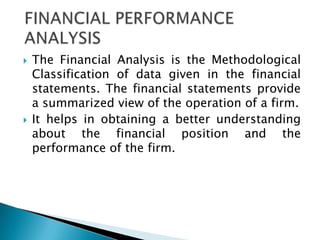
   The Financial Analysis is the Methodological
    Classification of data given in the financial
    statements. The financial statements provide
    a summarized view of the operation of a firm.
   It helps in obtaining a better understanding
    about the financial position and the
    performance of the firm.
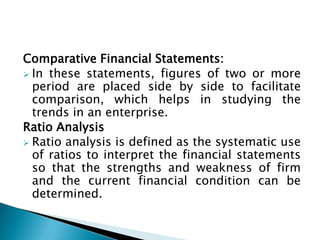
Comparative Financial Statements:
 In these statements, figures of two or more
  period are placed side by side to facilitate
  comparison, which helps in studying the
  trends in an enterprise.
Ratio Analysis
 Ratio analysis is defined as the systematic use
  of ratios to interpret the financial statements
  so that the strengths and weakness of firm
  and the current financial condition can be
  determined.
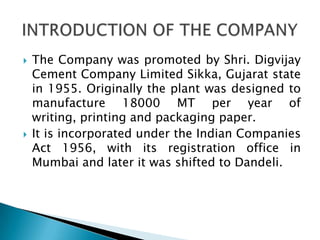
   The Company was promoted by Shri. Digvijay
    Cement Company Limited Sikka, Gujarat state
    in 1955. Originally the plant was designed to
    manufacture 18000 MT per year of
    writing, printing and packaging paper.
   It is incorporated under the Indian Companies
    Act 1956, with its registration office in
    Mumbai and later it was shifted to Dandeli.
   The Indian paper industry currently has a
    turnover of over Rs. 30000 crores and
    contributes over Rs. 3000 crores to the national
    exchequer. Even more importantly it is providing
    employment opportunities to over 1.5 million
    people, mostly in rural areas.
   Indian paper industry has continued to upgrade
    its capacities and technologies, in spite of huge
    challenges like shortage of raw material, highly
    capital intensive nature of the industry, threat of
    cheaper imports from China, Indonesia etc.
Competitors of WCPM are
 Mysore Paper mills ltd, Bhadravati
 Ballarpur Paper mills ltd, Andhra Pradesh
 Seesai Paper mills ltd, Andhra Pradesh
 Wood free Writing & Printing Paper
 Wood free Offset Paper
 Security paper
 Accounts Book Paper
 Duplex Board
 Indian Aluminum Co. Ltd.
 State Bank of India, Bank of Baroda, Central
  Bank of India, Syndicate Bank
 Canara Bank, Corporation Bank, Indian
  Bank, Indian Overseas Bank, Standard
  Chartered Bank, HSBC, etc.
Problem Identification
 The company posted gross profit of Rs.
  158.66 Crores as against Rs. 189. 18 Crores
  in the previous year – lower by Rs. 30.52
  Crores (16%) whereas there was a net loss of
  Rs. 33.56 Crores as against profit of Rs.
  90.08 Crores in the previous year.
The net loss is due to following reasons;
 It is observed that the company has procured
  10.31 lakhs MT of wood and bamboo as
  against 6.89 lakh MT in the previous year,
 With the Company geared to source more
  than 10 lakhs MT of raw material per annum
  on sustained basis which is insufficient to
  meet the requirements.
 Though there was shortage in the supply of
  raw material the establishment cost remained
  same.
   Increasing rates of wood due to competition
    among the paper mills.
   Other reasons are hike in the price of fuel and
    transportation cost.
   Change in method of calculation of
    depreciation, resulting in higher depreciation
    by Rs. 104.42 Crores.
   The company has reinstated Foreign Currency
    Loans/External Commercial Borrowings of
    USD 141.49 Million at the exchange rate
    prevailing as on 31st March 2012.
   The “Thane” cyclone which hit coasts of
    Tamilnadu and Pondicherry in December
    2011 has had its own share of strains on the
    supply side.
   Paper industry has been removed from Core
    Sector for supply of coal by subsidiaries of
    Coal India Ltd. This may increase rates of coal
    substantially.
   The paper industry is one of the 18 highly
    polluting categories of industries
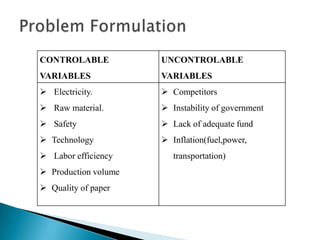
CONTROLABLE           UNCONTROLABLE
VARIABLES             VARIABLES
 Electricity.         Competitors
 Raw material.        Instability of government
 Safety               Lack of adequate fund
 Technology           Inflation(fuel,power,
 Labor efficiency       transportation)
 Production volume
 Quality of paper
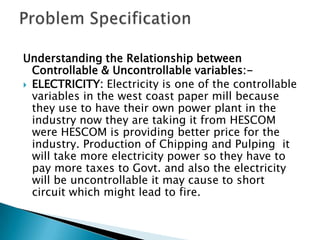
Understanding the Relationship between
  Controllable & Uncontrollable variables:-
 ELECTRICITY: Electricity is one of the controllable
  variables in the west coast paper mill because
  they use to have their own power plant in the
  industry now they are taking it from HESCOM
  were HESCOM is providing better price for the
  industry. Production of Chipping and Pulping it
  will take more electricity power so they have to
  pay more taxes to Govt. and also the electricity
  will be uncontrollable it may cause to short
  circuit which might lead to fire.
   EMPLOYEES: In production of Chipping,
    Pulping, Chemical Recovery, Paper Making it
    requires well educated person with required
    level of experience there will be a specific
    period of training for the employees. The
    company is providing more safety measures
    for employees to work difficult situation.
    Safety means avoiding the future unexpected
    happenings. Globalisation will affect
    employees because it will leads to job
    hopping.
 To analyze the financial performance of the
  company for the period 2007 to 2012
 To analyze the financial positions, overall
  growth & stability of the Company.
 To analyze organization efficiency based on
  profitability and liquidity ratios.
Secondary data:
 The secondary data has been collected from
  the company, they include annual reports and
  financial statements, balance sheet provided
  by the company for the year 2007 to 2012
The study is limited to only five years of financial
 statements.
The interpretations made are based on the data
 available from the annual reports of the company.
The study assumes that the information gained by
 interaction with the company people is true to their
 knowledge.
Some of the department heads were not so
 cooperative towards the answering of questions
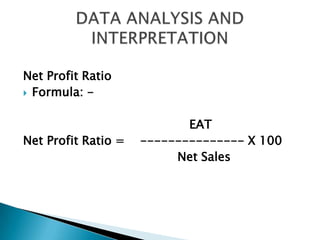
Net Profit Ratio
 Formula: -


                            EAT
Net Profit Ratio =   --------------- X 100
                          Net Sales
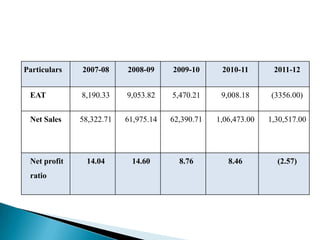
Particulars   2007-08     2008-09     2009-10      2010-11       2011-12


 EAT          8,190.33    9,053.82    5,470.21     9,008.18     (3356.00)


 Net Sales    58,322.71   61,975.14   62,390.71   1,06,473.00   1,30,517.00


 Net profit    14.04       14.60        8.76         8.46         (2.57)
 ratio
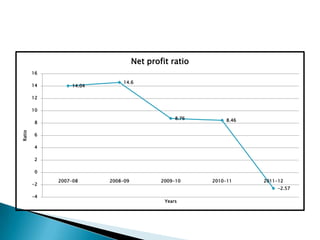
Net profit ratio
        16

                             14.6
        14       14.04

        12

        10
                                                8.76        8.46
        8
Ratio


        6

        4

        2

        0

             2007-08     2008-09           2009-10     2010-11     2011-12
        -2
                                                                       -2.57
        -4
                                            Years
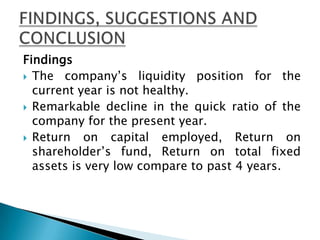
Findings
 The company’s liquidity position for the
  current year is not healthy.
 Remarkable decline in the quick ratio of the
  company for the present year.
 Return   on capital employed, Return on
  shareholder’s fund, Return on total fixed
  assets is very low compare to past 4 years.
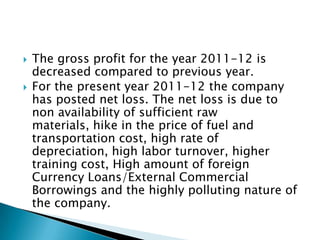
   The gross profit for the year 2011-12 is
    decreased compared to previous year.
   For the present year 2011-12 the company
    has posted net loss. The net loss is due to
    non availability of sufficient raw
    materials, hike in the price of fuel and
    transportation cost, high rate of
    depreciation, high labor turnover, higher
    training cost, High amount of foreign
    Currency Loans/External Commercial
    Borrowings and the highly polluting nature of
    the company.
Suggestion
 The company should concentrate on
  increasing the current assets in order to have
  a healthy liquidity position.
 Company should take right steps in
  decreasing the depreciation rate and
  maintenance charges.
 The company should take all possible steps
  towards the collection of debts.
 It is favorable for the company to minimize
  the establishment cost to earn more revenue.
   The company should stress to acquire more land in
    addition to existing land for the plantation of
    bamboos which is the main source of raw material
    for production
   Right the company is in a position to get nearly
    50% of the raw material requirement from the
    bamboos already planted in the acquired land by
    providing little source of income to the farmers
    engaged in the said land.
   It is feasible to extend the existing
    plantation land to cultivate the bamboos to
    make it available the remaining raw material
    required per annum.

   The company should take necessary steps
    to get the other raw materials like coal etc
    on cheaper basis to minimize transportation
    cost, freight etc.
Alfred

Alfred

  • 1.
  • 2.
    The Financial Analysis is the Methodological Classification of data given in the financial statements. The financial statements provide a summarized view of the operation of a firm.  It helps in obtaining a better understanding about the financial position and the performance of the firm.
  • 3.
    Comparative Financial Statements: In these statements, figures of two or more period are placed side by side to facilitate comparison, which helps in studying the trends in an enterprise. Ratio Analysis  Ratio analysis is defined as the systematic use of ratios to interpret the financial statements so that the strengths and weakness of firm and the current financial condition can be determined.
  • 4.
    The Company was promoted by Shri. Digvijay Cement Company Limited Sikka, Gujarat state in 1955. Originally the plant was designed to manufacture 18000 MT per year of writing, printing and packaging paper.  It is incorporated under the Indian Companies Act 1956, with its registration office in Mumbai and later it was shifted to Dandeli.
  • 5.
    The Indian paper industry currently has a turnover of over Rs. 30000 crores and contributes over Rs. 3000 crores to the national exchequer. Even more importantly it is providing employment opportunities to over 1.5 million people, mostly in rural areas.  Indian paper industry has continued to upgrade its capacities and technologies, in spite of huge challenges like shortage of raw material, highly capital intensive nature of the industry, threat of cheaper imports from China, Indonesia etc.
  • 6.
    Competitors of WCPMare  Mysore Paper mills ltd, Bhadravati  Ballarpur Paper mills ltd, Andhra Pradesh  Seesai Paper mills ltd, Andhra Pradesh
  • 7.
     Wood freeWriting & Printing Paper  Wood free Offset Paper  Security paper  Accounts Book Paper  Duplex Board
  • 8.
     Indian AluminumCo. Ltd.  State Bank of India, Bank of Baroda, Central Bank of India, Syndicate Bank  Canara Bank, Corporation Bank, Indian Bank, Indian Overseas Bank, Standard Chartered Bank, HSBC, etc.
  • 9.
    Problem Identification  Thecompany posted gross profit of Rs. 158.66 Crores as against Rs. 189. 18 Crores in the previous year – lower by Rs. 30.52 Crores (16%) whereas there was a net loss of Rs. 33.56 Crores as against profit of Rs. 90.08 Crores in the previous year.
  • 10.
    The net lossis due to following reasons;  It is observed that the company has procured 10.31 lakhs MT of wood and bamboo as against 6.89 lakh MT in the previous year,  With the Company geared to source more than 10 lakhs MT of raw material per annum on sustained basis which is insufficient to meet the requirements.  Though there was shortage in the supply of raw material the establishment cost remained same.
  • 11.
    Increasing rates of wood due to competition among the paper mills.  Other reasons are hike in the price of fuel and transportation cost.  Change in method of calculation of depreciation, resulting in higher depreciation by Rs. 104.42 Crores.
  • 12.
    The company has reinstated Foreign Currency Loans/External Commercial Borrowings of USD 141.49 Million at the exchange rate prevailing as on 31st March 2012.  The “Thane” cyclone which hit coasts of Tamilnadu and Pondicherry in December 2011 has had its own share of strains on the supply side.
  • 13.
    Paper industry has been removed from Core Sector for supply of coal by subsidiaries of Coal India Ltd. This may increase rates of coal substantially.  The paper industry is one of the 18 highly polluting categories of industries
  • 14.
    CONTROLABLE UNCONTROLABLE VARIABLES VARIABLES  Electricity.  Competitors  Raw material.  Instability of government  Safety  Lack of adequate fund  Technology  Inflation(fuel,power,  Labor efficiency transportation)  Production volume  Quality of paper
  • 15.
    Understanding the Relationshipbetween Controllable & Uncontrollable variables:-  ELECTRICITY: Electricity is one of the controllable variables in the west coast paper mill because they use to have their own power plant in the industry now they are taking it from HESCOM were HESCOM is providing better price for the industry. Production of Chipping and Pulping it will take more electricity power so they have to pay more taxes to Govt. and also the electricity will be uncontrollable it may cause to short circuit which might lead to fire.
  • 16.
    EMPLOYEES: In production of Chipping, Pulping, Chemical Recovery, Paper Making it requires well educated person with required level of experience there will be a specific period of training for the employees. The company is providing more safety measures for employees to work difficult situation. Safety means avoiding the future unexpected happenings. Globalisation will affect employees because it will leads to job hopping.
  • 17.
     To analyzethe financial performance of the company for the period 2007 to 2012  To analyze the financial positions, overall growth & stability of the Company.  To analyze organization efficiency based on profitability and liquidity ratios.
  • 18.
    Secondary data:  Thesecondary data has been collected from the company, they include annual reports and financial statements, balance sheet provided by the company for the year 2007 to 2012
  • 19.
    The study islimited to only five years of financial statements. The interpretations made are based on the data available from the annual reports of the company. The study assumes that the information gained by interaction with the company people is true to their knowledge. Some of the department heads were not so cooperative towards the answering of questions
  • 20.
    Net Profit Ratio Formula: - EAT Net Profit Ratio = --------------- X 100 Net Sales
  • 21.
    Particulars 2007-08 2008-09 2009-10 2010-11 2011-12 EAT 8,190.33 9,053.82 5,470.21 9,008.18 (3356.00) Net Sales 58,322.71 61,975.14 62,390.71 1,06,473.00 1,30,517.00 Net profit 14.04 14.60 8.76 8.46 (2.57) ratio
  • 22.
    Net profit ratio 16 14.6 14 14.04 12 10 8.76 8.46 8 Ratio 6 4 2 0 2007-08 2008-09 2009-10 2010-11 2011-12 -2 -2.57 -4 Years
  • 23.
    Findings  The company’sliquidity position for the current year is not healthy.  Remarkable decline in the quick ratio of the company for the present year.  Return on capital employed, Return on shareholder’s fund, Return on total fixed assets is very low compare to past 4 years.
  • 24.
    The gross profit for the year 2011-12 is decreased compared to previous year.  For the present year 2011-12 the company has posted net loss. The net loss is due to non availability of sufficient raw materials, hike in the price of fuel and transportation cost, high rate of depreciation, high labor turnover, higher training cost, High amount of foreign Currency Loans/External Commercial Borrowings and the highly polluting nature of the company.
  • 25.
    Suggestion  The companyshould concentrate on increasing the current assets in order to have a healthy liquidity position.  Company should take right steps in decreasing the depreciation rate and maintenance charges.  The company should take all possible steps towards the collection of debts.  It is favorable for the company to minimize the establishment cost to earn more revenue.
  • 26.
    The company should stress to acquire more land in addition to existing land for the plantation of bamboos which is the main source of raw material for production  Right the company is in a position to get nearly 50% of the raw material requirement from the bamboos already planted in the acquired land by providing little source of income to the farmers engaged in the said land.
  • 27.
    It is feasible to extend the existing plantation land to cultivate the bamboos to make it available the remaining raw material required per annum.  The company should take necessary steps to get the other raw materials like coal etc on cheaper basis to minimize transportation cost, freight etc.